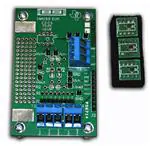
User's Guide
SBOU085 – May 2010
INA199A1-A3EVM
This user’s guide describes the characteristics, operation, and use of the INA199A1-A3 evaluation module
(EVM). This EVM is designed to evaluate the performance of the INA199A1, INA199A2, and INA199A3
voltage output current shunt monitors in a variety of configurations. The EVM layout and design are
flexible enough to allow evaluation of a wide range of applications. This document also includes a
schematic, reference printed circuit board (PCB) layouts, and a complete bill of materials.
1
2
3
4
5
6
Contents
Introduction and Overview ................................................................................................. 2
Quick Start Setup and Use ................................................................................................ 4
INA199A1-A3EVM Circuit .................................................................................................. 6
Reference Voltage Setup ................................................................................................. 11
INA199A1-A3EVM Schematic and PCB Layout ....................................................................... 12
Bill of Materials ............................................................................................................. 14
List of Figures
1
2
3
4
5
6
7
8
9
10
11
12
........................................................................
Measurement with Shunt ..................................................................................................
Measurement without Shunt ...............................................................................................
TO-247 Package In R1 .....................................................................................................
CS3 Package in R1 .........................................................................................................
TO-126 Package in R1 .....................................................................................................
TO-220 Package in R1 .....................................................................................................
Radial Package in R2 ......................................................................................................
U1 Footprint ................................................................................................................
U1 Populated with DIP Board ............................................................................................
INA199A1-A3EVM Schematic ...........................................................................................
INA199A1-A3EVM PCB ..................................................................................................
Hardware Included with the INA199A1-A3EVM
3
4
5
6
6
6
6
8
10
10
12
13
All trademarks are the property of their respective owners.
SBOU085 – May 2010
INA199A1-A3EVM
Copyright © 2010, Texas Instruments Incorporated
1
�Introduction and Overview
www.ti.com
1
Introduction and Overview
1.1
INA199A1-A3
The INA199A1-A3 devices are voltage output, high-side measurement, bi-directional, zero-drift current
shunt monitors. This family of devices has gains that range from 50V/V to 200V/V. The voltage developed
across the device inputs is amplified by the corresponding gain of the specific device and is presented at
the output pin. These devices can sense voltage drops across shunts at common-mode voltages from
–0.3V to 26V, independent of supply voltages. These devices operate with supply voltages between 2.7V
and 26V and draw a maximum of 100mA. The low offset of the zero-drift architecture enables current
sensing with maximum drops across the shunt as low as 10mV full-scale.
The INA199A1-A3 devices are currently available in an SC70 surface-mount package. Table 1
summarizes the available device options.
Table 1. INA199A1-A3 Device Summary
1.2
Product
Gain
INA199A1
50
INA199A2
100
INA199A3
200
INA199A1-A3EVM
The INA199A1-A3EVM is intended to provide basic functional evaluation of this device family. The fixture
layout is not intended to be a model for the target circuit, nor is it laid out for electromagnetic compatibility
(EMC) testing.
The layout of the INA199A1-A3EVM printed circuit board (PCB) is designed to provide the following
features:
• Easy handling of the small package; a mechanical drawing of the recommended land pattern is found
at the end of the product data sheet.
• Easy access to all device pins
• Space for optional input filtering capacitors and resistors as well as a prototype area for additional user
defined circuitry
• Space for shunt resistors of various footprints
• Multiple input signal options
• Evaluation of all gain options through provided device boards as well as a location to solder a test
device directly onto the board
The INA199A1-A3EVM allows the user to install a shunt resistor, and then connect both the
common-mode voltage and load to develop the input voltage, or omit the shunt resistor and apply a
differential voltage directly to the device input. This flexibility allows a user to test the device operation in a
simulated manner as well as an actual application.
Refer to the INA199A1-A3 product data sheet for comprehensive information about the INA199A1-A3
family of devices.
2
INA199A1-A3EVM
SBOU085 – May 2010
Copyright © 2010, Texas Instruments Incorporated
�Introduction and Overview
www.ti.com
1.3
Hardware Included
The initial release of this evaluation board and user's guide may precede the actual release of some
members of the INA199A1-A3 device family. As additional devices with the family are released, the
INA199A1-A3EVM evaluation board will be associated with them. A test fixture populated with an
INA199A1 is provided in all INA199A1-A3EVMs delivered, as Figure 1 shows.
Figure 1. Hardware Included with the INA199A1-A3EVM
The INA199A1-A3EVM kit is shipped with the following items:
• INA199A1-A3EVM PCB
• Three populated test boards (INA199A1, INA199A2, INA199A3)
If any of these items are missing or damaged, please contact the Texas Instruments Product Information
Center nearest you to inquire about a replacement.
SBOU085 – May 2010
INA199A1-A3EVM
Copyright © 2010, Texas Instruments Incorporated
3
�Quick Start Setup and Use
2
www.ti.com
Quick Start Setup and Use
Follow these procedures to set up and use the INA199A1-A3EVM.
Step 1. Insert the device board to be evaluated into the U1 location. The U1 location allows the user
to either evaluate one of the provided device boards or install the test device directly on the
surface-mount pads in the U1 footprint.
Step 2. Connect an external dc supply voltage between 2.7V and 26V to the V+ terminal referenced
to the GND terminal of T3. The INA199A1-A3 device output voltage is limited to 50mV above
ground to 200mV below the supply level.
Step 3. Connect the REF terminal of T3 to ground. The voltage applied at the reference input can
vary depending on how the device is to be used. Further details regarding the use of the
reference voltage are discussed later in this document.
Step 4. Connect the input.
2.1
Measurement with Shunt
This connection method allows the user to install a shunt resistor on the EVM and connect the
common-mode voltage and load to incorporate the test device directly into a sample application, as
Figure 2 shows. To configure a measurement evaluation with a shunt, follow these procedures.
1. Install a shunt resistor into the R2 location. If not using a surface-mount or through-hole shunt, please
refer to Section 3.1 for a summary of R1 component specifications.
2. Connect the common-mode voltage to the VIN terminal of T1.
3. Connect load to the Load terminal of T1.
INA199AxEVM
INA199A1
DIP
V+
R4
Load
R1/R2
Load
+
VIN
IS
C1
VOUT
R3
VCM
REF
+
Figure 2. Measurement with Shunt
4
INA199A1-A3EVM
SBOU085 – May 2010
Copyright © 2010, Texas Instruments Incorporated
�Quick Start Setup and Use
www.ti.com
2.2
Measurement without Shunt
This connection method allows the user to either simulate the voltage developed across a sense resistor
based on a given set of system conditions, or to connect the INA199A1-A3EVM remotely to an existing
shunt already included in an example application. Figure 3 illustrates a measurement configuration without
a shunt.
To configure a measurement evaluation without a shunt, follow these procedures.
1. Connect a differential voltage to the VIN+ and VIN– terminals of T2. With the reference voltage set at
ground, ensure that the VIN+ terminal is the more positive of the two inputs.
2. Measure the output voltage at the VOUT terminal of T2.
INA199AxEVM
INA199A1
DIP
V+
VIN-
R4
VOUT
VDIFF
C1
+
+
VIN+
R3
VCM
REF
+
Figure 3. Measurement without Shunt
NOTE: The output voltage is equal to the gain of the device multiplied by the differential voltage
measured directly at the device input pins.
SBOU085 – May 2010
INA199A1-A3EVM
Copyright © 2010, Texas Instruments Incorporated
5
�INA199A1-A3EVM Circuit
3
www.ti.com
INA199A1-A3EVM Circuit
This section summarizes the INA199A1-A3EVM components.
3.1
R1
R1 can be used for shunt resistors that have a package that may not be easily adaptable to a standard,
two-terminal, through-hole footprint or to a 0603 through 1206 surface-mount footprint. Specifically, this
component location was added to allow the use of TO-126, TO-220, TO-247, and four terminal inline
radial packages such as the CS3 series of shunts from Ohmite. The numbers located on the printed circuit
board (PCB) between R1 and J1 correspond to each of the holes in the R1 footprint. Holes with the same
number are connected together. The designation of 1 and 2 indicates that a particular hole is connected
directly to the VIN+ and VIN– inputs, respectively. The designation of 3 and 4 indicates that a particular hole
is intended for the sense measurement of a four-wire shunt. Care must be taken to ensure that the shunt
is placed in the correct position in the R1 location. This placement consideration is evident when using a
two-connection shunt with a spacing of 200 mils (.200in or 5,080mm). As shown in Figure 4 and Figure 7,
the shunt must be placed in the second 1-designated hole in order for the other leg to fit into the 2
position. If the shunt is placed in the first 1 position, the second leg is left floating; no differential voltage
will be generated for the current monitor.
Additional packages can be tested by using the provided prototype area of the board.
Figure 4. TO-247 Package In R1
6
Figure 5. CS3 Package in R1
INA199A1-A3EVM
SBOU085 – May 2010
Copyright © 2010, Texas Instruments Incorporated
�INA199A1-A3EVM Circuit
www.ti.com
Figure 6. TO-126 Package in R1
Figure 7. TO-220 Package in R1
SBOU085 – May 2010
INA199A1-A3EVM
Copyright © 2010, Texas Instruments Incorporated
7
�INA199A1-A3EVM Circuit
3.2
www.ti.com
R2
R2 is intended to handle two- and four-terminal radial packages (as Figure 8 shows) as well as
surface-mount packages that range in size from 0603 to 1206.
Figure 8. Radial Package in R2
8
INA199A1-A3EVM
SBOU085 – May 2010
Copyright © 2010, Texas Instruments Incorporated
�INA199A1-A3EVM Circuit
www.ti.com
3.3
R3, R4, C1
R3 and R4 are factory-installed 0Ω resistors. These resistors, in combination with C1, form an input filter.
These locations allow for both through-hole and surface-mount packages that range in size from 0603 to
1206. Additional information regarding the use of input filtering is provided in the INA199A1-A3 product
data sheet.
3.4
Bypass Capacitors and Jumpers
C2 and C3 are 0.1mF supply bypass capacitors.
J1 is intended to be used as measurements points of R1, if necessary.
J2 is used as a test port at the factory but can be used for the corresponding input and output pins, if
desired.
3.5
U1
U1 is the location for the test device. Three device boards are supplied with the INA199A1-A3EVM board.
Each board is populated with one of the available device gains. This interchangeable option allows users
to test the devices and determine the gain setting that is best suited for a given application.
Here is a list of the factors involved in selecting the appropriate device.
• The INA199A1-A3 devices are identical with the exception of different gain settings.
• The differential input voltage is either applied across the inputs or developed based on the load current
that flows through the shunt resistor.
• The limiting factor that requires attention to be given to device selection is the output voltage.
• The selected device must allow the output voltage to remain within the acceptable range after the
developed input voltage is amplified by the respective device gain. The output voltage must remain
with the range of 50mV above ground to 200mV below the supply voltage.
• An output below the minimum allowable output requires the selection of a device with a higher gain.
Likewise, an output above the maximum allowable output requires the selection of a device with a
lower gain.
SBOU085 – May 2010
INA199A1-A3EVM
Copyright © 2010, Texas Instruments Incorporated
9
�INA199A1-A3EVM Circuit
www.ti.com
In addition to being able to accommodate the device boards, a surface-mount footprint is also included so
the user can install one of these devices directly onto the board, if desired.Figure 9 illustrates the U1
footprint on the EVM. Figure 10 shows the U1 slot populated with a DIP board device.
Figure 9. U1 Footprint
10
Figure 10. U1 Populated with DIP Board
INA199A1-A3EVM
SBOU085 – May 2010
Copyright © 2010, Texas Instruments Incorporated
�Reference Voltage Setup
www.ti.com
3.6
Voltage Inputs
The VIN+ and VIN– terminals of T2 are intended to be used if the designer is configuring the EVM for
measurement without an onboard shunt resistor (see Figure 3). These inputs accept a differential voltage
that is amplified by the selected device gain and is presented at the VOUT terminal of T2. These inputs
could also be used to connect the differential voltage developed across an external shunt in an existing
circuit. The acceptable differential input voltage range and polarity are determined by the supply voltage,
reference voltage, and gain of the selected device.
VIN and Load terminals of T1 are intended to be used if the user configures the EVM for measurement with
a shunt resistor (see Figure 2). The common-mode voltage should be connected to the VIN terminal and
the load should be connected to the Load terminal. The shunt can be installed in R1, R2, or the prototype
area, and wired to the R2 footprint. As in the setup for the measurement without a shunt resistor, the input
voltage range and polarity are determined by the supply voltage, reference voltage, and the gain of the
selected device.
3.7
Miscellaneous
The REF terminal of T3 allows the user to configure the INA199A1-A3EVM for either unidirectional or
bi-directional operation
Two easily accessible oscilloscope ground pads are located on the board to facilitate easier probing.
4
Reference Voltage Setup
The INA199A1-A3 devices allow for the use of an external reference. This reference determines how the
output responds to certain input conditions. The reference also allows these devices to be used in both
unidirectional and bi-directional applications.
4.1
Unidirectional Mode
Unidirectional refers to a load current that flows in only one direction. For unidirectional applications, the
reference voltage can be set to ground or to +5V. If the reference is set to ground, the output is set at near
ground with no input voltage, and responds to input voltages that are positive with respect to VIN–/Load. If
the reference is set to +5V, the output is set near +5V with no input voltage, and responds to input
voltages that are negative with respect to VIN–/Load.
4.2
Bi-directional Mode
Bi-directional refers to a load current that flows in both directions. Figure 2 shows IS flowing in both
directions. For bi-directional applications, the reference voltage can be set anywhere within the 0V to 5V
range specified for the reference input. The voltage applied to the reference pin establishes the output
voltage of the device with no input voltage. The output voltage is limited by the supply voltage, so there is
a greater available range for positive input voltages than negative voltages because the reference voltage
is limited to the range of 0V to 5V.
The maximum range for the output of this device to accommodate a bi-directional application involves
applying 5V to the reference pin and a supply voltage of 18V. This configuration allows for a maximum
output voltage range of –4.95V/+20.8V about the 5V reference.
SBOU085 – May 2010
INA199A1-A3EVM
Copyright © 2010, Texas Instruments Incorporated
11
�INA199A1-A3EVM Schematic and PCB Layout
5
www.ti.com
INA199A1-A3EVM Schematic and PCB Layout
NOTE: Board layouts are not to scale. These figures are intended to show how the board is laid
out; they are not intended to be used for manufacturing INA199A1-A3EVM PCBs.
5.1
Schematic
Figure 11 shows the schematic for the INA199A1-A3EVM PCB.
J2
T1
10
9
8
7
6
5
4
3
2
1
Vin
Load
REF
V+
GND
2
1
T2
Vin+
Vin -
Vout
U1
Vin +
Vin -
J1
R1
V+
5
R3
6
R2
0
NC
NC
VIN+
V+
4
7
VIN-
GND
3
C2
2
0.1uF
C3
1
0.1uF
0
8
Vout
Burr Brown Products
VOUT
REF
REF
V+
C1
R4
LOGO1
3
2
1
Vin
Vout
VinVin+
REF
GND
V+
3
Vin2
Vin+
1
Vout
Load
1
2
3
4
5
6
7
8
T3
INA199Ax
REF
LOGO2
Burr Brown Products
Figure 11. INA199A1-A3EVM Schematic
12
INA199A1-A3EVM
SBOU085 – May 2010
Copyright © 2010, Texas Instruments Incorporated
�INA199A1-A3EVM Schematic and PCB Layout
www.ti.com
5.2
PCB Layout
Figure 12 illustrates the PCB layout for the INA199A1-A3EVM.
Figure 12. INA199A1-A3EVM PCB
SBOU085 – May 2010
INA199A1-A3EVM
Copyright © 2010, Texas Instruments Incorporated
13
�Bill of Materials
6
www.ti.com
Bill of Materials
Table 2 provides the parts list for the INA199A1-A3EVM.
Table 2. Bill of Materials
Count
Value
Description
R1
N/A
TO-126, TO-220, TO-247, C53
Optional/Not
Installed
R2
N/A
Resistor, 0603-1206/Through-hole
R3, R4
0Ω
Resistor, 0Ω, 1/8W 5%, 0603-1206/Through-hole
C1
N/A
Capacitor, 0603-1206/Through-hole
2
Optional/Not
Installed
14
RefDes
Optional/Not
Installed
Part Number
MFR
ERJ-6GEY0R00V
Panasonic - ECG
Capacitor, 0.1mF 50V X7R, 0603
ECJ-1VB1H104K
Panasonic - ECG
Conn Header 32-POS .100" SGL GOLD (4 per Strip)
TSW-132-07-G-S
Samtec
2
C2, C3
0.1uF
2
J1, J2
Strip cut to
size
11
All test points
TSW-132-07-G-S
Samtec
8
None
N/A
Pin Socket Rcpt .014-.026 30AU (U1)
5050863-5
AMP
4
None
N/A
Screw, Machine, Phillips, Panhead 4-40 x 1/4 SS
PMSSS 440 0025 PH
Building
Fasteners
4
None
N/A
Standoffs, Hex , 4-40 Threaded, 0.500" length, 0.250" OD
2203
Keystone
Electronics
3
INA199A1DIP INA199A3IP
N/A
Populated DIP-Adapter Board
2
T2, T3
N/A
3-Position Terminal Strip, Cage Clamp, 45°, 15A,
Dove-tailed
ED300/3
On Shore
Technology
1
T1
N/A
2-Position Terminal Strip, Cage Clamp, 45°, 15A,
Dove-tailed
ED300/2
On Shore
Technology
TP cut to size Conn Header 32-POS .100" SGL GOLD
INA199A1-A3EVM
Texas
Instruments
SBOU085 – May 2010
Copyright © 2010, Texas Instruments Incorporated
�Evaluation Board/Kit Important Notice
Texas Instruments (TI) provides the enclosed product(s) under the following conditions:
This evaluation board/kit is intended for use for ENGINEERING DEVELOPMENT, DEMONSTRATION, OR EVALUATION
PURPOSES ONLY and is not considered by TI to be a finished end-product fit for general consumer use. Persons handling the
product(s) must have electronics training and observe good engineering practice standards. As such, the goods being provided are
not intended to be complete in terms of required design-, marketing-, and/or manufacturing-related protective considerations,
including product safety and environmental measures typically found in end products that incorporate such semiconductor
components or circuit boards. This evaluation board/kit does not fall within the scope of the European Union directives regarding
electromagnetic compatibility, restricted substances (RoHS), recycling (WEEE), FCC, CE or UL, and therefore may not meet the
technical requirements of these directives or other related directives.
Should this evaluation board/kit not meet the specifications indicated in the User’s Guide, the board/kit may be returned within 30
days from the date of delivery for a full refund. THE FOREGOING WARRANTY IS THE EXCLUSIVE WARRANTY MADE BY
SELLER TO BUYER AND IS IN LIEU OF ALL OTHER WARRANTIES, EXPRESSED, IMPLIED, OR STATUTORY, INCLUDING
ANY WARRANTY OF MERCHANTABILITY OR FITNESS FOR ANY PARTICULAR PURPOSE.
The user assumes all responsibility and liability for proper and safe handling of the goods. Further, the user indemnifies TI from all
claims arising from the handling or use of the goods. Due to the open construction of the product, it is the user’s responsibility to
take any and all appropriate precautions with regard to electrostatic discharge.
EXCEPT TO THE EXTENT OF THE INDEMNITY SET FORTH ABOVE, NEITHER PARTY SHALL BE LIABLE TO THE OTHER
FOR ANY INDIRECT, SPECIAL, INCIDENTAL, OR CONSEQUENTIAL DAMAGES.
TI currently deals with a variety of customers for products, and therefore our arrangement with the user is not exclusive.
TI assumes no liability for applications assistance, customer product design, software performance, or infringement of
patents or services described herein.
Please read the User’s Guide and, specifically, the Warnings and Restrictions notice in the User’s Guide prior to handling the
product. This notice contains important safety information about temperatures and voltages. For additional information on TI’s
environmental and/or safety programs, please contact the TI application engineer or visit www.ti.com/esh.
No license is granted under any patent right or other intellectual property right of TI covering or relating to any machine, process, or
combination in which such TI products or services might be or are used.
FCC Warning
This evaluation board/kit is intended for use for ENGINEERING DEVELOPMENT, DEMONSTRATION, OR EVALUATION
PURPOSES ONLY and is not considered by TI to be a finished end-product fit for general consumer use. It generates, uses, and
can radiate radio frequency energy and has not been tested for compliance with the limits of computing devices pursuant to part 15
of FCC rules, which are designed to provide reasonable protection against radio frequency interference. Operation of this
equipment in other environments may cause interference with radio communications, in which case the user at his own expense
will be required to take whatever measures may be required to correct this interference.
EVM Warnings and Restrictions
It is important to operate this EVM within the input voltage range of –0.3V to +26V and the output voltage range of –0.3V to +26V.
Exceeding the specified input range may cause unexpected operation and/or irreversible damage to the EVM. If there are
questions concerning the input range, please contact a TI field representative prior to connecting the input power.
Applying loads outside of the specified output range may result in unintended operation and/or possible permanent damage to the
EVM. Please consult the EVM User's Guide prior to connecting any load to the EVM output. If there is uncertainty as to the load
specification, please contact a TI field representative.
During normal operation, some circuit components may have case temperatures greater than +25°C. The EVM is designed to
operate properly with certain components above +25°C as long as the input and output ranges are maintained. These components
include but are not limited to linear regulators, switching transistors, pass transistors, and current sense resistors. These types of
devices can be identified using the EVM schematic located in the EVM User's Guide. When placing measurement probes near
these devices during operation, please be aware that these devices may be very warm to the touch.
Mailing Address: Texas Instruments, Post Office Box 655303, Dallas, Texas 75265
Copyright © 2010, Texas Instruments Incorporated
�IMPORTANT NOTICE
Texas Instruments Incorporated and its subsidiaries (TI) reserve the right to make corrections, modifications, enhancements, improvements,
and other changes to its products and services at any time and to discontinue any product or service without notice. Customers should
obtain the latest relevant information before placing orders and should verify that such information is current and complete. All products are
sold subject to TI’s terms and conditions of sale supplied at the time of order acknowledgment.
TI warrants performance of its hardware products to the specifications applicable at the time of sale in accordance with TI’s standard
warranty. Testing and other quality control techniques are used to the extent TI deems necessary to support this warranty. Except where
mandated by government requirements, testing of all parameters of each product is not necessarily performed.
TI assumes no liability for applications assistance or customer product design. Customers are responsible for their products and
applications using TI components. To minimize the risks associated with customer products and applications, customers should provide
adequate design and operating safeguards.
TI does not warrant or represent that any license, either express or implied, is granted under any TI patent right, copyright, mask work right,
or other TI intellectual property right relating to any combination, machine, or process in which TI products or services are used. Information
published by TI regarding third-party products or services does not constitute a license from TI to use such products or services or a
warranty or endorsement thereof. Use of such information may require a license from a third party under the patents or other intellectual
property of the third party, or a license from TI under the patents or other intellectual property of TI.
Reproduction of TI information in TI data books or data sheets is permissible only if reproduction is without alteration and is accompanied
by all associated warranties, conditions, limitations, and notices. Reproduction of this information with alteration is an unfair and deceptive
business practice. TI is not responsible or liable for such altered documentation. Information of third parties may be subject to additional
restrictions.
Resale of TI products or services with statements different from or beyond the parameters stated by TI for that product or service voids all
express and any implied warranties for the associated TI product or service and is an unfair and deceptive business practice. TI is not
responsible or liable for any such statements.
TI products are not authorized for use in safety-critical applications (such as life support) where a failure of the TI product would reasonably
be expected to cause severe personal injury or death, unless officers of the parties have executed an agreement specifically governing
such use. Buyers represent that they have all necessary expertise in the safety and regulatory ramifications of their applications, and
acknowledge and agree that they are solely responsible for all legal, regulatory and safety-related requirements concerning their products
and any use of TI products in such safety-critical applications, notwithstanding any applications-related information or support that may be
provided by TI. Further, Buyers must fully indemnify TI and its representatives against any damages arising out of the use of TI products in
such safety-critical applications.
TI products are neither designed nor intended for use in military/aerospace applications or environments unless the TI products are
specifically designated by TI as military-grade or "enhanced plastic." Only products designated by TI as military-grade meet military
specifications. Buyers acknowledge and agree that any such use of TI products which TI has not designated as military-grade is solely at
the Buyer's risk, and that they are solely responsible for compliance with all legal and regulatory requirements in connection with such use.
TI products are neither designed nor intended for use in automotive applications or environments unless the specific TI products are
designated by TI as compliant with ISO/TS 16949 requirements. Buyers acknowledge and agree that, if they use any non-designated
products in automotive applications, TI will not be responsible for any failure to meet such requirements.
Following are URLs where you can obtain information on other Texas Instruments products and application solutions:
Products
Applications
Amplifiers
amplifier.ti.com
Audio
www.ti.com/audio
Data Converters
dataconverter.ti.com
Automotive
www.ti.com/automotive
DLP® Products
www.dlp.com
Communications and
Telecom
www.ti.com/communications
DSP
dsp.ti.com
Computers and
Peripherals
www.ti.com/computers
Clocks and Timers
www.ti.com/clocks
Consumer Electronics
www.ti.com/consumer-apps
Interface
interface.ti.com
Energy
www.ti.com/energy
Logic
logic.ti.com
Industrial
www.ti.com/industrial
Power Mgmt
power.ti.com
Medical
www.ti.com/medical
Microcontrollers
microcontroller.ti.com
Security
www.ti.com/security
RFID
www.ti-rfid.com
Space, Avionics &
Defense
www.ti.com/space-avionics-defense
RF/IF and ZigBee® Solutions www.ti.com/lprf
Video and Imaging
www.ti.com/video
Wireless
www.ti.com/wireless-apps
Mailing Address: Texas Instruments, Post Office Box 655303, Dallas, Texas 75265
Copyright © 2010, Texas Instruments Incorporated
�