National Semiconductor is now part of
Texas Instruments.
Search http://www.ti.com/ for the latest technical
information and details on our current products and services.
�LF156JAN
JFET Input Operational Amplifiers
General Description
Applications
This is the first monolithic JFET input operational amplifier to
incorporate well matched, high voltage JFETs on the same
chip with standard bipolar transistors (BI-FET™ Technology).
This amplifier features low input bias and offset currents/low
offset voltage and offset voltage drift, coupled with offset
adjust which does not degrade drift or common-mode rejection. The device is also designed for high slew rate, wide
bandwidth, extremely fast settling time, low voltage and
current noise and a low 1/ƒ noise corner.
n
n
n
n
n
n
n
Features
Advantages
n Replace expensive hybrid and module FET op amps
n Rugged JFETs allow blow-out free handling compared
with MOSFET input devices
n Excellent for low noise applications using either high or
low source impedance — very low 1/f corner
n Offset adjust does not degrade drift or common-mode
rejection as in most monolithic amplifiers
n New output stage allows use of large capacitive loads
(5,000 pF) without stability problems
n Internal compensation and large differential input voltage
capability
Precision high speed integrators
Fast D/A and A/D converters
High impedance buffers
Wideband, low noise, low drift amplifiers
Logarithmic amplifiers
Photocell amplifiers
Sample and Hold circuits
Common Features
n Low input bias current:
n Low Input Offset Current:
n High input impedance:
n Low input noise current:
n High common-mode rejection ratio:
n Large dc voltage gain:
Uncommon Features
n Extremely fast settling
time to 0.01%
n Fast slew rate
n Wide gain bandwidth
n Low input noise voltage
30pA
3pA
1012Ω
100 dB
106 dB
1.5µs
12V/µs
5MHz
12
Ordering Information
NS PART NUMBER
SMD PART NUMBER
NS PACKAGE NUMBER
PACKAGE DISCRIPTION
JL156BGA
JM38510/11402
H08C
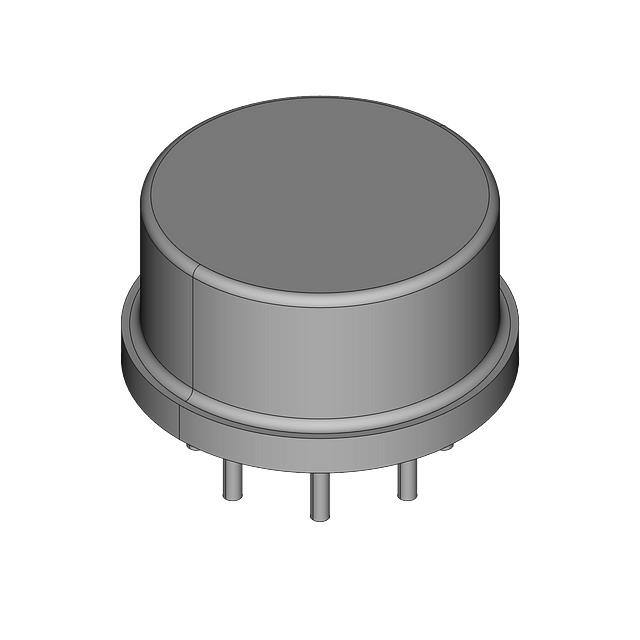
8LD Metal Can
JL156SGA
JM38510/11402
H08C
8LD Metal Can
Connection Diagrams
Metal Can Package (H)
20151114
Top View
See NS Package Number H08C
BI-FET™, BI-FET II™ are trademarks of National Semiconductor Corporation.
© 2006 National Semiconductor Corporation
DS201511
www.national.com
LF156JAN JFET Input Operational Amplifiers
March 2006
�LF156JAN
Simplified Schematic
20151101
*3pF in LF357 series.
Detailed Schematic
20151113
*C = 3pF in LF357 series.
www.national.com
2
�LF156JAN
Absolute Maximum Ratings (Note 1)
± 22V
± 40V
± 20V
Supply Voltage
Differential Input Voltage
Input Voltage Range (Note 3)
Output Short Circuit Duration (Note 4)
Continuous
TJMAX
175˚C
Power Dissipation at TA = 25˚C (Note 2)
Still Air
560 mW
500 LF/Min Air Flow
1200 mW
Thermal Resistance
θJA
Still Air
160˚C/W
400 LF/Min Air Flow
65˚C/W
θJC
23˚C/W
−65˚C ≤ TA ≤ +150˚C
Storage Temperature Range
Lead Temperature (Soldering 10 sec.)
300˚C
ESD tolerance (Note 5)
1200V
Recommended Operating Conditions
± 5 to ± 20 VDC
Supply voltage range
−55˚C ≤ TA ≤ +125˚C
Ambient temperature range
Quality Conformance Inspection
MIL-STD-883, Method 5005 - Group A
Subgroup
Description
Temp ( C)
1
Static tests at
+25
2
Static tests at
+125
3
Static tests at
-55
4
Dynamic tests at
+25
5
Dynamic tests at
+125
6
Dynamic tests at
-55
7
Functional tests at
+25
8A
Functional tests at
+125
8B
Functional tests at
-55
9
Switching tests at
+25
10
Switching tests at
+125
11
Switching tests at
-55
12
Settling time at
+25
3
www.national.com
�LF156JAN
LF156 Electrical Characteristics
DC Parameters
The following conditions apply, unless otherwise specified.
DC: VCC = ± 20V, VCM = 0V
Symbol
Parameter
Conditions
ICC
Supply Current
+VCC = 15V, -VCC = -15V
VIO
Input Offset Voltage
Notes
Input Bias Current
Unit
Subgroups
7.0
mA
1
6.0
mA
2
11
mA
3
-5.0
5.0
mV
1
-7.0
7.0
mV
2, 3
+VCC = 35V, -VCC = -5V,
VCM = -15V
-5.0
5.0
mV
1
-7.0
7.0
mV
2, 3
-5.0
5.0
mV
1
-7.0
7.0
mV
2, 3
-5.0
5.0
mV
1
-7.0
7.0
mV
2, 3
+VCC = 5V, -VCC = -35V,
VCM = 15V
-0.1
3.5
nA
1
-10
60
nA
2
+VCC = 35V, -VCC = -5V,
VCM = -15V
-0.1
0.1
nA
1
2
+VCC = 5V, -VCC = -25V,
VCM = 10V
IIO
Max
+VCC = 5V, -VCC = -35V,
VCM = 15V
+VCC = 5V, -VCC = -5V
± IIB
Min
Input Offset Current
-10
50
nA
-0.1
0.1
nA
1
-10
50
nA
2
-0.1
0.3
nA
1
-10
50
nA
2
-0.02
0.02
nA
1
-20
+20
nA
2
+PSRR
Power Supply Rejection Ratio
+VCC = 10V, -VCC = -20V
85
dB
1, 2, 3
-PSRR
Power Supply Rejection Ratio
+VCC = 20V, -VCC = -10V
85
dB
1, 2, 3
CMR
Input Voltage Common Mode
Rejection
VCM = -15V to 15V
85
dB
1, 2, 3
8.0
mV
1, 2, 3
mV
1, 2, 3
mA
1, 2, 3
50
mA
1, 2, 3
VIO
Adj(+)
Adjustment for Input Offset
Voltage
VIO
Adj(-)
Adjustment for Input Offset
Voltage
-8.0
+IOS
Output Short Circuit Current
(For Positive Output)
+VCC = 15V, -VCC = -15V,
t ≤ 25mS
-IOS
Output Short Circuit Current
(For Negative Output)
+VCC = 15V, -VCC = -15V,
t ≤ 25mS
∆ VIO/∆T
Temperature Coefficient of
Input Offset Voltage
25˚C ≤ TA ≤ +125˚C
(Note 7)
-30
30
µV/˚C
2
-55˚C ≤ TA ≤ 25˚C
(Note 7)
-30
30
µV/˚C
3
(Note 6)
50
V/mV
4
(Note 6)
25
V/mV
5, 6
(Note 6)
50
V/mV
4
(Note 6)
25
V/mV
5, 6
(Note 6)
10
V/mV
4, 5, 6
-50
-AVS
Open Loop Voltage Gain
(Single Ended)
VO = -15V, RL = 2KΩ
+AVS
Open Loop Voltage Gain
(Single Ended)
VO = +15V, RL = 2KΩ
AVS
Open Loop Voltage Gain
(Single Ended)
VCC = ± 5V, VO = ± 2V,
RL = 2KΩ
-VOP
Output Voltage Swing
VCM = 20V, RL = 10KΩ
-16
V
4, 5, 6
VCM = 20V, RL = 2KΩ
-15
V
4, 5, 6
+VOP
Output Voltage Swing
www.national.com
VCM = -20V, RL = 10KΩ
16
V
4, 5, 6
VCM = -20V, RL = 2KΩ
15
V
4, 5, 6
4
�LF156JAN
LF156 Electrical Characteristics
(Continued)
AC Parameters
The following conditions apply, unless otherwise specified.
AC: VCC = ± 15V, VCM = 0V
Symbol
Parameter
Conditions
Notes
-SR
Slew Rate Fall
VI = 5V to -5V, AV = 1
+SR
Slew Rate Rise
VI = -5V to 5V, AV = 1
TRTR
Transient Response Rise Time
RL = 2KΩ, CL= 100pF,
VI = 50mV, AV = 1
TROS
Transient Response Overshoot
NIBB
Min
Max
Subgroups
Unit
7.5
V/µS
7
5
V/µS
8A, 8B
7.5
V/µS
7
5
V/µS
8A, 8B
100
nS
7, 8A, 8B
RL = 2KΩ, CL = 100pF,
VI = 50mV, AV = 1
40
%
7, 8A, 8B
Noise Broad Band
BW = 5KHz, VCC = ± 20V
10
µVRMS
7
NIPC
Noise Popcorn
BW = 5KHz, VCC = ± 20V
40
µVPK
7
tS (+)
Settling Time
AV = -1
1500
nS
12
tS (-)
Settling Time
AV = -1
1500
nS
12
Drift Values
The following conditions apply, unless otherwise specified.
AC: VCC = ± 20V, VCM = 0V
Delta calculations performed on JAN S devices at group B, subgroup 5 only
Symbol
Parameter
VIO
Input Offset Voltage
± IIB
Input Bias Current
Conditions
Notes
Max
Unit
Subgroups
-1.0
1.0
mV
1
-0.05
0.05
nA
1
Min
Note 1: Absolute Maximum Ratings indicate limits beyond which damage to the device may occur. Operating Ratings indicate condition for which the device is
functional, but do not guarantee specific performance limits . For guaranteed specifications and test conditions, see the Electrical Characteristics. The guaranteed
specifications apply only for the test conditions listed. Some performance characteristics may degrade when the device is not operated under the listed test
conditions.
Note 2: The maximum power dissipation must be derated at elevated temperatures and is dictated by TJmax(maximum junction temperature), θJA(package junction
to ambient thermal resistance), and TA (ambient temperature). The maximum allowable power dissipation at any temperature is PD=(TJmax−TA)/θJA or the number
given in the Absolute Maximum Ratings, whichever is lower.
Note 3: The absolute maximum negative input voltage is equal to the negative power supply voltage.
Note 4: Short circuit may be to ground or either supply. Rating applies to +125˚C case temperature or +75˚C ambient temperature.
Note 5: Human body model, 100pF discharged through 1.5KΩ.
Note 6: Datalog Reading in K = V/mV.
Note 7: Calculated parameter.
5
www.national.com
�LF156JAN
Typical DC Performance Characteristics
Input Bias Current
Input Bias Current
20151138
20151137
Input Bias Current
Voltage Swing
20151140
20151139
Supply Current
Supply Current
20151142
20151141
www.national.com
6
�Negative Current Limit
LF156JAN
Typical DC Performance Characteristics
(Continued)
Positive Current Limit
20151143
20151144
Positive Common-Mode
Input Voltage Limit
Negative Common-Mode
Input Voltage Limit
20151145
20151146
Open Loop Voltage Gain
Output Voltage Swing
20151148
20151147
7
www.national.com
�LF156JAN
Typical AC Performance Characteristics
Gain Bandwidth
Normalized Slew Rate
20151150
20151151
Output Impedance
Output Impedance
20151153
20151152
LF156 Large Signal Puls
Response, AV = +1
LF156 Small Signal Pulse
Response, AV = +1
20151109
20151106
www.national.com
8
�Inverter Settling Time
LF156JAN
Typical AC Performance Characteristics
(Continued)
Open Loop Frequency Response
20151156
20151157
Bode Plot
Common-Mode Rejection Ratio
20151159
20151161
Power Supply Rejection Ratio
20151163
9
www.national.com
�LF156JAN
Typical AC Performance Characteristics
Undistorted Output Voltage Swing
(Continued)
Equivalent Input Noise Voltage
20151164
20151165
Equivalent Input Noise
Voltage (Expanded Scale)
20151166
www.national.com
10
�These are op amps with JFET input devices. These JFETs
have large reverse breakdown voltages from gate to source
and drain eliminating the need for clamps across the inputs.
Therefore large differential input voltages can easily be accommodated without a large increase in input current. The
maximum differential input voltage is independent of the
supply voltages. However, neither of the input voltages
should be allowed to exceed the negative supply as this will
cause large currents to flow which can result in a destroyed
unit.
Exceeding the negative common-mode limit on either input
will force the output to a high state, potentially causing a
reversal of phase to the output. Exceeding the negative
common-mode limit on both inputs will force the amplifier
output to a high state. In neither case does a latch occur
since raising the input back within the common-mode range
again puts the input stage and thus the amplifier in a normal
operating mode.
Exceeding the positive common-mode limit on a single input
will not change the phase of the output however, if both
inputs exceed the limit, the output of the amplifier will be
forced to a high state.
Typical Circuit Connections
VOS Adjustment
20151167
These amplifiers will operate with the common-mode input
voltage equal to the positive supply. In fact, the commonmode voltage can exceed the positive supply by approximately 100 mV independent of supply voltage and over the
full operating temperature range. The positive supply can
therefore be used as a reference on an input as, for example, in a supply current monitor and/or limiter.
Precautions should be taken to ensure that the power supply
for the integrated circuit never becomes reversed in polarity
or that the unit is not inadvertently installed backwards in a
socket as an unlimited current surge through the resulting
forward diode within the IC could cause fusing of the internal
conductors and result in a destroyed unit.
All of the bias currents in these amplifiers are set by FET
current sources. The drain currents for the amplifiers are
therefore essentially independent of supply voltage.
As with most amplifiers, care should be taken with lead
dress, component placement and supply decoupling in order
to ensure stability. For example, resistors from the output to
an input should be placed with the body close to the input to
minimize “pickup” and maximize the frequency of the feedback pole by minimizing the capacitance from the input to
ground.
A feedback pole is created when the feedback around any
amplifier is resistive. The parallel resistance and capacitance
from the input of the device (usually the inverting input) to AC
ground set the frequency of the pole. In many instances the
frequency of this pole is much greater than the expected 3dB
frequency of the closed loop gain and consequently there is
• VOS is adjusted with a 25k potentiometer
• The potentiometer wiper is connected to V+
• For potentiometers with temperature coefficient of 100
ppm/˚C or less the additional drift with adjust is ≈ 0.5µV/
˚C/mV of adjustment
• Typical overall drift: 5µV/˚C ± (0.5µV/˚C/mV of adj.)
Driving Capacitive Loads
20151168
* LF156 R = 5k
Due to a unique output stage design, these amplifiers
have the ability to drive large capacitive loads and still
maintain stability. CL(MAX) . 0.01µF.
Overshoot ≤ 20%
Settling time (ts) . 5µs
11
www.national.com
LF156JAN
negligible effect on stability margin. However, if the feedback
pole is less than approximately six times the expected 3 dB
frequency a lead capacitor should be placed from the output
to the input of the op amp. The value of the added capacitor
should be such that the RC time constant of this capacitor
and the resistance it parallels is greater than or equal to the
original feedback pole time constant.
Application Hints
�LF156JAN
Typical Applications
Settling Time Test Circuit
20151116
• Settling time is tested with the LF156 connected as unity gain inverter.
• FET used to isolate the probe capacitance
• Output = 10V step
Large Signal Inverter Output, VOUT (from Settling Time Circuit)
LF356
20151118
www.national.com
12
�LF156JAN
Typical Applications
(Continued)
Low Drift Adjustable Voltage Reference
20151120
•
•
•
•
∆ VOUT/∆T = ± 0.002%/˚C
All resistors and potentiometers should be wire-wound
P1: drift adjust
P2: VOUT adjust
Fast Logarithmic Converter
20151121
•
•
•
•
•
Dynamic range: 100µA ≤ Ii ≤ 1mA (5 decades), |VO| = 1V/decade
Transient response: 3µs for ∆Ii = 1 decade
C1, C2, R2, R3: added dynamic compensation
VOS adjust the LF156 to minimize quiescent error
RT: Tel Labs type Q81 + 0.3%/˚C
13
www.national.com
�LF156JAN
Typical Applications
(Continued)
Precision Current Monitor
20151131
• VO = 5 R1/R2 (V/mA of IS)
• R1, R2, R3: 0.1% resistors
8-Bit D/A Converter with Symmetrical Offset Binary Operation
20151132
• R1, R2 should be matched within ± 0.05%
• Full-scale response time: 3µs
EO
www.national.com
B1 B2 B3 B4 B5 B6 B7 B8
Comments
+9.920
1
1
1
1
1
1
1
1
+0.040
1
0
0
0
0
0
0
0
(+) Zero-Scale
−0.040
0
1
1
1
1
1
1
1
(−) Zero-Scale
−9.920
0
0
0
0
0
0
0
0
Negative Full-Scale
14
Positive Full-Scale
�LF156JAN
Typical Applications
(Continued)
Wide BW Low Noise, Low Drift Amplifier
20151170
•
Parasitic input capacitance C1 . 3pF interacts with feedback elements and creates undesirable high frequency pole. To
compensate add C2 such that: R2 C2 . R1 C1.
Boosting the LF156 with a Current Amplifier
20151173
•
•
IOUT(MAX).150mA (will drive RL≥ 100Ω)
• No additional phase shift added by the current amplifier
15
www.national.com
�LF156JAN
Typical Applications
(Continued)
3 Decades VCO
20151124
R1, R4 matched. Linearity 0.1% over 2 decades.
Isolating Large Capacitive Loads
20151122
• Overshoot 6%
• ts 10µs
• When driving large CL, the VOUT slew rate determined by CL and IOUT(MAX):
www.national.com
16
�LF156JAN
Typical Applications
(Continued)
Low Drift Peak Detector
20151123
•
•
•
•
By adding D1 and Rf, VD1=0 during hold mode. Leakage of D2 provided by feedback path through Rf.
Leakage of circuit is essentially Ib plus capacitor leakage of Cp.
Diode D3 clamps VOUT (A1) to VIN−VD3 to improve speed and to limit reverse bias of D2.
Maximum input frequency should be 100
• Use LF155 for
j Low IB
j Low supply current
19
www.national.com
�LF156JAN
Revision History
Date
Released
03/10/06
www.national.com
Revision
A
Section
Originator
New Released, Corporate format.
20
R. Malone
Changes
New Release, Corporate format 1 MDS
data sheet converted into a Corp. data
sheet format. Following MDS data sheet
will be Archived MJLF156-X, Rev. 0A0.
�LF156JAN JFET Input Operational Amplifiers
Physical Dimensions
inches (millimeters) unless otherwise noted
Metal Can Package (H)
NS Package Number H08C
National does not assume any responsibility for use of any circuitry described, no circuit patent licenses are implied and National reserves
the right at any time without notice to change said circuitry and specifications.
For the most current product information visit us at www.national.com.
LIFE SUPPORT POLICY
NATIONAL’S PRODUCTS ARE NOT AUTHORIZED FOR USE AS CRITICAL COMPONENTS IN LIFE SUPPORT DEVICES OR SYSTEMS
WITHOUT THE EXPRESS WRITTEN APPROVAL OF THE PRESIDENT AND GENERAL COUNSEL OF NATIONAL SEMICONDUCTOR
CORPORATION. As used herein:
1. Life support devices or systems are devices or systems
which, (a) are intended for surgical implant into the body, or
(b) support or sustain life, and whose failure to perform when
properly used in accordance with instructions for use
provided in the labeling, can be reasonably expected to result
in a significant injury to the user.
2. A critical component is any component of a life support
device or system whose failure to perform can be reasonably
expected to cause the failure of the life support device or
system, or to affect its safety or effectiveness.
BANNED SUBSTANCE COMPLIANCE
National Semiconductor manufactures products and uses packing materials that meet the provisions of the Customer Products
Stewardship Specification (CSP-9-111C2) and the Banned Substances and Materials of Interest Specification (CSP-9-111S2) and contain
no ‘‘Banned Substances’’ as defined in CSP-9-111S2.
Leadfree products are RoHS compliant.
National Semiconductor
Americas Customer
Support Center
Email: new.feedback@nsc.com
Tel: 1-800-272-9959
www.national.com
National Semiconductor
Europe Customer Support Center
Fax: +49 (0) 180-530 85 86
Email: europe.support@nsc.com
Deutsch Tel: +49 (0) 69 9508 6208
English Tel: +44 (0) 870 24 0 2171
Français Tel: +33 (0) 1 41 91 8790
National Semiconductor
Asia Pacific Customer
Support Center
Email: ap.support@nsc.com
National Semiconductor
Japan Customer Support Center
Fax: 81-3-5639-7507
Email: jpn.feedback@nsc.com
Tel: 81-3-5639-7560
�