OBSOLETE
LM2746
www.ti.com
SNVS362C – MAY 2005 – REVISED APRIL 2013
LM2746 Low Voltage N-Channel MOSFET Synchronous Buck Regulator Controller
Check for Samples: LM2746
FEATURES
DESCRIPTION
•
•
•
•
•
The LM2746 is a high-speed synchronous buck
regulator controller with a feedback voltage accuracy
of ±1%. It can provide simple down conversion to
output voltages as low as 0.6V. Though the control
sections of the IC are rated for 3 to 5.5V, the driver
sections are designed to accept input supply rails as
high as 16V. The use of non-overlapping MOSFET
gate drivers helps avoid potential shoot-through
problems while maintaining high efficiency. The IC is
designed for the more cost-effective option of driving
only N-channel MOSFETs in both the high-side and
low-side positions. It senses the low-side switch
voltage drop for providing a simple, adjustable current
limit.
1
2
•
•
•
•
•
•
Power Stage Input Voltage from 1V to 16V
Control Stage Input Voltage from 3V to 5.5V
Output Voltage Adjustable down to 0.6V
Power Good Flag and Shutdown
Output Overvoltage and Undervoltage
Detection
±1% Feedback Voltage Accuracy over
Temperature
Low-Side Adjustable Current Sensing
Adjustable Soft-Start
Tracking and Sequencing with Shutdown and
Soft Start Pins
Switching Frequency from 50 kHz to 1 MHz
Exposed Pad TSSOP-14 Package
The fixed-frequency voltage-mode PWM control
architecture is adjustable from 50 kHz to 1 MHz with
one external resistor. This wide range of switching
frequency gives the power supply designer the
flexibility to make better tradeoffs between
component size, cost and efficiency.
APPLICATIONS
•
•
•
•
Cable Modem, DSL and ADSL
Laser Jet and Ink Jet Printers
Low Voltage Power Modules
DSP, ASIC, Core and I/O
Features include soft-start, input undervoltage lockout
(UVLO) and Power Good (based on both
undervoltage and overvoltage detection). In addition,
the shutdown pin of the IC can be used for providing
startup delay, and the soft-start pin can be used for
implementing precise tracking, for the purpose of
sequencing with respect to an external rail.
Typical Application
VCC = 3.3V
RCC
VIN = 3.3V
D1
CBOOT
RPULL-UP
VCC
BOOT
PWGD
CSS
RCS
L1
VOUT = 1.2V@4A
ISEN
LM2746
LG
FREQ
RFADJ
CIN1,2
HG
SD
CCC
+
Q1
SS/TRACK
PGND
SGND
PGND
EAO
FB
RFB2
RC2
CC3
+
CO1,2
RFB1
CC1
CC2
RC1
1
2
Please be aware that an important notice concerning availability, standard warranty, and use in critical applications of
Texas Instruments semiconductor products and disclaimers thereto appears at the end of this data sheet.
All trademarks are the property of their respective owners.
PRODUCTION DATA information is current as of publication date.
Products conform to specifications per the terms of the Texas
Instruments standard warranty. Production processing does not
necessarily include testing of all parameters.
Copyright © 2005–2013, Texas Instruments Incorporated
�OBSOLETE
LM2746
SNVS362C – MAY 2005 – REVISED APRIL 2013
www.ti.com
Connection Diagram
BOOT
1
14
HG
LG
2
13
PGND
PGND
3
12
SD
LM2746
SGND
4
11
FREQ
VCC
5
10
FB
PWGD
6
9
SS/TRACK
ISEN
7
8
EAO
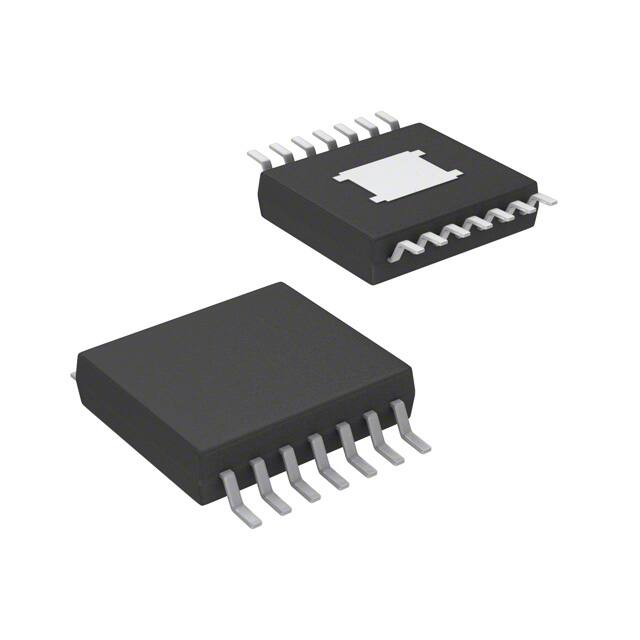
Figure 1. 14-Lead Plastic eTSSOP
ORDERING INFORMATION
Order Number
Package Type
Package Drawing
Supplied As
LM2746MXA
eTSSOP-14
MXA14A
94 Units, Rail
LM2746MXAX
eTSSOP-14
MXA14A
2500 Units on Tape and Reel
PIN DESCRIPTIONS
BOOT (Pin 1) - Bootstrap pin. This is the supply rail for the gate drivers. When the high-side MOSFET turns on, the voltage on this pin
should be at least one gate threshold above the regulator input voltage VIN to properly turn on the MOSFET. See MOSFET Gate Drivers in
the Application Information section for more details on how to select MOSFETs.
LG (Pin 2) - Low-gate drive pin. This is the gate drive for the low-side N-channel MOSFET. This signal is interlocked with the high-side gate
drive HG (Pin 14), so as to avoid shoot-through.
PGND (Pins 3, 13) - Power ground. This is also the ground for the low-side MOSFET driver. Both pins must be connected together on the
PCB to form a ground plane, which is usually the system ground.
SGND (Pin 4) - Signal ground. It should be connected appropriately to the ground plane with due regard to good layout practices in
switching power regulator circuits.
VCC (Pin 5) Supply rail for the control sections of the IC.
PWGD (Pin 6) - Power Good pin. This is an open drain output, which is typically meant to be connected to VCC or any other low voltage
source through a pull-up resistor. Choose the pull-up resistor so that the current going into this pin is kept below 1 mA. For most
applications a recommended value for the pull-up resistor is 100 kΩ. The voltage on this pin is thus pulled low under output undervoltage or
overvoltage fault conditions and also under input UVLO.
ISEN (Pin 7) - Current limit threshold setting pin. This sources a fixed 40 µA current. A resistor of appropriate value should be connected
between this pin and the drain of the low-side MOSFET (switch node). The minimum value for this resistor is 1 kΩ.
EAO (Pin 8) - Output of the error amplifier. The voltage level on this pin is compared with an internally generated ramp signal to determine
the duty cycle. This pin is necessary for compensating the control loop.
SS/TRACK (Pin 9) - Soft-start and tracking pin. This pin is internally connected to the non-inverting input of the error amplifier during softstart, and in fact any time the SS/TRACK pin voltage happens to be below the internal reference voltage. For the basic soft-start function, a
capacitor of minimum value 1nF is connected from this pin to ground. To track the rising ramp of another power supply’s output, connect a
resistor divider from the output of that supply to this pin as described in Application Information.
FB (Pin 10) - Feedback pin. This is the inverting input of the error amplifier, which is used for sensing the output voltage and compensating
the control loop.
FREQ (Pin 11) - Frequency adjust pin. The switching frequency is set by connecting a resistor of suitable value between this pin and
ground. The equation for calculating the exact value is provided in Application Information, but some typical values (rounded up to the
nearest standard values) are 324 kΩ for 100 kHz, 97.6 kΩ for 300 kHz, 56.2 kΩ for 500 kHz, 24.9 kΩ for 1 MHz.
SD (Pin 12) - IC shutdown pin. Pull this pin to VCC to ensure the IC is enabled. Connect to ground to disable the IC. Under shutdown, both
high-side and low-side drives are off. This pin also features a precision threshold for power supply sequencing purposes, as well as a low
threshold to ensure minimal quiescent current.
HG (Pin 14) - High-gate drive pin. This is the gate drive for the high-side N-channel MOSFET. This signal is interlocked with LG (Pin 2) to
avoid shoot-through.
EXPOSED PAD - Connect to ground.
2
Submit Documentation Feedback
Copyright © 2005–2013, Texas Instruments Incorporated
Product Folder Links: LM2746
�OBSOLETE
LM2746
www.ti.com
SNVS362C – MAY 2005 – REVISED APRIL 2013
These devices have limited built-in ESD protection. The leads should be shorted together or the device placed in conductive foam
during storage or handling to prevent electrostatic damage to the MOS gates.
Absolute Maximum Ratings (1) (2)
VCC
-0.3 to 6.25V
BOOT Voltage
-0.3 to 21V
All other pins
-0.3 to VCC + 0.3V
Junction Temperature
150°C
Storage Temperature
−65°C to 150°C
Soldering Information
Lead Temperature (soldering, 10sec)
260°C
Infrared or Convection (20sec)
235°C
ESD Rating (3)
(1)
(2)
(3)
2 kV
Absolute maximum ratings indicate limits beyond which damage to the device may occur. Operating ratings indicate conditions for which
the device operates correctly. Operating Ratings do not imply ensured performance limits.
If Military/Aerospace specified devices are required, please contact the Texas Instruments Sales Office/Distributors for availability and
specifications.
The human body model is a 100pF capacitor discharged through a 1.5k resistor into each pin.
Operating Ratings
Supply Voltage Range (VCC)
3V to 5.5V
Power Stage Input Voltage (VIN)
1V to 16V
−40°C to +125°C
Junction Temperature Range (TJ)
Thermal Resistance (θJA)
38°C/W
Electrical Characteristics
VCC = 3.3V unless otherwise indicated. Limits in standard type are for TJ = 25°C only; limits in boldface type apply over the
junction temperature (TJ) range of -40°C to +125°C. Minimum and Maximum limits are ensured through test, design, or
statistical correlation. Typical values represent the most likely parametric norm at TJ = 25°C, and are provided for reference
purposes only.
Symbol
Parameter
Conditions
Min
Typ
Max
Units
TJ = −25°C to +85°C
0.594
0.6
0.606
V
TJ = −40°C to +125°C
0.592
0.6
0.608
VCC = 3V to 5.5V
VFB
FB Pin Voltage
VON
UVLO Thresholds
IQ_VCC
Operating VCC Current
Rising
Falling
2.76
2.42
V
VCC = 3.3V, VSD = 3.3V
Fsw = 600kHz
1.0
1.5
2.1
VCC = 5V, VSD = 3.3V
Fsw = 600kHz
1.0
1.7
2.1
5
mA
Shutdown VCC Current
VCC = 3.3V, VSD = 0V
1
tPWGD1
PWGD Pin Response Time
VFB Rising
10
µs
tPWGD2
PWGD Pin Response Time
VFB Falling
10
µs
ISS-ON
SS Pin Source Current
VSS = 0V
ISS-OC
SS Pin Sink Current During Over
Current
VSS = 2.5V
ISEN-TH
ISEN Pin Source Current Trip Point
7
10
14
100
25
40
Product Folder Links: LM2746
µA
µA
55
Submit Documentation Feedback
Copyright © 2005–2013, Texas Instruments Incorporated
µA
µA
3
�OBSOLETE
LM2746
SNVS362C – MAY 2005 – REVISED APRIL 2013
www.ti.com
Electrical Characteristics (continued)
VCC = 3.3V unless otherwise indicated. Limits in standard type are for TJ = 25°C only; limits in boldface type apply over the
junction temperature (TJ) range of -40°C to +125°C. Minimum and Maximum limits are ensured through test, design, or
statistical correlation. Typical values represent the most likely parametric norm at TJ = 25°C, and are provided for reference
purposes only.
Symbol
Parameter
Conditions
Min
Typ
Max
Units
ERROR AMPLIFIER
GBW
Error Amplifier Unity Gain
Bandwidth
9
MHz
G
Error Amplifier DC Gain
106
dB
SR
Error Amplifier Slew Rate
3.2
V/µs
IEAO
EAO Pin Current Sourcing and
Sinking Capability
VEAO = 1.5, FB = 0.55V
VEAO = 1.5, FB = 0.65V
2.6
9.2
mA
VEA
Error Amplifier Output Voltage
Minimum
0
V
Maximum
3.3
V
VBOOT = 12V, VSD = 0
18
GATE DRIVE
IQ-BOOT
BOOT Pin Quiescent Current
RHG_UP
High-Side MOSFET Driver Pull-Up
VBOOT = 5V @ 350mA Sourcing
ON resistance
90
µA
3
Ω
RHG_DN
High-Side MOSFET Driver PullDown ON resistance
VBOOT = 5V @ 350mA Sinking
2
Ω
RLG_UP
Low-Side MOSFET Driver Pull-Up
ON resistance
VBOOT = 5V @ 350mA Sourcing
3
Ω
RLG_DN
Low-Side MOSFET Driver PullDown ON resistance
VBOOT = 5V @ 350mA Sinking
2
Ω
RFADJ = 702.1 kΩ
50
OSCILLATOR
fSW
PWM Frequency
RFADJ = 98.74 kΩ
RFADJ = 45.74 kΩ
300
475
RFADJ = 24.91 kΩ
D
Max High-Side Duty Cycle
600
725
kHz
1000
fSW = 300kHz
fSW = 600kHz
fSW = 1MHz
80
76
73
%
LOGIC INPUTS AND OUTPUTS
4
V SD-IH
SD Pin Logic High Trip Point
VSD Rising
V SD-IL
SD Pin Logic Low Trip Point
VSD Falling
0.8
VPWGD-TH-LO
PWGD Pin Trip Points
FB Falling
0.408
0.434
0.457
V
VPWGD-TH-HI
PWGD Pin Trip Points
FB Rising
0.677
0.710
0.742
V
VPWGD-HYS
PWGD Hysteresis
FB Falling
FB Rising
Submit Documentation Feedback
1.3
V
V
60
90
mV
Copyright © 2005–2013, Texas Instruments Incorporated
Product Folder Links: LM2746
�OBSOLETE
LM2746
www.ti.com
SNVS362C – MAY 2005 – REVISED APRIL 2013
Typical Performance Characteristics
Efficiency (VOUT = 1.2V)
VCC = 3.3V, fSW = 300kHz
Efficiency (VOUT = 2.5V)
VCC = 3.3V, fSW = 300kHz
100
100
VIN = 3.3V
90
90
70
80
EFFICIENCY (%)
EFFICIENCY (%)
80
VIN = 12V
VIN = 5V
60
50
70
VIN = 3.3V
60
VIN = 5V
50
40
40
30
30
20
VIN = 12V
20
0.0 0.4 0.8 1.2 1.6 2.0 2.4 2.8 3.2 3.6 4.0
0.0 0.4 0.8 1.2 1.6 2.0 2.4 2.8 3.2 3.6 4.0
OUTPUT CURRENT (A)
OUTPUT CURRENT (A)
Figure 2.
Figure 3.
Efficiency (VOUT = 3.3V)
VCC = 5V, fSW = 300kHz
VCC Operating Current plus BOOT Current vs Frequency
FDS6898A FET (TA = 25°C)
100
25
VCC OPERATING CURRENT
EFFICIENCY (%)
80
70
VIN = 5V
60
50
VIN = 12V
40
30
PLUS BOOT CURRENT (mA)
90
19
13
6
20
0.0 0.4 0.8 1.2 1.6 2.0 2.4 2.8 3.2 3.6 4.0
0
0.05
0.25
0.45
0.65
0.85
1.05
FREQUENCY (MHz)
Figure 4.
Figure 5.
BOOT Pin Current vs Temperature
for BOOT Voltage = 3.3V
fSW = 300kHz, FDS6898A FET, No-Load
BOOT Pin Current vs Temperature
for BOOT Voltage = 5V
fSW = 300kHz, FDS6898A FET, No-Load
6.7
10
6.6
9.9
BOOT PIN CURRENT (mA)
BOOT PIN CURRENT (mA)
OUTPUT CURRENT (A)
6.5
6.4
6.3
6.2
6.1
9.8
9.7
9.6
9.5
9.4
6
5.9
-40 -25 -10 5 20 35 50 65 80 95 110 125
TEMPERATURE (oC)
9.3
-40 -25 -10 5 20 35 50 65 80 95 110 125
TEMPERATURE (oC)
Figure 6.
Figure 7.
Submit Documentation Feedback
Copyright © 2005–2013, Texas Instruments Incorporated
Product Folder Links: LM2746
5
�OBSOLETE
LM2746
SNVS362C – MAY 2005 – REVISED APRIL 2013
www.ti.com
Typical Performance Characteristics (continued)
BOOT Pin Current vs Temperature
for BOOT Voltage = 12V
fSW = 300kHz, FDS6898A FET, No-Load
BOOT PIN CURRENT (mA)
24.8
24.7
24.6
24.5
24.4
24.3
24.2
24.1
24
23.9
-40 -25 -10 5 20 35 50 65 80 95 110125
Internal Reference Voltage vs Temperature
602
INTERNAL REFERENCE VOLTAGE (mV)
24.9
601
600
599
598
597
596
595
594
-40 -25 -10 5 20 35 50 65 80 95 110 125
TEMPERATURE (oC)
TEMPERATURE (oC)
Figure 8.
Figure 9.
Frequency vs Temperature
Output Voltage vs Output Current
1.210
640
1.209
1.208
OUTPUT VOLTAGE (V)
FREQUENCY (kHz)
620
600
580
560
1.207
1.206
1.205
1.204
1.203
1.202
540
1.201
520
-55 -35 -15
5
25
45
1.200
0
65 85 105 125
TEMPERATURE (oC)
0.4 0.8 1.2 1.6
2
2.4 2.8 3.2 3.6
OUTPUT CURRENT (A)
Figure 10.
Figure 11.
Switch Waveforms (HG Rising)
VCC = 3.3V, VIN = 5V, VOUT = 1.2V
IOUT = 4A, CSS = 12nF, fSW = 300kHz
Switch Waveforms (HG Falling)
VCC = 3.3V, VIN = 5V, VOUT = 1.2V
IOUT = 4A, CSS = 12nF, fSW = 300kHz
1V/div
HG
LG
2V/div
1V/div
2V/div
HG
LG
SW
SW
5V/div
5V/div
100 ns/DIV
100 ns/DIV
Figure 12.
6
4
Figure 13.
Submit Documentation Feedback
Copyright © 2005–2013, Texas Instruments Incorporated
Product Folder Links: LM2746
�OBSOLETE
LM2746
www.ti.com
SNVS362C – MAY 2005 – REVISED APRIL 2013
Typical Performance Characteristics (continued)
Start-Up (No-Load)
VCC = 3.3V, VIN = 5V, VOUT = 1.2V
CSS = 12nF, fSW = 300kHz
Start-Up (Full-Load)
VCC = 3.3V, VIN = 5V, VOUT = 1.2V
IOUT = 4A, CSS = 12nF, fSW = 300kHz
1V/div
1V/div
1V/div
VOUT
VOUT
VCSS
VCSS
1V/div
1A/div
1A/div
IIN
IIN
2V/div
2V/div
PWGD
PWGD
1 ms/DIV
1 ms/DIV
Figure 14.
Figure 15.
Shutdown (Full-Load)
VCC = 3.3V, VIN = 5V, VOUT = 1.2V
IOUT = 4A, CSS = 12nF, fSW = 300kHz
Load Transient Response (IOUT = 0A to 4A)
VCC = 3.3V, VIN = 5V, VOUT = 1.2V
CSS = 12nF, fSW = 300kHz
VOUT
1V/div
VOUT
VCSS
1V/div
IIN
50 mV/div
1A/div
2A/div
PWGD
IOUT
2V/div
1 ms/DIV
40 Ps/DIV
Figure 16.
Figure 17.
Load Transient Response (IOUT = 4A to 0A)
VCC = 3.3V, VIN = 5V, VOUT = 1.2V
CSS = 12nF, fSW = 300kHz
Load Transient Response
VCC = 3.3V, VIN = 5V, VOUT = 1.2V
CSS = 12nF, fSW = 300kHz
VOUT
VOUT
20 mV/div
20mV/div
IOUT
2A/div
2A/div
IOUT
40 Ps/DIV
100 Ps/DIV
Figure 18.
Figure 19.
Submit Documentation Feedback
Copyright © 2005–2013, Texas Instruments Incorporated
Product Folder Links: LM2746
7
�OBSOLETE
LM2746
SNVS362C – MAY 2005 – REVISED APRIL 2013
www.ti.com
Typical Performance Characteristics (continued)
Line Transient Response (VIN = 3V to 9V)
VCC = 3.3V, VOUT = 1.2V
IOUT = 2A, fSW = 300kHz
Line Transient Response (VIN = 9V to 3V)
VCC = 3.3V, VOUT = 1.2V
IOUT = 2A, fSW = 300kHz
100mV/div
100 mV/div
VOUT
VOUT
5V/div
VIN
5V/div
VIN
8
100 Ps/DIV
100 Ps/DIV
Figure 20.
Figure 21.
Submit Documentation Feedback
Copyright © 2005–2013, Texas Instruments Incorporated
Product Folder Links: LM2746
�OBSOLETE
LM2746
www.ti.com
SNVS362C – MAY 2005 – REVISED APRIL 2013
Block Diagram
VCC
SD
FREQ
CLOCK &
RAMP
PGND
PGND
SGND
UVLO
SHUT DOWN
LOGIC
BOOT
10 Ps
DELAY
HG
SSDONE
PWGD
SYNCHRONOUS
DRIVER LOGIC
OV
UV
LG
0.71V
0.434V
10 PA
SS/TRACK
1VPP
PWM LOGIC
PWM
Soft-Start
Comparator
+ Logic
REF
40 PA
-
+
100 PA
ISEN
ILIM
EA
-
+
VREF=0.6V
FB
EAO
Submit Documentation Feedback
Copyright © 2005–2013, Texas Instruments Incorporated
Product Folder Links: LM2746
9
�OBSOLETE
LM2746
SNVS362C – MAY 2005 – REVISED APRIL 2013
www.ti.com
APPLICATION INFORMATION
THEORY OF OPERATION
The LM2746 is a voltage-mode, high-speed synchronous buck regulator with a PWM control scheme. It is
designed for use in set-top boxes, thin clients, DSL/Cable modems, and other applications that require high
efficiency buck converters. It has output shutdown (SD), input undervoltage lock-out (UVLO) mode and power
good (PWGD) flag (based on overvoltage and undervoltage detection). The overvoltage and undervoltage
signals are logically OR'ed to drive the power good signal and provide a logic signal to the system if the output
voltage goes out of regulation. Current limit is achieved by sensing the voltage VDS across the low side MOSFET.
START UP/SOFT-START
When VCC exceeds 2.76V and the shutdown pin (SD) sees a logic high, the soft-start period begins. Then an
internal, fixed 10 µA source begins charging the soft-start capacitor. During soft-start the voltage on the soft-start
capacitor CSS is connected internally to the non-inverting input of the error amplifier. The soft-start period lasts
until the voltage on the soft-start capacitor exceeds the LM2746 reference voltage of 0.6V. At this point the
reference voltage takes over at the non-inverting error amplifier input. The capacitance of CSS determines the
length of the soft-start period, and can be approximated by:
CSS =
tSS
60
where
•
•
CSS is in µF and
tSS is in ms
(1)
During soft start the Power Good flag is forced low and it is released when the FB pin voltage reaches 70% of
0.6V. At this point the chip enters normal operation mode, and the output overvoltage and undervoltage
monitoring starts.
NORMAL OPERATION
While in normal operation mode, the LM2746 regulates the output voltage by controlling the duty cycle of the
high side and low side MOSFETs (see Typical Application Circuit).The equation governing output voltage is:
RFB1 + RFB2
VOUT =
RFB1
VFB
(VFB = 0.6V)
(2)
The PWM frequency is adjustable between 50 kHz and 1 MHz and is set by an external resistor, RFADJ, between
the FREQ pin and ground. The resistance needed for a desired frequency is approximately:
RFADJ = -5.93 + 3.06
107
1012
+ 0.24 2
fSW
f SW
where
•
•
10
fSW is in Hz and
RFADJ is in kΩ
(3)
Submit Documentation Feedback
Copyright © 2005–2013, Texas Instruments Incorporated
Product Folder Links: LM2746
�OBSOLETE
LM2746
www.ti.com
SNVS362C – MAY 2005 – REVISED APRIL 2013
TRACKING A VOLTAGE LEVEL
The LM2746 can track the output of a master power supply during soft-start by connecting a resistor divider to
the SS/TRACK pin. In this way, the output voltage slew rate of the LM2746 will be controlled by the master
supply for loads that require precise sequencing. Because the output of the master supply is divided down, in
order to track properly the output voltage of the LM2746 must be lower than the voltage of the master supply.
When the tracking function is used no soft-start capacitor should be connected to the SS/TRACK pin. However in
all other cases, a CSS value of at least 1nF between the soft-start pin and ground should be used.
Master Power
Supply
VOUT1 = 5V
RT2
1 k:
VOUT2 = 1.8V
SS/TRACK
VSS = 0.65V
RT1
150:
LM2746
FB
RFB2
10 k:
VFB
RFB1
5 k:
Figure 22. Tracking Circuit
One way to use the tracking feature is to design the tracking resistor divider so that the master supply’s output
voltage (VOUT1) and the LM2746’s output voltage (represented symbolically in Figure 22 as VOUT2, that is, without
explicitly showing the power components) both rise together and reach their target values at the same time. For
this case, the equation governing the values of the tracking divider resistors RT1 and RT2 is:
0.65 = VOUT1
RT1
RT1 + RT2
(4)
The current through RT1 should be about 3-4 mA for precise tracking. The final voltage of the SS/TRACK pin
should be set higher than the feedback voltage of 0.6V (say about 0.65V as in Equation 4). If the master supply
voltage were 5V and the LM2746 output voltage were 1.8V, for example, then the value of RT1 needed to give
the two supplies identical soft-start times would be 150Ω. A timing diagram for the equal soft-start time case is
shown in Figure 23.
5V
VOUT1
1.8V
VOUT2
Figure 23. Tracking with Equal Soft-Start Time
Submit Documentation Feedback
Copyright © 2005–2013, Texas Instruments Incorporated
Product Folder Links: LM2746
11
�OBSOLETE
LM2746
SNVS362C – MAY 2005 – REVISED APRIL 2013
www.ti.com
TRACKING A VOLTAGE SLEW RATE
The tracking feature can alternatively be used not to make both rails reach regulation at the same time but rather
to have similar rise rates (in terms of output dV/dt). This method ensures that the output voltage of the LM2746
always reaches regulation before the output voltage of the master supply. In this case, the tracking resistors can
be determined based on the following equation:
0.65 = VOUT2
RT1
RT1 + RT2
(5)
For the example case of VOUT1 = 5V and VOUT2 = 1.8V, with RT1 set to 150Ω as before, RT2 is calculated from
Equation 5 to be 265Ω. A timing diagram for the case of equal slew rates is shown in Figure 24.
5V
1.8V
VOUT1
1.8V
VOUT2
Figure 24. Tracking with Equal Slew Rates
SEQUENCING
The start up/soft-start of the LM2746 can be delayed for the purpose of sequencing by connecting a resistor
divider from the output of a master power supply to the SD pin, as shown in Figure 25.
Master Power
Supply
VOUT1
VOUT2
RS2
SD
LM2746
RS1
FB
RFB2
VFB
RFB1
Figure 25. Sequencing Circuit
A desired delay time tDELAY between the startup of the master supply output voltage and the LM2746 output
voltage can be set based on the SD pin low-to-high threshold VSD-IH and the slew rate of the voltage at the SD
pin, SRSD:
tDELAY = VSD-IH / SRSD
(6)
Note again, that in Figure 25, the LM2746’s output voltage has been represented symbolically as VOUT2, that is,
without explicitly showing the power components.
12
Submit Documentation Feedback
Copyright © 2005–2013, Texas Instruments Incorporated
Product Folder Links: LM2746
�OBSOLETE
LM2746
www.ti.com
SNVS362C – MAY 2005 – REVISED APRIL 2013
VSD-IH is typically 1.08V and SRSD is the slew rate of the SD pin voltage. The values of the sequencing divider
resistors RS1 and RS2 set the SRSD based on the master supply output voltage slew rate, SROUT1, using the
following equation:
SRSD = SROUT1
RS1
RS1 + RS2
(7)
For example, if the master supply output voltage slew rate were 1V/ms and the desired delay time between the
startup of the master supply and LM2746 output voltage were 5ms, then the desired SD pin slew rate would be
(1.08V/5ms) = 0.216V/ms. Due to the internal impedance of the SD pin, the maximum recommended value for
RS2 is 1kΩ. To achieve the desired slew rate, RS1 would then be 274Ω. A timing diagram for this example is
shown in Figure 26.
5V
VSD-IH
1.08V
VOUT1
1.8V
VOUT2
t = 5 ms
Figure 26. Delay for Sequencing
SD PIN IMPEDANCE
When connecting a resistor divider to the SD pin of the LM2746 some care has to be taken. Once the SD voltage
goes above VSD-IH, a 17 µA pull-up current is activated as shown in Figure 27. This current is used to create the
internal hysteresis (≊170mV); however, high external impedances will affect the SD pin logic thresholds as well.
The external impedance used for the sequencing divider network should preferably be a small fraction of the
impedance of the SD pin for good performance (around 1kΩ).
Submit Documentation Feedback
Copyright © 2005–2013, Texas Instruments Incorporated
Product Folder Links: LM2746
13
�OBSOLETE
LM2746
SNVS362C – MAY 2005 – REVISED APRIL 2013
www.ti.com
17 PA
8 PA
Bias Enable
SD
10k
Soft-Start Enable
1.25V
+
-
Figure 27. SD Pin Logic
MOSFET GATE DRIVERS
The LM2746 has two gate drivers designed for driving N-channel MOSFETs in a synchronous mode. Note that
unlike most other synchronous controllers, the bootstrap capacitor of the LM2746 provides power not only to the
driver of the upper MOSFET, but the lower MOSFET driver too (both drivers are ground referenced, that is, no
floating driver). To fully turn the top MOSFET on, the BOOT voltage must be at least one gate threshold greater
than VIN when the high-side drive goes high. This bootstrap voltage is usually supplied from a local charge pump
structure. But looking at the Typical Application schematic, this also means that the difference voltage VCC - VD1,
which is the voltage the bootstrap capacitor charges up to, must be always greater than the maximum tolerance
limit of the threshold voltage of the upper MOSFET. Here VD1 is the forward voltage drop across the bootstrap
diode D1. This therefore may place restrictions on the minimum input voltage and/or type of MOSFET used.
Two things must be kept in mind here. First, the BOOT pin has an absolute maximum rating of 21V. Since the
bootstrap capacitor is connected to the SW node, the peak voltage impressed on the BOOT pin is the sum of the
input voltage (VIN) plus the voltage across the bootstrap capacitor (ignoring any forward drop across the
bootstrap diode). The bootstrap capacitor is charged up by a given rail (called VBOOT_DC here) whenever the
upper MOSFET turns off. This rail can be the same as VCC or it can be any external ground-referenced DC rail.
But care has to be exercised when choosing this bootstrap DC rail that the BOOT pin is not damaged. For
example, if the desired maximum VIN is 16V, and VBOOT_DC is chosen to be the same as VCC, then clearly if the
VCC rail is 5.5V, the peak voltage on the BOOT pin is 16V + 5.5V = 21.5V. This is unacceptable, as it is in excess
of the rating of the BOOT pin. A VCC of 3V would be acceptable in this case. Or the VIN range must be reduced
accordingly. There is also the option of deriving the bootstrap DC rail from another 3V external rail, independent
of VCC.
The second thing to be kept in mind here is that the output of the low-side driver swings between the bootstrap
DC rail level of VBOOT_DC and Ground, whereas the output of the high-side driver swings between VIN+ VBOOT_DC
and Ground. To keep the high-side MOSFET fully on when desired, the Gate pin voltage of the MOSFET must
be higher than its instantaneous Source pin voltage by an amount equal to the 'Miller plateau'. It can be shown
that this plateau is equal to the threshold voltage of the chosen MOSFET plus a small amount equal to Io/g. Here
Io is the maximum load current of the application, and g is the transconductance of this MOSFET (typically about
100 for logic-level devices). That means we must choose VBOOT_DC to at least exceed the Miller plateau level.
This may therefore affect the choice of the threshold voltage of the external MOSFETs, and that in turn may
depend on the chosen VBOOT_DC rail.
14
Submit Documentation Feedback
Copyright © 2005–2013, Texas Instruments Incorporated
Product Folder Links: LM2746
�OBSOLETE
LM2746
www.ti.com
SNVS362C – MAY 2005 – REVISED APRIL 2013
So far, in the discussion above, the forward drop across the bootstrap diode has been ignored. But since that
does affect the output of the driver, it is a good idea to include this drop in the following examples. Looking at the
Typical Application schematic, this means that the difference voltage VCC - VD1, which is the voltage the
bootstrap capacitor charges up to, must always be greater than the maximum tolerance limit of the threshold
voltage of the upper MOSFET. Here VD1 is the forward voltage drop across the bootstrap diode D1. This may
place restrictions on the minimum input voltage and/or type of MOSFET used.
The basic bootstrap pump circuit can be built using one Schottky diode and a small capacitor, as shown in
Figure 28. The capacitor CBOOT serves to maintain enough voltage between the top MOSFET gate and source to
control the device even when the top MOSFET is on and its source has risen up to the input voltage level. The
charge pump circuitry is fed from VCC, which can operate over a range from 3.0V to 6.0V. Using this basic
method the voltage applied to the gates of both high-side and low-side MOSFETs is VCC - VD. This method
works well when VCC is 5V±10%, because the gate drives will get at least 4.0V of drive voltage during the worst
case of VCC-MIN = 4.5V and VD-MAX = 0.5V. Logic level MOSFETs generally specify their on-resistance at VGS =
4.5V. When VCC = 3.3V±10%, the gate drive at worst case could go as low as 2.5V. Logic level MOSFETs are
not ensured to turn on, or may have much higher on-resistance at 2.5V. Sub-logic level MOSFETs, usually
specified at VGS = 2.5V, will work, but are more expensive, and tend to have higher on-resistance. The circuit in
Figure 28 works well for input voltages ranging from 1V up to 16V and VCC = 5V ±10%, because the drive
voltage depends only on VCC.
LM2746
BOOT
D1
VCC
CBOOT
VIN
HG
+
VO
+
LG
Figure 28. Basic Charge Pump (Bootstrap)
Note that the LM2746 can be paired with a low cost linear regulator like the LM78L05 to run from a single input
rail between 6.0 and 16V. The 5V output of the linear regulator powers both the VCC and the bootstrap circuit,
providing efficient drive for logic level MOSFETs. An example of this circuit is shown in Figure 29.
Submit Documentation Feedback
Copyright © 2005–2013, Texas Instruments Incorporated
Product Folder Links: LM2746
15
�OBSOLETE
LM2746
SNVS362C – MAY 2005 – REVISED APRIL 2013
www.ti.com
LM2746
VCC
5V
LM78L05
D1
BOOT
CBOOT
VIN
+
HG
VO
LG
+
Figure 29. LM78L05 Feeding Basic Charge Pump
Figure 30 shows a second possibility for bootstrapping the MOSFET drives using a doubler. This circuit provides
an equal voltage drive of VCC - 3VD + VIN to both the high-side and low-side MOSFET drives. This method should
only be used in circuits that use 3.3V for both VCC and VIN. Even with VIN = VCC = 3.0V (10% lower tolerance on
3.3V) and VD = 0.5V both high-side and low-side gates will have at least 4.5V of drive. The power dissipation of
the gate drive circuitry is directly proportional to gate drive voltage, hence the thermal limits of the LM2746 IC will
quickly be reached if this circuit is used with VCC or VIN voltages over 5V.
LM2746
BOOT
D3
D2
D1
VCC
VIN
HG
+
VO
+
LG
Figure 30. Charge Pump with Added Gate Drive
All the gate drive circuits shown in Figure 28 through Figure 30 typically use 100nF ceramic capacitors in the
bootstrap locations.
POWER GOOD SIGNAL
The open drain output on the Power Good pin needs a pull-up resistor to a low voltage source. The pull-up
resistor should be chosen so that the current going into the Power Good pin is less than 1 mA. A 100 kΩ resistor
is recommended for most applications.
16
Submit Documentation Feedback
Copyright © 2005–2013, Texas Instruments Incorporated
Product Folder Links: LM2746
�OBSOLETE
LM2746
www.ti.com
SNVS362C – MAY 2005 – REVISED APRIL 2013
The Power Good signal is an OR-gated flag which takes into account both output overvoltage and undervoltage
conditions. If the feedback pin (FB) voltage is 18% above its nominal value (118% x VFB = 0.708V) or falls 28%
below that value (72 %x VFB = 0.42V) the Power Good flag goes low. The Power Good flag can be used to signal
other circuits that the output voltage has fallen out of regulation, however the switching of the LM2746 continues
regardless of the state of the Power Good signal. The Power Good flag will return to logic high whenever the
feedback pin voltage is between 72% and 118% of 0.6V.
UVLO
The 2.76V turn-on threshold on VCC has a built in hysteresis of about 300mV. If VCC drops below 2.42V, the chip
enters UVLO mode. UVLO consists of turning off the top and bottom MOSFETS and remaining in that condition
until VCC rises above 2.76V. As with shutdown, the soft-start capacitor is discharged through an internal
MOSFET, ensuring that the next start-up will be controlled by the soft-start circuitry.
CURRENT LIMIT
Current limit is realized by sensing the voltage across the low-side MOSFET while it is on. The RDSON of the
MOSFET is a known value; hence the current through the MOSFET can be determined as:
VDS = IOUT * RDSON
(8)
The current through the low-side MOSFET while it is on is also the falling portion of the inductor current. The
current limit threshold is determined by an external resistor, RCS, connected between the switching node and the
ISEN pin. A constant current of 40 µA is forced through RCS, causing a fixed voltage drop. This fixed voltage is
compared against VDS and if the latter is higher, the current limit of the chip has been reached. To obtain a more
accurate value for RCS you must consider the operating values of RDSON and ISEN-TH at their operating
temperatures in your application and the effect of slight parameter differences from part to part. RCS can be found
by using Equation 9 using the RDSON value of the low side MOSFET at it's expected hot temperature and the
absolute minimum value expected over the full temperature range for the for the ISEN-TH which is 25 µA:
RCS = RDSON-HOT x ILIM / 40 µA
(9)
For example, a conservative 15A current limit in a 10A design with a minimum RDSON of 10mΩ would require a
6kΩ resistor. The minimum value for RCS in any application is 1 kΩ. Because current sensing is done across the
low-side MOSFET, no minimum high-side on-time is necessary. The LM2746 enters current limit mode if the
inductor current exceeds the current limit threshold at the point where the high-side MOSFET turns off and the
low-side MOSFET turns on. (The point of peak inductor current, see Figure 31). Note that in normal operation
mode the high-side MOSFET always turns on at the beginning of a clock cycle. In current limit mode, by contrast,
the high-side MOSFET on-pulse is skipped. This causes inductor current to fall. Unlike a normal operation
switching cycle, however, in a current limit mode switching cycle the high-side MOSFET will turn on as soon as
inductor current has fallen to the current limit threshold. The LM2746 will continue to skip high-side MOSFET
pulses until the inductor current peak is below the current limit threshold, at which point the system resumes
normal operation.
Normal Operation
Current Limit
ILIM
IL
D
Figure 31. Current Limit Threshold
Submit Documentation Feedback
Copyright © 2005–2013, Texas Instruments Incorporated
Product Folder Links: LM2746
17
�OBSOLETE
LM2746
SNVS362C – MAY 2005 – REVISED APRIL 2013
www.ti.com
Unlike a high-side MOSFET current sensing scheme, which limits the peaks of inductor current, low-side current
sensing is only allowed to limit the current during the converter off-time, when inductor current is falling.
Therefore in a typical current limit plot the valleys are normally well defined, but the peaks are variable, according
to the duty cycle. The PWM error amplifier and comparator control the off-pulse of the high-side MOSFET, even
during current limit mode, meaning that peak inductor current can exceed the current limit threshold. Assuming
that the output inductor does not saturate, the maximum peak inductor current during current limit mode can be
calculated with the following equation:
IPK-CL = ILIM + (TSW - 200 ns)
VIN - VO
L
where
•
TSW is the inverse of switching frequency fSW
(10)
The 200ns term represents the minimum off-time of the duty cycle, which ensures enough time for correct
operation of the current sensing circuitry.
In order to minimize the time period in which peak inductor current exceeds the current limit threshold, the IC
also discharges the soft-start capacitor through a fixed 90 µA sink. The output of the LM2746 internal error
amplifier is limited by the voltage on the soft-start capacitor. Hence, discharging the soft-start capacitor reduces
the maximum duty cycle D of the controller. During severe current limit this reduction in duty cycle will reduce the
output voltage if the current limit conditions last for an extended time. Output inductor current will be reduced in
turn to a flat level equal to the current limit threshold. The third benefit of the soft-start capacitor discharge is a
smooth, controlled ramp of output voltage when the current limit condition is cleared.
SHUTDOWN
If the shutdown pin is pulled low, (below 0.8V) the LM2746 enters shutdown mode, and discharges the soft-start
capacitor through a MOSFET switch. The high and low-side MOSFETs are turned off. The LM2746 remains in
this state as long as VSD sees a logic low (see the Electrical Characteristics table). To assure proper IC start-up
the shutdown pin should not be left floating. For normal operation this pin should be connected directly to VCC or
to another voltage between 1.3V to VCC (see Electrical Characteristics the table).
DESIGN CONSIDERATIONS
The following is a design procedure for all the components needed to create the Typical Application Circuit. This
design converts 3.3V (VIN) to 1.2V (VOUT) at a maximum load of 4A with an efficiency of 89% and a switching
frequency of 300kHz. The same procedures can be followed to create many other designs with varying input
voltages, output voltages, and load currents.
Duty Cycle Calculation
The complete duty cycle for a buck converter is defined with the following equation:
VOUT + VSWL
D=
VIN - VSWH + VSWL
where
•
VSWL and VSWH are the respective forward voltage drops that develop across the low side and high side
MOSFETs
(11)
Assuming the inductor ripple current is 20% to 30% of the output current, therefore:
VSWL = IOUT x RDS(on)LOW (Low-Side MOSFET)
VSWH = IOUT x RDS(on)HIGH (High-Side MOSFET)
(12)
(13)
To calculate the maximum duty cycle use the estimated 'hot' RDS(on) value of the MOSFETs, the minimum input
voltage, and maximum load. As shown in Figure 32, the worst case maximum duty cycles of the LM2746 occurs
at 125°C junction temperature vs VCC (IC control section voltage). Ensure that the operating duty cycle is below
the curve in Figure 32, if this condition is not satisfied, the system will be unable to develop the required duty
cycle to derive the necessary system power and so the output voltage will fall out of regulation.
18
Submit Documentation Feedback
Copyright © 2005–2013, Texas Instruments Incorporated
Product Folder Links: LM2746
�OBSOLETE
LM2746
www.ti.com
SNVS362C – MAY 2005 – REVISED APRIL 2013
Figure 32. Maximum Duty Cycle vs VCC
TJ = 125°C
Input Capacitor
The input capacitors in a Buck converter are subjected to high stress due to the input current trapezoidal
waveform. Input capacitors are selected for their ripple current capability and their ability to withstand the heat
generated since that ripple current passes through their ESR. Input rms current is approximately:
IRMS = IOUT x D(1 - D)
(14)
The power dissipated by each input capacitor is:
(IRMS)2 x ESR
PCAP =
n2
where
•
•
n is the number of capacitors
ESR is the equivalent series resistance of each capacitor
(15)
Equation 15 indicates that power loss in each capacitor decreases rapidly as the number of input capacitors
increases. The worst-case ripple for a Buck converter occurs during full load and when the duty cycle (D) is 0.5.
For this 3.3V to 1.2V design the duty cycle is 0.364. For a 4A maximum load the ripple current is 1.92A.
Output Inductor
The output inductor forms the first half of the power stage in a Buck converter. It is responsible for smoothing the
square wave created by the switching action and for controlling the output current ripple (ΔIOUT). The inductance
is chosen by selecting between tradeoffs in efficiency and response time. The smaller the output inductor, the
more quickly the converter can respond to transients in the load current. However, as shown in the efficiency
calculations, a smaller inductor requires a higher switching frequency to maintain the same level of output current
ripple. An increase in frequency can mean increasing loss in the MOSFETs due to the charging and discharging
of the gates. Generally the switching frequency is chosen so that conduction loss outweighs switching loss. The
equation for output inductor selection is:
VIN - VOUT
L=
L=
xD
'IOUT x fSW
3.3V - 1.2V
1.2V
x
3.3V
0.4 x 4A x 300 kHz
L = 1.6µH
(16)
Here we have plugged in the values for output current ripple, input voltage, output voltage, switching frequency,
and assumed a 40% peak-to-peak output current ripple. This yields an inductance of 1.6 µH. The output inductor
must be rated to handle the peak current (also equal to the peak switch current), which is (IOUT + 0.5*ΔIOUT) =
4.8A, for a 4A design. The Coilcraft DO3316P-222P is 2.2 µH, is rated to 7.4A peak, and has a direct current
resistance (DCR) of 12mΩ.
Submit Documentation Feedback
Copyright © 2005–2013, Texas Instruments Incorporated
Product Folder Links: LM2746
19
�OBSOLETE
LM2746
SNVS362C – MAY 2005 – REVISED APRIL 2013
www.ti.com
After selecting an output inductor, inductor current ripple should be re-calculated with the new inductance value,
as this information is needed to select the output capacitor. Re-arranging the equation used to select inductance
yields the following:
VIN(MAX) - VO
'IOUT =
FSW x LACTUAL
xD
(17)
VIN(MAX) is assumed to be 10% above the steady state input voltage, or 3.6V. The actual current ripple will then
be 1.2A. Peak inductor/switch current will be 4.6A.
Output Capacitor
The output capacitor forms the second half of the power stage of a Buck switching converter. It is used to control
the output voltage ripple (ΔVOUT) and to supply load current during fast load transients.
In this example the output current is 4A and the expected type of capacitor is an aluminum electrolytic, as with
the input capacitors. Other possibilities include ceramic, tantalum, and solid electrolyte capacitors, however the
ceramic type often do not have the large capacitance needed to supply current for load transients, and tantalums
tend to be more expensive than aluminum electrolytic. Aluminum capacitors tend to have very high capacitance
and fairly low ESR, meaning that the ESR zero, which affects system stability, will be much lower than the
switching frequency. The large capacitance means that at the switching frequency, the ESR is dominant, hence
the type and number of output capacitors is selected on the basis of ESR. One simple formula to find the
maximum ESR based on the desired output voltage ripple, ΔVOUT and the designed output current ripple, ΔIOUT,
is:
ESRMAX =
'VOUT
'IOUT
(18)
In this example, in order to maintain a 2% peak-to-peak output voltage ripple and a 40% peak-to-peak inductor
current ripple, the required maximum ESR is 20mΩ. The Sanyo 4SP560M electrolytic capacitor will give an
equivalent ESR of 14mΩ. The capacitance of 560 µF is enough to supply energy even to meet severe load
transient demands.
MOSFETs
Selection of the power MOSFETs is governed by a tradeoff between cost, size, and efficiency. One method is to
determine the maximum cost that can be endured, and then select the most efficient device that fits that price.
Breaking down the losses in the high-side and low-side MOSFETs and then creating spreadsheets is one way to
determine relative efficiencies between different MOSFETs. Good correlation between the prediction and the
bench result is not ensured, however. Single-channel buck regulators that use a controller IC and discrete
MOSFETs tend to be most efficient for output currents of 2-10A.
Losses in the high-side MOSFET can be broken down into conduction loss, gate charging loss, and switching
loss. Conduction, or I2R loss, is approximately:
PC = D (IO2 x RDSON-HI x 1.3) (High-Side MOSFET)
PC = (1 - D) x (IO2 x RDSON-LO x 1.3) (Low-Side MOSFET)
(19)
(20)
In Equation 19 and Equation 20, the factor 1.3 accounts for the increase in MOSFET RDSON due to heating.
Alternatively, the 1.3 can be ignored and the RDSON of the MOSFET estimated using the RDSON Vs. Temperature
curves in the MOSFET datasheets.
Gate charging loss results from the current driving the gate capacitance of the power MOSFETs, and is
approximated as:
PGC = n x (VDD) x QG x fSW
where
•
•
•
‘n’ is the number of MOSFETs (if multiple devices have been placed in parallel)
VDD is the driving voltage (see MOSFET Gate Drivers)
QGS is the gate charge of the MOSFET
(21)
If different types of MOSFETs are used, the ‘n’ term can be ignored and their gate charges simply summed to
form a cumulative QG. Gate charge loss differs from conduction and switching losses in that the actual
dissipation occurs in the LM2746, and not in the MOSFET itself.
20
Submit Documentation Feedback
Copyright © 2005–2013, Texas Instruments Incorporated
Product Folder Links: LM2746
�OBSOLETE
LM2746
www.ti.com
SNVS362C – MAY 2005 – REVISED APRIL 2013
Switching loss occurs during the brief transition period as the high-side MOSFET turns on and off, during which
both current and voltage are present in the channel of the MOSFET. It can be approximated as:
PSW = 0.5 x VIN x IO x (tr + tf) x fSW
where
•
tR and tF are the rise and fall times of the MOSFET.
(22)
Switching loss occurs in the high-side MOSFET only.
For this example, the maximum drain-to-source voltage applied to either MOSFET is 3.6V. The maximum drive
voltage at the gate of the high-side MOSFET is 3.1V, and the maximum drive voltage for the low-side MOSFET
is 3.3V. Due to the low drive voltages in this example, a MOSFET that turns on fully with 3.1V of gate drive is
needed. For designs of 5A and under, dual McOSFETs in SO-8 provide a good tradeoff between size, cost, and
efficiency.
Support Components
CIN2 - A small (0.1 to 1 µF) ceramic capacitor should be placed as close as possible to the drain of the high-side
MOSFET and source of the low-side MOSFET (dual MOSFETs make this easy). This capacitor should be X5R
type dielectric or better.
RCC, CCC- These are standard filter components designed to ensure smooth DC voltage for the chip supply. RCC
should be 1-10Ω. CCC should 1 µF, X5R type or better.
CBOOT- Bootstrap capacitor, typically 100nF.
RPULL-UP – This is a standard pull-up resistor for the open-drain power good signal (PWGD). The recommended
value is 10 kΩ connected to VCC. If this feature is not necessary, the resistor can be omitted.
D1 - A small Schottky diode should be used for the bootstrap. It allows for a minimum drop for both high and lowside drivers. The MBR0520 or BAT54 work well in most designs.
RCS - Resistor used to set the current limit. Since the design calls for a peak current magnitude (IOUT+0.5*ΔIOUT)
of 4.8A, a safe setting would be 6A. (This is below the saturation current of the output inductor, which is 7A.)
Following Equation 9 from the Current Limit section, a 1.3kΩ resistor should be used.
RFADJ - This resistor is used to set the switching frequency of the chip. The resistor value is calculated from
Equation 3 in Normal Operation section. For 300 kHz operation, a 97.6 kΩ resistor should be used.
CSS - The soft-start capacitor depends on the user requirements and is calculated based on Equation 1 given in
the section titled START UP/SOFT-START. Therefore, for a 700µs delay, a 12nF capacitor is suitable.
Control Loop Compensation
The LM2746 uses voltage-mode (‘VM’) PWM control to correct changes in output voltage due to line and load
transients. One of the attractive advantages of voltage mode control is its relative immunity to noise and layout.
However VM requires careful small signal compensation of the control loop for achieving high bandwidth and
good phase margin.
The control loop is comprised of two parts. The first is the power stage, which consists of the duty cycle
modulator, output inductor, output capacitor, and load. The second part is the error amplifier, which for the
LM2746 is a 9MHz op-amp used in the classic inverting configuration. Figure 33 shows the regulator and control
loop components.
Submit Documentation Feedback
Copyright © 2005–2013, Texas Instruments Incorporated
Product Folder Links: LM2746
21
�OBSOLETE
LM2746
SNVS362C – MAY 2005 – REVISED APRIL 2013
www.ti.com
L
RL
+ C
O
VIN
RO
+
-
RC
+
VRAMP
RC2
CC2
RC1
10 k:
CC3
CC1
+
10 k:
+
-
VREF
Figure 33. Power Stage and Error Amp
One popular method for selecting the compensation components is to create Bode plots of gain and phase for
the power stage and error amplifier. Combined, they make the overall bandwidth and phase margin of the
regulator easy to see. Software tools such as Excel, MathCAD, and Matlab are useful for showing how changes
in compensation or the power stage affect system gain and phase.
The power stage modulator provides a DC gain ADC that is equal to the input voltage divided by the peak-to-peak
value of the PWM ramp. This ramp is 1.0VP-P for the LM2746. The inductor and output capacitor create a
double pole at frequency fDP, and the capacitor ESR and capacitance create a single zero at frequency fESR. For
this example, with VIN = 3.3V, these quantities are:
VIN
ADC =
VRAMP
1
2S
fDP =
fESR =
=
3.3
= 10.4 dB
1.0
RO + RL
LCO(RO + ESR)
1
2SCOESR
(23)
= 4.5 kHz
(24)
= 20.3 kHz
(25)
In the equation for fDP, the variable RL is the power stage resistance, and represents the inductor DCR plus the
on resistance of the top power MOSFET. RO is the output voltage divided by output current. The power stage
transfer function GPS is given by Equation 26, and Figure 34 shows Bode plots of the phase and gain in this
example.
VIN x RO
GPS =
VRAMP
x
sCORC + 1
a x s2 + b x s + c
where
•
•
•
22
a = LCO(RO + RC)
b = L + CO(RORL + RORC + RCRL)
c = RO + RL
(26)
Submit Documentation Feedback
Copyright © 2005–2013, Texas Instruments Incorporated
Product Folder Links: LM2746
�OBSOLETE
LM2746
SNVS362C – MAY 2005 – REVISED APRIL 2013
20
0
4
-30
PHASE (o)
GAIN (dB)
www.ti.com
-12
-28
-44
-60
-90
-120
-60
-150
100
1k
10k
100k
1M
100
FREQUENCY (Hz)
1k
10k
100k
1M
FREQUENCY (Hz)
Figure 34. Power Stage Gain and Phase
The double pole at 4.5kHz causes the phase to drop to approximately -130° at around 10kHz. The ESR zero, at
20.3kHz, provides a +90° boost that prevents the phase from dropping to -180º. If this loop were left
uncompensated, the bandwidth would be approximately 10kHz and the phase margin 53°. In theory, the loop
would be stable, but would suffer from poor DC regulation (due to the low DC gain) and would be slow to
respond to load transients (due to the low bandwidth.) In practice, the loop could easily become unstable due to
tolerances in the output inductor, capacitor, or changes in output current, or input voltage. Therefore, the loop is
compensated using the error amplifier and a few passive components.
For this example, a Type III, or three-pole-two-zero approach gives optimal bandwidth and phase.
In most voltage mode compensation schemes, including Type III, a single pole is placed at the origin to boost DC
gain as high as possible. Two zeroes fZ1 and fZ2 are placed at the double pole frequency to cancel the double
pole phase lag. Then, a pole, fP1 is placed at the frequency of the ESR zero. A final pole fP2 is placed at one-half
of the switching frequency. The gain of the error amplifier transfer function is selected to give the best bandwidth
possible without violating the Nyquist stability criteria. In practice, a good crossover point is one-fifth of the
switching frequency, or 60kHz for this example. The generic equation for the error amplifier transfer function is:
s
+1
2SfZ1
GEA = AEA x
s
s
+1
2SfP1
s
+1
2SfZ2
s
+1
2SfP2
(27)
In this equation the variable AEA is a ratio of the values of the capacitance and resistance of the compensation
components, arranged as shown in Figure 33. AEA is selected to provide the desired bandwidth. A starting value
of 80,000 for AEA should give a conservative bandwidth. Increasing the value will increase the bandwidth, but will
also decrease phase margin. Designs with 45-60° are usually best because they represent a good tradeoff
between bandwidth and phase margin. In general, phase margin is lowest and gain highest (worst-case) for
maximum input voltage and minimum output current. One method to select AEA is to use an iterative process
beginning with these worst-case conditions.
1. Increase AEA
2. Check overall bandwidth and phase margin
3. Change VIN to minimum and recheck overall bandwidth and phase margin
4. Change IO to maximum and recheck overall bandwidth and phase margin
The process ends when both bandwidth and phase margin are sufficiently high. For this example input voltage
can vary from 3.0 to 3.6V and output current can vary from 0 to 4A, and after a few iterations a moderate gain
factor of 101dB is used.
Submit Documentation Feedback
Copyright © 2005–2013, Texas Instruments Incorporated
Product Folder Links: LM2746
23
�OBSOLETE
LM2746
SNVS362C – MAY 2005 – REVISED APRIL 2013
www.ti.com
The error amplifier of the LM2746 has a unity-gain bandwidth of 9MHz. In order to model the effect of this
limitation, the open-loop gain can be calculated as:
OPG =
2S x 9 MHz
s
(28)
The new error amplifier transfer function that takes into account unity-gain bandwidth is:
GEA x OPG
HEA =
1 + GEA + OPG
(29)
60
50
48
20
PHASE (o)
GAIN (dB)
The gain and phase of the error amplifier are shown in Figure 35.
36
24
-10
-40
-70
12
-100
0
100
1k
10k
100k
1M
100
FREQUENCY (Hz)
1k
10k
100k
1M
FREQUENCY (Hz)
Figure 35. Error Amp. Gain and Phase
In VM regulators, the top feedback resistor RFB2 forms a part of the compensation. Setting RFB2 to 10kΩ, ±1%
usually gives values for the other compensation resistors and capacitors that fall within a reasonable range.
(Capacitances > 1pF, resistances < 1MΩ) CC1, CC2, CC3, RC1, and RC2 are selected to provide the poles and
zeroes at the desired frequencies, using the following equations:
fZ1
CC1 =
CC2 =
CC3 =
RC1 =
RC2 =
24
AEA x 10,000 x fP2
1
AEA x 10,000
1
2S x 10,000
1
2S x CC2 x fZ1
1
2S x CC3 x fP1
= 27 pF
(30)
- CC1 = 882 pF
(31)
x
1
1
= 2.73 nF
fZ2 fP1
(32)
= 39.8 k:
(33)
= 2.55 k:
(34)
Submit Documentation Feedback
Copyright © 2005–2013, Texas Instruments Incorporated
Product Folder Links: LM2746
�OBSOLETE
LM2746
www.ti.com
SNVS362C – MAY 2005 – REVISED APRIL 2013
In practice, a good trade off between phase margin and bandwidth can be obtained by selecting the closest
±10% capacitor values above what are suggested for CC1 and CC2, the closest ±10% capacitor value below the
suggestion for CC3, and the closest ±1% resistor values below the suggestions for RC1, RC2. Note that if the
suggested value for RC2 is less than 100Ω, it should be replaced by a short circuit. Following this guideline, the
compensation components will be:
CC1 = 27pF ±10%, CC2 = 820pF ±10%
CC3 = 2.7nF ±10%, RC1 = 39.2kΩ ±1%
RC2 = 2.55kΩ ±1%
The transfer function of the compensation block can be derived by considering the compensation components as
impedance blocks ZF and ZI around an inverting op-amp:
ZF
GEA-ACTUAL =
ZI
(35)
1
1
x 10,000 +
sCC2
sCC1
ZF =
10,000 +
1
1
+
sCC1 sCC2
(36)
1
RC2 +
sCC3
RC1
Z1 =
RC1 + RC2 +
1
sCC3
(37)
As with the generic equation, GEA-ACTUAL must be modified to take into account the limited bandwidth of the error
amplifier. The result is:
GEA-ACTUAL x OPG
HEA =
1 + GEA-ACTUAL+ OPG
(38)
The total control loop transfer function H is equal to the power stage transfer function multiplied by the error
amplifier transfer function.
H = GPS x HEA
(39)
60
-60
40
-84
PHASE (o)
GAIN (dB)
The bandwidth and phase margin can be read graphically from Bode plots of HEA are shown in Figure 36.
20
0
-20
-108
-132
-156
-40
-180
100
1k
10k
100k
1M
100
FREQUENCY (Hz)
1k
10k
100k
1M
FREQUENCY (Hz)
Figure 36. Overall Loop Gain and Phase
The bandwidth of this example circuit is 59kHz, with a phase margin of 60°.
Submit Documentation Feedback
Copyright © 2005–2013, Texas Instruments Incorporated
Product Folder Links: LM2746
25
�OBSOLETE
LM2746
SNVS362C – MAY 2005 – REVISED APRIL 2013
www.ti.com
EFFICIENCY CALCULATIONS
The following is a sample calculation.
A reasonable estimation of the efficiency of a switching buck controller can be obtained by adding together the
Output Power (POUT) loss and the Total Power (PTOTAL) loss:
POUT
K=
x 100%
POUT + PTOTAL
(40)
The Output Power (POUT) for the Typical Application Circuit design is (1.2V x 4A) = 4.8W. The Total Power
(PTOTAL), with an efficiency calculation to complement the design, is shown below.
The majority of the power losses are due to low and high side of MOSFET’s losses. The losses in any MOSFET
are group of switching (PSW) and conduction losses(PCND).
PFET = PSW + PCND = 61.38mW + 270.42mW
PFET = 331.8mW
(41)
FET Switching Loss (PSW)
PSW =
PSW =
PSW =
PSW =
PSW(ON) + PSW(OFF)
0.5 x VIN x IOUT x (tr + tf) x fSW
0.5 x 3.3V x 4A x 300kHz x 31ns
61.38mW
(42)
The FDS6898A has a typical turn-on rise time tr and turn-off fall time tf of 15ns and 16ns, respectively. The
switching losses for this type of dual N-Channel MOSFETs are 0.061W.
FET Conduction Loss (PCND)
PCND = PCND1 + PCND2
PCND1 = I2OUT x RDS(ON) x k x D
PCND2 = I2OUT x RDS(ON) x k x (1-D)
(43)
RDS(ON) = 13mΩ and the factor is a constant value (k = 1.3) to account for the increasing RDS(ON) of a FET due to
heating.
PCND1 = (4A)2 x 13mΩ x 1.3 x 0.364
PCND2 = (4A)2 x 13mΩ x 1.3 x (1 - 0.364)
PCND = 98.42mW + 172mW = 270.42mW
(44)
There are few additional losses that are taken into account:
IC Operating Loss (PIC)
PIC = IQ_VCC x VCC,
where
• IQ-VCC is the typical operating VCC current.
PIC= 1.5mA x 3.3V = 4.95mW
(45)
FET Gate Charging Loss (PGATE)
PGATE = n x VCC x QGS x fSW
PGATE = 2 x 3.3V x 3nC x 300kHz
PGATE = 5.94mW
(46)
The value n is the total number of FETs used and QGS is the typical gate-source charge value, which is 3nC. For
the FDS6898A the gate charging loss is 5.94mW.
26
Submit Documentation Feedback
Copyright © 2005–2013, Texas Instruments Incorporated
Product Folder Links: LM2746
�OBSOLETE
LM2746
www.ti.com
SNVS362C – MAY 2005 – REVISED APRIL 2013
Input Capacitor Loss (PCAP)
(IRMS)2 x ESR
PCAP =
n2
where
IRMS = IOUT x D(1 - D)
•
(47)
Here n is the number of paralleled capacitors, ESR is the equivalent series resistance of each, and PCAP is the
dissipation in each. So for example if we use only one input capacitor of 24 mΩ.
PCAP =
(1.924A)2 x 24 m:
12
(48)
PCAP = 88.8mW
Output Inductor Loss (PIND)
PIND = I2OUT * DCR
where
•
DCR is the DC resistance.
Therefore, for example:
PIND = (4A)2 x 11mΩ
PIND = 176mW
(49)
Total System Efficiency
PTOTAL = PFET + PIC + PGATE + PCAP + PIND
(50)
POUT
K=
K=
x 100%
POUT + PTOTAL
(51)
4.8W
= 89%
4.8W + 0.6W
(52)
Submit Documentation Feedback
Copyright © 2005–2013, Texas Instruments Incorporated
Product Folder Links: LM2746
27
�OBSOLETE
LM2746
SNVS362C – MAY 2005 – REVISED APRIL 2013
www.ti.com
Example Circuits
VCC = VIN= 3.3V
D1
RCC
CBOOT
RPULL-UP
VCC
HG
SD
CCC
BOOT
FREQ
CSS
RCS
VOUT = 1.8V@2A
L1
ISEN
PWGD
RFADJ
+ CIN1,2
Q1
LM2746
LG
SS/TRACK
PGND
SGND
PGND
EAO
FB
RFB2
RC2
CC3
+
CO1,2
RFB1
CC1
CC2
RC1
Figure 37. 3.3V to 1.8V @ 2A, fSW = 300kHz
PART
PART NUMBER
TYPE
PACKAGE
U1
LM2746
Synchronous
Controller
TSSOP-14
Q1
FDS6898A
Dual N-MOSFET
SO-8
D1
MBR0520LTI
Schottky Diode
SOD-123
L1
DO3316P-472
Inductor
CIN1
16SP100M
Aluminum Electrolytic
10mm x 6mm
CO1
6SP220M
Aluminum Electrolytic
CCC, CBOOT,
CIN2, CO2
VJ1206Y104KXXA
CC3
DESCRIPTION
VENDOR
TI
20V, 10mΩ@ 4.5V,
16nC
Fairchild
4.7µH, 4.8Arms 18mΩ
Coilcraft
100µF, 16V, 2.89Arms
Sanyo
10mm x 6mm
220µF, 6.3V 3.1Arms
Sanyo
Capacitor
1206
0.1µF, 10%
Vishay
VJ0805Y332KXXA
Capacitor
805
3300pF, 10%
Vishay
CSS
VJ0805A123KXAA
Capacitor
805
12nF, 10%
Vishay
CC2
VJ0805A821KXAA
Capacitor
805
820pF 10%
Vishay
CC1
VJ0805A220KXAA
Capacitor
805
22pF, 10%
Vishay
RFB2
CRCW08051002F
Resistor
805
10.0kΩ 1%
Vishay
RFB1
CRCW08054991F
Resistor
805
4.99kΩ1%
Vishay
RFADJ
CRCW08051103F
Resistor
805
110kΩ 1%
Vishay
RC2
CRCW08052101F
Resistor
805
2.1kΩ 1%
Vishay
RCS
CRCW08052101F
Resistor
805
2.1 kΩ 1%
Vishay
RCC
CRCW080510R0F
Resistor
805
10.0Ω 1%
Vishay
RC1
CRCW08055492F
Resistor
805
54.9kΩ 1%
Vishay
RPULL-UP
CRCW08051003J
Resistor
805
100kΩ 5%
Vishay
28
Submit Documentation Feedback
Copyright © 2005–2013, Texas Instruments Incorporated
Product Folder Links: LM2746
�OBSOLETE
LM2746
www.ti.com
SNVS362C – MAY 2005 – REVISED APRIL 2013
VCC = 5V
D1
RCC
CBOOT
RPULL-UP
HG
SD
BOOT
PWGD
RFADJ
CSS
+ CIN1,2
Q1
VCC
CCC
VIN = 5V
LM2746
RCS
L1
VOUT = 2.5V@2A
ISEN
FREQ
LG
SS/TRACK
PGND
SGND
PGND
EAO
FB
RFB2
RC2
CC3
+
CO1,2
RFB1
CC1
CC2
RC1
Figure 38. 5V to 2.5V @ 2A, fSW = 300kHz
PART
PART NUMBER
TYPE
PACKAGE
U1
LM2746
Synchronous
Controller
TSSOP-14
Q1
FDS6898A
Dual N-MOSFET
SO-8
D1
MBR0520LTI
Schottky Diode
SOD-123
L1
DO3316P-682
Inductor
CIN1
16SP100M
Aluminum
Electrolytic
10mm x 6mm
CO1
10SP56M
Aluminum
Electrolytic
CCC, CBOOT,
CIN2, CO2
VJ1206Y104KXXA
CC3
CSS
DESCRIPTION
VENDOR
TI
20V, 10mΩ@ 4.5V, 16nC
Fairchild
6.8µH, 4.4Arms, 27mΩ
Coilcraft
100µF, 16V, 2.89Arms
Sanyo
6.3mm x 6mm
56µF, 10V 1.7Arms
Sanyo
Capacitor
1206
0.1µF, 10%
Vishay
VJ0805Y182KXXA
Capacitor
805
1800pF, 10%
Vishay
VJ0805A123KXAA
Capacitor
805
12nF, 10%
Vishay
CC2
VJ0805A821KXAA
Capacitor
805
820pF 10%
Vishay
CC1
VJ0805A330KXAA
Capacitor
805
33pF, 10%
Vishay
RFB2
CRCW08051002F
Resistor
805
10.0kΩ 1%
Vishay
RFB1
CRCW08053161F
Resistor
805
3.16kΩ 1%
Vishay
RFADJ
CRCW08051103F
Resistor
805
110kΩ 1%
Vishay
RC2
CRCW08051301F
Resistor
805
1.3kΩ 1%
Vishay
RCS
CRCW08052101F
Resistor
805
2.1 kΩ 1%
Vishay
RCC
CRCW080510R0F
Resistor
805
10.0Ω 1%
Vishay
RC1
CRCW08053322F
Resistor
805
33.2kΩ 1%
Vishay
RPULL-UP
CRCW08051003J
Resistor
805
100kΩ 5%
Vishay
Submit Documentation Feedback
Copyright © 2005–2013, Texas Instruments Incorporated
Product Folder Links: LM2746
29
�OBSOLETE
LM2746
SNVS362C – MAY 2005 – REVISED APRIL 2013
www.ti.com
VCC = 5V
D1
RCC
CBOOT
RPULL-UP
HG
SD
BOOT
PWGD
RFADJ
CSS
+ CIN1,2
Q1
VCC
CCC
VIN = 12V
RCS
L1
VOUT = 3.3V@4A
ISEN
LM2746
FREQ
LG
SS/TRACK
PGND
SGND
PGND
EAO
FB
RFB2
RC2
CC3
+
CO1,2
RFB1
CC1
CC2
RC1
Figure 39. 12V to 3.3V @ 4A, fSW = 300kHz
PART
PART NUMBER
TYPE
PACKAGE
U1
LM2746
Synchronous
Controller
TSSOP-14
Q1
FDS6898A
Dual N-MOSFET
SO-8
D1
MBR0520LTI
Schottky Diode
SOD-123
L1
DO3316P-332
Inductor
CIN1
16SP100M
Aluminum Electrolytic
10mm x 6mm
CO1
6SP220M
Aluminum Electrolytic
CCC, CBOOT,
CIN2, CO2
VJ1206Y104KXXA
Capacitor
CC3
VJ0805Y222KXXA
CSS
VJ0805A123KXAA
CC2
DESCRIPTION
VENDOR
TI
20V, 10mΩ@ 4.5V, 16nC
Fairchild
3.3µH, 5.4Arms 15mΩ
Coilcraft
100µF, 16V, 2.89Arms
Sanyo
10mm x 6mm
220µF, 6.3V 3.1Arms
Sanyo
1206
0.1µF, 10%
Vishay
Capacitor
805
2200pF, 10%
Vishay
Capacitor
805
12nF, 10%
Vishay
VJ0805Y332KXXA
Capacitor
805
3300pF 10%
Vishay
CC1
VJ0805A820KXAA
Capacitor
805
82pF, 10%
Vishay
RFB2
CRCW08051002F
Resistor
805
10.0kΩ 1%
Vishay
RFB1
CRCW08052211F
Resistor
805
2.21kΩ 1%
Vishay
RFADJ
CRCW08051103F
Resistor
805
110kΩ 1%
Vishay
RC2
CRCW08052611F
Resistor
805
2.61kΩ 1%
Vishay
RCS
CRCW08054121F
Resistor
805
4.12 kΩ 1%
Vishay
RCC
CRCW080510R0F
Resistor
805
10.0Ω 1%
Vishay
RC1
CRCW08051272F
Resistor
805
12.7kΩ 1%
Vishay
RPULL-UP
CRCW08051003J
Resistor
805
100kΩ 5%
Vishay
30
Submit Documentation Feedback
Copyright © 2005–2013, Texas Instruments Incorporated
Product Folder Links: LM2746
�OBSOLETE
LM2746
www.ti.com
SNVS362C – MAY 2005 – REVISED APRIL 2013
REVISION HISTORY
Changes from Revision B (April 2013) to Revision C
•
Page
Changed layout of National Data Sheet to TI format .......................................................................................................... 30
Submit Documentation Feedback
Copyright © 2005–2013, Texas Instruments Incorporated
Product Folder Links: LM2746
31
�IMPORTANT NOTICE
Texas Instruments Incorporated and its subsidiaries (TI) reserve the right to make corrections, enhancements, improvements and other
changes to its semiconductor products and services per JESD46, latest issue, and to discontinue any product or service per JESD48, latest
issue. Buyers should obtain the latest relevant information before placing orders and should verify that such information is current and
complete. All semiconductor products (also referred to herein as “components”) are sold subject to TI’s terms and conditions of sale
supplied at the time of order acknowledgment.
TI warrants performance of its components to the specifications applicable at the time of sale, in accordance with the warranty in TI’s terms
and conditions of sale of semiconductor products. Testing and other quality control techniques are used to the extent TI deems necessary
to support this warranty. Except where mandated by applicable law, testing of all parameters of each component is not necessarily
performed.
TI assumes no liability for applications assistance or the design of Buyers’ products. Buyers are responsible for their products and
applications using TI components. To minimize the risks associated with Buyers’ products and applications, Buyers should provide
adequate design and operating safeguards.
TI does not warrant or represent that any license, either express or implied, is granted under any patent right, copyright, mask work right, or
other intellectual property right relating to any combination, machine, or process in which TI components or services are used. Information
published by TI regarding third-party products or services does not constitute a license to use such products or services or a warranty or
endorsement thereof. Use of such information may require a license from a third party under the patents or other intellectual property of the
third party, or a license from TI under the patents or other intellectual property of TI.
Reproduction of significant portions of TI information in TI data books or data sheets is permissible only if reproduction is without alteration
and is accompanied by all associated warranties, conditions, limitations, and notices. TI is not responsible or liable for such altered
documentation. Information of third parties may be subject to additional restrictions.
Resale of TI components or services with statements different from or beyond the parameters stated by TI for that component or service
voids all express and any implied warranties for the associated TI component or service and is an unfair and deceptive business practice.
TI is not responsible or liable for any such statements.
Buyer acknowledges and agrees that it is solely responsible for compliance with all legal, regulatory and safety-related requirements
concerning its products, and any use of TI components in its applications, notwithstanding any applications-related information or support
that may be provided by TI. Buyer represents and agrees that it has all the necessary expertise to create and implement safeguards which
anticipate dangerous consequences of failures, monitor failures and their consequences, lessen the likelihood of failures that might cause
harm and take appropriate remedial actions. Buyer will fully indemnify TI and its representatives against any damages arising out of the use
of any TI components in safety-critical applications.
In some cases, TI components may be promoted specifically to facilitate safety-related applications. With such components, TI’s goal is to
help enable customers to design and create their own end-product solutions that meet applicable functional safety standards and
requirements. Nonetheless, such components are subject to these terms.
No TI components are authorized for use in FDA Class III (or similar life-critical medical equipment) unless authorized officers of the parties
have executed a special agreement specifically governing such use.
Only those TI components which TI has specifically designated as military grade or “enhanced plastic” are designed and intended for use in
military/aerospace applications or environments. Buyer acknowledges and agrees that any military or aerospace use of TI components
which have not been so designated is solely at the Buyer's risk, and that Buyer is solely responsible for compliance with all legal and
regulatory requirements in connection with such use.
TI has specifically designated certain components as meeting ISO/TS16949 requirements, mainly for automotive use. In any case of use of
non-designated products, TI will not be responsible for any failure to meet ISO/TS16949.
Products
Applications
Audio
www.ti.com/audio
Automotive and Transportation
www.ti.com/automotive
Amplifiers
amplifier.ti.com
Communications and Telecom
www.ti.com/communications
Data Converters
dataconverter.ti.com
Computers and Peripherals
www.ti.com/computers
DLP® Products
www.dlp.com
Consumer Electronics
www.ti.com/consumer-apps
DSP
dsp.ti.com
Energy and Lighting
www.ti.com/energy
Clocks and Timers
www.ti.com/clocks
Industrial
www.ti.com/industrial
Interface
interface.ti.com
Medical
www.ti.com/medical
Logic
logic.ti.com
Security
www.ti.com/security
Power Mgmt
power.ti.com
Space, Avionics and Defense
www.ti.com/space-avionics-defense
Microcontrollers
microcontroller.ti.com
Video and Imaging
www.ti.com/video
RFID
www.ti-rfid.com
OMAP Applications Processors
www.ti.com/omap
TI E2E Community
e2e.ti.com
Wireless Connectivity
www.ti.com/wirelessconnectivity
Mailing Address: Texas Instruments, Post Office Box 655303, Dallas, Texas 75265
Copyright © 2013, Texas Instruments Incorporated
�