User's Guide
SNVA187C – January 2007 – Revised May 2013
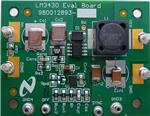
AN-1529 LM3430 Evaluation Board
1
Specifications of the Board
The Evaluation Board has been designed for testing of various circuits using the LM3430 boost regulator
controller. A complete schematic for all the components is shown in Figure 1. The board is two layers with
components and power paths in 1oz. copper. The board is 62mil FR4 laminate.
VIN
L1
1
IN1
CIN2
2
RUV2
10
8
SYNC
RUV1
RT
11
CSS
OFF
Q2
NC
VDHC
CINX
4
VIN
RT
UVLO
SS
LM3430
+C
COMP
OUT
CS
GND
VCC
FB
RC1
VO
D1
12
Q1
CO2
+
CO1
COX
6
9
RS2
RS1
7
5
CF
CSNS
RSNS
RFB2
3
CC2
RFB1
RPD
CC1
Figure 1. Circuit Schematic
2
Example Circuit
The example circuit that comes on the evaluation board delivers a 48V ±2% output voltage at currents up
to 700 mA and switches at 600 kHz. The input voltage range is optimized between 10.8V and 26.4V. The
measured efficiency of the converter is 96% at an input voltage of 24V and an output current of 0.7A.
Figure 2. Efficiency
All trademarks are the property of their respective owners.
SNVA187C – January 2007 – Revised May 2013
Submit Documentation Feedback
Copyright © 2007–2013, Texas Instruments Incorporated
AN-1529 LM3430 Evaluation Board
1
�Powering the Converter
3
www.ti.com
Powering the Converter
The example circuit for the LM3430 Evaluation Board is optimized to run at inputs of 12V or 24V, however
the circuit will operate with input voltages ranging from 6.0V to 40.0V connected between the ‘VIN’ and
‘GND’ terminals on the right side of the board. Fixed loads, resistors, and variable electronic loads can be
connected between the ‘Vo’ and ‘GND’ terminals on the left side of the board. Section 10 lists all the
components used in the example circuit.
4
Enabling the Converter
The OFF terminal controls the state of the converter while power is applied to the input terminals. The
LM340 is disabled whenever the voltage at OFF is a logic high. (Above 2.0V.) The LM3430 is enabled
whenever the OFF terminal is open-circuited or connected to ground. Upon enabling the LM3430 will
perform a soft-start, after which the output is ready to supply current to the load.
5
Testing the Converter
Figure 3 shows a block diagram of connections for making measurements of efficiency. The wires used for
making connections at both the input and output should be rated to at least 10A of continuous current and
should be no longer than is needed for convenient testing. A series ammeter capable of measuring 10A or
more should be used for both the input and the output lines. Dedicated voltmeters should be connected
with their positive and negative leads right at the four power terminals at the sides of the evaluation board.
This measurement technique minimizes the resistive loss in the wires that connect the evaluation board to
the input power supply and the electronic load.
Output voltage ripple measurements should be taken directly across the 100 nF ceramic capacitor Cox,
placed right between the output terminals. Care must be taken to minimize the loop area between the
oscilloscope probe tip and the ground lead. One method to minimize this loop is to remove the probe’s
spring tip and ‘pigtail’ ground lead and then wind bare wire around the probe shaft. The bare wire should
contact the ground of the probe, and the end of the wire can then contact the ground side of Cox. Figure 4
shows a diagram of this method.
Ammeter
Voltmeter
V
+
50W Electronic
Load
Ammeter
Vo
A
Vin
+
A
40V, 6A
Power Supply
GND
-
GND
V Voltmeter
-
LM3430
Evaluation Board
Figure 3. Efficiency Measurement Setup
Oscilloscope
Vo
GND
Cox
Figure 4. Output Voltage Ripple Measurement Setup
2
AN-1529 LM3430 Evaluation Board
SNVA187C – January 2007 – Revised May 2013
Submit Documentation Feedback
Copyright © 2007–2013, Texas Instruments Incorporated
�MOSFET Footprints
www.ti.com
6
MOSFET Footprints
The LM3430 evaluation board has a footprint for a single MOSFET with an SO-8 package using the
industry standard pinout. (See Figure 5). This footprint can also accept newer MOSFET packages that are
compatible with SO-8 footprints.
S
D
S
D
SO-8
S
D
G
D
Figure 5. SO-8 MOSFET Pinout
7
Permanent Components
The following components should remain the same for any new circuits evaluated on the LM3430
evaluation board.
8
Name
Value
Cox, Cinx
0.1 µF
Cf
1 µF
Csns
1 nF
Rpd
10 kΩ
Rs1
100Ω
Additional Footprints
The 100 pF capacitor Csyc provides an AC input path for external clock synchronization. Detection of the
sync pulse requires a peak voltage level greater than 3.8V at the RT/SYNC pin. Note that the DC voltage
at RT/SYNC is approximately 2V to allow compatibility with 3.3V logic. The sync pulse width should be set
between 15 ns to 150 ns by the external components. The Rt resistor is always required, whether the
oscillator is free running or externally synchronized. Rt must be selected so that the free-running oscillator
frequency is below the lowest synchronization frequency.
SNVA187C – January 2007 – Revised May 2013
Submit Documentation Feedback
Copyright © 2007–2013, Texas Instruments Incorporated
AN-1529 LM3430 Evaluation Board
3
�Typical Performance Characteristics
9
www.ti.com
Typical Performance Characteristics
10V/Div
10V/Div
VO
VO
SW
SW
10V/Div
10V/Div
1 Ps/DIV
1 Ps/DIV
Figure 6. Switch Node Voltage
(VIN = 12V, IO = 0.5A)
Figure 7. Switch Node Voltage
(VIN = 24V, IO = 0.5A)
VO
VO
50 mV/DIV
50 mV/Div
1 Ps/DIV
Figure 8. Output Voltage Ripple AC Coupled
(VIN = 12V, IO = 0.5A)
4
AN-1529 LM3430 Evaluation Board
1 Ps/DIV
Figure 9. Output Voltage Ripple AC Coupled
(VIN = 24V, IO = 0.5A)
SNVA187C – January 2007 – Revised May 2013
Submit Documentation Feedback
Copyright © 2007–2013, Texas Instruments Incorporated
�Typical Performance Characteristics
www.ti.com
VO
5V/Div
VO
500 mA/Div
IO
1 ms/DIV
5V/Div
500 mA/Div
IO
1 ms/DIV
Figure 11. Load Transient Response
(VIN = 24V, IO = 0 to 0.7A)
Figure 10. Load Transient Response
(VIN = 12V, IO = 0 to 0.7A)
OFF
5V/Div
OFF
5V/Div
20V/Div
20V/Div
VO
VO
20V/Div
20V/Div
SW
IIN
SW
2A/Div
IIN
400 és/DIV
Figure 12. Start Up
(VIN = 12V, IO = 0.5A)
SNVA187C – January 2007 – Revised May 2013
Submit Documentation Feedback
Copyright © 2007–2013, Texas Instruments Incorporated
2A/Div
200 Ps/DIV
Figure 13. Shutdown
(VIN = 12V, IO = 0.5A)
AN-1529 LM3430 Evaluation Board
5
�Typical Performance Characteristics
OFF
www.ti.com
OFF
5V/Div
5V/Div
20V/Div
VO
VO
SW
20V/Div
20V/Div
SW
IIN
2A/Div
20V/Div
2A/Div
IIN
100 Ps/DIV
200 Ps/Div
Figure 14. Start Up
(VIN = 24V, IO = 0.5A)
NGATE
2V/Div
Figure 15. Shutdown
(VIN = 24V, IO = 0.5A)
2V/Div
NGATE
20 ns/DIV
20 ns/DIV
Figure 16. NGATE Rise Time
(VIN = 12V, no-load, Si4850DY)
6
AN-1529 LM3430 Evaluation Board
Figure 17. NGATE Fall Time
(VIN = 12V, no-load, Si4850DY)
SNVA187C – January 2007 – Revised May 2013
Submit Documentation Feedback
Copyright © 2007–2013, Texas Instruments Incorporated
�Bill of Materials
www.ti.com
10
Bill of Materials
ID
Part Number
Type
Size
U1
LM3430
Low-Side Controller
WSON-12
Parameters
Qty
Vendor
1
Texas
Instruments
Q1
Si4850EY
MOSFET
SO-8
60V, 31mΩ, 27nC
1
Vishay
D1
CMSH3-60M
Schottky Diode
SMB
60V, 3A
1
Central Semi
L1
PF0553.333NL
Inductor
12.5x12.5 x8mm
33µH, 6.22A, 60mΩ
1
Pulse
Cin1,
Cin2
C4532X7R1H475M
Capacitor
1812
4.7µF, 50V
2
TDK
Co1,
Co2
C5750X7R2A475M
Capacitor
2220
4.7µF, 100V, 2mΩ
2
TDK
Cf
C3216X7R1E105K
Capacitor
1206
1µF, 25V
1
TDK
Cinx,
Cox
C2012X7R2A104M
Capacitor
0805
100nF 100V
2
TDK
Cc1
VJ0805Y222KXXAT
Capacitor
0805
2.2nF 10%
1
Vishay
Cc2
VJ0805Y224KXXAT
Capacitor
0805
220nF 10%
1
Vishay
Css
VJ0805Y103KXXAT
Capacitor
0805
10nF 10%
1
Vishay
Csns
VJ0805Y102KXXAT
Capacitor
0805
1nF 10%
1
Vishay
Csyc
VJ0805A101KXXAT
Capacitor
0805
100pF 10%
1
Vishay
Rc
CRCW08051621F
Resistor
0805
1.62kΩ 1%
1
Vishay
Rfb1
CRCW08055360F
Resistor
0805
536Ω 1%
1
Vishay
Rfb2
CRCW08052002F
Resistor
0805
20kΩ 1%
1
Vishay
Rs1
CRCW0805331J
Resistor
0805
330Ω 5%
1
Vishay
Rs2
CRCW08054990F
Resistor
0805
499Ω 1%
1
Vishay
Rsns
WSL2010 0.1 1%
Resistor
2010
0.1Ω 1%, 0.5W
1
Vishay
Rt
CRCW08053402F
Resistor
0805
34kΩ 1%
1
Vishay
Ruv1,
Ruv2
CRCW0805103J
Resistor
0805
10kΩ 5%
2
Vishay
VIN, Vo,
GND,
GND2
160-1026
Terminal
0.094”
4
Cambion
GND3,
GND4,
OFF,
SYNC
160-1512
Terminal
0.062”
4
Cambion
SNVA187C – January 2007 – Revised May 2013
Submit Documentation Feedback
Copyright © 2007–2013, Texas Instruments Incorporated
AN-1529 LM3430 Evaluation Board
7
�PC Board Layout
11
www.ti.com
PC Board Layout
Figure 18. Top Layer and Top Overlay
Figure 19. Bottom Layer
8
AN-1529 LM3430 Evaluation Board
SNVA187C – January 2007 – Revised May 2013
Submit Documentation Feedback
Copyright © 2007–2013, Texas Instruments Incorporated
�IMPORTANT NOTICE
Texas Instruments Incorporated and its subsidiaries (TI) reserve the right to make corrections, enhancements, improvements and other
changes to its semiconductor products and services per JESD46, latest issue, and to discontinue any product or service per JESD48, latest
issue. Buyers should obtain the latest relevant information before placing orders and should verify that such information is current and
complete. All semiconductor products (also referred to herein as “components”) are sold subject to TI’s terms and conditions of sale
supplied at the time of order acknowledgment.
TI warrants performance of its components to the specifications applicable at the time of sale, in accordance with the warranty in TI’s terms
and conditions of sale of semiconductor products. Testing and other quality control techniques are used to the extent TI deems necessary
to support this warranty. Except where mandated by applicable law, testing of all parameters of each component is not necessarily
performed.
TI assumes no liability for applications assistance or the design of Buyers’ products. Buyers are responsible for their products and
applications using TI components. To minimize the risks associated with Buyers’ products and applications, Buyers should provide
adequate design and operating safeguards.
TI does not warrant or represent that any license, either express or implied, is granted under any patent right, copyright, mask work right, or
other intellectual property right relating to any combination, machine, or process in which TI components or services are used. Information
published by TI regarding third-party products or services does not constitute a license to use such products or services or a warranty or
endorsement thereof. Use of such information may require a license from a third party under the patents or other intellectual property of the
third party, or a license from TI under the patents or other intellectual property of TI.
Reproduction of significant portions of TI information in TI data books or data sheets is permissible only if reproduction is without alteration
and is accompanied by all associated warranties, conditions, limitations, and notices. TI is not responsible or liable for such altered
documentation. Information of third parties may be subject to additional restrictions.
Resale of TI components or services with statements different from or beyond the parameters stated by TI for that component or service
voids all express and any implied warranties for the associated TI component or service and is an unfair and deceptive business practice.
TI is not responsible or liable for any such statements.
Buyer acknowledges and agrees that it is solely responsible for compliance with all legal, regulatory and safety-related requirements
concerning its products, and any use of TI components in its applications, notwithstanding any applications-related information or support
that may be provided by TI. Buyer represents and agrees that it has all the necessary expertise to create and implement safeguards which
anticipate dangerous consequences of failures, monitor failures and their consequences, lessen the likelihood of failures that might cause
harm and take appropriate remedial actions. Buyer will fully indemnify TI and its representatives against any damages arising out of the use
of any TI components in safety-critical applications.
In some cases, TI components may be promoted specifically to facilitate safety-related applications. With such components, TI’s goal is to
help enable customers to design and create their own end-product solutions that meet applicable functional safety standards and
requirements. Nonetheless, such components are subject to these terms.
No TI components are authorized for use in FDA Class III (or similar life-critical medical equipment) unless authorized officers of the parties
have executed a special agreement specifically governing such use.
Only those TI components which TI has specifically designated as military grade or “enhanced plastic” are designed and intended for use in
military/aerospace applications or environments. Buyer acknowledges and agrees that any military or aerospace use of TI components
which have not been so designated is solely at the Buyer's risk, and that Buyer is solely responsible for compliance with all legal and
regulatory requirements in connection with such use.
TI has specifically designated certain components as meeting ISO/TS16949 requirements, mainly for automotive use. In any case of use of
non-designated products, TI will not be responsible for any failure to meet ISO/TS16949.
Products
Applications
Audio
www.ti.com/audio
Automotive and Transportation
www.ti.com/automotive
Amplifiers
amplifier.ti.com
Communications and Telecom
www.ti.com/communications
Data Converters
dataconverter.ti.com
Computers and Peripherals
www.ti.com/computers
DLP® Products
www.dlp.com
Consumer Electronics
www.ti.com/consumer-apps
DSP
dsp.ti.com
Energy and Lighting
www.ti.com/energy
Clocks and Timers
www.ti.com/clocks
Industrial
www.ti.com/industrial
Interface
interface.ti.com
Medical
www.ti.com/medical
Logic
logic.ti.com
Security
www.ti.com/security
Power Mgmt
power.ti.com
Space, Avionics and Defense
www.ti.com/space-avionics-defense
Microcontrollers
microcontroller.ti.com
Video and Imaging
www.ti.com/video
RFID
www.ti-rfid.com
OMAP Applications Processors
www.ti.com/omap
TI E2E Community
e2e.ti.com
Wireless Connectivity
www.ti.com/wirelessconnectivity
Mailing Address: Texas Instruments, Post Office Box 655303, Dallas, Texas 75265
Copyright © 2013, Texas Instruments Incorporated
�