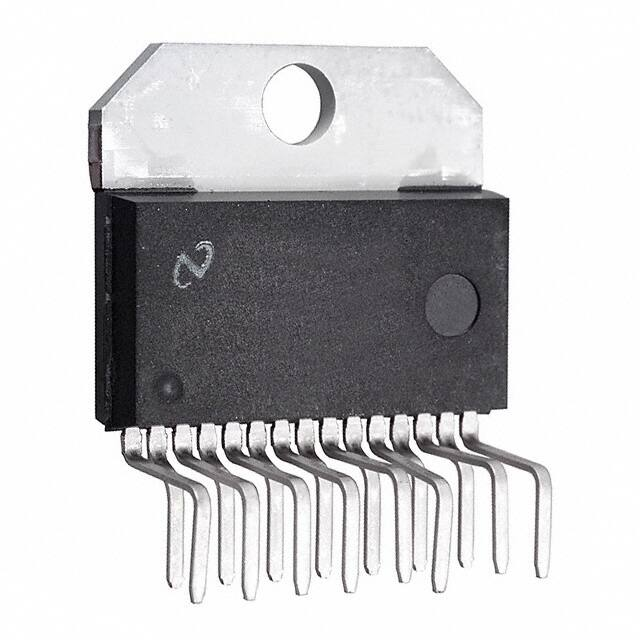
LMD18245
www.ti.com
SNVS110E – APRIL 1998 – REVISED APRIL 2013
LMD18245 3A, 55V DMOS Full-Bridge Motor Driver
Check for Samples: LMD18245
FEATURES
DESCRIPTION
•
The
LMD18245
full-bridge
power
amplifier
incorporates all the circuit blocks required to drive
and control current in a brushed type DC motor or
one phase of a bipolar stepper motor. The multitechnology process used to build the device
combines bipolar and CMOS control and protection
circuitry with DMOS power switches on the same
monolithic structure. The LMD18245 controls the
motor current via a fixed off-time chopper technique.
1
2
•
•
•
•
•
•
•
•
•
DMOS Power Stage Rated at 55V and 3A
Continuous
Low RDS(ON) of Typically 0.3Ω per Power
Switch
Internal Clamp Diodes
Low-loss Current Sensing Method
Digital or Analog Control of Motor Current
TTL and CMOS Compatible Inputs
Thermal Shutdown (Outputs Off) at TJ = 155°C
Overcurrent Protection
No Shoot-Through Currents
15-lead Package
APPLICATIONS
•
•
•
Full, Half and Microstep Stepper Motor Drives
Stepper Motor and Brushed DC Motor Servo
Drives
Automated Factory, Medical and Office
Equipment
An all DMOS H-bridge power stage delivers
continuous output currents up to 3A (6A peak) at
supply voltages up to 55V. The DMOS power
switches feature low RDS(ON) for high efficiency, and a
diode intrinsic to the DMOS body structure eliminates
the discrete diodes typically required to clamp bipolar
power stages.
An innovative current sensing method eliminates the
power loss associated with a sense resistor in series
with the motor. A four-bit digital-to-analog converter
(DAC) provides a digital path for controlling the motor
current, and, by extension, simplifies implementation
of full, half and microstep stepper motor drives. For
higher resolution applications, an external DAC can
be used.
1
2
Please be aware that an important notice concerning availability, standard warranty, and use in critical applications of
Texas Instruments semiconductor products and disclaimers thereto appears at the end of this data sheet.
All trademarks are the property of their respective owners.
PRODUCTION DATA information is current as of publication date.
Products conform to specifications per the terms of the Texas
Instruments standard warranty. Production processing does not
necessarily include testing of all parameters.
Copyright © 1998–2013, Texas Instruments Incorporated
�LMD18245
SNVS110E – APRIL 1998 – REVISED APRIL 2013
www.ti.com
Functional Block and Connection Diagram
15-Lead TO-220 Power Package (NDL)
Figure 1. Functional Block Diagram
Connection Diagram
Figure 2. Top View
15-Lead Package TO-220 Power Package
See Package Number NDL0015A
2
Submit Documentation Feedback
Copyright © 1998–2013, Texas Instruments Incorporated
Product Folder Links: LMD18245
�LMD18245
www.ti.com
SNVS110E – APRIL 1998 – REVISED APRIL 2013
Pinout Descriptions
(See Functional Block and Connection Diagrams)
Pin 1, OUT 1: Output node of the first half H-bridge.
Pin 2, COMP OUT: Output of the comparator. If the voltage at CS OUT exceeds that provided by the DAC, the
comparator triggers the monostable.
Pin 3, RC: Monostable timing node. A parallel resistorcapacitor network connected between this node and
ground sets the monostable timing pulse at about 1.1 RC seconds.
Pin 5, PGND: Ground return node of the power bridge. Bond wires (internaI) connect PGND to the tab of the
TO-220 package.
Pins 4 and 6 through 8, M4 through M1: Digital inputs of the DAC. These inputs make up a four-bit binary
number with M4 as the most significant bit or MSB. The DAC provides an analog voltage directly proportional to
the binary number applied at M4 through M1.
Pin 9, VCC: Power supply node.
Pin 10, BRAKE: Brake logic input. Pulling the BRAKE input logic-high activates both sourcing switches of the
power bridge — effectively shorting the load. See SWITCH CONTROL LOGIC TRUTH TABLE (1). Shorting the
load in this manner forces the load current to recirculate and decay to zero.
Pin 11, DIRECTION: Direction logic input. The logic level at this input dictates the direction of current flow in the
load. See SWITCH CONTROL LOGIC TRUTH TABLE (1).
Pin 12, SGND: Ground return node of all signal level circuits.
Pin 13, CS OUT: Output of the current sense amplifier. The current sense amplifier sources 250 μA (typical) per
ampere of total forward current conducted by the upper two switches of the power bridge.
Pin 14, DAC REF: Voltage reference input of the DAC. The DAC provides an analog voltage equal to VDAC
D/16, where D is the decimal equivalent (0–15) of the binary number applied at M4 through M1.
REF
×
Pin 15, OUT 2: Output node of the second half H-bridge.
SWITCH CONTROL LOGIC TRUTH TABLE (1)
(1)
(1)
BRAKE
DIRECTION
MONO
H
X
X
Source 1, Source 2
Active Switches
L
H
L
Source 2
L
H
H
Source 2, Sink 1
L
L
L
Source 1
L
L
H
Source 1, Sink 2
X = don't care. MONO is the output of the monostable.
X = don't care. MONO is the output of the monostable.
Submit Documentation Feedback
Copyright © 1998–2013, Texas Instruments Incorporated
Product Folder Links: LMD18245
3
�LMD18245
SNVS110E – APRIL 1998 – REVISED APRIL 2013
www.ti.com
These devices have limited built-in ESD protection. The leads should be shorted together or the device placed in conductive foam
during storage or handling to prevent electrostatic damage to the MOS gates.
Absolute Maximum Ratings
(1) (2)
DC Voltage at:
OUT 1, VCC, and OUT 2
+60V
COMP OUT, RC, M4, M3, M2, M1, BRAKE,
+12V
DIRECTION, CS OUT, and DAC REF
DC Voltage PGND to SGND
±400mV
Continuous Load Current
Peak Load Current
3A
(3)
6A
Junction Temperature (TJ(max))
Power Dissipation
(4)
+150°C
:
TO-220 (TA = 25°C, Infinite Heatsink)
25W
TO-220 (TA = 25°C, Free Air)
3.5W
ESD Susceptibility
(5)
1500V
−40°C to +150°C
Storage Temperature Range (TS)
Lead Temperature (Soldering, 10 seconds)
(1)
(2)
(3)
(4)
(5)
300°C
Absolute Maximum Ratings indicate limits beyond which damage to the device may occur. Electrical specifications do not apply when
operating the device outside the rated Operating Conditions.
If Military/Aerospace specified devices are required, please contact the Texas Instruments Sales Office/ Distributors for availability and
specifications.
Unless otherwise stated, load currents are pulses with widths less than 2 ms and duty cycles less than 5%.
The maximum allowable power dissipation at any ambient temperature is PMax = (125 − TA)/θJA, where 125°C is the maximum junction
temperature for operation, TA is the ambient temperature in °C, and θJAis the junction-to-ambient thermal resistance in °C/W. Exceeding
Pmax voids the Electrical Specifications by forcing TJabove 125°C. If the junction temperature exceeds 155°C, internal circuitry disables
the power bridge. When a heatsink is used, θJAis the sum of the junction-to-case thermal resistance of the package, θJC, and the caseto-ambient thermal resistance of the heatsink.
ESD rating is based on the human body model of 100 pF discharged through a 1.5 kΩ resistor. M1, M2, M3 and M4, pins 8, 7, 6 and 4
are protected to 800V.
Operating Conditions
Temperature Range (TJ)
(1)
(2)
−40°C to +125°C
Supply Voltage Range (VCC)
+12V to +55V
CS OUT Voltage Range
0V to +5V
DAC REF Voltage Range
0V to +5V
10 μs to 100 ms
MONOSTABLE Pulse Range
(1)
(2)
4
Absolute Maximum Ratings indicate limits beyond which damage to the device may occur. Electrical specifications do not apply when
operating the device outside the rated Operating Conditions.
The maximum allowable power dissipation at any ambient temperature is PMax = (125 − TA)/θJA, where 125°C is the maximum junction
temperature for operation, TA is the ambient temperature in °C, and θJAis the junction-to-ambient thermal resistance in °C/W. Exceeding
Pmax voids the Electrical Specifications by forcing TJabove 125°C. If the junction temperature exceeds 155°C, internal circuitry disables
the power bridge. When a heatsink is used, θJAis the sum of the junction-to-case thermal resistance of the package, θJC, and the caseto-ambient thermal resistance of the heatsink.
Submit Documentation Feedback
Copyright © 1998–2013, Texas Instruments Incorporated
Product Folder Links: LMD18245
�LMD18245
www.ti.com
SNVS110E – APRIL 1998 – REVISED APRIL 2013
Electrical Characteristics
(1)
The following specifications apply for VCC = +42V, unless otherwise stated. Boldface limits apply over the operating
temperature range, −40°C ≤ TJ ≤ +125°C. All other limits apply for TA = TJ = 25°C.
Symbol
ICC
Parameter
Quiescent Supply Current
Conditions
DAC REF = 0V, VCC = +20V
Typical
(2)
Limit
8
(2)
Units
(Limits)
mA
15
mA (max)
0.4
Ω (max)
0.6
Ω (max)
0.4
Ω (max)
0.6
Ω (max)
1.5
V(max)
POWER OUTPUT STAGE
RDS(ON)
VDIODE
Switch ON Resistance
Body Diode Forward Voltage
ILOAD = 3A
0.3
ILOAD = 6A
0.3
IDIODE = 3A
1.0
V
Trr
Diode Reverse Recovery Time
IDIODE = 1A
80
ns
Qrr
Diode Reverse Recovery Charge
IDIODE = 1A
40
nC
tD(ON)
Output Turn ON Delay Time
tD(OFF)
tON
tOFF
Sourcing Outputs
ILOAD = 3A
5
μs
Sinking Outputs
ILOAD = 3A
900
ns
Sourcing Outputs
ILOAD = 3A
600
ns
Sinking Outputs
ILOAD = 3A
400
ns
Sourcing Outputs
ILOAD = 3A
40
μs
Sinking Outputs
ILOAD = 3A
1
μs
Sourcing Outputs
ILOAD = 3A
200
ns
Sinking Outputs
ILOAD = 3A
80
ns
Pins 10 and 11
2
μs
40
ns
Output Turn OFF Delay Time
Output Turn ON Switching Time
Output Turn OFF Switching Time
tpw
Minimum Input Pulse Width
tDB
Minimum Dead Band
(3)
CURRENT SENSE AMPLIFIER
Current Sense Output
ILOAD = 1A
(4)
200
250
Current Sense Linearity Error
Current Sense Offset
(1)
(2)
(3)
(4)
0.5A ≤ ILOAD ≤ 3A
(4)
ILOAD = 0A
μA (min)
175
μA (min)
300
μA (max)
325
μA (max)
±9
%(max)
20
μA (max)
±6
%
μA
5
Unless otherwise stated, load currents are pulses with widths less than 2 ms and duty cycles less than 5%.
All limits are 100% production tested at 25°C. Temperature extreme limits are ensured via correlation using accepted SQC (Statistical
Quality Control) methods. All limits are used to calculate AOQL (Average Outgoing Quality Level). Typicals are at TJ = 25°C and
represent the most likely parametric norm.
Asymmetric turn OFF and ON delay times and switching times ensure a switch turns OFF before the other switch in the same half Hbridge begins to turn ON (preventing momentary short circuits between the power supply and ground). The transitional period during
which both switches are OFF is commonly referred to as the dead band.
(ILOAD, ISENSE) data points are taken for load currents of 0.5A, 1A, 2A and 3A. The current sense gain is specified as ISENSE/ILOAD for the
1A data point. The current sense linearity is specified as the slope of the line between the 0.5A and 1A data points minus the slope of
the line between the 2A and 3A data points all divided by the slope of the line between the 0.5A and 1A data points.
Submit Documentation Feedback
Copyright © 1998–2013, Texas Instruments Incorporated
Product Folder Links: LMD18245
5
�LMD18245
SNVS110E – APRIL 1998 – REVISED APRIL 2013
www.ti.com
Electrical Characteristics (1) (continued)
The following specifications apply for VCC = +42V, unless otherwise stated. Boldface limits apply over the operating
temperature range, −40°C ≤ TJ ≤ +125°C. All other limits apply for TA = TJ = 25°C.
Symbol
Parameter
Conditions
Typical
(2)
Limit
(2)
Units
(Limits)
DIGITAL-TO-ANALOG CONVERTER (DAC)
Resolution
4
Monotonicity
4
Bits (min)
0.25
LSB (max)
0.5
LSB (max)
Total Unadjusted Error
0.125
Propagation Delay
IREF
DAC REF Input Current
DAC REF = +5V
Bits (min)
50
ns
−0.5
μA
±10
μA (max)
COMPARATOR AND MONOSTABLE
Comparator High Output Level
6.27
V
Comparator Low Output Level
88
mV
Source
0.2
mA
Sink
3.2
mA
Comparator Output Current
tDELAY
Monostable Turn OFF Delay
(5)
μs
1.2
2.0
μs (max)
PROTECTION AND PACKAGE THERMAL RESISTANCES
Undervoltage Lockout, VCC
TJSD
Shutdown Temperature, TJ
5
V (min)
8
V (max)
155
°C
Package Thermal Resistances
θJC
Junction-to-Case, TO-220
1.5
°C/W
θJA
Junction-to-Ambient, TO-220
35
°C/W
LOGIC INPUTS
VIL
Low Level Input Voltage
VIH
High Level Input Voltage
IIN
Input Current
(5)
6
VIN = 0V or 12V
−0.1
V (min)
0.8
V (max)
2
V (min)
12
V (max)
±10
μA (max)
Turn OFF delay, tDELAY, is defined as the time from the voltage at the output of the current sense amplifier reaching the DAC output
voltage to the lower DMOS switch beginning to turn OFF. With VCC = 32V, DIRECTION high, and 200Ω connected between OUT1 and
VCC, the voltage at RC is increased from 0V to 5V at 1.2V/μs, and tDELAY is measured as the time from the voltage at RC reaching 2V to
the time the voltage at OUT 1 reaches 3V.
Submit Documentation Feedback
Copyright © 1998–2013, Texas Instruments Incorporated
Product Folder Links: LMD18245
�LMD18245
www.ti.com
SNVS110E – APRIL 1998 – REVISED APRIL 2013
Typical Performance Characteristics
RDS(ON) vs Temperature
RDS(ON) vs Load Current
Figure 3.
Figure 4.
RDS(ON) vs Supply Voltage
Current Sense Output vs Load Current
Figure 5.
Figure 6.
Supply Current vs Supply Voltage
Supply Current vs Temperature
Figure 7.
Figure 8.
Submit Documentation Feedback
Copyright © 1998–2013, Texas Instruments Incorporated
Product Folder Links: LMD18245
7
�LMD18245
SNVS110E – APRIL 1998 – REVISED APRIL 2013
www.ti.com
FUNCTIONAL DESCRIPTIONS
TYPICAL OPERATION OF A CHOPPER AMPLIFIER
Chopper amplifiers employ feedback driven switching of a power bridge to control and limit current in the winding
of a motor (Figure 9). The bridge consists of four solid state power switches and four diodes connected in an H
configuration. Control circuitry (not shown) monitors the winding current and compares it to a threshold. While the
winding current remains less than the threshold, a source switch and a sink switch in opposite halves of the
bridge force the supply voltage across the winding, and the winding current increases rapidly towards VCC/R
(Figure 9a and Figure 9d ). As the winding current surpasses the threshold, the control circuitry turns OFF the
sink switch for a fixed period or off-time. During the off-time, the source switch and the opposite upper diode
short the winding, and the winding current recirculates and decays slowly towards zero (Figure 9b and
Figure 9e ). At the end of the off-time, the control circuitry turns back ON the sink switch, and the winding current
again increases rapidly towards VCC/R (Figure 9a and Figure 9d again). The above sequence repeats to provide
a current chopping action that limits the winding current to the threshold (Figure 9g ). Chopping only occurs if the
winding current reaches the threshold. During a change in the direction of the winding current, the diodes provide
a decay path for the initial winding current (Figure 9c and Figure 9f ). Since the bridge shorts the winding for a
fixed period, this type of chopper amplifier is commonly referred to as a fixed off-time chopper.
8
(a)
(b)
(c)
(d)
Submit Documentation Feedback
Copyright © 1998–2013, Texas Instruments Incorporated
Product Folder Links: LMD18245
�LMD18245
www.ti.com
SNVS110E – APRIL 1998 – REVISED APRIL 2013
(e)
(f)
(g)
Figure 9. Chopper Amplifier Chopping States: Full VCC Applied Across the Winding (a) and (d), Shorted
Winding (b) and (e), Winding Current Decays During a Change in the Direction of the Winding Current (c)
and (f), and the Chopped Winding Current (g)
THE LMD18245 CHOPPER AMPLIFIER
The LMD18245 incorporates all the circuit blocks needed to implement a fixed off-time chopper amplifier. These
blocks include: an all DMOS, full H-bridge with clamp diodes, an amplifier for sensing the load current, a
comparator, a monostable, and a DAC for digital control of the chopping threshold. Also incorporated are logic,
level shifting and drive blocks for digital control of the direction of the load current and braking.
THE H-BRIDGE
The power stage consists of four DMOS power switches and associated body diodes connected in an H-bridge
configuration (Figure 10 ).
The time constant to charge or discharge any inductor, in this case the motor windings, is defined as:
τ = L/R
where
•
•
L is the winding inductance
R is the sum of the series resistance in the current path including the winding resistance
(1)
Turning ON a source switch and a sink switch in opposite halves of the bridge forces the full supply voltage less
the switch drops (I x RDS(ON)) across the motor winding. While the bridge remains in this state, the winding
current increases exponentially towards a limit dictated by the supply voltage, the switch drops (I x RDS(ON)), and
the winding resistance. However, the winding current exponential rate of increase will end when the current
chopping circuitry becomes active.
Subsequently turning OFF the sink switch causes a voltage transient that forward biases the body diode of the
other source switch. The diode clamps the transient at one diode drop above the supply voltage and provides an
alternative current path. While the bridge remains in this state, it essentially shorts the winding, the winding
current recirculates and decays exponentially towards zero at a rate that is defined by the L/R time constant.
During a change in the direction of the winding current, both the switches and the body diodes provide a decay
path for the initial winding current (Figure 11 ).
Submit Documentation Feedback
Copyright © 1998–2013, Texas Instruments Incorporated
Product Folder Links: LMD18245
9
�LMD18245
SNVS110E – APRIL 1998 – REVISED APRIL 2013
www.ti.com
During actual motor operation there are many variables that can effect the motor winding magnetic behavior and
performance. Resonance, eddy currents, friction, motor loading, damping, temperature coefficients of the
windings, are only a few. These are all issues that are beyond the scope of the this data sheet.
Figure 10. The DMOS H-Bridge
10
Submit Documentation Feedback
Copyright © 1998–2013, Texas Instruments Incorporated
Product Folder Links: LMD18245
�LMD18245
www.ti.com
SNVS110E – APRIL 1998 – REVISED APRIL 2013
Figure 11. Decay Paths for Initial Winding Current During a Change in the Direction of the Winding
Current
THE CURRENT SENSE AMPLIFIER
Many transistor cells in parallel make up the DMOS power switches. The current sense amplifier (Figure 12 )
uses a small fraction of the cells of both upper switches to provide a unique, low-loss means for sensing the load
current. In practice, each upper switch functions as a 1x sense device in parallel with a 4000x power device. The
current sense amplifier forces the voltage at the source of the sense device to equal that at the source of the
power device; thus, the devices share the total drain current in proportion to the 1:4000 cell ratio. Only the
current flowing from drain to source, the forward current, registers at the output of the current sense amplifier.
The current sense amplifier, therefore, sources 250 μA per ampere of total forward current conducted by the
upper two switches of the power bridge.
The sense current develops a potential across RSthat is proportional to the load current; for example, per ampere
of load current, the sense current develops one volt across a 4 kΩ resistor (the product of 250 μA per ampere
and 4 kΩ). Since chopping of the load current occurs as the voltage at CS OUT surpasses the threshold (the
DAC output voltage), RS sets the gain of the chopper amplifier; for example, a 2 kΩ resistor sets the gain at two
amperes of load current per volt of the threshold (the reciprocal of the product of 250 μA per ampere and 2 kΩ).
A quarter watt resistor suffices. A low value capacitor connected in parallel with RS filters the effects of switching
noise from the current sense signal.
While the specified maximum DC voltage compliance at CS OUT is 12V, the specified operating voltage range at
CS OUT is 0V to 5V.
Submit Documentation Feedback
Copyright © 1998–2013, Texas Instruments Incorporated
Product Folder Links: LMD18245
11
�LMD18245
SNVS110E – APRIL 1998 – REVISED APRIL 2013
www.ti.com
THE DIGITAL-TO-ANALOG CONVERTER (DAC)
The DAC sets the threshold voltage for chopping at VDAC REF × D/16, where D is the decimal equivalent (0–15) of
the binary number applied at M4 through M1, the digital inputs of the DAC. M4 is the MSB or most significant bit.
For applications that require higher resolution, an external DAC can drive the DAC REF input. While the specified
maximum DC voltage compliance at DAC REF is 12V, the specified operating voltage range at DAC REF is 0V
to 5V.
THE COMPARATOR, MONOSTABLE AND WINDING CURRENT THRESHOLD FOR CHOPPING
As the voltage at CS OUT surpasses that at the output of the DAC, the comparator triggers the monostable, and
the monostable, once triggered, provides a timing pulse to the control logic. During the timing pulse, the power
bridge shorts the motor winding, causing current in the winding to recirculate and decay slowly towards zero
(Figure 9b and Figure 9e again). A parallel resistor-capacitor network connected between RC (pin #3) and
ground sets the timing pulse or off-time at about 1.1 RC seconds.
Chopping of the winding current occurs as the voltage at CS OUT exceeds that at the output of the DAC; so
chopping occurs at a winding current threshold of about
(VDAC
REF
× D/16) ÷ ((250 × 10−6) × RS)) amperes.
(2)
The RS value required to set the winding current threshold at the maximum rated current of the LMD18245, with
D = 15 and VDAC REF of 5.00V would be:
(5.00V × 15/16) ÷ ((250 × 10−6) × 6.25 kΩ)) = 3.00A
(3)
The resulting typical DAC programmable current limit values, for different values of RS, would be:
Table 1. D to A winding current thresholds for VREF DAC = 5.00V
12
D
RS =
18.75 kΩ
RS =
9.375kΩ
RS =
6.250 kΩ
0
0.00A
0.00A
0.00A
1
0.07A
0.13A
0.20A
2
0.13A
0.27A
0.40A
3
0.20A
0.40A
0.60A
4
0.27A
0.53A
0.80A
5
0.33A
0.67A
1.00A
6
0.40A
0.80A
1.20A
7
0.47A
0.93A
1.40A
8
0.53A
1.07A
1.60A
9
0.60A
1.20A
1.80A
10
0.67A
1.33A
2.00A
11
0.73A
1.47A
2.20A
12
0.80A
1.60A
2.40A
13
0.87A
1.73A
2.60A
14
0.93A
1.87A
2.80A
15
1.00A
2.00A
3.00A
Submit Documentation Feedback
Copyright © 1998–2013, Texas Instruments Incorporated
Product Folder Links: LMD18245
�LMD18245
www.ti.com
SNVS110E – APRIL 1998 – REVISED APRIL 2013
Figure 12. The Source Switches of the Power Bridge and the Current Sense Amplifier
Applications Information
POWER SUPPLY BYPASSING
Step changes in current drawn from the power supply occur repeatedly during normal operation and may cause
large voltage spikes across inductance in the power supply line. Care must be taken to limit voltage spikes at
VCC to less than the 60V Absolute Maximum Rating. At a change in the direction of the load current, the initial
load current tends to raise the voltage at the power supply rail (Figure 11) again. Current transients caused by
the reverse recovery of the clamp diodes tend to pull down the voltage at the power supply rail.
Bypassing the power supply line at VCC is required to protect the device and minimize the adverse effects of
normal operation on the power supply rail. Using both a 1 μF high frequency ceramic capacitor and a large-value
aluminum electrolytic capacitor is highly recommended. A value of 100 μF per ampere of load current usually
suffices for the aluminum electrolytic capacitor. Both capacitors should have short leads and be located within
one half inch of VCC.
OVERCURRENT PROTECTION
If the forward current in either source switch exceeds a 12A threshold, internal circuitry disables both source
switches, forcing a rapid decay of the fault current (Figure 13). Approximately 3 μs after the fault current reaches
zero, the device restarts. Automatic restart allows an immediate return to normal operation once the fault
condition has been removed. If the fault persists, the device will begin cycling into and out of thermal shutdown.
Switching large fault currents may cause potentially destructive voltage spikes across inductance in the power
supply line; therefore, the power supply line must be properly bypassed at VCC for the motor driver to survive an
extended overcurrent fault.
In the case of a locked rotor, the inductance of the winding tends to limit the rate of change of the fault current to
a value easily handled by the protection circuitry. In the case of a low inductance short from either output to
ground or between outputs, the fault current could surge past the 12A shutdown threshold, forcing the device to
dissipate a substantial amount of power for the brief period required to disable the source switches. Because the
fault power must be dissipated by only one source switch, a short from output to ground represents the worst
case fault. Any overcurrent fault is potentially destructive, especially while operating with high supply voltages
(≥30V), so precautions are in order. Sinking VCC for heat with 1 square inch of 1 ounce copper on the printed
circuit board is highly recommended. The sink switches are not internally protected against shorts to VCC.
Submit Documentation Feedback
Copyright © 1998–2013, Texas Instruments Incorporated
Product Folder Links: LMD18245
13
�LMD18245
SNVS110E – APRIL 1998 – REVISED APRIL 2013
www.ti.com
THERMAL SHUTDOWN
Internal circuitry senses the junction temperature near the power bridge and disables the bridge if the junction
temperature exceeds about 155°C. When the junction temperature cools past the shutdown threshold (lowered
by a slight hysteresis), the device automatically restarts.
UNDERVOLTAGE LOCKOUT
Internal circuitry disables the power bridge if the power supply voltage drops below a rough threshold between
8V and 5V. Should the power supply voltage then exceed the threshold, the device automatically restarts.
Trace: Fault Current at 5A/div
Horizontal: 20 μs/div
Figure 13. Fault Current with VCC = 30V, OUT 1 Shorted to OUT 2, and CS OUT Grounded
14
Submit Documentation Feedback
Copyright © 1998–2013, Texas Instruments Incorporated
Product Folder Links: LMD18245
�LMD18245
www.ti.com
SNVS110E – APRIL 1998 – REVISED APRIL 2013
The Typical Application
Figure 14 shows the typical application, the power stage of a chopper drive for bipolar stepper motors. The 20
kΩ resistor and 2.2 nF capacitor connected between RC and ground set the off-time at about 48 μs, and the 20
kΩ resistor connected between CS OUT and ground sets the gain at about 200 mA per volt of the threshold for
chopping. Digital signals control the thresholds for chopping, the directions of the winding currents, and, by
extension, the drive type (full step, half step, etc.). A μprocessor or μcontroller usually provides the digital control
signals.
Figure 14. Typical Application Circuit for Driving Bipolar Stepper Motors
Submit Documentation Feedback
Copyright © 1998–2013, Texas Instruments Incorporated
Product Folder Links: LMD18245
15
�LMD18245
SNVS110E – APRIL 1998 – REVISED APRIL 2013
www.ti.com
ONE-PHASE-ON FULL STEP DRIVE (WAVE DRIVE)
To make the motor take full steps, windings A and B can be energized in the sequence
A→B→A*→B*→A→ …,
where A represents winding A energized with current in one direction and A* represents winding A energized
with current in the opposite direction. The motor takes one full step each time one winding is de-energized and
the other is energized. To make the motor step in the opposite direction, the order of the above sequence must
be reversed. Figure 15 shows the winding currents and digital control signals for a wave drive application of the
typical application circuit.
TWO-PHASE-ON FULL STEP DRIVE
To make the motor take full steps, windings A and B can also be energized in the sequence
AB→A*B→A*B*→AB*→AB→ …,
and because both windings are energized at all times, this sequence produces more torque than that produced
with wave drive. The motor takes one full step at each change of direction of either winding current. Figure 16
shows the winding currents and digital control signals for this application of the typical application circuit, and
Figure 17 shows, for a single phase, the winding current and voltage at the output of the associated current
sense amplifier.
16
Submit Documentation Feedback
Copyright © 1998–2013, Texas Instruments Incorporated
Product Folder Links: LMD18245
�LMD18245
www.ti.com
SNVS110E – APRIL 1998 – REVISED APRIL 2013
Top Trace: Phase A Winding Current at 1A/div
Bottom Trace: Phase B Winding Current at 1A/div
Horizontal: 1 ms/div
*500 steps/second
1
2
3
4
1
1
2
3
4
1
DIRECTION A
DIRECTION B
M4 A, M3 A, M2 A,
and M1 A
M4 B, M3 B, M2 B,
and M1 B
FORWARD
REVERSE
BRAKE A = BRAKE B = 0
Figure 15. Winding Currents and Digital Control Signals for One-Phase-On Drive (Wave Drive)
Submit Documentation Feedback
Copyright © 1998–2013, Texas Instruments Incorporated
Product Folder Links: LMD18245
17
�LMD18245
SNVS110E – APRIL 1998 – REVISED APRIL 2013
www.ti.com
Top Trace: Phase A Winding Current at 1A/div
Bottom Trace: Phase B Winding Current at 1A/div
Horizontal: 1 ms/div
*500 steps/second
1
2
3
4
1
1
2
3
4
1
DIRECTION A
DIRECTION B
FORWARD
REVERSE
M4 A through M1 A = M4 B through M1 B = 1
BRAKE A = BRAKE B = 0
Figure 16. Winding Currents and Digital Control Signals for Two-Phase-On Drive
18
Submit Documentation Feedback
Copyright © 1998–2013, Texas Instruments Incorporated
Product Folder Links: LMD18245
�LMD18245
www.ti.com
SNVS110E – APRIL 1998 – REVISED APRIL 2013
Top Trace: Phase A Winding Current at 1A/div
Bottom Trace: Phase A Sense Voltage at 5V/div
Horizontal: 1 ms/div
*500 steps/second
Figure 17. Winding Current and Voltage at the Output of the Associated Current Sense Amplifier
HALF STEP DRIVE WITHOUT TORQUE COMPENSATION
To make the motor take half steps, windings A and B can be energized in the sequence
A→AB→B→A*B→A*→
A*B*→B*→AB*→A→ …
The motor takes one half step each time the number of energized windings changes. It is important to note that
although half stepping doubles the step resolution, changing the number of energized windings from two to one
decreases (one to two increases) torque by about 40%, resulting in significant torque ripple and possibly noisy
operation. Figure 18 shows the winding currents and digital control signals for this half step application of the
typical application circuit.
Submit Documentation Feedback
Copyright © 1998–2013, Texas Instruments Incorporated
Product Folder Links: LMD18245
19
�LMD18245
SNVS110E – APRIL 1998 – REVISED APRIL 2013
www.ti.com
Top Trace: Phase A Winding Current at 1A/div
Bottom Trace: Phase B Winding Current at 1A/div
Horizontal: 1 ms/div
*500 steps/second
1
2
3
4
5
6
7
8
1
1
2
3
4
5
6
7
8
1
DIRECTION A
DIRECTION B
M4 A, M3 A, M2 A,
and M1 A
M4 B, M3 B, M2 B,
and M1 B
FORWARD
REVERSE
BRAKE A = BRAKE B = 0
Figure 18. Winding Currents and Digital Control Signals for Half Step Drive without Torque
Compensation
20
Submit Documentation Feedback
Copyright © 1998–2013, Texas Instruments Incorporated
Product Folder Links: LMD18245
�LMD18245
www.ti.com
SNVS110E – APRIL 1998 – REVISED APRIL 2013
HALF STEP DRIVE WITH TORQUE COMPENSATION
To make the motor take half steps, the windings can also be energized with sinusoidal currents (Figure 19).
Controlling the winding currents in the fashion shown doubles the step resolution without the significant torque
ripple of the prior drive technique. The motor takes one half step each time the level of either winding current
changes. Half step drive with torque compensation is microstepping drive. Along with the obvious advantage of
increased step resolution, micro-stepping reduces both full step oscillations and resonances that occur as the
motor and load combination is driven at its natural resonant frequency or subharmonics thereof. Both of these
advantages are obtained by replacing full steps with bursts of microsteps. When compared to full step drive, the
motor runs smoother and quieter.
Table 2 shows the lookup table for this application of the typical application circuit. Dividing 90°electrical per full
step by two microsteps per full step yields 45° electrical per microstep. α, therefore, increases from 0 to 315° in
increments of 45°. Each full 360° cycle comprises eight half steps. Rounding |cosα| to four bits gives D A, the
decimal equivalent of the binary number applied at M4 A through M1 A. DIRECTION A controls the polarity of the
current in winding A. Figure 19 shows the sinusoidal winding currents.
Submit Documentation Feedback
Copyright © 1998–2013, Texas Instruments Incorporated
Product Folder Links: LMD18245
21
�LMD18245
SNVS110E – APRIL 1998 – REVISED APRIL 2013
www.ti.com
Top Trace: Phase A Winding Current at 1A/div
Bottom Trace: Phase B Winding Current at 1A/div
Horizontal: 2 ms/div
*500 steps/second
1
2
3
4
5
6
7
8
1
1
2
3
4
5
6
7
8
1
DIRECTION A
DIRECTION B
M4 A, M2 A, M1 A,
and M3 B
M4 B, M2 B, M1 B,
and M3 A
FORWARD
REVERSE
BRAKE A = BRAKE B = 0
90° ELECTRICAL/FULL STEP ÷ 2 MICROSTEPS/FULL STEP = 45° ELECTRICAL/MICROSTEP
Figure 19. Winding Currents and Digital Control Signals for Half Step Drive with Torque Compensation
22
Submit Documentation Feedback
Copyright © 1998–2013, Texas Instruments Incorporated
Product Folder Links: LMD18245
�LMD18245
www.ti.com
SNVS110E – APRIL 1998 – REVISED APRIL 2013
Table 2. Lookup Table for Half Step Drive with Torque Compensation
α
|cos(α)|
DA
DIRECTION A
|sin(α)|
DB
DIRECTlON B
|
0°
1
15
1
0
0
1
FORWARD
45°
0.707
11
1
0.707
11
1
↓
90°
0
0
0
1
15
1
135°
0.707
11
0
0.707
11
1
180°
1
15
0
0
0
0
↑
225°
0.707
11
0
0.707
11
0
REVERSE
270°
0
0
1
1
15
0
|
315°
0.707
11
1
0.707
11
0
REPEAT
QUARTER STEP DRIVE WITH TORQUE COMPENSATION
Figure 20 shows the winding currents and lookup table for a quarter step drive (four microsteps per full step) with
torque compensation.
Top Trace: Phase A Winding Current at 1A/div
Bottom Trace: Phase B Winding Current at 1A/div
Horizontal: 2ms/div
*250 steps/second
90° ELECTRICAL/FULL STEP ÷ 4 MICROSTEPS/FULL STEP = 22.5° ELECTRICAL/MICROSTEP
Figure 20. Winding Currents for Quarter Step Drive with Torque Compensation
Submit Documentation Feedback
Copyright © 1998–2013, Texas Instruments Incorporated
Product Folder Links: LMD18245
23
�LMD18245
SNVS110E – APRIL 1998 – REVISED APRIL 2013
www.ti.com
Table 3. Lookup Table for Quarter Step Drive with Torque Compensation (1)
α
|cos(α)|
DA
DIRECTION A
|sin(α)|
DB
DIRECTION B
|
0.0°
1
15
1
0
0
1
FORWARD
22.5°
0.924
14
1
0.383
6
1
↓
45.0°
0.707
11
1
0.707
11
1
67.5°
0.383
6
1
0.924
14
1
90.0°
0
0
0
1
15
1
112.5°
0.383
6
0
0.924
14
1
135.0°
0.707
11
0
0.707
11
1
157.5°
0.924
14
0
0.383
6
1
180.0°
1
15
0
0
0
0
202.5°
0.924
14
0
0.383
6
0
225.0°
0.707
11
0
0.707
11
0
247.5°
0.383
6
0
0.924
14
0
270.0°
0
0
1
1
15
0
↑
292.5°
0.383
6
1
0.924
14
0
REVERSE
315.0°
0.707
11
1
0.707
11
0
337.5°
0.924
14
1
0.383
6
0
|
REPEAT
(1)
24
BRAKE A = BRAKE B = 0
Submit Documentation Feedback
Copyright © 1998–2013, Texas Instruments Incorporated
Product Folder Links: LMD18245
�LMD18245
www.ti.com
SNVS110E – APRIL 1998 – REVISED APRIL 2013
Test Circuit and Switching Time Definitions
Submit Documentation Feedback
Copyright © 1998–2013, Texas Instruments Incorporated
Product Folder Links: LMD18245
25
�LMD18245
SNVS110E – APRIL 1998 – REVISED APRIL 2013
www.ti.com
REVISION HISTORY
Changes from Revision D (April 2013) to Revision E
•
26
Page
Changed layout of National Data Sheet to TI format .......................................................................................................... 25
Submit Documentation Feedback
Copyright © 1998–2013, Texas Instruments Incorporated
Product Folder Links: LMD18245
�PACKAGE OPTION ADDENDUM
www.ti.com
30-Sep-2021
PACKAGING INFORMATION
Orderable Device
Status
(1)
Package Type Package Pins Package
Drawing
Qty
Eco Plan
(2)
Lead finish/
Ball material
MSL Peak Temp
Op Temp (°C)
Device Marking
(3)
(4/5)
(6)
LMD18245T
NRND
TO-220
NDL
15
20
Non-RoHS
& Green
Call TI
Level-1-NA-UNLIM
-40 to 125
LMD18245T
P+
LMD18245T/NOPB
ACTIVE
TO-220
NDL
15
20
RoHS & Green
SN
Level-1-NA-UNLIM
-40 to 125
LMD18245T
P+
(1)
The marketing status values are defined as follows:
ACTIVE: Product device recommended for new designs.
LIFEBUY: TI has announced that the device will be discontinued, and a lifetime-buy period is in effect.
NRND: Not recommended for new designs. Device is in production to support existing customers, but TI does not recommend using this part in a new design.
PREVIEW: Device has been announced but is not in production. Samples may or may not be available.
OBSOLETE: TI has discontinued the production of the device.
(2)
RoHS: TI defines "RoHS" to mean semiconductor products that are compliant with the current EU RoHS requirements for all 10 RoHS substances, including the requirement that RoHS substance
do not exceed 0.1% by weight in homogeneous materials. Where designed to be soldered at high temperatures, "RoHS" products are suitable for use in specified lead-free processes. TI may
reference these types of products as "Pb-Free".
RoHS Exempt: TI defines "RoHS Exempt" to mean products that contain lead but are compliant with EU RoHS pursuant to a specific EU RoHS exemption.
Green: TI defines "Green" to mean the content of Chlorine (Cl) and Bromine (Br) based flame retardants meet JS709B low halogen requirements of