Product
Folder
Order
Now
Support &
Community
Tools &
Software
Technical
Documents
LMK04832
SNAS688C – FEBRURAY 2017 – REVISED MAY 2018
LMK04832 Ultra Low-Noise JESD204B Compliant
Clock Jitter Cleaner With Dual Loop PLLs
1 Features
3 Description
•
•
The LMK04832 is an ultra-high performance clock
conditioner with JEDEC JESD204B support and is
also pin compatible with the LMK0482x family of
devices.
1
•
•
•
•
•
•
•
•
•
•
•
•
Maximum Clock Output Frequency: 3255 MHz
Multi-Mode: Dual PLL, Single PLL, and Clock
Distribution
Ultra-Low Noise, at 2500 MHz:
– 54 fs RMS Jitter (12 kHz to 20 MHz)
– 64 fs RMS Jitter (100 Hz to 20 MHz)
– –157.6 dBc/Hz Noise Floor
Ultra-Low Noise, at 3200 MHz:
– 61 fs RMS Jitter (12 kHz to 20 MHz)
– 67 fs RMS Jitter (100 Hz to 100 MHz)
– –156.5 dBc/Hz Noise Floor
PLL2
– PLL FOM of –230 dBc/Hz
– PLL 1/f of –128 dBc/Hz
– Phase Detector Rate up to 320 MHz
– Two Integrated VCOs: 2440 to 2580 MHz
and 2945 to 3255 MHz
Up to 14 Differential Device Clocks
– CML, LVPECL, LCPECL, HSDS, LVDS, and
2xLVCMOS Programmable Outputs
Up to 1 Buffered VCXO/XO Output
– LVPECL, LVDS, 2xLVCMOS Programmable
1-1023 CLKout Divider
1-8191 SYSREF Divider
25-ps Step Analog Delay for SYSREF Clocks
Digital Delay and Dynamic Digital Delay for
Device Clock and SYSREF
Holdover Mode With PLL1
0-Delay with PLL1 or PLL2
Supports 105°C PCB Temperature
(Measured at Thermal Pad)
The 14 clock outputs from PLL2 can be configured to
drive seven JESD204B converters or other logic
devices using device and SYSREF clocks. SYSREF
can be provided using both DC and AC coupling. Not
limited to JESD204B applications, each of the 14
outputs can be individually configured as high
performance outputs for traditional clocking systems.
The LMK04832 can be configured for operation in
dual PLL, single PLL, or clock distribution modes with
or without SYSREF generation or reclocking. PLL2
may operate with either internal or external VCO.
The high performance combined with features like the
ability to trade off between power and performance,
dual VCOs, dynamic digital delay, and holdover make
the LMK04832 ideal for providing flexible high
performance clocking trees.
Device Information(1)
PART NUMBER
LMK04832NKDT
LMK04832NKDR
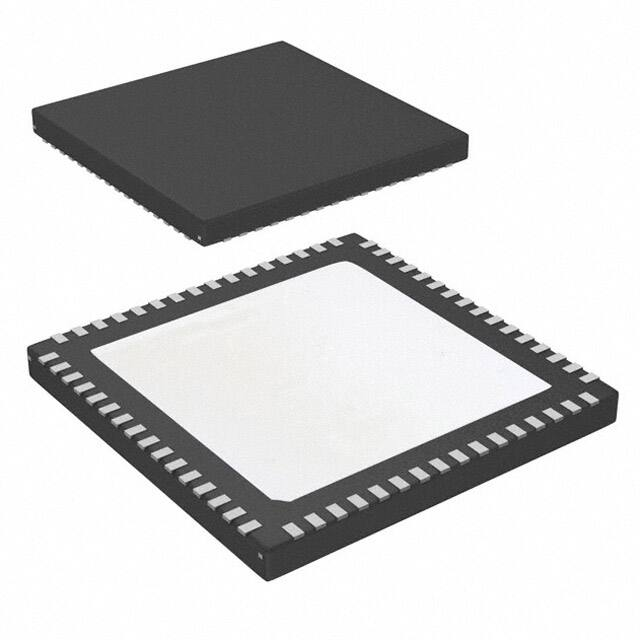
WQFN (64)
•
•
•
•
Test and Measurement
RADAR
Microwave Backhaul
Data Converter Clocking
BODY SIZE (NOM)
9.00 mm × 9.00 mm
(1) For all available packages, see the orderable addendum at
the end of the data sheet.
(2) T = Tape; R = Reel
Simplified Schematic
CLKout10
VCXO
Recovered
³GLUW\´ FORFN RU
clean clock
LMX2594
CLKout11
PLL+VCO
CLKin0
Backup
Reference
Clock
CLKin1
CLKout0 &
CLKout2
2 Applications
DESCRIPTION
ADC
CLKout1 &
CLKout3
0XOWLSOH ³FOHDQ´
clocks at different
frequencies
OSCout
CLKout8
CLKout9
LMK04832
FPGA
CLKout4 &
CLKout6
CLKout5 &
CLKout7
CLKout12,
CLKout13
DAC
DAC
Serializer/
Deserializer
Copyright © 2017, Texas Instruments Incorporated
1
An IMPORTANT NOTICE at the end of this data sheet addresses availability, warranty, changes, use in safety-critical applications,
intellectual property matters and other important disclaimers. PRODUCTION DATA.
�LMK04832
SNAS688C – FEBRURAY 2017 – REVISED MAY 2018
www.ti.com
Table of Contents
1
2
3
4
5
6
Features ..................................................................
Applications ...........................................................
Description .............................................................
Revision History.....................................................
Pin Configuration and Functions .........................
Specifications.........................................................
6.1
6.2
6.3
6.4
6.5
6.6
6.7
6.8
7
1
1
1
2
3
5
Absolute Maximum Ratings ...................................... 5
ESD Ratings.............................................................. 5
Recommended Operating Conditions....................... 6
Thermal Information .................................................. 6
Electrical Characteristics........................................... 6
Timing Requirements .............................................. 17
Timing Diagram....................................................... 17
Typical Characteristics – Clock Output AC
Characteristics ......................................................... 18
Parameter Measurement Information ................ 20
7.1 Charge Pump Current Specification Definitions...... 20
7.2 Differential Voltage Measurement Terminology ..... 21
8
Detailed Description ............................................ 22
8.1 Overview ................................................................. 22
8.2 Functional Block Diagram ....................................... 26
8.3
8.4
8.5
8.6
9
Feature Description.................................................
Device Functional Modes........................................
Programming...........................................................
Register Maps ........................................................
29
41
44
45
Application and Implementation ........................ 90
9.1 Application Information............................................ 90
9.2 Typical Application .................................................. 93
9.3 Do's and Don'ts ....................................................... 97
10 Power Supply Recommendations ..................... 97
10.1 Current Consumption ............................................ 97
11 Layout................................................................... 98
11.1 Layout Guidelines ................................................. 98
11.2 Layout Example .................................................... 98
12 Device and Documentation Support ............... 100
12.1
12.2
12.3
12.4
12.5
Device Support ..................................................
Community Resources........................................
Trademarks .........................................................
Electrostatic Discharge Caution ..........................
Glossary ..............................................................
100
100
100
100
100
13 Mechanical, Packaging, and Orderable
Information ......................................................... 100
4 Revision History
NOTE: Page numbers for previous revisions may differ from page numbers in the current version.
Changes from Revision B (January 2018) to Revision C
•
Page
Changed device status from ADVANCED INFORMATION to PRODUCTION DATA ........................................................... 1
Changes from Revision A (August 2017) to Revision B
Page
•
Updated features: Jitter, Noise Floor, PLL Performance, and VCO Range ........................................................................... 1
•
Updated the Electrical Characteristics table .......................................................................................................................... 5
•
Updated the Detailed Description section ........................................................................................................................... 22
Changes from Original (February 2017) to Revision A
•
2
Page
Changed device status from PRODUCT PREVIEW to ADVANCED INFORMATION ........................................................... 1
Submit Documentation Feedback
Copyright © 2017–2018, Texas Instruments Incorporated
Product Folder Links: LMK04832
�LMK04832
www.ti.com
SNAS688C – FEBRURAY 2017 – REVISED MAY 2018
5 Pin Configuration and Functions
NKD Package
64-Pin WQFN
Top View
CLKin_SEL1
CLKout11*
CLKout11
CLKout10*
CLKout10
Vcc11_CG3
CLKout8*
CLKout8
CLKout9*
CLKout9
57
56
55
54
53
52
51
50
49
CLKout13
60
CLKin_SEL0
CLKout13*
61
58
CLKout12
62
59
Vcc12_CG0
CLKout12*
63
Clock Group 3
64
Clock Group 0
CLKout0
1
48
Status_LD2
CLKout0*
2
47
Vcc10_PLL2
CLKout1
3
46
CPout2
CLKout1*
4
45
Vcc9_CP2
RESET/GPO
5
44
OSCin*
SYNC/SYSREF_REQ
6
43
OSCin
NC
7
42
Vcc8_OSCin
NC
8
41
OSCout*/CLKin2*
LLP-64
Top down view
NC
9
40
OSCout/CLKin2
Vcc1_VCO
10
39
Vcc7_OSCout
LDObyp1
11
38
CLKin0*
LDObyp2
12
37
CLKin0
CLKout3
13
36
Vcc6_PLL1
CLKout3*
14
35
CLKin1*/Fin*/FBCLKin*
CLKout2
15
34
CLKin1/Fin/FBCLKin
CLKout2*
16
33
Vcc5_DIG
26
27
28
29
30
31
32
Vcc4_CG2
CLKout6
CLKout6*
CLKout7
CLKout7*
Status_LD1
CPout1
23
CLKout5*
25
22
CLKout5
24
21
Vcc3_SYSREF
CLKout4
20
Clock Group 1
CLKout4*
19
SCK
18
CS*
SDIO
17
Vcc2_CG1
DAP
Clock Group 2
Pin Functions
PIN
NO.
NAME
1
CLKout0
2
CLKout0*
DESCRIPTION (1)
I/O
TYPE
O
Programmable
Clock output 0. For JESD204B systems suggest Device Clock.
Programmable formats: CML, LVPECL, LCPECL, or LVDS.
O
Programmable
Clock output 1. For JESD204B systems suggest SYSREF Clock.
Programmable formats: CML, LVPECL, LCPECL, LVDS, or 2xLVCMOS.
3
CLKout1
4
CLKout1*
5
RESET/GPO
I
CMOS
Device reset input or GPO
6
SYNC/SYSREF_
REQ
I
CMOS
Synchronization input or SYSREF_REQ for requesting continuous SYSREF.
NC
—
—
7
8
Do not connect.
9
10
Vcc1_VCO
PWR
Power supply for VCO and clock distribution.
11
LDObyp1
ANLG
LDO Bypass, bypassed to ground with 10-µF capacitor.
12
LDObyp2
ANLG
LDO Bypass, bypassed to ground with a 0.1-µF capacitor.
13
CLKout3
14
CLKout3*
(1)
O
Programmable
Clock output 3. For JESD204B systems suggest SYSREF Clock.
Programmable formats: CML, LVPECL, LCPECL, LVDS, or 2xLVCMOS.
See Pin Connection Recommendations for recommended connections.
Submit Documentation Feedback
Copyright © 2017–2018, Texas Instruments Incorporated
Product Folder Links: LMK04832
3
�LMK04832
SNAS688C – FEBRURAY 2017 – REVISED MAY 2018
www.ti.com
Pin Functions (continued)
PIN
NO.
NAME
15
CLKout2
16
CLKout2*
17
Vcc2_CG1
I/O
TYPE
O
Programmable
PWR
DESCRIPTION (1)
Clock output 2. For JESD204B systems suggest Device Clock.
Programmable formats: CML, LVPECL, LCPECL, or LVDS.
Power supply for clock outputs 2 and 3.
18
CS*
I
CMOS
Chip Select
19
SCK
I
CMOS
SPI Clock
20
SDIO
I/O
CMOS
SPI Data
21
Vcc3_SYSREF
22
CLKout5
23
CLKout5*
24
CLKout4
25
CLKout4*
26
Vcc4_CG2
27
CLKout6
28
CLKout6*
PWR
Power supply for SYSREF divider and SYNC.
O
Programmable
Clock output 5. For JESD204B systems suggest SYSREF Clock.
Programmable formats: CML, LVPECL, LCPECL, LVDS, or 2xLVCMOS.
O
Programmable
Clock output 4. For JESD204B systems suggest Device Clock.
Programmable formats: CML, LVPECL, LCPECL, or LVDS.
PWR
Power supply for clock outputs 4, 5, 6 and 7.
O
Programmable
Clock output 6. For JESD204B systems suggest Device Clock.
Programmable formats: CML, LVPECL, LCPECL, or LVDS.
O
Programmable
Clock output 7. For JESD204B systems suggest SYSREF Clock.
Programmable formats: CML, LVPECL, LCPECL, LVDS, or 2xLVCMOS.
Programmable status pin.
29
CLKout7
30
CLKout7*
31
Status_LD1
I/O
Programmable
32
CPout1
O
ANLG
Charge pump 1 output.
33
Vcc5_DIG
PWR
Power supply for the digital circuitry.
CLKin1
34
FBCLKin
Reference Clock Input Port 1 for PLL1.
I
ANLG
Fin1
External VCO Input or clock distribution input.
CLKin1*
35
FBCLKin*
Reference Clock Input Port 1 for PLL1.
I
ANLG
Fin1*
36
CLKin0
38
CLKin0*
39
Vcc7_OSCout
40
41
OSCout
CLKin2
OSCout*
CLKin2*
42
Vcc8_OSCin
43
OSCin
44
OSCin*
45
Vcc9_CP2
46
CPout2
47
Vcc10_PLL2
48
Status_LD2
49
CLKout9
50
CLKout9*
51
CLKout8
52
CLKout8*
53
Vcc11_CG3
4
Feedback input for external clock feedback input (0–delay mode).
External VCO Input or clock distribution input.
Vcc6_PLL1
37
Feedback input for external clock feedback input (0–delay mode).
I
PWR
Power supply for PLL1, charge pump 1, holdover DAC
ANLG
Reference Clock Input Port 0 for PLL1.
PWR
Power supply for OSCout port.
I/O
Programmable
I/O
Programmable
Buffered output of OSCin port.
Reference Clock Input Port 2 for PLL1.
Buffered output of OSCin port.
Reference Clock Input Port 2 for PLL1.
PWR
Power supply for OSCin
I
ANLG
Feedback to PLL1 and reference input to PLL2. AC-coupled.
PWR
Power supply for PLL2 Charge Pump.
O
ANLG
Charge pump 2 output.
PWR
Power supply for PLL2.
I/O
Programmable
Programmable status pin.
O
Programmable
Clock output 9. For JESD204B systems suggest SYSREF Clock.
Programmable formats: CML, LVPECL, LCPECL, LVDS, or 2xLVCMOS.
O
Programmable
Clock output 8. For JESD204B systems suggest Device Clock.
Programmable formats: CML, LVPECL, LCPECL, LVDS, or 2xLVCMOS.
PWR
Power supply for clock outputs 8, 9, 10, and 11.
Submit Documentation Feedback
Copyright © 2017–2018, Texas Instruments Incorporated
Product Folder Links: LMK04832
�LMK04832
www.ti.com
SNAS688C – FEBRURAY 2017 – REVISED MAY 2018
Pin Functions (continued)
PIN
NO.
NAME
DESCRIPTION (1)
I/O
TYPE
O
Programmable
Clock output 10. For JESD204B systems suggest Device Clock.
Programmable formats: CML, LVPECL, LCPECL, LVDS, or 2xLVCMOS.
O
Programmable
Clock output 11. For JESD204B systems suggest SYSREF Clock.
Programmable formats: CML, LVPECL, LCPECL, LVDS, or 2xLVCMOS.
54
CLKout10
55
CLKout10*
56
CLKout11
57
CLKout11*
58
CLKin_SEL0
I/O
Programmable
Programmable status pin.
59
CLKin_SEL1
I/O
Programmable
Programmable status pin.
O
Programmable
Clock output 13. For JESD204B systems suggest SYSREF Clock.
Programmable formats: CML, LVPECL, LCPECL, LVDS, or 2xLVCMOS.
O
Programmable
Clock output 12. For JESD204B systems suggest Device Clock.
Programmable formats: CML, LVPECL, LCPECL, or LVDS.
60
CLKout13
61
CLKout13*
62
CLKout12
63
CLKout12*
64
Vcc12_CG0
PWR
Power supply for clock outputs 0, 1, 12, and 13.
DAP
GND
DIE ATTACH PAD, connect to GND.
DAP
6 Specifications
6.1 Absolute Maximum Ratings
over operating free-air temperature range (unless otherwise noted) (1)
MIN
MAX
UNIT
-0.3
3.6
V
-0.3
(VCC+0.3)
V
Lead temperature (solder 4 seconds)
260
°C
Junction temperature
150
°C
IIN
Differential input current (CLKinX/X*,
OSCin/OSCin*)
±5
mA
MSL
Moisture sensitivity level
Tstg
Storage Temperature
VCC
Supply voltage
VIN
Input voltage
TL
TJ
(1)
(2)
(2)
3
-65
150
°C
Stresses beyond those listed under Absolute Maximum Ratings may cause permanent damage to the device. These are stress ratings
only, which do not imply functional operation of the device at these or any other conditions beyond those indicated under Recommended
Operating Conditions. Exposure to absolute-maximum-rated conditions for extended periods may affect device reliability.
Never to exceed 3.6 V
6.2 ESD Ratings
VALUE
V(ESD)
(1)
(2)
Electrostatic discharge
Human body model (HBM), per
ANSI/ESDA/JEDEC JS-001, all pins (1)
±2000
Machine Model (MM)
±150
Charged device model (CDM), per
JEDEC specification JESD22-C101, all
pins (2)
±250
UNIT
V
JEDEC document JEP155 states that 500-V HBM allows safe manufacturing with a standard ESD control process. Manufacturing with
less than 500-V HBM is possible with the necessary precautions. Pins listed as ±2000 V may actually have higher performance.
JEDEC document JEP157 states that 250-V CDM allows safe manufacturing with a standard ESD control process. Manufacturing with
less than 250-V CDM is possible with the necessary precautions. Pins listed as ±250 V may actually have higher performance.
Submit Documentation Feedback
Copyright © 2017–2018, Texas Instruments Incorporated
Product Folder Links: LMK04832
5
�LMK04832
SNAS688C – FEBRURAY 2017 – REVISED MAY 2018
www.ti.com
6.3 Recommended Operating Conditions
over operating free-air temperature range (unless otherwise noted)
TJ
Junction Temperature
TA
Ambient Temperature
TPCB
PCB Temperature (measured at thermal pad)
VCC
Supply Voltage
MIN
NOM
-40
25
3.15
3.3
MAX
UNIT
125
°C
85
°C
105
°C
3.45
V
6.4 Thermal Information
LMK04832
THERMAL METRIC
(1)
NKD (WQFN)
UNIT
64 PINS
Junction-to-ambient thermal resistance (2)
RθJA
(3)
24.3
°C/W
RθJC(top)
Junction-to-case (top) thermal resistance
6.1
°C/W
RθJB
Junction-to-board thermal resistance (4)
3.5
°C/W
ΨJT
Junction-to-top characterization parameter (5)
0.1
°C/W
ΨJB
Junction-to-board characterization parameter (6)
3.5
°C/W
(7)
0.7
°C/W
RθJC(bot)
(1)
(2)
(3)
(4)
(5)
(6)
(7)
Junction-to-case (bottom) thermal resistance
For more information about traditional and new thermal metrics, see the Semiconductor and IC Package Thermal Metrics application
report, SPRA953.
The junction-to-ambient thermal resistance under natural convection is obtained in a simulation on a JEDEC-standard, High-K board, as
specified in JESD51-7, in an environment described in JESD51-2a.
The junction-to-case(top) thermal resistance is obtained by simulating a cold plate test on the package top. No specific JEDEC-standard
test exists, but a close description can be found in the ANSI SEMI standard G30-88.
The junction-to-board thermal resistance is obtained by simulating in an environment with a ring cold plate fixture to control the PCB
temperature, as described in JESD51-8.
The junction-to-top characterization parameter, ΨJT, estimates the junction temperature of a device in a real system and is extracted
from the simulation data for obtaining RΘJA, using a procedure described in JESD51-2a (sections 6 and 7).
The junction-to-board characterization parameter, ΨJB estimates the junction temperature of a device in a real system and is extracted
from the simulation data for obtaining RΘJA , using a procedure described in JESD51-2a (sections 6 and 7).
The junction-to-case(bottom) thermal resistance is obtained by simulating a cold plate test on the exposed (power) pad. No specific
JEDEC standard test exists, but a close description can be found in the ANSI SEMI standard G30-88.
6.5 Electrical Characteristics
(3.15 V < VCC < 3.45 V, -40 °C < TA < 85 °C. Typical values at VCC = 3.3 V, TA = 25 °C, at the Recommended Operating
Conditions are not assured.)
PARAMETER
TEST CONDITIONS
MIN
TYP
MAX UNIT
CURRENT CONSUMPTION (1)
ICC_PD
Power Down Supply Current
ICC_JESD204B_ALL
4
Supply Current for JESD204B use
case during JESD204B
3
synchronization VCO = 2949.12 MHz 4
Dual Loop (2)
3
ICC_JESD204B_LOW
Supply Current for JESD204B use
case during JESD204B steady state
while holding SYSREF as low in DC
coupled configuration. (2)
4
3
4
3
ICC_JESD204B_VCM
Supply Current for JESD204B use
case during JESD204B steady state
while setting SYSREF outputs as
Vcm. (2)
(1)
(2)
6
1.5
3
mA
CML 32 mA clocks in bypass
LVDS clock /12
SYSREF as LCPECL
SYSREF as LVDS
930
1120
mA
CML 32 mA clocks in bypass
LVDS clock /12
SYSREF as LCPECL (low state)
SYSREF as LVDS (low state)
780
940
mA
4 CML 32 mA clocks in bypass
3 LVDS clock /12
7 SYSREF outputs powered down
675
810
mA
Use the TICS Pro tool to calculate Icc for a specific configuration.
LCPECL clocks have 120 Ω emitter resistors. OSCout LVPECL clock uses 240 Ω ohm emitter resistors. Other settings include
CLKoutX_Y_IDL = 0, CLKoutX_Y_ODL = 0, DCLKX_Y_DCC = 0. SCLK_X_Y_ADLY_EN = 0.
Submit Documentation Feedback
Copyright © 2017–2018, Texas Instruments Incorporated
Product Folder Links: LMK04832
�LMK04832
www.ti.com
SNAS688C – FEBRURAY 2017 – REVISED MAY 2018
Electrical Characteristics (continued)
(3.15 V < VCC < 3.45 V, -40 °C < TA < 85 °C. Typical values at VCC = 3.3 V, TA = 25 °C, at the Recommended Operating
Conditions are not assured.)
PARAMETER
TEST CONDITIONS
MIN
TYP
MAX UNIT
CLKin0/0*, CLKin1/1*, and CLKin2/2* INPUT CLOCK SPECIFICATIONS
fCLKinX_LOS
fCLKin0_PLL1_MOS
fCLKin1_PLL1_MOS
fCLKin2_PLL1_MOS
fCLKin0_PLL1
fCLKin1_PLL1
fCLKin2_PLL1
Clock Input LOS
(CLKin0/1/2)
LOS_EN = 1
Clock Input Frequency for PLL1
Reference (CLKin0/1/2)
CLKinX_TYPE = 1 (MOS)
CLKin0_OUT_MUX = 2 (PLL1)
Clock Input Frequency for PLL1
Reference (CLKin0/1/2)
CLKinX_TYPE = 0 (Bipolar)
CLKin0_OUT_MUX = 2 (PLL1)
CLKin1_OUT_MUX = 2 (PLL1)
250 MHz
MHz
0.001
250 MHz
OSCout_FMT = 0 (Power down)
CLKin1_OUT_MUX = 2 (PLL1)
MHz
0.001
750 MHz
OSCout_FMT = 0 (Power down)
CLKin0_OUT_MUX = 2 (PLL1)
PLL2R_CLK_MUX = 1 (PLL1 CLKinX)
fCLKin0_PLL2
fCLKin1_PLL2
0.001
Clock Input Frequency for PLL2
Reference (CLKin0/1/2)
CLKinX_TYPE = 0 (Bipolar)
CLKin1_OUT_MUX = 2 (PLL1)
PLL2R_CLK_MUX = 1 (PLL1 CLKinX)
500 MHz
OSCout_FMT = 0 (Power down)
PLL2R_CLK_MUX = 1 (PLL1 CLKinX)
fCLKin2_PLL2
fCLKin1_FB
Clock Input Frequency for 0-delay
with external feedback (CLKin1)
CLKin1_OUT_MUX = 1 (FB Mux)
CLKin1_TYPE = 0 (Bipolar)
0.001
750 MHz
fCLKin1_Fin
Clock Input Frequency for external
VCO or distribution mode (CLKin1)
CLKin1_OUT_MUX = 0 (Fin)
CLKin1_TYPE = 0 (Bipolar)
0.001
3250 MHz
SLEWCLKin
Clock Input Slew Rate (3)
20% to 80%
Differential Clock Input Voltage (4)
AC-coupled
VCLKin
Clock Input Single-ended Input
Voltage
AC-coupled to CLKinX;
CLKinX* AC-coupled to Ground
CLKinX_TYPE = 0 (Bipolar)
|VCLKinX-offset|
Each pin AC-coupled, CLKin0/1/2
CLKinX_TYPE = 0 (Bipolar)
DC offset voltage between
CLKinX/CLKinX* (CLKinX* - CLKinX) Each pin AC-coupled, CLKin0/1
CLKinX_TYPE = 1 (MOS)
VIDCLKin_AC
VSSCLKin_AC
DC offset voltage between
CLKin2/CLKin2* (CLKin2* - CLKin2)
Each pin AC-coupled
CLKinX_TYPE = 1 (MOS)
VCLKinVIH
High Input Voltage
VCLKinVIL
Low Input Voltage
DC-coupled to CLKinX;
CLKinX* AC-coupled to Ground
CLKinX_TYPE = 1 (MOS)
(3)
(4)
0.15
0.5
V/ns
0.125
1.55
|V|
0.25
3.1
Vpp
0.5
2.4
Vpp
0
|mV|
55
|mV|
20
|mV|
2
Vcc
V
0
0.4
V
In order to meet the jitter performance listed in the subsequent sections of this data sheet, the minimum recommended slew rate for all
input clocks is 0.5 V/ns. This is especially true for single-ended clocks. Phase noise performance will begin to degrade as the clock input
slew rate is reduced. However, the device will function at slew rates down to the minimum listed. When compared to single-ended
clocks, differential clocks (LVDS, LVPECL) will be less susceptible to degradation in phase noise performance at lower slew rates due to
their common mode noise rejection. However, it is also recommended to use the highest possible slew rate for differential clocks to
achieve optimal phase noise performance at the device outputs.
See Differential Voltage Measurement Terminology for definition of VID and VOD voltages.
Submit Documentation Feedback
Copyright © 2017–2018, Texas Instruments Incorporated
Product Folder Links: LMK04832
7
�LMK04832
SNAS688C – FEBRURAY 2017 – REVISED MAY 2018
www.ti.com
Electrical Characteristics (continued)
(3.15 V < VCC < 3.45 V, -40 °C < TA < 85 °C. Typical values at VCC = 3.3 V, TA = 25 °C, at the Recommended Operating
Conditions are not assured.)
PARAMETER
TEST CONDITIONS
MIN
TYP
MAX UNIT
PLL1 SPECIFICATIONS
fPD1
PLL1 Phase Detector Frequency
ICPout1SOURCE
ICPout1SINK
PLL1 Charge Pump Source
Current (5)
PLL1 Charge Pump Sink Current (5)
40 MHz
VCPout1 = Vcc/2, PLL1_CP_GAIN = 0
50
VCPout1 = Vcc/2, PLL1_CP_GAIN = 1
150
VCPout1 = Vcc/2, PLL1_CP_GAIN = 2
250
...
...
VCPout1 = Vcc/2, PLL1_CP_GAIN = 14
1450
VCPout1 = Vcc/2, PLL1_CP_GAIN = 15
1550
VCPout1 = Vcc/2, PLL1_CP_GAIN = 0
-50
VCPout1 = Vcc/2, PLL1_CP_GAIN = 1
-150
VCPout1 = Vcc/2, PLL1_CP_GAIN = 2
-250
...
VCPout1 = Vcc/2, PLL1_CP_GAIN = 14
-1450
VCPout1 = Vcc/2, PLL1_CP_GAIN = 15
-1550
Charge Pump Sink / Source
Mismatch
VCPout1 = Vcc/2, TA = 25 °C
1%
ICPout1%VTUNE
Magnitude of Charge Pump Current
Variation vs. Charge Pump Voltage
0.5 V < VCPout1 < VCC - 0.5 V TA = 25 °C
4%
ICPout1%TEMP
Charge Pump Current vs.
Temperature Variation
ICPout1TRI
Charge Pump TRI-STATE Leakage
Current
PN10 kHz (6)
PLL 1/f Noise at 10 kHz offset.
Normalized to 1 GHz Output
Frequency
(5)
(6)
(7)
8
Normalized Phase Noise
Contribution
µA
...
ICPout1%MIS
PN1 Hz (7)
µA
10%
4%
0.5 V < VCPout1 < VCC - 0.5 V
5
PLL1_CP_GAIN = 50 µA
-113
PLL1_CP_GAIN = 450 µA
-117
PLL1_CP_GAIN = 1550 µA
-119
PLL1_CP_GAIN = 50 µA
-217
PLL1_CP_GAIN = 450 µA
-224
PLL1_CP_GAIN = 1550 µA
-225
nA
dBc/
Hz
dBc/
Hz
This parameter is programmable
A specification in modeling PLL in-band phase noise is the 1/f flicker noise, LPLL_flicker(f), which is dominant close to the carrier. Flicker
noise has a 10 dB/decade slope. PN10 kHz is normalized to a 10 kHz offset and a 1 GHz carrier frequency. PN10 kHz = LPLL_flicker(10
kHz) - 20 log(Fout / 1 GHz), where LPLL_flicker(f) is the single side band phase noise of only the flicker noise's contribution to total
noise, L(f). To measure LPLL_flicker(f) it is important to be on the 10 dB/decade slope close to the carrier. A high compare frequency and
a clean crystal are important to isolating this noise source from the total phase noise, L(f). LPLL_flicker(f) can be masked by the reference
oscillator performance if a low-power or noisy source is used. The total PLL in-band phase noise performance is the sum of LPLL_flicker(f)
and LPLL_flat(f).
A specification modeling PLL in-band phase noise. The normalized phase noise contribution of the PLL, LPLL_flat(f), is defined as: PN1
HZ = LPLL_flat(f) - 20 log(N) - 10 log(fPDX). LPLL_flat(f) is the single side band phase noise measured at an offset frequency, f, in a 1 Hz
bandwidth and fPDX is the phase detector frequency of the synthesizer. LPLL_flat(f) contributes to the total noise, L(f).
Submit Documentation Feedback
Copyright © 2017–2018, Texas Instruments Incorporated
Product Folder Links: LMK04832
�LMK04832
www.ti.com
SNAS688C – FEBRURAY 2017 – REVISED MAY 2018
Electrical Characteristics (continued)
(3.15 V < VCC < 3.45 V, -40 °C < TA < 85 °C. Typical values at VCC = 3.3 V, TA = 25 °C, at the Recommended Operating
Conditions are not assured.)
PARAMETER
TEST CONDITIONS
MIN
TYP
MAX UNIT
OSCin INPUT CLOCK SPECIFICATIONS
fOSCin
PLL2 Reference Input
SLEWOSCin
PLL2 Reference Clock minimum slew
20% to 80%
rate on OSCin (3)
VOSCin
Input Voltage for OSCin or OSCin*
AC coupled; Single-ended
(Unused pin AC-coupled to GND)
Differential voltage swing (4)
AC-coupled
|VOSCin-offset|
DC offset voltage between
OSCin/OSCin* (OSCinX* - OSCinX)
Each pin AC-coupled
fdoubler_max
Doubler input frequency
EN_PLL2_REF_2X = 1 (8);
OSCin Duty Cycle 40% to 60%
VIDOSCin
VSSOSCin
500 MHz
0.15
0.5
V/ns
0.2
2.4
Vpp
0.2
1.55
|V|
0.4
3.1
Vpp
20
|mV|
320 MHz
PLL2 SPECIFICATIONS
fPD2
Phase Detector Frequency
ICPout2
SOURCE
PLL2 Charge Pump Source
Current (5)
320 MHz
ICPout2
SINK
PLL2 Charge Pump Sink Current (5)
VCPout2 = VCC/2, PLL2_CP_GAIN = 2
1600
VCPout2 = VCC/2, PLL2_CP_GAIN = 3
3200
VCPout2 = VCC/2, PLL2_CP_GAIN = 2
-1600
VCPout2 = VCC/2, PLL2_CP_GAIN = 3
-3200
µA
µA
ICPout2%MIS
Charge Pump Sink / Source
Mismatch
VCPout2 = Vcc/2, TA = 25 °C
1%
ICPout2%VTUNE
Magnitude of Charge Pump Current
Variation vs. Charge Pump Voltage
0.5 V < VCPout2 < VCC - 0.5 V
TA = 25 °C
4%
ICPout2%TEMP
Charge Pump Current vs.
Temperature Variation
ICPout2
Charge Pump TRI-STATE Leakage
Current
0.5 V < VCPout2 < VCC - 0.5 V
PN10 kHz (6)
PLL 1/f Noise at 10 kHz offset.
Normalized to 1 GHz Output
Frequency
PLL2_CP_GAIN = 3200 µA
-128
dBc/
Hz
PN1 Hz (7)
Normalized Phase Noise
Contribution
PLL2_CP_GAIN = 3200 µA
-230
dBc/
Hz
(8)
TRI
10%
4%
10
nA
The EN_PLL2_REF_2X bit enables/disables a frequency doubler mode for the PLL2 OSCin path.
Submit Documentation Feedback
Copyright © 2017–2018, Texas Instruments Incorporated
Product Folder Links: LMK04832
9
�LMK04832
SNAS688C – FEBRURAY 2017 – REVISED MAY 2018
www.ti.com
Electrical Characteristics (continued)
(3.15 V < VCC < 3.45 V, -40 °C < TA < 85 °C. Typical values at VCC = 3.3 V, TA = 25 °C, at the Recommended Operating
Conditions are not assured.)
PARAMETER
TEST CONDITIONS
MIN
TYP
MAX UNIT
INTERNAL VCO SPECIFICATIONS
fVCO
LMK04832 VCO Tuning Range
VCO0
2440
2580
VCO1
2945
3255
VCO0
KVCO
LMK04832 Vtune Tuning Sensitivity
VCO1
|ΔTCL|
Allowable Temperature Drift for
Continuous Lock (9)
2440 MHz
-11.8
2580 MHz
-14.5
2945 MHz
-22.9
3255 MHz
-31.4
After programming for lock, no changes to
output configuration are permitted to
assure continuous lock
1 kHz
VCO0 at
2440 MHz
L(f)VCO
Open-loop phase noise
VCO1 at
2945 MHz
VCO1 at
3250 MHz
(9)
10
MHz/
V
125
°C
-55
10 kHz
-86.3
100 kHz
-115.2
800 kHz
-136.3
1 MHz
-137.6
1 kHz
-53.3
10 kHz
VCO0 at
2580 MHz
MHz
dBc/
Hz
-85
100 kHz
-114.3
800 kHz
-135.3
1 MHz
-136.9
1 kHz
-49.2
10 kHz
-81.1
100 kHz
-111.1
800 kHz
-133.8
1 MHz
-135.9
1 kHz
-46.6
10 kHz
-78.9
100 kHz
-108.9
800 kHz
-131.7
1 MHz
-133.3
dBc/
Hz
dBc/
Hz
dBc/
Hz
Maximum Allowable Temperature Drift for Continuous Lock is how far the temperature can drift in either direction from the value it was
at the time that the 0x168 register was last programmed with PLL2_FCAL_DIS = 0, and still have the part stay in lock. The action of
programming the 0x168 register, even to the same value, activates a frequency calibration routine. This implies the part will work over
the entire frequency range, but if the temperature drifts more than the maximum allowable drift for continuous lock, then it will be
necessary to reload the appropriate register to ensure it stays in lock. Regardless of what temperature the part was initially programmed
at, the temperature can never drift outside the frequency range of – 40 °C to 85 °C without violating specifications.
Submit Documentation Feedback
Copyright © 2017–2018, Texas Instruments Incorporated
Product Folder Links: LMK04832
�LMK04832
www.ti.com
SNAS688C – FEBRURAY 2017 – REVISED MAY 2018
Electrical Characteristics (continued)
(3.15 V < VCC < 3.45 V, -40 °C < TA < 85 °C. Typical values at VCC = 3.3 V, TA = 25 °C, at the Recommended Operating
Conditions are not assured.)
PARAMETER
TEST CONDITIONS
MIN
TYP
MAX UNIT
CLOCK OUTPUT NOISE FLOOR
L(f)CLKout
LVDS
CLKoutX_Y_ODL=1
-159.5
L(f)CLKout
HSDS 6 mA
CLKoutX_Y_ODL=1
-161.5
L(f)CLKout
HSDS 8 mA
CLKoutX_Y_ODL=1
-162.5
L(f)CLKout
LCPECL
CLKoutX_Y_ODL=1
-162.5
L(f)CLKout
LVPECL 1.6 Vpp
CLKoutX_Y_ODL=1
-162
L(f)CLKout
LVPECL 2 Vpp
CLKoutX_Y_ODL=1
-163
L(f)CLKout
CML 16 mA, odd
CLKoutY
DC bias: 50 Ω to
Vcc
CLKoutX_Y_ODL=1
-162.5
L(f)CLKout
CML 24 mA, odd
CLKoutY
DC bias: 50 Ω to
Vcc
CLKoutX_Y_ODL=1
-162.5
L(f)CLKout
CML 32 mA, odd
CLKoutY
DC bias: 50 Ω to
Vcc
CLKoutX_Y_ODL=1
-163
L(f)CLKout
LVCMOS
CLKoutX_Y_ODL=1
-160
L(f)CLKout
CML 16 mA, even
CLKoutX
DC bias: 68 nH to
20 Ω to Vcc
CLKoutX_Y_IDL=1
-155.5
CML 24 mA, even
CLKoutX
DC bias: 68 nH to
20 Ω to Vcc
CLKoutX_Y_IDL=1
-156
CML 32 mA, even
CLKoutX
DC bias: 68 nH to
20 Ω to Vcc
CLKoutX_Y_IDL=1
-156.5
L(f)CLKout
245.76 MHz Noise Floor
20 MHz Offset
3.2 GHz Noise Floor
20 MHz Offset
L(f)CLKout
dBc/
Hz
dBc/
Hz
CLKout CLOSED LOOP PHASE NOISE SPECIFICATIONS
L(f)CLKout
L(f)CLKout
VCO0 SSB Phase Noise 245.76
MHz (10)
Doubler disabled
VCO1 SSB Phase Noise 245.76
MHz (10)
Doubler disabled
Offset = 1 kHz
-125
Offset = 10 kHz
-134
Offset = 100 kHz
-137
Offset = 1 MHz
-154
Offset = 1 kHz
-125
Offset = 10 kHz
-135
Offset = 100 kHz
-137
Offset = 1 MHz
-151
dBc/
Hz
dBc/
Hz
(10) Dual Loop, OSCin reference is a 122.88 MHz Crystek 603281 VCXO. Data collected using a MACOM H-183-4 Hybrid Junction for
differential to single ended converstion. PLL2_CP = 3.2 mA. PLL2 Loop filter is C1i = 60 pF, C1 (external) = 4.7 pF, R2 = 820 Ω
(external), C2 = 3.9 nF (external), R3 = 2.4 kΩ, C3 = 50 pF, R4 = 200 Ω, C4 = 10 pF. PLL1_CP = 450 µA with a narrow loop
bandwidth. CLKoutX_Y_IDL = 0, CLKoutX_Y_ODL = 1. Even CLKout with LVPECL20 format using 120-Ω to GND.
Submit Documentation Feedback
Copyright © 2017–2018, Texas Instruments Incorporated
Product Folder Links: LMK04832
11
�LMK04832
SNAS688C – FEBRURAY 2017 – REVISED MAY 2018
www.ti.com
Electrical Characteristics (continued)
(3.15 V < VCC < 3.45 V, -40 °C < TA < 85 °C. Typical values at VCC = 3.3 V, TA = 25 °C, at the Recommended Operating
Conditions are not assured.)
PARAMETER
TEST CONDITIONS
MIN
TYP
MAX UNIT
CLKout CLOSED LOOP JITTER SPECIFICATIONS
PDF = 312.5 MHz
BW = 12 kHz to 20 MHz
54
fs
rms
PDF = 312.5 MHz
BW = 100 Hz to 100 MHz
64
fs
rms
PDF = 320 MHz
BW = 12 kHz to 20 MHz
61
fs
rms
PDF = 320 MHz
BW = 100 Hz to 100 MHz
67
fs
rms
VCO0, fCLKout = 2457.6 MHz
Integrated RMS Jitter (10)
PDF = 245.76 MHz (Doubler enabled)
BW = 12 kHz to 20 MHz
55
fs
rms
VCO0, fCLKout = 2457.6 MHz
Integrated RMS Jitter (10)
PDF = 122.88 MHz
BW = 12 kHz to 20 MHz
70
fs
rms
VCO1, fCLKout = 2949.12 MHz
Integrated RMS Jitter (10)
PDF = 245.76 (Doubler enabled)
BW = 12 kHz to 20 MHz
60
fs
rms
VCO1, fCLKout = 2949.12 MHz
Integrated RMS Jitter (10)
PDF = 122.88 MHz
BW = 12 kHz to 20 MHz
75
fs
rms
VCO0, fCLKout = 2500 MHz (11)
Integrated RMS Jitter
JCLKout
VCO1, fCLKout = 3200 MHz (11)
Integrated RMS Jitter
JCLKout
DEFAULT POWER on RESET CLOCK OUTPUT FREQUENCY
OSCout default frequency (12)
fOSCout
CLOCK SKEW
500 MHz
(13)
|TSKEW|
Maximum skew CLKoutX to CLKoutX Any even CLKoutX, same format (14)
Device Clock
FCLK = 1.6 GHz, RL = 100 Ω ACcoupled
DCLKX_Y_BYP = 1
|TSKEW|
Maximum skew for CLKoutX to
CLKoutX or CLKoutY to CLKoutY
FCLK = 250 MHz, RL = 100 Ω ACcoupled
Even to even or odd to odd clock, same
format (15)
Device clock
DCLKX_Y_BYP = 0
DCLKX_Y_DIV = 12
|TSKEW|
Maximum skew for any CLKoutX or
Y to any CLKoutX or Y
FCLK = 250 MHz, RL = 100 Ω ACcoupled
Any output, same format (15)
Device clock
DCLKX_Y_BYP = 0
DCLKX_Y_DIV = 12
|TSKEW|
Delay from CLKoutX to CLKoutY in
same pair
FCLK = 250 MHz, RL = 100 Ω ACcoupled
Same pair of device clocks, same
format (15)
60
|ps|
60
|ps|
100
|ps|
35
ps
(11) Single Loop, OSCin reference is R&S SMA100B Signal Generator with option SMAB-B711 through Prodyn BIB-100G Balun to
OSCin. Data collected using a MACOM H-183-4 Hybrid Junction for differential to single ended converstion. PLL2 Loop filter is C1 = 60
pF, R2 = 470 Ω (external), C2 = 150 nF (external), R3 = 2.4 kΩ, C3 = 50 pF, R4 = 200 Ω, C4 = 10 pF, PLL2_CP = 3.2 mA.
CLKoutX_Y_IDL = 1, CLKoutX_Y_ODL = 0; Even CLKout with CML 32 mA format using DC bias 68-nH to 20-Ω to Vcc.
(12) OSCout will oscillate at start-up at the frequency of the VCXO attached to OSCin port.
(13) Equal loading and identical clock configuration on each clock input and/or output is required for skew, setup, and hold specifications to
be valid.
(14) Valid for CML 32 mA, CML 24 mA, CML 16 mA. CML DC bias is 50 ohms to Vcc or 68 nH to 20 Ω to Vcc.
(15) Valid for HSDS 8 mA, HSDS 6 mA, LVDS. LVPECL20, LVPECL16, LCPECL with 120 Ω emitter resistor to ground.
12
Submit Documentation Feedback
Copyright © 2017–2018, Texas Instruments Incorporated
Product Folder Links: LMK04832
�LMK04832
www.ti.com
SNAS688C – FEBRURAY 2017 – REVISED MAY 2018
Electrical Characteristics (continued)
(3.15 V < VCC < 3.45 V, -40 °C < TA < 85 °C. Typical values at VCC = 3.3 V, TA = 25 °C, at the Recommended Operating
Conditions are not assured.)
PARAMETER
TEST CONDITIONS
MIN
TYP
MAX UNIT
CML 32 mA CLOCK OUTPUTS (CLKoutX/Y)
TR / TF
20% to 80% Output Rise/Fall
VOH
Output High Voltage
VOL
Output Low Voltage
VOD
Differential Output Voltage
RL = AC-coupled 100 Ω, 250 MHz
Odd CLKoutY, CLKoutX_Y_ODL = 1
DC Bias, 50 ohm to Vcc
Differential Output Voltage
ps
Vcc
T = 25 °C, DC measurement
Termination 50-Ω pull up to Vcc
DC bias is 50-Ω pull
up to Vcc
RL = AC-coupled
100 Ω
VOD
135
DC bias is 68-nH to
20-Ω to Vcc
RL = AC-coupled
100 Ω
Vcc 1.66
V
1660
|mV|
250 MHz (16)
1070
2.5 GHz (17)
765
(18)
550
3.2 GHz (17)
610
3.2 GHz (18)
385
2.5 GHz
|mV|
CML 24 mA CLOCK OUTPUTS (CLKoutX/Y)
TR / TF
20% to 80% Output Rise/Fall
VOH
Output High Voltage
VOL
Output Low Voltage
VOD
Differential Output Voltage
RL = AC-coupled 100 Ω, 250 MHz
Odd CLKoutY, CLKoutX_Y_ODL = 1
DC Bias, 50 ohm to Vcc
Differential Output Voltage
ps
Vcc
T = 25 °C, DC measurement
Termination 50-Ω pull up to Vcc
DC bias is 50-Ω pull
up to Vcc
RL = AC-coupled
100 Ω
VOD
125
DC bias is 68-nH to
20-Ω to Vcc
RL = AC-coupled
100 Ω
Vcc 1.26
V
1260
|mV|
250 MHz (16)
815
2.5 GHz (17)
595
2.5 GHz (18)
445
3.2 GHz (17)
480
(18)
330
3.2 GHz
|mV|
(16) For even and odd outputs CLKoutX_Y_IDL=0. For even outputs CLKoutX_Y_ODL=X and for odd CLKoutX_Y_ODL=1.
(17) Even clock outputs (CLKoutX). CLKoutX_Y_IDL=1, CLKoutX_Y_ODL=X.
(18) Odd clock outputs (CLKoutY). CLKoutX_Y_IDL=X, CLKoutX_Y_ODL=1
Submit Documentation Feedback
Copyright © 2017–2018, Texas Instruments Incorporated
Product Folder Links: LMK04832
13
�LMK04832
SNAS688C – FEBRURAY 2017 – REVISED MAY 2018
www.ti.com
Electrical Characteristics (continued)
(3.15 V < VCC < 3.45 V, -40 °C < TA < 85 °C. Typical values at VCC = 3.3 V, TA = 25 °C, at the Recommended Operating
Conditions are not assured.)
PARAMETER
TEST CONDITIONS
MIN
TYP
MAX UNIT
CML 16 mA CLOCK OUTPUTS (CLKoutX/Y)
TR / TF
20% to 80% Output Rise/Fall
VOH
Output High Voltage
VOL
Output Low Voltage
VOD
Differential Output Voltage
Differential Output Voltage
VOD
VOD
VOD
120
ps
Vcc
T = 25 °C, DC measurement
Termination is 50-Ω pull up to Vcc
Vcc 0.84
840
DC bias is 50-Ω pull
up to Vcc
RL = AC-coupled
100 Ω
VOD
VOD
RL = AC-coupled 100 Ω, 250 MHz
Odd CLKoutY, CLKoutX_Y_ODL = 1
DC Bias, 50 ohm to Vcc
V
|mV|
250 MHz (16)
550
2.5 GHz (17)
400
(18)
325
3.2 GHz (17)
325
3.2 GHz (18)
250
RL = AC-coupled 100 Ω, 250 MHz
140
ps
VCC - 1
V
DC bias is 68-nH to
20-Ω to Vcc
RL = AC-coupled
100 Ω
2.5 GHz
|mV|
LVPECL CLOCK OUTPUT (CLKoutX/Y, OSCout)
TR / TF
20% to 80% Output Rise/Fall
LVPECL 2000 mVpp CLOCK OUTPUTS (CLKoutX/Y, OSCout)
VOH
Output High Voltage
VOL
Output Low Voltage
VOD
Output Voltage (4)
DC Measurement
Termination = 50-Ω to VCC - 2.0 V
250 MHz (19)
VOD
Differential Output Voltage
Em = 120 Ω to
ground
Termination = ACcoupled 100 Ω
VCC - 2
1000
925
(20)
585
2.5 GHz (21)
545
3.2 GHz (20)
415
3.2 GHz (21)
370
2.5 GHz
V
|mV|
|mV|
LVPECL 1600 mVpp CLOCK OUTPUTS (CLKoutX/Y, OSCout)
VOH
VOL
VOD
VOD
Output High Voltage
Output Low Voltage
Output Voltage
DC Measurement
Termination = 50-Ω to VCC - 2.0 V
(4)
Differential Output Voltage
VCC - 1
V
VCC 1.8
V
800
Em = 120 Ω to
ground
Termination = ACcoupled 100 Ω
250 MHz (19)
760
2.5 GHz (20)
510
2.5 GHz (21)
480
3.2 GHz (20)
370
3.2 GHz (21)
340
|mV|
|mV|
LCPECL CLOCK OUTPUT (CLKoutX/Y, OSCout)
TR / TF
20% to 80% Output Rise/Fall
VOH
Output High Voltage
VOL
Output Low Voltage
VOD
Output Voltage
(4)
RL = AC-coupled 100 Ω
DC bias = 120 Ω to GND
DC Measurement
Termination = 50-Ω to 0.5 V
135
ps
1.6
V
0.6
V
1000
|mV|
170
ps
HSDS 8 mA CLOCK OUTPUTS (CLKoutX/Y)
TR / TF
20% to 80% Output Rise/Fall
RL = 100 Ω, 250 MHz
(19) CLKoutX_Y_IDL=X and CLKoutX_Y_ODL=X.
(20) Even clock outputs (CLKoutX). CLKoutX_Y_IDL=X, CLKoutX_Y_ODL=1.
(21) Odd clock outputs (CLKoutY). CLKoutX_Y_IDL=X, CLKoutX_Y_ODL=1
14
Submit Documentation Feedback
Copyright © 2017–2018, Texas Instruments Incorporated
Product Folder Links: LMK04832
�LMK04832
www.ti.com
SNAS688C – FEBRURAY 2017 – REVISED MAY 2018
Electrical Characteristics (continued)
(3.15 V < VCC < 3.45 V, -40 °C < TA < 85 °C. Typical values at VCC = 3.3 V, TA = 25 °C, at the Recommended Operating
Conditions are not assured.)
PARAMETER
VOH
Output High Voltage
VOL
Output Low Voltage
VOD
Output Voltage (4)
ΔVOD
Change in Magnitude of VOD for
complementary output states
TEST CONDITIONS
MIN
DC Measurement
Termination = 50-Ω to VCC - 1.64 V
TYP
MAX UNIT
VCC 0.95
V
VCC 1.7
V
750
-115
|mV|
115
mV
HSDS 6 mA CLOCK OUTPUTS (CLKoutX/Y)
TR / TF
20% to 80% Output Rise
VOH
Output High Voltage
VOL
Output Low Voltage
RL = 100 Ω, 250 MHz
DC Measurement
Termination = 50-Ω to VCC - 1.42 V
(4)
VOD
Output Voltage
ΔVOD
Change in Magnitude of VOD for
complementary output states
170
ps
VCC 0.9
V
VCC 1.5
V
600
-80
|mV|
80
mV
LVDS CLOCK OUTPUTS (CLKoutX/Y, OSCout)
TR / TF
20% to 80% Output Rise
VOD
Differential Output Voltage
RL = 100 Ω, 250 MHz
ΔVOD
Change in Magnitude of VOD for
complementary output states
VOS
Output Offset Voltage
ΔVOS
Change in VOS for complementary
output states
ISA ISB
Output short circuit current - singleended
T = 25 °C, DC measurement
AC-coupled to receiver input
RL = 100-Ω differential termination
175
ps
400
|mV|
-60
1.125
60
1.25
1.375
mV
V
35 |mV|
Single-ended output shorted to GND
T = 25 °C
-24
24
Submit Documentation Feedback
Copyright © 2017–2018, Texas Instruments Incorporated
Product Folder Links: LMK04832
mA
15
�LMK04832
SNAS688C – FEBRURAY 2017 – REVISED MAY 2018
www.ti.com
Electrical Characteristics (continued)
(3.15 V < VCC < 3.45 V, -40 °C < TA < 85 °C. Typical values at VCC = 3.3 V, TA = 25 °C, at the Recommended Operating
Conditions are not assured.)
PARAMETER
TEST CONDITIONS
MIN
TYP
MAX UNIT
LVCMOS CLOCK OUTPUTS (CLKout8/10/Y, OSCout)
fCLKout
Maximum Frequency
5 pF Load
250
MHz
Vcc 0.1
VOH
Output High Voltage
1 mA Load
VOL
Output Low Voltage
1 mA Load
IOH
Output High Current (Source)
VCC = 3.3 V, VO = 1.65 V
-28
mA
IOL
Output Low Current (Sink)
VCC = 3.3 V, VO = 1.65 V
28
mA
DUTYCLK
Output Duty Cycle (22)
VCC/2 to VCC/2, FCLK = 100 MHz, T = 25°C
50
%
(23)
V
0.1
V
DIGITAL OUTPUTS (CLKin_SELX, Status_LDX, and RESET/GPO)
VOH
VOL
High-Level Output Voltage
IOH = -500 µA
CLKin_SELX_TYPE = 3 or 4
Status_LDX_TYPE = 3 or 4
RESET_TYPE = 3 or 4
Low-Level Output Voltage
IOL = 500 µA
CLKin_SELX_TYPE = 3, 4, or 6
Status_LDX_TYPE = 3, 4, or 6
RESET_TYPE = 3, 4, or 6
VCC 0.4
V
0.4
V
DIGITAL OUTPUTS (SDIO)
VOH
High-Level Output Voltage
IOH = -500 µA; During SPI read.
SDIO_RDBK_TYPE = 0
VOL
Low-Level Output Voltage
IOL = 500 µA; During SPI read.
SDIO_RDBK_TYPE = 0 or 1
VCC 0.4
V
0.4
V
DIGITAL INPUTS (CLKinX_SEL, RESET/GPO, SYNC, SCK, SDIO, and CS*)
VIH
High-Level Input Voltage
VIL
Low-Level Input Voltage
1.2
V
0.5
V
DIGITAL INPUT (CLKinX_SEL)
IIH
IIL
High-Level Input Current VIH = VCC
Low-Level Input Current VIL = 0 V
CLKin_SELX_TYPE = 0 (High Impedance)
-5
5
CLKin_SELX_TYPE = 1 (Pull up)
-5
5
CLKin_SELX_TYPE = 2 (Pull-down)
10
80
CLKin_SELX_TYPE = 0 (High Impedance)
-5
5
-40
-5
CLKin_SELX_TYPE = 2 (Pull-down)
-5
5
RESET_TYPE = 2 (Pull-down)
10
80
RESET_TYPE = 0 (High Impedance)
-5
5
-40
-5
-5
5
CLKin_SELX_TYPE = 1 (Pull up)
µA
µA
DIGITAL INPUT (RESET/GPO)
IIH
IIL
High-Level Input Current VIH = VCC
Low-Level Input Current VIL = 0 V
RESET_TYPE = 1 (Pull up)
RESET_TYPE = 2 (Pull-down)
µA
µA
DIGITAL INPUT (SYNC)
IIH
High-Level Input Current
VIH = VCC
25
µA
IIL
Low-Level Input Current
VIL = 0 V
-5
5
µA
DIGITAL INPUTS (SCK, SDIO, CS*)
IIH
High-Level Input Current
VIH = VCC
-5
5
µA
IIL
Low-Level Input Current
VIL = 0 V
-5
5
µA
(22) For OSCout when driven by OSCin, assumes OSCin has 50% input duty cycle.
(23) For any device clock with an odd divide value, assumes selected clock output has DCLKX_Y_DCC = 1 to enable duty cycle correction.
16
Submit Documentation Feedback
Copyright © 2017–2018, Texas Instruments Incorporated
Product Folder Links: LMK04832
�LMK04832
www.ti.com
SNAS688C – FEBRURAY 2017 – REVISED MAY 2018
6.6 Timing Requirements
(1)
DIGITAL INPUT TIMING
MIN
tdS
Setup time for SDI edge to SCLK rising edge
20
NOM
MAX
UNIT
ns
tdH
Hold time for SDI edge to SCLK rising edge
10
ns
tSCLK
Period of SCLK
200 (1)
ns
tHIGH
High width of SCLK
60
ns
tLOW
Low width of SCLK
60
ns
tcS
Setup time for CS* falling edge to SCLK rising edge
20
ns
tcH
Hold time for CS* rising edge from SCLK rising edge
20
tdV
SCLK falling edge to valid read back data
ns
60
ns
5 MHz
6.7 Timing Diagram
Register programming information on the SDIO pin is clocked into a shift register on each rising edge of the SCK
signal. On the rising edge of the CS* signal, the register is sent from the shift register to the register addressed.
A slew rate of at least 30 V/µs is recommended for these signals. After programming is complete the CS* signal
should be returned to a high state. If the SCK or SDIO lines are toggled while the VCO is in lock, as is
sometimes the case when these lines are shared with other parts, the phase noise may be degraded during this
programming.
4-cwire mode read back has same timing as SDIO pin.
R/W bit = 0 is for SPI write. R/W bit = 1 is for SPI read.
SDIO
(WRITE)
R/W
A14
tdS
tdH
tcS
tHIGH
A13
A12 to A0,
D7 to D2
D1
D0
SCLK
SDIO
(Read)
tcH
tLOW
tSCLK
D7 to
D2
D1
D0
tdV
CS*
Figure 1. SPI Timing Diagram
Submit Documentation Feedback
Copyright © 2017–2018, Texas Instruments Incorporated
Product Folder Links: LMK04832
17
�LMK04832
SNAS688C – FEBRURAY 2017 – REVISED MAY 2018
www.ti.com
6.8 Typical Characteristics – Clock Output AC Characteristics
Jitter from 100 Hz to 100 MHz = 63.6 fs rms.
Output is CLKout4 as CML 32 mA with 68-nH to 20-Ω DC bias.
Other settings are CLKout4_5_IDL = 1 and CLKout4_5_BYP = 1.
PLL2 Loop Filter R2 = 470 Ω, C2 = 150 nF, Charge Pump = 3200 µA.
Reference is R&S SMA100B Signal Generator with option SMAB - B711 through Prodyn BIB-100G Balun to
OSCin.
Figure 2. PLL2 with VCO1 Performance at 2500 MHz With 312.5-MHz OSCin/Phase Detector Frequency
18
Submit Documentation Feedback
Copyright © 2017–2018, Texas Instruments Incorporated
Product Folder Links: LMK04832
�LMK04832
www.ti.com
SNAS688C – FEBRURAY 2017 – REVISED MAY 2018
Typical Characteristics – Clock Output AC Characteristics (continued)
Jitter from 100 Hz to 100 MHz = 67 fs rms.
Output is CLKout4 as CML 32 mA with 68-nH to 20-Ω DC bias.
Other settings are CLKout4_5_IDL = 1 and CLKout4_5_BYP = 1.
PLL2 Loop Filter R2 = 470 Ω, C2 = 150 nF, Charge Pump = 3200 µA.
Reference is R&S SMA100B Signal Generator with option SMAB - B711 through Prodyn BIB-100G Balun to
OSCin.
Figure 3. PLL2 with VCO1 Performance at 3200 MHz With 320-MHz OSCin/Phase Detector Frequency
Submit Documentation Feedback
Copyright © 2017–2018, Texas Instruments Incorporated
Product Folder Links: LMK04832
19
�LMK04832
SNAS688C – FEBRURAY 2017 – REVISED MAY 2018
www.ti.com
7 Parameter Measurement Information
7.1 Charge Pump Current Specification Definitions
I1 = Charge Pump Sink Current at VCPout = VCC - ΔV
I2 = Charge Pump Sink Current at VCPout = VCC/2
I3 = Charge Pump Sink Current at VCPout = ΔV
I4 = Charge Pump Source Current at VCPout = VCC - ΔV
I5 = Charge Pump Source Current at VCPout = VCC/2
I6 = Charge Pump Source Current at VCPout = ΔV
ΔV = Voltage offset from the positive and negative supply rails. Defined to be 0.5 V for this device.
7.1.1 Charge Pump Output Current Magnitude Variation vs Charge Pump Output Voltage
7.1.2 Charge Pump Sink Current vs Charge Pump Output Source Current Mismatch
7.1.3 Charge Pump Output Current Magnitude Variation vs Ambient Temperature
20
Submit Documentation Feedback
Copyright © 2017–2018, Texas Instruments Incorporated
Product Folder Links: LMK04832
�LMK04832
www.ti.com
SNAS688C – FEBRURAY 2017 – REVISED MAY 2018
7.2 Differential Voltage Measurement Terminology
The differential voltage of a differential signal can be described by two different definitions causing confusion
when reading data sheets or communicating with other engineers. This section will address the measurement
and description of a differential signal so that the reader will be able to understand and distinguish between the
two different definitions when used.
The first definition used to describe a differential signal is the absolute value of the voltage potential between the
inverting and noninverting signal. The symbol for this first measurement is typically VID or VOD depending on if an
input or output voltage is being described.
The second definition used to describe a differential signal is to measure the potential of the noninverting signal
with respect to the inverting signal. The symbol for this second measurement is VSS and is a calculated
parameter. Nowhere in the IC does this signal exist with respect to ground, it only exists in reference to its
differential pair. VSS can be measured directly by oscilloscopes with floating references, otherwise this value can
be calculated as twice the value of VOD as described in the first description.
Figure 4 illustrates the two different definitions side-by-side for inputs and Figure 5 illustrates the two different
definitions side-by-side for outputs. The VID and VOD definitions show VA and VB DC levels that the noninverting
and inverting signals toggle between with respect to ground. VSS input and output definitions show that if the
inverting signal is considered the voltage potential reference, the noninverting signal voltage potential is now
increasing and decreasing above and below the noninverting reference. Thus the peak-to-peak voltage of the
differential signal can be measured.
VID and VOD are often defined as volts (V) and VSS is often defined as volts peak-to-peak (VPP).
VID Definition
VSS Definition for Input
Noninverting Clock
VA
2 × VID
VID
VB
Inverting Clock
VID = | VA s 9B |
VSS = 2 × VID
GND
Figure 4. Two Different Definitions for
Differential Input Signals
VOD Definition
VSS Definition for Output
Non-Inverting Clock
VA
2·VOD
VOD
VB
Inverting Clock
VOD = | VA - VB |
VSS = 2·VOD
GND
Figure 5. Two Different Definitions for
Differential Output Signals
Refer to application note AN-912 Common Data Transmission Parameters and their Definitions (SNLA036) for
more information.
Submit Documentation Feedback
Copyright © 2017–2018, Texas Instruments Incorporated
Product Folder Links: LMK04832
21
�LMK04832
SNAS688C – FEBRURAY 2017 – REVISED MAY 2018
www.ti.com
8 Detailed Description
8.1 Overview
The LMK04832 device is very flexible to meet many application requirements. Use cases include dual loop, dual
loop 0-delay nested, dual loop 0-delay cascaded, single loop, single loop 0-delay, and clock distribution.
The device may be used in JESD204B systems by providing a device clock and SYSREF to target devices,
however traditional (non-JESD204B) systems are possible by programming pairs of outputs to share the clock
divider or any mix of JESD204B and traditional.
8.1.1 Differences to LMK0482x
The LMK04832 is pin-to-pin compatible with LMK0482x. The LMK04832 can be substituted directly into an
existing LMK0482x hardware design. However, if a CML output is to be used on LMK04832, then 50-Ω pullups to
VCC are required. For higher amplitude on high frequency CML outputs, use 68 nH on each output pin to a
common to 20 ohms to Vcc. The LMK04832 does support LVPECL20 and LVPECL16 modes, but best
performance is achieved with CML outputs in bypass mode. Division of up to 1023 is supported by DCLKx_DIV
and each output clock can be a DEVCLK or a SYSREF. In addition, some programming updates are required
from LMK04828 to LMK04832, particularly for controlling the clock output groups.
8.1.2 Jitter Cleaning
The dual loop PLL architecture of the LMK04832 provides the lowest jitter performance over a wide range of
output frequencies and phase noise integration bandwidths. The first stage PLL (PLL1) is driven by an external
reference clock and uses an external VCXO to provide a frequency accurate, low phase noise reference clock for
the second stage frequency multiplication PLL (PLL2).
PLL1 typically uses a narrow loop bandwidth (typically 10 Hz to 200 Hz) to retain the frequency accuracy of the
reference clock input signal while at the same time suppressing the higher offset frequency phase noise that the
reference clock may have accumulated along its path or from other circuits. This cleaned reference clock
provides the reference input to PLL2.
The low phase noise reference provided to PLL2 allows PLL2 to operate with a wide loop bandwidth (typically 50
kHz to 200 kHz). The loop bandwidth for PLL2 is chosen to take advantage of the superior high offset frequency
phase noise profile of the internal VCO and the good low offset frequency phase noise of the reference VCXO.
Ultra-low jitter is achieved by allowing the phase noise of the external VCXO to dominate the final output phase
noise at low offset frequencies and the phase noise of the internal VCO to dominate the final output phase noise
at high offset frequencies. This results in best overall phase noise and jitter performance.
8.1.3 JEDEC JESD204B Support
The LMK04832 provides support for JEDEC JESD204B. The LMK04832 clocks up to 7 JESD204B targets using
7 device clocks and 7 SYSREF clocks.
The LMK04832 allows every clock output to be configured as a device clock or SYSREF clock.
8.1.4 Clock Inputs
NOTE
CLKin1 can be used as a reference for dual loop, single loop, or clock distribution mode,
providing flexibility configuring the device for different operation modes from one clock
input..
8.1.4.1 Three Redundant PLL1 Reference Inputs
The LMK04832 has up to three reference clock inputs for PLL1. They are CLKin0, CLKin1, and CLKin2.
Automatic or manual switching can occur between the inputs.
CLKin0, CLKin1, and CLKin2 each have their own PLL1 R dividers allowing clock switching references of
different frequencies.
22
Submit Documentation Feedback
Copyright © 2017–2018, Texas Instruments Incorporated
Product Folder Links: LMK04832
�LMK04832
www.ti.com
SNAS688C – FEBRURAY 2017 – REVISED MAY 2018
Overview (continued)
CLKin1 is shared for use as an external 0-delay feedback (FBCLKin), or for use with an external VCO (Fin).
CLKin2 is shared for use as OSCout. To use CLKin2 as an input power down OSCout, see VCO_MUX,
OSCout_MUX, OSCout_FMT.
Fast manual switching between reference clocks and holdover is possible with external pins CLKin_SEL0 and
CLKin_SEL1.
8.1.4.2 PLL2 Reference Inputs
In dual loop configurations, the PLL2 reference is from OSCin. However, in single PLL2 loop operation, it is also
possible to use any of the three CLKins of PLL1 as a reference to PLL2.
8.1.4.3 Clock Distribution Reference Input
For clock distribution mode, a reference signal is applied to the Fin1 pins for clock distribution. CLKin0 can be
used to distribute a SYSREF signal through the device. In this use case, CLKin0 is re-clocked by CLKin1.
8.1.5 VCXO Buffered Output
The LMK04832 provides OSCout, which by power-on default is a buffered copy of the PLL1 feedback and PLL2
reference input at OSCin. This reference input is typically a low noise VCXO or XO. This output can be used to
clock external devices such as microcontrollers, FPGAs, CPLDs, and so forth, before the LMK04832 is
programmed.
The OSCout buffer output type is programmable to LVDS, LVPECL, or LVCMOS.
The VCXO buffered output can be synchronized to the VCO clock distribution outputs by using Cascaded 0Delay Mode.
8.1.6 Frequency Holdover
The LMK04832 supports holdover operation to keep the clock outputs on frequency with minimum drift when the
reference is lost until a valid reference clock signal is re-established.
8.1.7 Internal VCOs
The LMK04832 has two internal VCOs. The output of the selected VCO is routed to the Clock Distribution Path.
This same selection is also fed back to the PLL2 phase detector through a prescaler and N-divider.
8.1.8 External VCO Mode
The Fin1 input allows an external VCO to be used with PLL2 of the LMK04832. Using Fin1 input for external
VCO prevents use of CLKin1 for other purposes.
8.1.9 Clock Distribution
The LMK04832 features a total of 14 PLL2 clock outputs driven from the internal or external VCO.
All clock outputs have programmable output types. They can be programmed to CML, LVPECL, LVDS, HSDS, or
LCPECL. All odd clock outputs plus CLKout8 and CLKout10 may be programmed to LVCMOS.
If OSCout is included in the total number of clock outputs the LMK04832 is able to distribute up to 15 differential
clocks. OSCout may be a buffered version of OSCin, DCLKout6, DCLKout8, or SYSREF. Its output format is
programmable to LVDS, LVPECL, or LVCMOS.
The following sections discuss specific features of the clock distribution channels that allow the user to control
various aspects of the output clocks.
8.1.9.1 Clock Divider
The LMK04832 has 7 clock dividers. In a traditional clocking system each divider can drive two outputs. The
divider range is 1 to 1023. Duty cycle correction may be enabled for the output. When the divider is used even
clocks may not output CML.
Submit Documentation Feedback
Copyright © 2017–2018, Texas Instruments Incorporated
Product Folder Links: LMK04832
23
�LMK04832
SNAS688C – FEBRURAY 2017 – REVISED MAY 2018
www.ti.com
Overview (continued)
In a JESD204B system, one clock output is a device clock driven from the clock divider and the other paired
clock is from the SYSREF divider. For connectivity flexibility, either the even or odd clock output may be driven
by the clock divider or be the SYSREF output.
8.1.9.2 High Performance Divider Bypass Mode
Even clock outputs (CLKoutX) of the LMK04832 may bypass the clock divider to achieve the best possible noise
floor and output swing. In this mode, the only usable output format is CML.
8.1.9.3 SYSREF Clock Divider
The SYSREF divider supports a divide range of 8 to 8191 (even and odd). There is no duty cycle correction for
the SYSREF divider. The SYSREF output may be routed to all clock outputs.
8.1.9.4 Device Clock Delay
The device clocks support digital delay for phase adjustment of the clock outputs.
The digital delay allows outputs to be delayed from 8 to 1023 VCO cycles. The delay step can be as small as
half the period of the clock distribution path. For example, a 3.2-GHz VCO frequency results in 156.25-ps steps.
The digital delay value takes effect on the clock output phase after a SYNC event.
8.1.9.5 Dynamic Digital Delay
The device clock dividers support a dynamic digital delay feature which allows the clock to be delayed by one full
device clock cycle. With a single programming, an adjustment of up to 255 one cycle delays may occur. When
making a multi-step adjustment, the adjustments are periodically applied to reduce impact to the clock.
Dynamic phase adjustments of half a clock distribution cycle are possible by half step.
The SYSREF digital delay value is reused for dynamic digital delay. To achieve a one cycle delay program the
SYSREF digital delay value to one greater than half the SYSREF divide value.
8.1.9.6 SYSREF Delay: Global and Local
The SYSREF divider includes a digital delay block which allows a global phase shift with respect to the device
clocks.
Each clock output pair includes a local SYSREF analog and digital delay for unique phase adjustment of each
SYSREF clock.
The local analog delay allows for approximately 21-ps steps. Turning-on analog delay adds an additional 124ps
of delay in the clock path. The digital delay step can be as small as half the period of the clock distribution path.
For example, a 3.2-GHz VCO frequency results in 156.25-ps steps.
The local digital delay and half step allows a SYSREF output to be delayed from 1.5 to 11 clock distribution path
cycles.
8.1.9.7 Programmable Output Formats
All LMK04832 clock outputs can be programmed to an LVDS, HSDS, LVPECL, or LCPECL output type. Odd
clock outputs in addition to CLKout8 and CLKout10 may also be programmed to LVCMOS. All odd clock outputs
can also be programmed to CML. When in bypass mode the even clock output may only be CML.
The OSCout can be programmed to an LVDS, LVPECL, or LVCMOS output type.
Any HSDS output type can be programmed to 6-mA or 8-mA amplitude levels.
Any LVPECL output type can be programmed to 1600-mVpp or 2000-mVpp amplitude levels. The 2000-mVpp
LVPECL output type is a Texas Instruments proprietary configuration that produces a 2000-mVpp differential
swing for compatibility with many data converters and is also known as 2VPECL.
LCPECL allows for DC-coupling SYSREF to low voltage JESD204B targets.
24
Submit Documentation Feedback
Copyright © 2017–2018, Texas Instruments Incorporated
Product Folder Links: LMK04832
�LMK04832
www.ti.com
SNAS688C – FEBRURAY 2017 – REVISED MAY 2018
Overview (continued)
8.1.9.8 Clock Output Synchronization
Using the SYNC input causes all active clock outputs to share a rising edge as programmed by fixed digital
delay.
The SYNC event must occur for digital delay values to take effect.
8.1.10 0-Delay
The LMK04832 supports two types of 0-delay.
1. Cascaded 0-delay
2. Nested 0-delay
Cascaded 0-delay mode establishes a fixed deterministic phase relationship of the phase of the PLL2 input clock
(OSCin) to the phase of a clock selected by the feedback mux. The 0-delay feedback uses internal feedback
from the CLKout6, CLKout8, or SYSREF. The 0-delay feedback can also be from an external feedback through
the FBCLKin port. The FB_MUX selects the feedback source. Because OSCin has a fixed deterministic phase
relationship to the feedback clock, OSCout will also have a fixed deterministic phase relationship to the feedback
clock. In this mode, PLL1 input clock (CLKinX) also has a fixed deterministic phase relationship to PLL2 input
clock (OSCin); this results in a fixed deterministic phase relationship between all clocks from CLKinX to the clock
outputs.
Nested 0-delay mode establishes a fixed deterministic phase relationship of the phase of the PLL1 input clock
(CLKinX) to the phase of a clock selected by the feedback mux. The 0-delay feedback uses internal feedback
from the CLKout6, CLKout8, or SYSREF. The 0-delay feedback can also be from an external feedback through
the FBCLKin port. The FB_MUX selects the feedback source.
Without using 0-delay mode, there will be n possible fixed phase relationships from clock input to clock output
depending on the clock output divide value.
Using an external 0-delay feedback reduces the number of available clock inputs by one.
8.1.11 Status Pins
The LMK04832 provides status pins which can be monitored for feedback or in some cases used for input
depending upon device programming. For example:
• The CLKin_SEL0 pin may indicate the LOS (loss-of-signal) for CLKin0.
• The CLKin_SEL1 pin may be an input for selecting the active clock input.
• The Status_LD1 pin may indicate if the device is locked.
• The Status_LD2 pin may indicate if PLL2 is locked.
The status pins can be programmed to a variety of other outputs including PLL divider outputs, combined PLL
lock detect signals, PLL1 Vtune railing, readback, and so forth. Refer to the Register Maps section of this data
sheet for more information.
Submit Documentation Feedback
Copyright © 2017–2018, Texas Instruments Incorporated
Product Folder Links: LMK04832
25
�LMK04832
SNAS688C – FEBRURAY 2017 – REVISED MAY 2018
www.ti.com
8.2 Functional Block Diagram
Figure 6 illustrates the high level LMK04832 block diagram.
CLKin1/Fin/
FBCLKin
CLKin1*/Fin*/
FBCLKin*
CLKin1
_DEMUX
CLKin0 R
Divider
(1 to 16,383)
CLKin0
N1 Divider
(1 to 16,383)
CLKin2 R
Divider
(1 to 16,383)
CLKin1
FB Mux
CLKout6
CLKout8
SYSREF Div
OSCout/
CLKin2
OSCout*/
CLKin2*
CLKin
MUX
CLKin1 R
Divider
(1 to 16,383)
PLL1
_NCLK
_MUX
2X
PLL2
_REF
_2X_EN
OSCin
OSCin*
RESET/GPO
SYNC
CLKin_SEL0
CLKin_SEL1
SCLK
SDIO
CS*
Device
Control
Status_LD1
Status_LD2
N2 Prescaler
(2 to 8)
PLL2
_RCLK
_MUX
R2 Divider
(1 to 4,095)
PLL2
_NCLK
_MUX
N2 Divider
(1 to 262,143)
Phase
Detector
PLL2
Clock Distribution Path
SPI
CPout1
Holdover
FB_
MUX
SPI
Selectable
Phase
Detector
PLL1
CPout2
CLKin0
CLKin0*
CLKin0
_DEMUX
Internal Dual
Core VCO
VCO_
MUX
CLKin1
Control
Registers
D
SYNC
CLKin0
Pulser
CLKout0
CLKout0*
Div (1 to 1023)
SYSREF_MUX
SYSREF/SYNC Control
Divider
(8 to 8191)
SYSREF/SYNC
Distribution Path
Dig. Delay
A. Delay
CLKout2
CLKout2*
Div (1 to 1023)
Dig. Delay
Dig. Delay
A. Delay
CLKout4
CLKout4*
Div (1 to 1023)
Dig. Delay
Dig. Delay
CLKout13
CLKout13*
Div (1 to 1023)
CLKout10
CLKout10*
A. Delay
CLKout11
CLKout11*
Div (1 to 1023)
CLKout8
CLKout8*
A. Delay
CLKout9
CLKout9*
Div (1 to 1023)
CLKout6
CLKout6*
A. Delay
CLKout7
CLKout7*
Dig. Delay
Dig. Delay
Dig. Delay
Dig. Delay
CLKout5
CLKout5*
A. Delay
Dig. Delay
Dig. Delay
CLKout3
CLKout3*
CLKout12
CLKout12*
Dig. Delay
Dig. Delay
CLKout1
CLKout1*
Div (1 to 1023)
Dig. Delay
A. Delay
Copyright © 2017, Texas Instruments Incorporated
Figure 6. High Level LMK04832 Block Diagram
26
Submit Documentation Feedback
Copyright © 2017–2018, Texas Instruments Incorporated
Product Folder Links: LMK04832
�LMK04832
www.ti.com
SNAS688C – FEBRURAY 2017 – REVISED MAY 2018
Functional Block Diagram (continued)
CLKou t0, 2, 4, 6, 8, 10, 12
CLKou tX_Y_PD
DCL KX_Y_PD
Device Clock (DCLK)
DCL KX
_BYP
CLKou tX_
FMT
DCL KX_Y_DDL Y_PD
CML
DCL KX_Y
_POL
VCO
DCL KX_Y_
DDL Y
(8 to 102 3)
DCL KX_Y_
DIV
(1 to 102 3)
DCL KX_Y_
HS
DCC
CLKou tX_
SRC_MUX
DCL KX_Y_
DCC
DDL YdX_Y_EN
DCL Kout6/8 to FB_MUX
CLKou tX_Y_ODL
SYNC_
DIS_DCL KX_Y
CLKou tX_Y_IDL
SYS RE F_GBL_PD
SDCLKou tY_DIS_MODE
SYS RE F/SYNC
SCLKX_Y_
DDL Y
SCLKX_Y
_HS
Ana log
DLY
SCLKX_Y
_ADLY_EN
SCLKX_Y
_POL
SYS RE F Clock (SCLK)
SCLKX_Y_PD
CLKou tY_
SRC_MUX
CLKou tY_
FMT
SYS RE F_CLR
CLKou t1, 3, 5, 7, 9, 11, 13
Legend
SPI Re gister
SYS RE F/SYNC Clo ck
VCO/Distribu tion Clock
X = Odd Numbers
Y = Even Numbers
Copyright © 201 7, Texas Instrumen ts Incorpor ate d
Figure 7. Device and SYSREF Clock Output Block
Submit Documentation Feedback
Copyright © 2017–2018, Texas Instruments Incorporated
Product Folder Links: LMK04832
27
�LMK04832
SNAS688C – FEBRURAY 2017 – REVISED MAY 2018
www.ti.com
Functional Block Diagram (continued)
CLKin0
CLKin0_
DEMUX
SPI Register: SYNC_EN
Must Be Set To Enable Any
SYNC/SYSREF Functionality
PLL1
D
SYNC_PLL1_DLD
PLL1_DLD
SYNC_PLL2_DLD
SYSREF_REQ_EN
PLL2_DLD
SYNC
SYNC
_MODE
SYNC
_POL
SYSREF_
MUX
D
PULSER MODE
SYSREF_PULSE_CNT
VCO0
VCO1
VCO
_MUX
SYSREF
DDLY
SYSREF
Divider
Pulser
SYSREF_PLSR_PD
SYNC/SYSREF
External
VCO
SYSREF_PD
SYSREF_DDLY_PD
DCLKout6
OSCin
DCLKout8
SYNC_
DISSYSREF
CLKin1
CLKin1_
DEMUX
FB_MUX
OSCout
_MUX
OSCout
CLKin1
FB_MUX
PLL1
DCLKout0, 2, 4, 6, 8, 10, 12
Clock
Distribution Path
VCO Frequency
DDLY
(4 to 32)
Divider
(1 to 32)
Analog
DLY
DCC
Output
Buffer
Digital
DLY
Analog
DLY
Output
Buffer
SYNC_
DISX
SYSREF/SYNC
Legend
SYSREF_CLR
SYSREF/SYNC Clock
VCO/Distribution Clock
SPI Register
SDCLKout1, 3, 5, 7, 9, 11, 13
Copyright © 2017, Texas Instruments Incorporated
Figure 8. SYNC/SYSREF Clocking Paths
28
Submit Documentation Feedback
Copyright © 2017–2018, Texas Instruments Incorporated
Product Folder Links: LMK04832
�LMK04832
www.ti.com
SNAS688C – FEBRURAY 2017 – REVISED MAY 2018
8.3 Feature Description
8.3.1 Synchronizing PLL R Dividers
In some cases, it is necessary to synchronize PLL R dividers to enable determinism of clocks outputs to inputs.
This typically is required when the fraction Total PLL N divide / Total PLL R divide does not reduce to N / 1
8.3.1.1 PLL1 R Divider Synchronization
It is possible to use the CLKin0 or SYNC pin to synchronize the PLL1 R divider. In either case, the PLL1 R
divider is armed for reset, then the rising sync edge arrives from either SYNC pin or CLKin0. After the PLL1 R
divider is armed, PLL1 is unlocked until the synchronization edge arrives and allows the divider to operate and
the PLL to lock. The procedure to synchronize PLL1 R is as follows:
1. Setup device for synchronizing PLL1 R:
– PLL1R_SYNC_EN = 0x1
– PLL1R_SYNC_SRC = 0x1 (SYNC pin) or 0x2 (CLKin0)
– CLKin0_DEMUX = 0x2 (PLL1)
– CLKin1_DEMUX = 0x2 (PLL1)
– CLKin0_TYPE = 0x1 (MOS) for DC-coupled or CLKin0_TYPE = 0x0 (Bipolar) for AC-coupled
2. Arm PLL1 R divider for synchronization
– PLL1R_RST = 1, then 0.
– PLL1 is unlocked.
3. Send rising edge on SYNC pin or CLKin0.
– PLL1 R divider is released from reset and PLL1 relocks.
It is necessary to meet a setup and hold time when CLKin0 or SYNC pin goes high to ensure deterministic reset
of the PLL1 R divider.
The SYNC_POL bit has no effect on SYNC polarity for PLL1 R synchronization.
8.3.1.2 PLL2 R Divider Synchronization
The SYNC pin must be used to synchronized the PLL2 R divider. When PLL2R_SYNC_EN = 1, as long as the
SYNC pin is held high, the PLL2 R divider is held in reset. When the SYNC pin is returned low, the divider is
allowed to continue dividing. While PLL2R_SYNC_EN = 1 and SYNC pin is high PLL2 is unlocked.
It is necessary to meet a setup and hold time when SYNC pin goes low to ensure deterministic reset of the PLL2
R divider.
The SYNC_POL bit has no effect on SYNC polarity for PLL2 R synchronization.
Submit Documentation Feedback
Copyright © 2017–2018, Texas Instruments Incorporated
Product Folder Links: LMK04832
29
�LMK04832
SNAS688C – FEBRURAY 2017 – REVISED MAY 2018
www.ti.com
Feature Description (continued)
8.3.2 SYNC/SYSREF
The SYNC and SYSREF signals share the same SYNC/SYSREF Clock Distribution path. To properly use SYNC
and/or SYSREF for JESD204B it is important to understand the SYNC/SYSREF system. Figure 7 illustrates the
detailed diagram of a clock output block with SYNC circuitry included. Figure 8 illustrates the interconnects and
highlights some important registers used in controlling the device for SYNC/SYSREF purposes.
To reset or synchronize a divider, the following conditions must be met:
1. SYNC_EN must be set. This ensures proper operation of the SYNC circuitry.
2. SYSREF_MUX and SYNC_MODE must be set to a proper combination to provide a valid SYNC/SYSREF
signal.
– If SYSREF block is being used, the SYSREF_PD bit must be clear.
– If the SYSREF Pulser is being used, the SYSREF_PLSR_PD bit must be clear.
– For each CLKoutX or CLKoutY being used for SYSREF, the respective SCLKX_Y_PD bit must be
cleared.
3. DCLKX_Y_DDLY_PD and SYSREF_DDLY_PD bits must be clear to power up the digital delay circuitry used
during SYNC to cause deterministic phase between the device clock dividers and the global SYSREF
divider.
4. The SYNC_DISX bit must be clear to allow SYNC/SYSREF signal to divider circuit. The SYSREF_MUX
register selects the SYNC source which resets the SYSREF/CLKoutX dividers provided the corresponding
SYNC_DISX bit is clear.
5. Other bits which impact the operation of SYNC such as SYNC_1SHOT_EN may be set as desired.
6. After these dividers are synchronized, the DCLKX_Y_DDLY_PD and SYSREF_DDLY_PD bits may be set to
save current. Clearing them to power up may disrupt the output clock phase.
Table 1 illustrates the some possible combinations of SYSREF_MUX and SYNC_MODE.
Table 1. Some Possible SYNC Configurations
SYNC_MODE
SYSREF_MUX
SYNC Disabled
NAME
0
0
CLKin0_DEMUX ≠ 0
No SYNC will occur.
Pin or SPI SYNC
1
0
CLKin0_DEMUX ≠ 0
Basic SYNC functionality, SYNC pin polarity is
selected by SYNC_POL.
To achieve SYNC through SPI, toggle the
SYNC_POL bit.
Differential input
SYNC
X
0 or 1
CLKin0_DEMUX = 0
Differential CLKin0 now operates as SYNC input.
JESD204B Pulser
on pin transition.
2
2
SYSREF_PULSE_CNT
sets pulse count
Produce SYSREF_PULSE_CNT programmed
number of pulses on pin transition. SYNC_POL can
be used to cause SYNC through SPI.
JESD204B Pulser
on SPI
programming.
3
2
SYSREF_PULSE_CNT
sets pulse count
Programming SYSREF_PULSE_CNT register starts
sending the number of pulses.
1
SYSREF operational,
SYSREF Divider as
required for training frame
size.
Allows precise SYNC for n-bit frame training patterns
for non-JESD converters such as LM97600.
2
SYSREF_REQ_EN = 1
Pulser powered up
When SYNC pin is asserted, continuous SYSERF
pulses occur. Turning on and off of the pulses is
synchronized to prevent runt pulses from occurring on
SYSREF.
Re-clocked SYNC
External SYSREF
request
Continuous
SYSREF
(1)
30
1
0
X
3
OTHER
SYSREF_PD = 0
SYSREF_DDLY_PD = 0
SYSREF_PLSR_PD = 1
DESCRIPTION
Continuous SYSREF signal.
(1)
SCLKX_Y_PD = 0 as required per SYSREF output. This applies to any SYNC or SYSREF output on SCLKX_Y when SCLKX_Y_MUX =
1 (SYSREF output)
Submit Documentation Feedback
Copyright © 2017–2018, Texas Instruments Incorporated
Product Folder Links: LMK04832
�LMK04832
www.ti.com
SNAS688C – FEBRURAY 2017 – REVISED MAY 2018
Feature Description (continued)
Table 1. Some Possible SYNC Configurations (continued)
NAME
SYNC_MODE
Re-clocked
SYSREF
distribution
SYSREF_MUX
0
0
OTHER
DESCRIPTION
SYSREF_DDLY_PD = 1
SYSREF_PLSR_PD = 1
SYSREF_PD = 1.
Fan-out of CLKin0 reclocked to the clock distribution
path.
NOTE
Because the SYNC/SYSREF signal is reclocked by the Clock Distribution Path, an active
clock must be present on the Clock Distribution Path (either from VCO or CLKin1/Fin pins
in distribution mode) for SYNC to take effect.
NOTE
Any device clock divider or the SYSREF divider which does not have the SYNC_DISX bit
or SYNC_DISSYSREF bit set will reset while SYNC/SYSREF Distribution Path is high.
This is especially important for the SYSREF divider which has the ability to reset itself if
the SYNC_DISSYSREF = 0! Be sure to set SYNC_DISX/SYNC_DISSYSREF bits as
required.
NOTE
While using Divide-by-2 or Divide-by-3 for DCLK_X_Y_DIV, SYNC procedure requires to
first program Divide-by-4 and then back to Divide-by-2 or Divide-by-3 before doing SYNC.
8.3.3 JEDEC JESD204B
8.3.3.1 How to Enable SYSREF
Table 2 summarizes the bits needed to make SYSREF functionality operational.
Table 2. SYSREF Bits
REGIS
TER
FIELD
VALUE
DESCRIPTION
0x140
SYSREF_PD
0
Must be clear, power-up SYSREF circuitry including the SYSREF divider.
0x140
SYSREF_DDLY_
PD
0
Must be clear to power-up digital delay circuitry. Must be powered up during initial SYNC to ensure
deterministic timing to other clock dividers.
0x143
SYNC_EN
1
Must be set, enable SYNC.
0x143
SYSREF_CLR
1→0
Do not hold local SYSREF DDLY block in reset except at start.
Anytime SYSREF_PD = 1 because of user programming or device RESET, it is necessary to set
SYSREF_CLR for 15 VCO clock cycles to clear the local SYSREF digital delay. Once cleared,
SYSREF_CLR must be cleared to allow SYSREF to operate.
Enabling JESD204B operation involves synchronizing all the clock dividers with the SYSREF divider, then
configuring the actual SYSREF functionality.
8.3.3.1.1 Setup of SYSREF Example
The following procedure is a programming example for a system which is to operate with a 3000-MHz VCO
frequency. Use CLKout0 and CLKout2 to drive converters at 1500 MHz. Use CLKout4 to drive an FPGA at 150
MHz. Synchronize the converters and FPGA using a two SYSREF pulses at 10 MHz.
1. Program registers 0x000 to 0x555 (refer to Recommended Programming Sequence). Key to prepare
for SYSREF operations:
a. Prepare for manual SYNC: SYNC_POL = 0, SYNC_MODE = 1, SYSREF_MUX = 0
b. Setup output dividers as per example: DCLK0_1_DIV and DCLK2_3_DIV = 2 for frequency of 1500 MHz.
DCLK4_5_DIV = 20 for frequency of 150 MHz.
Submit Documentation Feedback
Copyright © 2017–2018, Texas Instruments Incorporated
Product Folder Links: LMK04832
31
�LMK04832
SNAS688C – FEBRURAY 2017 – REVISED MAY 2018
2.
3.
4.
5.
6.
www.ti.com
c. Setup output dividers as per example: SYSREF_DIV = 300 for 10 MHz SYSREF
d. Setup SYSREF: SYSREF_PD = 0, SYSREF_DDLY_PD = 0, DCLK0_1_DDLY_PD = 0,
DCLK2_3_DDLY_PD = 0, DCLK4_5_DDLY_PD = 0, SYNC_EN = 1, SYSREF_PLSR_PD = 0,
SYSREF_PULSE_CNT = 1 (2 pulses). SCLK0_1_PD = 0, SCLK2_3_PD = 0, SCLK4_5_PD = 0
e. Clear Local SYSREF DDLY: SYSREF_CLR = 1.
Establish deterministic phase relationships between SYSREF and Device Clock for JESD204B:
a. Set device clock and SYSREF divider digital delays: DCLK0_1_DDLY, DCLK2_3_DDLY,
DCLK4_5_DDLY, and SYSREF_DDLY.
b. Set device clock digital delay half steps: DCLK0_1_HS, DCLK2_3_HS, DCLK4_5_HS.
c. Set SYSREF clock digital delay as required to achieve known phase relationships: SCLK0_1_DDLY,
SCLK2_3_DDLY, and SCLK4_5_DDLY. If half step adjustments are required SCLK0_1_HS,
SCLK2_3_HS, and SCLK4_5_HS.
d. To allow SYNC to affect dividers: SYNC_DIS0 = 0, SYNC_DIS2 = 0, SYNC_DIS4 = 0,
SYNC_DISSYSREF = 0
e. Perform SYNC by toggling SYNC_POL = 1 then SYNC_POL = 0.
Now that dividers are synchronized, disable SYNC from resetting these dividers. It is not desired for
SYSREF to reset it's own divider or the dividers of the output clocks.
a. Prevent SYNC (SYSREF) from affecting dividers: SYNC_DIS0 = 1, SYNC_DIS2 = 1, SYNC_DIS4 = 1,
SYNC_DISSYSREF = 1.
Release reset of local SYSREF digital delay.
a. SYSREF_CLR = 0. Note this bit needs to be set for only 15 clock distribution path clocks after
SYSREF_PD = 0.
Set SYSREF operation.
a. Allow pin SYNC event to start pulser: SYNC_MODE = 2.
b. Select pulser as SYSREF signal: SYSREF_MUX = 2.
Complete! Now asserting the SYNC pin, or toggling SYNC_POL will result in a series of 2 SYSREF pulses.
8.3.3.1.2 SYSREF_CLR
The local digital delay of the SCLKX_Y_DDLY is implemented as a shift buffer. To ensure no unwanted pulses
occur at this SYSREF output at start-up, when using SYSREF, requires clearing the buffers by setting
SYSREF_CLR = 1 for 15 VCO clock cycles. After a reset, this bit is set, so it must be cleared before SYSREF
output is used.
If the SYSREF pulser is used. It is also required to set SYSREF_CLR = 1 for 15 VCO clock cycles after the
SYSREF pulser is powered up.
8.3.3.2 SYSREF Modes
8.3.3.2.1 SYSREF Pulser
This mode allows for the output of 1, 2, 4, or 8 SYSREF pulses for every SYNC pin event or SPI programming.
This implements the gapped periodic functionality of the JEDEC JESD204B specification.
When in SYSREF Pulser mode, programming the field SYSREF_PULSE_CNT in register 0x13E will result in the
pulser sending the programmed number of pulses.
8.3.3.2.2 Continuous SYSREF
This mode allows for continuous output of the SYSREF clock.
NOTE
Continuous operation of SYSREF is not recommended due to crosstalk from the SYSREF
clock to device clock. JESD204B is designed to operate with a single burst of pulses to
initialize the system at start-up, after which it is theoretically not required to send another
SYSREF because the system will continue to operate with deterministic phases.
32
Submit Documentation Feedback
Copyright © 2017–2018, Texas Instruments Incorporated
Product Folder Links: LMK04832
�LMK04832
www.ti.com
SNAS688C – FEBRURAY 2017 – REVISED MAY 2018
8.3.3.2.3 SYSREF Request
This mode allows an external source to synchronously turn on or off a continuous stream of SYSREF pulses
using the SYNC/SYSREF_REQ pin.
Setup the mode by programming SYSREF_REQ_EN = 1 and SYSREF_MUX = 2 (Pulser). The pulser does not
need to be powered for this mode of operation.
When the SYSREF_REQ pin is asserted, the SYSREF_MUX will synchronously be set to continuous mode
providing continuous pulses at the SYSREF frequency until the SYSREF_REQ pin is unasserted and the final
SYSREF pulse will complete sending synchronously.
8.3.4 Digital Delay
Digital (coarse) delay allows a group of outputs to be delayed by 8 to 1023 clock distribution path cycles. The
delay step can be as small as half the period of the clock distribution path cycle by using the DCLKX_Y_HS bit.
There are two different ways to use the digital delay:
1. Fixed digital delay
2. Dynamic digital delay
In both delay modes, the regular clock divider is substituted with an alternative divide value.
8.3.4.1 Fixed Digital Delay
Fixed digital delay value takes effect on the clock outputs after a SYNC event. As such, the outputs will be LOW
for a while during the SYNC event. Applications that cannot accept clock breakup when adjusting digital delay
during application run time should use dynamic digital delay to adjust phase.
8.3.4.1.1 Fixed Digital Delay Example
Assuming the device already has the following initial configurations, and the application should delay CLKout2 by
one VCO cycle compared to CLKout0.
• VCO frequency = 2949.12 MHz
• CLKout0 = 368.64 MHz (DCLK0_1_DIV = 8, CLKout0_SRC_MUX = 0 (Device Clock))
• CLKout2 = 368.64 MHz (DCLK2_3_DIV = 8, CLKout2_SRC_MUX = 0 (Device Clock))
The following steps should be followed
1. Set DCLK0_1_DDLY = 8 and DCLK2_3_DDLY = 9. Static delay for each clock.
2. Set DCLK0_1_DDLY_PD = 0 and DCLK2_3_DDLY_PD = 0. Power up the digital delay circuit.
3. Set SYNC_DIS0 = 0 and SYNC_DIS2 = 0. Allow the outputs to be synchronized.
4. Perform SYNC by asserting, then unasserting SYNC. Either by using SYNC_POL bit or the SYNC pin.
5. Now that the SYNC is complete, to save power it is allowable to power down DCLK0_1_DDLY_PD = 1
and/or DCLK2_3_DDLY_PD = 1.
6. Set SYNC_DIS0 = 1 and SYNC_DIS2 = 1. Prevent the output from being synchronized, very important for
steady-state operation when using JESD204B.
No CLKout during SYNC
CLKout0
368.64 MHz
CLKout2
368.64 MHz
SYNC event
1 VCO cycle delay
Figure 9. Fixed Digital Delay Example
Submit Documentation Feedback
Copyright © 2017–2018, Texas Instruments Incorporated
Product Folder Links: LMK04832
33
�LMK04832
SNAS688C – FEBRURAY 2017 – REVISED MAY 2018
www.ti.com
8.3.4.2 Dynamic Digital Delay
Dynamic digital delay allows the phase of clocks to be changed with respect to each other with little impact to the
clock signal.
For the device clock dividers this is accomplished by substituting the regular clock divider with an alternate divide
value of one larger than the regular divider for one cycle. This substitution will occur a number of times equal to
the value programmed into the DDLYd_STEP_CNT field for all outputs with DDLYdX_EN = 1.
For the SYSREF divider an alternate divide value will be substituted for the regular divide value. This substitution
will occur a number of times equal to the value programmed into the DDLYd_STEP_CNT if
DDLYd_SYSREF_EN = 1. To achieve one cycle delay as is done for the device clock dividers, set the
SYSREF_DDLY value to one greater than SYSREF_DIV+SYSREF_DIV/2. For example, for a SYSREF divider of
100, to achieve 1 cycle delay, SYSREF_DIV = 100 + 50 + 1 = 151.
While using the Dynamic Digital Delay feature, CLKin_OVERRIDE must be set to 0.
• By programming a larger alternate divider (delay) value, the phase of the adjusted outputs are delayed with
respect to the other clocks.
• By programming a smaller alternate divider (delay) value, the phase of the adjusted outputs are advanced
with respect to the other clocks.
8.3.4.3 Single and Multiple Dynamic Digital Delay Example
In this example, two separate adjustments are made to the device clocks. In the first adjustment, a single delay
of 1 VCO cycle occurs between CLKout2 and CLKout0. In the second adjustment, two delays of 1 VCO cycle
occur between CLKout2 and CLKout0. At this point in the example, CLKout2 is delayed 3 VCO cycles behind
CLKout0.
Assuming the device already has the following initial configurations:
• VCO frequency: 2949.12 MHz
• CLKout0 = 368.64 MHz, DCLK0_1_DIV = 8
• CLKout2 = 368.64 MHz, DCLK2_3_DIV = 8
The following steps illustrate the example above:
1. Set DCLK2_3_DDLY = 4. First part of delay for CLKout2.
2. Set DCLK2_3_DDLY_PD = 0. Enable the digital delay for CLKout2.
3. Set DDLYd0_EN = 0 and DDLYd2_EN = 1. Enable dynamic digital delay for CLKout2 but not CLKout0.
4. Set DDLYd_STEP_CNT = 1. This begins the first adjustment.
Before step 4, CLKout2 clock edge is aligned with CLKout0.
After step 4, CLKout2 counts nine clock distribution path cycles to the next rising edge, one greater than the
divider value, effectively delaying CLKout2 by one VCO cycle with respect to CLKout0. This is the first
adjustment.
5. Set DDLYd_STEP_CNT = 2. This begins the second adjustment.
Before step 5, CLKout2 clock edge was delayed 1 clock distribution path cycle from DCLKout0.
After step 5, CLKout2 counts nine clock distribution path cycles twice, each time one greater than the divide
value, effectively delaying CLKout2 by two clock distribution path cycles with respect to CLKout0. This is the
second adjustment.
34
Submit Documentation Feedback
Copyright © 2017–2018, Texas Instruments Incorporated
Product Folder Links: LMK04832
�LMK04832
www.ti.com
SNAS688C – FEBRURAY 2017 – REVISED MAY 2018
VCO
2949.12 MHz
CLKout0
368.64 MHz
CLKout2
368.64 MHz
First
Adjustment
DCLK2_3_DIV + 1
CLKout2
368.64 MHz
Second
Adjustment
DCLK2_3_DIV + 1
DCLK2_3_DIV + 1
Figure 10. Single and Multiple Adjustment Dynamic Digital Delay Example
8.3.5 SYSREF to Device Clock Alignment
To ensure proper JESD204B operation, the timing relationship between the SYSREF and the Device clock must
be adjusted for optimum setup and hold time as shown in Figure 11. The global SYSREF digital delay
(SYSREF_DDLY), local SYSREF digital delay (SCLKX_Y_DDLY), local SYSREF half step (SCLKX_Y_HS), and
local SYSREF analog delay (SCLKX_Y_ADLY, SCLK2_3_ADLY_EN) can be adjusted to provide the required
setup and hold time between SYSREF and Device Clock. It is also possible to adjust the device clock digital
delay (DCLKX_Y_DDLY) and half step (DCLK0_1_HS, DCLK0_1_DCC) to adjust phase with respect to
SYSREF.
Figure 11. SYSREF to Device Clock Timing alignment
Depending on the DCLKout_X path settings, local SCLK_X_Y_DDLY might need adjustment factor. Following
equation can be used to calculate the required Digital Delay Values to align SYSREF to the corresponding
DCLKout:
SYSREF_DDLY = DCLKX_Y_DDLY - 1 + DCLK_DIV_ADJUST + DCLK_HS_ADJUST - SCLK_X_Y_DDLY
(1)
SYSREF_DDLY > 7; SCLK_X_Y_DDLY > 1.
Table 3. DCLK_DIV_ADJUST
DCLKX_Y_DIV
DCLK_DIV_ADJUST
>6
0
6
-1
Submit Documentation Feedback
Copyright © 2017–2018, Texas Instruments Incorporated
Product Folder Links: LMK04832
35
�LMK04832
SNAS688C – FEBRURAY 2017 – REVISED MAY 2018
www.ti.com
Table 3. DCLK_DIV_ADJUST (continued)
DCLKX_Y_DIV
DCLK_DIV_ADJUST
5
3
4
(1)
0
3
(1)
-2
2
(1)
-2
Refer to the SYNC requirement SYNC/SYSREF
Table 4. DCLK_HS_ADJUST
DCLK & HS
DCLK_HS_ADJUST
0
0
1
1
For example, DCLKX_Y_DIV = 32, DCLKX_Y_DDLY = 10,DCC&HS = 1;
SYSREF_DDLY=10 - 1 + 0 + 1 - 2 = 8
36
Submit Documentation Feedback
Copyright © 2017–2018, Texas Instruments Incorporated
Product Folder Links: LMK04832
�LMK04832
www.ti.com
SNAS688C – FEBRURAY 2017 – REVISED MAY 2018
8.3.6 Input Clock Switching
Manual, pin select, and automatic are three different kinds clock input switching modes can be selected
according to the combination of bits as illustrated in Figure 12.
Input Clock Select
Yes
CLKin_SEL_
AUTO_EN
Active CLKin is set Auto
Mode State Machine
Yes
No
CLKin_SEL_
PIN_EN
It is required for CLKin1
to be selected for
distribution mode.
Recommend using
CLKin_SEL_MANUAL
No
Active CLKin is set by
CLKin_SEL_MANUAL
Yes
CLKin_SEL_
PIN_POL
Active CLKin is set by
CLKin_SEL# and Status_LD1
pins, inverted.
No
Active CLKin is set by
CLKin_SEL# and Status_LD1
pins.
Figure 12. CLKinX Input Reference
The following sections provide information about how the active input clock is selected and what causes a
switching event in the various clock input selection modes.
8.3.6.1 Input Clock Switching - Manual Mode
When CLKin_SEL_AUTO_EN = 0 and CLKin_SEL_PIN_EN = 0, the active CLKin is selected by
CLKin_SEL_MANUAL. Programming a value of 0, 1, or 2 to CLKin_SEL_MANUAL causes CLKin0, CLKin1, or
CLKin2, respectively, to be the selected active input clock. In this mode, the EN_CLKinX bits are overriden such
that the CLKinX buffer operates even if CLKinX is disabled with EN_CLKinX = 0.
If holdover is entered in this mode by setting CLKin_SEL_MANUAL = 3, then the device will re-lock to the
selected CLKin upon holdover exit.
8.3.6.2 Input Clock Switching - Pin Select Mode
When CLKin_SEL_AUTO_EN = 0 and CLKin_SEL_PIN_EN = 1, the active CLKin is selected by the
CLKin_SEL# and Status_LD1 pins.
Configuring Pin Select Mode
The CLKin_SEL0_TYPE must be programmed to an input value for the CLKin_SEL0 pin to function as an input
for pin select mode.
The CLKin_SEL1_TYPE must be programmed to an input value for the CLKin_SEL1 pin to function as an input
for pin select mode.
The polarity of the clock input select pins can be inverted with the CLKin_SEL_PIN_POL bit.
The pin select mode overrides the EN_CLKinX bits such that the CLKinX buffer operates even if CLKinX is
disabled with EN_CLKinX = 0. To switch as fast as possible, keep the clock input buffers enabled (EN_CLKinX =
1) that could be switched to.
Submit Documentation Feedback
Copyright © 2017–2018, Texas Instruments Incorporated
Product Folder Links: LMK04832
37
�LMK04832
SNAS688C – FEBRURAY 2017 – REVISED MAY 2018
www.ti.com
8.3.6.3 Input Clock Switching - Automatic Mode
When CLKin_SEL_AUTO_EN = 1, LOS_EN = 1, and HOLDOVER_EXIT_MODE = 0 (Exit based on LOS), the
active clock is selected in priority order with CLKin0 being the highest priority, CLKin1 second, and CLKin2 third.
For a clock input to be eligible to be switched to, it must be enabled using EN_CLKinX. The LOS_TIMEOUT
should also be set to a frequency below the input frequency.
To ensure LOS is valid for AC-coupled inputs, the MOS mode must be set for the CLKin and no termination is
allowed to be between the pins unless DC blocked, for example, no 100-Ω termination across CLKin0 and
CLKin0* pins on IC side of AC-coupling capacitors.
8.3.7 Digital Lock Detect
Both PLL1 and PLL2 support digital lock detect. Digital lock detect compares the phase between the reference
path (R) and the feedback path (N) of the PLL. When the time error, which is phase error, between the two
signals is less than a specified window size (ε) a lock detect count increments. When the lock detect count
reaches a user specified value, PLL1_DLD_CNT or PLL2_DLD_CNT, lock detect is asserted true. Once digital
lock detect is true, a single phase comparison outside the specified window will cause digital lock detect to be
asserted false. This is illustrated in Figure 13.
NO
START
PLLX
Lock Detected = False
Lock Count = 0
NO
YES
Phase Error < g
Increment
PLLX Lock Count
PLLX Lock Count =
PLLX_DLD_CNT
NO
YES
PLLX
Lock Detected = True
Phase Error < g
YES
Figure 13. Digital Lock Detect Flowchart
This incremental lock detect count feature functions as a digital filter to ensure that lock detect is not asserted for
only a brief time when the phases of R and N are within the specified tolerance for only a brief time during initial
phase lock.
See Digital Lock Detect Frequency Accuracy for more detailed information on programming the registers to
achieve a specified frequency accuracy in ppm with lock detect.
The digital lock detect signal can be monitored on the Status_LD1 or Status_LD2 pin. The pin may be
programmed to output the status of lock detect for PLL1, PLL2, or both PLL1 and PLL2.
8.3.7.1 Calculating Digital Lock Detect Frequency Accuracy
See Digital Lock Detect Frequency Accuracy for more detailed information on programming the registers to
achieve a specified frequency accuracy in ppm with lock detect.
The digital lock detect feature can also be used with holdover to automatically exit holdover mode. See Exiting
Holdover for more info.
38
Submit Documentation Feedback
Copyright © 2017–2018, Texas Instruments Incorporated
Product Folder Links: LMK04832
�LMK04832
www.ti.com
SNAS688C – FEBRURAY 2017 – REVISED MAY 2018
8.3.8 Holdover
Holdover mode causes PLL2 to stay locked on frequency with minimal frequency drift when an input clock
reference to PLL1 becomes invalid. While in holdover mode, the PLL1 charge pump is TRI-STATED and a fixed
tuning voltage is set on CPout1 to operate PLL1 in open loop.
8.3.8.1 Enable Holdover
Program HOLDOVER_EN = 1 to enable holdover mode.
Holdover mode can be configured to set the CPout1 voltage upon holdover entry to a fixed user defined voltage
(EN_MAN_DAC = 1) or a tracked voltage (EN_MAN_DAC = 0).
8.3.8.1.1 Fixed (Manual) CPout1 Holdover Mode
By programming MAN_DAC_EN = 1, then the MAN_DAC value will be set on the CPout1 pin during holdover.
The user can optionally enable CPout1 voltage tracking (TRACK_EN = 1), read back the tracked DAC value,
then re-program MAN_DAC value to a user desired value based on information from previous DAC read backs.
This allows the most user control over the holdover CPout1 voltage, but also requires more user intervention.
8.3.8.1.2 Tracked CPout1 Holdover Mode
By programming MAN_DAC_EN = 0 and TRACK_EN = 1, the tracked voltage of CPout1 is set on the CPout1
pin during holdover. When the DAC has acquired the current CPout1 voltage, the DAC_Locked signal is set
which may be observed on Status_LD1 or Status_LD2 pins by programming PLL1_LD_MUX or PLL2_LD_MUX,
respectively.
Updates to the DAC value for the Tracked CPout1 sub-mode occurs at the rate of the PLL1 phase detector
frequency divided by (DAC_CLK_MULT × DAC_CLK_CNTR).
The DAC update rate should be programmed for ≤ 100 kHz to ensure DAC holdover accuracy.
The ability to program slow DAC update rates, for example one DAC update per 4.08 seconds when using 1024kHz PLL1 phase detector frequency with DAC_CLK_MULT = 16,384 and DAC_CLK_CNTR = 255, allows the
device to look-back and set CPout1 at a previous good CPout1 tuning voltage values before the event which
caused holdover to occur.
The current voltage of DAC value can be read back using RB_DAC_VALUE, see RB_DAC_VALUE.
8.3.8.2 During Holdover
PLL1 is run in open-loop mode.
• PLL1 charge pump is set to TRI-STATE.
• PLL1 DLD is unasserted.
• The HOLDOVER status is asserted
• During holdover, if PLL2 was locked prior to entry of holdover mode, PLL2 DLD continues to be asserted.
• CPout1 voltage is set to:
– a voltage set in the MAN_DAC register (MAN_DAC_EN = 1).
– a voltage determined to be the last valid CPout1 voltage (MAN_DAC_EN = 0).
• PLL1 attempts to lock with the active clock input.
The HOLDOVER status signal can be monitored on the Status_LD1 or Status_LD2 pin by programming the
PLL1_DLD_MUX or PLL2_DLD_MUX register to Holdover Status.
Submit Documentation Feedback
Copyright © 2017–2018, Texas Instruments Incorporated
Product Folder Links: LMK04832
39
�LMK04832
SNAS688C – FEBRURAY 2017 – REVISED MAY 2018
www.ti.com
8.3.8.3 Exiting Holdover
Holdover mode can be exited in one of two ways.
• Manually, by programming the device from the host.
• Automatically, when the LOS signal unasserts for a clock that provides a valid input to PLL1.
8.3.8.4 Holdover Frequency Accuracy and DAC Performance
When in holdover mode, PLL1 runs in open loop and the DAC sets the CPout1 voltage. If fixed CPout1 mode is
used, then the output of the DAC is dependant upon the MAN_DAC register. If tracked CPout1 mode is used,
then the output of the DAC is approximately the same voltage at the CPout1 pin before holdover mode was
entered. When using Tracked mode and MAN_DAC_EN = 1, the DAC value during holdover is loaded with the
programmed value in MAN_DAC and not the tracked value.
When in Tracked CPout1 mode, the DAC has a worst-case tracking error of ±2 LSBs once PLL1 tuning voltage
is acquired. The step size is approximately 3.2 mV, therefore the VCXO frequency error during holdover mode
caused by the DAC tracking accuracy is ±6.4 mV × Kv, where Kv is the tuning sensitivity of the VCXO in use.
Therefore, the accuracy of the system when in holdover mode in ppm is:
Holdover accuracy (ppm) =
± 6.4 mV × Kv × 1e6
VCXO Frequency
(2)
As an example, consider a system with a 19.2-MHz clock input, a 153.6-MHz VCXO with a Kv of 17 kHz/V. The
accuracy of the system in holdover in ppm is:
±0.71 ppm = ±6.4 mV × 17 kHz/V × 1e6 / 153.6 MHz
(3)
It is important to account for this frequency error when determining the allowable frequency error window to
cause holdover mode to exit.
8.3.9 PLL2 Loop Filter
PLL2 has an integrated loop filter of C1i = 60 pF, R3 = 2400 Ω, C3 = 50 pF, R4 = 200 Ω and C4 = 10 pF as
shown in Figure 14. Loop filter components C1, C2, and R2 can be solved using TI software. See Device
Support for more information.
Figure 14. PLL2 On-Chip Loop Filter
40
Submit Documentation Feedback
Copyright © 2017–2018, Texas Instruments Incorporated
Product Folder Links: LMK04832
�LMK04832
www.ti.com
SNAS688C – FEBRURAY 2017 – REVISED MAY 2018
8.4 Device Functional Modes
The following section describes the settings to enable various modes of operation for the LMK04832.
The LMK04832 is a flexible device that can be configured for many different use cases. The following simplified
block diagrams help show the user the different use cases of the device.
8.4.1 DUAL PLL
8.4.1.1 Dual Loop
Figure 15 illustrates the typical use case of the LMK04832 in dual loop mode. In dual loop mode, the reference to
PLL1 is from CLKin0, CLKin1, or CLKin2. An external VCXO is used to provide feedback for the first PLL and a
reference to the second PLL. This first PLL cleans the jitter with the VCXO by using a narrow loop bandwidth.
The VCXO may be buffered through the OSCout port. The VCXO is used as the reference to PLL2 and may be
doubled using the frequency doubler. The internal VCO drives up to seven divide/delay blocks which drive up to
14 clock outputs.
Hitless switching and holdover functionality are optionally available when the input reference clock is lost.
Holdover works by forcing a DAC voltage to the tuning voltage of the VCXO.
It is also possible to use an external VCO in place of PLL2's internal VCO. In this case one less CLKin is
available as a reference as CLKin1 is used for external Fin input.
PLL1
PLL2
R
N
Phase
Detector
PLL1
External
VCXO
External
Loop Filter
OSCout
OSCout*
OSCin
CLKinX
CLKinX*
Up to 3
inputs
CPout1
Up to 1 OSCout
External
Loop Filter
CPout2
Dual Internal
VCOs
R
Input
Buffer
N
Phase
Detector
PLL2
7 blocks
Device Clock
Divider
Digital Delay
Up to 14
Device or
SYSREF
Clocks
CLKoutX
CLKoutX*
7 blocks
Global SYSREF
Divider and DDLY
SYSREF
Digital Delay
Analog Delay
CLKoutY
CLKoutY*
LMK04832
Copyright © 2017, Texas Instruments Incorporated
Figure 15. Simplified Functional Block Diagram for Dual Loop Mode
8.4.1.2 Dual Loop With Cascaded 0-Delay
Figure 16 illustrates the use case of cascaded 0-delay dual loop mode. This configuration differs from dual loop
mode Figure 15 in that the feedback for PLL2 is driven by a clock output instead of the VCO output directly.
It is also possible to use an external VCO in place of the internal VCO of the PLL2, but one less CLKin is
available as a reference and the external 0-delay feedback is not available.
Submit Documentation Feedback
Copyright © 2017–2018, Texas Instruments Incorporated
Product Folder Links: LMK04832
41
�LMK04832
SNAS688C – FEBRURAY 2017 – REVISED MAY 2018
www.ti.com
Device Functional Modes (continued)
PLL1
PLL2
R
N
Phase
Detector
PLL1
External
VCXO
External
Loop Filter
OSCout
OSCout*
OSCin
CLKinX
CLKinX*
Up to 3
inputs
CPout1
Up to 1 OSCout
External
Loop Filter
CPout2
Dual Internal
VCOs
R
Input
Buffer
N
Phase
Detector
PLL2
7 blocks
Device Clock
Divider
Digital Delay
Up to 14
Device or
SYSREF
Clocks
CLKoutX
CLKoutX*
7 blocks
Global SYSREF
Divider and DDLY
SYSREF
Digital Delay
Analog Delay
CLKoutY
CLKoutY*
Internal or external loopback, user programmable
LMK04832
Copyright © 2017, Texas Instruments Incorporated
Figure 16. Simplified Functional Block Diagram for Cascaded 0-Delay Dual Loop Mode
8.4.1.3 Dual Loop With Nested 0-Delay
Figure 17 illustrates the use case of nested 0-delay dual loop mode. This configuration is similar to the dual PLL
in Figure 15 except that the feedback to the first PLL is driven by a clock output. The PLL2 reference OSCin is
not deterministic to the CLKin or feedback clock.
PLL1
PLL2
R
N
Phase
Detector
PLL1
External
VCXO
External
Loop Filter
OSCout
OSCout*
OSCin
CLKinX
CLKinX*
Up to 3
inputs
CPout1
Up to 1 OSCout
External
Loop Filter
CPout2
Dual Internal
VCOs
R
Input
Buffer
N
Phase
Detector
PLL2
7 blocks
Device Clock
Divider
Digital Delay
Up to 14
Device or
SYSREF
Clocks
CLKoutX
CLKoutX*
7 blocks
Internal or external loopback, user programmable
Global SYSREF
Divider and DDLY
SYSREF
Digital Delay
Analog Delay
CLKoutY
CLKoutY*
LMK04832
Copyright © 2017, Texas Instruments Incorporated
Figure 17. Simplified Functional Block Diagram for Nested 0-Delay Dual Loop Mode
42
Submit Documentation Feedback
Copyright © 2017–2018, Texas Instruments Incorporated
Product Folder Links: LMK04832
�LMK04832
www.ti.com
SNAS688C – FEBRURAY 2017 – REVISED MAY 2018
Device Functional Modes (continued)
8.4.2 Single PLL
8.4.2.1 PLL2 Single Loop
Figure 18 illustrates the use case of PLL2 single loop mode. When used with a high-frequency clean reference
performance as good as dual loop mode may be achieved. Traditionally the OSCin is used as a reference to
PLL2, but it is also possible to use CLKinX as a reference to PLL2.
PLL2
Up to 1 OSCout
OSCout
OSCout*
Up to 4
inputs
External
Loop Filter
Up to 14
Device or
SYSREF
Clocks
CPout2
OSCin
OSCin*
7 blocks
Dual Internal
VCOs
R
Device Clock
Divider
Digital Delay
Phase
Detector
PLL2
Input
Buffer
N
CLKoutX
CLKoutX*
7 blocks
CLKinX
CLKinX*
SYSREF
Digital Delay
Analog Delay
Global SYSREF
Divider and DDLY
CLKoutY
CLKoutY*
LMK04832
Copyright © 2017, Texas Instruments Incorporated
Figure 18. Simplified Functional Block Diagram for Single Loop Mode
8.4.2.2 PLL2 With External VCO
Adding an external VCO is possible using the CLKin1/Fin input port. The input may be single-ended or
differential. At high frequency the input impedance to Fin is low, a resistive pad is recommended for matching.
External VCO
PLL2
Up to 1 OSCout
External
Loop Filter
OSCout
OSCout*
Up to 3
inputs
CPout2
CLKin1/Fin
CLKin1*/Fin*
7 blocks
OSCin
OSCin*
R
Input
Buffer
N
Device Clock
Divider
Digital Delay
Phase
Detector
PLL2
Up to 14
Device or
SYSREF
Clocks
CLKoutX
CLKoutX*
7 blocks
CLKinX
CLKinX*
SYSREF
Digital Delay
Analog Delay
Global SYSREF
Divider and DDLY
CLKoutY
CLKoutY*
LMK04832
Copyright © 2017, Texas Instruments Incorporated
Figure 19. Simplified Functional Block Diagram for Single Loop Mode With External VCO
Submit Documentation Feedback
Copyright © 2017–2018, Texas Instruments Incorporated
Product Folder Links: LMK04832
43
�LMK04832
SNAS688C – FEBRURAY 2017 – REVISED MAY 2018
www.ti.com
Device Functional Modes (continued)
8.4.3 Distribution Mode
Figure 20 illustrates the use case of distribution mode. As in all the other use cases, OSCin to OSCout can be
used as a buffer to OSCin or from clock distribution path via CLKout6, CLKout8, or the SYSREF divider.
At high frequency, the input impedance to Fin is low and a resistive pad is recommended for matching.
OSCin
OSCin*
7 blocks
CLKout6/8
Device Clock
Divider
Digital Delay
CLKin1/Fin
CLKin1*/Fin*
OSCout
OSCout*
CLKoutX
CLKoutX*
7 blocks
Global SYSREF
Divider and DDLY
CLKin0
CLKin0*
SYSREF
Digital Delay
Analog Delay
Up to 14
Device or
SYSREF
Clocks
CLKoutY
CLKoutY*
LMK04832
Copyright © 2017, Texas Instruments Incorporated
Figure 20. Simplified Functional Block Diagram for Distribution Mode
8.5 Programming
The LMK04832 device is programmed using 24-bit registers. Each register consists of a 1-bit command field
(R/W), a 15-bit address field (A14 to A0) and a 8-bit data field (D7 to D0). The contents of each register is
clocked in MSB first (R/W), and the LSB (D0) last. During programming, the CS* signal is held low. The serial
data is clocked in on the rising edge of the SCK signal. After the LSB is clocked in, the CS* signal goes high to
latch the contents into the shift register. It is recommended to program registers in numeric order (for example,
0x000 to 0x555 with exceptions noted in the Recommended Programming Sequence). Each register consists of
one or more fields which control the device functionality. See the Electrical Characteristics section and Figure 1
for timing details.
8.5.1 Recommended Programming Sequence
Registers are generally programmed in numeric order with 0x000 being the first and 0x555 being the last register
programmed. The recommended programming sequence from POR involves:
1. Program register 0x000 with RESET = 1.
2. Program defined registers from 0x000 to 0x165.
3. If PLL2 is used, program 0x173 with PLL2_PD and PLL2_PRE_PD clear to allow PLL2 to lock after PLL2_N
is programmed.
4. Continue programming defined registers from 0x166 to 0x555.
NOTE
When using the internal VCO, PLL2_N registers 0x166, 0x167, and 0x168 must be
programmed after other PLL2 dividers are programed to ensure proper VCO frequency
calibration. This is also true for PLL2_N_CAL registers 0x163, 0x164, 0x165 when
PLL2_NCLK_MUX = 1. So if any divider such as PLL2_R is altered to change the VCO
frequency, the VCO calibration must be run again by programming PLL2_N.
Power up PLL2 by setting PLL2_PRE_PD = 0 and PLL2_PD = 0 in register 0x173 before
programming PLL2_N.
44
Submit Documentation Feedback
Copyright © 2017–2018, Texas Instruments Incorporated
Product Folder Links: LMK04832
�LMK04832
www.ti.com
SNAS688C – FEBRURAY 2017 – REVISED MAY 2018
8.6 Register Maps
8.6.1 Register Map for Device Programming
Table 5 provides the register map for device programming. Any register can be read from the same data address
it is written to.
Table 5. LMK04832 Register Map
ADDRESS
[14:0]
23:8
DATA[7:0]
7
6
5
4
3
2
1
0
0
0
0
0
0
0
0
POWER
DOWN
0x000
RESET
0
0
SPI_3WIRE
_DIS
0x002
0
0
0
0
0x003
ID_DEVICE_TYPE
0x004
ID_PROD[15:8]
0x005
ID_PROD[7:0]
0x006
ID_MASKREV
0x00C
ID_VNDR[15:8]
0x00D
ID_VNDR[7:0]
0x100
DCLK0_1_DIV[7:0]
0x101
DCLK0_1_DDLY[7:0]
0x102
CLKout0_1_PD
CLKout0_1_OD
L
0x103
0
1
CLKout0_SRC_
MUX
DCLK0_1_PD
0x104
0
0
CLKout1_SRC_
MUX
SCLK0_1_PD
0x105
0
0
SCLK0_1_ADL
Y_EN
0x106
0
0
0
0x107
CLKout0_1_IDL
DCLK0_1_DDL
Y_PD
DCLK0_1_BYP
DCLK0_1_DIV[9:8]
DCLK0_1_DCC
SCLK0_1_DIS_MODE
DCLK0_1_POL
DCLK0_1_HS
SCLK0_1_POL
SCLK0_1_HS
SCLK0_1_ADLY
0
SCLK0_1_DDLY
CLKout1_FMT
CLKout0_FMT
0x108
DCLK2_3_DIV[7:0]
0x109
DCLK2_3_DDLY[7:0]
0x10A
CLKout2_3_PD
CLKout2_3_OD
L
0x10B
0
1
CLKout2_SRC_
MUX
DCLK2_3_PD
0x10C
0
0
CLKout3_SRC_
MUX
SCLK2_3_PD
0x10D
0
0
SCLK2_3_ADL
Y_EN
0x10E
0
0
0x10F
CLKout2_3_IDL
DCLK2_3_DDL
Y_PD
0
DCLK2_3_DDLY[9:8]
DCLK2_3_BYP
DCLK2_3_DIV[9:8]
DCLK2_3_DCC
SCLK2_3_DIS_MODE
DCLK2_3_POL
DCLK2_3_HS
SCLK2_3_POL
SCLK2_3_HS
SCLK2_3_ADLY
0
SCLK2_3_DDLY
CLKout3_FMT
CLKout2_FMT
0x110
DCLK4_5_DIV[7:0]
0x111
DCLK4_5_DDLY[7:0]
0x112
CLKout4_5_PD
CLKout4_5_OD
L
0x113
0
1
CLKout4_SRC_
MUX
DCLK4_5_PD
0x114
0
0
CLKout5_SRC_
MUX
SCLK4_5_PD
0x115
0
0
SCLK4_5_ADL
Y_EN
0x116
0
0
0x117
DCLK0_1_DDLY[9:8]
CLKout4_5_IDL
DCLK4_5_DDL
Y_PD
0
DCLK4_5_DDLY[9:8]
DCLK4_5_BYP
DCLK4_5_DIV[9:8]
DCLK4_5_DCC
SCLK4_5_DIS_MODE
DCLK4_5_POL
DCLK4_5_HS
SCLK4_5_POL
SCLK4_5_HS
SCLK4_5_ADLY
0
CLKout5_FMT
SCLK4_5_DDLY
CLKout4_FMT
0x118
DCLK6_7_DIV[7:0]
0x119
DCLK6_7_DDLY[7:0]
Submit Documentation Feedback
Copyright © 2017–2018, Texas Instruments Incorporated
Product Folder Links: LMK04832
45
�LMK04832
SNAS688C – FEBRURAY 2017 – REVISED MAY 2018
www.ti.com
Register Maps (continued)
Table 5. LMK04832 Register Map (continued)
ADDRESS
[14:0]
23:8
DATA[7:0]
7
6
5
4
0x11A
CLKout6_7_PD
CLKout6_7_OD
L
CLKout6_7_IDL
DCLK6_7_DDL
Y_PD
0x11B
0
1
CLKout6_SRC_
MUX
DCLK6_7_PD
0x11C
0
0
CLKout7_SRC_
MUX
SCLK6_7_PD
0x11D
0
0
SCLK6_7_ADL
Y_EN
0x11E
0
0
0x11F
0
DCLK6_7_DIV[9:8]
DCLK6_7_DCC
SCLK6_7_DIS_MODE
DCLK6_7_POL
DCLK6_7_HS
SCLK6_7_POL
SCLK6_7_HS
SCLK6_7_DDLY
CLKout6_FMT
DCLK8_9_DIV[7:0]
DCLK8_9_DDLY[7:0]
0x122
CLKout8_9_PD
0x123
0
1
CLKout8_SRC_
MUX
DCLK8_9_PD
0x124
0
0
CLKout9_SRC_
MUX
SCLK8_9_PD
0x125
0
0
SCLK8_9_ADL
Y_EN
0x126
0
0
0x127
CLKout8_9_IDL
DCLK8_9_DDL
Y_PD
0
DCLK8_9_DDLY[9:8]
DCLK8_9_BYP
DCLK8_9_DIV[9:8]
DCLK8_9_DCC
SCLK8_9_DIS_MODE
DCLK8_9_POL
DCLK8_9_HS
SCLK8_9_POL
SCLK8_9_HS
SCLK8_9_ADLY
0
SCLK8_9_DDLY
CLKout9_FMT
CLKout8_FMT
0x128
DCLK10_11_DIV[7:0]
0x129
DCLK10_11_DDLY[7:0]
0x12A
CLKout10_11_P
D
CLKout10_11_
ODL
CLKout10_11_I
DL
DCLK10_11_D
DLY_PD
0x12B
0
1
CLKout10_SRC
_MUX
DCLK10_11_PD
0x12C
0
0
CLKout11_SRC
_MUX
SCLK10_11_PD
0x12D
0
0
SCLK10_11_AD
LY_EN
0x12E
0
0
0x12F
0
DCLK10_11_DDLY[9:8]
DCLK10_11_BY
P
DCLK10_11_DIV[9:8]
DCLK10_11_D
CC
SCLK10_11_DIS_MODE
DCLK10_11_P
OL
DCLK10_11_HS
SCLK10_11_P
OL
SCLK10_11_HS
SCLK10_11_ADLY
0
SCLK10_11_DDLY
CLKout11_FMT
CLKout10_FMT
0x130
DCLK12_13_DIV[7:0]
0x131
DCLK12_13_DDLY[7:0]
0x132
CLKout12_13_P
D
CLKout12_13_
ODL
CLKout12_13_I
DL
DCLK12_13_D
DLY_PD
0x133
0
1
CLKout12_SRC
_MUX
DCLK12_13_PD
0x134
0
0
CLKout13_SRC
_MUX
SCLK12_13_PD
0x135
0
0
SCLK12_13_AD
LY_EN
0x136
0
0
0x137
0
DCLK12_13_DDLY[9:8]
DCLK12_13_BY
P
0
DCLK12_13_DIV[9:8]
DCLK12_13_D
CC
SCLK12_13_DIS_MODE
DCLK12_13_P
OL
DCLK12_13_HS
SCLK12_13_P
OL
SCLK12_13_HS
SCLK12_13_ADLY
0
SCLK12_13_DDLY
CLKout13_FMT
CLKout12_FMT
VCO_MUX
OSCout_MUX
0x139
0
0
0
0x13A
0
0
0
0x13B
OSCout_FMT
SYSREF_REQ_
SYNC_BYPASS
EN
0
SYSREF_MUX
SYSREF_DIV[12:8]
SYSREF_DIV[7:0]
0
0
0
0
0
0
0x13D
46
DCLK6_7_BYP
0
SCLK6_7_ADLY
CLKout8_9_OD
L
0x13E
1
DCLK6_7_DDLY[9:8]
0
0x121
0x13C
2
CLKout7_FMT
0x120
0x138
3
SYSREF_DDLY[12:8]
SYSREF_DDLY[7:0]
0
0
Submit Documentation Feedback
SYSREF_PULSE_CNT
Copyright © 2017–2018, Texas Instruments Incorporated
Product Folder Links: LMK04832
�LMK04832
www.ti.com
SNAS688C – FEBRURAY 2017 – REVISED MAY 2018
Register Maps (continued)
Table 5. LMK04832 Register Map (continued)
ADDRESS
[14:0]
DATA[7:0]
23:8
7
6
5
0x13F
PLL2_RCLK_
MUX
0
PLL2_NCLK_
MUX
4
0x140
PLL1_PD
VCO_LDO_PD
VCO_PD
OSCin_PD
SYSREF_GBL_
PD
SYSREF_PD
SYSREF_DDLY
_PD
SYSREF_PLSR
_PD
0x141
DDLYd_
SYSREF_EN
DDLYd12_EN
DDLYd10_EN
DDLYd8_EN
DDLYd6_EN
DDLYd4_EN
DDLYd2_EN
DDLYd0_EN
0x143
SYSREF_CLR
SYNC_1SHOT_
EN
SYNC_POL
SYNC_EN
SYNC_PLL2_
DLD
SYNC_PLL1_
DLD
0x144
SYNC_DISSYS
REF
SYNC_DIS12
SYNC_DIS10
SYNC_DIS8
SYNC_DIS6
SYNC_DIS4
SYNC_DIS2
SYNC_DIS0
0x145
0
PLL1R_SYNC_
EN
PLL2R_SYNC_
EN
0
0
0
CLKin0_EN
CLKin2_TYPE
CLKin1_TYPE
CLKin0_TYPE
0x142
0x146
3
2
1
PLL1_NCLK_MUX
0
FB_MUX
FB_MUX_EN
DDLYd_STEP_CNT
CLKin_SEL_PIN CLKin_SEL_PIN
_EN
_POL
PLL1R_SYNC_SRC
CLKin2_EN
CLKin1_EN
SYNC_MODE
0x147
CLKin_SEL_
AUTO_
REVERT_EN
0x148
0
0
CLKin_SEL0_MUX
CLKin_SEL0_TYPE
0x149
0
SDIO_RDBK_
TYPE
CLKin_SEL1_MUX
CLKin_SEL1_TYPE
0x14A
0
0
RESET_MUX
0x14B
CLKin_SEL_
AUTO_EN
LOS_TIMEOUT
CLKin_SEL_MANUAL
LOS_EN
TRACK_EN
0x14C
0x14D
0x14E
0x151
DAC_TRIP_HIGH
0
0
HOLDOVER_
EXIT_MODE
HOLDOVER_
PLL1_DET
0
0
0
0
CLKin1_R[13:8]
CLKin1_R[7:0]
0
0
CLKin2_R[13:8]
CLKin2_R[7:0]
0
0
PLL1_N[13:8]
0x15A
PLL1_N[7:0]
PLL1_WND_SIZE
0
0
0
0
PLL1_CP_TRI
PLL1_CP_POL
PLL1_CP_GAIN
PLL1_DLD_CNT[13:8]
0x15D
PLL1_DLD_CNT[7:0]
0x15F
0
HOLDOVER_EXIT_NADJ
PLL1_LD_MUX
0
0
0
PLL1_LD_TYPE
0
0x161
PLL2_R
PLL2_R
0x162
0x163
HOLDOVER_
EN
CLKin0_R[13:8]
0x158
0x160
CLKin_SWITCH
_CP_TRI
CLKin0_R[7:0]
0x156
0x15E
HOLDOVER_
VTUNE_DET
HOLDOVER_DLD_CNT[7:0]
0x154
0x15B
LOS_EXTERNA
L_INPUT
HOLDOVER_DLD_CNT[13:8]
0x152
0x15C
MAN_DAC[9:8]
DAC_CLK_CNTR
CLKin_OVERRI
DE
0x159
MAN_DAC_EN
DAC_TRIP_LOW
DAC_CLK_MULT
0
0x157
RESET_TYPE
HOLDOVER_
FORCE
0
0x150
0x155
CLKin0_DEMUX
MAN_DAC[7:0]
0
0x14F
0x153
CLKin1_DEMUX
PLL2_P
0
0
0
0
0
OSCin_FREQ
0
0x164
PLL2_N_CAL[15:8]
0x165
PLL2_N_CAL[7:0]
PLL2_XTAL_EN
0
PLL2_REF_2X_
EN
PLL2_N_CAL[17:16]
Submit Documentation Feedback
Copyright © 2017–2018, Texas Instruments Incorporated
Product Folder Links: LMK04832
47
�LMK04832
SNAS688C – FEBRURAY 2017 – REVISED MAY 2018
www.ti.com
Register Maps (continued)
Table 5. LMK04832 Register Map (continued)
ADDRESS
[14:0]
DATA[7:0]
23:8
7
6
5
4
3
2
0x166
0
0
0
0
0
0
0x167
0
PLL2_N[17:16]
PLL2_N[15:8]
0x168
PLL2_N[7:0]
0x169
0
PLL2_WND_SIZE
PLL2_CP_GAIN
0x16A
0
0
PLL2_CP_POL
0x16C
0
0
0
0
0
0x173
0
PLL2_PRE_PD
PLL2_PD
0
0
PLL2_CP_TRI
PLL2_DLD_EN
0
0
0
0
0
0
PLL2_DLD_CNT[13:8]
0x16B
PLL2_DLD_CNT[7:0]
0x177
PLL1R_RST
CLR_PLL1_LD_ CLR_PLL2_LD_
LOST
LOST
0x182
0
0
0
0
0
0
0x183
0
0
0
0
RB_PLL1_DLD_
LOST
RB_PLL1_DLD
RB_PLL2_DLD_
LOST
RB_PLL2_DLD
RB_CLKin2_
SEL
RB_CLKin1_
SEL
RB_CLKin0_
SEL
RB_CLKin2_
LOS
RB_CLKin1_
LOS
RB_CLKin0_
LOS
RB_DAC_HIGH
RB_DAC_LOW
RB_DAC_
LOCKED
0x184
RB_DAC_VALUE[9:8]
0x185
0x188
RB_DAC_VALUE[7:0]
0
X
0x555
48
1
RB_
HOLDOVER
X
RB_DAC_RAIL
SPI_LOCK
Submit Documentation Feedback
Copyright © 2017–2018, Texas Instruments Incorporated
Product Folder Links: LMK04832
�LMK04832
www.ti.com
SNAS688C – FEBRURAY 2017 – REVISED MAY 2018
8.6.2 Device Register Descriptions
The following section details the fields of each register, the Power-On-Reset Defaults, and specific descriptions
of each bit.
In some cases similar fields are located in multiple registers. In this case specific outputs may be designated as
X or Y. In these cases, the X represents even numbers from 0 to 12 and the Y represents odd numbers from 1 to
13. In the case where X and Y are both used in a bit name, then Y = X + 1.
8.6.2.1 System Functions
8.6.2.1.1 RESET, SPI_3WIRE_DIS
This register contains the RESET function and the ability to turn off 3-wire SPI mode. To use a 4-wire SPI mode,
selecting SPI Read back in one of the output MUX settings. For example CLKin0_SEL_MUX or RESET_MUX. It
is possible to have 3-wire and 4-wire readback at the same time.
Table 6. Register 0x000
BIT
NAME
POR DEFAULT
DESCRIPTION
7
RESET
0
0: Normal operation
1: Reset (automatically cleared)
6:5
NA
0
Reserved
4
SPI_3WIRE_DIS
0
Disable 3-wire SPI mode.
0: 3 Wire Mode enabled
1: 3 Wire Mode disabled
3:0
NA
NA
Reserved
8.6.2.1.2 POWERDOWN
This register contains the POWERDOWN function.
Table 7. Register 0x002
BIT
NAME
POR DEFAULT
7:1
NA
0
Reserved
DESCRIPTION
0
POWERDOWN
0
0: Normal operation
1: Power down device.
8.6.2.1.3 ID_DEVICE_TYPE
This register contains the product device type. This is read only register.
Table 8. Register 0x003
BIT
NAME
POR DEFAULT
7:0
ID_DEVICE_TYPE
6
DESCRIPTION
PLL product device type.
Submit Documentation Feedback
Copyright © 2017–2018, Texas Instruments Incorporated
Product Folder Links: LMK04832
49
�LMK04832
SNAS688C – FEBRURAY 2017 – REVISED MAY 2018
www.ti.com
8.6.2.1.4 ID_PROD
These registers contain the product identifier. This is a read only register.
Table 9. ID_PROD Field Registers
MSB
LSB
0x004[7:0] / ID_PROD[15:8]
0x005[7:0] / ID_PROD[7:0]
Table 10. Registers 0x004 and 0x005
REGISTER
BIT
FIELD NAME
POR DEFAULT
0x004
7:0
ID_PROD[15:8]
209 (0xD1)
MSB of the product identifier.
DESCRIPTION
0x005
7:0
ID_PROD[7:0]
99 (0x63)
LSB of the product identifier.
8.6.2.1.5 ID_MASKREV
This register contains the IC version identifier. This is a read only register.
Table 11. Register 0x006
BIT
NAME
POR DEFAULT
7:0
ID_MASKREV
112 (0x70)
DESCRIPTION
IC version identifier for LMK04832.
8.6.2.1.6 ID_VNDR
These registers contain the vendor identifier. This is a read only register.
Table 12. ID_VNDR Field Registers
MSB
LSB
0x00C[7:0] / ID_VNDR[15:8]
0x00D[7:0] / ID_VNDR[7:0]
Table 13. Registers 0x00C, 0x00D
REGISTER
BIT
NAME
POR DEFAULT
0x00C
7:0
ID_VNDR[15:8]
81 (0x51)
MSB of the vendor identifier.
0x00D
7:0
ID_VNDR[7:0]
4 (0x04)
LSB of the vendor identifier.
50
DESCRIPTION
Submit Documentation Feedback
Copyright © 2017–2018, Texas Instruments Incorporated
Product Folder Links: LMK04832
�LMK04832
www.ti.com
SNAS688C – FEBRURAY 2017 – REVISED MAY 2018
8.6.2.2 (0x100 - 0x138) Device Clock and SYSREF Clock Output Controls
8.6.2.2.1 DCLKX_Y_DIV
The device clock divider can drive up to two outputs, an even (X) and an odd (Y) clock output. Divide is a 10 bit
number and split across two registers.
Table 14. DCLKX_Y_DIV Field Registers
MSB
LSB
0x0102[1:0] = DCLK0_1_DIV[9:8]
0x100[7:0] = DCLK0_1_DIV[7:0]
0x010A[1:0] = DCLK2_3_DIV[9:8]
0x108[7:0] = DCLK2_3_DIV[7:0]
0x0112[1:0] = DCLK4_5_DIV[9:8]
0x110[7:0] = DCLK4_5_DIV[7:0]
0x011A[1:0] = DCLK6_7_DIV[9:8]
0x118[7:0] = DCLK6_7_DIV[7:0]
0x0122[1:0] = DCLK8_9_DIV[9:8]
0x120[7:0] = DCLK8_9_DIV[7:0]
0x012A[1:0] = DCLK10_11_DIV[9:8]
0x128[7:0] = DCLK10_11_DIV[7:0]
0x0132[1:0] = DCLK12_13_DIV[9:8]
0x130[7:0] = DCLK12_13_DIV[7:0]
Table 15. Registers 0x100, 0x108, 0x110, 0x118, 0x120, 0x128, and 0x130
0x102, 0x10A, 0x112, 0x11A, 0x122, 0x12A, 0x132
REGISTER
0x102,
0x10A,
0x112,
0x11A,
0x122,
0x12A, 0x132
0x100,
0x108,
0x110,
0x118,
0x120,
0x128, and
0x130
(1)
BIT
1:0
7:0
NAME
DCLKX_Y_DIV[9:8]
DCLKX_Y_DIV[7:0]
POR DEFAULT
DESCRIPTION
DCLKX_Y_DIV sets the divide value for the clock output, the divide
may be even or odd. Both even or odd divides output a 50% duty
cycle clock if duty cycle correction (DCC) is enabled.
X_Y = 0_1 → 2
X_Y = 2_3 → 4
X_Y = 4_5 → 8
X_Y = 6_7 → 8
X_Y = 8_9 → 8
X_Y = 10_11 → 8
X_Y = 12_13 → 2
Field Value
Divider Value
0 (0x00)
Reserved
1 (0x01)
2 (0x02)
1
(1)
2
...
...
1022 (0x3FE)
1022
1023 (0x3FF)
1023
Duty cycle correction must also be enabled, DCLKX_Y_DCC = 1.
Submit Documentation Feedback
Copyright © 2017–2018, Texas Instruments Incorporated
Product Folder Links: LMK04832
51
�LMK04832
SNAS688C – FEBRURAY 2017 – REVISED MAY 2018
www.ti.com
8.6.2.2.2 DCLKX_Y_DDLY
This register controls the digital delay for the device clock outputs.
Table 16. DCLKX_Y_DDLY Field Registers
MSB
LSB
0x0102[2:3] = DCLK0_1_DDLY[9:8]
0x101[7:0] = DCLK0_1_DDLY[7:0]
0x010A[2:3] = DCLK2_3_DDLY[9:8]
0x109[7:0] = DCLK2_3_DDLY[7:0]
0x0112[2:3] = DCLK4_5_DDLY[9:8]
0x111[7:0] = DCLK4_5_DDLY[7:0]
0x011A[2:3] = DCLK6_7_DDLY[9:8]
0x119[7:0] = DCLK6_7_DDLY[7:0]
0x0122[2:3] = DCLK8_9_DDLY[9:8]
0x121[7:0] = DCLK8_9_DDLY[7:0]
0x012A[2:3] = DCLK10_11_DDLY[9:8]
0x129[7:0] = DCLK10_11_DDLY[7:0]
0x0132[2:3] = DCLK12_13_DDLY[9:8]
0x131[7:0] = DCLK12_13_DDLY[7:0]
Table 17. Registers 0x101, 0x109, 0x111, 0x119, 0x121, 0x129, 0x131
0x102, 0x10A, 0x112, 0x11A, 0x122, 0x12A, 0x132
REGISTER
0x102,
0x10A,
0x112,
0x11A,
0x122,
0x12A, 0x132
0x101,
0x109,
0x111,
0x119,
0x121,
0x129, 0x131
BIT
NAME
POR DEFAULT
DESCRIPTION
Static digital delay which takes effect after a SYNC.
2:3
DCLKX_Y_DDLY[9:8]
10 (0x0A)
7:0
DCLKX_Y_DDLY[7:0]
Field Value
Delay Values
0 (0x00)
Reserved
1 (0x01)
Reserved
...
...
7 (0x07)
Reserved
8 (0x08)
8
9 (0x09)
9
...
...
1022 (0x3FE)
1022
1023 (0x3FF)
1023
Depending on the DCLK divide value, there may be an adjustment in phase delay required. Table 18 illustrate
the impact of different divide values on the final digital delay.
Table 18. Digital Delay Adjustment based on Divide Values
(1)
Divide Value
Digital delay Adjustment
2, 3
-2 (1)
4, 7 to 1023
0
5
+3
6
+1
Before SYNC, program divider to Divide-by-4, then back to Divide-by-2 or Divide-by-3 to ensure '-2' delay relationship.
For example, Table 19 illustrates a system with clock outputs having divide values /2,/4,/5 and /6 to share a
common edge.
Table 19. Digital Delay Adjustment Illustration
52
Divide Value
Programmed DDLY
Actual DDLY
2
13
11
4
11
11
5
8
11
6
10
11
Submit Documentation Feedback
Copyright © 2017–2018, Texas Instruments Incorporated
Product Folder Links: LMK04832
�LMK04832
www.ti.com
SNAS688C – FEBRURAY 2017 – REVISED MAY 2018
8.6.2.2.3 CLKoutX_Y_PD, CLKoutX_Y_ODL, CLKoutX_Y_IDL, DCLKX_Y_DDLY_PD, DCLKX_Y_DDLY[9:8],
DCLKX_Y_DIV[9:8]
Table 20. Registers 0x102, 0x10A, 0x112, 0x11A, 0x122, 0x12A, 0x132
BIT
NAME
POR DEFAULT
DESCRIPTION
7
CLKoutX_Y_PD
1
Power down the clock group defined by X and Y.
0: Enabled
1: Power down entire clock group including both CLKoutX and CLKoutY.
6
CLKoutX_Y_ODL
0
Sets output drive level for clocks. This has no impact for the even clock output
in bypass mode.
0: Normal operation
1: Higher current consumption and lower noise floor.
5
CLKoutX_Y_IDL
0
Sets input drive level for clocks.
0: Normal operation
1: Higher current consumption and lower noise floor.
4
DCLKX_Y_DDLY_PD
0
Powerdown the device clock digital delay circuitry.
0: Enabled
1: Power down static digital delay for device clock divider.
3:2
DCLKX_Y_DDLY[9:8]
0
MSB of static digital delay, see DCLKX_Y_DDLY.
1:0
DCLKX_Y_DIV[9:8]
0
MSB of device clock divide value, see Table 15.
Submit Documentation Feedback
Copyright © 2017–2018, Texas Instruments Incorporated
Product Folder Links: LMK04832
53
�LMK04832
SNAS688C – FEBRURAY 2017 – REVISED MAY 2018
www.ti.com
8.6.2.2.4 CLKoutX_SRC_MUX, CLKoutX_Y_PD, DCLKX_Y_BYP, DCLKX_Y_DCC, DCLKX_Y_POL, DCLKX_Y_HS
These registers control the analog delay properties for the device clocks.
Table 21. Registers 0x103, 0x10B, 0x113, 0x11B, 0x123, 0x12B, 0x133
BIT
NAME
POR DEFAULT
7
NA
0
Reserved
6
NA
1
Reserved
5
CLKoutX_SRC_MUX
0
Select CLKoutX clock source. Source must also be powered up.
0: Device Clock
1: SYSREF
4
CLKoutX_Y_PD
0
Power down the clock group defined by X and Y.
0: Enabled
1: Power down enter clock group X_Y.
3
DCLKX_BYP
0
Enable high performance bypass path for even clock outputs.
0: CLKoutX not in high performance bypass mode. CML is not valid for
CLKoutX_FMT.
1: CLKoutX in high performance bypass mode. Only CML clock format is valid.
2
DCLKX_Y_DCC
0
Duty cycle correction for device clock divider. Required for half step.
0: No duty cycle correction.
1: Duty cycle correction enabled.
54
DESCRIPTION
1
DCLKX_Y_POL
0
Invert polarity of device clock output. This also applies to CLKoutX in high
performance bypass mode. Polarity invert is a method to get a half-step phase
adjustment in high performance bypass mode or /1 divide value.
0: Normal polarity
1: Invert polarity
0
DCLKX_Y_HS
0
Sets the device clock half step value. Must be set to zero (0) for a divide of 1.
No effect if DCLKX_Y_DCC = 0.
0: No phase adjustment
1: Adjust device clock phase -0.5 clock distribution path cycles.
Submit Documentation Feedback
Copyright © 2017–2018, Texas Instruments Incorporated
Product Folder Links: LMK04832
�LMK04832
www.ti.com
SNAS688C – FEBRURAY 2017 – REVISED MAY 2018
8.6.2.2.5 CLKoutY_SRC_MUX, SCLKX_Y_PD, SCLKX_Y_DIS_MODE, SCLKX_Y_POL, SCLKX_Y_HS
These registers set the half step for the device clock, the SYSREF output MUX, the SYSREF clock digital delay,
and half step.
Table 22. Registers 0x104, 0x10C, 0x114, 0x11C, 0x124, 0x12C, 0x134
BIT
NAME
POR DEFAULT
7:6
NA
0
Reserved
DESCRIPTION
5
CLKoutY_SRC_MUX
0
Select CLKoutX clock source. Source must also be powered up.
0: Device Clock
1: SYSREF
4
SCLKX_Y_PD
1
Power down the SYSREF clock output circuitry.
0: SYSREF enabled
1: Power down SYSREF path for clock pair.
Set disable mode for clock outputs controlled by SYSREF. Some cases will
assert when SYSREF_GBL_PD = 1.
3:2
(1)
SCLKX_Y_DIS_MODE
0
Field Value
Disable Mode
0 (0x00)
Active in normal operation
1 (0x01)
If SYSREF_GBL_PD = 1, the output is
a logic low, otherwise it is active.
2 (0x02)
If SYSREF_GBL_PD = 1, the output is
a nominal Vcm voltage for odd clock
channels (1) and low for even clocks.
Otherwise outputs are active.
3 (0x03)
Output is a nominal Vcm voltage (1)
1
SCLKX_Y_POL
0
Sets the polarity of clock on SCLKX_Y when SYSREF clock output is selected
with CLKoutX_MUX or CLKoutY_MUX.
0: Normal
1: Inverted
0
SCLKX_Y_HS
0
Sets the local SYSREF clock half step value.
0: No phase adjustment
1: Adjust device SYSREF phase -0.5 clock distribution path cycles.
If LVPECL mode is used with emitter resistors to ground, the output Vcm will be approximately 0 V, each pin will be approximately 0 V.
If CML mode is used with pullups to VCC, the output VCM will be approximately VCC V, each pin will be approximately VCC V.
Submit Documentation Feedback
Copyright © 2017–2018, Texas Instruments Incorporated
Product Folder Links: LMK04832
55
�LMK04832
SNAS688C – FEBRURAY 2017 – REVISED MAY 2018
www.ti.com
8.6.2.2.6 SCLKX_Y_ADLY_EN, SCLKX_Y_ADLY
These registers set the analog delay parameters for the SYSREF outputs.
Table 23. Registers 0x105, 0x10D, 0x115, 0x11D, 0x125, 0x12D, 0x135
BIT
NAME
POR DEFAULT
DESCRIPTION
7:6
NA
0
Reserved
5
SCLKX_Y
_ADLY_EN
0
Enables analog delay for the SYSREF output.
0: Disabled
1: Enabled
SYSREF analog delay in approximately 21 ps steps. Selecting analog delay
adds an additional 125 ps in propagation delay. Range is 125 ps to 608 ps.
Field Value
4:0
SCLKX_Y
_ADLY
0
Delay Value
0 (0x0)
125 ps
1 (0x1)
146 ps (+21 ps from 0x00)
2 (0x2)
167 ps (+42 ps from 0x00)
3 (0x3)
188 ps (+63 ps from 0x00)
...
...
14 (0xE)
587 ps (+462 ps from 0x00)
15 (0xF)
608 ps (+483 ps from 0x00)
8.6.2.2.7 SCLKX_Y_DDLY
Table 24. Registers 0x106, 0x10E, 0x116, 0x11E, 0x126, 0x12E, 0x136
56
BIT
NAME
POR DEFAULT
7:4
NA
0
Reserved
DESCRIPTION
3:0
SCLKX_Y_DDLY
0
Set digital delay value for SYSREF clock ( minimum 8
)
Submit Documentation Feedback
Copyright © 2017–2018, Texas Instruments Incorporated
Product Folder Links: LMK04832
�LMK04832
www.ti.com
SNAS688C – FEBRURAY 2017 – REVISED MAY 2018
8.6.2.2.8 CLKoutY_FMT, CLKoutX_FMT
The difference in the tables is that some of the clock outputs have inverted CMOS polarity settings.
Table 25. Registers 0x107 (CLKout0_1), 0x11F (CLKout6_7), 0x12F (CLKout10_11)
BIT
NAME
POR DEFAULT
DESCRIPTION
Set CLKoutY clock format
7:4
CLKoutY_FMT
0
Field Value
Output Format
0 (0x00)
Powerdown
1 (0x01)
LVDS
2 (0x02)
HSDS 6 mA
3 (0x03)
HSDS 8 mA
4 (0x04)
LVPECL 1600 mV
5 (0x05)
LVPECL 2000 mV
6 (0x06)
LCPECL
7 (0x07)
CML 16 mA
8 (0x08)
CML 24 mA
9 (0x09)
CML 32 mA
10 (0x0A)
CMOS (Off/Inv)
11 (0x0B)
CMOS (Norm/Off)
12 (0x0C)
CMOS (Inv/Inv)
13 (0x0D)
CMOS (Inv/Norm)
14 (0x0E)
CMOS (Norm/Inv)
15 (0x0F)
CMOS (Norm/Norm)
Set CLKoutX clock format
3:0
CLKoutX_FMT
0
Field Value
Output Format
DCLKX_BYP = 0
Output Format
DCLKX_BYP = 1
0 (0x00)
Powerdown
Reserved
1 (0x01)
LVDS
Reserved
2 (0x02)
HSDS 6 mA
Reserved
3 (0x03)
HSDS 8 mA
Reserved
4 (0x04)
LVPECL 1600 mV
Reserved
5 (0x05)
LVPECL 2000 mV
Reserved
6 (0x06)
LCPECL
Reserved
7 (0x07)
Reserved
CML 16 mA
8 (0x08)
Reserved
CML 24 mA
9 (0x09)
Reserved
CML 32 mA
10 (0x0A)
CMOS (Off/Inv) (1)
Reserved
11 (0x0B)
CMOS (Norm/Off) (1)
Reserved
12 (0x0C)
(1)
CMOS (Inv/Inv)
(1)
Reserved
13 (0x0D)
CMOS (Inv/Norm) (1)
Reserved
14 (0x0E)
CMOS (Norm/Inv) (1)
Reserved
15 (0x0F)
CMOS (Norm/Norm) (1)
Reserved
Only valid for CLKout10.
Submit Documentation Feedback
Copyright © 2017–2018, Texas Instruments Incorporated
Product Folder Links: LMK04832
57
�LMK04832
SNAS688C – FEBRURAY 2017 – REVISED MAY 2018
www.ti.com
Table 26. Registers 0x10F (CLKout2_3), 0x117 (CLKout4_5), 0x127 (CLKout8_9), 0x137 (CLKout12_13)
BIT
NAME
POR DEFAULT
DESCRIPTION
Set CLKoutY clock format
7:4
CLKoutY_FMT
0
Field Value
Output Format
0 (0x00)
Powerdown
1 (0x01)
LVDS
2 (0x02)
HSDS 6 mA
3 (0x03)
HSDS 8 mA
4 (0x04)
LVPECL 1600 mV
5 (0x05)
LVPECL 2000 mV
6 (0x06)
LCPECL
7 (0x07)
CML 16 mA
8 (0x08)
CML 24 mA
9 (0x09)
CML 32 mA
10 (0x0A)
CMOS (Off/Norm)
11 (0x0B)
CMOS (Inv/Off)
12 (0x0C)
CMOS (Norm/Norm)
13 (0x0D)
CMOS (Norm/Inv)
14 (0x0E)
CMOS (Inv/Norm)
15 (0x0F)
CMOS (Inv/Inv)
Set CLKoutX clock format
3:0
CLKoutX_FMT
0
Field Value
Output Format
DCLKX_BYP = 0
Output Format
DCLKX_BYP = 1
0 (0x00)
Powerdown
Reserved
1 (0x01)
LVDS
Reserved
2 (0x02)
HSDS 6 mA
Reserved
3 (0x03)
HSDS 8 mA
Reserved
4 (0x04)
LVPECL 1600 mV
Reserved
5 (0x05)
LVPECL 2000 mV
Reserved
6 (0x06)
LCPECL
Reserved
7 (0x07)
Reserved
CML 16 mA
8 (0x08)
Reserved
CML 24 mA
9 (0x09)
Reserved
CML 32 mA
10 (0x0A)
CMOS (Off/Norm) (1)
11 (0x0B)
58
Reserved
Reserved
12 (0x0C)
CMOS (Norm/Norm) (1)
Reserved
13 (0x0D)
CMOS (Norm/Inv) (1)
Reserved
14 (0x0E)
(1)
Reserved
15 (0x0F)
(1)
CMOS (Inv/Off)
(1)
CMOS (Inv/Norm)
CMOS (Inv/Inv) (1)
Reserved
Only valid for CLKout8.
Submit Documentation Feedback
Copyright © 2017–2018, Texas Instruments Incorporated
Product Folder Links: LMK04832
�LMK04832
www.ti.com
SNAS688C – FEBRURAY 2017 – REVISED MAY 2018
8.6.2.3 SYSREF, SYNC, and Device Config
8.6.2.3.1 VCO_MUX, OSCout_MUX, OSCout_FMT
Table 27. Register 0x138
BIT
NAME
POR DEFAULT
7
NA
0
DESCRIPTION
Reserved
Selects clock distribution path source from VCO0, VCO1, or CLKin (external
VCO)
6:5
4
VCO_MUX
OSCout_MUX
2
0
Field Value
VCO Selected
0 (0x00)
VCO 0
1 (0x01)
VCO 1
2 (0x02)
Fin1 / CLKin1 (external VCO)
3 (0x03)
Reserved
Select the source for OSCout:
0: Buffered OSCin
1: Feedback Mux
Selects the output format of OSCout. When powered down, these pins may be
used as CLKin2.
3:0
OSCout_FMT
4
Field Value
OSCout Format
0 (0x00)
Power down (CLKin2)
1 (0x01)
LVDS
2 (0x02)
Reserved
3 (0x03)
Reserved
4 (0x04)
LVPECL 1600 mVpp
5 (0x05)
LVPECL 2000 mVpp
6 (0x06)
LVCMOS (Norm / Inv)
7 (0x07)
LVCMOS (Inv / Norm)
8 (0x08)
LVCMOS (Norm / Norm)
9 (0x09)
LVCMOS (Inv / Inv)
10 (0x0A)
LVCMOS (Off / Norm)
11 (0x0B)
LVCMOS (Off / Inv)
12 (0x0C)
LVCMOS (Norm / Off)
13 (0x0D)
LVCMOS (Inv / Off)
14 (0x0E)
LVCMOS (Off / Off)
Submit Documentation Feedback
Copyright © 2017–2018, Texas Instruments Incorporated
Product Folder Links: LMK04832
59
�LMK04832
SNAS688C – FEBRURAY 2017 – REVISED MAY 2018
www.ti.com
8.6.2.3.2 SYSREF_REQ_EN, SYNC_BYPASS, SYSREF_MUX
This register sets the source for the SYSREF outputs. Refer to Figure 8 and SYNC/SYSREF.
Table 28. Register 0x139
BIT
NAME
POR DEFAULT
DESCRIPTION
7:6
NA
0
Reserved
5
NA
0
Reserved
4
SYSREF_REQ_EN
0
Enables the SYNC/SYSREF_REQ pin to force the SYSREF_MUX = 3 for
continuous pulses. When using this feature enable pulser and set
SYSREF_MUX = 2 (Pulser).
3
SYNC_BYPASS
0
Bypass SYNC polarity invert and other circuitry.
0: Normal
1: SYNC signal is bypassed
2
NA
0
Reserved
Selects the SYSREF source.
1:0
60
SYSREF_MUX
0
Field Value
SYSREF Source
0 (0x00)
Normal SYNC
1 (0x01)
Re-clocked
2 (0x02)
SYSREF Pulser
3 (0x03)
SYSREF Continuous
Submit Documentation Feedback
Copyright © 2017–2018, Texas Instruments Incorporated
Product Folder Links: LMK04832
�LMK04832
www.ti.com
SNAS688C – FEBRURAY 2017 – REVISED MAY 2018
8.6.2.3.3 SYSREF_DIV
These registers set the value of the SYSREF output divider.
Table 29. SYSREF_DIV[12:0]
MSB
LSB
0x13A[4:0] = SYSREF_DIV[12:8]
0x13B[7:0] = SYSREF_DIV[7:0]
Table 30. Registers 0x13A and 0x13B
REGISTER
BIT
NAME
POR DEFAULT
0x13A
7:5
NA
0
DESCRIPTION
Reserved
Divide value for the SYSREF outputs.
0x13A
0x13B
4:0
7:0
SYSREF_DIV[12:8]
SYSREF_DIV[7:0]
12
0
Field Value
Divide Value
0 to 7 (0x00 to 0x07)
Reserved
8 (0x08)
8
9 (0x09)
9
...
...
8190 (0x1FFE)
8190
8191 (0X1FFF)
8191
8.6.2.3.4 SYSREF_DDLY
These registers set the delay of the SYSREF digital delay value.
Table 31. SYSREF Digital Delay Register Configuration, SYSREF_DDLY[12:0]
MSB
LSB
0x13C[4:0] / SYSREF_DDLY[12:8]
0x13D[7:0] / SYSREF_DDLY[7:0]
Table 32. Registers 0X13C and 0X13D
REGISTER
BIT
NAME
POR DEFAULT
0x13C
7:5
NA
0
DESCRIPTION
Reserved
Sets the value of the SYSREF digital delay.
0x13C
0x13D
4:0
7:0
SYSREF_DDLY[12:8]
SYSREF_DDLY[7:0]
0
8
Field Value
Delay Value
0x00 to 0x07
Reserved
8 (0x08)
8
9 (0x09)
9
...
...
8190 (0x1FFE)
8190
8191 (0X1FFF)
8191
Submit Documentation Feedback
Copyright © 2017–2018, Texas Instruments Incorporated
Product Folder Links: LMK04832
61
�LMK04832
SNAS688C – FEBRURAY 2017 – REVISED MAY 2018
www.ti.com
8.6.2.3.5 SYSREF_PULSE_CNT
This register sets the number of SYSREF pulses if SYSREF is not in continuous mode. See SYSREF_REQ_EN,
SYNC_BYPASS, SYSREF_MUX for further description of SYSREF's outputs.
Programming the register causes the specified number of pulses to be output if "SYSREF Pulses" is selected by
SYSREF_MUX and SYSREF functionality is powered up.
Table 33. Register 0x13E
BIT
NAME
POR DEFAULT
7:2
NA
0
DESCRIPTION
Reserved
Sets the number of SYSREF pulses generated when not in continuous mode.
See SYSREF_REQ_EN, SYNC_BYPASS, SYSREF_MUX for more information
on SYSREF modes.
Field Value
1:0
SYSREF_PULSE_CNT
3
Number of Pulses
0 (0x00)
1 pulse
1 (0x01)
2 pulses
2 (0x02)
4 pulses
3 (0x03)
8 pulses
8.6.2.3.6 PLL2_RCLK_MUX, PLL2_NCLK_MUX, PLL1_NCLK_MUX, FB_MUX, FB_MUX_EN
This register controls the feedback feature.
Table 34. Register 0x13F
BIT
NAME
POR DEFAULT
DESCRIPTION
7
PLL2_RCLK_MUX
0
Selects the source for PLL2 reference.
0: OSCin
1: Currently selected CLKin.
6
NA
0
Reserved
5
PLL2_NCLK_MUX
0
Selects the input to the PLL2 N Divider
0: PLL2 Prescaler
1: Feedback Mux
4:3
PLL1_NCLK_MUX
0
Selects the input to the PLL1 N Divider.
0: OSCin
1: Feedback Mux
2: PLL2 Prescaler
When in 0-delay mode, the feedback mux selects the clock output to be fed
back into the PLL1 N Divider.
2:1
0
62
FB_MUX
FB_MUX_EN
0
0
Field Value
Source
0 (0x00)
CLKout6
1 (0x01)
CLKout8
2 (0x02)
SYSREF Divider
3 (0x03)
External
When using 0-delay, FB_MUX_EN must be set to 1 power up the feedback
mux.
0: Feedback mux powered down
1: Feedback mux enabled
Submit Documentation Feedback
Copyright © 2017–2018, Texas Instruments Incorporated
Product Folder Links: LMK04832
�LMK04832
www.ti.com
SNAS688C – FEBRURAY 2017 – REVISED MAY 2018
8.6.2.3.7 PLL1_PD, VCO_LDO_PD, VCO_PD, OSCin_PD, SYSREF_GBL_PD, SYSREF_PD, SYSREF_DDLY_PD,
SYSREF_PLSR_PD
This register contains power down controls for OSCin and SYSREF functions.
Table 35. Register 0x140
BIT
NAME
POR DEFAULT
DESCRIPTION
7
PLL1_PD
1
Power down PLL1
0: Normal operation
1: Power down
6
VCO_LDO_PD
1
Power down VCO_LDO
0: Normal operation
1: Power down
5
VCO_PD
1
Power down VCO
0: Normal operation
1: Power down
4
OSCin_PD
0
Power down the OSCin port.
0: Normal operation
1: Power down
0
Power down individual SYSREF outputs depending on the setting of
SCLKX_Y_DIS_MODE for each SYSREF output. SYSREF_GBL_PD allows
many SYSREF outputs to be controlled through a single bit.
0: Normal operation
1: Activate Power down Mode
3
SYSREF_GBL_PD
2
SYSREF_PD
0
Power down the SYSREF circuitry and divider. If powered down, SYSREF
output mode cannot be used. SYNC cannot be provided either.
0: SYSREF can be used as programmed by individual SYSREF output
registers.
1: Power down
1
SYSREF_DDLY_PD
0
Power down the SYSREF digital delay circuitry.
0: Normal operation, SYSREF digital delay may be used. Must be powered up
during SYNC for deterministic phase relationship with other clocks.
1: Power down
0
SYSREF_PLSR_PD
0
Powerdown the SYSREF pulse generator.
0: Normal operation
1: Powerdown
8.6.2.3.8 DDLYdSYSREF_EN, DDLYdX_EN
This register enables dynamic digital delay for enabled device clocks and SYSREF when DDLYd_STEP_CNT is
programmed.
Table 36. Register 0x141
BIT
NAME
POR DEFAULT
DESCRIPTION
7
DDLYd _SYSREF_EN
0
Enables dynamic digital delay on
SYSREF outputs
6
DDLYd12_EN
0
Enables dynamic digital delay on
DCLKout12
5
DDLYd10_EN
0
Enables dynamic digital delay on
DCLKout10
4
DDLYd8_EN
0
Enables dynamic digital delay on
DCLKout8
3
DDLYd6_EN
0
Enables dynamic digital delay on
DCLKout6
2
DDLYd4_EN
0
Enables dynamic digital delay on
DCLKout4
1
DDLYd2_EN
0
Enables dynamic digital delay on
DCLKout2
0
DDLYd0_EN
0
Enables dynamic digital delay on
DCLKout0
0: Disabled
1: Enabled
Submit Documentation Feedback
Copyright © 2017–2018, Texas Instruments Incorporated
Product Folder Links: LMK04832
63
�LMK04832
SNAS688C – FEBRURAY 2017 – REVISED MAY 2018
www.ti.com
8.6.2.3.9 DDLYd_STEP_CNT
This register sets the number of dynamic digital delay adjustments occur. Upon programming, the dynamic digital
delay adjustment begins for each clock output with dynamic digital delay enabled. Dynamic digital delay can only
be started by SPI.
Other registers must be set: SYNC_MODE = 3
Table 37. Register 0x142
BIT
NAME
POR DEFAULT
DESCRIPTION
Sets the number of dynamic digital delay adjustments that will occur.
7:0
64
DDLYd_STEP_CNT
0
Field Value
Dynamic Digital Delay Adjustments
0 (0x00)
No Adjust
1 (0x01)
1 step
2 (0x02)
2 steps
3 (0x03)
3 steps
...
...
254 (0xFE)
254 steps
255 (0xFF)
255 steps
Submit Documentation Feedback
Copyright © 2017–2018, Texas Instruments Incorporated
Product Folder Links: LMK04832
�LMK04832
www.ti.com
SNAS688C – FEBRURAY 2017 – REVISED MAY 2018
8.6.2.3.10 SYSREF_CLR, SYNC_1SHOT_EN, SYNC_POL, SYNC_EN, SYNC_PLL2_DLD, SYNC_PLL1_DLD,
SYNC_MODE
This register sets general SYNC parameters such as polarization, and mode. Refer to Figure 8 for block diagram.
Refer to Table 1 for using SYNC_MODE for specific SYNC use cases.
Table 38. Register 0x143
BIT
NAME
POR DEFAULT
DESCRIPTION
7
SYSREF_CLR
0
Except during SYSREF Setup Procedure (see SYNC/SYSREF), this bit should
always be programmed to 0. While this bit is set, extra current is used. Refer to
.
6
SYNC_1SHOT_EN
0
SYNC one shot enables edge sensitive SYNC.
0: SYNC is level sensitive and outputs will be held in SYNC as long as SYNC
is asserted.
1: SYNC is edge sensitive, outputs will be SYNCed on rising edge of SYNC.
This results in the clock being held in SYNC for a minimum amount of time.
5
SYNC_POL
0
Sets the polarity of the SYNC pin.
0: Normal
1: Inverted
4
SYNC_EN
0
Enables the SYNC functionality.
0: Disabled
1: Enabled
3
SYNC_PLL2_DLD
0
0: Off
1: Assert SYNC until PLL2 DLD = 1
2
SYNC_PLL1_DLD
0
0: Off
1: Assert SYNC until PLL1 DLD = 1
Sets the method of generating a SYNC event.
1:0
SYNC_MODE
Field Value
SYNC Generation
0 (0x00)
Prevent SYNC Pin, SYNC_PLL1_DLD
flag, or SYNC_PLL2_DLD flag from
generating a SYNC event.
1 (0x01)
SYNC event generated from SYNC pin
or if enabled the SYNC_PLL1_DLD
flag or SYNC_PLL2_DLD flag.
2 (0x02)
For use with pulser - SYNC/SYSREF
pulses are generated by pulser block
via SYNC Pin or if enabled
SYNC_PLL1_DLD flag or
SYNC_PLL2_DLD flag.
3 (0x03)
For use with pulser - SYNC/SYSREF
pulses are generated by pulser block
when programming register 0x13E
(SYSREF_PULSE_CNT) is written to
(see ).
1
Submit Documentation Feedback
Copyright © 2017–2018, Texas Instruments Incorporated
Product Folder Links: LMK04832
65
�LMK04832
SNAS688C – FEBRURAY 2017 – REVISED MAY 2018
www.ti.com
8.6.2.3.11 SYNC_DISSYSREF, SYNC_DISX
SYNC_DISX will prevent a clock output from being synchronized or interrupted by a SYNC event or when
outputting SYSREF.
Table 39. Register 0x144
BIT
NAME
POR DEFAULT
7
SYNC_DISSYSREF
0
6
SYNC_DIS12
0
5
SYNC_DIS10
0
4
SYNC_DIS8
0
3
SYNC_DIS6
0
2
SYNC_DIS4
0
1
SYNC_DIS2
0
0
SYNC_DIS0
0
DESCRIPTION
Prevent the SYSREF clocks from becoming synchronized during a SYNC
event. If SYNC_DISSYSREF is enabled it will continue to operate normally
during a SYNC event.
Prevent the device clock output from becoming synchronized during a SYNC
event or SYSREF clock. If SYNC_DIS bit for a particular output is enabled
then it will continue to operate normally during a SYNC event or SYSREF
clock.
8.6.2.3.12 PLL1R_SYNC_EN, PLL1R_SYNC_SRC, PLL2R_SYNC_EN
These bits are used when synchronizing PLL1 and PLL2 R dividers. Refer to Synchronizing PLL R Dividers for
more information.
Table 40. Register 0x145
BIT
NAME
POR DEFAULT
DESCRIPTION
7
NA
0
Reserved
6
PLL1R_SYNC_EN
0
Enable synchronization for PLL1 R divider
0: Not enabled
1: Enabled
Select the source for PLL1 R divider synchronization
Field Value
5:4
PLL1R_SYNC_SRC
0
Definition
0 (0x00)
Reserved
1 (0x01)
SYNC Pin
2 (0x02)
CLKin0
3 (0x03)
Reserved
3
PLL2R_SYNC_EN
0
Enable synchronization for PLL2 R divider. Synchronization for PLL2 R always
comes from the SYNC pin.
0: Not enabled
1: Enabled
2:0
NA
0
Reserved
66
Submit Documentation Feedback
Copyright © 2017–2018, Texas Instruments Incorporated
Product Folder Links: LMK04832
�LMK04832
www.ti.com
SNAS688C – FEBRURAY 2017 – REVISED MAY 2018
8.6.2.4 (0x146 - 0x149) CLKin Control
8.6.2.4.1 CLKin_SEL_PIN_EN, CLKin_SEL_PIN_POL, CLKin2_EN, CLKin1_EN, CLKin0_EN, CLKin2_TYPE,
CLKin1_TYPE, CLKin0_TYPE
This register has CLKin enable and type controls. See Input Clock Switching for more info on how clock input
selection works.
Table 41. Register 0x146
BIT
NAME
POR DEFAULT
7
CLKin_SEL_PIN_EN
0
Enables pin control according to Figure 12.
DESCRIPTION
6
CLKin_SEL_PIN_POL
0
Inverts the CLKin polarity for use in pin select mode.
0: Active High
1: Active Low
5
CLKin2_EN
0
Enable CLKin2 to be used during auto-switching.
0: Not enabled for auto mode
1: Enabled for auto clock switching mode
4
CLKin1_EN
1
Enable CLKin1 to be used during auto-switching.
0: Not enabled for auto mode
1: Enabled for auto clock switching mode
3
CLKin0_EN
1
Enable CLKin0 to be used during auto-switching.
0: Not enabled for auto mode
1: Enabled for auto clock switching mode
2
CLKin2_TYPE
0
1
CLKin1_TYPE
0
There are two buffer types for CLKin0,
1, and 2: bipolar and CMOS. Bipolar is
recommended for differential inputs
like LVDS or LVPECL. CMOS is
recommended for DC-coupled single
ended inputs.
When using bipolar, CLKinX and
CLKinX* must be AC-coupled.
When using CMOS, CLKinX and
CLKinX* may be AC or DC-coupled if
the input signal is differential. If the
input signal is single-ended the used
input may be either AC or DC-coupled
and the unused input must AC
grounded.
0: Bipolar
1: MOS
0
CLKin0_TYPE
0
8.6.2.4.2 CLKin_SEL_AUTO_REVERT_EN, CLKin_SEL_AUTO_EN, CLKin_SEL_MANUAL, CLKin1_DEMUX,
CLKin0_DEMUX
Table 42. Register 0x147
BIT
NAME
POR DEFAULT
DESCRIPTION
7
CLKin_SEL_
AUTO_REVERT_EN
0
When in auto clock switching mode. If active clock is detected on higher priority
clock, the clock input is immediately switched. Highest priority input is lowest
numbered active clock input.
6
CLKin_SEL_AUTO_EN
0
Enables pin control according to Figure 12.
Selects the clock input when in manual mode according to Figure 12.
5:4
CLKin_SEL_MANUAL
1
Field Value
Definition
0 (0x00)
CLKin0
1 (0x01)
CLKin1
2 (0x02)
CLKin2
3 (0x03)
Holdover
Selects where the output of the CLKin1 buffer is directed.
Field Value
3:2
CLKin1_DEMUX
0
CLKin1 Destination
0 (0x00)
Fin
1 (0x01)
Feedback Mux (0-delay mode)
2 (0x02)
PLL1
3 (0x03)
Off
Submit Documentation Feedback
Copyright © 2017–2018, Texas Instruments Incorporated
Product Folder Links: LMK04832
67
�LMK04832
SNAS688C – FEBRURAY 2017 – REVISED MAY 2018
www.ti.com
Table 42. Register 0x147 (continued)
BIT
NAME
POR DEFAULT
DESCRIPTION
Selects where the output of the CLKin0 buffer is directed.
1:0
CLKin0_DEMUX
3
Field Value
CLKin0 Destination
0 (0x00)
SYSREF Mux
1 (0x01)
Reserved
2 (0x02)
PLL1
3 (0x03)
Off
8.6.2.4.3 CLKin_SEL0_MUX, CLKin_SEL0_TYPE
This register has CLKin_SEL0 controls.
Table 43. Register 0x148
BIT
NAME
POR DEFAULT
7:6
NA
0
DESCRIPTION
Reserved
This set the output value of the CLKin_SEL0 pin. This register only applies if
CLKin_SEL0_TYPE is set to an output mode
Field Value
5:3
CLKin_SEL0_MUX
0
Output Format
0 (0x00)
Logic Low
1 (0x01)
CLKin0 LOS
2 (0x02)
CLKin0 Selected
3 (0x03)
DAC Locked
4 (0x04)
DAC Low
5 (0x05)
DAC High
6 (0x06)
SPI Readback
7 (0x07)
Reserved
This sets the IO type of the CLKin_SEL0 pin.
2:0
68
CLKin_SEL0_TYPE
2
Field Value
Configuration
Function
0 (0x00)
Input
1 (0x01)
Input with pullup resistor
2 (0x02)
Input with pulldown
resistor
Input mode, see Input
Clock Switching - Pin
Select Mode for
description of input
mode.
3 (0x03)
Output (push-pull)
4 (0x04)
Output inverted (pushpull)
5 (0x05)
Reserved
6 (0x06)
Output (open-drain)
Submit Documentation Feedback
Output modes; the
CLKin_SEL0_MUX
register for description of
outputs.
Copyright © 2017–2018, Texas Instruments Incorporated
Product Folder Links: LMK04832
�LMK04832
www.ti.com
SNAS688C – FEBRURAY 2017 – REVISED MAY 2018
8.6.2.4.4 SDIO_RDBK_TYPE, CLKin_SEL1_MUX, CLKin_SEL1_TYPE
This register has CLKin_SEL1 controls and register readback SDIO pin type.
Table 44. Register 0x149
BIT
NAME
POR DEFAULT
DESCRIPTION
7
NA
0
Reserved
6
SDIO_RDBK_TYPE
1
Sets the SDIO pin to open drain when during SPI readback in 3 wire mode.
0: Output, push-pull
1: Output, open drain.
This set the output value of the CLKin_SEL1 pin. This register only applies if
CLKin_SEL1_TYPE is set to an output mode.
Field Value
5:3
CLKin_SEL1_MUX
0
Output Format
0 (0x00)
Logic Low
1 (0x01)
CLKin1 LOS
2 (0x02)
CLKin1 Selected
3 (0x03)
DAC Locked
4 (0x04)
DAC Low
5 (0x05)
DAC High
6 (0x06)
SPI Readback
7 (0x07)
Reserved
This sets the IO type of the CLKin_SEL1 pin.
Field Value
2:0
CLKin_SEL1_TYPE
2
Configuration
Function
0 (0x00)
Input
1 (0x01)
Input with pullup resistor
2 (0x02)
Input with pulldown
resistor
Input mode, see Input
Clock Switching - Pin
Select Mode for
description of input
mode.
3 (0x03)
Output (push-pull)
4 (0x04)
Output inverted (pushpull)
5 (0x05)
Reserved
6 (0x06)
Output (open-drain)
Output modes; see the
CLKin_SEL1_MUX
register for description of
outputs.
Submit Documentation Feedback
Copyright © 2017–2018, Texas Instruments Incorporated
Product Folder Links: LMK04832
69
�LMK04832
SNAS688C – FEBRURAY 2017 – REVISED MAY 2018
www.ti.com
8.6.2.5 RESET_MUX, RESET_TYPE
This register contains control of the RESET pin.
Table 45. Register 0x14A
BIT
NAME
POR DEFAULT
7:6
NA
0
DESCRIPTION
Reserved
This sets the output value of the RESET pin. This register only applies if
RESET_TYPE is set to an output mode.
5:3
RESET_MUX
0
Field Value
Output Format
0 (0x00)
Logic Low
1 (0x01)
Reserved
2 (0x02)
CLKin2 Selected
3 (0x03)
DAC Locked
4 (0x04)
DAC Low
5 (0x05)
DAC High
6 (0x06)
SPI Readback
This sets the IO type of the RESET pin.
Field Value
2:0
70
RESET_TYPE
2
Configuration
0 (0x00)
Input
1 (0x01)
Input with pullup resistor
2 (0x02)
Input with pulldown
resistor
3 (0x03)
Output (push-pull)
4 (0x04)
Output inverted (pushpull)
5 (0x05)
Reserved
6 (0x06)
Output (open-drain)
Submit Documentation Feedback
Function
Reset Mode
Reset pin high = Reset
Output modes; see the
RESET_MUX register for
description of outputs.
Copyright © 2017–2018, Texas Instruments Incorporated
Product Folder Links: LMK04832
�LMK04832
www.ti.com
SNAS688C – FEBRURAY 2017 – REVISED MAY 2018
8.6.2.6 (0x14B - 0x152) Holdover
8.6.2.6.1 LOS_TIMEOUT, LOS_EN, TRACK_EN, HOLDOVER_FORCE, MAN_DAC_EN, MAN_DAC[9:8]
This register contains the holdover functions.
Table 46. Register 0x14B
BIT
NAME
POR DEFAULT
DESCRIPTION
This controls the amount of time in which no activity on a CLKin forces a clock
switch event.
7:6
5
4
LOS_TIMEOUT
LOS_EN
TRACK_EN
0
Field Value
Timeout
0 (0x00)
5 MHz typical
1 (0x01)
25 MHz typical
2 (0x02)
100 MHz typical
3 (0x03)
200 MHz typical
0
Enables the LOS (Loss-of-Signal) timeout control. Valid for MOS clock inputs.
0: Disabled
1: Enabled
0
Enable the DAC to track the PLL1 tuning voltage, optionally for use in holdover
mode. After device reset, tracking starts at DAC code = 512.
Tracking can be used to monitor PLL1 voltage in any mode.
0: Disabled
1: Enabled, will only track when PLL1 is locked.
3
HOLDOVER
_FORCE
0
This bit forces holdover mode. When holdover mode is forced, if
MAN_DAC_EN = 1, then the DAC will set the programmed MAN_DAC value.
Otherwise the tracked DAC value will set the DAC voltage.
0: Disabled
1: Enabled.
2
MAN_DAC_EN
1
This bit enables the manual DAC mode.
0: Automatic
1: Manual
1:0
MAN_DAC[9:8]
2
See MAN_DAC for more information on the MAN_DAC settings.
Submit Documentation Feedback
Copyright © 2017–2018, Texas Instruments Incorporated
Product Folder Links: LMK04832
71
�LMK04832
SNAS688C – FEBRURAY 2017 – REVISED MAY 2018
www.ti.com
8.6.2.6.2 MAN_DAC
These registers set the value of the DAC in holdover mode when used manually.
Table 47. MAN_DAC[9:0]
REGISTER
0x14B
MSB
LSB
0x14B[1:0]
0x14C[7:0]
BIT
NAME
POR DEFAULT
DESCRIPTION
See LOS_TIMEOUT, LOS_EN, TRACK_EN,
HOLDOVER_FORCE, MAN_DAC_EN, MAN_DAC[9:8] for
information on these bits.
7:2
Sets the value of the manual DAC when in manual DAC
mode.
0x14B
0x14C
1:0
7:0
MAN_DAC[9:8]
2
MAN_DAC[7:0]
0
Field Value
DAC Value
0 (0x00)
0
1 (0x01)
1
2 (0x02)
2
...
...
1022 (0x3FE)
1022
1023 (0x3FF)
1023
8.6.2.6.3 DAC_TRIP_LOW
This register contains the high value at which holdover mode is entered.
Table 48. Register 0x14D
BIT
NAME
POR DEFAULT
7:6
NA
0
DESCRIPTION
Reserved
Voltage from GND at which holdover is entered if HOLDOVER_VTUNE_DET is
enabled.
5:0
72
DAC_TRIP_LOW
0
Field Value
DAC Trip Value
0 (0x00)
1 x Vcc / 64
1 (0x01)
2 x Vcc / 64
2 (0x02)
3 x Vcc / 64
3 (0x03)
4 x Vcc / 64
...
...
61 (0x17)
62 x Vcc / 64
62 (0x18)
63 x Vcc / 64
63 (0x19)
64 x Vcc / 64
Submit Documentation Feedback
Copyright © 2017–2018, Texas Instruments Incorporated
Product Folder Links: LMK04832
�LMK04832
www.ti.com
SNAS688C – FEBRURAY 2017 – REVISED MAY 2018
8.6.2.6.4 DAC_CLK_MULT, DAC_TRIP_HIGH
This register contains the multiplier for the DAC clock counter and the low value at which holdover mode is
entered.
Table 49. Register 0x14E
BIT
NAME
POR DEFAULT
DESCRIPTION
This is the multiplier for the DAC_CLK_CNTR which sets the rate at which the
DAC value is tracked.
7:6
DAC_CLK_MULT
0
Field Value
DAC Multiplier Value
0 (0x00)
4
1 (0x01)
64
2 (0x02)
1024
3 (0x03)
16384
Voltage from Vcc at which holdover is entered if HOLDOVER_VTUNE_DET is
enabled.
5:0
8.6.2.6.5
DAC_TRIP_HIGH
0
Field Value
DAC Trip Value
0 (0x00)
1 x Vcc / 64
1 (0x01)
2 x Vcc / 64
2 (0x02)
3 x Vcc / 64
3 (0x03)
4 x Vcc / 64
...
...
61 (0x17)
62 x Vcc / 64
62 (0x18)
63 x Vcc / 64
63 (0x19)
64 x Vcc / 64
DAC_CLK_CNTR
This register contains the value of the DAC when in tracked mode.
Table 50. Register 0x14F
BIT
NAME
POR DEFAULT
DESCRIPTION
This with DAC_CLK_MULT set the rate at which the DAC is updated. The
update rate is = DAC_CLK_MULT * DAC_CLK_CNTR / PLL1 PDF
7:0
DAC_CLK_CNTR
127
Field Value
DAC Value
0 (0x00)
0
1 (0x01)
1
2 (0x02)
2
3 (0x03)
3
...
...
253 (0xFD)
253
254 (0xFE)
254
255 (0xFF)
255
Submit Documentation Feedback
Copyright © 2017–2018, Texas Instruments Incorporated
Product Folder Links: LMK04832
73
�LMK04832
SNAS688C – FEBRURAY 2017 – REVISED MAY 2018
www.ti.com
8.6.2.6.6 CLKin_OVERRIDE, HOLDOVER_EXIT_MODE, HOLDOVER_PLL1_DET, LOS_EXTERNAL_INPUT,
HOLDOVER_VTUNE_DET, CLKin_SWITCH_CP_TRI, HOLDOVER_EN
This register has controls for enabling clock in switch events.
Table 51. Register 0x150
BIT
NAME
POR DEFAULT
7
NA
0
Reserved
6
CLKin
_OVERRIDE
0
When manual clock select is enabled, then CLKin_SEL_MANUAL = 0/1/2
selects a manual clock input. CLKin_OVERRIDE = 1 will force that clock input.
CLKin_OVERRIDE = 1 is used with clock distribution mode for best
performance.
0: Normal, no override.
1: Force select of only CLKin0/1/2 as specified by CLKin_SEL_MANUAL in
manual mode. Dynamic digital delay will not operate.
5
HOLDOVER_
EXIT_MODE
0
0: Exit based on LOS status. If clock is active by LOS, then begin exit.
1: Exit based on PLL1 DLD. When the PLL1 phase detector confirming valid
clock.
4
HOLDOVER
_PLL1_DET
0
This enables the HOLDOVER when PLL1 lock detect signal transitions from
high to low.
0: PLL1 DLD does not cause a clock switch event
1: PLL1 DLD causes a clock switch event
0
Use external signals for LOS status instead of internal LOS circuitry.
CLKin_SEL0 pin is used for CLKin0 LOS, CLKin_SEL1 pin is used for CLKin1
LOS, and Status_LD1 is used for CLKin2 LOS. For any of these pins to be
valid, the corresponding _TYPE register must be programmed as an input.
0: Disabled
1: Enabled
3
74
DESCRIPTION
LOS_EXTERNAL_INPUT
2
HOLDOVER_
VTUNE_DET
0
Enables the DAC Vtune rail detector. When the DAC achieves a specified
Vtune, if this bit is enabled, the current clock input is considered invalid and an
input clock switch event is generated.
0: Disabled
1: Enabled
1
CLKin_SWITCH_CP_TRI
0
Enable clock switching with tri-stated charge pump.
0: Not enabled.
1: PLL1 charge pump tri-states during clock switching.
0
HOLDOVER_EN
0
Sets whether holdover mode is active or not.
0: Disabled
1: Enabled
Submit Documentation Feedback
Copyright © 2017–2018, Texas Instruments Incorporated
Product Folder Links: LMK04832
�LMK04832
www.ti.com
SNAS688C – FEBRURAY 2017 – REVISED MAY 2018
8.6.2.6.7 HOLDOVER_DLD_CNT
Table 52. HOLDOVER_DLD_CNT[13:0]
MSB
LSB
0x151[5:0] / HOLDOVER_DLD_CNT[13:8]
0x152[7:0] / HOLDOVER_DLD_CNT[7:0]
This register has the number of valid clocks of PLL1 PDF before holdover is exited.
Table 53. Registers 0x151 and 0x152
REGISTER
BIT
NAME
POR DEFAULT
0x151
7:6
NA
0
DESCRIPTION
Reserved
The number of valid clocks of PLL1 PDF before holdover
mode is exited.
0x151
0x152
5:0
7:0
HOLDOVER
_DLD_CNT[13:8]
HOLDOVER
_DLD_CNT[7:0]
2
0
Field Value
Count Value
0 (0x00)
0
1 (0x01)
1
2 (0x02)
2
...
...
16382 (0x3FFE)
16382
16383 (0x3FFF)
16383
Submit Documentation Feedback
Copyright © 2017–2018, Texas Instruments Incorporated
Product Folder Links: LMK04832
75
�LMK04832
SNAS688C – FEBRURAY 2017 – REVISED MAY 2018
www.ti.com
8.6.2.7 (0x153 - 0x15F) PLL1 Configuration
8.6.2.7.1 CLKin0_R
Table 54. CLKin0_R[13:0]
MSB
LSB
0x153[5:0] / CLKin0_R[13:8]
0x154[7:0] / CLKin0_R[7:0]
These registers contain the value of the CLKin0 divider.
Table 55. Registers 0x153 and 0x154
REGISTER
BIT
NAME
POR DEFAULT
0x153
7:6
NA
0
DESCRIPTION
Reserved
The value of PLL1 N counter when CLKin0 is selected.
0x153
0x154
5:0
7:0
CLKin0_R[13:8]
0
CLKin0_R[7:0]
120
Field Value
Divide Value
0 (0x00)
Reserved
1 (0x01)
1
2 (0x02)
2
...
...
16382 (0x3FFE)
16382
16383 (0x3FFF)
16383
8.6.2.7.2 CLKin1_R
Table 56. CLKin1_R[13:0]
MSB
LSB
0x155[5:0] / CLKin1_R[13:8]
0x156[7:0] / CLKin1_R[7:0]
These registers contain the value of the CLKin1 R divider.
Table 57. Registers 0x155 and 0x156
REGISTER
BIT
NAME
POR DEFAULT
0x155
7:6
NA
0
DESCRIPTION
Reserved
The value of PLL1 N counter when CLKin1 is selected.
0x155
0x156
76
5:0
7:0
CLKin1_R[13:8]
CLKin1_R[7:0]
0
150
Field Value
Divide Value
0 (0x00)
Reserved
1 (0x01)
1
2 (0x02)
2
...
...
16382 (0x3FFE)
16382
16383 (0x3FFF)
16383
Submit Documentation Feedback
Copyright © 2017–2018, Texas Instruments Incorporated
Product Folder Links: LMK04832
�LMK04832
www.ti.com
SNAS688C – FEBRURAY 2017 – REVISED MAY 2018
8.6.2.7.3 CLKin2_R
Table 58. CLKin2_R[13:0]
MSB
LSB
0x157[5:0] / CLKin2_R[13:8]
0x158[7:0] / CLKin2_R[7:0]
Table 59. Registers 0x157 and 0x158
REGISTER
BIT
NAME
POR DEFAULT
0x157
7:6
NA
0
DESCRIPTION
Reserved
The value of PLL1 N counter when CLKin2 is selected.
0x157
0x158
5:0
7:0
CLKin2_R[13:8]
0
CLKin2_R[7:0]
150
Field Value
Divide Value
0 (0x00)
Reserved
1 (0x01)
1
2 (0x02)
2
...
...
16382 (0x3FFE)
16382
16383 (0x3FFF)
16383
8.6.2.7.4 PLL1_N
Table 60. PLL1_N[13:0]
MSB
LSB
0x159[5:0] / PLL1_N[13:8]
0x15A[7:0] / PLL1_N[7:0]
These registers contain the N divider value for PLL1.
Table 61. Registers 0x159 and 0x15A
REGISTER
BIT
NAME
POR DEFAULT
0x159
7:6
NA
0
DESCRIPTION
Reserved
The value of PLL1 N counter.
0x159
0x15A
5:0
7:0
PLL1_N[13:8]
PLL1_N[7:0]
0
Field Value
Divide Value
0 (0x00)
Not Valid
1 (0x01)
1
2 (0x02)
2
...
...
4,095 (0xFFF)
4,095
120
Submit Documentation Feedback
Copyright © 2017–2018, Texas Instruments Incorporated
Product Folder Links: LMK04832
77
�LMK04832
SNAS688C – FEBRURAY 2017 – REVISED MAY 2018
www.ti.com
8.6.2.7.5 PLL1_WND_SIZE, PLL1_CP_TRI, PLL1_CP_POL, PLL1_CP_GAIN
This register controls the PLL1 phase detector.
Table 62. Register 0x15B
BIT
NAME
POR DEFAULT
DESCRIPTION
PLL1_WND_SIZE sets the window size used for digital lock detect for PLL1. If
the phase error between the reference and feedback of PLL1 is less than
specified time, then the PLL1 lock counter increments.
7:6
5
4
PLL1_WND_SIZE
PLL1_CP_TRI
PLL1_CP_POL
3
Field Value
Definition
0 (0x00)
4 ns
1 (0x01)
9 ns
2 (0x02)
19 ns
3 (0x03)
43 ns
0
This bit allows for the PLL1 charge pump output pin, CPout1, to be placed into
TRI-STATE.
0: PLL1 CPout1 is active
1: PLL1 CPout1 is at TRI-STATE
1
PLL1_CP_POL sets the charge pump polarity for PLL1. Many VCXOs use
positive slope.
A positive slope VCXO increases output frequency with increasing voltage. A
negative slope VCXO decreases output frequency with increasing voltage.
0: Negative Slope VCO/VCXO
1: Positive Slope VCO/VCXO
This bit programs the PLL1 charge pump output current level.
3:0
78
PLL1_CP_GAIN
4
Field Value
Gain
0 (0x00)
50 µA
1 (0x01)
150 µA
2 (0x02)
250 µA
3 (0x03)
350 µA
4 (0x04)
450 µA
...
...
14 (0x0E)
1450 µA
15 (0x0F)
1550 µA
Submit Documentation Feedback
Copyright © 2017–2018, Texas Instruments Incorporated
Product Folder Links: LMK04832
�LMK04832
www.ti.com
SNAS688C – FEBRURAY 2017 – REVISED MAY 2018
8.6.2.7.6 PLL1_DLD_CNT
Table 63. PLL1_DLD_CNT[13:0]
MSB
LSB
0x15C[5:0] / PLL1_DLD_CNT[13:8]
0x15D[7:0] / PLL1_DLD_CNT[7:0]
This register contains the value of the PLL1 DLD counter.
Table 64. Registers 0x15C and 0x15D
REGISTER
BIT
NAME
POR DEFAULT
0x15C
7:6
NA
0
0x15C
0x15D
PLL1_DLD
_CNT[13:8]
5:0
PLL1_DLD
_CNT[7:0]
7:0
DESCRIPTION
Reserved
The reference and feedback of PLL1 must be within the
window of phase error as specified by PLL1_WND_SIZE for
this many phase detector cycles before PLL1 digital lock
detect is asserted.
32
Field Value
Delay Value
0 (0x00)
Reserved
1 (0x01)
1
2 (0x02)
2
3 (0x03)
3
...
...
16,382 (0x3FFE)
16,382
16,383 (0x3FFF)
16,383
0
8.6.2.7.7 HOLDOVER_EXIT_NADJ
Table 65. Register 0x15E
BIT
NAME
POR DEFAULT
7:5
NA
0
Reserved
DESCRIPTION
4:0
HOLDOVER_EXIT_NADJ
30
When holdover exists, PLL1 R counter and PLL1 N
counter are reset. HOLDOVER_EXIT_NADJ is a 2s
complement number which provides a relative timing
offset between PLL1 R and PLL1 N divider.
Submit Documentation Feedback
Copyright © 2017–2018, Texas Instruments Incorporated
Product Folder Links: LMK04832
79
�LMK04832
SNAS688C – FEBRURAY 2017 – REVISED MAY 2018
www.ti.com
8.6.2.7.8 PLL1_LD_MUX, PLL1_LD_TYPE
This register configures the PLL1 LD pin.
Table 66. Register 0x15F
BIT
NAME
POR DEFAULT
DESCRIPTION
This sets the output value of the Status_LD1 pin.
7:3
PLL1_LD_MUX
1
Field Value
MUX Value
0 (0x00)
Logic Low
1 (0x01)
PLL1 DLD
2 (0x02)
PLL2 DLD
3 (0x03)
PLL1 & PLL2 DLD
4 (0x04)
Holdover Status
5 (0x05)
DAC Locked
6 (0x06)
Reserved
7 (0x07)
SPI Readback
8 (0x08)
DAC Rail
9 (0x09)
DAC Low
10 (0x0A)
DAC High
11 (0x0B)
PLL1_N
12 (0x0C)
PLL1_N/2
13 (0x0D)
PLL2_N
14 (0x0E)
PLL2_N/2
15 (0x0F)
PLL1_R
16 (0x10)
PLL1_R/2
17 (0x11)
PLL2_R (1)
18 (0x12)
PLL2_R/2 (1)
Sets the IO type of the Status_LD1 pin.
Field Value
2:0
(1)
80
PLL1_LD_TYPE
6
TYPE
0 (0x00)
Input for External CLKin2 LOS
1 (0x01)
Input for External CLKin2 LOS (pullup)
2 (0x02)
Input for External CLKin2 LOS
(pulldwn)
3 (0x03)
Output (push-pull)
4 (0x04)
Output inverted (push-pull)
5 (0x05)
Reserved
6 (0x06)
Output (open-drain)
Only valid when PLL2_LD_MUX is not set to 2 (PLL2_DLD) or 3 (PLL1 & PLL2 DLD).
Submit Documentation Feedback
Copyright © 2017–2018, Texas Instruments Incorporated
Product Folder Links: LMK04832
�LMK04832
www.ti.com
SNAS688C – FEBRURAY 2017 – REVISED MAY 2018
8.6.2.8 (0x160 - 0x16E) PLL2 Configuration
8.6.2.8.1 PLL2_R
Table 67. PLL2_R[11:0]
MSB
LSB
0x160[3:0] / PLL2_R[11:8]
0x161[7:0] / PLL2_R[7:0]
This register contains the value of the PLL2 R divider.
Table 68. Registers 0x160 and 0x161
REGISTER
BIT
NAME
POR DEFAULT
0x160
7:4
NA
0
DESCRIPTION
Reserved
Valid values for the PLL2 R divider.
0x160
0x161
3:0
7:0
PLL2_R[11:8]
PLL2_R[7:0]
0
Field Value
Divide Value
0 (0x00)
Not Valid
1 (0x01)
1
2 (0x02)
2
3 (0x03)
3
...
...
4,094 (0xFFE)
4,094
4,095 (0xFFF)
4,095
2
Submit Documentation Feedback
Copyright © 2017–2018, Texas Instruments Incorporated
Product Folder Links: LMK04832
81
�LMK04832
SNAS688C – FEBRURAY 2017 – REVISED MAY 2018
www.ti.com
8.6.2.8.2 PLL2_P, OSCin_FREQ, PLL2_REF_2X_EN
This register sets other PLL2 functions.
Table 69. Register 0x162
BIT
NAME
POR DEFAULT
DESCRIPTION
The PLL2 N Prescaler divides the output of the VCO as selected by
Mode_MUX1 and is connected to the PLL2 N divider.
7:5
PLL2_P
2
Field Value
Value
0 (0x00)
8
1 (0x01)
2
2 (0x02)
2
3 (0x03)
3
4 (0x04)
4
5 (0x05)
5
6 (0x06)
6
7 (0x07)
7
The frequency of the PLL2 reference input to the PLL2 Phase Detector
(OSCin/OSCin* port) must be programmed in order to support proper operation
of the frequency calibration routine which locks the internal VCO to the target
frequency.
4:2
1
0
82
OSCin_FREQ
NA
PLL2_REF_2X_EN
3
Field Value
OSCin Frequency
0 (0x00)
0 to 63 MHz
1 (0x01)
>63 MHz to 127 MHz
2 (0x02)
>127 MHz to 255 MHz
3 (0x03)
Reserved
4 (0x04)
>255 MHz to 500 MHz
5 (0x05) to 7(0x07)
Reserved
0
Reserved
1
Enabling the PLL2 reference frequency doubler allows for higher phase
detector frequencies on PLL2 than would normally be allowed with the given
VCXO frequency.
Higher phase detector frequencies reduces the PLL2 N values which makes
the design of wider loop bandwidth filters possible.
0: Doubler Disabled
1: Doubler Enabled
Submit Documentation Feedback
Copyright © 2017–2018, Texas Instruments Incorporated
Product Folder Links: LMK04832
�LMK04832
www.ti.com
8.6.2.8.3
SNAS688C – FEBRURAY 2017 – REVISED MAY 2018
PLL2_N_CAL
PLL2_N_CAL[17:0]
PLL2 never uses 0-delay during frequency calibration. These registers contain the value of the PLL2 N divider
used with PLL2 pre-scaler during calibration for cascaded 0-delay mode. Once calibration is complete, PLL2 will
use PLL2_N value. Cascaded 0-delay mode occurs when PLL2_NCLK_MUX = 1.
Table 70. PLL2_N_CAL[17:0]
MSB
—
LSB
0x163[1:0] / PLL2_N_CAL[17:16]
0x164[7:0] / PLL2_N_CAL[15:8]
0x165[7:0] / PLL2_N_CAL[7:0]
Table 71. Registers 0x163, 0x164, and 0x165
REGISTER
BIT
NAME
POR DEFAULT
0x163
7:2
NA
0
0x163
1:0
PLL2_N _CAL[17:16]
0
0x164
0x165
7:0
7:0
PLL2_N_CAL[15:8]
PLL2_N_CAL[7:0]
DESCRIPTION
Reserved
Field Value
Divide Value
0 (0x00)
Not Valid
1 (0x01)
1
0
12
2 (0x02)
2
...
...
262,143 (0x3FFFF)
262,143
8.6.2.8.4 PLL2_N
This register disables frequency calibration and sets the PLL2 N divider value. Programming register 0x168
starts a VCO calibration routine if PLL2_FCAL_DIS = 0.
Table 72. PLL2_N[17:0]
MSB
—
LSB
0x166[1:0] / PLL2_N[17:16]
0x167[7:0] / PLL2_N[15:8]
0x168[7:0] / PLL2_N[7:0]
Table 73. Registers 0x166, 0x167, and 0x168
REGISTER
BIT
NAME
POR DEFAULT
0x166
7:3
NA
0
0x166
1:0
PLL2_N[17:16]
0
0x167
7:0
PLL2_N[15:8]
0
0x168
7:0
PLL2_N[7:0]
12
DESCRIPTION
Reserved
Field Value
Divide Value
0 (0x00)
Not Valid
1 (0x01)
1
2 (0x02)
2
...
...
262,143 (0x3FFFF)
262,143
Submit Documentation Feedback
Copyright © 2017–2018, Texas Instruments Incorporated
Product Folder Links: LMK04832
83
�LMK04832
SNAS688C – FEBRURAY 2017 – REVISED MAY 2018
www.ti.com
8.6.2.8.5 PLL2_WND_SIZE, PLL2_CP_GAIN, PLL2_CP_POL, PLL2_CP_TRI
This register controls the PLL2 phase detector.
Table 74. Register 0x169
BIT
NAME
POR DEFAULT
7
NA
0
DESCRIPTION
Reserved
PLL2_WND_SIZE sets the window size used for digital lock detect for PLL2. If
the phase error between the reference and feedback of PLL2 is less than
specified time, then the PLL2 lock counter increments.
6:5
PLL2_WND_SIZE
2
Field Value
Maximum Phase Detector
Frequency / Window Size
0 (0x00)
Reserved
1 (0x01)
320 MHz / 1 ns
2 (0x02)
240 MHz / 1.8 ns
3 (0x03)
160 MHz / 2.6 ns
This bit programs the PLL2 charge pump output current level. The table below
also illustrates the impact of the PLL2 TRISTATE bit in conjunction with
PLL2_CP_GAIN.
4:3
2
1
0
84
PLL2_CP_GAIN
PLL2_CP_POL
PLL2_CP_TRI
PLL2_DLD_EN
3
0
Field Value
Definition
0 (0x00)
Reserved
1 (0x01)
Reserved
2 (0x02)
1600 µA
3 (0x03)
3200 µA
PLL2_CP_POL sets the charge pump polarity for PLL2. The internal VCO
requires the negative charge pump polarity to be selected. Many VCOs use
positive slope.
A positive slope VCO increases output frequency with increasing voltage. A
negative slope VCO decreases output frequency with increasing voltage.
Field Value
Description
0
Negative Slope VCO/VCXO
1
Positive Slope VCO/VCXO
0
PLL2_CP_TRI TRI-STATEs the output of the PLL2 charge pump.
0: Disabled
1: TRI-STATE
0
PLL2 DLD circuitry is enabled when the PLL2 DLD is used to provide an output
to a lock detect status pin. PLL2_DLD_EN allows enabling the PLL2 DLD
circuitry without needing to provide PLL2 DLD to a status pin. This enables
PLL2 DLD status to be read back using SPI while allowing the Status pins to
be used for other purposes.
0: PLL2 DLD circuitry is on only of PLL2 DLD or PLL1 + PLL2 DLD signal is
output from a Status_LD_MUX.
1: PLL2 DLD circuitry is forced on.
Submit Documentation Feedback
Copyright © 2017–2018, Texas Instruments Incorporated
Product Folder Links: LMK04832
�LMK04832
www.ti.com
SNAS688C – FEBRURAY 2017 – REVISED MAY 2018
8.6.2.8.6 PLL2_DLD_CNT
Table 75. PLL2_DLD_CNT[13:0]
MSB
LSB
0x16A[5:0] / PLL2_DLD_CNT[13:8]
0x16B[7:0] / PLL2_DLD_CNT[7:0]
This register has the value of the PLL2 DLD counter.
Table 76. Registers 0x16A and 0x16B
REGISTER
BIT
NAME
POR DEFAULT
0x16A
7
NA
0
0x16A
0x16B
5:0
7:0
PLL2_DLD
_CNT[13:8]
PLL2_DLD_CNT
32
DESCRIPTION
Reserved
The reference and feedback of PLL2 must be within the
window of phase error as specified by PLL2_WND_SIZE for
PLL2_DLD_CNT cycles before PLL2 digital lock detect is
asserted.
Field Value
Divide Value
0 (0x00)
Not Valid
1 (0x01)
1
2 (0x02)
2
3 (0x03)
3
...
...
16,382 (0x3FFE)
16,382
16,383 (0x3FFF)
16,383
0
Submit Documentation Feedback
Copyright © 2017–2018, Texas Instruments Incorporated
Product Folder Links: LMK04832
85
�LMK04832
SNAS688C – FEBRURAY 2017 – REVISED MAY 2018
www.ti.com
8.6.2.8.7 PLL2_LD_MUX, PLL2_LD_TYPE
This register sets the output value of the Status_LD2 pin.
Table 77. Register 0x16E
BIT
NAME
POR DEFAULT
DESCRIPTION
This sets the output value of the Status_LD2 pin.
7:3
PLL2_LD_MUX
0
Field Value
MUX Value
0 (0x00)
Logic Low
1 (0x01)
PLL1 DLD
2 (0x02)
PLL2 DLD
3 (0x03)
PLL1 & PLL2 DLD
4 (0x04)
Holdover Status
5 (0x05)
DAC Locked
6 (0x06)
Reserved
7 (0x07)
SPI Readback
8 (0x08)
DAC Rail
9 (0x09)
DAC Low
10 (0x0A)
DAC High
11 (0x0B)
PLL1_N
12 (0x0C)
PLL1_N/2
13 (0x0D)
PLL2_N
14 (0x0E)
PLL2_N/2
15 (0x0F)
PLL1_R
16 (0x10)
PLL1_R/2
17 (0x11)
PLL2_R (1)
18 (0x12)
PLL2_R/2 (1)
Sets the IO type of the Status_LD2 pin.
2:0
(1)
86
PLL2_LD_TYPE
6
Field Value
TYPE
0 (0x00)
Reserved
1 (0x01)
Reserved
2 (0x02)
Reserved
3 (0x03)
Output (push-pull)
4 (0x04)
Output inverted (push-pull)
5 (0x05)
Reserved
6 (0x06)
Output (open drain)
Only valid when PLL1_LD_MUX is not set to 2 (PLL2_DLD) or 3 (PLL1 & PLL2 DLD).
Submit Documentation Feedback
Copyright © 2017–2018, Texas Instruments Incorporated
Product Folder Links: LMK04832
�LMK04832
www.ti.com
SNAS688C – FEBRURAY 2017 – REVISED MAY 2018
8.6.2.9 (0x16F - 0x555) Misc Registers
8.6.2.9.1 PLL2_PRE_PD, PLL2_PD
Table 78. Register 0x173
BIT
NAME
POR DEFAULT
7
N/A
0
Reserved
DESCRIPTION
6
PLL2_PRE_PD
1
Powerdown PLL2 prescaler
0: Normal Operation
1: Powerdown
5
PLL2_PD
1
Powerdown PLL2
0: Normal Operation
1: Powerdown
4:0
N/A
16
Reserved
8.6.2.9.2 PLL1R_RST
Refer to PLL1 R Divider Synchronization for more information on synchronizing PLL1 R divider.
Table 79. Register 0x177
BIT
NAME
POR DEFAULT
7:6
NA
0
Reserved
DESCRIPTION
5
PLL1R_RST
0
When set, PLL1 R divider will be held in reset. PLL1 will never lock with
PLL1R_RST = 1. This bit is used in when synchronizing the PLL1 R divider.
0: PLL1 R divider normal operation.
1: PLL1 R divider held in reset.
4:0
NA
0
Reserved
Submit Documentation Feedback
Copyright © 2017–2018, Texas Instruments Incorporated
Product Folder Links: LMK04832
87
�LMK04832
SNAS688C – FEBRURAY 2017 – REVISED MAY 2018
www.ti.com
8.6.2.9.3 CLR_PLL1_LD_LOST, CLR_PLL2_LD_LOST
Table 80. Register 0x182
BIT
NAME
POR DEFAULT
7:2
NA
0
Reserved
DESCRIPTION
1
CLR_PLL1_LD_LOST
0
To reset RB_PLL1_LD_LOST, write CLR_PLL1_LD_LOST with 1 and then 0.
0: RB_PLL1_LD_LOST will be set on next falling PLL1 DLD edge.
1: RB_PLL1_LD_LOST is held clear (0). User must clear this bit to allow
RB_PLL1_LD_LOST to become set again.
0
CLR_PLL2_LD_LOST
0
To reset RB_PLL2_LD_LOST, write CLR_PLL2_LD_LOST with 1 and then 0.
0: RB_PLL2_LD_LOST will be set on next falling PLL2 DLD edge.
1: RB_PLL2_LD_LOST is held clear (0). User must clear this bit to allow
RB_PLL2_LD_LOST to become set again.
8.6.2.9.4 RB_PLL1_LD_LOST, RB_PLL1_LD, RB_PLL2_LD_LOST, RB_PLL2_LD
For PLL2 DLD read back to be valid, either PLL2 DLD or PLL1 + PLL2 DLD signal must be output from the
status pins, or PLL2_DLD_EN bit must be set = 1.
Table 81. Register 0x183
BIT
NAME
POR DEFAULT
7:4
N/A
0
Reserved
3
RB_PLL1_LD_LOST
0
This is set when PLL1 DLD edge falls. Does not set if cleared while PLL1 DLD
is low.
2
RB_PLL1_LD
0
Read back 0: PLL1 DLD is low.
Read back 1: PLL1 DLD is high.
1
RB_PLL2_LD_LOST
0
This is set when PLL2 DLD edge falls. Does not set if cleared while PLL2 DLD
is low.
0
PLL1_LD_MUX or PLL2_LD_MUX must select setting 2 (PLL2 DLD) for valid
reading of this bit.
Read back 0: PLL2 DLD is low.
Read back 1: PLL2 DLD is high.
0
88
RB_PLL2_LD
DESCRIPTION
Submit Documentation Feedback
Copyright © 2017–2018, Texas Instruments Incorporated
Product Folder Links: LMK04832
�LMK04832
www.ti.com
SNAS688C – FEBRURAY 2017 – REVISED MAY 2018
8.6.2.9.5 RB_DAC_VALUE (MSB), RB_CLKinX_SEL, RB_CLKinX_LOS
This register provides read back access to CLKinX selection indicator and CLKinX LOS indicator. The 2 MSBs
are shared with the RB_DAC_VALUE. See RB_DAC_VALUE section.
Table 82. Register 0x184
BIT
NAME
7:6
RB_DAC_VALUE[9:8]
POR DEFAULT
DESCRIPTION
5
RB_CLKin2_SEL
Read back 0: CLKin2 is not selected for input to PLL1.
Read back 1: CLKin2 is selected for input to PLL1.
4
RB_CLKin1_SEL
Read back 0: CLKin1 is not selected for input to PLL1.
Read back 1: CLKin1 is selected for input to PLL1.
3
RB_CLKin0_SEL
Read back 0: CLKin0 is not selected for input to PLL1.
Read back 1: CLKin0 is selected for input to PLL1.
2
N/A
1
RB_CLKin1_LOS
Read back 1: CLKin1 LOS is active.
Read back 0: CLKin1 LOS is not active.
0
RB_CLKin0_LOS
Read back 1: CLKin0 LOS is active.
Read back 0: CLKin0 LOS is not active.
See RB_DAC_VALUE section.
8.6.2.9.6 RB_DAC_VALUE
Contains the value of the DAC for user readback.
Table 83. RB_DAC_VALUE[9:0]
MSB
LSB
0x184 [7:6] / RB_DAC_VALUE[9:8]
0x185 [7:0] / RB_DAC_VALUE[7:0]
Table 84. Registers 0x184 and 0x185
REGISTER
0x184
0x185
BIT
NAME
POR DEFAULT
7:6
RB_DAC_
VALUE[9:8]
2
7:0
RB_DAC_
VALUE[7:0]
0
DAC value is 512 on power on reset, if PLL1 locks upon
power-up the DAC value will change.
8.6.2.9.7 RB_HOLDOVER
Table 85. Register 0x188
BIT
NAME
7:5
N/A
4
RB_HOLDOVER
3:0
N/A
POR DEFAULT
DESCRIPTION
Reserved
Read back 0: Not in HOLDOVER.
Read back 1: In HOLDOVER.
Reserved
8.6.2.9.8 SPI_LOCK
Prevents SPI registers from being written to, except for 0x555.
This register cannot be read back.
Table 86. Register 0x555
BIT
NAME
POR DEFAULT
7:0
SPI_LOCK
0
DESCRIPTION
0: Registers unlocked.
1 to 255: Registers locked.
Submit Documentation Feedback
Copyright © 2017–2018, Texas Instruments Incorporated
Product Folder Links: LMK04832
89
�LMK04832
SNAS688C – FEBRURAY 2017 – REVISED MAY 2018
www.ti.com
9 Application and Implementation
NOTE
Information in the following applications sections is not part of the TI component
specification, and TI does not warrant its accuracy or completeness. TI’s customers are
responsible for determining suitability of components for their purposes. Customers should
validate and test their design implementation to confirm system functionality.
9.1 Application Information
To assist customers in frequency planning and design of loop filters, Texas Instruments provides Clock Architect
and PLLatinum Sim and on ti.com.
9.1.1 Digital Lock Detect Frequency Accuracy
The digital lock detect circuit is used to determine PLL1 locked, PLL2 locked, and holdover exit events. A window
size and lock count register are programmed to set a ppm frequency accuracy of reference to feedback signals
of the PLL for each event to occur. When a PLL digital lock event occurs, the digital lock detect of thePLL is
asserted true. When the holdover exit event occurs, the device will exit holdover mode when
HOLDOVER_EXIT_MODE = 1 (Exit based on DLD).
Table 87. Digital Lock Detect Related Fields
EVENT
PLL
WINDOW SIZE
LOCK COUNT
PLL1 Locked
PLL1
PLL1_WND_SIZE
PLL1_DLD_CNT
PLL2 Locked
PLL2
PLL2_WND_SIZE
PLL2_DLD_CNT
Holdover exit
PLL1
PLL1_WND_SIZE
HOLDOVER_DLD_CNT
For a digital lock detect event to occur, there must be a lock count number of phase detector cycles of PLLX
during which the time and phase error of the PLLX_R reference and PLLX_N feedback signal edges are within
the user programmable window size. Because there must be at least one lock count phase detector event before
a lock event occurs, a minimum digital lock event time can be calculated as lock count / fPDX where X = 1 for
PLL1 or 2 for PLL2.
By using Equation 4, values for a lock count and window size can be chosen to set the frequency accuracy
required by the system in ppm before the digital lock detect event occurs:
ppm =
1e6 × PLLX_WND_SIZE × fPDX
PLLX_DLD_CNT
(4)
The effect of the lock count value is that it shortens the effective lock window size by dividing the window size by
lock count.
If at any time the PLLX_R reference and PLLX_N feedback signals are outside the time window set by window
size, then the lock count value is reset to 0.
9.1.1.1 Minimum Lock Time Calculation Example
To calculate the minimum PLL2 digital lock time given a PLL2 phase detector frequency of 40 MHz and
PLL2_DLD_CNT = 10,000. Then, the minimum lock time of PLL2 will be 10,000 / 40 MHz = 250 µs.
90
Submit Documentation Feedback
Copyright © 2017–2018, Texas Instruments Incorporated
Product Folder Links: LMK04832
�LMK04832
www.ti.com
SNAS688C – FEBRURAY 2017 – REVISED MAY 2018
9.1.2 Driving CLKin AND OSCin Inputs
9.1.2.1 Driving CLKin and OSCin PINS With a Differential Source
CLKin and OSCin pins can be driven by differential signals. TI recommends setting the input mode to bipolar
(CLKinX_BUF_TYPE = 0) when using differential reference clocks. The LMK04832 internally biases the input
pins so the differential interface should be AC-coupled. The recommended circuits for driving the CLKin pins with
either LVDS or LVPECL are shown in Figure 21 and Figure 22.
100-: Trace
(Differential)
LVDS
100 :
CLKinX
0.1 PF
LMK04832
Input
0.1 PF
CLKinX*
Copyright © 2017, Texas Instruments Incorporated
240 :
Figure 21. CLKinX/X* or OSCin Termination for an LVDS Reference Clock Source
LVPECL
Ref Clk
0.1 PF
0.1 PF
100-: Trace
(Differential)
100 :
CLKinX
0.1 PF
LMK04832
Input
0.1 PF
240 :
CLKinX*
Copyright © 2017, Texas Instruments Incorporated
Figure 22. CLKinX/X* or OSCin Termination for an LVPECL Reference Clock Source
Finally, a reference clock source that produces a differential sine wave output can drive the CLKin pins using the
following circuit. Note: the signal level must conform to the requirements for the CLKin pins listed in the Electrical
Characteristics.
100-: Trace
(Differential)
Differential
Sinewave Clock
Source
100 :
CLKinX
0.1 PF
0.1 PF
LMK04832
Input
CLKinX*
Copyright © 2017, Texas Instruments Incorporated
Figure 23. CLKinX/X* or OSCin Termination for a Differential Sinewave Reference Clock Source
Submit Documentation Feedback
Copyright © 2017–2018, Texas Instruments Incorporated
Product Folder Links: LMK04832
91
�LMK04832
SNAS688C – FEBRURAY 2017 – REVISED MAY 2018
www.ti.com
9.1.2.2 Driving CLKin Pins With a Single-Ended Source
The CLKin and OSCin pins of the LMK04832 can be driven using a single-ended reference clock source, for
example, either a sine wave source or an LVCMOS/LVTTL source. CLKin supports both AC coupling or DC
coupling. OSCin must use AC coupling. In the case of the sine wave source that is expecting a 50-Ω load, TI
recommends using AC coupling as shown in Figure 24 with a 50-Ω termination.
NOTE
The signal level must conform to the requirements for the CLKin or OSCin pins listed in
the Electrical Characteristics.
To support LOS functionality, CLKinX_BUF_TYPE must be set to MOS mode
(CLKinX_BUF_TYPE = 1) when AC-coupled. When AC coupling, if the 100-Ω termination
is placed on the IC side of the blocking capacitors, then the LOS functionality will not be
valid.
0.1 PF
50-: Trace
CLKinX
50 :
Clock Source
0.1 PF
LMK04832
CLKinX*
Copyright © 2017, Texas Instruments Incorporated
Figure 24. CLKinX/X* Single-Ended Termination
If the CLKin pins are being driven with a single-ended LVCMOS/LVTTL source, either DC coupling or AC
coupling may be used. If DC coupling is used, the CLKinX_BUF_TYPE should be set to MOS buffer mode
(CLKinX_BUF_TYPE = 1) and the voltage swing of the source must meet the specifications for DC -oupled,
MOS-mode clock inputs given in the Electrical Characteristics. If AC coupling is used, the CLKinX_BUF_TYPE
should be set to the bipolar buffer mode (CLKinX_BUF_TYPE = 0). The voltage swing at the input pins must
meet the specifications for AC-coupled, bipolar mode clock inputs given in the Electrical Characteristics. In this
case, some attenuation of the clock input level may be required. A simple resistive divider circuit before the ACcoupling capacitor is sufficient.
50-: Trace
CLKinX
LMK04832
LVCMOS/LVTTL
Clock Source
0.1 PF
CLKinX*
Copyright © 2017, Texas Instruments Incorporated
Figure 25. DC-Coupled LVCMOS/LVTTL Reference Clock
9.1.3 OSCin Doubler for Best Phase Noise Performance
PLL2 OSCin input path includes an on-chip Frequency Doubler. To have the best phase noise performance, it is
recommended to maximize the PLL2 phase detector frequency. For example, using 122.88MHz VCXO , PLL2
phase detector frequency can be increased to 245.76MHz by setting PLL2_REF_2X_EN. Doubler path is a high
performance path for OSCin clock. For configuration where doubler cannot be used, it is recomended to use
Doubler and PLL2_RDIV=2. To have deterministic phase relationship between input clock and output clocks, 0delay modes should be used (nested 0-delay mode for dual loop configuration instead of cascaded 0-delay
mode).
92
Submit Documentation Feedback
Copyright © 2017–2018, Texas Instruments Incorporated
Product Folder Links: LMK04832
�LMK04832
www.ti.com
SNAS688C – FEBRURAY 2017 – REVISED MAY 2018
9.2 Typical Application
This design example highlights using the available tools to design loop filters and create programming map for
LMK04832.
CLKout10
VCXO
Recovered
³GLUW\´ FORFN RU
clean clock
LMX2594
CLKout11
PLL+VCO
CLKin0
Backup
Reference
Clock
CLKin1
CLKout0 &
CLKout2
ADC
CLKout1 &
CLKout3
0XOWLSOH ³FOHDQ´
clocks at different
frequencies
OSCout
CLKout8
CLKout9
LMK04832
FPGA
CLKout4 &
CLKout6
CLKout5 &
CLKout7
CLKout12,
CLKout13
DAC
DAC
Serializer/
Deserializer
Copyright © 2017, Texas Instruments Incorporated
Figure 26. Typical Application
9.2.1 Design Requirements
Clocks outputs:
• 1x 245.76-MHz clock for JESD204B ADC, LVPECL.
– This clock requires the best performance in this example.
• 2x 2949.12-MHz clock for JESD204B DAC, CML.
• 1x 122.88-MHz clock for JESD204B FPGA block, LVDS
• 3x 10.24-MHz SYSREF for ADC (LVPECL), DAC (LVPECL), FPGA (LVDS).
• 2x 122.88-MHz clock for FPGA, LVDS
For best performance, the highest possible phase detector frequency is used at PLL2. As such, a 122.88-MHz
VCXO is used.
9.2.2 Detailed Design Procedure
NOTE
This information is current as of the date of the release of this datasheet. Design tools
receive continuous improvements to add features and improve model accuracy. Refer to
the software instructions or training for latest features.
9.2.2.1 Device Selection
Enter the required frequencies into the tools. In this design, the LMK04832 VCO0 and LMK04832 VCO1 both
meet the design requirements. VCO0 offers a relatively improved VCO performance over VCO1. In this case,
choose LMK04832_VCO0 for improved RMS jitter in the 12-kHz to 20-MHz integration range.
9.2.2.1.1 Clock Architect
Under the advanced tab of Clock Architect, filtering of specific parts can be done using regular expressions in the
Part Filter box. [LMK04832.*] will filter for only the LMK04832 device (without brackets). More detailed filters can
be given such as the entire part name LMK04832_VCO0 to force an LMK04832 using VCO0 solution if one is
available.
Submit Documentation Feedback
Copyright © 2017–2018, Texas Instruments Incorporated
Product Folder Links: LMK04832
93
�LMK04832
SNAS688C – FEBRURAY 2017 – REVISED MAY 2018
www.ti.com
Typical Application (continued)
9.2.2.2 Device Configuration and Simulation
The tools automatically configure the simulation to meet the input and output frequency requirements given, and
make assumptions about other parameters to give some default simulations. However, the user may chose to
make adjustments for more accurate simulations to their application. For example:
• Entering the VCO Gain of the external VCXO or possible external VCO used device.
• Adjust the charge pump current to help with loop filter component selection. Lower charge pump currents
result in smaller components but may increase impacts of leakage and at the lowest values reduce PLL
phase nosie performance.
• Clock Architect allows loading a custom phase noise plot for reference or VCXO block. Typically, a custom
phase noise plot is entered for CLKin to match the reference phase noise to device; a phase noise plot for the
VCXO can additionally be provided to match the performance of VCXO used. For improved accuracy in
simulation and optimum loop filter design, be sure to load these custom noise profiles for use in application.
• PLLatinum Sim can also be used to design and simulate a loop filter.
9.2.2.3 Device Programming
Using the clock design tools configuration the TICS Pro software is manually updated with this information to
meet the required application.
Frequency planning for assignment of outputs:
• To minimize crosstalk perform frequency planning / CLKout assignments to keep common frequencies on
outputs close together.
• It is best to place common device clock output frequencies on outputs sharing the same VCC group. For
example, these outputs share Vcc4_CG2. Refer to Pin Configuration and Functions to see the VCC groupings
the clock outputs.
In this example, the 245.76-MHz ADC output needs the best performance. CLKout2 on the LMK04832 provides
the best noise floor / performance. The 245.76 MHz is placed on CLKout2 with 10.24-MHz SYSREF on CLKout3.
• For best performance the input and output drive level bits may be set. Best noise floor performance is
achieved with CLKout2_3_IDL = 1 and CLKout2_3_ODL = 1.
• The CLKoutX_Y_ODL bit has no impact on even clock outputs in high performance bypass mode.
In this example, the 983.04-MHz DAC output is placed on CLKout4 and CLKout6 with 10.24-MHz SYSREF on
paired CLKout5 and CLKout7 outputs.
• These outputs share Vcc4_CG2.
In this example, the 122.88-MHz FPGA JESD204B output is placed on CLKout10 with 10.24-MHz SYSREF on
paired CLKout11 output.
Additionally, the 122.88-MHz FPGA non-JESD204B outputs are placed on CLKout8 and CLKout9.
• When frequency planning, consider PLL2 as a clock output at the phase detector frequency. As such, these
122.88-MHz outputs have been placed on the outputs close to the PLL2 and Charge Pump power supplies.
Once the device programming is completed as desired in the TICS Pro software, it is possible to export the
register settings from the Register tab for use in application.
94
Submit Documentation Feedback
Copyright © 2017–2018, Texas Instruments Incorporated
Product Folder Links: LMK04832
�LMK04832
www.ti.com
SNAS688C – FEBRURAY 2017 – REVISED MAY 2018
Typical Application (continued)
9.2.3 Application Curves
The phase noise plots collected with loop filter values of C1 = open, C2 = 150 nF, R2 = 470 Ω.
Figure 27. CLKout0 = 245.76 MHz, VCO = 2457.6 MHz
CLKout0_1_IDL = 1, CLKout0_1_ODL = 1
LVPECL20 With 240-Ω Emitter Resistors
Figure 28. CLKout0 = 245.76 MHz, VCO = 2949.12 MHz
CLKout0_1_IDL = 1, CLKout0_1_ODL = 1
LVPECL20 With 240-Ω Emitter Resistors
Figure 29. CLKout2 = 491.52-MHz, VCO = 2949.12 MHz
CLKout2_3_IDL = 1, CLKout2_3_ODL = 1
LVPECL16 With 120-Ω Emitter Resistors
Figure 30. CLKout2 = 983.04-MHz, VCO = 2949.12 MHz
CLKout2_3_IDL = 1, CLKout2_3_ODL = 1
LVPECL16 With 120-Ω Emitter Resistors
Submit Documentation Feedback
Copyright © 2017–2018, Texas Instruments Incorporated
Product Folder Links: LMK04832
95
�LMK04832
SNAS688C – FEBRURAY 2017 – REVISED MAY 2018
www.ti.com
Typical Application (continued)
96
Figure 31. CLKout4 = 2457.6, VCO = 2457.6 MHz
CLKout4_5_IDL = 1, CLKout4_5_ODL = 0
CML 32mA, 68 nH Inductor - 20 Ω Resistor
Figure 32. CLKout4 = 2949.12, VCO = 2949.12 MHz
CLKout4_5_IDL = 1, CLKout4_5_ODL = 1
LVPECL, 68 nH Inductor - 20 Ω Resistor
Figure 33. CLKout3 = 122.88 MHz, VCO = 2949.12 MHz
CLKout2_3_IDL = 1, CLKout2_3_ODL = 1
With 120-Ω Emitter Resistors
Figure 34. CLKout9 = 122.88 MHz, VCO = 2949.12 MHz,
HSDS 8 mA
CLKout8_9_IDL = 1, CLKout8_9_ODL = 1
Submit Documentation Feedback
Copyright © 2017–2018, Texas Instruments Incorporated
Product Folder Links: LMK04832
�LMK04832
www.ti.com
SNAS688C – FEBRURAY 2017 – REVISED MAY 2018
Typical Application (continued)
Figure 35. OSCout, 122.88 MHz, LVCMOS (Norm/Inv)
Normal Output Measured, Inverse 50-Ω Termination
Figure 36. Direct VCXO Measurement
Open-Loop, Holdover Mode Set
9.3 Do's and Don'ts
9.3.1 Pin Connection Recommendations
• VCC Pins and Decoupling: all VCC pins must always be connected.
• Unused Clock Outputs: leave unused clock outputs floating and powered down.
• Unused Clock Inputs: unused clock inputs can be left floating.
10 Power Supply Recommendations
10.1 Current Consumption
TI recommends using the TICS Pro software to calculate the current consumption estimate based on
programmed configuration.
Submit Documentation Feedback
Copyright © 2017–2018, Texas Instruments Incorporated
Product Folder Links: LMK04832
97
�LMK04832
SNAS688C – FEBRURAY 2017 – REVISED MAY 2018
www.ti.com
11 Layout
11.1 Layout Guidelines
11.1.1 Thermal Management
Power consumption of the LMK04832 can be high enough to require attention from thermal management. For
reliability and performance reasons the die temperature should be limited to a maximum of 125°C. That is, as an
estimate, TA (ambient temperature) plus device power consumption times RθJA should not exceed 125°C.
11.2 Layout Example
For any pins not connected, ensure that
the exposed copper is of the same area as
other pins to contribute to healthy
solderdown joint
For CLKout Vccs in JESD204B application,
place ferrite beads then 1 µF capacitor. The
1 µF capacitor supports low frequency
SYSREF switching/turning on.
For CLKout Vccs in traditional applications,
place ferrite bead on top layer close to pins
to choke high frequency noise from via.
Charge pump output ± shorter traces are
better. Place all resistors and caps close to IC.
CLKouts/OSCouts ± Differential signals should be
routed tightly coupled to minimize PCB crosstalk.
For LVPECL/LCPECL/CML place components
resistors close to IC.
OSCout shares pins with CLKin2 and is
programmable for input or output
CLKin and OSCin ± If differential input (preferred)
route traces tightly coupled. If single ended, have at
least 3 trace width (of CLKin/OSCin trace) separation
from other RF traces.
Place terminations close to IC.
CLKin2 and OSCout share pins and is programmable
for input or output.
Figure 37. LMK04832 Layout Example, Top Layer
98
Submit Documentation Feedback
Copyright © 2017–2018, Texas Instruments Incorporated
Product Folder Links: LMK04832
�LMK04832
www.ti.com
SNAS688C – FEBRURAY 2017 – REVISED MAY 2018
Layout Example (continued)
Expose copper under the PCB to
provide direct copper to air interface
to dissipate heat
Provide areas of connect copper to
allow heat to escape from directly
below PCB. Do not let components
block all thermal escape from
ground pad.
A flexible termination / PCB layout for
either CML requiring a pull-up to Vcc or
LVPECL/LCPECL requiring a pull-down to
ground, or for any other format is the H
configuration as illustrated in layout above
and schematic below. R1/R2 allow
connection to Vcc or ground. When using
CML with inductors (in position R3 and R4),
R1 allows the use of an additional series
resistor.
Vcc
R1
R2
R3
R4
Figure 38. LMK04832 Layout Example, Bottom Layer
Submit Documentation Feedback
Copyright © 2017–2018, Texas Instruments Incorporated
Product Folder Links: LMK04832
99
�LMK04832
SNAS688C – FEBRURAY 2017 – REVISED MAY 2018
www.ti.com
12 Device and Documentation Support
12.1 Device Support
12.1.1 Development Support
12.1.1.1 Clock Architect
Part selection, loop filter design, simulation.
To run the online Clock Architect tool, go to www.ti.com/clockarchitect.
12.1.1.2 PLLatinum Sim
Supports loop filter design and simulation. All simulation is for a single loop, to perform dual loop simulations, the
result of the first PLL sim must be loaded as a reference to the second PLL sim.
To download PLLatinum Sim tool, go to www.ti.com/tool/PLLATINUMSIM-SW
12.1.1.3 TICS Pro
EVM programming software. Can also be used to generate register map for programming and calculate current
consumption estimate.
For TICS Pro, go to www.ti.com/tool/TICSPRO-SW
12.2 Community Resources
The following links connect to TI community resources. Linked contents are provided "AS IS" by the respective
contributors. They do not constitute TI specifications and do not necessarily reflect TI's views; see TI's Terms of
Use.
TI E2E™ Online Community TI's Engineer-to-Engineer (E2E) Community. Created to foster collaboration
among engineers. At e2e.ti.com, you can ask questions, share knowledge, explore ideas and help
solve problems with fellow engineers.
Design Support TI's Design Support Quickly find helpful E2E forums along with design support tools and
contact information for technical support.
12.3 Trademarks
E2E is a trademark of Texas Instruments.
All other trademarks are the property of their respective owners.
12.4 Electrostatic Discharge Caution
These devices have limited built-in ESD protection. The leads should be shorted together or the device placed in conductive foam
during storage or handling to prevent electrostatic damage to the MOS gates.
12.5 Glossary
SLYZ022 — TI Glossary.
This glossary lists and explains terms, acronyms, and definitions.
13 Mechanical, Packaging, and Orderable Information
The following pages include mechanical, packaging, and orderable information. This data is subject to change
without notice and revision of this document.
100
Submit Documentation Feedback
Copyright © 2017–2018, Texas Instruments Incorporated
Product Folder Links: LMK04832
�PACKAGE OPTION ADDENDUM
www.ti.com
10-Dec-2020
PACKAGING INFORMATION
Orderable Device
Status
(1)
Package Type Package Pins Package
Drawing
Qty
Eco Plan
(2)
Lead finish/
Ball material
MSL Peak Temp
Op Temp (°C)
Device Marking
(3)
(4/5)
(6)
LMK04832NKDR
ACTIVE
WQFN
NKD
64
2000
RoHS & Green
SN
Level-3-260C-168 HR
-40 to 85
K04832NKD
LMK04832NKDT
ACTIVE
WQFN
NKD
64
250
RoHS & Green
SN
Level-3-260C-168 HR
-40 to 85
K04832NKD
(1)
The marketing status values are defined as follows:
ACTIVE: Product device recommended for new designs.
LIFEBUY: TI has announced that the device will be discontinued, and a lifetime-buy period is in effect.
NRND: Not recommended for new designs. Device is in production to support existing customers, but TI does not recommend using this part in a new design.
PREVIEW: Device has been announced but is not in production. Samples may or may not be available.
OBSOLETE: TI has discontinued the production of the device.
(2)
RoHS: TI defines "RoHS" to mean semiconductor products that are compliant with the current EU RoHS requirements for all 10 RoHS substances, including the requirement that RoHS substance
do not exceed 0.1% by weight in homogeneous materials. Where designed to be soldered at high temperatures, "RoHS" products are suitable for use in specified lead-free processes. TI may
reference these types of products as "Pb-Free".
RoHS Exempt: TI defines "RoHS Exempt" to mean products that contain lead but are compliant with EU RoHS pursuant to a specific EU RoHS exemption.
Green: TI defines "Green" to mean the content of Chlorine (Cl) and Bromine (Br) based flame retardants meet JS709B low halogen requirements of