Sample &
Buy
Product
Folder
Support &
Community
Tools &
Software
Technical
Documents
LMP92066
SNAS634B – MARCH 2014 – REVISED JANUARY 2016
LMP92066 Dual Temperature-Controlled DAC with Integrated EEPROM and Output
ON/OFF Control
1 Features
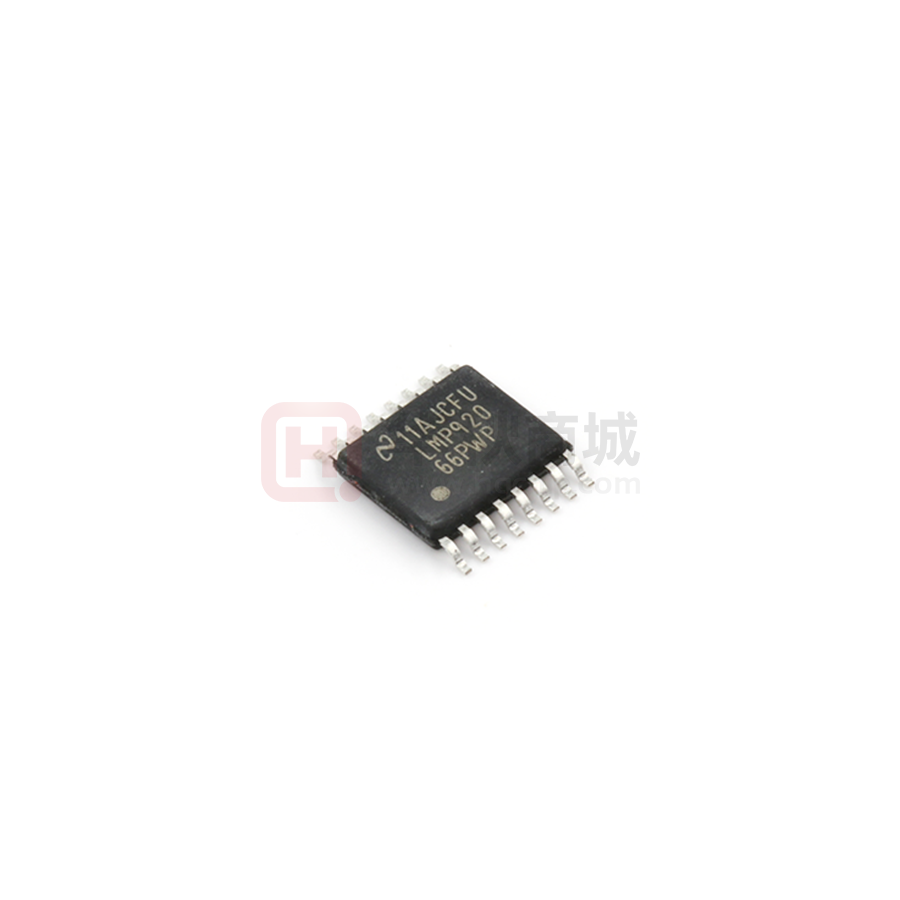
3 Description
•
The LMP92066 is a highly integrated temperaturecontrolled dual DAC. Both DACs can be programmed
by two independent, user-defined, temperature-tovoltage transfer functions stored in the internal
EEPROM, allowing any temperature effects to be
corrected without additional external circuitry. Once
powered up, the device operates autonomously,
without intervention from the system controller, to
provide a complete solution for setting and
compensating bias voltages and currents in control
applications.
1
•
•
•
•
•
•
•
•
Internal 12-Bit Temperature Sensor
– Accuracy (–40°C to 120°C), ±3.2°C
(maximum)
Two Independent Transfer Functions Stored in
EEPROM
Dual-Analog Output
– Two 12-Bit DACs
– Output Range 0 V to 5 V or 0 V to –5 V
– High-Capacitive Load Tolerant, up to 10 µF
– Post-Calibration Accuracy ±2.4 mV (typical)
Output On/Off Control Switching Time 50 ns
(typical)
– Switching Time 50 ns (typical)
– RDSON 5 Ω (maximum)
I2C Interface: Standard and Fast
– Nine Selectable Slave Addresses
– TIMEOUT Function
VDD Supply Range 4.75 V to 5.25 V
VIO Range 1.65 V to 3.6 V
Specified Temperature Range –25°C to 120°C
Operating Temperature Range –40°C to 125°C
2 Applications
•
•
•
GaN or LDMOS PA Bias Controller
Sensor Temperature Compensation
Timing Circuit Temperature Compensation
The LMP92066 has two analog outputs that support
two output ranges: zero to plus five volts and zero to
minus five volts. Each output can be switched to the
load individually through the use of the dedicated
control pin. The output switching is designed for rapid
response, making the device suitable for the RF
Power Amplifier biasing applications.
The EEPROM is verified for 100 write operations,
enabling repeated field updates. The EEPROM
programming is completed upon the user-issued I2C
command.
The LMP92066’s digital ports interface to a variety of
system controllers, as the dedicated VIO pin sets the
digital I/O levels. The device is available in the
thermally enhanced PowerPAD™ package, enabling
precise PCB temperature measurement.
Device Information
PART NUMBER
LMP92066
PACKAGE
BODY SIZE
HTSSOP (16)
5.00 mm x 4.40 mm
4 Simplified Schematic
3.3V
5V
Residual Error After One Point Calibration
VIO
35
VDD VDDB
FETDRV1
Gate Bias 1
MEAN = 0.72 mV
STDEV = 1.71 mV
PA: LDMOS
30
10µ
SCL
LMP92066
DRVEN1
DRVEN0
FETDRV0
PA: LDMOS
15
10
DAC0
10
8
6
4
2
0
0
5
±2
10µ
±4
GNDD GNDA VSSB
±6
A0
20
±8
A1
Gate Bias 0
25
±10
µC
Occurrences (%)
DAC1
SDA
REAOPC (mV)
C009
1
An IMPORTANT NOTICE at the end of this data sheet addresses availability, warranty, changes, use in safety-critical applications,
intellectual property matters and other important disclaimers. PRODUCTION DATA.
�LMP92066
SNAS634B – MARCH 2014 – REVISED JANUARY 2016
www.ti.com
Table of Contents
1
2
3
4
5
6
7
Features ..................................................................
Applications ...........................................................
Description .............................................................
Simplified Schematic.............................................
Revision History.....................................................
Pin Configuration and Functions .........................
Specifications.........................................................
7.1
7.2
7.3
7.4
7.5
7.6
7.7
7.8
8
1
1
1
1
2
3
5
Absolute Maximum Ratings ...................................... 5
ESD Ratings.............................................................. 5
Recommended Operating Conditions....................... 5
Thermal Information .................................................. 5
Electrical Characteristics........................................... 6
Timing Requirements ................................................ 8
Output Switching Characteristics .............................. 8
Typical Characteristics ............................................ 10
Detailed Description ............................................ 14
8.1
8.2
8.3
8.4
Overview .................................................................
Functional Block Diagram .......................................
Features Description ...............................................
Device Functional Modes........................................
14
14
15
28
8.5 Programming........................................................... 32
8.6 Register Map........................................................... 39
9
Application and Implementation ........................ 43
9.1
9.2
9.3
9.4
Application Information............................................
Typical Applications ................................................
Do's and Don'ts .......................................................
Initialization Setup ...................................................
43
43
51
52
10 Power Supply Recommendations ..................... 54
10.1 VDD Supply Sourcing ........................................... 54
10.2 IVDD During EEPROM BURN ................................ 54
10.3 IVDD During EEPROM TRANSFER....................... 54
11 Layout................................................................... 55
11.1 Layout Guidelines ................................................. 55
11.2 Layout Example .................................................... 56
12 Device and Documentation Support ................. 57
12.1
12.2
12.3
12.4
Device Support......................................................
Trademarks ...........................................................
Electrostatic Discharge Caution ............................
Glossary ................................................................
57
57
57
57
13 Mechanical, Packaging, and Orderable
Information ........................................................... 57
5 Revision History
Changes from Revision A (April 2015) to Revision B
Page
•
Added new footnote. .............................................................................................................................................................. 7
•
Added VDD Supply Sourcing section. ................................................................................................................................. 54
Changes from Original (March 2014) to Revision A
Page
•
Changed header row of Device Information table; revised "terminal" to "pin" throughout document, changed
Handling Ratings to ESD Ratings table; took out "+" from positive values; italicize section cross references; add
titles for tables 3, 4, 5, and 6 .................................................................................................................................................. 1
•
Added "Ω" after "k" in EC table ............................................................................................................................................. 6
•
Added "Ω" after "k" in Output Switching table ....................................................................................................................... 8
•
Added "NOTE" to beginning of Applications and Implementations ...................................................................................... 43
•
Changed title from Application Performance Plots to Application Curves; deleted reference to Figure 43 in first
sentence of first Application Curves section......................................................................................................................... 47
•
Added change "5 mA" to "50 mA" ........................................................................................................................................ 54
2
Submit Documentation Feedback
Copyright © 2014–2016, Texas Instruments Incorporated
Product Folder Links: LMP92066
�LMP92066
www.ti.com
SNAS634B – MARCH 2014 – REVISED JANUARY 2016
6 Pin Configuration and Functions
PWP Package
16-Pin HTSSOP
Top View
GNDD
1
16
VDD
DRVEN1
2
15
VDDB
DRVEN0
3
14
DAC1
VIO
4
13
FETDRV1
DAP
SDA
5
12
GNDA
SCL
6
11
FETDRV0
A1
7
10
DAC0
A0
8
9
VSSB
Pin Functions
PIN
NUMBER
NAME
TYPE
(1)
DESCRIPTION
ESD STRUCTURES
VIO
1
GNDD
G
Lower power rail of the digital I/O
2:3
DRVEN[1:0]
I
Asynchronous control of the Changeover Switches
Digital I/O power supply rail
GNDA
4
VIO
I
5
SDA
I/O
6
SCL
I
I2C bi-directional data line
I2C clock input
GNDA
VIO
7:8
A[1:0]
I
I2C slave address selector
GNDA
GNDA
9
VSSB
P
Output drive lower supply rail
10, 14
DAC0
DAC1
O
DAC0 output
11, 13
FETDRV0
FETDRV1
O
Gate drive of the external FET device
VDDB
VSSB
(1)
G = Ground; I = Input; O = Output; P = Power
Submit Documentation Feedback
Copyright © 2014–2016, Texas Instruments Incorporated
Product Folder Links: LMP92066
3
�LMP92066
SNAS634B – MARCH 2014 – REVISED JANUARY 2016
www.ti.com
Pin Functions (continued)
PIN
NUMBER
NAME
TYPE
(1)
DESCRIPTION
ESD STRUCTURES
VDD
12
GNDA
G
Analog block lower rail
Merril
Clamp
GNDA
VDD
15
VDDB
P
Output drive upper supply rail
GNDA
VDD
16
VDD
P
Analog block upper rail
Merril
Clamp
GNDA
---
4
DAP
G
Die Attach Pad. For best thermal, and noise performance
it should be soldered to the local system ground pad.
Submit Documentation Feedback
GNDA
Copyright © 2014–2016, Texas Instruments Incorporated
Product Folder Links: LMP92066
�LMP92066
www.ti.com
SNAS634B – MARCH 2014 – REVISED JANUARY 2016
7 Specifications
7.1 Absolute Maximum Ratings
over operating free-air temperature range (unless otherwise noted)
(1)
MIN
MAX
–0.3
5.5
–0.3
5.5
–0.3
5.5
VSSB
–5.5
0.3
GNDD
–0.3
0.3
VDDB to VSSB
–0.3
5.5
Any other pins to GNDA
–0.3
5.5
VDD
VDDB
VIO
Supply voltage with respect to GNDA
DAC output current
10
Current at all other pins
5
Storage temperature, Tstg
(1)
–65
UNIT
V
V
mA
150
°C
Stresses beyond those listed under Absolute Maximum Ratings may cause permanent damage to the device. These are stress ratings
only, which do not imply functional operation of the device at these or any other conditions beyond those indicated under Recommended
Operating Conditions. Exposure to absolute-maximum-rated conditions for extended periods may affect device reliability.
7.2 ESD Ratings
VALUE
V(ESD)
(1)
(2)
Electrostatic discharge
Human-body model (HBM), per ANSI/ESDA/JEDEC JS-001 (1)
±2500
Charged-device model (CDM), per JEDEC specification JESD22-C101 (2)
±1000
UNIT
V
JEDEC document JEP155 states that 500-V HBM allows safe manufacturing with a standard ESD control process.
JEDEC document JEP157 states that 250-V CDM allows safe manufacturing with a standard ESD control process.
7.3 Recommended Operating Conditions
over operating free-air temperature range (unless otherwise noted)
MIN
MAX
Operational temperature
–40
125
Specification temperature
–25
120
8
12
DAC output load capacitance
VDD
Supply voltage range (VDD)
4.75
5.25
VIO
Digital I/O supply voltage
1.65
3.3
VDDB–VSSB
LDMOS mode VSSB = GNDA
5
GaN mode VSSB = –5 V
5
UNIT
°C
µF
V
7.4 Thermal Information
THERMAL METRIC (1)
PWP (HTSSOP)
16 PINS
RθJA
Junction-to-ambient thermal resistance
38.2
RθJC(top)
Junction-to-case (top) thermal resistance
21.3
RθJB
Junction-to-board thermal resistance
15.1
ψJT
Junction-to-top characterization parameter
0.5
ψJB
Junction-to-board characterization parameter
14.9
RθJC(bot)
Junction-to-case (bottom) thermal resistance
1.4
(1)
UNIT
°C/W
For more information about traditional and new thermal metrics, see the IC Package Thermal Metrics application report, SPRA953.
Submit Documentation Feedback
Copyright © 2014–2016, Texas Instruments Incorporated
Product Folder Links: LMP92066
5
�LMP92066
SNAS634B – MARCH 2014 – REVISED JANUARY 2016
www.ti.com
7.5 Electrical Characteristics
Unless otherwise noted: VDD = 5 V ±5%, VIO = 1.8 V to 3.3 V, TA = 25°C. VDDB = 5 V ±5%, VSSB = GNDA, VDACx output
range 0 V to 5 V; or VDDB = GNDA, VSSB = –5 V ±5%, VDACx output range 0 V to –5V. DAC input code range 48 to 4047.
VDACX load CL = 10 µF.
PARAMETER
TEST CONDITIONS
MIN
TYP
MAX
UNIT
ANALOG SIGNAL PATH CHARACTERISTICS (DAC, Buffer Amplifier, Internal Reference)
Resolution
12
–25°C < TA < 120°C
Monotonic
12
12
DNL
Differential non-linearity
RL = 100 kΩ, –25°C < TA < 120°C
–0.99
1
INL
Integral non-linearity
RL = 100 kΩ, –25°C < TA < 120°C
−1.93
2.78
–14
14
LDMOS mode, RL = 100 kΩ,
–25°C < TA < 120°C
OE
Offset error
(1)
LDMOS mode, RL = 100 kΩ
±1
GaN mode, RL = 100 kΩ, –25°C < TA <
120°C
OETC
Offset error temperature coefficient (1) (2)
RL = 100 kΩ, –25°C < TA < 120°C
GE
Gain error (1)
RL = 100 kΩ, –25°C < TA < 120°C
GETC
Gain error temperature coefficient
(1) (2)
Residual error after one point
calibration (1) (2) (3) (4)
Zero code output (VDACx – VSSB)
FSO
Full-scale output at code 4095 (VDDB –
VDACx)
IO
Continuous output current per channel
allowed (5)
CL
Load capacitance (5)
mV
16.5
43
μV/°C
–0.72
0.74
%FS
20 ppm/°C
–13.3
BASEx = 1638 (VDACX = 2 V at 24°C)
BASEx = 819 (VDACX = 1 V at 24°C)
–25°C < TA < 120°C
13.3
±2.4
–11.3
BASEx = 819 (VDACX = 1 V at 24°C)
ZCO
mV
11.3
±2.1
LDMOS mode, RL = 100 kΩ
0
LDMOS mode, IOUT = 10 mA
mV
200
LDMOS mode, RL = 100 kΩ
10
LDMOS mode, IOUT = –10 mA
mV
150
TA = 125°C
10
RL = 2 kΩ or ∞, –25°C < TA < 120°C
12
RL = 2 kΩ or ∞
DAC output resistance
DACCODEx = 2048
DAC settling time
CL = 10 µF
LSB
–16.5
RL = 100 kΩ, –25°C < TA < 120°C
BASEx = 1638 (VDACX = 2 V at 24°C)
–25°C < TA < 120°C
REAOPC
Bits
10
mA
µF
3
Ω
250
µs
OUTPUT SWITCH DC CHARACTERISTICS
RDRV
On Resistance of the switch between
DACx and FETDRVx
RG
On Resistance of the switch between
FETDRVx and VSSB
–25°C < TA < 120°C
6
Ω
11
TEMPERATURE SENSOR CHARACTERISTICS
Resolution
TE
Temperature sensor error (2)
0.0625
TA = –40°C to 120°C
Conversion time
(1)
(2)
(3)
(4)
(5)
6
–3.2
°C/lsb
3.2
25
°C
ms
The package mechanical stress-induced parameter shift may cause the parts to manifest behavior beyond the specified limits.
Mechanical stresses may also arise as a result of the PCB manufacturing process.
Device specification is verified by characterization and is not tested in production.
The specification is a calculated worst-case value based on the OE, OETC, GE, and GETC limits.
The outcome of the REAOPC characterization of the PCB mounted devices is shown in Figure 4, Figure 5, and Figure 6 of the Typical
Characteristics. The 97, randomly selected, devices from 3 diffusion lots were installed on the 4-layer RO4003 Laminate using
Convection Reflow. The Look-Up-Table was set for maximum gain; for example, all DELx = 0xFF. While powered up, the devices were
subjected to 3 thermal cycles, from –40°C to 125°C, during which their REAOPC was recorded.
Parameter based on the process data and circuit simulation.
Submit Documentation Feedback
Copyright © 2014–2016, Texas Instruments Incorporated
Product Folder Links: LMP92066
�LMP92066
www.ti.com
SNAS634B – MARCH 2014 – REVISED JANUARY 2016
Electrical Characteristics (continued)
Unless otherwise noted: VDD = 5 V ±5%, VIO = 1.8 V to 3.3 V, TA = 25°C. VDDB = 5 V ±5%, VSSB = GNDA, VDACx output
range 0 V to 5 V; or VDDB = GNDA, VSSB = –5 V ±5%, VDACx output range 0 V to –5V. DAC input code range 48 to 4047.
VDACX load CL = 10 µF.
PARAMETER
TEST CONDITIONS
MIN
TYP
MAX
UNIT
EEPROM
Maximum EEPROM write cycles
100
DIGITAL INPUT CHARACTERISTICS (DRVEN0, DRVEN1, SDA, and SCL)
VIH
Input high voltage
–25°C < TA < 120°C
VIL
Input low voltage
–25°C < TA < 120°C
0.7 ×
VIO
0.3 ×
VIO
0.2 ×
VIO
Hysteresis
CiND
V
Input capacitance
5
pF
DIGITAL INPUT CHARACTERISTICS (A0, A1)
0.7 ×
VIO
VIH
Input high voltage
–25°C < TA < 120°C
VIL
Input low voltage
–25°C < TA < 120°C
RUP
Internal pullup resistance
17
RDN
Internal pulldown resistance
17
0.3 ×
VIO
Max external capacitance (5)
V
kΩ
30
pF
DIGITAL OUTPUT CHARACTERISTICS (SDA)
VOL
Output low voltage
ILEAK
Open-drain output leakage current with
output high (5)
COUT
Output capacitance
IOUT = 4 mA, –25°C < TA < 120°C
0.4
IOUT = 4 mA
0.16
Current from the supply rail through the
pullup resistor into the drain of the opendrain output device, –25°C < TA < 120°C
±1
4
V
μA
pF
SUPPLY CURRENT SPECIFICATIONS
Normal operation (6), (7) –25°C < TA < 120°C
IDD
2.6
While executing EEPROM BURN (8)
4
While transferring EEPROM content to
operating memory (9)
9
I2C inactive, –25°C < TA < 120°C
IVIO
mA
3
I2C in fast mode, –25°C < TA < 120°C
3.1
IVDDB
LDMOS mode, RL = ∞, –25°C < TA < 120°C
1.5
IVSSB
GaN mode, RL = ∞, –25°C < TA < 120°C
PWR
(Conv)
(6)
(7)
(8)
(9)
Power consumption, conversion mode
All output pins RL = ∞
–1.4
20
µA
mA
mW
The normal operation current through the VDD excludes the current supplied to the external load, and excludes the current required by
the EPPROM BURNS and TRANSFERS.
The power supply must be capable of sourcing a minimum of 50mA in order to avoid the continuous activation of the LMP92066’s
power-on-reset (POR) circuit.
During the EEPROM BURN command execution the device activates internal systems that are not active during the Normal operation.
This causes a momentary increase in supply current through the VDD pin. The duration of this temporary surge in supply current is
typically 125 ms.
During the data transfer from the EEPROM to the Operating memory there will be a momentary surge in supply current through the VDD
pin. The duration of this surge is typically 200 µs.
Submit Documentation Feedback
Copyright © 2014–2016, Texas Instruments Incorporated
Product Folder Links: LMP92066
7
�LMP92066
SNAS634B – MARCH 2014 – REVISED JANUARY 2016
www.ti.com
7.6 Timing Requirements
Unless otherwise noted: VDD = 5 V ±5%, VIO = 1.8 V to 3.3 V. VDDB = 5 V ±5%, VSSB = GNDA; or VDDB = GNDA, VSSB
= –5V ±5%.
PARAMETER
TEST CONDITIONS
MIN
I2C clock frequency
10
tLOW
Clock low time
1.3
tHIGH
Clock high time
MAX
UNIT
400
kHz
0.6
After this period, the first clock pulse is
generated
tHD-STA
Hold time repeated START condition
tSU;STA
Setup time for a repeated START
condition
tHD;DAT
Data hold time (Note x and y)
tSU;DAT
Data setup time
tf
SDA fall time
tSU;STO
Setup time for STOP condition
0.6
tBUF
Bus free time between a STOP and
START condition
1.3
Cb
SDA capacitive load
tSP
Pulse width of spikes that must be
suppressed by the input filter
µs
0.6
0.6
0
900
100
ns
IL ≤ 3 mA and CL ≤ 400 pF
250
SCL and SDA timeout
µs
25
400
pF
50
ns
35
ms
7.7 Output Switching Characteristics
Unless otherwise noted: VDD = 5 V ±5%, VIO = 1.8 V to 3.3 V. VDDB = 5 V ±5%, VSSB = GNDA; or VDDB = GNDA, VSSB
= –5V ±5%.
PARAMETER
TEST CONDITIONS
MIN
TYP
tON
On time
tOFF
Off time
tBBM
Break-before-make time
15
CFETDRV
FETDRV output capacitance
10
MAX
UNIT
50
DACCODEx = 4095, RL = 100 kΩ
50
ns
pF
tVD;DAT, tVD;ACK
SDA
70%
tLOW
tf
tr
SCL
tBUF
tHD;STA
tf
30%
tSP
70%
30%
tSU;STA
tHD;STA
tHD;DAT
START
tHIGH
tSU;STO
tSU;DAT
REPEATED
START
STOP
START
Figure 1. I2C Timing
8
Submit Documentation Feedback
Copyright © 2014–2016, Texas Instruments Incorporated
Product Folder Links: LMP92066
�LMP92066
www.ti.com
SNAS634B – MARCH 2014 – REVISED JANUARY 2016
VIO
DRVENx
50%
50%
GNDD
VDACx
FETDRVx
90%
HiZ
90%
HiZ
VSSB
tBBM
tON
tBBM
tOFF
Figure 2. Switching
Submit Documentation Feedback
Copyright © 2014–2016, Texas Instruments Incorporated
Product Folder Links: LMP92066
9
�LMP92066
SNAS634B – MARCH 2014 – REVISED JANUARY 2016
www.ti.com
7.8 Typical Characteristics
Unless otherwise stated the plot data was collected under these conditions: VDD = 5 V, VDDB = 5 V, VSSB = GNDA, VIO =
3.3 V, Temperature = 24°C, RL = 100 kΩ.
2.1
35
MEAN = 0.76 mV
STDEV = 1.43 mV
1.8
30
1.5
Occurrences (%)
1.2
0.9
TE (ƒC)
0.6
0.3
0.0
±0.3
25
20
15
10
±0.6
±40
±20
0
20
40
60
80
100
120
Temperature (ƒC)
C008
PCB Mounted
3 Cycles: –40°C to 125°C
Figure 3. Temperature Sensor Error
Figure 4. REAOPC
35
REAOPC (mV)
REAOPC (mV)
C009
BASE = 1638
97 devices
C010
PCB Mounted
3 Cycles: –40°C to 125°C
BASE = 3277
97 devices
Figure 5. REAOPC
PCB Mounted
3 Cycles: –40°C to 125°C
Figure 6. REAOPC
0.5
1.0
0.4
0.8
0.3
0.6
0.2
0.4
0.1
0.2
INL (lsb)
DNL (lsb)
10
8
2
0
10
8
6
4
2
0
±2
0
±4
0
±6
5
±8
5
±2
10
±4
10
15
±6
15
20
±8
20
25
±10
Occurrences (%)
25
±10
MEAN = 0.66 mV
STDEV = 2.42 mV
30
6
MEAN = 0.72 mV
STDEV = 1.71 mV
30
4
35
0.0
±0.1
0.0
±0.2
±0.2
±0.4
±0.3
±0.6
±0.4
±0.8
±0.5
±1.0
0
512
1024
1536
2048
2560
Input Code (dec)
3072
3584
4096
0
C003
Figure 7. DAC DNL
10
10
8
6
4
2
0
REAOPC (mV)
C001
BASE = 819
97 devices
Occurrences (%)
±2
±4
0
±6
±1.5
±10
±1.2
±8
5
Mean Error
1
± 1
±0.9
512
1024
1536
2048
2560
Input Code (dec)
3072
3584
4096
C003
Figure 8. DAC INL
Submit Documentation Feedback
Copyright © 2014–2016, Texas Instruments Incorporated
Product Folder Links: LMP92066
�LMP92066
www.ti.com
SNAS634B – MARCH 2014 – REVISED JANUARY 2016
Typical Characteristics (continued)
1.0
1.0
0.8
0.8
0.6
0.6
0.4
0.4
0.2
0.2
INL (lsb)
0.0
±0.2
±0.4
0.0
±0.2
±0.4
±0.6
±0.6
MAX
MIN
100 120 140
±60
25
60
Occurrences (%)
70
20
15
10
10
8
6
4
2
0
80
100 120 140
C005
20
0
±2
60
30
0
±4
40
40
10
±6
20
50
5
±8
0
Figure 10. DAC MIN/MAX INL vs Temperature
30
±10
±20
Temperature (ƒC)
Figure 9. DAC MIN/MAX DNL vs Temperature
Occurrences (%)
±40
C004
OE (mV)
GE (%)
C006
C007
TEMP = –40°C to 120°C
TEMP = –40°C to 120°C
Figure 11. DAC Offset Error
Figure 12. DAC Gain Error
VDACx
VDACx
VSCL
VSCL
Time (100 µs/DIV)
Time (100 µs/DIV)
C012
C011
DAC OVERRIDE MODE
CL = 10 µF
1.0
80
0.8
60
0.6
40
0.4
20
Temperature (ƒC)
0.2
0
±0.4
±20
±0.6
±40
±1.0
±0.8
±60
MAX
MIN
±0.8
0.0
±1.0
±0.2
±0.8
±1.0
DNL (lsb)
Unless otherwise stated the plot data was collected under these conditions: VDD = 5 V, VDDB = 5 V, VSSB = GNDA, VIO =
3.3 V, Temperature = 24°C, RL = 100 kΩ.
I2C command triggers DAC step
Step size: 1/4 to 3/4 FS
DAC OVERRIDE MODE
CL = 10 pF
Figure 13. DAC Step Response
I2C command triggers DAC step
Step size: 1/4 to 3/4 FS
Figure 14. DAC Step Response
Submit Documentation Feedback
Copyright © 2014–2016, Texas Instruments Incorporated
Product Folder Links: LMP92066
11
�LMP92066
SNAS634B – MARCH 2014 – REVISED JANUARY 2016
www.ti.com
Typical Characteristics (continued)
Unless otherwise stated the plot data was collected under these conditions: VDD = 5 V, VDDB = 5 V, VSSB = GNDA, VIO =
3.3 V, Temperature = 24°C, RL = 100 kΩ.
VDACx
VDACx
VSCL
VSCL
Time (100 µs/DIV)
Time (100 µs/DIV)
C013
I2C command triggers DAC step
Step size: 3/4 to 1/4 FS
DAC OVERRIDE MODE
CL = 10 µF
C014
Figure 15. DAC Step Response
Figure 16. DAC Step Response
5
5
4
4
3
3
RDRV ( )
RDRV ( )
I2C command triggers DAC step
Step size: 3/4 to 1/4 FS
DAC OVERRIDE MODE
CL = 10 pF
2
2
1
1
Vdacx=
VDACx 1.38 V
VDACx 3.23 V
Vdacx=
VDACx 4.46 V
Vdacx=
0
0
0
1
2
3
4
5
VDACx (V)
±40
±20
0
20
40
60
80
100
120
Temperature (ƒC)
C015
Figure 17. RDRV Resistance vs DAC Output Level
C016
Figure 18. RDRV vs Temperature
90
60
80
50
Occurrences (%)
70
tON (ns)
40
30
20
60
50
40
30
20
10
Temperature (ƒC)
C017
45
0
44
120
43
100
42
80
41
60
40
40
39
20
38
0
37
±20
36
±40
35
10
0
tON (ns)
C018
Figure 19. Output Switch ON Time vs Temperature
12
Submit Documentation Feedback
Figure 20. Output Switch ON Time
Copyright © 2014–2016, Texas Instruments Incorporated
Product Folder Links: LMP92066
�LMP92066
www.ti.com
SNAS634B – MARCH 2014 – REVISED JANUARY 2016
Typical Characteristics (continued)
Unless otherwise stated the plot data was collected under these conditions: VDD = 5 V, VDDB = 5 V, VSSB = GNDA, VIO =
3.3 V, Temperature = 24°C, RL = 100 kΩ.
70
Occurrences (%)
60
50
40
30
20
13.0
12.5
12.0
11.5
11.0
10.5
10.0
9.5
0
9.0
10
RG ( )
C019
Figure 21. Ground Switch Resistance When Closed
Submit Documentation Feedback
Copyright © 2014–2016, Texas Instruments Incorporated
Product Folder Links: LMP92066
13
�LMP92066
SNAS634B – MARCH 2014 – REVISED JANUARY 2016
www.ti.com
8 Detailed Description
8.1 Overview
The LMP92066 is a dual temperature-dependent bias generator whose temperature-to-voltage transfer functions
are user defined. The device contains a digital temperature sensor that addresses two independently
programmable Look-Up-Tables (LUTs). The outputs of LUTs are sent on to their respective 12-bit DACs to
produce two independent output voltages. For added flexibility the device can be configured to provide bias
potential above or below GNDA.
In applications requiring rapid ON/OFF switching of the bias voltage, the LMP92066 provides asynchronous
control over its outputs. Dedicated digital input pins control analog output switching.
All aspects of the device functionality are controlled through internal registers. These registers, and the LUTs, are
accessible through the I2C-compatible interface.
The LMP92066 can operate autonomously of the system controller, once LUT coefficients have been committed
to its non-volatile memory, EEPROM. Upon power up the EEPROM content is automatically transferred to the
operating memory, and the device begins to produce required bias voltage.
8.2 Functional Block Diagram
VIO
A[1:0]
SCL
SDA
VDD
VDDB
I2C
Interface
&
Controller
DAC1
LUT1
Temp.
Sensor
FETDRV1
DAC1
DRVEN1
EPROM
VSSB
DAC0
LUT0
FETDRV0
DAC0
DRVEN[1:0]
DRVEN0
VSSB
GNDD
14
GNDA
VSSB
Submit Documentation Feedback
Copyright © 2014–2016, Texas Instruments Incorporated
Product Folder Links: LMP92066
�LMP92066
www.ti.com
SNAS634B – MARCH 2014 – REVISED JANUARY 2016
8.3 Features Description
8.3.1 Temperature Sensor
The onboard digital temperature sensor produces 12-bit, twos complement output, where the LSB represents
+0.0625°C, and MSB represents –128°C. The output of the temperature sensor is stored in the TEMPM and
TEMPL registers. These registers are updated automatically once the temperature sensor completes a new
conversion, approximately every 25 ms. The temperature sensor begins operation immediately after the supply
voltage at VDD has reached its minimum operating level. Initially, right after power up, TEMPM and TEMPL
registers contain 0s. The first measurement result is loaded into TEMPM and TEMPL registers 25 ms after power
up.
Table 1. Temperature Sensor Output
TEMPERATURE SENSOR
OUTPUT
{TEMPM[3:0], TEMPL[7:0]}
TEMPERATURE (°C)
100000000000
–128.0000
111001000000
–28.0000
111111111111
–0.0625
000000000001
0.0625
000110000000
24.0000
011111111111
127.9375
NOTE
The maximum output of the temperature sensor stored in the TEMPM and TEMPL
registers is 127.9375°C.
8.3.2 Look-Up-Table (LUT) and Arithmetic-Logic Unit (ALU)
The LUT is used to create an arbitrary transfer function which maps the temperature to the analog output of the
device. In concept, the temperature readout is used as a pointer to a table of discrete values that are
representative of the samples of the desired temperature-dependent function.
In order to minimize the storage requirements, the LMP92066 LUTs are indexed in 4°C increments. Also, the
stored values are only the increments, or first derivatives (Δs) of the modeled transfer function. The internal ALU
reconstructs the original transfer function by integrating the coefficients stored in the LUTs. The errors due to the
coarseness of the temperature quantization are significantly reduced through the use of linear interpolation,
which is also implemented in the ALU.
Consider the example shown in Figure 22. The target output vs temperature is shown in the top graph. VDACx is a
smooth, monotonic function with, ideally, infinite precision. The LUT stores only the increments, or the rise, within
each 4°C interval.
In order to recreate the original transfer function, the series of increments must be summed together and added
to the constant BASE value. BASE represents the constant offset which is lost due to the differentiation - storage
of the increments only. This process must also be referenced to the common temperature point. This reference
temperature is called BASELINE in this document, and is fixed at 24°C.
Submit Documentation Feedback
Copyright © 2014–2016, Texas Instruments Incorporated
Product Folder Links: LMP92066
15
�LMP92066
SNAS634B – MARCH 2014 – REVISED JANUARY 2016
www.ti.com
VDACx
û4
BASE
24°C
Temperature
4°C
4°C
û VDACx
û4
1
2
3
4
LUT Index
BASELINE
Figure 22. Original Transfer Function
The LUT and ALU Organization, LUT Coefficient to Register Mapping, and The LUT Input and Output Ranges
sections below detail the operation of the LUTs and the ALUs.
8.3.2.1 LUT and ALU Organization
In Figure 23 TEMP represents the 12-bit input value to the LUT. This value is produced by the local temperature
sensor, or it can be provided by the user through the use of the OVERRIDE registers. The OVERRIDE modes
are described in the later sections.
TEMP is truncated, and TEMP[11:6] is used to index the LUT. The truncation is equivalent to reducing the TEMP
resolution from 0.0625°C/LSB to 4°C/LSB.
The overall transfer function is stored in the LUT as a set of unsigned 4-bit increments from the BASE value, that
is, LUT location (+1) stores the value of the increment Δ1. This is shown in Figure 23. The BASELINE is 24°C
temperature reference point, and BASE is the numeric representation of the required output at 24°C
TEMP
INDEX
VALUE
K+1
û(K+1)
K
ûK
36°C
+3
û3
32°C
+2
û2
28°C
+1
û1
24°C
BASELINE
BASE
20°C
-1
û-1
-(M-1)
û-(M-1)
-M
û-M
128°C
Temp.
Sensor
-28°C
Figure 23. LUT Organization
When TEMP is above 24°C, the LUT is addressed above the BASELINE address, all increments are added to
the BASE value to produce numeric equivalent of the analog output. When TEMP is below 24°C, LUT is
addressed below the BASELINE, all increments are subtracted from the BASE value to produce DACIN.
16
Submit Documentation Feedback
Copyright © 2014–2016, Texas Instruments Incorporated
Product Folder Links: LMP92066
�LMP92066
www.ti.com
SNAS634B – MARCH 2014 – REVISED JANUARY 2016
Interpolation function is implemented in the ALU that follows the LUT. The truncated lower bits of the TEMP
value, REM = TEMP[5:0], are used to interpolate between data points stored in the LUT. A portion of increment,
αΔi, is added to form the final numeric output - the input data to the DAC. The factor α is a fraction of 4°C
temperature span, or equivalently it is a fraction of the 64-code temperature span.
D
REM
64
(1)
The process of calculating the DACIN, including the interpolation, is depicted in Figure 24. The DACIN is the final
12-bit value produced by the ALU and the LUT, and forwarded to the DAC for conversion to analog domain.
K
DACIN = BASE + ™ ûi + . û(K+1)
i=1
DACIN
.û(K+1)
ûK+1
ûK
REM
û3
û2
û1
M
™û-i + . û-M
i=1
DACIN = BASE ±
BASE
û-1
REM
û-(M-1)
û-M
)
+K
+(K
+1
+3
+2
+1
-1
SE
(24 o LIN
C) E
LUT INDEX
(TEMP)
Truncated
Full Accuracy
Truncated
Full Accuracy
BA
-(M
-1)
-M
.û-M
Figure 24. DACIN Calculation
Up to this point the algorithm description concerned only the generation of the monotonically increasing transfer
function. The device can also produce monotonically decreasing transfer function by setting the
DACx_BASEM.POL bit.
The effect of polarity reversal (POL = 1) on the overall transfer function is shown in Figure 25. The LUT content
is unchanged from the original example above. Note that now the LUT values stored at locations above
BASELINE address are subtracted from BASE value, and the LUT values stored at locations below BASELINE
address are added to the BASE value.
Submit Documentation Feedback
Copyright © 2014–2016, Texas Instruments Incorporated
Product Folder Links: LMP92066
17
�LMP92066
SNAS634B – MARCH 2014 – REVISED JANUARY 2016
www.ti.com
DACIN
û-M
û-(M-1)
û-1
BASE
û1
û2
û3
ûK
+(K
+1
)
+K
+3
+2
SE
(24 o LIN
C) E
LUT INDEX
(TEMP)
BA
+1
-1
-1)
-(M
-M
ûK+1
Figure 25. Monotonically Decreasing Transfer Function
The expressions used in the calculation of the transfer function are summarized below:
LUT index > BASELINE:
DACIN
POL
BASE ( 1)
§
¨
¨
¨
©
¦
§
¨
¨
¨
©
M
K
'i
D'(K
·
¸
1) ¸
i 1
¸
¹
(2)
LUT index < BASELINE:
DACIN
18
POL
BASE ( 1)
¦
'
i
i 1
·
¸
D' M ¸
¸
¹
(3)
Submit Documentation Feedback
Copyright © 2014–2016, Texas Instruments Incorporated
Product Folder Links: LMP92066
�LMP92066
www.ti.com
SNAS634B – MARCH 2014 – REVISED JANUARY 2016
8.3.2.2 LUT Coefficient to Register Mapping
For the sake of convenience the preceding sections referred to LUT coefficients as ΔK. These are stored in the
operating memory in the registers DELx. This is reflected in the Register Map section of this document. The
example of the ΔK to DELx register mapping is shown in Table 2 section below.
Table 2. ΔK to DELx Register Mapping
TEMPERATURE
FUNCTION INCREMENT
REGISTER ASSIGNMENT
–28°C
Δ–13
DEL0
↓
↓
↓
20°C
Δ–1
DEL12
28°C
Δ+1
DEL13
↓
↓
↓
Δ+26
DEL38
124°C
128°C
8.3.2.3 The LUT Input and Output Ranges
The programmable LUT input range spans temperatures –28°C to 128°C. For the temperatures below –28°C the
LUT output is linearly extrapolated; that is, the increment Δ–13 (register DEL0) stored at the location
corresponding to –28°C is used as the slope down to –40°C.
Computed DAC input data
Extrapolated
LUT output
LUT Range
DEL0
-40° C
-28°C
-24°C
+124°C +128°C
Temperature Sensor Output
Figure 26. Temperature Sensor Output
Although the maximum output of the temperature sensor is 127.9375°C, the LUT index corresponding to 128°C
(DEL38) is required for proper interpolation when the temperature is above 124°C.
The increments stored in the LUT are 4-bit unsigned values. This limits the maximum slope of the transfer
function stored in the LUT to:
=
SLOPEMAX = 16LSB
4 qC
4LSB
qC
(4)
Given this slope limit imposed by the LUT structure, and the fact that the LUT input range is 156°C (from –28°C
to 128°C ), the maximum output range of the LUT due to the temperature sensor input is 624 LSBs, for the given
BASE value.
NOTE
The maximum span of 624 codes can reside anywhere within the 0 to 4095 code space of
the 12-bit DAC input. The total input code to the DAC is the sum of the increments (Δs)
and the 12-bit BASE value.
Submit Documentation Feedback
Copyright © 2014–2016, Texas Instruments Incorporated
Product Folder Links: LMP92066
19
�LMP92066
SNAS634B – MARCH 2014 – REVISED JANUARY 2016
www.ti.com
8.3.3 Analog Signal Path
The simplified schematic of one analog channel of the device is shown in Figure 27. The LMP92066 contains 2
such channels. The following sub-sections describe each of the individual blocks within a channel.
DACxM.DAC
DACxL.DAC
DACxM_OVRD.DAC
DACxL_OVRD.DAC
VDD
VDDB
DAC
BUFFER
0
1 S
1
2
DACx
OVRD_CTL.DAC
GNDA
VSSB
FETDRVx
DRVENx
VSSB
Figure 27. One Analog Channel Simplified Schematic
8.3.3.1 DAC
The DAC produces unipolar output voltage proportional to the 12-bit input code. The input code format is offset
binary, where 0x000 represents minimum and the 0xFFF full-scale input. The input code is produced by the
LUT/ALU and stored in the DACxM and DACxL read-only registers. The user can also insert the DAC input code
via the DACxM_OVRD and DACxL_OVRD registers, and by setting the OVRD_CTL.DAC bit. The DAC is
referenced to the internally generated 5 V.
The DAC transfer functions:
DACIN
VDACx 5A
(V)
4096
(5)
Where A is the Buffer Amplifier gain (see Buffer Amplifier) and DACIN is the 12-bit input code stored in either:
{ DACxM[3:0], DACxL[7:0] }
or
{ DACxM_OVRD[3:0], DACxL_OVRD[7:0] }
The LUT Input and Output Ranges describes the maximum output code span of the LUT, for the given base
value. This also implies that when DACxM and DACxL registers are selected as the DAC inputs, the maximum
VDACx output excursion over temperature is:
4LSB
5V
dVDACx SLOPEMAX x TRANGE x VLSB
x156qC x
762mV
qC
4096
(6)
However, this limitation is lifted when using DACxM_OVRD and DACxL_OVRD registers as the DAC inputs. In
this case the DAC input range is full 4096 codes, and the output spans 0 V to 5 V.
8.3.3.2 Buffer Amplifier
The buffer amplifier provides the low impedance drive for the potential generated by the DAC. The output of the
amplifier is always available at the DACx output pin of the device. The buffer is designed to drive large capacitive
loads, as high as 10 µF.
The structure of the Buffer is such that it can produce output voltages above or below GNDA potential. Both
Buffer Amplifiers are biased from dedicated supply rails: VDDB and VSSB. The difference between the VDDB
and VSSB is nominally 5 V, but the span can be above or below GNDA. The gain A of the Buffer Amplifier
depends on the state of supply rails VDDB and VSSB.
20
Submit Documentation Feedback
Copyright © 2014–2016, Texas Instruments Incorporated
Product Folder Links: LMP92066
�LMP92066
www.ti.com
SNAS634B – MARCH 2014 – REVISED JANUARY 2016
When the span is above GNDA, or VDDB = 5 V and VSSB = 0 V, then the output buffer gain is A = 1. The net
effect on the output of the analog processing chain is shown in Figure 28. The DAC input codes in the range of
0x000 to 0xFFF are mapped to the output voltage in the range of 0 V to 5 V.
VDDB
VDACx
5V
A=1
0V
VSSB
DACx Input Code
0x000
0xFFF
Figure 28. Output of Analog Processing Chain: Net Effect
If the span is below GNDA, or VDDB = 0 V and VSSB = –5 V, then the output buffer gain is A = –1. This
configuration is depicted Figure 29. This results in effective mapping of the DAC input codes in the range of
0x000 to 0xFFF, to the output voltage range of 0 V to –5 V.
0x000
0xFFF
DACx Input Code
VDDB
VDACx
0V
A=-1
-5V
VSSB
Figure 29. Common Mode Voltage Below GNDA,
or VDDB = 0 V and VSSB = –5 V
NOTE
Both Buffer Amplifiers share the VDDB and VSSB rails. Therefore, both Buffers produce
gain of A = 1, or both produce gain of A = –1.
The state of the VDDB and VSSB supplies, whether their span is above or below GNDA is indicated by the state
of the DRV_STATUS.GAN bit, and can be read by the controller via the I2C interface.
Submit Documentation Feedback
Copyright © 2014–2016, Texas Instruments Incorporated
Product Folder Links: LMP92066
21
�LMP92066
SNAS634B – MARCH 2014 – REVISED JANUARY 2016
www.ti.com
8.3.3.3 Output On and Off Control
The LMP92066 facilitates rapid turnon and shutdown of the downstream devices. The FETDRVx outputs can be
switched ON or OFF by the DRVENx input, independently of the I2C bus transactions. The FETDRVx pin is
driven by the Buffer amplifier when the corresponding DRVENx input pin is asserted HIGH. Otherwise, the
FETDRVx pin is connected to VSSB.
The control and switch design was optimized for minimum delay between the DRVENx input and the FETDRVx
switching. The design also ensures that during the state transition there exists an instance when both switches at
FETDRVx are open; that is, no possibility for the crow-bar current to flow from the Buffer output to VSSB.
The switches are assured to default to the state where FETDRVx output is connected to VSSB at power up, as
long as logic 0 is present at the DRVENx input.
8.3.4 Memory
The internal memory of the device consists of 2 distinct areas: the user register set or operating memory and the
EEPROM (non-volatile storage).
The operating memory registers provide the control over device functionality, report internal status of the device,
and store the signal path data (LUT, temperature sensor output, etc). A section of operating memory, designated
as a SCRATCH PAD, is available for arbitrary data storage. All operating memory locations are directly
accessible to the user via the I2C bus.
The EEPROM is not directly accessible via the I2C bus. The EEPROM acquires its data via the transfer from the
operating memory, upon user issued command.
Sections READ and WRITE Access, Access Control, LUT, NOTEPAD Storage, and EEPROM, and Figure 30
detail the internal memory functionality.
8.3.4.1 READ and WRITE Access
The operating memory consists of individually addressable bytes whose content can be accessed via a single
I2C transaction. For 8-bit data, as soon as the I2C transfer is complete the transferred value takes effect.
The device also uses values longer that 8 bits — for example, with Temperature Sensor output, Temperature
Sensor Override input, and the DAC input and Override registers are 12-bit values which require storage in 2
adjacent registers. For these values any access should start with the register containing the upper 4 bits,
immediately followed by the access to the lower byte.
NOTE
It is the WRITE of the lower byte that results in the update of the 12-bit value. See
Table 3.
Table 3. Block Writing
2
I C OPERATION
WRITE
22
REGISTER
BLK_CNTL
DATA
DESCRIPTION
0x8F
Enable the BLOCK access and set the block length to 15. This
transfer results in the immediate update of the BLK_CNTL register
and immediate change of behavior of the I2C interface.
WRITE
TEMPM_OVRD
0x08
Write the upper nibble of the Temperature Sensor override value.
This transaction does not result in the update of the
TEMPM_OVRD register. The transferred value is placed on a queue
awaiting the transfer of the lower byte. The output of the device is
not affected.
WRITE
TEMPL_OVRD
0x00
Write the lower byte of the Temperature Sensor override value. This
transaction results in the update of both the TEMPM_OVRD and
TEMPL_OVRD registers. The output of the device changes
accordingly with the new setting.
Submit Documentation Feedback
Copyright © 2014–2016, Texas Instruments Incorporated
Product Folder Links: LMP92066
�LMP92066
www.ti.com
SNAS634B – MARCH 2014 – REVISED JANUARY 2016
8.3.4.2 Access Control
By default, all operating memory locations are open to READ access. The WRITE access is controlled by the
Access Level setting. Increasing the Access Level, broadens the scope of the WRITE access. There are 3
access levels available to the user; see Access Control.
User can change the current Access Level by writing a “password” sequence to the ACC_CNTL register. The
“password” sequences are 2 consecutive I2C byte transfers to the ACC_CNTL register. The data content of each
2 byte transfer is unique for each access level.
For example, to enter access level L2 perform the following 2 transfers:
Table 4. Memory Access Control
2
I C OPERATION
REGISTER
DATA
WRITE
ACC_CNTL
0xCD
First byte of the “password”.
WRITE
ACC_CNTL
0xF0
Second byte of the “password”. After this transfer is
completed the access level is changed to L2.
0x03
Optional:
Reading the ACC_CNTL serves as status report.
The possible returned values are:
0x00 – access level L0
0x01 – access level L1 is activated
0x03 – access level L2 is activated (and due to
nesting, L1 is also indicated)
READ
ACC_CNTL
DESCRIPTION
Table 5. EEPROM Access Levels
ACCESS LEVEL
SCOPE
L0
Default. User has READ access only to all locations in the operating
memory.
L1
User has READ access to all locations, and WRITE access to ADR_LK
and BLK_CNTL registers.
L2
User has READ and WRITE access to all operating memory locations.
NOTE
The access levels are nested. This means that L1 access level also gives all L0 level
functionality. L2 access level provides L1 and L0 functionality.
8.3.4.3 LUT, NOTEPAD Storage, and EEPROM
The LUT (its coefficients, BASE value, ALU control bits) and the NOTEPAD are stored in the operating memory
block spanning addresses 0x40 through 0x7F. This space is directly accessible (READ and WIRITE) via the I2C
bus.
There is an option to store the LUT and the NOTEPAD in the non-volatile memory, EEPROM. The move of data
from the operating memory to the EEPROM (BURN) is initiated by WRITING a command byte to the
EEPROM_CNTL register.
Upon power up the device automatically executes the TRANSFER of the EEPROM data to the operating
memory. The user can also issue a command via the I2C bus to force the TRANSFER of data from the EEPROM
to the operating memory.
Table 6. EEPROM Control
TRANSFER/BURN
2
I C OPERATION
REGISTER
DATA
COMMENT
TRANSFER
WRITE
EEPROM_CNTL
0x4E
Transfer of data from the EEPROM to the
operating memory.
BURN
WRITE
EEPROM_CNTL
0xE4
Transfer of data from the operating memory
to the EEPROM.
Submit Documentation Feedback
Copyright © 2014–2016, Texas Instruments Incorporated
Product Folder Links: LMP92066
23
�LMP92066
SNAS634B – MARCH 2014 – REVISED JANUARY 2016
www.ti.com
The READ of the EEPROM_CNTL register returns the status of the BURN or TRANSFER.
Table 7. Status of BURN or TRANSFER
EEPROM_CNTL BIT FIELD
DESCRIPTION
RDYB
0 - The TRANSFER or BURN has completed
1 – The TRANSFER or BURN is in progress
COR
1 – A bit error was detected during the transfer from EEPROM to
the operating memory. The error has been corrected and the data
is valid.
UCOR
1 – A bit error was detected during the transfer from EEPROM to
operating memory. The error was not corrected. LUT data is
compromised.
0x00
0x05
Temp Sensor
and
DAC Data
RESERVED
0x07 Temp Sensor Status,
Override Control,
EEPROM Control
RESET,
Access Level Control
0x11
RESERVED
0x16 Block Access Control
RESERVED
0x18
Address Lock
I 2C
OPERATING MEMORY
RESERVED
0x1E Output Drive Status,
Device Version
0x1F
RESERVED
0x40
Burn Counter,
LUT Coefficients,
LUT Control
BURN
COMMAND
EEPROM
TRANSFER
COMMAND
0x6B
0x6C
Note Pad
0x7F
Figure 30. Memory-to-EEPROM Mapping
24
Submit Documentation Feedback
Copyright © 2014–2016, Texas Instruments Incorporated
Product Folder Links: LMP92066
�LMP92066
www.ti.com
SNAS634B – MARCH 2014 – REVISED JANUARY 2016
8.3.5 I2C Interface
I2C bus is used for communication between the Master (the digital supervisor; for example, the microcontroller)
and the Slave (LMP92066). This interface provides the user full access to all Data, Status, and Control registers
of the device.
LMP92066 supports Standard-mode and Fast-mode, 100 kbit/s and 400 kbit/s, respectively.
All
•
•
•
•
•
•
•
•
•
transactions follow the format:
Master begins all transactions by generating START condition.
All transfers comprise 8-bit bytes.
First byte following START must contain 7-bit Slave address.
First byte is followed by a READ/WRITE bit.
All subsequent bytes contain 8-bit data.
By default, the device assumes 1-byte data transfers. Block access can be enabled via BLK_CNTL register,
resulting in multi-byte transfers.
Bit order within a byte is always MSB first
ACK/NAK condition follows every byte transfer – this can be generated by either Master or the Slave
depending on direction of data transfer.
STOP condition generated by the MASTER terminates all transactions, and resets the I2C bus. LMP92066
resets its internal address pointer to 0x00.
8.3.5.1 Supported Data Transfer Formats
Table 8 lists all conditions defined by the I2C specification and supported by this device. All following bus
descriptions refer to the symbols listed in Table 8.
Table 8. I2C Symbol Set
CONDITION
SYMBOL
SOURCE
DESCRIPTION
START
S
Master
Begins all bus transactions
STOP
P
Master
Terminates all transations and resets
bus
ACK (Acknowledge)
A
Master/Slave
Handshaking bit (LOW)
NAK (Not
Acknowledge)
A
Master/Slave
Handshaking bit (HIGH)
Master
Active HIGH bit that follows
immediately after the slave address
sequence. Indicates that the master
is initiating the slave-to-master data
transfer.
READ
R
WRITE
W
Master
Active LOW bit that follows
immediately after the slave address
sequence. Indicates that the master
is initiating the master-to-slave data
transfer.
REPEATED START
Sr
Master
Generated by master, same function
as the START condition (highlights
the fact that STOP condition is not
strictly necessary.)
Submit Documentation Feedback
Copyright © 2014–2016, Texas Instruments Incorporated
Product Folder Links: LMP92066
25
�LMP92066
SNAS634B – MARCH 2014 – REVISED JANUARY 2016
www.ti.com
The single data byte transfers are shown in Figure 31 and Figure 32:
S
Slave Address
W
A
RegAddr[7:0]
A
Data[7:0]
A
P
From MASTER to SLAVE
From SLAVE to MASTER
Figure 31. Single-Byte WRITE Access Protocol
S
Slave Address
W
A
RegAddr[7:0]
A
Sr
Slave Address
R
A
Data[7:0]
A
P
From MASTER to SLAVE
From SLAVE to MASTER
Figure 32. Single-Byte READ Access Protocol
Block Access functionality is provided to minimize the transfer overhead of large data sets. By default the
LMP92066 is ready to accept multi-byte transfers. Until the transaction is terminated by the STOP condition, the
device will READ (WRITE) the subsequent memory locations.
The size of the contiguous block can be limited by the user. This functionality can be enabled by setting
BLK_CNTL.EN bit. The 7-bit value of BLK_CNTL.SIZE=N sets the size of the contiguous memory block that can
be accessed via the block transfer.
If the Master generates a block transfer that is larger than (BLK_CNTL.SIZE + 1), the internal register pointer
wraps around to the First Register address and the access continue to subsequent memory locations. The
examples of the block WRITE and READ transactions are shown below in Figure 33 and Figure 34:
Address of the First Register of
the contiguous memory block
S
Slave Address
W
A
RegAddr[7:0]
A
From MASTER to SLAVE
Data[7:0]
A
Data[7:0]
A
Data[7:0]
A
P
Data to First Register
N bytes of data to
contiguous memory
locations following First
Register
From SLAVE to MASTER
Figure 33. Block WRITE Access —
BLK_CNTL.EN = 1, BLK_CNTL.SIZE = N
Address of the First Register of
the contiguous memory block
S
Slave Address
W
A
RegAddr[7:0]
A
Sr
Data[7:0]
Slave Address
A
R
A
Data[7:0]
A
Data[7:0]
A
P
Data to First Register
From MASTER to SLAVE
From SLAVE to MASTER
N bytes of data to
contiguous memory
locations following First
Register
Figure 34. Block READ Access —
BLK_CNTL.EN = 1, BLK_CNTL.SIZE = N
26
Submit Documentation Feedback
Copyright © 2014–2016, Texas Instruments Incorporated
Product Folder Links: LMP92066
�LMP92066
www.ti.com
SNAS634B – MARCH 2014 – REVISED JANUARY 2016
8.3.5.2 Slave Address Selection
The I2C bus slave address is selected by installing shunts from A0 and A1 pins of the device to the VIO or GNDD
rails. The device discerns between 3 possible options for each pin: shunt to VIO, shunt to GNDD, or left not
connected (floating), for the total of 9 possible slave addresses.
The state of the A0 and A1 pins is tested after every occurrence of START condition on the I2C bus. However,
the user has an option to LOCK the acquired address by setting the ADR_LK.EN bit. Once the address is locked,
the device stores its Slave address internally and does not attempt to decode the address during subsequent I2C
transactions. The address lock can be disabled by resetting ADR_LK.EN bit. The device resets the ADR_LK.EN
upon power up.
Figure 35 and Figure 36 illustrate the operation of the address decoder circuit. The device internally attempts to
pull up, and then pull down, the Ax pin while monitoring the voltage at that pin. If the shunts are installed, the
weak pull-ups or pull-downs does not affect the voltage at the Ax pin; that is. the state is fixed by the shunt. If the
Ax pin floats, then pull-up and pull-down change the voltage at that pin.
VIO
VIO
Device
Terminal
LMP92066
UPx
SHUNT
RUP
Ax
OUTx
RDN
ENx
SHUNT
GNDD
DNx
GNDD
2
Figure 35. I C Address Decoder - Simplified Diagram
The address decoder operates during 2nd through 4th cycles of the SCL. The decoding of the state of Ax pins is
performed serially; that is, A0 is decoded first then A1. The functional diagram of the address decoder is shown
in Figure 36.
SCL
EN0
UP0
DN0
EN1
UP1
DN1
Figure 36. I2C Address Decoder - Functional Diagram
Submit Documentation Feedback
Copyright © 2014–2016, Texas Instruments Incorporated
Product Folder Links: LMP92066
27
�LMP92066
SNAS634B – MARCH 2014 – REVISED JANUARY 2016
www.ti.com
The interpretation of the OUTx values produced from the test phases is summarized in the following table. For
example: if a shunt is present between Ax and VIO (first case in the table), both UPx phase and DNx phase
result in OUTx being decoded as logical 1, unambiguously indicating the presence of the shunt to VIO, or HI
state of Ax.
Table 9. Address Decoder Output
TEST PHASE
DECODED Ax ↓
UPx
DNx
SHUNT to VIO: OUTx →
1
1
SHUNT to GNDD: OUTx →
0
0
LO
NO SHUNT: OUTx →
1
0
N.C.
HI
The mapping from the decoded Ax states to the I2C Slave address is shown in Table 10.
Table 10. Slave Address Space
I2C SLAVE ADDRESS
DEVICE PINS
A1
A0
[A6:A0]
LO
LO
0111111
LO
N.C.
1000000
LO
HI
1000001
N.C.
LO
1000010
N.C.
N.C.
1000011
N.C.
HI
1000100
HI
LO
1000101
HI
N.C.
1000110
HI
HI
1000111
The Slave Address alignment within the first byte following the START condition is shown in Figure 37:
S
A6
A5
A4
A3
A2
A1
A0 R/W
W
A
From MASTER to SLAVE
From SLAVE to MASTER
Figure 37. Slave Address Alignment
8.4 Device Functional Modes
The numeric signal path is shown in Figure 38. The signal flow is generally from left to right: the system input is
the temperature sensor, signal processing is done by the LUT/ALU, and the output is driven by the DACs - DAC
detail is omitted as DACs provide a conversion from numeric domain to voltage domain only, and they do not
affect the signal flow.
There are a number of multiplexers in the signal path which alter the data flow when their respective control bits
are set. The multiplexer states, and thus modes of device operation, are described in further detail below.
28
Submit Documentation Feedback
Copyright © 2014–2016, Texas Instruments Incorporated
Product Folder Links: LMP92066
�LMP92066
www.ti.com
SNAS634B – MARCH 2014 – REVISED JANUARY 2016
Device Functional Modes (continued)
DAC1_BASEM.POL
DAC1_BASEM.BYP
LUT1
0
ALU
[11:6]
S
DAC1M.DAC
12
DAC1L.DAC
1
0
DAC1
DAC1M_OVRD.DAC
DAC1L_OVRD.DAC
12
1 S
[5:0]
DAC1_BASEM
DAC1_BASEL
12
OVRD_CTL.TEMP
TEMPM.TEMP
Temp.
Sensor
TEMPL.TEMP
12
0 S
12
TEMPM_OVRD.TEMP
OVRD_CTL.DAC
1
TEMPL_OVRD.TEMP
12
DAC0_BASEM.POL
LUT0
DAC0_BASM.BYP
0
ALU
[11:6]
12
S
DAC0M.DAC
DAC0L.DAC
0 S
1
DAC0
DAC0M_OVRD.DAC
DAC0L_OVRD.DAC
12
1
[5:0]
DAC0_BASEM.BASE
DAC0_BASEL.BASE
12
Figure 38. Modes of Operation
8.4.1 Default Operating Mode
This mode of operation is active upon power up. By default the OVRD_CTL.TEMP and OVRD_CTL.DAC are
cleared. The temperature sensor continuously updates readings every 25 ms (registers: TEMPM, TEMPL). Each
temperature sensor update triggers the ALU to re-calculate its output using the user defined coefficients stored in
the LUT. The ALU output is passed on to the DACs (registers: DACxM, DACxL) which ultimately drive the VDACx
outputs. All of the functionality described here occurs automatically, without intervention from the system
controller, as long as the power is applied to the device supply pins: VDD, VIO, and VDDB.
Submit Documentation Feedback
Copyright © 2014–2016, Texas Instruments Incorporated
Product Folder Links: LMP92066
29
�LMP92066
SNAS634B – MARCH 2014 – REVISED JANUARY 2016
www.ti.com
Device Functional Modes (continued)
8.4.2 Temperature Sensor Override
The temperature sensor output can be overridden by the externally supplied data. This capability may be used to
verify the validity of the function stored in the LUT. The externally supplied data can act as the temperature
sweep input and the output response due to temperature may be readily observed, without actually altering the
temperature of the test setup.
This functionality is facilitated by the multiplexer that follows the temperature sensor, and user writable data
registers TEMPM_OVRD and TEMPL_OVRD. TEMPM_OVRD[3:0] is the upper nibble of the temperature data.
TEMPL_OVRD[7:0] is the lower byte of the temperature data. The multiplexer control signal is the
OVRD_CTL.TEMP bit.
Table 11 shows an example of the I2C bus transfer sequence which results in externally supplied data indexing
the LUT.
Table 11. I2C Bus Transfer Sequence:
Externally Supplied Data Indexing LUT
I2C OPERATION
REGISTER
DATA
DESCRIPTION
WRITE
ACC_CNTL
0xCD
First byte of the “password”
WRITE
ACC_CNTL
0xF0
Second byte of the “password”. After this transfer is completed
the access level is changed to L2
READ
ACC_CNTL
0x03
Optional:
Reading the ACC_CNTL serves as status report.
0x03 – access level L2 is activated (and due to nesting, L1 is
also indicated)
WRITE
TEMPM_OVRD
0x01
Writes 0x1 as the value of the top nibble of the 12-bit, twos
complement, temperature value. After this transaction the
TEMPM_OVRD register is not updated, yet. The update takes
place only after the TEMPL_OVRD register is written.
WRITE
TEMPL_OVRD
0x01
Writes 0x01 into the lower byte of temperature value. After this
transaction completes both TEMPM_OVRD and
TEMPL_OVRD registers are updated. The 12-bit value in this
example is 0x101 which corresponds to 16.0625°C
WRITE
OVRD_CTL
0x01
Sets the OVRD_CTL.TEMP bit. This causes the temperature
stored in the TEMPM_OVRD and TEMPL_OVRD to index the
LUT.
READ
TEMPM
0x**
Optional:
READ
TEMPL
0x**
Read the actual temperature reported by the temperature
sensor.
The temperature sensor override is cancelled by clearing the OVRD_CTL.TEMP bit.
NOTE
TEMPM_OVRD, TEMPL_OVRD and OVRD_CTL registers are in the volatile section of
memory and are not backed by EEPROM. Upon power up these registers are cleared.
8.4.3 ALU Bypass
It may be desirable that the device produces a predetermined constant output level as soon as it is powered up.
The ALU bypass mode does that. This mode is enabled by setting DACx_BASEM.BYP bit. Since
DACx_BASEM.BYP is stored in the EEPROM, its value is automatically loaded into the operating memory at
power up. If the stored value for DACx_BASEM.BYP is 1, upon power up the corresponding DAC output
immediately produces an analog output equivalent of the BASE.
In this mode of operation the ALU is bypassed, and the BASE value of the LUT is presented at the input of the
DAC. This is the result of DACx_BASEM.BYP, which controls the mux that follows the ALU in the signal path,
being set. Therefore, the output of the device is constant over the operating temperature range of the device.
30
Submit Documentation Feedback
Copyright © 2014–2016, Texas Instruments Incorporated
Product Folder Links: LMP92066
�LMP92066
www.ti.com
SNAS634B – MARCH 2014 – REVISED JANUARY 2016
NOTE
Each channel has its own BYP bit, and its own BASE value.
8.4.4 DAC Input Override
The DAC inputs words can be directly written via the I2C interface. In this mode the LMP92066 is a dual 12-bit
DAC. This functionality is facilitated by the multiplexers that precede the DACs, and user writable data registers
DACxM_OVRD and DACxL_OVRD. DACxM_OVRD[3:0] is the upper nibble of the DAC input word.
DACxL_OVRD[7:0] is the lower byte of the DAC input data.
The multiplexer control signal is the OVRD_CTL.DAC bit. This bit is shared by both channels; that is, both
channels are either in the DAC input override mode, or both are in the default mode.
Table 12 shows the example of the I2C bus transfer sequence which results in externally supplied data being the
source of input to the DACs.
Table 12. I2C Bus Transfer Sequence:
Externally Supplied Data Sourcing Input to DACs
I2C OPERATION
REGISTER
DATA
DESCRIPTION
WRITE
ACC_CNTL
0xCD
First byte of the “password”
WRITE
ACC_CNTL
0xF0
Second byte of the “password”. After this transfer is completed
the access level is changed to L2
READ
ACC_CNTL
0x03
Optional:
Reading the ACC_CNTL serves as status report.
0x03 – access level L2 is activated (and due to nesting, L1 is
also indicated)
WRITE
DAC0M_OVRD
0x08
Writes 0x8 as the value of the top nibble of the 12-bit, offset
binary, DAC0 input value. After this transaction the
DAC0M_OVRD register is not updated, yet. The update takes
place only after the DAC0L_OVRD register is written.
WRITE
DAC0L_OVRD
0x00
Writes 0x00 into the lower byte of the DAC0 input value. After
this transaction completes both DAC0M_OVRD and
DAC0L_OVRD registers are updated. The 12-bit value in this
example is 0x800.
WRITE
DAC1M_OVRD
0x04
Writes 0x4 as the value of the top nibble of the 12-bit, offset
binary, DAC1 input value. After this transaction the
DAC1M_OVRD register is not updated, yet. The update takes
place only after the DAC1L_OVRD register is written.
WRITE
DAC1L_OVRD
0x00
Writes 0x00 into the lower byte of the DAC1 input value. After
this transaction completes both DAC1M_OVRD and
DAC1L_OVRD registers are updated. The 12-bit value in this
example is 0x400.
WRITE
OVRD_CTL
0x02
Sets the OVRD_CTL.TEMP bit. This causes both multiplexers
that precede the DACs to start routing the DACx_OVRD
values to the inputs of their respective DACs. As a result the
outputs of the device are: VDAC0 = 2.5 V, and VDAC1 = 1.25
V
READ
DAC0M
0x**
Optional:
READ
DAC0L
0x**
Read the values computed by the ALU.
NOTE
The DAC Input Override and Temperature Sensor Override modes are mutually exclusive.
The allowed values for OVRD_CTRL register are 0x00, 0x01 or 0x02.
NOTE
DACxM_OVRD, DACxL_OVRD and OVRD_CTL registers are in the volatile section of
memory and are not backed by EEPROM. Upon power up these registers are cleared.
Submit Documentation Feedback
Copyright © 2014–2016, Texas Instruments Incorporated
Product Folder Links: LMP92066
31
�LMP92066
SNAS634B – MARCH 2014 – REVISED JANUARY 2016
www.ti.com
8.4.5 LDMOS and GaN Drives
The LDMOS mode and the GaN mode result from 2 possible biasing methods of the DAC output buffers – these
were described in earlier sections of this data sheet.
The LDMOS mode is in effect when the VDDB and VSSB common mode is above GNDA. This mode is suitable
for biasing of the LDMOS Power Amplifiers, since the output produced by the LMP92066 is in the 0 V to 5 V
range. The GaN mode is in effect when the VDDB and VSSB common mode is below GNDA. This mode is
suitable for biasing of the GaN type Power Amplifiers, as the output produced by the LMP92066 is in the 0V to
–5V range.
8.5 Programming
8.5.1 Temperature Sensor Output Data Access Registers
The temperature sensor produces a 12-bit output value, TEMP[11:0], which is stored in 2 adjacent registers:
TEMPM and TEMPL.
The temperature sensor updates its output every 25 ms, nominally, but the exact instance of the update is
unknown to the user. It is possible that the temperature sensor produces a new value between READ operations
of TEMPM and TEMPL. Therefore, a synchronization mechanism was implemented, to assure that TEMPM and
TEMPL values correspond to the same temperature sample. The coherence of the temperature sensor data is
maintained if the READ sequence is: read TEMPM first, then TEMPL.
ADDRESS
0x00
NAME
TEMPM
ACCESS
TYPE
R
ACCESS
LEVEL
BIT
FUNCTION
7
RES
6:5
*
4
RES
3:0
TEMP[11:8]
L0
ADDRESS
NAME
ACCESS
TYPE
ACCESS
LEVEL
BIT
FUNCTION
0x01
TEMPL
R
L0
7:0
TEMP[7:0]
DESCRIPTION
Reserved bit.
The value may be reported as 0 or 1
Reserved bit.
Always reported as 0.
Reserved bit.
The value may be reported as 0 or 1.
4-bit MSB nibble of the 12-bit Temperature Sensor
output word.
DESCRIPTION
8-bit LSB byte of the 12-bit Temperature Sensor
output word.
8.5.2 DAC Input Data Registers
The 12-bit data produced by the LUT and ALU is stored in the DAC0M and DAC0L, and DAC1M and DAC1L
pairs of registers. Unless overridden (see Override Control Register), the contents of these registers are
presented at each DAC inputs.
In cases where the user wants to read the temperature sensor output and resulting DACxM or DACxL data, the
following read order has to be maintained to assure the coherency of data: TEMPM, TEMPL, DAC0M, DAC0L,
DAC1M, DAC1L.
Coherency of the TEMPM is still maintained, and TEMPL read is omitted in the sequence above.
ADDRESS
NAME
ACCESS
TYPE
ACCESS
LEVEL
BIT
FUNCTION
0x02
DAC0M
R
L0
7:4
*
3:0
DAC[11:8]
ADDRESS
NAME
ACCESS
TYPE
ACCESS
LEVEL
BIT
FUNCTION
0x03
DAC0L
R
L0
7:0
DAC[7:0]
32
Submit Documentation Feedback
DESCRIPTION
Reserved bit. Always report as 0.
4-bit MSB nibble of the 12-bit DAC0 input word.
DESCRIPTION
8-bit LSB byte of the 12-bit Temperature Sensor
output word.
Copyright © 2014–2016, Texas Instruments Incorporated
Product Folder Links: LMP92066
�LMP92066
www.ti.com
SNAS634B – MARCH 2014 – REVISED JANUARY 2016
ADDRESS
NAME
ACCESS
TYPE
ACCESS
LEVEL
BIT
FUNCTION
0x04
DAC1M
R
L0
7:4
*
3:0
DAC[11:8]
ADDRESS
NAME
ACCESS
TYPE
ACCESS
LEVEL
BIT
FUNCTION
0x05
DAC1L
R
L0
7:0
TEMP[7:0]
DESCRIPTION
Reserved bit. Always report as 0.
4-bit MSB nibble of the 12-bit DAC1 input word.
DESCRIPTION
8-bit LSB byte of the 12-bit DAC1 input word.
8.5.3 Temperature Sensor Status Register
This register may contain non-zero values immediately after the device power up. Within 100 ms of the power up
the TEMP_STATUS register clears, indicating the temperature sensor’s output is valid.
ADDRESS
NAME
ACCESS
TYPE
ACCESS
LEVEL
BIT
FUNCTION
DESCRIPTION
0x07
TEMP_STATUS
R
L0
7:0
RBYB
If RDYB=0x00, the Temperature Sensor is initialized
and producing valid output.
8.5.4 Override Control Register
Override functionality allows the user to insert external data into the signal path of the device. When TEMP
override is enabled, the temperature sensor’s data is ignored, and the user-supplied data is used to index the
LUT (TEMPM_OVRD and TEMPL_OVRD, below). When DAC override is enabled the LUT and ALU produced
output is ignored, and both DAC0 and DAC1 use external data as their inputs (DAC0M_OVRD, DAC0L_OVRD
and DAC1M_OVRD and DAC1L_OVRD described below).
NOTE
Only 3 OVRD_CNTL[2:0] settings are allowed: 0x0, 0x1, 0x2; simultaneous DAC and
TEMP override is not allowed.
ADDRESS
0x08
NAME
OVRD_CNTL
ACCESS
TYPE
ACCESS
LEVEL
R/W
L2
BIT
FUNCTION
DESCRIPTION
7:4
*
Reserved bit. Always WRITE 0
3
RES
Reserved bit. Always WRITE 0
2
RES
Reserved bit. Always WRITE 0
1
DAC
DAC override enable bit:
0: DAC input generated by LUT
1: DAC input is supplied from user accessible
registers DACxy_OVRD.
0
TEMP
DAC override enable bit:
0: DAC input generated by LUT
1: DAC input is supplied from user accesible
registers TEMPy_OVRD.
8.5.5 Override Data Registers
These registers hold the externally supplied data to be inserted into the signal path of the device (see
OVRD_CNTL).
NOTE
Since override data are 12-bit words stored in 2 adjacent registers, it is the writing of the
lower byte that makes the new value take effect.
Submit Documentation Feedback
Copyright © 2014–2016, Texas Instruments Incorporated
Product Folder Links: LMP92066
33
�LMP92066
SNAS634B – MARCH 2014 – REVISED JANUARY 2016
www.ti.com
ADDRESS
NAME
ACCESS
TYPE
ACCESS
LEVEL
0x09
TEMPM_OVRD
R/W
L2
ADDRESS
NAME
ACCESS
TYPE
0x0A
TEMPL_OVRD
ADDRESS
BIT
FUNCTION
7:4
*
3:0
TEMP[11:8]
ACCESS
LEVEL
BIT
FUNCTION
R/W
L2
7:0
TEMP[7:0]
NAME
ACCESS
TYPE
ACCESS
LEVEL
BIT
FUNCTION
7:4
*
0x0B
DAC0M_OVRD
R/W
L2
3:0
DAC[11:8]
ADDRESS
NAME
ACCESS
TYPE
ACCESS
LEVEL
BIT
FUNCTION
0x0C
DAC0L_OVRD
R/W
L2
7:0
DAC[7:0]
ADDRESS
NAME
ACCESS
TYPE
ACCESS
LEVEL
BIT
FUNCTION
7:4
*
0x0D
DAC1M_OVRD
R/W
L2
3:0
DAC[11:8]
ADDRESS
NAME
ACCESS
TYPE
ACCESS
LEVEL
BIT
FUNCTION
0x0E
DAC1L_OVRD
R/W
L2
7:0
DAC[7:0]
DESCRIPTION
Reserved bit. Always report as 0.
4-bit MSB nibble of the 12-bit Temperature Sensor
override input word.
DESCRIPTION
8-bit LSB byte of the 12-bit Temperature Sensor
output word.
DESCRIPTION
Reserved bit. Always report as 0.
4-bit MSB nibble of the 12-bit DAC0 input override
word.
DESCRIPTION
8-bit LSB byte of the 12-bit DAC0 input override
word.
DESCRIPTION
Reserved bit. Always report as 0.
4-bit MSB nibble of the 12-bit DAC1 input override
word.
DESCRIPTION
8-bit LSB byte of the 12-bit DAC1 input override
word.
8.5.6 EEPROM Control Register
Writing a command byte results in either the EEPROM BURN (the commitment of a section of operating memory
to non-volatile storage), or the TRANSFER (recall of the data in the non-volatile storage to the operating
memory.
Reading this register yields status information.
NOTE
UCOR and COR bits are updated only by the TRANSFER command.
34
Submit Documentation Feedback
Copyright © 2014–2016, Texas Instruments Incorporated
Product Folder Links: LMP92066
�LMP92066
www.ti.com
ADDRESS
SNAS634B – MARCH 2014 – REVISED JANUARY 2016
NAME
ACCESS
TYPE
ACCESS
LEVEL
W
0x0F
L2
EEPROM_CNTL
R
BIT
FUNCTION
DESCRIPTION
7:0
*
Instruction to BURN EEPROM or TRANSFER
EEPROM content to operating memory:
0xE4: BURN EEPROM.
0x4E: TRANSFER data from EEPROM to operating
memory.
7:3
*
Reserved bit.
2
UCOR
1
COR
1: A bit error was detected and corrected during the
TRANSFER.
0: No errors detected during the TRANSFER.
0
RDYB
1: BURN or TRANSFER in progress.
0: BURN or TRANSFER completed.
L0
1: More than one bit error was detected during the
TRANSFER, and correction was not possible.
0: No uncorrected errors were detected during the
TRANSFER.
8.5.7 Software RESET Register
Has the same effect as the power-on reset.
ADDRESS
NAME
ACCESS
TYPE
ACCESS
LEVEL
BIT
FUNCTION
0x10
RESET
W
L2
7:0
DAC[7:0]
DESCRIPTION
WRITE 0xC3 to reset the deice to the power-up
default state.
8.5.8 Access Control Register
Changing the Access Level requires writing the 2-byte password sequence. Reading this register yields status
information.
ADDRESS
0x11
NAME
ACCESS
TYPE
ACCESS
LEVEL
BIT
FUNCTION
W
L0
7:0
PSWD
7:2
*
*
1
*
1: Access Level L2 is enabled.
0: L2 not enabled.
0
RES
1: Access Level L1 is enabled.
0: L1 not enabled.
ACC_CNTL
R
L0
DESCRIPTION
WRITE 2-byte password to change access level:
0xCD, 0xEF: Access Level L1.
0xCD, 0xF0: Access Level L2.
8.5.9 Block I2C Access Control Register
The I2C master may request a continuous transfer of data from or to the slave. By default, the slave continues
advancing its internal register pointer to the end of the internal register space, and then wrap back to address
0x00 and continue on.
BLK_CNTL allows to limit the size of the contiguous memory accessed continuously.
ADDRESS
0x16
NAME
BLK_CNTL
ACCESS
TYPE
ACCESS
LEVEL
R/W
BIT
FUNCTION
7
EN
6:0
*
L1
DESCRIPTION
Enable the control of the I2C access block size:
1: Enabled.
0: Block size control is disabled.
7-bit SIZE of the I2C access block. The continuous
I2C transaction accesses SIZE+1 memory locations,
and then wrap back to the starting address.
Submit Documentation Feedback
Copyright © 2014–2016, Texas Instruments Incorporated
Product Folder Links: LMP92066
35
�LMP92066
SNAS634B – MARCH 2014 – REVISED JANUARY 2016
www.ti.com
8.5.10 I2C Address LOCK Register
Allows the device to LOCK its own I2C slave address. Once the slave address is locked, the device does not
attempt to decode the state of A0 and A1 address setting pins on subsequent transactions.
ADDRESS
0x18
NAME
ADR_LK
ACCESS
TYPE
R/W
ACCESS
LEVEL
L1
BIT
FUNCTION
DESCRIPTION
7:3
*
2
RES
Always set to 0
Reserved bit. Always write 0.
1
RES
Reserved bit. Always write 0.
0
EN
1: Lock the slave address
0: Slave address is not locked. Device decodes state
of A1 and A0 after every START condition of the I2C
bus.
NOTE
The locked address is the one present at the A[1:0] pins during the I2C transaction that
follows the ADR_LK command.
8.5.11 Output Drive Supply Status Register
The device output stage can operate in either LDMOS or GaN modes. The mode is determined by the potential
applied to the VDDB and VSSB supply pins.
The device monitors the VDDB and VSSB supplies, and reports the mode of operation via the GaN status bit.
ADDRESS
0x1E
NAME
DRV-STATUS
ACCESS
TYPE
R
ACCESS
LEVEL
L0
BIT
FUNCTION
7:1
*
DESCRIPTION
Reserved. Always reports 0
0
GAN
1: GaN mode supply rails detected; that is, VDDB =
GNDA,
VSSB = –5V.
0: LDMOS mode supply rails detected; that is, VDDB
= +5V,
VSSB = GNDA.
DESCRIPTION
8.5.12 Device Version Register
Factory set value.
ADDRESS
NAME
ACCESS
TYPE
ACCESS
LEVEL
BIT
FUNCTION
0x1F
VERSION
R
L0
7:0
VERSION
8-bit device revision number.
8.5.13 EEPROM Burn Counter
The value is incremented automatically at the start of BURN sequence.
This data is transferred automatically from the EEPROM to operating memory upon power up.
ADDRESS
NAME
ACCESS
TYPE
ACCESS
LEVEL
BIT
FUNCTION
0x40
BURN_CT
R
L0
7:0
COUNT
DESCRIPTION
8-bit EEPROM BURN counter.
8.5.14 LUT Coefficient Registers
This data is transferred to the EEPROM when a BURN command sequence is issued.
This data is transferred automatically from the EEPROM to operating memory upon power up or after a software
reset.
36
Submit Documentation Feedback
Copyright © 2014–2016, Texas Instruments Incorporated
Product Folder Links: LMP92066
�LMP92066
www.ti.com
SNAS634B – MARCH 2014 – REVISED JANUARY 2016
NOTE
The LUT values are stored at locations corresponding to 4°C increments from –28°C to
128°C. There is no increment corresponding to 24°C because this temperature is a
BASELINE, and the corresponding LUT value is 12-bit BASE (see Look-Up-Table (LUT)
and Arithmetic-Logic Unit (ALU) ).
ADDRESS
NAME
0x41
DEL0
↓
↓
0x4D
DEL12 (20°C)
0x4E
DEL13 (28°C)
↓
↓
0x67
DEL38 (128°C)
ACCESS
TYPE
ACCESS
LEVEL
R/W
BIT
FUNCTION
DESCRIPTION
7:4
DAC1[3:0]
4-bit LUT1 entry
3:0
DAC0[3:0]
4-bit LUT0 entry
L2
8.5.15 LUT Control Registers
This data is transferred to the EEPROM when a BURN command sequence is issued.
This data is transferred automatically from the EEPROM to operating memory upon power up.
ADDRESS
0x68
NAME
DAC0_BASEM
ACCESS
TYPE
ACCESS
LEVEL
R/W
BIT
FUNCTION
7
RES
Reserved bit. Always write 0.
6
RES
Reserved bit. Always reported as 0.
5
BYP
ALU bypass control:
1: Bypass ALU. Send BASE value to DAC0.
0: ALU output sent to DAC0.
4
POL
LUT increment polarity control:
1: All LUT values are treated as negatives. This
realizes a monotonically decreasing LUT0 transfer
function.
0: All LUT values are treated as positive numbers.
This realizes a monotonically increasing LUT0
transfer function.
3:0
BASE[11:8]
L2
DESCRIPTION
4-bit MSB nibble of the 12-bit LUT0 BASE value
(LUT0 output at +24°C).
ADDRESS
NAME
ACCESS
TYPE
ACCESS
LEVEL
BIT
FUNCTION
0x69
DAC0_BASEL
R
L2
7:0
BASE[7:0]
ADDRESS
NAME
ACCESS
TYPE
ACCESS
LEVEL
BIT
FUNCTION
7
RES
Reserved bit. Always write 0.
6
RES
Reserved bit. Always reported as 0.
5
BYP
ALU bypass control:
1: Bypass ALU. Send BASE value to DAC1.
0: ALU output sent to DAC1.
4
POL
LUT increment polarity control:
1: All LUT values are treated as negatives. This
realizes a monotonically decreasing LUT1 transfer
function.
0: All LUT values are treated as positive numbers.
This realizes a monotonically increasing LUT1
transfer function.
3:0
BASE[11:8]
0x6A
DAC1_BASEM
R/W
L2
DESCRIPTION
8-bit LSB byte of the 12-bit BASE value (LUT0
output at +24°C).
DESCRIPTION
4-bit MSB nibble of the 12-bit LUT1 BASE value
(LUT0 output at +24°C).
Submit Documentation Feedback
Copyright © 2014–2016, Texas Instruments Incorporated
Product Folder Links: LMP92066
37
�LMP92066
SNAS634B – MARCH 2014 – REVISED JANUARY 2016
www.ti.com
ADDRESS
NAME
ACCESS
TYPE
ACCESS
LEVEL
BIT
FUNCTION
0x6B
DAC1_BASEL
R
L2
7:0
BASE[7:0]
DESCRIPTION
8-bit LSB byte of the 12-bit BASE value (LUT1
output at +24°C).
8.5.16 Notepad Registers
20 bytes of memory for arbitrary data storage. This data does not affect the operation of the device. This data is
transferred to the EEPROM when BURN command sequence is issued.
This data is transferred automatically from the EEPROM to operating memory upon power up.
ADDRESS
NAME
0x6C
PAD0
38
↓
↓
0x7F
PAD19
ACCESS
TYPE
R/W
ACCESS
LEVEL
L2
BIT
7:0
FUNCTION
DESCRIPTION
*
20 bytes of memory for arbitrary data storage. This
data does not affect the operation of the device.
This data is transferred to the EEPROM when BURN
command sequence is issued via I2C transaction.
Submit Documentation Feedback
Copyright © 2014–2016, Texas Instruments Incorporated
Product Folder Links: LMP92066
�LMP92066
www.ti.com
SNAS634B – MARCH 2014 – REVISED JANUARY 2016
8.6 Register Map
ADDRESS TYPE
ACC.
LVL
NAME
TEMPM
7
6
RES
5
BIT FIELDS
4
3
8'h00
R
L0
0
8'h01
R
L0
TEMPL
8'h02
R
L0
DAC0M
8'h03
R
L0
DAC0L
8'h04
R
L0
DAC1M
8'h05
R
L0
DAC1L
DAC[7:0]
8'h06
R
L0
RES
RES
8'h07
R
L0
8'h08
R/W
L2
OVRD_CNTL
2
RES
1
0
NOTES
TEMP[11:8]
TEMP[7:0]
0
DAC[11:8]
DAC[7:0]
0
DAC[11:8]
TEMP_STATUS RDYB RDYB RDYB RDYB RDYB RDYB RDYB RDYB
8'h09
R/W
L2
TEMPM_OVRD
8'h0A
R/W
L2
TEMPL_OVRD
8'h0B
R/W
L2
DAC0M_OVRD
8'h0C
R/W
L2
DAC0L_OVRD
8'h0D
R/W
L2
DAC1M_OVRD
8'h0E
R/W
L2
DAC1L_OVRD
POR
RES
RES
0
8'hFF
DAC TEMP
TEMP[11:8]
8'h01
TEMP[7:0]
8'h80
0
DAC[11:8]
8'h80
DAC[7:0]
8'h00
0
DAC[11:8]
8'h80
DAC[7:0]
8'h00
For BURN write: 8'hE4
For TRANSFER write: 8'h4E
8'h0F
W
L2
EEPROM_CNTL
BURN or TRNASFER command
8'h0F
R
L0
EEPROM_CNTL
8'h10
W
L2
RESET
SYSTEM RESET ± EQUIVALENT TO POWER-UP
write: 8'hC3
8'h11
W
L0
ACC_CNTL
ACCESS LEVEL PASSWORD
For L1 write: 8'hCD,8'hEF
For L2 write: 8'hCD,8'hF0
8'h11
R
L0
ACC_CNTL
8'h12
R/W
L1
RES
8'h13
W
L1
8'h13
R
L0
8'h14
R/W
L1
RES
RES
8'h00
8'h15
R/W
L1
RES
RES
8'h00
8'h16
R/W
L1
BLK_CNTL
8'h17
R/W
L1
RES
0
RES
RES
RES
8'h00
8'h18
R/W
L1
ADR_LK
0
RES
RES
EN
8'h00
8'h19
R/W
L1
RES
0
RES
RES
8'h00
8'h1A
R/W
L1
RES
0
RES
8'h00
8'h1E
R
L0
DRV_STATUS
8'h1F
R
L0
VERSION
UCOR COR RDYB
L2
L1
8'h00
0
RES
8'h00
RES
0
RES
8'h00
RES
0
RES
8'h00
EN
SIZE
8'h00
RES
0
GAN
VERSION=8'hA0
Submit Documentation Feedback
Copyright © 2014–2016, Texas Instruments Incorporated
Product Folder Links: LMP92066
39
�LMP92066
SNAS634B – MARCH 2014 – REVISED JANUARY 2016
www.ti.com
Register Map (continued)
ADDRESS TYPE
40
ACC.
LVL
NAME
7
6
5
BIT FIELDS
4
3
2
1
0
NOTES
8'h40
R
L0
BURN_CT
8'h41
R/W
L2
DEL0
DAC1[3:0]
DAC0[3:0]
-28°C
8'h42
R/W
L2
DEL1
DAC1[3:0]
DAC0[3:0]
-24°C
8'h43
R/W
L2
DEL2
DAC1[3:0]
DAC0[3:0]
-20°C
8'h44
R/W
L2
DEL3
DAC1[3:0]
DAC0[3:0]
-16°C
8'h45
R/W
L2
DEL4
DAC1[3:0]
DAC0[3:0]
-12°C
8'h46
R/W
L2
DEL5
DAC1[3:0]
DAC0[3:0]
-8°C
8'h47
R/W
L2
DEL6
DAC1[3:0]
DAC0[3:0]
-4°C
8'h48
R/W
L2
DEL7
DAC1[3:0]
DAC0[3:0]
0°C
8'h49
R/W
L2
DEL8
DAC1[3:0]
DAC0[3:0]
4°C
8'h4A
R/W
L2
DEL9
DAC1[3:0]
DAC0[3:0]
6°C
8'h4B
R/W
L2
DEL10
DAC1[3:0]
DAC0[3:0]
12°C
8'h4C
R/W
L2
DEL11
DAC1[3:0]
DAC0[3:0]
16°C
8'h4D
R/W
L2
DEL12
DAC1[3:0]
DAC0[3:0]
20°C
8'h4E
R/W
L2
DEL13
DAC1[3:0]
DAC0[3:0]
28°C
8'h4F
R/W
L2
DEL14
DAC1[3:0]
DAC0[3:0]
32°C
8'h50
R/W
L2
DEL15
DAC1[3:0]
DAC0[3:0]
36°C
8'h51
R/W
L2
DEL16
DAC1[3:0]
DAC0[3:0]
40°C
8'h52
R/W
L2
DEL17
DAC1[3:0]
DAC0[3:0]
44°C
8'h53
R/W
L2
DEL18
DAC1[3:0]
DAC0[3:0]
48°C
8'h54
R/W
L2
DEL19
DAC1[3:0]
DAC0[3:0]
52°C
8'h55
R/W
L2
DEL20
DAC1[3:0]
DAC0[3:0]
56°C
Submit Documentation Feedback
POR
Copyright © 2014–2016, Texas Instruments Incorporated
Product Folder Links: LMP92066
�LMP92066
www.ti.com
SNAS634B – MARCH 2014 – REVISED JANUARY 2016
Register Map (continued)
ADDRESS TYPE
ACC.
LVL
NAME
7
6
5
BIT FIELDS
4
3
2
1
0
NOTES
8'h56
R/W
L2
DEL21
DAC1[3:0]
DAC0[3:0]
60°C
8'h57
R/W
L2
DEL22
DAC1[3:0]
DAC0[3:0]
64°C
8'h58
R/W
L2
DEL23
DAC1[3:0]
DAC0[3:0]
68°C
8'h59
R/W
L2
DEL24
DAC1[3:0]
DAC0[3:0]
72°C
8'h5A
R/W
L2
DEL25
DAC1[3:0]
DAC0[3:0]
76°C
8'h5B
R/W
L2
DEL26
DAC1[3:0]
DAC0[3:0]
80°C
8'h5C
R/W
L2
DEL27
DAC1[3:0]
DAC0[3:0]
84°C
8'h5D
R/W
L2
DEL28
DAC1[3:0]
DAC0[3:0]
88°C
8'h5E
R/W
L2
DEL29
DAC1[3:0]
DAC0[3:0]
92°C
8'h5F
R/W
L2
DEL30
DAC1[3:0]
DAC0[3:0]
96°C
8'h60
R/W
L2
DEL31
DAC1[3:0]
DAC0[3:0]
100°C
8'h61
R/W
L2
DEL32
DAC1[3:0]
DAC0[3:0]
104°C
8'h62
R/W
L2
DEL33
DAC1[3:0]
DAC0[3:0]
108°C
8'h63
R/W
L2
DEL34
DAC1[3:0]
DAC0[3:0]
112°C
8'h64
R/W
L2
DEL35
DAC1[3:0]
DAC0[3:0]
116°C
8'h65
R/W
L2
DEL36
DAC1[3:0]
DAC0[3:0]
120°C
8'h66
R/W
L2
DEL37
DAC1[3:0]
DAC0[3:0]
124°C
8'h67
R/W
L2
DEL38
8'h66
8'h68
R/W
L2
DAC0_BASEM
DEL37
8'h67
8'h69
R/W
L2
DAC0_BASEL
DEL38
8'h6A
R/W
L2
DAC1_BASEM
8'h6B
R/W
L2
DAC1_BASEL
DAC1[3:0]
RES
RES
DAC1[3:0]
BYP
DAC1[3:0]
RES
RES
BYP
POL
BASE[7:0]
POL
DAC0[3:0]
128°C
BASE[11:8]
DAC0[3:0]
124°
24°CC
DAC0[3:0]
128°
24°CC
BASE[11:8]
24°C
BASE[7:0]
POR
24°C
Submit Documentation Feedback
Copyright © 2014–2016, Texas Instruments Incorporated
Product Folder Links: LMP92066
41
�LMP92066
SNAS634B – MARCH 2014 – REVISED JANUARY 2016
www.ti.com
Register Map (continued)
ADDRESS TYPE
42
ACC.
LVL
NAME
8'h6C
R/W
L2
PAD0
8'h6D
R/W
L2
PAD1
8'h6E
R/W
L2
PAD2
8'h6F
R/W
L2
PAD3
8'h70
R/W
L2
PAD4
8'h71
R/W
L2
PAD5
8'h72
R/W
L2
PAD6
8'h73
R/W
L2
PAD7
8'h74
R/W
L2
PAD8
8'h75
R/W
L2
PAD9
8'h76
R/W
L2
PAD10
8'h77
R/W
L2
PAD11
8'h78
R/W
L2
PAD12
8'h79
R/W
L2
PAD13
8'h7A
R/W
L2
PAD14
8'h7B
R/W
L2
PAD15
8'h7C
R/W
L2
PAD16
8'h7D
R/W
L2
PAD17
8'h7E
R/W
L2
PAD18
8'h7F
R/W
L2
PAD19
7
6
5
BIT FIELDS
4
3
2
1
Submit Documentation Feedback
0
NOTES
POR
Copyright © 2014–2016, Texas Instruments Incorporated
Product Folder Links: LMP92066
�LMP92066
www.ti.com
SNAS634B – MARCH 2014 – REVISED JANUARY 2016
9 Application and Implementation
NOTE
Information in the following applications sections is not part of the TI component
specification, and TI does not warrant its accuracy or completeness. TI’s customers are
responsible for determining suitability of components for their purposes. Customers should
validate and test their design implementation to confirm system functionality.
9.1 Application Information
The LMP92066 was designed for ease of use. The device requires minimum external components to realize its
full functionality. In the typical application the bulk of the design effort is spent on characterization of the target
transfer function, and then developing a set of coefficients that the LMP92066 to accurately reproduce the target
function.
NOTE
The LMP92066 can approximate temperature dependent functions, VDAC0,1(T), only if the
following requirements are met:
1. Each VDAC0,1(T) must be unipolar. The range of the function must be either wholly positive, or
wholly negative. This is dictated by the structure of the Buffer Amplifier that drives the
FETDRVx. See the Buffer Amplifier section.
2. Both functions VDAC0,1(T) must be of the same polarity. See the Buffer Amplifier section.
3. Each VDAC0,1(T) must be monotonic. This is dictated by the structure of the LUTs. See the LUT
and ALU Organization section.
4. The maximum slope of each VDAC0,1(T) is no greater than 4.88 mV/°C. This also limits the
maximum range, the minimum to maximum span, for the VDAC0,1(T) to 761 mV. This is due to
the fact that the LUT stores the slope of the VDAC0,1(T) as 4-bit values. See the The LUT Input
and Output Ranges section.
9.2 Typical Applications
9.2.1 Temperature Compensated Bias Generator for LDMOS Power Amplifer (PA)
The typical application for the LMP92066 is the biasing of the power amplifiers in an RF system. What is required
in such applications is for the PA drain current to remain constant over a wide range of operating temperatures.
The LMP92066 senses the PA temperature and adjust the bias potential at the gate of the PA in accordance with
the known VGS(T), at ID = constant, characteristic of the PA.
The typical application circuit for LDMOS applications is shown in Figure 39. A thermal path has to be provided
between the LMP92066 and the PA. This is typically accomplished through the close proximity of the 2 devices,
and the common metal layer. See also the Layout Example.
Submit Documentation Feedback
Copyright © 2014–2016, Texas Instruments Incorporated
Product Folder Links: LMP92066
43
�LMP92066
SNAS634B – MARCH 2014 – REVISED JANUARY 2016
www.ti.com
Typical Applications (continued)
3.3V
5V
+
VIO
VDD
RFIN
47µ
100n
VDDB
FETDRV1
10n
DAC1
SDA
PA: LDMOS
/4
10µ
SCL
LMP92066
µC
RFIN
DRVEN1
DRVEN0
FETDRV0
A1
/4
A0
DAC0
GNDD
GNDA VSSB
PA: LDMOS
10n
10µ
Figure 39. Temperature-Compensated Bias Generator
for LDMOS Power Amplifier (PA)
9.2.1.1 Design Requirements
The thermal characteristic of a hypothetical LDMOS PA is plotted in Figure 40. This characteristic was obtained
from the temperature sweep of the LDMOS gate-source voltage, VGS, while keeping the drain current, ID = 750
mA. The goal is to have the LMP92066 produce that same VGS vs T characteristic which, when applied to the
gate of the PA device ensures constant ID throughout the operating temperature range.
In the following sections the curve VGS vs T are referred to as the Target Function, VDAC (T).
2.50
2.45
Target Response (V)
2.40
2.35
2.30
2.25
2.20
2.15
2.10
2.05
2.00
±40
±20
0
20
40
60
80
100
120
Temperature (ƒC)
140
C023
Figure 40. Target Function to be Reproduced by the LMP92066:
VGS vs T Characteristic of an LDMOS PA
The target function is approximated by the following polynomial (T unit is °C):
VDAC (T)
5.1u 10
10
(T)4
2.63 u 10 8 (T)3
3.58 u 10 6 (T)2
5.14 u 10 4 (T) 2.26
(7)
In the Detailed Design Requirements section the above expression is used to obtain the LUT coefficient values.
44
Submit Documentation Feedback
Copyright © 2014–2016, Texas Instruments Incorporated
Product Folder Links: LMP92066
�LMP92066
www.ti.com
SNAS634B – MARCH 2014 – REVISED JANUARY 2016
Typical Applications (continued)
9.2.1.2 Detailed Design Requirements
Figure 41 outlines the LUT design procedure. The procedure is for one channel only – repeat for the second
available channel, as needed. In principle, the procedure follows the signal path backwards from the output,
which is ideally the target function VDAC(T), back to the LUT coefficients, and each block’s processing has to be
“reversed”. Additional comments for each design step are listed below Figure 41.
Designate the target function
VDAC(T)
Assign
pBUF(T) = -VDAC(T)
No
VDAC(T) > 0,
for all T
1
Yes
Assign
pBUF(T) = VDAC(T)
2
VDDB = 0V,
VSSB = -5V
Assign
cG(T) = -pBUF(T)
VDDB = 5V,
VSSB = 0V
No
dpBUF(T)/dT > 0,
for all T
Yes
Assign
cG(T) = pBUF(T)
3
POL=1
POL=0
Sample cG(T) at T= -28, -24..24..128(° C)
Store fpBASE = cG(T=24°C)
Store as G(k), k=0..39
4
Difference G(k) samples
fpDEL(k) = G(k+1)-G(k), for k=0..38
5
Map Voltage to numeric domain,
and quantize
BASE = round( fpBASE x 4096/5 )
DEL(k) = round( fpDEL(k) x 4096/5 )
6
BASE (12-bit)
DEL(k) (4-bit)
7
Figure 41. Flowchart of the Generalized LUT Design Procedure
1. Before attempting to calculate the LUT coefficients for the given target function VDAC(T), verify the
requirements listed in the Application Information section are met.
2. Test if the function is wholly positive, or negative. If necessary “undo” the action of the Buffer Amplifier. (See
the Buffer Amplifier section.) From now on consider the pre-buffer signal pBUFF(T). The design variable set
in this step is the state of the VDDB and VSSB supplies. VDAC(T) is a strictly positive valued function,
therefore:
VDDB
5V
VSSB
GNDA
pBUFF(T)
VDAC (T)
(8)
Submit Documentation Feedback
Copyright © 2014–2016, Texas Instruments Incorporated
Product Folder Links: LMP92066
45
�LMP92066
SNAS634B – MARCH 2014 – REVISED JANUARY 2016
www.ti.com
Typical Applications (continued)
3. Check the slope of the pBUF(T). Record the sign of the slope, and from here on consider a positive slope
function cG(T). The design variable set in this step is the POL bit. pBUFF(T) is a monotonically increasing
function, therefore:
POL
cG(T)
0
pBUFF(T)
(9)
4. Discretize the continuous cG(T) along its temperature domain, thus creating the sequence G(k). Maintain the
full precision of the G(k) values. Note the full precision cG(T) at T = 24°C — this is the full precision BASE
value, fpBASE, still in voltage domain.
G(0)
cG( 28qC)
2.2499
G(1)
cG( 24qC)
2.2508
G(2)
cG( 20qC)
2.2508
p
G(13)
cG(24qC)
2.2747
fpBASE
p
G(39)
cG(128qC)
2.4667
5. Apply difference operation to the G(k) sequence, and obtain new sequence fpDEL(k). These are now the full
precision increments of the target function with each 4°C interval.
fpDEL(0)
G(1) G(0)
0.9528 u 10
3
fpDEL(1)
G(2) G(1) 1.1846 u 10
3
fpDEL(2)
G(3) G(2) 1.3891u 10
3
p
fpDEL(38)
G(39) G(38) 16.9789 u 10
3
6. Convert the full precision voltages of fpDEL(k) and fpBASE to a numeric, quantized domain. This reverses
the DAC action.
§ fpBASE u 4096 ·
round ¨
¸ 186310 74716 0111010001112
5
©
¹
fpDEL(0)
4096
u
§
·
DEL(0) round ¨
¸ 110 116 00012
5
©
¹
BASE
p
§ fpDEL(38) u 4096 ·
round ¨
¸ 1410 E16 11102
5
©
¹
7. Usually BYP bit is reset, BYP=0. However, in cases where it is desirable to bypass the LUT and ALU, and
have the DACx output produce voltage equivalent of the BASE value, set BYP = 1.
8. Repeat steps 1 to 6 to obtain POL, BYP, BASE, DELx values for the second channel.
9. Now have BYP, POL, BASE, and DEL(0..38) values ready to be programmed into the LUT.
DEL(38)
NOTE
The device has to be in the L2 Access Level before commencing the WRITE access of
BYP, POL, BASE, DELx values. The register WRITE operation immediately affects the
operation of the device. However, operating memory is volatile, and BURN operation is
required to commit the LUT coefficients to non-volatile memory, EEPROM.
46
Submit Documentation Feedback
Copyright © 2014–2016, Texas Instruments Incorporated
Product Folder Links: LMP92066
�LMP92066
www.ti.com
SNAS634B – MARCH 2014 – REVISED JANUARY 2016
Typical Applications (continued)
9.2.1.3 Application Curves
The output of the LMP92066 due to the coefficients calculated in the above procedure is shown in Figure 42.
2.50
10
2.45
8
2.40
6
2.35
4
Error (mV)
Measured Response (V)
Figure 43 shows the absolute difference between the target function and the measured response of the
LMP92066.
2.30
2.25
2.20
2
0
±2
2.15
±4
2.10
±6
2.05
±8
2.00
±10
±40
±20
0
20
40
60
80
100
120
140
Temperature (ƒC)
±40
Figure 42. Measured Response of the LMP92066
Resulting from the LUT Coefficients
(see Detailed Design Requirements)
±20
0
20
40
60
80
100
120
Temperature (ƒC)
C024
140
C025
Figure 43. Difference Between the Target Response
shown in Figure 40 and
Measured Response in Figure 42
9.2.2 Temperature Compensated Bias Generator for GaN Power Amplifer (PA)
The typical application for the LMP92066 is the biasing of the power amplifiers in an RF system. What is required
in such applications is for the PA drain current to stay constant over a wide range of operating temperatures. The
LMP92066 senses the PA temperature and adjust the bias potential at the gate of PA in accordance with the
known VGS(T), at ID = constant, characteristic of the PA.
Submit Documentation Feedback
Copyright © 2014–2016, Texas Instruments Incorporated
Product Folder Links: LMP92066
47
�LMP92066
SNAS634B – MARCH 2014 – REVISED JANUARY 2016
www.ti.com
Typical Applications (continued)
3.3V
5V
+
100n
VIO
VDD
RFIN
47µ
VDDB
FETDRV1
10n
DAC1
SDA
PA: GaN
/4
10µ
+
SCL
LMP92066
µC
RFIN
DRVEN1
DRVEN0
FETDRV0
A1
10n
DAC0
GNDA
VSSB
+
GNDD
PA: GaN
/4
A0
10µ
+
10µ
100n
-5V
Figure 44. Temperature-Compensated Bias Generator
for GaN Power Amplifier (PA)
9.2.2.1 Design Requirements
The thermal characteristic of a hypothetical GaN PA is plotted in Figure 45. This characteristic was obtained from
the temperature sweep of the GaN gate-source voltage, VGS, while keeping the drain current, ID = 750 mA. The
goal is to have the LMP92066 produce that same VGS vs T characteristic which, when applied to the gate of the
PA device ensures constant ID throughout the operating temperature range.
In the following sections the curve VGS vs T is referred to as the Target Function, VDAC (T).
±1.00
±1.05
Target Response (V)
±1.10
±1.15
±1.20
±1.25
±1.30
±1.35
±1.40
±1.45
±1.50
±40
±20
0
20
40
60
80
Temperature (ƒC)
100
120
140
C026
Figure 45. The Target Function to be Reproduced by the LMP92066:
VGS vs T Characteristic of an GaN PA
48
Submit Documentation Feedback
Copyright © 2014–2016, Texas Instruments Incorporated
Product Folder Links: LMP92066
�LMP92066
www.ti.com
SNAS634B – MARCH 2014 – REVISED JANUARY 2016
Typical Applications (continued)
The target function is approximated by the following polynomial (T unit is °C):
VDAC (T)
6.33 u 10
11
(T)4 2.34 u 10 8 (T)3 1.95 u 10 6 (T)2 5.04 u 10 4 (T) 1.26
9.2.2.2 Detailed Design Procedure
Figure 46 outlines the LUT design procedure. The procedure is for one channel only – repeat for the second
available channel, as needed.
In principle, the procedure follows the signal path backwards from the output, which is ideally the target function
VDAC(T), back to the LUT coefficients, reversing the processing of each block. Additional comments for each
design step are listed below Figure 46.
Designate the target function
VDAC(T)
Assign
pBUF(T) = -VDAC(T)
No
VDAC(T) > 0,
for all T
1
Yes
Assign
pBUF(T) = VDAC(T)
2
VDDB = 0V,
VSSB = -5V
Assign
cG(T) = -pBUF(T)
VDDB = 5V,
VSSB = 0V
No
dpBUF(T)/dT > 0,
for all T
Yes
Assign
cG(T) = pBUF(T)
3
POL=1
POL=0
Sample cG(T) at T= -28, -24..24..128(° C)
Store fpBASE = cG(T=24°C)
Store as G(k), k=0..39
4
Difference G(k) samples
fpDEL(k) = G(k+1)-G(k), for k=0..38
5
Map Voltage to numeric domain,
and quantize
BASE = round( fpBASE x 4096/5 )
DEL(k) = round( fpDEL(k) x 4096/5 )
6
BASE (12-bit)
DEL(k) (4-bit)
7
Figure 46. Flowchart of the Generalized LUT Design Procedure
1. Before attempting to calculate the LUT coefficients for the given target function VDAC(T), verify the
requirements listed in the Application Information section are met.
2. Test if the function is wholly positive, or negative. If necessary “undo” the action of the Buffer Amplifier. (See
the Buffer Amplifier section.) From now on consider the pre-buffer signal pBUFF(T). The design variable set
in this step is the state of the VDDB, VSSB supplies. VDAC(T) is a strictly positive valued function, therefore:
Submit Documentation Feedback
Copyright © 2014–2016, Texas Instruments Incorporated
Product Folder Links: LMP92066
49
�LMP92066
SNAS634B – MARCH 2014 – REVISED JANUARY 2016
www.ti.com
Typical Applications (continued)
VDDB
GNDA
VSSB
5V
pBUFF(T)
VDAC (T)
(10)
3. Check the slope of the pBUF(T). Record the sign of the slope, and from here on consider a positive slope
function cG(T). The design variable set in this step is the POL bit. pBUFF(T) is a monotonically increasing
function, therefore:
POL
0
cG(T)
pBUFF(T)
(11)
4. Discretize the continuous cG(T) along its temperature domain, thus creating the sequence G(k). Maintain the
full precision of the G(k) values. Note the full precision cG(T) at T = 24°C — this is the full precision BASE
value, fpBASE, still in voltage domain.
G(0)
cG( 28qC) 1.2477
G(1)
cG( 24qC) 1.2495
G(2)
cG( 20qC) 1.2513
p
G(13)
cG(24qC) 1.2743
fpBASE
p
G(39)
cG(128qC) 1.3893
(12)
5. Apply difference operation to the G(k) sequence, and obtain new sequence fpDEL(k). These are now the full
precision increments of the target function with each 4°C interval.
fpDEL(0)
G(1) G(0)
1.8174 u 10
3
fpDEL(1)
G(2) G(1)
1.8189 u 10
3
fpDEL(2)
G(3) G(2)
1.8316 u 10
3
p
fpDEL(38)
G(39) G(38)
6.4124 u 10
3
6. Convert the full precision voltages of fpDEL(k) and fpBASE to a numeric, quantized domain. This reverses
the DAC action.
BASE
§ fpBASE u 4096 ·
round ¨
¸
5
©
¹
104410
41416
010000010100 2
p
DEL(0)
§ fpDEL(0) u 4096 ·
round ¨
¸
5
©
¹
110
116
00012
p
§ fpDEL(38) u 4096 ·
round ¨
¸ 510 516 01012
5
©
¹
7. Usually BYP bit is reset, BYP=0. However, in cases where it is desirable to bypass the LUT and ALU, and
have the DACx output produce voltage equivalent of the BASE value, set BYP = 1.
8. Repeat steps 1 to 6 to obtain POL, BYP, BASE, DELx values for the second channel.
9. Now have BYP, POL, BASE, and DEL(0..38) values ready to be programmed into the LUT.
DEL(38)
50
Submit Documentation Feedback
Copyright © 2014–2016, Texas Instruments Incorporated
Product Folder Links: LMP92066
�LMP92066
www.ti.com
SNAS634B – MARCH 2014 – REVISED JANUARY 2016
Typical Applications (continued)
NOTE
The device has to be in the L2 Access Level before commencing the WRITE access of
BYP, POL, BASE, DELx values. The register WRITE operation immediately affects the
operation of the device. However, operating memory is volatile, and BURN operation is
required to commit the LUT coefficients to non-volatile memory, EEPROM.
9.2.2.3 Application Curves
The output of the LMP92066 due to the coefficients calculated in the above procedure is shown in Figure 47.
±1.00
10
±1.05
8
±1.10
6
±1.15
4
Error (mV)
Measured Response (V)
Figure 48 shows the absolute difference between the target function and the measured response of the
LMP92066.
±1.20
±1.25
±1.30
2
0
±2
±1.35
±4
±1.40
±6
±1.45
±8
±1.50
±10
±40
±20
0
20
40
60
80
100
Temperature (ƒC)
120
140
±40
Figure 47. Measured Response of the LMP92066 Resulting
from the LUT Coefficients
(see Detailed Design Procedure)
±20
0
20
40
60
80
100
120
Temperature (ƒC)
C027
140
C028
Figure 48. Difference Between the Target Response
shown in Figure 45 and
Measured Response in Figure 47
9.3 Do's and Don'ts
9.3.1 Output Drive Switching
Some applications may require that the FETDRVx output reaches the level set by the DACx as fast as possible
after the assertion of DRVENx.
There are parameters which determine the delay between the assertion of DRVENx, and the FETDRVx output
achieving its final level as set by the DACx:
• The delay between the DRVENx input the output switch.
• The charge up time of the FETDRVx node once the output switch is closed.
The delay of the switch response to the DRVENx input, tON, is specified in the Electrical Characteristics table.
The charge up time of the FETDRVx node is dependent on the selection of the external components. Rapid rise
time of the FETDRVx output, is made possible through the use of the external capacitor C1. C1 is always
charged to the potential generated by the DACx, and used to provide instantaneous charge to the load present at
the FETDRVx when the output switch closes – the switch between DACx and FETDRVx pin.
C1 is chosen to be several orders of magnitude larger than the total capacitance present at the FETDRVx pin,
CEXT. In the typical application C1 is 10 µF, and CEXT is limited to 10 nF. See Figure 49. When the output
switch closes, a current flows from the C1, acting as a reservoir, to CEXT. This charge-up current is limited only
by the resistance of the output switch RDRV, resulting in very rapid slewing at the FETDRVx pin. RDRV is
specified in the Electrical Characteristics table.
For example, given the following parameters.
• tON = 50 ns
Submit Documentation Feedback
Copyright © 2014–2016, Texas Instruments Incorporated
Product Folder Links: LMP92066
51
�LMP92066
SNAS634B – MARCH 2014 – REVISED JANUARY 2016
www.ti.com
Do's and Don'ts (continued)
•
•
RDRV = 5 Ω
CEXT = 10 nF
The total delay time between activation of DRVENx and FETDRVx achieving 95% of its final value is:
TDELAY = tON+ 5τ = tON + 5RDRVCEXT = 300 ns
(13)
NOTE
The charge current flowing into the CEXT at the instant the output switch closes is relatively
large and of very short duration, which makes the parasitic inductance in the charge path
significant. This parasitic inductance is due to the bond wire and package pin between the
device die and the CEXT, and is shown as LP in Figure 49. In some applications it may be
beneficial to insert a small resistance in the charge path, see REXT in Figure 49, to
dampen the resonance of the LP and CEXT. Choice of REXT is highly application
dependent, but 5 Ω is a good initial selection.
LMP92066
DACx
+
C1
FETDRV
x
DACx
RDRV
LP
REXT
CEXT
P
A
DRVENx
Figure 49. Flow of Charge Current
9.4 Initialization Setup
9.4.1 Factory Default
At the factory the EEPROM is initialized such that all LUT increment values (Δ) are set to 0, BASE value is set to
0x00, and BYP and POL bits are set to 0. This results in the device producing constant output of 0V at DACx
pins upon power up, regardless of the temperature or mode or state at the DRVENx inputs.
9.4.2 At Power Up
The device is capable of autonomous operation upon power up, without intervention form the system controller.
When the power is applied and reaches the minimum level (approximately 4.1 V) the temperature sensor begins
operating, and the internal sequencer begins the transfer of LUT values from the EEPROM to the operating
memory. Once the transfer is complete, and the Temperature Sensor has completed the first conversion, the
ALU computes the DACs input values, and the DACs start producing output voltages representative of the
transfer functions implemented in the LUTs.
The control signal applied to the DRVENx input determines whether the DAC output voltage is present at the
FETDRVx output, or that output is driven to VSSB potential.
Figure 50 shows the typical power-up transient behavior at the DACx outputs. While VDD voltage is ramping up
from 0 to 5 V the DACx outputs initially follow the VDD. This is due to the fact that initially the device is in the
undefined state. When VDD reaches 4.1 V the internal reset occurs and clears the internal data path, resulting in
VDACx = 0 V. The Temperature Sensor begins operation at the moment of reset, and 25 ms later produces its first
temperature measurement. This, in turn, causes the ALU to update DAC input data, resulting in new VDACx
output.
52
Submit Documentation Feedback
Copyright © 2014–2016, Texas Instruments Incorporated
Product Folder Links: LMP92066
�LMP92066
www.ti.com
SNAS634B – MARCH 2014 – REVISED JANUARY 2016
Initialization Setup (continued)
VDD
VDAC1
VDAC0
Time (10 ms/DIV)
C020
VDD = 2V/div
VDAC1 = 1V/div
VDAC0 = 1V/div
Figure 50. Power-Up Transient Behavior
See also the Default Operating Mode section.
Submit Documentation Feedback
Copyright © 2014–2016, Texas Instruments Incorporated
Product Folder Links: LMP92066
53
�LMP92066
SNAS634B – MARCH 2014 – REVISED JANUARY 2016
www.ti.com
10 Power Supply Recommendations
The device rails VIO, VDD, and VDDB (VSSB in GaN mode) should be supplied from a well-regulated power
supply capable of sourcing at least 50 mA. The required supply levels are shown in the Specifications tables of
this document. Along with ceramic bypass capacitors, additional bulk capacitance is recommended on the VDD
node. The function of this bulk capacitance is to provide the momentary increases in the supply current
requirements due to the EEPROM activity. An electrolytic capacitor with a value of 10 μF to 47 μF is a typical
choice.
10.1 VDD Supply Sourcing
The power supply powering the VDD pin must be capable of sourcing a minimum of 50mA. This is required in
order to avoid the continuous activation of the LMP92066’s power-on-reset (POR) circuit. When the VDD supply
rail passes through the POR voltage of approximately 4.2V (either rising or falling edge), an increase in supply
current occurs. If the power supply is not capable of sourcing the 50mA that is required under worst case
conditions, the voltage supplied to VDD will not increase beyond the POR voltage level and the LMP92066’s
POR circuitry remains active and continues to draw excess current. This excess current draw is approximately
20mA under nominal conditions.
Since the LMP92066’s POR circuitry also responds to the discharge (falling edge) of the supply line, an increase
in supply current occurs when the VDD supply is turned off as well. Similar to the condition described above, if
the VDD supply is not capable of sourcing a minimum of 50mA, an increase in VDD supply current can be
experienced if the VDD supply is immediately ramped back up after being discharged. Under this circumstance,
the increase in VDD supply current will persist until the voltage surpasses 4.2V. This is a result of the POR
circuitry never turning off. The POR circuit will only turn off once the VDD supply has passed through the POR
voltage level of 4.2V.
10.2 IVDD During EEPROM BURN
Figure 51 shows the transient behavior of IVDD due to the EEPROM BURN operation. VSDA trace activity is used
as the trigger. The triggering event is the BURN command sent via the I2C interface. During the BURN the IVDD
increases to almost 4 mA for 125 ms. The 10-mA peaking in IVDD is due to the TRANSFER of newly stored data
from EEPROM back to the operating memory – this is part of the internal error detection and correction process.
IVDD
VSDA
Time (20 ms/DIV)
C021
IVDD = 2mA/div
VSDA = 5V/div
Figure 51. IVDD Transient During EEPROM BURN
10.3 IVDD During EEPROM TRANSFER
The transfer of data, from the EEPROM to the operating memory, results in the temporary increase in supply
current IVDD. The total IVDD increases to about 10 mA for the duration of the TRANFER operation, typically 200
µs. Given the infrequent occurrence, and the short duration, the increased IVDD can be easily supplied by the
external bulk capacitors; that is, this does not represent an additional burden to the system power supply. The
typical IVDD transient during TRANSFER is shown in Figure 52. The triggering event is the TRANSFER command
issued via the I2C interface.
54
Submit Documentation Feedback
Copyright © 2014–2016, Texas Instruments Incorporated
Product Folder Links: LMP92066
�LMP92066
www.ti.com
SNAS634B – MARCH 2014 – REVISED JANUARY 2016
IVDD During EEPROM TRANSFER (continued)
IVDD
VSDA
Time (200 µs/DIV)
C022
IVDD = 2mA/div
VSDA = 5V/div
Figure 52. IVDD Transient During EEPROM Transfer
The TRANSFER operation occurs due to the following:
1. Power-On RESET
2. Software RESET
3. EEPROM TRANSFER command issued via the I2C interface
4. Upon completion of the EEPROM BURN operation, as a data verification step.
11 Layout
11.1 Layout Guidelines
The LMP92066 is a device for which the input signal is temperature. The primary path of heat conduction is
through the exposed PowerPAD on the underside of the package. The layout should provide direct, high thermal
conductivity path between the LMP92066 and the devices controlled by its output:
• Use heavy copper layer as the thermal conduction path. This layer must be also a GND node.
• If the heavy copper layer is not a top layer, use a dense array of vias to connect to both the LMP92066 and
the heat sources to maintain high thermal conductivity.
• Place the LMP92066 in the geometric center between the multiple heat sources in order to minimize the
“thermal offsets” due to the temperature gradients.
Submit Documentation Feedback
Copyright © 2014–2016, Texas Instruments Incorporated
Product Folder Links: LMP92066
55
�LMP92066
SNAS634B – MARCH 2014 – REVISED JANUARY 2016
www.ti.com
11.2 Layout Example
xxxxxx
xxxxxx
xx
xx
xx
xx
xx
xx
xxxx
xx
xxxx
xx
xx
xx
xx
xxxx
xx
xxxx
D
xxx
xxxxxxxxxx
xxxxxxxxxxxxx
xxx
xxx
xxx
G
/4
1.8V ± 3.3V Supply
5V Supply
OPTIONAL
GNDD
VDD
DRVEN1
VDDB
DRVEN0
DAC1
5
VIO
FETDRV1
SDA
GNDA
SCL
FETDRV0
A1
DAC0
A0
VSSB
10n
10n
5
I2C bus pull-ups.
Location dependent on other slave devices present in the system
Details of the RF section are beyond
the scope of this document
D
G
Copper Pour
/4
50
Power Ground
Thermal bridge between LMP92066 and the PAs
RF_IN
Figure 53. LMP92066 Layout
56
Submit Documentation Feedback
Copyright © 2014–2016, Texas Instruments Incorporated
Product Folder Links: LMP92066
�LMP92066
www.ti.com
SNAS634B – MARCH 2014 – REVISED JANUARY 2016
12 Device and Documentation Support
12.1 Device Support
12.1.1 Device Nomenclature
REAOPC
Residual Error After One Point Calibration is the error acquired in the Analog Signal Path due to the
inaccuracies of the constituent signal processing blocks: DAC, Buffer Amplifier, internal Reference.
REAOPC is dominated by the Offset and Gain temperature drifts, since the significant portion of the
initial error is eliminated through the One Point Calibration process. The small contribution from the
DAC linearity error (INL) is omitted, since it is numerically insignificant. REAOPC can be predicted
through the following formulation:
REAOPC(T) = A[x(T) - x(TO)]GE(T) + A[GE(T) - GE(TO)]x(TO) + û
A=
5
(V)
4096
GE(T) = Gain Error at temperature T
û = OE(T) - OE(TO)
OE(T) = Offset error at temperature T
x(T) = DAC input code at temperature T
TO = temperature at which One Point Calibration is performed
One Point Calibration One Point Calibration is the process where the output of the LMP92066 is adjusted in
the target system to achieve the desired response, at temperature T0. Typically this involves
measurement of the overall system output variable; for example, ID of the PA, and modification of
the BASE value in the LUT to achieve the desired PA bias current.
12.2 Trademarks
PowerPAD is a trademark of Texas Instruments Incorporated.
All other trademarks are the property of their respective owners.
12.3 Electrostatic Discharge Caution
These devices have limited built-in ESD protection. The leads should be shorted together or the device placed in conductive foam
during storage or handling to prevent electrostatic damage to the MOS gates.
12.4 Glossary
SLYZ022 — TI Glossary.
This glossary lists and explains terms, acronyms, and definitions.
13 Mechanical, Packaging, and Orderable Information
The following pages include mechanical, packaging, and orderable information. This information is the most
current data available for the designated device(s). This data is subject to change without notice and revision of
this document. For browser-based versions of this data sheet, refer to the left-hand navigation.
Submit Documentation Feedback
Copyright © 2014–2016, Texas Instruments Incorporated
Product Folder Links: LMP92066
57
�PACKAGE OPTION ADDENDUM
www.ti.com
10-Dec-2020
PACKAGING INFORMATION
Orderable Device
Status
(1)
Package Type Package Pins Package
Drawing
Qty
Eco Plan
(2)
Lead finish/
Ball material
MSL Peak Temp
Op Temp (°C)
Device Marking
(3)
(4/5)
(6)
LMP92066PWP
ACTIVE
HTSSOP
PWP
16
92
RoHS & Green
Call TI | SN
Level-1-260C-UNLIM
-40 to 125
LMP920
66PWP
LMP92066PWPR
ACTIVE
HTSSOP
PWP
16
2500
RoHS & Green
Call TI | SN
Level-1-260C-UNLIM
-40 to 125
LMP920
66PWP
(1)
The marketing status values are defined as follows:
ACTIVE: Product device recommended for new designs.
LIFEBUY: TI has announced that the device will be discontinued, and a lifetime-buy period is in effect.
NRND: Not recommended for new designs. Device is in production to support existing customers, but TI does not recommend using this part in a new design.
PREVIEW: Device has been announced but is not in production. Samples may or may not be available.
OBSOLETE: TI has discontinued the production of the device.
(2)
RoHS: TI defines "RoHS" to mean semiconductor products that are compliant with the current EU RoHS requirements for all 10 RoHS substances, including the requirement that RoHS substance
do not exceed 0.1% by weight in homogeneous materials. Where designed to be soldered at high temperatures, "RoHS" products are suitable for use in specified lead-free processes. TI may
reference these types of products as "Pb-Free".
RoHS Exempt: TI defines "RoHS Exempt" to mean products that contain lead but are compliant with EU RoHS pursuant to a specific EU RoHS exemption.
Green: TI defines "Green" to mean the content of Chlorine (Cl) and Bromine (Br) based flame retardants meet JS709B low halogen requirements of