Order
Now
Product
Folder
Support &
Community
Tools &
Software
Technical
Documents
LMT85-Q1
SNIS200 – OCTOBER 2017
LMT85-Q1 1.8-V, SC70,
Analog Temperature Sensors
1 Features
3 Description
•
The LMT85-Q1 is a precision CMOS temperature
sensor with ±0.4°C typical accuracy (±2.7°C
maximum) and a linear analog output voltage that is
inversely proportional to temperature. The 1.8-V
supply voltage operation, 5.4-μA quiescent current,
and 0.7-ms power-on time enable effective powercycling architectures to minimize power consumption
for battery-powered applications such as drones and
sensor nodes. The LMT85-Q1 device is AEC-Q100
Grade 0 qualified and maintains ±2.7°C maximum
accuracy over the full operating temperature range
without calibration; this makes the LMT85-Q1 suitable
for automotive applications such as infotainment,
cluster, and powertrain systems. The accuracy over
the wide operating range and other features make the
LMT85-Q1 an excellent alternative to thermistors.
1
•
•
•
•
•
•
•
•
•
LMT85-Q1 is AEC-Q100 Qualified for Automotive
Applications:
– Device Temperature Grade 0: –40°C to
+150°C
– Device HBM ESD Classification Level 2
– Device CDM ESD Classification Level C6
Very Accurate: ±0.4°C Typical
Low 1.8-V Operation
Average Sensor Gain of -8.2 mV/°C
Low 5.4-µA Quiescent Current
Wide Temperature Range: –50°C to 150°C
Output is Short-Circuit Protected
Push-Pull Output With ±50-µA Drive Capability
Footprint Compatible With the Industry-Standard
LM20/19 and LM35 Temperature Sensors
Cost-Effective Alternative to Thermistors
For devices with different average sensor gains and
comparable
accuracy,
refer
to
Comparable
Alternative Devices for alternative devices in the
LMT8x family.
2 Applications
•
•
•
•
•
Device Information (1)
Infotainment and Cluster
Powertrain Systems
Smoke and Heat Detectors
Drones
Appliances
PART NUMBER
LMT85-Q1
(1)
PACKAGE
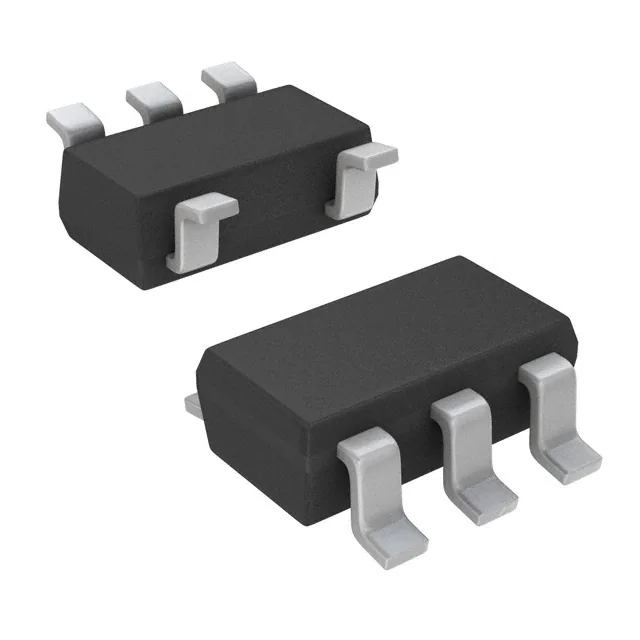
SOT (5)
BODY SIZE (NOM)
2.00 mm × 1.25 mm
For all available packages, see the orderable addendum
addendum at the end of the data sheet.
Thermal Time Constant
Output Voltage vs Temperature
VDD (+1.8V to +5.5V)
100%
FINAL TEMPERATURE
90%
VDD
80%
70%
LMT85
60%
CBP
50%
OUT
40%
30%
GND
20%
LMT8xLPG
Thermistor
10%
0
0
20
40
60
TIME (s)
80
100
Copyright © 2016, Texas Instruments Incorporated
D003
* Fast thermal response NTC
1
An IMPORTANT NOTICE at the end of this data sheet addresses availability, warranty, changes, use in safety-critical applications,
intellectual property matters and other important disclaimers. PRODUCTION DATA.
�LMT85-Q1
SNIS200 – OCTOBER 2017
www.ti.com
Table of Contents
1
2
3
4
5
6
7
8
Features ..................................................................
Applications ...........................................................
Description .............................................................
Revision History.....................................................
Device Comparison Tables...................................
Pin Configuration and Functions .........................
Specifications.........................................................
1
1
1
2
3
3
4
7.1
7.2
7.3
7.4
7.5
7.6
7.7
4
4
4
4
5
5
6
Absolute Maximum Ratings .....................................
ESD Ratings..............................................................
Recommended Operating Conditions.......................
Thermal Information ..................................................
Accuracy Characteristics...........................................
Electrical Characteristics ..........................................
Typical Characteristics .............................................
8.3 Feature Description................................................... 8
8.4 Device Functional Modes........................................ 10
9
Application and Implementation ........................ 12
9.1 Application Information............................................ 12
9.2 Typical Applications ................................................ 12
10 Power Supply Recommendations ..................... 13
11 Layout................................................................... 14
11.1 Layout Guidelines ................................................. 14
11.2 Layout Example .................................................... 14
12 Device and Documentation Support ................. 15
12.1
12.2
12.3
12.4
12.5
Detailed Description .............................................. 8
Receiving Notification of Documentation Updates
Community Resources..........................................
Trademarks ...........................................................
Electrostatic Discharge Caution ............................
Glossary ................................................................
15
15
15
15
15
13 Mechanical, Packaging, and Orderable
Information ........................................................... 15
8.1 Overview ................................................................... 8
8.2 Functional Block Diagram ......................................... 8
4 Revision History
NOTE: Page numbers for previous revisions may differ from page numbers in the current version.
DATE
October 2017
2
Submit Documentation Feedback
REVISION
NOTES
*
Initial release. Moved the automotive device
from the SNIS200 to a standalone data
sheet.
Copyright © 2017, Texas Instruments Incorporated
�LMT85-Q1
www.ti.com
SNIS200 – OCTOBER 2017
5 Device Comparison Tables
Table 1. Available Device Packages
ORDER NUMBER
(1)
PACKAGE
PIN
BODY SIZE (NOM)
MOUNTING TYPE
LMT85DCK
SOT (AKA (2): SC70, DCK)
5
2.00 mm × 1.25 mm
Surface Mount
LMT85LP
TO-92 (AKA (2): LP)
3
4.30 mm × 3.50 mm
Through-hole; straight leads
(2)
LMT85LPG
TO-92S (AKA
3
4.00 mm × 3.15 mm
Through-hole; straight leads
LMT85LPM
TO-92 (AKA (2): LPM)
3
4.30 mm × 3.50 mm
Through-hole; formed leads
LMT85DCK-Q1
SOT (AKA (2): SC70, DCK)
5
2.00 mm × 1.25 mm
Surface Mount
(1)
(2)
: LPG)
For all available packages and complete order numbers, see the Package Option addendum at the end of the data sheet.
AKA = Also Known As
Table 2. Comparable Alternative Devices
DEVICE NAME
AVERAGE OUTPUT SENSOR GAIN
POWER SUPPLY RANGE
LMT84-Q1
–5.5 mV/°C
1.5 V to 5.5 V
LMT85-Q1
–8.2 mV/°C
1.8 V to 5.5 V
LMT86-Q1
–10.9 mV/°C
2.2 V to 5.5 V
LMT87-Q1
–13.6 mV/°C
2.7 V to 5.5 V
6 Pin Configuration and Functions
DCK Package
5-Pin SOT/SC70
(Top View)
1
5
GND
VDD
2
GND
LMT85
3
4
OUT
VDD
Pin Functions
PIN
NAME
GND
SOT (SC70)
2 (1) , 5
TYPE
Ground
DESCRIPTION
EQUIVALENT CIRCUIT
N/A
FUNCTION
Power Supply Ground
VDD
OUT
3
Analog
Output
VDD
1, 4
Power
Outputs a voltage that is inversely
proportional to temperature
GND
(1)
N/A
Positive Supply Voltage
Direct connection to the back side of the die
Copyright © 2017, Texas Instruments Incorporated
Submit Documentation Feedback
3
�LMT85-Q1
SNIS200 – OCTOBER 2017
www.ti.com
7 Specifications
7.1 Absolute Maximum Ratings
See
(1) (2)
MIN
MAX
UNIT
Supply voltage
−0.3
6
V
Voltage at output pin
−0.3
(VDD + 0.5)
V
–7
7
mA
–5
5
mA
150
°C
150
°C
Output current
Input current at any pin
(3)
Maximum junction temperature (TJMAX)
Storage temperature, Tstg
(1)
(2)
(3)
–65
Stresses beyond those listed under Absolute Maximum Ratings may cause permanent damage to the device. These are stress ratings
only, which do not imply functional operation of the device at these or any other conditions beyond those indicated under Recommended
Operating Conditions. Exposure to absolute-maximum-rated conditions for extended periods may affect device reliability
Soldering process must comply with Reflow Temperature Profile specifications. Refer towww.ti.com/packaging .
When the input voltage (VI) at any pin exceeds power supplies (VI < GND or VI > V), the current at that pin should be limited to 5 mA.
7.2 ESD Ratings
VALUE
UNIT
LMT85DCK-Q1 in SC70 package
V(ESD)
(1)
Electrostatic discharge
Human-body model (HBM), per AEC Q100-002 (1)
±2500
Charged-device model (CDM), per AEC Q100-011
±1000
V
AEC Q100-002 indicates that HBM stressing shall be in accordance with the ANSI/ESDA/JEDEC JS-001 specification.
7.3 Recommended Operating Conditions
MIN
MAX
TMIN ≤ TA ≤ TMAX
Specified temperature
°C
−50 ≤ TA ≤ 150
Supply voltage (VDD)
1.8
UNIT
°C
5.5
V
7.4 Thermal Information (1)
LMT85-Q1
THERMAL METRIC (2)
DCK (SOT/SC70)
UNIT
5 PINS
(3) (4)
RθJA
Junction-to-ambient thermal resistance
275
°C/W
RθJC(top)
Junction-to-case (top) thermal resistance
84
°C/W
RθJB
Junction-to-board thermal resistance
56
°C/W
ψJT
Junction-to-top characterization parameter
1.2
°C/W
ψJB
Junction-to-board characterization parameter
55
°C/W
(1)
(2)
(3)
(4)
4
For information on self-heating and thermal response time, see section Mounting and Thermal Conductivity.
For more information about traditional and new thermal metrics, see the IC Package Thermal Metrics application report.
The junction to ambient thermal resistance (RθJA) under natural convection is obtained in a simulation on a JEDEC-standard, High-K
board as specified in JESD51-7, in an environment described in JESD51-2. Exposed pad packages assume that thermal vias are
included in the PCB, per JESD 51-5.
Changes in output due to self-heating can be computed by multiplying the internal dissipation by the thermal resistance.
Submit Documentation Feedback
Copyright © 2017, Texas Instruments Incorporated
�LMT85-Q1
www.ti.com
SNIS200 – OCTOBER 2017
7.5 Accuracy Characteristics
These limits do not include DC load regulation. These stated accuracy limits are with reference to the values in Table 3.
MIN (1)
TYP (2)
MAX (1)
TA = TJ= 20°C to 150°C; VDD = 1.8 V to 5.5 V
–2.7
±0.4
2.7
°C
TA = TJ= 0°C to 150°C; VDD = 1.9 V to 5.5 V
–2.7
±0.7
2.7
°C
PARAMETER
(3)
Temperature accuracy
TEST CONDITIONS
TA = TJ= 0°C to 150°C; VDD = 2.6 V to 5.5 V
±0.3
TA = TJ= –50°C to 0°C; VDD = 2.3 V to 5.5 V
–2.7
°C
±0.7
TA = TJ= –50°C to 0°C; VDD = 2.9 V to 5.5 V
(1)
(2)
(3)
UNIT
2.7
°C
±0.25
°C
Limits are specific to TI's AOQL (Average Outgoing Quality Level).
Typicals are at TJ = TA = 25°C and represent most likely parametric norm.
Accuracy is defined as the error between the measured and reference output voltages, tabulated in the Transfer Table at the specified
conditions of supply gain setting, voltage, and temperature (expressed in °C). Accuracy limits include line regulation within the specified
conditions. Accuracy limits do not include load regulation; they assume no DC load.
7.6 Electrical Characteristics
Unless otherwise noted, these specifications apply for VDD = +1.8V to +5.5V. MIN and MAX limits apply for TA = TJ = TMIN to
TMAX, unless otherwise noted; typical values apply for TA = TJ = 25°C.
PARAMETER
Average sensor gain (output
transfer function slope)
Load regulation
Line regulation
IS
CL
(1)
–30°C and 90°C used to calculate average sensor gain
Source ≤ 50 μA, (VDD - VOUT) ≥ 200 mV
–1
(2)
MAX
(1)
UNIT
mV/°C
–0.22
0.26
(4)
(5)
TYP
–8.2
mV
1
200
mV
μV/V
TA = TJ = 30°C to 150°C, (VDD - VOUT) ≥ 100 mV
5.4
8.1
μA
TA = TJ = -50°C to 150°C, (VDD - VOUT) ≥ 100 mV
5.4
9
μA
1.9
ms
+50
µA
Output load capacitance
Output drive
(5)
MIN
Sink ≤ 50 μA, VOUT ≥ 200 mV
Supply current
Power-on time
(1)
(2)
(3)
(4)
(3)
TEST CONDITIONS
1100
CL= 0 pF to 1100 pF
TA = TJ = 25°C
0.7
–50
pF
Limits are specific to TI's AOQL (Average Outgoing Quality Level).
Typicals are at TJ = TA = 25°C and represent most likely parametric norm.
Source currents are flowing out of the LMT85-Q1. Sink currents are flowing into the LMT85-Q1.
Line regulation (DC) is calculated by subtracting the output voltage at the highest supply voltage from the output voltage at the lowest
supply voltage. The typical DC line regulation specification does not include the output voltage shift discussed in Output Voltage Shift.
Specified by design and characterization.
Copyright © 2017, Texas Instruments Incorporated
Submit Documentation Feedback
5
�LMT85-Q1
SNIS200 – OCTOBER 2017
www.ti.com
7.7 Typical Characteristics
4
Minimum Operating Temperature (ƒC)
40
TEMPERATURE ERROR (ºC)
3
2
1
0
-1
-2
-3
-4
-50
-25
0
25
50
75
100 125 150
30
20
10
0
±10
±20
±30
±40
±50
1.50 2.00 2.50 3.00 3.50 4.00 4.50 5.00 5.50
Supply Voltage (V)
TEMPERATURE (ºC)
C002
Figure 1. Temperature Error vs Temperature
Figure 2. Minimum Operating Temperature vs
Supply Voltage
Figure 3. Supply Current vs Temperature
Figure 4. Supply Current vs Supply Voltage
Figure 5. Load Regulation, Sourcing Current
Figure 6. Load Regulation, Sinking Current
6
Submit Documentation Feedback
Copyright © 2017, Texas Instruments Incorporated
�LMT85-Q1
www.ti.com
SNIS200 – OCTOBER 2017
Typical Characteristics (continued)
Figure 7. Change in Vout vs Overhead Voltage
Figure 8. Supply-Noise Gain vs Frequency
Figure 9. Output Voltage vs Supply Voltage
Copyright © 2017, Texas Instruments Incorporated
Submit Documentation Feedback
7
�LMT85-Q1
SNIS200 – OCTOBER 2017
www.ti.com
8 Detailed Description
8.1 Overview
The LMT85-Q1 is an analog output temperature sensor. The temperature sensing element is comprised of a
simple base emitter junction that is forward biased by a current source. The temperature-sensing element is then
buffered by an amplifier and provided to the OUT pin. The amplifier has a simple push-pull output stage thus
providing a low impedance output source.
8.2 Functional Block Diagram
Full-Range Celsius Temperature Sensor (−50°C to 150°C).
VDD
OUT
Thermal Diodes
GND
8.3 Feature Description
8.3.1 LMT85-Q1 Transfer Function
The output voltage of the LMT85-Q1, across the complete operating temperature range, is shown in Table 3.
This table is the reference from which the LMT85 accuracy specifications (listed in the Accuracy Characteristics
section) are determined. This table can be used, for example, in a host processor look-up table. A file containing
this data is available for download at the LMT85-Q1 product folder under Tools and Software Models.
Table 3. LMT85-Q1 Transfer Table
8
TEMP
(°C)
VOUT
(mV)
TEMP
(°C)
VOUT
(mV)
TEMP
(°C)
VOUT
(mV)
TEMP
(°C)
VOUT
(mV)
TEMP
(°C)
VOUT
(mV)
-50
1955
-10
1648
30
1324
70
991
110
651
-49
1949
-9
1639
31
1316
71
983
111
642
-48
1942
-8
1631
32
1308
72
974
112
634
-47
1935
-7
1623
33
1299
73
966
113
625
-46
1928
-6
1615
34
1291
74
957
114
617
-45
1921
-5
1607
35
1283
75
949
115
608
-44
1915
-4
1599
36
1275
76
941
116
599
-43
1908
-3
1591
37
1267
77
932
117
591
-42
1900
-2
1583
38
1258
78
924
118
582
-41
1892
-1
1575
39
1250
79
915
119
573
-40
1885
0
1567
40
1242
80
907
120
565
-39
1877
1
1559
41
1234
81
898
121
556
-38
1869
2
1551
42
1225
82
890
122
547
Submit Documentation Feedback
Copyright © 2017, Texas Instruments Incorporated
�LMT85-Q1
www.ti.com
SNIS200 – OCTOBER 2017
Feature Description (continued)
Table 3. LMT85-Q1 Transfer Table (continued)
TEMP
(°C)
VOUT
(mV)
TEMP
(°C)
VOUT
(mV)
TEMP
(°C)
VOUT
(mV)
TEMP
(°C)
VOUT
(mV)
TEMP
(°C)
VOUT
(mV)
-37
1861
3
1543
43
1217
83
881
123
539
-36
1853
4
1535
44
1209
84
873
124
530
-35
1845
5
1527
45
1201
85
865
125
521
-34
1838
6
1519
46
1192
86
856
126
513
-33
1830
7
1511
47
1184
87
848
127
504
-32
1822
8
1502
48
1176
88
839
128
495
-31
1814
9
1494
49
1167
89
831
129
487
-30
1806
10
1486
50
1159
90
822
130
478
-29
1798
11
1478
51
1151
91
814
131
469
-28
1790
12
1470
52
1143
92
805
132
460
-27
1783
13
1462
53
1134
93
797
133
452
-26
1775
14
1454
54
1126
94
788
134
443
-25
1767
15
1446
55
1118
95
779
135
434
-24
1759
16
1438
56
1109
96
771
136
425
-23
1751
17
1430
57
1101
97
762
137
416
-22
1743
18
1421
58
1093
98
754
138
408
-21
1735
19
1413
59
1084
99
745
139
399
-20
1727
20
1405
60
1076
100
737
140
390
-19
1719
21
1397
61
1067
101
728
141
381
-18
1711
22
1389
62
1059
102
720
142
372
-17
1703
23
1381
63
1051
103
711
143
363
-16
1695
24
1373
64
1042
104
702
144
354
-15
1687
25
1365
65
1034
105
694
145
346
-14
1679
26
1356
66
1025
106
685
146
337
-13
1671
27
1348
67
1017
107
677
147
328
-12
1663
28
1340
68
1008
108
668
148
319
-11
1656
29
1332
69
1000
109
660
149
310
150
301
Although the LMT85-Q1 is very linear, its response does have a slight umbrella parabolic shape. This shape is
very accurately reflected in Table 3. The Transfer Table can be calculated by using the parabolic equation
(Equation 1).
mV
mV
ª
º ª
2º
VTEMP mV = 1324.0mV - «8.194
T - 30°C » - «0.00262 2 T - 30°C »
°C
¬
¼ ¬
°C
¼
(1)
The parabolic equation is an approximation of the transfer table and the accuracy of the equation degrades
slightly at the temperature range extremes. Equation 1 can be solved for T resulting in:
T
8 . 194
8 . 194
2
4 u 0 . 00262 u 1324
2 u 0 . 00262
VTEMP mV
30
(2)
For an even less accurate linear transfer function approximation, a line can easily be calculated over the desired
temperature range using values from the Table and a two-point equation (Equation 3):
·
¹
V - V1 =
V2 - V1
T2 - T1
· u (T - T1)
¹
where
•
•
•
•
V is in mV,
T is in °C,
T1 and V1 are the coordinates of the lowest temperature,
and T2 and V2 are the coordinates of the highest temperature.
Copyright © 2017, Texas Instruments Incorporated
(3)
Submit Documentation Feedback
9
�LMT85-Q1
SNIS200 – OCTOBER 2017
www.ti.com
For example, if the user wanted to resolve this equation, over a temperature range of 20°C to 50°C, they would
proceed as follows:
1159 mV - 1405 mV·
u (T - 20oC)
50oC - 20oC
¹
·
¹
V - 1405 mV =
(4)
o
o
V - 1405 mV = (-8.20 mV / C) u (T - 20 C)
(5)
o
V = (-8.20 mV / C) u T + 1569 mV
(6)
Using this method of linear approximation, the transfer function can be approximated for one or more
temperature ranges of interest.
8.4 Device Functional Modes
8.4.1 Mounting and Thermal Conductivity
The LMT85-Q1 can be applied easily in the same way as other integrated-circuit temperature sensors. It can be
glued or cemented to a surface.
To ensure good thermal conductivity, the backside of the LMT85 die is directly attached to the GND pin. The
temperatures of the lands and traces to the other leads of the LMT85-Q1 will also affect the temperature reading.
Alternatively, the LMT85-Q1 can be mounted inside a sealed-end metal tube, and can then be dipped into a bath
or screwed into a threaded hole in a tank. As with any IC, the LMT85-Q1 and accompanying wiring and circuits
must be kept insulated and dry, to avoid leakage and corrosion. This is especially true if the circuit may operate
at cold temperatures where condensation can occur. If moisture creates a short circuit from the output to ground
or VDD, the output from the LMT85 will not be correct. Printed-circuit coatings are often used to ensure that
moisture cannot corrode the leads or circuit traces.
The thermal resistance junction to ambient (RθJA or θJA) is the parameter used to calculate the rise of a device
junction temperature due to its power dissipation. Use Equation 7 to calculate the rise in the LMT85-Q1 die
temperature:
TJ = TA + TJA ª¬(VDDIS ) + (VDD - VOUT ) IL º¼
where
•
•
•
•
TA is the ambient temperature,
IS is the supply current,
ILis the load current on the output,
and VO is the output voltage.
(7)
For example, in an application where TA = 30°C, VDD = 5 V, IS = 5.4 μA, VOUT = 1324 mV, and IL = 2 μA, the
junction temperature would be 30.014°C, showing a self-heating error of only 0.014°C. Because the junction
temperature of the LMT85-Q1 is the actual temperature being measured, take care to minimize the load current
that the LMT85-Q1 is required to drive. Thermal Information shows the thermal resistance of the LMT85-Q1.
8.4.2 Output and Noise Considerations
A push-pull output gives the LMT85-Q1 the ability to sink and source significant current. This is beneficial when,
for example, driving dynamic loads like an input stage on an analog-to-digital converter (ADC). In these
applications the source current is required to quickly charge the input capacitor of the ADC. The LMT85-Q1
device is ideal for this and other applications which require strong source or sink current.
The LMT85-Q1 supply-noise gain (the ratio of the AC signal on VOUT to the AC signal on VDD) was measured
during bench tests. The typical attenuation is shown in Figure 8 found in the Typical Characteristics . A load
capacitor on the output can help to filter noise.
For operation in very noisy environments, some bypass capacitance should be present on the supply within
approximately 5 centimeters of the LMT85-Q1.
10
Submit Documentation Feedback
Copyright © 2017, Texas Instruments Incorporated
�LMT85-Q1
www.ti.com
SNIS200 – OCTOBER 2017
Device Functional Modes (continued)
8.4.3 Capacitive Loads
The LMT85-Q1 handles capacitive loading well. In an extremely noisy environment, or when driving a switched
sampling input on an ADC, it may be necessary to add some filtering to minimize noise coupling. Without any
precautions, the LMT85-Q1 can drive a capacitive load less than or equal to 1100 pF as shown in Figure 10. For
capacitive loads greater than 1100 pF, a series resistor may be required on the output, as shown in Figure 11.
VDD
LMT85
OPTIONAL
BYPASS
CAPACITANCE
OUT
GND
CLOAD ” 1100 pF
Figure 10. LMT85-Q1 No Decoupling Required for Capacitive Loads Less Than 1100 pF
VDD
RS
LMT85
OPTIONAL
BYPASS
CAPACITANCE
OUT
GND
CLOAD > 1100 pF
Figure 11. LMT85-Q1 with Series Resistor for Capacitive Loading Greater Than 1100 pF
Table 4. Recommended Series Resistor Values
CLOAD
MINIMUM RS
1.1 nF to 99 nF
3 kΩ
100 nF to 999 nF
1.5 kΩ
1 μF
800 Ω
8.4.4 Output Voltage Shift
The LMT85-Q1 is very linear over temperature and supply voltage range. Due to the intrinsic behavior of an
NMOS/PMOS rail-to-rail buffer, a slight shift in the output can occur when the supply voltage is ramped over the
operating range of the device. The location of the shift is determined by the relative levels of VDD and VOUT. The
shift typically occurs when VDD- VOUT = 1 V.
This slight shift (a few millivolts) takes place over a wide change (approximately 200 mV) in VDD or VOUT.
Because the shift takes place over a wide temperature change of 5°C to 20°C, VOUT is always monotonic. The
accuracy specifications in the Accuracy Characteristics table already include this possible shift.
Copyright © 2017, Texas Instruments Incorporated
Submit Documentation Feedback
11
�LMT85-Q1
SNIS200 – OCTOBER 2017
www.ti.com
9 Application and Implementation
NOTE
Information in the following applications sections is not part of the TI component
specification, and TI does not warrant its accuracy or completeness. TI’s customers are
responsible for determining suitability of components for their purposes. Customers should
validate and test their design implementation to confirm system functionality.
9.1 Application Information
The LMT85-Q1 features make it suitable for many general temperature-sensing applications. It can operate down
to 1.8-V supply with 5.4-µA power consumption, making it ideal for battery powered devices.
9.2 Typical Applications
9.2.1 Connection to an ADC
Simplified Input Circuit of
SAR Analog-to-Digital Converter
Reset
+1.8V to +5.5V
Input
Pin
LMT85
VDD
CBP
RMUX
RSS
Sample
OUT
GND
CFILTER
CMUX
CSAMPLE
Figure 12. Suggested Connection to a Sampling Analog-to-Digital Converter Input Stage
9.2.1.1 Design Requirements
Most CMOS ADCs found in microcontrollers and ASICs have a sampled data comparator input structure. When
the ADC charges the sampling cap, it requires instantaneous charge from the output of the analog source such
as the LMT85 temperature sensor and many op amps. This requirement is easily accommodated by the addition
of a capacitor (CFILTER).
9.2.1.2 Detailed Design Procedure
The size of CFILTER depends on the size of the sampling capacitor and the sampling frequency. Because not all
ADCs have identical input stages, the charge requirements will vary. This general ADC application is shown as
an example only.
9.2.1.3 Application Curve
Figure 13. Analog Output Transfer Function
12
Submit Documentation Feedback
Copyright © 2017, Texas Instruments Incorporated
�LMT85-Q1
www.ti.com
SNIS200 – OCTOBER 2017
Typical Applications (continued)
9.2.2 Conserving Power Dissipation With Shutdown
VDD
SHUTDOWN
VOUT
LMT85
Any logic
device output
Figure 14. Simple Shutdown Connection of the LMT85-Q1
9.2.2.1 Design Requirements
Because the power consumption of the LMT85-Q1 is less than 9 µA, it can simply be powered directly from any
logic gate output and therefore not require a specific shutdown pin. The device can even be powered directly
from a micro controller GPIO. In this way, it can easily be turned off for cases such as battery-powered systems
where power savings are critical.
9.2.2.2 Detailed Design Procedure
Simply connect the VDD pin of the LMT85-Q1 directly to the logic shutdown signal from a microcontroller.
9.2.2.3 Application Curves
Time: 500 µs/div; Top Trace: VDD 1 V/div;
Bottom Trace: OUT 1 V/div
Figure 15. Output Turnon Response Time Without a
Capacitive Load and VDD = 3.3 V
Time: 500 µs/div; Top trace: VDD 2 V/div;
Bottom trace: OUT 1 V/div
Figure 16. Output Turnon Response Time Without a
Capacitive Load and VDD = 5 V
Time: 500 µs/div; Top trace: VDD 1V/div;
Bottom trace: OUT 1 V/div
Figure 17. Output Turnon Response Time With 1.1-nF
Capacitive Load and VDD = 3.3 V
Time: 500 µs/div; Top trace: VDD 2 V/div;
Bottom trace: OUT 1 V/div
Figure 18. Output Turnon Response Time With 1.1-nF
Capacitive Load and VDD = 5 V
10 Power Supply Recommendations
The low supply current and supply range (1.8 V to 5.5 V) of the LMT85-Q1 allow the device to easily be powered
from many sources. Power supply bypassing is optional and is mainly dependent on the noise on the power
supply used. In noisy systems it may be necessary to add bypass capacitors to lower the noise that is coupled to
the output of the LMT85-Q1.
Copyright © 2017, Texas Instruments Incorporated
Submit Documentation Feedback
13
�LMT85-Q1
SNIS200 – OCTOBER 2017
www.ti.com
11 Layout
11.1 Layout Guidelines
The LMT85-Q1 is extremely simple to layout. If a power-supply bypass capacitor is used, it should be connected
as shown in the Layout Example
11.2 Layout Example
VIA to ground plane
VIA to power plane
VDD
GND
GND
OUT
0.01µ F
VDD
Figure 19. SC70 Package Recommended Layout
14
Submit Documentation Feedback
Copyright © 2017, Texas Instruments Incorporated
�LMT85-Q1
www.ti.com
SNIS200 – OCTOBER 2017
12 Device and Documentation Support
12.1 Receiving Notification of Documentation Updates
To receive notification of documentation updates, navigate to the device product folder on ti.com. In the upper
right corner, click on Alert me to register and receive a weekly digest of any product information that has
changed. For change details, review the revision history included in any revised document.
12.2 Community Resources
The following links connect to TI community resources. Linked contents are provided "AS IS" by the respective
contributors. They do not constitute TI specifications and do not necessarily reflect TI's views; see TI's Terms of
Use.
TI E2E™ Online Community TI's Engineer-to-Engineer (E2E) Community. Created to foster collaboration
among engineers. At e2e.ti.com, you can ask questions, share knowledge, explore ideas and help
solve problems with fellow engineers.
Design Support TI's Design Support Quickly find helpful E2E forums along with design support tools and
contact information for technical support.
12.3 Trademarks
E2E is a trademark of Texas Instruments.
All other trademarks are the property of their respective owners.
12.4 Electrostatic Discharge Caution
These devices have limited built-in ESD protection. The leads should be shorted together or the device placed in conductive foam
during storage or handling to prevent electrostatic damage to the MOS gates.
12.5 Glossary
SLYZ022 — TI Glossary.
This glossary lists and explains terms, acronyms, and definitions.
13 Mechanical, Packaging, and Orderable Information
The following pages include mechanical, packaging, and orderable information. This information is the most
current data available for the designated devices. This data is subject to change without notice and revision of
this document. For browser-based versions of this data sheet, refer to the left-hand navigation.
Copyright © 2017, Texas Instruments Incorporated
Submit Documentation Feedback
15
�PACKAGE OPTION ADDENDUM
www.ti.com
10-Dec-2020
PACKAGING INFORMATION
Orderable Device
Status
(1)
Package Type Package Pins Package
Drawing
Qty
Eco Plan
(2)
Lead finish/
Ball material
MSL Peak Temp
Op Temp (°C)
Device Marking
(3)
(4/5)
(6)
LMT85QDCKRQ1
ACTIVE
SC70
DCK
5
3000
RoHS & Green
SN
Level-1-260C-UNLIM
-50 to 150
BRA
LMT85QDCKTQ1
ACTIVE
SC70
DCK
5
250
RoHS & Green
SN
Level-1-260C-UNLIM
-50 to 150
BRA
(1)
The marketing status values are defined as follows:
ACTIVE: Product device recommended for new designs.
LIFEBUY: TI has announced that the device will be discontinued, and a lifetime-buy period is in effect.
NRND: Not recommended for new designs. Device is in production to support existing customers, but TI does not recommend using this part in a new design.
PREVIEW: Device has been announced but is not in production. Samples may or may not be available.
OBSOLETE: TI has discontinued the production of the device.
(2)
RoHS: TI defines "RoHS" to mean semiconductor products that are compliant with the current EU RoHS requirements for all 10 RoHS substances, including the requirement that RoHS substance
do not exceed 0.1% by weight in homogeneous materials. Where designed to be soldered at high temperatures, "RoHS" products are suitable for use in specified lead-free processes. TI may
reference these types of products as "Pb-Free".
RoHS Exempt: TI defines "RoHS Exempt" to mean products that contain lead but are compliant with EU RoHS pursuant to a specific EU RoHS exemption.
Green: TI defines "Green" to mean the content of Chlorine (Cl) and Bromine (Br) based flame retardants meet JS709B low halogen requirements of