LP3950
www.ti.com
SNVS331C – NOVEMBER 2004 – REVISED APRIL 2013
LP3950 Color LED Driver with Audio Synchronizer
Check for Samples: LP3950
FEATURES
DESCRIPTION
•
The LP3950 is a color LED driver with a built-in audio
synchronization feature for any analog audio input
such as polyphonic ring tones and MP3 music. LEDs
can be synchronized to an audio signal with two
methods - amplitude and frequency. Also several fine
tuning options are available for differentiation
purposes. The chip also has an unique AGC
(Automatic Gain Control) feature which tracks the
input signal level and automatically adjusts the gain
to an optimal value.
1
2
•
•
•
•
•
•
•
Audio Synchronization for Color LEDs with
Two Modes: Amplitude and Frequency
Programmable Frequency and Amplitude
Response with Tracking Speed Control
Automatic Gain Control or Selectable Gain for
Input Signal Optimization
RGB Pattern Generator Similar to
LP3933/LP3936
Magnetic DC-DC Boost Converter with
Programmable Boost Output Voltage
Selectable SPI or I2C Compatible Interface
One Pin Default Enable for Non-Serial Interface
Users. One Pin Selector for Synchronization
Mode
Space Efficient 32-Pin TLGA Package
The LP3950 has a high efficiency magnetic DC/DC
converter with programmable output voltage and
switching frequency. The converter has high output
current capability so it is also able to drive flash LEDs
in camera phone applications.
The LP3950 is similar
the color LEDs (or
programmed
to
(programmable color,
and blinking cycle).
APPLICATIONS
•
•
•
Cellular Phones
MP3/CD/Minidisc Players
Toys
to LP3933 and LP3936 in that
RGB LEDs) can also be
generate
light
patterns
intensity, on/off timing, slope
All functions are software controllable through a SPI
or I2C compatible interface but the device also
supports one pin control for enabling predefined
(default) audio synchronization mode.
Typical Application
VIN
2.8V
CVDD1
100 nF
VDD1
C1
SINGLE-ENDED
AUDIO SIGNAL
CVDD2
100 nF
VDD2
L1
CIN
4.7 PH
10 PF
D1
VDDA
SW
ASE
10 nF
COUT
10 PF
FB
RR1
C2
R1
AD1
DIFFERENTIAL
AUDIO SIGNAL
CVDDA
100 nF
RG1
10 nF
G1
C3
RB1
B1
AD2
10 nF
4
LP3950
SERIAL
INTERFACE
RG2
G2
RB2
NRST
MICROCONTROLLER
RR2
R2
B2
PWM_LED
RT
RT
82k
IF_SEL
VREF
VDD_IO
CVDD_IO
100 nF
DME
AMODE
GNDs
CVREF
100 nF
1
2
Please be aware that an important notice concerning availability, standard warranty, and use in critical applications of
Texas Instruments semiconductor products and disclaimers thereto appears at the end of this data sheet.
All trademarks are the property of their respective owners.
PRODUCTION DATA information is current as of publication date.
Products conform to specifications per the terms of the Texas
Instruments standard warranty. Production processing does not
necessarily include testing of all parameters.
Copyright © 2004–2013, Texas Instruments Incorporated
�LP3950
SNVS331C – NOVEMBER 2004 – REVISED APRIL 2013
www.ti.com
Connection Diagrams
Top View
Bottom View
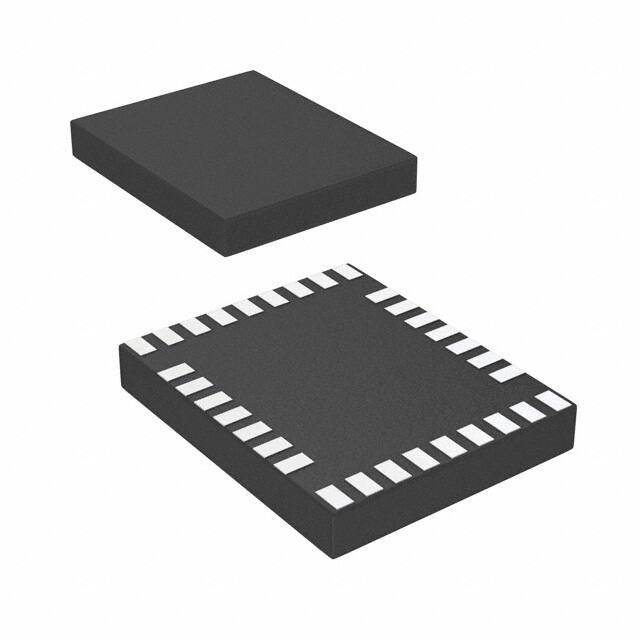
Figure 1. 32-Lead TLGA Package
4.5 x 5.5 x 0.8 mm, 0.5 mm Pitch, See Package Number NPC0032A
2
Submit Documentation Feedback
Copyright © 2004–2013, Texas Instruments Incorporated
Product Folder Links: LP3950
�LP3950
www.ti.com
SNVS331C – NOVEMBER 2004 – REVISED APRIL 2013
PIN DESCRIPTIONS
Pin #
Name
Type
Description
1
FB
Input
2
GND_BOOST
Ground
Boost converter feedback.
Power switch ground.
3
SW
Output
Open drain, boost converter power switch.
4
VDD2
Power
Supply voltage for internal digital circuits.
5
GND2
Ground
Ground return for VDD2 (internal digital).
6
DME
Logic Input
Default mode enable (internal pull down 1 MΩ).
7
AMODE
Logic Input
Audio mode selection (internal pull down 1 MΩ).
8
VDDA
Power
Supply voltage for audio circuits.
9
ASE
Input
Analog audio input, single-ended.
10
AD1
Input
Analog audio input, differential.
11
AD2
Input
Analog audio input, differential.
12
GNDA
Ground
Ground for analog audio inputs.
13
RT
Input
Oscillator resistor.
14
VDD1
Power
Supply voltage for internal analog circuits.
15
GND1
Ground
Ground.
16
VREF
Output
Internal reference bypass capacitor.
17
GND3
Ground
Ground.
18
NRST
Logic Input
19
SS/SDA
Logic I/O
20
SO
Logic Output
21
SI
Logic Input
SPI serial data input.
22
SCK/SCL
Logic Input
SPI/ I2C clock.
23
PWM_LED
Logic Input
Direct PWM control for LEDs.
Low active reset input.
SPI slave select/ I2C data line.
SPI serial data output.
24
VDDIO
Power
25
IF_SEL
Logic Input
Supply voltage for logic IO signals.
26
B2
Output
Open drain output, blue LED2.
27
G2
Output
Open drain output, green LED2.
SPI/I2C select (IF_SEL = 1 in SPI mode).
28
R2
Output
Open drain output, red LED2.
29
GND_RGB
Ground
RGB driver ground.
30
R1
Output
Open drain output, red LED1.
31
G1
Output
Open drain output, green LED1.
32
B1
Output
Open drain output, blue LED1.
Submit Documentation Feedback
Copyright © 2004–2013, Texas Instruments Incorporated
Product Folder Links: LP3950
3
�LP3950
SNVS331C – NOVEMBER 2004 – REVISED APRIL 2013
www.ti.com
These devices have limited built-in ESD protection. The leads should be shorted together or the device placed in conductive foam
during storage or handling to prevent electrostatic damage to the MOS gates.
Absolute Maximum Ratings (1) (2) (3)
(4) (5)
V (SW, FB, R1–2, G1–2, B1–2)
−0.3V to +7.2V
−0.3V to +6.0V
VDD1, VDD2, VDDIO, VDDA
−0.3V to VDD1 +0.3V with 6.0V max
Voltage on ASE, AD1, AD2
−0.3V to VDD_IO+0.3V with 6.0V max
Voltage on Logic Pins
(6)
I (R1, G1, B1, R2, G2, B2)
150 mA
I (VREF)
10 µA
Continuous Power Dissipation
(7)
Internally Limited
Junction Temperature (TJ-MAX)
125°C
Storage Temperature Range
−65°C to +150°C
Maximum Lead Temperature
260°C
(Reflow soldering, 3 times)
ESD Rating
(8)
(9)
Human Body Model:
2 kV
Machine Model:
(1)
(2)
(3)
(4)
(5)
(6)
(7)
(8)
(9)
200V
All voltages are with respect to the potential at the GND pins (GND1–3, GND_BOOST, GND_RGB, GNDA).
Absolute Maximum Ratings indicate limits beyond which damage to the component may occur. Operating Ratings are conditions under
which operation of the device is guaranteed. Operating Ratings do not imply guaranteed performance limits. For guaranteed
performance limits and associated test conditions, see the Electrical Characteristics tables.
If Military/Aerospace specified devices are required, please contact the TI Sales Office/Distributors for availability and specifications.
Battery/Charger voltage should be above 6.0V no more than 10% of the operational lifetime.
Voltage tolerance of LP3950 above 6.0V relies on fact that VDD1, VDD2 and VDDA (2.8V) are available (ON) at all conditions. If VDD1,
VDD2 and VDDA are not available (ON) at all conditions, Texas Instruments does not guarantee any parameters or reliability for this
device. Also, VDD1, VDD2 and VDDA must be at the same electric potential.
The total load current of the boost converter should be limited to 300 mA.
Internal thermal shutdown circuitry protects the device from permanent damage. Thermal shutdown engages at TJ = 160°C (typ.) and
disengages at TJ = 140°C (typ.).
For detailed package and soldering specifications and information, please refer to Texas Instruments Application Note 1125 (SNAA002):
Laminate CSP/FBGA.
The Human body model is a 100 pF capacitor discharged through a 1.5 kΩ resistor into each pin. The machine model is a 200 pF
capacitor discharged directly into each pin. MIL-STD-883 3015.7
Operating Ratings (1) (2)
V (SW, FB, R1–2, G1–2, B1–2)
0V to 6.0V
VDD1, VDD2, VDDA (3)
2.7V to 2.9V
VDDIO
1.65V to VDD1,2 V
Voltage on ASE, AD1, AD2
0.1V to VDD1 - 0.1V
Recommended Load Current
0 mA to 300 mA
−40°C to +125°C
Junction Temperature (TJ) Range
Ambient Temperature (TA) Range
(1)
(2)
(3)
(4)
4
(4)
−40°C to +85°C
Absolute Maximum Ratings indicate limits beyond which damage to the component may occur. Operating Ratings are conditions under
which operation of the device is guaranteed. Operating Ratings do not imply guaranteed performance limits. For guaranteed
performance limits and associated test conditions, see the Electrical Characteristics tables.
All voltages are with respect to the potential at the GND pins (GND1–3, GND_BOOST, GND_RGB, GNDA).
Voltage tolerance of LP3950 above 6.0V relies on fact that VDD1, VDD2 and VDDA (2.8V) are available (ON) at all conditions. If VDD1,
VDD2 and VDDA are not available (ON) at all conditions, Texas Instruments does not guarantee any parameters or reliability for this
device. Also, VDD1, VDD2 and VDDA must be at the same electric potential.
In applications where high power dissipation and/or poor package thermal resistance is present, the maximum ambient temperature may
have to be derated. Maximum ambient temperature (TA-MAX) is dependent on the maximum operating junction temperature (TJ-MAX-OP =
125°C), the maximum power dissipation of the device in the application (PD-MAX), and the junction-to ambient thermal resistance of the
part/package in the application (θJA), as given by the following equation: TA-MAX = TJ-MAX-OP − (θJA x PD-MAX).
Submit Documentation Feedback
Copyright © 2004–2013, Texas Instruments Incorporated
Product Folder Links: LP3950
�LP3950
www.ti.com
SNVS331C – NOVEMBER 2004 – REVISED APRIL 2013
Thermal Properties
Junction-to-Ambient Thermal Resistance
(θJA), NPC0032A Package
(1)
72°C/W
(1)
Junction-to-ambient thermal resistance is highly application and board-layout dependent. In applications where high maximum power
dissipation exists, special care must be paid to thermal dissipation issues in board design.
Electrical Characteristics
(1) (2)
Limits in standard typeface are for TJ = +25°C. Limits in boldface type apply over the operating ambient temperature range
(−40°C ≤ TA ≤ +85°C). Unless otherwise noted, specifications apply to Figure 2 with: VDD1 = VDD2 = VDDA = 2.8V, CVDD1 =
CVDD2 = CVDDA = CVDDIO = 100 nF, COUT = CIN = 10 µF, CVREF = 100 nF, L1 = 4.7 µH and fBOOST = 2.0 MHz (3).
Symbol
IVDD
Parameter
Condition
Min
Typ
Max
Units
Standby Supply Current
(VDD1 + VDD2 + VDDA current)
NSTBY = L (register)
SCK, SS, SI, NRST = H
1
5
µA
No-Load Supply Current
(VDD1 + VDD2 + VDDA current, boost off)
NSTBY = H (reg.)
EN_BOOST = L (reg.)
SCK, SS, SI, NRST = H
300
400
µA
Full Load Supply Current
(VDD1 + VDD2 + VDDA current, boost on) (4)
NSTBY = H (reg.)
EN_BOOST = H (reg.)
SCK, SS, SI, NRST = H
All Outputs Active
850
µA
IVDDIO
VDDIO Supply Current
1.0 MHz SCK Frequency
CL = 50 pF at SO Pin
20
µA
IVDDA
Audio Circuitry Supply Current (5)
INPUT_SEL = [10] (register)
550
µA
VREF
Reference Voltage (6)
IREF ≤ 1.0 nA Only for Test Purpose
1.230
V
(1)
(2)
(3)
(4)
(5)
(6)
All voltages are with respect to the potential at the GND pins (GND1–3, GND_BOOST, GND_RGB, GNDA).
Min and Max limits are guaranteed by design, test, or statistical analysis. Typical numbers are not guaranteed, but do represent the
most likely norm.
Low-ESR Surface-Mount Ceramic Capacitors are used in setting electrical characteristics.
Audio block inactive.
In single-ended and in differential mode one audio buffer only is active and IVDDA will be reduced by 90 µA (typ).
VREF pin (Bandgap reference output) is for internal use only. A capacitor should always be placed between VREF and GND1.
Submit Documentation Feedback
Copyright © 2004–2013, Texas Instruments Incorporated
Product Folder Links: LP3950
5
�LP3950
SNVS331C – NOVEMBER 2004 – REVISED APRIL 2013
www.ti.com
Block Diagram
CVDD2
100 nF
CVDDA
CIN
10 PF
-
CVDD1
100 nF
100 nF
VDD1
D1
SW
CVREF
OSC
COUT
10 PF
FB
THSD
100 nF
GND_BOOST
LP3950
RT
EN
VREF
BOOST
RT
82k
ASE
R1
FREQ
10 nF
L1
4.7 PH
VDDA
VDD2
VREF
SINGLE ENDED
AUDIO SIGNAL
10 nF
IMAX = 300 mA
VOUT = 4.1V TO 5.3V
+
BATTERY
LDO
2.8V
ADC
AD1
AGC
PWM
G1
AMPL
AD2
10 nF
B1
GNDA
SPI
RGB PATTERN
GENERATOR
CTRL
2
DRIVERS
DIFFERENTIAL
AUDIO SIGNAL
I C
RR1
RG1
RB1
RR2
R2
G2
B2
RG2
RB2
LEVEL SHIFTER
MICROCONTROLLER
GND3
GND1
GND2
VDDIO
DME
AMODE
NRST
PWM_LED
SI
SO
SS/SDA
IF_SEL
SCK/SCL
GND_RGB
CVDDIO
100 nF
Figure 2. LP3950 Block Diagram
Modes of Operation
RESET: In the RESET mode all the internal registers are reset to the default values. RESET is entered always if
input NRST is LOW or internal Power On Reset is active.
STANDBY: The STANDBY mode is entered if the register bit NSTBY is LOW and RESET is not active. This is
the low power consumption mode, when all the circuit functions are disabled. Registers can be written in
this mode and the control bits are effective immediately after start up.
STARTUP: INTERNAL STARTUP SEQUENCE powers up all the needed internal blocks (VREF, oscillator, etc.).
To ensure the correct oscillator initialization, a 10 ms delay is generated by the internal state-machine.
Thermal shutdown (THSD) disables the chip operation and Startup mode is entered until no thermal
shutdown event is present.
BOOST STARTUP: Soft start for boost output is generated in the BOOST STARTUP mode. In this mode the
boost output is raised in PFM mode during the 10 ms delay generated by the state-machine. All RGB
outputs are off during the 10 ms delay to ensure smooth startup. The Boost startup is entered from
Internal Startup Sequence if EN_BOOST is HIGH or from Normal mode when EN_BOOST is written
HIGH.
NORMAL: During the NORMAL mode the user controls the chip using the control registers. Registers can be
written in any sequence and any number of bits can be altered in a register within one write cycle . If the
default mode is selected, default control register values are used.
6
Submit Documentation Feedback
Copyright © 2004–2013, Texas Instruments Incorporated
Product Folder Links: LP3950
�LP3950
www.ti.com
SNVS331C – NOVEMBER 2004 – REVISED APRIL 2013
RESET
NRST = L
or
POR = H
NSTBY= L and
DME = L and
NRST = H
STANDBY
(NSTBY = H or DME = H)
and
NRST = H
(NSTBY = H or DME = H)
and
NRST = H
NSTBY = L
and
DME = L
and
NRST = H
INTERNAL
STARTUP
SEQUENCE
V REF = 95% OK 1
THSD = H
~10 ms DELAY
DME = H or
EN_BOOST = H1
DME = L and
EN_BOOST = L1
BOOST STARTUP
EN_BOOST
RISING EDGE1
~10 ms DELAY
NORMAL MODE
1) THSD = L
Submit Documentation Feedback
Copyright © 2004–2013, Texas Instruments Incorporated
Product Folder Links: LP3950
7
�LP3950
SNVS331C – NOVEMBER 2004 – REVISED APRIL 2013
www.ti.com
Logic Interface Characteristics (1)
Symbol
Parameter
Conditions
Min
Typ
Max
Units
0.5
V
LOGIC INPUTS SS, SI, SCK/SCL, PWM_LED, IF_SEL
VIL
Input Low Level
VIH
Input High Level
II
Logic Input Current
fSCL
Clock Frequency
VDDIO − 0.5
V
−1.0
1.0
µA
I2C Mode
400
kHz
SPI Mode
8
MHz
0.5
V
LOGIC OUTPUT SO
VOL
Output Low Level
ISO = 3.0 mA
VOH
Output High Level
ISO = −3.0 mA
IL
Output Leakage Current
VSO = 2.8V
0.3
VDDIO − 0.5
VDDIO − 0.3
V
1.0
µA
0.5
V
0.5
V
6.0
µA
LOGIC I/O SDA
VOL
Output Low Level
ISDA = 3.0 mA
0.3
LOGIC INPUTS DME, AMODE (Internal pull down 1 MΩ)
VIL
Input Low Level
VIH
Input High Level
II
Logic Input Current
VDDIO − 0.5
V
−1.0
(1.80V ≤ VDDIO ≤ VDD1,2V). Limits in standard typeface are for TJ = +25°C. Limits in boldface type apply over the operating ambient
temperature range (−40°C ≤ TA ≤ +85°C).
(1)
Logic Interface Characteristics, Low I/O Voltage (1)
Symbol
Parameter
Conditions
Min
Typ
Max
Units
0.35
V
1.0
µA
200
kHz
0.5
V
0.35
V
6.0
µA
Max
Units
0.5
V
1.0
µA
LOGIC INPUTS SCL, PWM_LED, IF_SEL
VIL
Input Low Level
VIH
Input High Level
II
Logic Input Current
fSCL
Clock Frequency
VDDIO − 0.35
V
−1.0
I2C Mode
LOGIC I/O SDA
VOL
Output Low Level
ISDA = 3.0 mA
0.3
LOGIC INPUTS DME, AMODE (Internal pull down 1 MΩ)
VIL
Input Low Level
VIH
Input High Level
II
Logic Input Current
VDDIO − 0.35
V
−1.0
(1.65V ≤ VDDIO < 1.80V) . I2C compatible interface only.
(1)
Logic Input NRST Characteristics (1)
Symbol
Parameter
Conditions
Min
VIL
Input Low Level
VIH
Input High Level
1.3
II
Logic Input Current
−1.0
tNRST
Reset Pulse Width
(1)
8
Note: Guaranteed by
design
10
Typ
V
µs
(1.65V ≤ VDDIO ≤ VDD1,2V).
Submit Documentation Feedback
Copyright © 2004–2013, Texas Instruments Incorporated
Product Folder Links: LP3950
�LP3950
www.ti.com
SNVS331C – NOVEMBER 2004 – REVISED APRIL 2013
Control Interface
The LP3950 supports three different interface modes:
1. SPI interface (4 wire, serial)
2. I2C compatible interface (2 wire, serial)
3. Direct enable (2 wire, enable lines)
User can define the serial interface by the IF_SEL pin. The following table shows the pin configuration for both
interface modes. Note that the pin configurations will be based on the status of the IF_SEL pin.
IF_SEL
Interface
Pin Configuration
Comment
HIGH
SPI
SCK
SI
SO
SS
(clock)
(data in)
(data out)
(chip select)
LOW
I2C Compatible
SCL
SDA
SI
SO
(clock)
(data in/out)
(I2 address)
(NC)
Use pull up resistor for SCL.
Use pull up resistor for SDA.
SI HIGH → address is 51'h;
SI LOW → address is 50'h;
Unused pin SO can be left unconnected.
SPI Interface
The transmission consists of 16-bit write and read cycles. One cycle consists of seven address bits, one
read/write (R/W) bit and eight data bits. R/W bit high state defines a write cycle and low defines a read cycle. SO
output is normally in high-impedance state and it is active only during when data is sent out during a read cycle.
A pull-up or pull-down resistor may be needed for SO line if a floating logic signal can cause unintended current
consumption in the circuitry.
The address and data are transmitted Most Significant Byte (MSB) first. The Slave Select signal (SS) must be
low during the cycle transmission. SS resets the interface when high and it has to be taken high between
successive cycles. Data is clocked in on the rising edge of the SCK clock signal, while data is clocked out on the
falling edge of SCK.
SS
SCK
SI
A6
A5
A4
A3
A2
A1
A0
1
R/W
D7
D6
D5
D4
D3
D2
D1
D0
D2
D1
D0
SO
Figure 3. SPI Write Cycle
SS
SCK
SI
A6
A5
A4
A3
A2
A1
A0
R/W
0
Don't Care
SO
D7
D6
D5
D4
D3
Figure 4. SPI Read Cycle
Submit Documentation Feedback
Copyright © 2004–2013, Texas Instruments Incorporated
Product Folder Links: LP3950
9
�LP3950
SNVS331C – NOVEMBER 2004 – REVISED APRIL 2013
www.ti.com
SS
2
5
1
SCK
3
4
12
7
6
SI
MSB IN
BIT 14
BIT 9
BIT 8
BIT 1
BIT 7
8
Address
9
11
10
MSB OUT
SO
LSB IN
BIT 1
LSB OUT
Data
R/W
Figure 5. SPI Timing Diagram
Table 1. SPI Timing Parameters (1)
Symbol
(1)
Limit
Parameter
Min
Max
Units
1
Cycle Time
80
ns
2
Enable Lead Time
40
ns
3
Enable Lag Time
40
ns
4
Clock Low Time
40
ns
5
Clock High Time
40
ns
6
Data Setup Time
0
ns
7
Data Hold Time
20
8
Data Access Time
27
ns
9
Output Disable Time
27
ns
10
Output Data Valid
37
ns
11
Output Data Hold Time
0
ns
12
SS Inactive Time
15
ns
ns
Data guaranteed by design.
I2C Compatible Interface
I2C SIGNALS
In I2C compatible mode, the LP3950 pin SCL is used for the I2C clock and the SDA pin is used for the I2C data.
Both these signals need a pull-up resistor according to I2C specification. The values of the pull-up resistors are
determined by the capacitance of the bus (typ. 1.8k). Signal timing specifications are shown in Table 2. Unused
pin SO can be left unconnected and pin SI must be connected to VDDIO or GND (address selector). Maximum bit
rate is 400 kbit/s (VDDIO 1.80V to VDD1,2V). I2C compatible interface can be used down to 1.65 VDDIO with
maximum bit rate of 200 kbit/s.
I2C DATA VALIDITY
The data on the SDA line must be stable during the HIGH period of the clock signal (SCL). In other words, state
of the data line can only be changed when CLK is LOW.
SCL
SDA
data
change
allowed
data
valid
data
change
allowed
data
valid
data
change
allowed
Figure 6. I2C Signals: Data Validity
10
Submit Documentation Feedback
Copyright © 2004–2013, Texas Instruments Incorporated
Product Folder Links: LP3950
�LP3950
www.ti.com
SNVS331C – NOVEMBER 2004 – REVISED APRIL 2013
I2C START AND STOP CONDITIONS
START and STOP bits classify the beginning and the end of the I2C session. START condition is defined as SDA
signal transition from HIGH to LOW while SCL line is HIGH. STOP condition is defined as the SDA transition
from LOW to HIGH while SCL is HIGH. The I2C master always generates START and STOP bits. The I2C bus is
considered to be busy after START condition and free after STOP condition. During data transmission, the I2C
master can generate repeated START conditions. First START and repeated START conditions are equivalent,
function-wise.
SDA
SCL
S
P
STOP condition
S TART condition
Figure 7. Start and Stop Conditions
TRANSFERRING DATA
Every byte put on the SDA line must be eight bits long, with the most significant bit (MSB) being transferred first.
Each byte of data has to be followed by an acknowledge bit. The acknowledge related clock pulse is generated
by the master. The transmitter releases the SDA line (HIGH) during the acknowledge clock pulse. The receiver
must pull down the SDA line during the 9th clock pulse, signifying an acknowledge. A receiver which has been
addressed must generate an acknowledge after each byte has been received.
After the START condition, the I2C master sends a chip address. This address is seven bits long followed by an
eighth bit which is a data direction bit (R/W). The LP3950 address is 50'h or 51'h. The selection of the address is
done by connecting SI pin to VDDIO (51 hex) or GND (50 hex). For the eighth bit, a “0” indicates a WRITE and a
“1” indicates a READ. The second byte selects the register to which the data will be written. The third byte
contains data to write to the selected register.
MSB
LSB
ADR6
bit7
ADR5
bit6
ADR4
bit5
ADR3
bit4
ADR2
bit3
ADR1
bit2
ADR0
bit1
0
1
1
0
1
1
0
R/W
bit0
I2C SLAVE address (chip address)
Figure 8. I2C Chip Address
ack from slave
ack from slave
start
msb Chip Address lsb
w
ack
msb Register Add lsb
ack
start
Id = 36h
w
ack
addr = 02h
ack
ack from slave
msb
DATA
lsb
ack
stop
ack
stop
SCL
SDA
DGGUHVV K¶02 data
w = write (SDA = “0”)
r = read (SDA = “1”)
ack = acknowledge (SDA pulled down by either master or slave)
rs = repeated start
id = chip address, 50'h or 51'h for LP3950.
Figure 9. I2C Write Cycle
Submit Documentation Feedback
Copyright © 2004–2013, Texas Instruments Incorporated
Product Folder Links: LP3950
11
�LP3950
SNVS331C – NOVEMBER 2004 – REVISED APRIL 2013
www.ti.com
When a READ function is to be accomplished, a WRITE function must precede the READ function, as shown in
Figure 10 .
ack from slave
ack from slave
start
msb Chip Address lsb
start
Id = 36h
w
msb Register Add lsb
ack from slave data from slave ack from master
repeated start
rs
msb Chip Address lsb
rs
Id = 36h
r
msb
DATA
lsb
r ack
$GGUHVV K¶00 data
stop
SCL
SDA
addr = K¶00
w ack
ack
ack stop
Figure 10. I2C Read Cycle
SDA
10
8
7
6
1
8
2
7
SCL
5
1
3
4
9
Figure 11. I2C Timing Diagram
Table 2. I2C Timing Parameters (1)
Symbol
Parameter
Limit
Min
(1)
12
Units
Max
1
Hold Time (repeated) START Condition
0.6
µs
2
Clock Low Time (1.65V ≤ VDDIO < 1.80V)
3.2
µs
2
Clock Low Time (1.80V ≤ VDDIO ≤ VDD1,2V)
1.3
µs
3
Clock High Time (1.65V ≤ VDDIO < 1.80V)
1200
ns
3
Clock High Time (1.80V ≤ VDDIO ≤ VDD1,2V)
600
ns
4
Setup Time for a Repeated START Condition
600
ns
5
Data Hold Time (data output, delay generated by LP3950)
300
900
ns
5
Data Hold Time (data input)
0
900
ns
6
Data Setup Time
7
Rise Time of SDA and SCL
20+0.1Cb
300
ns
8
Fall Time of SDA and SCL
15+0.1Cb
300
ns
9
Set-up Time for STOP condition
600
ns
10
Bus Free Time between a STOP and a START Condition
1.3
µs
Cb
Capacitive Load Parameter for Each Bus Line.
Load of One Picofarad Corresponds to One Nanosecond.
10
100
ns
200
ns
Data guaranteed by design
Submit Documentation Feedback
Copyright © 2004–2013, Texas Instruments Incorporated
Product Folder Links: LP3950
�LP3950
www.ti.com
SNVS331C – NOVEMBER 2004 – REVISED APRIL 2013
Magnetic Boost DC/DC Converter
The boost DC/DC converter generates a 4.1V–5.3V output voltage to drive LEDs from a single Li-Ion battery
(3.0V to 4.5V). The output voltage is controlled with an eight-bit register in nine steps. The converter is a
magnetic switching PWM mode DC/DC converter with a current limit. The converter has three options for
switching frequency, 1.0 MHz, 1.67 MHz and 2.0 MHz (default), when the timing resistor RT is 82 kΩ.
The LP3950 boost converter uses an unique pulse-skipping elimination method to stabilize the noise spectrum.
Even with light load or no load a minimum length current pulse is fed to the inductor. An internal active load is
used to remove the excess charge from the output capacitor when needed (see NOTE below). The boost
converter should be disabled when there is no load to avoid idle current consumption.
The topology of the magnetic boost converter is called CPM control, current programmed mode, where the
inductor current is measured and controlled with the feedback. The output voltage control changes the resistor
divider in the feedback loop.
Figure 12 shows the boost topology with the protection circuitry. Four different protection schemes are
implemented:
1. Over voltage protection, limits the maximum output voltage
– Keeps the output below breakdown voltage
– Prevents boost operation if the battery voltage is much higher than desired output
2. Over current protection, limits the maximum inductor current
– Voltage over switching NMOS is monitored; too high voltages turn the switch off
3. Feedback (FB) protection for no connection
4. Duty cycle limit function, done with digital control
NOTE
When the battery voltage is close to the output voltage, the output voltage may rise slightly
over programmed value if the load on output is small and pulse-skipping elimination is
active.
2 MHz clock
VIN
Duty control
VOUT
SW
FBNCCOMP
FB
+
-
R
S
R
OVPCOMP
SWITCH
+
-
R
RESETCOMP
+
ERRORAMP
SLOPER
+
-
+
-
R
+
-
R
OLPCOMP
ACTIVE
LOAD
LOOPC
Figure 12. Boost Converter Functional Block Diagram
Submit Documentation Feedback
Copyright © 2004–2013, Texas Instruments Incorporated
Product Folder Links: LP3950
13
�LP3950
SNVS331C – NOVEMBER 2004 – REVISED APRIL 2013
www.ti.com
Magnetic Boost DC/DC Converter Electrical Characteristics (1) (2)
Symbol
Parameter
Conditions
ILOAD
Load Current
3.0V ≤ VIN ≤ 4.5V
VOUT = 5.0V
VOUT
Output Voltage Accuracy
(FB Pin)
1.0 mA ≤ ILOAD ≤ 300 mA
3.0V ≤ VIN ≤ 4.5V
VOUT = 5.0V (target value), autoload OFF
Output Voltage
(FB Pin)
1.0 mA ≤ ILOAD ≤ 300 mA
3.0V < VIN < 5.0V + V(SCHOTTKY),
autoload OFF
Min
Typ
Max
Units
0
300
mA
−5
+5
%
5.0
V
1.0 mA ≤ ILOAD ≤ 300 mA
VIN > 5V + V(SCHOTTKY)
VIN–V(SCHOTTKY)
V
RDSON
Switch ON Resistance
VDD1,2 = 2.8V, ISW = 0.5A
0.4
fPWF
PWM Mode Switching
Frequency
RT = 82 kΩ
freq_sel[2:0] = 1XX
2.0
Frequency Accuracy
2.7 ≤ VDD1,2 ≤ 2.9
−6
RT = 82 kΩ
−9
tPULSE
Switch Pulse Minimum
Width
tSTARTUP
Startup Time
ICL_OUT
SW Pin Current Limit
±3
No Load
(2)
+6
25
800
%
ns
15
700
Ω
MHz
+9
500
(1)
0.7
ms
900
1000
mA
Limits in standard typeface are for TJ = +25°C. Limits in boldface type apply over the operating ambient temperature range (−40°C ≤ TA
≤ +85°C). Unless otherwise noted, specifications apply to Figure 2 with: VDD1 = VDD2 = VDDA = 2.8V, CVDD1 = CVDD2 = CVDDA = CVDDIO =
100 nF, COUT = CIN = 10 µF, CVREF = 100 nF, L1 = 4.7 µH and fBOOST = 2.0 MHz.
Low-ESR Surface-Mount Ceramic Capacitors are used in setting electrical characteristics.
Boost Standby Mode
User can set the boost converter to STANDBY mode by writing the register bit EN_BOOST low when there is no
load to avoid idle current consumption. When EN_BOOST is written high, the converter starts in PFM (Pulse
Frequency Modulation) mode for 10 ms and then goes to PWM (Pulse Width Modulation ) mode. All RGB
outputs are off during the 10 ms delay.
Boost Output Voltage Control
User can control the boost output voltage by eight-bit boost output voltage register according to the following
table.
BOOST[7:0]
Register 0D'h
14
BOOST Output Voltage
(typical)
Binary
Hex
0000 0000
00
4.10
0000 0001
01
4.25
0000 0011
03
4.40
0000 0111
07
4.55
0000 1111
0F
4.70
0001 1111
1F
4.85
0011 1111
3F
5.00 Default
0111 1111
7F
5.15
1111 1111
FF
5.30
Submit Documentation Feedback
Copyright © 2004–2013, Texas Instruments Incorporated
Product Folder Links: LP3950
�LP3950
www.ti.com
SNVS331C – NOVEMBER 2004 – REVISED APRIL 2013
Boost Frequency Control
The register ‘boost frequency’ has address 0C’h. The default value after reset is 07’h. ‘x’ means don’t care.
FREQ_SEL[2:0]
Frequency
1xx
2.00 MHz
01x
1.67 MHz
001
1.00 MHz
Submit Documentation Feedback
Copyright © 2004–2013, Texas Instruments Incorporated
Product Folder Links: LP3950
15
�LP3950
SNVS331C – NOVEMBER 2004 – REVISED APRIL 2013
www.ti.com
Boost Converter Typical Performance Characteristics
VIN = 3.6V, VOUT = 5.0V if not otherwise stated.
16
Boost Converter Efficiency
Boost Frequency
vs
RT Resistor
Figure 13.
Figure 14.
Battery Current
vs
Voltage
Battery Current
vs
Voltage
Figure 15.
Figure 16.
Submit Documentation Feedback
Copyright © 2004–2013, Texas Instruments Incorporated
Product Folder Links: LP3950
�LP3950
www.ti.com
SNVS331C – NOVEMBER 2004 – REVISED APRIL 2013
Boost Converter Typical Performance Characteristics (continued)
VIN = 3.6V, VOUT = 5.0V if not otherwise stated.
Boost Startup with No Load
(5V/DIV)
VSWITCH
ICOIL
100 mA
AVERAGE
(100 mA/DIV)
VOUT = 5.0V
(10 mV/DIV)
Boost Typical Waveforms at 100 mA Load
TIME (200 ns/DIV)
Figure 17.
Figure 18.
Boost Line Regulation
Boost Load Transient Response, 50 mA to 100 mA
Figure 19.
Figure 20.
Submit Documentation Feedback
Copyright © 2004–2013, Texas Instruments Incorporated
Product Folder Links: LP3950
17
�LP3950
SNVS331C – NOVEMBER 2004 – REVISED APRIL 2013
www.ti.com
RGB LED Pattern Generator
The LP3950 RGB outputs can be controlled either with audio synchronization or with RGB pattern generator.
The pattern generator of LP3950 drives three independently controlled LED outputs (for example, R1, G1 and
B1). The functionality is similar compared to RGB functionality of LP3936 and LP3933.
The output of RGB pattern generator can be selected to drive RGB1 (R1-G1-B1), RGB2 (R2-G2-B2) or RGB1
and RGB2 (R1&R2 – G1&G2 – B1&B2) outputs.
Programmable Pattern Mode
User has control over the following parameters separately for each LED:
ON and OFF (start and stop time in blinking cycle)
DUTY (PWM brightness control)
SLOPE (dimming slope)
ENABLE (output enable control)
The main blinking cycle is controlled with three-bit CYCLE control (0.25 / 0.5 / 1.0 / 2.0 / 4.0s).
LED
brightness
ON[3:0]
OFF[3:0]
SLOPE[3:0]
Duty increases
DUTY[3:0]
Duty constant
SLOPE[3:0]
Duty decreases
PWM
current
pulses
Blinking period
Figure 21. RGB PWM Operating Principle
RGB_START is the master control for the whole RGB function. The internal PWM and blinking control can be
disabled by setting the RGB_PWM control LOW. In this case the individual enable controls can be used to switch
outputs on and off. PWM_EN input can be used for external hardware PWM control.
In the normal PWM mode the R, G and B switches are controlled in 3 phases (one phase per driver). During
each phase the peak current set by an external ballast resistor is driven through the LED for the time defined by
DUTY setting (0 µs to 50 µs). As a time averaged current this means 0% to 33% of the peak current. The PWM
period is 150 µs and the pulse frequency is 6.67 kHz in normal mode.
R1
1111
G1
0110
B1
1100
3
1
2
3
150 Ps /6.7 kHz
1
2
Combined PWM cycle
Figure 22. Normal Mode PWM Waveforms at Different Duty Settings
In the FLASH mode all the outputs are controlled in one phase and the PWM period is 50 µs. The time averaged
FLASH mode current is three times the normal mode current at the same DUTY value.
18
Submit Documentation Feedback
Copyright © 2004–2013, Texas Instruments Incorporated
Product Folder Links: LP3950
�LP3950
www.ti.com
SNVS331C – NOVEMBER 2004 – REVISED APRIL 2013
ON