Order
Now
Product
Folder
Support &
Community
Tools &
Software
Technical
Documents
LP5523
SNVS550E – SEPTEMBER 2009 – REVISED JANUARY 2017
LP5523 Nine-Channel RGB- and White-LED Driver With Internal
Program Memory and Integrated Charge Pump – DSBGA Package
1 Features
3 Description
•
The LP5523 is a 9-channel LED driver designed to
produce lighting effects for mobile devices. A highefficiency charge pump enables LED driving over full
Li-Ion battery voltage range. The device is equipped
with an internal program memory, which allows
operation without processor control.
1
•
•
•
•
•
•
•
•
•
•
•
•
Three Independent Program Execution Engines,
Nine Programmable Outputs with 25.5-mA FullScale Current, 8-Bit Current Setting Resolution,
and 12-Bit PWM Control Resolution
Adaptive High-Efficiency 1×/1.5× Fractional
Charge Pump - Efficiency Up to 94%
LED Drive Efficiency Up to 93%
Charge Pump With Soft Start and Overcurrent and
Short-Circuit Protection
Built-in LED Test
200-nA Typical Standby Current
Automatic Power-Save Mode
IVDD = 10 µA (Typical)
Two-Wire I2C-Compatible Control Interface
Flexible Instruction Set
Large SRAM Program Memory
Small Application Circuit
Source (High-Side) Drivers
Architecture Supports Color Control
The LP5523 has an I2C-compatible control interface
with four pin selectable addresses. The device has a
flexible general purpose output (GPO), which can be
used as a digital control pin for other devices. INT pin
can be used to notify processor when a lighting
sequence has ended (interrupt function). Also, the
device has a trigger input interface, which allows
synchronization, for example, between multiple
LP5523 devices.
The device requires only four small, low-cost ceramic
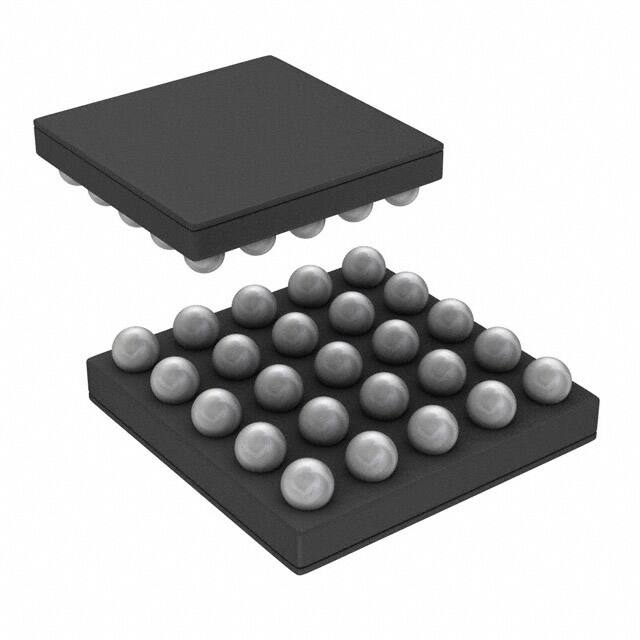
capacitors. The LP5523 is available in a tiny 25-pin
DSBGA package (0.4-mm pitch).
2 Applications
•
•
•
•
The LP5523 maintains excellent efficiency over a
wide operating range by autonomously selecting the
best charge-pump gain based on LED forward
voltage requirements. The LP5523 is able to
automatically enter power-save mode when LED
outputs are not active, thus lowering idle current
consumption down to 10 µA (typical).
Fun Lights and Indicator Lights
LED Backlighting
Haptic Feedback
Programmable Current Source
Device Information(1)
PART NUMBER
LP5523
PACKAGE
DSBGA (25)
BODY SIZE (NOM)
2.26 mm × 2.26 mm
(1) For all available packages, see the orderable addendum at
the end of the data sheet.
Typical Application
C1
C2
0.47 µF 0.47 µF
C1
C2
0.47 µF 0.47 µF
C1+ C1- C2+ C2- VOUT
COUT
1 µF
VIN = 2.7 V TO 5.5 V
CIN
1 µF
COUT
1 µF
VIN = 2.7 V TO 5.5 V
VDD
D7
D1
SCL
MCU
C1+ C1- C2+ C2- VOUT
D2
SDA
R
GPO
D8
LP5523
D3
INT
TRIG
ASEL0
ASEL1
GND
D4
D9
MCU
R
D1
D2
D3
SDA
EN
D4
CLK
LP5523
G
D5
GPO
B
R
INT
D6
TRIG
ASEL0
D7
ASEL1
GND
G
D5
D6
VDD
SCL
B
EN
CLK
CIN
1 µF
G
D8
D9
B
RGB LED
APPLICATION
WLED APPLICATION
NOTE: D7, D8 AND D9 POWERED
DIRECTLY FROM VIN
1
An IMPORTANT NOTICE at the end of this data sheet addresses availability, warranty, changes, use in safety-critical applications,
intellectual property matters and other important disclaimers. PRODUCTION DATA.
�LP5523
SNVS550E – SEPTEMBER 2009 – REVISED JANUARY 2017
www.ti.com
Table of Contents
1
2
3
4
5
6
Features ..................................................................
Applications ...........................................................
Description .............................................................
Revision History.....................................................
Pin Configuration and Functions .........................
Specifications.........................................................
6.1
6.2
6.3
6.4
6.5
6.6
6.7
6.8
6.9
6.10
6.11
6.12
7
1
1
1
2
3
4
Absolute Maximum Ratings ...................................... 4
ESD Ratings.............................................................. 4
Recommended Operating Conditions....................... 4
Thermal Information .................................................. 5
Electrical Characteristics........................................... 5
Charge Pump Electrical Characteristics .................. 6
LED Driver Electrical Characteristics ........................ 6
LED Test Electrical Characteristics .......................... 6
Logic Interface Characteristics ................................. 7
Recommended External Clock Source Conditions . 7
Serial Bus Timing Parameters (SDA, SCL) ............ 8
Typical Characteristics ............................................ 9
Detailed Description ............................................ 11
7.1 Overview ................................................................. 11
7.2
7.3
7.4
7.5
7.6
8
Functional Block Diagram .......................................
Feature Description.................................................
Device Functional Modes........................................
Programming...........................................................
Register Maps .........................................................
11
12
17
19
22
Application and Implementation ........................ 49
8.1 Application Information............................................ 49
8.2 Typical Applications ................................................ 49
9 Power Supply Recommendations...................... 53
10 Layout................................................................... 54
10.1 Layout Guidelines ................................................. 54
10.2 Layout Example .................................................... 54
11 Device and Documentation Support ................. 55
11.1
11.2
11.3
11.4
11.5
11.6
Device Support ....................................................
Receiving Notification of Documentation Updates
Community Resources..........................................
Trademarks ...........................................................
Electrostatic Discharge Caution ............................
Glossary ................................................................
55
55
55
55
55
55
12 Mechanical, Packaging, and Orderable
Information ........................................................... 55
4 Revision History
NOTE: Page numbers for previous revisions may differ from page numbers in the current version.
Changes from Revision D (May 2013) to Revision E
Page
•
Changed title of data sheet for SEO ..................................................................................................................................... 1
•
Added Device Information and Pin Configuration and Functions sections, ESD Ratings and Thermal Information
tables, Feature Description, Device Functional Modes, Application and Implementation, Power Supply
Recommendations, Layout, Device and Documentation Support, and Mechanical, Packaging, and Orderable
Information sections................................................................................................................................................................ 1
•
Changed RθJA value from "87°C/W" to "60.9°C/W" ................................................................................................................ 5
•
Added values in the Thermal Information table to align with JEDEC standards. .................................................................. 5
Changes from Revision C (April 2013) to Revision D
•
2
Page
Changed layout of National Semiconductor data sheet to TI format.................................................................................... 53
Submit Documentation Feedback
Copyright © 2009–2017, Texas Instruments Incorporated
Product Folder Links: LP5523
�LP5523
www.ti.com
SNVS550E – SEPTEMBER 2009 – REVISED JANUARY 2017
5 Pin Configuration and Functions
YFQ Package
25-Pin DSBGA
Top View
YFQ Package
25-Pin DSBGA
Bottom View
5
5
4
4
3
3
2
2
1
1
E
A
B
C
D
C
D
B
A
E
Pin Functions (1)
PIN
TYPE
DESCRIPTION
NO.
NAME
A1
D1
A
Current source output 1
A2
D2
A
Current source output 2
A3
VOUT
A
Charge pump output
A4
C2−
A
Flying capacitor 2 negative terminal
A5
C2+
A
Flying capacitor 2 positive terminal
B1
D3
A
Current source output 3
B2
D4
A
Current source output 4
B3
ASEL1
I
Serial interface address select input
B4
C1−
A
Flying capacitor 1 negative terminal
B5
C1+
A
Flying capacitor 1 positive terminal
C1
D5
A
Current source output 5
C2
D6
A
Current source output 6
C3
ASEL0
I
Serial interface address select input
C4
EN
I
Enable
C5
VDD
P
Input power supply
D1
D7
A
Current source output 7 - powered from VDD
D2
D8
A
Current source output 8 - powered from VDD
D3
INT
OD/O
D4
CLK
I
32 kHz clock input. Connect to ground if not used
D5
GND
G
Ground
Interrupt for microcontroller unit. Leave unconnected if not used
E1
D9
A
Current source output 9 - powered from VDD
E2
GPO
O
General purpose output. Leave unconnected if not used
E3
TRIG
I/OD
Trigger. Connect to ground if not used.
E4
SDA
I/OD
Serial interface data
E5
SCL
I
Serial interface clock
(1)
A: Analog Pin G: Ground Pin P: Power Pin I: Input Pin I/O: Input/Output Pin O: Output Pin OD: Open Drain Pin
Submit Documentation Feedback
Copyright © 2009–2017, Texas Instruments Incorporated
Product Folder Links: LP5523
3
�LP5523
SNVS550E – SEPTEMBER 2009 – REVISED JANUARY 2017
www.ti.com
6 Specifications
6.1 Absolute Maximum Ratings
over operating free-air temperature range (unless otherwise noted) (1) (2) (3)
MIN
MAX
UNIT
VDD
–0.3
6
V
Voltage on D1 to D9, C1−, C1+, C2–, C+, VOUT
–0.3
VDD + 0.3 V with 6 V maximum
V
Continuous power dissipation
Internally limited
Junction temperature, TJ-MAX
Storage temperature, Tstg
(1)
(2)
(3)
–65
125
°C
150
°C
Stresses beyond those listed under Absolute Maximum Ratings may cause permanent damage to the device. These are stress ratings
only, which do not imply functional operation of the device at these or any other conditions beyond those indicated under Recommended
Operating Conditions. Exposure to absolute-maximum-rated conditions for extended periods may affect device reliability.
If Military/Aerospace specified devices are required, contact the TI Sales Office/Distributors for availability and specifications.
All voltages are with respect to the potential at the GND pin.
6.2 ESD Ratings
VALUE
Human-body model (HBM), per
ANSI/ESDA/JEDEC JS-001 (1)
V(ESD)
Electrostatic discharge
±2500
Pins D1 to D9
±8000
Charged-device model (CDM), per JEDEC
All pins
specification JESD22-C101 (2)
Machine model
(1)
(2)
All pins except D1 to D9
±1000
All pins
UNIT
V
250
JEDEC document JEP155 states that 500-V HBM allows safe manufacturing with a standard ESD control process.
JEDEC document JEP157 states that 250-V CDM allows safe manufacturing with a standard ESD control process.
6.3 Recommended Operating Conditions
over operating free-air temperature range (unless otherwise noted) (1) (2)
MIN
VDD input voltage
MAX
UNIT
2.7
5.5
Voltage on logic pins (input or output pins)
0
VDD
V
Recommended charge pump load current
0
100
mA
–30
125
°C
–30
85
°C
Junction temperature, TJ
Ambient temperature, TA
(1)
(2)
4
(2)
V
All voltages are with respect to the potential at the GND pin.
In applications where high power dissipation and/or poor package thermal resistance is present, the maximum ambient temperature may
have to be derated. Maximum ambient temperature (TA-MAX) is dependent on the maximum operating junction temperature (TJ-MAX-OP =
125°C), the maximum power dissipation of the device in the application (PD-MAX), and the junction-to ambient thermal resistance of the
part/package in the application (RθJA), as given by the following equation: TA-MAX = TJ-MAX-OP – (RθJA × PD-MAX).
Submit Documentation Feedback
Copyright © 2009–2017, Texas Instruments Incorporated
Product Folder Links: LP5523
�LP5523
www.ti.com
SNVS550E – SEPTEMBER 2009 – REVISED JANUARY 2017
6.4 Thermal Information
LP5523
THERMAL METRIC (1)
YFQ (DSBGA)
UNIT
25 PINS
RθJA (2)
Junction-to-ambient thermal resistance
60.9
°C/W
RθJC(top)
Junction-to-case (top) thermal resistance
0.4
°C/W
RθJB
Junction-to-board thermal resistance
9.9
°C/W
ψJT
Junction-to-top characterization parameter
0.2
°C/W
ψJB
Junction-to-board characterization parameter
10.0
°C/W
(1)
(2)
For more information about traditional and new thermal metrics, see Semiconductor and IC Package Thermal Metrics.
Junction-to-ambient thermal resistance is highly application and board-layout dependent. In applications where high maximum power
dissipation exists, special care must be paid to thermal dissipation issues in board design.
6.5 Electrical Characteristics
Unless otherwise noted: typical limits are for TA = 25°C; minimum and maximum limits apply over the operating ambient
temperature range (−30°C < TA < +85°C), specifications apply to the Functional Block Diagram with: VDD = 3.6 V, VEN = 1.65
V, COUT = 1 µF, CIN = 1 µF, C1–2 = 0.47 µF. (1) (2) (3) (4)
PARAMETER
TEST CONDITIONS
MIN
VEN = 0V, CHIP_EN=0 (bit),
external 32-kHz clock running or not
running
Standby supply current
IVDD
Normal mode supply current
Power-save mode supply current
ƒOSC
(1)
(2)
(3)
(4)
TYP
MAX
UNIT
0.2
µA
CHIP_EN=0 (bit), external 32 kHz
clock not running
1
µA
CHIP_EN=0 (bit), external 32 kHz
clock running
1.4
µA
External 32-kHz clock running,
charge pump and current source
outputs disabled
0.6
mA
Charge pump in 1× mode, no load,
current source outputs disabled
0.8
mA
Charge pump in 1.5× mode, no
load, current source outputs
disabled
1.8
mA
External 32-kHz clock running
10
µA
Internal oscillator running
0.6
mA
Internal oscillator frequency accuracy
–4%
4%
–7%
7%
The Electrical Characteristics tables list ensured specifications under Recommended Operating Conditions except as otherwise modified
or specified by the Electrical Characteristics conditions and/or notes. Typical specifications are estimations only and are not ensured.
All voltages are with respect to the potential at the GND pin.
Minimum and maximum limits are ensured by design, test, or statistical analysis.
Low-ESR surface-mount ceramic capacitors (MLCCs) used in setting electrical characteristics.
Submit Documentation Feedback
Copyright © 2009–2017, Texas Instruments Incorporated
Product Folder Links: LP5523
5
�LP5523
SNVS550E – SEPTEMBER 2009 – REVISED JANUARY 2017
www.ti.com
6.6 Charge Pump Electrical Characteristics
Unless otherwise noted: typical limits are for TA = 25°C; minimum and maximum limits apply over the operating ambient
temperature range (−30°C < TA < +85°C). See (1) (2) (3)
PARAMETER
TEST CONDITIONS
ROUT
Charge pump output resistance
ƒSW
Switching frequency
IGND
Ground current
tON
VOUT turnon time
(1)
(2)
(3)
(4)
MIN
TYP
Gain = 1.5×
MAX
3.5
Gain = 1×
Ω
1
1.25
(4)
Gain = 1.5×
1.2
Gain = 1×
0.3
VDD = 3.6 V, IOUT = 60 mA
100
UNIT
MHz
mA
µs
The Electrical Characteristics tables list ensured specifications under Recommended Operating Conditions except as otherwise modified
or specified by the Electrical Characteristics conditions and/or notes. Typical specifications are estimations only and are not ensured.
All voltages are with respect to the potential at the GND pin.
Minimum and maximum limits are ensured by design, test, or statistical analysis.
Turnon time is measured from the moment the charge pump is activated until the VOUT crosses 90% of its target value.
6.7 LED Driver Electrical Characteristics
Unless otherwise noted limits apply for TA = 25°C. See (1) (2) (3)
PARAMETER
TEST CONDITIONS
ILEAKAGE
Leakage current (outputs D1
to D9)
PWM = 0%
IMAX
Maximum source current
Outputs D1 to D9
IOUT
Output current accuracy
IMATCH
Matching
ƒLED
LED switching frequency
VSAT
Saturation voltage
(1)
(2)
(3)
(4)
(5)
(4)
(4)
MIN
MAX
0.1
1
UNIT
µA
25.5
Output current set to 17.5 mA
−4%
−30°C < TA < +85°C
–5%
mA
4%
5%
Output current set to 17.5 mA
(5)
TYP
1%
2.5%
312
Output current set to 17.5 mA
Hz
45
100
mV
The Electrical Characteristics tables list ensured specifications under Recommended Operating Conditions except as otherwise modified
or specified by the Electrical Characteristics conditions and/or notes. Typical specifications are estimations only and are not ensured.
All voltages are with respect to the potential at the GND pin.
Minimum and maximum limits are ensured by design, test, or statistical analysis.
Output current accuracy is the difference between the actual value of the output current and programmed value of this current. Matching
is the maximum difference from the average. For the constant current outputs on the part (D1 to D9), the following are determined: the
maximum output current (MAX), the minimum output current (MIN), and the average output current of all outputs (AVG). Two matching
numbers are calculated: (MAX – AVG) / AVG and (AVG – MIN) / AVG. The largest number of the two (worst case) is considered the
matching figure. Note that some manufacturers have different definitions in use.
Saturation voltage is defined as the voltage when the LED current has dropped 10% from the value measured at VOUT – 1 V.
6.8 LED Test Electrical Characteristics
Unless otherwise noted limits apply for TA = 25°C. See (1) (2) (3)
PARAMETER
LSB
EABS
Total unadjusted error
tCONV
Conversion time
VIN_TEST
DC voltage range
(1)
(2)
(3)
(4)
6
TEST CONDITIONS
MIN
Least significant bit
TYP
MAX
30
(4)
VIN_TEST = 0 V to VDD
< ±3
mV
±4
2.7
0
UNIT
LSB
ms
5
V
The Electrical Characteristics tables list ensured specifications under Recommended Operating Conditions except as otherwise modified
or specified by the Electrical Characteristics conditions and/or notes. Typical specifications are estimations only and are not ensured.
All voltages are with respect to the potential at the GND pin.
Minimum and maximum limits are ensured by design, test, or statistical analysis.
Total unadjusted error includes offset, full-scale, and linearity errors.
Submit Documentation Feedback
Copyright © 2009–2017, Texas Instruments Incorporated
Product Folder Links: LP5523
�LP5523
www.ti.com
SNVS550E – SEPTEMBER 2009 – REVISED JANUARY 2017
6.9 Logic Interface Characteristics
Unless otherwise noted: typical limits are for TA = 25°C; minimum and maximum limits apply over the operating ambient
temperature range (−30°C < TA < +85°C).See (1) (2) (3) (4)
PARAMETER
TEST CONDITIONS
MIN
TYP
MAX
UNIT
LOGIC INPUT EN
VIL
Input low level
VIH
Input high level
1.2
II
Input current
−1
tDELAY
Input delay (5)
0.5
V
1
µA
V
2
µs
LOGIC INPUT SCL, SDA, TRIG, CLK, ASEL0, ASEL1
VIL
Input low level
VIH
Input high level
II
Input current
0.2 × VEN
0.8 × VEN
V
V
−1
1
µA
0.5
V
1
µA
0.5
V
1
µA
LOGIC OUTPUT SDA, TRIG, INT
VOL
Output low level
IOUT = 3 mA (pullup current)
IL
Output leakage current
VOUT = 2.8 V
0.3
LOGIC OUTPUT GPO
VOL
Output low level
IOUT = 3 mA
VOH
Output high level
IOUT = −2 mA
IL
Output leakage current
VOUT = 2.8 V
(1)
(2)
(3)
(4)
(5)
0.3
VDD − 0.5
VDD − 0.3
The Electrical Characteristics tables list ensured specifications under Recommended Operating Conditions except as otherwise modified
or specified by the Electrical Characteristics conditions and/or notes. Typical specifications are estimations only and are not ensured.
All voltages are with respect to the potential at the GND pin.
Minimum and maximum limits are ensured by design, test, or statistical analysis.
Low-ESR surface-mount ceramic capacitors (MLCCs) used in setting electrical characteristics.
The I2C host must allow at least 500 µs before sending data to the LP5523 after the rising edge of the enable line.
6.10 Recommended External Clock Source Conditions
Unless otherwise noted limits apply for TA = 25°C. See (1) (2) (3)
(4) (5)
MIN
NOM
MAX
UNIT
LOGIC INPUT CLK
ƒCLK
Clock frequency
tCLKH
High time
6
tCLKL
Low time
6
tr
Clock rise time, 10% to 90%
2
µs
tf
Clock fall time, 90% to 10%
2
µs
(1)
(2)
(3)
(4)
(5)
32.7
kHz
µs
µs
The Electrical Characteristics tables list ensured specifications under Recommended Operating Conditions except as otherwise modified
or specified by the Electrical Characteristics conditions and/or notes. Typical specifications are estimations only and are not ensured.
All voltages are with respect to the potential at the GND pin.
Minimum and maximum limits are ensured by design, test, or statistical analysis.
Specification is ensured by design and is not tested in production. VEN = 1.65 V to VDD.
The ideal external clock signal for the LP5523 is a 0 V to VEN 25% to 75% duty-cycle square wave. At frequencies above 32.7 kHz,
program execution is faster, and at frequencies below 32.7 kHz program execution is slower.
Submit Documentation Feedback
Copyright © 2009–2017, Texas Instruments Incorporated
Product Folder Links: LP5523
7
�LP5523
SNVS550E – SEPTEMBER 2009 – REVISED JANUARY 2017
www.ti.com
6.11 Serial Bus Timing Parameters (SDA, SCL)
Unless otherwise noted limits apply for TA = 25°C. See (1) (2) (3)
(4) (5)
MIN
MAX
UNIT
400
kHz
fSCL
Clock frequency
1
Hold time (repeated) START condition
0.6
µs
2
Clock low time
1.3
µs
3
Clock high time
600
ns
4
Setup TIME FOR A REPEATED START condition
600
ns
5
Data hold time
50
ns
6
Data setup time
100
ns
7
Rise time of SDA and SCL
20+0.1 Cb
300
ns
8
Fall time of SDA and SCL
15+0.1 Cb
300
ns
9
Set-up time for STOP condition
600
10
Bus free time between a STOP and a START condition
1.3
Cb
Capacitive load parameter for each bus line.
Load of one picofarad corresponds to one nanosecond.
10
(1)
(2)
(3)
(4)
(5)
ns
µs
200
ns
The Electrical Characteristics tables list ensured specifications under Recommended Operating Conditions except as otherwise modified
or specified by the Electrical Characteristics conditions and/or notes. Typical specifications are estimations only and are not ensured.
All voltages are with respect to the potential at the GND pin.
Minimum and maximum limits are ensured by design, test, or statistical analysis.
Minimum and maximum limits are ensured by design, test, or statistical analysis.
Specification is ensured by design and is not tested in production. VEN = 1.65 V to VDD.
Figure 1. External Clock Signals
Figure 2. Serial Bus Timing Diagram
8
Submit Documentation Feedback
Copyright © 2009–2017, Texas Instruments Incorporated
Product Folder Links: LP5523
�LP5523
www.ti.com
SNVS550E – SEPTEMBER 2009 – REVISED JANUARY 2017
6.12 Typical Characteristics
Unless otherwise specified: VDD = 3.6 V, CIN = COUT = 1 µF, C1 = C2 = 0.47 µF, TA = 25°C; CIN, COUT, C1, C2: low-ESR
surface-mount ceramic capacitors (MLCCs) used in setting electrical characteristics.
Figure 3. Charge Pump 1.5× Efficiency vs Load Current
6 × 1-mA Load
6 Nichia NSCW100 WLEDs on D1 To D6
Figure 5. Gain Change Hysteresis Loop At Factory Settings
17.5-mA Current
See note 4 in LED Driver Electrical Characteristics
Figure 4. Charge Pump Output Voltage (1.5×) as a Function
of Load Current at Four Input Voltage Levels
Load = 6 × Nichia NSCW100 WLEDs on D1 To D6 at 100% PWM
Figure 6. Effect of Adaptive Hysteresis on the Width of the
Hysteresis Loop
17.5-mA Current
See note 4 in LED Driver Electrical Characteristics
Figure 7. LED Current Matching Distribution
Figure 8. LED Current Accuracy Distribution
Submit Documentation Feedback
Copyright © 2009–2017, Texas Instruments Incorporated
Product Folder Links: LP5523
9
�LP5523
SNVS550E – SEPTEMBER 2009 – REVISED JANUARY 2017
www.ti.com
Typical Characteristics (continued)
Unless otherwise specified: VDD = 3.6 V, CIN = COUT = 1 µF, C1 = C2 = 0.47 µF, TA = 25°C; CIN, COUT, C1, C2: low-ESR
surface-mount ceramic capacitors (MLCCs) used in setting electrical characteristics.
20
1k
INTERNAL CLK (LEFT SCALE)
SDA
500
10
VOLTAGE (2V/DIV)
15
IVDD (PA)
IVDD (PA)
750
EXTERNAL CLK (RIGHT SCALE)
5
250
STOP CONDITION
SCL
VOUT 2V/DIV
0
2.7
3.1
3.5
3.9
4.3
4.7
5.1
0
5.5
TIME (40 Ps/DIV)
VDD (V)
Charge Pump In 1× Mode
If the charge pump is OFF the supply current is even lower.
Figure 9. Power-Save Mode Supply Current vs VDD
VDD = 3.6 V
ILOAD = 60 mA
Figure 10. Serial Bus Write (51h To Addr 36h) and
Charge-Pump Start-up Waveform
85
95
3 x SHARP GM5WA06270A RGB-LED
6 x NICHIA NSCW100 WLED
75
75
70
EFFICIENCY (%)
EFFICIENCY (%)
85
80
80
9 x 10 mA
65
65
60
60
55
10
2.7
3.3
3.9
6 x 15 mA
6 x 10 mA
60
9 x 6.7 mA
55
90
95
85
90
85
80
80
75
75
70
70
65
60
65
55
4.5
55
5.1
2.7
3.3
3.9
4.5
5.1
VDD (V)
VDD (V)
Figure 11. 100% PWM RGB LED Efficiency vs VDD
Figure 12. 100% PWM WLED Efficiency vs VDD
Submit Documentation Feedback
Copyright © 2009–2017, Texas Instruments Incorporated
Product Folder Links: LP5523
�LP5523
www.ti.com
SNVS550E – SEPTEMBER 2009 – REVISED JANUARY 2017
7 Detailed Description
7.1 Overview
The LP5523 is a fully integrated lighting management unit for producing lighting effects for mobile devices. The
LP5523 includes all necessary power management, high-side current sources, temperature compensation, twowire control interface and programmable pattern generators. The overall maximum current for each driver is set
by an 8-bit register.
The LP5523 controls LED luminance with a pulse width modulation (PWM) scheme with a resolution of 12 bits.
Also, the temperature compensation is done by PWM.
7.2 Functional Block Diagram
C1
C2
0.47 µF
0.47 µF
C1+
C1- C2+
C2VDD
VOUT
CIN
1 µF
1.25 MHz
OSC
COUT
1 µF
CHARGE PUMP
1x/1.5x
PWM PATTERN
GENERATOR
VREF
PROGRAM
MEMORY
50H TO 6FH;
96
INSTRUCTIONS
PWM PATTERN
GENERATOR
PWM PATTERN
GENERATOR
BIAS
12-BIT PWM
PATTERN
CONTROL
ASEL0
ASEL1
SCL
SERIAL
DATA
CTRL
REG
TEMP
COMP
D1
SDA
CONTROL
INT
CLK
DET
CURRENT
CONTROL
D/A
VDD
EN
CLK
POR
GPO
LED ERROR DETECTION
TRIG
D2
8-BIT
MAXIMUM
D6
D7
D8
D9
IDAC AND
HIGH SIDE
LED
DRIVERS
THERMAL
SHUTDOWN
GND
Copyright © 2016, Texas Instruments Incorporated
Submit Documentation Feedback
Copyright © 2009–2017, Texas Instruments Incorporated
Product Folder Links: LP5523
11
�LP5523
SNVS550E – SEPTEMBER 2009 – REVISED JANUARY 2017
www.ti.com
7.3 Feature Description
7.3.1 Programming
The LP5523 provides flexibility and programmability for dimming and sequencing control. Each LED can be
controlled directly and independently through the serial bus, or LED drivers can be grouped together for preprogrammed flashing patterns.
The LP5523 has three independent program execution engines, so it is possible to form three independently
programmable LED banks. LED drivers can be grouped based on their function so that, for example, the first
bank of drivers can be assigned to the keypad illumination, the second bank to the funlights, and the third group
to the indicator LED(s).
Each bank can contain 1 to 9 LED driver outputs. Instructions for program execution engines are stored in the
program memory. The total amount of the program memory is 96 instructions, and the user can allocate the
memory as required by the engines.
7.3.2 LED Error Detection
The LP5523 has built-in LED error detection. Error detection does not only detect open and short circuit, but
provides an opportunity to measure the VF of the LEDs. The test event is activated by a serial interface write, and
the results can be read through the serial interface during the next cycle. This feature can also be addressed to
measure the voltage on VDD, VOUT, and INT pins. Typical example usage includes monitoring battery voltage
or using INT pin as a light sensor interface.
7.3.3 Energy Efficiency
When charge-pump automatic mode selection is enabled, the LP5523 monitors the voltage over the drivers of D1
to D6 so that the device can select the best charge-pump gain and maintain good efficiency over the whole
operating voltage range. The red LED element of an RGB LED typically has a forward voltage of about 2 V. For
that reason, the outputs D7, D8, and D9 are internally powered by VDD, since battery voltage is high enough to
drive red LEDs over the whole operating voltage range. This allows the driving of three RGB LEDs with good
efficiency because the red LEDs do not load the charge pump. The LP5523 is able to automatically enter powersave mode when LED outputs are not active, thus lowering idle current consumption down to 10 µA (typical).
Also, during the down time of the PWM cycle (constant current output status is low), additional power savings
can be achieved when the PWM Powersave feature is enabled.
7.3.4 Temperature Compensation
The luminance of an LED is typically a function of its temperature even though the current flowing through the
LED remains constant. Because luminance is temperature dependent, many LED applications require some form
of temperature compensation to decrease luminance and color purity variations due to temperature changes. The
LP5523 has a built-in temperature-sensing element, and PWM duty cycle of the LED drivers changes linearly in
relationship to changes in temperature. User can select the slope of the graph (31 slopes) based on the LED
characteristics (see Figure 13). This compensation can be done either constantly, or only right after the device
wakes up from power-save mode, to avoid error due to self-heating of the device. Linear compensation is
considered to be practical and accurate enough for most LED applications.
12
Submit Documentation Feedback
Copyright © 2009–2017, Texas Instruments Incorporated
Product Folder Links: LP5523
�LP5523
www.ti.com
SNVS550E – SEPTEMBER 2009 – REVISED JANUARY 2017
Feature Description (continued)
100
MAXIMUM
SLOPE VALUE
PWM OUTPUT %
75
NO
COMP.
50
25
MINIMUM
SLOPE VALUE
0
-25
0
25
50
75
TEMPERATURE °C
Figure 13. Temperature Compensation Principle
Compensation is effective over the temperature range −40°C to +90°C.
7.3.5 Charge Pump Operational Description
7.3.5.1 Overview
The LP5523 includes a pre-regulated switched-capacitor charge pump with a programmable voltage
multiplication of 1× and 1.5×. In 1.5× mode, by combining the principles of a switched-capacitor charge pump
and a linear regulator, a regulated 4.5-V output is generated from the Li-Ion input voltage range. A two-phase
non-overlapping clock generated internally controls the operation of the charge pump. During the charge phase,
both flying capacitors (C1 and C2) are charged from input voltage. In the pump phase that follows, the flying
capacitors are discharged to output. A traditional switched-capacitor charge pump operating in this manner uses
switches with very low on-resistance, ideally 0 Ω, to generate an output voltage that is 1.5× the input voltage.
The LP5523 regulates the output voltage by controlling the resistance of the input-connected pass-transistor
switches in the charge pump.
7.3.5.2 Output Resistance
At lower input voltages, the charge pump output voltage may degrade due to effective output resistance (ROUT) of
the charge pump. The expected voltage drop can be calculated by using a simple model for the charge pump
shown in Figure 14.
VIN
REG
V
, ROUT
,
1.5X
1.5 x V
VOUT
Figure 14. Charge Pump Output Resistance Model
The model shows a linear pre-regulation block (REG), a voltage multiplier (1.5×), and an output resistance
(ROUT). Output resistance models the output voltage drop that is inherent to switched capacitor converters. The
output resistance is 3.5 Ω (typical), and it is a function of switching frequency, input voltage, capacitance value of
the flying capacitor, internal resistances of the switches, and ESR of the flying capacitors. When the output
voltage is in regulation, the regulator in the model controls the voltage V’ to keep the output voltage equal to 4.5
V (typical).
Submit Documentation Feedback
Copyright © 2009–2017, Texas Instruments Incorporated
Product Folder Links: LP5523
13
�LP5523
SNVS550E – SEPTEMBER 2009 – REVISED JANUARY 2017
www.ti.com
Feature Description (continued)
With increased output current, the voltage drop across ROUT increases. To prevent drop in output voltage, the
voltage drop across the regulator is reduced, V’ increases, and VOUT remains at 4.5 V. When the output current
increases to the point that there is zero voltage drop across the regulator, V’ equals the input voltage, and the
output voltage is on the edge of regulation. Additional output current causes the output voltage to fall out of
regulation, so that the operation is similar to a basic open-loop 1.5× charge pump. In this mode, output current
results in output voltage drop proportional to the output resistance of the charge pump. The out-of-regulation
output voltage can be approximated by: VOUT = 1.5 × VIN – IOUT × ROUT.
7.3.5.3 Controlling The Charge Pump
The charge pump is controlled with two CP_MODE bits in MISC register (address 36H). When both of the bits
are low, the charge pump is disabled, and output voltage is pulled down with an internal 300 kΩ (typ.) resistor.
The charge pump can be forced to bypass mode, so the battery voltage is connected directly to the current
sources; in 1.5×mode output voltage is boosted to 4.5 V. In automatic mode, charge-pump operation mode is
determined by saturation of constant current drivers, as described in LED Forward Voltage Monitoring.
7.3.5.4 LED Forward Voltage Monitoring
When the charge-pump automatic mode selection is enabled, voltages over LED drivers D1 to D6 are monitored.
(Note: Power input for current source outputs D7, D8 and D9 are internally connected to the VDD pin.) If the D1
to D6 drivers do not have enough headroom, charge-pump gain is set to 1.5×. Driver saturation monitor does not
have a fixed voltage limit, since saturation voltage is a function of temperature and current. Charge pump gain is
set to 1×, when battery voltage is high enough to supply all LEDs.
In automatic gain change mode, the charge pump is switched to bypass mode (1×), when LEDs are inactive for
over 50 ms.
7.3.5.5 Gain Change Hysteresis
Charge-pump-gain control utilizes digital filtering to prevent supply voltage disturbances (for example, the
transient voltage on the power supply during the GSM burst) from triggering unnecessary gain changes.
Hysteresis is provided to prevent periodic gain changes (which could occur due to LED driver) and charge-pump
voltage drop in 1× mode. The hysteresis of the gain change is user-configurable; default setting is factoryprogrammable. Flexible configuration ensures that hysteresis can be minimized or set to desired level in each
application.
LED forward voltage monitoring and gain control block diagram is shown in Figure 15.
MODE
CHARGE PUMP
VDD
VOUT
P
W
M
CURRENT
SOURCE
D1
TO
D6
VOFS
COMPARATOR
SATURATION
MONITOR
DIGITAL
FILTER
CONTROL
REGISTERS
PROGRAM
MEMORY
COMMAND
LOOK-AHEAD
MODE
CONTROL
Figure 15. Forward Voltage Monitoring and Gain Control Block
14
Submit Documentation Feedback
Copyright © 2009–2017, Texas Instruments Incorporated
Product Folder Links: LP5523
�LP5523
www.ti.com
SNVS550E – SEPTEMBER 2009 – REVISED JANUARY 2017
Feature Description (continued)
7.3.6 LED Driver Operational Description
7.3.6.1 Overview
The LP5523 LED drivers are constant-current sources. Output current can be programmed by control registers
up to 25.5 mA. The overall maximum current is set by 8-bit output current control registers with 100-μA step size.
Each of the 9 LED drivers has a separate output-current control register.
LED OUTPUT CURRENT
The LED luminance pattern (dimming) is controlled with PWM (pulse width modulation) technique, which has
internal resolution of 12 bits (8-bit control can be seen by user). PWM frequency is 312 Hz. See Figure 16.
PWM FREQUENCY = 312 Hz
12-BIT PWM
PATTERN
CONTROL
0% TO 100 %
8-BIT CURRENT
SETTING
0 mA TO 25.5 mA
TIME
Figure 16. LED Pattern and Current Control Principle
LED dimming is controlled according to a logarithmic or linear scale, see Figure 17. A logarithmic or linear
scheme can be set for both the program execution engine control and direct PWM control. Note: if the
temperature compensation is active, the maximum PWM duty cycle is limited to 50% at 25°C. This is required to
allow enough headroom for temperature compensation over the whole temperature range −40°C to +90°C.
100,0
100
PWM OUTPUT %
80,0
80
60
60,0
40,0
40
20,0
20
0
0,0
0,0
0
64,0
64
128,0
128
192,0
192
256,0
256
DIMMING CONTROL (DEC)
Figure 17. Logarithmic vs Linear Dimming
7.3.6.2 Powering LEDs
The LP5523 is very suitable for white LED and general purpose applications, and it is particularly well suited to
use with RGB LEDs. The device architecture is optimized for use with three RGB LEDs. Typically, the red LEDs
have forward voltages below 2 volts, thus red LEDs can be powered directly from VDD. In the LP5523 device the
D7, D8, and D9 drivers are powered from the battery voltage (VDD), not from the charge-pump output. D1 to D6
drivers are internally connected to the charge-pump output, and these outputs can be used for driving green and
blue (VF = 2.7 V to 3.7 V typical) or white LEDs. Of course, D7, D8, and D9 outputs can be used for green, blue
or white LEDs if the VDD voltage is high enough.
An RGB LED configuration example is given in Typical Applications.
Submit Documentation Feedback
Copyright © 2009–2017, Texas Instruments Incorporated
Product Folder Links: LP5523
15
�LP5523
SNVS550E – SEPTEMBER 2009 – REVISED JANUARY 2017
www.ti.com
Feature Description (continued)
7.3.6.3 Controlling The High-Side LED Drivers
1. Direct PWM Control: All LP5523 LED drivers, D1 to D9, can be controlled independently through the two-wire
serial I2C-compatible interface. For each high-side driver there is a PWM control register. Direct PWM control
is active by default.
2. Controlling by Program Execution Engines: Engine control is used when the user wants to create
programmed sequences. The program execution engine has a higher priority than direct control registers.
Therefore, if the user has set the PWM register to a certain value, it is automatically overridden when the
program execution engine controls the driver. LED control and program execution engine operation is
described in Control Register Details.
3. Master Fader Control: In addition to LED-by-LED PWM register control, the LP5523 is equipped with socalled master fader control, which allows the user to fade in or fade out multiple LEDs by writing to only one
register. This is a useful function to minimize serial-bus traffic between the MCU and the LP5523. The
LP5523 has three master fader registers, so it is possible to form three master fader groups.
16
Submit Documentation Feedback
Copyright © 2009–2017, Texas Instruments Incorporated
Product Folder Links: LP5523
�LP5523
www.ti.com
SNVS550E – SEPTEMBER 2009 – REVISED JANUARY 2017
7.4 Device Functional Modes
7.4.1 Modes Of Operation
RESET
In the RESET mode all the internal registers are reset to the default values. Reset is always
entered if Reset Register (3DH) is written FFH or internal Power-On Reset is active. Power-On
Reset (POR) activates during the chip startup or when the supply voltage VDD fall below 1.5V (typ.).
Once VDD rises above 1.5V (typ.), POR deactivates, and the device continues to the STANDBY
mode. CHIP_EN control bit is low after POR by default.
STANDBY: The STANDBY mode is entered if the register bit CHIP_EN or EN pin is LOW, and Reset is not
active. This is the low-power consumption mode, when all circuit functions are disabled. Most
registers can be written in this mode if EN pin is risen to high so that control bits are effective right
after the startup (see Control Register Details).
STARTUP: When CHIP_EN bit is written high and EN pin is high, the INTERNAL STARTUP SEQUENCE
powers up all the needed internal blocks (VREF, bias, oscillator etc.). Startup delay is 500 μs. If the
chip temperature rises too high, the Thermal shutdown (TSD) disables the chip operation, and the
chip waits in STARTUP mode until no thermal shutdown event is present.
NORMAL:
During NORMAL mode the user controls the chip using the Control Registers.
POWER SAVE: In POWER-SAVE mode analog blocks are disabled to minimize power consumption. See
Automatic Power-Save Mode for further information.
POR
RESET
Reset Register = FF
or
POR=H
STANDBY
EN=H (pin) and
CHIP_EN=H (bit)
EN=L (pin) or
CHIP_EN=L (bit)
INTERNAL
STARTUP
SEQUENCE
TSD = H
TSD = L
NORMAL MODE
Exit power save
Enter power save
POWER SAVE
Submit Documentation Feedback
Copyright © 2009–2017, Texas Instruments Incorporated
Product Folder Links: LP5523
17
�LP5523
SNVS550E – SEPTEMBER 2009 – REVISED JANUARY 2017
www.ti.com
Device Functional Modes (continued)
7.4.1.1 Automatic Power-Save Mode
Automatic power-save mode is enabled when POWERSAVE_EN bit in register address 36H is 1. Almost all
analog blocks are powered down in power-save if an external clock signal is used. Only the charge-pump
protection circuits remain active. However, if the internal clock has been selected, only charge pump and LED
drivers are disabled during the power save; the digital part of the LED controller needs to stay active. In both
cases the charge pump enters the weak 1× mode. In this mode the charge pump utilizes a passive current
limited keep-alive switch, which keeps the output voltage at the battery level. During the program execution
LP5523 can enter power save if there is no PWM activity in any of the LED driver outputs. To prevent short
power-save sequences during program execution, LP5523 has an instruction look-ahead filter. During program
execution engine 1, engine 2 and engine 3 instructions are constantly analyzed, and if there are time intervals of
more than 50 ms in length with no PWM activity on LED driver outputs, the device enters power save. In powersave mode program execution continues uninterrupted. When an instruction that requires PWM activity is
executed, a fast internal-startup sequence is started automatically.
7.4.1.2 PWM Power-Save Mode
PWM cycle power-save mode is enabled when register 36 bit [2] PWM_PS_EN is set to 1. In PWM power-save
mode analog blocks are powered down during the "down time" of the PWM cycle. Which blocks are powered
down depends whether the external or internal clock is used. While the Automatic Power-Save Mode (see
above) saves energy when there is no PWM activity at all, the PWM power-save mode saves energy during
PWM cycles. Like the automatic power-save mode, PWM power-save mode also works during program
execution. Figure 18 shows the principle of the PWM power-save technique. An LED on D9 output is driven at
50% PWM, 5-mA current (top waveform). After PWM Power-save enable, the LED-current remains the same, but
the LP5523 input current drops down to an approximately 50-µA level when the LED is OFF, or to an
approximately 200-µA level when the charge-pump-powered output(s) are used.
CURRENT
LED CURRENT 5 mA/DIV
LP5523 INPUT
CURRENT 1 mA/DIV
PWM POWERSAVE
ENABLED
INPUT CURRENT ~50 éA
DURING PWM
POWERSAVE
TIME 1 ms/DIV
Figure 18. PWM Power-Save Principle; External Clock, VDD = 3.6 V
18
Submit Documentation Feedback
Copyright © 2009–2017, Texas Instruments Incorporated
Product Folder Links: LP5523
�LP5523
www.ti.com
SNVS550E – SEPTEMBER 2009 – REVISED JANUARY 2017
7.5 Programming
7.5.1 I2C-Compatible Control Interface
The I2C-compatible synchronous serial interface provides access to the programmable functions and registers on
the device. This protocol uses a two-wire interface for bidirectional communications between the devices
connected to the bus. The two interface lines are the Serial Data Line (SDA), and the Serial Clock Line (SCL).
Every device on the bus is assigned a unique address and acts as either a Master or a Slave depending on
whether it generates or receives the serial clock SCL. The SCL and SDA lines should each have a pullup resistor
placed somewhere on the line and remain HIGH even when the bus is idle. Note: CLK pin is not used for serial
bus data transfer.
7.5.1.1 Data Validity
The data on SDA line must be stable during the HIGH period of the clock signal (SCL). In other words, state of
the data line can only be changed when clock signal is LOW.
SCL
SDA
data
change
allowed
data
valid
data
change
allowed
data
valid
data
change
allowed
Figure 19. Data Validity Diagram
7.5.1.2 Start and Stop Conditions
START and STOP conditions classify the beginning and the end of the data transfer session. A START condition
is defined as the SDA signal transitioning from HIGH to LOW while SCL line is HIGH. A STOP condition is
defined as the SDA transitioning from LOW to HIGH while SCL is HIGH. The bus master always generates
START and STOP conditions. The bus is considered to be busy after a START condition and free after a STOP
condition. During data transmission, the bus master can generate repeated START conditions. First START and
repeated START conditions are equivalent, function-wise.
7.5.1.3 Transferring Data
Every byte put on the SDA line must be eight bits long, with the most significant bit (MSB) being transferred first.
Each byte of data has to be followed by an acknowledge bit. The acknowledge related clock pulse is generated
by the master. The master releases the SDA line (HIGH) during the acknowledge clock pulse. The LP5523 pulls
down the SDA line during the 9th clock pulse, signifying an acknowledge. The LP5523 generates an
acknowledge after each byte has been received.
There is one exception to the “acknowledge after every byte” rule. When the master is the receiver, it must
indicate to the transmitter an end of data by not acknowledging (“negative acknowledge”) the last byte clocked
out of the slave. This “negative acknowledge” still includes the acknowledge clock pulse (generated by the
master), but the SDA line is not pulled down.
After the START condition, the bus master sends a chip address. This address is seven bits long followed by an
eighth bit which is a data direction bit (READ or WRITE). The LP5523 address is defined with ASEL0 and ASEL1
pins, and it is 32h when ASEL1 and ASEL0 are connected to GND. For the eighth bit, a “0” indicates a WRITE
and a “1” indicates a READ. The second byte selects the register to which the data is written. The third byte
contains data to write to the selected register.
Submit Documentation Feedback
Copyright © 2009–2017, Texas Instruments Incorporated
Product Folder Links: LP5523
19
�LP5523
SNVS550E – SEPTEMBER 2009 – REVISED JANUARY 2017
www.ti.com
Programming (continued)
7.5.1.4 I2C-Compatible Chip Address
ASEL0 and ASEL1 pins configure the chip address for the LP5523 as shown in Table 1.
Table 1. LP5523 Chip Address Configuration
ASEL1
ASEL0
ADDRESS
8-BIT HEX ADDRESS
GND
GND
(HEX)
WRITE/READ
32
GND
64/65
VEN
33
66/67
VEN
GND
34
68/69
VEN
VEN
35
6A/6B
MSB
LSB
ADR6
bit7
ADR5
bit6
ADR4
bit5
ADR3
bit4
ADR2
bit3
ADR1
bit2
ADR0
bit1
0
1
1
0
0
1
0
R/W
bit0
2
I C Slave Address (chip address)
Figure 20. LP5523 Chip Address
ack from slave
ack from slave
ack from slave
start
MSB Chip Addr LSB
w
ack
MSB Register Addr LSB
ack
MSB
Data LSB
ack
stop
start
id = 32h
w
ack
addr = 40h
ack
address 40h data
ack
stop
SCL
SDA
This data pattern writes temperature information to the TEMPERATURE WRITE register (40h).
Figure 21. Write Cycle (W = Write; SDA = 0), Id = Chip Address = 32h for LP5523
ack from slave
start
MSB Chip Addr LSB
w
ack from slave
MSB Register Addr LSB
repeated start
ack from slave data from slave nack from master
rs
MSB Chip Address LSB
rs
id = 32h
r
MSB
Data
LSB
stop
address 3Fh data
nack stop
SCL
SDA
start
id =32h
w ack
address = 3Fh
ack
r ack
This data pattern reads temperature information from the TEMPERATURE READ register (3Fh). When a READ
function is to be accomplished, a WRITE function must precede the READ function.
Figure 22. Read Cycle (R = Read; SDA = 1), Id = Chip Address = 32h for LP5523
20
Submit Documentation Feedback
Copyright © 2009–2017, Texas Instruments Incorporated
Product Folder Links: LP5523
�LP5523
www.ti.com
SNVS550E – SEPTEMBER 2009 – REVISED JANUARY 2017
7.5.1.4.1 Control Register Write Cycle
•
•
•
•
•
•
•
•
•
Master device generates start condition.
Master device sends slave address (7 bits) and the data direction bit (r/w = 0).
Slave device sends acknowledge signal if the slave address is correct
Master sends control register address (8 bits).
Slave sends acknowledge signal.
Master sends data byte to be written to the addressed register.
Slave sends acknowledge signal.
If master sends further data bytes, the slave’s control register address is incremented by one after
acknowledge signal. In order to reduce program load time, the LP5523 supports address auto incrementation.
Register address is incremented after each 8 data bits. For example, the whole program memory page can
be written in one serial bus write sequence. Note: serial bus address auto increment is not supported for
register addresses from 16 to 1E.
Write cycle ends when the master creates stop condition.
7.5.1.4.2 Control Register Read Cycle
•
•
•
•
•
•
•
•
•
•
•
Master device generates a start condition.
Master device sends slave address (7 bits) and the data direction bit (r/w = 0).
Slave device sends acknowledge signal if the slave address is correct
Master sends control register address (8 bits).
Slave sends acknowledge signal.
Master device generates repeated start condition.
Master sends the slave address (7 bits) and the data direction bit (r/w = 1).
Slave sends acknowledge signal if the slave address is correct.
Slave sends data byte from addressed register.
If the master device sends an acknowledge signal, the control register address is incremented by one. Slave
device sends data byte from addressed register.
Read cycle ends when the master does not generate acknowledge signal after data byte and generates stop
condition
7.5.1.4.3 Auto-Increment Feature
The auto-increment feature allows writing several consecutive registers within one transmission. Every time an 8bit word is sent to the LP5523, the internal address index counter is incremented by one, and the next register is
written. Example below (Table 2) shows writing sequence to two consecutive registers. Auto-increment feature is
enabled by writing EN_AUTO_INCR bit high in the MISC register (addr 36h). Note: serial bus address auto
increment is not supported for register addresses from 16 to 1E.
Table 2. Auto Increment Example.
MASTER
START
CHIP
ADDR
=32H
REG
ADDR
WRITE
LP5523
ACK
DATA
ACK
DATA
ACK
STOP
ACK
Submit Documentation Feedback
Copyright © 2009–2017, Texas Instruments Incorporated
Product Folder Links: LP5523
21
�LP5523
SNVS550E – SEPTEMBER 2009 – REVISED JANUARY 2017
www.ti.com
7.6 Register Maps
7.6.1 Register Set
The LP5523 is controlled by a set of registers through the two-wire serial interface port. Some register bits are
reserved for future use. Table 3 lists device registers, their addresses and their abbreviations. A more detailed
description is given in Control Register Details.
Table 3. Control Register Map
HEX
ADDRESS
00
01
02
03
04
22
REGISTER NAME
ENABLE / ENGINE
CNTRL1
ENGINE CNTRL2
OUTPUT
DIRECT/RATIOMETRIC
MSB
OUTPUT
DIRECT/RATIOMETRIC
LSB
OUTPUT ON/OFF
CONTROL MSB
BIT(s)
READ/
WRITE
DEFAULT VALUE
AFTER RESET
[6]
R/W
x0xxxxxx
CHIP_EN
0 = LP5523 not enabled
1 = LP5523 enabled
[5:4]
R/W
xx00xxxx
ENGINE1_EXEC
Engine 1 program execution control
[3:2]
R/W
xxxx00xx
ENGINE2_EXEC
Engine 2 program execution control
[1:0]
R/W
xxxxxx00
ENGINE3_EXEC
Engine 3 program execution control
[5:4]
R/W
xx00xxxx
ENGINE1_MODE
ENGINE 1 mode control
[3:2]
R/W
xxxx00xx
ENGINE2_MODE
ENGINE 2 mode control
[1:0]
R/W
xxxxxx00
ENGINE3_MODE
ENGINE 3 mode control
[0]
R/W
xxxxxxx0
D9_RATIO_EN
Enables ratiometric dimming for D9 output.
[7]
R/W
0xxxxxxx
D8_RATIO_EN
Enables ratiometric dimming for D8 output.
[6]
R/W
x0xxxxxx
D7_RATIO_EN
Enables ratiometric dimming for D7 output.
[5]
R/W
xx0xxxxx
D6_RATIO_EN
Enables ratiometric dimming for D6 output.
[4]
R/W
xxx0xxxx
D5_RATIO_EN
Enables ratiometric dimming for D5 output.
[3]
R/W
xxxx0xxx
D4_RATIO_EN
Enables ratiometric dimming for D4 output.
[2]
R/W
xxxxx0xx
D3_RATIO_EN
Enables ratiometric dimming for D3 output.
[1]
R/W
xxxxxx0x
D2_RATIO_EN
Enables ratiometric dimming for D2 output.
[0]
R/W
xxxxxxx0
D1_RATIO_EN
Enables ratiometric dimming for D1 output.
[0]
R/W
xxxxxxx1
D9_ON
ON/OFF control for D9 output
Submit Documentation Feedback
BIT MNEMONIC AND DESCRIPTION
Copyright © 2009–2017, Texas Instruments Incorporated
Product Folder Links: LP5523
�LP5523
www.ti.com
SNVS550E – SEPTEMBER 2009 – REVISED JANUARY 2017
Register Maps (continued)
Table 3. Control Register Map (continued)
HEX
ADDRESS
05
06
07
08
09
0A
0B
REGISTER NAME
OUTPUT ON/OFF
CONTROL LSB
D1 CONTROL
D2 CONTROL
D3 CONTROL
D4 CONTROL
D5 CONTROL
D6 CONTROL
BIT(s)
READ/
WRITE
DEFAULT VALUE
AFTER RESET
[7]
R/W
1xxxxxxx
D8_ON
ON/OFF control for D8 output
[6]
R/W
x1xxxxxx
D7_ON
ON/OFF control for D7 output
[5]
R/W
xx1xxxxx
D6_ON
ON/OFF control for D6 output
[4]
R/W
xxx1xxxx
D5_ON
ON/OFF control for D5 output
[3]
R/W
xxxx1xxx
D4_ON
ON/OFF control for D4 output
[2]
R/W
xxxxx1xx
D3_ON
ON/OFF control for D3 output
[1]
R/W
xxxxxx1x
D2_ON
ON/OFF control for D2 output
[0]
R/W
xxxxxxx1
D1_ON
ON/OFF control for D1 output
[7:6]
R/W
00xxxxxx
MAPPING
Mapping for D1 output
[5]
R/W
xx0xxxxx
LOG_EN
Logarithmic dimming control for D1
[4:0]
R/W
xxx00000
TEMP COMP
Temperature compensation control for D1 output
[7:6]
R/W
00xxxxxx
MAPPING
Mapping for D2 output
[5]
R/W
xx0xxxxx
LOG_EN
Logarithmic dimming control for D2 output
[4:0]
R/W
xxx00000
TEMP COMP
Temperature compensation control for D2 output
[7:6]
R/W
00xxxxxx
MAPPING
Mapping for D3 output
[5]
R/W
xx0xxxxx
LOG_EN
Logarithmic dimming control for D3 output
[4:0]
R/W
xxx00000
TEMP COMP
Temperature compensation control for D3 output
[7:6]
R/W
00xxxxxx
MAPPING
Mapping for D4 output
[5]
R/W
xx0xxxxx
LOG_EN
Logarithmic dimming control for D4 output
[4:0]
R/W
xxx00000
TEMP COMP
Temperature compensation control for D4 output
[7:6]
R/W
00xxxxxx
MAPPING
Mapping for D5 ouput
[5]
R/W
xx0xxxxx
LOG_EN
Logarithmic dimming control for D5 output
[4:0]
R/W
xxx00000
TEMP COMP
Temperature compensation control for D5
[7:6]
R/W
00xxxxxx
MAPPING
Mapping for D6 output
[5]
R/W
xx0xxxxx
LOG_EN
Logarithmic dimming control for D6 output
[4:0]
R/W
xxx00000
TEMP COMP
Temperature compensation control for D6 output
BIT MNEMONIC AND DESCRIPTION
Submit Documentation Feedback
Copyright © 2009–2017, Texas Instruments Incorporated
Product Folder Links: LP5523
23
�LP5523
SNVS550E – SEPTEMBER 2009 – REVISED JANUARY 2017
www.ti.com
Register Maps (continued)
Table 3. Control Register Map (continued)
HEX
ADDRESS
0C
0D
0E
0F TO 15
D7 CONTROL
D8 CONTROL
D9 CONTROL
BIT(s)
READ/
WRITE
DEFAULT VALUE
AFTER RESET
[7:6]
R/W
00xxxxxx
MAPPING
Mapping for D7 output
[5]
R/W
xx0xxxxx
LOG_EN
Logarithmic dimming control for D7 output
[4:0]
R/W
xxx00000
TEMP COMP
Temperature compensation control for D7 output
[7:6]
R/W
00xxxxxx
MAPPING
Mapping for D8 output
[5]
R/W
xx0xxxxx
LOG_EN
Logarithmic dimming control for D8 output
[4:0]
R/W
xxx00000
TEMP COMP
Temperature compensation control for D8 output
[7:6]
R/W
00xxxxxx
MAPPING
Mapping for D9 output
[5]
R/W
xx0xxxxx
LOG_EN
Logarithmic dimming control for D9 output
[4:0]
R/W
xxx00000
TEMP COMP
Temperature compensation control for D9 output
BIT MNEMONIC AND DESCRIPTION
RESERVED
[7:0]
16
D1 PWM
[7:0]
R/W
00000000
PWM
PWM duty cycle control for D1
17
D2 PWM
[7:0]
R/W
00000000
PWM
PWM duty cycle control for D2
18
D3 PWM
[7:0]
R/W
00000000
PWM
PWM duty cycle control for D3
19
D4 PWM
[7:0]
R/W
00000000
PWM
PWM duty cycle control for D4
1A
D5 PWM
[7:0]
R/W
00000000
PWM
PWM duty cycle control for D5
1B
D6 PWM
[7:0]
R/W
00000000
PWM
PWM duty cycle control for D6
1C
D7 PWM
[7:0]
R/W
00000000
PWM
PWM duty cycle control for D7
1D
D8 PWM
[7:0]
R/W
00000000
PWM
PWM duty cycle control for D8
1E
D9 PWM
[7:0]
R/W
00000000
PWM
PWM duty cycle control for D9
RESERVED
[7:0]
26
D1 CURRENT CONTROL
[7:0]
R/W
10101111
CURRENT
D1 output current control register. Default 17.5 mA
(typical)
27
D2 CURRENT CONTROL
[7:0]
R/W
10101111
CURRENT
D2 output current control register. Default 17.5 mA
(typical)
28
D3 CURRENT CONTROL
[7:0]
R/W
10101111
CURRENT
D3 output current control register. Default 17.5 mA
(typical)
29
D4 CURRENT CONTROL
[7:0]
R/W
10101111
CURRENT
D4 output current control register. Default current
is 17.5 mA (typical)
2A
D5 CURRENT CONTROL
[7:0]
R/W
10101111
CURRENT
D5 output current control register. Default current
is 17.5 mA (typical)
1F TO 25
24
REGISTER NAME
RESERVED FOR FUTURE USE
RESERVED FOR FUTURE USE
Submit Documentation Feedback
Copyright © 2009–2017, Texas Instruments Incorporated
Product Folder Links: LP5523
�LP5523
www.ti.com
SNVS550E – SEPTEMBER 2009 – REVISED JANUARY 2017
Register Maps (continued)
Table 3. Control Register Map (continued)
HEX
ADDRESS
REGISTER NAME
BIT(s)
READ/
WRITE
DEFAULT VALUE
AFTER RESET
BIT MNEMONIC AND DESCRIPTION
2B
D6 CURRENT CONTROL
[7:0]
R/W
10101111
CURRENT
D6 output current control register. Default current
is 17.5 mA (typical)
2C
D7 CURRENT CONTROL
[7:0]
R/W
10101111
CURRENT
D7 output current control register. Default current
is 17.5 mA (typical)
2D
D8 CURRENT CONTROL
[7:0]
R/W
10101111
CURRENT
D8 output current control register. Default current
is 17.5 mA (typical)
2E
D9 CURRENT CONTROL
[7:0]
R/W
10101111
CURRENT
D9 output current control register. Default current
is 17.5 mA (typical)
RESERVED FOR FUTURE
USE
[7:0]
2F TO 35
36
MISC
RESERVED FOR FUTURE USE
[7]
R/W
0xxxxxxx
VARIABLE_D_SEL
Variable D source selection
[6]
R/W
x1xxxxxx
EN_AUTO_INCR
Serial bus address auto increment enable
[5]
R/W
xx0xxxxx
POWERSAVE_EN
Powersave mode enable
[4:3]
R/W
xxx00xxx
CP_MODE
Charge pump gain selection
[2]
R/W
xxxxx0xx
PWM_PS_EN
PWM cycle powersave enable
[1]
R/W
xxxxxx0x
CLK_DET_EN
External clock detection
[0]
R/W
xxxxxxx0
INT_CLK_EN
Clock source selection
37
ENGINE1 PC
[6:0]
R/W
x0000000
PC
Program counter for engine 1
38
ENGINE2 PC
[6:0]
R/W
x0000000
PC
Program counter for engine 2
39
ENGINE3 PC
[6:0]
R/W
x0000000
PC
Program counter for engine 3
[7]
R
0xxxxxxx
LEDTEST_MEAS_DONE
Indicates when the LED test measurement is
done.
[6]
R
x1xxxxxx
MASK_BUSY
Mask bit for interrupts generated by STARTUP_BUSY or ENGINE_BUSY.
[5]
R
xx0xxxxx
START-UP_BUSY
This bit indicates that the start-up sequence is
running.
[4]
R
xxx0xxxx
ENGINE_BUSY
This bit indicates that a program execution engine
is clearing internal registers.
[3]
R
xxxx0xxx
EXT_CLK_USED
Indicates when external clock signal is in use.
[2]
R
xxxxx0xx
ENG1_INT
Interrupt bit for program execution engine 1
[1]
R
xxxxxx0x
ENG2_INT
Interrupt bit for program execution engine 2
[0]
R
xxxxxxx0
ENG3_INT
Interrupt bit for program execution engine 3
3A
STATUS/INTERRUPT
Submit Documentation Feedback
Copyright © 2009–2017, Texas Instruments Incorporated
Product Folder Links: LP5523
25
�LP5523
SNVS550E – SEPTEMBER 2009 – REVISED JANUARY 2017
www.ti.com
Register Maps (continued)
Table 3. Control Register Map (continued)
HEX
ADDRESS
3B
BIT(s)
READ/
WRITE
DEFAULT VALUE
AFTER RESET
[2]
R/W
xxxxx0xx
INT_CONF
INT pin can be configured to function as a GPO
with this bit
[0]
R/W
xxxxxxx0
INT_GPO
GPO pin control for INT pin when INT_CONF is
set 1
INT/GPO
BIT MNEMONIC AND DESCRIPTION
3C
VARIABLE
[7:0]
R/W
00000000
VARIABLE
Global 8-bit variable
3D
RESET
[7:0]
R/W
00000000
RESET
Writing 11111111 into this register resets the
LP5523
[7]
R
0xxxxxxx
TEMP_MEAS_BUSY
Indicates when temperature measurement is
active
[2]
R/W
xxxxx0xx
EN_TEMP_SENSOR
Reads the internal temperature sensor once
[1]
R/W
xxxxxx0x
CONTINUOUS_CONV
Continuous temperature measurement selection
[0]
R/W
xxxxxxx0
SEL_EXT_TEMP
Internal/external temperature sensor selection
3E
TEMP ADC CONTROL
3F
TEMPERATURE READ
[7:0]
R
00011001
TEMPERATURE
Bits for temperature information
40
TEMPERATURE WRITE
[7:0]
R/W
00000000
TEMPERATURE
Bits for temperature information
[7]
R/W
0xxxxxxx
EN_LED_TEST_ADC
[6]
R/W
x0xxxxxx
EN_LED_TEST_INT
[5]
R/W
xx0xxxxx
CONTINUOUS_CONV
Continuous LED test measurement selection
[4:0]
R/W
xxx00000
LED_TEST_CTRL
Control bits for LED test
R
N/A
41
26
REGISTER NAME
LED TEST CONTROL
LED_TEST_ADC
LED test result
42
LED TEST ADC
[7:0]
43
RESERVED
[7:0]
44
RESERVED
[7:0]
45
ENGINE1 VARIABLE A
[7:0]
R
00000000
VARIABLE FOR ENGINE1
46
ENGINE2 VARIABLE A
[7:0]
R
00000000
VARIABLE FOR ENGINE2
47
ENGINE3 VARIABLE A
[7:0]
R
00000000
VARIABLE FOR ENGINE3
48
MASTER FADER1
[7:0]
R/W
00000000
MASTER FADER
49
MASTER FADER2
[7:0]
R/W
00000000
MASTER FADER
4A
MASTER FADER3
[7:0]
R/W
00000000
MASTER FADER
4B
RESERVED FOR FUTURE
USE
4C
ENG1 PROG START
ADDR
[6:0]
R/W
x0000000
ADDR
4D
ENG2 PROG START
ADDR
[6:0]
R/W
x0001000
ADDR
4E
ENG3 PROG START
ADDR
[6:0]
R/W
x0010000
ADDR
4F
PROG MEM PAGE SEL
[2:0]
R/W
xxxxx000
PAGE_SEL
RESERVED FOR FUTURE USE
RESERVED FOR FUTURE USE
RESERVED FOR FUTURE USE
Submit Documentation Feedback
Copyright © 2009–2017, Texas Instruments Incorporated
Product Folder Links: LP5523
�LP5523
www.ti.com
SNVS550E – SEPTEMBER 2009 – REVISED JANUARY 2017
Register Maps (continued)
Table 3. Control Register Map (continued)
HEX
ADDRESS
REGISTER NAME
BIT(s)
READ/
WRITE
DEFAULT VALUE
AFTER RESET
PROGRAM MEMORY
00H/10H/20H/30H/40H/50H
[15:8]
R/W
00000000
[7:0]
R/W
00000000
PROGRAM MEMORY
01H/11H/21H/31H/41H/51H
[15:8]
R/W
00000000
[7:0]
R/W
00000000
PROGRAM MEMORY
02H/12H/22H/32H/42H/52H
[15:8]
R/W
00000000
[7:0]
R/W
00000000
PROGRAM MEMORY
03H/13H/23H/33H/43H/53H
[15:8]
R/W
00000000
[7:0]
R/W
00000000
PROGRAM MEMORY
04H/14H/24H/34H/44H/54H
[15:8]
R/W
00000000
[7:0]
R/W
00000000
PROGRAM MEMORY
05H/15H/25H/35H/45H/55H
[15:8]
R/W
00000000
[7:0]
R/W
00000000
PROGRAM MEMORY
06H/16H/26H/36H/46H/56H
[15:8]
R/W
00000000
[7:0]
R/W
00000000
PROGRAM MEMORY
07H/17H/27H/37H/47H/57H
[15:8]
R/W
00000000
[7:0]
R/W
00000000
PROGRAM MEMORY
08H/18H/28H/38H/48H/58H
[15:8]
R/W
00000000
[7:0]
R/W
00000000
PROGRAM MEMORY
09H/19H/29H/39H/49H/59H
[15:8]
R/W
00000000
[7:0]
R/W
00000000
PROGRAM MEMORY
0AH/1AH/2AH/3AH/4AH/5A
H
[15:8]
R/W
00000000
[7:0]
R/W
00000000
PROGRAM MEMORY
0BH/1BH/2BH/3BH/4BH/5B
H
[15:8]
R/W
00000000
[7:0]
R/W
00000000
PROGRAM MEMORY
0CH/1CH/2CH/3CH/4CH/5
CH
[15:8]
R/W
00000000
[7:0]
R/W
00000000
PROGRAM MEMORY
0DH/1DH/2DH/36D/46D/5D
H
[15:8]
R/W
00000000
[7:0]
R/W
00000000
PROGRAM MEMORY
0EH/1EH/2EH/3EH/4EH/5E
H
[15:8]
R/W
00000000
[7:0]
R/W
00000000
[15:8]
R/W
00000000
6F
PROGRAM MEMORY
0FH/1FH/2FH/3FH/4FH/5F
H
[7:0]
R/W
00000000
70
ENG1 MAPPING MSB
[0]
R
xxxxxxx0
50
51
52
53
54
55
56
57
58
59
5A
5B
5C
5D
5E
5F
60
61
62
63
64
65
66
67
68
69
6A
6B
6C
6D
6E
BIT MNEMONIC AND DESCRIPTION
CMD
Every Instruction is 16-bit width.
The LP5523 can store 96 instructions. Each
instruction consists of 16 bits. Because one
register has only 8 bits, one instruction requires
two register addresses. In order to reduce
program load time the LP5523 supports address
auto-incrementation. Register address is
incremented after each 8 data bits. Thus the
whole program memory page can be written in
one serial bus write sequence.
D9
Engine 1 mapping information, D9 output
Submit Documentation Feedback
Copyright © 2009–2017, Texas Instruments Incorporated
Product Folder Links: LP5523
27
�LP5523
SNVS550E – SEPTEMBER 2009 – REVISED JANUARY 2017
www.ti.com
Register Maps (continued)
Table 3. Control Register Map (continued)
HEX
ADDRESS
71
72
73
74
75
28
REGISTER NAME
BIT(s)
READ/
WRITE
DEFAULT VALUE
AFTER RESET
[7]
R
0xxxxxxx
D8
Engine 1 mapping information, D8 output
[6]
R
x0xxxxxx
D7
Engine 1 mapping information, D7 output
[5]
R
xx0xxxxx
D6
Engine 1 mapping information, D6 output
[4]
R
xxx0xxxx
D5
Engine 1 mapping information, D5 output
[3]
R
xxxx0xxx
D4
Engine 1 mapping information, D4 output
[2]
R
xxxxx0xx
D3
Engine 1 mapping information, D3 output
[1]
R
xxxxxx0x
D2
Engine 1 mapping information, D2 output
[0]
R
xxxxxxx0
D1
Engine 1 mapping information, D1 output
[0]
R
xxxxxxx0
D9
Engine 2 mapping information, D9 output
[7]
R
0xxxxxxx
D8
Engine 2 mapping information, D8 output
[6]
R
x0xxxxxx
D7
Engine 2 mapping information, D7 output
[5]
R
xx0xxxxx
D6
Engine 2 mapping information, D6 output
[4]
R
xxx0xxxx
D5
Engine 2 mapping information, D5 output
[3]
R
xxxx0xxx
D4
Engine 2 mapping information, D4 output
[2]
R
xxxxx0xx
D3
Engine 2 mapping information, D3 output
[1]
R
xxxxxx0x
D2
Engine 2 mapping information, D2 output
[0]
R
xxxxxxx0
D1
Engine 2 mapping information, D1 output
[0]
R
xxxxxxx0
D9
Engine 3 mapping information, D9 output
[7]
R
0xxxxxxx
D8
Engine 3 mapping information, D8 output
[6]
R
x0xxxxxx
D7
Engine 3 mapping information, D7 output
[5]
R
xx0xxxxx
D6
Engine 3 mapping information, D6 output
[4]
R
xxx0xxxx
D5
Engine 3 mapping information, D5 output
[3]
R
xxxx0xxx
D4
Engine 3 mapping information, D4 output
[2]
R
xxxxx0xx
D3
Engine 3 mapping information, D3 output
[1]
R
xxxxxx0x
D2
Engine 3 mapping information, D2 output
[0]
R
xxxxxxx0
D1
Engine 3 mapping information, D1 output
ENG1 MAPPING LSB
ENG2 MAPPING MSB
ENG2 MAPPING LSB
ENG3 MAPPING MSB
ENG3 MAPPING LSB
Submit Documentation Feedback
BIT MNEMONIC AND DESCRIPTION
Copyright © 2009–2017, Texas Instruments Incorporated
Product Folder Links: LP5523
�LP5523
www.ti.com
SNVS550E – SEPTEMBER 2009 – REVISED JANUARY 2017
Register Maps (continued)
Table 3. Control Register Map (continued)
HEX
ADDRESS
76
REGISTER NAME
GAIN CHANGE CTRL
BIT(s)
READ/
WRITE
DEFAULT VALUE
AFTER RESET
BIT MNEMONIC AND DESCRIPTION
[7:6]
R/W
00xxxxxx
THRESHOLD
Threshold voltage (typical)
00 – 400 mV
01 – 300 mV
10 – 200 mV
11 – 100 mV
[5]
R/W
xx0xxxxx
ADAPTIVE_THRESH_EN
Activates adaptive threshold.
[4:3]
R/W
xxx00xxx
TIMER
00 – 5 ms
01 – 10 ms
10 – 50 ms
11 – Infinite
[2]
R/W
xxxxx0xx
FORCE_1x
Activates 1.5× to 1× timer.
7.6.2 Control Register Details
00 ENABLE/ ENGINE CONTROL1
• 00 - Bit [6] CHIP_EN
– 1 = internal start-up sequence powers up all the needed internal blocks and the device enters normal
mode.
– 0 = standby mode is entered. Control registers can still be written or read, excluding bits[5:0] in reg 00
(this register), registers 16h to 1E (LED PWM registers) and 37h to 39h (program counters).
• 00 — Bits [5:4] ENGINE1_EXEC
– Engine 1 program execution control. Execution register bits define how the program is executed. Program
start address can be programmed to Program Counter (PC) register 37H.
– 00 = hold: Hold causes the execution engine to finish the current instruction and then stop. Program
counter (PC) can be read or written only in this mode.
– 01 = step: Execute the instruction at the location pointed by the PC, increment the PC by one and then
reset ENG1_EXEC bits to 00 (i.e. enter hold).
– 10 = free run: Start program execution from the location pointed by the PC.
– 11 = execute once: Execute the instruction pointed by the current PC value and reset ENG1_EXEC to 00
(that is, enter hold). The difference between step and execute once is that execute once does not
increment the PC.
• 00 — Bits [3:2] ENGINE2_EXEC
– Engine 2 program execution control. Equivalent to above definition of control bits. Program start address
can be programmed to PC register 38H.
• 00 — Bits [1:0] ENGINE3_EXEC
– Engine 3 program execution control. Equivalent to engine 1 control bits. Program start address can be
programmed to PC register 39H.
01 ENGINE CONTROL2
• Operation modes are defined in this register.
– Disabled: Engines can be configured to disabled mode each one separately.
– Load program: Writing to program memory is allowed only when the engine is in load program operation
mode and engine busy bit (reg 3A) is not set. Serial bus master should check the busy bit before writing to
program memory or allow at least 1ms delay after entering to load mode before memory write, to ensure
initalization. All the three engines are in hold while one or more engines are in load program mode. PWM
values are frozen, also. Program execution continues when all the engines are out of load program mode.
Load program mode resets the program counter of the respective engine. Load program mode can be
entered from the disabled mode only. Entering load program mode from the run program mode is not
allowed.
Submit Documentation Feedback
Copyright © 2009–2017, Texas Instruments Incorporated
Product Folder Links: LP5523
29
�LP5523
SNVS550E – SEPTEMBER 2009 – REVISED JANUARY 2017
www.ti.com
– Run Program:Run program mode executes the instructions stored in the program memory. Execution
register (ENG1_EXEC etc.) bits define how the program is executed (hold, step, free run or execute
once). Program start address can be programmed to the PC register. The PC is reset to zero when the
PC’s upper limit value is reached.
– Halt: Instruction execution aborts immediately, and engine operation halts.
– 01 — Bit [5:4] ENGINE1_MODE
– 00 = disabled.
– 01 = load program to SRAM, reset engine 1 PC.
– 10 = run program as defined by ENGINE1_EXEC bits.
– 11 = halts the engine.
– 01 — Bits [3:2] ENGINE2_MODE
– 00 = disabled.
– 01 = load program to SRAM, reset engine 2 PC.
– 10 = run program as defined by ENGINE2_EXEC bits.
– 11 = halts the engine.
– 01 — Bits [3:2] ENGINE3_MODE
– 00 = disabled.
– 01 = load program to SRAM, reset engine 3 PC.
– 10 = run program as defined by ENGINE3_EXEC bits.
– 11 = halts the engine.
02 OUTPUT DIRECT/RATIOMETRIC MSB
A particular feature of the LP5523 is the ratiometric up/down dimming of the RGB LEDs. In other words, the LED
driver PWM output varies in a ratiometric manner. By a ratiometric approach the emitted color of an RGB LED
remains the same regardless of the initial magnitudes of the R/G/B PWM outputs. For example, if the PWM
output of the red LED output is doubled, the output of green LED is doubled also.
• 02 — Bit [0] D9_RATIO_EN
– 1 = enables ratiometric dimming for D9 output.
– 0 = disables ratiometric dimming for D9 output.
03 OUTPUT DIRECT/RATIOMETRIC LSB
• 03 — Bit [7] D8_RATIO_EN
– 1 = enables ratiometric dimming for D8 output.
– 0 = disables ratiometric dimming for D8 output.
–
• 03 — Bit [0] D1_RATIO_EN to Bit [6] D7_RATIO_EN
– The options for D1 output to D7 output are the same as previous: see 03 — Bit [7].
–
30
Submit Documentation Feedback
Copyright © 2009–2017, Texas Instruments Incorporated
Product Folder Links: LP5523
�LP5523
www.ti.com
SNVS550E – SEPTEMBER 2009 – REVISED JANUARY 2017
04 OUTPUT ON/OFF CONTROL MSB
• 04 — Bit [0] D9_ON
– 1 = D9 output ON.
– 0 = D9 output OFF.
– Note: Engine mapping overrides this control.
05 OUTPUT ON/OFF CONTROL MSB
• 05 — Bit [7] D8_ON
– 1 = D8 output ON.
– 0 = D8 output OFF.
– Note: Engine mapping over rides this control.
• 05 — Bit [0] D1_ON to Bit [6] D7_ON
– The options for D1 output to D7 output are the same as above — see the “05 — Bit [7]” section.
06 D1 CONTROL
This is the register used to assign the D1 output to the MASTER FADER group 1, 2, or 3, or none of them. Also,
this register sets the correction factor for the D1 output temperature compensation and selects between linear
and logarithmic PWM brightness adjustment. By using logarithmic PWM-scale the visual effect looks like linear.
When the logarithmic adjustment is enabled, the device handles internal PWM values with 12-bit resolution. This
allows very fine-grained PWM control at low PWM duty cycles.
• 06 — Bit [7:6] MAPPING
– 00 = no master fader set, clears master fader set for D1. Default setting.
– 01 = MASTER FADER1 controls the D1 output.
– 10 = MASTER FADER2 controls the D1 output.
– 11 = MASTER FADER3 controls the D1 output.
– The duty cycle on D1 output is the D1 PWM register value (address 16H) multiplied with the value in the
MASTER FADER register.
• 06 — Bit [5] LOG_EN
–
– 0 = linear adjustment.
– 1 = logarithmic adjustment.
– This bit is effective for both the program execution engine control and direct PWM control.
• 06 — Bit [4:0] TEMP_COMP
– The reference temperature is 25°C (that is, the temperature at which the compensation has no effect) and
the correction factor (slope) can be set in 0.1% 1/°C steps to any value between −1.5% 1/°C and +1.5%
1/°C, with a default to 0.0% 1/°C.
TEMP_COMP BITS
CORRECTION FACTOR (%)
00000
Not activated - default setting after reset.
11111
−1.5 1/°C
11110
−1.4 1/°C
...
...
10001
−0.1 1/°C
10000
0 1/°C
00001
+0.1 1/°C
...
...
01110
+1.4 1/°C
01111
+1.5 1/°C
Submit Documentation Feedback
Copyright © 2009–2017, Texas Instruments Incorporated
Product Folder Links: LP5523
31
�LP5523
SNVS550E – SEPTEMBER 2009 – REVISED JANUARY 2017
www.ti.com
The PWM duty cycle at temperature T (in centigrade) can be obtained as follows: PWMF = [PWMS – (25 – T) ×
correction factor × PWMS] / 2, where PWMF is the final duty cycle at temperature T, PWMS is the set PWM duty
cycle (PWM duty cycle is set in registers 16H to 1EH) and the value of the correction factor is obtained from the
table above.
For example, if the set PWM duty cycle in register 16H is 90%, temperature T is −10°C, and the chosen
correction factor is 1.5% 1/°C, the final duty-cycle PWMF for D1 output is [90% – (25°C − (−10°C)) × 1.5% 1/°C ×
90%] / 2 = [90% – 35 × 0.015 × 90%] / 2 = 21.4%. Default setting 00000 means that the temperature
compensation is non-active and the PWM output (0 to 100%) is set solely by PWM registers D1 PWM to D9
PWM.
07 D2 CONTROL to 0E D9 CONTROL
• The control registers and control bits for D2 output to D9 output are similar to that given to D1, see previous
06 – Bit [5] and 06 – Bits [4:0].
16 D1 PWM
• This is the PWM duty cycle control for D1 output. D1 PWM register is effective during direct control operation;
direct PWM control is active after power up by default. Note: serial bus address auto increment is not
supported for register addresses from 16 to 1E.
– 16 — Bits [7:0] PWM
– These bits set the D1 output PWM as shown in Figure 23. Note: if the temperature compensation is
active, the maximum PWM duty cycle is 50% at 25°C. This is required to allow enough headroom for
temperature compensation over the temperature range −40°C to +90°C.
100
PWM %
75
50
25
0
00000000
10000000
11111111
PWM Bits
Figure 23. Direct PWM Control Bits vs PWM Duty Cycle
17 D2 PWM to 1E D9 PWM
• PWM duty cycle control for outputs D2 to D9. The control registers and control bits for D2 output to D9 output
are similar to that given to D1.
26 D1 CURRENT CONTROL
• D1 LED driver output current control register. The resolution is 8-bits and step size is 100 μA.
32
CURRENT bits
OUTPUT CURRENT (TYPICAL)
00000000
0.0 mA
00000001
0.1 mA
00000010
0.2 mA
...
...
10101111
17.5 mA default setting
....
....
11111110
25.4 mA
11111111
25.5 mA
Submit Documentation Feedback
Copyright © 2009–2017, Texas Instruments Incorporated
Product Folder Links: LP5523
�LP5523
www.ti.com
SNVS550E – SEPTEMBER 2009 – REVISED JANUARY 2017
27 D2 CURRENT CONTROL to 2E D9 CURRENT CONTROL
• The control registers and control bits for D2 output up to D9 output are similar to that given to D1 output.
36 MISC
• This register contains miscellaneous control bits.
– 36 — Bit [7] VARIABLE_D_SEL
– Variable D source selection
– 1 = variable D source is the LED test ADC output (LED TEST ADC). This allows, for example, program
execution control with analog signal.
– 0 = variable D source is the register 3C (VARIABLE).
– 36 — Bit [6] EN_AUTO_INCR
– The automatic increment feature of the serial bus address enables a quick memory write of successive
registers within one transmission.
– 1 = serial bus address automatic increment is enabled.
– 0 = serial bus address automatic increment is disabled.
– 36 — Bit [5] POWERSAVE_EN
– 1 = power save mode is enabled.
– 0 = power save mode is disabled. See Automatic Power-Save Mode for further details.
– 36 — Bits [4:3] CP_MODE
– Charge-pump-operation mode
– 00 = OFF
– 01 = forced to bypass mode (1×)
– 10 = forced to 1.5× mode; output voltage is boosted to 4.5 V
– 11 = automatic mode selection
– 36 — Bit [2] PWM_PS_EN
– Enables PWM power-save operation. Significant power savings can be achieved, for example, during
ramp instruction.
– 36 — Bits [1:0] CLK_DET_EN and INT_CLK_EN
– Program execution is clocked with internal 32.7-kHz clock or with an external clock. Clocking is
controlled with bits INT_CLK_EN and CLK_DET_EN in the following way:
– 00 = forced external clock (CLK pin).
– 01 = forced internal clock.
– 10 = automatic selection.
– 11 = internal clock.
– External clock can be used if a clock signal is present on CLK-pin. External clock frequency must be
32.7 kHz for correct operation. If a higher or a lower frequency is used, it affects the program execution
engine operation speed. The detector block does not limit the maximum frequency. External clock
status can be checked with read only bit EXT_CLK_USED in register address 3A, when the external
clock detection is enabled (Bit [1] CLK_DET_EN = high).
– If external clock is not used in the application, CLK pin should be connected to GND to avoid
oscillation on this pin and extra current consumption.
37 ENGINE1 PC
• Program counter starting value for program execution engine 1; a value from 0000000 to 1011111. The
maximum value depends on program memory allocation between the three program execution engines.
38 ENGINE2 PC
• 38 — Bits [6:0] PC
– Program counter starting value for program execution engine 2; a value from 0000000 to 1011111.
39 ENGINE3 PC
• 39 — Bits [6:0] PC
– Program counter starting value for program execution engine 3; a value from 0000000 to 1011111.
Submit Documentation Feedback
Copyright © 2009–2017, Texas Instruments Incorporated
Product Folder Links: LP5523
33
�LP5523
SNVS550E – SEPTEMBER 2009 – REVISED JANUARY 2017
www.ti.com
3A STATUS/INTERRUPT
• 3A — Bit [7] LEDTEST_MEAS_DONE
– This bit indicates when the LED test is done, and the result is written to the LED TEST ADC register.
Typically the conversion takes 2.7 milliseconds to complete.
– 1 = LED test done.
– 0 = LED test not done.
– This bit is a read-only bit, and it is cleared (to 0) automatically after a read operation.
• 3A — Bit [6] MASK_BUSY
– Mask bit for interrupts generated by STARTUP_BUSY or ENGINE_BUSY.
– 1 = Interrupt events are masked; that is, no external interrupt is generated from STARTUP_BUSY or
ENGINE_BUSY event (default).
– 0 = External interrupt are generated when STARTUP_BUSY or ENGINE_BUSY condition is no longer
true. Reading the register 3A clears the status bits [5:4] and releases INT pin to high state.
• 3A — Bit [5] STARTUP_BUSY
– A status bit which indicates that the device is running the internal start-up sequence. See Modes Of
Operation for details.
– 1 = internal start-up sequence running Note: STARTUP_BUSY = 1 always when CHIP_EN bit is 0.
– 0 = internal start-up sequence completed
• 3A — Bit [4] ENGINE_BUSY
– A status bit which indicates that a program execution engine is clearing internal registers. Serial bus
master should not write or read program memory, or registers 00H, 37H to 39H or 4CH to 4EH, when this
bit is set to 1.
– 1 = at least one of the engines is clearing internal registers
– 0 = engine ready
• 3A — Bit [3] EXT_CLK_USED
– 1 = external clock detected
– 0 = external clock not detected
– This bit is high when external clock signal on CLK pin is detected. CLK_DET_EN bit high in address 36
enables the clock detection.
• 3A — Bits [2:0] ENG1_INT, ENG2_INT, ENG3_INT
– 1 = interrupt set.
– 0 = interrupt unset/cleared.
– Interrupt bits for program execution engine 1, 2 and 3, respectively. These bits are set by END or INT
instruction. Reading the interrupt bit clears the interrupt.
3B GPO
The LP5523 has one general purpose output pin (GPO). The status of the pin can be controlled with this register.
Also, INT pin can be configured to function as a GPO by setting the bit INT_CONF. When INT is configured to
function as a GPO, output level is defined by the VDD voltage.
• 3B — Bit [2] INT_CONF
– 0 = INT pin is set to function as an interrupt pin (default).
– 1 = INT pin is configured to function as a GPO.
• 3B — Bit [1] GPO
– 0 = GPO pin state is low.
– 1 = GPO pin state is high.
– GPO pin is a digital CMOS output, and no pulldown resistor is needed.
• 3B — Bit [0] INT_GPO
– 0 = INT pin state is low (if INT_CONF = 1).
– 1 = INT pin state is high (if INT_CONF = 1).
– When the GPO function of the INT pin is disabled, it operates as an open drain pin. INT signal is active
low; that is, when an interrupt signal is sent, the pin is pulled to GND. External pullup resistor is needed
for proper functionality.
34
Submit Documentation Feedback
Copyright © 2009–2017, Texas Instruments Incorporated
Product Folder Links: LP5523
�LP5523
www.ti.com
SNVS550E – SEPTEMBER 2009 – REVISED JANUARY 2017
3C VARIABLE
• 3C — Bits [7:0] VARIABLE
– These bits are used for storing a global 8-bit variable. Variable can be used to control program flow.
3D RESET
• 3D — Bits [7:0] RESET
– Writing 11111111 into this register resets the LP5523. Internal registers are reset to the default values.
Reading RESET register returns 00000000.
3E TEMP ADC CONTROL
• 3E — Bit [7] TEMP_MEAS_BUSY
– 1 = temperature measurement active
– 0 = temperature measurement done or not activated
• 3E — Bit [2] EN_TEMP_SENSOR
– 1 = enables internal temperature sensor. Every time when EN_TEMP_SENSOR is written high a new
measurement period is started. The length of the measurement period depends on temperature. At 25°C a
measurement takes 20 milliseconds. Temperature can be read from register 3F.
– 0 = temp sensor disabled
• 3E — Bit [1] CONTINUOUS _CONV
– This bit is effective when EN_TEMP_SENSOR = 1.
– 1 = continuous temperature measurement. Not active when the device is in power save.
– 0 = new temperature measurement period initiated during start-up or after exit from power-save mode.
• 3E — Bit [0] SEL_EXT_TEMP
– 1 = temperature compensation source register addr 40H
– 0 = temperature compensation source register addr 3FH
3F TEMPERATURE READ
• 3F — Bits [7:0] TEMPERATURE
– These bits are used for storing an 8-bit temperature reading acquired from the internal temperature
sensor. This register is a read-only register. Temperature reading is stored in 8-bit two's complement
format — see the following table:
TEMPERATURE READ BITS
TEMPERATURE INTERPRETATION (TYPICAL) (°C)
11010111
−41
11011000
−40
...
...
11111110
−2
11111111
−1
00000000
0
00000001
1
00000010
2
...
...
01011000
88
01011001
89
Submit Documentation Feedback
Copyright © 2009–2017, Texas Instruments Incorporated
Product Folder Links: LP5523
35
�LP5523
SNVS550E – SEPTEMBER 2009 – REVISED JANUARY 2017
www.ti.com
40 TEMPERATURE WRITE
• 40 — Bits [7:0] TEMPERATURE
– These bits are used for storing an 8-bit temperature reading acquired from an external sensor, if such a
sensor is used. Temperature reading is stored in 8-bit two's complement format, like in 3F
TEMPERATURE READ register.
NOTE
When writing temperature data outside the range of the temperature compensation:
Values greater than 89°C are set to 89°C; values less than −39°C are set to −39°C.
41 LED TEST CONTROL
• LED test control register
– 41 — Bit [7] EN_LEDTEST_ADC
– Writing this bit high (1) fires single LED test conversion. LED test measurement cycle is 2.7 milliseconds.
• 41 — Bit [6] EN_LEDTEST_INT
– 1 = interrupt signal is sent to the INT pin when the LED test is accomplished.
– 0 = no interrupt signal is sent to the INT pin when the LED test is accomplished.
– Interrupt can be cleared by reading STATUS/INTERRUPT register 3A.
• 41 — Bit [5] CONTINUOUS_CONV
– 1 = continuous LED test measurement. Not active in power-save mode.
– 0 = continuous conversion is disabled.
• 41 — Bits [4:0] LED__TEST_CTRL
– These bits are used for choosing the LED driver output to be measured. VDD, INT-pin, and charge-pump
output voltage can be measured, also.
LED_TEST_CTRL BITS
MEASUREMENT
00000
D1
00001
D2
00010
D3
00011
D4
00100
D5
00101
D6
00110
D7
00111
D8
01000
D9
01001 to 01110
Reserved
01111
VOUT
10000
VDD
10001
INT-pin voltage
10010 to 11111
N/A
42 LED TEST ADC
• 42 — Bits [7:0] LED_TEST_ADC
– This is used to store the LED test result. Read-only register. LED test ADC's least significant bit
corresponds to 30 mV. The measured voltage V (typical) is calculated as follows: V = (RESULT(DEC) ×
0.03 – 1.478 V. For example, if the result is 10100110 = 166(DEC), the measured voltage is 3.5 V
(typical). See Figure 24.
36
Submit Documentation Feedback
Copyright © 2009–2017, Texas Instruments Incorporated
Product Folder Links: LP5523
�LP5523
www.ti.com
SNVS550E – SEPTEMBER 2009 – REVISED JANUARY 2017
5
VOLTAGE (V)
4
3
2
1
0
40
90
140
190
RESULT (DEC)
Figure 24. LED Test Results vs Measured Voltage
45 ENGINE1 VARIABLE A
• 45 — Bits [7:0] VARIABLE FOR ENGINE1
– These bits are used for Engine 1 local variable. Read-only register.
46 ENGINE2 VARIABLE A
• 46 — Bits [7:0] VARIABLE FOR ENGINE2
– These bits are used for Engine 2 local variable. Read-only register.
47 ENGINE3 VARIABLE A
• 47 — Bits [7:0] VARIABLE FOR ENGINE3
– These bits are used for Engine 3 local variable. Read-only register.
48 MASTER FADER1
• 48 — Bits [7:0] MASTER_FADER
– An 8-bit register to control all the LED-drivers mapped to MASTER FADER1. Master fader allows the user
to control dimming of multiple LEDS with a single serial bus write. This is a faster method to control the
dimming of multiple LEDs compared to the dimming done with the PWM registers (address 16H to 1EH),
which would need multiple writes.
49 MASTER FADER2
• 49 — Bits [7:0] MASTER_FADER
– An 8-bit register to control all the LED-drivers mapped to MASTER FADER2. See MASTER FADER1
description.
4A MASTER FADER3
• 4A — Bits [7:0] MASTER_FADER
– An 8-bit register to control all the LED-drivers mapped to MASTER FADER3. See MASTER FADER1
description.
4C ENG1 PROG START ADDR
• Program memory allocation for program execution engines is defined with PROG START ADDR registers.
– 4C — Bits [6:0] — ADDR
– Engine 1 program start address.
4D ENG2 PROG START ADDR
• 4D — Bits [6:0] — ADDR
– Engine 2 program start address.
4E ENG3 PROG START ADDR
• 4E — Bits [6:0] — ADDR
– Engine 3 program start address.
Submit Documentation Feedback
Copyright © 2009–2017, Texas Instruments Incorporated
Product Folder Links: LP5523
37
�LP5523
SNVS550E – SEPTEMBER 2009 – REVISED JANUARY 2017
www.ti.com
4F PROG MEM PAGE SELECT
• 4F — Bits [2:0] — PAGE_SEL
– These bits select the program memory page. The program memory is divided into six pages of 16
instructions; thus, the total amount of the program memory is 96 instructions.
70H ENG1 MAPPING MSB
• Valid engine 1-to-LED -mapping information can be read from ENG1 MAPPING register.
• 70H — Bit [7] GPO
– 1 = GPO pin is mapped to the program execution engine 1.
– 0 = GPO pin non-mapped to the program execution engine 1.
• 70H — Bit [0] D9
– 1 = D9 pin is mapped to the program execution engine 1.
– 0 = D9 pin non-mapped to the program execution engine 1.
71H ENG1 MAPPING LSB
• 71H — Bit [7] D8
– 1 = D8 pin is mapped to the program execution engine 1.
– 0 = D8 pin non-mapped to the program execution engine 1.
• 71H — Bit [6] D7
– 1 = D7 pin is mapped to the program execution engine 1.
– 0 = D7 pin non-mapped to the program execution engine 1.
• 71H — Bit [5] D6
– 1 = D6 pin is mapped to the program execution engine 1.
– 0 = D6 pin non-mapped to the program execution engine 1.
• 71H — Bit [4] D5
– 1 = D5 pin is mapped to the program execution engine 1.
– 0 = D5 pin non-mapped to the program execution engine 1.
• 71H — Bit [3] D4
– 1 = D4 pin is mapped to the program execution engine 1.
– 0 = D4 pin non-mapped to the program execution engine 1.
• 71H — Bit [2] D3
– 1 = D3 pin is mapped to the program execution engine 1.
– 0 = D3 pin non-mapped to the program execution engine 1.
• 71H — Bit [1] D2
– 1 = D2 pin is mapped to the program execution engine 1.
– 0 = D2 pin non-mapped to the program execution engine 1.
• 71H — Bit [0] D1
– 1 = D1 pin is mapped to the program execution engine 1.
– 0 = D1 pin non-mapped to the program execution engine 1.
72H ENG2 MAPPING MSB
• Valid engine 2-to-LED-mapping information can be read from ENG2 MAPPING register.
• 72H — Bit [7] GPO
– See description above for ENG1 MAPPING register.
• 72H — Bit [0] D9
– See previous description for ENG1 MAPPING register.
73H ENG2 MAPPING LSB
• 73H — Bit [7] D8 to Bit [0] D1
• See previous description for ENG1 MAPPING register.
74H ENG3 MAPPING MSB
• Valid engine 3-to-LED -mapping information can be read from ENG3 MAPPING register.
38
Submit Documentation Feedback
Copyright © 2009–2017, Texas Instruments Incorporated
Product Folder Links: LP5523
�LP5523
www.ti.com
•
•
SNVS550E – SEPTEMBER 2009 – REVISED JANUARY 2017
74H — Bit [7] GPO
– See description above for ENG1 MAPPING register.
74H — Bit [0] D9
– See description above for ENG1 MAPPING register.
75H ENG3 MAPPING LSB
• 75H — Bit [7] D8 to Bit [0] D1
– See previous description for ENG1 MAPPING register.
76H GAIN_CHANGE_CTRL
• With hysteresis and timer bits the user can optimize the charge pump performance to better meet the
requirements of the application at hand. Some applications need to be optimized for efficiency and others
need to be optimized for minimum EMI, for example.
• 76H - Bits[7:6] THRESHOLD
– Threshold voltage (typical) pre-setting. Bits set the threshold voltage at which the charge-pump gain
changes from 1.5× to 1×. The threshold voltage is defined as the voltage difference between highest
voltage output (D1 to D6) and input voltage VDD: VTHRESHOLD = VDD – MAX(voltage on D1 to D6).
– If VTHRESHOLD is larger than the set value (100 mV to 400 mV), the charge pump is in 1× mode.
– 00 = 400 mV
– 01 = 300 mV
– 10 = 200 mV
– 11 = 100 mV
–
NOTE
Values above are typical and should not be used as product-specification.
NOTE
Writing to threshold [7:6] bits by the user overrides factory settings. Factory settings aren't
user-accessible.
•
•
•
•
•
76H - Bit [5] ADAPTIVE_TRESH_EN
–
– 1 = Adaptive threshold enabled.0 = Adaptive threshold disabled.
– 0 = Adaptive threshold disabled.
Gain-change hysteresis prevents the mode from toggling back and forth (1× -> 1.5× -> 1x...) , which would
cause ripple on VIN and LED flicker. When the adaptive threshold is enabled, the width of the hysteresis
region depends on the choice of threshold bits (see above), saturation of the current sources, charge
pump load current, PWM overlap and temperature.
76H - Bits [4:3] TIMER
A forced mode change from 1.5× to 1× is attempted at the interval specified with these bits. Mode change is
allowed if there is enough voltage over the LED drivers to ensure proper operation. Set FORCE_1x to 1 (see
following 76H - Bit [2] FORCE_1x) to activate this feature.
– 00 = 5 ms
– 01 = 10 ms
– 10 = 50 ms
– 11 = infinite. The charge pump switches gain from 1× mode to 1.5× mode only. The gain reset back to 1×
is enabled under certain conditions, for example in the powersave mode.
Activates forced mode change. In forced mode, charge pump mode change from 1.5× to 1× is attempted at
the constant interval specified with the TIMER bits.
– 1 = forced-mode changes enabled
– 0 = forced-mode changes disabled
Submit Documentation Feedback
Copyright © 2009–2017, Texas Instruments Incorporated
Product Folder Links: LP5523
39
�LP5523
SNVS550E – SEPTEMBER 2009 – REVISED JANUARY 2017
www.ti.com
7.6.3 Instruction Set
The LP5523 has three independent programmable execution engines. All the program execution engines have
their own program memory block allocated by the user. Note that in order to access program memory the
operation mode needs to be load program, at least for one of the three program execution engines. Program
execution is clocked with a 32.7-kHz clock. This clock can be generated internally or external 32-kHz clock can
be connected to CLK pin. Using external clock enables synchronization of LED timing to the external clock
signal.
Supported instruction set is listed in the following tables:
Table 4. LP5523 LED Driver Instructions
Bit
[15]
Bit
[14]
ramp (1)
0
prescale
ramp (2)
1
0
0
0
0
1
0
0
set_pwm (1)
0
1
0
0
0
0
0
0
(2)
1
0
0
0
0
1
0
0
0
0
prescale
time
0
0
Inst.
set_pwm
wait
(1)
(2)
Bit
[13]
Bit
[12]
Bit
[11]
Bit
[10]
Bit
[7]
Bit [9] Bit [8]
step time
Bit [6] Bit [5] Bit [4] Bit [3] Bit [2] Bit [1]
sign
Bit [0]
number of increments
0
prescale
sign
1
1
0
0
0
step time
no. of
increments
0
0
0
PWM value
0
0
0
0
PWM value
0
This opcode is used with numerical operands.
This opcode is used with variables.
Table 5. LP5523 LED Mapping Instructions
Bit
[15]
Bit
[14]
Bit
[13]
Bit
[12]
Bit
[11]
Bit
[10]
Bit
[9]
Bit
[8]
Bit
[7]
mux_ld_start
1
0
0
1
1
1
1
0
0
mux_map_start
1
0
0
1
1
1
0
0
0
SRAM address 0-95
mux_ld_end
1
0
0
1
1
1
0
0
1
SRAM address 0 - 95
mux_sel
1
0
0
1
1
1
0
1
0
LED select
mux_clr
1
0
0
1
1
1
0
1
0
0
0
0
0
mux_map_next
1
0
0
1
1
1
0
1
1
0
0
0
0
mux_map_prev
1
0
0
1
1
1
0
1
1
1
0
0
mux_ld_next
1
0
0
1
1
1
0
1
1
0
0
mux_ld_prev
1
0
0
1
1
1
0
1
1
1
0
mux_ld_addr
1
0
0
1
1
1
1
1
0
SRAM address 0-95
mux_map_addr
1
0
0
1
1
1
1
1
1
SRAM address 0-95
Inst.
40
Submit Documentation Feedback
Bit
[6]
Bit
[5]
Bit
[1]
Bit [0]
0
0
0
0
0
0
0
0
0
0
0
0
0
0
1
0
0
0
0
1
Bit [4]
Bit
[3]
Bit [2]
SRAM address 0-95
Copyright © 2009–2017, Texas Instruments Incorporated
Product Folder Links: LP5523
�LP5523
www.ti.com
SNVS550E – SEPTEMBER 2009 – REVISED JANUARY 2017
Table 6. LP5523 Branch Instructions
Inst.
rst
Bit
[15]
Bit
[14]
Bit
[13]
Bit
[12]
Bit
[11]
Bit
[10]
Bit
[9]
Bit [8]
Bit
[7]
0
0
0
0
0
0
0
0
0
(1)
1
0
1
branch (2)
1
0
0
0
0
1
1
int
1
1
0
0
0
1
0
0
0
0
0
end
1
1
0
int
reset
0
0
0
0
0
0
branch
Bit
[4]
Bit [6] Bit [5]
0
0
Bit [3] Bit [2] Bit [1] Bit [0]
0
loop count
0
0
0
0
step number
step number
wait for trigger
loop count
0
0
0
0
0
0
0
0
0
0
E2
E1
send a trigger
trigger
1
1
1
ext.
trig
X (3)
X (3)
E3
jne
1
0
0
0
1
0
0
Number of instructions to be skipped
if the operation returns true
variable
1
variable
2
jl
1
0
0
0
1
0
1
Number of instructions to be skipped
if the operation returns true
variable
1
variable
2
jge
1
0
0
0
1
1
0
Number of instructions to be skipped
if the operation returns true
variable
1
variable
2
je
1
0
0
0
1
1
1
Number of instructions to be skipped
if the operation returns true
variable
1
variable
2
(1)
(2)
(3)
E2
E1
ext.
trig
X (3)
X (3)
E3
0
This opcode is used with numerical operands.
This opcode is used with variables.
X means do not care.
Table 7. LP5523 Data Transfer And Arithmetic Instructions
(1)
(2)
Inst.
Bit
[15]
Bit
[14]
Bit
[13]
Bit
[12]
ld
Bit
[11]
Bit
[10]
Bit [9] Bit [8] Bit [7] Bit [6]
Bit
[5]
Bit
[4]
Bit [3]
1
0
0
1
target variable
0
0
8-bit value
add
(1)
1
0
0
1
target variable
0
1
8-bit value
add
(2)
1
0
0
1
target variable
1
1
sub (1)
1
0
0
1
target variable
1
0
sub (2)
1
0
0
1
target variable
1
1
0
0
0
0
Bit [2]
variable
1
Bit
[1]
Bit [0]
variable
2
8-bit value
0
0
0
1
variable
1
variable
2
This opcode is used with numerical operands.
This opcode is used with variables.
7.6.4 LED Driver Instructions
7.6.4.1 Ramp
This is the instruction useful for smoothly changing from one PWM value into another PWM value on the D1 to
D9 outputs; in other words, generating ramps (with a negative or positive slope). The LP5523 allows
programming very fast and very slow ramps.
Ramp instruction generates a PWM ramp, using the effective PWM value as a starting value. At each ramp step
the output is incremented/decremented by one unit, unless the number of increments is 0. Time span for one
ramp step is defined with prescale bit [14] and step time bits [13:9]. Prescale = 0 sets 0.49 ms cycle time and
prescale = 1 sets 15.6 ms cycle time; so the minimum time span for one step is 0.49 ms (prescale × step time
span = 0.49 ms × 1) and the maximum time span is 15.6 ms × 31 = 484 ms/step.
Number of increments value defines how many steps are taken during one ramp instruction; increment maximum
value is 255d, which corresponds increment from zero value to the maximum value. If PWM reaches
minimum/maximum value (0/255) during the ramp instruction, ramp instruction is executed to the end regardless
of saturation. This enables ramp instruction to be used as a combined ramp and wait instruction. Note: Ramp
instruction is wait instruction when the increment bits [7:0] are set to zero.
Submit Documentation Feedback
Copyright © 2009–2017, Texas Instruments Incorporated
Product Folder Links: LP5523
41
�LP5523
SNVS550E – SEPTEMBER 2009 – REVISED JANUARY 2017
www.ti.com
Programming ramps with variables is very similar to programming ramps with numerical operands. The only
difference is that step time and number of increments are captured from variable registers, when the instruction
execution is started. If the variables are updated after starting the instruction execution, it has no effect on
instruction execution. Again, at each ramp step the output is incremented/decremented by one unless increment
is 0. Time span for one step is defined with prescale and step time bits. Step time is defined with variable A, B, C
or D. Variables A, B and C are set with ld-instruction. Variable D is a global variable and can be set by writing the
VARIABLE register (address 3C). LED TEST ADC register (address 42) can be used as a source for the variable
D, as well. Note: Variable A is the only local variable that can be read throughout the serial bus. Of course, the
variable stored in 3CH can be read (and written) as well.
Setting register 06H, 07H, or 08H bit LOG_EN high/low sets logarithmic (1) or linear ramp (0). By using the
logarithmic ramp setting the visual effect appears like a linear ramp, because the human eye behaves in a
logarithmic way.
NAME
prescale
sign
VALUE (d)
DESCRIPTION
0
Divides master clock (32.7 kHz) by 16 = 2048 Hz -> 0.488 ms cycle time
1
Divides master clock (32.7 kHz) by 512 = 64 Hz -> 15.625 ms cycle time
0
Increase PWM output
1
Decrease PWM output
step time (1)
1 - 31
One ramp increment done in (step time) × (prescale).
# of
increments (1)
0 - 255
The number of increment/decrement cycles. Note: Value 0 takes the same time as increment by 1, but
it is the wait instruction.
One ramp increment done in (step time) × (prescale).
Step time is loaded with the value (5 LSB bits) of the variable defined below.
0 = local variable A
step time
(2)
0-3
1 = local variable B
2 = global variable C
3 = register address 3CH variable D value, or register address 42H value.
The value of the variable should be from 00001b to 11111b (1d to 31d) for correct operation.
The number of increment/decrement cycles. Value is taken from variable following defined:
0 = local variable A
# of
increments (2)
0-3
1 = local variable B
2 = global variable C
3 = register address 3CH variable D value, or register address 42H value.
(1)
(2)
Valid for numerical operands.
Valid for variables.
7.6.4.2 Ramp Instruction Application Example
Suppose that the LED dimming is controlled according to the linear scale and effective PWM value at the
moment t = 0 is 140d (approximately 55%), as shown in Figure 25, and goal is to reach a PWM value of 148d
(approximately 58%) at the moment t = 1.5 s. The parameters for the RAMP instruction are:
• Prescale = 1 → 15.625 ms cycle time
• Step time = 12 → step time span is 12 × 15.625 ms = 187.5 ms
• Sign = 0 → increase PWM output
• # of increments = 8 → take 8 steps
42
Submit Documentation Feedback
Copyright © 2009–2017, Texas Instruments Incorporated
Product Folder Links: LP5523
�LP5523
www.ti.com
SNVS550E – SEPTEMBER 2009 – REVISED JANUARY 2017
DIMMING
CONTROL
148
147
146
145
STEP TIME
SPAN =
187.5ms
144
143
142
141
140
RAMP INSTRUCTION
375
750
1125
0
0
1
2
3
4
5
6
1500 TIME ELAPSED (ms)
7
8
STEP COUNT
Figure 25. Example of Ramp Instruction
7.6.4.3 Set_PWM
This instruction is used for setting the PWM value on the outputs D1 to D9 without any ramps. Set PWM output
value from 0 to 255 with PWM value bits [7:0]. Instruction execution takes sixteen 32 kHz clock cycles (=488 µs).
NAME
PWM value (i) (1)
VALUE (d)
0 - 255
DESCRIPTION
PWM output duty cycle 0 - 100%
0 = local variable A
variable (ii) (2)
0-3
1 = local variable B
2 = global variable C
3 = register address 3CH variable D value, or register address 42H value.
(1)
(2)
Valid for numerical operands.
Valid for variables.
7.6.4.4 Wait
When a wait instruction is executed, the engine is set in wait status, and the PWM values on the outputs are
frozen.
NAME
prescale
time
VALUE (d)
DESCRIPTION
0
Divide master clock (32.7 kHz) by 16 which means 0.488-ms cycle time.
1
Divide master clock (32 768 Hz) by 512 which means 15.625-ms cycle time.
1 - 31
Total wait time is = (time) × (prescale). Maximum 484 ms, minimum 0.488 ms.
Submit Documentation Feedback
Copyright © 2009–2017, Texas Instruments Incorporated
Product Folder Links: LP5523
43
�LP5523
SNVS550E – SEPTEMBER 2009 – REVISED JANUARY 2017
www.ti.com
7.6.5 LED Mapping Instructions
These instructions define the engine-to-LED mapping. The mapping information is stored in a table, which is
stored in the SRAM (program memory of the LP5523). LP5523 has three program execution engines which can
be mapped to 9 LED drivers or to one GPO pin. One engine can control one or multiple LED drivers. There are
totally eleven instructions for the engine-to-LED-driver control: mux_ld_start, mux_map_start, mux_ld_end,
mux_sel, mux_clr, mux_map_next, mux_map_prev, mux_ld_next, mux_ld_prev, mux_ld_addr and
mux_map_addr.
MUX_LD_START; MUX_LD_END
Mux_ld_start and mux_ld_end define the mapping table location in the memory.
NAME
SRAM address
VALUE (d)
0-95
DESCRIPTION
Mapping table start/end address
MUX_MAP_START
Mux_map_start defines the mapping table start address in the memory, and the first row of the table is activated
(mapped) at the same time.
NAME
SRAM address
VALUE (d)
0-95
DESCRIPTION
Mapping table start address
MUX_SEL
With mux_sel instruction one, and only one, LED driver (or the GPO-pin) can be connected to a program
execution engine. Connecting multiple LEDs to one engine is done with the mapping table. After the mapping
has been released from an LED, PWM register value still controls the LED brightness. If the mapping is released
from the GPO pin, serial bus control takes over the GPO state.
NAME
VALUE (d)
DESCRIPTION
0 = no drivers selected
1 = LED1 selected
LED select
0-16
2 = LED2 selected
...
9 = LED9 selected
16 = GPO
MUX_CLR
Mux_clr clears engine-to-driver mapping. After the mapping has been released from an LED, the PWM register
value still controls the LED brightness. If the mapping is released from the GPO pin, serial bus control takes over
the GPO state.
MUX_MAP_NEXT
This instruction sets the next row active in the mapping table each time it is called. For example, if the 2nd row is
active at this moment, after mux_map_next instruction call the 3rd row is active. If the mapping table end
address is reached, activation rolls to the mapping table start address next time when the mux_map_next
instruction is called. Engine does not push a new PWM value to the LED driver output before set_pwm or ramp
instruction is executed. If the mapping has been released from an LED, the value in the PWM register still
controls the LED brightness. If the mapping is released from the GPO pin, serial bus control takes over the GPO
state.
MUX_LD_NEXT
Similar than the mux_map_next instruction, but only the index pointer is set to point to the next row; that is, no
mapping is set, and the engine-to-LED-driver connection is not updated.
MUX_MAP_PREV
44
Submit Documentation Feedback
Copyright © 2009–2017, Texas Instruments Incorporated
Product Folder Links: LP5523
�LP5523
www.ti.com
SNVS550E – SEPTEMBER 2009 – REVISED JANUARY 2017
This instruction sets the previous row active in the mapping table each time it is called. For example, if the 3rd
row is active at this moment, after mux_map_prev instruction call the 2nd row is active. If the mapping table start
address is reached, activation rolls to the mapping table end address next time the mux_map_prev instruction is
called. Engine does not push a new PWM value to the LED driver output before set_pwm or ramp instruction is
executed. If the mapping has been released from an LED, the value in the PWM register still controls the LED
brightness. If the mapping is released from the GPO pin, serial bus control takes over the GPO state.
MUX_LD_PREV
Similar than the mux_map_prev instruction, but only the index pointer is set to point to the previous row; that is,
no mapping is set, and the engine-to-LED-driver connection is not updated.
MUX_MAP_ADDR
Mux_map_addr sets the index pointer to point the mapping table row defined by bits [6:0] and sets the row
active. Engine does not push a new PWM value to the LED driver output before set_pwm or ramp instruction is
executed. If the mapping has been released from an LED, the value in the PWM register still controls the LED
brightness. If the mapping is released from the GPO pin, serial bus control takes over the GPO state.
NAME
VALUE (d)
SRAM address
0-95
DESCRIPTION
Any SRAM address containing mapping data.
MUX_LD_ADDR
Mux_ld_addr sets the index pointer to point the mapping table row defined by bits [6:0], but the row is not set
active.
NAME
VALUE (d)
SRAM address
0-95
DESCRIPTION
Any SRAM address containing mapping data.
7.6.6 Branch Instructions
BRANCH
Branch instruction is mainly indented for repeating a portion of the program code several times. Branch
instruction loads step number value to program counter. Loop count parameter defines how many times the
instructions inside the loop are repeated. The LP5523 supports nested looping; that is, loop inside loop. The
number of nested loops is not limited. Instruction takes sixteen 32 kHz clock cycles.
NAME
ACCEPTED VALUE (d)
DESCRIPTION
loop count (1)
0-63
The number of loops to be done. 0 means an infinite loop.
step number
0-95
The step number to be loaded to program counter.
Selects the variable for loop count value. Loop count is loaded with the value of the
variable defined below.
loop count
(2)
0 = local variable A
0-3
1 = local variable B
2 = global variable C
3 = register address 3CH variable D value, or register address 42H value
(1)
(2)
Valid for numerical operands.
Valid for variables.
INT
Send interrupt to processor by pulling the INT pin down and setting corresponding status bit high. Interrupt can
be cleared by reading interrupt bits in STATUS/INTERRUPT register at address 3A.
Submit Documentation Feedback
Copyright © 2009–2017, Texas Instruments Incorporated
Product Folder Links: LP5523
45
�LP5523
SNVS550E – SEPTEMBER 2009 – REVISED JANUARY 2017
NAME
www.ti.com
VALUE (d)
int
DESCRIPTION
0
No interrupt is sent. PWM register values remain intact.
1
Reset program counter value to 0 and send interrupt to processor by pulling the INT pin down
and setting corresponding status bit high to notify that program has ended. PWM register
values remains intact. Interrupt can be cleared by reading interrupt bits in
STATUS/INTERRUPT register at address 3A.
0
Reset program counter value to 0 and hold. PWM register values remains intact.
Reset program counter value to 0 and hold. PWM register values of the non-mapped drivers
remains. PWM register values of the mapped drivers is set to 0000 0000.
reset
1
On completion of int instruction with this bit set to 1 the master fader registers are set to zero
as follows: Program execution engine 1 sets MASTER FADER 1 (48H) to zero, engine 2 sets
MASTER FADER 2 (49H) to zero and engine 3 sets MASTER FADER 3 (4AH) to zero.
RST
Rst instruction resets Program Counter register (address 37H, 38H, or 39H) and continues executing the
program from the program start address defined in 4C-4E. Instruction takes sixteen 32 kHz clock cycles. Note
that default value for all program memory registers is 0000H, which is the rst instruction.
END
End program execution. Instruction takes sixteen 32-kHz clock cycles.
TRIGGER
Wait or send triggers can be used to, for example, synchronize operation between the program execution
engines. Send trigger instruction takes sixteen 32 kHz clock cycles and wait for trigger takes at least sixteen 32
kHz clock cycles. The receiving engine stores the triggers which have been sent. Received triggers are cleared
by wait for trigger instruction. Wait for trigger instruction is executed until all the defined triggers have been
received. (Note: several triggers can be defined in the same instruction.)
External trigger input signal must stay low for at least two 32 kHz clock cycles to be executed. Trigger output
signal is three 32 kHz clock cycles long. External trigger signal is active low; that is, when trigger is sent/received
the pin is pulled to GND. Send external trigger is masked; that is, the device that has sent the trigger does not
recognize it. If send and wait external trigger are used on the same instruction, the send external trigger is
executed first, then the wait external trigger.
NAME
VALUE (d)
DESCRIPTION
wait for trigger
0 - 31
Wait for trigger from the engine(s). Several triggers can be defined in the same instruction. Bit
[7] engages engine 1, bit [8] engine 2, bit [9] engine 3 and bit [12] is for external trigger I/O.
Bits [10] and [11] are not in use.
send a trigger
0 - 31
Send a trigger to the engine(s). Several triggers can be defined in the same instruction. Bit [1]
engages engine 1, bit [2] engine 2, bit [3] engine 3 and bit [6] is for external trigger I/O. Bits [4]
and [5] are not in use.
The LP5523 instruction set includes the following conditional jump instructions: jne (jump if not equal); jge (jump
if greater or equal); jl (jump if less); je (jump if equal). If the condition is true, a certain number of instructions are
skipped (that is, the program jumps forward to a location relative to the present location). If condition is false, the
next instruction is executed.
NAME
VALUE (d)
DESCRIPTION
0 - 31
The number of instructions to be skipped when the statement is true. Note: value 0
means redundant code.
number of instructions to be
skipped if the operation returns
true.
Defines the variable to be used in the test:
0 = local variable A
variable 1
0-3
1 = local variable B
2 = global variable C
3 = register address 3CH variable, or register address 42H value.
46
Submit Documentation Feedback
Copyright © 2009–2017, Texas Instruments Incorporated
Product Folder Links: LP5523
�LP5523
www.ti.com
SNVS550E – SEPTEMBER 2009 – REVISED JANUARY 2017
NAME
VALUE (d)
DESCRIPTION
Defines the variable to be used in the test:
0 = local variable A
variable 2
0-3
1 = local variable B
2 = global variable C
3 = register address 3CH variable, or register address 42H value.
7.6.7 Arithmetic Instructions
LD
This instruction is used to assign a value into a variable; the previous value in that variable is overwritten. Each
of the engines have two local variables, called A and B. The variable C is a global variable.
NAME
VALUE (d)
DESCRIPTION
0 = variable A
target variable
0-2
1 = variable B
2 = variable C
8-bit value
0 - 255
Variable value
ADD
Operator either adds 8-bit value to the current value of the target variable, or adds the value of the variable 1 (A,
B, C or D) to the value of the variable 2 (A, B, C or D) and stores the result in the register of variable A, B or C.
Variables overflow from 255 to 0.
NAME
VALUE (d)
8-bit value (1)
0 - 255
DESCRIPTION
The value to be added.
0 = variable A
target variable
0-2
1 = variable B
2 = variable C
0 = local variable A
variable 1
(2)
0-3
1 = local variable B
2 = global variable C
3 = register address 3CH variable, or register address 42H value.
0 = local variable A
variable 2
(2)
0-3
1 = local variable B
2 = global variable C
3 = register address 3CH variable, or register address 42H value.
(1)
(2)
Valid for numerical operands.
Valid for variables.
Submit Documentation Feedback
Copyright © 2009–2017, Texas Instruments Incorporated
Product Folder Links: LP5523
47
�LP5523
SNVS550E – SEPTEMBER 2009 – REVISED JANUARY 2017
www.ti.com
SUB
SUB Operator either subtracts 8-bit value from the current value of the target variable, or subtracts the value of
the variable 2 (A, B, C or D) from the value of the variable 1 (A, B, C or D) and stores the result in the register of
target variable (A, B or C). Variables overflow from 0 to 255.
NAME
8-bit value
(1)
VALUE (d)
0 - 255
DESCRIPTION
The value to be added.
0 = variable A
target variable
0-2
1 = variable B
2 = variable C
0 = local variable A
variable 1
(2)
0-3
1 = local variable B
2 = global variable C
3 = register address 3CH variable, or register address 42H value.
0 = local variable A
variable 2
(2)
0-3
1 = local variable B
2 = global variable C
3 = register address 3CH variable, or register address 42H value.
(1)
(2)
48
Valid for numerical operands.
Valid for variables.
Submit Documentation Feedback
Copyright © 2009–2017, Texas Instruments Incorporated
Product Folder Links: LP5523
�LP5523
www.ti.com
SNVS550E – SEPTEMBER 2009 – REVISED JANUARY 2017
8 Application and Implementation
NOTE
Information in the following applications sections is not part of the TI component
specification, and TI does not warrant its accuracy or completeness. TI’s customers are
responsible for determining suitability of components for their purposes. Customers should
validate and test their design implementation to confirm system functionality.
8.1 Application Information
The LP5523 enables up to four parallel devices together, which can drive up to 12 RGB LEDs or 36 single LEDs.
Figure 26 shows the connections for two LP5523 devices for six RGB LEDs. Note that D7, D8, and D9 outputs
are used for the red LEDs. The SCL and SDA lines must each have a pullup resistor placed somewhere on the
line (R3 and R4; the pullup resistors are normally located on the bus master.). In typical applications, values of
1.8 kΩ to 4.7 kΩ are used, depending on the bus capacitance, I/O voltage, and the desired communication
speed. INT and TRIG are open-drain pins, which must have pullup resistors. Typical values for R1 and R2 are
from 120 kΩ to 180 kΩ for two devices.
8.2 Typical Applications
8.2.1 Using Two LP5523 Devices in Same Application
The LP5523 enables up to four parallel devices together, which can drive up to 12 RGB LEDs or 36 single LEDs.
This diagram shows the connections for two LP5523 devices for six RGB LEDs. Note that D7, D8 and D9
outputs are used for the red LEDs. The SCL and SDA lines must each have a pullup resistor placed somewhere
on the line (R3 and R4; The pullup resistors are normally located on the bus master.). In typical applications
values of 1.8 kΩ to 4.7 kΩ are used, depending on the bus capacitance, I/O voltage, and the desired
communication speed. INT and TRIG are open-drain pins, so they must have pullup resistors. Typical values for
R1 and R2 are from 120 k to 180 k for two devices.
Submit Documentation Feedback
Copyright © 2009–2017, Texas Instruments Incorporated
Product Folder Links: LP5523
49
�LP5523
SNVS550E – SEPTEMBER 2009 – REVISED JANUARY 2017
www.ti.com
Typical Applications (continued)
C1
0.47 PF
VIN = 2.7V TO 5.5V
C2
0.47 PF
COUT1
1 PF
C1+ C1- C2+ C2- VOUT
VDD
D1
CIN1
VIO 1 PF
D2
D7
R
R1
R2
R3
B
G
B
G
B
G
R4
D3
SCL
D4
SDA
INT
MCU
TRIG
D8
LP5523
R
G
EN
CLK
D5
D6
ASEL0
D9
ASEL1
R
GND
GPO
C3
0.47 PF
VIN
CIN2
1 PF
C4
0.47 PF
C1+ C1- C2+ C2- VOUT
COUT2
1 PF
D1
VDD
D2
D7
SCL
B
G
R
B
G
R
B
G
D3
SDA
D4
INT
TRIG
R
D8
LP5523
EN
CLK
D5
VIO
ASEL0
D6
ASEL1
D9
GND
GPO
Figure 26. Typical Application Circuits
8.2.1.1 Design Requirements
50
DESIGN PARAMETER
EXAMPLE VALUE
Input voltage range
2.7 V to 5.5 V
LED VF (maximum)
3.6 V
LED current
25.5 mA maximum
Input capacitor
CIN1 = CIN2 = 1 μF
Output capacitor
COUT1 = COUT2 = 1 μF
Charge pump fly capacitors
C1 = C2 = C3 = C4 = 0.47 μF
Charge pump mode
1.5× or automatic
Submit Documentation Feedback
Copyright © 2009–2017, Texas Instruments Incorporated
Product Folder Links: LP5523
�LP5523
www.ti.com
SNVS550E – SEPTEMBER 2009 – REVISED JANUARY 2017
8.2.1.2 Detailed Design Procedure
8.2.1.2.1 Recommended External Components
The LP5523 requires 4 external capacitors for proper operation. Surface-mount multi-layer ceramic capacitors
are recommended. Tantalum and aluminium capacitors are not recommended because of their high ESR. For
the flying capacitors (C1 and C2) always use multi-layer ceramic capacitors. These capacitors are small,
inexpensive, and have very low equivalent series resistance (ESR < 20 mΩ typical). Ceramic capacitors with
X7R or X5R temperature characteristic are preferred for use with the LP5523. These capacitors have tight
capacitance tolerance (as good as ±10%) and hold their value over temperature (X7R: ±15% over −55°C to
+125°C; X5R: ±15% over −55°C to +85°C). Capacitors with Y5V or Z5U temperature characteristic are generally
not recommended for use with the LP5523. Capacitors with these temperature characteristics typically have wide
capacitance tolerance (+80%, −20%) and vary significantly over temperature (Y5V: +22%, −82% over −30°C to
+85°C range; Z5U: +22%, −56% over 10°C to 85°C range). Under some conditions, a nominal 1 μF Y5V or Z5U
capacitor could have a capacitance of only 0.1 μF. Such detrimental deviation is likely to cause Y5V and Z5U
capacitors to fail to meet the minimum capacitance requirements of the LP5523.
For proper operation it is necessary to have at least 0.24 µF of effective capacitance for each of the flying
capacitors under all operating conditions. The output capacitor COUT directly affects the magnitude of the output
ripple voltage. In general, the higher the value of COUT, the lower the output ripples magnitude. For proper
operation TI recommends having at least 0.50 µF of effective capacitance for CIN and COUT under all operating
conditions. The voltage rating of all four capacitors must be 6.3 V; 10 V is recommended.
Table 8 lists recommended external components from some leading ceramic capacitor manufacturers. It is
strongly recommended that the LP5523 circuit be thoroughly evaluated early in the design-in process with the
mass-production capacitors of choice. This helps ensure that any variability in capacitance does not negatively
impact circuit performance.
Table 8. Recommended External Components
MODEL
TYPE
VENDOR
VOLTAGE RATING
PACKAGE SIZE
1 µF for COUT and CIN
C1005X5R1A105K
Ceramic X5R
TDK
10V
0402
LMK105BJ105KV-F
Ceramic X5R
Taiyo Yuden
10V
0402
ECJ0EB1A105M
Ceramic X5R
Panasonic
10V
0402
ECJUVBPA105M
Ceramic X5R, array
of two
Panasonic
10V
0504
C1005X5R1A474K
Ceramic X5R
TDK
10V
0402
LMK105BJ474KV-F
Ceramic X5R
Taiyo Yuden
10V
0402
ECJ0EB0J474K
Ceramic X5R
Panasonic
6.3V
0402
470 nF for C1 and C2
LEDs
User defined. Note that D7, D8 and D9 outputs are powered from VDD when
specifying the LEDs.
Submit Documentation Feedback
Copyright © 2009–2017, Texas Instruments Incorporated
Product Folder Links: LP5523
51
�LP5523
SNVS550E – SEPTEMBER 2009 – REVISED JANUARY 2017
www.ti.com
8.2.1.3 Application Curves
3.6V
VDD
VOLTAGE (500 mV/DIV)
VOLTAGE (500 mV/DIV)
VDD
3.6V
2.8V
4.5V
4.2V
2.8V
4.2V
3.6V
VOUT
3.6V
VOUT
TIME (2 ms/DIV)
TIME (2 ms/DIV)
6 LEDs at 1 mA ,100% PWM
6 LEDs at 1 mA ,100% PWM
Figure 28. Line Transient and Charge-Pump Automatic
Gain Change (1× To 1.5×)
Figure 27. Line Transient and Charge-Pump Automatic
Gain Change (1.5× To 1×)
8.2.2 Driving Haptic Feedback with LP5523
C1
0.47 PF
C2
0.47 PF
C1+ C1- C2+ C2- VOUT
COUT
1 PF
VIN
CIN
1 PF
VDD
D1
D2
SCL
D3
SDA
MCU
EN
D4
CLK
TRIG FROM
SCREEN
CONTROLLER
GPO
INT
D5
LP5523
D6
TRIG
ASEL0
D7
ASEL1
GND
D8
D9
100 k:
APPLICATION
PROCESSOR
CONTROL
(OPTIONAL)
{
VDD
INA
OUTA
OUTB
INB
H-DRIVER
240R/100 MHz
FERRITE
VIBRAP
VIBRAN
1 nF
1 nF
100 k:
Figure 29. Example Schematic – Vibra Motor
Figure 29 depicts an example schematic for LP5523 driving a vibra motor. A vibra motor can be used for haptic
feedback with touch screens and also for normal vibra operation (call indication, etc.). Battery-powered D8 and
D9 outputs are used for controlling the H-driver (Microchip TC442x-series or equivalent), which drives the vibra
motor. (The remaining outputs D1 to D7 can be used for LED driving, of course.) With H-driver the rotation
direction of the vibra motor can be changed. For vibra operation user can load several programs to the LP5523
program memory in order to get interesting vibration effects, with changing frequency, ramps, etc.
If the application processor has controls for a vibra motor they can be connected to H-Driver INA and INB as
shown in Figure 29. In this case the vibra can be controlled directly with application processor and also with
LP5523. If application processor control is not needed, then the 100-kΩ resistors should be connected to GND.
52
Submit Documentation Feedback
Copyright © 2009–2017, Texas Instruments Incorporated
Product Folder Links: LP5523
�LP5523
www.ti.com
SNVS550E – SEPTEMBER 2009 – REVISED JANUARY 2017
A simple waveform for H-driver control is shown in Figure 30. At first the motor rotates in CW direction for 30 ms,
following a rotation of 30 ms in CCW direction. The sequence is started when the TRIG signal is pulled down
(active low signal). the TRIG signal is received from the touch screen controller. After the sequence is executed,
the LP5523 waits for another TRIG signal to start the sequence again. TRIG signal timing is not critical; it does
not have to be pulled down for the whole sequence duration like in the example. For call indication, etc. purposes
the program can be changed; for example, rotation times can be adjusted to get desired haptic reaction. Direct
control of D8 and D9 output is also possible through the control registers, if programming is not desired.
TRIGGER SIGNAL
FROM TOUCH
SCREEN
CONTROLLER
TRIG
30 ms
CW
ROTATION
VIBRAP
30 ms
CCW
ROTATION
VIBRAN
Figure 30. H-Driver Control Waveform
9 Power Supply Recommendations
The device is designed to operate from an input voltage supply range between 2.7 V and 5.5 V. In a typical
application this is from single Li-ion battery cell. This input supply must be well regulated and able to withstand
maximum input current and maintain stable voltage without voltage drop even at load transition condition (startup or rapid brightness change). The resistance of the input supply rail must be low enough that the input current
transient does not cause drop below a 2.7-V level in the LP5523 supply voltage.
Submit Documentation Feedback
Copyright © 2009–2017, Texas Instruments Incorporated
Product Folder Links: LP5523
53
�LP5523
SNVS550E – SEPTEMBER 2009 – REVISED JANUARY 2017
www.ti.com
10 Layout
10.1 Layout Guidelines
Place capacitors as close as possible to the LP5523 device to minimize the current loops. Example of LP5523
PCB layout and component placement is seen in Figure 31.
10.2 Layout Example
C1
CIN
C2+
C1+
VDD
GND
SCL
4
C2-
C1-
EN
CLK
SDA
3
VOUT
ASEL1
ASEL0
INT
TRIG
2
D2
D4
D6
D8
GPO
1
D1
D3
D5
D7
D9
A
B
C
D
E
COUT
C2
5
= Layer 1 Routing
= Layer 2 Routing
= RGB LED Routing
= Via
Figure 31. LP5523 Layout Example
54
Submit Documentation Feedback
Copyright © 2009–2017, Texas Instruments Incorporated
Product Folder Links: LP5523
�LP5523
www.ti.com
SNVS550E – SEPTEMBER 2009 – REVISED JANUARY 2017
11 Device and Documentation Support
11.1 Device Support
11.1.1 Third-Party Products Disclaimer
TI'S PUBLICATION OF INFORMATION REGARDING THIRD-PARTY PRODUCTS OR SERVICES DOES NOT
CONSTITUTE AN ENDORSEMENT REGARDING THE SUITABILITY OF SUCH PRODUCTS OR SERVICES
OR A WARRANTY, REPRESENTATION OR ENDORSEMENT OF SUCH PRODUCTS OR SERVICES, EITHER
ALONE OR IN COMBINATION WITH ANY TI PRODUCT OR SERVICE.
11.2 Receiving Notification of Documentation Updates
To receive notification of documentation updates, navigate to the device product folder on ti.com. In the upper
right corner, click on Alert me to register and receive a weekly digest of any product information that has
changed. For change details, review the revision history included in any revised document.
11.3 Community Resources
The following links connect to TI community resources. Linked contents are provided "AS IS" by the respective
contributors. They do not constitute TI specifications and do not necessarily reflect TI's views; see TI's Terms of
Use.
TI E2E™ Online Community TI's Engineer-to-Engineer (E2E) Community. Created to foster collaboration
among engineers. At e2e.ti.com, you can ask questions, share knowledge, explore ideas and help
solve problems with fellow engineers.
Design Support TI's Design Support Quickly find helpful E2E forums along with design support tools and
contact information for technical support.
11.4 Trademarks
E2E is a trademark of Texas Instruments.
All other trademarks are the property of their respective owners.
11.5 Electrostatic Discharge Caution
This integrated circuit can be damaged by ESD. Texas Instruments recommends that all integrated circuits be handled with
appropriate precautions. Failure to observe proper handling and installation procedures can cause damage.
ESD damage can range from subtle performance degradation to complete device failure. Precision integrated circuits may be more
susceptible to damage because very small parametric changes could cause the device not to meet its published specifications.
11.6 Glossary
SLYZ022 — TI Glossary.
This glossary lists and explains terms, acronyms, and definitions.
12 Mechanical, Packaging, and Orderable Information
The following pages include mechanical, packaging, and orderable information. This information is the most
current data available for the designated devices. This data is subject to change without notice and revision of
this document. For browser-based versions of this data sheet, refer to the left-hand navigation.
Submit Documentation Feedback
Copyright © 2009–2017, Texas Instruments Incorporated
Product Folder Links: LP5523
55
�PACKAGE OPTION ADDENDUM
www.ti.com
10-Dec-2020
PACKAGING INFORMATION
Orderable Device
Status
(1)
Package Type Package Pins Package
Drawing
Qty
Eco Plan
(2)
Lead finish/
Ball material
MSL Peak Temp
Op Temp (°C)
Device Marking
(3)
(4/5)
(6)
LP5523TM/NOPB
ACTIVE
DSBGA
YFQ
25
250
RoHS & Green
SNAGCU
Level-1-260C-UNLIM
-30 to 85
5523
LP5523TMX/NOPB
ACTIVE
DSBGA
YFQ
25
3000
RoHS & Green
SNAGCU
Level-1-260C-UNLIM
-30 to 85
5523
(1)
The marketing status values are defined as follows:
ACTIVE: Product device recommended for new designs.
LIFEBUY: TI has announced that the device will be discontinued, and a lifetime-buy period is in effect.
NRND: Not recommended for new designs. Device is in production to support existing customers, but TI does not recommend using this part in a new design.
PREVIEW: Device has been announced but is not in production. Samples may or may not be available.
OBSOLETE: TI has discontinued the production of the device.
(2)
RoHS: TI defines "RoHS" to mean semiconductor products that are compliant with the current EU RoHS requirements for all 10 RoHS substances, including the requirement that RoHS substance
do not exceed 0.1% by weight in homogeneous materials. Where designed to be soldered at high temperatures, "RoHS" products are suitable for use in specified lead-free processes. TI may
reference these types of products as "Pb-Free".
RoHS Exempt: TI defines "RoHS Exempt" to mean products that contain lead but are compliant with EU RoHS pursuant to a specific EU RoHS exemption.
Green: TI defines "Green" to mean the content of Chlorine (Cl) and Bromine (Br) based flame retardants meet JS709B low halogen requirements of