National Semiconductor is now part of
Texas Instruments.
Search http://www.ti.com/ for the latest technical
information and details on our current products and services.
�LPC660
Low Power CMOS Quad Operational Amplifier
General Description
The LPC660 CMOS Quad operational amplifier is ideal for
operation from a single supply. It features a wide range of
operating voltages from +5V to +15V and features rail-to-rail
output swing in addition to an input common-mode range
that includes ground. Performance limitations that have
plagued CMOS amplifiers in the past are not a problem with
this design. Input VOS, drift, and broadband noise as well as
voltage gain (into 100 kΩ and 5 kΩ) are all equal to or better
than widely accepted bipolar equivalents, while the power
supply requirement is typically less than 1 mW.
This chip is built with National’s advanced Double-Poly
Silicon-Gate CMOS process.
See the LPC662 datasheet for a Dual CMOS operational
amplifier and LPC661 datasheet for a single CMOS
operational amplifier with these same features.
Applications
n High-impedance buffer
n Precision current-to-voltage converter
n
n
n
n
n
Long-term integrator
High-impedance preamplifier
Active filter
Sample-and-Hold circuit
Peak detector
Features
n
n
n
n
n
n
n
n
n
n
n
n
Rail-to-rail output swing
Micropower operation:
Specified for 100 kΩ and 5 kΩ loads
High voltage gain:
Low input offset voltage:
Low offset voltage drift:
Ultra low input bias current:
Input common-mode includes V−
Operation range from +5V to +15V
Low distortion:
Slew rate:
Full military temp. range available
(1 mW)
120 dB
3 mV
1.3 µV/˚C
2 fA
0.01% at 1 kHz
0.11 V/µs
Application Circuit
Sine-Wave Oscillator
DS010547-10
Oscillator frequency is determined by R1, R2, C1, and C2:
fOSC = 1/2πRC
where R = R1 = R2 and C = C1 = C2.
© 2001 National Semiconductor Corporation
DS010547
www.national.com
LPC660 Low Power CMOS Quad Operational Amplifier
August 2000
�LPC660
Absolute Maximum Ratings (Note 3)
If Military/Aerospace specified devices are required,
please contact the National Semiconductor Sales
Office/Distributors for availability and specifications.
Operating Ratings (Note 3)
± Supply Voltage
Differential Input Voltage
Supply Voltage (V+ − V−)
Output Short Circuit to V+
Output Short Circuit to V−
Lead Temperature
(Soldering, 10 sec.)
Storage Temp. Range
Junction Temperature (Note 2)
ESD Rating
(C = 100 pF, R = 1.5 kΩ)
Power Dissipation
Current at Input Pin
Current at Output Pin
(V+) + 0.3V, (V−) − 0.3V
35 mA
Voltage at Input/Output Pin
Current at Power Supply Pin
Temperature Range
LPC660AM
LPC660AI
LPC660I
Supply Range
Power Dissipation
Thermal Resistance (θJA), (Note 10)
14-Pin Ceramic DIP
14-Pin Molded DIP
14-Pin SO
14-Pin Side Brazed Ceramic DIP
16V
(Note 11)
(Note 1)
260˚C
−65˚C to +150˚C
150˚C
1000V
(Note 2)
± 5 mA
± 18 mA
−55˚C ≤ TJ ≤ +125˚C
−40˚C ≤ TJ ≤ +85˚C
−40˚C ≤ TJ ≤ +85˚C
4.75V to 15.5V
(Note 9)
90˚C/W
85˚C/W
115˚C/W
90˚C/W
DC Electrical Characteristics
Unless otherwise specified, all limits guaranteed for TJ = 25˚C. Boldface limits apply at the temperature extremes. V+ = 5V, V−
= 0V, VCM = 1.5V, VO = 2.5V, and RL > 1M unless otherwise specified.
Parameter
Conditions
Typ
LPC660AM
LPC660AI
LPC660I
Units
Limit
Limit
Limit
(Notes 4, 8)
(Note 4)
(Note 4)
3
3
6
mV
3.5
3.3
6.3
max
LPC660AMJ/883
Input Offset Voltage
1
Input Offset Voltage
1.3
µV/˚C
Average Drift
Input Bias Current
0.002
20
100
Input Offset Current
0.001
0V ≤ VCM ≤ 12.0V
83
+
Rejection Ratio
V = 15V
Positive Power Supply
5V ≤ V+ ≤ 15V
83
Rejection Ratio
Negative Power Supply
0V ≤ V− ≤ −10V
94
Input Common Mode
V+ = 5V & 15V
Voltage Range
For CMRR > 50 dB
Voltage Gain
RL = 100 kΩ (Note 5)
100
2
2
max
70
70
63
dB
68
68
61
min
70
70
63
dB
68
68
61
min
20
pA
Tera Ω
84
84
74
dB
83
73
min
−0.4
−0.1
−0.1
−0.1
V
0
0
0
max
V+ − 1.9
V+ − 2.3
V+ − 2.3
V+ − 2.3
V
V+ − 2.6
V+ − 2.5
V+ − 2.5
min
400
400
300
V/mV
250
300
200
min
180
180
90
V/mV
70
120
70
min
200
200
100
V/mV
150
160
80
min
100
100
50
V/mV
35
60
40
min
1000
Sourcing
Sinking
RL = 5 kΩ (Note 5)
500
1000
Sourcing
Sinking
www.national.com
max
82
Rejection Ratio
Large Signal
4
>1
Input Resistance
Common Mode
pA
4
250
2
�(Continued)
Unless otherwise specified, all limits guaranteed for TJ = 25˚C. Boldface limits apply at the temperature extremes. V+ = 5V, V−
= 0V, VCM = 1.5V, VO = 2.5V, and RL > 1M unless otherwise specified.
Parameter
Conditions
Typ
LPC660AM
LPC660AI
LPC660I
Units
LPC660AMJ/883
Output Swing
V+ = 5V
Limit
Limit
Limit
(Notes 4, 8)
(Note 4)
(Note 4)
4.987
4.970
4.970
4.940
V
4.950
4.950
4.910
min
0.004
0.030
0.030
0.060
V
0.050
0.050
0.090
max
4.940
4.850
4.850
4.750
V
4.750
4.750
4.650
min
0.040
0.150
0.150
0.250
V
0.250
0.250
0.350
max
+
RL = 100 kΩ to V /2
V+ = 5V
+
RL = 5 kΩ to V /2
V+ = 15V
14.970
RL = 100 kΩ to V+/2
0.007
V+ = 15V
14.840
RL = 5 kΩ to V+/2
0.110
Output Current
Sourcing, VO = 0V
22
V+ = 5V
Sinking, VO = 5V
Output Current
Sourcing, VO = 0V
21
40
V+ = 15V
Sinking, VO = 13V
39
(Note 11)
Supply Current
All Four Amplifiers
160
VO = 1.5V
3
14.920
14.920
14.880
V
14.880
14.880
14.820
min
0.030
0.030
0.060
V
0.050
0.050
0.090
max
14.680
14.680
14.580
V
14.600
14.600
14.480
min
0.220
0.220
0.320
V
0.300
0.300
0.400
max
16
16
13
mA
12
14
11
min
16
16
13
mA
12
14
11
min
19
28
23
mA
19
25
20
min
19
28
23
mA
19
24
19
min
200
200
240
µA
250
230
270
max
www.national.com
LPC660
DC Electrical Characteristics
�LPC660
AC Electrical Characteristics
Unless otherwise specified, all limits guaranteed for TJ = 25˚C. Boldface limits apply at the temperature extremes. V+ = 5V, V−
= 0V, VCM = 1.5V, VO = 2.5, and RL > 1M unless otherwise specified.
Parameter
Conditions
Typ
LPC660AM
LPC660AI
LPC660I
Units
LPC660AMJ/883
Slew Rate
(Note 6)
0.11
Gain-Bandwidth Product
Limit
Limit
Limit
(Notes 4, 8)
(Note 4)
(Note 4)
0.07
0.07
0.05
V/µs
0.04
0.05
0.03
min
0.35
MHz
Phase Margin
50
Deg
Gain Margin
17
dB
dB
Amp-to-Amp Isolation
(Note 7)
130
Input Referred Voltage Noise
F = 1 kHz
42
Input Referred Current Noise
F = 1 kHz
0.0002
Total Harmonic Distortion
F = 1 kHz, AV = −10
0.01
%
RL = 100 kΩ, VO = 8 VPP
Note 1: Applies to both single supply and split supply operation. Continuous short circuit operation at elevated ambient temperature and/or multiple Op Amp shorts
can result in exceeding the maximum allowed junction temperature of 150˚C. Output currents in excess of ± 30 mA over long term may adversely affect reliability.
Note 2: The maximum power dissipation is a function of TJ(max), θJA and TA. The maximum allowable power dissipation at any ambient temperature is PD =
(TJ(max)–TA)θJA.
Note 3: Absolute Maximum Ratings indicate limits beyond which damage to the device may occur. Operating Ratings indicate conditions for which the device is
intended to be functional, but do not guarantee specific performance limits. For guaranteed specifications and test conditions, see the Electrical Characteristics. The
guaranteed specifications apply only for the test conditions listed.
Note 4: Limits are guaranteed by testing or correlation.
Note 5: V+ = 15V, VCM = 7.5V and RL connected to 7.5V. For Sourcing tests, 7.5V ≤ VO ≤ 11.5V. For Sinking tests, 2.5V ≤ VO ≤ 7.5V.
Note 6: V+ = 15V. Connected as Voltage Follower with 10V step input. Number specified is the slower of the positive and negative slew rates.
Note 7: Input referred. V+ = 15V and RL = 100 kΩ connected to V+/2. Each amp excited in turn with 1 kHz to produce VO = 13 VPP.
Note 8: A military RETS electrical test specification is available on request. At the time of printing, the LPC660AMJ/883 RETS specification complied fully with the
boldface limits in this column. The LPC660AMJ/883 may also be procured to a Standard Military Drawing specification.
Note 9: For operating at elevated temperatures, the device must be derated based on the thermal resistance θJA with PD = (TJ–TA)/θJA.
Note 10: All numbers apply for packages soldered directly into a PC board.
Note 11: Do not connect output to V+when V+ is greater than 13V or reliability may be adversely affected.
Typical Performance Characteristics
VS = ± 7.5V, TA = 25˚C unless otherwise specified
Supply Current
vs Supply Voltage
Input Bias Current
vs Temperature
DS010547-27
www.national.com
DS010547-28
4
�LPC660
Typical Performance Characteristics
VS = ± 7.5V, TA = 25˚C unless otherwise
specified (Continued)
Common-Mode Voltage
Range vs Temperature
Output Characteristics
Current Sinking
DS010547-29
DS010547-30
Output Characteristics
Current Sourcing
Input Voltage Noise
vs Frequency
DS010547-31
Crosstalk Rejection
vs Frequency
DS010547-32
CMRR vs Frequency
DS010547-34
DS010547-33
5
www.national.com
�LPC660
Typical Performance Characteristics
VS = ± 7.5V, TA = 25˚C unless otherwise
specified (Continued)
CMRR vs Temperature
Power Supply Rejection
Ratio vs Frequency
DS010547-35
DS010547-36
Open-Loop Voltage Gain
vs Temperature
Open-Loop
Frequency Response
DS010547-37
Gain and Phase Responses
vs Load Capacitance
DS010547-38
Gain and Phase Responses
vs Temperature
DS010547-39
www.national.com
DS010547-40
6
�LPC660
Typical Performance Characteristics
VS = ± 7.5V, TA = 25˚C unless otherwise
specified (Continued)
Gain Error
(VOSvs VOUT)
Non-Inverting Slew Rate
vs Temperature
DS010547-41
Inverting Slew Rate
vs Temperature
DS010547-42
Large-Signal Pulse
Non-Inverting Response
(AV = +1)
DS010547-43
DS010547-44
Non-Inverting Small
Signal Pulse Response
(AV = +1)
DS010547-45
7
www.national.com
�LPC660
Typical Performance Characteristics
VS = ± 7.5V, TA = 25˚C unless otherwise
specified (Continued)
Inverting Large-Signal
Pulse Response
Inverting Small-Signal
Pulse Response
DS010547-46
DS010547-47
Stability vs Capacitive Load
Stability vs Capacitive Load
DS010547-4
DS010547-5
Note: Avoid resistive loads of less than 500Ω, as they may cause
instability.
www.national.com
8
�tolerated without oscillation. Note that in all cases, the output
will ring heavily when the load capacitance is near the
threshold for oscillation.
AMPLIFIER TOPOLOGY
The topology chosen for the LPC660 is unconventional
(compared to general-purpose op amps) in that the
traditional unity-gain buffer output stage is not used; instead,
the output is taken directly from the output of the integrator,
to allow rail-to-rail output swing. Since the buffer traditionally
delivers the power to the load, while maintaining high op
amp gain and stability, and must withstand shorts to either
rail, these tasks now fall to the integrator.
As a result of these demands, the integrator is a compound
affair with an embedded gain stage that is doubly fed forward
(via Cf and Cff) by a dedicated unity-gain compensation
driver. In addition, the output portion of the integrator is a
push-pull configuration for delivering heavy loads. While
sinking current the whole amplifier path consists of three
gain stages with one stage fed forward, whereas while
sourcing the path contains four gain stages with two fed
forward.
DS010547-7
FIGURE 2. Rx, Cx Improve Capacitive Load Tolerance
Capacitive load driving capability is enhanced by using a pull
up resistor to V+ (Figure 3). Typically a pull up resistor
conducting 50 µA or more will significantly improve
capacitive load responses. The value of the pull up resistor
must be determined based on the current sinking capability
of the amplifier with respect to the desired output swing.
Open loop gain of the amplifier can also be affected by the
pull up resistor (see Electrical Characteristics).
DS010547-6
FIGURE 1. LPC660 Circuit Topology (Each Amplifier)
The large signal voltage gain while sourcing is comparable
to traditional bipolar op amps, for load resistance of at least
5 kΩ. The gain while sinking is higher than most CMOS op
amps, due to the additional gain stage; however, when
driving load resistance of 5 kΩ or less, the gain will be
reduced as indicated in the Electrical Characteristics. The op
amp can drive load resistance as low as 500Ω without
instability.
DS010547-26
FIGURE 3. Compensating for Large
Capacitive Loads with A Pull Up Resistor
PRINTED-CIRCUIT-BOARD LAYOUT
FOR HIGH-IMPEDANCE WORK
It is generally recognized that any circuit which must operate
with less than 1000 pA of leakage current requires special
layout of the PC board. When one wishes to take advantage
of the ultra-low bias current of the LPC660, typically less
than 0.04 pA, it is essential to have an excellent layout.
Fortunately, the techniques for obtaining low leakages are
quite simple. First, the user must not ignore the surface
leakage of the PC board, even though it may sometimes
appear acceptably low, because under conditions of high
humidity or dust or contamination, the surface leakage will
be appreciable.
To minimize the effect of any surface leakage, lay out a ring
of foil completely surrounding the LPC660’s inputs and the
terminals of capacitors, diodes, conductors, resistors, relay
terminals, etc. connected to the op-amp’s inputs. See Figure
4. To have a significant effect, guard rings should be placed
on both the top and bottom of the PC board. This PC foil
must then be connected to a voltage which is at the same
voltage as the amplifier inputs, since no leakage current can
flow between two points at the same potential. For example,
a PC board trace-to-pad resistance of 1012 ohms, which is
normally considered a very large resistance, could leak 5 pA
if the trace were a 5V bus adjacent to the pad of an input.
COMPENSATING INPUT CAPACITANCE
Refer to the LMC660 or LMC662 datasheets to determine
whether or not a feedback capacitor will be necessary for
compensation and what the value of that capacitor would be.
CAPACITIVE LOAD TOLERANCE
Like many other op amps, the LPC660 may oscillate when
its applied load appears capacitive. The threshold of
oscillation varies both with load and circuit gain. The
configuration most sensitive to oscillation is a unity-gain
follower. See the Typical Performance Characteristics.
The load capacitance interacts with the op amp’s output
resistance to create an additional pole. If this pole frequency
is sufficiently low, it will degrade the op amp’s phase margin
so that the amplifier is no longer stable at low gains. The
addition of a small resistor (50Ω to 100Ω) in series with the
op amp’s output, and a capacitor (5 pF to 10 pF) from
inverting input to output pins, returns the phase margin to a
safe value without interfering with lower-frequency circuit
operation. Thus, larger values of capacitance can be
9
www.national.com
LPC660
Application Hints
�LPC660
Application Hints
performance. See Figure 5a, Figure 5b, Figure 5cfor typical
connections of guard rings for standard op-amp
configurations. If both inputs are active and at high
impedance, the guard can be tied to ground and still provide
some protection; see Figure 5d.
(Continued)
This would cause a 100 times degradation from the
LPC660’s actual performance. However, if a guard ring is
held within 5 mV of the inputs, then even a resistance of
1011 ohms would cause only 0.05 pA of leakage current, or
perhaps a minor (2:1) degradation of the amplifier’s
DS010547-19
FIGURE 4. Example of Guard Ring in P.C. Board Layout using the LPC660
DS010547-21
(b) Non-Inverting Amplifier
DS010547-20
(a) Inverting Amplifier
DS010547-22
(c) Follower
DS010547-23
(d) Howland Current Pump
FIGURE 5. Guard Ring Connections
The designer should be aware that when it is inappropriate
to lay out a PC board for the sake of just a few circuits, there
www.national.com
is another technique which is even better than a guard ring
on a PC board: Don’t insert the amplifier’s input pin into the
10
�LPC660
Application Hints
(Continued)
board at all, but bend it up in the air and use only air as an
insulator. Air is an excellent insulator. In this case you may
have to forego some of the advantages of PC board
construction, but the advantages are sometimes well worth
the effort of using point-to-point up-in-the-air wiring.
See Figure 6.
DS010547-25
FIGURE 7. Simple Input Bias Current Test Circuit
DS010547-24
(Input pins are lifted out of PC board and soldered directly to components.
All other pins connected to PC board.)
A suitable capacitor for C2 would be a 5 pF or 10 pF silver
mica, NPO ceramic, or air-dielectric. When determining the
magnitude of I−, the leakage of the capacitor and socket
must be taken into account. Switch S2 should be left shorted
most of the time, or else the dielectric absorption of the
capacitor C2 could cause errors.
Similarly, if S1 is shorted momentarily (while leaving S2
shorted)
FIGURE 6. Air Wiring
BIAS CURRENT TESTING
The test method of Figure 7 is appropriate for bench-testing
bias current with reasonable accuracy. To understand its
operation, first close switch S2 momentarily. When S2 is
opened, then
where Cx is the stray capacitance at the + input.
Typical Single-Supply Applications
(V+ = 5.0 VDC)
Photodiode Current-to-Voltage Converter
Micropower Current Source
DS010547-18
DS010547-17
Note: A 5V bias on the photodiode can cut its capacitance by a factor of 2
or 3, leading to improved response and lower noise. However, this bias on
the photodiode will cause photodiode leakage (also known as its dark
current).
Note: (Upper limit of output range dictated by input common-mode range;
lower limit dictated by minimum current requirement of LM385.)
11
www.national.com
�LPC660
Typical Single-Supply Applications
(V+ = 5.0 VDC) (Continued)
Low-Leakage Sample-and-Hold
DS010547-8
Instrumentation Amplifier
DS010547-9
For good CMRR over temperature, low drift resistors should be used. Matching of R3 to R6 and R4 to R7 affects CMRR. Gain may be adjusted through R2.
CMRR may be adjusted through R7.
www.national.com
12
�LPC660
Typical Single-Supply Applications
(V+ = 5.0 VDC) (Continued)
Sine-Wave Oscillator
1 Hz Square-Wave Oscillator
DS010547-11
DS010547-10
Oscillator frequency is determined by R1, R2, C1, and C2:
fOSC = 1/2πRC
where R = R1 = R2 and C = C1 = C2.
This circuit, as shown, oscillates at 2.0 kHz with a
peak-to-peak output swing of 4.5V
Power Amplifier
DS010547-12
13
www.national.com
�LPC660
Typical Single-Supply Applications
(V+ = 5.0 VDC) (Continued)
10 Hz Bandpass Filter
10 Hz High-Pass Filter (2 dB Dip)
DS010547-14
DS010547-13
fO = 10 Hz
Q = 2.1
Gain = −8.8
fc = 10 Hz
d = 0.895
Gain = 1
1 Hz Low-Pass Filter
(Maximally Flat, Dual Supply Only)
High Gain Amplifier with Offset Voltage Reduction
DS010547-15
DS010547-16
Gain = −46.8
Output offset voltage reduced to the level of the input offset voltage of the
bottom amplifier (typically 1 mV), referred to VBIAS.
www.national.com
14
�LPC660
Connection Diagram
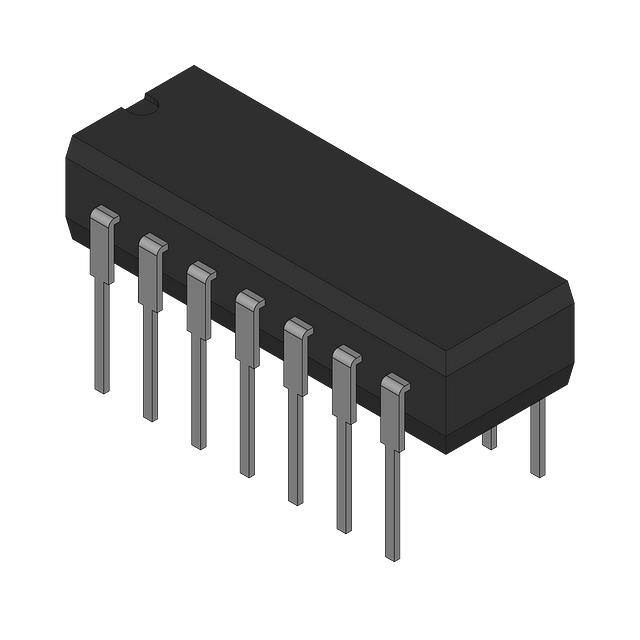
14-Pin DIP/SO
DS010547-1
Top View
Ordering Information
Package
Temperature Range
Military
14-Pin
Industrial
LPC660AMD
NSC
Drawing
Transport
Media
D14E
Rail
Side Brazed
Ceramic DIP
14-Pin
LPC660AIM
Small Outline
or LPC660IM
14-Pin
LPC660AIN
Molded DIP
or LPC660IN
14-Pin
LPC660AMJ/883
M14A
Rail
Tape and Reel
N14A
Rail
J14A
Rail
Ceramic DIP
15
www.national.com
�LPC660
Physical Dimensions
inches (millimeters) unless otherwise noted
14-Pin Cavity Dual-In-Line Package (D)
Order Number LPC660AMD
NS Package Number D14E
14-Lead Ceramic Dual-In-Line Package (J)
Order Number LPC660AMJ/883
NS Package Number J14A
www.national.com
16
�LPC660
Physical Dimensions
inches (millimeters) unless otherwise noted (Continued)
14-Pin Small Outline Molded Package (M)
Order Number LPC660AIM or LPC660IM
NS Package Number M14A
14-Pin Molded Dual-In-Line Package (N)
Order Number LPC660AIN or LPC660IN
NS Package Number N14A
17
www.national.com
�LPC660 Low Power CMOS Quad Operational Amplifier
Notes
LIFE SUPPORT POLICY
NATIONAL’S PRODUCTS ARE NOT AUTHORIZED FOR USE AS CRITICAL COMPONENTS IN LIFE SUPPORT
DEVICES OR SYSTEMS WITHOUT THE EXPRESS WRITTEN APPROVAL OF THE PRESIDENT AND GENERAL
COUNSEL OF NATIONAL SEMICONDUCTOR CORPORATION. As used herein:
1. Life support devices or systems are devices or
systems which, (a) are intended for surgical implant
into the body, or (b) support or sustain life, and
whose failure to perform when properly used in
accordance with instructions for use provided in the
labeling, can be reasonably expected to result in a
significant injury to the user.
National Semiconductor
Corporation
Americas
Tel: 1-800-272-9959
Fax: 1-800-737-7018
Email: support@nsc.com
www.national.com
National Semiconductor
Europe
Fax: +49 (0) 180-530 85 86
Email: europe.support@nsc.com
Deutsch Tel: +49 (0) 69 9508 6208
English Tel: +44 (0) 870 24 0 2171
Français Tel: +33 (0) 1 41 91 8790
2. A critical component is any component of a life
support device or system whose failure to perform
can be reasonably expected to cause the failure of
the life support device or system, or to affect its
safety or effectiveness.
National Semiconductor
Asia Pacific Customer
Response Group
Tel: 65-2544466
Fax: 65-2504466
Email: ap.support@nsc.com
National Semiconductor
Japan Ltd.
Tel: 81-3-5639-7560
Fax: 81-3-5639-7507
National does not assume any responsibility for use of any circuitry described, no circuit patent licenses are implied and National reserves the right at any time without notice to change said circuitry and specifications.
�National P/N LPC660 - Low Power CMOS Quad Operational Amplifier
See A/D Converters
Products
Products > Analog - Amplifiers > Operational Amplifiers > Low Power > LPC660
LPC660 Product Folder
Low Power CMOS Quad Operational Amplifier
Generic P/N 660
General
Description
Features
Package
& Models
Datasheet
Parametric Table
Samples
& Pricing
Design
Tools
Application
Notes
Parametric Table
Channels (Channels)
4
Maximum Supply Voltage (Volt)
15
Input Output Type
Vcm to V-, R-R Out
Offset Voltage, Max (mV)
3, 6
Bandwidth, typ (MHz)
.35
Input Bias Current, Temp Max (nA)
.0040
Slew Rate, typ (Volts/usec)
.11
Output Current, typ (mA)
21
Supply Current per Channel, typ (mA) .04
Voltage Noise, typ (nV/Hz)
42
Minimum Supply Voltage (Volt)
Shut down
No
Special Features
-
5
Datasheet
Size in
Date
Kbytes
Title
LPC660 Low Power CMOS Quad Operational Amplifier
LPC660 Low Power CMOS Quad Operational Amplifier
(JAPANESE)
View Online Download
7625
Mar- View Online
Kbytes
01
Download
475
Kbytes
Download
View Online
Receive via
Email
Receive via
Email
Receive via
Email
If you have trouble printing or viewing PDF file(s), see Printing Problems.
Package Availability, Models, Samples & Pricing
Part
Number
LPC660AIM
Package
Models
Status
Type
SOIC
NARROW
Pins MSL
14
MSL
SPICE
Budgetary
Samples &
Pricing
Electronic
$US
Orders
IBIS
Qty
each
Full
LPC660A.MOD N/A
production
Samples
Buy Now
1K+ $1.5000
Std
Pack
Size
Package
Marking
rail
of
55
[logo]¢U¢Z¢2¢T
LPC660AIM
file:///H|/imaging/BITTING/cpl/20020808_1/08062002_10/NATL/08062002_HTML/LPC660.html (1 of 3) [09-Aug-2002 9:44:52 AM]
�National P/N LPC660 - Low Power CMOS Quad Operational Amplifier
LPC660IM
SOIC
NARROW
14
MSL
Full
production
LPC660AIMX
SOIC
NARROW
14
MSL
Full
LPC660A.MOD N/A
production
LPC660IMX
SOIC
NARROW
14
MSL
Full
production
N/A
N/A
Full
production
N/A
N/A
LPC660 MDC
Die
N/A
N/A
24 Hour
Samples
Buy Now
Buy Now
Buy Now
Samples
1K+ $1.2000
rail
of
55
[logo]¢U¢Z¢2¢T
LPC660IM
1K+ $1.5000
reel
[logo]¢U¢Z¢2¢T
of
LPC660AIM
2500
1K+ $1.2000
reel
[logo]¢U¢Z¢2¢T
of
LPC660IM
2500
tray
of
N/A
General Description
The LPC660 CMOS Quad operational amplifier is ideal for operation from a single supply. It features a wide
range of operating voltages from +5V to +15V and features rail-to-rail output swing in addition to an input
common-mode range that includes ground. Performance limitations that have plagued CMOS amplifiers in
the past are not a problem with this design. Input VOS, drift, and broadband noise as well as voltage gain
(into 100 k and 5 k ) are all equal to or better than widely accepted bipolar equivalents, while the power
supply requirement is typically less than 1 mW.
This chip is built with National's advanced Double-Poly Silicon-Gate CMOS process.
See the LPC662 datasheet for a Dual CMOS operational amplifier and LPC661 datasheet for a single CMOS
operational amplifier with these same features.
Features
Rail-to-rail output swing
Micropower operation:
Specified for 100 k
and 5 k
(1 mW)
loads
High voltage gain:
Low input offset voltage:
Low offset voltage drift:
Ultra low input bias current:
120 dB
3 mV
1.3 µV/°C
2 fA
Input common-mode includes VOperation range from +5V to +15V
Low distortion:
Slew rate:
0.01% at 1 kHz
0.11 V/µs
Full military temp. range available
Applications
file:///H|/imaging/BITTING/cpl/20020808_1/08062002_10/NATL/08062002_HTML/LPC660.html (2 of 3) [09-Aug-2002 9:44:52 AM]
-
�National P/N LPC660 - Low Power CMOS Quad Operational Amplifier
●
●
●
●
●
●
●
High-impedance buffer
Precision current-to-voltage converter
Long-term integrator
High-impedance preamplifier
Active filter
Sample-and-Hold circuit
Peak detector
Design Tools
Title
Size in Kbytes Date
Amplifiers Selection Guide
software for Windows
7 Kbytes
View Online Download Receive via Email
12-Jun-2002 View
If you have trouble printing or viewing PDF file(s), see Printing Problems.
Application Notes
Title
Size in Kbytes Date
AN-856: A SPICE Compatible
Macromodel for CMOS Operational
Amplifiers
105 Kbytes
View Online Download Receive via Email
5-Aug-95 View Online
Download
Receive via Email
If you have trouble printing or viewing PDF file(s), see Printing Problems.
[Information as of 5-Aug-2002]
Search
Design
Purchasing
Quality
Company
Home
About Languages . Website Guide . About "Cookies" . National is QS 9000 Certified . Privacy/Security Statement .
Contact Us . Site Terms & Conditions of Use . Copyright 2002 © National Semiconductor Corporation . My Preferences .
Feedback
file:///H|/imaging/BITTING/cpl/20020808_1/08062002_10/NATL/08062002_HTML/LPC660.html (3 of 3) [09-Aug-2002 9:44:52 AM]
�