TI Designs
Ultralow Power Multi-sensor Data Logger with NFC
Interface Reference Design
Design Overview
Design Features
TIDA-00524 provides a complete reference design
for asset tracking and cold chain data logging with
over 5 year battery life and a simple NFC (Near Field
Communication) interface for configuration and read
back. For maximum flexibility, the system offers the
choice of multiple sensor configurations to monitor
temperature (TMP112), ambient light (OPT3001),
and/or humidity (HDC1000).
NFC is provided by
TI’s RF430CL331H and up to 64KB of non-volatile
FRAM memory is available with the MSP430FR5969
MCU.
Design Resources
TIDA-00524
Design Folder
RF430CL331H
Product Folder
MSP430FR5969IRGZ
Product Folder
TMP112
Product Folder
HDC1000
Product Folder
OPT3001
Product Folder
TPD1E10B06
Product Folder
> 5 Year Battery Life on a CR2032 coin cell
RF430CL33xH NFC Dynamic Tag Type 4B
Compliant Communication
NFC configuration and data read back
Multiple Sensor Options
- Temperature (TMP112)
- Temperature + Ambient Light
(OPT3001)
- Temperature+ Humidity (HDC1000)
- Temperature + Humidity + Ambient
Light
Up to 64KB of non-volatile FRAM memory
Data is Date/Time stamped using RTC
Featured Applications
Block Diagram
Asset and Cold Chain Tracking
Data Loggers
Intrusion and Tamper Detection
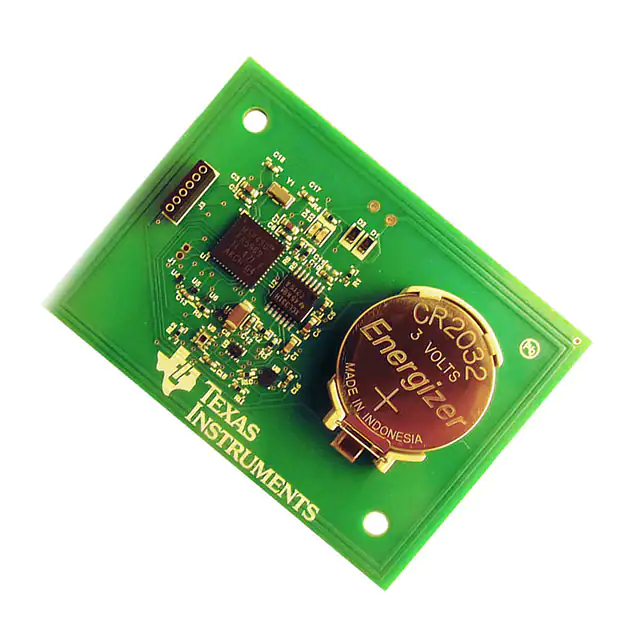
Board Image
Coin Cell Battery
(CR2032)
3.0 Volts
NFC
Enabled
Smartphone
Dynamic NFC
Transponder
(RF430CL331H)
I2C
MCU
I2C
Temperature
Sensor
(TMP112)
I2C
I2C
Humidity
Sensor
(HDC1000)
Light Sensor
(OPT3001)
TIDU821– September 2015Ultralow Power Multi-sensor Data Logger with NFC Interface Reference Design
Copyright © 2015, Texas Instruments Incorporated
1
�www.ti.com
1
Key System Specifications
PARAMETER
SPECIFICATIONs and FEATURES
DETAILS
Operating Power Supply Range
2.2 V to 3.6 V
Section 3.1
Input power source
CR2032 Lithium-ion coin cell battery
(3.0-V nominal voltage)
Section 4.1.7
Battery life
>5 years
Section 7.4
Operating temperature
Typical Read/Write Distance
RF Protocol
Data Rate
Typical Data Throughput
NFC Operating Frequency
Measurement Interval
Memory
Wired Interface from Transponder to
Application Processor
Form Factor
Sensors
–30°C to +60°C
(limited by CR2032 coin cell operating range)
Up to 5.5 cm
ISO14443B
106-848 kbps
Write 2.0 – 5.1 KBps
Read: 3.2 – 5.8 KBps
13.56 MHz
Configurable: 1 min to 720 min
3KB SRAM for NDEF Messages (RF430CL),
64 KB FRAM (MSP430FR)
Up to 1,853 samples
2
I C Compatible
58 mm x 43 mm square PCB
Sensor: Temperature (TMP112)
Operating Temperature Range: –40°C to +125°C
Temperature Accuracy: +/-0.5°C (typ)
Sensor: Humidity Sensor (HDC1000)
Operating Temperature Range: –20°C to +85°C
Relative Humidity Accuracy: ±3% RH (typ)
Sensor: Ambient Light Sensor (OPT3001)
Operating Temperature Range: –40°C to +85°C
Relative Accuracy between gain ranges: 0.2% (typ)
TIDU821 - September 2015Ultralow Power Multi-sensor Data Logger with NFC Interface Reference Design
Copyright © 2015, Texas Instruments Incorporated
Section 4.1.7
Section 7.2
Section 3.1.1
Section 7.3
Section 7.3
Section 3.1.1
Section 6.2
Section 6.2
Section 2
Section 5.1
Section 3.1.3
Section 3.1.4
Section 3.1.5
2
�www.ti.com
2
System Description
Cold chain management includes all of the means used to ensure a constant temperature for a product
that is not heat stable from the time it is manufactured or farmed until the time it is used. This includes
industries such as food, retail, medical, and pharmaceutical.
This design implements a cold chain monitoring system which measures temperature, light, and
humidity, then logs the sensor data to non-volatile(FRAM) memory. The design includes a Near Field
Communication (NFC) interface for wireless communication and is powered from a CR2032 coin cell
battery with a focus on low power to maximize the battery lifetime.
The MSP430FR5969 microcontroller communicates with all of the sensor devices via an I2C compatible
interface. The MSP430FR5969 also communicates with the RF430CL331H NFC transponder via this
interface. This board does not include any physical user interface, such as switches. An NFC enabled
smartphone can be used to send configuration to the board. This includes configuration of the RealTime Clock (RTC), both time and date, polling interval, Fahrenheit/Celsius, and sensor mode
(temperature (mode 0), temperature and light (mode 1), temperature and humidity (mode 2),
temperature, light, and humidity (mode 3). In addition, control commands to start measurements, stop
measurements, clear data, and reset can also be sent to the board via NFC.
To ensure the lowest power operation, the power rail for the MSP430 and all I2C compatible devices
has been separated. The power rail to the I2C compatible devices is controlled by the MSP430, so the
devices are only powered as needed during sensor measurements or RF communication. When idle,
the MSP430 is in low power mode and the power rail to the devices is off, resulting in current
consumption under 1 uA.
3
Block Diagram
Coin Cell Battery
(CR2032)
3.0 Volts
NFC
Enabled
Smartphone
Dynamic NFC
Transponder
(RF430CL331H)
I2C
MCU
I2C
Temperature
Sensor
(TMP112)
I2C
I2C
Humidity Sensor
(HDC1000)
Light Sensor
(OPT3001)
Figure 1: System Block Diagram
TIDU821 - September 2015Ultralow Power Multi-sensor Data Logger with NFC Interface Reference Design
Copyright © 2015, Texas Instruments Incorporated
3
�www.ti.com
3.1
Highlighted Products
The Ultralow Power Multi-sensor Data Logger with NFC Interface Reference Design features the
following devices:
RF430CL331H
- Dynamic NFC Interface Transponder
MSP430FR5969IRGZ
- FRAM Mixed Signal Microcontroller
TMP112
- High-Accuracy, Low-Power, Digital Temperature Sensor With I2C/SMBus™ Compatible
Interface
HDC1000
- Low Power, 3% Accuracy Digital Humidity Sensor
OPT3001
- Ambient Light Sensor
TPD1E10B06
- Single Channel ESD in 0402 package with 10 pF Capacitance and 6-V Breakdown
For more information on each of these devices, see the respective product folders at www.ti.com
TIDU821 - September 2015Ultralow Power Multi-sensor Data Logger with NFC Interface Reference Design
Copyright © 2015, Texas Instruments Incorporated
4
�www.ti.com
3.1.1 RF430CL331H Description
The TI Dynamic NFC/RFID Interface Transponder RF430CL331H is an NFC Tag Type 4 device that
combines a contactless NFC/RFID interface and a wired I2C compatible interface to connect the device
to a host. The NDEF message can be written and read from the integrated I 2C compatible serial
communication interface and can also be accessed and updated over a contactless interface using the
integrated ISO/IEC 14443 Type B compliant RF interface that supports up to 848 kbps.
The device requests responses to NFC Type 4 commands on demand from the host controller and
stores only a portion of the NDEF message in its buffer at any one time. This allows NDEF message
size to be limited only by the memory capacity of the host controller and specification limitations.
Support of read caching, prefetching, and write automatic acknowledgment features allows for greater
data throughput.
This device enables NFC connection handover for an alternative carrier like Bluetooth ®, Bluetooth ®
Low Energy (BLE), or Wi-Fi as an easy and intuitive pairing process or authentication process with only
a tap. As a general NFC interface, the RF430CL331H enables end equipment to communicate with the
fast growing infrastructure of NFC-enabled smart phones, tablets, and notebooks.
Figure 2: RF430CL331H Block Diagram
3.1.1.1 RF430CL331H Features
NFC Type 4B Tag Platform and ISO/IEC 14443B
I2C Interface to Write and Read NDEF Messages to Internal SRAM
3KB of SRAM for NDEF Message Buffer
Supports up to 847 kbps • Supports NDEF Messages Up To 64KB
TIDU821 - September 2015Ultralow Power Multi-sensor Data Logger with NFC Interface Reference Design
Copyright © 2015, Texas Instruments Incorporated
5
�www.ti.com
3.1.2 MSP430FR5969IRGZ Description
The MSP430™ ultra-low-power (ULP) FRAM platform combines uniquely embedded FRAM and a
holistic ultra-low-power system architecture, allowing innovators to increase performance at lowered
energy budgets. FRAM technology combines the speed, flexibility, and endurance of SRAM with the
stability and reliability of flash at much lower power. The MSP430 ULP FRAM portfolio consists of a
diverse set of devices featuring FRAM, the ULP 16-bit MSP430 CPU, and intelligent peripherals
targeted for various applications. The ULP architecture showcases seven low-power modes, optimized
to achieve extended battery life in energy-challenged applications.
Figure 3: MSP430FR5969 Block Diagram
3.1.2.1 MSP430FR5969IRGZ Features
•
•
•
Embedded Microcontroller
– 16-Bit RISC Architecture up to 16-MHz Clock
– Wide Supply Voltage Range (1.8 V to 3.6 V)
Optimized Ultralow-Power Modes
Ultralow-Power Ferroelectric RAM (FRAM)
– Up to 64KB Nonvolatile Memory
– Ultralow-Power Writes
– Fast Write at 125 ns Per Word (64KB in 4 ms)
– Unified Memory = Program + Data + Storage in one single space
– 1015 Write Cycle Endurance
– Radiation Resistant and Nonmagnetic
TIDU821 - September 2015Ultralow Power Multi-sensor Data Logger with NFC Interface Reference Design
Copyright © 2015, Texas Instruments Incorporated
6
�www.ti.com
•
•
•
•
•
•
•
•
•
•
•
•
•
Intelligent Digital Peripherals
– 32-Bit Hardware Multiplier (MPY)
– Three-Channel Internal DMA
– Real-Time Clock (RTC) With Calendar and Alarm Functions
– Five 16-Bit Timers With up to Seven Capture/Compare Registers Each
– 16-Bit Cyclic Redundancy Checker (CRC)
• High-Performance Analog
– 16-Channel Analog Comparator
– 14-Channel 12-Bit Analog-to-Digital Converter (ADC) with Internal Reference and Sampleand-Hold
200 ksps at 75-µA Consumption
Multifunction Input/Output Ports
– All Pins Support Capacitive Touch Capability With No Need for External Components
– Accessible Bit-, Byte-, and Word-Wise (in Pairs)
– Edge-Selectable Wake From LPM on All Ports
– Programmable Pullup and Pulldown on All Ports
Code Security and Encryption
– 128-Bit or 256-Bit AES Security Encryption and Decryption Coprocessor (MSP430FR59xx
Only)
– Random Number Seed for Random Number Generation Algorithms
Enhanced Serial Communication
– eUSCI_A0 and eUSCI_A1 Support
UART With Automatic Baud-Rate Detection
IrDA Encode and Decode
SPI at Rates up to 10 Mbps
– eUSCI_B0 Supports
I2C compatible interface with Multiple Slave Addressing
SPI at Rates up to 8 Mbps
– Hardware UART and I2C Bootstrap Loader (BSL)
Flexible Clock System
– Fixed-Frequency DCO With 10 Selectable Factory-Trimmed Frequencies
– Low-Power Low-Frequency Internal Clock Source (VLO)
– 32-kHz Crystals (LFXT)
– High-Frequency Crystals (HFXT)
Development Tools and Software
– Professional Development Environments
– Development Kit (MSP TS430RGZ48C)
For Complete Module Descriptions, see the SP430FR58xx, MSP430FR59xx, MSP430FR68xx, and
MSP430FR69xx Family User's Guide (SLAU367)
TIDU821 - September 2015Ultralow Power Multi-sensor Data Logger with NFC Interface Reference Design
Copyright © 2015, Texas Instruments Incorporated
7
�www.ti.com
3.1.3 TMP112 Description
The TMP112 device is a digital temperature sensor ideal for NTC/PTC thermistor replacement where
high accuracy is required. The device offers an accuracy of ±0.5°C without requiring calibration or
external component signal conditioning. IC temperature sensors are highly linear and do not require
complex calculations or lookup tables to derive the temperature. The calibration for improved accuracy
feature allows users to calibrate for accuracy as good as ±0.17°C. The on-chip 12-bit ADC offers
resolutions down to 0.0625°C.
The TMP112 device features SMBus™, two-wire and I2C interface compatibility, and allows up to four
devices on one bus. The device also features a SMBus alert function. The device is specified to
operate over supply voltages from 1.4 V to 3.6 V with the maximum quiescent current of 10 µA over the
full operating range.
The 1.6-mm × 1.6-mm SOT563 package is 68% smaller footprint than an SOT23 package. The
temperature sensor in the TMP112 device is the chip itself. Thermal paths run through the package
leads as well as the plastic package. The package leads provide the primary thermal path because of
the lower thermal resistance of the metal.
The TMP112 is ideal for temperature measurement in communication, computer, consumer,
environmental, industrial, and instrumentation applications. It is specified for operation over a
temperature range of –40°C to +125°C.
Figure 4 TMP112 Block Diagram
3.1.3.1 TMP112 Features
SOT563 Package (1.6 mm × 1.6 mm) is 68% smaller footprint than SOT23
Accuracy Without Calibration:
- 0.5°C (max) from 0°C to +65°C
- 1.0°C (max) from –40°C to +125°C
Low Quiescent Current:
- 10 µA Active (max), 1 µA Shutdown (max)
Supply Range: 1.4 V to 3.6 V
Resolution: 12 Bits
Digital Output: SMBus™, Two-Wire and I2C Interface Compatibility
TIDU821 - September 2015Ultralow Power Multi-sensor Data Logger with NFC Interface Reference Design
Copyright © 2015, Texas Instruments Incorporated
8
�www.ti.com
3.1.4 HDC1000 Description
The HDC1000 is a digital humidity sensor with an integrated temperature sensor that provides excellent
measurement accuracy at very low power. The device measures humidity based on a novel capacitive
sensor. The humidity and temperature sensors are factory calibrated. The innovative WLCSP (Wafer
Level Chip Scale Package) simplifies board design with the use of an ultra-compact package. The
HDC1000 is functional within the full –40°C to 125°C temperature range.
Figure 5: HDC1000 Block Diagram
3.1.4.1 HDC1000 Features
•
•
•
•
•
•
•
•
•
•
Relative humidity (RH) operating range 0% to 100%
14-bit measurement resolution
Relative humidity accuracy ±3%
Temperature range
– Operating –20°C to +85°C
– Functional –40°C to +125°C
Temperature accuracy ±0.2°C
200 nA sleep mode current
Average supply current:
– 820 nA at 1 sps, 11 bit RH measurement
– 1.2 µA at 1 sps, 11 bit RH and temperature measurement
Supply voltage 3 V to 5 V
Tiny 2 mm × 1.6 mm device footprint
I2C interface
TIDU821 - September 2015Ultralow Power Multi-sensor Data Logger with NFC Interface Reference Design
Copyright © 2015, Texas Instruments Incorporated
9
�www.ti.com
3.1.5 OPT3001 Description
The OPT3001 is a sensor that measures the intensity of visible light. The spectral response of the
sensor tightly matches the photonic response of the human eye and includes significant infrared
rejection. Measurements can be made from 0.01 lux up to 83k lux without manually selecting full-scale
ranges by using the built-in, full-scale setting feature. This capability allows light measurement over a
23-bit effective dynamic range.
The digital operation is flexible for system integration. Measurements can be either continuous or
single-shot. The control and interrupt system features autonomous operation, allowing the processor to
sleep while the sensor searches for appropriate wake-up events to report via the interrupt pin. The
digital output is reported over an I2C- and SMBus-compatible, two-wire serial interface.
The low power consumption and low power-supply voltage capability of the OPT3001 enhance the
battery life of battery-powered systems.
Figure 6: OPT3001 Block Diagram
3.1.5.1 OPT3001 Features
•
•
•
•
•
•
•
•
•
•
•
•
Precision Optical Filtering to Match Human Eye:
Rejects > 99% (typ) of IR
Automatic Full-Scale Setting Feature Simplifies Software and Ensures Proper Configuration
Measurements: 0.01 lux to 83k lux
23-Bit Effective Dynamic Range with Automatic Gain Ranging
12 Binary-Weighted Full-Scale Range Settings: < 0.2% (typ) Matching Between Ranges
Low Operating Current: 1.8 µA (typ)
Operating Temperature Range: –40°C to +85°C
Wide Power-Supply Range: 1.6 V to 3.6 V
5.5-V Tolerant I/O
Flexible Interrupt System
Small-Form Factor: 2.0 mm × 2.0 mm × 0.65 mm
TIDU821 - September 2015Ultralow Power Multi-sensor Data Logger with NFC Interface Reference Design
Copyright © 2015, Texas Instruments Incorporated
10
�www.ti.com
3.1.6 TPD1E10B06 Description
The TPD1E10B06 device is a single-channel electrostatic discharge (ESD) transient voltage
suppression (TVS) diode in a small 0402 package. This TVS protection product offers ±30-kV contact
ESD, ±30-kV IEC air-gap protection, and has an ESD clamp circuit with a back-to-back TVS diode for
bipolar or bidirectional signal support.
Figure 7: TPD1E10B06 Block Diagram
3.1.7 TPD1E10B06 Features
•
•
•
•
•
•
•
•
•
•
Provides System Level ESD Protection for Low-voltage IO Interface
IEC 61000-4-2 Level 4
– ±30 kV (Air-Gap Discharge)
– ±30 kV (Contact Discharge)
IEC 61000-4-5 (Surge): 6 A (8/20 µs)
IO Capacitance 12 pF (typ)
RDYN 0.4 Ω (typ)
DC Breakdown Voltage ±6 V (Min)
Ultra Low Leakage Current 100 nA (Max)
10 V Clamping Voltage (Max at IPP = 1 A)
Industrial Temperature Range: –40°C to +125°C
Space Saving 0402 Footprint (1.0 mm × 0.6 mm × 0.5 mm)
TIDU821 - September 2015Ultralow Power Multi-sensor Data Logger with NFC Interface Reference Design
Copyright © 2015, Texas Instruments Incorporated
11
�www.ti.com
4
4.1
System Design Theory
Component Selection
4.1.1 Dynamic Interface Transponder
The RF430CL331H Dynamic NFC Interface Transponder is an NFC Tag Type 4B device that combines
a wireless NFC interface and a wired I2C interface to connect the device to a host. The device utilizes a
3KB SRAM buffer to receive commands from an NFC enabled reader/writer and also communicate
back the response. The integrated ISO14443B-compliant RF interface supports data rates from 106
kbps to 848 kbps. The RF430CL331H was chosen to allow for a low cost, dual interface (wired and
wireless) transponder which allows for communication to/from a host controller. This functionality is not
possible with a standard passive NFC transponder (wireless only).
4.1.2 Microcontroller Selection
The MSP430 ultra-low-power (ULP) FRAM platform combines uniquely embedded FRAM and a holistic
ultra-low-power system architecture, allowing innovators to increase performance at lowered energy
budgets. FRAM technology combines the speed, flexibility, and endurance of SRAM with the stability
and reliability of flash at much lower power. The MSP430FR5969 was chosen for the large (64kB)
amount of non-volatile memory along with ultra-low power operation, which is especially important for
applications such as data loggers where the system is in low power mode a majority of the time.
4.1.3 Digital Temperature Sensor
The TMP112 digital temperature sensor device was chosen for this TI Design to provide high accuracy
temperature measurements, while requiring miniscule power and board space. The TMP112 device is a
digital output temperature sensor in a 1.6 mm x 1.6 mm footprint SOT563 package. It is specified for
operation over a temperature range of –40°C to +125°C and it offers an accuracy of ±0.5°C without
requiring calibration or external component signal conditioning. Its maximum quiescent current is 10 µA
over the full operating range.
4.1.4 Humidity Sensor
The HDC1000 humidity sensor device was chosen to enable humidity measurements in the Ultralow
Power Multi-sensor Data Logger with NFC Interface Reference Design. This humidity sensor is
functional within the full –40°C to +125°C temperature range. The sensor element of the HDC1000 is
placed on the bottom part of the device, which makes the HDC1000 robust against dirt, dust, and other
environmental contaminants.
4.1.5 Light Sensor
The OPT3001 light sensor device was chosen to enable ambient light measurements in the Ultralow
Power Multi-sensor Data Logger with NFC Interface Reference Design.
TIDU821 - September 2015Ultralow Power Multi-sensor Data Logger with NFC Interface Reference Design
Copyright © 2015, Texas Instruments Incorporated
12
�www.ti.com
4.1.6 ESD Protection
The TPD1E10B06 Single Channel ESD protection device was chosen to protect the Spy Bi-Wire (2wire JTAG) programming interface. The device offers over ±30 KV IEC air-gap, over ±30 KV contact
ESD protection, and has an ESD clamp circuit with a back-to-back diode for bipolar or bidirectional
signal support. The 10 pF line capacitance is suitable for a wide range of applications supporting data
rates up to 400 Mbps. The 0402 package is industry standard and convenient for component placement
in space saving applications. The TPD1E10B06 is characterized for operation over ambient air
temperature of –40°C to +125°C.
4.1.7 Coin Cell Battery
The CR2032 lithium-ion coin cell battery was chosen as the power source of this design due to its
ability of providing long shelf life, continuous voltage supply (220 mAh at 3 V) and its great availability
on the market. Also, the CR2032 is commonly used in small, low power applications like this data
logger due to its small form factor (20 mm diameter x 3.2 mm thickness) and low cost. The CR2032
operating temperature range is –30°C to +60°C. Among all the integrated circuits and electrical
components in the Ultralow Power Multi-sensor Data Logger with NFC Interface Reference Design
board the CR2032 have the narrower temperature range. Therefore, the specified operating
temperature range of the data loggers is –30°C to +60°C.
TIDU821 - September 2015Ultralow Power Multi-sensor Data Logger with NFC Interface Reference Design
Copyright © 2015, Texas Instruments Incorporated
13
�www.ti.com
5
5.1
Getting Started Hardware
Hardware Overview
The Ultralow Power Multi-sensor Data Logger with NFC Interface Reference Design is shown in Figure
8 Ultralow Power Multi-sensor Data Logger with NFC Interface Reference Design. This design is 59 mm x 43
mm and includes two mounting holes on opposing corners to allow for mounting the board in specific
test environments.
Figure 8 Ultralow Power Multi-sensor Data Logger with NFC Interface Reference Design
All components are located on the top side of the PCB. The antenna coil wraps around the edge and
uses both top and bottom layers. The board has been designed for use with a CR2032 battery with the
Battery holder (B1). J3 is used for programming and debug of the MSP430 microcontroller.
5.2
Programming the board
An MSP-FET must be used to program the Reference Design board. The appropriate connections
between the Reference Design hardware and the MSP-FET programming tool are shown in Table 1.
For convenience, the pinout diagram of the MSP-FET debugger is shown in Figure 9: MSP- FET JTAG
Connector Pinout. Once the electrical connections between the Reference Design board and the MSPFET are complete, then Code Composer Studio can be used to program the board.
Table 1: TIDA-00524 and MSP-FET JTAG Connector Pin Numbers and Names
TIDA-00524 J3 Pin
Number
1
2
3
4
5
6
TIDA-00524 J3 Pin
Name
NC
VCC
SBWTCK
SBWTDIO
GND
NC
MSP-FET Pin
Number
2
7
1
9
-
TIDU821 - September 2015Ultralow Power Multi-sensor Data Logger with NFC Interface Reference Design
Copyright © 2015, Texas Instruments Incorporated
MSP-FET Pin
Name
VCC_TOOL
TCK
TDO/TDI
GND
14
�www.ti.com
Figure 9: MSP- FET JTAG Connector Pinout
5.3
Configuring Reference Board using NFC enabled Phone/Tablet
The Data logger comes pre-programed and ready to be configured. Using a NFC enabled smart
phone, confirm that NFC is turned on in the settings. Next present the data logger to the back of the
phone. The welcome message, as shown in Figure 10: Welcome Message, should be read out and
displayed. The welcome message list default settings as well as all supported commands. This
message will always be displayed below all logged measurements for quick reference.
Figure 10: Welcome Message
TIDU821 - September 2015Ultralow Power Multi-sensor Data Logger with NFC Interface Reference Design
Copyright © 2015, Texas Instruments Incorporated
15
�www.ti.com
Configure the time, date, polling interval, and mode using the commands listed in Table 2. Once
configured, start the data logger. To read the logged measurements at any time, just present an NFC
enabled phone. Readings will appear as shown in Figure 11.
Table 2: Data Logger Commands
Control Commands
ST
SP
CD
RE
Configuration Commands
TI HH:MM:SS
DA MM/DD/YY
PI xxx
TM x
MO x
Description
Start data logging with current settings.
Stop/Pause data logging.
Clears data while keeping all settings.
Clears data and returns all settings to default.
Set Time in 24 hour format. Ex: “TI 14:30:00” (2:30 pm)
Set Date. Ex: “DA 09/01/15”
Set Polling interval in minutes. Ex: “PI 45”
Temperature Mode. Ex: “TM C” for Celsius
Set Data logging Mode. Ex: “MO 3”
Figure 11: Data Logged Measurements (Mode 3)
TIDU821 - September 2015Ultralow Power Multi-sensor Data Logger with NFC Interface Reference Design
Copyright © 2015, Texas Instruments Incorporated
16
�www.ti.com
6
6.1
Getting Started Firmware
High Level Controller Overview
Upon power up, the firmware runs a check to determine the previous state of the data logger. Since
our MSP430F5969 uses FRAM, which acts like non-volatile RAM, all previous states, settings, and
measurements are preserved. If the data logger has never been initialized, the welcome message is
written. This feature of FRAM also allows for easy detection of a previous power loss. If the firmware
determines that power was lost while logging, a warning message will be added. Time and date will be
reset because there is no way to determine the length of the power loss. The Controller state diagram
in Figure 12 shows the high level flow.
Power Up
Data logger
Memory
Initialized?
No
Yes
Data logger in
Reset State?
No
Data logger Init
Yes
Load Default Settings:
Mode: Temp Only
Temp Mode: Fahrenheit
Time: 12:00:00 AM
Date: 1/1/2015
Polling Interval: 10 minutes
Default State: Stopped
Power Lost State
Write power lost message
Time and Date Reset
Reset all data Pointers
Write welcome message to
Data logger memory
Wait for Command.
Command
Received?
No
Control
Commands
Configuration
Commands
Set Mode
MO x
RE
Reset
Restore default settings
Set Time
TI hh:mm:ss
ST
Start
Enable Data Logging
Set Date
DA mm:dd:yy
SP
Stop
Disable Data Logging
Set Polling Interval
1-720 minutes.
PI xxx
CD
Clear Data
Keeps all settings
Set Temperature Mode
Fahrenheit or Celsius
TM x
Process Command State
Figure 12: Controller State Diagram
TIDU821 - September 2015Ultralow Power Multi-sensor Data Logger with NFC Interface Reference Design
Copyright © 2015, Texas Instruments Incorporated
17
�www.ti.com
6.2
Data logger
The data logger is triggered by an alarm from the real-time clock (RTC). Once triggered, it checks if
there is still memory space available. If so, depending on the mode selected, it calls the respective
drivers for each sensor. These measurements are packaged along with a time stamp and stored in the
data logger memory block. The data logger state diagram is show in Figure 13. There is 46KB of data
logger memory space. Table 3 shows the number of measurements possible in each mode.
Wake from RTC
Alarm
Data logger
Memory Full?
Disable Data logging
Sleep
Data Logger
Mode
Mode 0
Mode 1
Mode 2
Mode 3
Get Temperature
Get Temperature
Get Temperature
Get Temperature
Get Lux
Get Humidity
Get Lux
Get Humidity
Store Sample in
Data logger Memory
Sleep
Figure 13: Data Logger State Diagram
Table 3: Number of measurements available in memory
Mode
Size
Number of samples
Notes
0
25 bytes
1853
-
1
36 bytes
1286
2
34 bytes
1362
Low lux measurements could adjust the
size down to 34 bytes
-
3
45 bytes
1029
Low lux measurements could adjust the
size down to 43 bytes
TIDU821 - September 2015Ultralow Power Multi-sensor Data Logger with NFC Interface Reference Design
Copyright © 2015, Texas Instruments Incorporated
18
�www.ti.com
6.3
NFC Overview
The NFC Forum defines a data format for NFC messages called NDEF (NFC Data Exchange Format).
Utilization of a common data format allows for all NFC compliant devices to exchange data in a “well
known” format. NDEF allows for many different record types ranging from simple text records, URL,
Vcard, and Bluetooth Connection Handover just to name a few. In this application, we are using simple
text records to display the measurements. Figure 14 shows an example of a NDEF tag application
mapping.
Figure 14: NDEF tag Application Mapping Example
There is a state machine in the NFC stack that emulates this NDEF memory structure. The
RF430CL331H generates requests for each file as required to respond to the NFC reader. The
RF430CL331H supports files up to 64KB. This enables streaming of all the measurements in a single
NDEF message, preventing the need to tap the phone more than once or needing custom applications.
TIDU821 - September 2015Ultralow Power Multi-sensor Data Logger with NFC Interface Reference Design
Copyright © 2015, Texas Instruments Incorporated
19
�www.ti.com
7
7.1
Test Data
Temperature Characterization
Figure 15 shows the test setup for temperature testing. For this test, two data loggers were placed in a
Delta 9064 Environmental Test Chamber. Data logger # 1 was configured to log every 5 minutes, in
Temperature reading mode only (Mode 0). Data logger #2 was configured to log every 5 minutes, in
Temperature + Humidity + Light Mode (Mode 3). Data logger #2 was added to the test to confirm that
the accuracy of TMP112 readings won’t be affected when other sensors are in use at the same time.
Figure 15: Delta 9064 Environmental Test Chamber and Test Setup
Two tests were performed. For test #1, the test chamber was programmed to do temperature steps
every 10°C, from 0°C to 60°C. For test #2, the chamber was programed to decrease from 0°C to -30°C
at a -10°C step rate. Table 4 shows the data logger readings for these two tests. These readings
confirm the accuracy of TMP112 in this design is around +/- 0.2°C (typ), +/- 1.0°C (max), without
calibration.
Table 4: TMP112 Temperature Reading Results
Oven Temperature (°C)
-30.0
-20.0
-10.0
0.0
10.0
20.0
30.0
40.0
50.0
60.0
TMP112 Temperature (°C)
Data logger #1
-30.0
-20.1
-10.0
0.0
09.8
19.8
29.6
39.7
49.7
59.2
TMP112 Temperature (°C)
Data logger #2
-29.6
-19.8
-9.6
0.0
10.0
20.0
29.8
39.8
49.8
59.0
TIDU821 - September 2015Ultralow Power Multi-sensor Data Logger with NFC Interface Reference Design
Copyright © 2015, Texas Instruments Incorporated
20
�www.ti.com
7.2
Read/Write Distance
Table 5 shows the measured communication range with some common NFC enabled phone/tablet
devices. This data assumes a parallel orientation between the reader antenna and the tag antenna
which provides the maximum magnetic field coupling.
Table 5: Communication Range
Device
Nexus 4
Nexus 5
Nexus 10
7.3
Communication Range
4.5 cm
4.5 cm
5.5 cm
Data Throughput
Data throughput varies based on the NFC reader/writer implementation of each tested device. The
conditions for the data throughput testing are listed in Table 6 along with the test results for several
NFC compliant devices.
• Data Rate: 106 kbps
• Payload size: 24 KBytes
• Start/End Time marks: Req B command / Deselect response
Table 6: Data Throughput
Device
Nexus 4
Nexus 5
Nexus 10
Write Throughput
4.6 KBps
3.1 KBps
5.1 KBps
Read Throughput
4.8 KBps
3.3 KBps
5.8 KBps
TIDU821 - September 2015Ultralow Power Multi-sensor Data Logger with NFC Interface Reference Design
Copyright © 2015, Texas Instruments Incorporated
21
�www.ti.com
7.4
Battery Life
In order to achieve very long battery life, there are some parameters which must be considered. The
main parameters that affect the estimated battery life of the entire system are:
• Capacity rating of the battery in milliamp-hours (mAh)
• Average off-state current consumption (nA)
• Off-state durations
• Average on-state current consumption (mA)
• On-state durations
( 1 ) describes the estimated battery life of the system in units most convenient to this TI Design:
𝐵𝑎𝑡𝑡𝑒𝑟𝑦 𝑙𝑖𝑓𝑒 (𝑦𝑒𝑎𝑟𝑠) =
𝐵𝑎𝑡𝑡𝑒𝑟𝑦 𝑐𝑎𝑝𝑎𝑐𝑖𝑡𝑦(𝑚𝐴ℎ)
1 𝑦𝑒𝑎𝑟
×
× 85% 𝑑𝑒𝑟𝑎𝑡𝑖𝑛𝑔 𝑓𝑎𝑐𝑡𝑜𝑟
𝐼𝑜𝑛 (𝑚𝐴) × 𝑡𝑜𝑛 (𝑠) + 𝐼𝑜𝑓𝑓 (𝑛𝐴) × 𝑡𝑜𝑓𝑓 (𝑠) × 10−6
8760 ℎ𝑜𝑢𝑟𝑠
(𝑡𝑜𝑛 (𝑠) + 𝑡𝑜𝑓𝑓 (𝑠))
(1)
Figure 16 can be used to estimate the CR2032 battery life of the Ultralow power Multi-sensor Data
Logger with NFC Interface Reference Design on every mode.
Figure 16: Battery Life Estimation
TIDU821 - September 2015Ultralow Power Multi-sensor Data Logger with NFC Interface Reference Design
Copyright © 2015, Texas Instruments Incorporated
22
�www.ti.com
7.5
Antenna Characteristics
Figure 17 shows the resonant frequency measurement of this reference board. Antenna inductance
and resulting Q value calculations are also shown in Figure 18. Antenna tuning is necessary in order to
keep the antenna resonant at or very close to the NFC operating frequency of 13.56 MHz to maximize
data and power transfer. For further information regarding antenna tuning, see SLOA197.
Figure 17: Resonant Frequency
Inductance (L) = 1.92uH
BW = f2 - f1
Q=
Q=
𝑓𝑟𝑒𝑞
𝐵𝑊
13.66𝑀𝐻𝑧
448.9𝑘𝐻𝑧
Q = 30.4
Figure 18: Q value Calculation
TIDU821 - September 2015Ultralow Power Multi-sensor Data Logger with NFC Interface Reference Design
Copyright © 2015, Texas Instruments Incorporated
23
�www.ti.com
8
8.1
Design Files
Schematics
To download the Schematics for each board, see the design files at http://www.ti.com/tool/TIDA-00524
Figure 19: Ultra Low Power Multi-sensor Data Logger with NFC Interface Schematic
TIDU821 - September 2015Ultralow Power Multi-sensor Data Logger with NFC Interface Reference Design
Copyright © 2015, Texas Instruments Incorporated
24
�www.ti.com
8.2
Layout Guidelines
To enable a low cost PCB, this design uses a 2-layer PCB. The bottom layer contains a ground pour
and signal routing and the top layer contains signal routing only. In order to maximize the RF
performance and reduce the PCB dimensions, the antenna coil is wrapped around the outside edge of
the PCB and components are placed in the middle of the PCB. It is important to provide spacing
between the antenna coil and any large metallic components such as batteries or ground pours.
For all of the TI products used in this TI Design, ensure that care is taken to adhere to the layout
guidelines given in the respective datasheets.
8.3
Bill of Materials
To download the Bill of Materials for each board, see the design files at http://www.ti.com/tool/TIDA00524
8.3.1 Layout Prints
To download the Layout Prints for each board, see the design files at http://www.ti.com/tool/TIDA00524
8.4
Altium Project
To download the Altium project files for each board, see the design files at http://www.ti.com/tool/TIDA00524
8.5
Gerber files
To download the Gerber files for each board, see the design files at http://www.ti.com/tool/TIDA-00524
8.6
Assembly Drawings
To download the Assembly Drawings for each board, see the design files at
http://www.ti.com/tool/TIDA-00524
9
Software Files
To download the software files for this reference design, please see the link at
http://www.ti.com/tool/TIDA-00524
TIDU821 - September 2015Ultralow Power Multi-sensor Data Logger with NFC Interface Reference Design
Copyright © 2015, Texas Instruments Incorporated
25
�www.ti.com
10 References
For additional references, see the following:
1. MSP430FR5969 Data Sheet, MSP430FR59xx Mixed-Signal Microcontrollers (SLAS704)
2. TMP112 Data Sheet, High-Accuracy, Low-Power, Digital Temperature Sensor With SMBus™ and
Two Wire Serial Interface in SOT563 (SBOS473)
3. TPD1E10B06 Data Sheet, Single Channel ESD Protection Device in 0402 Package (SLLSEB1)
4. HDC1000 Data Sheet, Low Power, 3% Accuracy Digital Humidity Sensor with Integrated
Temperature Sensor (SNAS643)
5. OPT3001 Data Sheet, Digital Ambient Light Sensor (ALS) with High Precision Human Eye
Response (SBOS681B)
6. NFC Forum Specifications: http://nfc-forum.org/our-work/specifications-and-application-documents/
11 About the Author
EDDIE LACOST is a NFC/RFID Applications Specialist at Texas Instruments where he is responsible
for developing reference design solutions and supporting customer applications for the NFC/RFID
market. Eddie brings to this role experience in low frequency and high frequency RFID/NFC, antenna
design, and mixed signal design. Eddie earned his Bachelor of Science (BS) in Technical Management
from DeVry University in Irving, TX.
JOHN CRUTCHFIELD is a NFC/RFID Applications Specialist at Texas Instruments where he is
responsible for developing reference software and supporting customer applications for the NFC/RFID
and Car Access markets. John brings to this role experience in low frequency and high frequency
RFID/NFC software, embedded design, and mixed signal design. John earned his Bachelor of Science
(BS) in Electrical Engineering from the University of Florida.
MAYRIM VERDEJO is an Applications Engineer at Texas Instruments (TI). She assists customers in
designing TI temperature sensors into end products which require precise temperature measurement.
To accelerate engineer’s time-to-market, she develops evaluation boards and demos showcasing TI
temperature sensors. Mayrim responds to technical inquiries on E2E and directly supports customers in
debugging technical issues via phone, email and on-site visits. She compiles product information and
training material for customers and internal TI staff which involves writing reference designs,
applications notes and product presentation slides. Mayrim graduated from the University of Puerto
Rico, Mayagüez, where she earned a Bachelor of Science in Electrical Engineering.
TIDU821 - September 2015Ultralow Power Multi-sensor Data Logger with NFC Interface Reference Design
Copyright © 2015, Texas Instruments Incorporated
26
�IMPORTANT NOTICE FOR TI REFERENCE DESIGNS
Texas Instruments Incorporated ("TI") reference designs are solely intended to assist designers (“Buyers”) who are developing systems that
incorporate TI semiconductor products (also referred to herein as “components”). Buyer understands and agrees that Buyer remains
responsible for using its independent analysis, evaluation and judgment in designing Buyer’s systems and products.
TI reference designs have been created using standard laboratory conditions and engineering practices. TI has not conducted any
testing other than that specifically described in the published documentation for a particular reference design. TI may make
corrections, enhancements, improvements and other changes to its reference designs.
Buyers are authorized to use TI reference designs with the TI component(s) identified in each particular reference design and to modify the
reference design in the development of their end products. HOWEVER, NO OTHER LICENSE, EXPRESS OR IMPLIED, BY ESTOPPEL
OR OTHERWISE TO ANY OTHER TI INTELLECTUAL PROPERTY RIGHT, AND NO LICENSE TO ANY THIRD PARTY TECHNOLOGY
OR INTELLECTUAL PROPERTY RIGHT, IS GRANTED HEREIN, including but not limited to any patent right, copyright, mask work right,
or other intellectual property right relating to any combination, machine, or process in which TI components or services are used.
Information published by TI regarding third-party products or services does not constitute a license to use such products or services, or a
warranty or endorsement thereof. Use of such information may require a license from a third party under the patents or other intellectual
property of the third party, or a license from TI under the patents or other intellectual property of TI.
TI REFERENCE DESIGNS ARE PROVIDED "AS IS". TI MAKES NO WARRANTIES OR REPRESENTATIONS WITH REGARD TO THE
REFERENCE DESIGNS OR USE OF THE REFERENCE DESIGNS, EXPRESS, IMPLIED OR STATUTORY, INCLUDING ACCURACY OR
COMPLETENESS. TI DISCLAIMS ANY WARRANTY OF TITLE AND ANY IMPLIED WARRANTIES OF MERCHANTABILITY, FITNESS
FOR A PARTICULAR PURPOSE, QUIET ENJOYMENT, QUIET POSSESSION, AND NON-INFRINGEMENT OF ANY THIRD PARTY
INTELLECTUAL PROPERTY RIGHTS WITH REGARD TO TI REFERENCE DESIGNS OR USE THEREOF. TI SHALL NOT BE LIABLE
FOR AND SHALL NOT DEFEND OR INDEMNIFY BUYERS AGAINST ANY THIRD PARTY INFRINGEMENT CLAIM THAT RELATES TO
OR IS BASED ON A COMBINATION OF COMPONENTS PROVIDED IN A TI REFERENCE DESIGN. IN NO EVENT SHALL TI BE
LIABLE FOR ANY ACTUAL, SPECIAL, INCIDENTAL, CONSEQUENTIAL OR INDIRECT DAMAGES, HOWEVER CAUSED, ON ANY
THEORY OF LIABILITY AND WHETHER OR NOT TI HAS BEEN ADVISED OF THE POSSIBILITY OF SUCH DAMAGES, ARISING IN
ANY WAY OUT OF TI REFERENCE DESIGNS OR BUYER’S USE OF TI REFERENCE DESIGNS.
TI reserves the right to make corrections, enhancements, improvements and other changes to its semiconductor products and services per
JESD46, latest issue, and to discontinue any product or service per JESD48, latest issue. Buyers should obtain the latest relevant
information before placing orders and should verify that such information is current and complete. All semiconductor products are sold
subject to TI’s terms and conditions of sale supplied at the time of order acknowledgment.
TI warrants performance of its components to the specifications applicable at the time of sale, in accordance with the warranty in TI’s terms
and conditions of sale of semiconductor products. Testing and other quality control techniques for TI components are used to the extent TI
deems necessary to support this warranty. Except where mandated by applicable law, testing of all parameters of each component is not
necessarily performed.
TI assumes no liability for applications assistance or the design of Buyers’ products. Buyers are responsible for their products and
applications using TI components. To minimize the risks associated with Buyers’ products and applications, Buyers should provide
adequate design and operating safeguards.
Reproduction of significant portions of TI information in TI data books, data sheets or reference designs is permissible only if reproduction is
without alteration and is accompanied by all associated warranties, conditions, limitations, and notices. TI is not responsible or liable for
such altered documentation. Information of third parties may be subject to additional restrictions.
Buyer acknowledges and agrees that it is solely responsible for compliance with all legal, regulatory and safety-related requirements
concerning its products, and any use of TI components in its applications, notwithstanding any applications-related information or support
that may be provided by TI. Buyer represents and agrees that it has all the necessary expertise to create and implement safeguards that
anticipate dangerous failures, monitor failures and their consequences, lessen the likelihood of dangerous failures and take appropriate
remedial actions. Buyer will fully indemnify TI and its representatives against any damages arising out of the use of any TI components in
Buyer’s safety-critical applications.
In some cases, TI components may be promoted specifically to facilitate safety-related applications. With such components, TI’s goal is to
help enable customers to design and create their own end-product solutions that meet applicable functional safety standards and
requirements. Nonetheless, such components are subject to these terms.
No TI components are authorized for use in FDA Class III (or similar life-critical medical equipment) unless authorized officers of the parties
have executed an agreement specifically governing such use.
Only those TI components that TI has specifically designated as military grade or “enhanced plastic” are designed and intended for use in
military/aerospace applications or environments. Buyer acknowledges and agrees that any military or aerospace use of TI components that
have not been so designated is solely at Buyer's risk, and Buyer is solely responsible for compliance with all legal and regulatory
requirements in connection with such use.
TI has specifically designated certain components as meeting ISO/TS16949 requirements, mainly for automotive use. In any case of use of
non-designated products, TI will not be responsible for any failure to meet ISO/TS16949.IMPORTANT NOTICE
Mailing Address: Texas Instruments, Post Office Box 655303, Dallas, Texas 75265
Copyright © 2015, Texas Instruments Incorporated
�