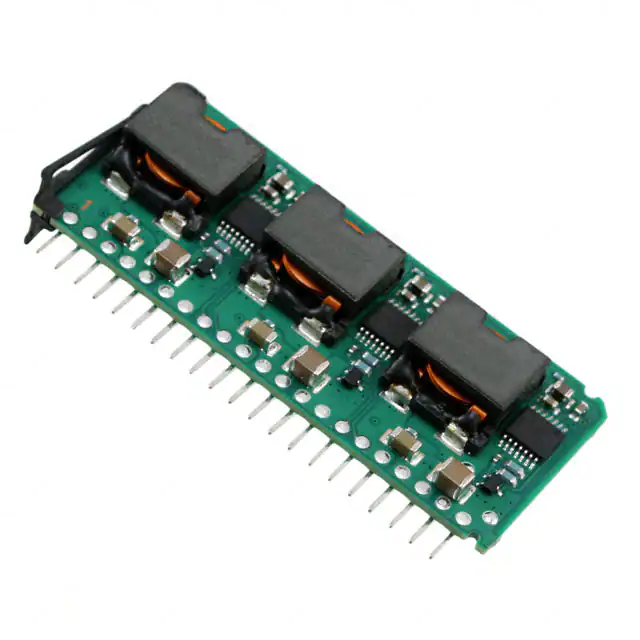
PTV08T250W
www.ti.com .......................................................................................................................................... SLTS260E – OCTOBER 2005 – REVISED NOVEMBER 2008
50-A, 8-V to 14-V INPUT, NON-ISOLATED, WIDE-OUTPUT ADJUST,
VERTICAL POWER MODULE w/ TurboTrans™ TECHNOLOGY
FEATURES
1
•
•
•
•
•
•
•
2
•
•
•
•
•
50-A Output Current
8-V to 14-V Input Voltage
Wide-Output Voltage Adjust (0.8 V to 3.6 V)
Efficiencies up to 95%
On/Off Inhibit
Differential Output Sense
Output Overcurrent Protection
(Nonlatching, Auto-Reset)
Overtemperature Protection
Start Up Into Output Prebias
Programmable Undervoltage Lockout (UVLO)
Safety Agency Approvals: (Pending)
UL/IEC/CSA-C22.2 60950-1
Operating Temperature: –40°C to 85°C
•
•
•
•
TurboTrans™Technology
Designed to meet ultra fast transient
requirements up to 300A/µs
Multi-Phase, Switch-Mode Topology
AutoTrack™ Sequencing
APPLICATIONS
•
Advanced Computing and Server Applications
DESCRIPTION
The PTV08T250W is a high-performance 50-A rated, non-isolated, vertical power module which uses a
multi-phase switched-mode topology. This provides a small, ready-to-use module that can power the most
densely populated multiprocessor systems. The PTV08T250W is produced in a 21-pin, single in-line pin (SIP)
package. The SIP footprint minimizes board space, and offers an alternate package option for space conscious
applications. The modules use double-sided surface mount construction to provide a compact design.
Operating from an input voltage range of 8 V to 14 V, the PTV08T250W requires a single resistor to set the
output voltage to any value over the range, 0.8 V to 3.6 V. The wide input voltage range makes the
PTV08T250W suitable for advanced computing and server applications that use a loosely regulated 12-V
intermediate distribution bus.
A new feature included in this 2nd generation of PTH and PTV modules is TurboTrans™ technology. TurboTrans
allows the transient response of the regulator to be optimized externally, resulting in a reduction of output voltage
deviation following a load transient and a reduction in required output capacitance. This feature also offers
enhanced stability when used with ultra-low ESR output capacitors.
The PTV08T250W incorporates a comprehensive list of standard features. They include on/off inhibit, a
differential remote output voltage sense which ensures tight load regulation, and an output overcurrent and
overtemperature shutdown to protect against load faults. A programmable undervoltage lockout allows the
turn-on and turn-off voltage thresholds to be customized. AutoTrack™ sequencing is a popular feature which
greatly simplifies the simultaneous power-up and power-down of multiple modules in a power system by allowing
the outputs to track a common voltage.
1
2
Please be aware that an important notice concerning availability, standard warranty, and use in critical applications of Texas
Instruments semiconductor products and disclaimers thereto appears at the end of this data sheet.
TurboTrans, AutoTrack, TMS320 are trademarks of Texas Instruments.
PRODUCTION DATA information is current as of publication date.
Products conform to specifications per the terms of the Texas
Instruments standard warranty. Production processing does not
necessarily include testing of all parameters.
Copyright © 2005–2008, Texas Instruments Incorporated
�PTV08T250W
SLTS260E – OCTOBER 2005 – REVISED NOVEMBER 2008 .......................................................................................................................................... www.ti.com
These devices have limited built-in ESD protection. The leads should be shorted together or the device placed in conductive foam
during storage or handling to prevent electrostatic damage to the MOS gates.
STANDARD APPLICATION
AutoTrack
TurboTrans
15
9
AutoTrack
TurboTrans
+Sense 1
3
6,7
VI
13,14
20,21
VI
16 Inhibit/
Prog UVLO
GND
CI
560 µF
(Required)
VO
PTV08T250W
12 18 19
RTT
1%
0.05 W
(Optional)
–Sense
GND
4
5 11
+Sense
VO
10
17
2
VO Adj
8
CO
660 µF
(Required)
RSET
1%
0.05 W
COTT
(Optional)
L
O
A
D
–Sense
GND
A.
GND
RSET = Required to set the output voltage higher than the minimum value (see the electrical characteristic for values.)
ORDERING INFORMATION
For the most current package and ordering information, see the Package Option Addendum at the end of this datasheet, or see
the TI website at www.ti.com.
ABSOLUTE MAXIMUM RATINGS
over operating free-air temperature range (unless otherwise noted)
UNIT
Signal input voltages
Track control (pin 15)
TA
Operating temperature range over VI range
Twave
Wave solder
temperature
Tstg
Storage temperature
–40°C to 85°C
Surface temperature of module body or pins (5 seconds)
Mechanical shock
Per Mil-STD-883D, Method 2002.3, 1 msec, Sine, mounted
Mechanical vibration
Mil-STD-883D, Method 2007.2, 20–2000 Hz
Flammability
260°C
–55°C to 125°C
Weight
2
–0.3 V to VI + 0.3 V
500 G
15 G
16.6 grams
Meets UL94V-O
Submit Documentation Feedback
Copyright © 2005–2008, Texas Instruments Incorporated
Product Folder Link(s): PTV08T250W
�PTV08T250W
www.ti.com .......................................................................................................................................... SLTS260E – OCTOBER 2005 – REVISED NOVEMBER 2008
ELECTRICAL CHARACTERISTICS
TA = 25°C, VI = 12 V, VO = 3.3 V, CI = 560 µF, CO = 660 F, and IO = IOmax (unless otherwise stated)
PARAMETER
TEST CONDITIONS
MIN
TYP
MAX
25°C, Natural Convection
0
50 (1)
60°C, 200 LFM airflow
0
48 (1)
UNIT
IO
Output current
8 V ≤ VI ≤ 14 V
VI
Input voltage range
Over IO range
VOtol
Set-point voltage tolerance
ΔRegtemp
Temperature variation
–40°C < TA < 85°C
±0.5
%VO
ΔRegline
Line regulation
Over VI range
±3
mV
ΔRegload
Load regulation
Over IO range
±3
ΔRegtot
Total output variation
Includes set-point, line, load, –40°C ≤ TA ≤ 85°C
ΔRegadj
Output adjust range
η
Efficiency
IOtrip
8
95
RSET = 6.98 kΩ, VO = 2.5 V
93
RSET = 13.0 kΩ, VO = 2 V
92
RSET = 16.9 kΩ, VO = 1.8 V
91
RSET = 27.4 kΩ, VO = 1.5 V
90
RSET = 53.6 kΩ, VO = 1.2 V
88
RSET = 113.0 kΩ, VO = 1 V
86
RSET = open circuit, VO = 0.8 V
82
All voltages
15
IO = 35 A
VO ripple (peak-to-peak)
20-MHz bandwidth
Overcurrent threshold
Reset, followed by auto-recovery
w/o TurboTrans
CO= 660 µF
ΔVtr
Transient response
ΔVtr
2.5 A/µs load step
50 to 100% IOmax
w/o TurboTrans
CO= 3300 µF, Type C
ttrTT
w/ TurboTrans
ΔVtrTT
CO= 3300 µF, Type C
IILtrack
Track input current (pin 15)
Pin to GND
dVtrack/dt
Track slew rate capability
CO ≤ CO(max)
UVLO
Undervoltage lockout
threshold
Pin 16 open
3.6
RSET = 2.49 kΩ, VO = 3.3 V
75
100
V
%VO
mV
±3 (2)
0.8
ttr
ttr
14
±2 (2)
A
%VO
V
%
mVPP
115
A
Recovery time
50
µs
VO over/undershoot
130
mV
Recovery time
50
µs
VO over/undershoot
85
mV
Recovery time
50
µs
VO over/undershoot
50
mV
–0.13
VI Increasing
7.5 (4)
VI Decreasing
6.5 (4)
(3)
mA
1
V/ms
7.8
V
Inhibit control (pin 16)
VIH
Input high voltage
Referenced to GND
2.5
Open (5)
VIL
Input low voltage
Referenced to GND
–0.2
0.5
IILinhibit
Input low current
Pin to GND
0.5
IIinh
Input standby current
Inhibit pin (16) to GND
35
fs
Switching frequency
Over VI and IO ranges
CI
External input capacitance
(1)
(2)
(3)
(4)
(5)
(6)
900
1050
V
mA
mA
1200
560 (6)
kHz
µF
See SOA curves or consult factory for appropriate derating.
The set-point voltage tolerance is affected by the tolerance of RSET. The stated limit is unconditionally met if RSET has a tolerance of 1%
with 100 ppm/°C or better temperature stability.
This control pin has an internal pull-up to 5 V. A small, low-leakage (1690 mA
16 × 15
No
TurboTrans
TurboTrans
(Cap
Type) (2)
1
≥ 2 (3)
N/R (4)
EEUFC1E102S
(3)
N/R (4)
EEUFC1E182
Vendor Part No.
FC (Radial)
25 V
1800
0.029Ω
2205 mA
16 × 20
1
≥1
FC(SMD)
25 V
2200
0.028Ω
>2490 mA
18 × 21,5
1
≥ 1 (3)
N/R (4)
EEVFC1E222N
FK(SMD)
25 V
1000
0.060Ω
1100 mA
12,5×13,5
1
≥ 2 (5)
N/R (4)
EEVFK1V102Q
PTB(SMD) Poly-Tant
6.3 V
330
0.025Ω
2600 mA
7,3x4,3x2.8
N/R (6)
2 ~ 4 (3)
C ≥ 2 (2)
LXZ, Aluminum (Radial)
25 V
680
0.068Ω
1050 mA
10 × 16
1
1 ~ 3 (3)
N/R (4)
PS, Poly-Alum(Radial)
16 V
330
0.014Ω
5060 mA
10 × 12,5
2
2~3
B ≥ 2 (2)
16PS330MJ12
PXA, Poly-Alum (SMD)
16 V
330
0.014Ω
5050 mA
10 × 12,2
2
2~3
B ≥ 2 (2)
PXA16VC331MJ12TP
(6)
(2)
United Chemi-Con
4PTB337MD6TER
LXZ25VB681M10X20LL
PS, Poly-Alum (Radial)
6.3 V
680
0.010Ω
5500 mA
10 × 12,5
N/R
1~2
C≥1
PXA, Poly-Alum (Radial)
6.3 V
680
0.010Ω
5500 mA
10 × 12,2
N/R (6)
1~2
C ≥ 1 (2)
Nichicon, Aluminum
25 V
560
0.060Ω
1060 mA
12,5 × 15
1
≥ 2 (3)
N/R (4)
UPM1E561MHH6
HD (Radial)
25 V
680
0.038Ω
1430 mA
10 × 16
1
≥ 2 (3)
N/R (4)
UHD1C681MHR
PM (Radial)
35 V
560
0.048Ω
1360 mA
16 × 15
1
≥ 2 (3)
N/R (4)
UPM1V561MHH6
Panasonic, Poly-Aluminum
2.0 V
390
0.005Ω
4000 mA
7,3×4,3×4,2
N/R (6)
N/R (6)
B ≥ 2 (2)
EEFSE0J391R (VO ≤ 1.6V) (7)
4V
680
0.015Ω
3900 mA
7,3 × 4,3
N/R (6)
1~3
C ≥ 1 (2)
4TPE680MF (VO ≤ 2.8V) (7)
7,3 × 4,3
N/R
(6)
1~2
B≥2
(2)
2R5TPE470M7 (VO ≤ 1.8V) (7)
N/R
(6)
B≥1
(2)
2R5TPD1000M5(VO ≤1.8V) (7)
6PS680MJ12
PXA6.3VC681MJ12TP
Sanyo
TPE, Poscap (SMD)
TPE Poscap(SMD)
TPD Poscap (SMD)
2.5 V
2.5 V
470
1000
0.007Ω
0.005Ω
4400 mA
6100 mA
7,3 × 4,3
1
SA, Os-Con (Radial)
16 V
1000
0.015Ω
>9700 mA
16 × 26
1
1~3
SP Oscon ( Radial)
10 V
470
0.015
>4500 mA
10 × 11,5
N/R (6)
1~3
C ≥ 2 (2)
10SP470M
SEPC, Os-Con (Radial)
16 V
330
0.016Ω
>4700 mA
10 × 12,7
2
2~3
B ≥ 2 (2)
16SVP330M
SVPA, Os-Con (SMD)
6.3 V
820
0.012Ω
4700 mA
8 × 11,9
N/R (6)
1 ~ 2 (3)
C ≥ 1 (2) (3)
6SVPC820M
AVX, Tantalum, Series III
TPM Multianode
6.3 V
6.3 V
680
470
0.035Ω
0.018Ω
>2400 mA
>3800 mA
7,3×4,3×4,1
7,3×4,3×4,1
N/R (6)
N/R (6)
2 ~ 7 (3)
2 ~ 3 (3)
N/R (4)
C ≥ 2 (2) (3)
TPSE477M010R0045
TPME687M006#0018
TPS Series III (SMD)
4V
1000
0.035Ω
2405
7,3×6,1x3.5
N/R (6)
2 ~ 7 (3)
N/R (4)
TPSV108K004R0035(VO≤2.2V) (7)
Kemet, Poly-Tantalum
6.3 V
470
0.040Ω
2000 mA
7,3×4,3×4
N/R (6)
2 ~ 7 (3)
N/R (4)
T520X337M010AS
T520 (SMD)
6.3 V
330
0.015Ω
>3800 mA
7,3×4,3×4
N/R (6)
2~3
B ≥ 2 (2)
T530X337M010AS
T530 (SMD)
4V
680
0.005Ω
7300 mA
7,3×4,3×4
N/R (6)
1
B ≥ 1 (2)
T530X687M004ASE005
(VO ≤ 3.5V) (7)
T530 (SMD)
2.5 V
1000
0.005Ω
7300 mA
7,3×4,3×4
N/R (6)
1
B ≥ 1 (2)
T530X108M2R5ASE005
(VO ≤ 2.0V) (7)
(1)
(2)
(3)
(4)
(5)
(6)
(7)
10
N/R
(4)
16SA1000M
Capacitor Supplier Verification
Please verify availability of capacitors identified in this table. Capacitor suppliers may recommend alternative part numbers because of
limited availability or obsolete products. In some instances, the capacitor product life cycle may be in decline and have short-term
consideration for obsolescence.
RoHS, Lead-free and Material Details
See the capacitor suppliers regarding material composition, RoHS status, lead-free status, and manufacturing process requirements.
Component designators or part number deviations can occur when material composition or soldering requirements are updated.
Required capacitors with TurboTrans. See the TransTrans Application information for Capacitor Selection
Capacitor Type Groups by ESR (Equivalent Series Resistance) :
a. Type A = (100 < capacitance × ESR ≤ 1000)
b. Type B = (1,000 < capacitance × ESR ≤ 5,000)
c. Type C = (5,001 < capacitance × ESR ≤ 10,000)
Total bulk nonceramic capacitors on the output bus with ESR of ≥ 15mΩ to ≤ 30mΩ requires an additional ≥ 200 µF of ceramic
capacitor.
Aluminum Electrolytic capacitor not recommended for the TurboTrans due to higher ESR × capacitance products. Aluminum and higher
ESR capacitors can be used in conjunction with lower ESR capacitance.
Output bulk capacitor's maximum ESR is ≥ 30 mΩ. Additional ceramic capacitance of ≥ 200 µF is required.
N/R – Not recommended. The voltage rating does not meet the minimum operating limits.
The voltage rating of this capacitor only allows it to be used for output voltage that is equal to or less than 80% of the working voltage.
Submit Documentation Feedback
Copyright © 2005–2008, Texas Instruments Incorporated
Product Folder Link(s): PTV08T250W
�PTV08T250W
www.ti.com .......................................................................................................................................... SLTS260E – OCTOBER 2005 – REVISED NOVEMBER 2008
Table 1. Input/Output Capacitors (continued)
Capacitor Characteristics
Capacitor Vendor,
Type Series (Style)
Working Value
Voltage
(µF)
Quantity
Max.
ESR
at 100
kHz
Max
Ripple
Current at
85°C
(Irms)
Physical
Size (mm)
Input
Bus
Output Bus
No
TurboTrans
TurboTrans
(Cap
Type) (2)
Vendor Part No.
Vishay-Sprague
594D, Tantalum (SMD)
6.3 V
1000
0.030Ω
2890 mA
7,2×5,7×4,1
N/R (8)
1~6
N/R (9)
594D108X06R3R2TR2T
94SA, Os-con (Radial)
16 V
1000
0.015Ω
9740 mA
16 × 25
1
1~3
N/R (9)
94SA108X0016HBP
94SVP Os-Con(SMD)
16 V
330
0.017Ω
>4500 mA
10 × 12,7
2
2~3
C ≥ 1 (10)
94SVP827X06R3F12
Kemet, Ceramic
16 V
10
0.002Ω
X5R (SMD)
6.3 V
47
0.002Ω
Murata, Ceramic
6.3 V
100
0.002Ω
X5R (SMD)
6.3 V
–
3225
1
≥1
(11)
A
(10)
C1210C106M4PAC
N/R (8)
≥ 1 (11)
A (10)
C1210C476K9PAC
N/R (8)
≥ 1 (11)
A (10)
GRM32ER60J107M
47
N/R (8)
≥ 1 (11)
A (10)
GRM32ER60J476M
25 V
22
1
≥ 1 (11)
A (10)
GRM32ER61E226K
16 V
10
1
≥ 1 (11)
A (10)
GRM32DR61C106K
TDK, Ceramic
6.3 V
100
N/R (8)
≥ 1 (11)
A (10)
C3225X5R0J107MT
X5R (SMD)
6.3 V
47
N/R (8)
≥ 1 (11)
A (10)
C3225X5R0J476MT
16 V
10
1
≥ 1 (11)
A (10)
C3225X5R1C106MT0
16 V
22
1
≥ 1 (11)
A (10)
C3225X5R1C226MT
0.002Ω
–
–
3225
3225
(8)
(9)
N/R – Not recommended. The voltage rating does not meet the minimum operating limits.
Aluminum Electrolytic capacitor not recommended for the TurboTrans due to higher ESR × capacitance products. Aluminum and higher
ESR capacitors can be used in conjunction with lower ESR capacitance.
(10) Required capacitors with TurboTrans. See the TransTrans Application information for Capacitor Selection
Capacitor Type Groups by ESR (Equivalent Series Resistance) :
a. Type A = (100 < capacitance × ESR ≤ 1000)
b. Type B = (1,000 < capacitance × ESR ≤ 5,000)
c. Type C = (5,001 < capacitance × ESR ≤ 10,000)
(11) Maximum ceramic capacitance on the output bus is ≤ 3000 µF. Any combination of the ceramic capacitor values is limited to 3000 µF
for non-TurboTrans applications. The total capacitance is limited to 14,000 µF which includes all ceramic and non-ceramic types.
Submit Documentation Feedback
Copyright © 2005–2008, Texas Instruments Incorporated
Product Folder Link(s): PTV08T250W
11
�PTV08T250W
SLTS260E – OCTOBER 2005 – REVISED NOVEMBER 2008 .......................................................................................................................................... www.ti.com
TurboTrans™ Technology
TurboTrans technology is a feature introduced in the T2 generation of the PTH/PTV family of power modules.
TurboTrans optimizes the transient response of the regulator with added external capacitance using a single
external resistor. The benefits of this technology include: reduced output capacitance, minimized output voltage
deviation following a load transient, and enhanced stability when using ultra-low ESR output capacitors. The
amount of output capacitance required to meet a target output voltage deviation is reduced with TurboTrans
activated. Likewise, for a given amount of output capacitance, with TurboTrans engaged, the amplitude of the
voltage deviation following a load transient is reduced. Applications requiring tight transient voltage tolerances
and minimized capacitor footprint area benefit from this technology.
TurboTrans™ Selection
Using TurboTrans requires connecting a resistor, RTT, between the +Sense pin (pin 1) and the TurboTrans pin
(pin 9). The value of the resistor directly corresponds to the amount of output capacitance added. All T2 products
require a minimum value of output capacitance whether or not TurboTrans is used. For the PTV08T250W, the
minimum required capacitance is 660 µF. When using TurboTrans, capacitors with a capacitance X ESR product
below 10,000µFxmΩ are required. (Multiply the capacitance (in µF) by the ESR (in mΩ) to determine the
capacitance X ESR product.) See the Capacitor Selection section of the data sheet for a variety of capacitors
that meet this criteria.
Figure 9 through Figure 14 show the amount of output capacitance required to meet a desired transient voltage
deviation with and without TurboTrans for several capacitor types; TypeA (e.g.ceramic), TypeB
(e.g.polymer-tantalum), and TypeC (e.g.OS-CON). To calculate the proper value of RTT, first determine the
required transient voltage deviation limits and magnitude of the transient load step. Next, determine the type of
output capacitors to be used. (If more than one type of output capacitor is used, select the capacitor type that
makes up the majority of the total output capacitance.) Knowing this information, use the chart in Figure 9,
through Figure 14, that corresponds to the capacitor type selected. To use the chart, begin by dividing the
maximum voltage deviation limit (in mV) by the magnitude of the load step (in Amps). This gives a mV/A value.
Find this value on the Y-axis of the appropriate chart. Read across the graph to the With TurboTrans plot. From
this point, read down to the X-axis which lists the minimum required capacitance, CO, to meet the transient
voltage deviation. The required RTT resistor value can then be calculated using Equation 1 or selected from the
TurboTrans table. The TurboTrans tables include both the required output capacitance and the corresponding
RTT values to meet several values of transient voltage deviation for 25% (12.5 A), 50% (25 A), and 75% (37.5 A)
output load steps.
The chart can also be used to determine the achievable transient voltage deviation for a given amount of output
capacitance. Selecting the amount of output capacitance along the X-axis, reading up to the With TurboTrans
curve, and then over to the Y-axis, gives the transient voltage deviation limit for that value of output capacitance.
The required RTT resistor value can be calculated using Equation 1 or selected from the TurboTrans table.
As an example, look at a 12-V input application requiring a 75 mV deviation during a 25 A, 50% load transient. A
majority of 330µF, 10mΩ (C X ESR=3300µFxmΩ) output capacitors are used. Use the 12 V, Type B capacitor
chart, Figure 11. Dividing 75mV by 25A gives 3mV/A transient voltage deviation per amp of transient load step.
Select 3 mV/A on the Y-axis and read across to the With TurboTrans plot. Following this point down to the X-axis
gives us a minimum required output capacitance of approximately 2000 µF. The required RTT resistor value for
2000 µF can then be calculated or selected from Table 3. The required RTT resistor is approximately 7.5kΩ.
To see the benefit of TurboTrans, follow the 3 mV/A marking across to the Without TurboTrans plot. Following
that point down shows that a minimum of 5800 µF of output capacitance is required to meet the same deviation
limit. This is the benefit of TurboTrans. A typical TurboTrans application schematic and TurboTrans waveforms
are shown in Figure 15 and Figure 16.
12
Submit Documentation Feedback
Copyright © 2005–2008, Texas Instruments Incorporated
Product Folder Link(s): PTV08T250W
�PTV08T250W
www.ti.com .......................................................................................................................................... SLTS260E – OCTOBER 2005 – REVISED NOVEMBER 2008
Type A Capacitor
12 V Input
8
7
Type A Capacitor
8 V Input
10
9
8
7
Without TurboTrans
6
6
5
4
Transient - mV/A
With TurboTrans
3
2
5
With TurboTrans
4
3
2
VI = 12 V
VI = 8 V
1
C - Capacitance - mF
5000
6000
7000
8000
9000
10000
4000
3000
600
700
800
900
1000
5000
6000
7000
8000
9000
10000
4000
3000
2000
600
700
800
900
1000
1
2000
Transient - mV/A
Without TurboTrans
C - Capacitance - mF
Figure 9. Cap Type A, 100 ≤ C(µF)xESR(mΩ) ≤ 1000, (e.g.
Ceramic)
Figure 10. Cap Type A, 100 ≤ C(µF)ESR(mΩ) ≤ 1000, (e.g.
Ceramic)
Table 2. Type A TurboTrans CO Values & Required RTT Selection Table
Transient Voltage Deviation (mV)
12 V Input
8 V Input
25%
load step
(12.5 A)
50%
load step
(25 A)
75%
load step
(37.5 A)
CO
Minimum Required
Output Capacitance
(µF)
RTT
Required
TurboTrans
Resistor (Ω)
CO
Minimum Required
Output Capacitance
(µF)
RTT
Required
TurboTrans
Resistor (Ω)
100
200
300
700
499 k
950
66.5 k
90
180
270
820
130 k
1100
42.2 k
80
160
240
960
63.4 k
1250
27.4 k
70
140
210
1200
34.8 k
1500
17.4 k
60
120
180
1450
19.6 k
1800
10.5 k
50
100
150
1850
9.76 k
2300
4.99 k
40
80
120
2600
3.32 k
3100
866
35
70
105
3100
845
3800
0
30
60
90
6400
0
7700
0
RTT Resistor Selection
The TurboTrans resistor value, RTT can be determined from the TurboTrans programming equation, see
Equation 1:
1 - (CO / 3300)
RTT = 40 ´
kW
5 x (CO / 3300) - 1
(1)
Where CO is the total output capacitance in µF. CO values greater than or equal to 3300 µF require RTT to be a
short, 0Ω. (RTT results in a negative value when CO > 3300 µF.)
Submit Documentation Feedback
Copyright © 2005–2008, Texas Instruments Incorporated
Product Folder Link(s): PTV08T250W
13
�PTV08T250W
SLTS260E – OCTOBER 2005 – REVISED NOVEMBER 2008 .......................................................................................................................................... www.ti.com
Type B Capacitor
12 V Input
Type B Capacitor
8 V Input
8
7
8
7
6
6
Without TurboTrans
5
5
4
Transient - mV/A
3
With TurboTrans
2
4
With TurboTrans
3
2
VI = 12 V
VI = 8 V
C - Capacitance - mF
5000
6000
7000
8000
9000
10000
4000
3000
600
700
800
900
1000
5000
6000
7000
8000
9000
10000
3000
2000
4000
1
600
700
800
900
1000
1
2000
Transient - mV/A
Without TurboTrans
C - Capacitance - mF
Figure 11. Cap Type B, 1000 ≤ C(µF)xESR(mΩ) ≤ 5000,
(e.g. Polymer-Tantalum)
Figure 12. Cap Type B, 1000 ≤ C(µF)xESR(mΩ) ≤ 5000,
(e.g. Polymer-Tantalum)
Table 3. Type B TurboTrans CO Values & Required RTT Selection Table
Transient Voltage Deviation (mV)
12 V Input
8 V Input
25%
load step
(12.5 A)
50%
load step
(25 A)
75%
load step
(37.5 A)
CO
Minimum Required
Output Capacitance
(µF)
RTT
Required
TurboTrans
Resistor (Ω)
CO
Minimum Required
Output Capacitance
(µF)
RTT
Required
TurboTrans
Resistor (Ω)
90
180
270
660
open
660
open
80
160
240
660
open
820
133 k
70
140
210
660
open
1000
56.2
60
120
180
880
95.3 k
1250
28.0 k
50
100
150
1200
30.9 k
1650
13.7 k
40
80
120
1800
10.5 k
2300
5.11 k
35
70
105
2300
4.99 k
2800
1.96 k
30
60
90
3050
909
3900
0
25
50
75
6900
0
9900
0
RTT Resistor Selection
The TurboTrans resistor value, RTT can be determined from the TurboTrans programming equation, see
Equation 2:
1 - (CO / 3300)
RTT = 40 ´
kW
5 x (CO / 3300) - 1
(2)
Where CO is the total output capacitance in µF. CO values greater than or equal to 3300 µF require RTT to be a
short, 0Ω. (RTT results in a negative value when CO > 3300 µF.)
14
Submit Documentation Feedback
Copyright © 2005–2008, Texas Instruments Incorporated
Product Folder Link(s): PTV08T250W
�PTV08T250W
www.ti.com .......................................................................................................................................... SLTS260E – OCTOBER 2005 – REVISED NOVEMBER 2008
Type C Capacitor
12 V Input
Type C Capacitor
8 V Input
8
7
8
7
6
6
Without TurboTrans
5
5
4
Transient - mV/A
3
With TurboTrans
2
4
With TurboTrans
3
2
VI = 12 V
VI = 8 V
C - Capacitance - mF
5000
6000
7000
8000
9000
10000
4000
3000
600
700
800
900
1000
5000
6000
7000
8000
9000
10000
3000
2000
4000
1
600
700
800
900
1000
1
2000
Transient - mV/A
Without TurboTrans
C - Capacitance - mF
Figure 13. Cap Type C, 5000 ≤ C(µF)xESR(mΩ) ≤ 10,000,
(e.g. Os-Con)
Figure 14. Cap Type C, 5000 ≤ C(µF)xESR(mΩ) ≤ 10,000,
(e.g. Os-Con)
Table 4. Type C TurboTrans CO Values & Required RTT Selection Table
Transient Voltage Deviation (mV)
12 V Input
8 V Input
25%
load step
(12.5 A)
50%
load step
(25 A)
75%
load step
(37.5 A)
CO
Minimum Required
Output Capacitance
(µF)
RTT
Required
TurboTrans
Resistor (Ω)
CO
Minimum Required
Output Capacitance
(µF)
RTT
Required
TurboTrans
Resistor (Ω)
80
160
240
660
open
750
232 k
70
140
210
660
open
950
64.9 k
60
120
180
750
226 k
1200
31.6 k
50
100
150
1000
54.9 k
1600
14.7 k
40
80
120
1450
18.7 k
2300
4.87 k
35
70
105
1800
10.5 k
2800
1.87 k
30
60
90
2350
4.53 k
3900
0
25
50
75
3200
316
10800
0
RTT Resistor Selection
The TurboTrans resistor value, RTT can be determined from the TurboTrans programming equation, see
Equation 3:
1 - (CO / 3300)
RTT = 40 ´
kW
5 x (CO / 3300) - 1
(3)
Where CO is the total output capacitance in µF. CO values greater than or equal to 3300 µF require RTT to be a
short, 0Ω. (RTT results in a negative value when CO > 3300 µF.)
Submit Documentation Feedback
Copyright © 2005–2008, Texas Instruments Incorporated
Product Folder Link(s): PTV08T250W
15
�PTV08T250W
SLTS260E – OCTOBER 2005 – REVISED NOVEMBER 2008 .......................................................................................................................................... www.ti.com
TurboTrans
15
AutoTrack
TurboTrans
+Sense 1
3
6,7
VI
13,14
20,21
VI
RTT
5.76 k
9
PTH08T250W
16 Inhibit /
Prog UVLO
VO
-Sense
GND
12 18 19
GND
4
5 11
+ Sense
VO
10
17
2
V OAdj
8
CI
L
O
A
D
COTT
560 mF
(Required)
RSET
1%
0.05 W
2200 mF
-Sense
GND
GND
Figure 15. Typical TurboTrans Application Schematic
VTR = 100 mV/div
CO = 2200 mF
No Turbo Trans
RTT = open
CO = 2200 mF
W/ Turbo Trans
RTT = 5.76 kW
Transient Load
Step = 25 A
t = 100 ms/div
Figure 16. Typical TurboTrans Waveforms
16
Submit Documentation Feedback
Copyright © 2005–2008, Texas Instruments Incorporated
Product Folder Link(s): PTV08T250W
�PTV08T250W
www.ti.com .......................................................................................................................................... SLTS260E – OCTOBER 2005 – REVISED NOVEMBER 2008
ADJUSTING THE OUTPUT VOLTAGE OF THE PTV08T250W WIDE-OUTPUT ADJUST POWER
MODULE
The VO Adjust control (pin 8) sets the output voltage of the PTV08T250W product. The adjustment range is from
0.8 V to 3.6 V. The adjustment method requires the addition of a single external resistor, RSET, that must be
connected directly between the VO Adjust and GND pins. Table 5 gives the preferred value of the external
resistor for a number of standard voltages, along with the actual output voltage that this resistance value
provides.
For other output voltages, the value of the required resistor can either be calculated using Equation 4, or by
selecting from the range of values given in Table 6. Figure 17 shows the placement of the required resistor.
RSET = 30.1 x
0.8
( VO - 0.8)
- 7.135 kW
(4)
Table 5. Standard Values of RSET for Common Output
Voltages
PTV08T250W
VO (Required)
RSET
VO (Actual)
3.3 V
2.49 kΩ
3.303 V
2.5 V
6.98 kΩ
2.5 V
2.0 V
13.0 kΩ
1.997 V
1.8 V
16.9 kΩ
1.796 V
1.5 V
27.4 kΩ
1.498 V
1.2 V
53.6 kΩ
1.202 V
1.0 V
113 kΩ
1V
0.8 V
Open
0.8 V
+Sense
+Sense
1
3
PTV08T250W
VO
-Sense
GND
GND
12 18 19 4 5 11
VO
10
17
2
VOAdj
8
CO1
RSET
1%
0.05 W
CO2
-Sense
GND
Figure 17. VO Adjust Resistor Placement
•
•
A 0.05-W rated resistor may be used. The tolerance should be 1%, and the temperature stability, 100 ppm/°C
(or better). Place the resistor as close to the regulator as possible. Connect the resistor directly between pin 8
and nearest GND pin (pin 11) using dedicated PCB traces.
Never connect capacitors from VO Adjust to either GND or VO. Any capacitance added to the VO Adjust pin
affects the stability of the regulator.
Submit Documentation Feedback
Copyright © 2005–2008, Texas Instruments Incorporated
Product Folder Link(s): PTV08T250W
17
�PTV08T250W
SLTS260E – OCTOBER 2005 – REVISED NOVEMBER 2008 .......................................................................................................................................... www.ti.com
Table 6. Output Voltage Set-Point Resistor Values
18
VO (V)
RSET (kΩ)
VO (V)
RSET (kΩ)
VO (V)
RSET (kΩ)
0.8
Open
1.375
34.8
2.4
7.87
0.825
953
1.4
33.2
2.45
7.50
0.85
475
1.425
31.6
2.5
6.98
0.875
316
1.45
30.1
2.55
6.65
0.9
232
1.475
28.7
2.6
6.19
0.925
187
1.5
27.4
2.65
5.90
0.95
154
1.55
24.9
2.7
5.49
0.975
130
1.6
22.6
2.75
5.23
1
113
1.65
21.0
2.8
4.87
1.025
100
1.7
19.6
2.85
4.64
1.05
88.7
1.75
18.2
2.9
4.32
1.075
80.6
1.8
16.9
2.95
4.02
1.1
73.2
1.85
15.8
3
3.83
1.125
66.5
1.9
14.7
3.05
3.57
1.15
61.9
1.95
13.7
3.1
3.32
1.175
57.6
2
13.0
3.15
3.09
1.2
53.6
2.05
12.1
3.2
2.87
1.225
49.9
2.1
11.3
3.25
2.67
1.25
46.4
2.15
10.7
3.3
2.49
1.275
43.2
2.2
10.0
3.35
2.32
1.3
41.2
2.25
9.53
3.4
2.10
1.325
38.3
2.3
8.87
3.5
1.78
1.35
36.5
2.35
8.45
3.6
1.47
Submit Documentation Feedback
Copyright © 2005–2008, Texas Instruments Incorporated
Product Folder Link(s): PTV08T250W
�PTV08T250W
www.ti.com .......................................................................................................................................... SLTS260E – OCTOBER 2005 – REVISED NOVEMBER 2008
ADJUSTING THE UNDERVOLTAGE LOCKOUT (UVLO) OF THE PTV08T250W POWER MODULES
The PTV08T250W power modules incorporate an input undervoltage lockout (UVLO). The UVLO feature
prevents the operation of the module until there is sufficient input voltage to produce a valid output voltage. This
enables the module to provide a clean, monotonic powerup for the load circuit, and also limits the magnitude of
current drawn from the regulator’s input source during the power-up sequence.
The UVLO characteristic is defined by the ON threshold (VTHD) and hysterisis (VHYS) voltages. Below the ON
threshold, the Inhibit control is overridden, and the module does not produce an output. The hysterisis voltage is
the difference between the ON and OFF threshold voltages. It ensures a clean power-up, even when the input
voltage is rising slowly. The hysterisis prevents start-up oscillations, which can occur if the input voltage droops
slightly when the module begins drawing current from the input source.
UVLO Adjustment
The UVLO feature of the PTV08T250W module allows for limited adjustment of both the on threshold and
hysterisis voltages. The adjustment is made via the UVLO Prog control pin. When the UVLO Prog pin is left open
circuit, the ON threshold and hysterisis voltages are internally set to their default values. The ON threshold has a
nominal voltage of 7.5 V, and the hysterisis 1 V. This ensures that the module produces a regulated output when
the minimum input voltage is applied (see specifications). The combination correlates to an OFF threshold of
approximately 6.5 V. The adjustments are limited. The ON threshold can only be adjusted higher, and the
hysterisis voltage can only be reduced in magnitude.
The ON threshold might need to be raised if the module is powered from a tightly regulated 12-V bus. This
prevents it from operating if the input bus fails to completely rise to its specified regulation voltage. The hysterisis
should not be changed unless absolutely necessary. The hysterisis ensures that the module exhibits a clean
startup. Therefore, adjustment of the hysterisis should only be considered if there is a system requirement to
specifically set the off threshold voltage (in addition to the on threshold). Depending on the load regulation of the
input source, the hysterisis should not be adjusted below 0.5 V without careful consideration.
Adjustment Method
The resistors, RTHD and RHYS (see Figure 18), provide the adjustment of the on-threshold and hysterisis voltages.
RTHD connects between the UVLO Prog control pin and GND, and RHYS is connected between the UVLO Prog
and VI. RTHD alone is used to adjust the on-threshold voltage higher. However, to adjust the hystersis to a lower
value requires both the RHYS and RTHD resistors to be placed in the circuit.
The recommended adjustment method requires that any change to the hysterisis be determined first. If the
hysterisis is changed, then a value for RTHD must also be calculated. This is irrespective of whether a change is
required to the value of VTHD. If there is no change to VHYS, then a resistor should not be placed in the RHYS
location. RHYS should then be assigned an infinite value for calculating the value of RTHD.
6, 7
VI
13, 14
20, 21
RHYS
VI
PTV08T250W
16 Inhibit/
UVLO Prog
GND
4
CI
5
11
RTHD
GND
Figure 18. UVLO Program Resistor Placement
Submit Documentation Feedback
Copyright © 2005–2008, Texas Instruments Incorporated
Product Folder Link(s): PTV08T250W
19
�PTV08T250W
SLTS260E – OCTOBER 2005 – REVISED NOVEMBER 2008 .......................................................................................................................................... www.ti.com
Hysterisis Adjust
The hysterisis voltage, VHYS, is the difference between the ON and OFF threshold values. The default value is 1
V and it can only be adjusted to a lower value.
CAUTION: Caution should be used when changing the hysterisis voltage to a lower value, as it could induce
start-up oscillations.
Any change in the hysterisis voltage requires both RHYS and RTHD resistors be in place. Adding RHYS alone does
not have the desired effect. The value for RHYS must first be calculated using Equation 5, and then be used to
determine a value for RTHD, using Equation 6.
R HYS =
2 6 .1 ´ V H Y S
kΩ
0 .3 6 5 ´ (1 - V H Y S )
(5)
Threshold Adjust
Equation 6 determines the value of RTHD required to adjust VTHD to a new value. The default value is 7.5 V, and it
may only be adjusted to a higher value. If the hysterisis value has been adjusted, then a value for RTHD must also
be calculated. (This is irrespective of whether VTHD is being adjusted.) If there has been no adjustment for the
hystersis voltage, the term 1/RHYS in Equation 6, may be assigned the value, 0.
R THD =
39.2
kΩ
39.2[(1/R HYS + 0.014)(VTHD /2.5 - 1) - 0.0027] - 1
(6)
Calculated Values
Table 7 shows a matrix of standard resistor values for RHYS and RTHD, for different options of the on-threshold
(VTHD) and hysterisis (VHYS) voltages. For most applications, only the on-threshold voltage should need to be
adjusted. In this case select only a value for RTHD from far right-hand column.
The hysterisis should only be adjusted if there is a specific requirement to independently adjust the off-threshold,
separately from the on-threshold voltage. In this case, a value for both RHYS and RTHD must be selected from
Table 7. This is irrespective of whether the on-threshold voltage is being adjusted.
Table 7. Calculated Values of RHYS and RTHD, for Various Values of VHYS and
VTHD
VTHD
0.5 V
RHYS
0.6 V
0.7 V
0.8 V
0.9 V
1V
(default)
71.5 kΩ
107 kΩ
165 kΩ
287 kΩ
649 kΩ
N/A
8V
30.1 kΩ
43.2 kΩ
63.4 kΩ
97.6 kΩ
169 kΩ
402 kΩ
8.5 V
25.5 kΩ
36.5 kΩ
51.1 kΩ
73.2 kΩ
110 kΩ
187 kΩ
9V
23.2 kΩ
30.9 kΩ
42.2 kΩ
57.6 kΩ
82.5 kΩ
124 kΩ
9.5 V
20 kΩ
27.4 kΩ
36.5 kΩ
48.7 kΩ
64.9 kΩ
90.9 kΩ
10 V
20
VHYS
18.2 kΩ
24.3 kΩ
31.6 kΩ
41.2 kΩ
54.9 kΩ
73.2 kΩ
10.5 V
RTHD
16.2 kΩ
21.5 kΩ
28 kΩ
36.5 kΩ
46.4 kΩ
60.4 kΩ
11 V
15 kΩ
19.6 kΩ
25.5 kΩ
32.4 kΩ
41.2 kΩ
52.3 kΩ
11.5 V
14 kΩ
18.2 kΩ
23.2 kΩ
28 kΩ
36.5 kΩ
45.3 kΩ
12 V
12.7 kΩ
16.5 kΩ
21 kΩ
26.1 kΩ
32.4 kΩ
40.2 kΩ
Submit Documentation Feedback
Copyright © 2005–2008, Texas Instruments Incorporated
Product Folder Link(s): PTV08T250W
�PTV08T250W
www.ti.com .......................................................................................................................................... SLTS260E – OCTOBER 2005 – REVISED NOVEMBER 2008
FEATURES OF THE PTH/PTV FAMILY OF NONISOLATED POWER MODULES
Soft-Start Power Up
The Auto-Track feature allows the power-up of multiple PTH/PTV modules to be directly controlled from the
Track pin. However in a stand-alone configuration, or when the Auto-Track feature is not being used, the Track
pin should be directly connected to the input voltage, VI (see Figure 19).
15
Track
6, 7
VI
13, 14
20, 21
VI
PTV08T250W
GND
CI
4
5
11
GND
Figure 19. Soft-Start Power-Up Application Circuit
When the Track pin is connected to the input voltage the Auto-Track function is permanently disengaged. This
allows the module to power up entirely under the control of its internal soft-start circuitry. When power up is
under soft-start control, the output voltage rises to the set-point at a monotonic and quicker rate.
From the moment a valid input voltage is applied, the soft-start control introduces a short time delay (typically
8 ms–15 ms) before allowing the output voltage to rise.
VI (5 V/div)
VO (1 V/div)
II (2 A/div)
t - Time = 4 ms/div
Figure 20. Power-Up Waveform
Submit Documentation Feedback
Copyright © 2005–2008, Texas Instruments Incorporated
Product Folder Link(s): PTV08T250W
21
�PTV08T250W
SLTS260E – OCTOBER 2005 – REVISED NOVEMBER 2008 .......................................................................................................................................... www.ti.com
The output then progressively rises to the module’s setpoint voltage. Figure 20 shows the soft-start power-up
characteristic of the PTV08T250W operating from a 12-V input bus and configured for a 3.3-V output. The
waveforms were measured with a 20-A constant current load and the Auto-Track feature disabled. The initial rise
in input current when the input voltage first starts to rise is the charge current drawn by the input capacitors.
Power-up is complete within 25 ms.
Overcurrent Protection
For protection against load faults, all modules incorporate output overcurrent protection. Applying a load that
exceeds the regulator’s overcurrent threshold causes the regulated output to shut down. Following shutdown, a
module periodically attempts to recover by initiating a soft-start power-up. This is described as a hiccup mode of
operation, whereby the module continues in a cycle of successive shutdown and power up until the load fault is
removed. During this period, the average current flowing into the fault is significantly reduced. Once the fault is
removed, the module automatically recovers and returns to normal operation.
Overtemperature Protection (OTP)
A thermal shutdown mechanism protects the module’s internal circuitry against excessively high temperatures. A
rise in the internal temperature may be the result of a drop in airflow, or a high ambient temperature. If the
internal temperature exceeds the OTP threshold, the module’s Inhibit control is internally pulled low. This turns
the output off. The output voltage drops as the external output capacitors are discharged by the load circuit. The
recovery is automatic, and begins with a soft-start power up. It occurs when the sensed temperature decreases
by about 10°C below the trip point.
The overtemperature protection is a last resort mechanism to prevent thermal stress to the regulator.
Operation at or close to the thermal shutdown temperature is not recommended and reduces the long-term
reliability of the module. Always operate the regulator within the specified safe operating area (SOA) limits for
the worst-case conditions of ambient temperature and airflow.
Remote Sense
Products with this feature incorporate one or two remote sense pins. Remote sensing improves the load
regulation performance of the module by allowing it to compensate for any IR voltage drop between its output
and the load. An IR drop is caused by the high output current flowing through the small amount of pin and trace
resistance.
To use this feature simply connect the Sense pins to the corresponding output voltage node, close to the load
circuit. If a sense pin is left open-circuit, an internal low-value resistor (15-Ω or less) connected between the pin
and the output node, ensures the output remains in regulation.
With the sense pin connected, the difference between the voltage measured directly between the VO and GND
pins, and that measured at the Sense pins, is the amount of IR drop being compensated by the regulator. This
should be limited to a maximum of 0.3 V.
The remote sense feature is not designed to compensate for the forward drop of nonlinear or frequency
dependent components that may be placed in series with the converter output. Examples include OR-ing
diodes, filter inductors, ferrite beads, and fuses. When these components are enclosed by the remote sense
connection they are effectively placed inside the regulation control loop, which can adversely affect the
stability of the regulator.
22
Submit Documentation Feedback
Copyright © 2005–2008, Texas Instruments Incorporated
Product Folder Link(s): PTV08T250W
�PTV08T250W
www.ti.com .......................................................................................................................................... SLTS260E – OCTOBER 2005 – REVISED NOVEMBER 2008
Output On/Off Inhibit
For applications requiring output voltage on/off control, the PTV08T250W incorporates an output Inhibit control
pin. The inhibit feature can be used wherever there is a requirement for the output voltage from the regulator to
be turned off.
The power modules function normally when the Inhibit pin is left open-circuit, providing a regulated output
whenever a valid source voltage is connected to VI with respect to GND.
Figure 21 shows the typical application of the inhibit function. Note the discrete transistor (Q1). The Inhibit input
has its own internal pull-up to a potential of 5 V. The input is not compatible with TTL logic devices and should
not be tied to VI. An open-collector (or open-drain) discrete transistor is recommended for control.
6, 7
VI
13, 14
20, 21
VI
CI
PTV08T250W
16 Inhibit/
UVLO
GND
4
1 = Inhibit
5
11
Q1
BSS138
GND
Figure 21. On/Off Inhibit Control Circuit
Turning Q1 on applies a low voltage to the Inhibit control pin and disables the output of the module. If Q1 is then
turned off, the module executes a soft-start power-up sequence. A regulated output voltage is produced within 25
ms. Figure 22 shows the typical rise in both the output voltage and input current, following the turn-off of Q1. The
turn off of Q1 corresponds to the rise in the waveform, Q1 VDS. The waveforms were measured with a 20-A
constant current load.
VINH (2 V/div)
VO (1 V/div)
II (2 A/div)
t - Time = 2 ms/div
Figure 22. Power-Up Response from Inhibit Control
Submit Documentation Feedback
Copyright © 2005–2008, Texas Instruments Incorporated
Product Folder Link(s): PTV08T250W
23
�PTV08T250W
SLTS260E – OCTOBER 2005 – REVISED NOVEMBER 2008 .......................................................................................................................................... www.ti.com
Auto-Track™ Function
The Auto-Track function is unique to the PTH/PTV family, and is available with all POLA products. Auto-Track
was designed to simplify the amount of circuitry required to make the output voltage from each module power up
and power down in sequence. The sequencing of two or more supply voltages during power up is a common
requirement for complex mixed-signal applications that use dual-voltage VLSI ICs such as the TMS320™ DSP
family, microprocessors, and ASICs.
How Auto-Track™ Works
Auto-Track works by forcing the module output voltage to follow a voltage presented at the Track control pin (1).
This control range is limited to between 0 V and the module set-point voltage. Once the track-pin voltage is
raised above the set-point voltage, the module output remains at its set-point (2). As an example, if the Track pin
of a 2.5-V regulator is at 1 V, the regulated output is 1 V. If the voltage at the Track pin rises to 3 V, the regulated
output does not go higher than 2.5 V.
When under Auto-Track control, the regulated output from the module follows the voltage at its Track pin on a
volt-for-volt basis. By connecting the Track pin of a number of these modules together, the output voltages follow
a common signal during power up and power down. The control signal can be an externally generated master
ramp waveform, or the output voltage from another power supply circuit (3). For convenience, the Track input
incorporates an internal RC-charge circuit. This operates off the module input voltage to produce a suitable rising
waveform at power up.
Typical Application
The basic implementation of Auto-Track allows for simultaneous voltage sequencing of a number of Auto-Track
compliant modules. Connecting the Track inputs of two or more modules forces their track input to follow the
same collective RC-ramp waveform, and allows their power-up sequence to be coordinated from a common
Track control signal. This can be an open-collector (or open-drain) device, such as a power-up reset voltage
supervisor IC. See U3 in Figure 23.
To coordinate a power-up sequence, the Track control must first be pulled to ground potential. This should be
done at or before input power is applied to the modules. The ground signal should be maintained for at least
20 ms after input power has been applied. This brief period gives the modules time to complete their internal
soft-start initialization (4), enabling them to produce an output voltage. A low-cost supply voltage supervisor IC,
that includes a built-in time delay, is an ideal component for automatically controlling the Track inputs at power
up.
Figure 23 shows how the TL7712A supply voltage supervisor IC (U3) can be used to coordinate the sequenced
power up of PTV08T250W modules. The output of the TL7712A supervisor becomes active above an input
voltage of 3.6 V, enabling it to assert a ground signal to the common track control well before the input voltage
has reached the module's undervoltage lockout threshold. The ground signal is maintained until approximately 28
ms after the input voltage has risen above U3's voltage threshold, which is 10.95 V. The 28-ms time period is
controlled by the capacitor C3. The value of 2.2 µF provides sufficient time delay for the modules to complete
their internal soft-start initialization. The output voltage of each module remains at zero until the track control
voltage is allowed to rise. When U3 removes the ground signal, the track control voltage automatically rises. This
causes the output voltage of each module to rise simultaneously with the other modules, until each reaches its
respective set-point voltage.
Figure 24 shows the output voltage waveforms after input voltage is applied to the circuit. The waveforms, VO1
and VO2, represent the output voltages from the two power modules, U1 (3.3 V) and U2 (1.8 V), respectively.
VTRK, VO1, and VO2 are shown rising together to produce the desired simultaneous power-up characteristic.
The same circuit also provides a power-down sequence. When the input voltage falls below U3's voltage
threshold, the ground signal is re-applied to the common track control. This pulls the track inputs to zero volts,
forcing the output of each module to follow, as shown in Figure 25. Power down is normally complete before the
input voltage has fallen below the modules' undervoltage lockout. This is an important constraint. Once the
modules recognize that an input voltage is no longer present, their outputs can no longer follow the voltage
applied at their track input. During a power-down sequence, the fall in the output voltage from the modules is
limited by the Auto-Track slew rate capability.
24
Submit Documentation Feedback
Copyright © 2005–2008, Texas Instruments Incorporated
Product Folder Link(s): PTV08T250W
�PTV08T250W
www.ti.com .......................................................................................................................................... SLTS260E – OCTOBER 2005 – REVISED NOVEMBER 2008
Notes on Use of Auto-Track™
1. The Track pin voltage must be allowed to rise above the module set-point voltage before the module
regulates at its adjusted set-point voltage.
2. The Auto-Track function tracks almost any voltage ramp during power up, and is compatible with ramp
speeds of up to 1 V/ms.
3. The absolute maximum voltage that may be applied to the Track pin is the input voltage VI.
4. The module cannot follow a voltage at its track control input until it has completed its soft-start initialization.
This takes about 20 ms from the time that a valid voltage has been applied to its input. During this period, it
is recommended that the Track pin be held at ground potential.
5. The Auto-Track function is disabled by connecting the Track pin to the input voltage (VI). When Auto-Track is
disabled, the output voltage rises at a quicker and more linear rate after input power has been applied.
RTT
U1
Track
TurboTrans
+ Sense
VI = 12 V
VI
VO
PTV08T250W
VO1 = 3.3 V
Inhibit/
UVLO Prog
− Sense
VOAdj
GND
CO1
+
CI1
U3
RSET
8
2.49 kW
VCC
SENSE
5
RESET
2
RESIN
TL7712A
1
REF
6
RESET
3
CT
7
U2
4
CREF
CT
0.1 mF
2.2 mF
Track
NC
GND
+ Sense
RRST
10 W
VI
VO
PTV08040W
Inhibit/
UVLO Prog
VO2 = 1.8 V
− Sense
GND
VOAdj
+
CO2
CI2
RSET2
16.9 kW
Figure 23. Sequenced Power Up and Power Down Using Auto-Track
Submit Documentation Feedback
Copyright © 2005–2008, Texas Instruments Incorporated
Product Folder Link(s): PTV08T250W
25
�PTV08T250W
SLTS260E – OCTOBER 2005 – REVISED NOVEMBER 2008 .......................................................................................................................................... www.ti.com
VTRK (1 V/div)
VTRK (1 V/div)
VO1 (1 V/div)
VO1 (1 V/div)
VO2 (1 V/div)
VO2 (1 V/div)
t - Time = 20 ms/div
t - Time = 400 ms/div
Figure 24. Simultaneous Power Up With Auto-Track
Control
Figure 25. Simultaneous Power Down With Auto-Track
Control
Prebias Startup Capability
A prebias startup condition occurs as a result of an external voltage being present at the output of a power
module prior to its output becoming active. This often occurs in complex digital systems when current from
another power source is backfed through a dual-supply logic component, such as an FPGA or ASIC. Another
path might be via clamp diodes, sometimes used as part of a dual-supply power-up sequencing arrangement. A
prebias can cause problems with power modules that incorporate synchronous rectifiers. This is because under
most operating conditions, such modules can sink as well as source output current. PTH modules all incorporate
synchronous rectifiers. Those that incorporate the prebias feature do not sink current during startup, or whenever
the Inhibit pin is held low. Start up includes an initial delay (approximately 8–15 ms), followed by the rise of the
output voltage under the control of the module’s internal soft-start mechanism; see Figure 26.
Conditions for PreBias Holdoff
For the module to allow an output prebias voltage to exist (and not sink current), certain conditions must be
maintained. The module holds off a prebias voltage when the Inhibit pin is held low, and whenever the output is
allowed to rise under soft-start control. Power up under soft-start control occurs upon the removal of the ground
signal to the Inhibit pin (with input voltage applied), or when input power is applied with Auto-Track disabled (see
Figure 26). To further ensure that the regulator doesn’t sink output current, (even with a ground signal applied to
its Inhibit), the input voltage must always be greater than the applied prebias source. This condition must exist
throughout the power-up sequence.
The soft-start period is complete when the output begins rising above the prebias voltage. Once it is complete
the module functions as normal, and sinks current if a voltage higher than the nominal regulation value is applied
to its output.
Note: If a prebias condition is not present, the soft-start period is complete when the output voltage has risen
to either the set-point voltage, or the voltage applied at the module’s Track control pin, whichever is lowest.
Demonstration Circuit
Figure 27 shows the startup waveforms for the demonstration circuit shown in Figure 28. The initial rise in VO2 is
the prebias voltage, which is passed from the VCCIO to the VCORE voltage rail through the ASIC. Note that the
output current from the PTH12010L module (IO2) is negligible until its output voltage rises above the applied
pre-bias.
26
Submit Documentation Feedback
Copyright © 2005–2008, Texas Instruments Incorporated
Product Folder Link(s): PTV08T250W
�PTV08T250W
www.ti.com .......................................................................................................................................... SLTS260E – OCTOBER 2005 – REVISED NOVEMBER 2008
UVLO
Threshold
VI (5 V/Div)
VO1 (1 V/Div)
VO (1 V/Div)
VO2 (1 V/Div)
IO2 (5 A/Div)
Startup Period
HORIZTAL SCALE: 10 ms/Div
HORIZTAL SCALE: 5 ms/Div
Figure 26. PTH08040W Startup
Figure 27. Prebias Startup Waveforms
Note
1. The prebias start-up feature is not compatible with Auto-Track. If the rise in the output is limited by the
voltage applied to the Track control pin, the output sinks current during the period that the track control
voltage is below that of the back-feeding source. For this reason, it is recommended that Auto-Track be
disabled when not being used. This is accomplished by connecting the Track pin to the input voltage, VI. This
raises the Track pin voltage well above the set-point voltage prior to the module’s start up, thereby defeating
the Auto-Track feature.
10 9
5
8
Up Dn Tra ck
VI = 12 V
2
VI
GND
1
7
+ C1
330 mF
10 9
Inhibit
3
TL7702B 8
VCC
7
SENSE
2
RESET
REF
R4
100 kW
C5
0.1 mF
RESET
6
CT
GND
4
C6
0.68 mF
C2
330 mF
5
Sense
PTH12010L
GND
1
7
+
VO
6
VO2 = 1.8 V
+
Vadj
4
IO2
R2
130 W
5
RESIN
1
3
VI
VO1 = 3.3 V
6
Adjust
4
R1
2 kW
8
Tra ck
2
VO
PTH12020W
Inhibit
3
R3
11 kW
Sense
+
C3
330 mF
VC CI O
VC ORE
+
C4
330 mF
ASIC
R5
10 kW
Figure 28. Application Circuit Demonstrating Prebias Startup
Submit Documentation Feedback
Copyright © 2005–2008, Texas Instruments Incorporated
Product Folder Link(s): PTV08T250W
27
�PACKAGE OPTION ADDENDUM
www.ti.com
5-Aug-2020
PACKAGING INFORMATION
Orderable Device
Status
(1)
Package Type Package Pins Package
Drawing
Qty
Eco Plan
(2)
Lead finish/
Ball material
MSL Peak Temp
Op Temp (°C)
(3)
Device Marking
(4/5)
(6)
PTV08T250WAD
ACTIVE
SIP MODULE
EAN
21
21
RoHS Exempt
& Green
SN
N / A for Pkg Type
-40 to 85
PTV08T250WAH
ACTIVE
SIP MODULE
EAN
21
21
RoHS Exempt
& Green
SN
N / A for Pkg Type
-40 to 85
(1)
The marketing status values are defined as follows:
ACTIVE: Product device recommended for new designs.
LIFEBUY: TI has announced that the device will be discontinued, and a lifetime-buy period is in effect.
NRND: Not recommended for new designs. Device is in production to support existing customers, but TI does not recommend using this part in a new design.
PREVIEW: Device has been announced but is not in production. Samples may or may not be available.
OBSOLETE: TI has discontinued the production of the device.
(2)
RoHS: TI defines "RoHS" to mean semiconductor products that are compliant with the current EU RoHS requirements for all 10 RoHS substances, including the requirement that RoHS substance
do not exceed 0.1% by weight in homogeneous materials. Where designed to be soldered at high temperatures, "RoHS" products are suitable for use in specified lead-free processes. TI may
reference these types of products as "Pb-Free".
RoHS Exempt: TI defines "RoHS Exempt" to mean products that contain lead but are compliant with EU RoHS pursuant to a specific EU RoHS exemption.
Green: TI defines "Green" to mean the content of Chlorine (Cl) and Bromine (Br) based flame retardants meet JS709B low halogen requirements of