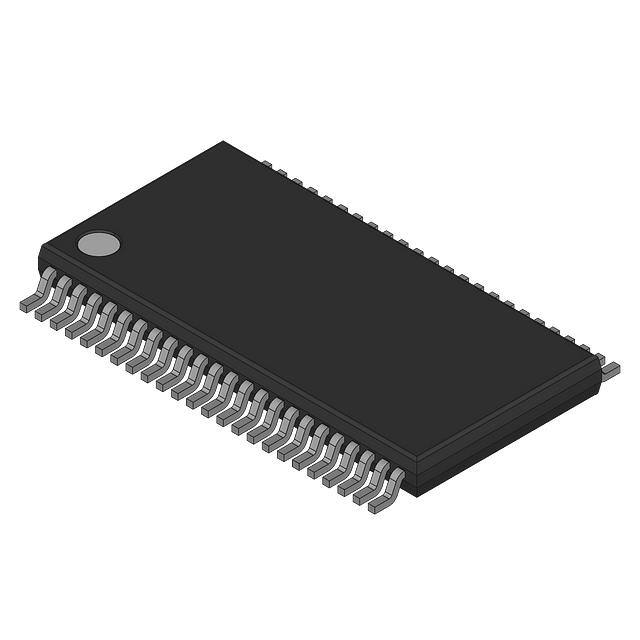
FlatLink™
Data Transmission System
�
Design
Overview
June 2001
Mixed-Signal Products
�Printed in U.S.A.
05/2001
SLLA012A
�FlatLink™ Data Transmission System
Design Overview
Kevin Gingerich, Technical Staff, Texas Instruments Incorporated
Literature Number: SLLA012A
June 2001
Printed on Recycled Paper
�INTRODUCTION
FlatLink™ is a data transmission system that can provide better than a 2:1 reduction in the number
of signal lines used for synchronous parallel data bus structures with no loss in data throughput.
To do this, FlatLink takes single-ended data at clock rates of up to 68 MHz and increases the data
signaling rate seven times up to 476 Mbps. The following report provides some design guidelines
for successful implementation of a basic FlatLink system with no justification provided.
SYSTEM DEFINITION
General Description
This example of the FlatLink data transmission system is a single SN75LVDS81 transmitter and
SN75LVDS82 receiver over 0.2 m of cable between the video display processor (VDP) and flat
panel display (FPD) controller. The display offers a 1024 × 768 pixel resolution and 256 colors
(8 bit/pixel). The graphical system clock is a nominal 65 MHz. The cable consists of five
twisted-pair signal cables, a power wire, and a ground wire. There are board-mounted connectors
on the VDP and FPD printed-circuit boards (PCBs).
NOTE:
For more detailed information about the SN75LVDS81 FlatLink transmitter
and the SN75LVDS82 FlatLink Receiver, see their respective data sheets
(literature numbers SLLS258 and SLLS259).
System Diagram
Figure 1 shows a basic FlatLink system with one transmitter connected to one receiver.
Host (VDP)
Power
Balanced Interconnect
Power
Target (VDP)
Host
Controller
Target
Controller
28 Signals
28 Signals
TX Clock
RX Clock
FlatLink Transmitter
FlatLink Receiver
Indicates Twisting of The
Conductors and is Optional.
Indicates The Line
Termination Circuit.
Figure 1. Typical Connection of One FlatLink Transmitter and One Receiver.
FlatLink is a trademark of Texas Instruments Incorporated.
1
�Interface Definition
The data inputs to the transmitter are from the VDP and consist of up to 24 bits of video
information, a horizontal synchronization bit, a vertical synchronization bit, an enable bit, and a
spare bit for a total of 28 data signals. All data is to be valid upon the falling edge of the clock signal
to the SN75LVDS81. The bit mapping is listed in Table 1.
Table 1. Bit Mapping and Terminal Assignments for 24-Bit Color Display
SN75LVDS81/82
INPUT/OUTPUT SIGNAL
SN75LVDS81
TERMINAL NUMBER
SN75LVDS82
TERMINAL NUMBER
Red0
D0
51
27
Red1
D1
52
29
Red2
D2
54
30
Red3
D3
55
32
Red4
D4
56
33
Red5
D6
3
35
Red6
D27
50
7
Red7
D5
2
34
Green0
D7
4
37
Green1
D8
6
38
Green2
D9
7
39
Green3
D12
11
43
Green4
D13
12
45
Green5
D14
14
46
Green6
D10
8
41
Green7
D11
10
42
Blue0
D15
15
47
Blue1
D18
19
51
Blue2
D19
20
53
Blue3
D20
22
54
Blue4
D21
23
55
Blue5
D22
24
1
Blue6
D16
16
49
Blue7
D17
18
50
H_SYNC
D24
27
3
V_SYNC
D25
28
5
ENABLE
D26
30
6
Reserved
D23
25
2
CLKIN/CLKOUT
31
26
SIGNAL
CLOCK
2
�The output of the receiver goes to the controller in the FPD with the same bit mapping as the input
to the transmitter. The receiver presents valid data on the falling edge of the output clock.
Both the transmitter and the receiver must be supplied with a reasonably clean 3.3-V (nominal)
supply voltage and a connection to a ground plane.
ELECTRICAL CHARACTERISTICS
Transmitter
Inputs
•
Unused inputs to the transmitter should be left open circuited. All inputs are internally
pulled down to ground with approximately a 300-kΩ resistance.
•
If not actively driven, the SHTDN terminal should be pulled up to VCC by no more than
a 10-kΩ resistor.
•
The board trace between the VDP and the transmitter should be less than 9 cm in length
and all lengths matched to within 1 cm of each other.
•
The output buffer of the VDP should be rated at an output current of 4 mA minimum.
Supply Voltage
•
Place a 0.01 µF Z5U ceramic, mica, or polystyrene dielectric 0805-size chip capacitor
between each of the VCC, PLLVCC, and LVDSVCC terminals of the transmitter and the
ground plane. The capacitors should be located as close as possible to the device
terminals.
•
A ground plane is highly recommended, if not mandatory. A power plane is
recommended, but if not used, sharing of supply traces with other components should
be held to a minimum.
Outputs
•
If the PCB trace is more than 2 cm in length between the transmitter output terminals
and the connector, the PCB must be constructed to maintain a controlled differential
impedance near 100 Ω (see Figure 2).
•
The physical length of each trace between the transmitter outputs and the connector
should be matched to within 5 mm of each other. This usually requires mitering of the
traces as shown in Figure 3.
ÎÎÎÎÎ ÎÎÎÎ ÎÎ ÎÎÎÎÎÎÎÎÎ
ÎÎÎÎÎ ÎÎÎÎ ÎÎ ÎÎÎÎÎÎÎÎÎ
0,30
LAYER 1 (Signal)
LAYER 2 (Ground)
LAYER 3 (Signal)
LAYER 4 (Signal)
0,36
0,30
1,2 mm
0,30
0,36
0,30
0,22 TYP.
Single Pair
ÎÎÎÎÎÎÎÎÎ ÎÎÎÎÎÎÎÎÎÎÎÎ
ÎÎÎÎÎÎÎÎÎÎÎÎÎÎÎÎÎÎÎÎÎÎÎ
ÎÎÎÎÎÎÎÎÎÎÎÎÎÎÎÎÎÎÎÎÎÎÎ
Figure 2. Typical PCB Construction
3
�Decoupling Capacitor Locations
(7 Places)
Figure 3. Transmitter Layout Example
Receiver
Inputs
•
If there is more than 2 cm distance between the connector and the receiver input pins,
the PCB must be constructed to maintain a controlled differential impedance near
100 Ω.
•
The physical length of each trace between the connector and the receiver inputs should
be matched to within 5 mm of each other. This may require mitering of the traces.
•
A common misconception is that the receiver requires a termination resistor. This is not
true. Termination is part of the interconnection and may or may not be located at the
inputs to the receiver. See the Termination section of this document for more details.
•
The SHTDN terminal is internally pulled down to ground such that the device is disabled
if this pin is left open circuited.
•
If not actively driven, the SHTDN terminal should be pulled up to VCC by no more than
a 10-kΩ resistor.
Supply Voltage
4
•
Place a 0.01 µF Z5U ceramic, mica, or polystyrene dielectric 0805- or 0603-size chip
capacitor between each of the VCC, PLLVCC, and LVDSVCC terminals of the receiver
and the ground plane. The capacitors should be located as close as possible to the
device terminals.
•
A ground plane is highly recommended, if not mandatory. A power plane is
recommended, but if not used, sharing of supply traces with other components should
be held to a minimum.
•
It is recommended that the supply voltage (particularly the PLLVCC ) be filtered through
a surface mount (0805) ferrite followed by a 0.01 µF capacitance to ground between
the ferrite and the receiver.
�Outputs
•
The total length of board traces between the receiver outputs and the receiving
controller should be less than 9 cm.
•
The input capacitance to the controller should be less than 5 pF.
Interconnection
Characteristic Impedance
•
At any cut point in the interconnect, the differential characteristic impedance should be
90 Ω to 130 Ω.
•
Use polyethylene, polypropylene, or Teflon™ insulation in either round or flat cables and
uniform distance between the conductors in a signal pair.
•
•
•
Twisting of the signal pairs is recommended but not mandatory.
Beldon #9807 is an example round cable.
Beldon #9V28010 is an example flat cable.
Termination
•
•
•
Termination at the far end of the interconnect from the transmitter is mandatory.
The system diagram in Figure 1 shows locations of the terminations.
The termination schematic diagram is shown in Figure 4.
To Transmitter
90 Ω < ZO < 130 Ω
RT, 100 Ω,
± 5%, 1/20 W
Figure 4. Differential Termination
•
Use thick film leadless (0603 or 0805) chip resistors.
Balance
•
The distance and insulation between the signal and return conductors in a pair should
be uniform.
•
Any parasitic loading (capacitance) must be applied in equal amounts to each line.
Stubs
•
A stub is any conductive path(s) connected to the cable conductors or PCB traces
between the transmitter and receiver.
•
•
A stub should be as short as possible but no longer than 2 cm to 3 cm.
The interconnect ends at the termination. If the receiver cannot be located within 2 cm
of the termination, use the fly-by termination shown in Figure 5.
Teflon is a trademark of E. I. du Pont Nemours and Company.
5
�Termination Resistors
Connector
Receiver
Solder Pads
Figure 5. Fly-By Termination at the Receiver
Skew and ISI
•
Keep the overall length of the interconnect between the transmitter and receiver less
than 0.5 m.
•
Keep the physical length of the signal pairs in the cable and PCB traces as close to the
same as possible.
•
The skew between signal pairs in good quality manufactured cables can range from
40 ps/m to 120 ps/m and should be specified by the vendor. A lower number is better.
TIMING REQUIREMENTS
Assuming the prior guidelines have been followed:
6
•
The VDP should provide a minimum set up time of 4 ns and a minimum hold time of
2.5 ns relative to the falling edge of the clock.
•
The nominal period (between falling edges) of the clock signal should be greater than
14.5 ns.
•
In general, the period of the input clock signal should not change by more than 2 ns from
nominal.
•
The FPD controller should require no more than 4 ns of set up time and 4 ns of hold time
relative to the falling edge of the clock.
�ELECTROMAGNETIC COMPATIBILITY
Electrostatic Discharge
•
It is advisable that exposed connectors have pins recessed from the shell to prevent
casual contact and discharges.
•
It is also a good idea to have the ground pins longer than the signal pins in order to make
the ground connection first and equalize the ground potentials before signal
connections.
Radiated Emissions and Susceptibility
•
•
There should be only one path for return current between the VDP and the FPD PCBs.
•
If an overall shield is used, use a short pig-tail crimped to the shield end at each
connector and then brought through a separate connector pin to a ground located as
close to the connector as possible.
•
If individual shielding of the signal pairs is used, use the same terminating technique
as for the overall shield.
Unused pins in connectors as well as unused wires in cables should be single-point
grounded at the connector. Unused wires should be grounded at alternate ends.
7
�IMPORTANT NOTICE
Texas Instruments Incorporated and its subsidiaries (TI) reserve the right to make corrections, modifications, enhancements,
improvements, and other changes to its products and services at any time and to discontinue any product or service without notice.
Customers should obtain the latest relevant information before placing orders and should verify that such information is current and
complete. All products are sold subject to TI’s terms and conditions of sale supplied at the time of order acknowledgment.
TI warrants performance of its hardware products to the specifications applicable at the time of sale in accordance with TI’s
standard warranty. Testing and other quality control techniques are used to the extent TI deems necessary to support this
warranty. Except where mandated by government requirements, testing of all parameters of each product is not necessarily
performed.
TI assumes no liability for applications assistance or customer product design. Customers are responsible for their products and
applications using TI components. To minimize the risks associated with customer products and applications, customers should
provide adequate design and operating safeguards.
TI does not warrant or represent that any license, either express or implied, is granted under any TI patent right, copyright, mask
work right, or other TI intellectual property right relating to any combination, machine, or process in which TI products or services
are used. Information published by TI regarding third-party products or services does not constitute a license from TI to use such
products or services or a warranty or endorsement thereof. Use of such information may require a license from a third party under
the patents or other intellectual property of the third party, or a license from TI under the patents or other intellectual property of TI.
Reproduction of information in TI data books or data sheets is permissible only if reproduction is without alteration and is
accompanied by all associated warranties, conditions, limitations, and notices. Reproduction of this information with alteration is an
unfair and deceptive business practice. TI is not responsible or liable for such altered documentation.
Resale of TI products or services with statements different from or beyond the parameters stated by TI for that product or service
voids all express and any implied warranties for the associated TI product or service and is an unfair and deceptive business
practice. TI is not responsible or liable for any such statements.
TI products are not authorized for use in safety-critical applications (such as life support) where a failure of the TI product would
reasonably be expected to cause severe personal injury or death, unless officers of the parties have executed an agreement
specifically governing such use. Buyers represent that they have all necessary expertise in the safety and regulatory ramifications
of their applications, and acknowledge and agree that they are solely responsible for all legal, regulatory and safety-related
requirements concerning their products and any use of TI products in such safety-critical applications, notwithstanding any
applications-related information or support that may be provided by TI. Further, Buyers must fully indemnify TI and its
representatives against any damages arising out of the use of TI products in such safety-critical applications.
TI products are neither designed nor intended for use in military/aerospace applications or environments unless the TI products are
specifically designated by TI as military-grade or "enhanced plastic." Only products designated by TI as military-grade meet military
specifications. Buyers acknowledge and agree that any such use of TI products which TI has not designated as military-grade is
solely at the Buyer's risk, and that they are solely responsible for compliance with all legal and regulatory requirements in
connection with such use.
TI products are neither designed nor intended for use in automotive applications or environments unless the specific TI products
are designated by TI as compliant with ISO/TS 16949 requirements. Buyers acknowledge and agree that, if they use any
non-designated products in automotive applications, TI will not be responsible for any failure to meet such requirements.
Following are URLs where you can obtain information on other Texas Instruments products and application solutions:
Products
Applications
Amplifiers
amplifier.ti.com
Audio
www.ti.com/audio
Data Converters
dataconverter.ti.com
Automotive
www.ti.com/automotive
DSP
dsp.ti.com
Broadband
www.ti.com/broadband
Interface
interface.ti.com
Digital Control
www.ti.com/digitalcontrol
Logic
logic.ti.com
Military
www.ti.com/military
Power Mgmt
power.ti.com
Optical Networking
www.ti.com/opticalnetwork
Microcontrollers
microcontroller.ti.com
Security
www.ti.com/security
RFID
www.ti-rfid.com
Telephony
www.ti.com/telephony
Low Power
Wireless
www.ti.com/lpw
Video & Imaging
www.ti.com/video
Wireless
www.ti.com/wireless
Mailing Address: Texas Instruments, Post Office Box 655303, Dallas, Texas 75265
Copyright © 2007, Texas Instruments Incorporated
�