Product
Folder
Sample &
Buy
Support &
Community
Tools &
Software
Technical
Documents
TLC59108F
SLDS162B – MARCH 2009 – REVISED DECEMBER 2015
TLC59108F 8-Bit FM+ I2C Bus LED Driver
1 Features
2 Applications
•
•
•
•
1
•
•
•
•
•
•
•
•
•
•
•
•
•
•
•
•
•
•
Eight LED Drivers (Each Output Programmable at
OFF, ON, Programmable LED Brightness,
Programmable Group Dimming and Blinking
Mixed With Individual LED Brightness)
Eight Open-Drain Output Channels
256-Step (8-Bit) Linear Programmable Brightness
Per LED Output Varying From Fully Off (Default)
to Maximum Brightness Using a 97-kHz PWM
Signal
256-Step Group Brightness Control Allows
General Dimming [Using a 190-Hz PWM Signal
From Fully Off to Maximum Brightness (Default)]
256-Step Group Blinking With Frequency
Programmable From 24 Hz to 10.73 s and Duty
Cycle From 0% to 99.6%
Four Software Programmable I2C Bus Addresses
(One LED Group Call Address and Three LED
Sub Call Addresses) Allow Groups of Devices to
be Simultaneously Addressed Any Combination
(For Example, One Register Used for All Call so
That All the TLC59108Fs on the I2C Bus Can be
Simultaneously Addressed and the Second
Register Used for Three Different Addresses so
That One Third of All Devices on the Bus Can be
Simultaneously Addressed)
Software Enable and Disable for I2C Bus Address
Software Reset Feature (SWRST Call) Allows the
Device to be Reset Through the I2C Bus
Up to 14 Hardware Selectable I2C Bus Addresses
so That Each Device Can be Programmed
Individually
Output State Change Programmable on the
Acknowledge or the STOP Command to Update
Outputs Byte-by-Byte or All at the Same Time
(Default to Change on STOP)
Maximum Output Current: 120 mA
Maximum Output Voltage: 17 V
25-MHz Internal Oscillator Requires No External
Components
1-MHz Fast-Mode Plus (FM+) Compatible I2C Bus
Interface With 30 mA High Drive Capability on
SDA Output for Driving High Capacitive Buses
Internal Power-On Reset
Noise Filter on SCL/SDA Inputs
No Glitch on Power Up
Active-Low Reset (RESET)
Supports Hot Insertion
Gaming
Small Signage
Industrial Equipment
3 Description
The TLC59108F device is an I2C bus controlled 8-bit
LED driver optimized for red, green, blue, or amber
(RGBA) color-mixing applications. Each LED output
has its own 8-bit resolution (256 steps) fixed
frequency individual PWM controller that operates at
97 kHz with a duty cycle that is adjustable from 0% to
99.6% to allow the LED to be set to a specific
brightness value. An additional 8-bit resolution (256
steps) group PWM controller has both a fixed
frequency of 190 Hz and an adjustable frequency
between 24 Hz to once every 10.73 seconds with a
duty cycle that is adjustable from 0% to 99.6% that is
used to either dim or blink all LEDs with the same
value.
Each LED output can be off, on (no PWM control),
set at its individual PWM controller value or at both
individual and group PWM controller values. The
TLC59108F operates with a supply voltage range of 3
V to 5.5 V and the outputs are 17-V tolerant. LEDs
can be directly connected to the TLC59108F device
outputs.
Device Information
PART NUMBER
TLC59108F
PACKAGE
(1)
BODY SIZE (NOM)
VQFN (20)
4.50 mm × 3.50 mm
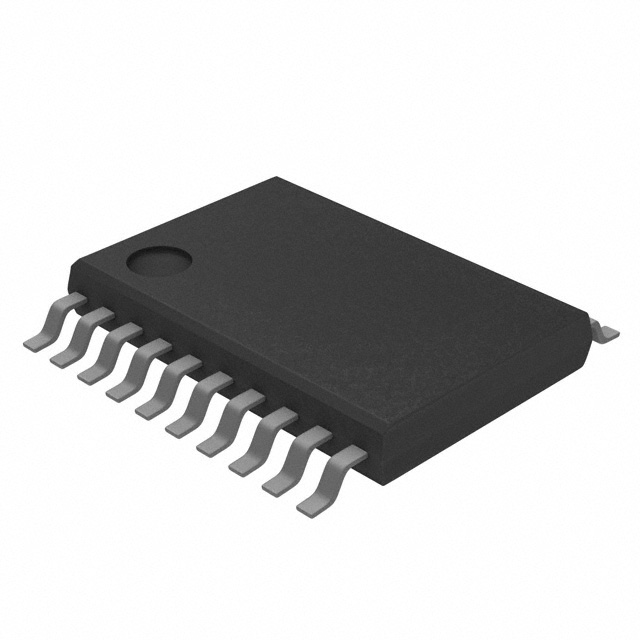
TSSOP (20)
6.50 mm × 4.40 mm
(1) For all available packages, see the orderable addendum at
the end of the data sheet.
Simplified Schematic
VLED
3.3V or 5V
µC
SCL
VDD
SDA
OUT7
RESET
OUT0
A0-A3
TLC59108F
GND
1
An IMPORTANT NOTICE at the end of this data sheet addresses availability, warranty, changes, use in safety-critical applications,
intellectual property matters and other important disclaimers. PRODUCTION DATA.
�TLC59108F
SLDS162B – MARCH 2009 – REVISED DECEMBER 2015
www.ti.com
Table of Contents
1
2
3
4
5
6
7
8
Features ..................................................................
Applications ...........................................................
Description .............................................................
Revision History.....................................................
Pin Configuration and Functions .........................
Specifications.........................................................
1
1
1
2
3
4
6.1
6.2
6.3
6.4
6.5
6.6
6.7
4
4
4
4
5
6
7
Absolute Maximum Ratings .....................................
ESD Ratings..............................................................
Recommended Operating Conditions ......................
Thermal Information ..................................................
Electrical Characteristics...........................................
I2C Interface Timing Requirements...........................
Typical Characteristics ..............................................
Parameter Measurement Information .................. 7
Detailed Description .............................................. 9
8.1 Overview ................................................................... 9
8.2 Functional Block Diagram ......................................... 9
8.3
8.4
8.5
8.6
9
Feature Description.................................................
Device Functional Modes........................................
Programming...........................................................
Register Maps .........................................................
10
11
11
16
Application and Implementation ........................ 23
9.1 Application Information............................................ 23
9.2 Typical Application .................................................. 26
10 Power Supply Recommendations ..................... 27
11 Layout................................................................... 27
11.1 Layout Guidelines ................................................. 27
11.2 Layout Example .................................................... 28
12 Device and Documentation Support ................. 30
12.1
12.2
12.3
12.4
Community Resources..........................................
Trademarks ...........................................................
Electrostatic Discharge Caution ............................
Glossary ................................................................
30
30
30
30
13 Mechanical, Packaging, and Orderable
Information ........................................................... 30
4 Revision History
NOTE: Page numbers for previous revisions may differ from page numbers in the current version.
Changes from Revision A (December 2011) to Revision B
•
Page
Added Pin Configuration and Functions section, ESD Ratings table, Feature Description section, Device Functional
Modes, Application and Implementation section, Power Supply Recommendations section, Layout section, Device
and Documentation Support section, and Mechanical, Packaging, and Orderable Information section .............................. 1
Changes from Original (November 2011) to Revision A
Page
•
Fixed address typo in the Software Reset Section .............................................................................................................. 10
•
Changed SLEEP Symbol to OSC and removed the "Low power mode" description to clairify functionality. ..................... 19
•
Added TLC59108 and TLC59108F Differences section....................................................................................................... 23
2
Submit Documentation Feedback
Copyright © 2009–2015, Texas Instruments Incorporated
Product Folder Links: TLC59108F
�TLC59108F
www.ti.com
SLDS162B – MARCH 2009 – REVISED DECEMBER 2015
5 Pin Configuration and Functions
PW Package
20-Pin TSSOP
Top View
N.C.
A0
A1
A2
A3
OUT0
OUT1
GND
OUT2
OUT3
RGY Package
20-Pin VQFN With Exposed Thermal Pad
Top View
1
20
VCC
2
19
SDA
SCL
RESET
GND
OUT7
OUT6
GND
OUT5
OUT4
3
18
4
17
5
16
6
15
7
14
8
13
9
12
10
11
N.C. – No internal connection
N.C.
VCC
1
20
A0
2
19
SDA
A1
3
18
SCL
A2
4
17
RESET
A3
5
16
GND
OUT0
6
15
OUT7
OUT1
7
14
OUT6
GND
8
13
GND
OUT2
9
12
OUT5
10
11
OUT3
OUT4
Pin Functions
PIN
NAME
NO.
I/O (1)
DESCRIPTION
A0
2
I
Address input 0
A1
3
I
Address input 1
A2
4
I
Address input 2
A3
5
I
Address input 3
–
Ground
I
No internal connection
O
Open-drain output 0 to 7, LED ON at low
8
GND
13
16
N.C.
1
OUT0
6
OUT1
7
OUT2
9
OUT3
10
OUT4
11
OUT5
12
OUT6
14
OUT7
15
RESET
17
I
Active-low reset input
SCL
18
I
Serial clock input
SDA
19
I/O
VCC
20
–
(1)
Serial data input/output
Power supply
I = input, O = output
Submit Documentation Feedback
Copyright © 2009–2015, Texas Instruments Incorporated
Product Folder Links: TLC59108F
3
�TLC59108F
SLDS162B – MARCH 2009 – REVISED DECEMBER 2015
www.ti.com
6 Specifications
6.1 Absolute Maximum Ratings
over operating free-air temperature range (unless otherwise noted) (1)
MIN
MAX
UNIT
0
7
V
–0.4
7
V
–0.5
20
V
120
mA
VCC
Supply voltage
VI
Input voltage
VO
Output voltage
IO
Continuous output current
PD
Power dissipation, TA = 25 °C, JESD 51-7
TJ
Junction temperature
–40
150
°C
Tstg
Storage temperature
–55
150
°C
(1)
PW package
1.2
RGY package
2.2
W
Stresses beyond those listed under Absolute Maximum Ratings may cause permanent damage to the device. These are stress ratings
only, and functional operation of the device at these or any other conditions beyond those indicated under Recommended Operating
Conditions is not implied. Exposure to absolute-maximum-rated conditions for extended periods may affect device reliability.
6.2 ESD Ratings
VALUE
Electrostatic
discharge
V(ESD)
(1)
(2)
Human body model (HBM), per ANSI/ESDA/JEDEC JS-001
(1)
UNIT
±1500
Charged-device model (CDM), per JEDEC specification JESD22-C101 (2)
V
±500
JEDEC document JEP155 states that 500-V HBM allows safe manufacturing with a standard ESD control process.
JEDEC document JEP157 states that 250-V CDM allows safe manufacturing with a standard ESD control process.
6.3 Recommended Operating Conditions
(1)
See
.
VCC
Supply voltage
VIH
High-level input voltage
SCL, SDA, RESET, A0, A1, A2, A3
VIL
Low-level input voltage
SCL, SDA, RESET, A0, A1, A2, A3
VO
Output voltage
OUT0 to OUT7
IOL
Low-level output current
SDA
IO
Output current
OUT0 to OUT7
TA
Operating free-air temperature
(1)
MIN
MAX
3
5.5
V
0.7 × VCC
5.5
V
0
0.3 × VCC
V
17
V
VCC = 3 V
20
VCC = 4.5 V
30
UNIT
mA
5
120
mA
–40
85
°C
All unused inputs of the device must be held at VCC or GND to ensure proper device operation.
6.4 Thermal Information
TLC59108F
THERMAL METRIC (1)
PW (TSSOP)
RGY (VQFN)
20 PINS
20 PINS
UNIT
RθJA
Junction-to-ambient thermal resistance
98.9
39.1
°C/W
RθJC(top)
Junction-to-case (top) thermal resistance
32.9
44.7
°C/W
RθJB
Junction-to-board thermal resistance
49.9
14.8
°C/W
ψJT
Junction-to-top characterization parameter
1.7
1.0
°C/W
ψJB
Junction-to-board characterization parameter
49.3
14.9
°C/W
RθJC(bot)
Junction-to-case (bottom) thermal resistance
—
7.6
°C/W
(1)
4
For more information about traditional and new thermal metrics, see the Semiconductor and IC Package Thermal Metrics application
report, SPRA953.
Submit Documentation Feedback
Copyright © 2009–2015, Texas Instruments Incorporated
Product Folder Links: TLC59108F
�TLC59108F
www.ti.com
SLDS162B – MARCH 2009 – REVISED DECEMBER 2015
6.5 Electrical Characteristics
VCC = 3 V to 5.5 V, TA = –40°C to 85°C (unless otherwise noted)
PARAMETER
II
VPOR
TEST CONDITIONS
Input/output leakage
current
SCL, SDA, A0,
A1, A2, A3,
VI = VCC or GND
RESET
Output leakage
current
OUT0 to
OUT7
MIN
TYP (1)
VO = 17 V, TJ = 25°C
Power-on reset voltage
MAX
UNIT
±0.3
μA
0.5
μA
2.5
VCC = 3 V, VOL = 0.4 V
20
VCC = 5 V, VOL = 0.4 V
30
V
IOL
Low-level output
current
SDA
VOL
Low-level output
voltage
OUT0 to
OUT7
VCC = 3 V, IOL = 120 mA
230
450
VCC = 4.5 V, IOL = 120 mA
200
400
rON
ON-state resistance
OUT0 to
OUT7
VCC = 3 V, IOL = 120 mA
1.92
3.75
VCC = 4.5 V, IOL = 120 mA
1.64
3.3
TSD
Overtemperature shutdown (2)
175
200
THYS
Restart hysteresis
Ci
Input capacitance
SCL, A0, A1,
A2, A3,
RESET
Cio
Input/output
capacitance
SDA
ICC
Supply current
(1)
(2)
150
mA
mV
Ω
°C
15
°C
VI = VCC or GND
5
pF
VI = VCC or GND
8
pF
VCC = 3 V
VCC = 4.5 V
OUT0 to OUT7 =
OFF
6
9
mA
All typical values are at TA = 25°C.
Specified by design, not production tested.
Submit Documentation Feedback
Copyright © 2009–2015, Texas Instruments Incorporated
Product Folder Links: TLC59108F
5
�TLC59108F
SLDS162B – MARCH 2009 – REVISED DECEMBER 2015
www.ti.com
6.6 I2C Interface Timing Requirements
TA = –40°C to 85°C
STANDARD-MODE
I2C BUS
FAST-MODE
I2C BUS
FAST-MODE PLUS
I2C BUS
MIN
MAX
MIN
MAX
MIN
MAX
0
100
0
400
0
1000
UNIT
I2C Interface
fSCL
SCL clock frequency
kHz
2
tBUF
I C bus free time between Stop and
Start
tHD;STA
Hold time (repeated) for Start
condition
tSU;STA
Set-up time (repeated) for Start
condition
tSU;STO
Set-up time for Stop condition
tHD;DAT
Data hold time
tVD;ACK
Data valid acknowledge time (1)
0.3
3.45
0.1
0.9
0.05
0.45
μs
tVD;DAT
Data valid time (2)
0.3
3.45
0.1
0.9
0.05
0.45
μs
tSU;DAT
Data set-up time
250
100
50
ns
tLOW
Low period of the SCL clock
4.7
1.3
0.5
μs
tHIGH
High period of the SCL clock
4
0.6
0.26
μs
tf
Fall time of both SDA and SCL
signals (3) (4)
tr
Rise time of both SDA and SCL
signals
tSP
Pulse width of spikes that must be
suppressed by the input filter (6)
4.7
1.3
0.5
μs
4
0.6
0.26
μs
4.7
0.6
0.26
μs
4
0.6
0.26
μs
0
0
0
ns
300
20 +
0.1Cb (5)
300
120
ns
1000
20 +
0.1Cb (5)
300
120
ns
50
50
ns
50
Reset
tW
Reset pulse width
tREC
Reset recovery time
tRESET
Time to reset (7) (8)
(1)
(2)
(3)
(4)
(5)
(6)
(7)
(8)
6
10
10
10
ns
0
0
0
ns
400
400
400
ns
tVD;ACK = time for Acknowledgement signal from SCL low to SDA (out) low.
tVD;DAT = minimum time for SDA data out to be valid following SCL low.
A master device must internally provide a hold time of at least 300 ns for the SDA signal (refer to the VIL of the SCL signal) in order to
bridge the undefined region of SCLs falling edge.
The maximum tf for the SDA and SCL bus lines is specified at 300 ns. The maximum fall time (tf) for the SDA output stage is specified
at 250 ns. This allows series protection resistors to be connected between the SDA and the SCL pins and the SDA/SCL bus lines
without exceeding the maximum specified tf.
Cb = total capacitance of one bus line in pF.
Input filters on the SDA and SCL inputs suppress noise spikes less than 50 ns
Resetting the device while actively communicating on the bus may cause glitches or errant Stop conditions.
Upon reset, the full delay will be the sum of tRESET and the RC time constant of the SDA bus.
Submit Documentation Feedback
Copyright © 2009–2015, Texas Instruments Incorporated
Product Folder Links: TLC59108F
�TLC59108F
www.ti.com
SLDS162B – MARCH 2009 – REVISED DECEMBER 2015
8
8
6
6
ICC (mA)
ICC (mA)
6.7 Typical Characteristics
4
85°C
2
4
85°C
2
25°C
25°C
–40°C
–40°C
0
0
3.0
3.5
4.0
4.5
5.0
VCC (V)
5.5
3.0
3.5
4.0
4.5
5.0
VCC (V)
C001
all LEDs on
Duty Cycle = 100%
5.5
C001
all LEDs off
Figure 1. ICC vs VCC
Figure 2. ICC vs VCC
7 Parameter Measurement Information
START
SCL
ACK OR READ CYCLE
SDA
30%
tRESET
50%
RESET
tREC
tW
OUTn
50%
tRESET
Figure 3. Definition of Reset Timing
SDA
tBUF
tHD;STA
tr
tSP
tf
tLOW
SCL
tHD;STA
P
S
tHD;DAT
tHIGH
tSU;DAT
tSU;DAT
Sr
tSU;STO
P
Figure 4. Definition of Timing
Submit Documentation Feedback
Copyright © 2009–2015, Texas Instruments Incorporated
Product Folder Links: TLC59108F
7
�TLC59108F
SLDS162B – MARCH 2009 – REVISED DECEMBER 2015
www.ti.com
Parameter Measurement Information (continued)
Protocol
Start
Condition
(S)
Bit 7
MSB
(A7)
tLOW
tSU;STA
Bit 6
(A6)
tHIGH
Bit 7
(D1)
Bit 8
(D0)
Acknowledge
(A)
Stop
Condition
(P)
1/fSCL
SCL
tr
tf
tBUF
SDA
tHD;STA
tSU;DAT
tHD;DAT
tVD;DAT
tVD;ACK
tSU;STO
Rise and fall times refer to VIL and VIH.
Figure 5. I2C Bus Timing
VCC
Pulse
Generator
VI
DUT
RT
RL
VO
VCC
Open
GND
CL
RL = Load resistance for SDA and SCL; should be >1 kΩ at 3-mA or lower current.
CL = Load capacitance; includes jig and probe capacitance.
RT = Termination resistance; should be equal to the output impedance (ZO) of the pulse generator.
Figure 6. Test Circuit for Switching Characteristics
8
Submit Documentation Feedback
Copyright © 2009–2015, Texas Instruments Incorporated
Product Folder Links: TLC59108F
�TLC59108F
www.ti.com
SLDS162B – MARCH 2009 – REVISED DECEMBER 2015
8 Detailed Description
8.1 Overview
The TLC59108F is an I2C bus controlled 8-bit LED driver optimized for red, green, blue, or amber (RGBA) colormixing applications. Each LED output has its own 8-bit resolution (256 steps) fixed frequency individual PWM
controller that operates at 97 kHz with a duty cycle that is adjustable from 0% to 99.6% to allow the LED to be
set to a specific brightness value. An additional 8-bit resolution (256 steps) group PWM controller has both a
fixed frequency of 190 Hz and an adjustable frequency between 24 Hz to once every 10.73 seconds with a duty
cycle that is adjustable from 0% to 99.6% that is used to either dim or blink all LEDs with the same value.
Each LED output can be off, on (no PWM control), set at its individual PWM controller value or at both individual
and group PWM controller values. The TLC59108F operates with a supply voltage range of 3 V to 5.5 V and the
outputs are 17-V tolerant. LEDs can be directly connected to the TLC59108F device outputs.
Software programmable LED group and three sub call I2C bus addresses allow all or defined groups of
TLC59108F devices to respond to a common I2C bus address, allowing for example, all the same color LEDs to
be turned on or off at the same time or marquee chasing effect, thus minimizing I2C bus commands.
Four hardware address pins allow up to 14 devices on the same bus.
The software reset (SWRST) call allows the master to perform a reset of the TLC59108F through the I2C bus,
identical to the power-on reset (POR) that initializes the registers to their default state causing the outputs to be
set high (LED off). This allows an easy and quick way to reconfigure all device registers to the same condition.
8.2 Functional Block Diagram
A0
SCL
SDA
RESET
INPUT FILTER
A1 A2
A3
2
I C BUS CONTROL
OUT0
25 MHz
OSCILLATOR
OUT7
OUTPUT DRIVER AND
ERROR DETECTION
LED STATE
SELECT
REGISTER
PWM
REGISTER X
BRIGHTNESS
CONTROL
24.3 kHz
OUT6
NOTE:
All 8 FETs
are present
POWER-ON
RESET CONTROL
97 kHz
OUT1
GRPFREQ
REGISTER
GRPPWM
REGISTER
190 Hz
‘0’ – Permanently OFF
‘1’ – Permanently ON
VCC
GND
Only one PWM shown for clarity.
Submit Documentation Feedback
Copyright © 2009–2015, Texas Instruments Incorporated
Product Folder Links: TLC59108F
9
�TLC59108F
SLDS162B – MARCH 2009 – REVISED DECEMBER 2015
www.ti.com
8.3 Feature Description
8.3.1 Power-On Reset
When power is applied to VCC, an internal power-on reset holds the TLC59108F in a reset condition until VCC has
reached VPOR. At this point, the reset condition is released and the TLC59108F registers and I2C bus state
machine are initialized to their default states causing all the channels to be deselected. Thereafter, VCC must be
lowered below 0.2 V to reset the device.
8.3.2 External Reset
A reset can be accomplished by holding the RESET pin low for a minimum of tW. The TLC59108F registers and
I2C state machine will be held in their default state until the RESET input is once again high.
This input requires a pullup resistor to VCC if no active connection is used.
8.3.3 Software Reset
The Software Reset Call (SWRST Call) allows all the devices in the I2C bus to be reset to the power-up state
value through a specific I2C bus command. To be performed correctly, the I2C bus must be functional and there
must be no device hanging the bus.
The SWRST Call function is defined as the following:
1. A Start command is sent by the I2C bus master.
2. The reserved SWRST I2C bus address 1001 011 with the R/W bit set to 0 (write) is sent by the I2C bus
master.
3. The TLC59108F device(s) acknowledge(s) after seeing the SWRST Call address 1001 0110 (96h) only. If
the R/W bit is set to 1 (read), no acknowledge is returned to the I2C bus master.
4. Once the SWRST Call address has been sent and acknowledged, the master sends two bytes with two
specific values (SWRST data byte 1 and byte 2):
(a) Byte1 = A5h: the TLC59108F acknowledges this value only. If byte 1 is not equal to A5h, the TLC59108F
does not acknowledge it.
(b) Byte 2 = 5Ah: the TLC59108F acknowledges this value only. If byte 2 is not equal to 5Ah, the
TLC59108F does not acknowledge it.
If more than two bytes of data are sent, the TLC59108F does not acknowledge any more.
5. Once the correct two bytes (SWRST data byte 1 and byte 2 only) have been sent and correctly
acknowledged, the master sends a Stop command to end the SWRST Call. The TLC59108F then resets to
the default value (power-up value) and is ready to be addressed again within the specified bus free time
(tBUF).
The I2C bus master may interpret a non-acknowledge from the TLC59108F (at any time) as a SWRST Call
Abort. The TLC59108F does not initiate a reset of its registers. This happens only when the format of the Start
Call sequence is not correct.
8.3.4 Individual Brightness Control With Group Dimming or Blinking
A 97-kHz fixed frequency signal with programmable duty cycle (8 bits, 256 steps) is used to control individually
the brightness for each LED.
On top of this signal, one of the following signals can be superimposed (this signal can be applied to the 4 LED
outputs):
• A lower 190-Hz fixed frequency signal with programmable duty cycle (8 bits, 256 steps) is used to provide a
global brightness control.
• A programmable frequency signal from 24 Hz to 1/10.73 s (8 bits, 256 steps) is used to provide a global
blinking control.
10
Submit Documentation Feedback
Copyright © 2009–2015, Texas Instruments Incorporated
Product Folder Links: TLC59108F
�TLC59108F
www.ti.com
SLDS162B – MARCH 2009 – REVISED DECEMBER 2015
Feature Description (continued)
1 2
3
4
5
6
7
8
9 10 11 12
507
508
510
512 508
510
512
508
511 507
508
511
1 2
3
4
5
6
7
8
3
4
5
6
7
8
9 10 11
N X 40 ns with
N = (0 to 255)
(PWMx Register)
M X 256 X 2 X 40 ns
with M = (0 to 255)
(GRPPWM Register)
256 X 40 ns = 10.24 µs
(97.6 kHz)
Group Dimming Signal
256 X 2 X 256 X 40 ns = 5.24 ms (190.7 Hz)
1 2
3
4
5
6
7
8
1 2
Resulting Brightness + Group Dimming Signal
A.
Minimum pulse width for LEDn brightness control is 40 ns.
B.
Minimum pulse width for group dimming is 20.48 μs.
C.
When M = 1 (GRPPWM register value), the resulting LEDn brightness control and group dimming signal will have two
pulses of the LED brightness control signal (pulse width = N × 40 ns,w ith N defined in the PWMx register).
D.
The resulting brightness plus group dimming signal shown above demonstrate a resulting control signal with M = 4 (8
pulses).
Figure 7. Brightness + Group Dimming Signals
8.4 Device Functional Modes
Active - Active mode occurs when one or more of the output channels is enabled.
Standby - Standby mode occurs when all output channels are disabled. Standby mode may be entered either
through I2C command or by pulling the RESET pin low.
8.5 Programming
8.5.1 Device Address
Following a Start condition, the bus master must output the address of the slave it is accessing.
8.5.2 Regular I2C Bus Slave Address
The I2C bus slave address of the TLC59108F is shown in Figure 8. To conserve power, no internal pullup
resistors are incorporated on the hardware-selectable address pins, and they must be pulled high or low. For
buffer management purpose, a set of sector information data should be stored.
Slave Address
1
0
Fixed
0
A3
A2
A1
A0 R/W
Hardware Selectable
Figure 8. Slave Address
The last bit of the address byte defines the operation to be performed. When set to logic 1, a read operation is
selected. When set to logic 0, a write operation is selected.
Submit Documentation Feedback
Copyright © 2009–2015, Texas Instruments Incorporated
Product Folder Links: TLC59108F
11
�TLC59108F
SLDS162B – MARCH 2009 – REVISED DECEMBER 2015
www.ti.com
Programming (continued)
8.5.3 LED All Call I2C Bus Address
• Default power-up value (ALLCALLADR address register): 90h or 1001 000
• Programmable through I2C bus (volatile programming)
• At power-up, LED All Call I2C bus address is enabled. TLC59108F sends an ACK when 90h (R/W = 0) or 91h
(R/W = 1) is sent by the master.
NOTE
The LED All Call I2C bus address (90h or 1001 000) must not be used as a regular I2C
bus slave address since this address is enabled at power-up. All the TLC59108Fs on the
I2C bus will acknowledge the address if sent by the I2C bus master.
8.5.4 LED Sub Call I2C Bus Address
•
•
•
•
Three different I2C bus address can be used
Default power-up values:
– SUBADR1 register: 92h or 1001 001
– SUBADR2 register: 94h or 1001 010
– SUBADR3 register: 98h or 1001 100
Programmable through I2C bus (volatile programming)
At power-up, Sub Call I2C bus address is disabled. TLC59108F does not send an ACK when 92h (R/W = 0)
or 93h (R/W = 1) or 94h (R/W = 0) or 95h (R/W = 1) or 98h (R/W = 0) or 99h (R/W = 1) is sent by the master.
NOTE
The default LED Sub Call I2C bus address may be used as a regular I2C bus slave
address as long as they are disabled.
8.5.5 Software Reset I2C Bus Address
The address shown in Figure 9 is used when a reset of the TLC59108F needs to be performed by the master.
The software reset address (SWRST Call) must be used with R/W = 0. If R/W = 1, the TLC59108F does not
acknowledge the SWRST. See Software Reset for more detail.
R/W
1
0
0
1
0
1
1
0
Figure 9. Software Reset Address
NOTE
The Software Reset I2C bus address is a reserved address and cannot be use as a
regular I2C bus slave address.
8.5.6 Characteristics of the I2C Bus
The I2C bus is for two-way two-line communication between different devices or modules. The two lines are a
serial data line (SDA) and a serial clock line (SCL). Both lines must be connected to a positive supply through a
pullup resistor when connected to the output stages of a device. Data transfer may be initiated only when the bus
is not busy.
12
Submit Documentation Feedback
Copyright © 2009–2015, Texas Instruments Incorporated
Product Folder Links: TLC59108F
�TLC59108F
www.ti.com
SLDS162B – MARCH 2009 – REVISED DECEMBER 2015
Programming (continued)
8.5.6.1 Bit Transfer
One data bit is transferred during each clock pulse. The data on the SDA line must remain stable during the high
period of the clock pulse as changes in the data line at this time will be interpreted as control signals (see
Figure 10).
SDA
SCL
Data Line
Stable;
Data Valid
Change
of Data
Allowed
Figure 10. Bit Transfer
8.5.6.2 Start and Stop Conditions
Both data and clock lines remain high when the bus is not busy. A high-to-low transition of the data line while the
clock is high is defined as the Start condition (S). A low-to-high transition of the data line while the clock is high is
defined as the Stop condition (P) (see Figure 11).
SDA
SDA
SCL
S
P
SCL
Stop Condition
Start Condition
Figure 11. Start and Stop Conditions
8.5.7 System Configuration
A device generating a message is a transmitter; a device receiving is the receiver. The device that controls the
message is the master and the devices which are controlled by the master are the slaves (see Figure 12).
SDA
SCL
Master
Transmitter/
Receiver
Slave Receiver
Slave
Transmitter/
Receiver
Master
Transmitter
Master
Transmitter/
Receiver
I2C Bus
Multiplexer
Slave
Figure 12. System Configuration
Submit Documentation Feedback
Copyright © 2009–2015, Texas Instruments Incorporated
Product Folder Links: TLC59108F
13
�TLC59108F
SLDS162B – MARCH 2009 – REVISED DECEMBER 2015
www.ti.com
Programming (continued)
8.5.8 Acknowledge
The number of data bytes transferred between the Start and the Stop conditions from transmitter to receiver is
not limited. Each byte of eight bits is followed by one acknowledge bit. The acknowledge bit is a high level put on
the bus by the transmitter, whereas the master generates an extra acknowledge related clock pulse.
A slave receiver which is addressed must generate an acknowledge after the reception of each byte. Also a
master must generate an acknowledge after the reception of each byte that has been clocked out of the slave
transmitter. The device that acknowledges has to pull down the SDA line during the acknowledge clock pulse, so
that the SDA line is stable low during the high period of the acknowledge related clock pulse; set-up time and
hold time must be taken into account.
A master receiver must signal an end of data to the transmitter by not generating an acknowledge on the last
byte that has been clocked out of the slave. In this event, the transmitter must leave the data line high to enable
the master to generate a Stop condition.
Data Output
by Transmitter
NACK
Data Output
by Receiver
ACK
SCL From
Master
1
2
8
9
S
Start
Condition
Clock Pulse for
Acknowledgment
Figure 13. Acknowledge on I2C Bus
Control Register
Slave Address
S
1
0
START Condition
0
A3
A2
A1
A0
0
A
X
X
X
D4
D3
Auto-Increment Options
Auto-Increment Flag
Acknowledge
From Slave
D2
D1
D0
A
A
R/W
Acknowledge
From Slave
P
STOP
Condition
Acknowledge
From Slave
Figure 14. Write to a Specific Register
14
Submit Documentation Feedback
Copyright © 2009–2015, Texas Instruments Incorporated
Product Folder Links: TLC59108F
�TLC59108F
www.ti.com
SLDS162B – MARCH 2009 – REVISED DECEMBER 2015
Programming (continued)
1
S
0
0
A3
MODE1 Register
Control Register
Slave Address
A2
0
A0
A1
START Condition
1
A
0
0
0
0
Auto-Increment on
All Registers
R/W
0
0
0
A
MODE1 Register
Selection
Acknowledge
From Slave
Acknowledge
From Slave
MODE2 Register
(cont.)
A
A
Acknowledge
From Slave
Acknowledge
From Slave
Auto-Increment On
ALLCALLADR Register
SUBADR3 Register
(cont.)
A
A
P
Acknowledge
From Slave
Acknowledge
From Slave
STOP
Condition
Figure 15. Write to All Registers Using Auto-Increment
S
1
0
0
A3
A2
START Condition
PWM0 Register
Control Register
Slave Address
A1
A0
0
1
A
R/W
Acknowledge
From Slave
0
1
0
0
0
1
0
PWM1 Register
A
A
Auto-Increment on
PWM Register
Brightness Registers
Selection
Only
Acknowledge
From Slave
(cont.)
A
Acknowledge
From Slave
Acknowledge
From Slave
Auto-Increment On
(cont.)
PWM0 Register
PWM7 Register
PWM6 Register
A
Acknowledge
From Slave
A
Acknowledge
From Slave
PWMx Register
A
A
Acknowledge
From Slave
P
Acknowledge
From Slave
STOP
Condition
Figure 16. Multiple Writes to Individual Brightness Registers Only Using the Auto-Increment Feature
Submit Documentation Feedback
Copyright © 2009–2015, Texas Instruments Incorporated
Product Folder Links: TLC59108F
15
�TLC59108F
SLDS162B – MARCH 2009 – REVISED DECEMBER 2015
www.ti.com
Programming (continued)
S
1
0
0
A3
A2
Slave Address
Control Register
Slave Address
0
A0
A1
START Condition
1
A
0
0
0
0
Auto-Increment
on All Registers
R/W
0
0
0
MODE1Register
Selection
1
Sr
A
0
A3
0
Data from MODE1 Register
A1
A2
A0
Repeated Start
A
A
(cont.)
Acknowledge
From Master
R/W
Acknowledge
From Slave
Acknowledge
From Slave
1
Acknowledge
From Slave
Auto-Increment On
Data from ALLCALLADR Register
Data from PWM0 Register
Data from MODE2 Register
(cont.)
Data from MODE1 Register
A
A
A
Acknowledge
From Master
Acknowledge
From Master
Acknowledge
From Master
A
(cont.)
Acknowledge
From Master
Data from Last Read Byte
(cont.)
P
A
Not Acknowledge
From Master
STOP
Condition
Figure 17. Read All Registers With the Auto-Increment Feature
Sequence A
S
1
0
0
A3
A2
New LED All-Call I2C Address(B)
Control Register
Slave Address
A1
A0
START Condition
0
A
X
X
1
X
0
0
0
1
A
1
0
0
1
1
0
1
ALLCALLADR
Register Selection
R/W
X
P
Acknowledge
From Slave
STOP
Condition
Acknowledge
From Slave
Acknowledge
From Slave
A
Auto-Increment Flag
Sequence B
S
1
0
0
1
1
START Condition
0
The 16 LEDs are ON at Acknowledge
(C)
LEDOUT0 Register (LED0–LED3 Fully ON)
Control Register
LED All-Call I2C Address
1
0
A
X
X
0
X
1
1
0
0
A
0
1
LEDOUT0 Register Selection
R/W
Acknowledge
From Slave
0
1
0
1
0
1
A
P
Acknowledge
From Slave
Acknowledge
From the 4 Devices
STOP
Condition
Auto-Increment Flag
A.
In this example, four TLC59108Fs are used with the same sequence sent to each.
B.
ALLCALL bit in MODE1 register is equal to 1 for this example.
C.
OCH bit in MODE2 register is equal to 1 for this example.
Figure 18. LED All-Call I2C Bus Address Programming and LED All-Call Sequence Example
8.6 Register Maps
Table 2 describes the registers in the TLC59108F.
16
Submit Documentation Feedback
Copyright © 2009–2015, Texas Instruments Incorporated
Product Folder Links: TLC59108F
�TLC59108F
www.ti.com
SLDS162B – MARCH 2009 – REVISED DECEMBER 2015
Register Maps (continued)
8.6.1 Control Register
Following the successful acknowledgment of the slave address, LED All Call address or LED Sub Call address,
the bus master will send a byte to the TLC59108F, which will be stored in the Control register. The lowest 5 bits
are used as a pointer to determine which register will be accessed (D[4:0]). The highest 3 bits are used as AutoIncrement flag and Auto-Increment options (AI[2:0]).
Auto-Increment
Flag
AI2 AI1 AI0
Register Address
D4
D3
D2
D1
D0
Auto-Increment Options
Figure 19. Control Register
When the Auto-Increment flag is set (AI2 = logic 1), the five low order bits of the Control register are
automatically incremented after a read or write. This allows the user to program the registers sequentially. Four
different types of Auto-Increment are possible, depending on AI1 and AI0 values.
Table 1. Auto-Increment Options
(1)
(1)
AI2
AI1
AI0
DESCRIPTION
0
0
0
No auto-increment
1
0
0
Auto-increment for all registers. D[4:0] roll over to 0 0000 after the last register (1 0001) is
accessed.
1
0
1
Auto-increment for individual brightness registers only. D[4:0] roll over to 0 0010 after the last
register (0 1001) is accessed.
1
1
0
Auto-increment for global control registers only. D[4:0] roll over to 0 1010 after the last register
(0 1011) is accessed.
1
1
1
Auto-increment for individual and global control registers only. D[4:0] roll over to 0 0010 after
the last register (0 1011) is accessed.
Other combinations not shown in Table 1 (A1[2:0] = 001, 010, and 011) are reserved and must not be used for proper device operation.
AI[2:0] = 000 is used when the same register must be accessed several times during a single I2C bus
communication, for example, changes the brightness of a single LED. Data is overwritten each time the register
is accessed during a write operation.
AI[2:0] = 100 is used when all the registers must be sequentially accessed, for example, power-up programming.
AI[2:0] = 101 is used when the four LED drivers must be individually programmed with different values during the
same I2C bus communication, for example, changing color setting to another color setting.
AI[2:0] = 110 is used when the LED drivers must be globally programmed with different settings during the same
I2C bus communication, for example, global brightness or blinking change.
AI[2:0] = 111 is used when individually and global changes must be performed during the same I2C bus
communication, for example, changing color and global brightness at the same time.
Only the 5 least significant bits D[4:0] are affected by the AI[2:0] bits.
When Control register is written, the register entry point determined by D[4:0] is the first register that will be
addressed (read or write operation), and can be anywhere between 0 0000 and 1 0001 (as defined in Table 2).
When AI[2] = 1, the Auto-Increment flag is set and the rollover value at which the point where the register
increment stops and goes to the next one is determined by AI[2:0]. See Table 1 for rollover values. For example,
if the Control register = 1110 1100 (ECh), then the register addressing sequence will be (in hex):
04 → … → 11 → 02 → ... → 11 → 02 → … as long as the master keeps sending or reading data.
Submit Documentation Feedback
Copyright © 2009–2015, Texas Instruments Incorporated
Product Folder Links: TLC59108F
17
�TLC59108F
SLDS162B – MARCH 2009 – REVISED DECEMBER 2015
www.ti.com
Table 2. Register Descriptions
REGISTER
NUMBER
(HEX)
(1)
18
NAME
ACCESS
(1)
DESCRIPTION
00
MODE1
R/W
Mode register 1
01
MODE2
R/W
Mode register 2
02
PWM0
R/W
Brightness control LED0
03
PWM1
R/W
Brightness control LED1
04
PWM2
R/W
Brightness control LED2
05
PWM3
R/W
Brightness control LED3
06
PWM4
R/W
Brightness control LED4
07
PWM5
R/W
Brightness control LED5
08
PWM6
R/W
Brightness control LED6
09
PWM7
R/W
Brightness control LED7
0A
GRPPWM
R/W
Group duty cycle control
0B
GRPFREQ
R/W
Group frequency
0C
LEDOUT0
R/W
LED output state 0
0D
LEDOUT1
R/W
LED output state 1
0E
SUBADR1
R/W
I2C bus sub-address 1
0F
SUBADR2
R/W
I2C bus sub-address 2
10
SUBADR3
R/W
I2C bus sub-address 3
11
ALLCALLADR
R/W
LED all call I2C bus address
R = read, W = write
Submit Documentation Feedback
Copyright © 2009–2015, Texas Instruments Incorporated
Product Folder Links: TLC59108F
�TLC59108F
www.ti.com
SLDS162B – MARCH 2009 – REVISED DECEMBER 2015
8.6.2 Mode Register 1 (MODE1)
Table 3 describes Mode Register 1.
Table 3. MODE1 – Mode Register 1 (Address 00h) Bit Description
BIT
7
6
(4)
AI2
AI1
ACCESS
R
4
OSC
R/W
SUB2
R/W
1
SUB3
R/W
0
ALLCALL
R/W
(2)
1
0
0
DESCRIPTION
Register auto-increment disabled
Register auto-increment enabled
(2)
1
R/W
2
VALUE
0
R
AI0
SUB1
(1)
R
5
3
(1)
(2)
(3)
SYMBOL
Auto-increment bit 1 = 0
Auto-increment bit 1 = 1
(2)
Auto-increment bit 0 = 0
1
Auto-increment bit 0 = 1
0
Normal mode
(3)
1
(2)
Oscillator off
0
(2)
Device does not respond to I2C bus sub-address 1.
(2)
1
Device does not respond to I2C bus sub-address 2.
Device responds to I2C bus sub-address 2.
1
0
.
Device responds to I2C bus sub-address 1.
1
0
(4)
(2)
Device does not respond to I2C bus sub-address 3.
1
Device responds to I2C bus sub-address 3.
0
Device does not respond to LED All Call I2C bus address.
(2)
Device responds to LED All Call I2C bus address.
R = read, W = write
Default value
It takes 500 μs max. for the oscillator to be up and running once SLEEP bit has been set from logic 1 to 0. Timings on LEDn outputs are
not guaranteed if PWMx, GRPPWM, or GRPFREQ registers are accessed within the 500 μs window.
No LED control (on, off, blinking, or dimming) is possible when the oscillator is off. Write to a register cannot be accepted during SLEEP
mode. When you change the LED condition, SLEEP bit must be set to logic 0.
8.6.3 Mode Register 2 (MODE2)
Table 4 describes Mode Register 2.
Table 4. MODE2 – Mode Register 2 (Address 01h) Bit Description
BIT
SYMBOL
7:6
5
2:0
(1)
(2)
(3)
(1)
R
DMBLNK
4
3
ACCESS
R/W
R
OCH
R/W
R
VALUE
DESCRIPTION
0
(2)
Reserved
0
(2)
Group control = dimming
1
Group control = blinking
0
(2)
Reserved
0
(2)
Outputs change on Stop command
1
000
(3)
.
Outputs change on ACK.
(2)
Reserved
R = read, W = write
Default value
Change of the outputs at the STOP command allows synchronizing outputs of more than one TLC59108F. Applicable to registers from
02h (PWM0) to 0Dh (LEDOUT) only.
Submit Documentation Feedback
Copyright © 2009–2015, Texas Instruments Incorporated
Product Folder Links: TLC59108F
19
�TLC59108F
SLDS162B – MARCH 2009 – REVISED DECEMBER 2015
www.ti.com
8.6.4 Individual Brightness Control Registers (PWM0–PWM7)
Table 5 describes the Individual Brightness Control Registers.
Table 5. PWM0–PWM7 – Individual Brightness Control Registers (Addresses 02h–09h) Bit Description
REGISTER
BIT
SYMBOL
02h
PWM0
7:0
IDC0[7:0]
R/W
0000 0000
(2)
PWM0 individual duty cycle
03h
PWM1
7:0
IDC1[7:0]
R/W
0000 0000
(2)
PWM1 individual duty cycle
PWM2 individual duty cycle
(1)
(2)
ACCESS
(1)
ADDRESS
VALUE
DESCRIPTION
04h
PWM2
7:0
IDC2[7:0]
R/W
0000 0000
(2)
05h
PWM3
7:0
IDC3[7:0]
R/W
0000 0000
(2)
PWM3 individual duty cycle
06h
PWM4
7:0
IDC4[7:0]
R/W
0000 0000
(2)
PWM4 individual duty cycle
07h
PWM5
7:0
IDC5[7:0]
R/W
0000 0000
(2)
PWM5 individual duty cycle
PWM6 individual duty cycle
PWM7 individual duty cycle
08h
PWM6
7:0
IDC6[7:0]
R/W
0000 0000
(2)
09h
PWM7
7:0
IDC7[7:0]
R/W
0000 0000
(2)
R = read, W = write
Default value
A 97-kHz fixed-frequency signal is used for each output. Duty cycle is controlled through 256 linear steps from
00h (0% duty cycle = LED output off) to FFh (99.6% duty cycle = LED output at maximum brightness). Applicable
to LED outputs programmed with LDRx = 10 or 11 (LEDOUT0 and LEDOUT1 registers).
duty cycle =
IDCx[7:0]
256
8.6.5 Group Duty Cycle Control Register (GRPPWM)
Table 6 describes the Group Duty Cycle Control Register .
Table 6. GRPPWM – Group Duty Cycle Control Register (Address 0Ah) Bit Description
ADDRESS
REGISTER
BIT
SYMBOL
0Ah
GRPPWM
7:0
GDC0[7:0]
(1)
(2)
ACCESS
(1)
R/W
VALUE
1111 1111
DESCRIPTION
(2)
GRPPWM register
R = read, W = write
Default value
When DMBLNK bit (MODE2 register) is programmed with logic 0, a 190-Hz fixed frequency signal is
superimposed with the 97-kHz individual brightness control signal. GRPPWM is then used as a global brightness
control allowing the LED outputs to be dimmed with the same value. The value in GRPFREQ is then a Don’t
care.
General brightness for the 8 outputs is controlled through 256 linear steps from 00h (0% duty cycle = LED output
off) to FFh (99.6% duty cycle = maximum brightness). Applicable to LED outputs programmed with LDRx = 11
(LEDOUT0 and LEDOUT1 registers).
When DMBLNK bit is programmed with logic 1, GRPPWM and GRPFREQ registers define a global blinking
pattern, where GRPPWM and GRPFREQ registers define a global blinking pattern, where GRPFREQ contains
the blinking period (from 24 Hz to 10.73 s) and GRPPWM the duty cycle (ON/OFF ratio in %).
Duty cycle =
GDC[7:0]
256
(1)
8.6.6 Group Frequency Register (GRPFREQ)
Table 7 describes the Group Frequency Register.
Table 7. GRPFREQ – Group Frequency Register (Address 0Bh) Bit Description
ADDRESS
REGISTER
BIT
SYMBOL
0Bh
GRPFREQ
7:0
GFRQ[7:0]
(1)
(2)
20
ACCESS
R/W
(1)
VALUE
0000 0000
DESCRIPTION
(2)
GRPFREQ register
R = read, W = write
Default value
Submit Documentation Feedback
Copyright © 2009–2015, Texas Instruments Incorporated
Product Folder Links: TLC59108F
�TLC59108F
www.ti.com
SLDS162B – MARCH 2009 – REVISED DECEMBER 2015
GRPFREQ is used to program the global blinking period when DMBLNK bit (MODE2 register) is equal to 1.
Value in this register is a Don’t care when DMBLNK = 0. Applicable to LED output programmed with LDRx = 11
(LEDOUT0 and LEDOUT1 registers).
Blinking period is controlled through 256 linear steps from 00h (41 ms, frequency 24 Hz) to FFh (10.73 s).
globalblinkingperiod =
GFRQ[7:0] + 1
(s)
24
(2)
8.6.7 LED Driver Output State Registers (LEDOUT0, LEDOUT1)
Table 8 describes the LED Driver Output State Registers.
Table 8. LEDOUT0 and LEDOUT1 – LED Driver Output State Registers (Address 0Ch and 0Dh) Bit
Descriptions
ADDRESS
0Ch
0Dh
REGISTER
LEDOUT0
LEDOUT1
BIT
SYMBOL
(1)
VALUE
DESCRIPTION
7:6
LDR3[1:0]
00
(2)
5:4
LDR2[1:0]
00
(2)
LED2 output state control
3:2
LDR1[1:0]
00
(2)
LED1 output state control
LED0 output state control
R/W
LED3 output state control
1:0
LDR0[1:0]
00
(2)
7:6
LDR7[1:0]
00
(2)
LED7 output state control
5:4
LDR6[1:0]
00
(2)
LED6 output state control
3:2
LDR4[1:0]
00
(2)
LED5 output state control
00
(2)
LED4 output state control
1:0
(1)
(2)
ACCESS
R/W
LDR4[1:0]
R = read, W = write
Default value
LDRx = 00 : LED driver x is off (default power-up state).
LDRx = 01 : LED driver x is fully on (individual brightness and group dimming and blinking not controlled).
LDRx = 10 : LED driver x is individual brightness can be controlled through its PWMx register.
LDRx = 11 : LED driver x is individual brightness and group dimming/blinking can be controlled through its PWMx
register and the GRPPWM registers.
8.6.8 I2C Bus Sub-Address Registers 1 to 3 (SUBADR1–SUBADR3)
Table 9 describes the Output Gain Control Register.
Table 9. SUBADR1–SUBADR3 – I2C Bus Sub-Address Registers 1 to 3 (Addresses 0Eh–10h) Bit
Descriptions
ADDRESS
0Eh
REGISTER
SUBADR1
BIT
10h
SUBADR2
SUBADR3
(1)
VALUE
A1[7:5]
R
100
4:1
A1[4:1]
R/W
1001
A1[0]
R
0
A2[7:5]
R
100
4:1
A2[4:1]
R/W
1010
0
A2[0]
R
0
A3[7:5]
R
100
A3[4:1]
A3[0]
R/W
R
1100
0
(2)
(2)
(2)
(2)
7:5
4:1
(2)
(2)
7:5
0
(1)
(2)
ACCESS
7:5
0
0Fh
SYMBOL
(2)
(2)
(2)
DESCRIPTION
Reserved
I2C bus sub-address 1
Reserved
Reserved
I2C bus sub-address 2
Reserved
Reserved
I2C bus sub-address 3
Reserved
R = read, W = write
Default value
Submit Documentation Feedback
Copyright © 2009–2015, Texas Instruments Incorporated
Product Folder Links: TLC59108F
21
�TLC59108F
SLDS162B – MARCH 2009 – REVISED DECEMBER 2015
www.ti.com
Sub-addresses are programmable through the I2C bus. Default power-up values are 92h, 94h, 98h and the
device(s) will not acknowledge these addresses right after power-up (the corresponding SUBx bit in MODE1
register is equal to 0).
Once sub-addresses have been programmed to their right values, SUBx bits need to be set to 1 in order to have
the device acknowledging these addresses (MODE1 register).
Only the 7 MSBs representing the I2C bus sub-address are valid. The LSB in SUBADRx register is a read-only
bit (0).
When SUBx is set to 1, the corresponding I2C bus sub-address can be used during either an I2C bus read or
write sequence.
8.6.9 LED All Call I2C Bus Address Register (ALLCALLADR)
Table 10 describes the LED All Call I2C Bus Address Register.
Table 10. ALLCALLADR – LED All Call I2C Bus Address Register Addresses 11h) Bit Description
ADDRESS
11h
REGISTER
ALLCALLADR
SYMBOL
7:5
AC[7:5]
R
100
4:1
AC[4:1]
R/W
1000
0
(1)
(2)
AC[0]
ACCESS
(1)
BIT
R
VALUE
0
(2)
(2)
(2)
DESCRIPTION
Reserved
ALLCALL I2C bus address
Reserved
R = read, W = write
Default value
The LED All Call I2C-bus address allows all the TLC59108Fs in the bus to be programmed at the same time
(ALLCALL bit in register MODE1 must be equal to 1 (power-up default state)). This address is programmable
through the I2C-bus and can be used during either an I2C-bus read or write sequence. The register address can
also be programmed as a Sub Call.
Only the 7 MSBs representing the All Call I2C-bus address are valid. The LSB in ALLCALLADR register is a
read-only bit (0).
If ALLCALL bit = 0 (MODE1 register), the device does not acknowledge the address programmed in register
ALLCALLADR.
22
Submit Documentation Feedback
Copyright © 2009–2015, Texas Instruments Incorporated
Product Folder Links: TLC59108F
�TLC59108F
www.ti.com
SLDS162B – MARCH 2009 – REVISED DECEMBER 2015
9 Application and Implementation
NOTE
Information in the following applications sections is not part of the TI component
specification, and TI does not warrant its accuracy or completeness. TI’s customers are
responsible for determining suitability of components for their purposes. Customers should
validate and test their design implementation to confirm system functionality.
9.1 Application Information
9.1.1 Setting LED Current
The LED current is primarily dependent on the supply voltage, the forward voltage of the LED, and the series
resistor (RSET). In many applications the supply voltage and LED forward voltage cannot be adjusted. Hence,
RSET is used to adjust the LED current. This calculation is discussed in detail in the typical application example.
9.1.2 PWM Brightness Dimming
The perceived brightness of the LEDs can be adjusted by use of PWM dimming. For example, an LED driven at
50% duty cycle will appear less bright than it would at 100% duty cycle. The TLC59116F offers duty cycle control
for each individual channel and also offers group duty cycle control. Refer to the Register Maps for details
regarding programmable duty cycle.
9.1.3 TLC59108 and TLC59108F Differences
The TLC59108 and TLC59108F are similar devices with the difference being the output structure. The TLC59108
has 8 constant-current outputs while the TLC59108F has 8 open-drain outputs. The REXT is used to program
the current on the TLC59108 for all channels. The in-line resistors on the OUT pins are used in conjunction with
the VLED to set the currents on each TLC59108F channel. Because the resistors are unique for each output, the
currents can be set by output by changing the resistor value.
LEDs: 8 LEDs / TLC59108F * 1 TLC59108F = 8 LEDs
LEDs: 8 LEDs / TLC59108 * 1 TLC59108 = 8 LEDs
VLED
VLED
VCC
R0
R1
R2
R3
R4
R5
R6
R7
SDA
SDA
OUT0
SCL
SCL
OUT1
A2
A3
RESET
RESET
REXT
R
E
X
T
OUT2
VCC
OUT3
OUT4
SDA
SDA
OUT0
OUT5
SCL
SCL
OUT1
OUT6
OUT7
GND
Address: 00h
A0
A1
A2
A3
RESET
RESET
TLC59108F
A1
VCC
System Controller
A0
TLC59108
System Controller
VCC
OUT2
OUT3
OUT4
OUT5
OUT6
OUT7
GND
Address: 00h
REXT is used to set the current for the TLC59108.
All channels will have the same current based on REXT.
R0 through R7 are used to set the current for each channel.
.
Changing the values of R0-R7 allows the user to use different
colored (forward voltage) LEDs on a single TLC59108F.
Figure 20. TLC59108 One Driver
Figure 21. TLC59108F One Driver
Submit Documentation Feedback
Copyright © 2009–2015, Texas Instruments Incorporated
Product Folder Links: TLC59108F
23
�TLC59108F
SLDS162B – MARCH 2009 – REVISED DECEMBER 2015
www.ti.com
Application Information (continued)
9.1.4 Connecting Multiple Devices
This drawing is an example of using the TLC59108F in a system requiring up to 48 LED strings. The TLC59108F
drivers share a single I2C bus. The address pins are set high or low to enable the drivers to be independently
accessed (all can be written in parallel through the ALLCALLADR function). The resistors in series with the LEDs
along with the VLED voltage will set the current for each string independently. Changing the resistor values
allows for multi-color displays.
24
Submit Documentation Feedback
Copyright © 2009–2015, Texas Instruments Incorporated
Product Folder Links: TLC59108F
�TLC59108F
www.ti.com
SLDS162B – MARCH 2009 – REVISED DECEMBER 2015
Application Information (continued)
LEDs: 8 LEDs / TLC59108F * 6 TLC59108Fs = 48 LEDs
VLED
R0
R7
R8
R15 R16
R23 R24
R31 R32
R39 R40
R47
VCC
Address: 00h
SDA
OUT0
SCL
SCL
.
.
.
A0
A2
OUT7
RESET
A3
RESET
SDA
OUT0
SCL
.
.
.
A0
A1
A2
TLC59108F
System Controller
A1
TLC59108F
SDA
OUT7
RESET
A3
Address: 01h
Address: 02h
SCL
A0
A1
A2
OUT0
TLC59108F
SDA
.
.
.
OUT7
RESET
A3
Address: 03h
OUT0
SCL
.
.
.
A0
A1
A2
TLC59108F
SDA
OUT7
RESET
A3
Address: 04h
OUT0
SCL
.
.
.
A0
A1
A2
TLC59108F
SDA
OUT7
RESET
A3
Address: 05h
OUT0
SCL
.
.
.
A0
A1
A2
TLC59108F
SDA
OUT7
RESET
A3
Figure 22. Six Drivers
Submit Documentation Feedback
Copyright © 2009–2015, Texas Instruments Incorporated
Product Folder Links: TLC59108F
25
�TLC59108F
SLDS162B – MARCH 2009 – REVISED DECEMBER 2015
www.ti.com
9.2 Typical Application
This application example provides guidance on how to set the LED current using the TLC59108F.
VLED
3.3V or 5V
SCL
SCL
VDD
SDA
SDA
OUT7
RESET
RESET
OUT6
A0-A3
OUT5
RSET
Microcontroller
TLC59108F
OUT1
OUT0
GND
Figure 23. Typical Application
9.2.1 Design Requirements
For this design example, use the following as the input parameters listed in Table 11.
Table 11. Design Parameters
DESIGN PARAMETERS
EXAMPLE VALUE
VLED
Supply voltage that
powers LED
5V
VF
Forward voltage across
the LED
3V
ILED
Current flowing through
the LED
6 mA
RON
Resistance across opendrain output
1.5 Ω
9.2.2 Detailed Design Procedure
In the LED current path, there are three voltage drops that must be considered:
• Drop across the series resistor (VRSET)
• Drop across the LED (VF)
• Drop across the open-drain output channel (VO)
The drop across the LED is defined above as VF = 3 V. The drop across the open-drain output is calculated as
RON × ILED (1.5 × 0.006 = 0.009 V). The remaining voltage must be across the series resistor:
5 V = 3 V + 0.009 V + VRSET
VRSET = 1.991 V
(3)
(4)
After calculating VRSET, we can calculate RSET using Equation 5, Equation 6, and Equation 7 :
VRSET = ILED × RSET
1.991 V = 0.006 mA × RSET
RSET = 332 Ω
26
(5)
(6)
(7)
Submit Documentation Feedback
Copyright © 2009–2015, Texas Instruments Incorporated
Product Folder Links: TLC59108F
�TLC59108F
www.ti.com
SLDS162B – MARCH 2009 – REVISED DECEMBER 2015
9.2.3 Application Curve
The following graph shows the typical LED Current as a function of RSET and VF. The graph assumes that VLED =
5 V.
70
LED Current (mA)
VF = 2 V
60
VF = 3 V
50
VF = 4 V
40
30
20
10
0
0
100
200
300
400
500
600
RSET (Ÿ)
700
C001
Figure 24. LED Current vs RSET
10 Power Supply Recommendations
TLC59108F is designed to operate from a VCC range of 3 V to 5.5 V. The system will also require a power supply
for the LEDs. The supply voltage for the LEDs must be greater than the forward voltage of the LED plus the VOL
of the channel.
11 Layout
11.1 Layout Guidelines
The I2C signals (SDA / SCL) should be kept away from potential noise sources.
The traces carrying power through the LEDS should be wide enough to handle the necessary current.
All LED current passes through the device and into the ground node. There must be a strong connection
between the device ground and the circuit board ground. For the RGY package, the thermal pad should be
connected to ground to help dissipate heat.
Submit Documentation Feedback
Copyright © 2009–2015, Texas Instruments Incorporated
Product Folder Links: TLC59108F
27
�TLC59108F
SLDS162B – MARCH 2009 – REVISED DECEMBER 2015
www.ti.com
11.2 Layout Example
To power supply
N.C.
VCC
A0
SDA
To µC
A1
SCL
To µC
A2
RESET
To µC
A3
GND
OUT0
OUT7
OUT1
OUT6
GND
GND
OUT2
OUT5
OUT3
OUT4
Via to GND
Figure 25. RGY Layout Example
28
Submit Documentation Feedback
Copyright © 2009–2015, Texas Instruments Incorporated
Product Folder Links: TLC59108F
�TLC59108F
www.ti.com
SLDS162B – MARCH 2009 – REVISED DECEMBER 2015
Layout Example (continued)
N.C.
VCC
To power
supply
A0
SDA
To µC
A1
SCL
To µC
A2
RESET
To µC
A3
GND
OUT0
OUT7
OUT1
OUT6
GND
GND
OUT2
OUT5
OUT3
OUT4
Via to
GND
Figure 26. PW Layout Example
Submit Documentation Feedback
Copyright © 2009–2015, Texas Instruments Incorporated
Product Folder Links: TLC59108F
29
�TLC59108F
SLDS162B – MARCH 2009 – REVISED DECEMBER 2015
www.ti.com
12 Device and Documentation Support
12.1 Community Resources
The following links connect to TI community resources. Linked contents are provided "AS IS" by the respective
contributors. They do not constitute TI specifications and do not necessarily reflect TI's views; see TI's Terms of
Use.
TI E2E™ Online Community TI's Engineer-to-Engineer (E2E) Community. Created to foster collaboration
among engineers. At e2e.ti.com, you can ask questions, share knowledge, explore ideas and help
solve problems with fellow engineers.
Design Support TI's Design Support Quickly find helpful E2E forums along with design support tools and
contact information for technical support.
12.2 Trademarks
E2E is a trademark of Texas Instruments.
All other trademarks are the property of their respective owners.
12.3 Electrostatic Discharge Caution
These devices have limited built-in ESD protection. The leads should be shorted together or the device placed in conductive foam
during storage or handling to prevent electrostatic damage to the MOS gates.
12.4 Glossary
SLYZ022 — TI Glossary.
This glossary lists and explains terms, acronyms, and definitions.
13 Mechanical, Packaging, and Orderable Information
The following pages include mechanical, packaging, and orderable information. This information is the most
current data available for the designated devices. This data is subject to change without notice and revision of
this document. For browser-based versions of this data sheet, refer to the left-hand navigation.
30
Submit Documentation Feedback
Copyright © 2009–2015, Texas Instruments Incorporated
Product Folder Links: TLC59108F
�PACKAGE OPTION ADDENDUM
www.ti.com
10-Dec-2020
PACKAGING INFORMATION
Orderable Device
Status
(1)
Package Type Package Pins Package
Drawing
Qty
Eco Plan
(2)
Lead finish/
Ball material
MSL Peak Temp
Op Temp (°C)
Device Marking
(3)
(4/5)
(6)
TLC59108FIPWR
ACTIVE
TSSOP
PW
20
2000
RoHS & Green
NIPDAU
Level-1-260C-UNLIM
-40 to 85
Y59108F
(1)
The marketing status values are defined as follows:
ACTIVE: Product device recommended for new designs.
LIFEBUY: TI has announced that the device will be discontinued, and a lifetime-buy period is in effect.
NRND: Not recommended for new designs. Device is in production to support existing customers, but TI does not recommend using this part in a new design.
PREVIEW: Device has been announced but is not in production. Samples may or may not be available.
OBSOLETE: TI has discontinued the production of the device.
(2)
RoHS: TI defines "RoHS" to mean semiconductor products that are compliant with the current EU RoHS requirements for all 10 RoHS substances, including the requirement that RoHS substance
do not exceed 0.1% by weight in homogeneous materials. Where designed to be soldered at high temperatures, "RoHS" products are suitable for use in specified lead-free processes. TI may
reference these types of products as "Pb-Free".
RoHS Exempt: TI defines "RoHS Exempt" to mean products that contain lead but are compliant with EU RoHS pursuant to a specific EU RoHS exemption.
Green: TI defines "Green" to mean the content of Chlorine (Cl) and Bromine (Br) based flame retardants meet JS709B low halogen requirements of