AM335xStarterKitHardwareUsersGuide - Texas Instruments Embedded Processors Wiki
Page 1 of 22
AM335xStarterKitHardwareUsersGuide
From Texas Instruments Embedded Processors Wiki
AM335xStarterKitHardwareUsersGuide Translate this page to cs - Česky
AM335x Starter Kit
Hardware User Guide
Translate
Search
Contents
1 Introduction
2 Description
3 EVM System View
3.1 Top view
3.2 Bottom view
3.3 System view
4 Functional Block Diagram
4.1 Processor
4.2 Clocks
4.3 Reset Signals
4.4 Power
4.5 Power Management IC
4.6 Configuration/Setup
4.6.1 Boot Configuration
4.6.2 I2C Port Address Assignments
4.7 Memories Supported
4.7.1 DDR3 SDRAM
4.7.2 Board Identity Memory
4.7.3 SD/MMC0
4.8 Ethernet
4.9 USB
4.9.1 USB to UART/JTAG
4.9.2 USB 1
4.10 Audio Codec
4.11 WLAN
4.12 User LEDs
4.13 User Keys
4.14 Accelerometer
5 Pin Use Description
5.1 GPIO Definitions
6 Board Expansion Connectors
7 LCD
8 EVM Important Notice
8.1 EVALUATION BOARD/KIT/MODULE (EVM) ADDITIONAL TERMS
8.2 REGULATORY COMPLIANCE INFORMATION
8.3 EVALUATION BOARD/KIT/MODULE (EVM)WARNINGS, RESTRICTIONS
mhtml:file://C:\Users\peggy_kraemer\Desktop\AM335xStarterKit_Web.mht
9/4/2012
�AM335xStarterKitHardwareUsersGuide - Texas Instruments Embedded Processors Wiki
Page 2 of 22
AND DISCLAIMERS
9 ANNEX
Introduction
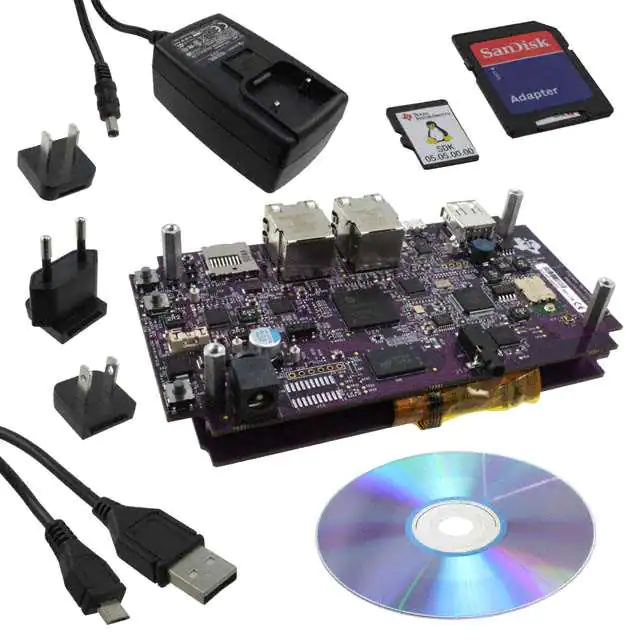
This document provides the design information on the AM335x processor based Starter Kit
(TMDSSK3358) to users.
Description
The AM335x Starter Kit (TMDSSK3358) can be used as an evaluation and development platform for
low cost AM335x based solutions and networking platforms. The embedded emulation logic allows
emulation and debug using standard development tools such as TI’s Code Composer Studio by just
using the supplied USB cable. It is not intended for use in end products. All of the design information is
freely available and can be used as the basis for the development of an AM335x based product.
EVM System View
TMDSSK3358 is partitioned into two different boards: the main board (processor, peripherals & the
main power supply) and the LCD Carrier board (LCD and touch screen). The TMDSSK3358 main
board and the LCD carrier board mounted are mounted together using 10mm standoffs. The
TMDSSK3358 main board has dimensions of 5.257” x 2.798 “and that of the LCD Carrier board is
4.963” x 2.798 “. The Top and the Bottom side views of the TMDSSK3358 are shown in the pictures
provided below.
Top view
mhtml:file://C:\Users\peggy_kraemer\Desktop\AM335xStarterKit_Web.mht
9/4/2012
�AM335xStarterKitHardwareUsersGuide - Texas Instruments Embedded Processors Wiki
Page 3 of 22
Figure 1: TMDSSK3358 Top view
Bottom view
mhtml:file://C:\Users\peggy_kraemer\Desktop\AM335xStarterKit_Web.mht
9/4/2012
�AM335xStarterKitHardwareUsersGuide - Texas Instruments Embedded Processors Wiki
Page 4 of 22
Figure 2: TMDSSK3358 V1.2A Bottom View
System view
mhtml:file://C:\Users\peggy_kraemer\Desktop\AM335xStarterKit_Web.mht
9/4/2012
�AM335xStarterKitHardwareUsersGuide - Texas Instruments Embedded Processors Wiki
Page 5 of 22
Figure 3: TMDSSK3358 System View
Functional Block Diagram
This section describes about the major functional blocks of the TMDSSK3358. The Functional block
diagram of the TMDSSK3358 design is shown below.
mhtml:file://C:\Users\peggy_kraemer\Desktop\AM335xStarterKit_Web.mht
9/4/2012
�AM335xStarterKitHardwareUsersGuide - Texas Instruments Embedded Processors Wiki
Page 6 of 22
Figure 4: TMDSSK3358 Block Diagram
Processor
The AM3358ZCZ processor is the central processor for TMDSSK3358. All the resources on the board
surround the AM3358 processor to provide development capabilities for hardware and software. See the
AM3358 datasheet and TRM for the details about the processor.
There are system configuration signals, SYSBOOT, that can be set on the EVM to define some startup
parameters on the AM335x processor. See the Configuration/Setup section later for more details.
Clocks
The main clock for the processor is derived from a 24MHz crystal. An on-board oscillator in the
AM3358 generates the base clock and subsequent module clocks as needed within the AM3358
processor. A 32kHz clock for the RTC on the AM3358 is derived from a 32kHz crystal on board.
Reset Signals
Power On Reset to the AM335x is driven by the PMIC. SYS_ WARMRESETn is a signal running to
mhtml:file://C:\Users\peggy_kraemer\Desktop\AM335xStarterKit_Web.mht
9/4/2012
�AM335xStarterKitHardwareUsersGuide - Texas Instruments Embedded Processors Wiki
Page 7 of 22
several peripherals and AM335x which performs a reset on those peripherals. SYS_WARMRESETn is
asserted by a pushbutton on the main board and is used to force a reset of the AM335x. AM335x can
also pull down on the RESET_INOUTn signal to cause the SYS_ WARMRESETn line to go active. The
RTC_PORZ reset signal for the RTC section is derived using AND Gates.
Power
The power input to TMDSSK3358 is from a 5V Power Supply. This 5V power is provided as power
input to the Power Manager TPS65910A3. The power requirements of the processor are taken care of by
the Power Manager IC TPS65910A3. The Power ON LED "D5" is ON if the PMIC output power
VAUX33 is available ( to indicate the active status of the PMIC). The power sequencing requirements
of the AM335X processor (see the AM335x datasheet) are handled automatically by the TPS65910A3
PMIC.
Note: When powering the TMDSSK3358 EVM, always use the supplied power supply (CUI/VInfinity Part Number EMSA050300-P6P-SZ, Model 3A-182WP05) or equivalent model having
output voltage of +5VDC and output current max 3.0 Amps.
Power Management IC
TMDSSK3358 uses the TPS65910A3 power management IC. The I2C0 on AM335x is used to control
the TPS65910A PMIC.
The PWRON input of PMIC is connected to an external push-button. The built-in debouncing time
defines a minimum button press duration that is required for button press detection. Any button press
duration which is lower than this value is ignored, considered an accidental touch.
For AM335x, the following power supplies from the TPS65910A are used.
TPS65910 Power Supply/Other
sources
VAUX2 (300mA)
VMMC (300mA)
VDD2 SMPS (1500mA)
VDD1 SMPS (1500mA)
No supply needed
VRTC (External LDO)
VIO_SMPS (1000mA)
VIO_SMPS (1000mA)
VDAC (150mA)
VDIG1 (300mA)
AM335x Power Rail
VDDSHV6 (300mA)
VDDSHV2,3,4,5 (300 mA), VDDA3P3V_USB0/1 (10
mA)
VDD_CORE (1000mA)
VDD_MPU (1500mA)
VDD_RTC
VDDS_RTC (10mA)
VDDS_DDR (200mA)
DDR_VREF (10mA)
VDDS (100mA)
VDDSHV1
mhtml:file://C:\Users\peggy_kraemer\Desktop\AM335xStarterKit_Web.mht
Voltage
3.3V
3.3V
1.1V
1.2V
1.1V
1.8V
1.5V
0.9V
1.8V
1.8V
9/4/2012
�AM335xStarterKitHardwareUsersGuide - Texas Instruments Embedded Processors Wiki
Page 8 of 22
VDDS_SRAM_CORE_BG
VDIG2 (300mA)
1.8V
(40mA)
VDIG2 (300mA)
VDIG2 (300mA)
VDIG2 (300mA)
VDIG2 (300mA)
VDIG2 (300mA)
VAUX1 (300mA)
VPLL (50mA)
VDD3 SMPS (100mA)
VDDS_SRAM_MPU_BB (40mA)
VDDS_PLL_DDR (25mA)
VDDS_PLL_CORE_LCD (25mA)
VDDS_PLL_MPU (25mA)
VDDS_OSC (10mA)
VDDA1P8V_USB0/1 (50mA)
VDDA_ADC
Not Used
1.8V
1.8V
1.8V
1.8V
1.8V
1.8V
1.8V
-
Table 1: Power supplies to AM335x from TPS65910A3 PMIC
Configuration/Setup
Boot Configuration
Various boot configurations can be set using the pull up / down resistor combinations provided on the
SYS_BOOT pins (LCD_DATA0..15).Boot configuration pins are latched upon de-assertion of PORz
pin.
I2C Port Address Assignments
Information on I2C address assignments are provided below.
AM335x STARTER KIT (TMDSSK3358) Function
Baseboard ID memory
AM355x PMIC Control
AM355x PMIC Smart Reflex Control
Accelerometer Control
Audio Codec
Capacitive Touch screen
AM335x I2C Port
I2C0
I2C0
I2C0
I2C0
I2C0
I2C0
Address
0x50
0x2D
0x12
0x18
0x1B
0x38
Table 2:I2C Bus Addresses
Memories Supported
The TMDSSK3358 design supports on-board memories like DDR3 SDRAM and Board ID EEPROM. It
also supports an SD card socket.
DDR3 SDRAM
DDR3 SDRAM memory design is provided by using a 2 Gb single chip solution (MT41J128M16JT-
mhtml:file://C:\Users\peggy_kraemer\Desktop\AM335xStarterKit_Web.mht
9/4/2012
�AM335xStarterKitHardwareUsersGuide - Texas Instruments Embedded Processors Wiki
Page 9 of 22
125) from Micron. It is internally configured as a16 Meg x 16 x 8 bank memory. A separate Regulator
to supply the DDR reference power to the AM335x and the VTT termination voltage to the termination
components is provided in the design. The VIO_SMPS output from the PMIC is programmed to provide
the required 1.5V to the DDR3 SDRAM.
Board Identity Memory
The board contains a serial EEPROM with the board specific data which allows the processor to
automatically detect which board is connected and the version of that board. Other hardware specific
data can be stored in this memory as well. The part number of the memory device used is
CAT24C256WI-GT3. See the Configuration/Setup section for details on the data in this memory.
Name
Header
Board Name
Version
Size
Contents
4
MSB 0xEE3355AA LSB
8
Name for board in ASCII “A335X_SK” = AM335x TMDSSK3358Board
4
Hardware version code for board in ASCII “1.2A” = rev. 01.2A
Serial number of the board. This is a 12 character string which is:
Serial Number
12
Configuration
Option
32
WWYY4P19nnnn where: WW = 2 digit week of the year of production YY
= 2 digit year of production nnnn = incrementing board number
Codes to show the configuration setup on this board. For the available
EVM’s supported, the following codes are used:
ASCII “SKU#00” = default configuration Remaining 26 bytes are reserved
Available
32720 Available space for other non-volatile codes/data
Table 3:I2C Configuration
SD/MMC0
The Micro SD/MMC0 port is provided with a card socket SCHA5B0200. This is a standard Micro
SD/MMC Card type of connector which is of the low profile compact type. It is connected to the MMC0
port of the AM335x processor. Check the AM335x data sheet and TRM for supported card
types/densities.8Gb SD cards are tested with this design. The Pin assignment is as given below.
Pin No
uSD#1
uSD#2
uSD #3
uSD #4
uSD #5
uSD #6
uSD #7
uSD #8
Memory Card PIN No.
DAT2
CD/DAT3
CMD
VCC
CLK
GND
DAT0
DAT1
mhtml:file://C:\Users\peggy_kraemer\Desktop\AM335xStarterKit_Web.mht
9/4/2012
�AM335xStarterKitHardwareUsersGuide - Texas Instruments Embedded Processors Wiki Page 10 of 22
uSD #9 GND
uSD #10 CD
Table 4: SD/MMC0 Connector Pin Details
Ethernet
TMDSSK3358 has two Giga bit Ethernet transceivers. AR8031-AL1A from Atheros is used as a single
port, tri speed PHY. A single 3.3V is enough to power this PHY and the other voltages required were
generated internally. Reset for both the chips are driven by the SYS_WARMRESETn signal through a
SN74LVC1G07 buffer.Both the PHYs have individual 25MHz, 50ppm crystal as their clock source. The
25MHz Clock out of the EMAC1-PHY port has been connected to the XTLI of the EMAC2-PHY as an
optional clock input.
For both the PHYs, mode selection pins MODE [3:0] are set as “0000” to operate it in 1000 BASE-T,
RGMII mode. The PHY address for the EMAC1-PHY and EMAC2-PHY are 00100 and 00101
respectively.The interrupts from the both PHYs are connected to both the Non Maskable Interrupt pin
and to the processor GPIO pins.
The Wake On LAN interrupts from the both PHYs are connected to the EXT_WAKEUP signal of the
processor as an option.
Pin No
1
2
3
4
5
6
7
8
9
10
D1
D2
D3
D4
Signal Name
DGND
NC
ETHER_D3P
ETHER_D3N
ETHER_D2P
ETHER_D2N
ETHER_D1P
ETHER_D1N
ETHER_D0P
ETHER_D0N
PHY_ LED_ACTn
GND
GND
PHY_ LED_1000n
Description
Ground
No connect
MDI 3 POSITIVE
MDI 3 NEGATIVE
MDI 2 POSITIVE
MDI 2 NEGATIVE
MDI 1 POSITIVE
MDI 1 NEGATIVE
MDI 0 POSITIVE
MDI 0 NEGATIVE
PHY ACTIVITY LED signal
Ground
Ground
1000 Base-T LINK LED signal
Table 5: 10/100 PRU Ethernet1 Pin Details
USB
USB to UART/JTAG
mhtml:file://C:\Users\peggy_kraemer\Desktop\AM335xStarterKit_Web.mht
9/4/2012
�AM335xStarterKitHardwareUsersGuide - Texas Instruments Embedded Processors Wiki Page 11 of 22
Micro AB USB port is provided as an upstream port of the USB HUB USB2412. This is used for USB
to JTAG and USB to UART conversion applications through the downstream port 1 of the HUB.
FT2232L is used for the USB to UART and JTAG conversion applications. The Downstream port 2 of
the Hub is connected to USB port 0 of the AM335x.
The USB to UART/JTAG converter (FT2232L) has 32 configurable multifunction pins. A 16 bit, serial
EEPROM 93LC56B from MicroChip is used to store the configuration data. Some of the pins from
ADBUS [7:0] and ACBUS [7:0] are configured as JTAG and Reset signals. These JTAG pins from the
FT2232 IC are connected to the dedicated processor JTAG pins and as well to the optional JTAG
connector.
The Micro AB USB pin out details are provided below.
Pin No
1
2
3
4
5
Signal Name
USB_DC
USBDM_UP
USBDP_UP
NC (USB_ID)
DGND
Description
USB BUS VOLTAGE
USB DATA MINUS
USB DATA PLUS
No connect
Ground
Table 6: Micro AB – USB0
USB 1
The USB port1 of the AM335x is connected to the USB type A connector. USB power (5V )is provided
to this connector through a buck-boost converter circuit.
Pin No
1
2
3
4
Signal Name
VUSB_VBUS1
USB1_CONN_DM
USB1_CONN_DP
DGND
Description
USB BUS VOLTAGE
USB1 DATA MINUS
USB1 DATA PLUS
Ground
Table 7: USB A Type – USB1
Audio Codec
The TLV320AIC3106 is a low-power stereo audio codec with stereo headphone amplifier from TI.
CLKOUT1 of the processor is sourcing the master clock of the codec (24Mhz). The CODEC I2C is
capable of supporting both the standard and fast modes. I2C address of the codec is configured as
0011011. MCASP1 interface of the processor is connected to the audio interface of the codec. The
stereo audio output is terminated in a stereo headphone Jack. The Pinout assignments for the headset
jack are provided below.
mhtml:file://C:\Users\peggy_kraemer\Desktop\AM335xStarterKit_Web.mht
9/4/2012
�AM335xStarterKitHardwareUsersGuide - Texas Instruments Embedded Processors Wiki Page 12 of 22
Pin No
1
3
10
2
Signal
AGND_AUD
HS_SPKRP
NC
HD_SPKRP
Description
Analog Ground
Headset stereo LOUT
No Connect
Headset stereo ROUT
Table 8: Headset Jack
WLAN
LBEE5ZSTNC-523 Type TN WiFi / BT Module from Murata is used to provide the WLAN and the
Bluetooth connectivity for the TMDSSK3358 design. The WLAN design has IEEE802.11 b, g, n
compliance for WLAN and Version4.0 with Blue tooth Low Energy (BLE) for BT. This module
requires an external 32.768 KHz, +/-150ppm clock. This is sourced by the CLKOUT2 clock out pin of
the processor. The required digital interfaces for the module are connected to the UART1 and McASP0
ports of the processor through voltage level converters.
Note that due to a HW bug in the WiFi Antenna matching network design, customers may observe
significant degradation in throughput (15-20 Mbps - Typical) as well as reduced WiFi Range when
using the AM335x Starter Kit and COM6M module with AM335-EVM, with the onboard WiFi
Antenna.
For optimal throughput we recomend using an external Antenna as describe in the link:
Warning: To minimize risks of potential radiation hazards associated with handling and/or
moving the energized EVM including compliance with the wireless radio grant licensing
provisions, always maintain a minimum distance of 20cm measured between EVM user(s) and the
EVM antenna.
User LEDs
The Four User LEDs implemented are D1-D4 in the user panel area. These are driven by the GPIOs
from the AM335x.
All the user LEDs are green in color.
User Keys
This design has 4 user keys SW1,SW2,SW3 & SW4, three of them connected directly to the GPIO
bank2 of the processor (Keys 2,3 & 4) and one of them (Key 1) connected to the GPIO bank0 of the
processor.
Apart from the above four user keys, the design also has a button to interrupt the processor via the non
maskable interrupt pin.
mhtml:file://C:\Users\peggy_kraemer\Desktop\AM335xStarterKit_Web.mht
9/4/2012
�AM335xStarterKitHardwareUsersGuide - Texas Instruments Embedded Processors Wiki Page 13 of 22
Accelerometer
The LIS331DLH is an ultra low-power high performance three axes linear accelerometer used in
TMDSSK3358 board. The accelerometer is mounted closer to the center of the board as to allow the
most useful/dynamic data. The accelerometer is connected via I2C0 of the processor. The I2C(0) address
is 0011000b.
Pin Use Description
The Pin use description file provides us the information on the pin functionality mode selected. The pin
mux utility file is found here File:TMDSSK3358 V1 2 Pin Mux.dat
GPIO Definitions
See the updated pinmux document File:TMDSSK3358 V1 2 Pin Mux.xlsx which shows the use case
columns for GPIOs.
Board Expansion Connectors
The SPI0 and the I2C0 ports are extended through the connectors J11 and J8 respectively. SPI0
Expansion header pinout is provided below.
Pin No
1
2
3
4
5
6
Signal
Description
V3_3D
Power 3.3V supply
AM335X_SPI0_CS0 SPI0 Chip Select 0
AM335X_SPI0_D1
SPI0 Data 1
DGND
Ground
AM335X_SPI0_SCLK SPI0 Clock
AM335X_SPI0_D0
SPI0 Data 0
Table 9: SPI0 Expansion Header
I2C0 Expansion header is provided below.
Pin No
1
2
3
4
Signal
Description
DGND
Ground
AM335X_I2C0_SDA I2C0 DATA
AM335X_I2C0_SCL I2C0 Clock
V3_3D
Power 3.3V supply
mhtml:file://C:\Users\peggy_kraemer\Desktop\AM335xStarterKit_Web.mht
9/4/2012
�AM335xStarterKitHardwareUsersGuide - Texas Instruments Embedded Processors Wiki Page 14 of 22
Table 10: I2C0 Expansion Header
LCD
TFT color LCD module from Newhaven Display NHD-4.3-480272MF-ATXI#-T-1 with resistive touch
screen shall be used as the LCD display for the TMDSSK3358 design. It is 4.3 inches wide and it has a
built in driver and no controller is required. It has 480 X 272 pixels and supports up to 16.7M colors.
This LCD supports white LED backlight. 24bit RGB signals, control signals and Resistive touch screen
signals are terminated in a flex PCB with a 40 pin connector that fits into the TMDSSK3358 main board
using a mating connector.
40 pin LCD connector pinout is provided here.
Pin No
1
2
3
4
5
6
7
8
9
10
11
12
13
14
15
16
17
18
19
20
21
22
23
24
25
26
Signal
LEDLED+
DGND
VCC
R0
R1
R2
R3
R4
R5
R6
R7
G0
G1
G2
G3
G4
G5
G6
G7
B0
B1
B2
B3
B4
B5
Description
Backlight LED power supply GND
Backlight LED power supply voltage
Ground
3.3V LCD Power Supply
Red Data0
Red Data1
Red Data2
Red Data3
Red Data4
Red Data5
Red Data6
Red Data7
Green Data0
Green Data1
Green Data2
Green Data3
Green Data4
Green Data5
Green Data6
Green Data7
Blue Data0
Blue Data1
Blue Data2
Blue Data3
Blue Data4
Blue Data5
mhtml:file://C:\Users\peggy_kraemer\Desktop\AM335xStarterKit_Web.mht
9/4/2012
�AM335xStarterKitHardwareUsersGuide - Texas Instruments Embedded Processors Wiki Page 15 of 22
27
28
29
30
31
32
33
34
35
36
37
38
39
40
B6
B7
GND
PCLK
DISP
HSYNC
VSYNC
DE
AVDD
GND
XR
YD
XL
YU
Blue Data6
Blue Data7
Ground
Data Sample clock signal
Display ON/OFF signal
Line Sync signal
Frame Sync signal
Data enable
No connect
Ground
Touch Panel Right
Touch Panel Down
Touch Panel Left
Touch Panel Up
Table 11 :LCD Connector
EVM Important Notice
EVALUATION BOARD/KIT/MODULE (EVM) ADDITIONAL
TERMS
Texas Instruments (TI) provides the enclosed Evaluation Board/Kit/Module (EVM) under the following
conditions:
The user assumes all responsibility and liability for proper and safe handling of the goods. Further, the
user indemnifies TI from all claims arising from the handling or use of the goods.
Should this evaluation board/kit not meet the specifications indicated in the User's Guide, the board/ kit
may be returned within 30 days from the date of delivery for a full refund. THE FOREGOING
LIMITED WARRANTY IS THE EXCLUSIVE WARRANTY MADE BY SELLER TO BUYER AND
IS IN LIEU OF ALL OTHER WARRANTIES, EXPRESSED, IMPLIED, OR STATUTORY,
INCLUDING ANY WARRANTY OF MERCHANTABILITY OR FITNESS FOR ANY
PARTICULAR PURPOSE. EXCEPT TO THE EXTENT OF THE INDEMNITY SET FORTH
ABOVE, NEITHER PARTY SHALL BE LIABLE TO THE OTHER FOR ANY INDIRECT,
SPECIAL, INCIDENTAL, OR CONSEQUENTIAL DAMAGES.
Please read the User's Guide and, specifically, the Warnings and Restrictions notice in the User's Guide
prior to handling the product. This notice contains important safety information about temperatures and
voltages. For additional information on TI's environmental and/or safety programs, please visit [http://www.ti.com/esh]www.ti.com/esh or contact TI.
mhtml:file://C:\Users\peggy_kraemer\Desktop\AM335xStarterKit_Web.mht
9/4/2012
�AM335xStarterKitHardwareUsersGuide - Texas Instruments Embedded Processors Wiki Page 16 of 22
No license is granted under any patent right or other intellectual property right of TI covering or relating
to any machine, process, or combination in which such TI products or services might be or are used. TI
currently deals with a variety of customers for products, and therefore our arrangement with the user is
not exclusive. TI assumes no liability for applications assistance, customer product design, software
performance, or infringement of patents or services described herein.
Mailing Address: Texas Instruments Post Office Box 655303 Dallas, Texas 75265
Copyright 2011, Texas Instruments Incorporated
REGULATORY COMPLIANCE INFORMATION
As noted in the EVM User’s Guide and/or EVM itself, this EVM and/or accompanying hardware may or
may not be subject to the Federal Communications Commission (FCC) and Industry Canada (IC) rules
For EVMs not subject to the above rules, this evaluation board/kit/module is intended for use for
ENGINEERING DEVELOPMENT, DEMONSTRATION OR EVALUATION PURPOSES ONLY and
is not considered by TI to be a finished end product fit for general consumer use. It generates, uses, and
can radiate radio frequency energy and has not been tested for compliance with the limits of computing
devices pursuant to part 15 of FCC or ICES-003 rules, which are designed to provide reasonable
protection against radio frequency interference. Operation of the equipment may cause interference with
radio communications, in which case the user at his own expense will be required to take whatever
measures may be required to correct this interference.
General Statement for EVMs including a radio
User Power/Frequency Use Obligations: This radio is intended for development/professional use only in
legally allocated frequency and power limits. Any use of radio frequencies and/or power availability of
this EVM and its development application(s) must comply with local laws governing radio spectrum
allocation and power limits for this evaluation module. It is the user's sole responsibility to only operate
this radio in legally acceptable frequency space and within legally mandated power limitations. Any
exceptions to this is strictly prohibited and unauthorized by Texas Instruments unless user has obtained
appropriate experimental/development licenses from local regulatory authorities, which is responsibility
of user including its acceptable authorization.
For EVMs annotated as FCC – FEDERAL COMMUNICATIONS COMMISSION Part 15
Compliant
Caution
This device complies with part 15 of the FCC Rules. Operation is subject to the following two
conditions: (1) This device may not cause harmful interference, and (2) this deice must accept any
interference received, including interference that may cause undesired operation.
mhtml:file://C:\Users\peggy_kraemer\Desktop\AM335xStarterKit_Web.mht
9/4/2012
�AM335xStarterKitHardwareUsersGuide - Texas Instruments Embedded Processors Wiki Page 17 of 22
Changes or modifications not expressly approved by the party responsible for compliance could void the
user's authority to operate the equipment.
FCC Interference Statement for Class A EVM devices
This equipment has been tested and found to comply with the limits for a Class A digital device,
pursuant to part 15 of the FCC Rules. These limits are designed to provide reasonable protection against
harmful interference when the equipment is operated in a commercial environment. This equipment
generates, uses, and can radiate radio frequency energy and, if not installed and used in accordance with
the instruction manual, may cause harmful interference to radio communications. Operation of this
equipment in a residential area is likely to cause harmful interference in which case the user will be
required to correct the interference at his own expense.
FCC Interference Statement for Class B EVM devices
This equipment has been tested and found to comply with the limits for a Class B digital device,
pursuant to part 15 of the FCC Rules. These limits are designed to provide reasonable protection against
harmful interference in a residential installation. This equipment generates, uses and can radiate radio
frequency energy and, if not installed and used in accordance with the instructions, may cause harmful
interference to radio communications. However, there is no guarantee that interference will not occur in
a particular installation. If this equipment does cause harmful interference to radio or television
reception, which can be determined by turning the equipment off and on, the user is encouraged to try to
correct the interference by one or more of the following measures:
Reorient or relocate the receiving antenna.
Increase the separation between the equipment and receiver.
Connect the equipment into an outlet on a circuit different from that to which the receiver is
connected.
Consult the dealer or an experienced radio/TV technician for help.
For EVMs annotated as IC – INDUSTRY CANADA Compliant
This Class A or B digital apparatus complies with Canadian ICES-003.
Changes or modifications not expressly approved by the party responsible for compliance could void the
user's authority to operate the equipment.
Concerning EVMs including radio transmitters
This device complies with Industry Canada licence-exempt RSS standard(s). Operation is subject to the
following two conditions: (1) this device may not cause interference, and (2) this device must accept any
mhtml:file://C:\Users\peggy_kraemer\Desktop\AM335xStarterKit_Web.mht
9/4/2012
�AM335xStarterKitHardwareUsersGuide - Texas Instruments Embedded Processors Wiki Page 18 of 22
interference, including interference that may cause undesired operation of the device.
Concerning EVMs including detachable antennas
Under Industry Canada regulations, this radio transmitter may only operate using an antenna of a type
and maximum (or lesser) gain approved for the transmitter by Industry Canada. To reduce potential
radio interference to other users, the antenna type and its gain should be so chosen that the equivalent
isotropically radiated power (e.i.r.p.) is not more than that necessary for successful communication.
This radio transmitter has been approved by Industry Canada to operate with the antenna types listed in
the user guide with the maximum permissible gain and required antenna impedance for each antenna
type indicated. Antenna types not included in this list, having a gain greater than the maximum gain
indicated for that type, are strictly prohibited for use with this device.
\~
Cet appareil numérique de la classe A ou B est conforme à la norme NMB-003 du Canada.
Les changements ou les modifications pas expressément approuvés par la partie responsable de la
conformité ont pu vider l'autorité de l'utilisateur pour actionner l'équipement.
Concernant les EVMs avec appareils radio
Le présent appareil est conforme aux CNR d'Industrie Canada applicables aux appareils radio exempts
de licence. L'exploitation est autorisée aux deux conditions suivantes : (1) l'appareil ne doit pas produire
de brouillage, et (2) l'utilisateur de l'appareil doit accepter tout brouillage radioélectrique subi, même si
le brouillage est susceptible d'en compromettre le fonctionnement.
Concernant les EVMs avec antennes détachables
Conformément à la réglementation d'Industrie Canada, le présent émetteur radio peut fonctionner avec
une antenne d'un type et d'un gain maximal (ou inférieur) approuvé pour l'émetteur par Industrie
Canada. Dans le but de réduire les risques de brouillage radioélectrique à l'intention des autres
utilisateurs, il faut choisir le type d'antenne et son gain de sorte que la puissance isotrope rayonnée
équivalente (p.i.r.e.) ne dépasse pas l'intensité nécessaire à l'établissement d'une communication
satisfaisante.
Le présent émetteur radio a été approuvé par Industrie Canada pour fonctionner avec les types d'antenne
énumérés dans le manuel d'usage et ayant un gain admissible maximal et l'impédance requise pour
chaque type d'antenne. Les types d'antenne non inclus dans cette liste, ou dont le gain est supérieur au
gain maximal indiqué, sont strictement interdits pour l'exploitation de l'émetteur.
mhtml:file://C:\Users\peggy_kraemer\Desktop\AM335xStarterKit_Web.mht
9/4/2012
�AM335xStarterKitHardwareUsersGuide - Texas Instruments Embedded Processors Wiki Page 19 of 22
【Important Notice for Users of this Product in Japan】
This development kit is NOT certified as Confirming to Technical Regulations of Radio Law of
Japan!
If you use this product in Japan, you are required by Radio Law of Japan to follow the instructions
below with respect to this product:
(1) Use this product in a shielded room or any other test facility as defined in the notification \#173
issued by Ministry of Internal Affairs and Communications on March 28, 2006, based on Sub-section
1.1 of Article 6 of the Ministry's Rule for Enforcement of Radio Law of Japan,
(2) Use this product only after you obtained the license of Test Radio Station as provided in Radio Law
of Japan with respect to this product, or
(3) Use of this product only after you obtained the Technical Regulations Conformity Certification as
provided in Radio Law of Japan with respect to this product. Also, please do not transfer this product,
unless you give the same notice above to the transferee. Please note that if you could not follow the
instructions above, you will be subject to penalties of Radio Law of Japan.
Texas Instruments Japan Limited
(address) 24-1, Nishi-Shinjuku 6 chome, Shinjukku-ku, Tokyo, Japan
http://www.tij.co.jp/
【ご使用にあたっての注意】
本開発キットは技術基準適合証明を受けておりません。
本製品のご使用に際しては、電波法遵守のため、以下のいずれかの措置を取っていただく必要が
ありますのでご注意ください。
(1)電波法施行規則第6条第1項第1号に基づく平成18年3月28日総務省告示第173号で定められ
た電波暗室等の試験設備でご使用いただく。
(2)実験局の免許を取得後ご使用いただく。
(3)技術基準適合証明を取得後ご使用いただく。
なお、本製品は、上記の「ご使用にあたっての注意」を譲渡先、移転先に通知しない限り、譲渡、移転できないものとします。
上記を遵守頂けない場合は、電波法の罰則が適用される可能性があることをご留意くださ
い。
日本テキサス・インスツルメンツ株式会社
mhtml:file://C:\Users\peggy_kraemer\Desktop\AM335xStarterKit_Web.mht
9/4/2012
�AM335xStarterKitHardwareUsersGuide - Texas Instruments Embedded Processors Wiki Page 20 of 22
東京都新宿区西新宿6丁目24番1号
西新宿三井ビル
http://www.tij.co.jp/
EVALUATION BOARD/KIT/MODULE (EVM)WARNINGS,
RESTRICTIONS AND DISCLAIMERS
For Feasibility Evaluation Only, in Laboratory/Development Environments. Unless otherwise
indicated, this EVM is not a finished electrical equipment and not intended for consumer use. It is
intended solely for use for preliminary feasibility evaluation in laboratory/development environments by
technically qualified electronics experts who are familiar with the dangers and application risks
associated with handling electrical mechanical components, systems and subsystems. It should not be
used as all or part of a finished end product.
Your Sole Responsibility and Risk. You acknowledge, represent and agree that:
1. You have unique knowledge concerning Federal, State and local regulatory requirements
(including but not limited to Food and Drug Administration regulations, if applicable) which
relate to your products and which relate to your use (and/or that of your employees, affiliates,
contractors or designees) of the EVM for evaluation, testing and other purposes.
2. You have full and exclusive responsibility to assure the safety and compliance of your products
with all such laws and other applicable regulatory requirements, and also to assure the safety of
any activities to be conducted by you and/or your employees, affiliates, contractors or designees,
using the EVM. Further, you are responsible to assure that any interfaces (electronic and/or
mechanical) between the EVM and any human body are designed with suitable isolation and
means to safely limit accessible leakage currents to minimize the risk of electrical shock hazard.
3. You will employ reasonable safeguards to ensure that your use of the EVM will not result in any
property damage, injury or death, even if the EVM should fail to perform as described or
expected.
4. You will take care of proper disposal and recycling of the EVM's electronic components and
packing materials
Certain Instructions. It is important to operate this EVM within the input voltage range of 2.7 V to 5.5
V and the output voltage range of -10 V to 15 V. Exceeding these EVM ratings may cause property
damage, personal injury or death. If there are questions concerning these ratings please contact a TI field
representative prior to connecting interface electronics including input power and intended loads. Any
loads applied outside of the specified output range may result in unintended and/or inaccurate operation
and/or possible permanent damage to the EVM and/or interface electronics. Please consult the EVM
User's Guide prior to connecting any load to the EVM output. If there is uncertainty as to the load
specification, please contact a TI field representative. During normal operation, some circuit
components may have case temperatures greater than 60°C as long as the input and output are
maintained at a normal ambient operating temperature. These components include but are not limited to
linear regulators, switching transistors, pass transistors, and current sense resistors which can be
identified using the EVM schematic located in the EVM User's Guide. When placing measurement
mhtml:file://C:\Users\peggy_kraemer\Desktop\AM335xStarterKit_Web.mht
9/4/2012
�AM335xStarterKitHardwareUsersGuide - Texas Instruments Embedded Processors Wiki Page 21 of 22
probes near these devices during normal operation, please be aware that these devices may be very
warm to the touch. As with all electronic evaluation tools, only qualified personnel knowledgeable in
electronic measurement and diagnostics normally found in development environments should use these
EVMs.
Agreement to Defend, Indemnify and Hold Harmless. You agree to defend, indemnify and hold TI,
its licensors and their representatives harmless from and against any and all claims, damages, losses,
expenses, costs and liabilities (collectively, "Claims") arising out of or in connection with any use of the
EVM that is not in accordance with the terms of the agreement. This obligation shall apply whether
Claims arise under law of tort or contract or any other legal theory, and even if the EVM fails to perform
as described or expected.
Safety-Critical or Life-Critical Applications. If you intend to evaluate the components for possible
use in safety critical applications (such as life support) where a failure of the TI product would
reasonably be expected to cause severe personal injury or death, such as devices which are classified as
FDA Class III or similar classification, then you must specifically notify TI of such intent and enter into
a separate Assurance and Indemnity Agreement.
ANNEX
This Hardware User's Guide is prepared by using the following documents as references.
1. AM335x Sitara ARM Microprocessors TRM (SPRUH73)
For technical support please post your questions at
http://e2e.ti.com/. Please post only comments about the
article AM335xStarterKitHardwareUsersGuide here.
Links
ARM
Digital
Digital
ARM
Microcontroller Multi Core
Microcontroller
Media
Signal
Processor
MCU
Processor
MCU
Processor Processing
Ultra Low
8 bit Microcontroller 16 bit Microcontroller 32 bit Microcontroller
Power DSP
MCU
MCU
MCU
Retrieved from "http://processors.wiki.ti.com/index.php/AM335xStarterKitHardwareUsersGuide"
Categories: AM335x | AM335xHW
Leave a Comment
Comments
Comments on AM335xStarterKitHardwareUsersGuide
mhtml:file://C:\Users\peggy_kraemer\Desktop\AM335xStarterKit_Web.mht
9/4/2012
�AM335xStarterKitHardwareUsersGuide - Texas Instruments Embedded Processors Wiki Page 22 of 22
Anunakin said ...
I see 2GB as RAM size, its OK? because estore.ti.com show me 256MB, I think 256MB is correct.
--Anunakin 18:10, 31 August 2012 (CDT)
This page was last modified on 4 September 2012, at 03:11.
This page has been accessed 1,439 times.
Content is available under Creative Commons Attribution-Share Alike 3.0 license.
Privacy policy
About Texas Instruments Embedded Processors Wiki
Disclaimers
mhtml:file://C:\Users\peggy_kraemer\Desktop\AM335xStarterKit_Web.mht
9/4/2012
�