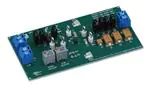
Using the TPS211xADRB EVM
User's Guide
Literature Number: SLUU409
February 2010
�User's Guide
SLUU409 – February 2010
TPS211xADRB EVM, Power Multiplexer Evaluation Module
1
Introduction
The TPS211xA EVM is an evaluation module for the Texas Instruments TPS211xA family of two-input,
one-output power multiplexers. These multiplexers enable seamless transition between two power
supplies, each operating at 2.8 V-5.5 V and delivering up to 1 A. TPS211xA EVM-061 is used for
TPS211xAPW packaged parts. The TPS211xA EVM-581 is used for TPS211xADRB packaged parts and
described in this user's guide which contains the EVM schematics, board layout, list of materials and
configuration materials.
The EVM has test points for convenient access to all critical node voltages, potentiometers for adjusting
the current limit and the auto-switching voltage sense thresholds, headers for selecting the
manual/auto-switching operating modes, and headers for selecting the output hold-up capacitance.
2
EVM Setup
This chapter describes the proper setup of the TPS211xAEVM for use indevice evaluations.
2.1
Setting Up the EVM
The user is encouraged to read the applicable TPS211xA data sheet before using the EVM.
The following test equipment is recommended:
• Storage oscilloscope
• Current probe
• Two adjustable power supplies, 0 V - 6 V @ 2-A
• Volt-Ohm meter
• A passive or active load
V1
RL
V2
Figure 1. Basic EVM Setup
2
TPS211xADRB EVM, Power Multiplexer Evaluation Module
Copyright © 2010, Texas Instruments Incorporated
SLUU409 – February 2010
Submit Documentation Feedback
�EVM Setup
www.ti.com
2.2
Current-Limit Adjustment
Potentiometer R4 controls the resistance RILIM that sets the TPS211xA current limit threshold. Adjusting
R4 clockwise increases the current limit threshold by decreasing RILIM. The current limit threshold is
500/RILIM for the TPS2113A and TPS2115A.
To measure the resistance RILIM, connect an ohmmeter between test points TP4 and GND. The
measurement should be made with the IN1 and IN2 supplies off. To ensure accurate in-circuit resistance
measurements, the ohmmeter must apply no more than 0.5 V across the resistor.
2.3
Manual Switching Mode (TPS2115A Only)
Potentiometer R2 and header J4 do not affect the operation of the manual switching mode.
Some products like digital cameras and hand-held devices that receive power from an internal battery or
from a docking station can take advantage of the manual-switching feature. The TPS2115A digital control
input, D1, can directly sense the presence of the docking station and connect the load to the appropriate
power source.
2.3.1
Configuring the TPS2115A for Manual Switching
To place the device into manual switching mode, short header J2. The logic level on the D1 pin
determines which input is selected. On the EVM, header J3 controls the D1 pin. If J3 is left open, then D1
is internally pulled high and IN1 is selected. If J3 is shorted, then D1 is pulled low and IN2 is selected.
2.4
Automatic Switching Modes
All EVMs support Mode 1 automatic switching. Mode 2 automatic switching is supported by the TPS2113A
EVM only.
2.4.1
Mode 1 Automatic Switching
OUT connects to the higher of IN1 and IN1 in Mode 1 automatic switching. Refer to Table 2-1 to configure
the EVM for Mode 1 automatic switching.
Table 1. EVM Shorting Jumper Placement for Mode 1 Automatic Switching
EVM
DEVICE
HPA581-001
TPS2113A
HPA581-002
TPS2115A
HEADER
J1
J2
J3
J4
OUT
IN
OUT
OUT
OUT
OUT
IN
OUT
A manufacturer can provide a secondary battery pack option to extend the product run time with Mode 1
automatic switching. The TPS211xA cycles between the primary and secondary batteries until both
batteries are drained.
SLUU409 – February 2010
Submit Documentation Feedback
TPS211xADRB EVM, Power Multiplexer Evaluation Module
Copyright © 2010, Texas Instruments Incorporated
3
�EVM Setup
2.4.2
www.ti.com
Mode 2 Automatic Switching (TPS2113A Only)
In Mode 2 automatic switching, OUT connects to IN1 if the voltage at IN1 is sufficiently high; otherwise,
OUT connects to the higher of IN1 and IN2. The threshold at which IN1 is selected corresponds to
approximately 0.8 V at test point TP3. The corresponding value of the IN1 voltage depends upon the
setting of potentiometer R2. Adjusting R2 clockwise increases the IN1 selection threshold voltage.
Table 2. EVM Shorting Jumper Placement for Mode 2 Automatic Switching
EVM
DEVICE
HPA581-002
HEADER
J1
J2
J3
J4
OUT
IN
OUT
IN
A manufacturer can provide a secondary battery pack option to extend the product run time with Mode 2
automatic switching. The TPS2110A-TPS2113A drains the primary battery at IN1 and automatically
switches to the secondary battery at IN2.
2.5
Output Voltage Holdup
Headers J5-J8 select the output holdup capacitance.
The output voltage drops out for 60 ms (max) whenever the TPS211xA switches between the IN1 and IN2
supplies. Some capacitance at the TPS211xA output is necessary to prevent the output voltage from
dropping too much during the supply switchover. Excessive voltage drop can cause a system to reset or
lose data.
2.6
Switch Status
The switch status output can be monitored at the positive terminal of header J1. A switch status output
equal to logic 1 corresponds to an IN2 switch that is on.
4
TPS211xADRB EVM, Power Multiplexer Evaluation Module
Copyright © 2010, Texas Instruments Incorporated
SLUU409 – February 2010
Submit Documentation Feedback
�Schematic and List of Materials
www.ti.com
3
Schematic and List of Materials
This chapter provides the TPS211xAEVM schematic and list of materials.
3.1
EVM Configurations
Table 3. Available EVM Configurations
3.2
EVM
DESIGNATOR
DEVICE
CURRENT-LIMIT
ADJUSTMANT
RANGE
SWITCH STATUS
OUTPUT
SWITCHING MODE
AUTOMATIC
HPA581-001
TPS2113A
0.63 A to 1.25 A
Yes
Yes
No
HPA581-002
TPS2115A
0.63 A to 1.25 A
Yes
Yes
Yes
MANUAL
Schematic
Figure 2. TPS211xAEVM Schematic
Table 4.
U1
R1
R2
R3
R5
CURRENT LIMIT
TPS2113A
10 kΩ
10 kΩ
681 Ω
392 Ω
0.63 A to 1.25 A
TPS2115A
10 kΩ
-
681 Ω
392 Ω
0.63 A to 1.25 A
SLUU409 – February 2010
Submit Documentation Feedback
TPS211xADRB EVM, Power Multiplexer Evaluation Module
Copyright © 2010, Texas Instruments Incorporated
5
�Schematic and List of Materials
3.3
www.ti.com
List of Materials
Table 5. TPS2113A/5A List of Materials (1) (2) (3) (4)
-002
(1)
(2)
(3)
(4)
6
-001
RefDes
Description
PART NUMBER
MFR
1206R104K9B20
D
Philips
2
2
C1, C2
Capacitor, ceramic, 0.1 µF, 50 V, X&R, 10%,
1206
1
1
C3
Capacitor, tantalum, 10 µF, 10 V, 20%, 3528
293D106X0010B2
T
Vishay
3
3
C4, C5, C6
Capacitor, tantalum, 100 µF, 10 V, 20%, 7343
(D)
293D107X0010D2
T
Vishay
8
8
J1, J2, J3, J4, J5,
J6, J7, J8
Header, male 2 pin, 100-mil spacing, 0.100 inch
x 2 inch
PEC02SAAN
Sullins
3
3
J9, J10, J11
Terminal block, 2 pin, 6 A, 3.5 mm, 0.27 inch x
0.25 inch
ED555/2DS
OST
1
1
R1
Resistor, chip, 10 kΩ, 1/10 W, 1%, 0805
ERJ-ENCF1002
Panasonic
3266W-1-103
Bourns
STD
Vishay
3266W-1-102
Bourns
0
1
R2
Potentiometer, 10 kΩ, 0.25 W, 12 turn,
top-adjust, 0.25 inch x 0.17 inch
1
1
R3
Resistor, chip, 681 Ω, 1/10 W, 1%, 0805
1
1
R4
Potentiometer, 1 kΩ, 0.25 W 10% , 12 turn,
top-adjust, 0.25 inch x 0.17 inch
1
1
R5
Resistor, chip, 392 Ω, 1/10 W, 1%, 0805
STD
Vishay
5
5
TP1, TP2, TP3,
TP4, TP7
Test point, white, 0.250 inch
5012
Keystone
2
2
TP5, TP6
Test point, SM, square, 0.185 inch x 0.135 inch
5016
Keystone
0
1
U1
Auto switching power mux, SON-8
TPS2114/5ADRB
TI
1
0
U1
Auto switching power mux, SON-8
TPS2114/5ADRB
TI
These assemblies are ESD sensitive, ESD precautions shall be observed.
These assemblies must be clean and free from flux and all contaminants. Use of no clean flux is not acceptable.
These assemblies must comply with workmanship standards IPC-A-610 Class 2.
Ref designators marked with an asterisk ('**') cannot be substituted. All other components can be substituted with equivalent
MFG's components.
TPS211xADRB EVM, Power Multiplexer Evaluation Module
Copyright © 2010, Texas Instruments Incorporated
SLUU409 – February 2010
Submit Documentation Feedback
�Board Layout
www.ti.com
4
Board Layout
This chapter describes the TPS211xAEVM board layout and presents some component placement
considerations.
4.1
Layout Considerations
The IN1, IN2, and OUT pins of the TPS211xA can carry up to 1 A, so traces to these pins should be of
suitable length and width to minimize the voltage drop to the load. Locate the 0.1 mF bypass capacitors
close to the IN1, IN2, and GND pins of the TPS211xA.
Figure 3. Top-Side Layout
Figure 4. Bottom-Side Layout
SLUU409 – February 2010
Submit Documentation Feedback
TPS211xADRB EVM, Power Multiplexer Evaluation Module
Copyright © 2010, Texas Instruments Incorporated
7
�IMPORTANT NOTICE
Texas Instruments Incorporated and its subsidiaries (TI) reserve the right to make corrections, modifications, enhancements, improvements,
and other changes to its products and services at any time and to discontinue any product or service without notice. Customers should
obtain the latest relevant information before placing orders and should verify that such information is current and complete. All products are
sold subject to TI’s terms and conditions of sale supplied at the time of order acknowledgment.
TI warrants performance of its hardware products to the specifications applicable at the time of sale in accordance with TI’s standard
warranty. Testing and other quality control techniques are used to the extent TI deems necessary to support this warranty. Except where
mandated by government requirements, testing of all parameters of each product is not necessarily performed.
TI assumes no liability for applications assistance or customer product design. Customers are responsible for their products and
applications using TI components. To minimize the risks associated with customer products and applications, customers should provide
adequate design and operating safeguards.
TI does not warrant or represent that any license, either express or implied, is granted under any TI patent right, copyright, mask work right,
or other TI intellectual property right relating to any combination, machine, or process in which TI products or services are used. Information
published by TI regarding third-party products or services does not constitute a license from TI to use such products or services or a
warranty or endorsement thereof. Use of such information may require a license from a third party under the patents or other intellectual
property of the third party, or a license from TI under the patents or other intellectual property of TI.
Reproduction of TI information in TI data books or data sheets is permissible only if reproduction is without alteration and is accompanied
by all associated warranties, conditions, limitations, and notices. Reproduction of this information with alteration is an unfair and deceptive
business practice. TI is not responsible or liable for such altered documentation. Information of third parties may be subject to additional
restrictions.
Resale of TI products or services with statements different from or beyond the parameters stated by TI for that product or service voids all
express and any implied warranties for the associated TI product or service and is an unfair and deceptive business practice. TI is not
responsible or liable for any such statements.
TI products are not authorized for use in safety-critical applications (such as life support) where a failure of the TI product would reasonably
be expected to cause severe personal injury or death, unless officers of the parties have executed an agreement specifically governing
such use. Buyers represent that they have all necessary expertise in the safety and regulatory ramifications of their applications, and
acknowledge and agree that they are solely responsible for all legal, regulatory and safety-related requirements concerning their products
and any use of TI products in such safety-critical applications, notwithstanding any applications-related information or support that may be
provided by TI. Further, Buyers must fully indemnify TI and its representatives against any damages arising out of the use of TI products in
such safety-critical applications.
TI products are neither designed nor intended for use in military/aerospace applications or environments unless the TI products are
specifically designated by TI as military-grade or "enhanced plastic." Only products designated by TI as military-grade meet military
specifications. Buyers acknowledge and agree that any such use of TI products which TI has not designated as military-grade is solely at
the Buyer's risk, and that they are solely responsible for compliance with all legal and regulatory requirements in connection with such use.
TI products are neither designed nor intended for use in automotive applications or environments unless the specific TI products are
designated by TI as compliant with ISO/TS 16949 requirements. Buyers acknowledge and agree that, if they use any non-designated
products in automotive applications, TI will not be responsible for any failure to meet such requirements.
Following are URLs where you can obtain information on other Texas Instruments products and application solutions:
Products
Applications
Amplifiers
amplifier.ti.com
Audio
www.ti.com/audio
Data Converters
dataconverter.ti.com
Automotive
www.ti.com/automotive
DLP® Products
www.dlp.com
Communications and
Telecom
www.ti.com/communications
DSP
dsp.ti.com
Computers and
Peripherals
www.ti.com/computers
Clocks and Timers
www.ti.com/clocks
Consumer Electronics
www.ti.com/consumer-apps
Interface
interface.ti.com
Energy
www.ti.com/energy
Logic
logic.ti.com
Industrial
www.ti.com/industrial
Power Mgmt
power.ti.com
Medical
www.ti.com/medical
Microcontrollers
microcontroller.ti.com
Security
www.ti.com/security
RFID
www.ti-rfid.com
Space, Avionics &
Defense
www.ti.com/space-avionics-defense
RF/IF and ZigBee® Solutions www.ti.com/lprf
Video and Imaging
www.ti.com/video
Wireless
www.ti.com/wireless-apps
Mailing Address: Texas Instruments, Post Office Box 655303, Dallas, Texas 75265
Copyright © 2010, Texas Instruments Incorporated
�