User's Guide
SLVUA42A – February 2014 – Revised March 2014
Using the TPS22961EVM-067 Single Channel Load Switch
IC
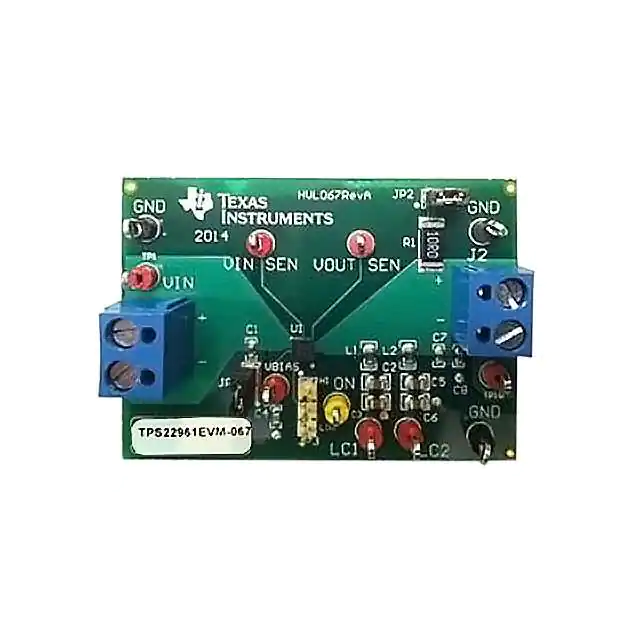
The TPS22961EVM-067 evaluation module (EVM) allows the user to connect power to and control the
8pin SON package load switch. Parameters such as the On State resistance, Output Slew Rate and
Output Discharge properties can be easily evaluated. Table 1 lists a short description of the load switch
performance specifications; refer to the datasheet SLVSCI4 for more details.
Table 1. TPS22961 Slew Rate, Output Current Rating, Enable, and Output Discharge Options
1
2
3
4
5
6
7
EVM
Device
Slew Rate Typical
VIN (V)
Max. Continuous Current
Enable (ON Pin)
Quick Output
Discharge
HVL067
TPS22961
5μs with VBIAS = 5V
1.05
6A
Active High
Yes
Contents
Introduction .................................................................................................................. 2
1.1
Description .......................................................................................................... 2
1.2
Features ............................................................................................................. 2
Electrical Performance ..................................................................................................... 2
Schematic .................................................................................................................... 2
Layouts ....................................................................................................................... 3
4.1
Setup ................................................................................................................ 5
Operation ..................................................................................................................... 6
Test Configuraions .......................................................................................................... 7
6.1
On-Resistance (RON) Test Setup ................................................................................. 7
6.2
Slew Rate Test Setup ............................................................................................. 7
6.3
VOUT Slew Rate Examples ...................................................................................... 9
Bill of Materials (BOM) .................................................................................................... 11
List of Figures
1
TPS22961EVM-067 Schematic
..........................................................................................
2
2
TPS22961EVM-067 Top Assembly.......................................................................................
3
3
TPS22961EVM-067 Top Layout
.........................................................................................
4
4
TPS22961EVM-067 Bottom Layout ......................................................................................
5
5
RON Setup
....................................................................................................................
Slew Rate Setup ............................................................................................................
TPS22961 Vout tR Example (VBIAS = 5V, VIN = 1.05V, RL = Open) ......................................................
TPS22961 Vout tR Example (VBIAS = 5V, VIN = 1.05V, RL = Open) ....................................................
7
6
7
8
8
9
10
List of Tables
..........................
1
TPS22961 Slew Rate, Output Current Rating, Enable, and Output Discharge Options
2
Bill of Materials.............................................................................................................
SLVUA42A – February 2014 – Revised March 2014
Submit Documentation Feedback
Using the TPS22961EVM-067 Single Channel Load Switch IC
Copyright © 2014, Texas Instruments Incorporated
1
11
1
�Introduction
1
www.ti.com
Introduction
The TPS22961EVM-067 evaluation module (EVM) allows the user to connect power to and control the 8pin SON package load switch. Parameters such as the On-resistance, output rise time and output
discharge resistance can be easily evaluated. Table 1 lists a short description of the load switch
performance specifications; refer to the datasheet SLVSCI4 for more details.
1.1
Description
The TPS22961EVM is a two sided PCB containing the TPS22961 load switch device. The VIN and VOUT
connections to the device and the PCB layout routing are capable of handling high continuous currents
and provide a low resistance pathway into and out of the device under test. Test point connections allow
the EVM User to control the device with user defined test conditions and make accurate RON
measurements.
1.2
Features
•
•
•
•
•
•
2
EVM allows access to the Input, Output and Control pins of the TPS22961 Load Switch Device.
On board CIN and COUT capacitors.
On Board Output loading resistor 10Ω.
VIN input voltage range: 0.8V to 3.0V.
VBIAS voltage range: 3.0 to 5.5V
6A max continuous current.
Electrical Performance
Refer to the datasheet SLVSCI4 for detailed electrical characteristics of the TPS22961.
3
Schematic
TP1
VIN
TP2
TP3
VIN SENSE
VOUT SENSE
VIN
TP4
U1
J1
VIN
+
0.8V - 3.0V
-
1
1
2
2
C1
1µF
JP1
TP5
3
VBIAS
3.0V-5.5V
AGND
4
PAD
VIN
VOUT
VIN
VOUT
VBIAS
VOUT
ON
GND
8
LQM21PN2R2MC0D
2.2µH
7
C2
22µF
6
C3
22µF
5
AGND
TPS22961DNY
VBIAS
LC1 OUT
L1
AGND
SH-JP1
AGND
C4
0.01µF
VIN
TP6
TP7 ON
VBIAS
AGND
JP3
AGND
TP8
TP9
GND
1
2
3
SH-JP3
LQM21PN2R2MC0D
2.2µH
GND
C5
22µF
C6
22µF
AGND
TP11
GND
LC2 OUT
L2
AGND
AGND
TP10
AGND
AGND
VOUT
AGND
J2
2
1
C7
1µF
C8
1µF
+
-
VOUT
6A Max Continuous
R1
10.0
AGND
AGND
AGND
JP2
AGND
Figure 1. TPS22961EVM-067 Schematic
2
Using the TPS22961EVM-067 Single Channel Load Switch IC
SLVUA42A – February 2014 – Revised March 2014
Submit Documentation Feedback
Copyright © 2014, Texas Instruments Incorporated
�Layouts
www.ti.com
4
Layouts
Figure 2. TPS22961EVM-067 Top Assembly
SLVUA42A – February 2014 – Revised March 2014
Submit Documentation Feedback
Using the TPS22961EVM-067 Single Channel Load Switch IC
Copyright © 2014, Texas Instruments Incorporated
3
�Layouts
www.ti.com
Figure 3. TPS22961EVM-067 Top Layout
4
Using the TPS22961EVM-067 Single Channel Load Switch IC
SLVUA42A – February 2014 – Revised March 2014
Submit Documentation Feedback
Copyright © 2014, Texas Instruments Incorporated
�Layouts
www.ti.com
Figure 4. TPS22961EVM-067 Bottom Layout
4.1
Setup
This section describes the jumpers and connectors on the EVM as well as how to properly connect, set
up, and use the EVM.
4.1.1
J1 – Input Connection
This is the connection for the leads from the input source. Connect the positive lead to J1-1 (+) terminal
and the negative lead to J1-2 (–) terminal (GND). TP1 is also available for connecting to the input. J1
Connector is rated for currents of 15A, use the J1 input connection point when operating the EVM in the
High current mode (IIN > 3A).
4.1.2
J2 – Output Connection
This is the connection for the output of the EVM. Connect the positive lead to J2-2 (+) terminal and the
negative lead to J2-1 (–) terminal (GND). TP10 is also available for connecting to the output. J2 Connector
is rated for currents of 15A, use the J2 input connection point when operating the EVM in the High current
mode (IOUT > 3A).
SLVUA42A – February 2014 – Revised March 2014
Submit Documentation Feedback
Using the TPS22961EVM-067 Single Channel Load Switch IC
Copyright © 2014, Texas Instruments Incorporated
5
�Operation
4.1.3
www.ti.com
JP3 – ON
This is the enable input for the device. A shorting jumper must be installed on JP3 in either the High or
Low Position. The TPS22961 is active High. ON must not be left floating. An external enable source can
be applied to the EVM by removing the shunt and connecting a signal to TP7. Refer to the datasheet for
proper ON and OFF voltage level settings. A switching signal may also be used and connected at this
point.
4.1.4
TP2 –VIN Sense, TP3 - VOUT Sense
These two connections are used when very accurate measurements of the input or output are required.
RON measurements should be made using these sense connections when measuring the voltage drop
from VIN to VOUT and then calculating the resistance.
4.1.5
JP1 – Input Capacitor
During normal operation a shorting jumper is placed on JP1 this connects C1 capacitor from the input of
the device to ground. Refer to the Applications Section of the Datasheet for additional information on
selecting the input capacitor..
4.1.6
C7 and C8 – Output Capacitors
During normal operation C7 and C8 capacitors are connected from the output of the device to ground.
Refer to the Applications Section of the Datasheet for additional information on selecting the output
capacitors.
4.1.7
JP2 – Output Resistor
During normal operation no shorting jumper is placed on JP2. A shorting jumper may be used on JP2 to
connect R1 10Ω load resistor from the output of the device to ground. R1 is sized for a 2512 1.5W power
resistor.
4.1.8
TP4 – VBIAS
This connection to the device is used for applying VBIAS voltage, VBIAS voltage range is from 3.0V to
5.5V, VBIAS voltage must be applied for the device to operate.
4.1.9
TP6 – Filtered Outputs
These output connections are low current output that can be used as additional loads for the device.
4.1.10
TP8/TP9/TP11 – GND
These are connections to GND.
5
Operation
Connect the positive input of the VIN power supply to VIN at J1-1 for currents greater than 3A, or connect
the positive input of the VIN power supply to VIN at TP1 for currents less than 3A. Connect the negative
lead of the power supply to GND at J1-2. The input voltage range of the TPS22961EVM-067 is 0.8V to
3.0V.
The VBIAS voltage range of the TPS22961EVM-067 is 3.0V to 5.5V. Connect the positive input of the
VBIAS power supply to VBIAS at TP5. Connect the negative lead of the VBIAS power supply to GND at
TP8, TP9 or TP11.
External output loads can be applied to the switch by connecting between J2-2 VOUT and J2-1 GND for
currents greater than 3A. For currents less than 3A, connect the output load between TP10 and GND
(TP8, TP9 or TP11). The TPS22961EVM-067 is rated for a maximum continuous current of 6A. Configure
JP3 as required. JP3 must be installed for proper operation. When the ON pin is asserted high, the output
of the TPS22961 will be enabled.
6
Using the TPS22961EVM-067 Single Channel Load Switch IC
SLVUA42A – February 2014 – Revised March 2014
Submit Documentation Feedback
Copyright © 2014, Texas Instruments Incorporated
�Test Configuraions
www.ti.com
6
Test Configuraions
6.1
On-Resistance (RON) Test Setup
Figure 5 shows a typical setup for measuring On-Resistance. The voltage drop across the switch is
measured using the sense connections then divided by the current into the load yielding the RON
resistance.
Figure 5. RON Setup
6.2
Slew Rate Test Setup
Figure 6shows a test setup for measuring the Slew Rate of the Load Switch. Controlling the ON pin of the
switch with a signal source and then measuring the outputs with a scope shows the switches ability to
have a controlled VOUT ramp.
SLVUA42A – February 2014 – Revised March 2014
Submit Documentation Feedback
Using the TPS22961EVM-067 Single Channel Load Switch IC
Copyright © 2014, Texas Instruments Incorporated
7
�Test Configuraions
www.ti.com
Figure 6. Slew Rate Setup
8
Using the TPS22961EVM-067 Single Channel Load Switch IC
SLVUA42A – February 2014 – Revised March 2014
Submit Documentation Feedback
Copyright © 2014, Texas Instruments Incorporated
�Test Configuraions
www.ti.com
6.3
VOUT Slew Rate Examples
Figure 7. TPS22961 Vout tR Example (VBIAS = 5V, VIN = 1.05V, RL = Open)
SLVUA42A – February 2014 – Revised March 2014
Submit Documentation Feedback
Using the TPS22961EVM-067 Single Channel Load Switch IC
Copyright © 2014, Texas Instruments Incorporated
9
�Test Configuraions
www.ti.com
Figure 8. TPS22961 Vout tR Example (VBIAS = 5V, VIN = 1.05V, RL = Open)
10
Using the TPS22961EVM-067 Single Channel Load Switch IC
SLVUA42A – February 2014 – Revised March 2014
Submit Documentation Feedback
Copyright © 2014, Texas Instruments Incorporated
�Bill of Materials (BOM)
www.ti.com
7
Bill of Materials (BOM)
Table 2. Bill of Materials (1)
Designator
Quantity
PCB
1
C1, C7, C8
3
C2, C3, C5, C6
4
C4
1
FID1, FID2, FID3
3
Value
1µF
22µF
0.01µF
ED120/2D
S
Description
Package Reference
Part Number
Manufacturer
Printed Circuit Board
HVL067
Any
CAP, CERM, 1µF, 16V, ±10%, X5R, 0603
0603
C0603C105K4PAC
TU
Kemet
CAP, CERM, 22µF, 10V, ±10%, X5R, 0805
0805
CL21R226KQQNN
NE
Samsung
CAP, CERM, 0.01µF, 50V, ±5%, X7R, 0603
0603
C0603C103J5RAC
TU
Kemet
Fiducial mark. This is nothing to buy or mount
Fiducial
N/A
N/A
Terminal Block, 2-pin, 15-A, 5.1mm
ED120/2DS
OST
J1, J2
2
JP1, JP2
2
Header, 100mil, 2x1, Tin plated, TH
PEC02SAN
Sullins Connector
Solutions
JP3
1
Header, 100mil, 3x1, Tin plated, TH
PEC0SAAN
Sullins Connector
Solutions
L1, L2
2
LBL1
1
R1
1
SH-JP1, SH-JP3
2
TP1–TP6, TP10
7
TP7
1
TP8, TP9, TP11
3
U1
(1)
1
2.2µH
10.0
1x2
Red
Yellow
Black
Inductor, Shielded, Ferrite, 2.2µH, 0.8A,
0.23Ω, SMD
0805
LQM21PN2R2NGC
Murata
Thermal Transfer Printable Labels, 0.650' W x
0.200" H
-10,000 per roll
PCB Label 0.650"H x
0.200"W
THT-14-423-10
Brady
RES, 10.0Ω, 5%, 1.5W, 2512
2512
RPC2512JT10R0
Stackpole Electronics
Inc.
Shunt, 100mil, Gold plated, Black
Shunt
969102-0000-DA
3M
Test Point, Multipurpose, Red, TH
Red Multipurpose
Testpoint
5010
Keystone
Test Point, Compact, Yellow, TH
Yellow Compact
Testpoint
5009
Keystone
Test Point, Multipurpose, Black, TH
Black Multipurpose
Testpoint
5011
Keystone
IC, Ultra- Low on Resistance, 6A Single
Chan-Load SW with Controlled Turn-On
DNY0008A
TPS22961DNY
Texas Instruments
Alternate Part Number
Alternate
Manufacturer
–
–
SNT-100-BK-G
Samtec
None
Unless otherwise noted in the Alternative Part Number and/or Alternative Manufacturer columns, all parts may be substituted with equivalents.
SLVUA42A – February 2014 – Revised March 2014
Submit Documentation Feedback
Using the TPS22961EVM-067 Single Channel Load Switch IC
Copyright © 2014, Texas Instruments Incorporated
11
�IMPORTANT NOTICE
Texas Instruments Incorporated and its subsidiaries (TI) reserve the right to make corrections, enhancements, improvements and other
changes to its semiconductor products and services per JESD46, latest issue, and to discontinue any product or service per JESD48, latest
issue. Buyers should obtain the latest relevant information before placing orders and should verify that such information is current and
complete. All semiconductor products (also referred to herein as “components”) are sold subject to TI’s terms and conditions of sale
supplied at the time of order acknowledgment.
TI warrants performance of its components to the specifications applicable at the time of sale, in accordance with the warranty in TI’s terms
and conditions of sale of semiconductor products. Testing and other quality control techniques are used to the extent TI deems necessary
to support this warranty. Except where mandated by applicable law, testing of all parameters of each component is not necessarily
performed.
TI assumes no liability for applications assistance or the design of Buyers’ products. Buyers are responsible for their products and
applications using TI components. To minimize the risks associated with Buyers’ products and applications, Buyers should provide
adequate design and operating safeguards.
TI does not warrant or represent that any license, either express or implied, is granted under any patent right, copyright, mask work right, or
other intellectual property right relating to any combination, machine, or process in which TI components or services are used. Information
published by TI regarding third-party products or services does not constitute a license to use such products or services or a warranty or
endorsement thereof. Use of such information may require a license from a third party under the patents or other intellectual property of the
third party, or a license from TI under the patents or other intellectual property of TI.
Reproduction of significant portions of TI information in TI data books or data sheets is permissible only if reproduction is without alteration
and is accompanied by all associated warranties, conditions, limitations, and notices. TI is not responsible or liable for such altered
documentation. Information of third parties may be subject to additional restrictions.
Resale of TI components or services with statements different from or beyond the parameters stated by TI for that component or service
voids all express and any implied warranties for the associated TI component or service and is an unfair and deceptive business practice.
TI is not responsible or liable for any such statements.
Buyer acknowledges and agrees that it is solely responsible for compliance with all legal, regulatory and safety-related requirements
concerning its products, and any use of TI components in its applications, notwithstanding any applications-related information or support
that may be provided by TI. Buyer represents and agrees that it has all the necessary expertise to create and implement safeguards which
anticipate dangerous consequences of failures, monitor failures and their consequences, lessen the likelihood of failures that might cause
harm and take appropriate remedial actions. Buyer will fully indemnify TI and its representatives against any damages arising out of the use
of any TI components in safety-critical applications.
In some cases, TI components may be promoted specifically to facilitate safety-related applications. With such components, TI’s goal is to
help enable customers to design and create their own end-product solutions that meet applicable functional safety standards and
requirements. Nonetheless, such components are subject to these terms.
No TI components are authorized for use in FDA Class III (or similar life-critical medical equipment) unless authorized officers of the parties
have executed a special agreement specifically governing such use.
Only those TI components which TI has specifically designated as military grade or “enhanced plastic” are designed and intended for use in
military/aerospace applications or environments. Buyer acknowledges and agrees that any military or aerospace use of TI components
which have not been so designated is solely at the Buyer's risk, and that Buyer is solely responsible for compliance with all legal and
regulatory requirements in connection with such use.
TI has specifically designated certain components as meeting ISO/TS16949 requirements, mainly for automotive use. In any case of use of
non-designated products, TI will not be responsible for any failure to meet ISO/TS16949.
Products
Applications
Audio
www.ti.com/audio
Automotive and Transportation
www.ti.com/automotive
Amplifiers
amplifier.ti.com
Communications and Telecom
www.ti.com/communications
Data Converters
dataconverter.ti.com
Computers and Peripherals
www.ti.com/computers
DLP® Products
www.dlp.com
Consumer Electronics
www.ti.com/consumer-apps
DSP
dsp.ti.com
Energy and Lighting
www.ti.com/energy
Clocks and Timers
www.ti.com/clocks
Industrial
www.ti.com/industrial
Interface
interface.ti.com
Medical
www.ti.com/medical
Logic
logic.ti.com
Security
www.ti.com/security
Power Mgmt
power.ti.com
Space, Avionics and Defense
www.ti.com/space-avionics-defense
Microcontrollers
microcontroller.ti.com
Video and Imaging
www.ti.com/video
RFID
www.ti-rfid.com
OMAP Applications Processors
www.ti.com/omap
TI E2E Community
e2e.ti.com
Wireless Connectivity
www.ti.com/wirelessconnectivity
Mailing Address: Texas Instruments, Post Office Box 655303, Dallas, Texas 75265
Copyright © 2014, Texas Instruments Incorporated
�







 工商网监
湘ICP备2023018690号
工商网监
湘ICP备2023018690号