User's Guide
SLVU329A – September 2009 – Revised March 2010
TPS23756EVM
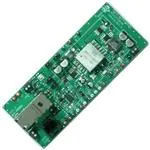
This user’s guide describes the TPS23756 evaluation module (TPS23756EVM). The TPS23756EVM
contains evaluation and reference circuitry for the TPS23756. The TPS23756 integrates a powered-device
(PD) controller and power-supply controller targeted at high-power, wide input range, isolated converter
topologies. The TPS23756 is compliant with the IEEE 802.3at Power over Ethernet (PoE) standard.
1
2
3
4
5
6
7
8
Contents
Description ................................................................................................................... 2
1.1
Features ............................................................................................................. 2
1.2
Applications ......................................................................................................... 2
Electrical Specifications .................................................................................................... 3
Schematic .................................................................................................................... 4
General Configuration and Description .................................................................................. 5
4.1
Physical Access .................................................................................................... 5
Test Setup ................................................................................................................... 7
TPS23756EVM Typical Performance Data .............................................................................. 7
6.1
5-V DC/DC Efficiency .............................................................................................. 7
6.2
TPS23756EVM Conducted Emissions .......................................................................... 9
EVM Assembly Drawings and Layout Guidelines ...................................................................... 9
7.1
PCB Drawings ...................................................................................................... 9
7.2
Layout Guidelines ................................................................................................ 11
7.3
EMI Containment ................................................................................................. 12
Bill of Materials ............................................................................................................. 13
List of Figures
1
TPS23756EVM Schematic (DC-DC Converter)......................................................................... 4
2
TPS23756EVM Schematic (PoE and Adapter Input Terminals) ...................................................... 5
3
Typical TPS23756EVM Test Setup ....................................................................................... 7
4
TPS23756EVM Efficiency With 12-V Input .............................................................................. 8
5
TPS23756EVM Efficiency With 24-V Input .............................................................................. 8
6
TPS23756EVM Efficiency With 48-V Input .............................................................................. 9
7
TPS23756EVM Conducted Emissions ................................................................................... 9
8
Top-Side Layout/Routing ................................................................................................. 10
9
Layer-Two Routing ........................................................................................................ 10
10
Layer-Three Routing ...................................................................................................... 11
11
Bottom-Side Placement/Routing......................................................................................... 11
1
TPS23756EVM Electrical and Performance Specifications ........................................................... 3
2
Connector Functionality .................................................................................................... 6
3
Test Points ................................................................................................................... 6
4
TPS23756EVM Bill of Materials ......................................................................................... 13
List of Tables
SLVU329A – September 2009 – Revised March 2010
Submit Documentation Feedback
Copyright © 2009–2010, Texas Instruments Incorporated
TPS23756EVM
1
�Description
1
www.ti.com
Description
The TPS23756EVM allows reference circuitry evaluation of the TPS23756. It contains input and output
power connectors and an array of onboard test points for circuit evaluation.
1.1
Features
•
•
•
1.2
Applications
•
•
•
2
High-power PD and DC-DC converter controllers
– IEEE 802.3at-compliant PD controller with adapter preference support
– Converter controller supports high-efficiency, isolated converter topologies
Wide-input voltage range DC-DC converter
– Active clamp forward converter design using self-driven synchronous rectifiers
– End-to-end efficiency at full load: 89% (12 V), 91% (24 V), 88% (48 V), 85% (PoE)
– Converter efficiency at full load: 91% (12 V), 91% (24 V), 88% (PoE or 48 V)
– 5-V, 5-A output (25 W) over a 10- to 57-V input voltage range
Operates from PoE or external adapters
– Integrated 1000base-T RJ-45 jack including transformer and cable terminations
– Operates from 12-V, 24-V, and 48-V wall adapters
– Onboard, “efficient diode” (replaces standard adapter diode) circuit when operating from 12-V
adapters
– Selection of option 1 (PD input using PPD pin) or option 2 (converter input using APD pin) adapter
input power using jumpers
– Selection of PPD1 or PPD2 mode using jumpers
– Supports option 2 adapter input with either PoE or adapter preference
– Onboard “smooth handoff” circuit for 48-V adapter using PoE as a hot backup
Voice over Internet Protocol – IP telephones
Wireless LAN – Wireless Access Points
Security – Wired IP cameras
TPS23756EVM
SLVU329A – September 2009 – Revised March 2010
Submit Documentation Feedback
Copyright © 2009–2010, Texas Instruments Incorporated
�Electrical Specifications
www.ti.com
2
Electrical Specifications
Table 1. TPS23756EVM Electrical and Performance Specifications
PARAMETER
CONDITION
MIN
TYP
MAX UNITS
POWER INTERFACE
Input voltage
Applied to the power pins of connectors J4 or J7
Operating voltage
After start-up
Input UVLO
Rising input voltage
0
–
57
V
30
–
57
V
–
–
36
V
Falling input voltage
30
–
–
V
Detection voltage
At device terminals
1.6
–
10
V
Classification voltage
At device terminals
100
–
23
V
Classification current
Rclass = 63.4 Ω
38
–
42
mA
Inrush current-limit
100
–
180
mA
Operating current-limit
850
–
1100
mA
V
DC/DC CONVERTER
Output voltage
10.5 V ≤ Vin ≤ 57 V, ILOAD ≤ ILOAD (max)
5-V output
4.75
5.00
5.25
Output current
10.5 V ≤ Vin ≤ 57 V
5-V output
–
–
5
A
Output ripple voltage, peak-to-peak
Vin = 44 V, ILOAD = 5 A
5-V output
–
50
–
mV
Efficiency, end-to-end
Vin = 44 V, ILOAD = 5 A
5-V output
–
85%
–
225
–
275
Switching frequency
SLVU329A – September 2009 – Revised March 2010
Submit Documentation Feedback
Copyright © 2009–2010, Texas Instruments Incorporated
TPS23756EVM
kHz
3
�Schematic
Schematic
3
2
1
1
3
www.ti.com
Figure 1. TPS23756EVM Schematic (DC-DC Converter)
4
TPS23756EVM
SLVU329A – September 2009 – Revised March 2010
Submit Documentation Feedback
Copyright © 2009–2010, Texas Instruments Incorporated
�General Configuration and Description
www.ti.com
3
1
2
1
1
3
Figure 2. TPS23756EVM Schematic (PoE and Adapter Input Terminals)
4
General Configuration and Description
4.1
Physical Access
Table 2 lists the TPS23756EVM connector functionality and Table 3 describes the test point availability.
SLVU329A – September 2009 – Revised March 2010
Submit Documentation Feedback
Copyright © 2009–2010, Texas Instruments Incorporated
TPS23756EVM
5
�General Configuration and Description
www.ti.com
Table 2. Connector Functionality
Connector
Label
Description
J7
ADAPTER
External adapter input. J10 (low side) and J11 (high side) can select whether the adapter
is at the PD controller input (VDD to VSS) or at the converter input (VDD1 to RTN). J8 is
used to select PPD or APD function. J9 along with J8 set to PPD can select the PPD1 or
PPD2 function.
J1
VOUT
Output voltage connector.
J4
DATA + PoE POWER
Ethernet power input connector. Contains Ethernet transformer and cable terminations
J5
DATA PORT
Ethernet data port connector
J6
EGND
Earth GND connection
Table 3. Test Points
Test Point
TP2, TP16, TP17
6
Color
Label
Description
BLK
GND
Secondary-side (output) grounds (GND)
TP4
RED
VC
TP5
ORG
DRAIN
DC/DC converter bias supply
TP9
BLK
VSS
POE input, low side
DC/DC converter return
Drain terminal of the primary-side switching MOSFET
TP10, TP14
BLK
RTN
TP12
ORG
LOOP
Can be used with TP11 for overall feedback loop measurements.
TP11
RED
VOUT
DC/DC converter output voltage.
TP13
WHT
CTL
Control loop input to the pulse width modulator
TP8
WHT
RCS
DC/DC converter primary-side switching MOSFET current sense (before external
slope comp resistor).
TP3
RED
VB
TP7
WHT
GATE
Gate drive for the primary-side switching MOSFET
TP6
WHT
GAT2
Gate drive for the primary-side active clamp MOSFET
TP1
RED
PVDD1
TP15
WHT
T2P
Type 2 PSE output from TPS23756
TP19
RED
P78
Pair 7, 8
TP20
ORG
P12
Pair 1, 2
TP18
ORG
P45
Pair 4, 5
Bias voltage regulator
Transformer primary high side.
TP21
RED
P36
Pair 3, 6
D11
GRN
T2P
Type 2 PSE indicator. Remove the shunt on J3 to inhibit the T2P indicator.
D12
RED
POWER ON
Output power indicator. Remove the shunt on J2 to inhibit the output power
indicator.
CL1
NA
CL1
TPS23756EVM
CL1 provides a connection between VDD and VDD1, shorting out D25. Removing
the short at CL1 allows certain power source priority schemes to be evaluated.
SLVU329A – September 2009 – Revised March 2010
Submit Documentation Feedback
Copyright © 2009–2010, Texas Instruments Incorporated
�Test Setup
www.ti.com
5
Test Setup
Figure 3 shows a typical test setup for TPS23756EVM. Input voltage can be applied as described in
Table 2.
AUX
Power Source
J7
PSE
Or
Power Supply
-
(Ethernet Cable)
+
J4
DUT
TPS23756EVM
J5
VOUT
J1
GND
Data to PHY
(Ethernet Cable)
RLOAD
Figure 3. Typical TPS23756EVM Test Setup
6
TPS23756EVM Typical Performance Data
6.1
5-V DC/DC Efficiency
Figure 4, Figure 5, and Figure 6 highlight the TPS23756EVM efficiency over input voltage. Nsupply is
measured from TP1/TP10 to J1-1/2; Nadapter is measured from J7-1/2 to J1-1/2; and PoE is measured
from J4 input to J1-1/2.
SLVU329A – September 2009 – Revised March 2010
Submit Documentation Feedback
Copyright © 2009–2010, Texas Instruments Incorporated
TPS23756EVM
7
�TPS23756EVM Typical Performance Data
www.ti.com
95
90
Nadapter
85
Nsupply
Efficiency - %
80
75
70
65
60
55
50
0
1
2
3
4
IO - Output Current - A
5
6
Figure 4. TPS23756EVM Efficiency With 12-V Input
95
90
Nadapter
Nsupply
85
Efficiency - %
80
75
70
65
60
55
50
0
1
2
3
4
IO - Output Current - A
5
6
Figure 5. TPS23756EVM Efficiency With 24-V Input
8
TPS23756EVM
SLVU329A – September 2009 – Revised March 2010
Submit Documentation Feedback
Copyright © 2009–2010, Texas Instruments Incorporated
�EVM Assembly Drawings and Layout Guidelines
www.ti.com
95
90
Nsupply
85
Nadapter
Efficiency - %
80
PoE
75
70
65
60
55
50
0
1
2
3
4
IO - Output Current - A
5
6
Figure 6. TPS23756EVM Efficiency With 48-V Input
6.2
TPS23756EVM Conducted Emissions
HPA479 (TPS23756EVM)
48V PoE Input
5V / 4A Output
Class B Quasi-Peak Limit
Class B Average Limit
Figure 7. TPS23756EVM Conducted Emissions
7
EVM Assembly Drawings and Layout Guidelines
7.1
PCB Drawings
The following figures shows component placement and layout.
SLVU329A – September 2009 – Revised March 2010
Submit Documentation Feedback
Copyright © 2009–2010, Texas Instruments Incorporated
TPS23756EVM
9
�EVM Assembly Drawings and Layout Guidelines
www.ti.com
Figure 8. Top-Side Layout/Routing
Figure 9. Layer-Two Routing
10
TPS23756EVM
SLVU329A – September 2009 – Revised March 2010
Submit Documentation Feedback
Copyright © 2009–2010, Texas Instruments Incorporated
�EVM Assembly Drawings and Layout Guidelines
www.ti.com
Figure 10. Layer-Three Routing
Figure 11. Bottom-Side Placement/Routing
7.2
Layout Guidelines
The layout of the PoE front end must follow power and EMI/ESD best practice guidelines. A basic set of
recommendations include:
• Parts placement must be driven by power flow in a point-to-point manner; RJ-45, Ethernet transformer,
diode bridges, TVS and 0.1-mF capacitor, and TPS23756 converter input bulk capacitor.
• All leads must be as short as possible with wide power traces and paired signal and return.
• There must not be any crossovers of signals from one part of the flow to another.
• Spacing consistent with safety standards like IEC60950 must be observed between the 48-V input
voltage rails and between the input and an isolated converter output.
• The TPS23756 must be located over split, local ground planes referenced to VSS for the PoE input
and to RTN for the converter. Whereas the PoE side may operate without a ground plane, the
converter side must have one. Logic ground and power layers must not be present under the Ethernet
input or the converter primary side.
• Large copper fills and traces must be used on SMT power-dissipating devices, and wide traces or
overlay copper fills must be used in the power path.
SLVU329A – September 2009 – Revised March 2010
Submit Documentation Feedback
Copyright © 2009–2010, Texas Instruments Incorporated
TPS23756EVM
11
�EVM Assembly Drawings and Layout Guidelines
www.ti.com
The DC/DC converter layout can benefit from basic rules such as:
• Pair signals to reduce emissions and noise, especially the paths that carry high-current pulses which
include the power semiconductors and magnetics.
• Minimize trace length of high-current, power semiconductors and magnetic components.
• Where possible, use vertical pairing.
• Use the ground plane for the switching currents carefully.
• Keep the high-current and high-voltage switching away from low-level sensing circuits including those
outside the power supply.
• Pay special attention to spacing around the high-voltage sections of the converter.
7.3
EMI Containment
•
•
•
•
•
•
•
•
•
•
•
•
•
•
•
•
•
•
•
•
•
12
Use compact loops for dv/dt and di/dt circuit paths (power loops and gate drives).
Use minimal, yet thermally adequate, copper areas for heat sinking of components tied to switching
nodes (minimize exposed radiating surface).
Use copper ground planes (possible stitching) and top layer copper floods (surround circuitry with
ground floods).
Use four-layer PCB if economically feasible (for better grounding).
Minimize the amount of copper area associated with input traces (to minimize radiated pickup).
Hide copper associated with switching nodes under shielded magnetics where possible.
Heat sink the “quiet side” of components instead of the “switching side” where possible (like the output
side of inductor).
Use Bob Smith terminations, Bob Smith EFT capacitor, and Bob Smith plane.
Use Bob Smith plane as ground shield on input side of PCB (creating a phantom or literal earth
ground).
Use LC filter at DC/DC input.
Dampen high-frequency ringing on all switching nodes if present (allow for possible snubbers).
Control rise times with gate drive resistors and possibly snubbers.
Switching frequency considerations
Use of EMI bridge capacitor across isolation boundary (isolated topologies)
Observe the polarity dot on inductors (embed noisy end).
Use of ferrite beads on input (allow for possible use of beads or 0-Ω resistors)
Maintain physical separation between input-related circuitry and power circuitry (use ferrite beads as
boundary line).
Balance efficiency vs acceptable noise margin
Possible use of common-mode inductors
Possible use of integrated RJ-45 jacks (shielded with internal transformer and Bob Smith terminations)
End-product enclosure considerations (shielding)
TPS23756EVM
SLVU329A – September 2009 – Revised March 2010
Submit Documentation Feedback
Copyright © 2009–2010, Texas Instruments Incorporated
�Bill of Materials
www.ti.com
8
Bill of Materials
Table 4. TPS23756EVM Bill of Materials
Count RefDes
Value
Description
Size
Part Number
MFR
1
C1
0.047uF
Capacitor, Ceramic, 250V, X7R, 10%
1206
Std
Std
1
C11
2200pF
Capacitor, Ceramic, 100V, X7R, 10%
0805
Std
Std
2
C13, C17
220uF
Capacitor, Aluminum, 10V, 20%
0.328 x 0.354 inch
EEV-FK1A221P
Panasonic
1
C14
1.0uF
Capacitor, Ceramic, 25V, X7R, 10%
0805
Std
Std
1
C15
22uF
Capacitor, Aluminum, 25V, 20%
5x5.8mm
EEVFK1E220R
Panasonic
1
C16
47pF
Capacitor, Ceramic, 50V, C0G, 5%
0603
Std
Std
1
C18
10pF
Capacitor, Ceramic, 50V, X7R, 10%
0603
Std
Std
1
C19
1.0uF
Capacitor, Ceramic, 16V, X7R, 10%
0603
Std
Std
1
C2
1uF
Capacitor, Ceramic, 16V, X7R, 20%
0603
C1608X7R1C105M
TDK
1
C20
2200pF
Capacitor, Ceramic, 2KV, X7R, 10%
1812
C4532X7R3D222K
TDK
1
C21
10pF
Capacitor, Ceramic, 50V, C0G, 5%
0603
Std
Std
1
C22
22nF
Capacitor, Ceramic, 50V, X7R, 10%
0603
Std
Std
1
C23
10nF
Capacitor, Ceramic, 50V, X7R, 10%
0603
Std
Std
1
C24
2.2uF
Capacitor, Ceramic, 16V, X7R, 10%
0805
Std
Std
2
C25, C28
1nF
Capacitor, Ceramic, 100V, X7R, 10%
0805
Std
Std
1
C26
1000pF
Capacitor, Ceramic, 2kV, X7R, 10%
1210
Std
TDK
2
C27, C30
10nF
Capacitor, Ceramic, 100V, X7R, 10%
0603
Std
Std
2
C3, C8
2.2uF
Capacitor, Ceramic, 100V, X7R, 10%
1210
Std
Std
3
C4, C10, C29
0.1uF
Capacitor, Ceramic, 100V, X7R, 10%
0805
Std
Std
1
C5
1uF
Capacitor, Ceramic, 100V, X7R, 10%
1210
Std
Std
2
C6, C7
22uF
Capacitor, Aluminum, 100V, ±20%
8x10.2mm
EEVFK2A220P
Panasonic
2
C9, C12
22uF
Capacitor, Ceramic, 10-V, X7R, 10%
1210
GRM32ER71A226KE20L
Murata
1
CL1
AWG 24
Wire, 24AWG, Solid, non-insulated, 0.30 inches
0.300 X AWG 24
NA
NA
5
D1, D2, D4, D5,
D9
BAS16
Diode, Switching, 75V, 200mA
SOT23
BAS16LT1
Vishay-Liteon
1
D10
BAT54S
Diode, Dual Schottky, 200-mA, 30-V
SOT23
BAT54S
Zetex
1
D11
GREEN
Diode, LED, GRN, 2.0-V, 650-mcd, SM
1210
LTST-C930KGKT
LITE-ON INC
1
D12
RED
Diode, LED, RED, 2.0-V, 850-mcd, SM
1210
LTST-C930KRKT
LITE-ON INC
8
D13, D14, D15,
D16, D17, D18,
D19, D20
B1100
Diode, Schottky, 1A, 100V
SMA
B1100
Diodes, Inc
0
D21
V8P10
Diode, High Current, Trench MOS Barrier Schottky, 100V, 8A
TO-277A[SMPC]
V8P10
Vishay
1
D25
V8P10
Diode, High Current, Trench MOS Barrier Schottky, 100V, 8A
TO-277A[SMPC]
V8P10
Vishay
1
D22
30V
Diode, Zener, 200mW, 30V
SOD-323
BZT52C30S
Diodes Inc.
1
D23
12V
Diode, Zener, 12V, 5-mA
SOD-123
BZT52C12
Diodes Inc
1
D24
5.1V
Diode, Zener, 200mW, 5.1V
SOD-323
BZT52C5V1S
Diodes Inc.
SLVU329A – September 2009 – Revised March 2010
Submit Documentation Feedback
TPS23756EVM
Copyright © 2009–2010, Texas Instruments Incorporated
13
�Bill of Materials
www.ti.com
Table 4. TPS23756EVM Bill of Materials (continued)
Count RefDes
14
Value
Description
Size
Part Number
MFR
1
D26
SMAJ24A
Diode, TVS, 24-V, 1W
SMA
SMAJ24A
Diodes Inc.
3
D3, D27, D28
SMAJ58A
Diode, TVS, 58-V, 1W
SMA
SMAJ58A
Diodes Inc.
1
D6
BAS20
Diode, Switching, 200-mA, 200-V, 330-mW
SOT23
BAS20
Zetex
2
D7, D8
12V
Diode, Zener, 12-V
SOT23
BZX84C12LT1
ON Semiconductor
2
FB1, FB2
500
Bead, Ferrite, 2000mA, 60 mΩ
1206
MI1206L501R-10
Steward
2
FB3, FB4
91-Ohm
Bead, SMD 3A, Low DC Resistance
1806
EXCML45A910H
Panasonic
3
J1, J6, J7
ED555/2DS
Terminal Block, 2-pin, 6-A, 3,5mm
0.27 x 0.25
ED555/2DS
OST
2
J2, J3
PEC02SAAN
Header, Male 2-pin, 100mil spacing,
0.100 inch x 2
PEC02SAAN
Sullins
1
J4
7499511001
Connector, RJ45 PoE+Enabled, 1000 Base-T
0.670 x 1.300 inch
7499511001
Wuerth Electronics
1
J5
5556416-1
Connector, Jack Modular, Vertical, Pos.
0.655 x 0.615 inch
5556416-1
AMP
4
J8, J9, J10, J11
PEC03SAAN
Header, Male 3-pin, 100mil spacing,
0.100 inch x 3
PEC03SAAN
Sullins
1
L1
3.3uH
Inductor, SM Toroid, 3.3A, 20-mΩ
0.287 x 0.287 inch
MSS7341-332
Coilcraft
1
L2
10uH
Inductor, SMT, 7-A, 9-mΩ
0.508 x 0.516 inch
SER1360-103KL
Coilcraft
1
L3
1mH
Inductor, SMT, 100mA, 16.3 Ω
0.169 x 0.169 inch
LPS4414-105MLC
Coilcraft
1
Q1
Si7119DN
MOSFET, Fast Switching, PChan, -200V, 3.8A, 1.05 Ω
PWRPAK 1212
Si7119DN
Vishay
1
Q2
SI7852DP
MOSFET, NChan, 80V, 12A, 16-mΩ
PWRPAK S0-8
SI7852DP
Vishay
1
Q3
MMBTA06
Bipolar, NPN, 80V, 500mA
SOT23
MMBTA06LT1
ON Semiconductor
1
Q4
SI4894BDY
MOSFET, Nch, 30V, 12A, 11mΩ
SO8
SI4894BDY
Vishay
1
Q5
Si7456DP
MOSFET, NChan, 100V, 9.3A, 25-mΩ
PWRPAK S0-8
Si7456DP
Vishay
1
Q6
BSS119
MOSFET, Nch, 100V, 0.17A, 6 Ω
SOT23
BSS119
Infineon
1
Q7
Si7489DP
MOSFET, PChan, -100V, -28A, 41mΩ
PWRPAK S0-8
Si7489DP
Vishay
2
R1, R15
10K
Resistor, Chip, 1/16W, 1%
0603
Std
Std
1
R10
2.2
Resistor, Chip, 1/16W, 1%
0603
Std
Std
1
R11
1K
Resistor, Chip, 1/16W, 1%
0603
Std
Std
1
R12
11
Resistor, Chip, 1/10W, 1%
0603
Std
Std
1
R13
49.9
Resistor, Chip, 1/16W, 1%
0603
Std
Std
1
R14
499
Resistor, Chip, 1/16W, 1%
0603
Std
Std
1
R16
2K
Resistor, Chip, 1/16W, 1%
0603
Std
Std
1
R17
681
Resistor, Chip, 1/16W, 1%
0603
Std
Std
2
R18, R31
41.2K
Resistor, Chip, 1/16W, 1%
0603
Std
Std
1
R19
6.49K
Resistor, Chip, 1/10-W, 1%
0805
Std
Std
2
R2, R29
0
Resistor, Chip, 1/16W, 1%
0603
Std
Std
1
R20
1K
Resistor, Chip, 1/10-W, 1%
0805
Std
Std
1
R22
13.7K
Resistor, Chip, 1/16W, 1%
0603
Std
Std
4
R23, R24, R25,
R26
75
Resistor, Chip, 1/16W, 1%
0603
Std
Std
2
R27, R30
54.9K
Resistor, Chip, 1/16W, 1%
0603
Std
Std
TPS23756EVM
SLVU329A – September 2009 – Revised March 2010
Submit Documentation Feedback
Copyright © 2009–2010, Texas Instruments Incorporated
�Bill of Materials
www.ti.com
Table 4. TPS23756EVM Bill of Materials (continued)
Count RefDes
Value
Description
Size
Part Number
MFR
2
R28, R34
20K
Resistor, Chip, 1/16W, 1%
0603
Std
Std
1
R3
10
Resistor, Chip, 1/2W, 5%
1210
Std
Std
1
R32
105K
Resistor, Chip, 1/16W, 1%
0603
Std
Std
1
R33
5.49K
Resistor, Chip, 1/16W, 1%
0603
Std
Std
0
R35
1.8K
Resistor, Chip, 1/2W, 1%
2010
Std
Std
0
R36
3.30 Meg
Resistor, Chip, 1/10W, 1%
0603
Std
Std
2
R4, R21
24.9K
Resistor, Chip, 1/16W, 1%
0603
Std
Std
1
R5
2K
Resistor, Chip, 1/4W, 5%
1210
Std
Std
1
R6
69.8K
Resistor, Chip, 1/16W, 1%
0603
Std
Std
1
R7
80.6K
Resistor, Chip, 1/16W, 1%
0603
Std
Std
1
R8
100K
Resistor, Chip, 1/16W, 1%
0603
Std
Std
1
R9
63.4
Resistor, Chip, 1/10W, 1%
0805
Std
Std
1
T1 or T2
83501095FC/JA4249CL or PA2887NL
Transformer, forward, 5V, 5A, 1.25:1
0.860 × 1.150 inch
835-01095FC/JA4249-CL or
PA2887NL
E&E
Magnetics/Coilcraft or
Pulse
1
T3
P8208NLT
Transformer, 100:1, 10A, 6 mΩ DCR
0.330 × 0.360 inch
P8208NLT
Pulse
6
TP1, TP3, TP4,
TP11, TP19,
TP21
5010
Test Point, Red, Thru Hole
0.125 × 0.125 inch
5010
Keystone
6
TP2, TP9, TP10,
TP14, TP16,
TP17
5011
Test Point, Black, Thru Hole
0.125 x 0.125 inch
5011
Keystone
4
TP5, TP12, TP18, 5013
TP20
Test Point, Orange, Thru Hole
0.125 × 0.125 inch
5013
Keystone
5
TP6, TP7, TP8,
TP13, TP15
5012
Test Point, White, Thru Hole
0.125 × 0.125 inch
5012
Keystone
1
U1
TPS23756PWP
IC, IEEE 802.3at PoE Interface and Isolated Converter Controller
PWP20
TPS23756PWP
TI
1
U2
TCMT1107
IC, Photocoupler, 3750VRMS, 80-160% CTR
MF4
TCMT1107
Vishay
1
U3
TLV431A
IC, Shunt Regulator, 6V, 10mA, 1%
SOT23-5
TLV431ACDBVR
TI
2566
SPC
929950-00
3M
HPA479
Any
4
Bumpons
6
—
Shunt, Black
100-mil
1
—
PCB, 5.75 In x 2.25 In x 0.062 In
SLVU329A – September 2009 – Revised March 2010
Submit Documentation Feedback
TPS23756EVM
Copyright © 2009–2010, Texas Instruments Incorporated
15
�Evaluation Board/Kit Important Notice
Texas Instruments (TI) provides the enclosed product(s) under the following conditions:
This evaluation board/kit is intended for use for ENGINEERING DEVELOPMENT, DEMONSTRATION, OR EVALUATION
PURPOSES ONLY and is not considered by TI to be a finished end-product fit for general consumer use. Persons handling the
product(s) must have electronics training and observe good engineering practice standards. As such, the goods being provided are
not intended to be complete in terms of required design-, marketing-, and/or manufacturing-related protective considerations,
including product safety and environmental measures typically found in end products that incorporate such semiconductor
components or circuit boards. This evaluation board/kit does not fall within the scope of the European Union directives regarding
electromagnetic compatibility, restricted substances (RoHS), recycling (WEEE), FCC, CE or UL, and therefore may not meet the
technical requirements of these directives or other related directives.
Should this evaluation board/kit not meet the specifications indicated in the User’s Guide, the board/kit may be returned within 30
days from the date of delivery for a full refund. THE FOREGOING WARRANTY IS THE EXCLUSIVE WARRANTY MADE BY
SELLER TO BUYER AND IS IN LIEU OF ALL OTHER WARRANTIES, EXPRESSED, IMPLIED, OR STATUTORY, INCLUDING
ANY WARRANTY OF MERCHANTABILITY OR FITNESS FOR ANY PARTICULAR PURPOSE.
The user assumes all responsibility and liability for proper and safe handling of the goods. Further, the user indemnifies TI from all
claims arising from the handling or use of the goods. Due to the open construction of the product, it is the user’s responsibility to
take any and all appropriate precautions with regard to electrostatic discharge.
EXCEPT TO THE EXTENT OF THE INDEMNITY SET FORTH ABOVE, NEITHER PARTY SHALL BE LIABLE TO THE OTHER
FOR ANY INDIRECT, SPECIAL, INCIDENTAL, OR CONSEQUENTIAL DAMAGES.
TI currently deals with a variety of customers for products, and therefore our arrangement with the user is not exclusive.
TI assumes no liability for applications assistance, customer product design, software performance, or infringement of
patents or services described herein.
Please read the User’s Guide and, specifically, the Warnings and Restrictions notice in the User’s Guide prior to handling the
product. This notice contains important safety information about temperatures and voltages. For additional information on TI’s
environmental and/or safety programs, please contact the TI application engineer or visit www.ti.com/esh.
No license is granted under any patent right or other intellectual property right of TI covering or relating to any machine, process, or
combination in which such TI products or services might be or are used.
FCC Warning
This evaluation board/kit is intended for use for ENGINEERING DEVELOPMENT, DEMONSTRATION, OR EVALUATION
PURPOSES ONLY and is not considered by TI to be a finished end-product fit for general consumer use. It generates, uses, and
can radiate radio frequency energy and has not been tested for compliance with the limits of computing devices pursuant to part 15
of FCC rules, which are designed to provide reasonable protection against radio frequency interference. Operation of this
equipment in other environments may cause interference with radio communications, in which case the user at his own expense
will be required to take whatever measures may be required to correct this interference.
EVM Warnings and Restrictions
It is important to operate this EVM within the input voltage range of 0 V to 57 V and the output voltage range of 4 V to 6 V .
Exceeding the specified input range may cause unexpected operation and/or irreversible damage to the EVM. If there are
questions concerning the input range, please contact a TI field representative prior to connecting the input power.
Applying loads outside of the specified output range may result in unintended operation and/or possible permanent damage to the
EVM. Please consult the EVM User's Guide prior to connecting any load to the EVM output. If there is uncertainty as to the load
specification, please contact a TI field representative.
During normal operation, some circuit components may have case temperatures greater than 85°C. The EVM is designed to
operate properly with certain components above 85°C as long as the input and output ranges are maintained. These components
include but are not limited to linear regulators, switching transistors, pass transistors, and current sense resistors. These types of
devices can be identified using the EVM schematic located in the EVM User's Guide. When placing measurement probes near
these devices during operation, please be aware that these devices may be very warm to the touch.
Mailing Address: Texas Instruments, Post Office Box 655303, Dallas, Texas 75265
Copyright © 2010, Texas Instruments Incorporated
�IMPORTANT NOTICE
Texas Instruments Incorporated and its subsidiaries (TI) reserve the right to make corrections, modifications, enhancements, improvements,
and other changes to its products and services at any time and to discontinue any product or service without notice. Customers should
obtain the latest relevant information before placing orders and should verify that such information is current and complete. All products are
sold subject to TI’s terms and conditions of sale supplied at the time of order acknowledgment.
TI warrants performance of its hardware products to the specifications applicable at the time of sale in accordance with TI’s standard
warranty. Testing and other quality control techniques are used to the extent TI deems necessary to support this warranty. Except where
mandated by government requirements, testing of all parameters of each product is not necessarily performed.
TI assumes no liability for applications assistance or customer product design. Customers are responsible for their products and
applications using TI components. To minimize the risks associated with customer products and applications, customers should provide
adequate design and operating safeguards.
TI does not warrant or represent that any license, either express or implied, is granted under any TI patent right, copyright, mask work right,
or other TI intellectual property right relating to any combination, machine, or process in which TI products or services are used. Information
published by TI regarding third-party products or services does not constitute a license from TI to use such products or services or a
warranty or endorsement thereof. Use of such information may require a license from a third party under the patents or other intellectual
property of the third party, or a license from TI under the patents or other intellectual property of TI.
Reproduction of TI information in TI data books or data sheets is permissible only if reproduction is without alteration and is accompanied
by all associated warranties, conditions, limitations, and notices. Reproduction of this information with alteration is an unfair and deceptive
business practice. TI is not responsible or liable for such altered documentation. Information of third parties may be subject to additional
restrictions.
Resale of TI products or services with statements different from or beyond the parameters stated by TI for that product or service voids all
express and any implied warranties for the associated TI product or service and is an unfair and deceptive business practice. TI is not
responsible or liable for any such statements.
TI products are not authorized for use in safety-critical applications (such as life support) where a failure of the TI product would reasonably
be expected to cause severe personal injury or death, unless officers of the parties have executed an agreement specifically governing
such use. Buyers represent that they have all necessary expertise in the safety and regulatory ramifications of their applications, and
acknowledge and agree that they are solely responsible for all legal, regulatory and safety-related requirements concerning their products
and any use of TI products in such safety-critical applications, notwithstanding any applications-related information or support that may be
provided by TI. Further, Buyers must fully indemnify TI and its representatives against any damages arising out of the use of TI products in
such safety-critical applications.
TI products are neither designed nor intended for use in military/aerospace applications or environments unless the TI products are
specifically designated by TI as military-grade or "enhanced plastic." Only products designated by TI as military-grade meet military
specifications. Buyers acknowledge and agree that any such use of TI products which TI has not designated as military-grade is solely at
the Buyer's risk, and that they are solely responsible for compliance with all legal and regulatory requirements in connection with such use.
TI products are neither designed nor intended for use in automotive applications or environments unless the specific TI products are
designated by TI as compliant with ISO/TS 16949 requirements. Buyers acknowledge and agree that, if they use any non-designated
products in automotive applications, TI will not be responsible for any failure to meet such requirements.
Following are URLs where you can obtain information on other Texas Instruments products and application solutions:
Products
Applications
Amplifiers
amplifier.ti.com
Audio
www.ti.com/audio
Data Converters
dataconverter.ti.com
Automotive
www.ti.com/automotive
DLP® Products
www.dlp.com
Communications and
Telecom
www.ti.com/communications
DSP
dsp.ti.com
Computers and
Peripherals
www.ti.com/computers
Clocks and Timers
www.ti.com/clocks
Consumer Electronics
www.ti.com/consumer-apps
Interface
interface.ti.com
Energy
www.ti.com/energy
Logic
logic.ti.com
Industrial
www.ti.com/industrial
Power Mgmt
power.ti.com
Medical
www.ti.com/medical
Microcontrollers
microcontroller.ti.com
Security
www.ti.com/security
RFID
www.ti-rfid.com
Space, Avionics &
Defense
www.ti.com/space-avionics-defense
RF/IF and ZigBee® Solutions www.ti.com/lprf
Video and Imaging
www.ti.com/video
Wireless
www.ti.com/wireless-apps
Mailing Address: Texas Instruments, Post Office Box 655303, Dallas, Texas 75265
Copyright © 2010, Texas Instruments Incorporated
�