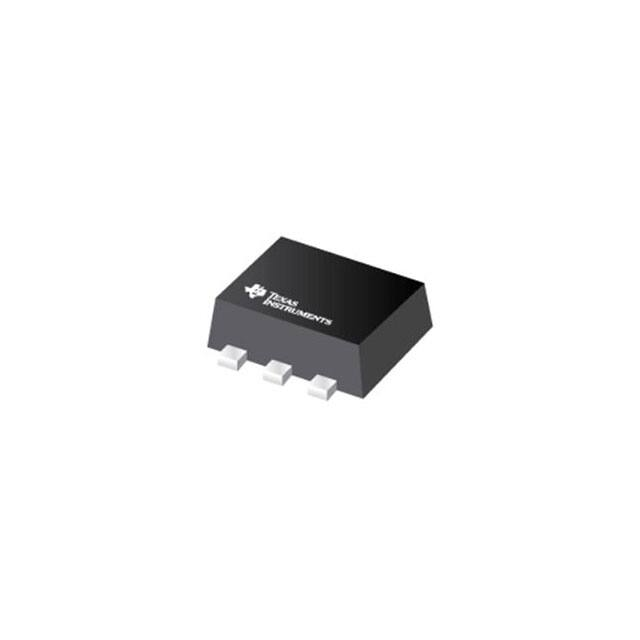
TPS61023
TPS61023
SLVSF14B – SEPTEMBER 2019 – REVISED AUGUST
2020
SLVSF14B – SEPTEMBER 2019 – REVISED AUGUST 2020
www.ti.com
TPS61023 3.7-A Boost Converter with 0.5-V Ultra-low Input Voltage
1 Features
3 Description
•
•
•
•
•
•
TPS61023 device is a synchronous boost converter
with 0.5-V ultra-low input voltage. The device provides
a power supply solution for portable equipment and
smart devices powered by various batteries and super
capacitors. The TPS61023 has typical 3.7-A valley
switch current limit over full temperature range. With a
wide input voltage range of 0.5 V to 5.5 V, the
TPS61023 supports super capacitor backup power
applications, which may deeply discharge the super
capacitor.
•
•
•
•
•
•
•
•
•
Input voltage range: 0.5 V to 5.5 V
1.8-V Minimum input voltage for start-up
Output voltage setting range: 2.2 V to 5.5 V
Two 47-mΩ (LS) / 68-mΩ (HS) MOSFETs
3.7-A Valley switching current limit
94% Efficiency at VIN = 3.6 V, VOUT = 5 V and IOUT
= 1.5 A
1-MHz Switching frequency when VIN > 1.5 V and
0.5-MHz switching frequency when VIN < 1 V
Typical 0.1-µA shutdown current from VIN and SW
±2.5% Reference voltage accuracy over –40°C to
+125°C
Auto PFM operation mode at light load
Pass-through mode when VIN > VOUT
True disconnection between input and output
during shutdown
Output overvoltage and thermal shutdown
protections
Output short-circuit protection
1.2-mm × 1.6-mm SOT563 (DRL) 6-pin package
The TPS61023 operates at 1-MHz switching
frequency when the input voltage is above 1.5 V. The
switching frequency decreases gradually to 0.5 MHz
when the input voltage is below 1.5 V down to 1 V.
The TPS61023 enters power-save mode at light load
condition to maintain high efficiency over the entire
load current range. The TPS61023 consumes a 20µA quiescent current from VOUT in light load condition.
During shutdown, the TPS61023 is completely
disconnected from the input power and only
consumes a 0.1-µA current to achieve long battery
life. The TPS61023 has 5.7-V output overvoltage
protection, output short circuit protection, and thermal
shutdown protection.
2 Applications
•
•
•
Electronic shelf label
Video doorbell
Remote controller
The TPS61023 offers a very small solution size with
1.2-mm × 1.6-mm SOT563 (DRL) package and
minimum amount of external components.
Device Information
PART NUMBER
PACKAGE
TPS61023
(1)
(1)
SOT563 (6)
BODY SIZE (NOM)
1.20 mm × 1.60 mm
For all available packages, see the orderable addendum at
the end of the data sheet.
L1
VIN : 0.5 V ~ 5.5 V
1 µH
C1
VIN
SW
VOUT : 2.2 V ~ 5.5 V
VOUT
GND
TPS61023
R1
ON
EN
C2
FB
R2
OFF
Typical Application Circuit
An©IMPORTANT
NOTICEIncorporated
at the end of this data sheet addresses availability, warranty, changes, use in
safety-critical
applications,
Copyright
2020 Texas Instruments
Submit
Document
Feedback
intellectual property matters and other important disclaimers. PRODUCTION DATA.
Product Folder Links: TPS61023
1
�TPS61023
www.ti.com
SLVSF14B – SEPTEMBER 2019 – REVISED AUGUST 2020
Table of Contents
1 Features............................................................................1
2 Applications..................................................................... 1
3 Description.......................................................................1
4 Revision History.............................................................. 2
5 Pin Configuration and Functions...................................3
Pin Functions.................................................................... 3
6 Specifications.................................................................. 4
6.1 Absolute Maximum Ratings........................................ 4
6.2 ESD Ratings............................................................... 4
6.3 Recommended Operating Conditions.........................4
6.4 Thermal Information....................................................4
6.5 Electrical Characteristics.............................................5
6.6 Typical Characteristics................................................ 6
7 Detailed Description........................................................8
7.1 Overview..................................................................... 8
7.2 Functional Block Diagram........................................... 8
7.3 Feature Description.....................................................9
7.4 Device Functional Modes..........................................10
8 Application and Implementation.................................. 12
8.1 Application Information............................................. 12
8.2 Typical Application.................................................... 12
9 Power Supply Recommendations................................17
10 Layout...........................................................................18
10.1 Layout Guidelines................................................... 18
10.2 Layout Example...................................................... 18
10.3 Thermal Considerations..........................................19
11 Device and Documentation Support..........................20
11.1 Device Support........................................................20
11.2 Receiving Notification of Documentation Updates.. 20
11.3 Support Resources................................................. 20
11.4 Trademarks............................................................. 20
11.5 Electrostatic Discharge Caution.............................. 20
11.6 Glossary.................................................................. 20
12 Mechanical, Packaging, and Orderable
Information.................................................................... 20
12.1 Package Option Addendum.................................... 21
12.2 Tape and Reel Information......................................23
4 Revision History
NOTE: Page numbers for previous revisions may differ from page numbers in the current version.
Changes from Revision A (October 2019) to Revision B (August 2020)
Page
• Updated the numbering format for tables, figures and cross-references throughout the document...................1
• Changed unit in Figure 6-6 to μA........................................................................................................................6
• Changed 80 mA to 800 mA in Figure 8-7 ........................................................................................................ 16
Changes from Revision * (September 2019) to Revision A (October 2019)
Page
• Changed Product Status to Production Data for Production release .................................................................1
2
Submit Document Feedback
Copyright © 2020 Texas Instruments Incorporated
Product Folder Links: TPS61023
�TPS61023
www.ti.com
SLVSF14B – SEPTEMBER 2019 – REVISED AUGUST 2020
5 Pin Configuration and Functions
FB
VOUT
EN
SW
VIN
GND
Figure 5-1. DRL Package 6-Pin SOT563 Top View
Pin Functions
PIN
NO.
NAME
I/O
DESCRIPTION
1
FB
I
Voltage feedback of adjustable output voltage
2
EN
I
Enable logic input. Logic high voltage enables the device. Logic low voltage disables the
device and turns it into shutdown mode.
IC power supply input
3
VIN
I
4
GND
PWR
Ground pin of the IC
5
SW
PWR
The switch pin of the converter. It is connected to the drain of the internal low-side power
MOSFET and the source of the internal high-side power MOSFET.
6
VOUT
PWR
Boost converter output
Submit Document Feedback
Copyright © 2020 Texas Instruments Incorporated
Product Folder Links: TPS61023
3
�TPS61023
www.ti.com
SLVSF14B – SEPTEMBER 2019 – REVISED AUGUST 2020
6 Specifications
6.1 Absolute Maximum Ratings
over operating free-air temperature range (unless otherwise noted)(1)
MIN
MAX
VIN, EN, FB, SW, VOUT
–0.3
7
V
SW spike at 10ns
–0.7
8
V
SW spike at 1ns
–0.7
9
V
Operating junction temperature, TJ
–40
150
°C
Storage temperature, Tstg
–65
150
°C
Voltage range at terminals(2)
(1)
(2)
UNIT
Stresses beyond those listed under Absolute Maximum Ratings may cause permanent damage to the device. These are stress ratings
only, which do not imply functional operation of the device at these or any other conditions beyond those indicated under
Recommended Operating Conditions. Exposure to absolute-maximum-rated conditions for extended periods may affect device
reliability.
All voltage values are with respect to network ground terminal.
6.2 ESD Ratings
VALUE
V(ESD)
(1)
(2)
Electrostatic discharge
Human-body model (HBM), per ANSI/ESDA/JEDEC JS-001(1)
±2000
Charged-device model (CDM), per JEDEC specification JESD22-C101(2)
±500
UNIT
V
JEDEC document JEP155 states that 500-V HBM allows safe manufacturing with a standard ESD control process. Manufacturing with
less than 500-V HBM is possible with the necessary precautions. Pins listed as ±2000 V may actually have higher performance.
JEDEC document JEP157 states that 250-V CDM allows safe manufacturing with a standard ESD control process. Manufacturing with
less than 250-V CDM is possible with the necessary precautions. Pins listed as ±500 V may actually have higher performance.
6.3 Recommended Operating Conditions
over operating free-air temperature range (unless otherwise noted)
MIN
NOM
MAX
UNIT
VIN
Input voltage range
0.5
5.5
V
VOUT
Output voltage setting range
2.2
5.5
V
L
Effective inductance range
2.9
µH
CIN
Effective input capacitance range
COUT
Effective output capacitance range
1000
µF
TJ
Operating junction temperature
125
°C
0.37
1.0
1.0
4.7
4
10
µF
–40
6.4 Thermal Information
THERMAL
TPS61023
TPS61023
DRL (SOT563) - 6 PINS
DRL (SOT563) - 6 PINS
Standard
EVM(2)
UNIT
RθJA
Junction-to-ambient thermal resistance
142.7
91.4
°C/W
RθJC
Junction-to-case thermal resistance
55.7
N/A
°C/W
RθJB
Junction-to-board thermal resistance
31.0
N/A
°C/W
ΨJT
Junction-to-top characterization parameter
1.4
5.3
°C/W
ΨJB
Junction-to-board characterization parameter
30.7
38.1
°C/W
(1)
(2)
4
METRIC(1)
For more information about traditional and new thermal metrics, see the Semiconductor and IC Package Thermal Metrics application
report.
Measured on TPS61023EVM, 4-layer, 2oz copper 50mm×38mm PCB.
Submit Document Feedback
Copyright © 2020 Texas Instruments Incorporated
Product Folder Links: TPS61023
�TPS61023
www.ti.com
SLVSF14B – SEPTEMBER 2019 – REVISED AUGUST 2020
6.5 Electrical Characteristics
TJ = –40°C to 125°C, VIN = 3.6 V and VOUT = 5.0 V. Typical values are at TJ = 25°C (unless otherwise noted)
PARAMETER
TEST CONDITIONS
MIN
TYP
MAX
UNIT
POWER SUPPLY
VIN
VIN_UVLO
Input voltage range
Under-voltage lockout threshold
0.5
V
1.7
1.8
V
VIN falling
0.4
0.5
V
Quiescent current into VIN pin
IC enabled, No load, No switching VIN =
1.8 V to 5.5 V, VFB = VREF + 0.1 V, TJ up
to 85°C
0.9
3.0
µA
Quiescent current into VOUT pin
IC enabled, No load, No switching VOUT =
2.2 V to 5.5 V, VFB = VREF + 0.1 V, TJ up
to 85°C
20
30
µA
Shutdown current into VIN and SW pin
IC disabled, VIN = VSW = 3.6 V, TJ = 25°C
0.1
0.2
µA
5.5
V
610
mV
IQ
ISD
5.5
VIN rising
OUTPUT
VOUT
VREF
Output voltage setting range
Reference voltage at the FB pin
VOVP
Output over-voltage protection threshold
VOVP_HYS
Over-voltage protection hysteresis
IFB_LKG
Leakage current at FB pin
2.2
PWM mode
580
595
PFM mode
585
601
VOUT rising
5.5
5.7
mV
6.0
V
20
nA
0.1
TJ = 25°C
4
TJ = 125°C
6
1
IVOUT_LKG
Leakage current into VOUT pin
IC disabled, VIN = 0 V, VSW = 0 V, VOUT =
5.5 V, TJ = 25°C
tSS
Soft startup time
From active EN to VOUT regulation.
VIN = 2.5 V, VOUT = 5.0 V, COUT_EFF =
10μF, IOUT = 0
V
nA
3
µA
700
μs
POWER SWITCH
RDS(on)
High-side MOSFET on resistance
VOUT = 5.0 V
68
mΩ
Low-side MOSFET on resistance
VOUT = 5.0 V
47
mΩ
VIN = 3.6 V, VOUT = 5.0 V, PWM mode
1.0
MHz
VIN = 1.0 V, VOUT = 5.0 V, PWM mode
0.5
MHz
fSW
Switching frequency
tON_min
Minimum on time
tOFF_min
Minimum off time
ILIM_SW
Valley current limit
ILIM_CHG
Pre-charge current
40
96
130
ns
80
120
ns
VIN = 3.6 V, VOUT = 5.0 V
2.7
3.7
A
VIN = 1.8 - 5.5 V, VOUT < 0.4 V
200
350
mA
VIN = 2.4 V, VOUT = 2.15 V
750
1200
mA
0.35
0.42
LOGIC INTERFACE
VEN_H
EN logic high threshold
VIN > 1.8 V or VOUT > 2.2 V
VEN_L
EN logic low threshold
VIN > 1.8 V or VOUT > 2.2 V
TSD
Thermal shutdown threshold
TJ rising
TSD_HYS
Thermal shutdown hysteresis
TJ falling below TSD
1.2
0.45
V
PROTECTION
150
°C
20
°C
Submit Document Feedback
Copyright © 2020 Texas Instruments Incorporated
Product Folder Links: TPS61023
5
�TPS61023
www.ti.com
SLVSF14B – SEPTEMBER 2019 – REVISED AUGUST 2020
6.6 Typical Characteristics
100
100
95
95
90
90
85
85
Efficiency (%)
Efficiency (%)
VIN = 3.6 V, VOUT = 5 V, TJ = 25°C, unless otherwise noted
80
75
70
65
80
75
70
65
VIN=1.8 V
VIN=3.0 V
VIN=3.6 V
VIN=4.2 V
60
55
50
0.0001
0.001
0.01
0.05
Output Current (A)
0.2
0.5 1
60
VOUT=2.2V
VOUT=3.6V
VOUT=5V
55
50
0.0001
2
0.001
effi
VIN = 1.8 V, 3.0 V, 3.6 V, 4.2 V; VOUT = 5 V
0.01
0.05
Output Current (A)
0.2
0.5 1
2
effi
VIN = 1.8 V; VOUT = 2.2 V, 3.6 V, 5 V
Figure 6-1. Load Efficiency With Different Input
Figure 6-2. Load Efficiency With Different Output
5.15
2
1.8
Precharge Current (A)
Output Voltage (V)
5.1
5.05
5
VIN=1.8V
VIN=3.0V
VIN=3.6V
VIN=4.2V
4.95
0.0001
1.6
1.4
1.2
1
0.8
0.6
0.4
0.2
0.001
0.01
0.05
Output Current (A)
0.2
0.5 1
2
0
VIN = 1.8 V, 3.0 V, 3.6 V, 4.2 V; VOUT = 5 V
1
1.5
2
Output Voltage (V)
2.5
597
1
Quiescent Current (PA)
1.25
596
595
594
prec
0.75
0.5
0.25
-30
0
30
60
Temperature (qC)
90
3.5
Figure 6-4. Pre-charge Current vs Output Voltage
598
593
-60
3
VIN = 3.6 V; VOUT = 0.1 V to 3.3 V
Figure 6-3. Load Regulation
Reference Voltage (mV)
0.5
regu
120
150
refe
0
-60
VIN = 3.6 V; VOUT = 5 V, TJ = –40°C to +125°C
Figure 6-5. Reference Voltage vs Temperature
VIN=1.8V
VIN=3.6V
VIN=4.5V
-30
0
30
60
Temperature (qC)
90
120
150
iqVi
VIN = 1.8 V, 3.6 V 4.5 V; VOUT = 5 V, TJ = –40°C to +125°C, No
switching
Figure 6-6. Quiescent Current into VIN vs
Temperature
6
Submit Document Feedback
Copyright © 2020 Texas Instruments Incorporated
Product Folder Links: TPS61023
�TPS61023
SLVSF14B – SEPTEMBER 2019 – REVISED AUGUST 2020
22
1.1
21.5
1
21
0.9
20.5
Shutdown Current (PA)
Quiescent Current (PA)
www.ti.com
20
19.5
19
18.5
18
17.5
17
16
-40
-20
0
20
40
60
80
Temperature (qC)
100
120
0.7
0.6
0.5
0.4
0.3
0.1
0
-40
140
0
20
40
60
80
Temperature (qC)
100
120
140
shut
VIN = VSW = 1.8 V, 3.6 V, 4.5 V, 5 V; VOUT = 0 V; TJ = –40°C to
+125°C
Figure 6-8. Shutdown Current vs Temperature
Figure 6-7. Quiescent Current into VOUT vs
Temperature
1050
0.99
1000
0.96
950
0.93
900
0.9
Voltage (V)
850
800
750
700
0.87
0.84
0.81
0.78
650
600
0.75
550
0.72
500
0.5
-20
iqVo
VIN = 1.8 V; VOUT = 2.2 V, 3.6 V, 5 V, TJ = –40°C to +125°C, No
switching
Frequency (kHz)
0.8
0.2
VOUT=2.2V
VOUT=3.6V
VOUT=5V
16.5
VIN=1.8V
VIN=3.6V
VIN=4.5V
VIN=5V
1
1.5
2
2.5
3
Input Voltage (V)
3.5
4
VIN=1.8V
VIN=2.4V
VIN=3.6V
VIN=4.5V
0.69
-40
4.5
-20
0
20
freq
40
60
80
Temperature (qC)
100
120
140
enri
VIN = 1.8 V, 2.4 V, 3.6 V, 4.5 V; VOUT = 0 V; TJ = –40°C to
+125°C
VIN = 0.5 V to 4.5 V; VOUT = 5 V
Figure 6-9. Switching Frequency vs Input Voltage
Figure 6-10. EN Rising Threshold vs Temperature
0.475
VIN=1.8V
VIN=2.4V
VIN=3.6V
VIN=4.5V
Voltage (V)
0.45
0.425
0.4
0.375
0.35
-40
-20
0
20
40
60
80
Temperature (qC)
100
120
140
enfa
VIN = 1.8 V, 2.4 V, 3.6 V, 4.5 V; VOUT = 0 V; TJ = –40°C to +125°C
Figure 6-11. EN Falling Threshold vs Temperature
Submit Document Feedback
Copyright © 2020 Texas Instruments Incorporated
Product Folder Links: TPS61023
7
�TPS61023
www.ti.com
SLVSF14B – SEPTEMBER 2019 – REVISED AUGUST 2020
7 Detailed Description
7.1 Overview
The TPS61023 synchronous step-up converter is designed to operate from an input voltage supply range
between 0.5 V and 5.5 V with 3.7-A (typical) valley switch current limit. The TPS61023 typically operates at a
quasi-constant frequency pulse width modulation (PWM) at moderate to heavy load currents. The switching
frequency is 1 MHz when the input voltage is above 1.5 V. The switching frequency reduces down to 0.5 MHz
gradually when the input voltage goes down from 1.5 V to 1 V and keeps at 0.5 MHz when the input voltage is
below 1 V. At light load conditions, the TPS61023 converter operates in power-save mode with pulse frequency
modulation (PFM). During PWM operation, the converter uses adaptive constant on-time valley current mode
control scheme to achieve excellent line regulation and load regulation and allows the use of a small inductor
and ceramic capacitors. Internal loop compensation simplifies the design process while minimizing the number
of external components.
7.2 Functional Block Diagram
SW
5
VIN
3
EN
2
Undervoltage
Lockout
Logic
VIN
VOUT
6 VOUT
Valley Current
Sense
Gate Driver
4 GND
Thermal
Shutdown
PWM Control
VOUT
Over Voltage
Protection &
Short Circuit
Protection
1 FB
Soft Startup
EA
VREF
8
Submit Document Feedback
Copyright © 2020 Texas Instruments Incorporated
Product Folder Links: TPS61023
�TPS61023
www.ti.com
SLVSF14B – SEPTEMBER 2019 – REVISED AUGUST 2020
7.3 Feature Description
7.3.1 Undervoltage Lockout
The TPS61023 has a built-in undervoltage lockout (UVLO) circuit to ensure the device working properly. When
the input voltage is above the UVLO rising threshold of 1.8 V, the TPS61023 can be enabled to boost the output
voltage. After the TPS61023 starts up and the output voltage is above 2.2 V, the TPS61023 works with input
voltage as low as 0.5 V.
7.3.2 Enable and Soft Start
When the input voltage is above the UVLO rising threshold and the EN pin is pulled to a voltage above 1.2 V, the
TPS61023 is enabled and starts up. At the beginning, the TPS61023 charges the output capacitors with a
current of about 350 mA when the output voltage is below 0.4 V. When the output voltage is charged above 0.4
V, the output current is changed to having output current capability to drive the 2-Ω resistance load. After the
output voltage reaches the input voltage, the TPS61023 starts switching, and the output voltage ramps up
further. The typical start-up time is 700 µs accounting from EN high to output reaching target voltage for the
application with input voltage is 2.5 V, output voltage is 5 V, output effective capacitance is 10 µF, and no load.
When the voltage at the EN pin is below 0.4 V, the internal enable comparator turns the device into shutdown
mode. In the shutdown mode, the device is entirely turned off. The output is disconnected from input power
supply.
7.3.3 Switching Frequency
The TPS61023 switches at a quasi-constant 1-MHz frequency when the input voltage is above 1.5 V. When the
input voltage is lower than 1.5 V, the switching frequency is reduced gradually to 0.5 MHz to improve the
efficiency and get higher boost ratio. When the input voltage is below 1 V, the switching frequency is fixed at a
quasi-constant 0.5 MHz.
7.3.4 Current Limit Operation
The TPS61023 uses a valley current limit sensing scheme. Current limit detection occurs during the off-time by
sensing of the voltage drop across the synchronous rectifier.
When the load current is increased such that the inductor current is above the current limit within the whole
switching cycle time, the off-time is increased to allow the inductor current to decrease to this threshold before
the next on-time begins (so called frequency foldback mechanism). When the current limit is reached, the output
voltage decreases during further load increase.
The maximum continuous output current (I OUT(LC)), before entering current limit (CL) operation, can be defined
by Equation 1.
IOUT(CL)
§
1 D u ¨ ILIM
©
1
'I
2 LP
P
·
¸
¹
(1)
where
•
•
D is the duty cycle
ΔIL(P-P) is the inductor ripple current
The duty cycle can be estimated by Equation 2.
D
1
VIN u K
VOUT
(2)
where
•
•
•
VOUT is the output voltage of the boost converter
VIN is the input voltage of the boost converter
η is the efficiency of the converter, use 90% for most applications
Submit Document Feedback
Copyright © 2020 Texas Instruments Incorporated
Product Folder Links: TPS61023
9
�TPS61023
www.ti.com
SLVSF14B – SEPTEMBER 2019 – REVISED AUGUST 2020
The peak-to-peak inductor ripple current is calculated by Equation 3.
'IL P
P
VIN u D
L u fSW
(3)
where
•
•
•
•
L is the inductance value of the inductor
fSW is the switching frequency
D is the duty cycle
VIN is the input voltage of the boost converter
7.3.5 Pass-Through Operation
When the input voltage is higher than the setting output voltage, the output voltage is higher than the target
regulation voltage. When the output voltage is 101% of the setting target voltage, the TPS61023 stops switching
and fully turns on the high-side PMOS FET. The device works in pass-through mode. The output voltage is the
input voltage minus the voltage drop across the DCR of the inductor and the R DS(on) of the PMOS FET. When
the output voltage drops below the 97% of the setting target voltage as the input voltage declines or the load
current increases, the TPS61023 resumes switching again to regulate the output voltage.
7.3.6 Overvoltage Protection
The TPS61023 has an output overvoltage protection (OVP) to protect the device if the external feedback resistor
divider is wrongly populated. When the output voltage is above 5.7 V typically, the device stops switching. Once
the output voltage falls 0.1 V below the OVP threshold, the device resumes operating again.
7.3.7 Output Short-to-Ground Protection
The TPS61023 starts to limit the output current when the output voltage is below 1.8 V. The lower the output
voltage reaches, the smaller the output current is. When the VOUT pin is short to ground, and the output voltage
becomes less than 0.4 V, the output current is limited to approximately 350 mA. Once the short circuit is
released, the TPS61023 goes through the soft start-up again to the regulated output voltage.
7.3.8 Thermal Shutdown
The TPS61023 goes into thermal shutdown once the junction temperature exceeds 150°C. When the junction
temperature drops below the thermal shutdown recovery temperature, typically 130°C, the device starts
operating again.
7.4 Device Functional Modes
The TPS61023 has two switching operation modes, PWM mode in moderate to heavy load conditions and power
save mode with pulse frequency modulation (PFM) in light load conditions.
7.4.1 PWM Mode
The TPS61023 uses a quasi-constant 1.0-MHz frequency pulse width modulation (PWM) at moderate to heavy
load current. Based on the input voltage to output voltage ratio, a circuit predicts the required on-time. At the
beginning of the switching cycle, the NMOS switching FET. The input voltage is applied across the inductor and
the inductor current ramps up. In this phase, the output capacitor is discharged by the load current. When the
on-time expires, the main switch NMOS FET is turned off, and the rectifier PMOS FET is turned on. The inductor
transfers its stored energy to replenish the output capacitor and supply the load. The inductor current declines
because the output voltage is higher than the input voltage. When the inductor current hits the valley current
threshold determined by the output of the error amplifier, the next switching cycle starts again.
The TPS61023 has a built-in compensation circuit that can accommodate a wide range of input voltage, output
voltage, inductor value, and output capacitor value for stable operation.
10
Submit Document Feedback
Copyright © 2020 Texas Instruments Incorporated
Product Folder Links: TPS61023
�TPS61023
www.ti.com
SLVSF14B – SEPTEMBER 2019 – REVISED AUGUST 2020
7.4.2 Power-Save Mode
The TPS61023 integrates a power-save mode with PFM to improve efficiency at light load. When the load
current decreases, the inductor valley current set by the output of the error amplifier no longer regulates the
output voltage. When the inductor valley current hits the low limit, the output voltage exceeds the setting voltage
as the load current decreases further. When the FB voltage hits the PFM reference voltage, the TPS61023 goes
into the power-save mode. In the power-save mode, when the FB voltage rises and hits the PFM reference
voltage, the device continues switching for several cycles because of the delay time of the internal comparator
— then it stops switching. The load is supplied by the output capacitor, and the output voltage declines. When
the FB voltage falls below the PFM reference voltage, after the delay time of the comparator, the device starts
switching again to ramp up the output voltage.
Output
Voltage
PFM mode at light load
1.01 x VOUT_NOM
VOUT_NOM
PWM mode at heavy load
Figure 7-1. Output Voltage in PWM Mode and PFM Mode
Submit Document Feedback
Copyright © 2020 Texas Instruments Incorporated
Product Folder Links: TPS61023
11
�TPS61023
www.ti.com
SLVSF14B – SEPTEMBER 2019 – REVISED AUGUST 2020
8 Application and Implementation
Note
Information in the following applications sections is not part of the TI component specification, and TI
does not warrant its accuracy or completeness. TI’s customers are responsible for determining
suitability of components for their purposes. Customers should validate and test their design
implementation to confirm system functionality.
8.1 Application Information
The TPS61023 is a synchronous boost converter designed to operate from an input voltage supply range
between 0.5 V and 5.5 V with a typically 3.7-A valley switch current limit. The TPS61023 typically operates at a
quasi-constant 1-MHz frequency PWM at moderate-to-heavy load currents when the input voltage is above 1.5
V. The switching frequency changes to 0.5 MHz gradually with the input voltage changing from 1.5 V to 1 V for
better efficiency and high step-up ratio. When the input voltage is below 1 V, the switching frequency is fixed at a
quasi-constant 0.5 MHz. At light load currents, the TPS61023 converter operates in power-save mode with PFM
to achieve high efficiency over the entire load current range.
8.2 Typical Application
The TPS61023 provides a power supply solution for portable devices powered by batteries or backup
applications powered by super-capacitors. With typical 3.7-A switch current capability, the TPS61023 can output
5 V and 1.5 A from a single-cell Li-ion battery.
L1
2.7 V to 4.35 V
1 µH
C1
10 µF
VIN
SW
5V
VOUT
GND
TPS61023
EN
ON
C2
R1
FB
2 x 22 µF
732 k
R2
OFF
100 k
Figure 8-1. Li-ion Battery to 5-V Boost Converter
8.2.1 Design Requirements
The design parameters are listed in Table 8-1.
Table 8-1. Design Parameters
12
PARAMETERS
VALUES
Input voltage
2.7 V to 4.35 V
Output voltage
5V
Output current
1.5 A
Output voltage ripple
±50 mV
Submit Document Feedback
Copyright © 2020 Texas Instruments Incorporated
Product Folder Links: TPS61023
�TPS61023
www.ti.com
SLVSF14B – SEPTEMBER 2019 – REVISED AUGUST 2020
8.2.2 Detailed Design Procedure
8.2.2.1 Setting the Output Voltage
The output voltage is set by an external resistor divider (R1, R2 in Figure 8-1). When the output voltage is
regulated, the typical voltage at the FB pin is VREF. Thus the resistor divider is determined by Equation 4.
§V
R1 ¨ OUT
© VREF
·
1¸ u R2
¹
(4)
where
•
•
VOUT is the regulated output voltage
VREF is the internal reference voltage at the FB pin
For the best accuracy, should be kept R2 smaller than 300 kΩ to ensure the current flowing through R2 is at
least 100 times larger than the FB pin leakage current. Changing R2 towards a lower value increases the
immunity against noise injection. Changing the R2 towards a higher value reduces the quiescent current for
achieving highest efficiency at low load currents.
8.2.2.2 Inductor Selection
Because the selection of the inductor affects steady-state operation, transient behavior, and loop stability. The
inductor is the most important component in power regulator design. There are three important inductor
specifications, inductor value, saturation current, and dc resistance (DCR).
The TPS61023 is designed to work with inductor values between 0.37 µH and 2.9 µH. Follow Equation 5 to
Equation 7 to calculate the inductor peak current for the application. To calculate the current in the worst case,
use the minimum input voltage, maximum output voltage, and maximum load current of the application. To have
enough design margins, choose the inductor value with –30% tolerances, and low power-conversion efficiency
for the calculation.
In a boost regulator, the inductor dc current can be calculated by Equation 5.
VOUT u IOUT
VIN u K
IL DC
(5)
where
•
•
•
•
VOUT is the output voltage of the boost converter
IOUT is the output current of the boost converter
VIN is the input voltage of the boost converter
η is the power conversion efficiency, use 90% for most applications
The inductor ripple current is calculated by Equation 6.
'IL P
P
VIN u D
L u fSW
(6)
where
•
•
•
•
D is the duty cycle, which can be calculated by Equation 2
L is the inductance value of the inductor
fSW is the switching frequency
VIN is the input voltage of the boost converter
Therefore, the inductor peak current is calculated by Equation 7.
Submit Document Feedback
Copyright © 2020 Texas Instruments Incorporated
Product Folder Links: TPS61023
13
�TPS61023
www.ti.com
SLVSF14B – SEPTEMBER 2019 – REVISED AUGUST 2020
IL P
'IL P
IL DC
P
(7)
2
Normally, it is advisable to work with an inductor peak-to-peak current of less than 40% of the average inductor
current for maximum output current. A smaller ripple from a larger valued inductor reduces the magnetic
hysteresis losses in the inductor and EMI. But in the same way, load transient response time is increased. The
saturation current of the inductor must be higher than the calculated peak inductor current. Table 8-2 lists the
recommended inductors for the TPS61023.
Table 8-2. Recommended Inductors for the TPS61023
L (µH)
DCR MAX
(mΩ)
SATURATION CURRENT
(A)
SIZE (LxWxH)
VENDOR
XEL4030-102ME
1
9.78
9.0
4.0 × 4.0 × 3.1
Coilcraft
74438357010
1
13.5
9.6
4.1 x 4.1 x 3.1
Wurth Elecktronik
HBME042A-1R0MS-99
1
11.5
7.0
4.1 x 4.1 x 2.1
Cyntec
PART NUMBER
(1)
(1)
See Third-party Products disclaimer
8.2.2.3 Output Capacitor Selection
The output capacitor is mainly selected to meet the requirements for output ripple and loop stability. The ripple
voltage is related to capacitor capacitance and its equivalent series resistance (ESR). Assuming a ceramic
capacitor with zero ESR, the minimum capacitance needed for a given ripple voltage can be calculated by
Equation 8.
COUT
IOUT u DMAX
fSW u VRIPPLE
(8)
where
•
•
•
•
DMAX is the maximum switching duty cycle
VRIPPLE is the peak-to-peak output ripple voltage
IOUT is the maximum output current
fSW is the switching frequency
The ESR impact on the output ripple must be considered if tantalum or aluminum electrolytic capacitors are
used. The output peak-to-peak ripple voltage caused by the ESR of the output capacitors can be calculated by
Equation 9.
VRIPPLE(ESR)
IL(P) u RESR
(9)
Take care when evaluating the derating of a ceramic capacitor under dc bias voltage, aging, and ac signal. For
example, the dc bias voltage can significantly reduce capacitance. A ceramic capacitor can lose more than 50%
of its capacitance at its rated voltage. Therefore, always leave margin on the voltage rating to ensure adequate
capacitance at the required output voltage. Increasing the output capacitor makes the output ripple voltage
smaller in PWM mode.
TI recommends using the X5R or X7R ceramic output capacitor in the range of 4-μF to 1000-μF effective
capacitance. The output capacitor affects the small signal control loop stability of the boost regulator. If the
output capacitor is below the range, the boost regulator can potentially become unstable. Increasing the output
capacitor makes the output ripple voltage smaller in PWM mode.
8.2.2.4 Loop Stability, Feedforward Capacitor Selection
When the switching waveform shows large duty cycle jitter or the output voltage or inductor current shows
oscillations, the regulation loop can be unstable.
14
Submit Document Feedback
Copyright © 2020 Texas Instruments Incorporated
Product Folder Links: TPS61023
�TPS61023
www.ti.com
SLVSF14B – SEPTEMBER 2019 – REVISED AUGUST 2020
The load transient response is another approach to check the loop stability. During the load transient recovery
time, VOUT can be monitored for settling time, overshoot or ringing that helps judge the stability of the converters.
Without any ringing, the loop has usually more than 45° of phase margin.
A feedforward capacitor (C3 in the Figure 8-2) in parallel with R1 induces a pair of zero and pole in the loop
transfer function. By setting the proper zero frequency, the feedforward capacitor can increase the phase margin
to improve the loop stability. For large output capacitance more than 40 μF application, TI recommends a
feedforward capacitor to set the zero frequency (f FFZ) to 1 kHz. As for the input voltage lower than 1-V
application, TI recommends to use the effective output capacitance is about 100 µF and set the zero frequency
(fFFZ) to 1 kHz. The value of the feedforward capacitor can be calculated by Equation 10.
C3
1
2S u fFFZ u R1
(10)
where
•
•
R1 is the resistor between the VOUT pin and FB pin
fFFZ is the zero frequency created by the feedforward capacitor
L1
VIN : 0.5 V ~ 5.5 V
1 µH
C1
VIN
SW
VOUT : 2.2 V ~ 5.5 V
VOUT
GND
TPS61023
C3
C2
R1
ON
EN
FB
R2
OFF
Figure 8-2. TPS61023 Circuit With Feedforward Capacitor
8.2.2.5 Input Capacitor Selection
Multilayer X5R or X7R ceramic capacitors are excellent choices for the input decoupling of the step-up converter
as they have extremely low ESR and are available in small footprints. Input capacitors must be located as close
as possible to the device. While a 10-μF input capacitor is sufficient for most applications, larger values may be
used to reduce input current ripple without limitations. Take care when using only ceramic input capacitors.
When a ceramic capacitor is used at the input and the power is being supplied through long wires, a load step at
the output can induce ringing at the VIN pin. This ringing can couple to the output and be mistaken as loop
instability or could even damage the part. In this circumstance, place additional bulk capacitance (tantalum or
aluminum electrolytic capacitor) between ceramic input capacitor and the power source to reduce ringing that
can occur between the inductance of the power source leads and ceramic input capacitor.
Submit Document Feedback
Copyright © 2020 Texas Instruments Incorporated
Product Folder Links: TPS61023
15
�TPS61023
www.ti.com
SLVSF14B – SEPTEMBER 2019 – REVISED AUGUST 2020
8.2.3 Application Curves
Vout(5V offset)
50mV/div
Vout(5V offset)
20mV/div
Inductor Current
500mA/div
Inductor Current
1A/div
SW
2.0V/div
SW
2.0V/div
Time Scale: 500ns/div
Time Scale: 5.0…s/div
VIN = 3.6 V, VOUT = 5 V, IOUT = 50 mA
VIN = 3.6 V, VOUT = 5 V, IOUT = 1 A
Figure 8-3. Switching Waveform at Heavy Load
EN
2.0V/div
Figure 8-4. Switching Waveform at Light Load
EN
2.0V/div
Vout
2.0V/div
Vout
2.0V/div
Inductor Current
500mA/div
Inductor Current
500mA/div
Time Scale: 100µs/div
Time Scale: 5.0µs/div
VIN = 3.6 V, VOUT = 5 V, 5-Ω resistance load
VIN = 3.6 V, VOUT = 5 V, 5-Ω resistance load
Figure 8-5. Start-up Waveform
Figure 8-6. Shutdown Waveform
Vout (5V offset)
200mV/div
Vout (5V offset)
500mV/div
Output Current
500mA/div
Input Voltage
1V/div
Time Scale: 200µs/div
Time Scale: 50µs/div
VIN = 3.6 V, VOUT = 5 V, IOUT = 800 mA to 1.5 A with 20-μs slew
rate
VIN = 2.7 V to 4.35 V with 20-μs slew rate, VOUT = 5 V
Figure 8-8. Line Transient
Figure 8-7. Load Transient
16
IOUT = 1 A
Submit Document Feedback
Copyright © 2020 Texas Instruments Incorporated
Product Folder Links: TPS61023
�TPS61023
www.ti.com
SLVSF14B – SEPTEMBER 2019 – REVISED AUGUST 2020
Vout (5V offset)
100 mV/div
Vin
1.0 V/div
Vout (5V offset)
100 mV/div
Output Current
500m A/div
Inductor Current
2.0 A/div
Time Scale: 500µs/div
Time Scale: 10ms/div
VIN = 3.6 V, VOUT = 5 V, IOUT = 0 A to 1.5 A Sweep
VIN = 0 V to 4.35 V Sweep, VOUT = 5 V, 5-Ω resistance load
Figure 8-10. Line Sweep
Figure 8-9. Load Sweep
Vout
2.0 V/div
Vout
2.0 V/div
SW
2.0 V/div
SW
2.0 V/div
Inductor Current
1.0 A/div
Inductor Current
1.0 A/div
Time Scale: 5.0µs/div
Time Scale: 100µs/div
VIN = 3.6 V, VOUT = 5 V, IOUT = 1 A
VIN = 3.6 V, VOUT = 5 V, IOUT = 1 A
Figure 8-11. Output Short Protection (Entry)
Figure 8-12. Output Short Protection (Recover)
9 Power Supply Recommendations
The device is designed to operate from an input voltage supply range between 0.5 V to 5.5 V. This input supply
must be well regulated. If the input supply is located more than a few inches from the converter, additional bulk
capacitance may be required in addition to the ceramic bypass capacitors. A typical choice is a tantalum or
aluminum electrolytic capacitor with a value of 100 µF. Output current of the input power supply must be rated
according to the supply voltage, output voltage, and output current of the TPS61023.
Submit Document Feedback
Copyright © 2020 Texas Instruments Incorporated
Product Folder Links: TPS61023
17
�TPS61023
www.ti.com
SLVSF14B – SEPTEMBER 2019 – REVISED AUGUST 2020
10 Layout
10.1 Layout Guidelines
As for all switching power supplies, especially those running at high switching frequency and high currents,
layout is an important design step. If the layout is not carefully done, the regulator could suffer from instability
and noise problems. To maximize efficiency, switch rise and fall time are very fast. To prevent radiation of high
frequency noise (for example, EMI), proper layout of the high-frequency switching path is essential. Minimize the
length and area of all traces connected to the SW pin, and always use a ground plane under the switching
regulator to minimize interplane coupling. The input capacitor needs not only to be close to the VIN pin, but also
to the GND pin in order to reduce input supply ripple.
The most critical current path for all boost converters is from the switching FET, through the rectifier FET, then
the output capacitors, and back to ground of the switching FET. This high current path contains nanosecond rise
and fall time and must be kept as short as possible. Therefore, the output capacitor not only must be close to the
VOUT pin, but also to the GND pin to reduce the overshoot at the SW pin and VOUT pin.
For better thermal performance, TI suggest to make copper polygon connected with each pin bigger.
10.2 Layout Example
GND
VOUT
GND
FB
VOUT
EN
SW
VIN
GND
GND
VIN
Figure 10-1. Layout Example
18
Submit Document Feedback
Copyright © 2020 Texas Instruments Incorporated
Product Folder Links: TPS61023
�TPS61023
www.ti.com
SLVSF14B – SEPTEMBER 2019 – REVISED AUGUST 2020
10.3 Thermal Considerations
Restrict the maximum IC junction temperature to 125°C under normal operating conditions. Calculate the
maximum allowable dissipation, P D(max), and keep the actual power dissipation less than or equal to PD(max). The
maximum-power-dissipation limit is determined using Equation 11.
PD max
125 TA
RTJA
(11)
where
•
•
TA is the maximum ambient temperature for the application
RθJA is the junction-to-ambient thermal resistance given in Thermal Information
The TPS61023 comes in a SOT563 package. The real junction-to-ambient thermal resistance of the package
greatly depends on the PCB type, layout. Using larger and thicker PCB copper for the power pads (GND, SW,
and VOUT) to enhance the thermal performance. Using more vias connects the ground plate on the top layer
and bottom layer around the IC without solder mask also improves the thermal capability.
Submit Document Feedback
Copyright © 2020 Texas Instruments Incorporated
Product Folder Links: TPS61023
19
�TPS61023
www.ti.com
SLVSF14B – SEPTEMBER 2019 – REVISED AUGUST 2020
11 Device and Documentation Support
11.1 Device Support
11.1.1 Third-Party Products Disclaimer
TI'S PUBLICATION OF INFORMATION REGARDING THIRD-PARTY PRODUCTS OR SERVICES DOES NOT
CONSTITUTE AN ENDORSEMENT REGARDING THE SUITABILITY OF SUCH PRODUCTS OR SERVICES
OR A WARRANTY, REPRESENTATION OR ENDORSEMENT OF SUCH PRODUCTS OR SERVICES, EITHER
ALONE OR IN COMBINATION WITH ANY TI PRODUCT OR SERVICE.
11.2 Receiving Notification of Documentation Updates
To receive notification of documentation updates, navigate to the device product folder on ti.com. Click on
Subscribe to updates to register and receive a weekly digest of any product information that has changed. For
change details, review the revision history included in any revised document.
11.3 Support Resources
TI E2E™ support forums are an engineer's go-to source for fast, verified answers and design help — straight
from the experts. Search existing answers or ask your own question to get the quick design help you need.
Linked content is provided "AS IS" by the respective contributors. They do not constitute TI specifications and do
not necessarily reflect TI's views; see TI's Terms of Use.
11.4 Trademarks
TI E2E™ is a trademark of Texas Instruments.
All trademarks are the property of their respective owners.
11.5 Electrostatic Discharge Caution
This integrated circuit can be damaged by ESD. Texas Instruments recommends that all integrated circuits be handled
with appropriate precautions. Failure to observe proper handling and installation procedures can cause damage.
ESD damage can range from subtle performance degradation to complete device failure. Precision integrated circuits may
be more susceptible to damage because very small parametric changes could cause the device not to meet its published
specifications.
11.6 Glossary
TI Glossary
This glossary lists and explains terms, acronyms, and definitions.
12 Mechanical, Packaging, and Orderable Information
The following pages include mechanical, packaging, and orderable information. This information is the most
current data available for the designated devices. This data is subject to change without notice and revision of
this document. For browser-based versions of this data sheet, refer to the left-hand navigation.
20
Submit Document Feedback
Copyright © 2020 Texas Instruments Incorporated
Product Folder Links: TPS61023
�TPS61023
www.ti.com
SLVSF14B – SEPTEMBER 2019 – REVISED AUGUST 2020
12.1 Package Option Addendum
Packaging Information
Orderable
Device
Status(1)
Package Type
Package
Drawing
Pins
Package Qty
Eco Plan(2)
Lead/Ball Finish(6) MSL Peak Temp(3) Op Temp (°C)
Device Marking(4) (5)
TPS61023DRLR
ACTIVE
SOT-5X3
DRL
6
4000
Green (RoHS &
no Sb/Br)
Call TISN
1GI
Level-1-260UNLIM
-40 to 125
1. The marketing status values are defined as follows:
ACTIVE: Product device recommended for new designs.
LIFEBUY: TI has announced that the device will be discontinued, and a lifetime-buy period is in effect.
NRND: Not recommended for new designs. Device is in production to support existing customers, but TI does not recommend using this part in a new
design.
PRE_PROD Unannounced device, not in production, not available for mass market, nor on the web, samples not available.
PREVIEW: Device has been announced but is not in production. Samples may or may not be available.
OBSOLETE: TI has discontinued the production of the device.
2. Eco Plan - The planned eco-friendly classification: Pb-Free (RoHS), Pb-Free (RoHS Exempt), or Green (RoHS & no Sb/Br) - please check
www.ti.com/productcontent for the latest availability information and additional product content details.
TBD: The Pb-Free/Green conversion plan has not been defined.
Pb-Free (RoHS): TI's terms "Lead-Free" or "Pb-Free" mean semiconductor products that are compatible with the current RoHS requirements for all 6
substances, including the requirement that lead not exceed 0.1% by weight in homogeneous materials. Where designed to be soldered at high
temperatures, TI Pb-Free products are suitable for use in specified lead-free processes.
Pb-Free (RoHS Exempt): This component has a RoHS exemption for either 1) lead-based flip-chip solder bumps used between the die and package,
or 2) lead-based die adhesive used between the die and leadframe. The component is otherwise considered Pb-Free (RoHS compatible) as defined
above.
3.
4.
5.
6.
Green (RoHS & no Sb/Br): TI defines "Green" to mean Pb-Free (RoHS compatible), and free of Bromine (Br) and Antimony (Sb) based flame
retardants (Br or Sb do not exceed 0.1% by weight in homogeneous material).
MSL, Peak Temp. -- The Moisture Sensitivity Level rating according to the JEDEC industry standard classifications, and peak solder temperature.
There may be additional marking, which relates to the logo, the lot trace code information, or the environmental category on the device.
Multiple Device markings will be inside parentheses. Only one Device Marking contained in parentheses and separated by a "~" will appear on a
device. If a line is indented then it is a continuation of the previous line and the two combined represent the entire Device Marking for that device.
Lead/Ball Finish - Orderable Devices may have multiple material finish options. Finish options are separated by a vertical ruled line. Lead/Ball Finish
values may wrap to two lines if the finish value exceeds the maximum column width.
Submit Document Feedback
Copyright © 2020 Texas Instruments Incorporated
Product Folder Links: TPS61023
21
�TPS61023
www.ti.com
SLVSF14B – SEPTEMBER 2019 – REVISED AUGUST 2020
Important Information and Disclaimer: The information provided on this page represents TI's knowledge and belief as of the date that it is provided. TI bases its knowledge and belief
on information provided by third parties, and makes no representation or warranty as to the accuracy of such information. Efforts are underway to better integrate information from third
parties. TI has taken and continues to take reasonable steps to provide representative and accurate information but may not have conducted destructive testing or chemical analysis on
incoming materials and chemicals. TI and TI suppliers consider certain information to be proprietary, and thus CAS numbers and other limited information may not be available for release.
In no event shall TI's liability arising out of such information exceed the total purchase price of the TI part(s) at issue in this document sold by TI to Customer on an annual basis.
22
Submit Document Feedback
Copyright © 2020 Texas Instruments Incorporated
Product Folder Links: TPS61023
�TPS61023
www.ti.com
SLVSF14B – SEPTEMBER 2019 – REVISED AUGUST 2020
12.2 Tape and Reel Information
REEL DIMENSIONS
TAPE DIMENSIONS
K0
P1
B0 W
Reel
Diameter
Cavity
A0
B0
K0
W
P1
A0
Dimension designed to accommodate the component width
Dimension designed to accommodate the component length
Dimension designed to accommodate the component thickness
Overall width of the carrier tape
Pitch between successive cavity centers
Reel Width (W1)
QUADRANT ASSIGNMENTS FOR PIN 1 ORIENTATION IN TAPE
Sprocket Holes
Q1
Q2
Q1
Q2
Q3
Q4
Q3
Q4
User Direction of Feed
Pocket Quadrants
Device
Package
Type
Package
Drawing
Pins
SPQ
Reel
Diameter
(mm)
TPS61023DRLR
SOT-5X3
DRL
6
4000
180.0
Reel
Width W1
(mm)
A0
(mm)
B0
(mm)
K0
(mm)
P1
(mm)
W
(mm)
Pin1
Quadrant
8.4
2.0
1.8
0.75
4.0
8.0
Q3
Submit Document Feedback
Copyright © 2020 Texas Instruments Incorporated
Product Folder Links: TPS61023
23
�TPS61023
www.ti.com
SLVSF14B – SEPTEMBER 2019 – REVISED AUGUST 2020
TAPE AND REEL BOX DIMENSIONS
Width (mm)
L
W
24
H
Device
Package Type
Package Drawing
Pins
SPQ
Length (mm)
Width (mm)
Height (mm)
TPS61023DRLR
SOT-5X3
DRL
6
4000
182.0
182.0
20.0
Submit Document Feedback
Copyright © 2020 Texas Instruments Incorporated
Product Folder Links: TPS61023
�PACKAGE OUTLINE
DRL0006A
SOT - 0.6 mm max height
SCALE 8.000
PLASTIC SMALL OUTLINE
1.7
1.5
PIN 1
ID AREA
1
A
6
4X 0.5
1.7
1.5
NOTE 3
2X 1
4
3
B
1.3
1.1
6X
0.3
0.1
0.6 MAX
0.05
TYP
0.00
C
SEATING PLANE
6X
0.18
0.08
0.05 C
SYMM
SYMM
6X
6X
0.4
0.2
0.27
0.15
0.1
0.05
C A B
4223266/B 12/2020
NOTES:
1. All linear dimensions are in millimeters. Any dimensions in parenthesis are for reference only. Dimensioning and tolerancing
per ASME Y14.5M.
2. This drawing is subject to change without notice.
3. This dimension does not include mold flash, protrusions, or gate burrs. Mold flash, protrusions, or gate burrs shall not
exceed 0.15 mm per side.
4. Reference JEDEC registration MO-293 Variation UAAD
www.ti.com
�EXAMPLE BOARD LAYOUT
DRL0006A
SOT - 0.6 mm max height
PLASTIC SMALL OUTLINE
6X (0.67)
SYMM
1
6
6X (0.3)
SYMM
4X (0.5)
4
3
(R0.05) TYP
(1.48)
LAND PATTERN EXAMPLE
SCALE:30X
0.05 MIN
AROUND
0.05 MAX
AROUND
SOLDER MASK
OPENING
METAL
METAL UNDER
SOLDER MASK
NON SOLDER MASK
DEFINED
(PREFERRED)
SOLDER MASK
OPENING
SOLDER MASK
DEFINED
SOLDERMASK DETAILS
4223266/B 12/2020
NOTES: (continued)
5. Publication IPC-7351 may have alternate designs.
6. Solder mask tolerances between and around signal pads can vary based on board fabrication site.
www.ti.com
�EXAMPLE STENCIL DESIGN
DRL0006A
SOT - 0.6 mm max height
PLASTIC SMALL OUTLINE
6X (0.67)
SYMM
1
6
6X (0.3)
SYMM
4X (0.5)
4
3
(R0.05) TYP
(1.48)
SOLDER PASTE EXAMPLE
BASED ON 0.1 mm THICK STENCIL
SCALE:30X
4223266/B 12/2020
NOTES: (continued)
7. Laser cutting apertures with trapezoidal walls and rounded corners may offer better paste release. IPC-7525 may have alternate
design recommendations.
8. Board assembly site may have different recommendations for stencil design.
www.ti.com
�IMPORTANT NOTICE AND DISCLAIMER
TI PROVIDES TECHNICAL AND RELIABILITY DATA (INCLUDING DATA SHEETS), DESIGN RESOURCES (INCLUDING REFERENCE
DESIGNS), APPLICATION OR OTHER DESIGN ADVICE, WEB TOOLS, SAFETY INFORMATION, AND OTHER RESOURCES “AS IS”
AND WITH ALL FAULTS, AND DISCLAIMS ALL WARRANTIES, EXPRESS AND IMPLIED, INCLUDING WITHOUT LIMITATION ANY
IMPLIED WARRANTIES OF MERCHANTABILITY, FITNESS FOR A PARTICULAR PURPOSE OR NON-INFRINGEMENT OF THIRD
PARTY INTELLECTUAL PROPERTY RIGHTS.
These resources are intended for skilled developers designing with TI products. You are solely responsible for (1) selecting the appropriate
TI products for your application, (2) designing, validating and testing your application, and (3) ensuring your application meets applicable
standards, and any other safety, security, regulatory or other requirements.
These resources are subject to change without notice. TI grants you permission to use these resources only for development of an
application that uses the TI products described in the resource. Other reproduction and display of these resources is prohibited. No license
is granted to any other TI intellectual property right or to any third party intellectual property right. TI disclaims responsibility for, and you
will fully indemnify TI and its representatives against, any claims, damages, costs, losses, and liabilities arising out of your use of these
resources.
TI’s products are provided subject to TI’s Terms of Sale or other applicable terms available either on ti.com or provided in conjunction with
such TI products. TI’s provision of these resources does not expand or otherwise alter TI’s applicable warranties or warranty disclaimers for
TI products.
TI objects to and rejects any additional or different terms you may have proposed. IMPORTANT NOTICE
Mailing Address: Texas Instruments, Post Office Box 655303, Dallas, Texas 75265
Copyright © 2021, Texas Instruments Incorporated
�