User's Guide
SLVU143 – June 2006
TPS74x01EVM-118
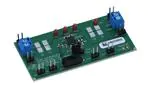
This user's guide describes the characteristics, operation, and use of the
TPS74x01EVM-118 evaluation module (EVM). This EVM contains either the
TPS74201, TPS74301 or TPS74401 low dropout linear regulator IC. This user's guide
includes EVM specifications, recommended test setup, test results, bill of materials
(BOM), and a schematic diagram.
1
2
3
4
Contents
Introduction ..........................................................................................
Input/Output Connector Descriptions ............................................................
Board Layout ........................................................................................
Bill of Materials and Schematic ...................................................................
1
2
5
8
List of Figures
1
2
3
4
5
6
7
8
TPS74201 and TPS74401 Startup with 1-ms Soft Startup ...................................
TPS74201 and TPS74401 Startup with 10-ms Soft Startup ..................................
TPS74301 Simultaneous Startup .................................................................
TPS74301 Ratiometric Startup ...................................................................
Top Assembly Layer ...............................................................................
Top Layer ............................................................................................
Bottom Layer ........................................................................................
Schematic ...........................................................................................
4
4
4
4
5
5
6
7
List of Tables
1
2
1
Typical Performance Specification Summary ................................................... 2
HPA118 Bill of Materials ........................................................................... 8
Introduction
The Texas Instruments TPS74x01EVM-118 evaluation module uses either the TPS74201, TPS74301 or
TPS74401 low-dropout linear regulator IC. These regulators require a low power bias voltage, VBIAS, and a
power input voltage, VIN. All three regulators are capable of providing output voltages down to 0.8 V and
have an integrated supervisory circuit with open drain output that goes to high impedance when the output
voltage reaches regulation (power good or PG). The TPS74301 can provide up to 1.5 A dc current and
has a TRACK pin which allows the user to input a ramp signal for the output voltage to follow, effectively
implementing either simultaneous or ratiometric sequencing. The TPS74201 and TPS74401 can provide
up to 1.5 A and 3.0 A dc current, respectively, and have a SS pin which allows the user to set the output
voltage's linear ramp rate. The goal of the EVM is to facilitate evaluation of the TPS74x01 ICs.
SLVU143 – June 2006
Submit Documentation Feedback
TPS74x01EVM-118
1
�www.ti.com
Input/Output Connector Descriptions
1.1
Performance Specification Summary
Table 1 provides a summary of the TPS74x01EVM-118 performance specifications. All specifications are
given for an ambient temperature of 25°C.
Table 1. Typical Performance Specification Summary
CONDITION
VOUT
(1)
(2)
(3)
1.2
CURRENT RANGE
(mA)
MIN
TYP
2.62 (1)
5.0
5.25
TPS74201 (HPA118-002), TPS74301
(HPA118-003)
1.31 (1)
3.3
5.25 (2)
1500
TPS74401 (HPA118-001)
1.32 (1)
3.3
5.25 (2)
3000
TPS74201 (HPA118-002), TPS74301
(HPA118-003)
1.18 (3)
1.20
1.22 (3)
1500 (2)
TPS74401 (HPA118-001)
1.18 (3)
1.20
1.22 (3)
3000 (2)
VBIAS supply
VIN supply
VOLTAGE RANGE
(V)
MAX
MIN
TYP
MAX
2
This is the minimum voltage to provide the maximum output current in the table assuming the typical VBIAS voltage is applied.
Lower output currents are achievable with lower VIN and VBIAS voltages. See datasheet for VIN to VOUT and VBIAS to VOUT
dropout data.
Linear regulator power dissipation is computed as PD = (VIN - VOUT) × IOUT. As specified in the data sheet, the regulator's
package has a finite power dissipation rating depending on the ambient temperature, board type and airflow. Using VIN and/or
VOUT voltages other than the typical voltages recommended in the table or using the EVM in an environment with an ambient
temperature higher than 25°C will significantly reduce the maximum allowed output current. See the datasheet for the regulator
package's thermal resistance data and refer to application note SLVA118 entitled Digital Designer's Guide to Linear Voltage
Regulators and Thermal Management for a full explanation.
The EVM uses ±1% feedback resistors. Therefore, the EVM output tolerance is the ±1% internal reference tolerance plus 2 × (1
- VREF/VOUT) × TOLFBRES = 2 × (1- 0.8V/1.2V) ×± 1% = 0.7% or ±1.7%. For tigher output tolerance, tighter tolerance feedback
resistors must be used.
Modifications
To aid user customization of the EVM, the board was designed with devices having 0603 or larger
footprints. A real implementation would likely occupy less total board space.
Changing components can improve or degrade EVM performance. For example, adding a larger output
capacitor will reduce output voltage undershoot but lengthen response time after a load transient event.
2
Input/Output Connector Descriptions
J1–VIN/GND This terminal block has both a positive and ground return connection to the power input (VIN)
supply. The leads to the input supply should be twisted and kept as short as possible.
J2–GND This header is the return connection for the bias (VBIAS) supply.
J3–VIN This header is a positive connection to the power input supply (VIN). Its use is recommended for
low power (i.e., IIN = IOUT< 1A) evaluation or as a voltage test point.
J4–VBIAS This header is the positive connection for the bias (VBIAS) supply.
J5–GND This header is a ground return connection to the power input (VIN) supply. Its use is
recommended for low power (i.e., IIN = IOUT< 1A) evaluation or as a ground test point.
J6–VOUT This header is the positive connection for the output load on VOUT. Its use is recommended for
low power (i.e., IIN = IOUT< 1A) evaluation only or as a voltage test point.
J7–GND This header is the ground return connection for the output load. Its use is recommended for low
power (i.e., IIN = IOUT< 1A) evaluation or as a ground test point.
J8–VOUT/GND This terminal block has both a positive and ground return connection for the output load.
The leads to the output load should be twisted and kept as short as possible.
2
TPS74x01EVM-118
SLVU143 – June 2006
Submit Documentation Feedback
�www.ti.com
Input/Output Connector Descriptions
J9–TRACK IN This header connects to top resistor of a resistor divider whose mid point connects to the
TRACK IN pin of the TPS74301. An external voltage greater than 0.8 V must be applied to this pin for the
TPS74301 to produce an output voltage. This header is not populated on the TPS74201 or TPS74401
EVM.
J10–EN This header is a connection to the enable pin (EN), which is also connected to the middle pin of
S1. When S1 is OFF, the EN pin is pulled to ground through pull-down resistor.
J11–GND This header is a ground connection.
JP1– 1ms/Simult vs. 10ms/Ratio For the TPS74301, this jumper allows the user to select the
appropriate resistor divider for either simultaneous or ratiometric sequencing. These resistors have been
sized per the equations in datasheet Figure 5 assuming an external 3.3 V ramp signal is applied to J9
TRACK IN pin. Selecting SIMULTaneous results in the TPS74301 output voltage following the external
ramp signal within a few millivolts until the TPS74301 reaches its regulated voltage. The TPS74301 output
voltage will have the same ramp rate (dv/dt) as the external ramp signal but a different soft-start time.
Selecting RATIOmetric results in the TPS74301 output voltage reaching its regulated voltage at the same
time as the externally applied tracking signal reaches its maximum voltage (e.g., 3.3 V). Although the
external ramp signal and the TPS74301 will have different ramp rates, they will have the same soft-start
time. Leaving the jumper open and not applying the track signal results in no output voltage. Leaving the
jumper open and applying a dc track signal greater than 0.8V results in the output voltage ramping up with
default soft-start time of 500 us.
For the TPS74201 and TPS74401, this jumper allows the user to choose either 1 ms or 10 ms soft start
time for the output voltage. Leaving the jumper open results in the output voltage ramping up with default
soft-start time of 500 us.
S1 - This switch connects to the EN pin of the IC and allows the user to turn the IC ON or OFF by
connecting enable to either VBIAS or ground through a pull-down resistor.
TP1 - This is a Kelvin test point to VIN.
TP2 - This is a Kelvin test point to IC ground.
TP3 - This is a Kelvin test point to VOUT.
2.1
Test Setup
The absolute maximum voltage allowed on the BIAS, IN, EN or TRACK pins is 6 V. All three TPS74x01
devices are designed to operate with VIN and VBIAS less than or equal to 5.25 V. The TPS74201 and
TPS74401 can have VIN, VBIAS, and VENABLE applied in any order without causing damage to the device.
However, for the soft-start function to work as intended certain sequencing rules must be applied. With S1
in the OFF position, connecting the EN and IN pins through a jumper wire is acceptable for most
applications as long as VIN is greater than 1.1V and the ramp rate of both VIN and VBIAS is faster than the
programmed soft-start ramp rate. If the ramp rate of the input sources is slower than the set soft-start time
the output will track the slower supply minus the dropout voltage until it reaches the set output voltage. If
EN is connected to BIAS (e.g., by placing S1 in the ON position on the EVM), the device will soft-start as
programmed as long as VIN is present before VBIAS. Figure 5 in the datasheet shows the use of an RC
delay circuit to hold off VEN until VBIAS has ramped. This technique can also be used to drive VEN from
VIN.If VBIAS > 2.375V and VEN > 1.1V before VIN is applied then VOUT tracks the lower of VIN or VSS
*(1+R1/R2), where VSS is the voltage on the SS pin and is clamped to 0.8V. With S1 in the OFF position,
an external control signal can also be used to enable the device after VIN and VBIAS are present.
The TPS74301 can also have VIN, VBIAS, VEN, and VTRACK sequenced in any order without causing
damage to the device. However for the track function to work as intended certain sequencing rules must
be applied. VBIAS must be above 2.375 V and VEN must be above 1.1V (e.g., S1 in the ON position tying
the BIAS and EN pins together) before the externally applied track signal starts to ramp. VIN should ramp
up faster than the tracking signal so that the externally applied tracking signal does not drive the device
into VIN dropout as VOUT ramps up. The preferred method to sequence the TPS74301 is for VIN, VBIAS and
VEN to be above their minimum required voltages before the tracking signal is applied and initates output
voltage ramping. If the tracking feature is not needed, the TRACK pin should be connected to VIN.
Configured this way, the device starts up within 50us which may result in large inrush current that could
cause the input supply to momentarily dip. Also, if the VIN = VTRACK ramps faster than 500 us, the output
voltage may overshoot.
SLVU143 – June 2006
Submit Documentation Feedback
TPS74x01EVM-118
3
�www.ti.com
Input/Output Connector Descriptions
When connecting external loads above 1A, use short, twisted leads connected to the screw terminals in
order to minimize DC drop at the connector and/or inductive voltage dip after a transient load is removed.
2.2
Test Results
Below are the test results at TA = 25°C using this EVM:
A
VIN = 5 V, VOUT/IOUT = 1.2 V / 1 A.
Figure 1. TPS74201 and TPS74401 Startup with
1-ms Soft Startup
A
VIN = 5 V, VOUT/IOUT = 1.2 V / 1 A with
TRACK-IN signal provided by TPS74201
configured for 3.3 V and 10ms startup
Figure 3. TPS74301 Simultaneous Startup
4
TPS74x01EVM-118
A
VIN = 5 V, VOUT/IOUT = 1.2 V / 1 A.
Figure 2. TPS74201 and TPS74401 Startup with
10-ms Soft Startup
A
VIN = 5 V, VOUT/IOUT = 1.2 V / 1 A with with
TRACK-IN signal provided by TPS74201
configured for 3.3 V and 10ms startup
Figure 4. TPS74301 Ratiometric Startup
SLVU143 – June 2006
Submit Documentation Feedback
�www.ti.com
Board Layout
3
Board Layout
Board layout is critical for all switch mode power supplies. Figure 5, Figure 6, and Figure 7 show the board
layout for the HPA118 PWB. The switching nodes with high-frequency noise are isolated from the
noise-sensitive feedback circuitry, and careful attention has been given to the routing of high-frequency
current loops. See the data sheet for more specific layout guidelines.
Figure 5. Top Assembly Layer
Figure 6. Top Layer
SLVU143 – June 2006
Submit Documentation Feedback
TPS74x01EVM-118
5
�www.ti.com
Board Layout
Figure 7. Bottom Layer
6
TPS74x01EVM-118
SLVU143 – June 2006
Submit Documentation Feedback
�www.ti.com
Board Layout
Figure 8. Schematic
SLVU143 – June 2006
Submit Documentation Feedback
TPS74x01EVM-118
7
�www.ti.com
Bill of Materials and Schematic
4
Bill of Materials and Schematic
4.1
Bill of Materials
Table 2. HPA118 Bill of Materials
Count
RefDes
Value
Description
Size
Part Number
MFR
-001 -002 -003
8
2
2
2
C1, C2
1.0 µF
Capacitor, Ceramic, 25V, X5R, 10% 0603
C1608X5R1E105K
TDK
1
1
1
C3
4.7 µF
Capacitor, Ceramic, 6.3V, X5R,
10%
0603
C1608X5R0J475K
TDK
1
1
0
C4
1000
pF
Capacitor, Ceramic, 50V, C0G, 5%
0603
C1608C0G1H102JB
TDK
1
1
0
C5
0.01
µF
Capacitor, Ceramic, 50V, X7R, 10% 0603
C1608X7R1H103KB
TDK
0
0
0
C6, C7,
C8, C9
Open
Capacitor, Multi-pattern, 603-D case 7343 (D)
2
2
2
J1, J8
Terminal Block, 2 pin, 6A, 3.5mm
0.27 x 0.25
ED1514
OST
8
8
8
J2 - J7,
J10, J11
Header, 2 pin, 100mil spacing,
(36-pin strip)
0.100 x 2
PTC36SAAN
Sullins
0
0
1
J9
Header, 2 pin, 100mil spacing,
(36-pin strip)
0.100 x 2
PTC36SAAN
Sullins
1
1
1
JP1
Header, 3 pin, 100mil spacing,
(36-pin strip)
0.100 x 3
PTC36SAAN
Sullins
1
1
1
R1
2.49
kΩ
Resistor, Chip, 1/16W, 1%
0603
Std
Std
1
1
1
R2
4.99
kΩ
Resistor, Chip, 1/16W, 1%
0603
Std
Std
1
1
1
R3
10.0
kΩ
Resistor, Chip, 1/16W, 1%
0603
Std
Std
0
0
1
R4
4.99
kΩ
Resistor, Chip, 1/16W, 1%
0603
Std
Std
0
0
1
R5
10.0
kΩ
Resistor, Chip, 1/16W, 1%
0603
Std
Std
0
0
1
R6
1.78
kΩ
Resistor, Chip, 1/16W, 1%
0603
Std
Std
1
1
1
R7
100 kΩ Resistor, Chip, 1/16W, 1%
0603
Std
Std
1
1
1
S1
Switch, 1P2T, Slide, PC mount,
200mA
0.46 x 0.16
EG1218
E_Switch
4
4
4
TP1 TP4
Test Point, Red, Thru Hole Color
Keyed
0.100 x 0.100 5000
Keystone
1
0
0
U1
IC, 3.0A LDO With Programmable
Soft Start
QFN-20
TPS74401RGW
TI
0
1
0
IC, 1.5A LDO With Programmable
Soft Start
QFN-20
TPS74201RGW
TI
0
0
1
IC, 1.5A LDO With Programmable
Sequencing
QFN-20
TPS74301RGW
TI
1
1
1
--
PCB, 2.7 In x 1.345 In x 0.062 In
HPA118
Any
1
1
1
--
Shunt, 100 mil, Black
TPS74x01EVM-118
0.100
929950-00
SLVU143 – June 2006
Submit Documentation Feedback
�EVALUATION BOARD/KIT IMPORTANT NOTICE
Texas Instruments (TI) provides the enclosed product(s) under the following conditions:
This evaluation board/kit is intended for use for ENGINEERING DEVELOPMENT, DEMONSTRATION, OR EVALUATION
PURPOSES ONLY and is not considered by TI to be a finished end-product fit for general consumer use. Persons handling the
product(s) must have electronics training and observe good engineering practice standards. As such, the goods being provided are
not intended to be complete in terms of required design-, marketing-, and/or manufacturing-related protective considerations,
including product safety and environmental measures typically found in end products that incorporate such semiconductor
components or circuit boards. This evaluation board/kit does not fall within the scope of the European Union directives regarding
electromagnetic compatibility, restricted substances (RoHS), recycling (WEEE), FCC, CE or UL, and therefore may not meet the
technical requirements of these directives or other related directives.
Should this evaluation board/kit not meet the specifications indicated in the User’s Guide, the board/kit may be returned within 30
days from the date of delivery for a full refund. THE FOREGOING WARRANTY IS THE EXCLUSIVE WARRANTY MADE BY
SELLER TO BUYER AND IS IN LIEU OF ALL OTHER WARRANTIES, EXPRESSED, IMPLIED, OR STATUTORY, INCLUDING
ANY WARRANTY OF MERCHANTABILITY OR FITNESS FOR ANY PARTICULAR PURPOSE.
The user assumes all responsibility and liability for proper and safe handling of the goods. Further, the user indemnifies TI from all
claims arising from the handling or use of the goods. Due to the open construction of the product, it is the user’s responsibility to
take any and all appropriate precautions with regard to electrostatic discharge.
EXCEPT TO THE EXTENT OF THE INDEMNITY SET FORTH ABOVE, NEITHER PARTY SHALL BE LIABLE TO THE OTHER
FOR ANY INDIRECT, SPECIAL, INCIDENTAL, OR CONSEQUENTIAL DAMAGES.
TI currently deals with a variety of customers for products, and therefore our arrangement with the user is not exclusive.
TI assumes no liability for applications assistance, customer product design, software performance, or infringement of
patents or services described herein.
Please read the User’s Guide and, specifically, the Warnings and Restrictions notice in the User’s Guide prior to handling the
product. This notice contains important safety information about temperatures and voltages. For additional information on TI’s
environmental and/or safety programs, please contact the TI application engineer or visit www.ti.com/esh.
No license is granted under any patent right or other intellectual property right of TI covering or relating to any machine, process, or
combination in which such TI products or services might be or are used.
FCC Warning
This evaluation board/kit is intended for use for ENGINEERING DEVELOPMENT, DEMONSTRATION, OR EVALUATION
PURPOSES ONLY and is not considered by TI to be a finished end-product fit for general consumer use. It generates, uses, and
can radiate radio frequency energy and has not been tested for compliance with the limits of computing devices pursuant to part 15
of FCC rules, which are designed to provide reasonable protection against radio frequency interference. Operation of this
equipment in other environments may cause interference with radio communications, in which case the user at his own expense
will be required to take whatever measures may be required to correct this interference.
�EVM WARNINGS AND RESTRICTIONS
It is important to operate this EVM within the input voltage of 5 V and the output voltage of 3.3 V.
Exceeding the specified input range may cause unexpected operation and/or irreversible damage
to the EVM. If there are questions concerning the input range, please contact a TI field
representative prior to connecting the input power.
Applying loads outside of the specified output range may result in unintended operation and/or
possible permanent damage to the EVM. Please consult the EVM User's Guide prior to
connecting any load to the EVM output. If there is uncertainty as to the load specification, please
contact a TI field representative.
During normal operation, some circuit components may have case temperatures greater than
25°C. The EVM is designed to operate properly with certain components above 25°C as long as
the input and output ranges are maintained. These components include but are not limited to
linear regulators, switching transistors, pass transistors, and current sense resistors. These types
of devices can be identified using the EVM schematic located in the EVM User's Guide. When
placing measurement probes near these devices during operation, please be aware that these
devices may be very warm to the touch.
Mailing Address: Texas Instruments, Post Office Box 655303, Dallas, Texas 75265
Copyright © 2006, Texas Instruments Incorporated
�IMPORTANT NOTICE
Texas Instruments Incorporated and its subsidiaries (TI) reserve the right to make corrections, modifications, enhancements,
improvements, and other changes to its products and services at any time and to discontinue any product or service without notice.
Customers should obtain the latest relevant information before placing orders and should verify that such information is current and
complete. All products are sold subject to TI’s terms and conditions of sale supplied at the time of order acknowledgment.
TI warrants performance of its hardware products to the specifications applicable at the time of sale in accordance with TI’s
standard warranty. Testing and other quality control techniques are used to the extent TI deems necessary to support this
warranty. Except where mandated by government requirements, testing of all parameters of each product is not necessarily
performed.
TI assumes no liability for applications assistance or customer product design. Customers are responsible for their products and
applications using TI components. To minimize the risks associated with customer products and applications, customers should
provide adequate design and operating safeguards.
TI does not warrant or represent that any license, either express or implied, is granted under any TI patent right, copyright, mask
work right, or other TI intellectual property right relating to any combination, machine, or process in which TI products or services
are used. Information published by TI regarding third-party products or services does not constitute a license from TI to use such
products or services or a warranty or endorsement thereof. Use of such information may require a license from a third party under
the patents or other intellectual property of the third party, or a license from TI under the patents or other intellectual property of TI.
Reproduction of information in TI data books or data sheets is permissible only if reproduction is without alteration and is
accompanied by all associated warranties, conditions, limitations, and notices. Reproduction of this information with alteration is an
unfair and deceptive business practice. TI is not responsible or liable for such altered documentation.
Resale of TI products or services with statements different from or beyond the parameters stated by TI for that product or service
voids all express and any implied warranties for the associated TI product or service and is an unfair and deceptive business
practice. TI is not responsible or liable for any such statements.
TI products are not authorized for use in safety-critical applications (such as life support) where a failure of the TI product would
reasonably be expected to cause severe personal injury or death, unless officers of the parties have executed an agreement
specifically governing such use. Buyers represent that they have all necessary expertise in the safety and regulatory ramifications
of their applications, and acknowledge and agree that they are solely responsible for all legal, regulatory and safety-related
requirements concerning their products and any use of TI products in such safety-critical applications, notwithstanding any
applications-related information or support that may be provided by TI. Further, Buyers must fully indemnify TI and its
representatives against any damages arising out of the use of TI products in such safety-critical applications.
TI products are neither designed nor intended for use in military/aerospace applications or environments unless the TI products are
specifically designated by TI as military-grade or "enhanced plastic." Only products designated by TI as military-grade meet military
specifications. Buyers acknowledge and agree that any such use of TI products which TI has not designated as military-grade is
solely at the Buyer's risk, and that they are solely responsible for compliance with all legal and regulatory requirements in
connection with such use.
TI products are neither designed nor intended for use in automotive applications or environments unless the specific TI products
are designated by TI as compliant with ISO/TS 16949 requirements. Buyers acknowledge and agree that, if they use any
non-designated products in automotive applications, TI will not be responsible for any failure to meet such requirements.
Following are URLs where you can obtain information on other Texas Instruments products and application solutions:
Products
Applications
Amplifiers
amplifier.ti.com
Audio
www.ti.com/audio
Data Converters
dataconverter.ti.com
Automotive
www.ti.com/automotive
DSP
dsp.ti.com
Broadband
www.ti.com/broadband
Interface
interface.ti.com
Digital Control
www.ti.com/digitalcontrol
Logic
logic.ti.com
Military
www.ti.com/military
Power Mgmt
power.ti.com
Optical Networking
www.ti.com/opticalnetwork
Microcontrollers
microcontroller.ti.com
Security
www.ti.com/security
RFID
www.ti-rfid.com
Telephony
www.ti.com/telephony
Low Power
Wireless
www.ti.com/lpw
Video & Imaging
www.ti.com/video
Wireless
www.ti.com/wireless
Mailing Address: Texas Instruments, Post Office Box 655303, Dallas, Texas 75265
Copyright © 2007, Texas Instruments Incorporated
�