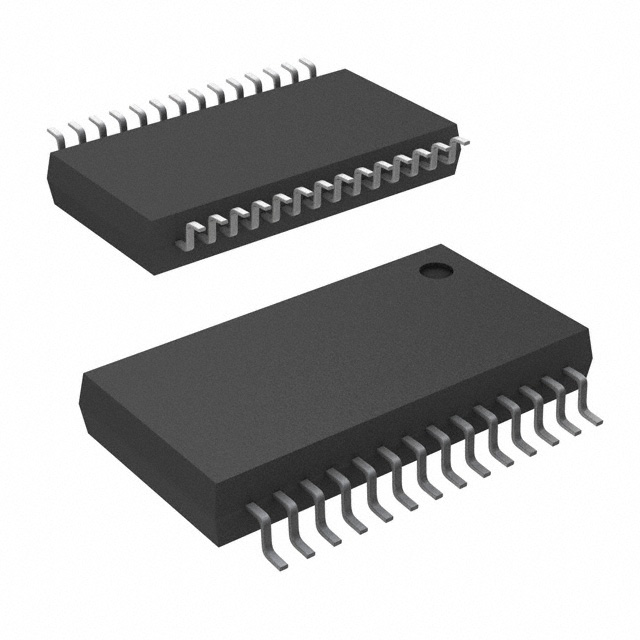
TRS211
5-V MULTICHANNEL RS-232 LINE DRIVER/RECEIVER
WITH ±15-kV ESD PROTECTION
www.ti.com
SLLS811 – JULY 2007
FEATURES
•
•
•
•
•
•
•
•
DB OR DW PACKAGE
(TOP VIEW)
RS-232 Bus-Pin ESD Protection Exceeds
±15 kV Using Human-Body Model (HBM)
Meets or Exceeds the Requirements of
TIA/EIA-232-F and ITU v.28 Standards
Operates at 5-V VCC Supply
Four Drivers and Five Receivers
Operates up to 120 kbit/s
Low Supply Current in Shutdown
Mode . . . 1 μA Typical
External Capacitors . . . 4 × 0.1 μF
Latch-Up Performance Exceeds 100 mA Per
JESD 78, Class II
DOUT3
DOUT1
DOUT2
RIN2
ROUT2
DIN2
DIN1
ROUT1
RIN1
GND
VCC
C1+
V+
C1−
APPLICATIONS
•
•
•
•
•
•
Battery-Powered Systems
PDAs
Notebooks
Laptops
Palmtop PCs
Hand-Held Equipment
1
28
2
27
3
26
4
5
25
24
6
23
7
22
8
21
9
10
20
19
11
18
12
17
13
16
14
15
DOUT4
RIN3
ROUT3
SHDN
EN
RIN4
ROUT4
DIN4
DIN3
ROUT5
RIN5
V−
C2−
C2+
DESCRIPTION/ORDERING INFORMATION
The TRS211 device consists of four line drivers, five line receivers, and a dual charge-pump circuit with ±15-kV
ESD protection pin to pin (serial-port connection pins, including GND). The device meets the requirements of
TIA/EIA-232-F and provides the electrical interface between an asynchronous communication controller and the
serial-port connector. The charge pump and four small external capacitors allow operation from a single 5-V
supply. The devices operate at data signaling rates up to 120 kbit/s and a maximum of 30-V/μs driver output
slew rate.
The TRS211 has both shutdown (SHDN) and enable control (EN). In shutdown mode, the charge pumps are
turned off, V+ is pulled down to VCC, V– is pulled to GND, and the transmitter outputs are disabled. This reduces
supply current typically to 1 μA. EN is used to put the receiver outputs into the high-impedance state to allow
wired-OR connection of two RS-232 ports. It has no effect on the RS-232 drivers or the charge pumps.
ORDERING INFORMATION
PACKAGE (1) (2)
TA
SOIC – DW
0°C to 70°C
SSOP – DB
SOIC – DW
–40°C to 85°C
SSOP – DB
(1)
(2)
ORDERABLE PART NUMBER
Tube of 20
TRS211CDW
Reel of 1000
TRS211CDWR
Tube of 50
TRS211CDB
Reel of 2000
TRS211CDBR
Tube of 20
TRS211IDW
Reel of 1000
TRS211IDWR
Tube of 50
TRS211IDB
Reel of 2000
TRS211IDBR
TOP-SIDE MARKING
TRS211C
TRS211C
TRS211I
TRS211I
Package drawings, standard packing quantities, thermal data, symbolization, and PCB design guidelines are available at
www.ti.com/sc/package.
For the most current package and ordering information, see the Package Option Addendum at the end of this document, or see the TI
website at www.ti.com.
Please be aware that an important notice concerning availability, standard warranty, and use in critical applications of Texas
Instruments semiconductor products and disclaimers thereto appears at the end of this data sheet.
PRODUCTION DATA information is current as of publication date.
Products conform to specifications per the terms of the Texas
Instruments standard warranty. Production processing does not
necessarily include testing of all parameters.
Copyright © 2007, Texas Instruments Incorporated
�TRS211
5-V MULTICHANNEL RS-232 LINE DRIVER/RECEIVER
WITH ±15-kV ESD PROTECTION
www.ti.com
SLLS811 – JULY 2007
FUNCTION TABLES (1)
INPUTS
(1)
DRIVER
RECEIVER
DEVICE STATUS
L
All active
All active
Normal operation
L
H
All active
Z
Normal operation
H
X
Z
Z
Shutdown
SHDN
EN
L
X = don't care, Z = high impedance
Each Driver (1)
INPUTS
(1)
DIN
SHDN
OUTPUT
DOUT
L
L
H
H
L
L
X
H
Z
DRIVER STATUS
Normal operation
Powered off
X = don't care, Z = high impedance
Each Receiver (1)
INPUTS
(1)
2
RIN
EN
OUTPUT
ROUT
L
L
H
H
L
L
X
H
Z
RECEIVER STATUS
X = don't care, Z = high impedance
Submit Documentation Feedback
Normal operation
Powered off
�TRS211
5-V MULTICHANNEL RS-232 LINE DRIVER/RECEIVER
WITH ±15-kV ESD PROTECTION
www.ti.com
SLLS811 – JULY 2007
LOGIC DIAGRAM (POSITIVE LOGIC)
7
2
DIN1
DOUT1
6
3
DIN2
TTL/CMOS
Inputs
DOUT2
20
DIN3
DOUT3
21
28
DIN4
DOUT4
25
8
SHDN
9
ROUT1
RIN1
5
4
ROUT2
RIN2
26
TTL/CMOS
Outputs
RS-232
Outputs
1
27
ROUT3
RIN3
22
RS-232
Inputs
23
ROUT4
RIN4
19
18
ROUT5
RIN5
24
EN
Submit Documentation Feedback
3
�TRS211
5-V MULTICHANNEL RS-232 LINE DRIVER/RECEIVER
WITH ±15-kV ESD PROTECTION
www.ti.com
SLLS811 – JULY 2007
Absolute Maximum Ratings (1)
over operating free-air temperature range (unless otherwise noted)
VCC
Supply voltage range (2)
V+
Positive charge pump voltage range (2)
V–
Negative charge pump voltage range
VI
Input voltage range
VO
Output voltage range
θJA
Package thermal impedance (3) (4)
TJ
Operating virtual junction temperature
Tstg
Storage temperature range
(2)
(3)
(4)
MAX
6
V
VCC – 0.3
14
V
0.3
–14
V
–0.3
V+ + 0.3
(2)
Drivers
±30
Receivers
Drivers
Receivers
Short-circuit duration
(1)
MIN
–0.3
V– – 0.3
V+ + 0.3
–0.3
VCC + 0.3
DOUT
UNIT
V
V
Continuous
DB package
62
DW package
46
–65
°C/W
150
°C
150
°C
Stresses beyond those listed under "absolute maximum ratings" may cause permanent damage to the device. These are stress ratings
only, and functional operation of the device at these or any other conditions beyond those indicated under "recommended operating
conditions" is not implied. Exposure to absolute-maximum-rated conditions for extended periods may affect device reliability.
All voltages are with respect to network GND.
Maximum power dissipation is a function of TJ(max), θJA, and TA. The maximum allowable power dissipation at any allowable ambient
temperature is PD = (TJ(max) – TA)/θJA. Operating at the absolute maximum TJ of 150°C can affect reliability.
The package thermal impedance is calculated in accordance with JESD 51-7.
Recommended Operating Conditions (1)
See Figure 6
Supply voltage
VIH
VIL
VI
TA
(1)
Driver high-level input voltage
DIN
Control high-level input voltage
EN, SHDN
Driver and control low-level input voltage
DIN, EN, SHDN
Driver and control input voltage
DIN, EN, SHDN
NOM
MAX
4.5
5
5.5
2
0.8
TRS211C
TRS211I
UNIT
V
V
2.4
Receiver input voltage
Operating free-air temperature
MIN
0
5.5
–30
30
0
70
–40
85
V
V
°C
Test conditions are C1–C4 = 0.1 μF at VCC = 5 V ± 0.5 V.
Electrical Characteristics (1)
over recommended ranges of supply voltage and operating free-air temperature (unless otherwise noted)
PARAMETER
ICC
(1)
(2)
4
TEST CONDITIONS
MIN
TYP (2)
MAX
UNIT
Supply current
No load,
See Figure 6
14
20
mA
Shutdown supply current
TA = 25°C,
See Figure 1
1
10
μA
Test conditions are C1–C4 = 0.1 μF at VCC = 5 V ± 0.5 V.
All typical values are at VCC = 5 V, and TA = 25°C.
Submit Documentation Feedback
�TRS211
5-V MULTICHANNEL RS-232 LINE DRIVER/RECEIVER
WITH ±15-kV ESD PROTECTION
www.ti.com
SLLS811 – JULY 2007
DRIVER SECTION
Electrical Characteristics (1)
over recommended ranges of supply voltage and operating free-air temperature (unless otherwise noted) (see Figure 4)
PARAMETER
TEST CONDITIONS
MIN
TYP (2)
VOH
High-level output voltage
All DOUT at RL = 3 kΩ to GND
5
9
VOL
Low-level output voltage
All DOUT at RL = 3 kΩ to GND
–5
–9
Driver high-level input current
DIN = VCC
Control high-level input current
EN, SHDN = VCC
Driver low-level input current
DIN = 0 V
Control low-level input current
EN, SHDN = 0 V
IOS
Short-circuit output current (3)
VCC = 5.5 V,
VO = 0 V
ro
Output resistance
VCC, V+, and V– = 0 V,
VO = ±2 V
IIH
IIL
(1)
(2)
(3)
MAX
UNIT
V
V
15
200
3
10
–15
–200
–3
–10
±10
±60
μA
μA
mA
Ω
300
Test conditions are C1–C4 = 0.1 μF at VCC = 5 V ± 0.5 V.
All typical values are at VCC = 5 V, and TA = 25°C.
Short-circuit durations should be controlled to prevent exceeding the device absolute power dissipation ratings, and not more than one
output should be shorted at a time.
Switching Characteristics (1)
over recommended ranges of supply voltage and operating free-air temperature (unless otherwise noted)
PARAMETER
TEST CONDITIONS
MIN
TYP (2)
MAX
UNIT
Maximum data rate
CL = 50 pF to 1000 pF,
One DOUT switching,
RL = 3 kΩ to 7 kΩ,
See Figure 2
tPLH(D)
Propagation delay time,
low- to high-level output
CL = 2500 pF,
All drivers loaded,
RL = 3 kΩ,
See Figure 2
2
μs
tPHL(D)
Propagation delay time,
high- to low-level output
CL = 2500 pF,
All drivers loaded,
RL = 3 kΩ,
See Figure 2
2
μs
tsk(p)
Pulse skew (3)
CL = 150 pF to 2500 pF,
See Figure 3
RL = 3 kΩ to 7 kΩ,
300
ns
SR(tr)
Slew rate, transition region
CL = 50 pF to 1000 pF,
VCC = 5 V
RL = 3 kΩ to 7 kΩ,
(1)
(2)
(3)
120
3
kbit/s
6
30
V/μs
TYP
UNIT
±15
kV
Test conditions are C1–C4 = 0.1 μF at VCC = 5 V ± 0.5 V.
All typical values are at VCC = 5 V, and TA = 25°C.
Pulse skew is defined as |tPLH – tPHL| of each channel of the same device.
ESD Protection
PIN
DOUT, RIN
TEST CONDITIONS
Human-Body Model
Submit Documentation Feedback
5
�TRS211
5-V MULTICHANNEL RS-232 LINE DRIVER/RECEIVER
WITH ±15-kV ESD PROTECTION
www.ti.com
SLLS811 – JULY 2007
RECEIVER SECTION
Electrical Characteristics (1)
over recommended ranges of supply voltage and operating free-air temperature (unless otherwise noted) (see Figure 6)
PARAMETER
TEST CONDITIONS
VOH
High-level output voltage
IOH = –1 mA
VOL
Low-level output voltage
IOH = 1.6 mA
VIT+
Positive-going input threshold voltage
VCC = 5 V,
TA = 25°C
VIT–
Negative-going input threshold voltage
VCC = 5 V,
TA = 25°C
Vhys
Input hysteresis (VIT+ – VIT– )
ri
Input resistance
VCC = 5 V,
TA = 25°C
Output leakage current
EN = VCC,
0 ≤ ROUT ≤ VCC
(1)
(2)
MIN
TYP (2)
3.5
VCC – 0.4
1.7
MAX
UNIT
V
0.4
V
2.4
V
0.8
1.2
0.2
0.5
1
V
V
3
5
7
kΩ
±0.05
±10
μa
Test conditions are C1–C4 = 0.1 μF at VCC = 5 V ± 0.5 V.
All typical values are at VCC = 5 V, and TA = 25°C.
Switching Characteristics (1)
over recommended ranges of supply voltage and operating free-air temperature (unless otherwise noted)
PARAMETER
MIN
TYP (2)
MAX
UNIT
tPLH(R)
Propagation delay time, low- to high-level output
CL = 150 pF,
See Figure 4
0.5
10
μs
tPHL(R)
Propagation delay time, high- to low-level output
CL = 150 pF,
See Figure 4
0.5
10
μs
ten
Output enable time
CL = 150 pF,
See Figure 5
RL = 1 kΩ,
600
ns
tdis
Output disable time
CL = 150 pF,
See Figure 5
RL = 1 kΩ,
200
ns
300
ns
tsk(p)
(1)
(2)
(3)
6
TEST CONDITIONS
Pulse skew
(3)
See Figure 3
Test conditions are C1–C4 = 0.1 μF at VCC = 5 V ± 0.5 V.
All typical values are at VCC = 5 V, and TA = 25°C.
Pulse skew is defined as |tPLH – tPHL| of each channel of the same device.
Submit Documentation Feedback
�TRS211
5-V MULTICHANNEL RS-232 LINE DRIVER/RECEIVER
WITH ±15-kV ESD PROTECTION
www.ti.com
SLLS811 – JULY 2007
PARAMETER MEASUREMENT INFORMATION
0.1 µF
−
+
ISHDN
5.5 V
0.1 µF
+
−
VCC
C1+
0.1 µF
V+
+
−
V−
0.1 µF
− +
C1−
C2+
0.1 µF
+
−
C2−
VCC
400 kΩ
5.5 V
DOUT
DIN
3 kΩ
D1 to D4
RIN
ROUT
5.5 V
EN
0-V or 5.5-V Drive
5 kΩ
R1 to R5
5.5 V
SHDN
GND
Figure 1. Shutdown Current Test Circuit
Submit Documentation Feedback
7
�TRS211
5-V MULTICHANNEL RS-232 LINE DRIVER/RECEIVER
WITH ±15-kV ESD PROTECTION
www.ti.com
SLLS811 – JULY 2007
PARAMETER MEASUREMENT INFORMATION (continued)
0V
SHDN
3V
Input
Generator
(see Note B)
1.5 V
RS-232
Output
50 Ω
RL
1.5 V
0V
tPHL (D)
CL
(see Note A)
Output
tPLH (D)
3V
3V
−3 V
−3 V
TEST CIRCUIT
SR(tr) +
t
PHL (D)
6V
or t
VOH
VOL
VOLTAGE WAVEFORMS
PLH (D)
A.
CL includes probe and jig capacitance.
B.
The pulse generator has the following characteristics: PRR = 120 kbit/s, ZO = 50 Ω, 50% duty cycle, tr ≤ 10 ns,
tf ≤ 10 ns.
Figure 2. Driver Slew Rate and Propagation Delay Times
0V
SHDN
3V
Generator
(see Note B)
RS-232
Output
50 Ω
RL
Input
1.5 V
1.5 V
0V
CL
(see Note A)
tPLH (D)
tPHL (D)
VOH
50%
50%
Output
VOL
TEST CIRCUIT
VOLTAGE WAVEFORMS
A.
CL includes probe and jig capacitance.
B.
The pulse generator has the following characteristics: PRR = 120 kbit/s, ZO = 50 Ω, 50% duty cycle, tr ≤ 10 ns,
tf ≤ 10 ns.
Figure 3. Driver Pulse Skew
0V
SHDN
Input
3V
1.5 V
1.5 V
−3 V
Output
Generator
(see Note B)
50 Ω
CL
(see Note A)
0V
EN
tPHL (R)
tPLH (R)
VOH
50%
Output
50%
VOL
TEST CIRCUIT
VOLTAGE WAVEFORMS
A.
CL includes probe and jig capacitance.
B.
The pulse generator has the following characteristics: ZO = 50 Ω, 50% duty cycle, tr ≤ 10 ns, tf ≤ 10 ns.
Figure 4. Receiver Propagation Delay Times
8
Submit Documentation Feedback
�TRS211
5-V MULTICHANNEL RS-232 LINE DRIVER/RECEIVER
WITH ±15-kV ESD PROTECTION
www.ti.com
SLLS811 – JULY 2007
PARAMETER MEASUREMENT INFORMATION (continued)
3V
VCC
0V
SHDN
GND
S1
1.5 V
0V
tPZH
(S1 at GND)
tPHZ
(S1 at GND)
RL
3 V or 0 V
1.5 V
Input
Output
Output
VOH
VOH − 0.1 V
CL
(see Note A)
EN
Generator
(see Note B)
3.5 V
tPLZ
(S1 at VCC)
50 Ω
tPZL
(S1 at VCC)
VOL + 0.1 V
0.8 V
VOL
Output
TEST CIRCUIT
VOLTAGE WAVEFORMS
A.
CL includes probe and jig capacitance.
B.
The pulse generator has the following characteristics: ZO = 50 Ω, 50% duty cycle, tr ≤ 10 ns, tf ≤ 10 ns.
C.
tPLZ and tPHZ are the same as tdis.
D.
tPZL and tPZH are the same as ten.
Figure 5. Receiver Enable and Disable Times
Submit Documentation Feedback
9
�TRS211
5-V MULTICHANNEL RS-232 LINE DRIVER/RECEIVER
WITH ±15-kV ESD PROTECTION
www.ti.com
SLLS811 – JULY 2007
APPLICATION INFORMATION
DOUT3
DOUT1
DOUT2
RIN2
1
28
2
27
3
DOUT4
RIN3
5 kΩ
4
26
5 kΩ
ROUT3
25
SHDN
ROUT2
24
5
EN
23
5V
RIN4
5 kΩ
400 kΩ
DIN2
6
22
ROUT4
5V
400 kΩ
DIN1
ROUT1
RIN1
GND
−
CBYPASS
+
= 0.1 µF
7
400 kΩ
21
8
9
5V
10
5 kΩ
400 kΩ
DIN3
11
19
VCC
−
18
+
12
13
C1 =
0.1 µF
6.3 V
DIN4
20
VCC
C3 † =
0.1 µF
6.3 V
5V
C1+
C4 =
0.1 µF
16 V
5 kΩ
V−
14
RIN5
V+
+
−
ROUT5
C1−
C2−
17
−
16
−
+
C2+
†
C2 =
0.1 µF
16 V
15
C3 can be connected to VCC or GND.
A.
Resistor values shown are nominal.
B.
Nonpolarized ceramic capacitors are acceptable. If polarized tantalum or electrolytic capacitors are used, they should
be connected as shown.
Figure 6. Typical Operating Circuit and Capacitor Values
10
+
Submit Documentation Feedback
�TRS211
5-V MULTICHANNEL RS-232 LINE DRIVER/RECEIVER
WITH ±15-kV ESD PROTECTION
www.ti.com
SLLS811 – JULY 2007
APPLICATION INFORMATION (continued)
Capacitor Selection
The capacitor type used for C1–C4 is not critical for proper operation. The TRS211 requires 0.1-μF capacitors,
although capacitors up to 10 μF can be used without harm. Ceramic dielectrics are suggested for the 0.1-μF
capacitors. When using the minimum recommended capacitor values, make sure the capacitance value does
not degrade excessively as the operating temperature varies. If in doubt, use capacitors with a larger (e.g., 2×)
nominal value. The capacitors' effective series resistance (ESR), which usually rises at low temperatures,
influences the amount of ripple on V+ and V–.
Use larger capacitors (up to 10 μF) to reduce the output impedance at V+ and V–.
Bypass VCC to ground with at least 0.1 μF. In applications sensitive to power-supply noise generated by the
charge pumps, decouple VCC to ground with a capacitor the same size as (or larger than) the charge-pump
capacitors (C1–C4).
Electrostatic Discharge (ESD) Protection
TI TRS211 devices have standard ESD protection structures incorporated on the pins to protect against
electrostatic discharges encountered during assembly and handling. In addition, the RS232 bus pins (driver
outputs and receiver inputs) of these devices have an extra level of ESD protection. Advanced ESD structures
were designed to successfully protect these bus pins against ESD discharge of ±15 kV when powered down.
ESD Test Conditions
ESD testing is stringently performed by TI, based on various conditions and procedures. Please contact TI for a
reliability report that documents test setup, methodology, and results.
Human-Body Model (HBM)
The HBM of ESD testing is shown in Figure 7. Figure 8 shows the current waveform that is generated during a
discharge into a low impedance. The model consists of a 100-pF capacitor charged to the ESD voltage of
concern and subsequently discharged into the DUT through a 1.5-kΩ resistor.
RD
1.5 kΩ
VHBM
+
−
CS
100 pF
DUT
Figure 7. HBM ESD Test Circuit
Submit Documentation Feedback
11
�TRS211
5-V MULTICHANNEL RS-232 LINE DRIVER/RECEIVER
WITH ±15-kV ESD PROTECTION
www.ti.com
SLLS811 – JULY 2007
APPLICATION INFORMATION (continued)
1.5
VHBM = 2 kV
DUT = 10 V, 1-Ω Zener Diode
I DUT − A
1.0
0.5
0.0
0
50
100
150
200
Time − ns
Figure 8. Typical HBM Current Waveform
Machine Model (MM)
The MM ESD test applies to all pins, using a 200-pF capacitor with no discharge resistance. The purpose of the
MM test is to simulate possible ESD conditions that can occur during the handling and assembly processes of
manufacturing. In this case, ESD protection is required for all pins, not just RS-232 pins. However, after PC
board assembly, the MM test no longer is as pertinent to the RS-232 pins.
12
Submit Documentation Feedback
�PACKAGE OPTION ADDENDUM
www.ti.com
10-Dec-2020
PACKAGING INFORMATION
Orderable Device
Status
(1)
Package Type Package Pins Package
Drawing
Qty
Eco Plan
(2)
Lead finish/
Ball material
MSL Peak Temp
Op Temp (°C)
Device Marking
(3)
(4/5)
(6)
TRS211CDB
ACTIVE
SSOP
DB
28
50
RoHS & Green
NIPDAU
Level-1-260C-UNLIM
0 to 70
TRS211C
(1)
The marketing status values are defined as follows:
ACTIVE: Product device recommended for new designs.
LIFEBUY: TI has announced that the device will be discontinued, and a lifetime-buy period is in effect.
NRND: Not recommended for new designs. Device is in production to support existing customers, but TI does not recommend using this part in a new design.
PREVIEW: Device has been announced but is not in production. Samples may or may not be available.
OBSOLETE: TI has discontinued the production of the device.
(2)
RoHS: TI defines "RoHS" to mean semiconductor products that are compliant with the current EU RoHS requirements for all 10 RoHS substances, including the requirement that RoHS substance
do not exceed 0.1% by weight in homogeneous materials. Where designed to be soldered at high temperatures, "RoHS" products are suitable for use in specified lead-free processes. TI may
reference these types of products as "Pb-Free".
RoHS Exempt: TI defines "RoHS Exempt" to mean products that contain lead but are compliant with EU RoHS pursuant to a specific EU RoHS exemption.
Green: TI defines "Green" to mean the content of Chlorine (Cl) and Bromine (Br) based flame retardants meet JS709B low halogen requirements of