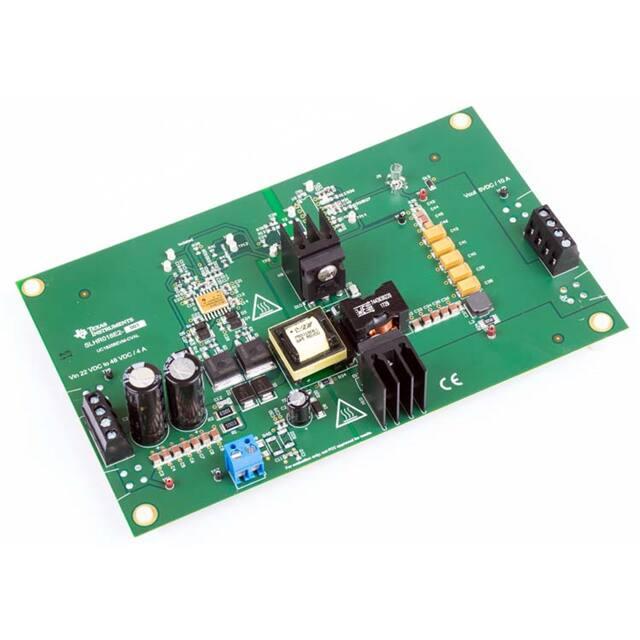
User's Guide
SLUUBZ0 – March 2019
UC1825B-SP evaluation module (EVM)
The UC1825BEVM-CVAL is the evaluation module (EVM) for the UC1825B-SP and provides a platform to
electrically evaluate its features. This user’s guide provides details about the EVM, its configuration,
schematics, and BOM.
1
2
3
4
5
Contents
Introduction ................................................................................................................... 3
System Design Theory ...................................................................................................... 4
Test Setup and Results ..................................................................................................... 8
Board Layout ................................................................................................................ 23
Schematics and Bill of Materials ......................................................................................... 30
List of Figures
1
Test Setup .................................................................................................................... 8
2
Efficiency vs Output Current .............................................................................................. 10
3
Load Regulation vs Output Current ...................................................................................... 11
4
Frequency Response of 22 VIN ........................................................................................... 12
5
Frequency Response of 48 VIN ........................................................................................... 13
6
Thermal Characteristics With 22 VIN ..................................................................................... 13
7
Thermal Characteristics With 48 VIN ..................................................................................... 14
8
Output Voltage Ripple With 22 VIN ....................................................................................... 15
9
Output Voltage Ripple With 48 VIN ....................................................................................... 15
10
Partial Step Down Transient With 22 VIN ................................................................................ 16
11
Full Step Down Transient With 22 VIN ................................................................................... 16
12
Full Step Up Transient With 22 VIN....................................................................................... 17
13
Partial Step Down Transient With 48 VIN ................................................................................ 17
14
Full Step Down Transient With 48 VIN ................................................................................... 18
15
Full Step Up Transient With 48 VIN....................................................................................... 18
16
No Load Startup With 22 VIN .............................................................................................. 19
17
Full Load Startup With 22 VIN ............................................................................................. 19
18
No Load Startup With 48 VIN .............................................................................................. 20
19
Full Load Startup With 48 VIN ............................................................................................. 20
20
Full Load Shutdown With 22 VIN .......................................................................................... 21
21
Full Load Shutdown With 48 VIN .......................................................................................... 21
22
Voltage Stress Across Main Switching MOSFETS Q1 and Q2 ...................................................... 22
23
Voltage Stress Across Output Diode .................................................................................... 22
24
Top Overlay ................................................................................................................. 23
25
Top Solder
26
27
28
29
30
..................................................................................................................
Top Layer ...................................................................................................................
Signal Layer 1 ..............................................................................................................
Signal Layer 2 ..............................................................................................................
Bottom Layer................................................................................................................
Bottom Solder...............................................................................................................
SLUUBZ0 – March 2019
Submit Documentation Feedback
UC1825B-SP evaluation module (EVM)
Copyright © 2019, Texas Instruments Incorporated
24
24
25
25
26
26
1
�www.ti.com
31
Bottom Overlay ............................................................................................................. 27
32
Drill Drawing ................................................................................................................ 28
33
Board Dimensions.......................................................................................................... 29
34
UC1825BEVM-CVAL Schematic 01 ..................................................................................... 30
35
UC1825BEVM-CVAL Schematic 02 ..................................................................................... 31
List of Tables
1
Test Parameters ............................................................................................................. 8
2
48 VIN Efficiency Raw Data................................................................................................ 10
3
22 VIN Efficiency Raw Data................................................................................................ 10
4
48 VIN Load Regulation Raw Data
5
22 VIN Load Regulation Raw Data
6
7
8
9
10
.......................................................................................
.......................................................................................
Frequency Response Characteristics of 22 VIN ........................................................................
Frequency Response Characteristics of 48 VIN ........................................................................
Notable Thermal Values for 22 VIN .......................................................................................
Notable Thermal Values for 48 VIN .......................................................................................
Bill of Materials .............................................................................................................
11
11
12
13
14
14
33
Trademarks
All trademarks are the property of their respective owners.
2
UC1825B-SP evaluation module (EVM)
SLUUBZ0 – March 2019
Submit Documentation Feedback
Copyright © 2019, Texas Instruments Incorporated
�Introduction
www.ti.com
1
Introduction
The UC1825BEVM-CVAL uses the UC1825B-SP to supply power using a push-pull topology. The
UC1825B-SP supplies both outputs necessary for a push pull topology using its two outputs in a radiation
improved package. Both low side MOSFETs are switched using the UC1825B-SP's integrated drivers. If
isolation gate drive transformers are used, the UC1825B-SP could be used to supply output signals for
both half bridge and full bridge applications. The UC1825B-SP has the soft start function integrated for
decreased external components.
1.1
Features
•
•
•
•
1.2
Applications
•
•
•
1.3
Pulse-by-pulse current limiting using UC1825B-SP
Dual output PWM control using UC1825B-SP
Low start-up current of 1.1 mA
Dedicated soft-start pin
Space satellite isolated power supplies
Radiation hardened applications
Space satellite payloads
Description
CAUTION
Do not touch! Surface of EVM gets hot. Contact may cause burns.
The UC1825BEVM-CVAL uses the UC1825B-SP as a dual output controller that has integrated drivers for
a push-pull topology. The push-pull topology was selected to avoid having to use external high side
drivers and take advantage of the low output noise the topology allows for. The UC1825B-SP originally
supported voltage mode topologies, but with minimal external components can support current mode
topologies as well. The RAMP pin is used for the input current sense and the ILIM pin is used as the
current limit pin. External components are needed to ensure slope compensation is implemented. The soft
start pin is critical for many designs and is shown in the EVM using the UC1825B-SP's integrated soft start
pin.
SLUUBZ0 – March 2019
Submit Documentation Feedback
UC1825B-SP evaluation module (EVM)
Copyright © 2019, Texas Instruments Incorporated
3
�System Design Theory
2
System Design Theory
2.1
Switching Frequency
www.ti.com
Choosing a switching frequency has a trade off between efficiency and bandwidth. Higher switching
frequencies will have larger bandwidth, but a lower efficiency than lower switching frequencies. A
switching frequency of 215 kHz was chosen as a trade off between bandwidth and efficiency. Using
equations provided by the data sheet for the UC1825B-SP, RT and CT were chosen to be 10 kΩ and 680
pF, respectively. The equation from the data sheet to calculate the switching frequency using these values
is shown in Equation 1.
(1)
(2)
2.2
Transformer
The transformer of the design consists of two major values, turns ratio and primary side inductance. There
is no minimum limit to the turns ratio of the transformer, only a maximum limit. The following equation will
give the turns ratio as a function of duty cycle which if the maximum duty cycle of the converter is used
will give you a maximum turns ratio. The UC1825B-SP design targeted a duty cycle of 30%. Since this
design is for a dual output device the duty cycle must stay below 50%. If both outputs were running above
50% duty cycle they would have to overlap which is not possible for the topology. The equation of the
turns ratio of the transformer is Equation 3.
(3)
(4)
Often the turns ratio will slightly change in design due to how the transformer is manufactured. For the
UC1825B-SP design a turns ratio of 2.2 was used. Another turns ratio that is important is the turns ratio of
the auxiliary winding. The auxiliary winding is found by figuring out what positive voltage is needed from
the auxiliary winding. Selecting this voltage lets one pick the turns ratio from the secondary to the auxiliary
winding, which in turn allows for the turns ratio from primary to auxiliary to be found. The equation for the
turns ratio is Equation 5.
(5)
(6)
An auxiliary winding of 1.5 was used for the UC1825B-SP design. The primary inductance of the
transformer is found from picking an appropriate magnetizing current. The magnetizing current of the
transformer is the amount of current drawn through the windings of the transformer when the output is
open circuited. Decreasing the magnetizing current will increase the inductance of the transformer,
perhaps to unreasonable values. Increasing the magnetizing current will cause efficiency to decrease. It is
desirable to keep the magnetizing current low, thus 6% was picked for the design value. The equation for
the auxiliary winding turns ratio is Equation 7.
(7)
(8)
There are quite a few physical limitations when making transformers that will affect the inductance value.
For the UC1825B-SP design a primary inductance of 120 µH was used. The output inductor was then
picked based on the output inductor ripple current with Equation 9.
(9)
(10)
4
UC1825B-SP evaluation module (EVM)
SLUUBZ0 – March 2019
Submit Documentation Feedback
Copyright © 2019, Texas Instruments Incorporated
�System Design Theory
www.ti.com
In the final design, a 2.2 μH inductor was used. The peak and primary currents of the transformer are also
generally useful for figuring out the physical structure of the transformer, so equations are listed below.
Note these equations are only true for continuous conduction mode. Peak currents are higher at the
maximum input voltage while the RMS current is highest at the minimum input voltage. These are also
idea values and do not take into account efficiency. Final designs needs to be optimized depending on the
specific application requirements. See the following equations for this design:
(11)
(12)
(13)
(14)
(15)
(16)
(17)
(18)
(19)
(20)
(21)
(22)
(23)
(24)
(25)
(26)
(27)
(28)
2.3
RCD and Diode Clamp
For the UC1825BEVM-CVAL a resistor and capacitor in combination with a diode was used to clamp the
voltage of the switch node. The resistor and capacitor is generally a value that is found through testing,
but starting values can be obtained. To figure out the resistor and capacitor needed for the RCD clamp,
one must first decide how much the node is allowed to overshoot. The equation for finding the voltage of
the clamp is Equation 29.
(29)
Note that Kclamp is recommended to be 1.5 as this will allow for only around 50% overshoot. Knowing the
parasitic inductance of the transformer and how much the RCD clamp voltage is allowed to change over
the switching cycle, can allow one to figuring out starting values for the resistor and capacitor using
Equation 30 and Equation 31.
(30)
(31)
SLUUBZ0 – March 2019
Submit Documentation Feedback
UC1825B-SP evaluation module (EVM)
Copyright © 2019, Texas Instruments Incorporated
5
�System Design Theory
www.ti.com
A starting value of 10% is generally used for ΔVclamp.
2.4
Output Diode
The voltage stress by the converter on the diode can be found with Equation 32.
(32)
(33)
Note that any diode picked should have a voltage rating of well above this value as it does not include
parasitic spikes in the equation. The UC1825-SP diode was picked to have a voltage rating of 60 V.
2.5
Main Switching MOSFETs
Each switch applies the input voltage across the transformer and the voltage is then divided down by the
turns ratio and applied to the secondary side. Since the magnitude of the voltage across the windings is
the input voltage, when the switch is off the primary switching MOSFETs will see twice the input voltage
as the voltage stress plus some amount of ringing. This means the MOSFETs chosen for a push-pull
topology should have a voltage rating of about 2.5 to 3 times higher than the input voltage.
2.6
Output Filter and Capacitance
For most designs, a ripple voltage is picked and the output capacitance is figured out from that value. The
output capacitance value needs to be able to withstand a full output current step as well as keep the
voltage ripple of the output low. The UC1825B-SP design started similar to that using the equations for
voltage ripple and load step with Equation 34 and Equation 36.
(34)
(35)
(36)
(37)
A value of around 1145 µF was chosen to keep output voltage ripple low. Note that the output voltage
ripple in the design was further decreased by adding an output filter and by adding an inductor after a
small portion of the output capacitance. This was done in order to keep output voltage ripple as low as
possible. Six ceramic capacitors were picked to be placed before the output filter and then the large
tantalum capacitors with some small ceramics were added to be part of the output filter. The initial
ceramics will help with the initial current ripple, but have a very large output voltage ripple. This voltage
ripple will be attenuated by the inductor and capacitor combination placed between the ceramic capacitors
and the output. The equations below allow for finding the amount of attenuation that will come from a
specific output filter inductance. An inductance of 500 nH was chosen to attenuate the output voltage
ripple. The value was chosen to put the resonant frequency pole well before the switching frequency of the
design as well as the zero from the ESR of the bulk capacitors to provide more attenuation.
(38)
(39)
(40)
(41)
(42)
(43)
Sometimes the output filter can cause peaking at high frequencies, this can be damped by adding a
resistor in parallel with the inductor which will decrease efficiency. For the UC1825B-SP design 0.5 Ω was
used as a very conservative value. The resistance needed to damp the peaking can be calculated using
the following equations:
6
UC1825B-SP evaluation module (EVM)
SLUUBZ0 – March 2019
Submit Documentation Feedback
Copyright © 2019, Texas Instruments Incorporated
�System Design Theory
www.ti.com
(44)
(45)
(46)
(47)
2.7
Compensation
Type IIB compensation was picked for the topology, adding a pole and a zero to the frequency response.
The location of where the pole and zero should be placed will depend on the desired crossover frequency
and the ESR zero of the output capacitors. The zero in compensation should be placed at least a decade
before the crossover frequency for the maximum phase boost. Note that compensation values were
picked with a crossover frequency of 5 kHz in mind for this design. The pole from the compensation
should be placed at the zero created by the ESR of the output capacitor.
(48)
(49)
(50)
The zero from compensation was placed well before the 500-Hz mark which is appropriate. The pole from
compensation was optimized while the circuit was tested and thus it was found that placing the pole a little
bit earlier smoothed out the frequency response.
2.8
Sense Resistor
The sense resistor is used to sense the ripple current from the transformer as well as shutdown the
switching cycle if the peak current of the converter is over the current limit set. The voltage threshold of
the CS pin is around 1 V and the shutdown current should be above the max current you expect. What the
max current limit will be will depend on the specific design. The equation used to find the max current limit
is Equation 51.
(51)
(52)
SLUUBZ0 – March 2019
Submit Documentation Feedback
UC1825B-SP evaluation module (EVM)
Copyright © 2019, Texas Instruments Incorporated
7
�Test Setup and Results
www.ti.com
3
Test Setup and Results
3.1
Test Setup
5V
LOUT
Lp
LFILTER
Feedback Network
Ls
RFBU
10 V
VBUS
Vo
CoCERM
48 - 22 V
VCC/VC
CoBULK
OUTA
Output
OUTB
Compensation Network
RFBL
VREF
CHF
EAOUT
RCOMP
Ro
CCOMP
Slope Compensation
UC1825B-SP
CT
INV
CCT
SS
RT
RRAMP
CSS
RT
ILIM/RAMP
GND
RCSF
RCS
Current Sense Filter
CCSF
Figure 1. Test Setup
WARNING
The UC1825BEVM-CVAL (EVM) is intended only for the developer’s
evaluation of the UC1825B-SP Current Mode PWM Controller
device.
This EVM is not designed nor intended to simulate actual end
product or subassembly applications involving high voltages often
found in isolated topologies exceeding the specified electrical
circuit ratings for UC1825BEVM-CVAL.
To minimize potential risk of personal injury, death, or damage to
the EVM itself, application of any differential voltages applied
between the electrical grounds of each input and output side of the
evaluation module is strictly prohibited.
All tests were done with 10 VIN on the UC1825B-SP unless otherwise specified.
Table 1. Test Parameters
8
PARAMETER
SPECIFICATIONS
Input Power Supply
22 to 48 VDC
Output Voltage
5 VDC
Output Current
0 to 10 A
Output Current Pre-load
0.5 mA
Operating Temperature
25°C
Switching Frequency of UC1825B-SP
215 kHz
Peak Input Current Limit
7A
UC1825B-SP evaluation module (EVM)
SLUUBZ0 – March 2019
Submit Documentation Feedback
Copyright © 2019, Texas Instruments Incorporated
�Test Setup and Results
www.ti.com
Table 1. Test Parameters (continued)
PARAMETER
SPECIFICATIONS
Bandwidth
~5 kHz
Phase Margin
~80°
SLUUBZ0 – March 2019
Submit Documentation Feedback
UC1825B-SP evaluation module (EVM)
Copyright © 2019, Texas Instruments Incorporated
9
�Test Setup and Results
3.2
www.ti.com
Test Results
3.2.1
Efficiency
90%
85%
80%
75%
70%
65%
60%
Efficiency
55%
50%
45%
40%
35%
30%
25%
20%
15%
10%
48 Vin
22 Vin
5%
0
1
1.5
2
2.5
3
3.5
4
4.5
5
5.5
6
Output Current (A)
6.5
7
7.5
8
8.5
9
9.5
10
D001
Figure 2. Efficiency vs Output Current
Please note that the test for Figure 2 was done such that the effect of the UC1825B-SP is not included in
the efficiency measurement. The efficiency numbers are for the push-pull converter without the UC1825BSP included.
Table 2. 48 VIN Efficiency Raw Data
VIN
IIN
VOUT
IOUT
PIN
POUT
Efficiency
48.5
1.24
4.93
9.98
59.9
49.2
0.821
48.6
1.11
4.93
8.99
53.9
44.3
0.823
48.6
0.99
4.93
7.99
47.9
39.4
0.822
48.6
0.87
4.93
7.01
42.2
34.6
0.820
48.6
0.75
4.93
5.99
36.2
29.6
0.817
48.6
0.62
4.93
5.02
30.2
24.7
0.820
48.6
0.51
4.93
4.01
24.6
19.8
0.805
48.6
0.38
4.93
3.01
18.4
14.9
0.807
48.6
0.27
4.93
2.01
13.0
9.9
0.765
48.6
0.15
4.94
1.01
7.3
5.0
0.684
48.6
0.00
4.94
0.00
0.0
0.0
0.000
Table 3. 22 VIN Efficiency Raw Data
10
VIN
IIN
VOUT
IOUT
PIN
POUT
Efficiency
22.12
2.69
4.93
9.98
59.4
49.2
0.83
22.14
2.40
4.93
9.01
53.1
44.4
0.84
22.16
2.11
4.93
7.99
46.7
39.4
0.84
22.17
1.84
4.93
7.01
40.8
34.6
0.85
22.19
1.57
4.93
6.01
34.8
29.6
0.85
22.21
1.30
4.93
5.01
28.9
24.7
0.86
22.23
1.04
4.93
4.01
23.1
19.8
0.86
UC1825B-SP evaluation module (EVM)
SLUUBZ0 – March 2019
Submit Documentation Feedback
Copyright © 2019, Texas Instruments Incorporated
�Test Setup and Results
www.ti.com
Table 3. 22 VIN Efficiency Raw Data (continued)
3.2.2
VIN
IIN
VOUT
IOUT
PIN
POUT
Efficiency
22.25
0.78
4.93
3.01
17.3
14.9
0.86
22.26
0.52
4.93
2.01
11.6
9.9
0.86
22.28
0.27
4.94
1.01
6.1
5.0
0.82
22.30
0.00
4.94
0.00
0.0
0.0
0.00
Load Regulation
4.9355
22 Vin
48 Vin
4.935
Output Voltage (V)
4.9345
4.934
4.9335
4.933
4.9325
4.932
4.9315
0
1
2
3
4
5
Output Current (A)
6
7
8
9
10
D002
Figure 3. Load Regulation vs Output Current
The test for Figure 3 was done at different input voltages shown by the separate curves and taken over
output current.
Table 4. 48 VIN Load Regulation Raw Data
VOUT
IOUT
4.9327
9.98
4.9329
8.99
4.9331
7.99
4.9333
7.01
4.9336
5.99
4.9339
5.02
4.9342
4.01
4.9345
3.01
4.9349
2.01
4.935
1.01
4.9353
0.00
Table 5. 22 VIN Load Regulation Raw Data
VOUT
IOUT
4.9317
9.98
4.9317
9.01
SLUUBZ0 – March 2019
Submit Documentation Feedback
UC1825B-SP evaluation module (EVM)
Copyright © 2019, Texas Instruments Incorporated
11
�Test Setup and Results
www.ti.com
Table 5. 22 VIN Load Regulation Raw Data (continued)
3.2.3
VOUT
IOUT
4.9319
7.99
4.9325
7.01
4.933
6.01
4.9334
5.014
4.9342
4.013
4.9345
3.013
4.9348
2.012
4.9353
1.011
4.9355
0
Frequency Response
Figure 4. Frequency Response of 22 VIN
Frequency response in Figure 4 was measured with 22 V on the input and with an output current of 10 A.
Table 6. Frequency Response Characteristics of 22 VIN
12
PARAMETER
VALUE
Crossover Frequency
5.35 kHz
Phase Margin
82.44°
Phase Crossover
47.23 kHz
Gain Margin
–11.82 dB
UC1825B-SP evaluation module (EVM)
SLUUBZ0 – March 2019
Submit Documentation Feedback
Copyright © 2019, Texas Instruments Incorporated
�Test Setup and Results
www.ti.com
Figure 5. Frequency Response of 48 VIN
Frequency response in Figure 5 was measured with 48 V on the input and with an output current of 10 A.
Table 7. Frequency Response Characteristics of 48 VIN
3.2.4
PARAMETER
VALUE
Crossover Frequency
5.06 kHz
Phase Margin
80.33°
Phase Crossover
43.53 kHz
Gain Margin
–15.60 dB
Thermal Characteristics
Figure 6. Thermal Characteristics With 22 VIN
SLUUBZ0 – March 2019
Submit Documentation Feedback
UC1825B-SP evaluation module (EVM)
Copyright © 2019, Texas Instruments Incorporated
13
�Test Setup and Results
www.ti.com
Table 8. Notable Thermal Values for 22 VIN
AREA
TEMPERATURE
Output Diode (D10 and D11)
62.0°C
Resistor Snubber (R23 and R26)
59.7°C
Output Filter Inductor (L1)
57.8°C
Main Switching MOSFET (Q1 and Q2)
61.7°C
Sense Resistors (R16 and R17)
82.0°C
Transformer (T1)
80.0°C
Thermal picture in Figure 6 was done with 22 V on the input and 10-A output for 20 minutes.
Figure 7. Thermal Characteristics With 48 VIN
Thermal picture in Figure 7 was done with 48 V on the input and 10-A output for 20 minutes.
Table 9. Notable Thermal Values for 48 VIN
14
AREA
TEMPERATURE
Output Diode (D10 and D11)
87.9°C
Resistor Snubber (R23 and R26)
83.1°C
Output Filter Inductor (L1)
61.4°C
Main Switching MOSFET (Q1 and Q2)
56.5°C
Sense Resistors (R16 and R17)
56.7°C
Transformer (T1)
91.9°C
UC1825B-SP evaluation module (EVM)
SLUUBZ0 – March 2019
Submit Documentation Feedback
Copyright © 2019, Texas Instruments Incorporated
�Test Setup and Results
www.ti.com
3.2.5
Output Voltage Ripple
Figure 8. Output Voltage Ripple With 22 VIN
Output voltage ripple test in Figure 8 was done with 22-V input and 10 A of output current.
Figure 9. Output Voltage Ripple With 48 VIN
Output voltage ripple test in Figure 9 was done with 48-V input and 10 A of output current.
SLUUBZ0 – March 2019
Submit Documentation Feedback
UC1825B-SP evaluation module (EVM)
Copyright © 2019, Texas Instruments Incorporated
15
�Test Setup and Results
3.2.6
www.ti.com
Transients
Figure 10. Partial Step Down Transient With 22 VIN
Partial step down transient in Figure 10 was done with 22-V input and current was stepped from 10 A to
0.16 A.
Figure 11. Full Step Down Transient With 22 VIN
Full step down transient in Figure 11 was done with 22-V input and current was stepped from 10 A to 0 A.
16
UC1825B-SP evaluation module (EVM)
SLUUBZ0 – March 2019
Submit Documentation Feedback
Copyright © 2019, Texas Instruments Incorporated
�Test Setup and Results
www.ti.com
Figure 12. Full Step Up Transient With 22 VIN
Step up transient in Figure 12 was done with 22-V input and current was stepped from 0 A to 10 A.
Figure 13. Partial Step Down Transient With 48 VIN
Partial step down transient in Figure 13 was done with 48-V input and current was stepped from 10 A to
0.16 A.
SLUUBZ0 – March 2019
Submit Documentation Feedback
UC1825B-SP evaluation module (EVM)
Copyright © 2019, Texas Instruments Incorporated
17
�Test Setup and Results
www.ti.com
Figure 14. Full Step Down Transient With 48 VIN
Full step down transient in Figure 14 was done with 48-V input and current was stepped from 10 A to 0 A.
Figure 15. Full Step Up Transient With 48 VIN
Full step up transient in Figure 15 was done with 48-V input and current was stepped from 0 A to 10 A.
18
UC1825B-SP evaluation module (EVM)
SLUUBZ0 – March 2019
Submit Documentation Feedback
Copyright © 2019, Texas Instruments Incorporated
�Test Setup and Results
www.ti.com
3.2.7
Startup
Figure 16. No Load Startup With 22 VIN
No load startup in Figure 16 was done with 22 V on the input and a 0-A output. Note that the output
overshoot does eventually drop down to the regulated 5 V.
Figure 17. Full Load Startup With 22 VIN
Full load startup in Figure 17 was done with 22 V on the input and a 10-A output.
SLUUBZ0 – March 2019
Submit Documentation Feedback
UC1825B-SP evaluation module (EVM)
Copyright © 2019, Texas Instruments Incorporated
19
�Test Setup and Results
www.ti.com
Figure 18. No Load Startup With 48 VIN
No load startup in Figure 18 was done with 48 V on the input and a 0-A output. Note that the output
overshoot does eventually drop down to the regulated 5 V.
Figure 19. Full Load Startup With 48 VIN
Full load startup in Figure 19 was done with 48 V on the input and a 10-A output.
20
UC1825B-SP evaluation module (EVM)
SLUUBZ0 – March 2019
Submit Documentation Feedback
Copyright © 2019, Texas Instruments Incorporated
�Test Setup and Results
www.ti.com
3.2.8
Shutdown
Figure 20. Full Load Shutdown With 22 VIN
Full load shutdown in Figure 20 was done with 22 V on the input and a 10-A load on the output.
Figure 21. Full Load Shutdown With 48 VIN
Full load shutdown in Figure 21 was done with 48 V on the input and a 10-A load on the output.
SLUUBZ0 – March 2019
Submit Documentation Feedback
UC1825B-SP evaluation module (EVM)
Copyright © 2019, Texas Instruments Incorporated
21
�Test Setup and Results
3.2.9
www.ti.com
Component Stress
Figure 22. Voltage Stress Across Main Switching MOSFETS Q1 and Q2
The test in Figure 22 was done with 48 V on the input and a 10-A output load.
Figure 23. Voltage Stress Across Output Diode
The test in Figure 23 was done with 48 V on the input and a 10-A output load.
22
UC1825B-SP evaluation module (EVM)
SLUUBZ0 – March 2019
Submit Documentation Feedback
Copyright © 2019, Texas Instruments Incorporated
�Board Layout
www.ti.com
4
Board Layout
Care was taken in the layout to ensure that high current path lengths were minimized as well as providing
multiple layers for high current input/outputs. Signals were kept to the top layer, except when it was
necessary to use the bottom layer. Internal layers were used for creating large planes for input/output
current as well as the switch nodes of the topology. Areas that dissipate large amounts of power such as
the RCD clamp and the sense resistors were placed on large copper planes in order to allow the thermal
properties of the parts to keep the temperature down as much as possible. Care was also taken to have
the high switching current path short. The switching current path starts at the input capacitors, through the
transformer into the MOSFETs, and then finally through the sense resistors and back into the input
capacitors. On the secondary side the high switching current path is from the ground of the output
capacitors, through the transformer, and then to the output.
Figure 24. Top Overlay
SLUUBZ0 – March 2019
Submit Documentation Feedback
UC1825B-SP evaluation module (EVM)
Copyright © 2019, Texas Instruments Incorporated
23
�Board Layout
www.ti.com
Figure 25. Top Solder
Figure 26. Top Layer
24
UC1825B-SP evaluation module (EVM)
SLUUBZ0 – March 2019
Submit Documentation Feedback
Copyright © 2019, Texas Instruments Incorporated
�Board Layout
www.ti.com
Figure 27. Signal Layer 1
Figure 28. Signal Layer 2
SLUUBZ0 – March 2019
Submit Documentation Feedback
UC1825B-SP evaluation module (EVM)
Copyright © 2019, Texas Instruments Incorporated
25
�Board Layout
www.ti.com
Figure 29. Bottom Layer
Figure 30. Bottom Solder
26
UC1825B-SP evaluation module (EVM)
SLUUBZ0 – March 2019
Submit Documentation Feedback
Copyright © 2019, Texas Instruments Incorporated
�Board Layout
www.ti.com
Figure 31. Bottom Overlay
SLUUBZ0 – March 2019
Submit Documentation Feedback
UC1825B-SP evaluation module (EVM)
Copyright © 2019, Texas Instruments Incorporated
27
�Board Layout
www.ti.com
Figure 32. Drill Drawing
28
UC1825B-SP evaluation module (EVM)
SLUUBZ0 – March 2019
Submit Documentation Feedback
Copyright © 2019, Texas Instruments Incorporated
�Board Layout
www.ti.com
Figure 33. Board Dimensions
SLUUBZ0 – March 2019
Submit Documentation Feedback
UC1825B-SP evaluation module (EVM)
Copyright © 2019, Texas Instruments Incorporated
29
�Schematics and Bill of Materials
5
www.ti.com
Schematics and Bill of Materials
This section presents the UC1825BEVM-CVAL schematics and bill of materials.
5.1
Schematics
The following figures show the UC1825BEVM-CVAL schematic.
C31
R23
3.00
500V
4700pF
D10
Switch Node2
1
2
R24
3
0.5
L1
VS-40CPQ060PBF
Vout
TP9
L2
J6
TP10
C32
50V
0.1uF
2.2uH
C33
100V
4.7uF
C34
100V
4.7uF
C35
100V
4.7uF
C36
100V
4.7uF
C37
100V
2200pF
DNP
500nH
C43
100V
2200pF
C44
50V
0.1uF
C45
100V
4.7uF
C46
16V
22uF
C38
10V
220uF
C39
10V
220uF
C40
10V
220uF
C41
10V
220uF
C42
10V
220uF
634-10ABPE
R25
10.0k
D13
J5
Vo
1
J7
6V
1
2
3
4
2
3
4
5
H9
Vout
C47
R26
PGND
Vo
3.00
500V
4700pF
PGND
J8
DNP
D11
Switch Node1
GND
1
2
PGND
3
Vout
VS-40CPQ060PBF
H10
R41
0
Vout
TP11
R27
DNP
49.9
634-10ABPE
9
5
4
Driver A
Driver B
Status13
TP15
D12
360
2
1
VREF
DRIVERA
DRIVERB
STATUS
3
6
NC
NC
7
GND
NI
INV
10
11
COMP
12
EXTCLK
2
CT
RT
1
8
+VIN
30.0k
C51
14
10.0k
R33
TP14
R29
40.2k
C50
INV
DNP
25V
2700pF
R35
17.2k
R32
2.05k
R34
0
R37
R38
DNP
0
PGND
R30
2.00k
PGND
0.1uF
50V
100pF
PGND
5962-8944101VCA
C52
0.1uF
C48
16V
0.22uF
C49
R31
Green
TP16
5002
TP12
U2
TP13
R36
R28
49.9
0
R42
0
Vout
PGND
C53
16V
2.2uF
GND
PGND
PGND
PGND
TP17 TP18
PGND
Figure 34. UC1825BEVM-CVAL Schematic 01
30
UC1825B-SP evaluation module (EVM)
SLUUBZ0 – March 2019
Submit Documentation Feedback
Copyright © 2019, Texas Instruments Incorporated
�Schematics and Bill of Materials
www.ti.com
1
Vin
T1
13
14
Switch Node2
TP1
J1
3
2
DNP
C1
100V
270uF
J2
C2
100V
270uF
4
3
2
1
C3
100V
4.7uF
C4
100V
4.7uF
C5
100V
4.7uF
C6
100V
4.7uF
C7
100V
4.7uF
C8
100V
4.7uF
C9
100V
4.7uF
R1
100k
C11
C10
100V
100V
.039uF 4.7nF
R2
100k
11
12
C12
330pF
D1
4
6
GND
INV
ILIM
C15
1.46/(10k*680pF) = 215 kHz
R6
10.0k
CT
C16
RAMP
0.68nF
13
VC
2
1
NI
INV
8
Soft Start
E/AOUT
3
Clock
4
ILIM/SD
5
RT
GND
10
6
CT
Pwr Gnd
12
7
Ramp
EP
17
D4
D5
Vref
C13
50V
2200pF
C14
25V
0.47uF
GND
GND
R5
Out A
D6
R11
50V
2200pF C20
C24
50V
470pF
DNP
8
2
3
TP4
NC
NC
Driver A
5
NC
NC
GND
R14
ILIM
R15
1.47k
6
7
RAMP
1.47k
R16
0.3
C22
50V
56pF
GND
Driver B
DNPC19
50V
0.01uF
C21
50V
2200pF
R12
47.5k
0.12µF
4
R10
31.6k
DNP
50V
120pF
EA OUT
4.75k
C18
GND
R17
0.3
Q3
1
CT
R8
DNP
1.00k
NV
DIODE
R18
DNP
49.9
R7
10.0k
GND
T2
1
Vref
CT
R9
49.9k
C17 GND
TP3
Q2
1
10.0
GND
GND
INV
R4
10.0k
Vref
GND
D7
4
Vcc
EA OUT
5962R8768106VYC
GND TP2
2.2:1.5:1 120 uH
Q1
1
10.0
Out B
16
VREF 5.1 V
9
750318061
R3
Out B
3
NV
Out A
11
14
OUTA
OUTB
4
GND
VCC
3
GND
15
3
Vcc
Switch Node1
5
Vaux
ES3D-E3/57T
D3
U1
DNP
PGND
GND
Vin
J3
7
8
ES3D-E3/57T
D2
Vcc
2
Vin
15nF
9
10
C23
50V
56pF
750311765
GND
Vref
R13
2.74k
TP5
GND
GND
TP6
INV
R21
9.76k
R19
2.74k
C25
50V
220pF
R39
DNP
0
Vaux
Vin
GND
R20
DNP
10.0
R22
DNP
2.00k
R40
DNP
2.00k
D8
MURA110T3G
DNPC27
0.01uF
C28
0.1uF
C29
1uF
C30
1uF
C26
50V
100uF
D9
SMAZ18-13-F
18V
Vcc
J4
2
1
10 to 20 V
TP7
TP8
GND
GND
GND
GND
Figure 35. UC1825BEVM-CVAL Schematic 02
SLUUBZ0 – March 2019
Submit Documentation Feedback
UC1825B-SP evaluation module (EVM)
Copyright © 2019, Texas Instruments Incorporated
31
�Schematics and Bill of Materials
5.2
32
www.ti.com
Bill of Materials
UC1825B-SP evaluation module (EVM)
SLUUBZ0 – March 2019
Submit Documentation Feedback
Copyright © 2019, Texas Instruments Incorporated
�Schematics and Bill of Materials
www.ti.com
Table 10. Bill of Materials
Designator
Quantity
Value
Description
PackageReference
PartNumber
Manufacturer
!PCB1
1
Printed Circuit Board
C1, C2
2
270uF
CAP, AL, 270 uF, 100 V, +/- 20%, 0.033 ohm,
TH
SLHR018
Any
D12.5xL30mm
EKYB101ELL271MK30S
Chemi-Con
C3, C4, C5,
C6, C7, C8,
C9, C33, C34,
C35, C36, C45
12
4.7uF
CAP, CERM, 4.7 uF, 100 V, +/- 10%, X7S,
AEC-Q200 Grade 1, 1210
1210
CGA6M3X7S2A475K200AB
TDK
C10
1
0.039uF
CAP, CERM, 0.039 uF, 100 V, +/- 10%, X7R,
0603
0603
C0603C393K1RACTU
Kemet
C11
1
4700pF
CAP, CERM, 4700 pF, 100 V, +/- 10%, X7R,
0603
0603
06031C472KAT2A
AVX
C12
1
330pF
CAP, CERM, 330 pF, 630 V,+/- 5%, C0G/NP0,
1206
1206
GRM31A5C2J331JW01D
MuRata
C13, C17, C21
3
2200pF
CAP, CERM, 2200 pF, 50 V, +/- 10%, X7R,
0603
0603
C0603C222K5RACTU
Kemet
C14
1
0.47uF
CAP, CERM, 0.47 uF, 25 V, +/- 10%, X7R,
AEC-Q200 Grade 1, 0603
0603
CGA3E3X7R1E474K080AB
TDK
C15
1
Cap Ceramic 0.015uF 50V X7R 10% Pad SMD
0603
0603 125°C T/R
C0603C153K5RACTU
Kemet
C16
1
YAGEO (PHYCOMP) CC0603KRX7R9BB681
SMD Multilayer Ceramic Capacitor, 0603 [1608
Metric], 680 pF, 50 V, 10%, X7R, CC Series
0603 (1608 Metric)
CC0603KRX7R9BB681
YAGEO
C20
1
CAP Ceramic 0.12uF 10% X7R 0603 SMD
0603 (1608 metric)
C0603C124K3RAC7867
KEMET
C22, C23
2
56pF
CAP, CERM, 56 pF, 50 V, +/- 5%, C0G/NP0,
0603
0603
06035A560JAT2A
AVX
C24
1
470pF
CAP, CERM, 470 pF, 50 V, +/- 10%, X7R,
0603
0603
885012206081
Wurth Elektronik
C25
1
220pF
CAP, CERM, 220 pF, 50 V, +/- 10%, X7R,
0603
0603
C0603C221K5RACTU
Kemet
C26
1
100uF
CAP, AL, 100 uF, 50 V, +/- 20%, 0.12 ohm, TH
CAP, 8x11.5mm
50ZLJ100MT78X11.5
Rubycon
0603
CGA3E2X7R1H104K080AA
TDK
C28, C49, C52
3
0.1uF
CAP, CERM, 0.1 uF, 50 V, +/- 10%, X7R,
AEC-Q200 Grade 1, 0603
C29, C30
2
1uF
CAP, CERM, 1 uF, 50 V, +/- 10%, X7R, 0603
0603
UMK107AB7105KA-T
Taiyo Yuden
C31, C47
2
4700pF
CAP, CERM, 4700 pF, 500 V, +/- 10%, X7R,
1210
1210
VJ1210Y472KXEAT5Z
Vishay-Vitramon
C32, C44
2
0.1uF
CAP, CERM, 0.1 uF, 50 V, +/- 10%, X7R, 1210 1210
C1210C104K5RACTU
Kemet
0805
08051C222KAT2A
AVX
C37, C43
2
2200pF
CAP, CERM, 2200 pF, 100 V, +/- 10%, X7R,
0805
C38, C39,
C40, C41, C42
5
220uF
CAP, TA, 220 uF, 10 V, +/- 10%, 0.045 ohm,
SMD
7343-43
T495X227K010ATE045
Kemet
C46
1
22uF
CAP, CERM, 22 uF, 16 V, +/- 20%, X7R, AECQ200 Grade 1, 1210
1210
CGA6P1X7R1C226M250AC
TDK
SLUUBZ0 – March 2019
Submit Documentation Feedback
Alternate
PartNumber
Alternate
Manufacturer
UC1825B-SP evaluation module (EVM)
Copyright © 2019, Texas Instruments Incorporated
33
�Schematics and Bill of Materials
www.ti.com
Table 10. Bill of Materials (continued)
Designator
Quantity
Value
Description
PackageReference
PartNumber
Manufacturer
C48
1
0.22uF
CAP, CERM, 0.22 uF, 16 V, +/- 10%, X7R,
0603
0603
885012206048
Wurth Elektronik
C51
1
100pF
CAP, CERM, 100 pF, 50 V, +/- 5%, C0G/NP0,
0603
0603
885012006057
Wurth Elektronik
C53
1
2.2uF
CAP, CERM, 2.2 uF, 16 V,+/- 10%, X7R, 0603
0603
EMK107BB7225MA-T
Taiyo Yuden
D1, D2
2
200V
Diode, Ultrafast, 200 V, 3 A, SMC
SMC
ES3D-E3/57T
Vishay-Semiconductor
D3, D4, D5,
D6
4
30V
Diode, Schottky, 30 V, 1 A, SMA
SMA
B130-13-F
Diodes Inc.
D7
1
75V
Diode, Switching, 75 V, 0.3 A, SOD-523F
SOD-523F
1N4148WT
Fairchild Semiconductor
D8
1
100V
Diode, Ultrafast, 100 V, 2 A, SMA
SMA
MURA110T3G
ON Semiconductor
D9
1
18V
Diode, Zener, 18 V, 1 W, AEC-Q101, SMA
SMA
SMAZ18-13-F
Diodes Inc.
D10, D11
2
60V
Diode, Schottky, 60 V, 40 A, TH
TO-247
VS-40CPQ060PBF
Vishay-Semiconductor
D12
1
Green
LED, Green, SMD
2x1.4mm
LG M67K-G1J2-24-Z
OSRAM
D13
1
6V
Diode, Zener, 6 V, 500 mW, SOD-123
SOD-123
MMSZ5233B-7-F
Diodes Inc.
Screw
NY PMS 440 0025 PH
B&F Fastener Supply
Standoff
1902C
Keystone
16.26x25.4x16.26 mm
634-10ABPE
Wakefield-Vette
Terminal Block, 4x1, 5.08mm, TH
4x1 Terminal Block
39544-3004
Molex
ED120/2DS
On-Shore Technology
H1, H2, H3,
H4
4
Machine Screw, Round, #4-40 x 1/4, Nylon,
Philips panhead
H5, H6, H7,
H8
4
Standoff, Hex, 0.5"L #4-40 Nylon
H9, H10
2
J2, J7
2
J4
1
Terminal Block, 5.08 mm, 2x1, Brass, TH
2x1 5.08 mm Terminal
Block
J5
1
Compact Probe Tip Circuit Board Test Points,
TH, 25 per
TH Scope Probe
131-5031-00
Tektronix
L1
1
2.2uH
Inductor, Shielded Drum Core, Mn-Zn, 2.2 uH,
28 A, 0.0015 ohm, SMD
21.8x14.5x21.5mm
7443630220
Wurth Elektronik
L2
1
500nH
Inductor, Shielded, Ferrite, 500 nH, 12 A,
0.0066 ohm, AEC-Q200 Grade 1, SMD
8x8x4.5 mm
SRN8040TA-R50Y
Bourns
Q1, Q2
2
250V
MOSFET, N-CH, 250 V, 25 A, DDPAK
DDPAK
IPB600N25N3 G
Infineon Technologies
Q3
1
40 V
Transistor, NPN, 40 V, 0.2 A, SOT-323
SOT-323
MMBT3904WT1G
ON Semiconductor
R1, R2
2
100k
RES, 100 k, 1%, 1 W, AEC-Q200 Grade 0,
2512
2512
CRCW2512100KFKEG
Vishay-Dale
R3, R5
2
10.0
RES, 10.0, 1%, 0.1 W, 0603
0603
RC0603FR-0710RL
Yageo America
R4, R6, R7,
R33
4
10.0k
RES, 10.0 k, 1%, 0.1 W, 0603
0603
ERJ-3EKF1002V
Panasonic
R9
1
49.9k
RES, 49.9 k, 1%, 0.1 W, 0603
0603
RC0603FR-0749K9L
Yageo
0603
CRCW060331K6FKEA
Vishay-Dale
0603
CRCW06034K75FKEA
Vishay-Dale
R10
1
31.6k
RES, 31.6 k, 1%, 0.1 W, AEC-Q200 Grade 0,
0603
R11
1
4.75k
RES, 4.75 k, 1%, 0.1 W, AEC-Q200 Grade 0,
0603
34
UC1825B-SP evaluation module (EVM)
Alternate
PartNumber
Alternate
Manufacturer
None
SLUUBZ0 – March 2019
Submit Documentation Feedback
Copyright © 2019, Texas Instruments Incorporated
�Schematics and Bill of Materials
www.ti.com
Table 10. Bill of Materials (continued)
Designator
Quantity
Value
Description
PackageReference
PartNumber
Manufacturer
R12
1
47.5k
RES, 47.5 k, 1%, 0.1 W, AEC-Q200 Grade 0,
0603
0603
ERJ-3EKF4752V
Panasonic
R13, R19
2
2.74k
RES, 2.74 k, 1%, 0.1 W, AEC-Q200 Grade 0,
0603
0603
CRCW06032K74FKEA
Vishay-Dale
R14, R15
2
1.47k
RES, 1.47 k, 1%, 0.1 W, AEC-Q200 Grade 0,
0603
0603
CRCW06031K47FKEA
Vishay-Dale
R16, R17
2
0.3
RES, 0.3, 1%, 2 W, 2512
2512
CSRN2512FKR300
Stackpole Electronics Inc
0603
CRCW06039K76FKEA
Vishay-Dale
R21
1
9.76k
RES, 9.76 k, 1%, 0.1 W, AEC-Q200 Grade 0,
0603
R23, R26
2
3.00
RES, 3.00, 1%, 1 W, 2512
2512
ERJ-1TRQF3R0U
Panasonic
R24
1
0.5
RES, 0.5, 1%, 1 W, 2010
2010
CSRN2010FKR500
Stackpole Electronics Inc
R25
1
10.0k
RES, 10.0 k, 0.1%, 0.063 W, 0402
0402
MCR01MRTF1002
Rohm
R28
1
49.9
RES, 49.9, 1%, 0.1 W, 0603
0603
RC0603FR-0749R9L
Yageo America
0603
CRCW060340K2FKEA
Vishay-Dale
R29
1
40.2k
RES, 40.2 k, 1%, 0.1 W, AEC-Q200 Grade 0,
0603
R30
1
2.00k
RES, 2.00 k, 1%, 0.1 W, 0603
0603
RC0603FR-072KL
Yageo America
R31
1
30.0k
RES, 30.0 k, 1%, 0.1 W, 0603
0603
RC0603FR-0730KL
Yageo
R32
1
2.05k
RES, 2.05 k, 1%, 0.1 W, 0603
0603
RC0603FR-072K05L
Yageo
R34, R37
2
0
RES, 0, 5%, 0.25 W, 1206
1206
RC1206JR-070RL
Yageo America
R35
1
17.2k
RES, 17.2 k, 0.1%, 0.1 W, 0603
0603
RT0603BRD0717K2L
Yageo America
0603
CRCW0603360RJNEA
Vishay-Dale
R36
1
360
RES, 360, 5%, 0.1 W, AEC-Q200 Grade 0,
0603
R41, R42
2
0
RES, 0, 1%, 0.1 W, AEC-Q200 Grade 0, 0603
0603
RMCF0603ZT0R00
Stackpole Electronics Inc
T1
1
TRANSFORMER
PTH_25MM0_22MM2
750318061
Wurth Electronics
TP1, TP9,
TP10
3
Test Point, Miniature, Red, TH
Red Miniature Testpoint
5000
Keystone
TP2, TP3,
TP4, TP5,
TP6, TP11,
TP12, TP13,
TP14, TP15,
TP16
11
Test Point, Miniature, White, TH
White Miniature Testpoint
5002
Keystone
TP7, TP8,
TP17, TP18
4
Test Point, Miniature, Black, TH
Black Miniature Testpoint
5001
Keystone
U1
1
RAD-TOLERANT CLASS V, HIGH-SPEED
PWM CONTROLLER, HKT0016A (CFP-16)
HKT0016A
5962R8768106VYC
Texas Instruments
U2
1
Isolated Feedback Generator, -55 to 125 degC,
J0014A
14-pin CDIP (J)
5962-8944101VCA
Texas Instruments
C18
0
120pF
CAP, CERM, 120 pF, 50 V, +/- 5%, C0G/NP0,
0603
0603
GRM1885C1H121JA01D
MuRata
C19
0
0.01uF
CAP, CERM, 0.01 uF, 50 V, +/- 10%, X7R,
0603
0603
CL10B103KB8NCNC
Samsung ElectroMechanics
SLUUBZ0 – March 2019
Submit Documentation Feedback
Alternate
PartNumber
Alternate
Manufacturer
Texas
Instruments
UC1825B-SP evaluation module (EVM)
Copyright © 2019, Texas Instruments Incorporated
35
�Schematics and Bill of Materials
www.ti.com
Table 10. Bill of Materials (continued)
Designator
Quantity
Value
Description
PackageReference
PartNumber
Manufacturer
C27
0
0.01uF
CAP, CERM, 0.01 uF, 50 V, +/- 10%, X7R,
0603
0603
GRM188R71H103KA01D
MuRata
C50
0
2700pF
CAP, CERM, 2700 pF, 25 V, +/- 10%, X7R,
0603
0603
GRM188R71E272KA01D
MuRata
FID1, FID2,
FID3
0
Fiducial mark. There is nothing to buy or
mount.
N/A
N/A
N/A
J1, J6
0
Banana Jack Insul Nylon Red, R/A, TH
CTE_CT3151SP-2
CT3151SP-2
Cal Test Electronics
J3, J8
0
Banana Jack Insul Nylon Black, R/A, TH
CTE_CT3151SP-0
CT3151SP-0
Cal Test Electronics
R8
0
1.00k
RES, 1.00 k, 1%, 0.1 W, AEC-Q200 Grade 0,
0603
0603
CRCW06031K00FKEA
Vishay-Dale
R18, R27
0
49.9
RES, 49.9, 1%, 0.1 W, 0603
0603
RC0603FR-0749R9L
Yageo America
R20
0
10.0
RES, 10.0, 1%, 0.25 W, 1206
1206
RC1206FR-0710RL
Yageo America
2512
CRCW25122K00FKEG
Vishay-Dale
R22, R40
0
2.00k
RES, 2.00 k, 1%, 1 W, AEC-Q200 Grade 0,
2512
R38
0
0
RES, 0, 0%, W, AEC-Q200 Grade 0, 0805
0805
PMR10EZPJ000
Rohm
R39
0
0
RES, 0, 1%, 0.1 W, AEC-Q200 Grade 0, 0603
0603
RMCF0603ZT0R00
Stackpole Electronics Inc
T2
0
1.2mH
Transformer, 1200 uH, SMD
8.64x9.02mm
750311765
Wurth Elektronik
36
UC1825B-SP evaluation module (EVM)
Alternate
PartNumber
Alternate
Manufacturer
SLUUBZ0 – March 2019
Submit Documentation Feedback
Copyright © 2019, Texas Instruments Incorporated
�IMPORTANT NOTICE AND DISCLAIMER
TI PROVIDES TECHNICAL AND RELIABILITY DATA (INCLUDING DATA SHEETS), DESIGN RESOURCES (INCLUDING REFERENCE
DESIGNS), APPLICATION OR OTHER DESIGN ADVICE, WEB TOOLS, SAFETY INFORMATION, AND OTHER RESOURCES “AS IS”
AND WITH ALL FAULTS, AND DISCLAIMS ALL WARRANTIES, EXPRESS AND IMPLIED, INCLUDING WITHOUT LIMITATION ANY
IMPLIED WARRANTIES OF MERCHANTABILITY, FITNESS FOR A PARTICULAR PURPOSE OR NON-INFRINGEMENT OF THIRD
PARTY INTELLECTUAL PROPERTY RIGHTS.
These resources are intended for skilled developers designing with TI products. You are solely responsible for (1) selecting the appropriate
TI products for your application, (2) designing, validating and testing your application, and (3) ensuring your application meets applicable
standards, and any other safety, security, regulatory or other requirements.
These resources are subject to change without notice. TI grants you permission to use these resources only for development of an
application that uses the TI products described in the resource. Other reproduction and display of these resources is prohibited. No license
is granted to any other TI intellectual property right or to any third party intellectual property right. TI disclaims responsibility for, and you
will fully indemnify TI and its representatives against, any claims, damages, costs, losses, and liabilities arising out of your use of these
resources.
TI’s products are provided subject to TI’s Terms of Sale or other applicable terms available either on ti.com or provided in conjunction with
such TI products. TI’s provision of these resources does not expand or otherwise alter TI’s applicable warranties or warranty disclaimers for
TI products.
TI objects to and rejects any additional or different terms you may have proposed. IMPORTANT NOTICE
Mailing Address: Texas Instruments, Post Office Box 655303, Dallas, Texas 75265
Copyright © 2022, Texas Instruments Incorporated
�