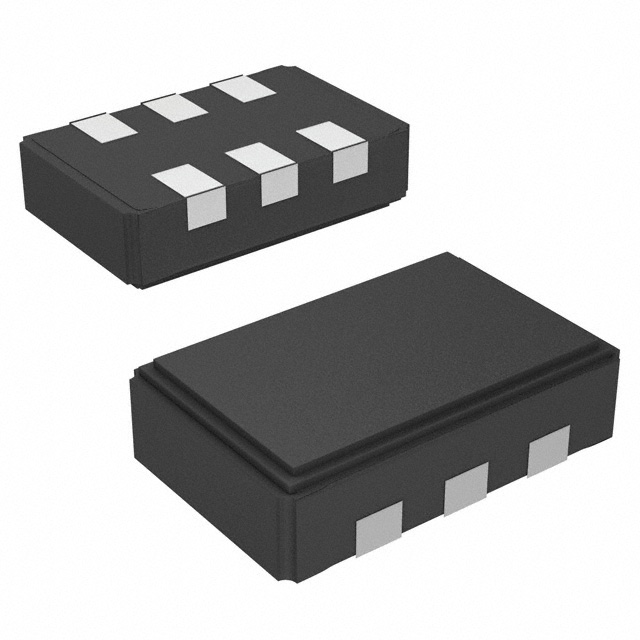
CY2X013
CY2X0137
High-Performance LVDS Oscillator
High-Performance LVDS Oscillator
Features
Functional Description
■
Low-jitter crystal oscillator (XO)
■
Less than 1 ps typical root mean square (RMS) phase jitter
■
Low-voltage differential signaling (LVDS) output
■
Output frequency from 50 MHz to 690 MHz
■
Factory-configured or field-programmable
■
Integrated phase-locked loop (PLL)
■
Can be configured as four different devices
■
Supply voltage: 3.3 V or 2.5 V
■
5.0 × 3.2 mm Pb-free chip carrier (LCC): CY2X013
■
7.0 × 5.0 mm Pb-free chip carrier (LCC): CY2X0137
■
Commercial and industrial temperature ranges
Cypress Semiconductor Corporation
Document Number: 001-86061 Rev. *D
•
The CY2X013/CY2X0137 device is a high-performance and
high-frequency XO. The device uses a Cypress proprietary
low-noise PLL to synthesize the frequency from an integrated
crystal.
The CY2X013/CY2X0137 device is available as a
factory-configured device or as a field-programmable device.
Factory-configured devices are configured for general use or
they can be customer-specific. The same CY2X013/CY2X0137
device can be configured as four different device types as
mentioned in the Logic Block Diagram.
For a complete list of related documentation, click here.
198 Champion Court
•
San Jose, CA 95134-1709
•
408-943-2600
Revised July 25, 2017
�CY2X013
CY2X0137
Logic Block Diagram
4
CRYSTAL
OSCILLATOR
Device Type 1: High-performance
LVDS crystal oscillator with Output
Enable
LOW- NOISE
PLL
CLK
OUTPUT
DIVIDER
5
CLK#
PROGRAMMABLE
CONFIGURATION
1
OE/PD#
6
3
VDD
VSS
4
CRYSTAL
OSCILLATOR
Device Type 2: High-performance
LVDS crystal oscillator with
Frequency Margining - I2C control
LOW-NOISE
PLL
CLK
OUTPUT
DIVIDER
5
CLK#
PROGRAMMABLE
CONFIGURATION
1
SDA
I2C
INTERFACE
2
SCL
Device Type 3:
High-performance LVDS
crystal oscillator with
frequency margining Frequency Select
Crystal
Oscillator
FS1
4
CLK
5
CLK#
Output
Divider
Low-Noise PLL
1
Frequency Select
Decode
FS0
2
CRYSTAL
OSC ILLATOR
LOW-NOISE
PLL
4
C LK
5
C LK#
OUTPUT
DIVIDER
Device Type 4:
High-performance LVDS
voltage-controlled crystal
oscillator
VIN
1
OE/PD#
2
Document Number: 001-86061 Rev. *D
PROGRAMMABLE
CONFIGURATION
6
3
VDD
VSS
Page 2 of 21
�CY2X013
CY2X0137
Contents
Pinouts .............................................................................. 4
Pin Definitions .................................................................. 4
Functional Overview ........................................................ 5
Device Type 1 ............................................................. 5
Device Type 2 ............................................................. 5
Device Type 3 ............................................................. 5
Device Type 4 ............................................................. 5
Programming Description ............................................... 6
Field-Programmable CY2X013F/CY2X0137F ............. 6
Factory-Configured CY2X013/CY2X0137 ................... 6
Programming Variables ................................................... 6
Output Frequency ........................................................ 6
Pin 1: Output Enable (OE) or Power Down (PD#) ....... 6
Industrial versus Commercial Device Performance .... 6
Absolute Pull Range .................................................... 6
Memory Map ...................................................................... 7
Serial Interface Protocol and Timing ........................... 7
Device Address ........................................................... 8
Data Valid .................................................................... 8
Data Frame ................................................................. 8
Acknowledge Pulse ..................................................... 8
Write Operations ............................................................... 9
Writing Individual Bytes ............................................... 9
Writing Multiple Bytes .................................................. 9
Read Operations ............................................................... 9
Current Address Read ................................................. 9
Document Number: 001-86061 Rev. *D
Random Read ............................................................. 9
Sequential Read .......................................................... 9
Serial Programming Interface
Timing Specifications .................................................... 10
Absolute Maximum Conditions ..................................... 11
Operating Conditions ..................................................... 11
DC Electrical Characteristics ........................................ 12
AC Electrical Characteristics ........................................ 13
Switching Waveforms .................................................... 14
Termination Circuits ....................................................... 15
Ordering Information ...................................................... 16
Possible Configurations ............................................. 16
Ordering Code Definitions ......................................... 16
Package Diagrams .......................................................... 17
Acronyms ........................................................................ 19
Document Conventions ................................................. 19
Units of Measure ....................................................... 19
Document History Page ................................................. 20
Sales, Solutions, and Legal Information ...................... 21
Worldwide Sales and Design Support ....................... 21
Products .................................................................... 21
PSoC® Solutions ...................................................... 21
Cypress Developer Community ................................. 21
Technical Support ..................................................... 21
Page 3 of 21
�CY2X013
CY2X0137
Pinouts
Figure 1. 6-pin Ceramic LCC Pinout
Device Type 1:
High--performance LVDS
crystal oscillator with Output
Enable:
Device Type 2:
High-performance LVDS
crystal oscillator with
Frequency Margining - I2C
control
Device Type 3:
High-performance LVDS
crystal oscillator with
Frequency Margining Frequency Select
6 VDD
SDA 1
6 VDD
FS1 1
6 VDD
DNU 2
5 CLK#
SCLK 2
5 CLK#
FS0 2
5 CLK#
VSS 3
4 CLK
4 CLK
VSS 3
4 CLK
OE/PD# 1
VSS 3
Device Type 4:
High-performance LVDS
voltage-controlled crystal
oscillator
VIN 1
OE/PD# 2
VSS 3
6 VDD
5 CLK#
4 CLK
Pin Definitions
6-pin Ceramic LCC
Name
Device Type 1
Device Type 2
Device Type 3
Device Type 4
I/O Type
Description
OE/PD#
1
N/A
N/A
2
CMOS
input
Output Enable pin: Active HIGH.
If OE = 1, CLK is enabled.
Power-down pin: Active LOW.
If PD# = 0, the device is powered
down and the clock is disabled. The
functionality
of
this
pin
is
programmable
CLK,
CLK#
4,5
4,5
4,5
4,5
LVDS
output
Differential output clock
DNU
2
N/A
N/A
N/A
–
VDD
6
6
6
6
Power
Supply voltage: 2.5 V or 3.3 V
Do not use: DNU pins are electrically
connected, but perform no function
VSS
3
3
3
3
Power
Ground
FS1, FS0
N/A
N/A
1,2
N/A
CMOS
input
Frequency Select
SDA
N/A
1
N/A
N/A
I/O
I2C Serial Data
SCLK
N/A
2
N/A
N/A
CMOS
input
I2C Serial Clock
VIN
N/A
N/A
N/A
1
Analog
input
VCXO control voltage, positive slope
Document Number: 001-86061 Rev. *D
Page 4 of 21
�CY2X013
CY2X0137
Functional Overview
Device Type 1
Device Type 1 is a simple crystal oscillator with one output
frequency. Pin 1 can be programmed either as OE or PD#. The
OE function is used to enable or disable the CLK output whereas
the PD# function places the device in a low-power state,
Figure 2 shows how the frequency words are arranged and
selected.
Figure 2. Frequency Words
Register
Address
10h – 15h
Frequency Word 0
00
16h – 1Bh
Frequency Word 1
01
Device Type 2
1Ch – 21h
Frequency Word 2
10
Device Type 2 has an I2C bus serial interface [1], which is used
to change the output frequency.
22h – 27h
Frequency Word 3
11
CY2X013/CY2X0137 is configured for four frequencies. At
power-on, the four configurations are transparently loaded into
an internal volatile memory which, in turn, controls the PLL. The
user can switch between the four frequencies through the I2C
bus. The user can also configure CY2X013/CY2X0137 with new
output frequencies by shifting new data into the internal memory.
Frequency-margining is a common application for this feature.
One frequency is used for the standard operating mode of the
device, while additional frequencies are available for margin
testing, either during product development or in-system
manufacturing test.
Note that all configuration changes made using I2C are
temporary and are lost when power is removed from the device.
At power-on, the device returns to its original state.
The configuration for a particular frequency is stored in a 6-byte
block of memory, known as a word. CY2X013/CY2X0137 has
four such words, labeled ‘Frequency Word 0’ through ‘Frequency
Word 3’. An additional register byte contains a 2-bit field, which
selects one of the four frequency words. By writing to this select
byte, the user can switch back and forth between the four
programmed frequencies. The select byte can be configured to
select any of the four frequency words at power-on.
When changing the output frequency, the frequency transition is
not guaranteed to be smooth. There can be frequency
excursions beyond the start frequency and the new
frequency.Glitches and runt pulses are possible and time must
be allowed for the PLL to re-lock.
If more than four frequencies are needed, the I2C bus can be
used to change any of the four frequency words. When writing
frequency words through I2C, the users should not change the
currently selected word. Instead, write one of the three
unselected words before changing the select byte to select that
new word.
40h
Control
PLL
Sel
Bits [1:0]
Select Byte
Device Type 3
The FS0 and FS1 pins select between four different output
frequencies, as shown in Table 1. Frequency margining is a
common application for this feature. One frequency is used for
the standard operating mode of the device, while the other
frequencies are available for margin testing, either during
product development or in-system manufacturing test.
Table 1. Frequency Select
FS1
FS0
0
0
Frequency 0
Output Frequency
0
1
Frequency 1
1
0
Frequency 2
1
1
Frequency 3
When changing the output frequency, the frequency transition is
not guaranteed to be smooth. There can be frequency
excursions beyond the start frequency and the new frequency.
Glitches and runt pulses are possible, and time must be allowed
for the PLL to relock.
Device Type 4
Device Type 4 is a voltage-controlled crystal oscillator. It has a
control voltage pin, VIN, which is an analog input used to adjust
the output frequency. The nominal output frequency is defined
when VIN = VDD,NOM/2. Increasing the voltage on VIN
increases the output frequency, while decreasing the voltage on
VIN decreases the output frequency. Any voltage between VSS
and VDD is allowed on VIN. The voltage or frequency slope is
very linear over most of the control voltage range.
Note
1. The serial interface is I2C Bus compliant with the following exceptions: SDA input leakage current, SDA input capacitance, SDA and SCLK are clamped to VDD,
setup time, and output hold time.
Document Number: 001-86061 Rev. *D
Page 5 of 21
�CY2X013
CY2X0137
Programming Description
Programming Variables
CY2X013/CY2X0137 is a programmable device. Prior to being
used in an application, it must be programmed with the output
frequency and other variables described in Programming
Variables. Two device types are available, each with its own
programming flow. They are described in the following sections.
Output Frequency
Field-Programmable CY2X013F/CY2X0137F
The CY2X013/CY2X0137 device has an output frequency range
of 50 MHz to 690 MHz, but the range is not continuous.
ThisCY2X013CY2X0137cannot generate frequencies in the
ranges of 521 MHz to 529 MHz and 596 MHz to 617 MHz.
Field-programmable devices are shipped unprogrammed and
must be programmed before being installed on a PCB.
Customers use the CyClockWizard™ software to specify the
device configuration and generate a joint electron devices
engineering council (JEDEC - extension .jed) programming file.
Programming of samples and prototype quantities is available
using the CyClockWizard software along with a
CY3675-CLKMAKER1 CyClockMaker Clock Programmer Kit
and CY3675-LCC6B socket adapter. Cypress’s value-added
distribution
partners
also
provide
programming
services. Field-programmable devices are designated with an ‘F’
in the part number. They are intended for quick prototyping and
inventory reduction. You can generate JEDEC for these four
devices using CyClockWizard 1.0. However, while creating
JEDEC or programming different device types, select different
MPNs in the CyClockWizard 1.0 software (see Table 2).
CY2X013/CY2X0137 can synthesize a frequency to a resolution
of one part per million (ppm), but the actual accuracy of the
output frequency is limited by the accuracy of the integrated
reference crystal.
Pin 1: Output Enable (OE) or Power Down (PD#)
This function is only available in Device Type 1 and 4. Pin 1
(Device Type 1) or Pin 2 (Device type 2) is programmed as either
OE or PD#. The OE function is used to enable or disable the CLK
output quickly, but it does not reduce core power consumption.
The PD# function places the device in a low-power state, but the
wake-up takes longer because the PLL must reacquire the lock.
Industrial versus Commercial Device Performance
You can download the software and programmer kit hardware
from www.cypress.com by clicking the hyperlinks in the previous
paragraph.
Industrial and commercial devices have different internal
crystals. They have a potentially significant impact on
performance levels for applications requiring the lowest possible
phase noise. The CyClockWIzard 1.0 software allows the user
to select between, and view the expected performance of, both
options.
Table 2. MPNs Selection on CyClockWizard 1.0 Software
Absolute Pull Range
Device Type
MPN selection on CyClockWizard 1.0
Device Type 1
CY2X013
Device Type 2
CY2XF23
Device Type 3
CY2XF33
Device Type 3
Contact Local Cypress FAE
Factory-Configured CY2X013/CY2X0137
For
ready-to-use
devices,
the
preconfigured
CY2X013/CY2X0137 device is available for samples or orders,
or you can request for a custom configuration. All requests are
submitted to the local Cypress field application engineer (FAE)
or sales representative. After the request is processed, the user
receives a new part number, samples, and datasheet with the
programmed values. This part number is used for additional
sample
requests
and
production
orders.
The
CY2X013/CY2X0137device is one-time programmable (OTP).
Document Number: 001-86061 Rev. *D
This is only applicable for Device Type 4. The pull range of
VCXO, measured in ppm is programmable. The configuration
software allows the user to select one of seven possible absolute
pull ranges (APR), ranging up to approximately ±200 ppm. APR
is the net pull range of the device, after subtracting frequency
variability due to device variation, and temperature, voltage, and
aging effects.
Table 3. Device Programming Variables
Variable
Output frequency
Device Type
Device Type 1 and 4
Pin 1 function (OE or PD#)
Device Type 1
Temperature range
(commercial or industrial)
Device Type 1, 2, 3 and 4
Output frequency 0
Device Type 2 and 3
Output frequency 1
Device Type 2 and 3
Output frequency 2
Device Type 2 and 3
Output frequency 3
Device Type 2 and 3
Absolute Pull Range
Device Type 4
Pin 2 function (OE or PD#)
Device Type 4
Page 6 of 21
�CY2X013
CY2X0137
Memory Map
Table 5. Register 40h: Select Byte
2
Five fields can be written via the I C bus. Four frequency words
define the output frequency. As shown in Table 4, each of these
words is a 6-byte field. When writing to a frequency word, all six
bytes should be written. They may be written either as individual
byte writes, or as a block write. The currently selected frequency
word should not be written to. All four words are symmetrical,
meaning that a 6-byte value that is valid for one word is also valid
for any of the other words, and produces the same frequency.
The fifth field is the select byte, located at byte address 40h. The
value written into the two least significant bits determines the
active frequency word. The other bits of the byte are reserved
and must be written with the values indicated in the table. Users
should never write to any address other than the 25 bytes
described here.
Table 4. Frequency Words
Frequency Byte Addresses (hex)
Word
0
Word Select
(Select Byte 40h)
10h to 15h
00
1
16h to 1Bh
01
2
1Ch to 21h
10
3
22h to 27h
11
Value
Bits Default
(binary)
Name
Description
7:2 000000
Reserved
Reserved. Always write
this value.
1:0 User-defined
Word select Selects the Frequency
Word to determine the
output frequency. 00
selects Word 0; 01 selects
Word 1; 10 selects Word
2; 11 selects Word 3.
Serial Interface Protocol and Timing
The CY2X013 / CY2X0137 device uses the SDA and SCLK pins
for an I2C bus that operates up to 100 kbits/sec in read or write
mode. The CY2X013 / CY2X0137 device is always a slave on
this bus, meaning that it never initiates a bus transaction. The
basic write protocol is as follows:
Start Bit: 7-bit Device Address (DA); R/W Bit; Slave Clock
Acknowledge (ACK); 8-bit Memory Address (MA); ACK; 8-bit
Data; ACK; 8-bit Data in MA+1 if desired; ACK; 8-bit Data in
MA+2; ACK; and so on, until STOP Bit. The basic serial format
is illustrated in Figure 3.
Figure 3. Data Frame Architecture
SDA Write
Multiple
Contiguous
Registers
1 Bit
1 Bit Slave
R/W = 0 ACK
7-bit
Device
Address
1 Bit
Slave
ACK
8-bit
Register
Address
(XXH)
1 Bit
Slave
ACK
8-bit
Register
Data
(XXH)
1 Bit
Slave
ACK
8-bit
Register
Data
(XXH+1)
8-bit
Register
Data
(XXH+2)
1 Bit
Slave
ACK
1 Bit
Slave
ACK
8-bit
Register
Data
(FFH)
1 Bit
Slave
ACK
8-bit
Register
Data
(00H)
Stop Signal
Start Signal
SDA Read
Current
Address
Read Start Signal
SDA Read
Multiple
Contiguous
Registers
1 Bit
Slave
ACK
1 Bit
1 Bit Slave
ACK
R/W = 1
7-bit
Device
Address
1 Bit
Slave
ACK
1 Bit
Master
NACK
8-bit
Register
Data
Stop Signal
1 Bit
1 Bit Slave
ACK
R/W = 0
7-bit
Device
Address
1 Bit
Slave
ACK
8-bit
Register
Address
(XXH)
1 Bit
Master
ACK
7-bit
Device
Address
+R/W=1
8-bit
Register
Data
(XXH)
1 Bit
Master
ACK
8-bit
Register
Data
(XXH+1)
1 Bit
Master
ACK
8-bit
Register
Data
(FFH)
1 Bit
Master
ACK
1 Bit
Master
ACK
1 Bit
Master
NACK
8-bit
Register
Data
(00H)
Stop Signal
Start Signal
Repeated
Start bit
Document Number: 001-86061 Rev. *D
Page 7 of 21
�CY2X013
CY2X0137
Device Address
Data Valid
The device I2C address is a 7-bit value. The default I2C address,
which appears in CyClockWizard is 69H, which can be changed
to any other value while generating configuration using
CyClockWizard. Note that the default address of the
field-programmable (unprogrammed[2]) devices is 69H.
Data is valid when the clock is HIGH and may only be
transitioned when the clock is LOW, as illustrated in Figure 4.
Figure 4. Data Valid and Data Transition Periods
Transition
to next Bit
Data Valid
SDAT
tSU:DAT
tHD:DAT
tHIGH
VIH
SCLK
tLOW
VIL
Data Frame
Every new data frame is indicated by a start and stop sequence,
as illustrated in Figure 5.
START Sequence - Start frame is indicated by SDA going LOW
when SCLK is HIGH. Every time a start signal is given, the next
8-bit data must be the device address (seven bits) and a R/W bit,
followed by register address (eight bits) and register data (eight
bits).
STOP Sequence - Stop frame is indicated by SDA going HIGH
when SCLK is HIGH. A stop frame frees the bus for writing to
another part on the same bus or writing to another random
register address.
Figure 5. Start and Stop Frame
SDA
SCLK
Transition
to next Bit
START
Acknowledge Pulse
During write mode, the CY2X013/CY2X0137 device responds
with an Acknowledge (ACK) pulse after every eight bits. This is
accomplished by pulling the SDA line LOW during the N*9th clock
STOP
cycle as illustrated in Figure 6 (N = the number of bytes
transmitted). After the data packet is sent during read mode, the
master generates the acknowledge.
Figure 6. Frame Format (Device Address, R/W, Register Address, Register Data)
SDA
+
START
DA6
DA5 DA0
+
R/W
+
ACK
RA7
RA6 RA1
+
+
RA0
ACK
D7
D6
D1
D0
ACK
STOP
+
SCLK
Note
2. Field-programmable devices are shipped unprogrammed and must be programmed before being installed on a PCB. An unprogrammed device will output the crystal
frequency of the integrated crystal (25 MHz for commercial and 38.8 MHz for industrial).
Document Number: 001-86061 Rev. *D
Page 8 of 21
�CY2X013
CY2X0137
Write Operations
Writing Individual Bytes
A valid write operation must have a full 8-bit register address
after the device address word from the master, which is followed
by an acknowledge bit from the slave (SDA = 0/LOW). The next
eight bits must contain the data word intended for storage. After
the data word is received, the slave responds with another
acknowledge bit (SDA = 0/LOW), and the master must end the
write sequence with a STOP condition.
Writing Multiple Bytes
To write more than one byte at a time, the master does not end
the write sequence with a stop condition. Instead, the master can
send multiple contiguous bytes of data to be stored. After each
byte, the slave responds with an acknowledge bit, just like after
the first byte, and accepts data until the acknowledge bit is
responded to by the STOP condition. When receiving multiple
bytes, the CY2X013/CY2X0137 device internally increments the
register address.
Read Operations
Read operations are initiated the same way as write operations
except that the R/W bit of the slave address is set to ‘1’ (HIGH).
There are three basic read operations: current address read,
random read, and sequential read.
Current Address Read
The CY2X013/CY2X0137 device has an onboard address
counter that retains 1 more than the address of the last word
access. If the last word written or read was word ‘n’, then a
current address read operation returns the value stored in
location ‘n+1’. When CY2X0137 receives the slave address with
Document Number: 001-86061 Rev. *D
the R/W bit set to a ‘1’, CY2X013/CY2X0137 issues an
acknowledge and transmits the 8-bit word. The master device
does not acknowledge the transfer but does generate a STOP
condition, which causes CY2X013/CY2X0137 to stop transmission.
Random Read
Through random read operations, the master may access any
memory location. To perform this type of read operation, first the
word address must be set. This is accomplished by sending the
address to the CY2X013/CY2X0137 as part of a write operation.
After the word address is sent, the master generates a START
condition following the acknowledge. This terminates the write
operation before any data is stored in the address, but not before
the internal address pointer is set. Next, the master reissues the
control byte with the R/W byte set to ‘1’. The
CY2X013/CY2X0137 device then issues an acknowledge and
transmits the 8-bit word. The master device does not
acknowledge the transfer, but does generate a STOP condition,
which causes the CY2X013/CY2X0137 to stop transmission.
Sequential Read
Sequential read operations follow the same process as random
reads except that the master issues an acknowledge instead of
a STOP condition after transmission of the first 8-bit data word.
This action results in an incrementing of the internal address
pointer, and subsequently output of the next 8-bit data word. By
continuing to issue acknowledges instead of STOP conditions,
the master may serially read the entire contents of the slave
device memory. When the internal address pointer points to the
FFh register, the pointer will point to the 00h register after the
next increment.
Page 9 of 21
�CY2X013
CY2X0137
Serial Programming Interface Timing Specifications
Parameter
Description
Min
Max
Unit
–
100
kHz
Hold time START condition
4.0
–
s
tLOW
Low period of the SCLK clock
4.7
–
s
tHIGH
High period of the SCLK clock
4.0
–
s
tSU:STA
Setup time for a repeated START condition
4.7
–
s
tHD:DAT
Data hold time
200
–
ns
tSU:DAT
Data setup time
1000
–
ns
tR
Rise time
–
300
ns
tF
Fall time
–
300
ns
tSU:STO
Setup time for STOP condition
4.0
–
s
tBUF
Bus-free time between STOP and START conditions
4.7
–
s
fSCLK
Frequency of SCLK
tHD:STA
Figure 7. Definition for Timing on the Serial bus
SDAT
tf
tLOW
tr
tSU;DAT
tf
tHD;STA
tr
tBUF
SCLK
S
tHD;STA
tHD;DAT
Document Number: 001-86061 Rev. *D
tHIGH
tSU;STA
tSU;STO
Sr
P
S
Page 10 of 21
�CY2X013
CY2X0137
Absolute Maximum Conditions
Parameter
Description
Condition
Min
Max
Unit
–0.5
4.4
V
Relative to VSS
–0.5
VDD + 0.5
V
Non operating
–55
135
°C
–40
135
°C
2000
–
V
VDD
Supply voltage
VIN[3]
Input voltage, DC
TS
Temperature, storage
TJ
Temperature, junction
ESDHBM
Electrostatic discharge (ESD)
protection human body model
(HBM)
JEDEC Std 22-A114-B
JA[4]
Thermal resistance, junction to
ambient
0 m/s airflow
64
°C /
W
Operating Conditions
Parameter
VDD
Min
Typ
Max
Unit
3.3-V supply voltage range
Description
3.0
3.3
3.6
V
2.5-V supply voltage range
2.375
2.5
2.625
V
TPU
Power-up time for VDD to reach minimum specified voltage (power
ramp is monotonic)
0.05
–
500
ms
TA
Ambient temperature (commercial)
0
–
70
°C
–40
–
85
°C
Ambient temperature (industrial)
Notes
3. The voltage on any input or I/O pin cannot exceed the power pin during power-up.
4. Simulated. The board is derived from the JEDEC multilayer standard. It measures 76 × 114 × 1.6 mm and has 4 layers of copper (2/1/1/2 oz.). The internal layers
are 100% copper planes, while the top and bottom layers have 50% metalization. No vias are included in the model.
Document Number: 001-86061 Rev. *D
Page 11 of 21
�CY2X013
CY2X0137
DC Electrical Characteristics
Parameter
IDD[5]
Description
Operating supply current
Min
Typ
Max
Unit
VDD = 3.6 V, OE/PD# = VDD,
output terminated,
Device Type 1 and 4
Condition
–
–
125
mA
VDD = 2.625 V, OE/PD# = VDD,
output terminated,
Device Type 1 and 4
–
–
120
mA
VDD = 3.465 V, CLK = 150 MHz,
output terminated,
Device Type 2 and 3
–
–
120
mA
VDD = 2.625 V, CLK = 150 MHz,
output terminated,
Device Type 2 and 3
–
–
115
mA
–
–
200
A
ISB
Standby supply current
PD# = VSS
VOD
LVDS differential output voltage
VDD = 3.3 V or 2.5 V,
RTERM = 100 between
CLK and CLK#
247
–
454
mV
VOD
Change in VOD between
complementary output states
VDD = 3.3 V or 2.5 V,
RTERM = 100 between
CLK and CLK#
–
–
50
mV
VOS
LVDS offset output voltage
VDD = 3.3 V or 2.5 V,
RTERM = 100 between
CLK and CLK#
1.125
–
1.375
V
VOS
Change in VOS between
complementary output states
VDD = 3.3 V or 2.5 V,
RTERM = 100 between
CLK and CLK#
–
–
50
mV
VOLS
Output low voltage (SDA)
IOL = 4 mA
IOZ
LVDS output leakage current
Tristate output, unterminated,
measured on one pin while floating
the other pin, PD#/OE = VSS
–
–
0.1 × VDD
V
–35
–
35
A
VIH
VIL
Input high voltage
0.7 × VDD
–
–
V
Input low voltage
–
–
0.3 × VDD
V
IIH0
Input high current, Pin 1
IIH1
Input high current, Pin 2
Input = VDD
–
–
115
A
Input = VDD
–
–
10
A
IIL0
IIL1
Input low current, Pin 1
Input = VSS
–50
–
Input low current, Pin 2
Input = VSS
–20
–
–
A
CIN0[6]
CIN1[6]
Input capacitance, Pin 1
–
15
–
pF
Input capacitance, Pin 2
–
4
–
pF
A
VVIN
VIN input voltage (Device Type 4)
0
–
VDD
V
IVIN
VIN input current (Device Type 4) VSS VIN VDD
–50
–
115
A
INLVIN[6, 7]
VIN to FOUT Integral Nonlinearity VSS VIN VDD
(Device Type 4)
–
1
–
%
Notes
5. IDD includes ~4 mA of current that is dissipated externally in the output termination resistors.
6. Not 100% tested, guaranteed by design and characterization.
7. Integral nonlinearity is defined in IEEE Standard 1241-2000.
Document Number: 001-86061 Rev. *D
Page 12 of 21
�CY2X013
CY2X0137
AC Electrical Characteristics
The following table lists the AC electrical specifications for this device. [8]
Parameter
Description
FOUT
Output frequency [9]
FSC
Frequency stability, commercial
devices [10]
FSI
Frequency stability, industrial
devices [10]
AG
Aging, 10 years
TDC
Output duty cycle
Condition
Min
Typ
Max
Unit
50
–
690
MHz
VDD = min to max,
TA = 0 °C to 70 °C
–
–
±35
ppm
VDD = min to max,
TA = –40 °C to 85 °C
–
–
±55
ppm
–
–
±15
ppm
F < 450 MHz,
measured at zero crossing
45
50
55
%
F > 450 MHz,
measured at zero crossing
40
50
60
%
TR, TF
Output rise and fall time
20% and 80% of full output swing
–
0.35
1.0
ns
TOHZ
Output disable time
Time from falling edge on OE to
stopped outputs (asynchronous)
–
–
100
ns
TOE
Output enable time
Time from rising edge on OE to
outputs at a valid frequency
(asynchronous)
–
–
120
ns
TLOCK
Startup time
Time for CLK to reach valid
frequency measured from the time
VDD = VDD(min) or from PD# rising
edge
–
–
5
ms
TLSER
Relock time
Time for CLK to reach valid
frequency from serial bus change to
select bits in register 40h, measured
from I2C STOP (Device Type 2) or
Time for CLK to reach valid
frequency from FS0 or FS1 pin
change (Device Type 3)
–
–
1
ms
TJitter()
RMS phase jitter (random)
FOUT = 106.25 MHz
(12 kHz to 20 MHz)
–
1
–
ps
Notes
8. Not 100% tested, guaranteed by design and characterization.
9. This parameter is specified in the CyClockWizard 1.0 software.
10. Frequency stability is the maximum variation in frequency from F0. It includes initial accuracy, and variation from temperature and supply voltage.
Document Number: 001-86061 Rev. *D
Page 13 of 21
�CY2X013
CY2X0137
Switching Waveforms
Figure 8. Output Voltage Swing
CLK#
VOD1
VOD2
CLK
VOD = VOD1 - VOD2
Figure 9. Output Offset Voltage
CLK
50
VOS
50
CLK#
Figure 10. Duty Cycle Timing
CLK
TDC =
CLK#
TPW
TPERIOD
TPW
TPERIOD
Figure 11. Output Rise and Fall Time
CLK#
CLK
80%
80%
20%
20%
TF
TR
Figure 12. Output Enable and Disable Timing
OE
VIL
TOHZ
VIH
TOE
CLK
High-Impedance
CLK#
Document Number: 001-86061 Rev. *D
Page 14 of 21
�CY2X013
CY2X0137
Termination Circuits
Figure 13. LVDS Termination
CLK
100
CLK#
Document Number: 001-86061 Rev. *D
Page 15 of 21
�CY2X013
CY2X0137
Ordering Information
Part Number
Configuration
Package Description
Product Flow
Pb-free
CY2X013FLXCT
Field-programmable
6-pin ceramic LCC SMD - Tape and Reel Commercial, 0 °C to 70 °C
CY2X013FLXIT
Field-programmable
6-pin ceramic LCC SMD - Tape and Reel Industrial, –40 °C to 85 °C
CY2X0137FLXCT
Field-programmable
6-pin ceramic LCC SMD - Tape and Reel Commercial, 0 °C to 70 °C
CY2X0137FLXIT
Field-programmable
6-pin ceramic LCC SMD - Tape and Reel Industrial, –40 °C to 85 °C
Some product offerings are factory-programmed, customer-specific devices with customized part numbers. The Possible
Configurations table shows the available device types, but not complete part numbers. Contact your local Cypress FAE or sales
representative for more information.
Possible Configurations
Part Number [11]
Configuration
Package Description
Product Flow
Pb-free
CY2X013LXCxxx
Factory-configured
6-pin ceramic LCC SMD
CY2X013LXCxxxT
Factory-configured
6-pin ceramic LCC SMD - Tape and Reel Commercial, 0 °C to 70 °C
Commercial, 0 °C to 70 °C
CY2X013LXIxxx
Factory-configured
6-pin ceramic LCC SMD
CY2X013LXIxxxT
Factory-configured
6-pin ceramic LCC SMD - Tape and Reel Industrial, –40 °C to 85 °C
CY2X0137LXCxxx
Factory-configured
6-pin ceramic LCC SMD
CY2X0137LXCxxxT
Factory-configured
6-pin ceramic LCC SMD - Tape and Reel Commercial, 0 °C to 70 °C
CY2X0137LXIxxx
Factory-configured
6-pin ceramic LCC SMD
CY2X0137LXIxxxT
Factory-configured
6-pin ceramic LCC SMD - Tape and Reel Industrial, –40 °C to 85 °C
Industrial, –40 °C to 85 °C
Commercial, 0 °C to 70 °C
Industrial, –40 °C to 85 °C
Ordering Code Definitions
CY 2X 0137 X
L
X X xxx
X
X = blank or T
blank = Tube; T = Tape and Reel
Customer Part Configuration Code
Temperature Range: X = C or I
C = Commercial; I = Industrial
Pb-free
Package Type: L = 6-pin Ceramic LCC SMD
Configuration: X = F or blank
F = Field Programmable; blank = Factory Configured
Part identifier
Family
Company ID: CY = Cypress
Note
11. “xxx” indicates factory programmed parts based on customer specific configuration. For more details, contact your local Cypress FAE or a sales representative.
Document Number: 001-86061 Rev. *D
Page 16 of 21
�CY2X013
CY2X0137
Package Diagrams
Figure 14. 6-pin Ceramic LCC (5.0 × 3.2 × 1.30 mm) LZ06B Package Outline, 001-10044
001-10044 *C
Document Number: 001-86061 Rev. *D
Page 17 of 21
�CY2X013
CY2X0137
Package Diagrams (continued)
Figure 15. 6-pin Ceramic LCC (5.0 × 7.0 × 1.80 mm) LZ06B Package Outline, 001-85862
001-85862 *A
Document Number: 001-86061 Rev. *D
Page 18 of 21
�CY2X013
CY2X0137
Acronyms
Acronym
Document Conventions
Description
Units of Measure
ESD
Electrostatic Discharge
FAE
Field Application Engineer
°C
degree Celsius
HBM
Human Body Model
MHz
megahertz
JEDEC
Joint Electron Devices Engineering Council
A
microampere
LCC
Leadless Chip Carrier
mA
milliampere
LVDS
Low-Voltage Differential Signaling
mV
millivolt
OE
Output Enable
ms
millisecond
OTP
One-Time Programmable
ns
nanosecond
PCB
Printed Circuit Board
ohm
PLL
Phase-Locked Loop
ppm
parts per million
RMS
Root Mean Square
pF
picofarad
XO
Crystal Oscillator
ps
picosecond
V
volt
W
watt
Document Number: 001-86061 Rev. *D
Symbol
Unit of Measure
Page 19 of 21
�CY2X013
CY2X0137
Document History Page
Document Title: CY2X013/CY2X0137, High-Performance LVDS Oscillator
Document Number: 001-86061
Revision
ECN
Orig. of
Change
Submission
Date
**
3944886
PURU
06/21/2013
New data sheet.
*A
4178429
CINM
10/30/2013
Changed status from Preliminary to Final.
Updated Ordering Information:
Updated part numbers.
Updated to new template.
*B
4587303
CINM
12/05/2014
Updated Functional Description:
Added “For a complete list of related documentation, click here.” at the end.
Updated Memory Map:
Updated Serial Interface Protocol and Timing:
Updated Figure 3 (Updated the last ACK in SDA Read to “NACK”).
*C
4756544
XHT
05/06/2015
Updated Document Title to read as “CY2X013/CY2X0137, High-Performance
LVDS Oscillator”.
Added CY2X013 part related information in all instances across the document.
Added Serial Programming Interface Timing Specifications.
Updated Ordering Information:
Updated part numbers.
Updated Package Diagrams:
Added spec 001-10044 *C.
*D
5832001
XHT
07/25/2017
Updated to new template.
Completing Sunset Review.
Document Number: 001-86061 Rev. *D
Description of Change
Page 20 of 21
�CY2X013
CY2X0137
Sales, Solutions, and Legal Information
Worldwide Sales and Design Support
Cypress maintains a worldwide network of offices, solution centers, manufacturer’s representatives, and distributors. To find the office
closest to you, visit us at Cypress Locations.
PSoC® Solutions
Products
ARM® Cortex® Microcontrollers
Automotive
cypress.com/arm
cypress.com/automotive
Clocks & Buffers
Interface
cypress.com/clocks
cypress.com/interface
Internet of Things
Memory
cypress.com/iot
cypress.com/memory
Microcontrollers
cypress.com/mcu
PSoC
cypress.com/psoc
Power Management ICs
Cypress Developer Community
Forums | WICED IOT Forums | Projects | Video | Blogs |
Training | Components
Technical Support
cypress.com/support
cypress.com/pmic
Touch Sensing
cypress.com/touch
USB Controllers
Wireless Connectivity
PSoC 1 | PSoC 3 | PSoC 4 | PSoC 5LP
cypress.com/usb
cypress.com/wireless
© Cypress Semiconductor Corporation, 2013–2017. This document is the property of Cypress Semiconductor Corporation and its subsidiaries, including Spansion LLC ("Cypress"). This document,
including any software or firmware included or referenced in this document ("Software"), is owned by Cypress under the intellectual property laws and treaties of the United States and other countries
worldwide. Cypress reserves all rights under such laws and treaties and does not, except as specifically stated in this paragraph, grant any license under its patents, copyrights, trademarks, or other
intellectual property rights. If the Software is not accompanied by a license agreement and you do not otherwise have a written agreement with Cypress governing the use of the Software, then Cypress
hereby grants you a personal, non-exclusive, nontransferable license (without the right to sublicense) (1) under its copyright rights in the Software (a) for Software provided in source code form, to
modify and reproduce the Software solely for use with Cypress hardware products, only internally within your organization, and (b) to distribute the Software in binary code form externally to end users
(either directly or indirectly through resellers and distributors), solely for use on Cypress hardware product units, and (2) under those claims of Cypress's patents that are infringed by the Software (as
provided by Cypress, unmodified) to make, use, distribute, and import the Software solely for use with Cypress hardware products. Any other use, reproduction, modification, translation, or compilation
of the Software is prohibited.
TO THE EXTENT PERMITTED BY APPLICABLE LAW, CYPRESS MAKES NO WARRANTY OF ANY KIND, EXPRESS OR IMPLIED, WITH REGARD TO THIS DOCUMENT OR ANY SOFTWARE
OR ACCOMPANYING HARDWARE, INCLUDING, BUT NOT LIMITED TO, THE IMPLIED WARRANTIES OF MERCHANTABILITY AND FITNESS FOR A PARTICULAR PURPOSE. To the extent
permitted by applicable law, Cypress reserves the right to make changes to this document without further notice. Cypress does not assume any liability arising out of the application or use of any
product or circuit described in this document. Any information provided in this document, including any sample design information or programming code, is provided only for reference purposes. It is
the responsibility of the user of this document to properly design, program, and test the functionality and safety of any application made of this information and any resulting product. Cypress products
are not designed, intended, or authorized for use as critical components in systems designed or intended for the operation of weapons, weapons systems, nuclear installations, life-support devices or
systems, other medical devices or systems (including resuscitation equipment and surgical implants), pollution control or hazardous substances management, or other uses where the failure of the
device or system could cause personal injury, death, or property damage ("Unintended Uses"). A critical component is any component of a device or system whose failure to perform can be reasonably
expected to cause the failure of the device or system, or to affect its safety or effectiveness. Cypress is not liable, in whole or in part, and you shall and hereby do release Cypress from any claim,
damage, or other liability arising from or related to all Unintended Uses of Cypress products. You shall indemnify and hold Cypress harmless from and against all claims, costs, damages, and other
liabilities, including claims for personal injury or death, arising from or related to any Unintended Uses of Cypress products.
Cypress, the Cypress logo, Spansion, the Spansion logo, and combinations thereof, WICED, PSoC, CapSense, EZ-USB, F-RAM, and Traveo are trademarks or registered trademarks of Cypress in
the United States and other countries. For a more complete list of Cypress trademarks, visit cypress.com. Other names and brands may be claimed as property of their respective owners.
Document Number: 001-86061 Rev. *D
Revised July 25, 2017
Page 21 of 21
�