CY7C1292DV18
CY7C1294DV18
9-Mbit QDR- II™ SRAM 2-Word
Burst Architecture
Features
Functional Description
• Separate Independent Read and Write data ports
The CY7C1292DV18 and CY7C1294DV18 are 1.8V
Synchronous Pipelined SRAMs, equipped with QDR™-II
architecture. QDR-II architecture consists of two separate
ports to access the memory array. The Read port has
dedicated Data Outputs to support Read operations and the
Write Port has dedicated Data Inputs to support Write operations. QDR-II architecture has separate data inputs and data
outputs to completely eliminate the need to “turn-around” the
data bus required with common I/O devices. Access to each
port is accomplished through a common address bus. The
Read address is latched on the rising edge of the K clock and
the Write address is latched on the rising edge of the K clock.
Accesses to the QDR-II Read and Write ports are completely
independent of one another. In order to maximize data
throughput, both Read and Write ports are equipped with
Double Data Rate (DDR) interfaces. Each address location is
associated with two 18-bit words (CY7C1292DV18) or 36-bit
words (CY7C1294DV18) that burst sequentially into or out of
the device. Since data can be transferred into and out of the
device on every rising edge of both input clocks (K and K and
C and C), memory bandwidth is maximized while simplifying
system design by eliminating bus “turn-arounds.”
— Supports concurrent transactions
• 250-MHz clock for high bandwidth
• 2-Word Burst on all accesses
• Double Data Rate (DDR) interfaces on both Read and
Write ports (data transferred at 500 MHz) @ 250 MHz
• Two input clocks (K and K) for precise DDR timing
— SRAM uses rising edges only
• Two input clocks for output data (C and C) to minimize
clock-skew and flight-time mismatches
• Echo clocks (CQ and CQ) simplify data capture in
high-speed systems
• Single multiplexed address input bus latches address
inputs for both Read and Write ports
• Separate Port Selects for depth expansion
• Synchronous internally self-timed writes
• Available in x 18 and x 36 configurations
• Full data coherency, providing most current data
Depth expansion is accomplished with Port Selects for each
port. Port selects allow each port to operate independently.
• Core VDD = 1.8V (±0.1V); I/O VDDQ = 1.4V to VDD
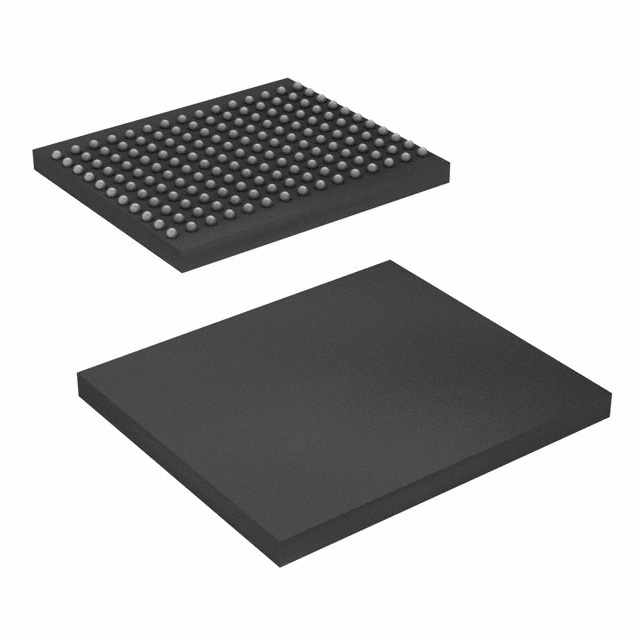
• Available in 165-ball FBGA package (13 x 15 x 1.4 mm)
• Offered in both lead-free and non-lead free packages
All synchronous inputs pass through input registers controlled
by the K or K input clocks. All data outputs pass through output
registers controlled by the C or C (or K or K in a single clock
domain) input clocks. Writes are conducted with on-chip
synchronous self-timed write circuitry.
• Variable drive HSTL output buffers
• JTAG 1149.1 compatible test access port
• Delay Lock Loop (DLL) for accurate data placement
Configurations
CY7C1292DV18 – 512K x 18
CY7C1294DV18 – 256K x 36
Selection Guide
250 MHz
200 MHz
167 MHz
Unit
Maximum Operating Frequency
250
200
167
MHz
Maximum Operating Current
600
550
500
mA
Cypress Semiconductor Corporation
Document #: 001-00350 Rev. *A
•
198 Champion Court
•
San Jose, CA 95134-1709
•
408-943-2600
Revised July 20, 2006
[+] Feedback
�CY7C1292DV18
CY7C1294DV18
Logic Block Diagram (CY7C1292DV18)
D[17:0]
K
K
CLK
Gen.
DOFF
Address
Register
Read Add. Decode
18
Write
Reg
256K x 18 Array
A(17:0)
Write
Reg
256K x 18 Array
Address
Register
Write Add. Decode
18
RPS
Control
Logic
C
C
Read Data Reg.
36
VREF
WPS
BWS[1:0]
CQ
CQ
18
Reg.
Control
Logic
A(17:0)
18
18
Reg.
18
18
Reg.
Q[17:0]
18
Logic Block Diagram (CY7C1294DV18)
K
K
CLK
Gen.
DOFF
VREF
WPS
BWS[3:0]
Address
Register
Read Add. Decode
17
Write
Reg
128K x 36 Array
Address
Register
Write
Reg
128K x 36 Array
A(16:0)
36
Write Add. Decode
D[35:0]
17
RPS
Control
Logic
C
C
Read Data Reg.
72
Control
Logic
Reg.
Reg.
36
Reg.
36
36
Document #: 001-00350 Rev. *A
CQ
CQ
36
36
A(16:0)
Q[35:0]
Page 2 of 23
[+] Feedback
�CY7C1292DV18
CY7C1294DV18
Pin Configurations
165-ball FBGA (13 x 15 x 1.4 mm) Pinout
CY7C1292DV18 (512K x 18)
1
A
B
C
D
E
F
G
H
J
K
L
M
N
P
R
CQ
2
3
NC/144M NC/36M
4
5
6
7
8
9
10
11
WPS
BWS1
K
NC/288M
NC/18M
NC
NC/72M
CQ
NC
Q8
D8
D7
NC
Q9
D9
A
NC
K
BWS0
RPS
A
NC
NC
NC
D11
D10
Q10
VSS
VSS
A
A
VSS
VSS
VSS
NC
VSS
A
VSS
NC
Q7
NC
NC
NC
Q11
VDDQ
VSS
VSS
VSS
VDDQ
NC
D6
Q6
NC
Q12
D12
VDDQ
VDD
VSS
VDD
VDDQ
NC
NC
Q5
NC
D13
VREF
NC
Q13
VDDQ
D14
VDDQ
VDDQ
VDDQ
VDD
VDD
VDD
VSS
VSS
VSS
VDD
VDD
VDD
VDDQ
VDDQ
VDDQ
NC
VDDQ
NC
NC
VREF
Q4
D5
ZQ
D4
NC
NC
Q14
VDDQ
VDD
VSS
VDD
VDDQ
NC
D3
Q3
NC
Q15
D15
VDDQ
VSS
VSS
VSS
VDDQ
NC
NC
Q2
NC
NC
NC
D17
D16
Q16
VSS
VSS
VSS
A
VSS
A
VSS
A
VSS
VSS
NC
NC
Q1
NC
D2
D1
NC
NC
Q17
A
A
C
A
A
NC
D0
Q0
TDO
TCK
A
A
A
C
A
A
A
TMS
TDI
9
10
11
DOFF
NC
CY7C1294DV18 (256K x 36)
1
A
B
C
D
E
F
G
H
J
K
L
M
N
P
R
2
3
5
6
7
8
RPS
A
WPS
BWS2
K
BWS1
Q18
D18
A
D27
D28
Q28
D20
D19
BWS3
A
Q19
VSS
VSS
VSS
K
NC/18M
VSS
BWS0
A
VSS
Q29
D29
Q20
VDDQ
VSS
VSS
Q30
D30
Q21
D21
VDDQ
VDD
D22
VREF
Q31
Q22
VDDQ
D23
VDDQ
VDDQ
VDDQ
VDD
VDD
VDD
Q32
D32
Q23
VDDQ
Q33
Q24
D24
VDDQ
D33
D34
Q34
D26
D25
Q25
Q35
D35
TDO
TCK
CQ
Q27
DOFF
D31
NC/288M NC/72M
4
Document #: 001-00350 Rev. *A
NC/36M NC/144M
D17
Q17
D16
CQ
Q8
VSS
VSS
Q16
Q7
D15
D8
D7
VSS
VDDQ
Q15
D6
Q6
VSS
VDD
VDDQ
D14
Q14
Q5
VSS
VSS
VSS
VDD
VDD
VDD
VDDQ
VDDQ
VDDQ
Q13
VDDQ
D12
D13
VREF
Q4
D5
ZQ
D4
VDD
VSS
VDD
VDDQ
Q12
D3
Q3
VSS
VSS
VSS
VDDQ
D11
Q11
Q2
VSS
VSS
VSS
A
VSS
A
VSS
A
VSS
VSS
D10
Q10
Q1
D9
D2
D1
Q26
A
A
C
A
A
Q9
D0
Q0
A
A
A
C
A
A
A
TMS
TDI
Page 3 of 23
[+] Feedback
�CY7C1292DV18
CY7C1294DV18
Pin Definitions
Pin Name
I/O
Pin Description
D[x:0]
InputData input signals, sampled on the rising edge of K and K clocks during valid write
Synchronous operations.
CY7C1292DV18 - D[17:0]
CY7C1294DV18 - D[35:0]
WPS
InputWrite Port Select, active LOW. Sampled on the rising edge of the K clock. When asserted
Synchronous active, a Write operation is initiated. Deasserting will deselect the Write port. Deselecting the
Write port will cause D[x:0] to be ignored.
BWS0, BWS1,
BWS2, BWS3
InputByte Write Select 0, 1, 2 and 3 − active LOW. Sampled on the rising edge of the K and K clocks
Synchronous during Write operations. Used to select which byte is written into the device during the current
portion of the Write operations. Bytes not written remain unaltered.
CY7C1292DV18 − BWS0 controls D[8:0], BWS1 controls D[17:9].
CY7C1294DV18 − BWS0 controls D[8:0], BWS1 controls D[17:9],BWS2 controls D[26:18] and
BWS3 controls D[35:27].
All the Byte Write Selects are sampled on the same edge as the data. Deselecting a Byte Write
Select will cause the corresponding byte of data to be ignored and not written into the device.
A
InputAddress Inputs. Sampled on the rising edge of the K (Read address) and K (Write address)
Synchronous clocks during active Read and Write operations. These address inputs are multiplexed for both
Read and Write operations. Internally, the device is organized as 512K x 18 (2 arrays each of
256K x 18) for CY7C1292DV18 and 256K x 36 (2 arrays each of 128K x 36) for CY7C1294DV18.
Therefore 18 address inputs for CY7C1292DV18 and 17 address inputs for CY7C1294DV18.
These inputs are ignored when the appropriate port is deselected.
Q[x:0]
OutputsData Output signals. These pins drive out the requested data during a Read operation. Valid
Synchronous data is driven out on the rising edge of both the C and C clocks during Read operations or K
and K when in single clock mode. When the Read port is deselected, Q[x:0] are automatically
tri-stated.
CY7C1292DV18 − Q[17:0]
CY7C1294DV18 − Q[35:0]
RPS
InputRead Port Select, active LOW. Sampled on the rising edge of Positive Input Clock (K). When
Synchronous active, a Read operation is initiated. Deasserting will cause the Read port to be deselected.
When deselected, the pending access is allowed to complete and the output drivers are
automatically tri-stated following the next rising edge of the C clock. Each read access consists
of a burst of two sequential transfers.
C
Input-Clock
Positive Input Clock for Output Data. C is used in conjunction with C to clock out the Read
data from the device. C and C can be used together to deskew the flight times of various devices
on the board back to the controller. See application example for further details.
C
Input-Clock
Negative Input Clock for Output Data. C is used in conjunction with C to clock out the Read
data from the device. C and C can be used together to deskew the flight times of various devices
on the board back to the controller. See application example for further details.
K
Input-Clock
Positive Input Clock Input. The rising edge of K is used to capture synchronous inputs to the
device and to drive out data through Q[x:0] when in single clock mode. All accesses are initiated
on the rising edge of K.
K
Input-Clock
Negative Input Clock Input. The rising edge of K is used to capture synchronous inputs being
presented to the device and to drive out data through Q[x:0] when in single clock mode.
CQ
Echo Clock
CQ is referenced with respect to C. This is a free running clock and is synchronized to the
input clock for output data (C) of the QDR-II. In the single clock mode, CQ is generated with
respect to K. The timings for the echo clocks are shown in the AC Timing table.
CQ
Echo Clock
ZQ
Input
CQ is referenced with respect to C. This is a free running clock and is synchronized to the
input clock for output data (C) of the QDR-II. In the single clock mode, CQ is generated with
respect to K. The timings for the echo clocks are shown in the AC Timing table.
Output Impedance Matching Input. This input is used to tune the device outputs to the system
data bus impedance. CQ, CQ, and Q[x:0] output impedance are set to 0.2 x RQ, where RQ is a
resistor connected between ZQ and ground. Alternately, this pin can be connected directly to
VDDQ, which enables the minimum impedance mode. This pin cannot be connected directly to
GND or left unconnected.
Document #: 001-00350 Rev. *A
Page 4 of 23
[+] Feedback
�CY7C1292DV18
CY7C1294DV18
Pin Definitions (continued)
Pin Name
DOFF
I/O
Pin Description
Input
DLL Turn Off, active LOW. Connecting this pin to ground will turn off the DLL inside the device.
The timings in the DLL turned off operation will be different from those listed in this data sheet.
TDO
Output
TCK
Input
TDO for JTAG.
TCK pin for JTAG.
TDI
Input
TDI pin for JTAG.
TMS
Input
TMS pin for JTAG.
NC
N/A
Not connected to the die. Can be tied to any voltage level.
NC/18M
N/A
Not connected to the die. Can be tied to any voltage level.
NC/36M
N/A
Not connected to the die. Can be tied to any voltage level.
NC/72M
N/A
Not connected to the die. Can be tied to any voltage level.
NC/144M
N/A
Not connected to the die. Can be tied to any voltage level.
NC/288M
N/A
Not connected to the die. Can be tied to any voltage level.
VREF
VDD
VSS
VDDQ
InputReference
Reference Voltage Input. Static input used to set the reference level for HSTL inputs and
Outputs as well as AC measurement points.
Power Supply Power supply inputs to the core of the device.
Ground
Ground for the device.
Power Supply Power supply inputs for the outputs of the device.
Functional Overview
The CY7C1292DV18 and CY7C1294DV18 are synchronous
pipelined Burst SRAMs equipped with both a Read port and a
Write port. The Read port is dedicated to Read operations and
the Write port is dedicated to Write operations. Data flows into
the SRAM through the Write port and out through the Read
port. These devices multiplex the address inputs in order to
minimize the number of address pins required. By having
separate Read and Write ports, the QDR-II completely eliminates the need to “turn-around” the data bus and avoids any
possible data contention, thereby simplifying system design.
Each access consists of two 18-bit data transfers in the case
of CY7C1292DV18 and two 36-bit data transfers in the case
of CY7C1294DV18 in one clock cycle.
Accesses for both ports are initiated on the rising edge of the
positive Input Clock (K). All synchronous input timings are
referenced from the rising edge of the input clocks (K and K)
and all output timings are referenced to the rising edge of
output clocks (C and C or K and K when in single clock mode).
All synchronous data inputs (D[x:0]) inputs pass through input
registers controlled by the input clocks (K and K). All
synchronous data outputs (Q[x:0]) outputs pass through output
registers controlled by the rising edge of the output clocks (C
and C or K and K when in single clock mode).
All synchronous control (RPS, WPS, BWS[x:0]) inputs pass
through input registers controlled by the rising edge of the
input clocks (K and K).
CY7C1292DV18 is described in the following sections. The
same basic descriptions apply to CY7C1294DV18.
Document #: 001-00350 Rev. *A
Read Operations
The CY7C1292DV18 is organized internally as 2 arrays of
256K x 18. Accesses are completed in a burst of two
sequential 18-bit data words. Read operations are initiated by
asserting RPS active at the rising edge of the Positive Input
Clock (K). The address is latched on the rising edge of the K
Clock. The address presented to Address inputs is stored in
the Read address register. Following the next K clock rise the
corresponding lowest order 18-bit word of data is driven onto
the Q[17:0] using C as the output timing reference. On the
subsequent rising edge of C, the next 18-bit data word is
driven onto the Q[17:0]. The requested data will be valid 0.45
ns from the rising edge of the output clock (C and C or K and
K when in single clock mode).
Synchronous internal circuitry will automatically tri-state the
outputs following the next rising edge of the Output Clocks
(C/C). This will allow for a seamless transition between
devices without the insertion of wait states in a depth
expanded memory.
Write Operations
Write operations are initiated by asserting WPS active at the
rising edge of the Positive Input Clock (K). On the same K
clock rise, the data presented to D[17:0] is latched and stored
into the lower 18-bit Write Data register provided BWS[1:0] are
both asserted active. On the subsequent rising edge of the
Negative Input Clock (K), the address is latched and the information presented to D[17:0] is stored into the Write Data
register provided BWS[1:0] are both asserted active. The 36
bits of data are then written into the memory array at the
specified location. When deselected, the write port will ignore
all inputs after the pending Write operations have been
completed.
Page 5 of 23
[+] Feedback
�CY7C1292DV18
CY7C1294DV18
Byte Write Operations
Programmable Impedance
Byte Write operations are supported by the CY7C1292DV18.
A Write operation is initiated as described in the Write Operations section above. The bytes that are written are determined
by BWS0 and BWS1, which are sampled with each 18-bit data
word. Asserting the appropriate Byte Write Select input during
the data portion of a Write will allow the data being presented
to be latched and written into the device. Deasserting the Byte
Write Select input during the data portion of a write will allow
the data stored in the device for that byte to remain unaltered.
This feature can be used to simplify Read/Modify/Write operations to a Byte Write operation.
An external resistor, RQ, must be connected between the ZQ
pin on the SRAM and VSS to allow the SRAM to adjust its
output driver impedance. The value of RQ must be 5x the
value of the intended line impedance driven by the SRAM. The
allowable range of RQ to guarantee impedance matching with
a tolerance of ±15% is between 175Ω and 350Ω, with
VDDQ = 1.5V.The output impedance is adjusted every 1024
cycles upon power-up to account for drifts in supply voltage
and temperature.
Single Clock Mode
The CY7C1292DV18 can be used with a single clock that
controls both the input and output registers. In this mode, the
device will recognize only a single pair of input clocks (K and
K) that control both the input and output registers. This
operation is identical to the operation if the device had zero
skew between the K/K and C/C clocks. All timing parameters
remain the same in this mode. To use this mode of operation,
the user must tie C and C HIGH at power on. This function is
a strap option and not alterable during device operation.
Concurrent Transactions
The Read and Write ports on the CY7C1292DV18 operate
completely independently of one another. Since each port
latches the address inputs on different clock edges, the user
can Read or Write to any location, regardless of the transaction on the other port. Also, reads and writes can be started
in the same clock cycle. If the ports access the same location
at the same time, the SRAM will deliver the most recent information associated with the specified address location. This
includes forwarding data from a Write cycle that was initiated
on the previous K clock rise.
Echo Clocks
Echo clocks are provided on the QDR-II to simplify data
capture on high-speed systems. Two echo clocks are
generated by the QDR-II. CQ is referenced with respect to C
and CQ is referenced with respect to C. These are
free-running clocks and are synchronized to the output clock
(C/C) of the QDR-II. In the single clock mode, CQ is generated
with respect to K and CQ is generated with respect to K. The
timings for the echo clocks are shown in the AC Timing table.
DLL
These chips utilize a Delay Lock Loop (DLL) that is designed
to function between 80 MHz and the specified maximum clock
frequency. During power-up, when the DOFF is tied HIGH, the
DLL gets locked after 1024 cycles of stable clock. The DLL can
also be reset by slowing or stopping the input clock K and K
for a minimum of 30 ns. However, it is not necessary for the
DLL to be specifically reset in order to lock the DLL to the
desired frequency. The DLL will automatically lock 1024 clock
cycles after a stable clock is presented.the DLL may be
disabled by applying ground to the DOFF pin. For information
refer to the application note “DLL Considerations in
QDRII/DDRII/QDRII+/DDRII+”.
Depth Expansion
The CY7C1292DV18 has a Port Select input for each port.
This allows for easy depth expansion. Both Port Selects are
sampled on the rising edge of the Positive Input Clock only (K).
Each port select input can deselect the specified port.
Deselecting a port will not affect the other port. All pending
transactions (Read and Write) will be completed prior to the
device being deselected.
Document #: 001-00350 Rev. *A
Page 6 of 23
[+] Feedback
�CY7C1292DV18
CY7C1294DV18
Application Example[1]
R = 250οηµσ
SRAM #1
Vt
D
A
R
R
P
S
#
W
P
S
#
SRAM #4
ZQ
CQ/CQ#
Q
C C# K K#
B
W
S
#
R
P
S
#
D
A
DATA IN
DATA OUT
Address
RPS#
BUS
WPS#
MASTER
BWS#
(CPU CLKIN/CLKIN#
or
Source K
ASIC)
Source K#
R
W
P
S
#
B
W
S
#
ZQ R = 250οηµσ
CQ/CQ#
Q
C C# K K#
Vt
Vt
Delayed K
Delayed K#
R
Truth
R = 50οηµσ Vt = Vddq/2
Table[2, 3, 4, 5, 6, 7]
Operation
K
RPS
WPS
Write Cycle:
Load address on the rising edge of K clock; input write
data on K and K rising edges.
L-H
X
L
D(A + 0) at K(t) ↑
D(A + 1) at K(t) ↑
Read Cycle:
Load address on the rising edge of K clock; wait one
and a half cycle; read data on C and C rising edges.
L-H
L
X
Q(A + 0) at C(t + 1)↑
Q(A + 1) at C(t + 2) ↑
NOP: No Operation
L-H
H
H
D = X,
Q = High-Z
D = X,
Q = High-Z
Stopped
X
X
Previous State
Previous State
Standby: Clock Stopped
Write Cycle Descriptions (CY7C1292DV18)
BWS0
L
BWS1
L
K
L-H
L
L
–
L
H
L-H
L
H
–
H
L
L-H
H
L
–
H
H
L-H
H
H
–
K
–
DQ
DQ
[2, 8]
Comments
During the Data portion of a Write sequence: both bytes (D[17:0]) are written into the device.
L-H During the Data portion of a Write sequence: both bytes (D[17:0]) are written into the device.
–
During the Data portion of a Write sequence: only the lower byte (D[8:0]) is written into the
device. D[17:9] will remain unaltered.
L-H During the Data portion of a Write sequence: only the lower byte (D[8:0]) is written into the
device. D[17:9] will remain unaltered.
–
During the Data portion of a Write sequence: only the upper byte (D[17:9]) is written into the
device. D[8:0] will remain unaltered.
L-H During the Data portion of a Write sequence: only the upper byte (D[17:9]) is written into the
device. D[8:0] will remain unaltered.
–
No data is written into the devices during this portion of a Write operation.
L-H No data is written into the devices during this portion of a Write operation.
Notes:
1. The above application shows four QDR-II being used.
2. X = “Don't Care,” H = Logic HIGH, L= Logic LOW, ↑represents rising edge.
3. Device will power-up deselected and the outputs in a tri-state condition.
4. “A” represents address location latched by the devices when transaction was initiated. A + 0, A + 1 represents the internal address sequence in the burst.
5. “t” represents the cycle at which a Read/Write operation is started. t + 1 and t + 2 are the first and second clock cycles respectively succeeding the “t” clock cycle.
6. Data inputs are registered at K and K rising edges. Data outputs are delivered on C and C rising edges, except when in single clock mode.
7. It is recommended that K = K and C = C = HIGH when clock is stopped. This is not essential, but permits most rapid restart by overcoming transmission line
charging symmetrically.
8. Assumes a Write cycle was initiated per the Write Port Cycle Description Truth Table. NWS0, NWS1, BWS0, BWS1, BWS2 and BWS3 can be altered on different
portions of a Write cycle, as long as the set-up and hold requirements are achieved.
Document #: 001-00350 Rev. *A
Page 7 of 23
[+] Feedback
�CY7C1292DV18
CY7C1294DV18
Write Cycle Descriptions (CY7C1294DV18)
BWS0 BWS1 BWS2 BWS3
L
L
L
L
K
L-H
L
L
L
L
-
L
H
H
H
L-H
L
H
H
H
-
H
L
H
H
L-H
H
L
H
H
-
H
H
L
H
L-H
H
H
L
H
-
H
H
H
L
L-H
H
H
H
L
-
H
H
H
H
L-H
H
H
H
H
-
Document #: 001-00350 Rev. *A
K
-
[2, 8]
Comments
During the Data portion of a Write sequence, all four bytes (D[35:0]) are written
into the device.
L-H During the Data portion of a Write sequence, all four bytes (D[35:0]) are written
into the device.
-
During the Data portion of a Write sequence, only the lower byte (D[8:0]) is written
into the device. D[35:9] will remain unaltered.
L-H During the Data portion of a Write sequence, only the lower byte (D[8:0]) is written
into the device. D[35:9] will remain unaltered.
-
During the Data portion of a Write sequence, only the byte (D[17:9]) is written into
the device. D[8:0] and D[35:18] will remain unaltered.
L-H During the Data portion of a Write sequence, only the byte (D[17:9]) is written into
the device. D[8:0] and D[35:18] will remain unaltered.
-
During the Data portion of a Write sequence, only the byte (D[26:18]) is written into
the device. D[17:0] and D[35:27] will remain unaltered.
L-H During the Data portion of a Write sequence, only the byte (D[26:18]) is written into
the device. D[17:0] and D[35:27] will remain unaltered.
During the Data portion of a Write sequence, only the byte (D[35:27]) is written into
the device. D[26:0] will remain unaltered.
L-H During the Data portion of a Write sequence, only the byte (D[35:27]) is written into
the device. D[26:0] will remain unaltered.
-
No data is written into the device during this portion of a Write operation.
L-H No data is written into the device during this portion of a Write operation.
Page 8 of 23
[+] Feedback
�CY7C1292DV18
CY7C1294DV18
IEEE 1149.1 Serial Boundary Scan (JTAG)
These SRAMs incorporate a serial boundary scan test access
port (TAP) in the FBGA package. This part is fully compliant
with IEEE Standard #1149.1-1900. The TAP operates using
JEDEC standard 1.8V I/O logic levels.
Disabling the JTAG Feature
It is possible to operate the SRAM without using the JTAG
feature. To disable the TAP controller, TCK must be tied LOW
(VSS) to prevent clocking of the device. TDI and TMS are internally pulled up and may be unconnected. They may alternately
be connected to VDD through a pull-up resistor. TDO should
be left unconnected. Upon power-up, the device will come up
in a reset state which will not interfere with the operation of the
device.
Test Access Port—Test Clock
The test clock is used only with the TAP controller. All inputs
are captured on the rising edge of TCK. All outputs are driven
from the falling edge of TCK.
Test Mode Select
The TMS input is used to give commands to the TAP controller
and is sampled on the rising edge of TCK. It is allowable to
leave this pin unconnected if the TAP is not used. The pin is
pulled up internally, resulting in a logic HIGH level.
Test Data-In (TDI)
The TDI pin is used to serially input information into the
registers and can be connected to the input of any of the
registers. The register between TDI and TDO is chosen by the
instruction that is loaded into the TAP instruction register. For
information on loading the instruction register, see the TAP
Controller State Diagram. TDI is internally pulled up and can
be unconnected if the TAP is unused in an application. TDI is
connected to the most significant bit (MSB) on any register.
Instruction Register
Three-bit instructions can be serially loaded into the instruction
register. This register is loaded when it is placed between the
TDI and TDO pins as shown in TAP Controller Block Diagram.
Upon power-up, the instruction register is loaded with the
IDCODE instruction. It is also loaded with the IDCODE
instruction if the controller is placed in a reset state as
described in the previous section.
When the TAP controller is in the Capture IR state, the two
least significant bits are loaded with a binary “01” pattern to
allow for fault isolation of the board level serial test path.
Bypass Register
To save time when serially shifting data through registers, it is
sometimes advantageous to skip certain chips. The bypass
register is a single-bit register that can be placed between TDI
and TDO pins. This allows data to be shifted through the
SRAM with minimal delay. The bypass register is set LOW
(VSS) when the BYPASS instruction is executed.
Boundary Scan Register
The boundary scan register is connected to all of the input and
output pins on the SRAM. Several no connect (NC) pins are
also included in the scan register to reserve pins for higher
density devices.
The boundary scan register is loaded with the contents of the
RAM Input and Output ring when the TAP controller is in the
Capture-DR state and is then placed between the TDI and
TDO pins when the controller is moved to the Shift-DR state.
The EXTEST, SAMPLE/PRELOAD and SAMPLE Z instructions can be used to capture the contents of the Input and
Output ring.
The Boundary Scan Order tables show the order in which the
bits are connected. Each bit corresponds to one of the bumps
on the SRAM package. The MSB of the register is connected
to TDI, and the LSB is connected to TDO.
Test Data-Out (TDO)
Identification (ID) Register
The TDO output pin is used to serially clock data-out from the
registers. The output is active depending upon the current
state of the TAP state machine (see Instruction codes). The
output changes on the falling edge of TCK. TDO is connected
to the least significant bit (LSB) of any register.
The ID register is loaded with a vendor-specific, 32-bit code
during the Capture-DR state when the IDCODE command is
loaded in the instruction register. The IDCODE is hardwired
into the SRAM and can be shifted out when the TAP controller
is in the Shift-DR state. The ID register has a vendor code and
other information described in the Identification Register
Definitions table.
Performing a TAP Reset
A Reset is performed by forcing TMS HIGH (VDD) for five
rising edges of TCK. This RESET does not affect the operation
of the SRAM and may be performed while the SRAM is
operating. At power-up, the TAP is reset internally to ensure
that TDO comes up in a high-Z state.
TAP Instruction Set
TAP Registers
Eight different instructions are possible with the three-bit
instruction register. All combinations are listed in the
Instruction Code table. Three of these instructions are listed
as RESERVED and should not be used. The other five instructions are described in detail below.
Registers are connected between the TDI and TDO pins and
allow data to be scanned into and out of the SRAM test
circuitry. Only one register can be selected at a time through
the instruction registers. Data is serially loaded into the TDI pin
on the rising edge of TCK. Data is output on the TDO pin on
the falling edge of TCK.
Instructions are loaded into the TAP controller during the
Shift-IR state when the instruction register is placed between
TDI and TDO. During this state, instructions are shifted
through the instruction register through the TDI and TDO pins.
To execute the instruction once it is shifted in, the TAP
controller needs to be moved into the Update-IR state.
Document #: 001-00350 Rev. *A
Page 9 of 23
[+] Feedback
�CY7C1292DV18
CY7C1294DV18
IDCODE
The IDCODE instruction causes a vendor-specific, 32-bit code
to be loaded into the instruction register. It also places the
instruction register between the TDI and TDO pins and allows
the IDCODE to be shifted out of the device when the TAP
controller enters the Shift-DR state. The IDCODE instruction
is loaded into the instruction register upon power-up or
whenever the TAP controller is given a test logic reset state.
SAMPLE Z
The SAMPLE Z instruction causes the boundary scan register
to be connected between the TDI and TDO pins when the TAP
controller is in a Shift-DR state. The SAMPLE Z command puts
the output bus into a High-Z state until the next command is
given during the “Update IR” state.
SAMPLE/PRELOAD
SAMPLE/PRELOAD is a 1149.1 mandatory instruction. When
the SAMPLE/PRELOAD instructions are loaded into the
instruction register and the TAP controller is in the Capture-DR
state, a snapshot of data on the inputs and output pins is
captured in the boundary scan register.
The user must be aware that the TAP controller clock can only
operate at a frequency up to 20 MHz, while the SRAM clock
operates more than an order of magnitude faster. Because
there is a large difference in the clock frequencies, it is
possible that during the Capture-DR state, an input or output
will undergo a transition. The TAP may then try to capture a
signal while in transition (metastable state). This will not harm
the device, but there is no guarantee as to the value that will
be captured. Repeatable results may not be possible.
To guarantee that the boundary scan register will capture the
correct value of a signal, the SRAM signal must be stabilized
long enough to meet the TAP controller's capture set-up plus
hold times (tCS and tCH). The SRAM clock input might not be
captured correctly if there is no way in a design to stop (or
slow) the clock during a SAMPLE/PRELOAD instruction. If this
is an issue, it is still possible to capture all other signals and
simply ignore the value of the CK and CK captured in the
boundary scan register.
Once the data is captured, it is possible to shift out the data by
putting the TAP into the Shift-DR state. This places the
boundary scan register between the TDI and TDO pins.
The shifting of data for the SAMPLE and PRELOAD phases
can occur concurrently when required—that is, while data
captured is shifted out, the preloaded data can be shifted in.
BYPASS
When the BYPASS instruction is loaded in the instruction
register and the TAP is placed in a Shift-DR state, the bypass
register is placed between the TDI and TDO pins. The
advantage of the BYPASS instruction is that it shortens the
boundary scan path when multiple devices are connected
together on a board.
EXTEST
The EXTEST instruction enables the preloaded data to be
driven out through the system output pins. This instruction also
selects the boundary scan register to be connected for serial
access between the TDI and TDO in the shift-DR controller
state.
EXTEST OUTPUT BUS TRI-STATE
IEEE Standard 1149.1 mandates that the TAP controller be
able to put the output bus into a tri-state mode.
The boundary scan register has a special bit located at bit #47.
When this scan cell, called the “extest output bus tri-state,” is
latched into the preload register during the “Update-DR” state
in the TAP controller, it will directly control the state of the
output (Q-bus) pins, when the EXTEST is entered as the
current instruction. When HIGH, it will enable the output
buffers to drive the output bus. When LOW, this bit will place
the output bus into a High-Z condition.
This bit can be set by entering the SAMPLE/PRELOAD or
EXTEST command, and then shifting the desired bit into that
cell, during the “Shift-DR” state. During “Update-DR”, the value
loaded into that shift-register cell will latch into the preload
register. When the EXTEST instruction is entered, this bit will
directly control the output Q-bus pins. Note that this bit is
pre-set LOW to enable the output when the device is
powered-up, and also when the TAP controller is in the
“Test-Logic-Reset” state.
Reserved
These instructions are not implemented but are reserved for
future use. Do not use these instructions.
PRELOAD allows an initial data pattern to be placed at the
latched parallel outputs of the boundary scan register cells
prior to the selection of another boundary scan test operation.
Document #: 001-00350 Rev. *A
Page 10 of 23
[+] Feedback
�CY7C1292DV18
CY7C1294DV18
TAP Controller State Diagram[9]
1
TEST-LOGIC
RESET
0
0
TEST-LOGIC/
IDLE
1
1
1
SELECT
DR-SCAN
SELECT
IR-SCAN
0
0
1
1
CAPTURE-DR
CAPTURE-IR
0
0
0
SHIFT-DR
0
SHIFT-IR
1
1
1
EXIT1-DR
1
EXIT1-IR
0
0
PAUSE-DR
0
0
PAUSE-IR
1
1
0
0
EXIT2-DR
EXIT2-IR
1
1
UPDATE-DR
1
0
UPDATE-IR
1
0
Note:
9. The 0/1 next to each state represents the value at TMS at the rising edge of TCK.
Document #: 001-00350 Rev. *A
Page 11 of 23
[+] Feedback
�CY7C1292DV18
CY7C1294DV18
TAP Controller Block Diagram
0
Bypass Register
Selection
Circuitry
2
TDI
1
0
1
0
Selection
Circuitry
TDO
Instruction Register
31 30 29
.
.
2
Identification Register
106 .
.
.
.
2
1
0
Boundary Scan Register
TCK
TAP Controller
TMS
TAP Electrical Characteristics Over the Operating Range [10, 11, 12]
Parameter
Description
Test Conditions
Min.
VOH1
Output HIGH Voltage
IOH = −2.0 mA
1.4
VOH2
Output HIGH Voltage
IOH = −100 µA
1.6
VOL1
Output LOW Voltage
IOL = 2.0 mA
IOL = 100 µA
VOL2
Output LOW Voltage
VIH
Input HIGH Voltage
VIL
Input LOW Voltage
IX
Input and OutputLoad Current
GND ≤ VI ≤ VDD
Max.
Unit
V
V
0.4
V
0.2
V
0.65VDD
VDD + 0.3
V
–0.3
0.35VDD
V
−5
5
µA
Notes:
10. These characteristic pertain to the TAP inputs (TMS, TCK, TDI and TDO). Parallel load levels are specified in the Electrical Characteristics table.
11. Overshoot: VIH(AC) < VDDQ +0.85V (Pulse width less than tCYC/2), Undershoot: VIL(AC) > –1.5V (Pulse width less than tCYC/2).
12. All voltage referenced to Ground.
Document #: 001-00350 Rev. *A
Page 12 of 23
[+] Feedback
�CY7C1292DV18
CY7C1294DV18
TAP AC Switching Characteristics Over the Operating Range[13, 14]
Parameter
Description
Min.
Max.
Unit
20
MHz
tTCYC
TCK Clock Cycle Time
tTF
TCK Clock Frequency
tTH
TCK Clock HIGH
20
ns
tTL
TCK Clock LOW
20
ns
50
ns
Set-up Times
tTMSS
TMS Set-up to TCK Clock Rise
5
ns
tTDIS
TDI Set-up to TCK Clock Rise
5
ns
tCS
Capture Set-up to TCK Rise
5
ns
tTMSH
TMS Hold after TCK Clock Rise
5
ns
tTDIH
TDI Hold after Clock Rise
5
ns
tCH
Capture Hold after Clock Rise
5
ns
Hold Times
Output Times
tTDOV
TCK Clock LOW to TDO Valid
tTDOX
TCK Clock LOW to TDO Invalid
10
0
ns
ns
TAP Timing and Test Conditions[13]
0.9V
50Ω
ALL INPUT PULSES
1.8V
TDO
0.9V
Z0 = 50Ω
0V
CL = 20 pF
tTH
tTL
GND
(a)
Test Clock
TCK
tTCYC
tTMSS
tTMSH
Test Mode Select
TMS
tTDIS
tTDIH
Test Data-In
TDI
Test Data-Out
TDO
tTDOV
tTDOX
Notes:
13. Test conditions are specified using the load in TAP AC test conditions. tR/tF = 1 ns.
14. tCS and tCH refer to the set-up and hold time requirements of latching data from the boundary scan register.
Document #: 001-00350 Rev. *A
Page 13 of 23
[+] Feedback
�CY7C1292DV18
CY7C1294DV18
Identification Register Definitions
Value
Instruction Field
CY7C1292DV18
CY7C1294DV18
000
000
Cypress Device ID (28:12)
11010011010010110
11010011010100110
Cypress JEDEC ID (11:1)
00000110100
00000110100
ID Register Presence (0)
1
1
Revision Number (31:29)
Description
Version number.
Defines the type of SRAM.
Unique identification of SRAM vendor.
Indicates the presence of an ID register.
Scan Register Sizes
Register Name
Bit Size
Instruction
3
Bypass
1
ID
32
Boundary Scan Cells
107
Instruction Codes
Instruction
Code
Description
EXTEST
000
Captures the Input/Output ring contents.
IDCODE
001
Loads the ID register with the vendor ID code and places the register between
TDI and TDO. This operation does not affect SRAM operation.
SAMPLE Z
010
Captures the Input/Output contents. Places the boundary scan register
between TDI and TDO. Forces all SRAM output drivers to a High-Z state.
RESERVED
011
Do Not Use: This instruction is reserved for future use.
SAMPLE/PRELOAD
100
Captures the Input/Output ring contents. Places the boundary scan register
between TDI and TDO. Does not affect the SRAM operation.
RESERVED
101
Do Not Use: This instruction is reserved for future use.
RESERVED
110
Do Not Use: This instruction is reserved for future use.
BYPASS
111
Places the bypass register between TDI and TDO. This operation does not
affect SRAM operation.
Document #: 001-00350 Rev. *A
Page 14 of 23
[+] Feedback
�CY7C1292DV18
CY7C1294DV18
Boundary Scan Order
Bit #
Bump ID
Bit #
Bump ID
Bit #
Bump ID
Bit #
Bump ID
0
6R
27
11H
54
7B
81
3G
1
6P
28
10G
55
6B
82
2G
2
6N
29
9G
56
6A
83
1J
3
7P
30
11F
57
5B
84
2J
4
7N
31
11G
58
5A
85
3K
5
7R
32
9F
59
4A
86
3J
6
8R
33
10F
60
5C
87
2K
7
8P
34
11E
61
4B
88
1K
8
9R
35
10E
62
3A
89
2L
9
11P
36
10D
63
1H
90
3L
10
10P
37
9E
64
1A
91
1M
11
10N
38
10C
65
2B
92
1L
12
9P
39
11D
66
3B
93
3N
13
10M
40
9C
67
1C
94
3M
14
11N
41
9D
68
1B
95
1N
15
9M
42
11B
69
3D
96
2M
16
9N
43
11C
70
3C
97
3P
17
11L
44
9B
71
1D
98
2N
18
11M
45
10B
72
2C
99
2P
19
9L
46
11A
73
3E
100
1P
20
10L
47
Internal
74
2D
101
3R
21
11K
48
9A
75
2E
102
4R
22
10K
49
8B
76
1E
103
4P
23
9J
50
7C
77
2F
104
5P
24
9K
51
6C
78
3F
105
5N
25
10J
52
8A
79
1G
106
5R
26
11J
53
7A
80
1F
Document #: 001-00350 Rev. *A
Page 15 of 23
[+] Feedback
�CY7C1292DV18
CY7C1294DV18
Power-Up Sequence in QDR-II SRAM[16]
DLL Constraints
QDR-II SRAMs must be powered up and initialized in a
predefined manner to prevent undefined operations.
• DLL uses K clock as its synchronizing input. The input
should have low phase jitter, which is specified as tKC Var.
Power-Up Sequence
• The DLL will function at frequencies down to 80 MHz.
• Apply power with DOFF tied HIGH (All other inputs can be
HIGH or LOW)
— Apply VDD before VDDQ
— Apply VDDQ before VREF or at the same time as VREF
• If the input clock is unstable and the DLL is enabled, then
the DLL may lock onto an incorrect frequency, causing
unstable SRAM behavior. To avoid this, provide 1024 cycles
stable clock to relock to the desired clock frequency.
• Provide stable power and clock (K, K) for 1024 cycles to
lock the DLL.
~
~
Power-up Waveforms
K
K
~
~
Unstable Clock
> 1024 Stable clock
Start Normal
Operation
Clock Start (Clock Starts after V DD / V DDQ Stable)
VDD / VDDQ
DOFF
V DD / V DDQ Stable (< +/- 0.1V DC per 50ns )
Fix High (or tied to VDDQ)
Notes:
15. It is recommended that the DOFF pin be pulled HIGH via a pull up resistor of 1Kohm.
16. During Power-Up, when the DOFF is tied HIGH, the DLL gets locked after 1024 cycles of stable clock.
Document #: 001-00350 Rev. *A
Page 16 of 23
[+] Feedback
�CY7C1292DV18
CY7C1294DV18
Maximum Ratings
Current into Outputs (LOW)......................................... 20 mA
(Above which the useful life may be impaired.)
Static Discharge Voltage.......................................... > 2001V
(per MIL-STD-883, Method 3015)
Storage Temperature ................................. –65°C to +150°C
Latch-up Current.................................................... > 200 mA
Ambient Temperature with
Power Applied............................................. –55°C to +125°C
Operating Range
Supply Voltage on VDD Relative to GND........ –0.5V to +2.9V
Supply Voltage on VDDQ Relative to GND ...... –0.5V to +VDD
DC Voltage Applied to Outputs
in High-Z State .................................... –0.5V to VDDQ + 0.3V
Range
Ambient
Temperature (TA)
VDD[19]
VDDQ[19]
0°C to +70°C
1.8 ± 0.1 V
1.4V to VDD
Com’l
Ind’l
–40°C to +85°C
DC Input Voltage[11] ...............................–0.5V to VDD + 0.3V
Electrical Characteristics Over the Operating Range[12, 19]
DC Electrical Characteristics Over the Operating Range
Parameter
Description
VDD
Power Supply Voltage
VDDQ
I/O Supply Voltage
VOH
Output HIGH Voltage
VOL
VOH(LOW)
Test Conditions
Min.
Typ.
Max.
Unit
1.7
1.8
1.9
V
1.4
1.5
VDD
V
Note 17
VDDQ/2 – 0.12
VDDQ/2 + 0.12
V
Output LOW Voltage
Note 18
VDDQ/2 – 0.12
VDDQ/2 + 0.12
V
Output HIGH Voltage
IOH = −0.1 mA, Nominal Impedance
VDDQ – 0.2
VDDQ
V
VOL(LOW)
Output LOW Voltage
IOL = 0.1 mA, Nominal Impedance
VIH
Input HIGH Voltage[11]
VIL
Input LOW
Voltage[11]
IX
Input Leakage Current
GND ≤ VI ≤ VDDQ
IOZ
Output Leakage Current
GND ≤ VI ≤ VDDQ, Output Disabled
VREF
Input Reference Voltage[20] Typical Value = 0.75V
IDD
VDD Operating Supply
ISB1
Automatic Power-down
Current
VSS
0.2
V
VREF + 0.1
VDDQ+0.3
V
–0.3
VREF – 0.1
V
−5
5
µA
−5
0.68
0.75
VDD = Max., IOUT = 0 mA, 167 MHz
f = fMAX = 1/tCYC
200 MHz
5
µA
0.95
V
500
mA
550
mA
250 MHz
600
mA
Max. VDD, Both Ports
167 MHz
Deselected, VIN ≥ VIH or 200 MHz
VIN ≤ VIL f = fMAX = 1/tCYC,
250 MHz
Inputs Static
240
mA
260
mA
280
mA
Max.
Unit
AC Input Requirements Over the Operating Range
Parameter
Description
Test Conditions
Min.
Typ.
VIH
Input HIGH Voltage
VREF + 0.2
–
–
V
VIL
Input LOW Voltage
–
–
VREF - 0.2
V
Capacitance[21]
Parameter
Description
CIN
Input Capacitance
CCLK
Clock Input Capacitance
CO
Output Capacitance
Test Conditions
TA = 25°C, f = 1 MHz,
VDD = 1.8V
VDDQ = 1.5V
Max.
Unit
5
pF
6
pF
7
pF
Notes:
17. Output are impedance controlled. IOH = –(VDDQ/2)/(RQ/5) for values of 175Ω