DS1624
Digital Thermometer and Memory
General Description
The DS1624 consists of two separate functional units: a
256-byte nonvolatile E2 memory and a direct-to-digital
temperature sensor.
The nonvolatile memory is made up of 256 bytes of E2
memory. This memory can be used to store any type of
information the user wishes. These memory locations are
accessed through the 2-wire serial bus.
The direct-to-digital temperature sensor allows the
DS1624 to measure the ambient temperature and report
the temperature in a 12-bit word with 0.0625°C resolution. The temperature sensor and its related registers are
accessed through the 2-wire serial interface. Figure 1
shows a block diagram of the DS1624.
Benefits and Features
●● Reduces Component Count with Integrated
Temperature Sensor and Nonvolatile E2 Memory
• Measures Temperatures from -55°C to +125°C in
0.0625°C Increments
• ±0.5°C Accuracy from 0°C to 70°C
• 256 Bytes of E2 Memory for Storing Information
Such as Frequency Compensation Coefficients
• No External Components
●● Easy-to-Use 2-Wire Serial Interface
• Temperature is Read as a 12-Bit Value
(2-Byte Transfer)
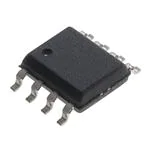
●● Available in 8-Pin SO and DIP Packages
Ordering Information appears at end of data sheet.
VDD
STATUS REGISTER AND
CONTROL LOGIC
SCL
SDA
A0
A1
TEMPERATURE
SENSOR
ADDRESS AND
I/O CONTROL
A2
GND
EEPROM MEMORY
(256 BYTES)
DS1624
Figure 1. Block Diagram
19-6288; Rev 5; 8/15
�DS1624
Digital Thermometer and Memory
Absolute Maximum Ratings
Voltage Range on Any Pin Relative to Ground.....-0.5V to +6.0V
Continuous Power Dissipation (TA = +70°C)
PDIP (derate 9.10mW/°C above +70°C).................727.30mW
Operating Temperature Range.......................... -55°C to +125°C
Storage Temperature Range............................. -55°C to +125°C
Soldering Temperature (reflow)........................................+260°C
Lead Temperature (soldering, 10s).................................. +300°C
This is a stress rating only and functional operation of the device at these or any other conditions above those indicated in the operation sections of this specification is not implied. Exposure to
absolute maximum rating conditions for extended periods of time may affect device reliability.
Package Thermal Characteristics (Note 1)
PDIP
Junction-to-Ambient Thermal Resistance (θJA).........110°C/W
Junction-to-Case Thermal Resistance (θJC)................40°C/W
Note 1: Package thermal resistances were obtained using the method described in JEDEC specification JESD51-7, using a four-layer
board. For detailed information on package thermal considerations, refer to www.maximintegrated.com/thermal-tutorial.
Recommended Operating Conditions
PARAMETER
Supply Voltage
SYMBOL
VDD
CONDITIONS
(Note 2)
MIN
TYP
MAX
UNITS
2.7
5.0
5.5
V
MIN
TYP
MAX
UNITS
DC Electrical Characteristics
(VDD = 2.7V to 5.5V, TA = -55°C to +125°C, unless otherwise noted.) (Note 3)
PARAMETER
Thermometer Error
SYMBOL
TERR
Thermometer Resolution
VIL
High-Level Input Voltage
VIH
Pulse Width of Spikes That Must
Be Suppressed by the Input Filter
tSP
Active Supply Current
Standby Supply Current
www.maximintegrated.com
±0.5
-55°C to +125°C
±2.0
0.0625
-0.3
0.7 x VDD
°C
°C
0.3 x VDD
V
VDD + 0.3
V
Fast mode
0
50
VOL1
3mA sink current (Note 2)
0
0.4
VOL2
6mA sink current (Note 2)
0
0.6
0.4 < VI/O < 0.9VDD (Note 4)
-1
+1
µA
10
pF
Input Current Each I/O Pin
I/O Capacitance
0°C to +70°C
12-bit
Low-Level Input Voltage
Low-Level Output Voltage (SDA)
CONDITIONS
CI/O
ICC
ISTBY
Temperature conversion
1250
E2 write (Notes 5, 6)
400
Communication only
125
(Notes 5, 6, 7)
1
3
ns
V
µA
µA
Maxim Integrated │ 2
�DS1624
Digital Thermometer and Memory
AC Electrical Characteristics
(VDD = 2.7V to 5.5V, TA = -55°C to +125°C, unless otherwise noted. All values referred to VIH = 0.9VDD and VIL = 0.1VDD.)
PARAMETER
SYMBOL
Temperature Conversion Time
tTC
EEPROM Write Cycle Time
tWR
EEPROM Endurance
EEPROM Data Retention
NEEWR
tEEDR
SLK Clock Frequency
fSCL
Bus Free Time Between a STOP
and START Condition
tBUF
Hold Time (Repeated)
START Condition
tHD:STA
Low Period of SCL Clock
tLOW
High Period of SCL Clock
tHIGH
Setup Time for a Repeated START
Condition
tSU:STA
Data Hold Time
tHD:DAT
Data Setup Time
tSU:DAT
Rise Time of Both SDA and SCL
Signals
tR
Fall Time of Both SDA and SCL
Signals
tF
Setup Time for STOP Condition
tSU:STO
Capacitive Load for Each Bus Line
CB
Input Capacitance
CI
CONDITIONS
MIN
TYP
0°C to +70°C (Note 8)
-20°C to +70°C
TA = +25°C
(Note 9)
-40°C to +70°C
Fast mode
Standard mode
Fast mode
Standard mode
Fast mode
Standard mode
Fast mode
Standard mode
Fast mode
Standard mode
Fast mode
Standard mode
Fast mode
Standard mode
Fast mode
Standard mode
Fast mode
Standard mode
Fast mode
Standard mode
Fast mode
Standard mode
(Note 10)
(Note 10)
(Notes 10, 11)
(Note 10)
(Note 10)
(Note 10)
(Note 10)
(Notes 10, 11,
12)
(Notes 8, 10, 12)
(Notes 8, 10, 12)
(Note 10)
MAX
UNITS
200
ms
50
ms
10k
20k
40k
80k
Write
Cycles
10
20
Years
0
400
0
100
1.3
µs
4.7
0.6
µs
4.0
1.3
µs
4.7
0.6
µs
4.0
0.6
µs
4.7
0
0.9
0
0.9
100
µs
ns
250
20 + 0.1CB
300
20 + 0.1CB
1000
20 + 0.1CB
300
20 + 0.1CB
300
0.6
ns
ns
µs
4.0
400
5
kHz
pF
pF
Note 2:
Note 3:
Note
Note
Note
Note
Note
Note
Note
Note
Note
All voltages are referenced to ground.
Limits are 100% production tested at TA = +25°C and/or TA = +85°C. Limits over the operating temperature range and
relevant supply voltage are guaranteed by design and characterization.
4: I/O pins of fast mode devices must not obstruct the SDA and SCL lines if VDD is switched off.
5: ICC specified with SDA pin open.
6: ICC specified with VCC at 5.0V and SDA, SCL = 5.0V, 0°C to +70°C.
7: EEPROM inactive, temperature sensor in shutdown mode.
8: For example, if CB = 300pF, then tR(MIN) = tF(MIN) = 50ns.
9: Write occurs between 0°C and +70°C.
10: See the timing diagram (Figure 2). All timing is referenced to 0.9VDD and 0.1VDD.
11: After this period, the first clock pulse is generated.
12: A fast mode device can be used in a standard mode system, but the requirement tSU:DAT ≥ 250ns must then be met. This
is automatically the case if the device does not stretch the low period of the SCL signal. If such a device does stretch the
low period of the SCL signal, it must output the next data bit to the SDA line tR(MAX) + tSU:DAT = 1000 + 250 = 1250ns
before the SCL line is released.
www.maximintegrated.com
Maxim Integrated │ 3
�DS1624
Digital Thermometer and Memory
Timing Diagram
SDA
tBUF
tSP
tLOW
tR
tHD:STA
tF
SCL
tHIGH
tHD:STA
tSU:STO
tSU:DAT
tHD:DAT
STOP
tSU:STA
REPEATED
START
START
NOTE: THE DS1624 DOES NOT DELAY THE SDA LINE INTERNALLY WITH RESPECT TO SCL FOR ANY LENGTH OF TIME
Typical Performance Curve
DS1624 DIGITAL THERMOMETER AND THERMOSTAT TEMPERATURE READING ERROR
5
4
3
ERROR (°C)
2
1
0
-55
-35
-15
LOWER LIMIT
SPECIFICATION
5
25
45
65
85
105
125
TYPICAL
ERROR
-1
-2
-3
TEMPERATURE (°C)
www.maximintegrated.com
Maxim Integrated │ 4
�DS1624
Digital Thermometer and Memory
Pin Configurations
Pin Description
TOP VIEW
SDA
1
SCL
2
N.C.
3
GND
+
DS1624
4
2
SCL
3
4
1
SDA
Data Input/Output Pin for 2-Wire Serial
Communication Port
SCL
Clock Input/Output Pin for 2-Wire Serial
Communication Port
7
A0
2
6
A1
3
N.C.
No Connection. No Internal Connection.
A2
4
GND
Ground
5
A2
Address Input
6
A1
Address Input
7
A0
Address Input
8
VDD
VDD
8
A0
7
N.C.
A1
6
GND
A2
5
DS1624
FUNCTION
VDD
SO (208 mils)
SDA
NAME
8
5
1
PIN
2.7V to 5.5V Input Power-Supply Voltage
PDIP (300 mils)
Detailed Description
2-Wire Serial Data Bus
The DS1624 supports a bidirectional two-wire bus and
data transmission protocol. A device that sends data onto
the bus is defined as a transmitter, and a device receiving
data as a receiver. The device that controls the message
is called a “master.” The devices that are controlled by
the master are “slaves.” The bus must be controlled by
a master device which generates the serial clock (SCL),
controls the bus access, and generates the START and
STOP conditions. The DS1624 operates as a slave on
the two-wire bus. Connections to the bus are made via
the open-drain I/O lines SDA and SCL. The following bus
protocol has been defined (see Figure 2):
●●
Data transfer can be initiated only when the bus is
not busy.
●●
During data transfer, the data line must remain stable
whenever the clock line is high. Changes in the data
line while the clock line is high are interpreted as
control signals.
www.maximintegrated.com
Accordingly, the following bus conditions have been
defined:
Bus Not Busy: Both data and clock lines remain high.
Start Data Transfer: A change in the state of the data
line, from high to low, while the clock is high, defines a
START condition.
Stop Data Transfer: A change in the state of the data
line, from low to high, while the clock line is high, defines
the STOP condition.
Data Valid: The state of the data line represents valid
data when, after a START condition, the data line is stable
for the duration of the high period of the clock signal. The
data on the line must be changed during the low period of
the clock signal. There is one clock pulse per bit of data.
Each data transfer is initiated with a START condition and
terminated with a STOP condition. The number of data
bytes transferred between START and STOP conditions
is not limited, and is determined by the master device.
Maxim Integrated │ 5
�DS1624
Digital Thermometer and Memory
The information is transferred byte-wise and each receiver acknowledges with a ninth bit.
Within the bus specifications a standard mode (100kHz
clock rate) and a fast mode (400kHz clock rate) are
defined. The DS1624 works in both modes.
Acknowledge: Each receiving device, when addressed,
is obliged to generate an acknowledge after the reception
of each byte. The master device must generate an extra
clock pulse, which is associated with this acknowledge bit.
A device that acknowledges must pull down the SDA line
during the acknowledge clock pulse in such a way that
the SDA line is stable low during the high period of the
acknowledge related clock pulse. Of course, setup and
hold times must be taken into account. A master must
signal an end of data to the slave by not generating an
acknowledge bit on the last byte that has been clocked
out of the slave. In this case, the slave must leave the
data line high to enable the master to generate the STOP
condition.
Figure 2 details how data transfer is accomplished on the
two-wire bus. Depending upon the state of the R/W bit,
two types of data transfer are possible:
1. Data transfer from a master transmitter to a slave
receiver. The first byte transmitted by the master
is the slave address. Next follows a number of data
bytes. The slave returns an acknowledge bit after each
received byte.
2. Data transfer from a slave transmitter to a master
receiver. The first byte (the slave address) is transmitted by the master. The slave then returns an acknowledge bit. Next follows a number of data bytes transmitted by the slave to the master. The master returns an
acknowledge bit after all received bytes other than the
last byte. At the end of the last received byte, a ‘not
acknowledge’ is returned.
The master device generates all of the serial clock pulses
and the START and STOP conditions. A transfer is ended
with a STOP condition or with a repeated START condition. Since a repeated START condition is also the beginning of the next serial transfer, the bus is not released.
The DS1624 can operate in the following two modes:
1. Slave receiver mode: Serial data and clock are
received through SDA and SCL. After each byte is
received an acknowledge bit is transmitted. START
and STOP conditions are recognized as the beginning and end of a serial transfer. Address recognition
is performed by hardware after reception of the slave
address and direction bit.
2. Slave transmitter mode: The first byte is received
and handled as in the slave receiver mode. However,
in this mode the direction bit indicates that the transfer
direction is reversed. Serial data is transmitted on SDA
by the DS1624 while the serial clock is input on SCL.
START and STOP conditions are recognized as the
beginning and end of a serial transfer.
SDA
MSB
SLAVE ADDRESS
ACKNOWLEDGEMENT
SIGNAL FROM RECEIVER
R/W
DIRECTION BIT
ACKNOWLEDGEMENT
SIGNAL FROM RECEIVER
SCL
1
2
START
CONDITION
6
7
8
9
1
2
3-8
8
9
ACK
ACK
REPEATED IF MORE BYTES
ARE TRANSFERRED
STOP CONDITION
OR
REPEATED
START CONDITION
Figure 2. Data Transfer on 2-Wire Serial Bus
www.maximintegrated.com
Maxim Integrated │ 6
�DS1624
Digital Thermometer and Memory
Slave Address
Measuring Temperature
A control byte is the first byte received following the
START condition from the master device. The control byte
consists of a four bit control code; for the DS1624, this
is set as 1001 binary for read and write operations. The
next three bits of the control byte are the device select
bits (A2, A1, A0). They are used by the master device to
select which of eight devices are to be accessed. These
bits are in effect the three least significant bits of the slave
address. The last bit of the control byte (R/W) defines
the operation to be performed. When set to a “1”, a read
operation is selected, when set to a “0”, a write operation
is selected. Following the START condition the DS1624
monitors the SDA bus checking the device type identifier
being transmitted. Upon receiving the 1001 code and
appropriate device select bits, the slave device outputs an
acknowledge signal on the SDA line.
START
CONTROL
BYTE
COMMAND
PROTOCOL
CONTROL
BYTE
DATA
BYTE 0
DATA
BYTE 1
NACK
STOP
ACK
ACK
ACK
ACK
BUS ACTIVITY
ACK
ACK
COMMAND
PROTOCOL
1
0
0
1
A2
A1
A0
R/W = 1
START
CONTROL
BYTE
1
0
0
1
A2
A1
A0
R/W = 0
SDA LINE
ACK
BUS ACTIVITY
BUS ACTIVITY:
MASTER
DATA
BYTE
START
SDA LINE
READ FROM DS1624
Since data is transmitted over the 2-wire bus MSB first,
temperature data can be written to/read from the DS1624
as either a single byte (with temperature resolution of
1°C) or as 2 bytes, the second byte containing the value
of the four least significant bits of the temperature reading
as shown in Figure 4. Note that the remaining 4 bits of this
byte are set to all zeros.
1
0
0
1
A2
A1
A0
R/W = 0
BUS ACTIVITY:
MASTER
The temperature reading is stored as a 16-bit two’s
complement number in the 2-byte temperature register as
shown in Figure 4.
STOP
WRITE TO DS1624
Figure 1 shows a block diagram of the DS1624. The
DS1624 measures the temperature using a bandgapbased temperature sensor. A delta-sigma analog-to-digital
(ADC) converts the temperature to a 12-bit digital value
that is calibrated in °C; for °F applications a lookup table
or conversion routine must be used. Throughout this data
sheet the term “conversion” is used to refer to the entire
temperature measurement and ADC sequence.
Figure 3. 2-Wire Serial Communication with DS1624
MS BYTE
LS BYTE
BIT 15
BIT 14
BIT 13
BIT 12
BIT 11
BIT 10
BIT 9
BIT 8
S
26
25
24
23
22
21
20
BIT 7
BIT 6
BIT 5
BIT 4
BIT 3
BIT 2
BIT 1
BIT 0
2-1
2-2
2-3
2-4
0
0
0
0
Figure 4. Temperature Register Format
www.maximintegrated.com
Maxim Integrated │ 7
�DS1624
Digital Thermometer and Memory
Table 1. Temperature/Data Relationships
TEMP (°C)
DIGITAL OUTPUT
(BINARY)
DIGITAL OUTPUT
(HEX)
+125
01111101 00000000
7D00h
+25.0625
00011001 00010000
1910h
+0.5
00000000 10000000
0080h
0
00000000 00000000
0000h
-0.5
11111111 10000000
FF80h
-25.0625
11100110 11110000
E6F0h
-55
11001001 00000000
C900h
Temperature is represented in the DS1624 in terms of a 0.0625°C LSB, yielding the following 12-bit example:
MSB
0
LSB
0
0
1
1
0
0
1
0
0
0
1
0
0
0
0
= +25.0625°C
Operation and Control
A configuration/status register is used to determine the method of operation the DS1624 will use in a particular application
as well as indicating the status of the temperature conversion operation.
The configuration register is defined as follows:
CONFIGURATION/STATUS REGISTER
DONE
0
0
0
1
0
1
1SHOT
where:
DONE = Conversion Done bit, “1” = Conversion complete, “0” = conversion in progress.
1SHOT = One Shot Mode. If 1SHOT is “1,” the DS1624 performs one temperature conversion upon receipt of the Start
Convert T protocol. If 1SHOT is “0,” the DS1624 continuously performs temperature conversions. This bit is nonvolatile
and the DS1624 is shipped with 1SHOT = “0.”
Since the configuration register is implemented in E2, writes to the register require 10ms to complete. After issuing a
command to write to the configuration register, no further accesses to the DS1624 should be made for at least 10ms.
www.maximintegrated.com
Maxim Integrated │ 8
�DS1624
Memory
Byte Program Mode
In this mode, the master sends addresses and one data
byte to the DS1624.
Following a START condition, the device code (4-bit), the
slave address (3-bit), and the R/W bit (which is logic-low)
are placed onto the bus by the master. The master then
sends the Access Memory protocol. This indicates to the
addressed DS1624 that a byte with a word address will follow after it has generated an acknowledge bit. Therefore,
the next byte transmitted by the master is the word address
and will be written into the address pointer of the DS1624.
After receiving the acknowledge of the DS1624, the master device transmits the data word to be written into the
addressed memory location. The DS1624 acknowledges
again and the master generates a STOP condition. This
initiates the internal programming cycle of the DS1624. A
repeated START condition, instead of a STOP condition,
will abort the programming operation.
During the programming cycle the DS1624 does not
acknowledge any further accesses to the device until the
programming cycle is complete (no longer than 50ms.)
Page Program Mode
To program the DS1624 the master sends addresses and
data to the DS1624, which is the slave. This is done by
supplying a START condition followed by the 4-bit device
code, the 3-bit slave address, and the R/W bit which
is defined as a logic-low for a write. The master then
sends the Access Memory protocol. This indicates to the
addressed slave that a word address will follow. The slave
outputs the acknowledge pulse to the master during the
ninth clock pulse. When the word address is received
by the DS1624 it is placed in the address pointer defining which memory location is to be written. The DS1624
generates an acknowledge after every 8 bits received and
store them consecutively in an 8-byte RAM until a STOP
condition is detected which initiates the internal programming cycle.
A repeated START condition, instead of a STOP condition, aborts the programming operation. During the
programming cycle the DS1624 does not acknowledge
any further accesses to the device until the programming
cycle is complete (no longer than 50ms).
If more than 8 bytes are transmitted by the master, the
DS1624 rolls over and overwrites the data beginning with
the first received byte. This does not affect erase/write
www.maximintegrated.com
Digital Thermometer and Memory
cycles of the EEPROM array and is accomplished as a
result of only allowing the address register’s bottom 3 bits
to increment while the upper 5 bits remain unchanged.
The DS1624 is capable of 20,000 writes (25,000 erase/
write cycles) before EEPROM wear out can occur.
If the master generates a STOP condition after transmitting the first data word, byte programming mode is
entered.
Read Mode
In this mode, the master is reading data from the DS1624
E2 memory. The master first provides the slave address
to the device with R/W set to “0.” The master then sends
the Access Memory protocol and, after receiving an
acknowledge, then provides the word address, which is
the address of the memory location at which it wishes to
begin reading. Note that while this is a read operation the
address pointer must first be written. During this period
the DS1624 generates acknowledge bits as defined in the
appropriate section.
The master now generates another START condition and
transmits the slave address. This time the R/W bit is set
to “1” to put the DS1624 in read mode. After the DS1624
generates the acknowledge bit it outputs the data from
the addressed location on the SDA pin, increments the
address pointer, and, if it receives an acknowledge from
the master, transmits the next consecutive byte. This
auto-increment sequence is only aborted when the master sends a STOP condition instead of an acknowledge.
When the address pointer reaches the end of the 256byte memory space (address FFh) it increments from the
end of the memory back to the first location of the memory
(address 00h).
Command Set
Data and control information is read from and written to
the DS1624 in the format shown in Figure 3. To write
to the DS1624, the master issues the slave address of
the DS1624 and the R/W bit is set to 0. After receiving
an acknowledge the bus master provides a command
protocol. After receiving this protocol the DS1624 issues
an acknowledge, and then the master can send data
to the DS1624. If the DS1624 is to be read, the master
must send the command protocol as before then issue a
repeated START condition and the control byte again, this
time with the R/W bit set to 1 to allow reading of the data
from the DS1624. The command set for the DS1624 as
shown in Table 2 is as follows.
Maxim Integrated │ 9
�DS1624
Digital Thermometer and Memory
Table 2. DS1624 Command Set
PROTOCOL
2-WIRE BUS DATA AFTER
ISSUING PROTOCOL
Reads last converted temperature value from
temperature register
AAh
Start Convert T
Initiates temperature conversion (Note 1)
EEh
idle
Stop Convert T
Halts temperature conversion (Note 1)
22h
idle
Reads or writes to 256-byte EEPROM memory
(Note 2)
17h
Reads or writes configuration data to
configuration register (Note 2)
ACh
INSTRUCTION
DESCRIPTION
TEMPERATURE CONVERSION COMMANDS
Read Temperature
THERMOSTAT COMMANDS
Access Memory
Access Config
Note 1:
Note 2:
In continuous conversion mode, a Stop Convert T command halta continuous conversion. To restart, the Start Convert T
command must be issued. In one-shot mode, a Start Convert T command must be issued for every temperature reading
desired.
Writing to the E2 typically requires 10ms at room temperature. After issuing a write command, no further reads or writes
should be requested for at least 10ms.
Access Memory [17h]
This command instructs the DS1624 to access its E2
memory. After issuing this command, the next data byte
is the value of the word address to be accessed. See the
Memory section for detailed explanations of the use of
this protocol and data format following it.
Start Convert T [EEh]
This command begins a temperature conversion. No further data is required. In one-shot mode, the temperature
conversion is performed and then the DS1624 remain
sidle. In continuous mode, this command initiates continuous conversions.
Access Config [ACh]
Stop Convert T [22h]
If R/W is “0”, this command writes to the configuration
register. After issuing this command, the next data byte
is the value to be written into the configuration register. If
R/W is “1,” the next data byte read is the value stored in
the configuration register.
This command stops temperature conversion. No further
data is required. This command can be used to halt a
DS1624 in continuous conversion mode. After issuing this
command, the current temperature measurement is completed, then the DS1624 remains idle until a Start Convert
T is issued to resume continuous operation.
Read Temperature [AAh]
This command reads the last temperature conversion
result. The DS1624 sends 2 bytes in the format described
earlier, which are the contents of this register.
www.maximintegrated.com
During the programming cycle, the DS1624 does not
acknowledge any further accesses to the device until the
programming cycle is complete (no longer than 50ms).
Maxim Integrated │ 10
�DS1624
Digital Thermometer and Memory
Memory Function Example
BUS MASTER
DS1624
DATA
MODE
MODE
(MSB FIRST)
{Command protocol for configuration register}
{Start here}
COMMENTS
Tx
Rx
START
Tx
Rx
Bus master initiates a START condition.
Rx
Tx
ACK
DS1624 generates acknowledge bit.
Tx
Rx
ACh
Bus master sends Access Config command protocol.
Rx
Tx
ACK
DS1624 generates acknowledge bit (Note 1).
Tx
Rx
00h
Bus master sets up DS1624 for continuous conversion.
Rx
Tx
ACK
DS1624 generates acknowledge bit (Notes 2, 4).
Tx
Rx
STOP
Bus master initiates the STOP condition.
Bus master initiates a START condition.
Bus master sends DS1624 address; R/W = 0.
{Command protocol for Start Convert T}
{Start here}
Tx
Rx
START
Tx
Rx
Rx
Tx
ACK
Bus master sends DS1624 address; R/W = 0.
DS1624 generates acknowledge bit.
Tx
Rx
EEh
Bus master sends Start Convert T command protocol.
Rx
Tx
ACK
DS1624 generates acknowledge bit (Note 1).
Tx
Rx
STOP
Bus master initiates the STOP condition.
{Command protocol for reading the Temperature}
{Start here}
Tx
Rx
START
Tx
Rx
Bus master initiates a START condition.
Rx
Tx
ACK
DS1624 generates acknowledge bit.
Bus master sends DS1624 address; R/W = 0.
Tx
Rx
AAh
Bus master sends Read Temp command protocol.
Rx
Tx
ACK
DS1624 generates acknowledge bit (Note 1).
Tx
Rx
START
Tx
Rx
Rx
Tx
ACK
Rx
Tx
Tx
Rx
ACK
Rx
Tx
DS1624 sends the LSB byte of Temperature.
Tx
Rx
NACK
Bus master sends not-acknowledge bit.
Tx
Rx
STOP
Bus master initiates the STOP condition.
Bus master initiates a START condition.
Bus master initiates a repeated START condition.
Bus Master sends DS1624 address; R/W = 1.
DS1624 generates acknowledge bit.
DS1624 sends the MSB byte of Temperature.
Bus master generates acknowledge bit.
{Command protocol for writing to EEPROM}
{Start here}
Tx
Rx
START
Tx
Rx
Rx
Tx
ACK
DS1624 generates acknowledge bit.
Tx
Rx
17h
Bus master sends Access Memory command protocol.
Rx
Tx
ACK
DS1624 generates acknowledge bit (Note 1).
www.maximintegrated.com
Bus master sends DS1624 address; R/W = 0.
Maxim Integrated │ 11
�DS1624
Digital Thermometer and Memory
Memory Function Example (continued)
BUS MASTER
MODE
DS1624
MODE
DATA
(MSB FIRST)
Tx
Rx
Rx
Tx
ACK
Tx
Rx
Rx
Tx
ACK
Tx
Rx
Rx
Tx
ACK
...
...
...
Tx
Rx
Rx
Tx
ACK
Tx
Rx
STOP
COMMENTS
Bus master sets the starting memory address.
DS1624 generates acknowledge bit.
Bus master sends the first byte of data.
DS1624 generates acknowledge bit.
Bus master sends the second byte of data.
DS1624 generates acknowledge bit.
...
Bus master sends the nth byte of data (Note 3).
DS1624 generates acknowledge bit.
Bus master initiates the STOP condition (Notes 2, 4)
{Command protocol for reading from EEPROM}
{Start here}
Note 1:
Note 2:
Note 3:
Note 4:
Note 5:
Tx
Rx
START
Tx
Rx
Bus master initiates a START condition.
Rx
Tx
ACK
DS1624 generates acknowledge bit.
Tx
Rx
17h
Bus master sends Access Memory command protocol.
Rx
Tx
ACK
DS1624 generates acknowledge bit (Note 1).
Bus master sends DS1624 address; R/W = 0.
Tx
Rx
Rx
Tx
ACK
Bus master sends the starting memory address.
Tx
Rx
START
Tx
Rx
Rx
Tx
ACK
DS1624 generates acknowledge bit.
Rx
Tx
DS1624 sends the first byte of data.
Tx
Rx
ACK
Bus master generates acknowledge bit.
Rx
Tx
DS1624 sends the second byte of data.
Tx
Rx
ACK
Bus master generates acknowledge bit.
...
...
...
Rx
Tx
DS1624 sends the nth byte of data (Note 5).
Tx
Rx
NACK
Bus master sends not-acknowledge bit.
Tx
Rx
STOP
Bus master initiates the STOP condition.
DS1624 generates acknowledge bit.
Bus master initiates a repeated START condition.
Bus master sends DS1624 address; R/W = 1.
...
If this protocol follows a write and the DS1624 does not acknowledge here, restart the protocol at the START here. If it
does acknowledge, continue on.
Wait for write to complete (50ms max). If DS1624 does not acknowledge the command protocol immediately following a
configure register or write memory protocol, the DS1624 has not finished writing. Restart the new command protocol until
the DS1624 acknowledges.
If n is greater than eight, the last 8 bytes are the only bytes saved in memory. If the starting address is 00 and the incoming data is 00 11 22 33 44 55 66 77 88 99, the result is mem00=88 mem01=99 mem02=22 mem03=33 mem04=44
mem05=55 mem06=66 mem07=77. The data wraps around and overwrites itself.
The STOP condition causes the DS1624 to initiate the write to EEPROM sequence. If a START condition comes instead
of the STOP condition, the write is aborted. The data is not saved.
For reading, the address is incremented. If the starting address is 04h and 30 bytes of data are read out, 21h is the final
address read.
www.maximintegrated.com
Maxim Integrated │ 12
�DS1624
Digital Thermometer and Memory
Package Information
Ordering Information
PART
TOP MARK
DS1624+
DS1624
PIN-PACKAGE
8 PDIP (300 mils)
DS1624S+
DS1624S
8 SO (208 mils)
DS1624S+T&R
DS1624S
8 SO (208 mils)
(2000 pieces)
Note: All devices rated for the -55°C to +125°C operating temperature range.
+Denotes a lead(Pb)-free/RoHS-compliant package.
T&R = Tape and reel.
www.maximintegrated.com
For the latest package outline information and land patterns
(footprints), go to www.maximintegrated.com/packages. Note
that a “+”, “#”, or “-” in the package code indicates RoHS status
only. Package drawings may show a different suffix character, but
the drawing pertains to the package regardless of RoHS status.
PACKAGE
TYPE
PACKAGE
CODE
OUTLINE
NO.
LAND
PATTERN NO.
8 PDIP
P8+4
21-0043
—
8 SO
W8+2
21-0262
90-0258
Maxim Integrated │ 13
�DS1624
Digital Thermometer and Memory
Revision History
REVISION
NUMBER
REVISION
DATE
PAGES
CHANGED
0
5/12
Updated Ordering Information and Package Information; updated the soldering
information in the Absolute Maximum Ratings section
1
12/13
Updated the Features and Description, removed the Overview section; replaced
the Operation—Measuring Temperature section and Figure 4; added the Package
Thermal Characteristics section; updated the DC Electrical Characteristics and
AC Electrical Characteristics tables and related notes
2
3/14
Updated the EEPROM Data Retention parameter in the AC Electrical
Characteristics table
3
5/14
Updated the Electrical Characteristics
4
1/15
Updated Benefits and Features sections
1
5
8/15
Updated AC Electrical Characteristics
3
DESCRIPTION
1, 2, 7, 14, 18
1, 2, 5,
13, 14, 15
14
13, 14
For pricing, delivery, and ordering information, please contact Maxim Direct at 1-888-629-4642, or visit Maxim Integrated’s website at www.maximintegrated.com.
Maxim Integrated cannot assume responsibility for use of any circuitry other than circuitry entirely embodied in a Maxim Integrated product. No circuit patent licenses
are implied. Maxim Integrated reserves the right to change the circuitry and specifications without notice at any time. The parametric values (min and max limits)
shown in the Electrical Characteristics table are guaranteed. Other parametric values quoted in this data sheet are provided for guidance.
Maxim Integrated and the Maxim Integrated logo are trademarks of Maxim Integrated Products, Inc.
© 2015 Maxim Integrated Products, Inc. │ 14
�









 工商网监
湘ICP备2023018690号
工商网监
湘ICP备2023018690号