19-3646; Rev 1; 2/11
KIT
ATION
EVALU
LE
B
A
IL
A
AV
Octal, 12-Bit, 40Msps, 1.8V ADC
with Serial LVDS Outputs
The MAX1436 octal, 12-bit analog-to-digital converter
(ADC) features fully differential inputs, a pipelined
architecture, and digital error correction incorporating a
fully differential signal path. This ADC is optimized for
low-power and high-dynamic performance in medical
imaging instrumentation and digital communications
applications. The MAX1436 operates from a 1.8V single
supply and consumes only 743mW (93mW per channel) while delivering a 69.9dB (typ) signal-to-noise ratio
(SNR) at a 5.3MHz input frequency. In addition to low
operating power, the MAX1436 features a power-down
mode for idle periods.
An internal 1.24V precision bandgap reference sets the
full-scale range of the ADC. A flexible reference structure allows the use of an external reference for applications requiring increased accuracy or a different input
voltage range. The reference architecture is optimized
for low noise.
A single-ended clock controls the data-conversion
process. An internal duty-cycle equalizer compensates
for wide variations in clock duty cycle. An on-chip PLL
generates the high-speed serial low-voltage differential
signal (LVDS) clock.
The MAX1436 has self-aligned serial LVDS outputs for
data, clock, and frame-alignment signals. The output
data is presented in two’s complement or binary format.
The MAX1436 offers a maximum sample rate of
40Msps. See the Pin-Compatible Versions table below
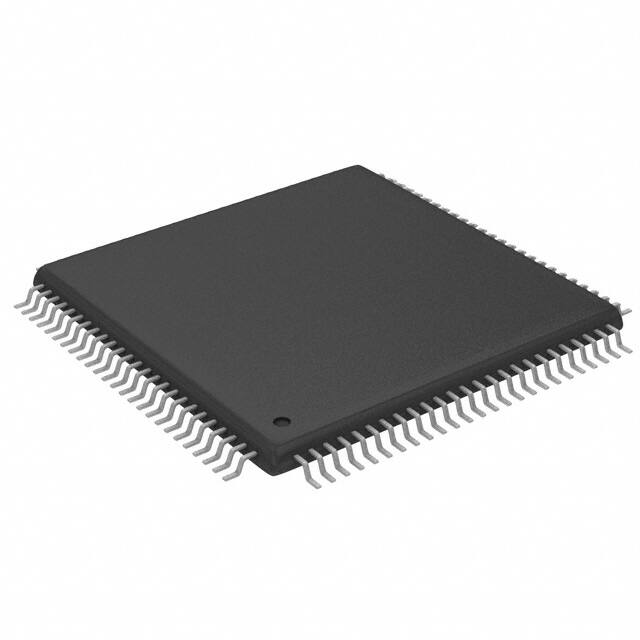
for higher-speed versions. This device is available in a
small, 14mm x 14mm x 1mm, 100-pin TQFP package
with exposed pad and is specified for the extended
industrial (-40°C to +85°C) temperature range.
Features
o Excellent Dynamic Performance
69.9dB SNR at 5.3MHz
96dBc SFDR at 5.3MHz
95dB Channel Isolation
o Ultra-Low Power
93mW per Channel (Normal Operation)
o Serial LVDS Outputs
o Pin-Selectable LVDS/SLVS (Scalable Low-Voltage
Signal) Mode
o LVDS Outputs Support Up to 30 Inches FR-4
Backplane Connections
o Test Mode for Digital Signal Integrity
o Fully Differential Analog Inputs
o Wide Differential Input Voltage Range (1.4VP-P)
o On-Chip 1.24V Precision Bandgap Reference
o Clock Duty-Cycle Equalizer
o Compact, 100-Pin TQFP Package with Exposed
Pad
o Evaluation Kit Available (Order MAX1436EVKIT)
Ordering Information
PART
TEMP RANGE
PIN-PACKAGE
MAX1436ECQ+D
-40°C to +85°C
100 TQFP-EP*
(14mm x 14mm x 1mm)
+Denotes a lead(Pb)-free/RoHS-compliant package.
D = Dry pack.
*EP = Exposed pad.
Applications
Pin-Compatible Versions
Ultrasound and Medical Imaging
Instrumentation
Multichannel Communications
PART
SAMPLING RATE
(Msps)
RESOLUTION
(BITS)
MAX1434
50
10
MAX1436
40
12
MAX1437
50
12
MAX1438
65
12
Pin Configuration appears at the end of data sheet.
________________________________________________________________ Maxim Integrated Products
For pricing, delivery, and ordering information, please contact Maxim Direct at 1-888-629-4642,
or visit Maxim’s website at www.maxim-ic.com.
1
MAX1436
General Description
�MAX1436
Octal, 12-Bit, 40Msps, 1.8V ADC
with Serial LVDS Outputs
ABSOLUTE MAXIMUM RATINGS
(Voltages referenced to GND)
AVDD.....................................................................-0.3V to +2.0V
CVDD.....................................................................-0.3V to +3.6V
OVDD ....................................................................-0.3V to +2.0V
IN_P, IN_N ..............................................-0.3V to (VAVDD + 0.3V)
CLK ........................................................-0.3V to (VCVDD + 0.3V)
OUT_P, OUT_N, FRAME_, CLKOUT_ ....-0.3V to (VOVDD + 0.3V)
DT, SLVS/LVDS, LVDSTEST, PLL_, T/B,
REFIO, REFADJ, CMOUT...................-0.3V to (VAVDD + 0.3V)
Continuous Power Dissipation (TA = +70°C)
TQFP (derate 47.6mW/°C above +70°C) ................3809.5mW
Operating Temperature Range ...........................-40°C to +85°C
Maximum Junction Temperature .....................................+150°C
Storage Temperature Range .............................-65°C to +150°C
Lead Temperature (soldering, 10s) .................................+300°C
Soldering Temperature (reflow) .......................................+260°C
Stresses beyond those listed under “Absolute Maximum Ratings” may cause permanent damage to the device. These are stress ratings only, and functional
operation of the device at these or any other conditions beyond those indicated in the operational sections of the specifications is not implied. Exposure to
absolute maximum rating conditions for extended periods may affect device reliability.
PACKAGE THERMAL CHARACTERISTICS (Note 1)
TQFP
Junction-to-Ambient Thermal Resistance (θJA) ...........21°C/W
Junction-to-Case Thermal Resistance (θJC) ..................2°C/W
Note 1: Package thermal resistances were obtained using the method described in JEDEC specification JESD51-7, using a fourlayer board. For detailed information on package thermal considerations, refer to www.maxim-ic.com/thermal-tutorial.
ELECTRICAL CHARACTERISTICS
(VAVDD = 1.8V, VOVDD = 1.8V, VCVDD = 3.3V, VGND = 0V, external VREFIO = 1.24V, CREFIO = 0.1µF, CREFP = 10µF, CREFN = 10µF, fCLK
= 40MHz (50% duty cycle), VDT = 0V, TA = TMIN to TMAX, unless otherwise noted. Typical values are at TA = +25°C.) (Notes 2, 3)
PARAMETER
SYMBOL
CONDITIONS
MIN
TYP
MAX
UNITS
±0.4
±3
LSB
DC ACCURACY (Note 4)
Resolution
N
Integral Nonlinearity
INL
Differential Nonlinearity
DNL
12
No missing codes over temperature
Bits
±1
LSB
Offset Error
±0.25
±0.5
%FS
Gain Error
±2.4
%FS
ANALOG INPUTS (IN_P, IN_N)
Input Differential Range
Common-Mode Voltage Range
VID
Differential input
VCMO
Common-Mode Voltage Range
Tolerance
(Note 5)
Differential Input Impedance
RIN
Differential Input Capacitance
CIN
Switched capacitor load
1.4
VP-P
0.76
V
±50
mV
2
kΩ
12.5
pF
CONVERSION RATE
Maximum Conversion Rate
fSMAX
Minimum Conversion Rate
fSMIN
Data Latency
2
40
MHz
4.0
MHz
6.5
Cycles
_______________________________________________________________________________________
�Octal, 12-Bit, 40Msps, 1.8V ADC
with Serial LVDS Outputs
(VAVDD = 1.8V, VOVDD = 1.8V, VCVDD = 3.3V, VGND = 0V, external VREFIO = 1.24V, CREFIO = 0.1µF, CREFP = 10µF, CREFN = 10µF, fCLK
= 40MHz (50% duty cycle), VDT = 0V, TA = TMIN to TMAX, unless otherwise noted. Typical values are at TA = +25°C.) (Notes 2, 3)
PARAMETER
SYMBOL
CONDITIONS
MIN
TYP
66.5
69.6
66.5
69.6
MAX
UNITS
DYNAMIC CHARACTERISTICS (differential inputs, 4096-point FFT) (Note 4)
Signal-to-Noise Ratio
SNR
Signal-to-Noise and Distortion
(First 4 Harmonics)
SINAD
Effective Number of Bits
ENOB
Spurious-Free Dynamic Range
SFDR
Total Harmonic Distortion
THD
Intermodulation Distortion
fIN = 5.3MHz at -0.5dBFS
fIN = 19.3MHz at -0.5dBFS
69.9
fIN = 5.3MHz at -0.5dBFS
fIN = 19.3MHz at -0.5dBFS
69.9
fIN = 5.3MHz at -0.5dBFS
11.3
fIN = 19.3MHz at -0.5dBFS
11.3
fIN = 5.3MHz at -0.5dBFS
fIN = 19.3MHz at -0.5dBFS
dB
dB
dB
96
79
dBc
90
fIN = 5.3MHz at -0.5dBFS
-96
fIN = 19.3MHz at -0.5dBFS
-92
IMD
f1 = 5.3MHz at -6.5dBFS
f2 = 6.3MHz at -6.5dBFS
89.8
dBc
Third-Order Intermodulation
IM3
f1 = 5.3MHz at -6.5dBFS
f2 = 6.3MHz at -6.5dBFS
96.6
dBc
Aperture Jitter
tAJ
Figure 11
< 0.4
psRMS
Aperture Delay
tAD
dBc
1
ns
Small-Signal Bandwidth
SSBW
Input at -20dBFS
100
MHz
Full-Power Bandwidth
LSBW
Input at -0.5dBFS
100
MHz
IN_P = IN_N
0.44
LSBRMS
1
Clock
cycle
Output Noise
Over-Range Recovery Time
tOR
Figure 11
-79
RS = 25Ω, CS = 50pF
INTERNAL REFERENCE
REFADJ Internal Reference-Mode
Enable Voltage
(Note 6)
0.1
REFADJ Low-Leakage Current
REFIO Output Voltage
Reference Temperature
Coefficient
1.5
VREFIO
1.18
TCREFIO
1.24
120
V
mA
1.30
V
ppm/°C
EXTERNAL REFERENCE
REFADJ External ReferenceMode Enable Voltage
(Note 6)
VAVDD 0.1
V
REFADJ High-Leakage Current
200
REFIO Input Voltage
1.24
V
±5
%
1MΩ to GND
when the MAX1436 is in power-down mode. The internal reference circuit requires 100ms (CREFP to GND =
CREFN to GND = 1µF) to power up and settle when
power is applied to the MAX1436 or when PD transitions from high to low.
To compensate for gain errors or to decrease or
increase the ADC’s FSR, add an external resistor
between REFADJ and GND or REFADJ and REFIO.
This adjusts the internal reference value of the
MAX1436 by up to ±5% of its nominal value. See the
Full-Scale Range Adjustments Using the Internal
Reference section.
______________________________________________________________________________________
�Octal, 12-Bit, 40Msps, 1.8V ADC
with Serial LVDS Outputs
External Reference Mode
The external reference mode allows for more control
over the MAX1436 reference voltage and allows multiple converters to use a common reference. Connect
REFADJ to AVDD to disable the internal reference.
Apply a stable 1.18V to 1.30V source at REFIO. Bypass
REFIO to GND with a ≥ 0.1µF capacitor. The REFIO
input impedance is >1MΩ.
Clock Input (CLK)
The MAX1436 accepts a CMOS-compatible clock signal with a wide 20% to 80% input clock duty cycle.
Drive CLK with an external single-ended clock signal.
Figure 2 shows the simplified clock input diagram.
Low clock jitter is required for the specified SNR performance of the MAX1436. Analog input sampling occurs
on the rising edge of CLK, requiring this edge to provide the lowest possible jitter. Jitter limits the maximum
SNR performance of any ADC according to the following relationship:
⎛
⎞
1
SNR = 20 × log ⎜
⎟
⎝ 2 × π × fIN × t J ⎠
where fIN represents the analog input frequency and tJ
is the total system clock jitter.
PLL Inputs (PLL1, PLL2, PLL3)
The MAX1436 features a PLL that generates an output
clock signal with 6 times the frequency of the input
clock. The output clock signal is used to clock data out
of the MAX1436 (see the System Timing Requirements
section). Set the PLL1, PLL2, and PLL3 bits according
to the input clock range provided in Table 1.
MAX1436
Connect ≥ 1µF (10µF typ) capacitors to GND from
REFP and REFN and a ≥ 1µF (10µF typ) capacitor
between REFP and REFN as close to the device as
possible on the same side of the PC board.
Table 1. PLL1, PLL2, and PLL3
Configuration Table
PLL1
PLL2
PLL3
INPUT CLOCK RANGE
(MHz)
MIN
MAX
0
0
0
0
0
1
32.5
Unused
40.0
0
1
0
22.5
32.5
0
1
1
16.3
22.5
1
0
0
11.3
16.3
1
0
1
8.1
11.3
1
1
0
5.6
8.1
1
1
1
4.0
5.6
System Timing Requirements
Figure 3 shows the relationship between the analog
inputs, input clock, frame-alignment output, serial-clock
output, and serial-data output. The differential analog
input (IN_P and IN_N) is sampled on the rising edge of
the CLK signal and the resulting data appears at the
digital outputs 6.5 clock cycles later. Figure 4 provides
a detailed, two-conversion timing diagram of the relationship between the inputs and the outputs.
Clock Output (CLKOUTP, CLKOUTN)
The MAX1436 provides a differential clock output that
consists of CLKOUTP and CLKOUTN. As shown in Figure
4, the serial output data is clocked out of the MAX1436 on
both edges of the clock output. The frequency of the output clock is 6 times the frequency of CLK.
Frame-Alignment Output (FRAMEP, FRAMEN)
The MAX1436 provides a differential frame-alignment
signal that consists of FRAMEP and FRAMEN. As
shown in Figure 4, the rising edge of the frame-alignment signal corresponds to the first bit (D0) of the 12bit serial data stream. The frequency of the framealignment signal is identical to the frequency of the
input clock.
AVDD
MAX1436
CVDD
DUTY-CYCLE
EQUALIZER
CLK
GND
Serial Output Data (OUT_P, OUT_N)
The MAX1436 provides its conversion results through
individual differential outputs consisting of OUT_P and
OUT_N. The results are valid 6.5 input clock cycles
after the sample is taken. As shown in Figure 3, the output data is clocked out on both edges of the output
clock, LSB (D0) first. Figure 5 provides the detailed serial-output timing diagram.
Figure 2. Clock Input Circuitry
______________________________________________________________________________________
15
�MAX1436
Octal, 12-Bit, 40Msps, 1.8V ADC
with Serial LVDS Outputs
N+2
N+6
N+3
N
(VIN_P VIN_N)
N+8
N+5
N+1
N+9
N+7
N+4
tSAMPLE
CLK
6.5 CLOCK-CYCLE DATA LATENCY
(VFRAMEP VFRAMEN)*
(VCLKOUTP VCLKOUTN)
(VOUT_P VOUT_N)
OUTPUT
DATA FOR
SAMPLE
N-6
OUTPUT
DATA FOR
SAMPLE N
*DUTY CYCLE VARIES DEPENDING ON INPUT CLOCK FREQUENCY.
Figure 3. Global Timing Diagram
N+2
N
(VIN_P - VIN_N)
N+1
tSF
tSAMPLE
CLK
(VFRAMEP VFRAMEN)*
tCF
(VCLKOUTP VCLKOUTN)
(VOUT_P VOUT_N)
D5N-7 D6N-7 D7N-7 D8N-7 D9N-7 D10N-7 D11N-7 D0N-6 D1N-6 D2N-6 D3N-6 D4N-6 D5N-6 D6N-6 D7N-6 D8N-6 D9N-6 D10N-6 D11N-6 D0N-5 D1N-5 D2N-5 D3N-5 D4N-5 D5N-5 D6N-5
*DUTY CYCLE DEPENDS ON INPUT CLOCK FREQUENCY.
Figure 4. Detailed Two-Conversion Timing Diagram
tCH
tCL
(VCLKOUTP VCLKOUTN)
(VOUT_P VOUT_N)
tOD
D0
D1
tOD
D2
D3
Figure 5. Serialized-Output Detailed Timing Diagram
16
______________________________________________________________________________________
�Octal, 12-Bit, 40Msps, 1.8V ADC
with Serial LVDS Outputs
TWO’S-COMPLEMENT DIGITAL OUTPUT CODE
(T/B = 0)
OFFSET BINARY DIGITAL OUTPUT CODE
(T/B = 1)
VIN_P - VIN_N (mV)
(VREFIO = 1.24V)
BINARY
D11 → D0
HEXADECIMAL
EQUIVALENT
OF D11 → D0
DECIMAL
EQUIVALENT
OF D11 → D0
BINARY
D11 → D0
HEXADECIMAL
EQUIVALENT
OF D11 → D0
DECIMAL
EQUIVALENT
OF D11 → D0
0111 1111 1111
0x7FF
+2047
1111 1111 1111
0xFFF
+4095
+699.66
0111 1111 1110
0x7FE
+2046
1111 1111 1110
0xFFE
+4094
+699.32
0000 0000 0001
0x001
+1
1000 0000 0001
0x801
+2049
+0.34
0000 0000 0000
0x000
0
1000 0000 0000
0x800
+2048
0
1111 1111 1111
0xFFF
-1
0111 1111 1111
0x7FF
+2047
-0.34
1000 0000 0001
0x801
-2047
0000 0000 0001
0x001
+1
-699.66
1000 0000 0000
0x800
-2048
0000 0000 0000
0x000
0
-700.00
1 LSB = 2 x FSR
4096
FSR = 700mV x VREFIO
1.24V
FSR
0x7FF
0x7FE
0x7FD
0x001
0x000
0xFFF
0x803
0x802
0x801
0x800
-2047 -2045
-1 0 +1
+2045 +2047
DIFFERENTIAL INPUT VOLTAGE (LSB)
FSR = 700mV x VREFIO
1.24V
FSR
OFFSET BINARY OUTPUT CODE (LSB)
TWO'S-COMPLEMENT OUTPUT CODE (LSB)
FSR
1 LSB = 2 x FSR
4096
FSR
0xFFF
0xFFE
0xFFD
0x801
0x800
0x7FF
0x003
0x002
0x800
0x000
-2047 -2045
-1 0 +1
+2045 +2047
DIFFERENTIAL INPUT VOLTAGE (LSB)
Figure 6. Two’s-Complement Transfer Function (T/B = 0)
Figure 7. Binary Transfer Function (T/B = 1)
Output Data Format (T/B) Transfer Functions
The MAX1436 output data format is either offset binary
or two’s complement, depending on the logic-input T/B.
With T/B low, the output data format is two’s complement. With T/B high, the output data format is offset
binary. The following equations, Table 2, and Figures 6
and 7 define the relationship between the digital output
and the analog input. For two’s complement (T/B = 0):
and for offset binary (T/B = 1):
VIN _ P − VIN _ N = FSR × 2 ×
CODE10
4096
VIN _ P − VIN _ N = FSR × 2 ×
CODE10 − 2048
4096
where CODE10 is the decimal equivalent of the digital
output code as shown in Table 2.
Keep the capacitive load on the MAX1436 digital outputs as low as possible.
______________________________________________________________________________________
17
MAX1436
Table 2. Output Code Table (VREFIO = 1.24V)
�MAX1436
Octal, 12-Bit, 40Msps, 1.8V ADC
with Serial LVDS Outputs
LVDS and SLVS Signals (SLVS/LVDS)
Drive SLVS/LVDS low for LVDS or drive SLVS/LVDS high
for SLVS levels at the MAX1436 outputs (OUT_P, OUT_N,
CLKOUTP, CLKOUTN, FRAMEP, and FRAMEN). For
SLVS levels, enable double-termination by driving DT
high. See the Electrical Characteristics table for LVDS
and SLVS output voltage levels.
DT
OUT_P/
CLKOUTP/
FRAMEP
Z0 = 50Ω
LVDS Test Pattern (LVDSTEST)
Drive LVDSTEST high to enable the output test pattern
on all LVDS or SLVS output channels. The output test
pattern is 0000 1011 1101. Drive LVDSTEST low for
normal operation (test pattern disabled).
100Ω
100Ω
Common-Mode Output (CMOUT)
CMOUT provides a common-mode reference for DCcoupled analog inputs. If the input is DC-coupled,
match the output common-mode voltage of the circuit
driving the MAX1436 to the output voltage at VCMOUT
to within ±50mV. It is recommended that the output
common-mode voltage of the driving circuit be derived
from CMOUT.
Double-Termination (DT)
The MAX1436 offers an optional, internal 100Ω termination
between the differential output pairs (OUT_P and OUT_N,
CLKOUTP and CLKOUTN, FRAMEP and FRAMEN).
In addition to the termination at the end of the line, a
second termination directly at the outputs helps eliminate
unwanted reflections down the line. This feature is useful
in applications where trace lengths are long (>5in) or with
mismatched impedance. Drive DT high to select doubletermination, or drive DT low to disconnect the internal termination resistor (single-termination). Selecting
double-termination increases the OVDD supply current
(see Figure 8).
Power-Down Mode (PD)
The MAX1436 offers a power-down mode to efficiently
use power by transitioning to a low-power state when
conversions are not required.
PD controls the power-down mode of all channels and
the internal reference circuitry. Drive PD high to enable
power-down. In power-down mode, the output impedance of all of the LVDS/SLVS outputs is approximately
342Ω, if DT is low. The output impedance of the differential LVDS/SLVS outputs is 100Ω when DT is high. See the
Electrical Characteristics table for typical supply currents
during power-down. The following list shows the state of
the analog inputs and digital outputs in power-down
mode:
• IN_P, IN_N analog inputs are disconnected from
the internal input amplifier
•
18
REFIO has > 1MΩ to GND
MAX1436
OUT_N/
CLKOUTN/
FRAMEN
Z0 = 50Ω
SWITCHES ARE CLOSED WHEN DT IS HIGH.
SWITCHES ARE OPEN WHEN DT IS LOW.
Figure 8. Double-Termination
•
OUT_P, OUT_N, CLKOUTP, CLKOUTN, FRAMEP,
and FRAMEN have approximately 342Ω between
the output pairs when DT is low. When DT is high,
the differential output pairs have 100Ω between
each pair.
When operating from the internal reference, the wakeup time from power-down is typically 100ms (CREFP to
GND = CREFN to GND = 1µF). When using an external
reference, the wake-up time is dependent on the external reference drivers.
Applications Information
Full-Scale Range Adjustments
Using the Internal Reference
The MAX1436 supports a full-scale adjustment range of
10% (±5%). To decrease the full-scale range, add a
25kΩ to 250kΩ external resistor or potentiometer (RADJ)
between REFADJ and GND. To increase the full-scale
range, add a 25kΩ to 250kΩ resistor between REFADJ
and REFIO. Figure 9 shows the two possible configurations.
The following equations provide the relationship between
RADJ and the change in the analog full-scale range:
⎛
1.25kΩ ⎞
FSR = 0.7V ⎜1 +
RADJ ⎟⎠
⎝
for RADJ connected between REFADJ and REFIO, and:
______________________________________________________________________________________
�Octal, 12-Bit, 40Msps, 1.8V ADC
with Serial LVDS Outputs
MAX1436
10Ω
ADC FULL-SCALE = REFT - REFB
REFT
REFB
0.1µF
G
REFERENCESCALING
AMPLIFIER
IN_P
6
1
VIN
39pF
T1
N.C.
2
5
MAX1436
0.1µF
REFERENCE
BUFFER
REFIO
1V
REFADJ
4
3
MINICIRCUITS
ADT1-1WT
0.1µF
IN_N
25kΩ
250kΩ
CONTROL LINE TO
DISABLE REFERENCE
BUFFER
AVDD
39pF
Figure 10. Transformer-Coupled Input Drive
25kΩ
250kΩ
MAX1436
10Ω
AVDD/2
Figure 9. Circuit Suggestions to Adjust the ADC’s Full-Scale
Range
⎛ 1.25kΩ ⎞
FSR = 0.7V ⎜1 −
RADJ ⎟⎠
⎝
for RADJ connected between REFADJ and GND.
Using Transformer Coupling
An RF transformer (Figure 10) provides an excellent
solution to convert a single-ended input source signal
to a fully differential signal. The MAX1436 input common-mode voltage is internally biased to 0.76V (typ)
with f CLK = 40MHz. Although a 1:1 transformer is
shown, a step-up transformer can be selected to
reduce the drive requirements. A reduced signal swing
from the input driver, such as an op amp, can also
improve the overall distortion.
Grounding, Bypassing, and Board Layout
The MAX1436 requires high-speed board layout design
techniques. Refer to the MAX1434/MAX1436/MAX1437/
MAX1438 EV kit data sheet for a board layout reference. Locate all bypass capacitors as close to the
device as possible, preferably on the same side as the
ADC, using surface-mount devices for minimum inductance. Bypass AVDD to GND with a 0.1µF ceramic
capacitor in parallel with a 0.1µF ceramic capacitor.
Bypass OVDD to GND with a 0.1µF ceramic capacitor
in parallel with a ≥ 2.2µF ceramic capacitor. Bypass
CVDD to GND with a 0.1µF ceramic capacitor in parallel with a ≥ 2.2µF ceramic capacitor.
Multilayer boards with ample ground and power planes
produce the highest level of signal integrity. Connect
MAX1436 ground pins and the exposed pad to the
same ground plane. The MAX1436 relies on the
exposed-backside-pad connection for a low-inductance ground connection. Isolate the ground plane from
any noisy digital system ground planes.
Route high-speed digital signal traces away from the
sensitive analog traces. Keep all signal lines short and
free of 90° turns.
Ensure that the differential analog input network layout is
symmetric and that all parasitics are balanced equally.
Refer to the MAX1434/MAX1436/MAX1437/MAX1438 EV
kit data sheet for an example of symmetric input layout.
Parameter Definitions
Integral Nonlinearity (INL)
Integral nonlinearity is the deviation of the values on an
actual transfer function from a straight line. For the
MAX1436, this straight line is between the end points of
the transfer function, once offset and gain errors have
been nullified. INL deviations are measured at every
step and the worst-case deviation is reported in the
Electrical Characteristics table.
Differential Nonlinearity (DNL)
Differential nonlinearity is the difference between an
actual step width and the ideal value of 1 LSB. A DNL
error specification of less than 1 LSB guarantees no
missing codes and a monotonic transfer function. For
the MAX1436, DNL deviations are measured at every
step and the worst-case deviation is reported in the
Electrical Characteristics table.
______________________________________________________________________________________
19
�MAX1436
Octal, 12-Bit, 40Msps, 1.8V ADC
with Serial LVDS Outputs
Offset Error
Offset error is a figure of merit that indicates how well
the actual transfer function matches the ideal transfer
function at a single point. For the MAX1436, the ideal
midscale digital output transition occurs when there is
-1/2 LSBs across the analog inputs (Figures 6 and 7).
Bipolar offset error is the amount of deviation between
the measured midscale transition point and the ideal
midscale transition point.
CLK
tAD
ANALOG
INPUT
tAJ
SAMPLED
DATA
Gain Error
Gain error is a figure of merit that indicates how well the
slope of the actual transfer function matches the slope
of the ideal transfer function. For the MAX1436 the gain
error is the difference of the measured full-scale and
zero-scale transition points minus the difference of the
ideal full-scale and zero-scale transition points.
For the bipolar devices (MAX1436), the full-scale transition point is from 0x7FE to 0x7FF for two’s-complement
output format (0xFFE to 0xFFF for offset binary) and the
zero-scale transition point is from 0x800 to 0x801 for
two’s complement (0x000 to 0x001 for offset binary).
Crosstalk
Crosstalk indicates how well each analog input is isolated
from the others. For the MAX1436, a 5.3MHz, -0.5dBFS
analog signal is applied to one channel while a 19.3MHz,
-0.5dBFS analog signal is applied to another channel. An
FFT is taken on the channel with the 5.3MHz analog signal. From this FFT, the crosstalk is measured as the difference in the 5.3MHz and 19.3MHz amplitudes.
Aperture Delay
Aperture delay (tAD) is the time defined between the
rising edge of the sampling clock and the instant when
an actual sample is taken. See Figure 11.
Aperture Jitter
Aperture jitter (tAJ) is the sample-to-sample variation in
the aperture delay. See Figure 11.
Signal-to-Noise Ratio (SNR)
For a waveform perfectly reconstructed from digital
samples, the theoretical maximum SNR is the ratio of
the full-scale analog input (RMS value) to the RMS
quantization error (residual error). The ideal, theoretical
minimum analog-to-digital noise is caused by quantization error only and results directly from the ADC’s resolution (N bits):
SNRdB[max] = 6.02dB x N x 1.76dB
In reality, there are other noise sources besides quantization noise: thermal noise, reference noise, clock jitter, etc.
20
T/H
HOLD
TRACK
HOLD
Figure 11. Aperture Jitter/Delay Specifications
For the MAX1436, SNR is computed by taking the ratio
of the RMS signal to the RMS noise. RMS noise
includes all spectral components to the Nyquist frequency excluding the fundamental, the first six harmonics (HD2–HD7), and the DC offset.
Signal-to-Noise Plus Distortion (SINAD)
SINAD is computed by taking the ratio of the RMS signal
to the RMS noise plus distortion. RMS noise plus distortion includes all spectral components to the Nyquist frequency, excluding the fundamental and the DC offset.
Effective Number of Bits (ENOB)
ENOB specifies the dynamic performance of an ADC at
a specific input frequency and sampling rate. An ideal
ADC’s error consists of quantization noise only. ENOB for
a full-scale sinusoidal input waveform is computed from:
⎛ SINAD − 1.76 ⎞
ENOB = ⎜
⎟
⎝
⎠
6.02
Total Harmonic Distortion (THD)
THD is the ratio of the RMS sum of the first six harmonics of the input signal to the fundamental itself. This is
expressed as:
⎛
V22 + V32 + V4 2 + V52 + V62 + V72
THD = 20 × log ⎜
⎜
V1
⎝
⎞
⎟
⎟
⎠
Spurious-Free Dynamic Range (SFDR)
SFDR is the ratio expressed in decibels of the RMS
amplitude of the fundamental (maximum signal component) to the RMS value of the next-largest spurious
______________________________________________________________________________________
�Octal, 12-Bit, 40Msps, 1.8V ADC
with Serial LVDS Outputs
Intermodulation Distortion (IMD)
IMD is the total power of the IM2 to IM5 intermodulation
products to the Nyquist frequency relative to the total
input power of the two input tones f1 and f2. The individual input tone levels are at -6.5dBFS. The intermodulation products are as follows:
• 2nd-order intermodulation products (IM2): f1 + f2,
f2 - f1
•
3rd-order intermodulation products (IM3): 2 x f1 - f2,
2 x f2 - f1, 2 x f1 + f2, 2 x f2 + f1
•
4th-order intermodulation products (IM4): 3 x f1 - f2,
3 x f2 - f1, 3 x f1 + f2, 3 x f2 + f1
•
5th-order intermodulation products (IM5): 3 x f1 - 2
x f2, 3 x f2 - 2 x f1, 3 x f1 + 2 x f2, 3 x f2 + 2 x f1
Third-Order Intermodulation (IM3)
IM3 is the total power of the 3rd-order intermodulation
product to the Nyquist frequency relative to the total
input power of the two input tones f1 and f2. The individual input tone levels are at -6.5dBFS. The 3rd-order
intermodulation products are 2 x f1 - f2, 2 x f2 - f1, 2 x f1
+ f2, 2 x f2 + f1.
Full-Power Bandwidth
A large -0.5dBFS analog input signal is applied to an
ADC, and the input frequency is swept up to the point
where the amplitude of the digitized conversion result
has decreased by -3dB. This point is defined as fullpower input bandwidth frequency.
Gain Matching
Gain matching is a figure of merit that indicates how
well the gain of all eight ADC channels is matched to
each other. For the MAX1436, gain matching is measured by applying the same 5.3MHz, -0.5dBFS analog
signal to all analog input channels. These analog inputs
are sampled at 40Msps and the maximum deviation in
amplitude is reported in dB as gain matching in the
Electrical Characteristics table.
Phase Matching
Phase matching is a figure of merit that indicates how
well the phases of all eight ADC channels are matched
to each other. For the MAX1436, phase matching is
measured by applying the same 5.3MHz, -0.5dBFS
analog signal to all analog input channels. These analog inputs are sampled at 40Msps and the maximum
deviation in phase is reported in degrees as phase
matching in the Electrical Characteristics table.
Small-Signal Bandwidth
A small -20.5dBFS analog input signal is applied to an
ADC so that the signal’s slew rate does not limit the
ADC’s performance. The input frequency is then swept
up to the point where the amplitude of the digitized
conversion result has decreased by -3dB.
______________________________________________________________________________________
21
MAX1436
component, excluding DC offset. SFDR is specified in
decibels relative to the carrier (dBc).
�Octal, 12-Bit, 40Msps, 1.8V ADC
with Serial LVDS Outputs
PLL3
PD
LVDSTEST
OUT0P
OUT0N
OVDD
T/B
PLL1
PLL2
GND
AVDD
AVDD
AVDD
REFADJ
REFIO
GND
REFP
REFN
99 98 97 96 95 94 93 92 91 90 89 88 87 86 85 84 83 82 81 80 79 78 77 76
N.C.
GND
IN0N
IN0P
GND
CMOUT
GND
TOP VIEW
100
MAX1436
Pin Configuration
+
N.C.
OVDD
OUT1P
OUT1N
OVDD
GND
IN1P
1
75
2
74
IN1N
GND
IN2P
IN2N
3
73
4
72
5
71
6
70
GND
IN3P
IN3N
7
69
8
68
N.C.
OUT2P
OUT2N
9
67
OVDD
GND
10
66
AVDD
AVDD
AVDD
11
65
12
64
OUT3P
OUT3N
OVDD
N.C.
AVDD
14
15
61
GND
IN4P
16
60
17
59
IN4N
GND
IN5P
IN5N
18
58
19
57
20
56
21
55
GND
IN6P
IN6N
22
54
23
53
GND
25
13
63
MAX1436
62
24
52
*EP
51
OVDD
CLKOUTP
CLKOUTN
OVDD
FRAMEP
FRAMEN
OVDD
OUT4P
OUT4N
OVDD
OUT5P
OUT5N
N.C.
*CONNECT EP TO GND
0VDD
N.C.
OUT6P
OVDD
OUT7N
OUT7P
OVDD
OUT6N
AVDD
AVDD
CVDD
CLK
GND
AVDD
AVDD
AVDD
AVDD
SLVS/LVDS
IN7N
GND
N.C.
DT
GND
IN7P
GND
26 27 28 29 30 31 32 33 34 35 36 37 38 39 40 41 42 43 44 45 46 47 48 49 50
TQFP
14mm x 14mm x 1mm
Chip Information
PROCESS: BiCMOS
22
______________________________________________________________________________________
�Octal, 12-Bit, 40Msps, 1.8V ADC
with Serial LVDS Outputs
PACKAGE TYPE
PACKAGE CODE
OUTLINE NO.
LAND PATTERN NO.
100 TQFP-EP
C100E+2
21-0116
90-0153
______________________________________________________________________________________
23
MAX1436
Package Information
For the latest package outline information and land patterns (footprints), go to www.maxim-ic.com/packages. Note that a "+", "#", or
"-" in the package code indicates RoHS status only. Package drawings may show a different suffix character, but the drawing pertains to the package regardless of RoHS status.
�MAX1436
Octal, 12-Bit, 40Msps, 1.8V ADC
with Serial LVDS Outputs
Revision History
REVISION
NUMBER
REVISION
DATE
0
4/05
Initial release
2/11
Updated Ordering Information, added new Package Thermal Characteristics section,
and fixed errors in Electrical Characteristics table
1
DESCRIPTION
PAGES
CHANGED
—
1–5
Maxim cannot assume responsibility for use of any circuitry other than circuitry entirely embodied in a Maxim product. No circuit patent licenses are
implied. Maxim reserves the right to change the circuitry and specifications without notice at any time.
Maxim Integrated Products, 120 San Gabriel Drive, Sunnyvale, CA 94086 408-737-7600 ____________________ 24
© 2011 Maxim Integrated Products
Maxim is a registered trademark of Maxim Integrated Products, Inc.
�