Click here to ask about the production status of specific part numbers.
MAX25530
Automotive I2C-Controlled 4-Channel 150mA
Backlight Driver and 4-Output TFT-LCD Bias
General Description
Benefits and Features
The MAX25530 is a highly integrated TFT power supply
and LED backlight driver IC for automotive TFT-LCD applications. The IC integrates one buck-boost converter,
one boost converter, two gate-driver supplies, and a
boost/SEPIC converter that can power one to four strings
of LEDs in the display backlight.
● 4-Output TFT-LCD Bias Power
• 2.8V to 5.5V Input for the TFT-LCD Section
• Integrated 430kHz or 2.2MHz Boost and BuckBoost Converters
• Positive and Negative 10mA Gate Voltage
Regulators (Tripler/Inverting Doubler) with
Adjustable Output Voltage
• Flexible Resistor-Programmable Sequencing
through the SEQ Pin
• Undervoltage Detection on All Outputs
• Low-Quiescent-Current Standby Mode
The source-driver power supplies consist of a synchronous boost converter and an inverting buck-boost converter that can generate voltages up to +18V and down to
-7V. The positive source driver can deliver up to 120mA,
while the negative source driver is capable of 100mA. The
positive source-driver supply-regulation voltage (VPOS) is
set by connecting an external resistor-divider on FBP or
through I2C. The negative source-driver supply voltage
(VNEG) is always tightly regulated to -VPOS (down to a
minimum of -7V). The source-driver supplies operate from
an input voltage between 2.8V and 5.5V.
The gate-driver power supplies consist of regulated
charge pumps that generate from +28V to -21.5V and can
deliver 10mA or more each depending on the exact configuration.
The IC features a quad-string LED driver that operates
from a separate input voltage (VBATT) and can power up
to four strings of LEDs with 150mA (max) of current per
string. The IC features logic-controlled pulse-width-modulation (PWM) dimming, with minimum pulse widths as low
as 500ns with the option of phase shifting the LED strings
with respect to one another. When phase shifting is enabled, each string is turned on at a different time, reducing
the input and output ripple, as well as audible noise. With
phase shifting disabled, the current sinks turn on simultaneously and parallel connection of current sinks is possible.
The startup and shutdown sequences for all power domains are controlled using one of the seven preset modes,
which are selectable through a resistor on the SEQ pin or
through the I2C interface.
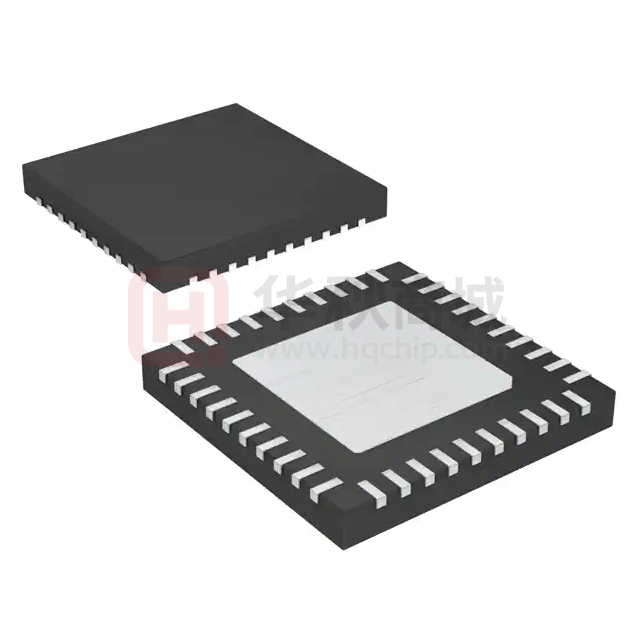
The MAX25530 is available in a 40-pin (6mm x 6mm)
TQFN package with an exposed pad, and operates over
the -40°C to +105°C ambient temperature range.
Applications
●
●
●
●
Automotive Dashboards
Automotive Central Information Displays
Automotive Head Up Displays
Automotive Navigation Systems
19-101001; Rev 0; 2/21
● 4-Channel LED Backlight Driver
• Up to 150mA Current per Channel
• 4.5V to 42V Input Voltage Range
• Integrated Boost/SEPIC Controller (440kHz or
2.2MHz)
• Dimming Ratio 10,000:1 at 200Hz
• Adaptive Voltage Optimization to Reduce Power
Dissipation in the LED Current Sinks
• Open-String, Shorted-LED, and Short-to-GND
Diagnostics
● Low EMI
• Phase-Shift Dimming of LED Strings
• Spread Spectrum on LED Driver and TFT
• Selectable Switching Frequency
● I2C Interface for Control and Diagnostics
• Fault Indication through the FLTB pin and I2C
• Auto-Retry after Fault Detection
● Overload and Thermal Protection
● -40°C to +105°C Ambient Temperature Operation
● 40-Pin (6mm x 6mm) TQFN Package with Exposed
Pad
● AECQ100 Grade 1
Ordering Information appears at end of datasheet.
�Automotive I2C-Controlled 4-Channel 150mA
Backlight Driver and 4-Output TFT-LCD Bias
MAX25530
Simplified Block Diagram
COMP
OVP
VCC
PWM
COMP
DRIVE
LOGIC
NDRV
SLOPE
COMP
ISET
UP/DOWN
COUNTER
+
DAC
gM
1 of 4
VTHH
OUT_
VTHL
CURRENT
REF.
FAULT
DETECTION
420mV
CS
BATT
VCC
5V
REGULATOR
+
UVLO + BG
TEMP
WARNING,
SHUTDOWN
PHASESHIFT
LOGIC
LGND1,2
DIM
IN
MAX25530
PGVDD
DP
400kHz
POSITIVE
CHARGE PUMP
BST
TFT BOOST
CONTROL
430kHz/2.2MHz
TEMP
WARNING,
SHUTDOWN
FBPG
DGVDD
LXP
PGND
1.25V
FBP
HVINP
DGVEE
DN
POSITIVE
SOFT-START
AND
DISCHARGE
400kHz
NEGATIVE
CHARGE PUMP
ENABLE, CONTROL
AND FAULT LOGIC
FBNG
SEQ
DGND
EN
FLTB
REF
POS
NEGATIVE
SOFT-START
AND
DISCHARGE
NEG
INVERTING
REGULATOR
430kHz/2.2MHz
REFERENCE
1.25V
I 2C
INN
LXN
EP
GND
ADD SCL SDA
www.maximintegrated.com
Maxim Integrated | 2
�MAX25530
Automotive I2C-Controlled 4-Channel 150mA
Backlight Driver and 4-Output TFT-LCD Bias
TABLE OF CONTENTS
General Description. . . . . . . . . . . . . . . . . . . . . . . . . . . . . . . . . . . . . . . . . . . . . . . . . . . . . . . . . . . . . . . . . . . . . . . . . . . . . . 1
Applications . . . . . . . . . . . . . . . . . . . . . . . . . . . . . . . . . . . . . . . . . . . . . . . . . . . . . . . . . . . . . . . . . . . . . . . . . . . . . . . . . . . . 1
Benefits and Features . . . . . . . . . . . . . . . . . . . . . . . . . . . . . . . . . . . . . . . . . . . . . . . . . . . . . . . . . . . . . . . . . . . . . . . . . . . . 1
Simplified Block Diagram . . . . . . . . . . . . . . . . . . . . . . . . . . . . . . . . . . . . . . . . . . . . . . . . . . . . . . . . . . . . . . . . . . . . . . . . . 2
Absolute Maximum Ratings. . . . . . . . . . . . . . . . . . . . . . . . . . . . . . . . . . . . . . . . . . . . . . . . . . . . . . . . . . . . . . . . . . . . . . . . 7
Package Information . . . . . . . . . . . . . . . . . . . . . . . . . . . . . . . . . . . . . . . . . . . . . . . . . . . . . . . . . . . . . . . . . . . . . . . . . . . . . 7
40-Pin TQFN . . . . . . . . . . . . . . . . . . . . . . . . . . . . . . . . . . . . . . . . . . . . . . . . . . . . . . . . . . . . . . . . . . . . . . . . . . . . . . . . 7
Electrical Characteristics . . . . . . . . . . . . . . . . . . . . . . . . . . . . . . . . . . . . . . . . . . . . . . . . . . . . . . . . . . . . . . . . . . . . . . . . . 7
Typical Operating Characteristics . . . . . . . . . . . . . . . . . . . . . . . . . . . . . . . . . . . . . . . . . . . . . . . . . . . . . . . . . . . . . . . . . 16
Pin Configuration . . . . . . . . . . . . . . . . . . . . . . . . . . . . . . . . . . . . . . . . . . . . . . . . . . . . . . . . . . . . . . . . . . . . . . . . . . . . . . . 20
MAX25530 . . . . . . . . . . . . . . . . . . . . . . . . . . . . . . . . . . . . . . . . . . . . . . . . . . . . . . . . . . . . . . . . . . . . . . . . . . . . . . . . . 20
Pin Description . . . . . . . . . . . . . . . . . . . . . . . . . . . . . . . . . . . . . . . . . . . . . . . . . . . . . . . . . . . . . . . . . . . . . . . . . . . . . . . . 20
Functional Diagrams . . . . . . . . . . . . . . . . . . . . . . . . . . . . . . . . . . . . . . . . . . . . . . . . . . . . . . . . . . . . . . . . . . . . . . . . . . . . 23
Detailed Block Diagram . . . . . . . . . . . . . . . . . . . . . . . . . . . . . . . . . . . . . . . . . . . . . . . . . . . . . . . . . . . . . . . . . . . . . . . 23
Detailed Description . . . . . . . . . . . . . . . . . . . . . . . . . . . . . . . . . . . . . . . . . . . . . . . . . . . . . . . . . . . . . . . . . . . . . . . . . . . . 24
TFT Power Section. . . . . . . . . . . . . . . . . . . . . . . . . . . . . . . . . . . . . . . . . . . . . . . . . . . . . . . . . . . . . . . . . . . . . . . . . . . 24
Source-Driver Power Supplies . . . . . . . . . . . . . . . . . . . . . . . . . . . . . . . . . . . . . . . . . . . . . . . . . . . . . . . . . . . . . . . 24
Gate-Driver Power Supplies . . . . . . . . . . . . . . . . . . . . . . . . . . . . . . . . . . . . . . . . . . . . . . . . . . . . . . . . . . . . . . . . . 24
Fault Protection . . . . . . . . . . . . . . . . . . . . . . . . . . . . . . . . . . . . . . . . . . . . . . . . . . . . . . . . . . . . . . . . . . . . . . . . . . . 24
Output Sequencing Control . . . . . . . . . . . . . . . . . . . . . . . . . . . . . . . . . . . . . . . . . . . . . . . . . . . . . . . . . . . . . . . . . . 25
TFT Sequence with RSEQ = 10k . . . . . . . . . . . . . . . . . . . . . . . . . . . . . . . . . . . . . . . . . . . . . . . . . . . . . . . . . . . 26
Description of the LED Driver Section . . . . . . . . . . . . . . . . . . . . . . . . . . . . . . . . . . . . . . . . . . . . . . . . . . . . . . . . . . . . 26
Current-Mode DC-DC Controller . . . . . . . . . . . . . . . . . . . . . . . . . . . . . . . . . . . . . . . . . . . . . . . . . . . . . . . . . . . . . . 27
8-Bit DAC . . . . . . . . . . . . . . . . . . . . . . . . . . . . . . . . . . . . . . . . . . . . . . . . . . . . . . . . . . . . . . . . . . . . . . . . . . . . . . . 27
PWM Dimming . . . . . . . . . . . . . . . . . . . . . . . . . . . . . . . . . . . . . . . . . . . . . . . . . . . . . . . . . . . . . . . . . . . . . . . . . . . 27
Low-Dim Mode . . . . . . . . . . . . . . . . . . . . . . . . . . . . . . . . . . . . . . . . . . . . . . . . . . . . . . . . . . . . . . . . . . . . . . . . . . . 28
Phase Shifting . . . . . . . . . . . . . . . . . . . . . . . . . . . . . . . . . . . . . . . . . . . . . . . . . . . . . . . . . . . . . . . . . . . . . . . . . . . . 28
Figure 2 Phase-Shifted Outputs . . . . . . . . . . . . . . . . . . . . . . . . . . . . . . . . . . . . . . . . . . . . . . . . . . . . . . . . . . . . 29
Undervoltage Lockout . . . . . . . . . . . . . . . . . . . . . . . . . . . . . . . . . . . . . . . . . . . . . . . . . . . . . . . . . . . . . . . . . . . . . . 29
Startup Sequence . . . . . . . . . . . . . . . . . . . . . . . . . . . . . . . . . . . . . . . . . . . . . . . . . . . . . . . . . . . . . . . . . . . . . . . . . 29
Stage 1 . . . . . . . . . . . . . . . . . . . . . . . . . . . . . . . . . . . . . . . . . . . . . . . . . . . . . . . . . . . . . . . . . . . . . . . . . . . . . . . 29
Stage 2 . . . . . . . . . . . . . . . . . . . . . . . . . . . . . . . . . . . . . . . . . . . . . . . . . . . . . . . . . . . . . . . . . . . . . . . . . . . . . . . 30
Open-LED Management and Overvoltage Protection (OVP) . . . . . . . . . . . . . . . . . . . . . . . . . . . . . . . . . . . . . . . . 30
Short-LED Detection . . . . . . . . . . . . . . . . . . . . . . . . . . . . . . . . . . . . . . . . . . . . . . . . . . . . . . . . . . . . . . . . . . . . . . . 31
LED Current Control . . . . . . . . . . . . . . . . . . . . . . . . . . . . . . . . . . . . . . . . . . . . . . . . . . . . . . . . . . . . . . . . . . . . . . . 31
FLTB Output . . . . . . . . . . . . . . . . . . . . . . . . . . . . . . . . . . . . . . . . . . . . . . . . . . . . . . . . . . . . . . . . . . . . . . . . . . . . . . . . 31
Serial Interface . . . . . . . . . . . . . . . . . . . . . . . . . . . . . . . . . . . . . . . . . . . . . . . . . . . . . . . . . . . . . . . . . . . . . . . . . . . . . . 32
Register Map . . . . . . . . . . . . . . . . . . . . . . . . . . . . . . . . . . . . . . . . . . . . . . . . . . . . . . . . . . . . . . . . . . . . . . . . . . . . . . . . . . 33
www.maximintegrated.com
Maxim Integrated | 3
�MAX25530
Automotive I2C-Controlled 4-Channel 150mA
Backlight Driver and 4-Output TFT-LCD Bias
TABLE OF CONTENTS (CONTINUED)
Reg Map . . . . . . . . . . . . . . . . . . . . . . . . . . . . . . . . . . . . . . . . . . . . . . . . . . . . . . . . . . . . . . . . . . . . . . . . . . . . . . . . . . . 33
Register Details . . . . . . . . . . . . . . . . . . . . . . . . . . . . . . . . . . . . . . . . . . . . . . . . . . . . . . . . . . . . . . . . . . . . . . . . . . . . . 33
Applications Information . . . . . . . . . . . . . . . . . . . . . . . . . . . . . . . . . . . . . . . . . . . . . . . . . . . . . . . . . . . . . . . . . . . . . . . . . 47
TFT Power Section. . . . . . . . . . . . . . . . . . . . . . . . . . . . . . . . . . . . . . . . . . . . . . . . . . . . . . . . . . . . . . . . . . . . . . . . . . . 47
Boost Converter . . . . . . . . . . . . . . . . . . . . . . . . . . . . . . . . . . . . . . . . . . . . . . . . . . . . . . . . . . . . . . . . . . . . . . . . . . 47
Boost Converter Inductor Selection . . . . . . . . . . . . . . . . . . . . . . . . . . . . . . . . . . . . . . . . . . . . . . . . . . . . . . . . . 47
Boost Output-Filter Capacitor Selection . . . . . . . . . . . . . . . . . . . . . . . . . . . . . . . . . . . . . . . . . . . . . . . . . . . . . . 47
Setting the POS Voltage . . . . . . . . . . . . . . . . . . . . . . . . . . . . . . . . . . . . . . . . . . . . . . . . . . . . . . . . . . . . . . . . . 47
NEG Inverting Regulator . . . . . . . . . . . . . . . . . . . . . . . . . . . . . . . . . . . . . . . . . . . . . . . . . . . . . . . . . . . . . . . . . . . . 47
NEG Regulator Inductor Selection . . . . . . . . . . . . . . . . . . . . . . . . . . . . . . . . . . . . . . . . . . . . . . . . . . . . . . . . . . 47
NEG External Diode Selection . . . . . . . . . . . . . . . . . . . . . . . . . . . . . . . . . . . . . . . . . . . . . . . . . . . . . . . . . . . . . 47
NEG Output Capacitor Selection . . . . . . . . . . . . . . . . . . . . . . . . . . . . . . . . . . . . . . . . . . . . . . . . . . . . . . . . . . . 47
Setting the DGVDD and DGVEE Output Voltages . . . . . . . . . . . . . . . . . . . . . . . . . . . . . . . . . . . . . . . . . . . . . . . . 48
LED Driver Section . . . . . . . . . . . . . . . . . . . . . . . . . . . . . . . . . . . . . . . . . . . . . . . . . . . . . . . . . . . . . . . . . . . . . . . . . . . 48
DC-DC Converter for LED Driver . . . . . . . . . . . . . . . . . . . . . . . . . . . . . . . . . . . . . . . . . . . . . . . . . . . . . . . . . . . . . 48
Power-Circuit Design. . . . . . . . . . . . . . . . . . . . . . . . . . . . . . . . . . . . . . . . . . . . . . . . . . . . . . . . . . . . . . . . . . . . . . . 48
Boost Configuration . . . . . . . . . . . . . . . . . . . . . . . . . . . . . . . . . . . . . . . . . . . . . . . . . . . . . . . . . . . . . . . . . . . . . 49
SEPIC Configuration . . . . . . . . . . . . . . . . . . . . . . . . . . . . . . . . . . . . . . . . . . . . . . . . . . . . . . . . . . . . . . . . . . . . 49
Current-Sense Resistor and Slope Compensation . . . . . . . . . . . . . . . . . . . . . . . . . . . . . . . . . . . . . . . . . . . . . . . . 50
Output Capacitor Selection . . . . . . . . . . . . . . . . . . . . . . . . . . . . . . . . . . . . . . . . . . . . . . . . . . . . . . . . . . . . . . . . . . 51
External Switching-MOSFET Selection . . . . . . . . . . . . . . . . . . . . . . . . . . . . . . . . . . . . . . . . . . . . . . . . . . . . . . . . 51
Rectifier Diode Selection . . . . . . . . . . . . . . . . . . . . . . . . . . . . . . . . . . . . . . . . . . . . . . . . . . . . . . . . . . . . . . . . . . . . 52
Feedback Compensation . . . . . . . . . . . . . . . . . . . . . . . . . . . . . . . . . . . . . . . . . . . . . . . . . . . . . . . . . . . . . . . . . . . 52
Typical Application Circuits . . . . . . . . . . . . . . . . . . . . . . . . . . . . . . . . . . . . . . . . . . . . . . . . . . . . . . . . . . . . . . . . . . . . . . . 54
Typical Application Circuit for I2C Mode. . . . . . . . . . . . . . . . . . . . . . . . . . . . . . . . . . . . . . . . . . . . . . . . . . . . . . . . . . . 54
Typical Application Circuit for Stand-Alone Mode . . . . . . . . . . . . . . . . . . . . . . . . . . . . . . . . . . . . . . . . . . . . . . . . . . . 55
Typical Application Circuit for I2C Mode, SEPIC Topology . . . . . . . . . . . . . . . . . . . . . . . . . . . . . . . . . . . . . . . . . . . . 56
Ordering Information . . . . . . . . . . . . . . . . . . . . . . . . . . . . . . . . . . . . . . . . . . . . . . . . . . . . . . . . . . . . . . . . . . . . . . . . . . . . 57
Revision History . . . . . . . . . . . . . . . . . . . . . . . . . . . . . . . . . . . . . . . . . . . . . . . . . . . . . . . . . . . . . . . . . . . . . . . . . . . . . . . 58
www.maximintegrated.com
Maxim Integrated | 4
�MAX25530
Automotive I2C-Controlled 4-Channel 150mA
Backlight Driver and 4-Output TFT-LCD Bias
LIST OF FIGURES
Figure 1. TFT Sequence with RSEQ = 10kΩ . . . . . . . . . . . . . . . . . . . . . . . . . . . . . . . . . . . . . . . . . . . . . . . . . . . . . . . . . . 26
Figure 2. Phase-Shifted Outputs . . . . . . . . . . . . . . . . . . . . . . . . . . . . . . . . . . . . . . . . . . . . . . . . . . . . . . . . . . . . . . . . . . . 29
www.maximintegrated.com
Maxim Integrated | 5
�MAX25530
Automotive I2C-Controlled 4-Channel 150mA
Backlight Driver and 4-Output TFT-LCD Bias
LIST OF TABLES
Table 1. Sequencing Options . . . . . . . . . . . . . . . . . . . . . . . . . . . . . . . . . . . . . . . . . . . . . . . . . . . . . . . . . . . . . . . . . . . . . 25
Table 2. I2C Addresses . . . . . . . . . . . . . . . . . . . . . . . . . . . . . . . . . . . . . . . . . . . . . . . . . . . . . . . . . . . . . . . . . . . . . . . . . . 32
www.maximintegrated.com
Maxim Integrated | 6
�Automotive I2C-Controlled 4-Channel 150mA
Backlight Driver and 4-Output TFT-LCD Bias
MAX25530
Absolute Maximum Ratings
BATT, OUT_, OVP to GND .................................... -0.3V to +52V
IN, INN, VCC, FLTB, DIM, CS, EN, SDA, SCL, ADD to GND-0.3V
to +6V
COMP, NDRV, ISET to GND........................ -0.3V to VCC + 0.3V
REF, FBP, FBNG, FBPG, SEQ to GND .........-0.3V to VIN + 0.3V
LXP, HVINP, BST to GND...................................... -0.3V to +26V
LXP, PGND RMS Current Rating .......................................... 2.4A
BST to LXP............................................................... -0.3V to +6V
PGVDD, POS, DP, DN to GND ............... -0.3V to VHVINP + 0.3V
LXN to INN ............................................................. -24V to +0.3V
LXN, INN RMS Current Rating .............................................. 1.6A
DGVDD to GND...................................................... -0.3V to +40V
NEG, DGVEE to GND............................................. -24V to +0.3V
GND to PGND........................................................ -0.3V to +0.3V
GND to LGND1, LGND2 ........................................ -0.3V to +0.3V
GND to DGND ....................................................... -0.3V to +0.3V
Continuous Power Dissipation ((TA = +70°C))
40-Pin TQFN-EP (derate 37mW/°C above +70°C), (Multilayer
Board)..........................................................................2963mW
Operating Temperature Range ...........................-40°C to +105°C
Junction Temperature ....................................................... +150°C
Storage Temperature Range ..............................-65°C to +150°C
Lead Temperature (soldering, 10s)................................... +300°C
Soldering Temperature (reflow) ........................................ +260°C
Stresses beyond those listed under “Absolute Maximum Ratings” may cause permanent damage to the device. These are stress ratings only, and functional operation of the
device at these or any other conditions beyond those indicated in the operational sections of the specifications is not implied. Exposure to absolute maximum rating conditions for
extended periods may affect device reliability.
Package Information
40-Pin TQFN
Package Code
T4066-5C
Outline Number
21-0141
Land Pattern Number
90-0055
Thermal Resistance, Single-Layer Board:
Junction to Ambient (θJA)
38
Junction to Case (θJC)
1
Thermal Resistance, Four-Layer Board:
Junction to Ambient (θJA)
27
Junction to Case (θJC)
1
For the latest package outline information and land patterns (footprints), go to www.maximintegrated.com/packages. Note that a “+”, “#”, or “-” in the package code indicates
RoHS status only. Package drawings may show a different suffix character, but the drawing pertains to the package regardless of RoHS status.
Package thermal resistances were obtained using the method described in JEDEC specification JESD51-7, using a four-layer board. For detailed information on package thermal
considerations, refer to www.maximintegrated.com/thermal-tutorial.
Electrical Characteristics
(VIN = 3.3V, VBATT = 12V, Typical operating circuit, TA = TJ = -40°C to +105°C, unless otherwise noted. Typical values are at TA =
+25°C. (Note 1))
PARAMETER
SYMBOL
CONDITIONS
MIN
TYP
MAX
UNITS
5.5
V
2.55
2.65
V
INPUT SUPPLY
IN Voltage Range
2.8
IN UVLO Threshold
IN_UVLO_R
IN UVLO Hysteresis
IN_UVLO_HY
S
IN Shutdown Current
IIN_SHDN
IN Quiescent Current
IIN_Q
www.maximintegrated.com
Rising
2.45
100
EN = GND, VIN = 3.6V
VEN = VIN = 3.6V, no switching
4
2.2
mV
10
µA
mA
Maxim Integrated | 7
�Automotive I2C-Controlled 4-Channel 150mA
Backlight Driver and 4-Output TFT-LCD Bias
MAX25530
Electrical Characteristics (continued)
(VIN = 3.3V, VBATT = 12V, Typical operating circuit, TA = TJ = -40°C to +105°C, unless otherwise noted. Typical values are at TA =
+25°C. (Note 1))
PARAMETER
SYMBOL
CONDITIONS
MIN
TYP
MAX
UNITS
1.232
1.25
1.268
V
1
1.2
V
REFERENCE
Reference Output
Voltage
VREF_NL
Reference UVLO
Threshold
REF_UVLO_R
Reference UVLO
Hysteresis
REF_UVLO_H
YS
Reference Load
Regulation
REF_LDREG
0 < IREF < 100µA
10
20
mV
Reference Line
Regulation
REF_LNREG
2.7V < VIN < 5.5V
2
5
mV
No load
REF rising
100
mV
BOOST REGULATOR
VIN > 4V
VIN + 1
18
VIN < 4V
5
18
POS Voltage Range,
I2C Mode
SEQ connected to IN
5
18
POS Adjustment Step
Size, I2C Mode
SEQ connected to IN
Output Voltage Range
POS Output Regulation
Operating Frequency
Frequency Dither
Oscillator Maximum
Duty Cycle
FBP Regulation Voltage
VHVINP
VPOS
vpos[7:0] = 0x19
6.37
6.5
6.63
swfreq_tft bit = 0, dither disabled
1900
2200
2500
fBOOSTL
swfreq_tft bit = 1, dither disabled
360
430
500
fBOOSTD
+4/-4
kHz
%
90
94
98
%
VFBP
1.23
1.25
1.27
V
FBP_LDREG
1mA < IPOS < 100mA
FBP_LNREG
VIN = 2.8V to 5.5V
IFBP_BIAS
LXP_RON_LS
VFBP = 1.25V, TA = +25°C
-1
Synchronous Rectifier
Zero-Crossing
Threshold
ZX_TH
LXP Leakage Current
LXP_L_LEAK
%
-0.4
0
+0.4
%
20
100
200
nA
0.2
0.4
Ω
0.25
0.5
Ω
ILXP = 0.1A
Synchronous Rectifier
On-Resistance
20
EN = GND, VLXP = 15V
LXP Current Limit, High
Setting
ILIMPH
Duty cycle = 80%, lxp_lim_low = 0
1.7
LXP Current Limit, Low
Setting
ILIMPL
Duty cycle = 80%, lxp_lim_low = 1
0.74
www.maximintegrated.com
V
BOOST_MAX
DC
FBP Line Regulation
Low-Side Switch OnResistance
V
V
fBOOSTH
FBP Load Regulation
FBP Input Bias Current
0.1
V
mA
20
µA
2.0
2.3
A
1
1.3
A
Maxim Integrated | 8
�Automotive I2C-Controlled 4-Channel 150mA
Backlight Driver and 4-Output TFT-LCD Bias
MAX25530
Electrical Characteristics (continued)
(VIN = 3.3V, VBATT = 12V, Typical operating circuit, TA = TJ = -40°C to +105°C, unless otherwise noted. Typical values are at TA =
+25°C. (Note 1))
PARAMETER
Soft-Start Period
SYMBOL
BOOST_SSTI
ME
CONDITIONS
MIN
Current-limit ramp
TYP
MAX
10
UNITS
ms
INVERTING REGULATOR
INN Voltage Range
2.7
INN Shutdown Current
INN Quiescent Current
Operating Frequency
Frequency Dither
Oscillator Maximum
Duty Cycle
VPOS + VNEG
Regulation Voltage
EN = GND, VINN = 3.6V
5.5
V
1
µA
IINN
EN = VINN = 3.6V
fINVL
swfreq_tft bit = 0, dither disabled
1900
2200
1
2500
mA
fINVH
swfreq_tft bit = 1, dither disabled
360
430
500
kHz
fINV_DITH
±4
%
INV_MAXDC
94
%
VNEG_POS_R
EG
VINN = 2.8V to 5.5V, VPOS = 7.1V, 1mA
< INEG < 100mA, IPOS = no load
-50
0
70
mV
Above this value on POS, the inverting
regulator is turned off
7.5
7.9
8.2
V
0.6
1.2
Ω
20
µA
Inverting-Regulator
Disable Threshold
VPOSth
LXN On-Resistance
LXN_RON
INN to LXN, ILXN = 0.1A
LXN Leakage Current
LXN_LEAK
VIN = 3.6V, VLXN = VNEG = -7V, TA =
+25°C
LXN Current Limit, High
Setting
ILIMNH
Duty cycle = 80%, neg_lim_low = 0
1.2
1.5
1.8
A
LXN Current Limit, Low
Setting
ILIMNL
Duty cycle = 80%, neg_lim_low = 1
0.6
0.75
1.1
A
Soft-Start Period
INV_SSTIME
Current-limit ramp
5
ms
POSITIVE CHARGE-PUMP REGULATOR
PGVDD Operating
Voltage Range
HVINP-PGVDD
Threshold For DGVDD
Charge-Pump Start-Up
VPGVDD
VHVINPPGVDD
5
VHVINP = 5V
400
510
VHVINP
V
620
mV
HVINP-DP Current Limit
150
mA
DP to PGND Current
Limit
80
mA
Oscillator Frequency
300
DGVDD Voltage Range,
I2C Mode
8
DGVDD Adjustment
Step Size, I2C Mode
FBPG Line Regulation
www.maximintegrated.com
500
kHz
28
V
0.5
I2C mode, DGVDD set to 16V (0x10)
DGVDD Output Voltage
FBPG Regulation
Voltage
400
VFBPG_REG
VHVINP = 11V to 15V
V
15.68
16
16.32
V
1.23
1.25
1.27
V
0
0.2
%/V
Maxim Integrated | 9
�Automotive I2C-Controlled 4-Channel 150mA
Backlight Driver and 4-Output TFT-LCD Bias
MAX25530
Electrical Characteristics (continued)
(VIN = 3.3V, VBATT = 12V, Typical operating circuit, TA = TJ = -40°C to +105°C, unless otherwise noted. Typical values are at TA =
+25°C. (Note 1))
CONDITIONS
MIN
FBPG Input Bias
Current
PARAMETER
SYMBOL
VFBPG = 1.25V, TA = +25ºC
-100
DP On-Resistance, High
IDP = +10mA
DP On-Resistance, Low
IDP = -10mA
TYP
MAX
UNITS
100
nA
3
5
Ω
3
5
Ω
NEGATIVE CHARGE-PUMP REGULATOR
HVINP to DN Current
Limit
150
mA
DN to PGND Current
Limit
80
mA
Oscillator Frequency
300
DGVEE Voltage Range,
I2C Mode
400
-21.5
DGVEE Adjustment
Step Size, I2C Mode
500
kHz
-6
V
0.5
DGVEE Output-Voltage
Accuracy
-2
FBNG Regulation
Voltage
-12
V
+2
%
0
+12
mV
0
0.2
%/V
+100
nA
FBNG Line Regulation
VNEG = -11V to -15V
FBNG Input Bias
Current
VFBNG = 0V, TA = +25°C
DN On-Resistance, High
IDN = 10mA
4
6.5
Ω
DN On-Resistance, Low
IDN = -10mA
4
6.5
Ω
18
V
2.6
Ω
-100
SEQUENCE SWITCHES
POS Output-Voltage
Range
VPOS
Tracks HVINP
5
(HVINP-POS),
IPOS = 80mA
POS On-Resistance
RONPOS
POS Charge Current
Limit
Expires after soft-start period
120
Expires after soft start period
120
ILIMPOS
POS Discharge
Resistance
2
POS Soft-Start Charge
Time
NEG Output-Voltage
Range
Current mode (0A to full current limit)
VNEG
Tracks HVINN
NEG Discharge
Resistance
(HVINP-PGVDD), IPGVDD = 3mA
PGVDD Current Limit
Expires when PGVDD charging is
completed
380
3.4
6
5
40
mA
kΩ
ms
-7
2
PGVDD On-Resistance
www.maximintegrated.com
1.5
V
3.4
6
kΩ
6
10
Ω
55
mA
Maxim Integrated | 10
�Automotive I2C-Controlled 4-Channel 150mA
Backlight Driver and 4-Output TFT-LCD Bias
MAX25530
Electrical Characteristics (continued)
(VIN = 3.3V, VBATT = 12V, Typical operating circuit, TA = TJ = -40°C to +105°C, unless otherwise noted. Typical values are at TA =
+25°C. (Note 1))
PARAMETER
SYMBOL
CONDITIONS
MIN
DGVDD Input Voltage
Range
6
DGVDD Discharge
Resistance
7
DGVEE Input Voltage
Range
TYP
12
-22
DGVEE Discharge
Resistance
MAX
UNITS
22
V
17
kΩ
-6
V
7
12
17
kΩ
VSEQ = 1V
9.4
10
10.5
µA
HVINP Undervoltage
Fault
Before the end of POS soft-startup,
VHVINP falling, I2C mode
75
80
85
%
POS Undervoltage-Fault
Threshold
After POS soft startup, VPOS falling, I2C
mode
75
80
85
%
NEG Undervoltage-Fault
Threshold
VNEG rising (% of POS setting)
75
80
85
%
FBP Undervoltage-Fault
Threshold
VFBP falling, stand-alone mode
0.95
1
1.05
V
FBPG UndervoltageFault Threshold
VFBPG falling, stand-alone mode
0.95
1
1.05
V
FBNG UndervoltageFault
VFBNG rising, standalone mode.
160
210
260
mV
DGVDD Undervoltage
Fault
I2C mode, DGVDD falling
75
80
85
%
DGVEE Undervoltage
Fault
I2C mode, DGVEE rising
75
80
85
%
HVINP Short-Circuit
Fault
Before end of POS soft-start, HVINP
falling, I2C mode
30
40
50
%
FBP Short-Circuit Fault
Threshold
VFBP falling, stand-alone mode
30
40
50
%
POS falling (% of VHVINP)
70
73
76
%
VNEG rising (% of POS setting)
30
40
50
%
SEQ Bias Current
ISEQ
TFT FAULT PROTECTION
POS Overload Fault
Threshold
POS_OL
NEG Short-Circuit Fault
Threshold
Undervoltage-Fault
Timer
50
ms
Retry Delay after Fault
Detection
818
ms
LED BACKLIGHT DRIVER
Input Voltage Range
Quiescent Supply
Current
www.maximintegrated.com
VBATT
BATT_IQ
VBATT = VCC
VDIM = 5V, VOVP = 1.3V, OUT1–OUT4
open
4.5
42
4.5
5.5
5
8
V
mA
Maxim Integrated | 11
�Automotive I2C-Controlled 4-Channel 150mA
Backlight Driver and 4-Output TFT-LCD Bias
MAX25530
Electrical Characteristics (continued)
(VIN = 3.3V, VBATT = 12V, Typical operating circuit, TA = TJ = -40°C to +105°C, unless otherwise noted. Typical values are at TA =
+25°C. (Note 1))
PARAMETER
SYMBOL
Standby Supply Current
BATT_ISHDN
Backlight block disabled
CONDITIONS
Undervoltage Lockout
UVLOBATT
VBATT rising, VDIM = 5V
Undervoltage-Lockout
Hysteresis
UVLOBATTHY
MIN
3.7
TYP
4.15
MAX
UNITS
1
µA
4.45
V
500
S
mV
VCC REGULATOR
Output Voltage
VCC
Dropout Voltage
VCCDROP
5.75V < VBATT < 36V, IVCC = 1mA to
10mA, CVCC = 2.2μF
4.8
VBATT = 4.5V, IVCC = 5mA
5
5.2
V
0.05
0.12
V
VCC Undervoltage
Lockout, Rising
UVLOVCCR
4.05
4.2
4.35
V
VCC Undervoltage
Lockout, Falling
UVLOVCCF
3.75
3.9
4.04
V
Short-Circuit Current
Limit
IVCC_SC
VCC shorted to GND
50
mA
BOOST/SEPIC CONTROLLER
Switching Frequency
fSW
Minimum Off-Time
tOFF_MIN
Frequency Dither
fDITH
Dither disabled
1980
Switching frequency 2.2MHz
2200
2420
kHz
40
ns
±6
%
SLOPE COMPENSATION
Peak SlopeCompensation Current
Ramp Per Cycle
ISLOPE
Current ramp added to CS
42
50
60
µA
VCS_MAX
380
410
440
mV
ICS
-1
+1
µA
CS LIMIT COMPARATOR
CS Threshold Voltage
CS Input Current
ERROR AMPLIFIER
OUT_ Regulation High
Threshold
VOUT_UP
VOUT_ falling
0.9
0.97
1.05
V
OUT_ Regulation Low
Threshold
VOUT_DOWN
VOUT_ rising
0.65
0.72
0.8
V
400
700
880
µS
Transconductance
gM
COMP Sink Current
ICOMP_SINK
VCOMP = 2V
200
480
800
µA
COMP Source Current
ICOMP_SRC
VCOMP = 1V
200
480
800
µA
NDRV Low-Side OnResistance
RNDRV_LS
INDRV = -20mA
1.2
2
Ω
NDRV High-Side OnResistance
RNDRV_HS
INDRV = +20mA
1.5
3
Ω
75
kΩ
MOSFET DRIVER
LED CURRENT SINK
ISET Resistance Range
www.maximintegrated.com
RISET
10
Maxim Integrated | 12
�Automotive I2C-Controlled 4-Channel 150mA
Backlight Driver and 4-Output TFT-LCD Bias
MAX25530
Electrical Characteristics (continued)
(VIN = 3.3V, VBATT = 12V, Typical operating circuit, TA = TJ = -40°C to +105°C, unless otherwise noted. Typical values are at TA =
+25°C. (Note 1))
PARAMETER
Full-Scale OUT_ Output
Current
ISET Output Voltage
SYMBOL
MIN
TYP
MAX
143.5
150
156.5
RISET = 15kΩ
96
100
104
RISET = 30kΩ
47.5
50
52.5
RISET = 75kΩ
17.5
20
22.5
1.22
1.25
1.28
RISET = 10kΩ
IOUT100
IOUT50
IOUT20
VISET
IOUT_MATCH1
Current Regulation
Between Strings
CONDITIONS
IOUT150
50
IOUT_MATCH5
0
Current-Setting
Resolution
IOUT_LSB
OUT_ Leakage Current
IOUT_LEAK
IOUT_ = 150mA
-2.2
+2.2
IOUT_ = 50mA
-2.5
+2.5
UNITS
mA
V
%
0.5
VOUT_ = 48V, DIM = 0, all OUT_ pins
shorted together
8
%
12
µA
IOUT_ Rise Time
IOUT_TR
10% to 90% IOUT_
150
ns
IOUT_ Fall Time
IOUT_TF
90% to 10% IOUT_
50
ns
LED FAULT DETECTION
LED Short-Detection
Threshold
LED Short-Detection
Disable Threshold
VTHSHRT
VTHSHRT_DIS
I2C mode, bit configuration = 11 (00:
short detection disabled), default value in
stand-alone mode
7.3
7.8
8.3
I2C mode, led_short_th[1:0 ] = 10
5.4
5.9
6.4
I2C mode, led_short_th[1:0] = 01
2.7
2.95
3.2
V
All active OUT_s rising
2.8
V
OUT_ Check-LEDSource Current
IOUT_CKLED
45
60
70
µA
OUT_ Short-to-GND
Detection Threshold
VOUT_GND
250
300
350
mV
VOUT_UN
1.15
1.25
1.35
V
VOUT_OPEN
250
300
350
mV
OUT_ Unused-Detection
Threshold
OUT_ Open-LEDDetection Threshold
Shorted-LED-Detection
Flag Delay
tSHRT
7
μs
OVERVOLTAGE AND UNDERVOLTAGE PROTECTION
Overvoltage-Trip
Threshold
VOVPTH
Overvoltage Hysteresis
VOVPHYS
OVP Input Bias Current
IOVP
Undervoltage-Trip
Threshold
www.maximintegrated.com
VOVPUVLO
VOVP rising
1.18
1.23
1.28
70
0 < VOVP < 1.3V
-500
VOVP falling
0.405
0.425
V
mV
+500
nA
0.44
V
Maxim Integrated | 13
�Automotive I2C-Controlled 4-Channel 150mA
Backlight Driver and 4-Output TFT-LCD Bias
MAX25530
Electrical Characteristics (continued)
(VIN = 3.3V, VBATT = 12V, Typical operating circuit, TA = TJ = -40°C to +105°C, unless otherwise noted. Typical values are at TA =
+25°C. (Note 1))
PARAMETER
Boost UndervoltageDetection Delay
SYMBOL
CONDITIONS
MIN
OVPUVLO_B
LK
Boost UndervoltageBlanking Time
After soft-startup
TYP
MAX
UNITS
10
µs
60
ms
10
µs
LOGIC INPUTS and OUTPUTS (EN, SCL, ADD, SDA, DIM)
EN Blanking Time
EN_BLK
DIM Input, Logic-High
VDIM_IH
DIM Input, Logic-Low
VDIM_IL
DIM Input Hysteresis
VDIM_HYS
300
mV
DIM Pullup Current
IDIM_PUP
5
µA
2.1
V
0.8
EN, ADD Input, LogicHigh
2.1
V
EN, ADD Input, LogicLow
0.8
SCL, SDA Input, LogicHigh
0.38 x
VIN
-1
SEQ Level to Set I2C
Mode
FLTB, SDA Output Low
Voltage
0.11 x
VIN
V
+1
µA
0.92 x
VIN
VOL
FLTB, SDA Output
Leakage Current
ILEAK
FLTB Frequency for
Fault Detection
fFLTB
Sinking 5mA
5.5V
-1
0.84
V
V
SCL, SDA Input, LogicLow
Input Current
V
0.97
V
0.4
V
+1
µA
1.08
kHz
FLTB Pin Duty Cycle on
LED String Fault
FLTB_DLED
Stand-alone mode
25
%
FLTB Pin Duty Cycle on
TFT-Rail Fault
FLTB_DTFT
Stand-alone mode; fault on at least one
of the POS, NEG, DGVDD, or DGVEE
pins
75
%
FLTB Pin Duty Cycle on
LED String and TFT-Rail
Fault
FLTB_D
Stand-alone mode, fault on at least one
of the POS, NEG, DGVDD, or DGVEE
pins, and LED driver
50
%
FLTB continuously low
0
%
Backlight only, TRISING
125
°C
Backlight only
10
°C
FLTB Duty Cycle on
Thermal-Shutdown
Event
THERMAL WARNING/SHUTDOWN
Thermal-Warning
Threshold
TWARN
Thermal-Warning
Hysteresis
TWARN_HYS
www.maximintegrated.com
Maxim Integrated | 14
�Automotive I2C-Controlled 4-Channel 150mA
Backlight Driver and 4-Output TFT-LCD Bias
MAX25530
Electrical Characteristics (continued)
(VIN = 3.3V, VBATT = 12V, Typical operating circuit, TA = TJ = -40°C to +105°C, unless otherwise noted. Typical values are at TA =
+25°C. (Note 1))
PARAMETER
SYMBOL
Thermal-Shutdown
Threshold
TSHDN
Thermal-Shutdown
Hysteresis
TSHDN_HYS
CONDITIONS
MIN
TRISING
TYP
MAX
UNITS
160
°C
15
°C
I2C INTERFACE
Clock Frequency
fSCL
1
MHz
Setup Time (Repeated)
START
tSU:STA
(Note 2)
260
ns
Hold Time (Repeated)
START
tHD:STA
(Note 2)
260
ns
SCL Low Time
tLOW
(Note 2)
500
ns
SCL High Time
tHIGH
(Note 2)
260
ns
Data Setup Time
tSU:DAT
(Note 2)
50
ns
Data Hold Time
tHD:DAT
(Note 2)
0
ns
Setup Time for STOP
Condition
tSU:STO
(Note 2)
260
ns
Spike Suppression
(Note 2)
50
ns
Note 1: Limits are 100% tested at TA = +25°C, TA = +105°C and TA = -40°C. Limits over the operating temperature range and relevant
supply voltage range are guaranteed by design and characterization.
Note 2: Guaranteed by design. Not production tested.
www.maximintegrated.com
Maxim Integrated | 15
�MAX25530
Automotive I2C-Controlled 4-Channel 150mA
Backlight Driver and 4-Output TFT-LCD Bias
Typical Operating Characteristics
(TA = 25°C, VIN = VINN = 3.3V, VBATT = 14V unless otherwise noted.)
www.maximintegrated.com
Maxim Integrated | 16
�MAX25530
Automotive I2C-Controlled 4-Channel 150mA
Backlight Driver and 4-Output TFT-LCD Bias
Typical Operating Characteristics (continued)
(TA = 25°C, VIN = VINN = 3.3V, VBATT = 14V unless otherwise noted.)
www.maximintegrated.com
Maxim Integrated | 17
�MAX25530
Automotive I2C-Controlled 4-Channel 150mA
Backlight Driver and 4-Output TFT-LCD Bias
Typical Operating Characteristics (continued)
(TA = 25°C, VIN = VINN = 3.3V, VBATT = 14V unless otherwise noted.)
www.maximintegrated.com
Maxim Integrated | 18
�MAX25530
Automotive I2C-Controlled 4-Channel 150mA
Backlight Driver and 4-Output TFT-LCD Bias
Typical Operating Characteristics (continued)
(TA = 25°C, VIN = VINN = 3.3V, VBATT = 14V unless otherwise noted.)
www.maximintegrated.com
Maxim Integrated | 19
�Automotive I2C-Controlled 4-Channel 150mA
Backlight Driver and 4-Output TFT-LCD Bias
MAX25530
Pin Configuration
VCC
OUT3
29
OUT1
OUT4
30
LGND2
COMP
25 24
CS
26
EN
28 27
NDRV
OVP
TOP VIEW
OUT2
MAX25530
23
22
21
31
20 LGND1
32
19 ISET
PGND
33
18
LXP
34
17 SDA
HVINP
35
BATT
MAX
MAX25530
25530
16
SCL
DIM
POS
36
15 ADD
BST
37
14
DGVDD
38
13 REF
PGVDD
39
DP
40
FLTB
12 FBNG
+
3
4
5
6
7
8
FBP
IN
GND
LXN
INN
NEG
DGVEE
TQFN
6mm x 6mm
9
10
DGND
2
DN
1
FBPG
11 SEQ
Pin Description
PIN
NAME
FUNCTION
1
FBPG
Feedback Input for DGVDD. In stand-alone mode, connect a resistor-divider between DGVDD and
GND with its midpoint connected to the FBPG pin to set the DGVDD voltage. In I2C mode, connect
FBPG to GND.
2
FBP
Feedback Input for HVINP. In stand-alone mode, connect a resistor-divider from the boost output
to GND with its midpoint connected to the FBP pin to set the HVINP voltage. In I2C mode, connect
FBP to GND.
3
IN
4
GND
Ground Connection
5
LXN
DC-DC Inverting Converter Inductor/Diode Connection
6
INN
Buck-Boost Converter Input. Connect a 1μF ceramic capacitor from INN to GND for proper
operation.
7
NEG
Negative Source-Driver Output Voltage
8
DGVEE
9
DN
10
DGND
www.maximintegrated.com
Supply Input. Connect a 1μF ceramic capacitor from IN to GND for proper operation.
Connects directly to the negative charge-pump output to facilitate DGVEE discharge through an
internal switch connected between DGVEE and GND. In I2C mode, DGVEE is the regulator
feedback pin.
Regulated Charge-Pump Driver for the Negative Charge Pump. Connect to the external flying
capacitor.
Digital Ground
Maxim Integrated | 20
�Automotive I2C-Controlled 4-Channel 150mA
Backlight Driver and 4-Output TFT-LCD Bias
MAX25530
Pin Description (continued)
PIN
NAME
FUNCTION
Sequencing Programming Pin. In stand-alone mode, connect an appropriate resistor from SEQ to
GND to program the desired sequence. When using I2C control, connect SEQ to IN (see the
description). When SEQ is connected to IN, it is still possible to adjust the OUT_ output current
through I2C and read the fault registers.
11
SEQ
12
FBNG
13
REF
1.25V Reference Output. Connect a 220nF ceramic capacitor from REF to GND.
14
FLTB
Active-Low Open-Drain Fault Indication Output. Connect an external pullup resistor from FLTB to
an external supply lower than 5V.
15
ADD
I2C Address Select (see Table 2). In stand-alone mode, this pin is used to select the startup speed
of the backlight boost converter. Connect to GND for the standard startup. Connect to IN to select
accelerated startup with a final voltage of 1.1V on OVP.
16
DIM
PWM Dimming Input. DIM has an internal pullup to VCC.
17
SDA
I2C Data I/O. Connect SDA to GND in stand-alone mode.
18
SCL
I2C Clock Input. Connect SCL to ground in stand-alone mode.
19
ISET
Full-Scale LED Current-Adjustment Pin. The resistance from ISET to GND controls the current in
each LED string.
20
LGND1
21
OUT1
LED String 1 Cathode Connection
22
OUT2
LED String 2 Cathode Connection. Connect OUT2 to ground using a 12kΩ resistor if not used.
23
LGND2
24
OUT3
LED String 3 Cathode Connection. Connect OUT3 to ground using a 12kΩ resistor if not used.
25
OUT4
LED String 4 Cathode Connection. Connect OUT4 to ground using a 12kΩ resistor if not used.
26
OVP
LED Driver Output-Voltage-Sensing Input. This voltage is used for overvoltage and undervoltage
protection.
27
COMP
LED Driver Switching-Converter Compensation Input. Connect an RC network from COMP to GND
to compensate the backlight boost converter (see the Feedback Compensation section).
28
CS
LED Driver Current-Sense Connection. Connect a sense resistor from the MOSFET source to
PGND and a further resistor from the MOSFET source to the CS pin to set the slope compensation
(see the Current-Sense Resistor and Slope Compensation section).
29
EN
Enable Input. When EN is high, the device is enabled in stand-alone mode. When using I2C
control, connect EN to GND.
30
NDRV
31
VCC
32
BATT
LED Driver Supply Input. Connect BATT to a 4.75V–40V supply. Bypass BATT to ground with a
ceramic capacitor.
33
PGND
Power-Ground Connection
Feedback Input for the Negative Charge Pump. In stand-alone mode, connect a resistor-divider
from REF to DGVEE, with its midpoint connected to FBNG to set the DGVEE voltage. In I2C
mode, connect FBNG to GND.
Power-Ground Connection for OUT1 and OUT2
Power-Ground Connection for OUT3 and OUT4
Switching nMOSFET Gate-Driver Output. Connect NDRV to the gate of the external switchingpower MOSFET. Typically, a small resistor (1Ω to 22Ω) is inserted between the NDRV output and
nMOSFET gate to decrease the slew rate of the gate driver and reduce the switching noise.
5V Regulator Output. Place 2.2μF and 22nF ceramic capacitors from VCC and GND with the
smaller capacitor placed as close as possible to the pin.
34
LXP
35
HVINP
Input Power for the POS Voltage Rail
36
POS
Positive Source-Driver Output Voltage
www.maximintegrated.com
Boost HVINP Converter Switching-Node Connection. Connect LXP to the external inductor.
Maxim Integrated | 21
�Automotive I2C-Controlled 4-Channel 150mA
Backlight Driver and 4-Output TFT-LCD Bias
MAX25530
Pin Description (continued)
PIN
NAME
37
BST
Boost Converter High-Side Driver Power Supply. Connect a 0.1μF capacitor from BST to LXP.
38
DGVDD
DGVDD connects directly to the positive charge-pump output to facilitate DGVDD discharge
through an internal switch connected between DGVDD and GND. In I2C mode, DGVDD is the
regulator feedback pin. In stand-alone mode, DGVDD is used for the discharge function.
39
PGVDD
Switched Version of HVINP Voltage for the Positive Charge Pump. Provides soft-start control of
the DGVDD output.
40
DP
Regulated Charge-Pump Driver for Positive Charge Pump. Connect to an external flying capacitor.
—
EP
Exposed Pad. Connect to a large contiguous copper-ground plane for optimal heat dissipation. Do
not use EP as the only electrical ground connection.
www.maximintegrated.com
FUNCTION
Maxim Integrated | 22
�Automotive I2C-Controlled 4-Channel 150mA
Backlight Driver and 4-Output TFT-LCD Bias
MAX25530
Functional Diagrams
Detailed Block Diagram
COMP
OVP
VCC
PWM
COMP
DRIVE
LOGIC
NDRV
SLOPE
COMP
ISET
UP/DOWN
COUNTER
+
DAC
gM
1 of 4
VTHH
OUT_
VTHL
CURRENT
REF.
FAULT
DETECTION
420mV
CS
BATT
VCC
5V
REGULATOR
+
UVLO + BG
TEMP
WARNING,
SHUTDOWN
PHASESHIFT
LOGIC
LGND1,2
DIM
IN
MAX25530
PGVDD
DP
400kHz
POSITIVE
CHARGE PUMP
BST
TFT BOOST
CONTROL
430kHz/2.2MHz
TEMP
WARNING,
SHUTDOWN
FBPG
DGVDD
LXP
PGND
1.25V
FBP
HVINP
DGVEE
DN
POSITIVE
SOFT-START
AND
DISCHARGE
400kHz
NEGATIVE
CHARGE PUMP
ENABLE, CONTROL
AND FAULT LOGIC
FBNG
SEQ
DGND
EN
FLTB
REF
POS
NEGATIVE
SOFT-START
AND
DISCHARGE
NEG
INVERTING
REGULATOR
430kHz/2.2MHz
REFERENCE
1.25V
I 2C
INN
LXN
EP
GND
ADD SCL SDA
www.maximintegrated.com
Maxim Integrated | 23
�MAX25530
Automotive I2C-Controlled 4-Channel 150mA
Backlight Driver and 4-Output TFT-LCD Bias
Detailed Description
The MAX25530 is a highly integrated TFT power supply and LED backlight driver IC for automotive TFT-LCD
applications. The IC integrates one buck-boost converter, one boost converter, two gate-driver supplies, and a boost/
SEPIC converter that can power one to four strings of LEDs in the display backlight.
The source-driver power supplies consist of a synchronous boost converter and an inverting buck-boost converter
that can generate voltages up to +18V and down to -7V. The positive source-driver can deliver up to 120mA, while
the negative source driver is capable of 100mA. The positive source-driver-supply regulation voltage (VPOS) is set by
connecting an external resistor-divider on FBP or through I2C. The negative source-driver-supply voltage (VNEG) is
always tightly regulated to -VPOS (down to a minimum of -7V). The source-driver supplies operate from an input voltage
between 2.8V and 5.5V.
The gate-driver-power supplies consist of regulated charge pumps that generate between +28V and -21.5V and can each
deliver 10mA or more each, depending on the exact configuration.
The IC features a quad-string LED driver that operates from a separate input voltage (BATT) and can power up to four
strings of LEDs with 150mA (max) of current per string. The IC features logic-controlled pulse-width modulation (PWM)
dimming, with minimum pulse widths as low as 500ns and the option of phase shifting the LED strings with respect to
one another. When phase shifting is enabled, each string is turned on at a different time, reducing the input and output
ripple, as well as audible noise. With phase shifting disabled, each current sink turns on at the same time and allows
parallel connection of current sinks.
The startup and shutdown sequences for all power domains are controlled using one of the seven preset modes that
are selectable through a resistor on SEQ. If the SEQ pin is connected to IN (I2C control), any sequence can be
controlled using the individual regulator-enable bits. When a regulator other than HVINP is enabled, the HVINP boost is
automatically enabled (if not previously active). In this case, the second regulator is enabled when the soft-start of HVINP
has completed.
TFT Power Section
Source-Driver Power Supplies
The source-driver power supplies consist of a boost converter with output switch and an inverting buck-boost converter
that generates up to +18V (max) and down to -7V (min), respectively, and can deliver up to 120mA on the positive
regulator and -100mA on the negative regulator. The positive source-driver power supply’s regulation voltage (VPOS) can
be set by the resistor-divider on FBP or through the I2C interface.
The negative source-driver supply voltage (VNEG) is automatically tightly regulated to -VPOS. VNEG cannot be adjusted
independently of VPOS. In I2C mode, VPOS (and VNEG) is set by writing to the appropriate register. When HVINP is set
to a voltage greater than 7V in I2C mode, the NEG converter should be disabled to avoid damage to the device. If the
NEG output is not needed, the external components can be omitted and INN should be connected to IN; LXN should be
left open and NEG should be connected to GND.
Gate-Driver Power Supplies
The positive gate-driver power supply (DGVDD) generates +28V (max) and the negative gate-driver power supply
(DGVEE) generates -21.5V (min). The maximum output currents depend on the number of charge-pump stages and
the POS setting. The DGVDD and DGVEE regulation voltages are set independently using external resistor networks or
through the I2C interface.
Fault Protection
The IC has robust fault and overload protection. In stand-alone mode, if any of the DGVEE, NEG, POS, or DGVDD
outputs fall to less than 80% (typ) of their intended regulation voltage for more than 50ms (typ), or if a short-circuit
condition occurs on any output for any duration, then the faulted rail latches off, the other outputs follow the turn-off
sequence and a fault condition is set. In I2C mode, only the output at fault is automatically disabled.
www.maximintegrated.com
Maxim Integrated | 24
�Automotive I2C-Controlled 4-Channel 150mA
Backlight Driver and 4-Output TFT-LCD Bias
MAX25530
In stand-alone mode, the fault condition is cleared when the EN pin or IN supply are cycled. In I2C mode, the fault
condition is cleared when the EN bit of the affected rail is set to 0 or the IN supply is cycled.
Both sections (TFT and WLED) have thermal-fault detection; only the section causing the thermal overload is turned off.
Thermal faults are cleared when the die temperature drops by 15°C.
When a fault is detected, FLTB goes low in I2C mode, while in stand-alone mode the FLTB output pulses at a duty cycle
that indicates the source of the fault.
After fault detection, a retry timer is started and after 818ms the device attempts to re-start with the programmed
sequence or that set by the SEQ pin. If the fault persists the device will again shut down and re-start the retry time unless
the EN pin is taken low.
Output Sequencing Control
The IC’s source-driver and gate-driver outputs (DGVEE, NEG, POS, and DGVDD) can be controlled by the resistor value
on the SEQ pin (stand-alone mode), or by the I2C interface if SEQ is connected to IN (I2C mode). In I2C mode, the EN
pin does not have any function; the IC is turned on once one of the rails is activated by the appropriate I2C command,
and the sequence is controlled by the I2C commands.
All outputs are brought up with soft-start control to limit the inrush current.
In stand-alone mode, toggling the EN pin from low to high initiates an adjustable preset power-up sequence (see Table
1). Toggling the EN pin from high to low initiates an adjustable preset power-down sequence. The EN pin has an internal
deglitching filter of 7μs (typ).
Note that a glitch in the EN signal with a period of less than 7μs is ignored by the internal enable circuitry. After all the
TFT outputs have exceeded their power-good levels, the backlight block is turned on.
Table 1. Sequencing Options
SEQ PIN
RESISTOR
POWER-ON SUPPLY SEQUENCING
(t1–t4* IS TIME FROM THE EXPIRATION
(kΩ ±1%)
OF SOFT-START PERIOD)
3rd
AFTER
POWER-OFF SEQUENCING
(REVERSE ORDER OF POWER-UP)
(t5–t8 IS TIME FROM THE INSTANT
WHEN EN IS DRIVEN LOW)
4th AFTER
1st AFTER
t4 (ms)
t5 (ms)
DGVEE
DGVDD
DGVDD
NEG
DGVDD
DGVEE
POS
DGVEE
DGVDD
DGVDD
1st AFTER t1
(ms)
2nd AFTER t2
(ms)
10
POS
NEG
30
POS
51
NEG
t3 (ms)
2nd
AFTER
3rd AFTER t7
(ms)
4th AFTER
DGVEE
NEG
POS
DGVEE
DGVDD
NEG
POS
DGVDD
DGVEE
POS
NEG
DGVEE
POS
No NEG
output
t6 (ms)
t8 (ms)
68
POS
DGVEE
DGVDD
No NEG
output
91
POS
DGVDD
DGVEE
No NEG
output
DGVEE
DGVDD
POS
No NEG
output
110
POS NEG
—
—
DGVDD
DGVEE
DGVDD
DGVEE
—
—
POS NEG
150
DGVEE
DGVDD
NEG
POS
POS
NEG
DGVDD
DGVEE
*t1 = t5 = 15ms
t2 = t6 = 30ms
t3 = t7 = 45ms
t4 = t8 = 60ms
www.maximintegrated.com
Maxim Integrated | 25
�Automotive I2C-Controlled 4-Channel 150mA
Backlight Driver and 4-Output TFT-LCD Bias
MAX25530
TFT Sequence with RSEQ = 10k
DGVDD
HVINP
POS
FLTB
EN
NEG
t1
t2
DGVEE
t5
t3
t4
t6
t7
t8
500ms
Figure 1. TFT Sequence with RSEQ = 10kΩ
Description of the LED Driver Section
The IC also includes a high-efficiency, high-brightness LED driver that integrates all the necessary features to implement
a high-performance backlight driver to power LEDs in medium-to-large-sized displays for automotive and general
applications. The IC provides load-dump voltage protection up to 52V in automotive applications and incorporates two
major blocks: a DC-DC controller with peak current-mode control to implement a boost, or a SEPIC-type switched-mode
power supply and a 4-channel LED driver with 20mA to 150mA constant-current-sink capability per channel.
The IC features constant-frequency, peak current-mode control with programmable slope compensation to control the
duty cycle of the PWM controller. The DC-DC converter implemented using the controller generates the required supply
voltage for the LED strings from a wide input-supply range. Connect LED strings from the DC-DC converter output to the
4-channel constant-current-sink drivers (OUT1–OUT4) to control the current through the LED strings. A single resistor
connected from the ISET input to ground adjusts the forward current through all four LED strings. Fine adjustment can
be made to the LED current using the I2C interface, even in stand-alone mode.
The IC features adaptive voltage control that adjusts the converter output voltage depending on the forward voltage of
the LED strings. This feature minimizes the voltage drop across the constant-current-sink drivers and reduces power
dissipation in the device. The backlight boost and current sinks are enabled when the complete sequence of the TFT bias
section is completed.
The IC provides a very wide (10,000:1) PWM dimming range at 200Hz dimming frequency (with a dimming pulse as
narrow as 500ns possible). The internal dimming signal is derived from the DIM signal or from the phase-shift dimming
logic. Phase shifting of the LED strings can be disabled in I2C mode by writing to the psen bit in the enable (0x02)
register.
Other advanced features include detection and string disconnect for open-LED strings, partially or fully shorted strings,
and unused strings. Overvoltage protection clamps the converter output voltage to the programmed OVP threshold in the
event of an open-LED condition.
www.maximintegrated.com
Maxim Integrated | 26
�MAX25530
Automotive I2C-Controlled 4-Channel 150mA
Backlight Driver and 4-Output TFT-LCD Bias
The shorted-LED string threshold is programmable using the led_short_th[1:0] bits in the cnfg_gen (0x01 register (in
stand-alone mode, the threshold is fixed at 7.8V).
In I2C mode, the FLTB signal asserts low to indicate open-LED, shorted-LED, and overtemperature conditions if they
are not masked. In stand-alone mode, a fault in the backlight section causes FLTB to pulse at 25% duty cycle. Disable
individual current-sink channels by connecting the corresponding OUT_ to LGND_ through a 12kΩ resistor (starting
with OUT4). In this case, FLTB will not indicate an open-LED condition for the disabled channel. The IC also features
overtemperature warning and protection that shuts down the controller if the die temperature exceeds +160°C.
Current-Mode DC-DC Controller
The IC backlight boost is a constant-frequency, current-mode controller designed to drive the LEDs in a boost or SEPIC
configuration. The IC features multiloop control to regulate the peak current in the inductor, as well as the voltage across
the LED current sinks to minimize power dissipation.
The default switching frequency is 2.2MHz but this can be reduced to 440kHz by setting the bl_swfreq bit in the cnfg_gen
(0x01) register. Programmable slope compensation is used to avoid subharmonic oscillation that can occur at > 50% duty
cycles in continuous-conduction mode.
The external nMOSFET is turned on at the beginning of every switching cycle. The inductor current ramps up linearly
until turned off at the peak current level set by the feedback loop. The peak inductor current is sensed from the voltage
across the current-sense resistor (RCS) connected from the source of the external nMOSFET to PGND.
The IC features leading-edge blanking to suppress the external nMOSFET switching noise. A PWM comparator
compares the current-sense voltage plus the slope-compensation signal with the output of the transconductance error
amplifier. The controller turns off the external nMOSFET when the voltage at CS exceeds the error amplifier’s output
voltage (at the COMP pin). This process repeats every switching cycle to achieve peak current-mode control.
In addition to the peak current-mode-control loop, the IC has two other feedback loops for control. The converter output
voltage is sensed through the OVP input, which goes to the inverting input of the error amplifier.
The OVP gain (AOVP) is defined as VOUT/VOVP, or (R17 + R16)/R16. The other feedback comes from the OUT_
current sinks. This loop controls the headroom of the current sinks to minimize total power dissipation, while still ensuring
accurate LED current matching. Each current sink has a window comparator with a low threshold of 0.68V and a high
threshold of 0.93V. These comparators drive logic that controls an up/down counter. The up/down counter is updated on
every falling edge of the DIM input and drives an 8-bit digital-to-analog converter (DAC), which sets the reference to the
error amplifier.
8-Bit DAC
The error amplifier’s reference input is controlled with an 8-bit DAC. The DAC output is ramped up during startup to
implement a soft-start function (see the Startup Sequence section). During normal operation, the DAC output range is
limited to between 0.6V and 1.25V. The DAC LSB determines the minimum output-voltage step according to the following
equation.
Equation 1:
VSTEP_MIN = VDAC_LSB × AOVP
where VSTEP_MIN is the minimum output-voltage step, VDAC_LSB is 2.5mV (typ), and AOVP is the OVP resistor-divider
gain.
PWM Dimming
The DIM input accepts a pulse-width modulation (PWM) signal to control the luminous intensity of the LEDs and modulate
the pulse width of the LED current. This allows for changing the brightness of the LEDs without the color temperature
shift that sometimes occurs with analog dimming. The DIM input detects the dimming frequency based on the first two
pulses applied to the DIM input after EN goes high. The dimming frequency cannot be changed during normal operation.
If a change of dimming frequency is desired, disable the backlight block, change the DIM frequency, and then re-enable
the backlight block. The DIM signal can be applied before or after the device is enabled, but must power on smoothly
(no high-frequency pulses). If the DIM signal turn-on is inconsistent, the DIM signal should be applied first; once the DIM
www.maximintegrated.com
Maxim Integrated | 27
�MAX25530
Automotive I2C-Controlled 4-Channel 150mA
Backlight Driver and 4-Output TFT-LCD Bias
signal is stable, the backlight block can be enabled. In normal dimming mode, if at least one of the LED current sinks
is turned on, the boost converter switches. If none of the current sinks are on (each current-sink DIM signal is low), the
boost converter stops switching, and the COMP node is disconnected from the error amplifier until one of the LED current
sinks is turned on again.
Low-Dim Mode
The IC's operation mode changes at very narrow dimming pulses to ensure a consistent dimming response of the LEDs.
The IC checks the pulse width of the signal being applied to the DIM input, and if the dimming on-time is lower than
25μs (typ) for the 2.2MHz switching frequency (fSW), the IC enters low-dim mode. In this state, the converter switches
continuously and the LED short detection is disabled. When the DIM input is greater than 26μs (typ) for 2.2MHz, the IC
goes back into normal dim mode, enabling the short-LED detection and switching the power FET only when the DIM
signal is high. When the switching frequency is set to 440kHz the low-dim thresholds become 50μs and 51μs.
Phase Shifting
The IC offers phase shifting of the LED strings. To achieve this, the DIM signal is sampled internally by a 10MHz clock.
When phase shifting is enabled, the sampled DIM input is used to generate separate dimming signals for each LED string
that is shifted in phase. The resolution with which the DIM signal is captured degrades at higher DIM input frequencies;
therefore, dimming frequencies between 100Hz and 3kHz are recommended, although higher dimming frequencies are
technically possible. The phase shift between strings is determined by the following equation.
Equation 2:
360
Θ= n
where n is the total number of strings being used and θ is the phase shift in degrees. The order of the sequence is fixed,
with OUT1 as the first in the sequence and OUT4 as the last. See Figure 2 for a timing diagram example with phase
shifting enabled.
The phase-shifting feature is enabled or disabled with the psen bit. In stand-alone mode (no I2C), the psen bit in register
0x02 is set high by default (phase shifting enabled). When phase shifting is disabled, all strings turn on/off at the same
time. If multiple current sinks are being connected in parallel to achieve greater than 150mA per string, phase shifting
should be disabled.
If a fault is detected, resulting in a string being disabled during normal operation, the phase shifting does not adjust. For
example, if all four strings are used, each string is 90 degrees out-of-phase. If the fourth string is disabled due to a fault,
there will still be 90 degrees phase difference between each string.
When disabling unused strings, disable the higher-numbered OUT_ current sinks first.
www.maximintegrated.com
Maxim Integrated | 28
�Automotive I2C-Controlled 4-Channel 150mA
Backlight Driver and 4-Output TFT-LCD Bias
MAX25530
Figure 2 Phase-Shifted Outputs
DIM
ILED
OUT1 Current
OUT2 Current
OUT3 Current
OUT4 Current
ILED
Total Current
Figure 2. Phase-Shifted Outputs
Undervoltage Lockout
The WLED section features two UVLOs that monitor the input voltage at BATT and the output of the internal LDO
regulator at VCC. The backlight boost is active only when both BATT and VCC exceed their respective UVLO thresholds.
Startup Sequence
The WLED section startup sequence occurs in two stages, as described in the Stage 1 and Stage 2 sections. The overall
startup time can be selected as either slow or fast using the ADD pin in stand-alone mode or the wled_ss_time bit in the
fault_masks1 (0x0B) register when using the I2C interface. The final boost output voltage differs between the slow and
fast startup modes: when the slow-startup mode is selected, the final voltage on the OVP pin is 0.6V, while in the fast
mode and the final voltage on OVP is 1.1V.
Stage 1
Assuming the BATT input is above its UVLO and the TFT has completed the startup sequence, the VCC regulator begins
to charge up its output capacitor. Once the VCC regulator output rises above the VCC UVLO threshold, the IC goes
through its power-up checks, including unused string detection and OUT_ short-to-ground detection. To avoid possible
damage, the converter does not start if any OUT_ is detected as shorted to ground.
Any current sinks detected as unused are disabled to prevent a false fault-flag assertion during normal operation. After
these checks have been performed, the converter begins to operate and the output voltage begins to ramp up. The DAC
reference to the error amplifier is stepped upwards until the OVP pin reaches 0.6V (or 1.1V in fast startup mode).
This stage duration is fixed at approximately 50ms (22ms in fast startup mode).
www.maximintegrated.com
Maxim Integrated | 29
�Automotive I2C-Controlled 4-Channel 150mA
Backlight Driver and 4-Output TFT-LCD Bias
MAX25530
Stage 2
The second stage begins once the first stage is complete and the DIM input goes high. During Stage 2, the output of
the converter is adjusted until the minimum OUT_ voltage falls within the window comparator limits of 0.68V (typ) and
0.93V (typ). The output ramp is again controlled by the DAC, which provides the reference for the error amplifier. The
DAC output is updated on each rising edge of the DIM input. If the DIM input is a 100% duty cycle (DIM = high), then the
DAC output is updated once every 10ms.
The total soft-start time can be calculated using the following equation in slow-startup mode.
Equation 3:
tSS = 50ms +
(
VLED + 0.81 − 0.6 × AOVP
)
fDIM × 0.01 × AOVP
where tSS is the total soft-start time, 50ms is the fixed Stage 1 duration, VLED is the total forward voltage of the LED
strings, 0.81V is midpoint of the window comparator, AOVP is the gain of the OVP resistor-divider, fDIM is the dimming
frequency (use 100Hz if the DIM input duty cycle is 100%), and 0.01V is the maximum voltage step per clock cycle of the
DAC.
In fast-startup mode (with ADD connected to IN or the wled_ss_time bit in the fault_masks1 (0x0B) register set to 1), the
following equation should be used.
Equation 4:
tSS = 22ms +
1.1 × AOVP − (VLED + 0.81)
fDIM × 0.01 × AOVP
Open-LED Management and Overvoltage Protection (OVP)
On power-up, the IC detects and disconnects any unused current-sink channels before entering the DC-DC converter
soft-start. Disable the unused current-sink channels by connecting the corresponding OUT_ to LGND_ through a 12kΩ
resistor. This avoids asserting the FLTB output for the unused channels. After soft-start, the IC detects open strings and
disconnects them from the internal minimum OUT_ voltage detector. This keeps the DC-DC converter output voltage
within safe limits and maintains high efficiency.
If any LED string is open, the voltage at the open OUT_ goes to GND. The DC-DC converter output voltage then
increases to the overvoltage-protection threshold set by the voltage-divider network connected between the converter
output, OVP input, and GND (the threshold at which the PWM controller is switched off, holding NDRV low). At that point,
any current-sink output with VOUT_ < 300mV (typ) is disconnected from the minimum-voltage detector. Select VOUT_OVP
(which will be the maximum voltage that the boost converter can produce) according to the following equation.
Equation 5:
VOUT_OVP > 1.1 × (VLED_MAX + 1)
where VLED_MAX is the maximum expected LED string voltage. VOUT_OVP should also be chosen such that the voltage
at the OUT_ pins does not exceed the absolute maximum rating.
The upper resistor in the OVP resistor-divider (R17) can be selected using the following formula.
Equation 6:
R17 = R16 × (
VOUT_OVP
1.23
− 1)
where 1.23V is the typical OVP threshold. Ensure that the minimum voltage on the OVP pin is always greater than 0.6V
to avoid the boost converter latching off due to undervoltage by checking the following.
Equation 7:
R16
(VLED_MIN + 0.6) × R16 + R17 > 0.6V
where VLED_MIN is the worst-case minimum LED string voltage.
www.maximintegrated.com
Maxim Integrated | 30
�MAX25530
Automotive I2C-Controlled 4-Channel 150mA
Backlight Driver and 4-Output TFT-LCD Bias
When an open-LED condition occurs, FLTB is asserted low in I2C mode or switches at 25% in stand-alone mode.
For boost-circuit applications, the OVP resistor-divider always dissipates power from the battery, through the inductor
and switching diode. If ultra-low shutdown current is needed in stand-alone mode, a general-purpose MOSFET can be
added between the bottom OVP resistor and ground, with the EN of the device controlling the gate of the MOSFET. This
additional MOSFET disconnects the OVP resistor-divider path when the device is disabled.
Short-LED Detection
The IC checks for shorted LEDs at each rising edge of DIM. An LED short is detected at OUT_ if the OUT_ voltage is
greater than the value programmed using the led_short_th bits in register 0x01 (or 7.8V in stand-alone mode). Once a
short is detected on any of the strings, the LED strings with the short are disconnected and the FLTB output flag asserts
(unless the fault is masked) until the device detects that the shorts are removed on any of the following rising edges of
DIM. Short-LED detection is disabled in low-dimming mode. If the DIM input is connected high, short-LED detection is
performed continuously.
Short-LED detection is also disabled in cases where all active OUT_ channels rise above 2.8V (typ). This can occur in a
boost-converter application when the input voltage becomes higher than the total LED string voltage drop, such as during
a battery load dump. If a short-LED fault occurs during a load dump, the fault flag does not assert until the load dump is
over and the minimum OUT_ voltage has fallen below 2.8V. If a load dump occurs after a short LED is detected, the fault
flag deasserts until the load dump is over and the minimum OUT_ voltage has fallen below 2.8V, at which point, the fault
flag reasserts.
LED Current Control
The IC features four identical constant-current sources used to drive multiple high-brightness LED strings. The current
through each one of the four channels is adjustable between 20mA and 150mA using an external resistor (RISET)
connected between ISET and GND.
Select RISET using the formula below.
Equation 8:
1500
RISET = I
OUT_
where IOUT_ is the desired output current for each of the four channels. All four channels can be paralleled together for
string currents exceeding 150mA. When I2C control is used, the current in the strings can be reduced in steps by writing
to the diout (0x06) register. The resolution of this setting is 0.5% of the value set by the resistor on ISET.
FLTB Output
The FLTB output pin is an active-low, open-drain output that can be used to signal various device faults (for operation in
stand-alone mode (see the Stand-Alone Mode section). When the I2C interface is used, the FLTB output can flag any or
all of the following conditions:
●
●
●
●
●
●
●
Open fault on any of the OUT_ pins
Shorted-LED fault on any of the OUT_ pins
Any OUT_ shorted to GND
LED boost converter undervoltage or overvoltage
Undervoltage on HVINP, POS, NEG, DGVDD, or DGVEE
Thermal warning on LED drive section
Thermal shutdown on either LED drive or TFT bias section
The above conditions can be masked from causing FLTB to go low by using the corresponding mask bit in the
bl_fault_masks (0x0A), fault_masks1 (0x0B), and fault_masks2 (0x0C) registers, if available.
In standalone mode, the duty.cycle output on the FLTB pin indicates the type of fault according to the following scheme:
● FLTB continuously low: Thermal-shutdown fault
● 75% duty cycle on FLTB: Fault in TFT section
● 50% duty cycle on FLTB: Faults in both LED and TFT sections
www.maximintegrated.com
Maxim Integrated | 31
�Automotive I2C-Controlled 4-Channel 150mA
Backlight Driver and 4-Output TFT-LCD Bias
MAX25530
● 25% duty cycle on FLTB: Fault in LED section
Serial Interface
The MAX25530 IC features an I2C, 2-wire serial interface consisting of a serial-data line (SDA) and a serial-clock line
(SCL). SDA and SCL facilitate communication between the IC and the master at clock rates up to 1MHz. The master,
typically a microcontroller, generates SCL and initiates data transfer on the bus.
The Slave ID of the MAX25530 depends on the connection of the ADD pin and the selected device version (see Table
2).
Table 2. I2C Addresses
DEVICE ADDRESS
ADD PIN
DEVICE
CONNECTION
VERSION
A6
A5
A4
A3
A2
A1
A0
WRITE
ADDRESS
READ
ADDRESS
GND
MAX25530GTL
1
1
0
0
0
0
0
0xC0
0xC1
IN
MAX25530GTL
1
1
0
0
1
0
0
0xC8
0xC9
GND
MAX25530GTLA
0
1
0
0
0
0
0
0x40
0x41
IN
MAX25530GTLA
0
1
0
0
1
0
0
0x48
0x49
A master device communicates with the MAX25530 by transmitting the correct Slave ID followed by the register address
and data word. Each transmit sequence is framed by a START (S) or Repeated START (Sr) condition, and a STOP (P)
condition. Each word transmitted over the bus is 8 bits long and is always followed by an acknowledge clock pulse.
The IC's SDA line operates as both an input and an open-drain output. A pullup resistor greater than 500Ω is required
on the SDA bus. In general, the resistor has to be selected as a function of bus capacitance such that the rise time on
the bus is not greater than 120ns. The IC's SCL line operates as an input only. A pullup resistor greater than 500Ω is
required on SCL if there are multiple masters on the bus, or if the master in a single-master system has an open-drain
SCL output. In general, for the SCL-line resistor selection, the same SDA recommendations apply. Series resistors in line
with SDA and SCL are optional. The SCL and SDA inputs suppress noise spikes to assure proper device operation even
on a noisy bus.
www.maximintegrated.com
Maxim Integrated | 32
�Automotive I2C-Controlled 4-Channel 150mA
Backlight Driver and 4-Output TFT-LCD Bias
MAX25530
Register Map
Reg Map
ADDRESS
NAME
MSB
LSB
MAX25530
0x00
nop[7:0]
rev_id[3:0]
lxp_lim_l
ow
neg_lim_
low
–
enbst
0x01
cnfg_gen[7:0]
0x02
enable[7:0]
0x03
vpos_set[7:0]
0x04
dgvdd_set[7:0]
–
–
0x05
dgvee_set[7:0]
–
–
0x06
diout[7:0]
–
0x07
bl_fault[7:0]
0x08
fault[7:0]
0x09
dev_status[7:0]
0x0A
bl_fault_masks[7:0]
dev_id[3:0]
led_short_th[1:0]
bl_swfre
q
ssoff_bl
swfreq_tf
t
ssoff_tft
enpos
engvdd
engvee
enblight
psen
enneg
vpos[7:0]
dgvdd[5:0]
–
dgvee[4:0]
diout[6:0]
led_open[3:0]
led_short[3:0]
boostuv
boostov
led_short
gnd
hvinpuv
pos_ol
neguv
dgvdduv
dgveeuv
–
–
–
–
hw_rst
wled_th_
shdn
wled_th_
warn
tft_th_sh
dn
led_open_mask[3:0]
0x0B
fault_masks1[7:0]
boostuv_
mask
boostov_
mask
led_short
gnd_mas
k
0x0C
fault_masks2[7:0]
–
–
–
led_short_mask[3:0]
hvinpuv_
mask
wled_ss_
time
neguv_m
ask
dgvdduv
_mask
dgveeuv
_mask
–
–
–
wled_th_
warn_ma
sk
–
Register Details
nop (0x00)
Device identification register
BIT
7
6
5
4
3
2
1
Field
rev_id[3:0]
dev_id[3:0]
Reset
0x1
0x3
Read Only
Read Only
Access
Type
BITFIELD
BITS
DESCRIPTION
rev_id
7:4
Revision ID.
dev_id
3:0
Device identification.
0
DECODE
0011: Device ID for the device
cnfg_gen (0x01)
Configuration register
www.maximintegrated.com
Maxim Integrated | 33
�Automotive I2C-Controlled 4-Channel 150mA
Backlight Driver and 4-Output TFT-LCD Bias
MAX25530
BIT
7
6
Field
lxp_lim_low
neg_lim_lo
w
Reset
0b0
Write, Read
Access
Type
BITFIELD
5
4
3
2
1
0
led_short_th[1:0]
bl_swfreq
ssoff_bl
swfreq_tft
ssoff_tft
0b0
0x3
0b0
0b0
0x0
0x0
Write, Read
Write, Read
Write, Read
Write, Read
Write, Read
Write, Read
BITS
DESCRIPTION
lxp_lim_low
7
When set to 1, the LXP switch current limit is
reduced.
neg_lim_low
6
When set to 1, the NEG switch current limit is
reduced.
led_short_th
5:4
DECODE
LED fault-detection threshold.
00: Fault disabled
01: Fault threshold is 3V
10: Fault threshold is 6V
11: Fault threshold is 7.8V
bl_swfreq
3
Sets backlight boost switching frequency.
Default value is 2.2MHz.
0: 2.2MHz
1: 440kHz
ssoff_bl
2
When 1, spread-spectrum modulation is
disabled on the backlight boost; when 0,
spread spectrum is enabled.
0: SS enabled
1: SS disabled
swfreq_tft
1
Sets TFT section switching frequency (note
that the charge-pump operating frequency is
always 400kHz). Default value is 2.2MHz.
0: 2.2MHz
1: 430kHz
ssoff_tft
0
When 1, spread-spectrum modulation is
disabled on the TFT section; when 0, spread
spectrum is enabled.
0: Enabled
1: Disabled
enable (0x02)
Block enables register
7
6
5
4
3
2
1
0
Field
BIT
–
enbst
enpos
enneg
engvdd
engvee
enblight
psen
Reset
–
0x0
0x0
0x0
0x0
0x0
0x0
0x1
Access
Type
–
Write, Read
Write, Read
Write, Read
Write, Read
Write, Read
Write, Read
Write, Read
BITFIELD
BITS
DESCRIPTION
DECODE
enbst
6
Boost converter enable bit.
0: Disabled
1: Enabled
enpos
5
POS output enable bit. When POS is
enabled, the HVINP boost converter is
automatically enabled if not already active.
0: Disabled
1: Enabled
enneg
4
NEG converter enabled bit. When NEG is
enabled, the HVINP boost converter is
automatically enabled if not already active.
0: Disable
1: Enable
engvdd
3
DGVDD regulator enable bit. When DGVDD
is enabled, the HVINP boost converter is
automatically enabled if not already active.
0: Disabled
1: Enabled
www.maximintegrated.com
Maxim Integrated | 34
�Automotive I2C-Controlled 4-Channel 150mA
Backlight Driver and 4-Output TFT-LCD Bias
MAX25530
BITFIELD
BITS
DESCRIPTION
engvee
2
DGVEE regulator enable bit. When DGVEE is
enabled, the HVINP boost converter is
automatically enabled if not already active.
0: Disabled
1: Enabled
enblight
1
Backlight boost converter and current sinks
enable bit. If 1, they are enabled when the
TFT section has completed soft-start.
0: Disabled
1: Enabled
0
LED string phase-shift enable. When 0,
phase shifting between the strings is
disabled. Read only at backlight startup;
thereafter, this bit has no effect.
0: Direct dimming
1: Phase shift
psen
DECODE
vpos_set (0x03)
BIT
7
6
5
4
3
Field
vpos[7:0]
Reset
0x14
Access
Type
www.maximintegrated.com
2
1
0
Write, Read
Maxim Integrated | 35
�Automotive I2C-Controlled 4-Channel 150mA
Backlight Driver and 4-Output TFT-LCD Bias
MAX25530
BITFIELD
vpos
BITS
7:0
www.maximintegrated.com
DESCRIPTION
Sets POS output voltage.
DECODE
0xA: 5
0xB: 5.1
0xC: 5.2
0xD: 5.3
0xE: 5.4
0xF: 5.5
0x10: 5.6
0x11: 5.7
0x12: 5.8
0x13: 5.9
0x14: 6
0x15: 6.1
0x16: 6.2
0x17: 6.3
0x18: 6.4
0x19: 6.5
0x1A: 6.6
0x1B: 6.7
0x1C: 6.8
0x1D: 6.9
0x1E: 7
0x1F: 7.1
0x20: 7.2
0x21: 7.3
0x22: 7.4
0x23: 7.5
0x24: 7.6
0x25: 7.7
0x26: 7.8
0x27: 7.9
0x28: 8
0x29: 8.1
0x2A: 8.2
0x2B: 8.3
0x2C: 8.4
0x2D: 8.5
0x2E: 8.6
0x2F: 8.7
0x30: 8.8
0x31: 8.9
0x32: 9
0x33: 9.1
0x34: 9.2
0x35: 9.3
0x36: 9.4
0x37: 9.5
0x38: 9.6
0x39: 9.7
0x3A: 9.8
0x3B: 9.9
0x3C: 10
0x3D: 10.1
0x3E: 10.2
0x3F: 10.3
0x40: 10.4
0x41: 10.5
0x42: 10.6
Maxim Integrated | 36
�Automotive I2C-Controlled 4-Channel 150mA
Backlight Driver and 4-Output TFT-LCD Bias
MAX25530
BITFIELD
BITS
DESCRIPTION
DECODE
0x43: 10.7
0x44: 10.8
0x45: 10.9
0x46: 11
0x47: 11.1
0x48: 11.2
0x49: 11.3
0x4A: 11.4
0x4B: 11.5
0x4C: 11.6
0x4D: 11.7
0x4E: 11.8
0x4F: 11.9
0x50: 12
0x51: 12.1
0x52: 12.2
0x53: 12.3
0x54: 12.4
0x55: 12.5
0x56: 12.6
0x57: 12.7
0x58: 12.8
0x59: 12.9
0x5A: 13
0x5B: 13.1
0x5C: 13.2
0x5D: 13.3
0x5E: 13.4
0x5F: 13.5
0x60: 13.6
0x61: 13.7
0x62: 13.8
0x63: 13.9
0x64: 14
0x65: 14.1
0x66: 14.2
0x67: 14.3
0x68: 14.4
0x69: 14.5
0x6A: 14.6
0x6B: 14.7
0x6C: 14.8
0x6D: 14.9
0x6E: 15
0x6F: 15.1
0x70: 15.2
0x71: 15.3
0x72: 15.4
0x73: 15.5
0x74: 15.6
0x75: 15.7
0x76: 15.8
0x77: 15.9
0x78: 16
0x79: 16.1
0x7A: 16.2
0x7B: 16.3
www.maximintegrated.com
Maxim Integrated | 37
�Automotive I2C-Controlled 4-Channel 150mA
Backlight Driver and 4-Output TFT-LCD Bias
MAX25530
BITFIELD
BITS
DESCRIPTION
DECODE
0x7C: 16.4
0x7D: 16.5
0x7E: 16.6
0x7F: 16.7
0x80: 16.8
0x81: 16.9
0x82: 17
0x83: 17.1
0x84: 17.2
0x85: 17.3
0x86: 17.4
0x87: 17.5
0x88: 17.6
0x89: 17.7
0x8A: 17.8
0x8B: 17.9
0x8C: 18
0x8D-0xFF: 18
dgvdd_set (0x04)
BIT
7
6
Field
–
–
dgvdd[5:0]
Reset
–
–
0x0
Access
Type
–
–
Write, Read
www.maximintegrated.com
5
4
3
2
1
0
Maxim Integrated | 38
�Automotive I2C-Controlled 4-Channel 150mA
Backlight Driver and 4-Output TFT-LCD Bias
MAX25530
BITFIELD
dgvdd
BITS
5:0
DESCRIPTION
DECODE
0x0: 8
0x1: 8.5
0x2: 9
0x3: 9.5
0x4: 10
0x5: 10.5
0x6: 11
0x7: 11.5
0x8: 12
0x9: 12.5
0xA: 13
0xB: 13.5
0xC: 14
0xD: 14.5
0xE: 15
0xF: 15.5
0x10: 16
0x11: 16.5
0x12: 17
0x13: 17.5
0x14: 18
0x15: 18.5
0x16: 19
0x17: 19.5
0x18: 20
0x19: 20.5
0x1A: 21
0x1B: 21.5
0x1C: 22
0x1D: 22.5
0x1E: 23
0x1F: 23.5
0x20: 24
0x21: 24.5
0x22: 25
0x23: 25.5
0x24: 26
0x25: 26.5
0x26: 27
0x27: 27.5
0x28: 28
0x29- 0x3F: Unused
Sets DGVDD output voltage.
dgvee_set (0x05)
BIT
7
6
5
Field
–
–
–
dgvee[4:0]
Reset
–
–
–
0x0
Access
Type
–
–
–
Write, Read
www.maximintegrated.com
4
3
2
1
0
Maxim Integrated | 39
�Automotive I2C-Controlled 4-Channel 150mA
Backlight Driver and 4-Output TFT-LCD Bias
MAX25530
BITFIELD
dgvee
BITS
4:0
DESCRIPTION
DECODE
0x0: -6
0x1: -6.5
0x2: -7
0x3: -7.5
0x4: -8
0x5: -8.5
0x6: -9
0x7: -9.5
0x8: -10
0x9: -10.5
0xA: -11
0xB: -11.5
0xC: -12
0xD: -12.5
0xE: -13
0xF: -13.5
0x10: -14
0x11: -14.5
0x12: -15
0x13: -15.5
0x14: -16
0x15: -16.5
0x16: -17
0x17: -17.5
0x18: -18
0x19: -18.5
0x1A: -19
0x1B: -19.5
0x1C: -20
0x1D: -20.5
0x1E: -21
0x1F: -21.5
Sets DGVEE output voltage.
diout (0x06)
BIT
7
6
5
4
3
Field
–
diout[6:0]
Reset
–
0x7F
Access
Type
–
Write, Read
www.maximintegrated.com
2
1
0
Maxim Integrated | 40
�Automotive I2C-Controlled 4-Channel 150mA
Backlight Driver and 4-Output TFT-LCD Bias
MAX25530
BITFIELD
diout
BITS
6:0
www.maximintegrated.com
DESCRIPTION
The value in this register sets the percentage
of LED current, with respect to the value
dictated by the resistor on the ISET pin.
DECODE
0x0: 36.5
0x1: 37
0x2: 37.5
0x3: 38
0x4: 38.5
0x5: 39
0x6: 39.5
0x7: 40
0x8: 40.5
0x9: 41
0xA: 41.5
0xB: 42
0xC: 42.5
0xD: 43
0xE: 43.5
0xF: 44
0x10: 44.5
0x11: 45
0x12: 45.5
0x13: 46
0x14: 46.5
0x15: 47
0x16: 47.5
0x17: 48
0x18: 48.5
0x19: 49
0x1A: 49.5
0x1B: 50
0x1C: 50.5
0x1D: 51
0x1E: 51.5
0x1F: 52
0x20: 52.5
0x21: 53
0x22: 53.5
0x23: 54
0x24: 54.5
0x25: 55
0x26: 55.5
0x27: 56
0x28: 56.5
0x29: 57
0x2A: 57.5
0x2B: 58
0x2C: 58.5
0x2D: 59
0x2E: 59.5
0x2F: 60
0x30: 60.5
0x31: 61
0x32: 61.5
0x33: 62
0x34: 62.5
0x35: 63
0x36: 63.5
0x37: 64
0x38: 64.5
Maxim Integrated | 41
�Automotive I2C-Controlled 4-Channel 150mA
Backlight Driver and 4-Output TFT-LCD Bias
MAX25530
BITFIELD
BITS
DESCRIPTION
DECODE
0x39: 65
0x3A: 65.5
0x3B: 66
0x3C: 66.5
0x3D: 67
0x3E: 67.5
0x3F: 68
0x40: 68.5
0x41: 69
0x42: 69.5
0x43: 70
0x44: 70.5
0x45: 71
0x46: 71.5
0x47: 72
0x48: 72.5
0x49: 73
0x4A: 73.5
0x4B: 74
0x4C: 74.5
0x4D: 75
0x4E: 75.5
0x4F: 76
0x50: 76.5
0x51: 77
0x52: 77.5
0x53: 78
0x54: 78.5
0x55: 79
0x56: 79.5
0x57: 80
0x58: 80.5
0x59: 81
0x5A: 81.5
0x5B: 82
0x5C: 82.5
0x5D: 83
0x5E: 83.5
0x5F: 84
0x60: 84.5
0x61: 85
0x62: 85.5
0x63: 86
0x64: 86.5
0x65: 87
0x66: 87.5
0x67: 88
0x68: 88.5
0x69: 89
0x6A: 89.5
0x6B: 90
0x6C: 90.5
0x6D: 91
0x6E: 91.5
0x6F: 92
0x70: 92.5
0x71: 93
www.maximintegrated.com
Maxim Integrated | 42
�Automotive I2C-Controlled 4-Channel 150mA
Backlight Driver and 4-Output TFT-LCD Bias
MAX25530
BITFIELD
BITS
DESCRIPTION
DECODE
0x72: 93.5
0x73: 94
0x74: 94.5
0x75: 95
0x76: 95.5
0x77: 96
0x78: 96.5
0x79: 97
0x7A: 97.5
0x7B: 98
0x7C: 98.5
0x7D: 99
0x7E: 99.5
0x7F: 100
bl_fault (0x07)
Backlight LED string faults
BIT
7
6
5
4
3
2
1
Field
led_open[3:0]
led_short[3:0]
Reset
0x0
0x0
Read Only
Read Only
Access
Type
BITFIELD
led_open
led_short
0
BITS
DESCRIPTION
7:4
Each bit of this field corresponds to a string. If
a bit is set to 1, then an open fault has been
detected on the corresponding string and the
string was disabled.
DECODE
0: Corresponding string is not open
1: Corresponding string is
open or the string is unused or shorted to GND.
3:0
Each bit of this field corresponds to a string. If
a bit is set to 1, then one or more LEDs in
that string are shorted. This bit is updated at
the beginning of each DIM cycle.
0: Corresponding string has no LED shorted
1: Corresponding string has one or more LEDs
shorted
fault (0x08)
TFT fault register
BIT
7
6
5
4
3
2
1
0
hvinpuv
pos_ol
neguv
dgvdduv
dgveeuv
Field
boostuv
boostov
led_shortgn
d
Reset
0x0
0x0
0x0
0x0
0x0
0x0
0x0
0x0
Read Only
Read Only
Read Only
Read Only
Read Only
Read Only
Read Only
Read Only
Access
Type
BITFIELD
BITS
DESCRIPTION
boostuv
7
Backlight boost undervoltage status/flag.
When an undervoltage is detected, the boost
is disabled.
0: Not detected so far
1: Event detected
boostov
6
Backlight boost overvoltage status flag. When
the overvoltage level is reached, switching
stops but the converter is not disabled.
0: Not detected so far
1: Event detected
www.maximintegrated.com
DECODE
Maxim Integrated | 43
�Automotive I2C-Controlled 4-Channel 150mA
Backlight Driver and 4-Output TFT-LCD Bias
MAX25530
BITFIELD
BITS
DESCRIPTION
led_shortgnd
5
LED string shorted to GND status flag. When
this bit is detected, the converter does not
start and the condition is latched.
0: No LED strings shorted to GND
1: One or more LED strings shorted to GND
hvinpuv
4
Undervoltage on FBP (external feedback) or
POS (internal feedback). Set immediately if
an undervoltage is detected. If the
undervoltage persists for 50ms, the output is
turned off.
0: No undervoltage detected so far
1: Undervoltage detected
pos_ol
3
When 1, signals an overload or overcurrent
fault on the POS output.
0: No error detected so far
1: Error detected
neguv
2
NEG output undervoltage status flag. Set
immediately when an undervoltage is
detected. If the condition persists for 50ms,
the output is turned off.
0: No undervoltage detected
1: Undervoltage detected
dgvdduv
1
DGVDD undervoltage status flag. This bit is
set immediately when an undervoltage is
detected. If the condition persists for 50ms,
the output is turned off.
0: No undervoltage detected
1: Undervoltage detected
0
DGVEE undervoltage status/flag. This bit is
set immediately when an undervoltage is
detected. If the condition persists for 50ms,
the output is turned off.
0: No undervoltage detected
1: Undervoltage detected
dgveeuv
DECODE
dev_status (0x09)
Device status bits
BIT
7
6
5
4
3
2
1
0
Field
–
–
–
–
hw_rst
wled_th_sh
dn
wled_th_wa
rn
tft_th_shdn
Reset
–
–
–
–
0x1
0x0
0x0
0x0
–
Read
Clears All
Read Only
Read Only
Read Only
Access
Type
BITFIELD
–
–
BITS
–
DESCRIPTION
DECODE
hw_rst
3
This flag reports if a POR took place since
the last time this bit was reset. It is reset
when this register is read.
0: No POR since last read
1: This is the first read of this register after a POR.
wled_th_shd
n
2
LED driver thermal-shutdown status flag.
0: No thermal shutdown
1: Backlight driver is in thermal shutdown
wled_th_war
n
1
LED driver thermal-warning status flag.
0: Device junction temperature is below 125°C
1: Device junction temperature is equal to or
greater than 125°C
tft_th_shdn
0
TFT section thermal-shutdown status flag.
0: No thermal shutdown
1: TFT section is in thermal shutdown
bl_fault_masks (0x0A)
Backlight LED string masks for fault bits
www.maximintegrated.com
Maxim Integrated | 44
�Automotive I2C-Controlled 4-Channel 150mA
Backlight Driver and 4-Output TFT-LCD Bias
MAX25530
BIT
7
6
5
4
3
2
1
Field
led_open_mask[3:0]
led_short_mask[3:0]
Reset
0x0
0x0
Write, Read
Write, Read
Access
Type
0
BITFIELD
BITS
DESCRIPTION
led_open_ma
sk
7:4
This field contains masks for the
corresponding led_open flags. A bit set to 1 in
this field implies that the corresponding status
flag will not casue the FLTB pin to assert.
0: Status flag causes FLTB pin assertion
1: Status flag does not cause FLTB pin assertion
3:0
This field contains masks for the
corresponding led_short flags. A bit set to 1 in
this field implies that the corresponding
status/flag will not contribute to fault-pin
assertion.
0: Status flag causes FLTB pin assertion
1: Status flag does not cause FLTB pin assertion
led_short_ma
sk
DECODE
fault_masks1 (0x0B)
TFT masks for fault bits
BIT
7
6
5
4
3
2
1
0
Field
boostuv_ma
sk
boostov_ma
sk
led_shortgn
d_mask
hvinpuv_ma
sk
wled_ss_tim
e
neguv_mas
k
dgvdduv_m
ask
dgveeuv_m
ask
Reset
0x0
0x0
0x0
0x0
0x0
0x0
0x0
0x0
Write, Read
Write, Read
Write, Read
Write, Read
Write, Read
Write, Read
Write, Read
Write, Read
Access
Type
BITS
DESCRIPTION
boostuv_mas
k
BITFIELD
7
Mask for backlight boost undervoltage status
flag.
0: Boost UV will cause FLTB pin assertion
1: Boost UV will not cause FLTB pin assertion
boostov_mas
k
6
Mask for backlight boost overvoltage status
flag.
0: Boost OV will cause FLTB pin assertion
1: Boost OV will not cause FLTB pin assertion
led_shortgnd
_mask
5
Mask for led_shortgnd status flag.
0: A short-to-ground fault will cause FLTB pin
assertion
1: A short-to-ground fault will not cause FLTB pin
assertion
hvinpuv_mas
k
4
Mask for HVINP undervoltage status flag.
0: A HVINP UV fault will cause FLTB pin assertion
1: A HVINP UV fault will not cause FLTB pin
assertion
wled_ss_time
3
Backlight boost soft-start and final voltage
setting.
0: Standard 50ms soft-start with final value of 0.6V
on OVP.
1: Accelerated start-up (22ms) with final value of
1.1V on OVP.
neguv_mask
2
Mask for NEG undervoltage status flag.
0: A NEG UV fault will cause FLTB pin assertion
1: A NEG UV fault will not cause FLTB pin
assertion
Mask for DGVDD undervoltage status flag.
0: A DGVDD UV fault will cause FLTB pin
assertion
1: A DGVDD UV fault will not causeFLTB pin
assertion
dgvdduv_ma
sk
1
www.maximintegrated.com
DECODE
Maxim Integrated | 45
�Automotive I2C-Controlled 4-Channel 150mA
Backlight Driver and 4-Output TFT-LCD Bias
MAX25530
BITFIELD
BITS
dgveeuv_ma
sk
0
DESCRIPTION
DECODE
Mask for DGVEE undervoltage status flag.
0: A DGVEE UV fault will cause FLTB pin assertion
1: A DGVEE UV fault will not cause FLTB pin
assertion
fault_masks2 (0x0C)
Masks for ofaults contained in register dev_status
BIT
7
6
5
4
3
2
1
0
–
Field
–
–
–
–
–
–
wled_th_wa
rn_mask
Reset
–
–
–
–
–
–
0x0
–
Access
Type
–
–
–
–
–
–
Write, Read
–
BITFIELD
BITS
wled_th_war
n_mask
1
www.maximintegrated.com
DESCRIPTION
Mask for wled_th_warn status flag.
DECODE
0: Status flag will cause FLTB pin assertion
1: Status flag will not cause FLTB pin assertion
Maxim Integrated | 46
�Automotive I2C-Controlled 4-Channel 150mA
Backlight Driver and 4-Output TFT-LCD Bias
MAX25530
Applications Information
TFT Power Section
Boost Converter
Boost Converter Inductor Selection
Select the value of the boost inductor using the following table:
VPOS < 10V
VPOS > 10V
430kHz
fSW
4.7μH
10μH
2.2MHz
1μH
2.2μH
The inductor’s saturation rating must exceed the maximum current limit of 1.7A or 0.74A, depending on the setting of the
lxp_lim_low bit in the cnfg_gen (0x01) register.
Boost Output-Filter Capacitor Selection
The primary criterion for selecting the output-filter capacitor is low effective series resistance (ESR). The product of the
peak inductor current and the output filter capacitor’s ESR determine the amplitude of the high-frequency ripple seen on
the output voltage. For stability, the boost output-filter capacitor should have a value of 10μF or greater.
To avoid a large drop on HVINP when POS is enabled, the capacitance on the HVINP node should be at least three
times larger than that on POS.
Setting the POS Voltage
In stand-alone mode, the POS output voltage is set by connecting FBP to a resistive voltage divider between HVINP and
GND. Select the lower feedback resistor value and calculate the upper resistor value using the following formula.
Equation 9:
RUPPER =
(VHVINP − 1.25) × RLOWER
1.25
In I2C mode, the POS output is set by writing an 8-bit value to the vpos_set (0x03) register.
The NEG converter outputs a negative voltage whose absolute value is the same as POS. The most negative voltage
the NEG can output is -7V.
NEG Inverting Regulator
NEG Regulator Inductor Selection
Select the inductor value for the NEG regulator based on the switching frequency: at 430kHz use 10μH and at 2.2MHz
use 2.2μH.
The inductor's saturation current rating must exceed the maximum current-limit setting of 1.2A or 0.6A, depending on the
setting of the neg_lim_low bit in the cnfg_gen (0x01) register.
NEG External Diode Selection
Select a diode with a peak current rating of at least the selected LXN current limit (1.8A or 1.1A) for use with the NEG
output. The diode breakdown-voltage rating should exceed the sum of the maximum INN voltage and the absolute value
of the NEG voltage. A Schottky diode improves the overall efficiency of the converter.
NEG Output Capacitor Selection
The primary criterion for selecting the output filter capacitor is low ESR and capacitance value, as the NEG capacitor
provides the load current when the internal switch is on. The voltage ripple on the NEG output has two components:
www.maximintegrated.com
Maxim Integrated | 47
�Automotive I2C-Controlled 4-Channel 150mA
Backlight Driver and 4-Output TFT-LCD Bias
MAX25530
● Ripple due to ESR, which is the product of the peak inductor current and the output filter capacitor’s ESR
● Ripple due to bulk capacitance that can be determined as follows:
Equation 10:
ΔVBULK =
INEG ×
D
fSW
CNEG
For stability, the NEG output capacitor should have a value of 10μF or greater.
Setting the DGVDD and DGVEE Output Voltages
For most applications, a single charge-pump stage is sufficient for both the positive and negative charge pumps. In the
case of DGVDD, the maximum output voltage is then twice the HVINP voltage. For DGVEE, the most negative voltage
is -VHVINP. If necessary, add further stages while maintaining the DGVDD and DGVEE voltages within their permitted
operating ranges.
The DGVDD output voltage is set in stand-alone mode with a resistor-divider from DGVDD to GND, with its center
connected to the FBPG pin. After a value for RLOWER is selected, RUPPER can be calculated using the following formula.
Equation 11:
RUPPER =
(DGVDD − 1.25) × RLOWER
1.25
The DGVEE output voltage is set by connecting a resistor-divider from REF to DGVEE, with its center connected to
FBNG. The control loop forces FBNG to 0V. Select the resistor connected to REF (RREF) so that less than 100μA is
drawn from REF (i.e., the value of RREF shall be greater than 12.5kΩ). After selecting RREF, calculate RDGVEE using
Equation 12.
Equation 12:
RDGVEE =
RREF × |DGVEE|
1.25
In I2C mode, the DGVDD and DGVEE voltages are set by writing a 6-bit value to the dgvdd_set (0x04) register and a
5-bit value to the dgvee_set (0x05) register, respectively.
LED Driver Section
DC-DC Converter for LED Driver
Two different converter topologies are possible with the DC-DC controller in the device, which has the ground-referenced
outputs necessary to use the constant-current sink drivers. If the LED string forward voltage is always higher than the
input supply voltage range, use the boost-converter topology. If the LED string forward voltage falls within the supplyvoltage range, use the SEPIC topology.
Note that the boost converter topology provides the highest efficiency.
Power-Circuit Design
First select a converter topology based on the above factors. Determine the required input supply-voltage range, the
maximum voltage needed to drive the LED strings, including the worst-case 1V across the constant LED current sink
(VLED), and the total output current needed to drive the LED strings (ILED) as shown below.
Equation 13:
ILED = ISTRING × NSTRING
where ISTRING is the LED current per string in amperes and NSTRING is the number of strings used. Calculate the
maximum duty cycle (DMAX) using the following equations:
Equation 14 (for the boost configuration):
www.maximintegrated.com
Maxim Integrated | 48
�Automotive I2C-Controlled 4-Channel 150mA
Backlight Driver and 4-Output TFT-LCD Bias
MAX25530
DMAX =
(VLED + VD1 − VIN_MIN)
(VLED + VD1 − VDS − 0.42)
Equation 15 (for the SEPIC configuration):
DMAX =
(VLED + VD1)
(VIN_MIN − VDS − 0.42 + VLED + VD1)
where VD1 is the forward drop of the rectifier diode in volts (approximately 0.6V), VIN_MIN is the minimum input supply
voltage in volts, VDS is the drain-to-source voltage of the external MOSFET in volts when it is on, and 0.42V is the peak
current-sense voltage. Initially, use an approximate value of 0.2V for VDS to calculate DMAX. Calculate a more accurate
value of DMAX after the power MOSFET is selected based on the maximum inductor current.
Boost Configuration
The average inductor current varies with the line voltage, and the maximum average current occurs at the lowest line
voltage. For the boost converter, the average inductor current is equal to the input current. Select the maximum peak-topeak ripple on the inductor current (ΔIL). The recommended peak-to-peak ripple is 60% of the average inductor current.
Use the following equations to calculate the maximum average inductor current (ILAVG) and peak inductor current (ILP)
in amperes.
Equation 16:
ILED
ILAVG = 1 − D
MAX
Allowing the peak-to-peak inductor ripple ΔIL to be ±30% of the average inductor current:
Equation 17:
ΔIL = ILAVG × 0.3 × 2
and
ΔIL
ILP = ILAVG + 2
Calculate the minimum inductance value (LMIN), in henries with the inductor-current ripple set to the maximum value.
Equation 18:
LMIN =
(VIN_MIN − VDS − 0.42) × DMAX
fSW × ΔIL
where 0.42V is the peak current-sense voltage. Choose an inductor that has a minimum inductance greater than the
calculated LMIN and current rating greater than ILP. The recommended saturation current limit of the selected inductor is
10% higher than the inductor peak current for boost configuration.
SEPIC Configuration
Power-circuit design for the SEPIC configuration is very similar to a conventional design, with the output voltage
referenced to the input supply voltage. For SEPIC, the output is referenced to ground and the inductor is split into two
parts (see Typical Application Circuits). One of the inductors (L2) has the LED current as the average current, and the
other inductor (L1) has the input current as its average current. Use the following equations to calculate the average
inductor currents (IL1AVG, IL2AVG) and peak inductor currents (IL1P, IL2P) in amperes:
Equation 19:
IL1AVG =
ILED × DMAX × 1.1
1 − DMAX
The factor 1.1 provides a 10% margin to account for the converter losses:
www.maximintegrated.com
Maxim Integrated | 49
�Automotive I2C-Controlled 4-Channel 150mA
Backlight Driver and 4-Output TFT-LCD Bias
MAX25530
Equation 20:
IL2AVG = ILED
Assuming the peak-to-peak inductor ripple ΔIL is ±30% of the average inductor current:
Equation 21:
ΔIL1 = IL1AVG × 0.3 × 2
and
ΔIL1
IL1P = IL1AVG + 2
ΔIL2 = IL2AVG × 0.3 × 2
and
ΔIL2
IL2P = IL2AVG + 2
Calculate the minimum inductance values L1MIN and L2MIN in henries with the inductor current ripples set to the
maximum value as follows:
Equation 22:
L1MIN =
L2MIN =
(VIN_MIN − VDS − 0.42) × DMAX
fSW × ΔIL1
(VIN_MIN − VDS − 0.42) × DMAX
fSW × ΔIL2
where 0.42V is the peak current-sense voltage. Choose inductors that have a minimum inductance greater than the
calculated L1MIN and L2MIN, and current ratings greater than IL1P and IL2P, respectively. The recommended saturation
current limit of the selected inductor is 10% higher than the inductor peak current.
For simplifying further calculations, consider L1 and L2 as a single inductor with L1/L2 connected in parallel. The
combined inductance value and current is calculated as follows:
Equation 23:
L1MIN × L2MIN
LMIN = L1
MIN + L2MIN
and
ILAVG = IL1AVG + IL2AVG
where ILAVG represents the total average current through both the inductors, connected together for SEPIC
configuration. Use these values in the calculations for the SEPIC configuration in the following sections.
Select coupling capacitor CS so that the peak-to-peak ripple on it is less than 2% of the minimum input supply voltage.
This ensures that the second-order effects created by the series resonant circuit comprising L1, CS, and L2 do not affect
the normal operation of the converter. Use the following equation to calculate the minimum value of CS.
Equation 24:
ILED × DMAX
CS ≥ V
IN_MIN × 0.02 × fSW
where CS is the minimum value of the coupling capacitor in farads, ILED is the LED current in amperes, and the factor
0.02 accounts for 2% ripple.
Current-Sense Resistor and Slope Compensation
The MAX25530 backlight boost generates a current ramp for slope compensation. This ramp current is in sync with the
www.maximintegrated.com
Maxim Integrated | 50
�Automotive I2C-Controlled 4-Channel 150mA
Backlight Driver and 4-Output TFT-LCD Bias
MAX25530
switching frequency, starting from zero at the beginning of every clock cycle and rising linearly to reach 50μA at the end
of the clock cycle. The slope-compensating resistor (RSC) is connected between the CS input and the source of the
external MOSFET. This adds a programmable ramp voltage to the CS input voltage to provide slope compensation.
Use the following equation to calculate the value of slope-compensation resistance (RSC):
Equation 25: (for boost configuration):
RSC =
(VLED − 2 × VIN_MIN) × RCS × 3
LMIN × 50μA × fSW × 4
Equation 26: (for SEPIC and coupled-inductor configurations):
RSC =
(VLED − VIN_MIN) × RCS × 3
LMIN × 50μA × fSW × 4
where VLED and VIN_MIN are in volts, RSC and RCS are in ohms, LMIN is in henries, and fSW is in hertz. The value of
the switch current-sense resistor (RCS) can be calculated as follows:
Equation 27: (for the boost configuration):
RCS =
4 × LMIN × fSW × 0.39 × 0.9
(
)
ILP × 4 × LMIN × fSW + DMAX × VLED − 2 × VIN_MIN × 3
Equation 28: (for SEPIC and coupled-inductor configurations):
RCS =
4 × LMIN × fSW × 0.39 × 0.9
(
)
ILP × 4 × LMIN × fSW + DMAX × VLED − VIN_MIN × 3
where 0.39 is the minimum value of the peak current-sense threshold. The current-sense threshold also includes the
slope-compensation component. The minimum current-sense threshold of 0.4 is multiplied by 0.9 to take tolerances into
account.
Output Capacitor Selection
For all converter topologies, the output capacitor supplies the load current when the main switch is on. The function of
the output capacitor is to reduce the converter output ripple to acceptable levels. The entire output-voltage ripple appears
across the constant-current sink outputs because the LED string voltages are stable due to the constant current. For the
MAX25530, limit the peak-to-peak output-voltage ripple to 200mV to get stable output current.
The ESR, ESL, and bulk capacitance of the output capacitor contribute to the output ripple. In most applications, using
low-ESR ceramic capacitors can dramatically reduce the output ESR and ESL effects, connecting multiple ceramic
capacitors in parallel to achieve the required bulk capacitance. To minimize audible noise during PWM dimming however,
it may be desirable to limit the use of ceramic capacitors on the boost output. In such cases, an additional electrolytic or
tantalum capacitor can provide the majority of the bulk capacitance.
External Switching-MOSFET Selection
The external switching MOSFET should have a voltage rating sufficient to withstand the maximum boost output voltage,
together with the rectifier diode drop and any possible overshoot due to ringing caused by parasitic inductance and
capacitance. The recommended MOSFET VDS voltage rating is 30% higher than the sum of the maximum output voltage
and the rectifier diode drop.
The continuous-drain current rating of the MOSFET (ID), when the case temperature is at the maximum operating
ambient temperature, should be greater than that calculated below.
Equation 29:
IDRMS =
(√ILAVG2 × DMAX) × 1.3
The MOSFET dissipates power due to both switching losses and conduction losses. Use the following equation to
calculate the conduction losses in the MOSFET.
www.maximintegrated.com
Maxim Integrated | 51
�Automotive I2C-Controlled 4-Channel 150mA
Backlight Driver and 4-Output TFT-LCD Bias
MAX25530
Equation 30:
PCOND = IL2AVG × DMAX × RDS(ON)
where RDS(ON) is the on-state drain-to-source resistance of the MOSFET. Use the following equation to calculate the
switching losses in the MOSFET.
Equation 31:
PSW =
ILAVG × VLED2 × CGD × fSW
2
(
1
1
× I
+I
GON
GOFF
)
where IGON and IGOFF are the gate currents of the MOSFET in amperes when it is turned on and turned off, respectively.
CGD is the gate-to-drain MOSFET capacitance in farads.
Rectifier Diode Selection
Using a Schottky rectifier diode produces less forward drop and puts the least burden on the MOSFET during reverse
recovery. A diode with considerable reverse-recovery time increases the MOSFET switching loss. Select a Schottky
diode with a voltage rating 20% higher than the maximum boost-converter output voltage and current rating greater than
that calculated in the following equation.
Equation 32:
ID = ILAVG × (1 − DMAX) × 1.2
Feedback Compensation
During normal operation, the feedback control loop regulates the minimum OUT_ voltage to fall within the window
comparator limits of 0.8V and 1.1V when LED string currents are enabled during PWM dimming. When LED currents
are off during PWM dimming, the control loop turns off the converter and stores the steady-state condition in the form
of capacitor voltages, primarily the output filter-capacitor voltage and compensation-capacitor voltage. When the PWM
dimming pulses are less than 24 switching-clock cycles, the feedback loop regulates the converter output voltage to 95%
of the OVP threshold.
The worst-case condition for the feedback loop is when the LED driver is in normal mode regulating the minimum OUT_
voltage. The switching converter small-signal transfer function has a right-half plane (RHP) zero for boost configuration
if the inductor current is in continuous-conduction mode. The RHP zero adds a 20dB/decade gain and a 90° phase lag,
which is difficult to compensate.
The worst-case RHP zero frequency (fZRHP) is calculated as follows:
Equation 33 (for boost configuration):
fZRHP =
(
VLED × 1 − DMAX
)
2
2π × L × ILED
Equation 34 (for SEPIC configuration):
(
VLED × 1 − DMAX
)
2
fZRHP = 2π × L × I
LED × DMAX
where fZRHP is in hertz, VLED is in volts, L is the inductance value of L1 in henries, and ILED is in amperes. A simple way
to avoid this zero is to roll off the loop gain to 0dB at a frequency less than 1/5 of the RHP zero frequency with a -20dB/
decade slope.
The switching converter small-signal transfer function also has an output pole. The effective output impedance, together
with the output filter capacitance, determines the output pole frequency (fP1), calculated as follows:
Equation 35 (for boost configuration):
www.maximintegrated.com
Maxim Integrated | 52
�Automotive I2C-Controlled 4-Channel 150mA
Backlight Driver and 4-Output TFT-LCD Bias
MAX25530
ILED
fP1 = 2π × V
LED × COUT
Equation 36 (for SEPIC configuration):
ILED × DMAX
fP1 = 2π × V
LED × COUT
where fP1 is in hertz, VLED is in volts, ILED is in amperes, and COUT is in farads. Compensation components (RCOMP
and CCOMP) perform two functions: CCOMP introduces a low-frequency pole that presents a -20dB/ decade slope to
the loop gain, and RCOMP flattens the gain of the error amplifier for frequencies above the zero formed by RCOMP and
CCOMP. For compensation, this zero is placed at the output pole frequency (fP1), so it provides a -20dB/decade slope for
frequencies above fP1 to the combined modulator and compensator response.
The value of RCOMP needed to fix the total loop gain at fP1, so the total loop gain crosses 0dB with -20dB/decade slope
at 1/5 the RHP zero frequency, is calculated as follows.
Equation 37 (for boost configuration):
RCOMP =
fZRHP × RCS × ILED
(
5 × fP1 × GMCOMP × VLED × 1 − DMAX
)
Equation 38 (for SEPIC configuration):
RCOMP =
fZRHP × RCS × ILED × DMAX
(
5 × fP1 × GMCOMP × VLED × 1 − DMAX
)
where RCOMP is the compensation resistor in ohms, fZRHP and fP2 are in hertz, RCS is the switch current-sense resistor
in ohms, and GMCOMP is the transconductance of the error amplifier (700μS).
The value of CCOMP is calculated as follows.
Equation 39:
1
CCOMP = 2π × R
COMP × fZ1
where fZ1 is the compensation zero placed at 1/5 of the crossover frequency that is, in turn, set at 1/5 of the fZRHP. If
the output capacitors do not have low ESR, the ESR zero frequency may fall within the 0dB crossover frequency. An
additional pole may be required to cancel out this pole placed at the same frequency. This is usually implemented by
connecting a capacitor in parallel with CCOMP and RCOMP.
www.maximintegrated.com
Maxim Integrated | 53
�Automotive I2C-Controlled 4-Channel 150mA
Backlight Driver and 4-Output TFT-LCD Bias
MAX25530
Typical Application Circuits
Typical Application Circuit for I2C Mode
D1
L1
BATTERY INPUT
DIM INPUT
C21
C2
TFT POWER
INPUT
DIM
BATT
IN
VCC
C1
PGVDD
C8
D3
R 17
NDRV
C7
CS
D4
D7
2.2mF
22nF
SEQ
OVP
COMP
C10
ISET
C4
DP
R15
D9
R11
R16
R12
DGVDD
C 22
FBPG
LGND1,2
C9
OUT1
VDGVDD
OUT2
VDGVEE
OUT3
OUT4
DGVEE
MAX25530
D5
DN
C 11
TFT POWER INPUT
BST
C10
D6
D11
L3
C19
LXP
C20
D12
HVINP
FBNG
C23
FBP
PGND
REF
C14
POS
VPOS
C4
GND
EN
INN
I2C BUS
FAULT
OUTPUT
SDA
SCL
NEG
FLTB
DGND
www.maximintegrated.com
TFT POWER INPUT
EP
ADD
VNEG
D2
LXN
C5
L2
C6
Maxim Integrated | 54
�Automotive I2C-Controlled 4-Channel 150mA
Backlight Driver and 4-Output TFT-LCD Bias
MAX25530
Typical Application Circuits (continued)
Typical Application Circuit for Stand-Alone Mode
D1
L1
BATTERY INPUT
DIM INPUT
C21
C2
TFT POWER
INPUT
DIM
BATT
IN
VCC
C1
PGVDD
C8
D3
R 17
NDRV
C7
CS
D4
D7
2.2mF
22nF
OVP
COMP
C10
ISET
C4
DP
R16
R15
D9
R11
R12
DGVDD
C 22
LGND1,2
FBPG
C9
OUT1
VDGVDD
OUT2
VDGVEE
OUT3
OUT4
DGVEE
MAX25530
D5
DN
C 11
TFT POWER INPUT
BST
C10
D6
D11
L3
C19
LXP
C20
D12
HVINP
C23
FBP
FBNG
PGND
REF
C14
SEQ
POS
ENABLE
INPUT
VPOS
C4
GND
TFT POWER
INPUT
INN
EN
SDA
FAULT
OUTPUT
SCL
DGND
www.maximintegrated.com
NEG
FLTB
EP
ADD
VNEG
D2
LXN
C5
L2
C6
Maxim Integrated | 55
�Automotive I2C-Controlled 4-Channel 150mA
Backlight Driver and 4-Output TFT-LCD Bias
MAX25530
Typical Application Circuits (continued)
Typical Application Circuit for I2C Mode, SEPIC Topology
D1
BATTERY INPUT
C2
DIM INPUT
CS
C21
DIM
BATT
IN
VCC
C1
PGVDD
D3
NDRV
C7
CS
D4
D7
R17
22nF 2.2mF
SEQ
C8
L2
L1
TFT POWER
INPUT
OVP
COMP
C10
SETI
C4
DP
R15
D9
R11
R16
R12
DGVDD
C 22
FBPG
LGND1,2
C9
OUT1
VDGVDD
OUT2
VDGVEE
OUT3
OUT4
DGVEE
MAX25530
D5
DN
C 11
TFT POWER INPUT
BST
C10
D6
D11
L3
C19
LXP
C20
D12
HVINP
FBNG
C23
FBP
PGND
REF
C14
POS
VPOS
C4
GND
EN
INN
I2C BUS
FAULT
OUTPUT
SDA
SCL
NEG
FLTB
DGND
www.maximintegrated.com
TFT POWER INPUT
EP
ADD
VNEG
D2
LXN
C5
L2
C6
Maxim Integrated | 56
�Automotive I2C-Controlled 4-Channel 150mA
Backlight Driver and 4-Output TFT-LCD Bias
MAX25530
Ordering Information
PART
TEMP RANGE
PACKAGE
CODE
PIN-PACKAGE
MAX25530GTL/V+
-40°C to +105°C
T4066-5C
40 TQFN-EP*
MAX25530GTL/VY+**
-40°C to +105°C
T4066Y-6C
40 TQFN-EP*
MAX25530GTLA/V+**
-40°C to +105°C
T4066-5C
40 TQFN-EP*
MAX25530GTLA/VY+T**
-40°C to +105°C
T4066Y-6C
40 TQFN-EP*
/V Denotes an automotive-qualified part.
+Denotes a lead(Pb)-free/RoHS-compliant package.
T = Tape and reel.
*EP = Exposed pad.
Y = Side-wettable (SW) package
**Future product—contact factory for availability.
www.maximintegrated.com
Maxim Integrated | 57
�Automotive I2C-Controlled 4-Channel 150mA
Backlight Driver and 4-Output TFT-LCD Bias
MAX25530
Revision History
REVISION
NUMBER
REVISION
DATE
0
2/21
DESCRIPTION
Initial release
PAGES
CHANGED
—
For pricing, delivery, and ordering information, please visit Maxim Integrated’s online storefront at https://www.maximintegrated.com/en/storefront/storefront.html.
Maxim Integrated cannot assume responsibility for use of any circuitry other than circuitry entirely embodied in a Maxim Integrated product. No circuit patent
licenses are implied. Maxim Integrated reserves the right to change the circuitry and specifications without notice at any time. The parametric values (min and max
limits) shown in the Electrical Characteristics table are guaranteed. Other parametric values quoted in this data sheet are provided for guidance.
Maxim Integrated and the Maxim Integrated logo are trademarks of Maxim Integrated Products, Inc.
© 2021 Maxim Integrated Products, Inc.
�