19-1402; Rev 0; 11/98
3V to 5.5V, IrDA Infrared Transceiver with
Integrated RS-232 Interface
Features
The MAX3130/MAX3131 combine an IrDA 1.2 compatible infrared transceiver with an RS-232 interface—all in
a single 3V-powered hybrid microcircuit. The infrared
transceiver supports IrDA data rates of 2.4kbps to
115kbps. The infrared receive channel provides a highgain/low-noise PIN-diode amplifier with 100µA of ambient photodiode current rejection at a +3V supply. A
high-power LED driver capable of sinking 200mA is
included in the infrared transmit path. The on-board
encoder/decoder (ENDEC) compresses/stretches signals to and from the external UART, allowing IrDA communication even with non-IrDA UARTs.
A 2-driver/2-receiver RS-232 transceiver supports data
rates up to 120kbps. A proprietary, high-efficiency, dual
charge-pump power supply and a low-dropout transmitter combine to deliver true RS-232 performance from
a single +3.0V to +5.5V supply. Selectable shutdown
for IR and RS-232 circuitry reduces supply current to
1µA.
The MAX3130 is optimized for applications using a single UART for both infrared and RS-232 communication.
The infrared transmitter input and infrared receiver output are multiplexed with one RS-232 transmitter input
and one RS-232 receiver output, respectively. The
MAX3131’s IrDA transceiver and RS-232 transceivers
are separate and have their own data inputs and outputs.
Both these devices require a minimum of external components: four small 0.1µF capacitors, a photodiode, an
infrared LED, and a current-setting resistor.
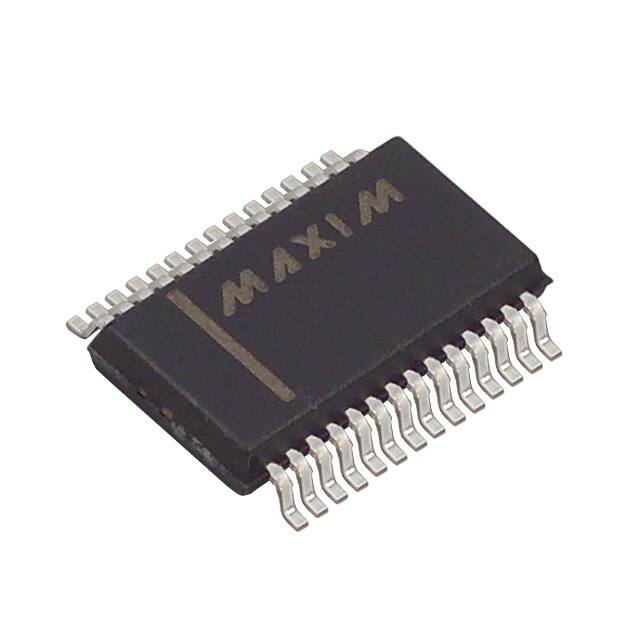
♦ Integrated RS-232 and IrDA in Single 28-Pin SSOP
Package
♦ 370µA Supply Current
♦ IrDA 1.2 Compatible: 2.4kbps to 115kbps
Data Rate
♦ On-Board IR Encoder/Decoder Allows Use of
Non-IrDA UARTs
♦ +3.0V to +5.5V Single-Supply Operation
♦ Meet EIA/TIA-232 Specifications Down to +3V
♦ 200mA, High-Current Infrared LED Drive
♦ 1µA Low-Power Shutdown with RS-232
Receivers Active
Ordering Information
TEMP. RANGE
PART
0°C to +70°C
28 SSOP
MAX3130EAI
MAX3131CAI
MAX3131EAI
-40°C to +85°C
0°C to +70°C
-40°C to +85°C
28 SSOP
28 SSOP
28 SSOP
Pin Configuration
TOP VIEW
28 R2OUT
EDGEDET (RXD) 1
Applications
Personal Digital Assistants (PDAs)
Palmtop Computers
Battery-Powered Systems
Hand-Held Equipment
Peripherals
IrDA Applications
Cellular Phones
PIN-PACKAGE
MAX3130CAI
T1IN 2
27 R2IN
T2IN 3
26 T2OUT
25 RSSD
IRMODE (TXD) 4
24 V-
R1OUT 5
R1IN 6
MAX3130
MAX3131
23 C2-
T1OUT 7
22 C2+
BAUD16 8
21 C1-
GND 9
20 C1+
VCC 10
19 V+
N.C. 11
18 N.C.
AVCC 12
17 LEDC
AGND 13
16 PGND
PINC 14
15 IRSD
( ) ARE FOR MAX3131
SSOP
________________________________________________________________ Maxim Integrated Products
1
For free samples & the latest literature: http://www.maxim-ic.com, or phone 1-800-998-8800.
For small orders, phone 1-800-835-8769.
MAX3130/MAX3131
General Description
�MAX3130/MAX3131
3V to 5.5V, IrDA Infrared Transceiver with
Integrated RS-232 Interface
ABSOLUTE MAXIMUM RATINGS
VCC to GND ..............................................................-0.3V to +6V
AVCC to AGND .........................................................-0.3V to +6V
VCC to AVCC .......................................................................±0.3V
AGND, PGND to GND ........................................................±0.1V
V+ to GND ................................................................-0.3V to +7V
V- to GND .................................................................+0.3V to -7V
V+ to V- ................................................................................+13V
Inputs (referenced to GND)
T1IN, T2IN, TXD, RSSD, IRMODE, BAUD16,
IRSD....................................................................-0.3V to +6V
R1IN, R2IN .....................................................................±25V
Outputs (referenced to GND)
T1OUT, T2OUT............................................................±13.2V
R1OUT, R2OUT, EDGEDET, RXD.........-0.3V to (VCC + 0.3V)
LEDC...................................................................-0.3V to +6V
Output Short-Circuit Duration (to VCC or GND)
T1OUT, T2OUT .....................................................Continuous
Output Currents
LEDC Continuous ........................................................200mA
LEDC 20% Duty Cycle tON < 90µs..............................500mA
Input Current
PINC ..............................................................................10mA
Continuous Power Dissipation (TA = +70°C)
SSOP (derate 9.52mW/°C above +70°C) ...................762mW
Operating Temperature Ranges
MAX3130/MAX3131CAI ....................................0°C to +70°C
MAX3130/MAX3131EAI..................................-40°C to +85°C
Storage Temperature Range .............................-65°C to +160°C
Lead Temperature (soldering, 10sec) .............................+300°C
Stresses beyond those listed under “Absolute Maximum Ratings” may cause permanent damage to the device. These are stress ratings only, and functional
operation of the device at these or any other conditions beyond those indicated in the operational sections of the specifications is not implied. Exposure to
absolute maximum rating conditions for extended periods may affect device reliability.
ELECTRICAL CHARACTERISTICS
(VCC = AVCC = 3.0V to 5.5V, GND = AGND = PGND, C1–C4 = 0.1µF (Note 1), TA = TMIN to TMAX, unless otherwise noted. Typical
values are at TA = +25°C and VCC = AVCC = 3.3V.)
PARAMETER
CONDITIONS
MIN
TYP
MAX
UNITS
DC CHARACTERISTICS
Power-Supply Current
VCC = 3.3V or 5V, TA = +25°C (Note 2)
0.25
1.0
mA
Analog Power-Supply Current
TA = +25°C (Note 2)
120
200
µA
Shutdown Supply Current
RSSD = low or IRMODE = low,
TA = +25°C (Note 2)
1.0
10
µA
Shutdown Analog Supply Current
IRSD = low, TA = +25°C (Note 2)
0.01
1.0
µA
0.8
V
LOGIC INPUTS (T1IN, T2IN, TXD, IRMODE, BAUD16, IRSD, RSSD)
Input Logic Threshold Low
Input Logic Threshold High
Input Leakage Current
VCC = AVCC = 3.3V
2.0
VCC = AVCC = 5V
2.4
VIN = 0 to VCC
V
±0.01
±1.0
µA
0.1
0.4
V
LOGIC OUTPUTS (R1OUT, R2OUT, RXD, EDGEDET)
Output Voltage Low
ISINK = 1.6mA
Output Voltage High
ISOURCE = 1.0mA
VCC 0.6
VCC 0.05
V
IR RECEIVER
Data Rate
(Note 3)
2.4
Input Current Sensitivity
(Note 3)
0.0002
Ambient Photodiode Current
Rejection
AVCC = 3.3V
100
AVCC = 5V
375
Equivalent Input Noise Current
2
115.2
10
nARMS
6
_______________________________________________________________________________________
kbps
mA
µA
µA
�3V to 5.5V, IrDA Infrared Transceiver with
Integrated RS-232 Interface
(VCC = AVCC = 3.0V to 5.5V, GND = AGND = PGND, C1–C4 = 0.1µF (Note 1), TA = TMIN to TMAX, unless otherwise noted. Typical
values are at TA = +25°C and VCC = AVCC = 3.3V.)
PARAMETER
CONDITIONS
MIN
TYP
MAX
UNITS
IR Receiver Disable Time
Delay until IAVCC < 1µA
10
µs
IR Receiver Enable Time
Delay until maximum IR receive data rate is valid
300
µs
IR Receiver Output Pulse Width
BAUD16 = static
(Note 3)
Data rate = 2.4kbps
1
Data rate = 115kbps
1
90
µs
1.6
8
20
600
ns
IR TRANSMITTER
Transmitter Rise Time
10% to 90% of 200mA drive current
Transmitter Fall Time
90% to 10% of 200mA drive current
Transmitter Output Resistance
IOUT = 200mA
Off-Leakage Current
VLEDC = 5.5V
20
600
ns
AVCC = 3.3V
1.15
2
AVCC = 5V
0.9
1.6
Ω
0.01
10.0
µA
2
MHz
IrDA ENCODER/DECODER (ENDEC)
Maximum Operating Frequency
Maximum frequency at BAUD16
IR Output Pulse Width
fBAUD16 = 1.8432MHz, measured at VLEDC
1.43
2.23
µs
BAUD16 Operating Frequency Range
fBAUD16 required to enable ENDEC
34.6
2000
kHz
25
V
RS-232 RECEIVER
Input Voltage Range
Input Threshold Low
Input Threshold High
-25
VCC = 3.3V
0.6
1.2
VCC = 5V
0.8
1.5
V
VCC = 3.3V
1.5
2.4
VCC = 5V
1.8
2.4
Input Hysteresis
0.3
Input Resistance
TA = +25°C
Receiver Propagation Delay
R_IN to R_OUT,
CL = 150pF
Receiver Skew
tPHL - tPLH, CL = 150pF
3
5
tPHL
300
tPLH
300
V
V
7
kΩ
ns
300
ns
RS-232 TRANSMITTER OUTPUTS
Output Voltage Swing
T1OUT, T2OUT, loaded with 3kΩ to GND
±5
±5.4
V
Output Resistance
VCC = V+ = V- = 0, T_OUT = ±2V
300
10M
Ω
Output Short-Circuit Current
VT_OUT = 0
Output Leakage Current
VT_OUT = ±12V, VCC = 0 to 5.5V,
RS-232 transceiver shutdown
Maximum Data Rate
RL = 3kΩ, CL = 1000pF, one transmitter switching
Transmitter Skew
tPHL - tPLH
±35
120
±60
mA
±25
µA
235
kbps
300
ns
_______________________________________________________________________________________
3
MAX3130/MAX3131
ELECTRICAL CHARACTERISTICS (continued)
�ELECTRICAL CHARACTERISTICS (continued)
(VCC = AVCC = 3.0V to 5.5V, GND = AGND = PGND, C1–C4 = 0.1µF (Note 1), TA = TMIN to TMAX, unless otherwise noted. Typical
values are at TA = +25°C and VCC = AVCC = 3.3V.)
PARAMETER
CONDITIONS
VCC = 3.3V, RL = 3kΩ to
7kΩ, measured from
+3V to -3V or -3V to +3V,
TA = +25°C
Transition-Region Slew Rate
Transmitter Enable Time
MIN
TYP
MAX
CL = 150pF to 1000pF
6
30
CL = 150pF to 2500pF
4
30
UNITS
V/µs
Delay until transmitter outputs are valid
100
µs
Note 1: C1–C4 = 0.1µF, tested at +3.3V ±10%. C1 = 0.047µF, C2–C4 = 0.33µF, tested at +5.0V ±10%.
Note 2: All supply current measurements are made under no-load condition on all outputs, and all input voltages are at VCC or GND.
Note 3: For a compliant IrDA input signal where the data rate is within the supported data rate for the IR receive mode: rise/fall
times are less than 600ns and pulse widths are between 1.41µs and 3/16 of the baud rate.
Typical Operating Characteristics
(VCC = AVCC = 3.3V, GND = AGND = PGND, C1–C4 = 0.1µF, RL = 3kΩ, TA = +25°C, unless otherwise noted.)
ANALOG SUPPLY CURRENT
vs. TEMPERATURE
340
140
VCC = 3.3V or 5V
IAVCC (µA)
ICC (µA)
AVCC = 5V
130
320
300
280
120
AVCC = 3.3V
110
260
240
500
CURRENT REJECTION (µA)
360
MAX3130 toc02
150
MAX3130 toc01
380
AMBIENT PHOTODIODE CURRENT
REJECTION vs. SUPPLY VOLTAGE
MAX3130 toc03
SUPPLY CURRENT vs. TEMPERATURE
400
300
200
100
100
220
90
-20
0
20
40
60
80
0
-40
100
-20
LED DRIVER ON-RESISTANCE
vs. TEMPERATURE
40
60
80
100
1.0
VCC = 5V
0.6
VCC = 3.3V
400
300
200
VCC = 5V
0.4
0
0
20
40
TEMPERATURE (°C)
4
80
100
5.0
5.5
100
TRANSMITTER POWER = 200mW/sr
INPUT PULSE WIDTH = 78µs
TEMIC BPV22NF
VCC = 3.3V
80
60
40
PULSED AT
20% DUTY CYCLE
ILEDC = 200mA
0
4.5
20
100
0.2
4.0
RXD OUTPUT PULSE WIDTH
vs. DISTANCE (2400bps)
MAX3130 toc05
500
LEDC VOLTAGE (mV)
1.2
-20
3.5
SUPPLY VOLTAGE (V)
600
MAX3130 toc04
VCC = 3.3V
-40
3.0
LEDC VOLTAGE vs. LEDC CURRENT
1.6
0.8
20
TEMPERATURE (°C)
TEMPERATURE (°C)
1.4
0
RXD PULSE WIDTH (µs)
-40
MAX3130 toc06
200
RLED (Ω)
MAX3130/MAX3131
3V to 5.5V, IrDA Infrared Transceiver with
Integrated RS-232 Interface
0
100
150
200
250
300
LEDC CURRENT (mA)
350
400
0
20
40
60
DISTANCE (cm)
_______________________________________________________________________________________
80
100
�3V to 5.5V, IrDA Infrared Transceiver with
Integrated RS-232 Interface
RXD OUTPUT PULSE WIDTH vs. DISTANCE
(115.2 kbps)
3.0
2.5
2.0
1.5
1 TRANSMITTER AT 235kbps
1 TRANSMITTER AT 15kbps
2
1
0
-1
-2
-3
-4
VOUT-
-5
1.0
0
20
40
60
80
-6
100
0
1000
DISTANCE (cm)
4000
40
MAX3130 toc09
18
1 TRANSMITTER DRIVEN ONLY
35
5000
235kbps
30
-SLEW
12
ICC (mA)
SLEW RATE (V/µs)
3000
SUPPLY CURRENT vs. LOAD CAPACITANCE
(RS-232 TRANSMITTING)
16
10
+SLEW
8
2000
LOAD CAPACITANCE (pF)
RS-232 TRANSMITTER SLEW RATE
vs. LOAD CAPACITANCE
14
MAX3130 toc08
VOUT+
4
3
MAX3130-toc10
RXD PULSE WIDTH (µs)
3.5
6
5
TRANSMITTER OUTPUT VOLTAGE (V)
TRANSMITTER POWER = 200mW/sr
INPUT PULSE WIDTH = 1.63µs
TEMIC BPV22NF
VCC = 3.3V
MAX3130 toc07
4.0
TRANSMITTER OUTPUT VOLTAGE
vs. LOAD CAPACITANCE
25
120kbps
20
15
6
20kbps
4
10
2
5
0
0
0
1000
2000
3000
4000
5000
0
LOAD CAPACITANCE (pF)
RXD OUTPUT
vs. INFRARED INPUT
2000
3000
RXD OUTPUT
vs. INFRARED INPUT
MAX3130 toc11
2V/div
5000
MAX3130 toc12
RXD
OUTPUT
INFRARED
INPUT
INFRARED
INPUT
2V/div
4000
LOAD CAPACITANCE (pF)
RXD
OUTPUT
2V/div
1000
2V/div
2µs/div
VCC = 3.3V, 115.2kbps AT 1cm DISTANCE
TEMIC BPV22NF
TRANSMIT POWER 200mW/sr
100µs/div
VCC = 3.3V, 2400bps AT 1cm DISTANCE
TEMIC BPV22NF
TRANSMIT POWER 200mW/sr
_______________________________________________________________________________________
5
MAX3130/MAX3131
Typical Operating Characteristics (continued)
(VCC = AVCC = 3.3V, GND = AGND = PGND, C1–C4 = 0.1µF, RL = 3kΩ, TA = +25°C, unless otherwise noted.)
�MAX3130/MAX3131
3V to 5.5V, IrDA Infrared Transceiver with
Integrated RS-232 Interface
Typical Operating Characteristics (continued)
(VCC = AVCC = 3.3V, GND = AGND = PGND, C1–C4 = 0.1µF, RL = 3kΩ, TA = +25°C, unless otherwise noted.)
RXD OUTPUT
vs. INFRARED INPUT
RXD OUTPUT
vs. INFRARED INPUT
MAX3130 toc13
2V/div
RXD
OUTPUT
2V/div
INFRARED
INPUT
2V/div
RXD
OUTPUT
2V/div
INFRARED
INPUT
100µs/div
VCC = 3.3V, 2400bps AT 10cm DISTANCE
TEMIC BPV22NF
TRANSMIT POWER 200mW/sr
2µs/div
VCC = 3.3V, 115.2kbps AT 10cm DISTANCE
TEMIC BPV22NF
TRANSMIT POWER 200mW/sr
RXD OUTPUT
vs. INFRARED INPUT
MAX3130 toc14
RXD OUTPUT
vs. INFRARED INPUT
MAX3130 toc15
MAX3130 toc16
2V/div
RXD
OUTPUT
2V/div
RXD
OUTPUT
2V/div
INFRARED
INPUT
2V/div
INFRARED
INPUT
2µs/div
VCC = 3.3V, 115.2kbps AT 1m DISTANCE
TEMIC BPV22NF
TRANSMIT POWER 200mW/sr
100µs/div
VCC = 3.3V, 2400bps AT 1m DISTANCE
TEMIC BPV22NF
TRANSMIT POWER 200mW/sr
Pin Description
PIN
6
NAME
FUNCTION
EDGEDET
Edge Detector Output. EDGEDET goes low if activity is sensed on either the RS-232
receiver or the IrDA receiver, depending on the state of IRMODE. See EDGEDET: EdgeDetection Circuitry section.
MAX3130
MAX3131
1
—
—
1
RXD
IR Receiver TTL/CMOS Data Output
2
2
T1IN
TTL/CMOS RS-232 Transmitter Input
_______________________________________________________________________________________
�3V to 5.5V, IrDA Infrared Transceiver with
Integrated RS-232 Interface
PIN
MAX3130
3
MAX3131
3
NAME
FUNCTION
T2IN
TTL/CMOS RS-232 Transmitter Input. For the MAX3130, drive IRMODE low to connect
T2IN to the IR transmitter input, and drive IRMODE high to connect T2IN to the RS-232
transmitter input. For the MAX3131, T2IN is always connected to the RS-232 transmitter
input.
IRMODE
IR Mode Control. Drive IRMODE low to connect R2OUT to the IR receiver output and
T2IN to the IR transmitter input. Driving IRMODE low also shuts down the RS-232
charge pump and puts the RS-232 transmitter outputs in a high-impedance state. Drive
IRMODE high to connect R2OUT to the RS-232 receiver output and connect T2IN to the
RS-232 transmitter input.
4
—
—
4
TXD
IR Transmitter TTL/CMOS Data Input
5
5
R1OUT
TTL/CMOS RS-232 Receiver Output
6
6
R1IN
7
7
T1OUT
8
8
BAUD16
RS-232 Receiver Input
RS-232 Transmitter Output
16-Times Baud-Rate Input. To use the ENDEC, apply a signal that is 16 times the baud
rate into BAUD16. Connect BAUD16 to GND or VCC to disable the ENDEC.
9
9
GND
Ground
10
10
VCC
3.0V to 5.5V Supply Voltage
11, 18
11, 18
N.C.
No Connection. Do not make connections to these pins.
12
12
AVCC
Analog Supply Voltage VCC for IR Signal Processing. AVCC range is 3.0V to 5.5V.
13
13
AGND
Analog Ground for IR Signal Processing. Connect to GND.
14
14
PINC
Silicon PIN Photodiode Input. Connect PINC to the cathode of the PIN photodiode.
Connect the anode of the PIN photodiode to GND.
15
15
IRSD
Shutdown Input for the IrDA Transceiver Circuitry
16
16
PGND
Power Ground for IR LED Driver. Connect to GND.
17
17
LEDC
Open-Drain Output for Driving the IR LED. Connect LEDC to the cathode of the IR LED.
19
19
V+
20
20
C1+
Positive Terminal of the Voltage-Doubling Charge-Pump Capacitor
21
21
C1-
Negative Terminal of the Voltage-Doubling Charge-Pump Capacitor
22
22
C2+
Positive Terminal of the Inverting Charge-Pump Capacitor
23
23
C2-
Negative Terminal of the Inverting Charge-Pump Capacitor
24
24
V-
25
25
RSSD
Shutdown Input for the RS-232 Transmitters and Charge Pump
26
26
T2OUT
RS-232 Transmitter Output
27
27
R2IN
28
28
R2OUT
+5.5V Generated by the Internal Charge Pump
-5.5V Generated by the Internal Charge Pump
RS-232 Receiver Input
TTL/CMOS RS-232 Receiver Output. For the MAX3130, drive IRMODE low to connect
R2OUT to the IR receiver output, and drive IRMODE high to connect R2OUT to the
RS-232 receiver output. For the MAX3131, R2OUT is always internally connected to the
RS-232 receiver output.
_______________________________________________________________________________________
7
MAX3130/MAX3131
Pin Description (continued)
�MAX3130/MAX3131
3V to 5.5V, IrDA Infrared Transceiver with
Integrated RS-232 Interface
MAX3130 Function Table
MAX3130
CONTROL INPUTS
RSSD
IRMODE
LOGIC INPUTS
IRSD
T1IN
T2IN
IrDA
Input
IrDA
Input
RS-232 I/O
T1OUT
LOGIC OUTPUTS
IrDA
OUTPUT
IrDA
INPUT
T2OUT
R1IN
R2IN
R1OUT
R2OUT
LEDC
PINC
High-Z
High-Z
RS-232
Input
RS-232
Input
RS-232
Output
IrDA
Output
Enabled
Disabled
High-Z
High-Z
RS-232
Input
RS-232
Input
RS-232
Output
IrDA
Output
Enabled
Enabled
X
0
0
RS-232
Input
X
0
1
RS-232
Input
0
1
0
RS-232 RS-232
Input
Input
High-Z
High-Z
RS-232
Input
RS-232
Input
RS-232
Output
RS-232
Output
Disabled
Disabled
0
1
1
RS-232 RS-232
Input
Input
High-Z
High-Z
RS-232
Input
RS-232
Input
RS-232
Output
RS-232
Output
Disabled
Enabled
1
1
0
RS-232 RS-232 RS-232
Input
Input
Output
RS-232
Output
RS-232
Input
RS-232
Input
RS-232
Output
RS-232
Output
Disabled
Disabled
1
1
1
RS-232 RS-232 RS-232
Input
Input
Output
RS-232
Output
RS-232
Input
RS-232
Input
RS-232
Output
RS-232
Output
Disabled
Enabled
X = Don’t care
MAX3131 Operational Modes Table
RSSD
IRSD
T_OUT
R_IN
LEDC
RXD
0
0
High-Z
Enabled
Enabled
Logic High
0
1
High-Z
Enabled
Enabled
IrDA Output
1
0
Enabled
Enabled
Enabled
Logic High
1
1
Enabled
Enabled
Enabled
IrDA Output
Detailed Description
The MAX3130/MAX3131 are IrDA 1.2 compatible,
infrared transceivers with an integrated RS-232 interface. By selecting appropriate external optical components, these devices support IrDA 1.2 data rates from
2.4kbps to 115kbps at distances from 1cm to 1m. A
low-noise design allows them to achieve a bit-error rate
below 10-8 at maximum data rates. On-chip filtering
rejects out-of-band ambient light signals that interfere
with infrared communication. Both devices include a
high-power LED driver capable of sinking 200mA.
The MAX3130 and MAX3131 contain two RS-232 drivers
and two RS-232 receivers that support data rates up to
120kbps. The RS-232 transceiver is powered by a highefficiency, dual charge-pump power supply that operates with input supply voltages from +3.0V to +5.5V.
The MAX3130 is optimized for applications using a single UART for both infrared and RS-232 communication.
The infrared transmitter input and infrared receiver output are multiplexed with one RS-232 transmitter input
and one RS-232 receiver output, respectively. The
MAX3131 IrDA and RS-232 transceivers are independent of each other for use in simultaneous multiprotocol
transceiver applications.
8
IR Receivers
The receiver amplifier reverse biases the PIN diode
with approximately 1.2V, and the PIN diode converts
pulses of IR light into pulses of current. The input transimpedance (current-to-voltage) amplifier converts and
amplifies these current pulses into voltage pulses. The
MAX3130/MAX3131 incorporate filters that remove lowfrequency ambient light interference and high-frequency
circuit noise from these voltage pulses. A high-speed
comparator then translates these voltage pulses into
CMOS output levels. Figures 1 and 2 show system
functional diagrams.
The RXD pin is the output of the infrared receiver for
the MAX3131. The R2OUT pin is the output of the
infrared receiver for the MAX3130 (IRMODE = low).
With the ENDEC disabled, the infrared receiver output
pulses low upon each incoming infrared pulse. The
pulse width of the receiver output depends on many
factors, including transmitter distance and power, PIN
photodiode efficiency and area, and incoming data
rate. Under all circumstances the output pulse is less
than one baud period. To communicate with UARTs
that are not IrDA compatible, enable the ENDEC (see
the IrDA Encoder/Decoder (ENDEC) section).
_______________________________________________________________________________________
�3V to 5.5V, IrDA Infrared Transceiver with
Integrated RS-232 Interface
MAX3130/MAX3131
ON
RSSD
C1+
C1
SHDN
C1-
V+
V-
CHARGE PUMP
C2+
C2
C3
C4
C2R1OUT
RECEIVE
LOGIC
OUTPUTS
OFF
R1IN
5k
RS-232
INPUTS
R2IN
R2OUT
5k
EDGE
T1OUT
T1IN
TRANSMIT
LOGIC
INPUTS
T2IN
T2OUT
RS-232
OUTPUTS
232
IRMODE
IR
BAUD16
Rx
TxIN
ENDEC
RxIN
Tx
EDGEDET
EDGE
fBAUD16
VCC
GND
1µF
RSET
MAX3130
LEDC
PGND
PINC
ON
OFF
IRSD
BIAS
1.2V
AVCC
AGND
1µF
Figure 1. MAX3130 Functional Diagram
_______________________________________________________________________________________
9
�MAX3130/MAX3131
3V to 5.5V, IrDA Infrared Transceiver with
Integrated RS-232 Interface
ON
C1+
C1
C1-
V-
C3
C4
C2R1OUT
RS-232
RECEIVE
LOGIC
OUTPUTS
OFF
V+
CHARGE PUMP
C2+
C2
RSSD
SHDN
R1IN
RS-232
INPUTS
5k
R2IN
R2OUT
5k
RS-232
TRANSMIT
LOGIC
INPUTS
IrDA TRANSMIT
LOGIC INPUT
T1IN
T1OUT
T2IN
T2OUT
RS-232
OUTPUTS
TXD
RXD
IrDA RECEIVE
LOGIC
OUTPUT
BAUD16
Rx
TxIN
ENDEC
Tx
RxIN
MAX3131
VCC
GND
1µF
fBAUD16
RSET
LEDC
PGND
PINC
ON
OFF
IRSD
BIAS
1.2V
AVCC
AGND
1µF
Figure 2. MAX3131 Functional Diagram
10
______________________________________________________________________________________
�3V to 5.5V, IrDA Infrared Transceiver with
Integrated RS-232 Interface
IRMODE: Multiplexed RS-232 Operation
and IrDA Operation (MAX3130)
The MAX3130 has the capability to multiplex R2OUT and
T2IN between the IrDA infrared interface and the RS-232
electrical interface. The state of the IRMODE input determines which interface (infrared or RS-232) is multiplexed
to R2OUT and T2IN. When IRMODE is low, R2OUT acts
as the infrared receiver output and T2IN acts as the
infrared transmitter input. Also, while IRMODE is low, the
RS-232 charge pumps are shut down and the RS-232
transmitters are disabled (see Shutdown section). When
IRMODE is high, R2OUT and T2IN assume their functions as the RS-232 data receive output and transmit
input, respectively. Also, while IRMODE is high, the IR
transmitter is disabled (turned off).
The MAX3130 has internal edge-detection circuitry that
monitors the RS-232 R2OUT line when IRMODE is low
and monitors the IrDA receive channel when IRMODE
is high. EDGEDET goes low when a positive or negative
edge is detected on either the RS-232 R2OUT line or
the IrDA receive channel (depending on the IRMODE
pin). This edge-detection feature is useful for initiating
an interrupt when data is received on the deselected
line. The EDGEDET signal is cleared when IRMODE is
toggled. Table 1 shows EDGEDET operation.
IrDA Encoder/Decoder (ENDEC)
The MAX3130 and MAX3131 provide an on-board
ENDEC to communicate with UARTs that are not IrDA
compatible. The ENDEC is enabled by applying a clock
with a frequency 16 times the baud rate to the BAUD16
input. This BAUD16 clock is commonly provided on
UARTs that do not have IrDA ENDEC capability. Figure
3 illustrates the operation of the ENDEC. The ENDEC
stretches the incoming infrared pulse (a pulse between
Table 1. EDGEDET Operation
IRSD
RSSD IRMODE
R2IN
X
X
0
X
X
0
X
X
1
X
X
X
1
X
IrDA RxIN
EDGEDET*
X
X
X = Don’t care
* EDGEDET is cleared by any transition on IRMODE.
INFRARED
PHOTODIODE INPUT *
1.41µs < t < 3CS
16CS
R2OUT (RXD)
WITH ENDEC DISABLED
R2OUT (RXD)
WITH ENDEC ENABLED
16CS
32CS
CS = BAUD16 CLOCK CYCLES
* HIGH = INFRARED LIGHT PULSE
( ) ARE FOR MAX3131
Figure 3a. ENDEC Operation, Receiving Infrared
______________________________________________________________________________________
11
MAX3130/MAX3131
EDGEDET: Edge-Detection Circuitry
(MAX3130)
IR Transmitter
The infrared transmitter consists of an internal highpower, open-drain MOSFET switch. This switch has an
on-resistance of less than 2Ω and is capable of switching 200mA of current. Internal buffering keeps the input
capacitance of the TXD pin extremely low to ease user
drive requirements. Connect an IR LED in series with a
current-setting resistor to select the appropriate IR output power (see the Powering the IR LED section). The
transmitter is not current limited so do not exceed the
power dissipation of the external components during
high duty-cycle transmit schemes.
The TXD input controls the IR LED for the MAX3131.
The T2IN input controls the IR LED for the MAX3130
(IRMODE = low). With the ENDEC disabled (see IrDA
Encoder/Decoder (ENDEC) section), the IR LED is
turned on by a logic-high signal at the TXD or T2IN
input, for the MAX3131 and MAX3130 respectively.
�MAX3130/MAX3131
3V to 5.5V, IrDA Infrared Transceiver with
Integrated RS-232 Interface
T2IN (TXD)
7CS
INFRARED LED
OUTPUT *
3CS
16CS
CS = BAUD16 CLOCK CYCLES
* HIGH = INFRARED LIGHT PULSE
( ) ARE FOR MAX3131
Figure 3b. ENDEC Operation, Transmitting Infrared
1µs and three BAUD16 clock cycles) into a full baud
period (Figure 3a). Signals applied to TXD are inverted
and compressed to three BAUD16 clock cycles by the
ENDEC before being transmitted (Figure 3b). The
ENDEC is disabled by connecting the BAUD16 input to
VCC or GND.
Dual Charge-Pump Voltage Converter
The MAX3130/MAX3131’s internal power supply consists of a regulated dual charge pump that provides
output voltages of +5.5V (doubling charge pump) and
-5.5V (inverting charge pump) for supply voltages from
+3.0V to +5.5V. The charge pump operates in a discontinuous mode: if the output voltages are less than
5.5V, the charge pumps are enabled; if the output voltages exceed 5.5V, the charge pumps stop switching.
Each charge pump requires a flying capacitor (C1, C2)
and a reservoir capacitor (C3, C4) to generate the V+
and V- supplies (Figures 1 and 2). If RSSD (or IRMODE
for MAX3130) is low, both charge pumps shut down.
RS-232 Transmitters
The RS-232 transmitters are inverting level translators
that convert CMOS-logic levels to ±5.0V EIA/TIA-232
levels. The MAX3130/MAX3131 transmitters are guaranteed for data rates of 120kbps, providing compatibility with PC-to-PC communication software, such as
LapLink™. These RS-232 transmitters typically operate
at data rates of 235kbps. The RS-232 transmitter outputs are high impedance when either IRMODE or RSSD
are low.
The MAX3130/MAX3131 RS-232 receivers translate RS232 signal levels to CMOS-level logic. The RS-232
receivers also perform a logic inversion from input to
output. The receivers are always active and are not
affected by the RS-232 shutdown input (RSSD).
LapLink is a trademark of Traveling Software.
12
__________ Applications Information
Shutdown
The MAX3130/MAX3131 have split analog and digital
supplies (V CC and AV CC ) with separate shutdown
modes. When IRSD is pulled low, the IR receiver is disabled and AVCC current reduces to