Demonstration
System EPC9113
Quick Start Guide
6.78 MHz, ZVS Class-D Wireless Power System
using EPC2108 / EPC2036
�QUICK START GUIDE
Demonstration System EPC9113
DESCRIPTION
The EPC9113 wireless power demonstration system is a high efficiency,
Zero Voltage Switching (ZVS), Voltage Mode class-D wireless power
transfer demonstration kit capable of delivering up to 16 W into a DC
load while operating at 6.78 MHz (Lowest ISM band). The purpose of this
demonstration system is to simplify the evaluation process of wireless
power technology using eGaN® FETs and ICs.
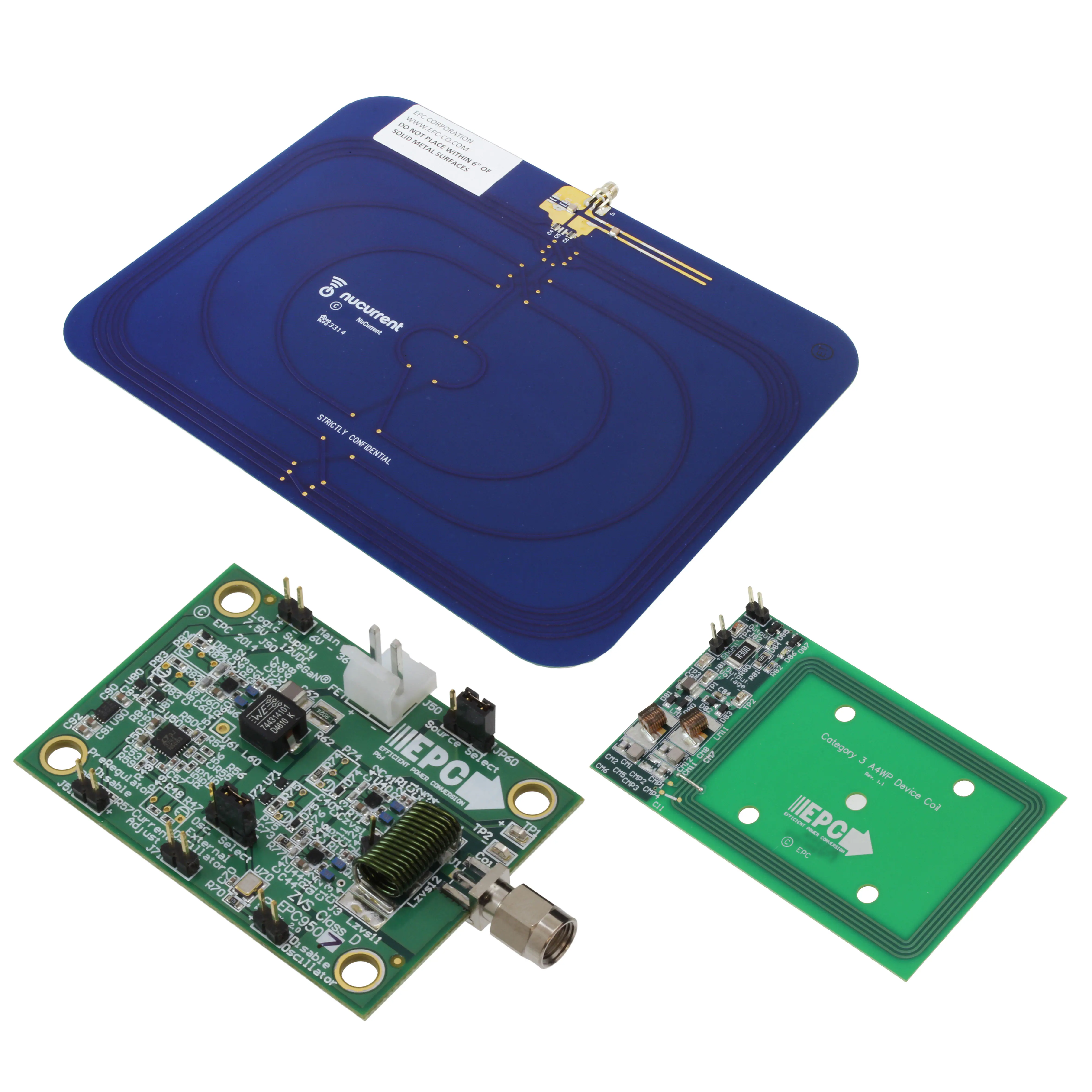
The EPC9113 wireless power system comprises the three boards (shown
in Figure 1) namely:
1) A Source Board (Transmitter or Power Amplifier) EPC9509
2) A Class 3 AirFuelTM Alliance compliant Source Coil (Transmit Coil)
3) A Category 3 AirFuel compliant Device Coil with rectifier and DC
smoothing capacitor.
The amplifier board features the enhancement-mode, half-bridge field
effect transistor (FET), the 60 V rated EPC2108 eGaN FET with integrated
synchronous bootstrap FET. The amplifier can be set to operate in either
differential mode or single-ended mode and includes the gate driver/s,
oscillator, and feedback controller for the pre-regulator that ensures
operation for wireless power control based on the AirFuel standard. This
allows for testing compliant to the AirFuel class 3 standard over a load
range as high as ±50j Ω. The pre-regulator features the 100 V rated 73 mΩ
EPC2036 as the main switching device for a SEPIC converter.
The EPC9509 can operate in either Single ended or Differential mode by
changing a jumper setting. This allows for high efficiency operation with
load impedance ranges that allow for single ended operation.
The timing, the timing adjust circuits for the ZVS class-D amplifiers have
been separated to further ensure highest possible efficiency setting and
includes separate ZVS tank circuits.
The amplifier is equipped with a pre-regulator controller that adjusts the
voltage supplied to the ZVS Class-D amplifier based on the limits of 3
parameters; coil current, DC power delivered, and maximum voltage.
the coil current has the lowest priority followed by the power delivered
with amplifier supply voltage having the highest priority. Changes in
the device load power demand, physical placement of the device on
the source coil and other factors such as metal objects in proximity to
the source coil all contribute to variations in coil current, DC power, and
amplifier voltage requirements. Under any conditions, the controller will
ensure the correct operating conditions for the ZVS class-D amplifier
based on the AirFuel standard. The pre-regulator can be bypassed to
allow testing with custom control hardware. The board further allows
easy access to critical measurement nodes that allow accurate power
measurement instrumentation hookup. A simplified diagram of the
amplifier board is given in Figure 2.
The Source and Device Coils are AirFuel Alliance compliant and have been
pre-tuned to operate at 6.78 MHz with the EPC9509 amplifier. The source coil
is class 3 and the device coil is category 3 compliant.
The device board includes a high frequency schottky diode based full
bridge rectifier and output filter to deliver a filtered unregulated DC
voltage. The device board comes equipped with two LED’s, one green
to indicate the power is being received with an output voltage equal
or greater than 4 V and a second red LED that indicates that the output
voltage has reached the maximum and is above 37 V.
For more information on the EPC2108 or EPC2036 please refer to the
datasheet available from EPC at www.epc-co.com. The datasheet should
be read in conjunction with this quick start guide.
The Source coil used in this wireless power transfer demo system is
provided by NuCurrent (nucurrent.com). Reverse Engineering of the
Source coil is prohibited and protected by multiple US and international
patents. For additional information on the source coil, please contact
NuCurrent direct or EPC for contact information.
Figure 1: EPC9113 demonstration system.
2 |
| EPC – EFFICIENT POWER CONVERSION CORPORATION | WWW.EPC-CO.COM | COPYRIGHT 2017
�QUICK START GUIDE
Demonstration System EPC9113
Table 1: Performance Summary (TA = 25°C) EPC9509
Symbol
Parameter
Conditions
Min
Max
Units
VIN
Bus Input Voltage Range – PreRegulator Mode
Also used in
bypass mode
for logic supply
17
24
V
VIN
Amp Input Voltage Range –
Bypass Mode
0
52
V
VOUT
Switch-Node Output Voltage
52
V
IOUT
Switch-Node Output
Current (each)
External Oscillator Input
Threshold
1*
A
Vextosc
VPre_Disable
IPre_Disable
VOsc_Disable
IOsc_Disable
VsgnDiff
IsgnDiff
Pre-Regulator Disable
Voltage Range
Pre-Regulator Disable
Current
Oscillator Disable
Voltage Range
Oscillator Disable
Current
Differential or Single-Select
Voltage
Differential or Single-Select
Current
Input ‘Low’
-0.3
0.8
V
Input ‘High’
2.4
5
V
Floating
-0.3
5.5
V
Floating
-10
10
mA
Open Drain/
Collector
Open Drain/
Collector
Open Drain/
Collector
Open Drain/
Collector
-0.3
5
V
-25
25
mA
-0.3
5.5
V
-1
1
mA
* Maximum current depends on die temperature – actual maximum current will be subject to switching
frequency, bus voltage and thermals.
Table 2: Performance Summary (TA = 25 °C) Category 3 Device Board
Symbol
Parameter
Min
Max
Units
VOUT
Output Voltage Range
Conditions
0
38
V
IOUT
Output Current Range
0
1.5#
A
# Actual maximum current subject to operating temperature limits
MECHANICAL ASSEMBLY
The assembly of the EPC9113 Wireless Demonstration kit is simple and
shown in Figure 1. The source coil and amplifier have been equipped
with SMA connectors. The source coil is simply connected to the
amplifier.
The device board does not need to be mechanically attached to the
source coil.
The coil sets of the EPC9111 and EPC9112 (both the source and
device coils) are not compatible with the EPC9113/4 kit. To prevent
inadvertent connection of either, the connectors of the amplifier and
coils have been changed from reverse polarity to standard polarity.
Please contact EPC for modifications to the original coil set to ensure
compatibility with the EPC9509 amplifier.
DETAILED DESCRIPTION
The Amplifier Board (EPC9509)
Figure 2 shows the system block diagram of the EPC9509 ZVS class-D
amplifier with pre-regulator and Figure 3 shows the details of the
ZVS class-D amplifier section. The pre-regulator is used to control
the ZVS class-D wireless power amplifier based on three feedback
parameters 1) the magnitude of the coil current indicated by the
green LED, 2) the DC power drawn by the amplifier indicated by
the yellow LED and 3) a maximum supply voltage to the amplifier
indicated by the red LED. Only one parameter at any time is used to
control the pre-regulator with the highest priority being the maximum
voltage supplied to the amplifier followed by the power delivered
to the amplifier and lastly the magnitude of the coil current. The
maximum amplifier supply voltage is pre-set to 52 V and the maximum
power drawn by the amplifier is pre-set to 16 W. The coil current
magnitude is pre-set to 800 mARMS but can be made adjustable
using P25. The pre-regulator comprises a SEPIC converter that can
operate at full power from 17 V through 24 V.
The pre-regulator can be bypassed by connecting the positive supply
directly to the ZVS class-D amplifier supply after removing the jumper
at location JP1 and connecting the main positive supply to the bottom
pin. JP1 can also be removed and replaced with a DC ammeter to directly
measure the current drawn by the amplifier. When doing this observe
a low impedance connection to ensure continued stable operation of
the controller. Together with the Kelvin voltage probes (TP1 and TP2)
connected to the amplifier supply, an accurate measurement of the
power drawn by the amplifier can be made.
The EPC9509 is also provided with a miniature high efficiency switchmode 5 V supply to power the logic circuits on board such as the gate
drivers and oscillator.
The amplifier comes with its own low supply current oscillator that is
pre-programmed to 6.78 MHz ± 678 Hz. It can be disabled by placing
a jumper into JP70 or can be externally shutdown using an externally
controlled open collector / drain transistor on the terminals of JP70 (note
which is the ground connection). The switch needs to be capable of
sinking at least 25 mA. An external oscillator can be used instead of the
internal oscillator when connected to J70 (note which is the ground
connection) and the jumper (JP71) is removed.
The pre-regulator can also be disabled in a similar manner as the oscillator
using JP50. However, note that this connection is floating with respect to
the ground so removing the jumper for external connection requires a
floating switch to correctly control this function. Refer to the datasheet of
the controller IC and the schematic in this QSG for specific details.
The ZVS timing adjust circuits for the ZVS class D amplifiers are each
independently settable to ensure highest possible efficiency setting
and includes separate ZVS tank circuits. This allows OOK modulation
capability for the amplifier.
The EPC9509 is provided with 3 LED’s that indicate the mode of
operation of the system. If the system is operating in coil current limit
mode, then the green LED will illuminate. For power limit mode, the
yellow LED will illuminate. Finally, when the pre-regulator reaches
maximum output voltage the red LED will illuminate indicating that
the system is no longer AirFuel compliant as the load impedance is too
high for the amplifier to drive. When the load impedance is too high
to reach power limit or voltage limit mode, then the current limit LED
will illuminate incorrectly indicating current limit mode. This mode
also falls outside the AirFuel standard and by measuring the amplifier
supply voltage across TP1 and TP2 will show that it has nearly reach the
maximum value limit.
EPC – EFFICIENT POWER CONVERSION CORPORATION | WWW.EPC-CO.COM | COPYRIGHT 2017 |
|3
�QUICK START GUIDE
Demonstration System EPC9113
Single ended or Differential Mode operation
Determining component values for LZVS
The EPC9509 amplifier can be operated in one of two modes; single-ended
or differential mode. Single ended operation offers higher amplifier
efficiency but reduced imaginary impedance drive capability. If the
reflected impedance of the tuned coil load exceeds the capability of
the amplifier to deliver the desired power, then the amplifier can be
switched over to differential mode. In differential mode, the amplifier is
capable of driving an impedance range of 1 Ω through 56 Ω and ±50j Ω
and maintains either the 800 mARMS coil current or deliver up to 16 W
of power. The EPC9509 is set by default to differential mode and can be
switched to single ended mode by inserting a jumper into J75. When
inserted the amplifier operates in the single-ended mode. Using an
external pull down with floating collector/ drain connection will have
the same effect. The external transistor must be capable of sinking 25
mA and withstand at least 6 V.”
The ZVS tank circuit is not operated at resonance, and only provides the
necessary negative device current for self-commutation of the output
voltage at turn off. The capacitors CZVS1 and CZVS2 are chosen to have
a very small ripple voltage component and are typically around 1 µF.
The amplifier supply voltage, switch-node transition time will determine
the value of inductance for LZVSx which needs to be sufficient to maintain
ZVS operation over the DC device load resistance range and coupling
between the device and source coil range and can be calculated using
the following equation:
For differential mode only operation, the two ZVS inductors LZVS1 and LZVS2
can be replaced by a single inductor LZVS12 and by removing CZVS1 and CZVS2.
Δtvt
= Voltage Transition Time [s]
ƒSW
= Operating Frequency [Hz]
COSSQ
= Charge Equivalent Device Output Capacitance [F]
ZVS Timing Adjustment
Cwell
= Gate driver well capacitance [F]. Use 20 pF for the LM5113
Setting the correct time to establish ZVS transitions is critical to
achieving high efficiency with the EPC9509 amplifier. This can be
done by selecting the values for R71, R72, R77, and R78 or P71, P72,
P77, and P78 respectively. This procedure is best performed using a
potentiometer installed at the appropriate locations that is used to
determine the fixed resistor values. The procedure is the same for both
single-ended and differential mode of operation. The timing MUST
initially be set WITHOUT the source coil connected to the amplifier.
The timing diagrams are given in Figure 10 and should be referenced
when following this procedure. Only perform these steps if changes
have been made to the board as it is shipped preset. The steps are:
NOTE. that the amplifier supply voltage VAMP is absent from the equation as
1. With power off, remove the jumper in JP1 and install it into JP50 to
place the EPC9509 amplifier into Bypass mode. Connect the main
input power supply (+) to JP1 (bottom pin – for bypass mode) with
ground connected to J1 ground (-) connection.
2. With power off, connect the control input power supply bus (19 V) to
(+) connector (J1). Note the polarity of the supply connector.
∆tvt
8 ∙ fsw∙ COSSQ + Cwell
(1)
Where:
it is accounted for by the voltage transition time. The COSS of the EPC2108
eGaN FETs is very low and lower than the gate driver well capacitance
Cwell which as a result must now be included in the ZVS timing calculation.
The charge equivalent capacitance can be determined using
the following equation:
COSSQ =
1
VAMP
∙
∫
VAMP
0
COSS (v) ∙ dv
(2)
To add additional immunity margin for shifts in coil impedance, the value
of LZVS can be decreased to increase the current at turn off of the devices
(which will increase device losses). Typical voltage transition times range
from 2 ns through 12 ns. For the differential case the voltage and charge
(COSSQ) are doubled when calculating the ZVS inductance.
The Source Coil
3. Connect a LOW capacitance oscilloscope probe to the probe-hole
of the half-bridge to be set and lean against the ground post as shown
in Figure 9.
Figure 4 shows the schematic for the source coil which is Class 3
AirFuel compliant. The matching network includes both series and
shunt tuning. The matching network series tuning is differential to
allow balanced connection and voltage reduction for the capacitors.
4. Turn on the control supply – make sure the supply is approximately 19 V.
The Device Board
5. Turn on the main supply voltage starting at 0 V and increasing to the
required predominant operating value (such as 24 V but NEVER
exceedthe absolute maximum voltage of 52 V).
Figure 5 shows the basic schematic for the device coil which is Category 3
AirFuel compliant. The matching network includes both series and
shunt tuning. The matching network series tuning is differential to
allow balanced connection and voltage reduction for the capacitors.
6. While observing the oscilloscope adjust the applicable potentiometers
to so achieve the green waveform of Figure 10.
7. Repeat for the other half-bridge.
8. Replace the potentiometers with fixed value resistors if required
Remove the jumper from JP50 and install it back into JP1 to revert the
EPC9509 back to pre-regulator mode.
4 |
LZVS =
The device board comes equipped with a kelvin connected output
DC voltage measurement terminal and a built in shunt to measure
the output DC current.
Two LEDs have been provided to indicate that the board is receiving
power with an output voltage greater than 4 V (green LED) and that
the board output voltage limit has been reached (greater than 36 V
using the red LED).
| EPC – EFFICIENT POWER CONVERSION CORPORATION | WWW.EPC-CO.COM | COPYRIGHT 2017
�QUICK START GUIDE
QUICK START PROCEDURE
The EPC9113 demonstration system is easy to set up and evaluate the
performance of the eGaN FET in a wireless power transfer application. Refer
to Figure 1 to assemble the system and Figures 6 and 8 for proper connection
and measurement setup before following the testing procedures.
The EPC9509 can be operated using any one of two alternative methods:
a. Using the pre-regulator
b. Bypassing the pre-regulator
a. Operation using the pre-regulator
The pre-regulator is used to supply power to the amplifier in this mode
and will limit the coil current, power delivered or maximum supply voltage to the amplifier based on the pre-determined settings.
The main 19 V supply must be capable of delivering 2 ADC. DO NOT turn
up the voltage of this supply when instructed to power up the board,
instead simply turn on the supply. The EPC9509 board includes a preregulator to ensure proper operation of the board including start up.
1. Make sure the entire system is fully assembled prior to making electrical
connections and make sure jumper JP1 is installed. Also make sure the
source coil and device coil with load are connected.
2. With power off, connect the main input power supply bus to J1 as
shown in Figure 3. Note the polarity of the supply connector.
3. Make sure all instrumentation is connected to the system.
4. Turn on the main supply voltage to the required value (19 V)
5. Once operation has been confirmed, observe the output voltage
and other parameters on both the amplifier and device boards.
6. For shutdown, please follow steps in the reverse order.
b. Operation bypassing the pre-regulator
In this mode, the pre-regulator is bypassed and the main power is
connected directly to the amplifier. This allows the amplifier to be
operated using an external regulator.
In this mode there is no protection for ensuring the correct operating
conditions for the eGaN FETs.
1. Make sure the entire system is fully assembled prior to making
electrical connections and make sure jumper JP1 has been removed
and installed in JP50 to disable the pre-regulator and to place the
EPC9509 amplifier in bypass mode. Also make sure the source coil and
device coil with load are connected.
2. With power off, connect the main input power supply bus +VIN to the
bottom pin of JP1 and the ground to the ground connection of J1 as
shown in Figure 3.
3. With power off, connect the control input power supply bus to J1.
Note the polarity of the supply connector. This is used to power the
gate drivers and logic circuits.
4. Make sure all instrumentation is connected to the system.
5. Turn on the control supply – make sure the supply is 19 V range.
6. Turn on the main supply voltage to the required value (it is
recommended to start at 0 V and do not exceed the absolute
maximum voltage of 52 V).
Demonstration System EPC9113
7. Once operation has been confirmed, adjust the main supply
voltage within the operating range and observe the output voltage,
efficiency and other parameters on both the amplifier and device boards.
8. For shutdown, please follow steps in the reverse order. Start by
reducing the main supply voltage to 0 V followed by steps 6 through 2.
NOTE.
1. When measuring the high frequency content switch-node (Source Coil Voltage), care
must be taken to avoid long ground leads. An oscilloscope probe connection (preferred
method) has been built into the board to simplify the measurement of the Source Coil
voltage (shown in Figure 4).
2. To maintain control stability, the red LED for voltage mode indicator on the EPC9509
version 1.0 has been disabled. This will be corrected in subsequent revisions of the
board. For questions regarding this LED function, please contact EPC.
3. AVOID using a Lab Benchtop programmable DC as the load for the category 3 device
board. These loads have low control bandwidth and will cause the EPC9113 system to
oscillate at a low frequency and may lead to failure. It is recommended to use a fixed low
inductance resistor as an initial load. Once a design matures, a post regulator, such as a
Buck converter, can be used.
THERMAL CONSIDERATIONS
The EPC9113 demonstration system showcases the EPC2108 and
EPC2036 in a wireless energy transfer application. Although the
electrical performance surpasses that of traditional silicon devices,
their relatively smaller size does magnify the thermal management
requirements. The operator must observe the temperature of the gate
driver and eGaN FETs to ensure that both are operating within the
thermal limits as per the datasheets.
NOTE. The EPC9113 demonstration system has limited current and thermal protection
only when operating off the Pre-Regulator. When bypassing the pre-regulator there is no
current or thermal protection on board and care must be exercised not to over-current or
over-temperature the devices. Excessively wide coil coupling and load range variations can
lead to increased losses in the devices.
Pre-Cautions
The EPC9113 demonstration system has no enhanced protection
systems and therefore should be operated with caution. Some specific
precautions are:
1. Never operate the EPC9113 system with a device board that is AirFuel
compliant as this system does not communicate with the device to
correctly setup the required operating conditions and doing so can
lead to the failure of the device board. Please contact EPC should
operating the system with an AirFuel compliant device is required to
obtain instructions on how to do this. Please contact EPC at info@epcco.com should the tuning of the coil be required to change to suite
specific conditions so that it can be correctly adjusted for use with the
ZVS class-D amplifier.
2. There is no heat-sink on the devices and during experimental
evaluation it is possible present conditions to the amplifier that may
cause the devices to overheat. Always check operating conditions and
monitor the temperature of the EPC devices using an IR camera.
3. Never connect the EPC9509 amplifier board into your VNA in an
attempt to measure the output impedance of the amplifier. Doing so
will severely damage the VNA.
EPC – EFFICIENT POWER CONVERSION CORPORATION | WWW.EPC-CO.COM | COPYRIGHT 2017 |
|5
�QUICK START GUIDE
SEPIC
Pre-Regulator
Demonstration System EPC9113
3VDC – ZVS Class-D
Amplifier
52VDC
CS
Bypass Mode
Connection
JP1
19V DC
Pre-Regulator
Jumper
VAMP
Coil
Connection
Coil
|ICOIL|
PreRegulator
I COIL
IAMP
LZVS12
VIN
VAMP
X
Q 1_a
LZVS2
Combiner
J1
+
PAMP
Q 1_b
Q 2_a
LZVS1
CZVS1
Single
Ended
Operation
CZVS2 Jumper
Q 2_b
Control Reference Signal
Figure 2: Block diagram of the EPC9509 wireless power amplifier.
Figure 3: Diagram of EPC9509 amplifier circuit.
Matching
Impedance
Network
Matching
Impedance
Network
Coil
Connection
Class 3
Coil
Source Coil
Device Board
Figure 4: Basic schematic of the AirFuel Class 3 source coil.
6 |
Un-Regulated
DC output
Cat. 3
Coil
Figure 5: Basic schematic of the AirFuel Category 3 device board.
| EPC – EFFICIENT POWER CONVERSION CORPORATION | WWW.EPC-CO.COM | COPYRIGHT 2017
�QUICK START GUIDE
9-24 VDC
VIN supply
(note polarity)
Demonstration System EPC9113
Amplifier voltage
source jumper
bypass connection
Pre-regulator jumper
Operating mode LED
indicators
+
Coil current setting
Switch-node main
oscilloscope probe
Switch-node
pre-regulator
oscilloscope probe
Ground post
Ground post
Source coil
connection
Amplifier timing
setting (not installed)
Disable pre-regulator
jumper
OOK modulation input
V
Single ended/ differential
mode operation selector
Internal oscillator
selection jumper
Disable
oscillator
jumper
Ground post
Switch-node secondary
oscilloscope probe
External
oscillator
Figure
6: Proper connection and measurement setup for the amplifier board.
Source Board
Connection
Amplifier
supply voltage
(0 V – 52 Vmax )
Amplifier board – front-side
Matching with
trombone tuning
External Load
Connection
Output Voltage
> 5 V LED
Output Voltage
> 37 V LED
Standoffs for Mechanical
attachment to Source Coil
to these locations (x5)
Device Output
mV
Current
(300 m Shunt)
Device Output
Voltage
(0 V – 38 Vmax)
V
A
Load Current
(See Notes for details)
* ONLY to be used with
Shunt removed
Matching
Figure 7: Proper connection for the source coil.
Figure 8: Proper connection and measurement setup for the device board.
EPC – EFFICIENT POWER CONVERSION CORPORATION | WWW.EPC-CO.COM | COPYRIGHT 2017 |
|7
�QUICK START GUIDE
Demonstration System EPC9113
Do not use
probe ground
lead
Ground
probe
against
post
Place probe tip
in large via
Minimize
loop
Figure 9 : Proper measurement of the switch nodes using the hole and ground post.
Q1 turn-off
Q2 turn-off
VAMP
VAMP
Q2 turn-on
0
Partial
Shoot- ZVS
through
Q1 turn-on
time
ZVS
0
Partial
Shoot- ZVS
through
ZVS + Diode
Conduction
time
ZVS
ZVS + Diode
Conduction
Figure 10: ZVS timing diagrams.
8 |
| EPC – EFFICIENT POWER CONVERSION CORPORATION | WWW.EPC-CO.COM | COPYRIGHT 2017
�QUICK START GUIDE
Demonstration System EPC9113
Table 3: Bill of Materials - Amplifier Board
Item
Qty
Reference
Part Description
Manufacturer
Part #
1
3
C1_a, C1_b, C80
1 µF, 10 V
TDK
C1005X7S1A105M050BC
2
12
C2_a, C2_b, C4_a, C4_b, C35, C51,
100 nF, 16 V
C70, C71, C72, C77, C78, C81
Würth
885012205037
3
3
C3_a, C3_b, C95
22 nF, 25 V
Würth
885012205052
4
2
C5_a, C5_b
DNP (100 nF, 16 V)
Würth
885012205037
5
1
C20
DNP (1 nF, 50 V)
Murata
GRM155R71H102KA01D
6
1
C73
DNP (22 pF, 50 V)
Würth
885012005057
7
1
R20
DNP (10k)
Panasonic
ERJ-2GEJ103X
8
8
C6_a, C6_b, C7_a, C7_b, C31, C44,
22 pF, 50 V
C75, C82
Würth
885012005057
9
4
C11_a, C11_b, C12_a, C12_b
10 nF, 100 V
TDK
C1005X7S2A103K050BB
10
4
C15_a, C15_b, C64, C65
2.2 µF, 100 V
Taiyo Yuden
HMK325B7225KN-T
11
1
C21
680 pF, 50 V
Murata
GRM155R71H681KA01D
12
1
C22
1 nF, 50 V
Murata
GRM155R71H102KA01D
13
2
C30, C50
100 nF, 100 V
Murata
GRM188R72A104KA35D
14
1
C32
1 nF, 50 V
Murata
GRM1555C1H102JA01D
15
1
C52
100 pF
Murata
GRM1555C1H101JA01D
16
2
C53, CR43 (on top of R43)
10 nF, 50 V
Murata
GRM155R71H103KA88D
17
2
C61, C62
4.7 µF, 50 V
Taiyo Yuden
UMK325BJ475MM-T
18
1
C63
10 µF, 35 V
Taiyo Yuden
GMK325BJ106KN-T
19
3
C90, C91, C92
1 µF, 25 V
Würth
885012206076
20
2
Czvs1, Czvs2
1 µF, 50 V
Würth
885012207103
21
3
D1_a, D1_b, D95
40 V, 300 mA
ST
BAT54KFILM
22
10
D2_a, D2_b, D21, D40, D41, D42,
D71, D72, D77, D78
40 V, 30 mA
Diodes Inc.
SDM03U40
23
3
D3_a, D3_b, D20
40 V, 30 mA
Diodes Inc.
SDM03U40
24
2
D4_a, D4_b
5V1, 150 mW
Bournes
CD0603-Z5V1
25
1
D35
LED 0603 Yellow
Lite-On
LTST-C193KSKT-5A
26
1
D36
LED 0603 Green
Lite-On
LTST-C193KGKT-5A
27
1
D37
LED 0603 Red
Lite-On
LTST-C193KRKT-5A
28
1
D60
100 V, 1 A
On-Semi
MBRS1100T3G
29
1
D90
40 V, 1 A
Diodes Inc.
PD3S140-7
30
3
GP1_a, GP1_b, GP60
.1" Male Vert.
Würth
61300111121
31
1
J1
.156" Male Vert.
Würth
645002114822
32
1
J2
SMA Board Edge
Linx
CONSAM003.062
33
6
J70, J75, JP1, JP50, JP70, JP71
.1" Male Vert.
Würth
61300211121
34
1
JMP1
DNP
35
1
L60
33 µH, 2.8 A
CoilCraft
MSD1278-334
36
1
L80
10 µH,150 mA
Taiyo Yuden
LBR2012T100K
37
1
L90
47 µH, 250mA
Würth
7440329470
38
1
Lsns
110 nH
CoilCraft
2222SQ-111JE
39
2
Lzvs1, Lzvs2 see addendum statement 390 nH
CoilCraft
2929SQ-391JE
40
1
Lzvs12
DNP
CoilCraft
TBD
41
5
P25, P71, P72, P77, P78
10k, DNP (1k)
Bournes, Murata
3266Y-1-103LF, PV37Y102C01B00
42
2
Q1_a, Q1_b
60 V, 150 mΩ with SB
EPC
EPC2108
43
1
Q60
100 V, 65 mΩ
EPC
EPC2036
44
1
Q61
DNP (100 V, 6 A, 30 mΩ)
EPC
EPC2007C
45
3
R2_a, R2_b, R82
20 Ω
Stackpole
RMCF0402JT20R0
46
2
R3_a, R3_b
27k
Panasonic
ERJ-2GEJ273X
47
2
R4_a, R4_b
4.7 Ω
Panasonic
ERJ-2GEJ4R7X
(continued on next page)
EPC – EFFICIENT POWER CONVERSION CORPORATION | WWW.EPC-CO.COM | COPYRIGHT 2017 |
|9
�QUICK START GUIDE
Demonstration System EPC9113
Table 3: Bill of Materials - Amplifier Board (continued)
Item
Qty
Reference
Part Description
Manufacturer
Part #
48
49
1
R20
DNP (10k)
Panasonic
ERJ-2GEJ103X
1
R21
100k
Panasonic
ERJ-2GEJ104X
50
1
R25
7.5k
Panasonic
ERJ-2RKF7501X
51
1
R26
2k
Panasonic
ERJ-2RKF2001X
52
1
R30
100 Ω
Panasonic
ERJ-3EKF1000V
53
1
R31
51.0k 1%
Panasonic
ERJ-3EKF5102V
54
1
R32
8.2k 1%
Panasonic
ERJ-2RKF8201X
55
2
R33, R70
47k
Panasonic
ERJ-2RKF4702X
56
2
R35, R36
634 Ω
Panasonic
ERJ-2RKF6340X
57
1
R37
150k 1%
Panasonic
ERJ-2RKF1503X
58
2
R38, R91
49.9k 1%
Panasonic
ERJ-2RKF4992X
59
1
R40
196k
Panasonic
ERJ-3EKF1963V
60
1
R41
6.04k
Panasonic
ERJ-2RKF6041X
61
1
R42
24.9k
Panasonic
ERJ-2RKF2492X
62
1
R43
10.5k
Panasonic
ERJ-2RKF1052X
63
2
R44, R90
100k 1%
Panasonic
ERJ-2RKF1003X
64
1
R50
10 Ω
Panasonic
ERJ-3EKF10R0V
65
1
R51
124k 1%
Panasonic
ERJ-2RKF1243X
66
1
R52
71.5k 1%
Panasonic
ERJ-2RKF7152X
67
1
R53
1.00k
Panasonic
ERJ-2RKF1001X
68
1
R54
0Ω
Yageo
RC0402JR-070RL
69
1
R60
40 mΩ, 0.4 W
Vishay Dale
WSLP0603R0400FEB
70
1
R61
150 mΩ, 0.25 W
Vishay Dale
WSL0805R1500FEA18
71
2
R71, R78
124 Ω
Panasonic
ERJ-2RKF1240X
72
2
R72, R77
22 Ω
Panasonic
ERJ-2RKF22R0X
73
2
R73, R75
10k
Panasonic
ERJ-2GEJ103X
74
1
R80
2.2 Ω
Yageo
RC0402JR-072R2L
75
1
R92
9.53k 1%
Panasonic
ERJ-2RKF9531X
76
2
TP1, TP2
SMD Probe Loop
Keystone
5015
77
1
Tsns
10 µH, 1:1, 96.9%
CoilCraft
PFD3215-103ME
78
2
U1_a, U1_b
100 V eGaN Driver
Texas Instruments
LM5113TM
79
1
U30
Power & Current Monitor
Linear
LT2940IMS#PBF
80
1
U35
DNP (Comparator)
Texas Instruments
TLV3201AIDBVR
81
1
U50
Boost Controller
Texas Instruments
LM3478MAX/NOPB
82
1
U70
Programmable Oscillator
KDS Daishinku America
DSO221SHF 6.780
83
2
U71, U77
2 In NAND
Fairchild
NC7SZ00L6X
84
2
U72, U78
2 In AND
Fairchild
NC7SZ08L6X
85
1
U80
Gate Driver with LDO
Texas Instruments
UCC27611DRV
86
1
U90
1.4 MHz, 24 V, 0.5A Buck
MPS
MP2357DJ-LF
Addendum Statement; Ongoing testing of the EPC9509 revealed that the improvement in performance of the EPC2108 based design exceeded that of earlier design criteria and as such the design could further be improved to
increase efficiency by changing Lzvs1 and Lzvs2 from 390nH (Coilcraft 2929SQ-391JEB) to 500nH (Coilcraft 2929SQ-501JEB).
10 |
| EPC – EFFICIENT POWER CONVERSION CORPORATION | WWW.EPC-CO.COM | COPYRIGHT 2017
�QUICK START GUIDE
Demonstration System EPC9113
Table 4: Bill of Materials - Source Coil
Item
Qty
Reference
Part Description
Manufacturer
Part #
1
1
Ctrombone
120 pF, 1000 V
Vishay
VJ1111D12KXGAT
2
1
C1
3.3 pF, 1500 V
Vishay
VJ1111D3R3CXRAJ
3
1
C2
12 pF, 1500 V
Vishay
VJ1111D1120JXRAJ
4
1
C3
120 pF, 1000 V
Vishay
VJ1111D121KXGAT
5
1
PCB1
Class 3 Coil Former
NuCurrent
R26_RZTX_D1
6
2
C4, C6
DNP
—
—
7
1
C5
0 Ω, 0612
Vishay
RCL06120000Z0EA
8
1
J1
SMA PCB Edge
Linx
CONSMA013.031
Reference
Part Description
Manufacturer
Part #
Table 5: Bill of Materials - Device Board
Item
Qty
1
1
C84
100 nF, 50 V
Murata
GRM188R71H104KA93D
2
1
C85
10 µF, 50 V
Murata
GRM32DF51H106ZA01L
3
1
PCB1
Cat3PRU
Coastal Circuits
Cat3DeviceBoard
4
2
CM1, CM11
470 pF
Vishay
VJ1111D471KXLAT
5
4
CM2, CM12, CMP1, CMP2
DNP
6
3
CM5, CM7, CMP3, CMP4
DNP
–
–
–
–
7
1
CM6
56 pF
Vishay
VJ0505D560JXPAJ
8
1
CMP8
68 pF
Vishay
VJ0505D680JXCAJ
9
4
D80, D81, D82, D83
40 V, 1 A
Diodes Inc.
PD3S140-7
10
1
D84
LED 0603 Green
Lite-On
LTST-C193KGKT-5A
11
1
D85
2.7 V 250 mW
NXP
BZX84-C2V7,215
12
1
D86
LED 0603 Red
Lite-On
LTST-C193KRKT-5A
13
1
D87
33 V, 250 mW
NXP
BZX84-C33,215
14
2
J81, J82
.1" Male Vert.
Würth
61300211121
15
2
LM1, LM11
82 nH
Würth
744912182
16
1
R80
300 mΩ, 1 W
Stackpole
CSRN2512FKR300
17
1
R81
4.7k Ω
Stackpole
RMCF1206FT4K70
18
1
R82
422 Ω
Yageo
RMCF0603FT422R
19
4
TP1, TP2, TP3, TP4
SMD Probe Loop
Keystone
5015
20
1
JPR1
Wire Jumper at CM11
–
–
EPC would like to acknowledge Würth Electronics (www.we-online.com/web/en/wuerth_elektronik/start.php), Coilcraft (www.coilcraft.com), and KDS Daishinku America (www.kdsamerica.com) for their support of this project.
EPC – EFFICIENT POWER CONVERSION CORPORATION | WWW.EPC-CO.COM | COPYRIGHT 2017 |
| 11
�QUICK START GUIDE
12 |
1
5V
UVLO Limit
R5 1
124 k 1%
2
R5 3
4.7 k
D40
Vom
SDM03U40
R41 40 V, 30 mA
6.04 k
C52
100 pF
C51
22nF, 25 V
Isns
1
Comp
Vfd bk
R5 4
0 Ω
3
U50
LM3478 MAX/NOPB
FB
DR
Cnt
2
1
6
1 R8 2
20 Ω
PreDR
Isens
5 VGD
C81
100 nF, 16 V
Isns
1
Isns
2
PW M
VDD
VREF
LDO
3
U80
UCC27611DRV
C82
22 pF, 50 V
Isns
VSS
6
5 VGD
5
4
GLPH
GLPL
Vin
EP Isns
GLPH 1
SW
GLPL
1
VCC
R31
45.3 k, 1%
Output Current Limit
D42
2
Vfd bk
V+
Vout
10
I+
IImon
V+
7
V-
3
CMP+
1 R33
47 k
5
Imon
4
Pmon
Q61
EPC2007C
100 V, 6 A, 30 mΩ
EMPTY
GP60
.1" Male Vert.
R6 0
40 mΩ, 0.4 W
C65
2.2 μF, 100 V
U30
LT2940IMS#PBF
8
Vout
Vout
2
2
1
1
Ground Post
2
GND
Pcmp
Pmon
CMPout
2
C32
22 pF, 50 V
2
5V
DC Power Monitor
5V
R132
18 k, 1%
3
1
4
U130
TLV3201AIDBVR
2
1 R134
470 k
1
C223
1 nF, 50 V
EMPTY
C131
1 nF, 50 V
R133
6.8 k, 1%
2
2
R223
6.8 k, 1%
2
2
1
1
1 R224
330 k
5V
C130
100 nF, 16 V
5V
5
1
R130
196 k
R131
6.04 k
CD0603-Z3V9
Pcmp
R3 8
49.9 k, 1%
Voltage Mode
2
1
C221
1nF, 50 V
1 R3 6
2 5V
634 Ω
D36
2
UVLO
U220
TLV3201AIDBVR
2
D221
R2 21
5.76 k
1 R3 5
2
634 Ω
Iled
1
5
1
4
D37
Current Mode
Vout
3
2
R2 20
71.5 k
CMPout 2
2
1
C220
100 nF, 16 V
5V
R2 22
18 k, 1%
2
1
Vin
Latch
R37
150 k, 1%
Power Mode
GND
5V
D35
Pled
Lo
Hi
6
5V
1
Q
CLR LE
UVLC
9
5V
D
1.24 V
2
R32
C31
8.2 k, 1% 22pF, 50 V
2
C44
22 pF, 50 V
1
1
SDM03U40
40 V, 30 mA R44
100 k, 1%
1
1
Icoil
R6 1
11
Vout
1
150 mΩ, 0.25 W
1 R3 0
2
100 Ω
C30
100 nF, 100 V
1
Vsepic
Vsepic
C64
2.2 μF, 100 V
Q60
EPC2036
100 V, 65 mΩ
2 GLPL
Isns
12
1
SDM03U40
R43 40 V, 30 mA
10.5 k
PH60
ProbeHole
5
Gate Driver
R8 0
2.2 Ω
D41
2
Pmon
Vsepic
C63
2.2 μF, 100 V
Output Power Limit
1 R4 2
2
23.2 k
D60
MBRS1100T3G
100 V, 1 A
L60
33 µH, 2.8 A
2
C133
1 nF, 50 V
EMPTY
Figure 11: EPC9509 - ZVS class-D amplifier schematic.
Addendum Statement; Ongoing testing of the EPC9509 revealed that the
improvement in performance of the EPC2108 based design exceeded that
of earlier design criteria and as such the design could further be improved
to increase efficiency by changing Lzvs1 and Lzvs2 from 390nH (Coilcraft
2929SQ-391JEB) to 500nH (Coilcraft 2929SQ-501JEB).
Demonstration System EPC9113
| EPC – EFFICIENT POWER CONVERSION CORPORATION | WWW.EPC-CO.COM | COPYRIGHT 2017
C53
10 nF, 50 V
5 VGD
2
Pgnd
4
Agnd
5 VGD
C80
1 μF, 10 V
Isns
UVLO
1.26 V
1
2
1
1 R4 0
196 k
Osc
C62
4.7 μF, 50 V
2
2
FA/SD
1
7
L80
10 μH, 150 mA
5V
2
Vout
C50
100 nF, 100 V
Vin
4
FA/SD
Comp
Output Voltage Limit
Vin
C61
4.7 μF, 50 V
2
8
R5 2
71.5 k 1%
1 R5 0
10 Ω
3
1
Vin
PreRegulator Disable
R4 8
15.4 k
Vin
Vin
1
2
SDM03U40-7
40 V, 30 mA
2
2
JP50
.1" Male Vert.
2
D47
1 R4 9
2
6.04 k
1
UVLO
�5V
5V
1
C2
100 nF, 16 V
R4
4.7 Ω
2
5 VHS
C4
100 nF, 16 V
Gbtst
QUICK START GUIDE
EPC – EFFICIENT POWER CONVERSION CORPORATION | WWW.EPC-CO.COM | COPYRIGHT 2017 |
Q1B
EPC2108
D4
CD0603-Z5V1
OUT
D3
SDM03U40
Synchronous Bootstrap Power Supply
1
4.7 V
C3
22 nF, 25 V
R3
27k
2
C5
100 nF, 16 V
1
VAMP
VAMP
C11
10 nF, 100 V
D2
SDM03U40
C12
10 nF, 100 V
2
R2
20 Ω
VAMP
GL
VAMP
C15
2.2 µF 100 V
5VHS
VAMP
GU
GU
HIN
HIN
OUT
4.7 V
LIN
GL
GL
LIN
C7
22 pF, 50 V
U1
LM5113TM
D1
BAT54KFILM
5V
PH1
OUT
1
ProbeHole
GL
C1
1 µF, 10 V
Gate Driver
GP1
1
GND
.1" Male Vert.
Ground Post
Figure 12: EPC9509 - Gate driver and power devices schematic
This schematic is repeated for each single-ended ZVS class D amplifier.
GND
OUT
Demonstration System EPC9113
C6
22 pF, 50 V
Q1A
EP C2108
60 V 150 mΩ with SB
GU
| 13
�QUICK START GUIDE
14 |
JP10
OOKM
2
C91
1uF, 25 V
D90
40 V, 1 A
PD3S140-7
A
OSC
C92
1uF, 25 V
1
Y
B
R72
2
L_S ig1
1
2
1
IntOsc
2
1
a
EPC9509_SE_ZVSclassD_Rev2_0.SchDoc
Vamp
5V
VAMP
5V
D72
40 V, 30 mA
SDM03U40
H_Sig1
Jumper 100
OSC
Hin
OUT
OSC
1
2
L_Sig1
Lin
.1" Male Vert.
P77
3
nSD
IntOsc
1
B
R7 7
nSD
OOKM
2
L_S ig2
b
EPC9509_SE_ZVSclassD_Rev2_0.SchDoc
D77
40 V, 30 mA
SDM03U40
H_Sig2
U78
NC7SZ08L6X
1
nSD
C75
22 pF, 50 V
J75
R76
10 k
2
1
2
R75
10 k
OOKM
1
2
.1" Male Vert.
Single / Differential Mode
OSC
C76
22 pF, 50 V
J76
1
2
.1" Male Vert.
OOK Modulation
A
nSD
B
Y
EMPTY
L_Sig2
1k
1
R78
Hin
OUT
Vamp
Lzvs2
390 nH
Czvs2
1μF, 50 V
OutB
JMP 1
DNP
Lin
Single Ended Operation Only
2
H_Sig2
124 Ω
5V
C78
100 nF, 16 V
VAMP
5V
Deadtime B Rise
P78
Lzvs12
TBD
EMPTY
ZVS Tank Circuit
1
5V
5V
SDM03U40
40 V, 30 mA
Czvs1
1 μF, 50 V
SMD probeloop
D76
5V
Lsns
82 nH
EMPTY
Lzvs1
390 nH
TP 2
22 Ω
C77
100nF, 16 V
Oscillator
5V
J2
SMA Board Edge
OutA
SMD probeloop
EMPTY
1k
5V
C70
100 nF, 16 V
Oscillator Disable
U77
NC7SZ00L6X
A
OSC
5V
2
.1" Male Vert.
U70
DSO221SHF 6.780
VCC
OE
OUT
GND
Tsns1
EMPTY
10 μH 1:1 96.9%
GND
1
2
1
4
1
2
JP70
Tsns2
CST7030-020LB
1:20 Current Xrmr
Vamp
1
Deadtime B Fall
5V
5V
R7 0
47 k
R2 1
51 Ω 1/2 W
Icoil
R2 6
6.81 k, 1%
External Oscillator
TP 1
5V
P25
10 k
EMPTY
Current Set/Adjust
J70
Internal / External Oscillator
2
R2 5
4.3 k, 1%
C22
1 nF, 50 V
D78
40 V, 30 mA
SDM03U40
Figure 13: EPC9509 - Pre-regulator schematic.
Demonstration System EPC9113
| EPC – EFFICIENT POWER CONVERSION CORPORATION | WWW.EPC-CO.COM | COPYRIGHT 2017
OSC
1
2
Coil Current Sense
C72
100 nF, 16 V
C73
22 pF, 50 V
EMPTY
1
Pre-Regulator
22 Ω
JP71
JP72
.1" Male Vert.
R7 3
10 k
EMPTY
PreRegulator
EPC9509PR_R2_0.SchDoc
5V
Logic Supply Regulator
OSC
C21
680 pF, 50 V
Vout
1 2
1k
Vout
2
U72
NC7SZ08L6X
5V
L90
47 μH, 250 mA
GND
R92
9.53 k, 1%
2
6
GND
3
FB
DRV
Icoil
6
CNTL
D21
SDM03U40
40 V, 30 mA
Vin
1
0.81V
C95
22 nF, 25 V
EMPTY
Vin
Reverse Polarity Protection
4
Reg
1
3
EN
P72
5V
Icoil
Deadtime A Fall
5V
BAT54KFILM
1
5V
Vamp
Pre-Regulator Disconnect
3
1
2
R91
49.9 k, 1%
4
Vout
Main Supply
19 V, 1.5 Amax
D71
40 V, 30 mA
SDM03U40
JP1
.1" Male Vert.
D1
25V, 11A
SMAJ22A
GND
IN
Vin
Jumper 100
2
C71
100nF, 16 V
Vin
H_Sig1
5V
D95
OSC
2
124 Ω
2
5V
1
2
R7 1
1
5
1
R9 0
100 k, 1%
J1
.156" Male Vert.
1k
B
C90
1 μF, 25 V
U90
MP2357DJ-LF
A
OSC
Vin
U71
NC7SZ00L6X
EMPTY
4
OOKM
Vin
P71
1
Deadtime A Rise
5V
�QUICK START GUIDE
Demonstration System EPC9113
Ctrombone
120 pF 1111
Adjust on trombone
J1
SMA PCB
Edge
C6
DNP
PCB1
Cls3PTU
C3
120 pF 1111
Amplifier
Connection
C4
DNP
Coil Matching
C2
12pF 1111
C5
0 Ω 0612
C1
3.3 pF 1111
Figure 14: Class 3 source board schematic.
1
TP3
SMD probe loop
1
Kelvin Output Current
TP4
SMD probe loop
J81
.1" Male Vert.
2
1
Shunt Bypass
VRECT
1
2
R80
300 mΩ,1W
RX Coil
DNP
56 pF
Output
1
SMD probe loop
TP2
LM 1
Kelvin Output Voltage
1
82 nH
SMD probe loop
VRECT
CM P4
DNP pF
CMP2
DNP
CM 11 CM 7
470 pF DNP
C84
100 nF, 50V
Matching
LM 11
CM 8
68 pF
VOUT
C85
10 µF, 50 V
D81
40 V, 1 A
VOUT
R81
4.7k
D84
LED 0603
Green
82 nH
CM 12
DNP
VRECT
1
CM 6
.1" Male Vert.
TP1
R82
422 Ω
2
CMP3
DNP
CM 2
D82
40 V, 1A
2
Cl1
Cat3PRU
CMP1
DNP
D80
40 V, 1 A
CM1
470 pF
2
1
1
CM 5
DNP
J82
VOUT
D86
LED 0603 Red
D83
40 V, 1 A
D85
2.7 V, 250 mW
D87
33 V, 250 mW
Receive Indicator Over-Voltage Indicator
V OUT > 4 V
V OUT > 36 V
Figure 15: Category 3 device board schematic.
EPC – EFFICIENT POWER CONVERSION CORPORATION | WWW.EPC-CO.COM | COPYRIGHT 2017 |
| 15
�For More Information:
Please contact info@epc-co.com
or your local sales representative
Visit our website:
www.epc-co.com
Sign-up to receive
EPC updates at
bit.ly/EPCupdates
or text “EPC” to 22828
EPC Products are distributed through Digi-Key.
www.digikey.com
Demonstration Board Warning and Disclaimer
The EPC9113 board is intended for product evaluation purposes only and is not intended for commercial use. Replace components on the Evaluation Board only with those parts shown on
the parts list (or Bill of Materials) in the Quick Start Guide. Contact an authorized EPC representative with any questions.
This board is intended to be used by certified professionals, in a lab environment, following proper safety procedures. Use at your own risk.
As an evaluation tool, this board is not designed for compliance with the European Union directive on electromagnetic compatibility or any other such directives or regulations. As board
builds are at times subject to product availability, it is possible that boards may contain components or assembly materials that are not RoHS compliant. Efficient Power Conversion
Corporation (EPC) makes no guarantee that the purchased board is 100% RoHS compliant.
The Evaluation board (or kit) is for demonstration purposes only and neither the Board nor this Quick Start Guide constitute a sales contract or create any kind of warranty, whether express
or implied, as to the applications or products involved.
Disclaimer: EPC reserves the right at any time, without notice, to make changes to any products described herein to improve reliability, function, or design. EPC does not assume any liability
arising out of the application or use of any product or circuit described herein; neither does it convey any license under its patent rights, or other intellectual property whatsoever, nor the
rights of others.
�