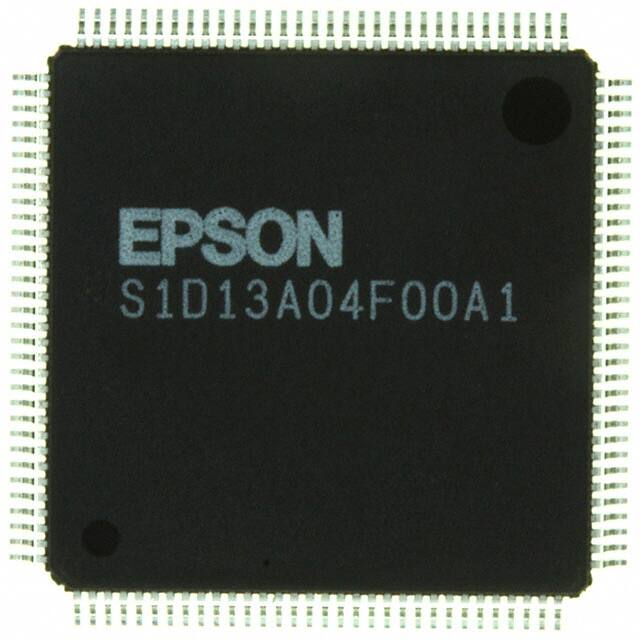
S1C17W22/23
16-bit Single Chip Microcontroller
z Low power operation from 1.2V with a single alkaline or silver
oxide button battery.
z Low power consumption standby driving at HALT 0.3 μA .
*super economy mode
z Built-in LCD Driver: 56 SEG x 24 COM (max.)
z Internal R/F converters enable to realize various sensing.
■ DESCRIPTIONS
The S1C17W22/W23 is a 16-bit MCU that features low-voltage operation from 1.2 V even though Flash memory
is included. The embedded high-efficiency DC-DC converter generates the constant-voltage to drive the IC with
lower power consumption than 4-bit MCUs. This IC includes a real-time clock, a stopwatch, an LCD driver, and
a PWM timer capable of being used to generate drive waveforms for a motor driver as well as a
high-performance 16-bit CPU. It is suitable for battery-driven applications that require an LCD display and
timers.
■ FEATURES
Model
CPU
CPU core
Other
Embedded Flash memory
Capacity
Erase/program count
Other
Embedded RAM
Capacity
Embedded display RAM
Capacity
Clock generator (CLG)
System clock source
System clock frequency
(operating frequency)
IOSC oscillator circuit
(boot clock source)
OSC1 oscillator circuit
OSC3 oscillator circuit
EXOSC clock input
Other
I/O port (PPORT)
Number of
general-purpose I/O
ports
Number of input
interrupt ports
Number of ports that
support
universal port
multiplexer (UPMUX)
Timers
Watchdog timer (WDT)
Real-time clock (RTCA)
S1C17W22
S1C17W23
Seiko Epson original 16-bit RISC CPU core S1C17
On-chip debugger
64K bytes (for both instructions and data)
96K bytes (for both instructions and
data)
50 times (min.) * Programming by the debugging tool ICDmini
Security function to protect from reading/programming by ICDmini
On-board programming function using ICDmini
4K bytes
8K bytes
576 bytes
4 sources (IOSC/OSC1/OSC3/EXOSC)
1.1 MHz (max.) VDD = 1.2 to 1.6 V
4.2 MHz (max.) VDD = 1.6 to 3.6 V
700 kHz (typ.) embedded oscillator
23 μs (max.) starting time (time from cancelation of SLEEP state to vector table
read by the CPU)
32.768 kHz (typ.) crystal oscillator
Oscillation stop detection circuit included
4.2 MHz (max.) crystal/ceramic oscillator
500 kHz, 1, 2, and 4 MHz-switchable embedded oscillator
500 Hz to 2 MHz CR oscillator (an external R is required)
4.2 MHz (max.) square or sine wave input
Configurable system clock division ratio
Configurable system clock used at wake up from SLEEP state
Operating clock frequency for the CPU and all peripheral circuits is selectable.
Input/output port: 41 bits (max.)
Output port: 1 bit (max.)
Pins are shared with the peripheral I/O.
37 bits
32 bits
A peripheral circuit I/O function selected via software can be assigned to each port.
Generates NMI or watchdog timer reset.
128–1 Hz counter, second/minute/hour/day/day of the week/month/year counters
Theoretical regulation function for 1-second correction
�S1C17W22/23
16-bit timer (T16)
Alarm and stopwatch functions
2 channels
1 channel can generate the SPIA master
clock.
16-bit PWM timer
(T16B)
4 channels
Generates the SPIA master clocks
and
the ADC12A trigger signal.
3 channels
2 channels
Event counter/capture function
PWM waveform generation function
Number of PWM output or capture input ports: 2 ports/channel
Supply voltage detector (SVD)
Detection level
30 levels (1.2 to 3.6 V)
Other
Intermittent operation mode
Generates an interrupt or reset according to the detection level evaluation.
Serial interfaces
UART (UART)
1 channel
2 channels
Baud-rate generator included, IrDA1.0 supported
Synchronous Serial
1 channel
2 channels
Interface
2 to 16-bit variable data length
(SPIA)
The 16-bit timer (T16) can be used for the baud-rate generator in master mode.
I2C (I2C)
1 channel
Baud-rate generator included
Sound generator (SNDA)
Buzzer output function
512 Hz to 16 kHz output frequencies
One-shot output function
Melody generation
Pitch: 128 Hz to 16 kHz ≈ C3 to C6
function
Duration: 7 notes/rests (Half note/rest to thirty-second note/rest)
Tempo: 16 tempos (30 to 480)
Tie may be specified.
IR remote controller (REMC)
Number of transmitter
–
1 channel
channels
LCD driver (LCD24A)
LCD output
72 SEG × 1–8 COM (max.), 64 SEG × 9–16 COM (max.), 56 SEG × 17–24 COM
(max.)
LCD contrast
32 levels (TBD to TBD V)
Other
1/4 or 1/3 bias power supply included, external voltage can be applied.
R/F converter (RFC)
Conversion method
CR oscillation type with 24-bit counters
Number of conversion
2 channels (Up to two sensors can be connected to each channel.)
channels
Supported sensors
DC-bias resistive sensors, AC-bias resistive sensors (Ch.0 only)
12-bit A/D converter (ADC12A)
Conversion method
–
Successive approximation type
Resolution
–
12 bits
Number of conversion
–
1 channel
channels
Number of analog signal –
6 ports/channel
inputs
Operational amplifier/comparator (OPCMP)
Number of channels
–
2 channels
Multiplier/divider (COPRO2)
Arithmetic functions
16-bit × 16-bit multiplier
16-bit × 16-bit + 32-bit multiply and accumulation unit
32-bit ÷ 32-bit divider
Reset
#RESET pin
Reset when the reset pin is set to low.
Power-on reset
Reset at power on.
Key entry reset
Reset when the P00 to P01/P02/P03 keys are pressed simultaneously (can be
enabled/
disabled using a register).
Watchdog timer reset
Reset when the watchdog timer overflows (can be enabled/disabled using a
register).
Supply voltage detector Reset when the supply voltage detector detects the set voltage level (can be
reset
enabled/
disabled using a register).
Interrupt
2
Seiko Epson Corporation
�S1C17W22/23
Non-maskable interrupt
Programmable interrupt
Power supply voltage
VDD operating voltage
VDD operating voltage
for Flash programming
VDD operating voltage
for super economy
mode
Operating temperature
Operating temperature
range
Current consumption
SLEEP mode
HALT mode
RUN mode
Shipping form
1
2
4 systems (Reset, address misaligned interrupt, debug, NMI)
External interrupt: 1 system (8 levels)
Internal interrupt: 16 systems (8 levels)
Internal interrupt: 23 systems (8
levels)
1.2 to 3.6 V
1.8 to 3.6 V (VPP = 7.5 V external power supply is required.)
2.7 to 3.6 V
-40 to 85 °C
0.15 μA (TBD)
IOSC = OFF, OSC1 = OFF, OSC3 = OFF
0.5 μA (TBD)
OSC1 = 32 kHz, RTC = ON
0.3 μA (TBD)
OSC1 = 32 kHz, RTC = ON, super economy mode
1.5 μA (TBD)
OSC1 = 32 kHz, RTC = ON, CPU = OSC1, LCD = ON (no panel load, VC2
reference,
1/3 bias), super economy mode
8 μA (TBD)
OSC1 = 32 kHz, RTC = ON, CPU = OSC1, FLASHCWAIT.RDWAIT[1:0] bits = 0x1
4 μA (TBD)
OSC1 = 32 kHz, RTC = ON, CPU = OSC1, super economy mode,
FLASHCWAIT.RDWAIT[1:0] bits = 0x1
250 μA (TBD)
OSC3 = 1 MHz (internal oscillator), OSC1 = 32 kHz, RTC = ON, CPU = OSC3,
FLASHCWAIT.RDWAIT[1:0] bits = 0x1
TQFP15-128pin (Lead pitch: 0.4 mm)
Die form (Pad pitch: 80 μm (min.))
Seiko Epson Corporation
3
�S1C17W22/23
■ BLOCK DIAGRAM
S1C17W22
DCLK
DSIO
DST2
Coprocessor bus
Multiplier/divider
(COPRO2)
32-bit RAM bus
Internal RAM
4K bytes
Instruction bus
Flash memory
64K bytes
CPU core & debugger
(S1C17)
System clock
VPP
Interrupt request
16-bit internal bus
Interrupt signal
FOUT
Clock generator
(CLG)
IOSC
oscillator
OSC1
OSC2
VOSC
OSC1
oscillator
OSC3
OSC4
OSC3
oscillator
Interrupt
Controller
(ITC)
I/O port
(PPORT)
P00-07, P10-17,
P20-27, P30-37,
P40-44, PD0-D1,
PD3-D4
UART
(UART)
USIN0
USOUT0
Synchronous
serial interface
(SPIA)
SDI0
SDO0
SPICLK0
#SPISS0
PD2
EXOSC
EXOSC
Input circuit
2
IC
(I2C)
Watchdog timer
(WDT)
Real-time clock
(RTCA)
#RESET
VDD
VSS
VD1
VD2
CV1
CV2
System reset controller
(SRC)
Power-on reset
(POR)
Supply voltage
detector
(SVD)
RTC1S
EXSVD
16-bit timer
(T16)
2 Ch.
Power generator
(PWG2)
16-bit PWM timer
(T16B)
2 Ch.
R/F converter
(RFC)
2 Ch.
LCD driver
(LCD24A)
RFIN0-1
REF0-1
SENA0-1
SENB0-1
RFCLKO0-1
VC1-4
CP1-4
COM0-23
SEG0-71
LFRO
Display RAM
576 bytes
TOUT00-01, 10-11
CAP00-01, 10-11
EXCL00-01, 10-11
Sound generator
(SNDA)
IR remote
Controller
(REMC)
1 Ch.
4
SDA0
SCL0
Seiko Epson Corporation
BZOUT
#BZOUT
REMO
�S1C17W22/23
S1C17W23
Seiko Epson Corporation
5
�S1C17W22/23
■ Pin Configuration Diagram
CHIP (S1C17W22)
6
Seiko Epson Corporation
�S1C17W22/23
CHIP (S1C17W23)
Port function
or signal
assignment
Pad
name
Seiko Epson Corporation
7
�S1C17W22/23
TQFP15-128pin (S1C17W22)
Port function
or signal
assignment
8
Pad
name
Seiko Epson Corporation
�S1C17W22/23
TQFP15-128pin (S1C17W23)
Port function
or signal
assignment
Pad
name
Seiko Epson Corporation
9
�S1C17W22/23
■ Pin Descriptions
Symbol meanings
Assigned signal:
The signal listed at the top of each pin is assigned in the initial state. The pin function must
be switched via software to assign another signal (see the “I/O Ports” chapter).
I/O:
I
= Input
O
= Output
I/O
= Input/output
P
= Power supply
A
= Analog signal
Hi-Z
= High impedance state
Initial state:
I (Pull-up)
= Input with pulled up
I (Pull-down)
= Input with pulled down
Hi-Z
= High impedance state
O (H)
= High level output
O (L)
= Low level output
Tolerant fail-safe structure:
✓
= Over voltage tolerant fail-safe type I/O cell included
(see the “I/O Ports” chapter)
Pin/pad
name
VDD
VSS
VPP
VD1
VD2
CV1–2
VC1–4
CP1–4
VOSC
OSC1
OSC2
#RESET
P00
P01
P02
P03
P04
P05
P06
P07
P10
10
Assigned
signal
VDD
VSS
VPP
VD1
VD2
CV1–2
VC1–4
CP1–4
VOSC
OSC1
OSC2
#RESET
P00
UPMUX
SENB0
P01
UPMUX
SENA0
P02
UPMUX
REF0
P03
UPMUX
RFIN0
P04
RTC1S
UPMUX
P05
UPMUX
ADIN05
I/O
P
P
P
A
A
A
P
A
A
A
A
I
I/O
I/O
A
I/O
I/O
A
I/O
I/O
A
I/O
I/O
A
I/O
O
I/O
I/O
I/O
A
P06
UPMUX
ADIN04
I/O
I/O
A
OPIN0P
A
P07
UPMUX
ADIN03
I/O
I/O
A
OPIN0N
A
P10
UPMUX
ADIN02
I/O
I/O
A
OPOUT0
A
Initial
state
–
–
–
–
–
–
–
–
–
–
–
I (Pull-up)
Hi-Z
Tolerant fail-safe
structure
–
–
–
–
–
–
–
–
–
–
–
–
–
Hi-Z
–
Hi-Z
–
Hi-Z
–
Hi-Z
✓
Hi-Z
–
Hi-Z
–
Hi-Z
–
Hi-Z
–
Function
Power supply (+)
GND
Power supply for Flash programming
DC-DC converter output
DC-DC converter stabilization capacitor connect pin
DC-DC converter charge pump capacitor connect pins
LCD panel driver power supply
LCD power supply booster capacitor connect pins
OSC1 oscillator circuit voltage regulator output
OSC1 oscillator circuit input
OSC1 oscillator circuit output
Reset input
I/O port
User-selected I/O (universal port multiplexer)
R/F converter Ch.0 sensor B oscillator pin
I/O port
User-selected I/O (universal port multiplexer)
R/F converter Ch.0 sensor A oscillator pin
I/O port
User-selected I/O (universal port multiplexer)
R/F converter Ch.0 reference oscillator pin
I/O port
User-selected I/O (universal port multiplexer)
R/F converter Ch.0 oscillation input
I/O port
Real-time clock 1-second cycle pulse output
User-selected I/O (universal port multiplexer)
I/O port
User-selected I/O (universal port multiplexer)
12-bit A/D converter Ch.0 analog signal input 5
(S1C17W23 only)
I/O port
User-selected I/O (universal port multiplexer)
12-bit A/D converter Ch.0 analog signal input 4
(S1C17W23 only)
Operational amplifier/comparator Ch.0 analog signal input (+)
(S1C17W23 only)
I/O port
User-selected I/O (universal port multiplexer)
12-bit A/D converter Ch.0 analog signal input 3
(S1C17W23 only)
Operational amplifier/comparator Ch.0 analog signal input (-)
(S1C17W23 only)
I/O port
User-selected I/O (universal port multiplexer)
12-bit A/D converter Ch.0 analog signal input 2
(S1C17W23 only)
Operational amplifier/comparator Ch.0 analog signal output
Seiko Epson Corporation
�S1C17W22/23
P11
P11
UPMUX
ADIN01
OPIOUT1
P12
P13
P14
P15
P16
P17
P20
P21
P22
P23
P24
P25
P26
P27
P30
P31
I/O
I/O
A
Hi-Z
–
Hi-Z
–
Hi-Z
–
Hi-Z
–
Hi-Z
✓
Hi-Z
–
Hi-Z
✓
Hi-Z
✓
Hi-Z
✓
Hi-Z
✓
Hi-Z
✓
Hi-Z
✓
Hi-Z
✓
Hi-Z
✓
Hi-Z
✓
Hi-Z
✓
Hi-Z
✓
A
P12
UPMUX
ADIN00
I/O
I/O
A
OPIN1N
A
P13
#BZOUT
UPMUX
VREFA0
I/O
O
I/O
A
OPIN1P
A
P14
BZOUT
UPMUX
P15
FOUT
UPMUX
P16
REMO
UPMUX
EXSVD
P17
UPMUX
RFIN1
P20
UPMUX
REF1
P21
UPMUX
SENA1
P22
UPMUX
SENB1
P23
UPMUX
SEG71
COM8/COM0
P24
UPMUX
SEG70
COM9/COM1
P25
#ADTRG0
UPMUX
SEG69
COM10/COM2
P26
EXCL10
UPMUX
SEG68
COM11/COM3
P27
EXCL11
UPMUX
SEG67
COM12/COM4
P30
EXCL20
I/O
O
I/O
I/O
O
I/O
I/O
O
I/O
A
I/O
I/O
A
I/O
I/O
A
I/O
I/O
A
I/O
I/O
A
I/O
I/O
A
A
I/O
I/O
A
A
I/O
I
I/O
A
A
I/O
I
I/O
A
A
I/O
I
I/O
A
A
I/O
I
UPMUX
SEG66
COM13/COM5
P31
I/O
A
A
I/O
(S1C17W23 only)
I/O port
User-selected I/O (universal port multiplexer)
12-bit A/D converter Ch.0 analog signal input 1
(S1C17W23 only)
Operational amplifier/comparator Ch.1 analog signal output
(S1C17W23 only)
I/O port
User-selected I/O (universal port multiplexer)
12-bit A/D converter Ch.0 analog signal input 0
(S1C17W23 only)
Operational amplifier/comparator Ch.1 analog signal input (-)
(S1C17W23 only)
I/O port
Sound generator inverted output
User-selected I/O (universal port multiplexer)
12-bit A/D converter Ch.0 reference voltage input
(S1C17W23 only)
Operational amplifier/comparator Ch.1 analog signal input (+)
(S1C17W23 only)
I/O port
Sound generator output
User-selected I/O (universal port multiplexer)
I/O port
Clock external output
User-selected I/O (universal port multiplexer)
I/O port
IR remote controller transmit data output
User-selected I/O (universal port multiplexer)
External power supply voltage detection input
I/O port
User-selected I/O (universal port multiplexer)
R/F converter Ch.1 oscillation input
I/O port
User-selected I/O (universal port multiplexer)
R/F converter Ch.1 reference oscillator pin
I/O port
User-selected I/O (universal port multiplexer)
R/F converter Ch.1 sensor A oscillator pin
I/O port
User-selected I/O (universal port multiplexer)
R/F converter Ch.1 sensor B oscillator pin
I/O port
User-selected I/O (universal port multiplexer)
LCD segment output
LCD COMMON OUTPUT
I/O port
User-selected I/O (universal port multiplexer)
LCD segment output
LCD COMMON OUTPUT
I/O port
12-bit A/D converter Ch.0 trigger input (S1C17W23 only)
User-selected I/O (universal port multiplexer)
LCD segment output
LCD COMMON OUTPUT
I/O port
16-bit PWM timer Ch.1 event counter input 0
User-selected I/O (universal port multiplexer)
LCD segment output
LCD COMMON OUTPUT
I/O port
16-bit PWM timer Ch.1 event counter input 1
User-selected I/O (universal port multiplexer)
LCD segment output
LCD COMMON OUTPUT
I/O port
16-bit PWM timer Ch.2 event counter input 0 (S1C17W23
only)
User-selected I/O (universal port multiplexer)
LCD segment output
LCD COMMON OUTPUT
I/O port
Seiko Epson Corporation
11
�S1C17W22/23
EXCL21
P32
P33
P34
P35
P36
P37
P40
P41
P42
P43
P44
PD0
PD1
PD2
PD3
PD4
COM0–7
SEG0–53
Notes:
12
UPMUX
SEG65
COM14/COM6
P32
UPMUX
SEG64
COM15/COM7
P33
UPMUX
SEG63
COM16/COM8
P34
UPMUX
SEG62
COM17/COM9
P35
UPMUX
SEG61
COM18/COM10
P36
UPMUX
SEG60
COM19/COM11
P37
UPMUX
SEG59
COM20/COM12
P40
RFCLKO0
SEG58
COM21/COM13
P41
RFCLKO1
SEG57
COM22/COM14
P42
LFRO
SEG56
COM23/COM15
P43
EXCL00
SEG55
P44
EXCL01
SEG54
DST2
PD0
DSIO
PD1
DCLK
PD2
PD3
EXOSC
EXCL00
OSC3
PD4
EXCL01
OSC4
COM0–7
SEG0–53
I
I/O
A
A
I/O
I/O
A
A
I/O
I/O
A
A
I/O
I/O
A
A
I/O
I/O
A
A
I/O
I/O
A
A
I/O
I/O
A
A
I/O
O
A
A
I/O
O
A
A
I/O
O
A
A
I/O
I
A
I/O
I
A
O
I/O
I/O
I/O
O
O
I/O
I
I
A
I/O
I
A
A
A
Hi-Z
✓
Hi-Z
✓
Hi-Z
✓
Hi-Z
✓
Hi-Z
✓
Hi-Z
✓
Hi-Z
✓
Hi-Z
✓
Hi-Z
✓
Hi-Z
✓
Hi-Z
✓
O (L)
✓
I (Pull-up)
✓
O (H)
✓
Hi-Z
–
Hi-Z
–
Hi-Z
Hi-Z
–
–
16-bit PWM timer Ch.2 event counter input 1 (S1C17W23
only)
User-selected I/O (universal port multiplexer)
LCD segment output
LCD COMMON OUTPUT
I/O port
User-selected I/O (universal port multiplexer)
LCD segment output
LCD COMMON OUTPUT
I/O port
User-selected I/O (universal port multiplexer)
LCD segment output
LCD COMMON OUTPUT
I/O port
User-selected I/O (universal port multiplexer)
LCD segment output
LCD COMMON OUTPUT
I/O port
User-selected I/O (universal port multiplexer)
LCD SEGMENT OUTPUT
LCD COMMON OUTPUT
I/O port
User-selected I/O (universal port multiplexer)
LCD SEGMENT OUTPUT
LCD COMMON OUTPUT
I/O port
User-selected I/O (universal port multiplexer)
LCD SEGMENT OUTPUT
LCD COMMON OUTPUT
I/O port
R/F converter Ch.0 clock monitor output
LCD SEGMENT OUTPUT
LCD COMMON OUTPUT
I/O port
R/F converter Ch.1 clock monitor output
LCD SEGMENT OUTPUT
LCD COMMON OUTPUT
I/O port
LCD frame signal monitor output
LCD SEGMENT OUTPUT
LCD COMMON OUTPUT
I/O port
16-bit PWM timer Ch.0 event counter input 0
LCD SEGMENT OUTPUT
I/O port
16-bit PWM timer Ch.0 event counter input 1
LCD SEGMENT OUTPUT
On-chip debugger status output
I/O port
On-chip debugger status output
I/O port
On-chip debugger status output
I/O port
I/O port
Clock generator external clock input
16-bit PWM timer Ch.0 event counter input 0
OSC3 oscillator circuit input
I/O port
16-bit PWM timer Ch.0 event counter input 1
OSC3 oscillator circuit output
LCD COMMON OUTPUT
LCD SEGMENT OUTPUT
• In the peripheral circuit descriptions, the assigned signal name is used as the pin name.
• Both the S1C17W23 A/D converter and operational amplifier/comparator pins are assigned to the same pin
function.
Seiko Epson Corporation
�S1C17W22/23
Universal port multiplexer (UPMUX)
The universal port multiplexer (UPMUX) allows software to select the peripheral circuit input/output function to be assigned to
each pin from those listed below.
Peripheral circuit
Synchronous serial
interface
(SPIA)
I2C
(I2C)
UART
(UART)
16-bit PWM timer
(T16B)
Signal to be assigned
SDIn
SDOn
SPICLKn
#SPISSn
SCLn
SDAn
USINn
USOUTn
TOUTn0/CAPn0
TOUTn1/CAPn1
I/O
I
O
I/O
I
I/O
I/O
I
O
I/O
I/O
Channel number n
S1C17W22: n = 0
S1C17W23: n = 0, 1
S1C17W22: n = 0
S1C17W23: n = 0
S1C17W22: n = 0
S1C17W23: n = 0, 1
S1C17W22: n = 0, 1
S1C17W23: n = 0, 1, 2
Function
SPIA Ch.n data input
SPIA Ch.n data output
SPIA Ch.n clock input/output
SPIA Ch.n slave-select input
I2C Ch.n clock input/output
I2C Ch.n data input/output
UART Ch.n data input
UART Ch.n data output
T16B Ch.n PWM output/capture input 0
T16B Ch.n PWM output/capture input 1
Note: Do not assign a function to two or more pins simultaneously.
NOTICE:
No part of this material may be reproduced or duplicated in any form or by any means without the written permission of Seiko Epson. Seiko
Epson reserves the right to make changes to this material without notice. Seiko Epson does not assume any liability of any kind arising out
of any inaccuracies contained in this material or due to its application or use in any product or circuit and, further, there is no representation
that this material is applicable to products requiring high level reliability, such as, medical products. Moreover, no license to any intellectual
property rights is granted by implication or otherwise, and there is no representation or warranty that anything made in accordance with this
material will be free from any patent or copyright infringement of a third party. When exporting the products or technology described in this
material, you should comply with the applicable export control laws and regulations and follow the procedures required by such laws and
regulations. You are requested not to use, to resell, to export and/or to otherwise dispose of the products (and any technical information
furnished, if any) for the development and/or manufacture of weapon of mass destruction or for other military purposes.
All brands or product names mentioned herein are trademarks and/or registered trademarks of their respective companies.
©Seiko Epson Corporation 2013, All rights reserved
EPSON semiconductor website
MICRODEVICES OPERATIONS DIVISION
IC Sales & Marketing Department
421-8 Hino, Hino-shi, Tokyo 191-8501, JAPAN
Phone: +81-42-587-5814 FAX: +81-42-587-5117
http://www.epson.jp/device/semicon_e/
Document code: 412533601
First issue Nov., 2012 in Japan
Revised Jun., 2013
Seiko Epson Corporation
13
�