AN2017-41
Evaluation board for CoolSiC™ Easy1B halfbridge modules
Evaluation of CoolSiC™ MOSFET modules in a bidirectional buck -boost
converter
About this document
Scope and purpose
SiC MOSFET-based modules are a revolutionary step towards highly efficient power electronic devices with a
benchmark in terms of power density. Switching frequencies exceeding 100 kHz as well as greater than 99%
power conversion efficiency are simple to implement using Infineon EasyPACK™ modules with CoolSiC™
trench-MOSFET devices.
The purpose of this board is to enable the evaluation of the FF11MR12W1M1_B11 and FF23MR12W1M1_B11
CoolSiC™ MOSFET modules. The evaluation board allows users to evaluate the device performance via doublepulse measurements and functional tests as bidirectional buck-boost converter. The board is designed on a
bidirectional buck-boost converter topology.
The properties of this board are described in the design features chapter of this document. The remaining
sections provide information to enable designers to copy, modify and qualify the design for production,
according to the customer specific requirements.
Environmental regulations have been considered in the design of the EVAL-PS-E1BF12-SiC board. Components
qualified for a lead-free, reflow soldering process have been selected. The design has been tested as described
in this document, but not qualified regarding manufacturing and operation over the whole operating
temperature range or lifetime.
Note: The evaluation boards provided by Infineon are only designed for functional testing, and are available in
small quantities.
In view of their function, evaluation boards are not subject to the same procedures in the context of Returned
Material Analysis (RMA), Process Change Notification (PCN) and Product Discontinuation (PD) as other
products.
Read the legal disclaimer and warnings for further restrictions on Infineon’s warranty and liability.
Warnings
Caution: The described evaluation board is dedicated for a laboratory environment only.
It operates at high voltages. This board must be operated by qualified and skilled
personnel familiar with all applicable safety standards.
Intended audience
This document is intended for engineers who design power converters on the basis of Infineon CoolSiC™
modules used in their applications.
Application Note AN 2017-41 Please read the Important Notice and Warnings at the end of this document
www.infineon.com
page 1 of 27
Revision No 2.0
2019-10-16
�Evaluation Board for CoolSiC™ Easy1B half -bridge modules
Introduction
Table of contents
Table of contents ............................................................................................................................ 2
1
1.1
1.2
1.3
Introduction .......................................................................................................................... 3
Design features ........................................................................................................................................ 3
Key data ................................................................................................................................................... 5
Pin assignments ...................................................................................................................................... 5
2
2.1
2.2
2.3
Functional blocks ................................................................................................................... 7
Power stage ............................................................................................................................................. 7
Driver power supply stage ...................................................................................................................... 7
Driver stage: ............................................................................................................................................. 8
3
3.1
3.2
3.3
Characterization ................................................................................................................... 10
Test setup and current measurement .................................................................................................. 10
Test results ............................................................................................................................................ 11
Current sharing...................................................................................................................................... 12
4
4.1
4.2
Schematic, layout and bill of material ..................................................................................... 14
Layout .................................................................................................................................................... 14
Bill of material ....................................................................................................................................... 16
5
Conclusion ........................................................................................................................... 23
6
How to order ........................................................................................................................ 24
7
Reference ............................................................................................................................. 25
8
Revision history .................................................................................................................... 26
AN 2017-41
2 of 27
Revision No 2.0
2019-10-16
�Evaluation Board for CoolSiC™ Easy1B half -bridge modules
Introduction
1
Introduction
1.1
Design features
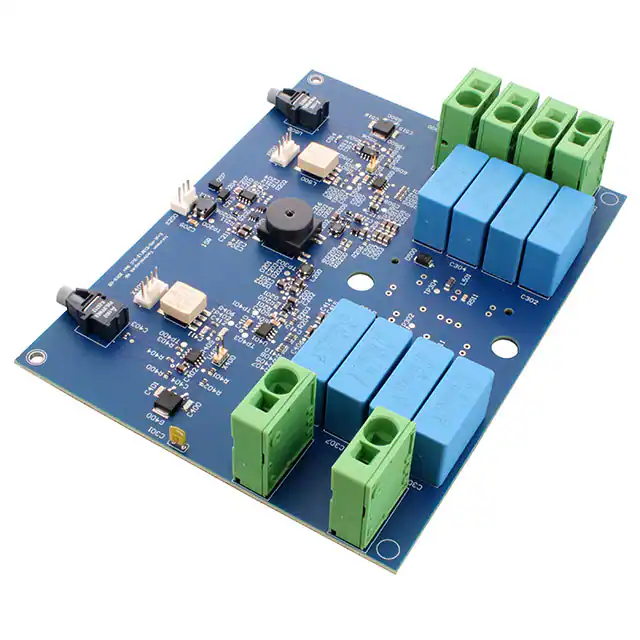
The EVAL-PS-E1BF12-SiC evaluation board has been designed as a bidirectional buck-boost converter. It
enables users to make basic electrical tests such as double-pulse measurements as well as functional testing in
buck and/or boost operation. Figure 1 shows a picture of the physical appearance of the board which has a
dimension of 133 mm x 175 mm.
Figure 1
Evaluation board EVAL-PS-E1BF12-SiC
This section provides an overview of the evaluation board, and includes the description of its main features,
key data, pin assignments and mechanical dimensions.
Figure 2 shows the circuit topology used in the described evaluation board in conventional buck-boost
converter mode. The board is provided with the option of using an Easy 1B device in half-bridge configuration,
and includes drivers for the top and bottom device of the power module, and high-frequency decoupling
capacitors. It also has the option of providing an external gate driver signal via electrical signals or optical
fibers. Any other components necessary for converter systems such as inductors, bulk capacitors and necessary
protection circuits need to be added externally if required in the application.
AN 2017-41
3 of 27
Revision No 2.0
2019-10-16
�Evaluation Board for CoolSiC™ Easy1B half -bridge modules
Introduction
Figure 2
Bidirectional buck-boost converter using a CoolSiC™ MOSFET half bridge
The main function of this board is the evaluation of the FF11MR12W1M1_B11 and the FF23MR12W1M1_B11 in
combination with the EiceDRIVER™ 1EDI60IH12AH driver.
1. A bidirectional buck-boost converter is a useful converter in today’s power electronics’ world. As an
example, transformer-less chargers use it to charge and discharge high-voltage batteries. Another
application for the boost mode is the maximum power point tracker (MPPtracker) for PV applications
achieving high efficiency by synchronous rectification. In the boost operation mode, S1 is the active switch,
while S2 is operated as the diode. The buck operation works with S2 as the active switch and S1 as the
diode.
2. The evaluation board is electrically and mechanically suitable for the FF11MR12W1M1_B11 and the
FF23MR12W1M1_B11 CoolSiC™ MOSFET modules. The initial configuration of the board is equipped with the
required components to do:
Double-pulse characterization
Functional testing of the buck-boost operation using electrical loads at the input or output stage
AN 2017-41
4 of 27
Revision No 2.0
2019-10-16
�Evaluation Board for CoolSiC™ Easy1B half -bridge modules
Introduction
1.2
Key data
General key data and characteristic values are given in Table 1. These are typical values, measured at an
ambient temperature of Tamb = 25°C.
Table 1
Electrical parameters
Parameter
Description DC-link
Value
Unit
VDC
Maximal input DC-link voltage
900
V
IOut
Maximal output current
25
A
CDC
DC-link capacitance at the board delivery (input and output)
8
µF
Top
Operation temperature (design target)
-40…+85
°C
Tstg
Store temperature (design target)
-40…+85
°C
Parameter
Description driver and SMPS
Value
VCC
Driver input voltage
VGS
Drive voltages at the SiC MOSFET switches
IG
Maximum and minimum gate driver current for each driver
channel
1.3
Unit
15
V
-3/18
V
6
A
Pin assignments
The evaluation board allows an optical or electrical pulsing of the two SiC MOSFET switches. The connector
names are highlighted in Figure 3. The pin numbering is from left to right for the gate signals.
X401
X200
X500
Figure 3
Connectors of the evaluation board’s driver circuit
The board is powered by the connector X3 as listed in the Table 2.
Table 2
Pin assignment of the connector X200 to power the internal DC/DC converter
Pin name
Pin
X200_1
+15 V
X200_2
No Connection
X200_3
GND
AN 2017-41
5 of 27
Revision No 2.0
2019-10-16
�Evaluation Board for CoolSiC™ Easy1B half -bridge modules
Introduction
X401 and X500 pin assignment
Each SiC MOSFET switch has a separate driver circuitry. The interfaces for external signal measurement are
offered by X401 and X500 as listed in Table 3 and Table 4.
Table 3
Pin assignment of connector X401 for the driving of upper device (S2)
Pin name
Pin
X401_1
+5 V
X401_2
GND
X401_3
PWM signal
X401_4
GND
Table 4
Pin assignment of connector X500 for the driving of lower device (S1)
Pin name
Pin
X500_1
+5 V
X500_2
GND
X500_3
PWM signal
X500_4
GND
The optical pulsing of the top device is possible via U402, while the bottom device is pulsed using U502.
Additionally, the corresponding jumpers X400 (for U402) and X501 (for U502) have to be activated.
The inductor of the bidirectional buck-boost converter is connected between the connectors X304 and X305 of
the board. The respective DC-source and load connections depend on whether the board is used as buck or
boost converter.
AN 2017-41
6 of 27
Revision No 2.0
2019-10-16
�Evaluation Board for CoolSiC™ Easy1B half -bridge modules
Functional blocks
2
Functional blocks
2.1
Power stage
The purpose of the EVAL-PS-E1BF12-SiC board is to evaluate the CoolSiC™ MOSFET half-bridge modules in the
Easy1B package. The functional schematics of the board are shown in Figure 4. Electrical or optical pulses are
translated in the evaluation board to signals for the 1EDI60IH12AF driver. Each driver controls one of the SiC
MOSFET switches within the FF11MR12W1M1_B11 or FF23MR12W1M1_B11 modules. The driving voltages are -3
V/18 V.
Figure 4
2.2
Functional schematic of the evaluation board
Driver power supply stage
The evaluation board is equipped with the isolated power supply required for driving the gate of the power
devices. The power supply has been implemented by a half-bridge DC-bus converter. It is controlled on the
primary side by AUIR2085S based self-oscillating, half-bridge driver. The schematic is shown below in Figure 5.
The isolated secondary side has been equipped with a regulated adjustable linear regulator, which has been
adjusted for -3 V to supply negative voltage to the gate for this board. The negative gate voltage level can be
adjusted according to the application note AN2018-09 (Guidelines for CoolSiC™ MOSFET gate-drive voltage
window) depending on the device and operating conditions.
AN 2017-41
7 of 27
Revision No 2.0
2019-10-16
�Evaluation Board for CoolSiC™ Easy1B half -bridge modules
Functional blocks
Figure 5
Gate driver power supply of lower-side device
2.3
Driver stage:
The driver stage for upper and lower device has been implemented in the board and below section.
The driver stage for the lower side device can be seen in figure 6. The upper part of the picture shows the
optical driver input. U502 converts the optical signal into an electrical signal, the driver stage TC4426EOA
transforms the electrical signals to an input voltage for EiceDRIVER™ Compact 1EDI60I12AF.
An optional 15 V/+5 V linear regular circuit has been implemented which can be configured for supplying 5 V for
various combinations of optical and electrical input voltages. This will ensure a proper supply voltage to U502
connector (HFBR-2521Z), U501 (TC4426EOA) and U500 (1EDI60I12AF) control power supply. The table below
shows the options available on the board to reconfigure it for different types of optical input and electrical
voltages.
Table 1 Configuration for external 15 V supply for optical and electrical control input
Component
Status
X400, X501
Shorted for optical input gate drive signal/Open for electrical
control input gate drive signal
R400, R402 , R509, R510 Open
Electrical 5 V input at connector U502, U402 avaialble
R509, R510, R400, R402 Open
Electrical 5 V input at connector X500, X401 available
R401 and R508 Open
Electrical 15 V input at connector X500, X401 available
AN 2017-41
8 of 27
Revision No 2.0
2019-10-16
�Evaluation Board for CoolSiC™ Easy1B half -bridge modules
Functional blocks
The analog electrical driver input is illustrated on the bottom left of Figure 6. The electrical input is fed via a
common mode choke (L400, L500) to the driver stage for better immunity from noise.
The driver output is shown in the bottom right section of Figure 6. The driver voltages of -3 V/18 V are
decoupled from the ground by capacitors. The turn-on and turn-off resistance of the EiceDRIVER™ output is
realized by a parallel connection of two SMD resistors.
Special mention should be made here of the issue of false gate turn-on, a phenomenon in a half-bridge SiC
configuration that is due to ringing in the Vgs of the MOSFET. The higher switching speed and parasitic
capacitance plays a major role in this phenomenon. Layout considerations have been made for reducing stray
inductances, and provisions made in the gate drive circuitary for adjusting the dv/dt which helps to reduce the
ringing of the circuit.
Figure 6
AN 2017-41
Schematic details of the input stage for a single MOSFET driver section
9 of 27
Revision No 2.0
2019-10-16
�Evaluation Board for CoolSiC™ Easy1B half -bridge modules
Characterization
3
Characterization
3.1
Test setup and current measurement
Figure 7 captures the test setup and voltage measurement techniques for double-pulse testing of lower
devices. The first turn-on pulse of the low-side device (S2) establishes the desired current value (e.g. nominal
data sheet current in this case) in the inductive load, and the turn-off pulse makes the current flow in the freewheeling diode (e.g. body diode of the top device S1 in this case). An external inductance value of 630 uH was
used in the actual test setup. The second turn-on pulse measures the low-side device turn-on characteristics,
which also include the reverse recovery of the free-wheeling diode.
Figure 7
Test setup and voltage measurement techniques
The source-current measurement of S1 and S2 is done with the help of copper rivet adapters (Part no. Stäubli
41.0051B1) and Rogowski current sensors as shown below in Figure 8. Be aware that the use of rivet adapters
leads to an increase in inductance in the main circuit as well as in the gate circuit.
Figure 8
AN 2017-41
Current measurement with the help copper rivets and a Rogowski coil
10 of 27
Revision No 2.0
2019-10-16
�Evaluation Board for CoolSiC™ Easy1B half -bridge modules
Characterization
All current measurements shown in this application note have been performed with thin clip-around Rogowski
coils of 1.2 kV, having a 1.6 mm cross section. The bandwidth of the Regowski coil is 30 MHz with current ratings
of 300 A with di/dt capabilities of 20 kA/uS.
3.2
Test results
This chapter presents some examples of extracted waveforms of the module FF11MR12W1M1_B11 Easy1B,
which has been characterized with the help of the evaluation board.
One key aspect in designing half-bridge topologies with SiC MOSFET devices is to assess the risk of a parasitic
turn-on of the upper device during switching of the lower device, and vice versa. This effect may be caused by a
high dv/dt of a SiC MOSFET, which can exceed 50 kV/µs for a CoolSiC™ MOSFET.
To mitigate the situtation, two approaches have been considered here. As a first approach, asymmetric power
supplies such as +18 V/-3 V are used to drive the gate of the device. This creates a safe margin so that the
ringing voltage does not touch the gate threshold limit (Vth=4.5 V). In the case of unipolar switching (15V/0 V),
the dv/dt can be reduced by using larger gate resistance to mitigate the parasitic turn-on events. This is a
significant advantage of the simple gate controllability of CoolSiC™ MOSFET devices. For more details on this
topic, see the article referred to in [4].
As a second approach, an external capacitor (R511, R411 = 1.5 nF capacitance) is added between the gate and
the source for a better ratio between Cgs and Cgd. This lowers the impedance of the gate terminal and helps to
get rid of the ringing in the waveform although it sacrifices some switching speed. Figure 9 shows the turn-on
behavior of the lower-side device with gate resistor of 5 ohm (2 of 10 Ohm resistors are in parallel) and external
gate capacitances of 1.5 nF.
CH2: Vgs of the
LS device.
CH3: Vds of the
LS device,
CH4: Current
through the
device (x 5
A/V)
Figure 9
AN 2017-41
Turn-on of a FF11MR12W1M1_B11 device at 100 A and 600 V
11 of 27
Revision No 2.0
2019-10-16
�Evaluation Board for CoolSiC™ Easy1B half -bridge modules
Characterization
As shown, the switching waveform has less ringing, which improves the EMI performance and has been
optimized by taking advantage of low board inductance and the low inductive parasitics of the Easy1B module.
Figure 10 shows the turn-off behavior of the device under test at the same operation point with a equivalent
turn-off gate drive resistanec of 11 Ohm( 2 of 22 Ohm resistors are in parallel) . During turn-off, the overvoltage
peak of Vds has to be properly analyzed, as the di/dt of the FF11MR12W1_B11 is up to ten times higher than a
comparable IGBT current gain leading to a high overvoltage with respect to
𝑉𝐷𝐶 = 𝑉0 + 𝑑𝑖⁄𝑑𝑡 × 𝐿𝜎
The low stray inductances of the power module and the board lead to a low overvoltage below 100 V, which is
reasonable for a power electronic application using CoolSiC™ MOSFET modules.
CH2: Vgs of the
LS device.
CH3: Vds of the
LS device,
CH4: Current
through the
device (x 5
A/V)
Figure 10
3.3
Turn-off of a FF11MR12W1M1_B11 device at 100 A and 600 V
Current sharing
The use of fast switching devices requires a high level of symmetry in the module as well as in the PCB design.
This aspect has been taken into account during the design of the EVAL-PS-E1BF12-SiC board. Figure 11 shows
the connection of the DC-link to the board input and the module. As illustrated, the PCB layer design achieves a
high level of symmetry.
Figure 12 shows the results of this symmetrical design. The output current flows with nearly no current
mismatch between the two groups of output pins into the board. Consequently, this approach leads to a higher
level of power density, as the current mismatch does not create a bottleneck.
AN 2017-41
12 of 27
Revision No 2.0
2019-10-16
�Evaluation Board for CoolSiC™ Easy1B half -bridge modules
Characterization
Figure 11
PCB layer design of the input DC-link
Figure 12
Current sharing of the EVAL-PS-E1BF12-SiC board toward the inductor terminals
AN 2017-41
13 of 27
Revision No 2.0
2019-10-16
�Evaluation Board for CoolSiC™ Easy1B half -bridge modules
Schematic, layout and bill of material
4
Schematic, layout and bill of material
To meet the individual customer requirements and to ease the development or modification using the
evaluation driver board for the Easy module, all necessary technical data like schematic, layout and
components are included in this chapter.
4.1
Layout
The PCB is a four-layer board made of FR4 material. The layer stack of the board is shown below in the Figure
13. The layout is provided in the subsequent drawings.
Figure 13
PCB stack of the evaluation board
Layer 1:
AN 2017-41
14 of 27
Revision No 2.0
2019-10-16
�Evaluation Board for CoolSiC™ Easy1B half -bridge modules
Schematic, layout and bill of material
Layer 2:
Layer 3:
AN 2017-41
15 of 27
Revision No 2.0
2019-10-16
�Evaluation Board for CoolSiC™ Easy1B half -bridge modules
Schematic, layout and bill of material
Layer 4:
4.2
Bill of material
The tolerance recommendations for resistors should be less or equal to ±1 %, for the capacitors of the type
C0G, less or equal to ±5 %, and for capacitors of the type X7R, less or equal to ±10 %.
Quantity
Package
reference
Recommended
manufacturer
4.7 uF
Designator
C200, C201, C202, C203,
C206, C208, C210, C211,
C212, C214, C215, C216,
C404, C406, C407, C408,
C414, C415, C416, C501,
C502, C503, C509, C510,
C511, C512
26
1206 (X7R)
NO
100 pF
C204
1
0603 (C0G)
NO
100 pF
C205
1
0603 (C0G)
NO
1 uF
1
0603 (X7R)
NO
6
1206 (X7R)
NO
2
Radial Type
NO
8
wire leads 27.5 mm
pitch
NO
6
1206 (C0G)
NO
4
0603 (X7R)
NO
Type
Comment
Capacitor
Capacitor
Capacitor
Capacitor
Capacitor
Capacitor
100 nF
C207
C209, C213, C409, C410,
C506, C507
4.7 nF
C300, C301
Capacitor
2 uF
Capacitor
Capacitor
1 nF
C302, C303, C304, C305,
C306, C307, C308, C309
C400, C401, C412, C504,
C515, C516
100 nF
C402, C403, C513, C514
AN 2017-41
16 of 27
Revision No 2.0
2019-10-16
�Evaluation Board for CoolSiC™ Easy1B half -bridge modules
Schematic, layout and bill of material
Type
Comment
Designator
Quantity
Package
reference
Recommended
manufacturer
Capacitor
Capacitor
Capacitor
Resistor
Resistor
Resistor
Resistor
100 nF
C405, C413, C500, C508
4
0805 (X7R)
NO
10 nF
C411, C505
2
1206 (C0G)
NO
1.5 nF
R411, R511
2
0805
NO
470 R
R200, R210
2
0805
NO
Resistor
Resistor
Resistor
Resistor
Resistor
Resistor
Resistor
Resistor
Resistor
Resistor
Resistor
Magnetics
Magnetics
Magnetics
Magnetics
52.3 k
R201, R209
2
0805
NO
150 mR
R202
1
0805
NO
82 k
R203, R208
2
0805
NO
0R
R204, R206, R400, R401,
R402, R508, R509, R510
8
0805
NO
2.2 k
R205
1
0603
NO
15 R
R207, R211
2
0603
NO
68 k
1
0603
NO
68 k
R212
R300, R301, R302, R303,
R304, R305, R306, R307,
R308, R309, R310, R311
12
2010
NO
1.8 k
R403, R506
2
0603
NO
10 k
R404, R507
2
0603
NO
10 R
R405, R407, R503, R505
4
0805
NO
100 R
R406, R504
2
0603
NO
22 R
R408, R410, R501, R502
4
0805
NO
4.7 k
ACM4520-142-2PT000
R409, R500
2
0603
NO
L200, L202
2
SMD
TDK Corporation
ACM7060-301-2PLTL01
L201
1
7X6X3.5mm
TDK Corporation
B82792C2475N365
L400, L500
2
SMD
TDK Corporation
BLM41PG600SN1
L401, L501
2
4516 (1806)
muRata
Transformer, SMD;
2.54mm Pitch, 17mm
L x 16mm W x 12mm
H body
Vacuumschmelze
Diotec
DO-214AC
Semiconductor
ON
DO-214AA
Semiconductor
Texas
SOT23-5 (DBV)
Instruments
Magnetics
T60403-F5046-X100
TR200
1
Semiconductor
P4SMA440A
D204, D207
2
Semiconductor
ES2D
D400, D500
2
Semiconductor
TPS72301DBVTG4
G200, G201
2
Semiconductor
BAT165
D200, D201, D202, D203,
D205, D206, D208
7
SOD323
Semiconductor
IFX7805ABTF
G500,G400
1
PG-TO252-3-11
Semiconductor
BSL302SN
Q200, Q201
2
PG-TSOP-6
Semiconductor
AUIR2085S
U202
1
SOIC8-N
U300
1
AG-EASY1B-2
U401, U500
2
PG-DSO-8-51
Semiconductor FF11MR12W1M1_B11
1EDI60I12AF
Semiconductor
AN 2017-41
17 of 27
Infineon
Technologies
Infineon
Technologies
Infineon
Technologies
Infineon
Technologies
Infineon
Technologies
Infineon
Technologies
Revision No 2.0
2019-10-16
�Evaluation Board for CoolSiC™ Easy1B half -bridge modules
Schematic, layout and bill of material
Type
Comment
Designator
Quantity
Package
reference
Semiconductor
Semiconductor
TC4426EOA
U400, U501
2
SOIC
HFBR-2521Z
U402, U502
2
THT
Connector
22-23-2031
1
Connector
Connector
1735862
X200
X300, X301, X302, X303,
X304, X305
Broadcom
MOLEX
Incorporated
6
Phoenix Contact
HTSW-102-07-G-S
X400, X501
2
Connector
47053-1000
X401, X500
2
Samtec
MOLEX
Incorporated
AN 2017-41
18 of 27
Recommended
manufacturer
Microchip
Technology
Revision No 2.0
2019-10-16
�Evaluation Board for CoolSiC™ Easy1B half -bridge modules
Schematic, layout and bill of material
AN 2017-41
19 of 27
Revision No 2.0
2019-10-16
�Evaluation Board for CoolSiC™ Easy1B half -bridge modules
Schematic, layout and bill of material
AN 2017-41
20 of 27
Revision No 2.0
2019-10-16
�Evaluation Board for CoolSiC™ Easy1B half -bridge modules
Schematic, layout and bill of material
AN 2017-41
21 of 27
Revision No 2.0
2019-10-16
�Evaluation Board for CoolSiC™ Easy1B half -bridge modules
Schematic, layout and bill of material
AN 2017-41
22 of 27
Revision No 2.0
2019-10-16
�Evaluation Board for CoolSiC™ Easy1B half -bridge modules
Conclusion
5
Conclusion
The evaluation board EVAL-PS-E1BF12-SiC demonstrates the design of a symmetrical and low inductive board
to fully exploit the superior properties of CoolSiC™ MOSFET Easy power modules. The low board inductance
has been achieved by applying strip line concepts in the board design.
Furthermore, the PCB layout has been a main focus during the board development. The symmetric board
layout leads to a very low current mismatch, which allows the maximum achievable power density with
CoolSiC™ MOSFET modules.
The board allows for an extensive evaluation of the FF11MR12W1M1_B11 and FF23MR12W1M1_B11 properties.
In this application note, the general turn-on and turn-off behavior as well as the robustness against parasitic
turn-on has been shown.
Further investigations are possible with the EVAL-PS-E1BF12-SiC board such as determining the power
conversion efficiency during buck or boost operation, the behavior at different Rg values, and temperaturedependent measurements, etc.
AN 2017-41
23 of 27
Revision No 2.0
2019-10-16
�Evaluation Board for CoolSiC™ Easy1B half -bridge modules
How to order
6
How to order
Each evaluation driver board has its own IFX order number and can be ordered via your Infineon sales partner.
Information can also be found at the Infineon Web Page: www.infineon.com
CAD data for the board described here is available on request. The use of this data is subjected to the disclaimer
given in this AN. Please contact: WAR-IGBT-Application@infineon.com
IFX order number for EVAL-PS-E1BF12-SiC:
AN 2017-41
SP001798382
24 of 27
Revision No 2.0
2019-10-16
�Evaluation Board for CoolSiC™ Easy1B half -bridge modules
Reference
7
Reference
The following literature might be helpful:
[1] Slawinski, M., Villbusch, T., Heer, D., & Buschkuehle, M. (2016, May). Demonstration of superior SiC
MOSFET Module performance within a Buck-Boost Conversion System. In PCIM Europe 2016; International
Exhibition and Conference for Power Electronics, Intelligent Motion, Renewable Energy and Energy
Management; Proceedings of (pp. 1-8). VDE.
[2] Infineon Technologies AG, AN2017-04 Advanced Gate Drive Options for Silicon-Carbide (SiC) MOSFET using
EiceDRIVER™, April 2017, www.infineon.com
[3] Heer, D., Domes, D., & Peters, D. (2016, May). Switching performance of a 1200 V SiC-Trench-MOSFET in a
low-power module. In PCIM Europe 2016; International Exhibition and Conference for Power Electronics,
Intelligent Motion, Renewable Energy and Energy Management; Proceedings of (pp. 1-7). VDE.
[4] Klaus Sobe, Thomas Basler, Blaz Klobucar .Characterization of the parasitic turn-on behavior of discrete
CoolSiC™ MOSFETs, PCIM Europe 2019, 7 – 9 May 2019, Nuremberg, Germany.
[5] Infineon Technologies AG , AN 2018-09 : Guidelines for CoolSiC MOSFET gate drive voltage window,May
2019, www.infineon.com
AN 2017-41
25 of 27
Revision No 2.0
2019-10-16
�RESTRICTED
Title
Title_continued
Table of contents
8
Revision history
Document
version
Date of release
Description of changes
1.0
23/10/2017
Initial version
2.0
08/10/2019
Board layout has been updated, and negative voltage regulator added
AN 2017-41
26 of 27
Revision No 2.0
2019-10-16
�Trademarks
All referenced product or service names and trademarks are the property of their respective owners.
Edition 2019-10-16
Published by
Infineon Technologies AG
81726 Munich, Germany
© 2019 Infineon Technologies AG.
All Rights Reserved.
Do you have a question about this
document?
Email:
WAR-IGBT-Application@infineon.com
AN2017-41
IMPORTANT NOTICE
The information contained in this application note is
given as a hint for the implementation of the product
only and shall in no event be regarded as a
description or warranty of a certain functionality,
condition or quality of the product. Before
implementation of the product, the recipient of this
application note must verify any function and other
technical information given herein in the real
application. Infineon Technologies hereby disclaims
any and all warranties and liabilities of any kind
(including without limitation warranties of noninfringement of intellectual property rights of any
third party) with respect to any and all information
given in this application note.
The data contained in this document is exclusively
intended for technically trained staff. It is the
responsibility of customer’s technical departments
to evaluate the suitability of the product for the
intended application and the completeness of the
product information given in this document with
respect to such application.
For further information on the product, technology,
delivery terms and conditions and prices please
contact your nearest Infineon Technologies office
(www.infineon.com).
Please note that this product is not qualified
according to the AEC Q100 or AEC Q101 documents
of the Automotive Electronics Council.
WARNINGS
Due to technical requirements products may contain
dangerous substances. For information on the types
in question please contact your nearest Infineon
Technologies office.
Except as otherwise explicitly approved by Infineon
Technologies in a written document signed by
authorized
representatives
of
Infineon
Technologies, Infineon Technologies’ products may
not be used in any applications where a failure of the
product or any consequences of the use thereof can
reasonably be expected to result in personal injury.
�