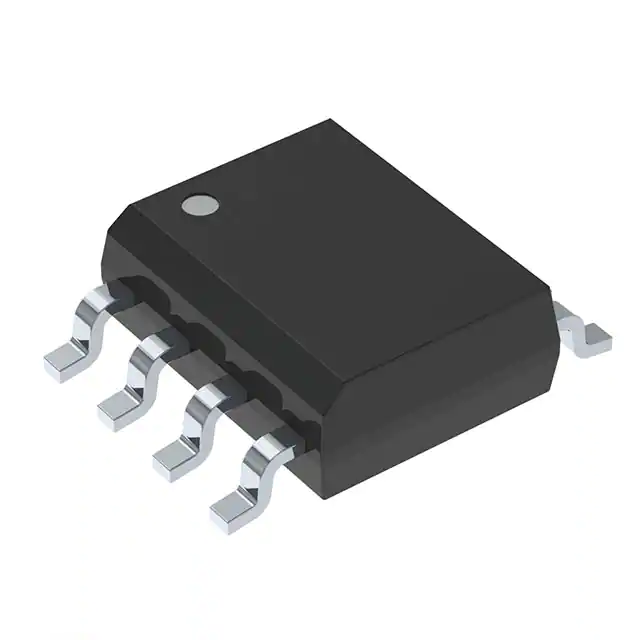
TLE5501
TMR-Based Angle Sensor
Features
•
Tunneling Magneto Resistance (TMR)-based principle
•
360° angle measurement
•
Large output signals of up to 0.37 V/V for direct micro controller
connection
•
Discrete bridge with differential sine and cosine output
•
Ratiometric output signals
•
Two different pin-outs:
- E0001: pin compatible to TLE5009, AEC-Q100 compliant (QM)
- E0002: de-coupled bridges for redundant external angle calculation and highest diagnostic coverage,
ISO26262 ASIL-D compliant (requires use of external safety mechanisms)
•
Automotive qualified AEC-Q100, Grade 0: TA = -40°C to 150°C (ambient temperature)
•
ESD > 4 kV (HBM)
•
RoHS compliant and halogen free package
Functional Safety
•
Safety Manual and Safety Analysis Summary Report available on request
Potential applications
The TLE5501 TMR-based angle sensor is designed for angular position sensing in automotive applications with
focus on steering angle sensor and BLDC motor commutation.
Product validation
Qualified for automotive applications. Product validation according to AEC-Q100.
Description
Table 1
Derivative Ordering codes
Product type
Marking
Ordering code Package
Functional Safety
Classification
Comment
TLE5501 E0001 5010001 SP001621824
PG-DSO-8 n.a.
pin compatible to TLE5009
TLE5501 E0002 5010002 SP001621828
PG-DSO-8 ISO26262 Compliant
de-coupled bridges
Datasheet
www.infineon.com
1
Rev. 1.0
2018-07-24
�TLE5501
TMR-Based Angle Sensor
Table of contents
1
Product overview . . . . . . . . . . . . . . . . . . . . . . . . . . . . . . . . . . . . . . . . . . . . . . . . . . . . . . . . . . . . . . . . . . . . . . . . . 3
2
Block diagram . . . . . . . . . . . . . . . . . . . . . . . . . . . . . . . . . . . . . . . . . . . . . . . . . . . . . . . . . . . . . . . . . . . . . . . . . . . . 4
3
Pin configuration / description . . . . . . . . . . . . . . . . . . . . . . . . . . . . . . . . . . . . . . . . . . . . . . . . . . . . . . . . . . . . . 5
4
Application circuit . . . . . . . . . . . . . . . . . . . . . . . . . . . . . . . . . . . . . . . . . . . . . . . . . . . . . . . . . . . . . . . . . . . . . . . . 6
5
5.1
5.2
5.3
General product characteristics . . . . . . . . . . . . . . . . . . . . . . . . . . . . . . . . . . . . . . . . . . . . . . . . . . . . . . . . . . . .
Absolute maximum ratings . . . . . . . . . . . . . . . . . . . . . . . . . . . . . . . . . . . . . . . . . . . . . . . . . . . . . . . . . . . . . . . .
Functional range . . . . . . . . . . . . . . . . . . . . . . . . . . . . . . . . . . . . . . . . . . . . . . . . . . . . . . . . . . . . . . . . . . . . . . . . .
Thermal resistance . . . . . . . . . . . . . . . . . . . . . . . . . . . . . . . . . . . . . . . . . . . . . . . . . . . . . . . . . . . . . . . . . . . . . . .
6
6.1
6.2
6.3
6.4
Functional behavior . . . . . . . . . . . . . . . . . . . . . . . . . . . . . . . . . . . . . . . . . . . . . . . . . . . . . . . . . . . . . . . . . . . . . . 10
Functional description . . . . . . . . . . . . . . . . . . . . . . . . . . . . . . . . . . . . . . . . . . . . . . . . . . . . . . . . . . . . . . . . . . . 10
Safety functions . . . . . . . . . . . . . . . . . . . . . . . . . . . . . . . . . . . . . . . . . . . . . . . . . . . . . . . . . . . . . . . . . . . . . . . . . 10
Failure reactions . . . . . . . . . . . . . . . . . . . . . . . . . . . . . . . . . . . . . . . . . . . . . . . . . . . . . . . . . . . . . . . . . . . . . . . . . 10
Electrical parameters . . . . . . . . . . . . . . . . . . . . . . . . . . . . . . . . . . . . . . . . . . . . . . . . . . . . . . . . . . . . . . . . . . . . 10
7
7.1
7.2
Typical performance . . . . . . . . . . . . . . . . . . . . . . . . . . . . . . . . . . . . . . . . . . . . . . . . . . . . . . . . . . . . . . . . . . . . . 14
Angle error . . . . . . . . . . . . . . . . . . . . . . . . . . . . . . . . . . . . . . . . . . . . . . . . . . . . . . . . . . . . . . . . . . . . . . . . . . . . . . 14
Hysteresis . . . . . . . . . . . . . . . . . . . . . . . . . . . . . . . . . . . . . . . . . . . . . . . . . . . . . . . . . . . . . . . . . . . . . . . . . . . . . . . 15
8
8.1
8.2
8.3
8.4
Package . . . . . . . . . . . . . . . . . . . . . . . . . . . . . . . . . . . . . . . . . . . . . . . . . . . . . . . . . . . . . . . . . . . . . . . . . . . . . . . . 16
Package info . . . . . . . . . . . . . . . . . . . . . . . . . . . . . . . . . . . . . . . . . . . . . . . . . . . . . . . . . . . . . . . . . . . . . . . . . . . . 16
Package marking . . . . . . . . . . . . . . . . . . . . . . . . . . . . . . . . . . . . . . . . . . . . . . . . . . . . . . . . . . . . . . . . . . . . . . . . 17
Packing . . . . . . . . . . . . . . . . . . . . . . . . . . . . . . . . . . . . . . . . . . . . . . . . . . . . . . . . . . . . . . . . . . . . . . . . . . . . . . . . . 17
Die Position inside package . . . . . . . . . . . . . . . . . . . . . . . . . . . . . . . . . . . . . . . . . . . . . . . . . . . . . . . . . . . . . . . 17
9
Revision history . . . . . . . . . . . . . . . . . . . . . . . . . . . . . . . . . . . . . . . . . . . . . . . . . . . . . . . . . . . . . . . . . . . . . . . . . 18
Datasheet
2
8
8
9
9
Rev. 1.0
2018-07-24
�TLE5501
TMR-Based Angle Sensor
Product overview
1
Product overview
The TLE5501 is a 360° TMR-based angle sensor that detects the orientation of a magnetic field. This is achieved
by measuring sine and cosine angle components with Tunneling Magneto Resistance (TMR) elements. These
raw signals (sine and cosine) are provided as a differential output signal and can directly be further processed
within a micro controller. The large output voltage of the bridge renders any further signal amplification
unnecessary.
The TLE5501 is available in two different derivatives:
•
TLE5501 E0001 has one VDD pin and is pin-compatible with the GMR-based TLE5009. This option offers a
easy change to the TLE5501. The only difference to TLE5009 is the pin 5, which is not used in TLE5501 and
provides a temperature and diagnosis function in TLE5009.
•
TLE5501 E0002 is a version which has two independent VDD and GND pins, for the P- and N-bridge
respectively. In this way, two completely independent bridge signals are generated which can be used in
an advanced safety concept to perform a cross-check of the P- and N- signals and achieve a high diagnostic
coverage for any sensor malfunction.
Datasheet
3
Rev. 1.0
2018-07-24
�TLE5501
TMR-Based Angle Sensor
Block diagram
2
Block diagram
The TLE5501 consists of 8 TMR resistors, which are arranged in 2 Wheatstone bridges. The resistance of these
resistors depends on the direction of the external magnetic field. Each bridge provides a differential output
signal, i.e. X (cosine) and Y (sine) signals which can further be processed for angle calculation.
VDD
X-Bridge
Y-Bridge
SIN_N
COS_P
0°
SIN_P
COS_N
GND1
GND2
90°
Figure 1
Principle block diagram of discrete TMR bridge, version TLE5501 E0001
VDD_N
VDD_P
N-Bridge
P-Bridge
COS_N
SIN_P
0°
SIN_N
COS_P
GND_P
GND_N
90°
Figure 2
Principle block diagram of discrete TMR bridge, de-coupled version TLE5501 E0002
Datasheet
4
Rev. 1.0
2018-07-24
�TLE5501
TMR-Based Angle Sensor
Pin configuration / description
3
Pin configuration / description
The pin-out of the device is shown in Table 2.
A magnet which rotates counter-clockwise (CCW) leads to an increasing angle value.
8
7
6
0°
5
+α
1
2
3
Figure 3
Pin-out of the discrete TMR bridge
Table 2
Pin description (compatible version TLE5501 E0001)
4
Pin No.
Symbol
In/Out
Function
1
COS_P
O
Analog positive cosine output
2
COS_N
O
Analog negative cosine output
3
GND2
I
Ground, internally connected to GND1
4
GND1
I
Ground
5
n.c
6
VDD
I
Supply voltage
7
SIN_N
O
Analog negative sine output
8
SIN_P
O
Analog positive sine output
Table 3
not used, internally connected to
GND2
Pin description (de-coupled version TLE5501 E0002)
Pin No.
Symbol
In/Out
Function
1
SIN_P
O
Analog positive sine output
2
VDD_P
I
Supply voltage P-bridge
3
COS_P
O
Analog positive cosine output
4
GND_P
I
Ground P-bridge
5
COS_N
O
Analog negative cosine output
6
VDD_N
I
Supply voltage N-bridge
7
SIN_N
O
Analog negative sine output
8
GND_N
I
Ground N-bridge
Datasheet
5
Rev. 1.0
2018-07-24
�TLE5501
TMR-Based Angle Sensor
Application circuit
4
Application circuit
Figure 4 to Figure 7 show the application circuit which is proposed for TLE5501. The value for the buffer
capacitor Cb has to be adjusted according to the speed of the magnetic input signal. It represents a low-pass
filter together with the TMR resistor and limits the bandwidth of the sensor, improves, however, noise
performance. Even without any buffer capacitor Cb, the bandwidth of the device is determined by the TMR
resistor and the input capacitor of the used ADC. It has to be considered and the ADC sample and hold time
has to be adjusted accordingly.
In case the TLE5501 is used in a single-ended configuration, it is recommended to keep the unused pins open.
COS_P
COS_P
Cb
COS_N
Cb
GND2
GND2
TLE5501
Cb
COS_N
SIN_P
SIN_P
SIN_N
SIN_N
Cb
VDD
VDD
100n
GND1
GND1
Figure 4
Application circuit for TLE5501 E0001, both bridges used
COS_P
COS_P
SIN_P
SIN_P
Cb
COS_N
GND2
TLE5501
Cb
SIN_N
VDD
VDD
100n
GND1
Figure 5
Datasheet
GND1
Application circuit for TLE5501 E0001, only one bridge used
6
Rev. 1.0
2018-07-24
�TLE5501
TMR-Based Angle Sensor
Application circuit
GND_N
SIN_P
SIN_P
GND_N
VDD_P
VDD_P
100n
COS_P
COS_P
Cb
SIN_N
SIN_N
100n
VDD_N
VDD_N
Cb
Cb
GND_P
Figure 6
TLE5501
Cb
GND_P
COS_N
COS_N
Application circuit for TLE5501 E0002, both bridges used
SIN_P
SIN_P
GND_N
VDD_P
SIN_N
VDD_P
COS_P
COS_P
100n
GND_P
Figure 7
Datasheet
TLE5501
Cb
VDD_N
Cb
GND_P
COS_N
Application circuit for TLE5501 E0002, only one bridge used
7
Rev. 1.0
2018-07-24
�TLE5501
TMR-Based Angle Sensor
General product characteristics
5
General product characteristics
5.1
Absolute maximum ratings
Stresses above the maximum values listed here may cause permanent damage to the device. Exposure to
absolute maximum rating conditions for extended periods may affect device reliability. Maximum ratings are
absolute ratings; exceeding only one of these values may cause irreversible damage to the device.
Table 4
Maximum ratings for voltages and output current
Parameter
Symbol
Values
Min.
Typ.
Max.
Unit
Note or Test Condition
Absolute maximum supply
voltage
VDD
-6.5
–
6.5
V
limited to 40 h over lifetime
Maximum ambient
temperature
TA
-40
–
150
°C
Grade 0 qualification
Maximum allowed magnetic Bmax
field
–
–
200
mT
max 5 min @ TA = 25°C
Maximum allowed magnetic Bmax
field
–
–
150
mT
max 5 h @ TA = 25°C
Storage & Shipment 1)
5
–
40
°C
for dry packed devices,
Relative humidity < 90 %,
storage time < 3 a
Tstorage
1) See Infineon Application Note: “Storage of Products Supplied by Infineon Technologies”
Table 5
Temperature / lifetime budget
Parameter
Symbol
Temperature / lifetime
budget1)
TA,max
Values
Min.
Typ.
Max.
–
–
125
Unit
Note or Test Condition
°C
for 1000 h, Grade 1 qualification
–
–
150
°C
for 1000 h, Grade 0 qualification
1)The angle accuracy depends on the maximum ambient temperature (see Table 12 and Table 13)
Table 6
Lifetime & Ignition Cycles
Parameter
Symbol
Values
Min.
Typ.
Max.
Unit
Note or Test Condition
Operating life time
top_life
15.000
–
–
h
see Table 5
Total life time
ttot_life
19
–
–
a
additional 5 a storage time1)
Ignition cycles
Nignition
3.6E6
–
–
during operating life time top_life
1) This storage time refers to storage in the module (including magnet) after soldering of the part
Datasheet
8
Rev. 1.0
2018-07-24
�TLE5501
TMR-Based Angle Sensor
General product characteristics
Table 7
ESD voltage
Parameter
Symbol
Values
Unit
Note or Test Condition
Min.
Typ.
Max.
Electro-Static-Discharge
VHBM
voltage (HBM), according to
ANSI/ESDA/JEDEC JS-0012010)
-4
–
4
kV
HBM contact discharge
for all pins
VCDM
Electro-Static-Discharge
voltage (CDM), according to
JESD22-C101
-0.5
–
0.5
kV
for all pins except corner pins
-0.75
–
0.75
kV
for corner pins only
5.2
Functional range
The following operating conditions must not be exceeded in order to ensure correct operation of the angle
sensor. All parameters specified in the following sections refer to these operating conditions. Table 8 & Table 9
is valid for -40°C < TA < 150°C.
Table 8
Operating range
Parameter
Symbol
Values
Min.
Typ.
Max.
Unit
Note or Test Condition
Operating supply voltage
VDD
2.7
–
5.5
V
–
Operating ambient
temperature
TA
-40
–
150
°C
–
Angle speed
n
–
–
1E6
°/s
–
Unit
Note or Test Condition
Table 9
Magnetic field range
Parameter
Symbol
Values
Min.
Typ.
Max.
Magnetic field range
B
20
–
100
mT
Extended magnetic field
range
Bextended
20
–
130
mT
additional reversible angle
error and additional angle error
life time drift
Unit
Note or Test Condition
K/W
Junction to air1)
5.3
Thermal resistance
The Table 10 describes the thermal resistance of the package.
Table 10
Thermal resistance of DSO-8
Parameter
Thermal resistance DSO-8
Symbol
RthJA
Values
Min.
Typ.
Max.
–
300
350
1) According to Jedec JESD51-7
Datasheet
9
Rev. 1.0
2018-07-24
�TLE5501
TMR-Based Angle Sensor
Functional behavior
6
Functional behavior
6.1
Functional description
The measurement principle of the sensor is based on the TMR (tunneling magneto-resistance) effect.
The sensor measures the angular orientation of the magnetic field vector parallel to the package surface.
The sensor provides a differential sine and a differential cosine analog output signal for external angle
calculation.
The provided output signal is ratiometric to the supply voltage.
The sensor has a measurement range of 360°.
6.2
Safety functions
The TLE5501 has no internal safety mechanisms implemented. All diagnostics to verify correct sensor
functionality must be implemented externally in the micro controller.
6.3
Failure reactions
As the TLE5501 has no implemented safety mechanisms, potential chip errors will not be indicated by the
sensor. They can be detected, however, by proper external mechanisms.
The sensor can withstand a short of any pin to ground without any damage of the sensor.
The sensor can withstand a short of any pin to sensor supply voltage without any damage of the sensor.
The sensor can also withstand a short of a pin to a neighbor pin without any damage.
6.4
Electrical parameters
The indicated parameters apply to the full operating range, unless otherwise specified. The typical values
correspond to a supply voltage VDD = 5.0 V and TA = 25°C, unless individually specified.
Table 11
Electrical parameters
Parameter
Symbol
Values
Min.
Typ.
Max.
Unit
Note or Test Condition
Bridge resistance
Rbridge
4000
6000
8000
Ohm
for TA = 25°C
Temperature coefficient of
bridge resistance
TCbridge
-0.124
-0.1
0
%/K
reference temperature: 25°C
Differential output voltage
amplitude
Aout,diff
270
320
370
mV/V peak-value, for TA = 25°C
Single ended output voltage Aout,se
amplitude
135
160
185
mV/V peak-value, for TA = 25°C
Orthogonality error (single
and differential ended)
ɸ
-10
0
10
°
Amplitude synchronism
(single and differential
ended)
k
90
100
110
%
Differential offset voltage
Voff,diff
-5
0
5
mV/V for TA = 25°C
Datasheet
10
for TA = 25°C
Rev. 1.0
2018-07-24
�TLE5501
TMR-Based Angle Sensor
Functional behavior
Table 11
Electrical parameters (cont’d)
Parameter
Symbol
Values
Unit
Min.
Typ.
Max.
Note or Test Condition
Single ended offset voltage
Voff,se
-5
0
5
mV/V referring to VDD/2,
for TA = 25°C
Temperature coefficient of
output amplitude (single
and differential ended)
TCAmp
-0.145
-0.12
0
%/K
Temperature coefficient of
offset voltage (single and
differential ended)
TCVoff
-5
0
5
µV/V/
K
Supply current
IS
–
1.67
2.5
mA
@VDD = 5 V /TA = 25°C (supply
current is calculated from
supply voltage and bridge
resistance)
Power on delay time
tdelay
–
–
1
ms
for a load capacity of CL < 30 nF
–
–
4
µs
for a load capacity of CL <
100 pF
reference temperature:
TA = 25°C
Vout
Aout,se
VDD
2
Voff,se
angle
Figure 8
Definition of single ended offset Voff,se and single ended amplitude Aout,se
The sensor has a remaining angle error as shown in Table 12 for differential usage and in Table 13 for single
ended. The error value refers to BZ = 0 mT. The overall angle error represents the relative angle error. This error
describes the deviation from the reference line after zero-angle definition. The reference line is defined in a
way that the angle error is symmetric to this line. It is valid for a static magnetic field.
Datasheet
11
Rev. 1.0
2018-07-24
�TLE5501
TMR-Based Angle Sensor
Functional behavior
Table 12 specifies the angle error in the magnetic field range of 25 mT < B < 80 mT with maximum ambient
temperature TA = 125°C and TA = 150°C, respectively. Differential output signal is used. For magnetic field
values B in the range of 20 mT < B < 25 mT or 80 mT < B < 100 mT, a corresponding adder has to be applied to
the specified angle accuracy as given in the footnote.
Table 12
Angle error for TA < 125°C and TA < 150°C (differential)
Parameter
Symbol
Values
Min.
Typ.
Max.
Unit
Note or Test Condition
Difference between output
angle and real angle1)
differential signals used
AErr,RT
–
–
0.8
°
at 0 h/25°C, B = 25 mT to 80 mT2)
(with compensation of offset,
orthogonality and amplitude at
0h/25°C)
Difference between output
angle and real angle1)
differential signals used
AErr,0
–
–
1.0
°
at 0 h/over temperature
TA = -40°C to 150°C,
B = 25 mT to 80 mT2)
(with compensation of offset,
orthogonality and amplitude at
0h/25°C)
Difference between output
angle and real angle1)
differential signals used
AErr,125
–
–
1.2
°
over lifetime & temperature
TA = -40°C to 125°C,
B = 25 mT to 80 mT2)
(with compensation of offset,
orthogonality and amplitude at
0h/25°C)
lifetime stress according to
Grade 1 qualification
Difference between output
angle and real angle1)
differential signals used
AErr,150
–
–
1.5
°
over lifetime & temperature
TA = -40°C to 150°C,
B = 25 mT to 80 mT2)
(with compensation of offset,
orthogonality and amplitude at
0h/25°C)
lifetime stress according to
Grade 0 qualification
Angle error due to
hysteresis3)
AHyst
–
–
0.4
°
20 mT < B < 100 mT
1) Hysteresis and noise are included in the angle accuracy specification
2) For magnetic fields in the range of 20 mT < B < 25 mT or 80 mT < B < 100 mT an adder of 0.2° to the angle error has to
be applied
3) Hysteresis is the largest measurement angle difference between left rotation and right rotation. The raw signals are
corrected with the mean correction parameters of both rotation directions
Datasheet
12
Rev. 1.0
2018-07-24
�TLE5501
TMR-Based Angle Sensor
Functional behavior
Table 13 specifies the angle error in the magnetic field range of 25 mT < B < 80 mT with maximum ambient
temperature TA = 125°C and TA = 150°C, respectively. Single ended output signal is used. For magnetic field
values B in the range of 20 mT < B < 25 mT or 80 mT < B < 100 mT, a corresponding adder has to be applied to
the specified angle accuracy as given in the footnote.
Table 13
Angle error for TA < 125°C and TA < 150°C (single-ended)
Parameter
Symbol
Values
Min.
Typ.
Max.
Unit
Note or Test Condition
Difference between output
angle and real angle1)
single-ended signals used
AErr,RT
–
–
0.9
°
at 0 h/25°C, B = 25 mT to 80 mT2)
(with compensation of offset,
orthogonality and amplitude at
0h/25°C)
Difference between output
angle and real angle1)
single-ended signals used
AErr,0
–
–
1.1
°
at 0 h/over temperature
TA = -40°C to 150°C,
B = 25 mT to 80 mT2)
(with compensation of offset,
orthogonality and amplitude at
0h/25°C)
Difference between output
angle and real angle1)
single-ended signals used
AErr,125
–
–
1.3
°
over lifetime & temperature
TA = -40°C to 125°C,
B = 25 mT to 80 mT2)
(with compensation of offset,
orthogonality and amplitude at
0h/25°C)
lifetime stress according to
Grade 1 qualification
Difference between output
angle and real angle1)
single-ended signals used
AErr,150
–
–
1.6
°
over lifetime & temperature
TA = -40°C to 150°C,
B = 25 mT to 80 mT2)
(with compensation of offset,
orthogonality and amplitude at
0h/25°C)
lifetime stress according to
Grade 0 qualification
Angle error due to
hysteresis3)
AHyst
–
–
0.4
°
20 mT < B < 100 mT
1) Hysteresis and noise are included in the angle accuracy specification
2) For magnetic fields in the range of 20 mT < B < 25 mT or 80 mT < B < 100 mT an adder of 0.2° to the angle error has to
be applied
3) Hysteresis is the largest measurement angle difference between left rotation and right rotation. The raw signals are
corrected with the mean correction parameters of both rotation directions
Datasheet
13
Rev. 1.0
2018-07-24
�TLE5501
TMR-Based Angle Sensor
Typical performance
7
Typical performance
7.1
Angle error
Figure 9 shows the typical angle error of the TLE5501 for different ambient temperatures TA and magnetic
fields B for a one-time compensation of offset, amplitude and non-orthogonality at 25°C and B = 40 mT.
Figure 10 shows the typical angle error in case offset, amplitude and non-orthogonality is compensated for
each temperature T and magnetic field B.
1.0
0.9
Angle error (°)
0.8
0.7
0.6
0.5
0.4
0.3
-40°
0.2
25°C
0.1
150°C
0.0
0
20
40
60
80
100
120
B (mT)
Figure 9
Typical angle error at 0h, differential signals, one-time compensation of offset, amplitude
and orthogonality error at 25°C and 40 mT
1.0
0.9
Angle error (°)
0.8
0.7
0.6
0.5
0.4
0.3
-40°C
0.2
25°C
0.1
150°C
0.0
0
20
40
60
80
100
120
B (mT)
Figure 10
Datasheet
Typical angle error at 0h, differential signals, ideal compensation of offset, amplitude and
orthogonality error at each temperature T and magnetic field B
14
Rev. 1.0
2018-07-24
�TLE5501
TMR-Based Angle Sensor
Typical performance
7.2
Hysteresis
Figure 11 shows the typical hysteresis of the TLE5501.
0.35
Hysteresis error (°)
0.30
0.25
0.20
0.15
0.10
-40°C
0.05
25°C
150°C
0.00
0
Figure 11
Datasheet
20
40
60
B (mT)
80
100
120
Typical hysteresis
15
Rev. 1.0
2018-07-24
�TLE5501
TMR-Based Angle Sensor
Package
8
Package
8.1
Package info
The package is qualified with a MSL level of 3. It is halogen free, lead free and RoHS compliant.
Package outline
1.31
Figure 12
5.69
0.65
1.27
Figure 13
Datasheet
Footprint
16
Rev. 1.0
2018-07-24
�TLE5501
TMR-Based Angle Sensor
Package
8.2
Package marking
The marking on the front side of the package identifies the type of the sensor, the manufacturing lot
information and the manufacturing date code.
Table 14
Marking
Position
Marking
Description
1st Line
5010001 / 5010002
See ordering code in Table 1
2nd Line
xxx
Lot code
3rd Line
Gxxxx
G: green, 4-digit: date code
8.3
Packing
The packing of the device is in tape & reel.
0.3
5.2
12 ±0.3
8
1.75
6.4
2.1
Figure 14
Packing
8.4
Die Position inside package
The position of the sensitive element inside the package is specified in Figure 15.
The size of the sensitive TMR area is 315 µm x 315 µm with the center being in the center of the package.
Figure 15
Datasheet
Die in package
17
Rev. 1.0
2018-07-24
�TLE5501
TMR-Based Angle Sensor
Revision history
9
Revision history
Revision Date
1.0
Datasheet
Changes
2018-07-24 Initial creation
18
Rev. 1.0
2018-07-24
�Trademarks
All referenced product or service names and trademarks are the property of their respective owners.
Edition 2018-07-24
Published by
Infineon Technologies AG
81726 Munich, Germany
© 2018 Infineon Technologies AG.
All Rights Reserved.
Do you have a question about any
aspect of this document?
Email: erratum@infineon.com
Document reference
IMPORTANT NOTICE
The information given in this document shall in no
event be regarded as a guarantee of conditions or
characteristics ("Beschaffenheitsgarantie").
With respect to any examples, hints or any typical
values stated herein and/or any information regarding
the application of the product, Infineon Technologies
hereby disclaims any and all warranties and liabilities
of any kind, including without limitation warranties of
non-infringement of intellectual property rights of any
third party.
In addition, any information given in this document is
subject to customer's compliance with its obligations
stated in this document and any applicable legal
requirements, norms and standards concerning
customer's products and any use of the product of
Infineon Technologies in customer's applications.
The data contained in this document is exclusively
intended for technically trained staff. It is the
responsibility of customer's technical departments to
evaluate the suitability of the product for the intended
application and the completeness of the product
information given in this document with respect to
such application.
For further information on technology, delivery terms
and conditions and prices, please contact the nearest
Infineon Technologies Office (www.infineon.com).
WARNINGS
Due to technical requirements products may contain
dangerous substances. For information on the types
in question please contact your nearest Infineon
Technologies office.
Except as otherwise explicitly approved by Infineon
Technologies in a written document signed by
authorized representatives of Infineon Technologies,
Infineon Technologies’ products may not be used in
any applications where a failure of the product or any
consequences of the use thereof can reasonably be
expected to result in personal injury.
�