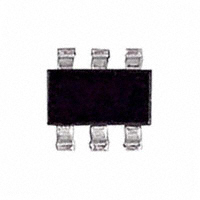
FDC608PZ
June 2006
FDC608PZ
P-Channel 2.5V Specified PowerTrench® MOSFET
General Description
This P-Channel 2.5V specified MOSFET is produced using Fairchild Semiconductor’s advanced PowerTrench process that has been especially tailored to minimize the on-state resistance and yet maintain low gate charge for superior switching performance. These devices are well suited for battery power applications: load switching and power management, battery power circuits, and DC/DC conversions.
tm
Features
• –5.8 A, –20 V. RDS(ON) = 30 mΩ @ VGS = –4.5 V RDS(ON) = 43 mΩ @ VGS = –2.5 V • Low Gate Charge • High performance trench technology for extremely low RDS(ON) • SuperSOT
TM
–6 package: small footprint (72%
smaller than standard SO–8) low profile (1mm thick).
D
D
S
1 2
6 5 4
SuperSOT TM -6
D
D
G
3
Absolute Maximum Ratings
Symbol
VDSS VGSS ID PD TJ, TSTG Drain-Source Voltage Gate-Source Voltage Drain Current – Continuous – Pulsed Maximum Power Dissipation
TA=25oC unless otherwise noted
Parameter
Ratings
–20 ±12
(Note 1a)
Units
V V A W °C
–5.8 –20 1.6 0.8 –55 to +150
(Note 1a) (Note 1b)
Operating and Storage Junction Temperature Range
Thermal Characteristics
RθJA RθJC Thermal Resistance, Junction-to-Ambient Thermal Resistance, Junction-to-Case Device FDC608PZ
(Note 1a) (Note 1)
78 30 Tape width 8mm
°C/W °C/W Quantity 3000 units
Package Marking and Ordering Information
Device Marking .608Z Reel Size 7’’
©2006 Fairchild Semiconductor Corporation
FDC608PZ Rev B (W)
�FDC608PZ
Electrical Characteristics
Symbol
BVDSS ∆BVDSS ∆TJ IDSS IGSS
TA = 25°C unless otherwise noted
Parameter
Drain–Source Breakdown Voltage Breakdown Voltage Temperature Coefficient Zero Gate Voltage Drain Current Gate–Body Leakage
(Note 2)
Test Conditions
VGS = 0 V, ID = –250 µA ID = –250 µA,Referenced to 25°C VDS = –16 V, VGS = ±12 V, VGS = 0 V VDS = 0 V
Min
–20
Typ
Max Units
V
Off Characteristics
–10 –1 ±10 mV/°C µA µA
On Characteristics
VGS(th) ∆VGS(th) ∆TJ RDS(on)
Gate Threshold Voltage Gate Threshold Voltage Temperature Coefficient Static Drain–Source On–Resistance On–State Drain Current Forward Transconductance
VDS = VGS, ID = –250 µA ID = –250 µA,Referenced to 25°C VGS = –4.5V, ID = –5.8 A ID = –5.0 A VGS = –2.5V, VGS = –4.5V,ID = –5.8A,TJ=125°C VGS = –4.5 V, VDS = –5 V VDS = –10 V, ID = –5.8 A
–0.4
–1.0 3 26 38 35
–1.5
V mV/°C
30 43
mΩ
ID(on) gFS
–20 22
A S
Dynamic Characteristics
Ciss Coss Crss RG Input Capacitance Output Capacitance Reverse Transfer Capacitance Gate Resistance
(Note 2)
VDS = –10 V, f = 1.0 MHz
V G S = 0 V,
1330 270 230 12
pF pF pF Ω
VGS = 15 mV, f = 1.0 MHz
Switching Characteristics
td(on) tr td(off) tf Qg Qgs Qgd IS VSD trr Qrr Turn–On Delay Time Turn–On Rise Time Turn–Off Delay Time Turn–Off Fall Time Total Gate Charge Gate–Source Charge Gate–Drain Charge
VDD = –10 V, VGS = –4.5 V,
ID = –1 A, RGEN = 6 Ω
13 8 91 60
24 16 145 96 23
ns ns ns ns nC nC nC
VDS = –10 V, VGS = –4.5 V
ID = –5.8 A,
17 3 6
Drain–Source Diode Characteristics and Maximum Ratings
Maximum Continuous Drain–Source Diode Forward Current Drain–Source Diode Forward Voltage Diode Reverse Recovery Time Diode Reverse Recovery Charge VGS = 0 V, IF = –5.8 A, IF = –5.8 A, IS = –1.3 A
(Note 2)
–1.3 –0.7 40 15 –1.2 60 23
A V ns nC
diF/dt = 100A/µs diF/dt = 100A/µs
Notes: 1. RθJA is the sum of the junction-to-case and case-to-ambient resistance where the case thermal reference is defined as the solder mounting surface of the drain pins. RθJC is guaranteed by design while RθCA is determined by the user's board design. a. b.
2 78°C/W when mounted on a 1in pad of 2oz copper on FR-4 board.
156°C/W when mounted on a minimum pad.
2. Pulse Test: Pulse Width ≤ 300 µs, Duty Cycle ≤ 2.0%
FDC608PZ Rev B (W)
�FDC608PZ
Typical Characteristics
20
VGS = -4.5V -3.5V -3.0V -2.5V RDS(ON), NORMALIZED DRAIN-SOURCE ON-RESISTANCE
2.6 VGS= -2.0V 2.2
-ID, DRAIN CURRENT (A)
15
1.8
10
-2.0V
1.4
-2.5V -3.0V -3.5V
5
1
-4.0V
-4.5V
0 0 0.5 1 1.5 2 2.5 -VDS, DRAIN TO SOURCE VOLTAGE (V) 3
0.6 0 5 10 -ID, DRAIN CURRENT (A) 15 20
Figure 1. On-Region Characteristics.
Figure 2. On-Resistance Variation with Drain Current and Gate Voltage.
0.1 RDS(ON), ON-RESISTANCE (OHM)
1.5 RDS(ON), NORMALIZED DRAIN-SOURCE ON-RESISTANCE
ID = -5.8A VGS = -4.5V
ID = -2.9A 0.08
1.3
1.1
0.06 TA = 125 C 0.04 TA = 25oC 0.02
o
0.9
0.7 -50 -25 0 25 50 75 100 o TJ, JUNCTION TEMPERATURE ( C) 125 150
0
2 4 6 8 -VGS, GATE TO SOURCE VOLTAGE (V)
10
Figure 3. On-Resistance Variation with Temperature.
20 VDS = -5V -ID, DRAIN CURRENT (A) 15
Figure 4. On-Resistance Variation with Gate-to-Source Voltage.
100 -IS, REVERSE DRAIN CURRENT (A)
VGS = 0V
10 1 0.1
TA = 125oC
10 TA = -55 C 5
o
125 C
o
0.01 0.001 0.0001
25oC -55oC
25oC 0 0 0.5 1 1.5 2 2.5 -VGS, GATE TO SOURCE VOLTAGE (V) 3
0
0.2 0.4 0.6 0.8 1 1.2 -VSD, BODY DIODE FORWARD VOLTAGE (V)
1.4
Figure 5. Transfer Characteristics.
Figure 6. Body Diode Forward Voltage Variation with Source Current and Temperature.
FDC608PZ Rev B (W)
�FDC608PZ
Typical Characteristics
10 -VGS, GATE-SOURCE VOLTAGE (V)
2500 ID = -5.8A VDS = -5V -15V 2000 CAPACITANCE (pF) -10V Ciss 1500 f = 1 MHz VGS = 0 V
8
6
4
1000 Coss 500 Crss
2
0 0 10 20 Qg, GATE CHARGE (nC) 30 40
0 0 2 4 6 8 -VDS, DRAIN TO SOURCE VOLTAGE (V) 10
Figure 7. Gate Charge Characteristics.
100
RDS(ON) LIMIT 100µs 1ms 10ms 100ms P(pk), PEAK TRANSIENT POWER (W) 10
Figure 8. Capacitance Characteristics.
-ID, DRAIN CURRENT (A)
8
10
SINGLE PULSE RθJA = 156°C/W TA = 25°C
6
1
1s DC VGS = -4.5V SINGLE PULSE RθJA = 156oC/W T A = 25 C
o
4
0.1
2
0.01 0.1 1 10 -VDS, DRAIN-SOURCE VOLTAGE (V) 100
0 0.01
0.1
1 t1, TIME (sec)
10
100
Figure 9. Maximum Safe Operating Area.
Figure 10. Single Pulse Maximum Power Dissipation.
r(t), NORMALIZED EFFECTIVE TRANSIENT THERMAL RESISTANCE
1
D = 0.5 0.2
RθJA(t) = r(t) * RθJA RθJA = 156 C/W P(pk) t1 t2 TJ - TA = P * RθJA(t) Duty Cycle, D = t1 / t2
o
0.1
0.1 0.05 0.02
0.01
0.01
SINGLE PULSE
0.001 0.00001
0.0001
0.001
0.01
0.1
t1, TIME (sec)
1
10
100
1000
Figure 11. Transient Thermal Response Curve.
Thermal characterization performed using the conditions described in Note 1b. Transient thermal response will change depending on the circuit board design.
FDC608PZ Rev B (W)
�TRADEMARKS
The following are registered and unregistered trademarks Fairchild Semiconductor owns or is authorized to use and is not intended to be an exhaustive list of all such trademarks. FACT Quiet Series™ GlobalOptoisolator™ GTO™ HiSeC™ I2C™ i-Lo™ ImpliedDisconnect™ IntelliMAX™ ISOPLANAR™ LittleFET™ MICROCOUPLER™ MicroFET™ MicroPak™ MICROWIRE™ MSX™ MSXPro™ Across the board. Around the world.™ The Power Franchise® Programmable Active Droop™ DISCLAIMER
FAIRCHILD SEMICONDUCTOR RESERVES THE RIGHT TO MAKE CHANGES WITHOUT FURTHER NOTICE TO ANY PRODUCTS HEREIN TO IMPROVE RELIABILITY, FUNCTION, OR DESIGN. FAIRCHILD DOES NOT ASSUME ANY LIABILITY ARISING OUT OF THE APPLICATION OR USE OF ANY PRODUCT OR CIRCUIT DESCRIBED HEREIN; NEITHER DOES IT CONVEY ANY LICENSE UNDER ITS PATENT RIGHTS, NOR THE RIGHTS OF OTHERS. THESE SPECIFICATIONS DO NOT EXPAND THE TERMS OF FAIRCHILD’S WORLDWIDE TERMS AND CONDITIONS, SPECIFICALLY THE WARRANTY THEREIN, WHICH COVERS THESE PRODUCTS.
ACEx™ ActiveArray™ Bottomless™ Build it Now™ CoolFET™ CROSSVOLT™ DOME™ EcoSPARK™ E2CMOS™ EnSigna™ FACT™ FAST® FASTr™ FPS™ FRFET™
OCX™ OCXPro™ OPTOLOGIC® OPTOPLANAR™ PACMAN™ POP™ Power247™ PowerEdge™ PowerSaver™ PowerTrench® QFET® QS™ QT Optoelectronics™ Quiet Series™ RapidConfigure™ RapidConnect™ μSerDes™ ScalarPump™
SILENT SWITCHER® SMART START™ SPM™ Stealth™ SuperFET™ SuperSOT™-3 SuperSOT™-6 SuperSOT™-8 SyncFET™ TCM™ TinyBoost™ TinyBuck™ TinyPWM™ TinyPower™ TinyLogic® TINYOPTO™ TruTranslation™ UHC™
UniFET™ UltraFET® VCX™ Wire™
LIFE SUPPORT POLICY
FAIRCHILD’S PRODUCTS ARE NOT AUTHORIZED FOR USE AS CRITICAL COMPONENTS IN LIFE SUPPORT DEVICES OR SYSTEMS WITHOUT THE EXPRESS WRITTEN APPROVAL OF FAIRCHILD SEMICONDUCTOR CORPORATION. As used herein: 1. Life support devices or systems are devices or systems which, (a) are intended for surgical implant into the body, or (b) support or sustain life, or (c) whose failure to perform when properly used in accordance with instructions for use provided in the labeling, can be reasonably expected to result in significant injury to the user. 2. A critical component is any component of a life support device or system whose failure to perform can be reasonably expected to cause the failure of the life support device or system, or to affect its safety or effectiveness.
PRODUCT STATUS DEFINITIONS Definition of Terms
Datasheet Identification Advance Information Product Status Formative or In Design Definition This datasheet contains the design specifications for product development. Specifications may change in any manner without notice. This datasheet contains preliminary data, and supplementary data will be published at a later date. Fairchild Semiconductor reserves the right to make changes at any time without notice to improve design. This datasheet contains final specifications. Fairchild Semiconductor reserves the right to make changes at any time without notice to improve design. This datasheet contains specifications on a product that has been discontinued by Fairchild semiconductor. The datasheet is printed for reference information only.
Preliminary
First Production
No Identification Needed
Full Production
Obsolete
Not In Production
Rev. I20
�