Magnetic Displacement Sensors
HMC1501/1512
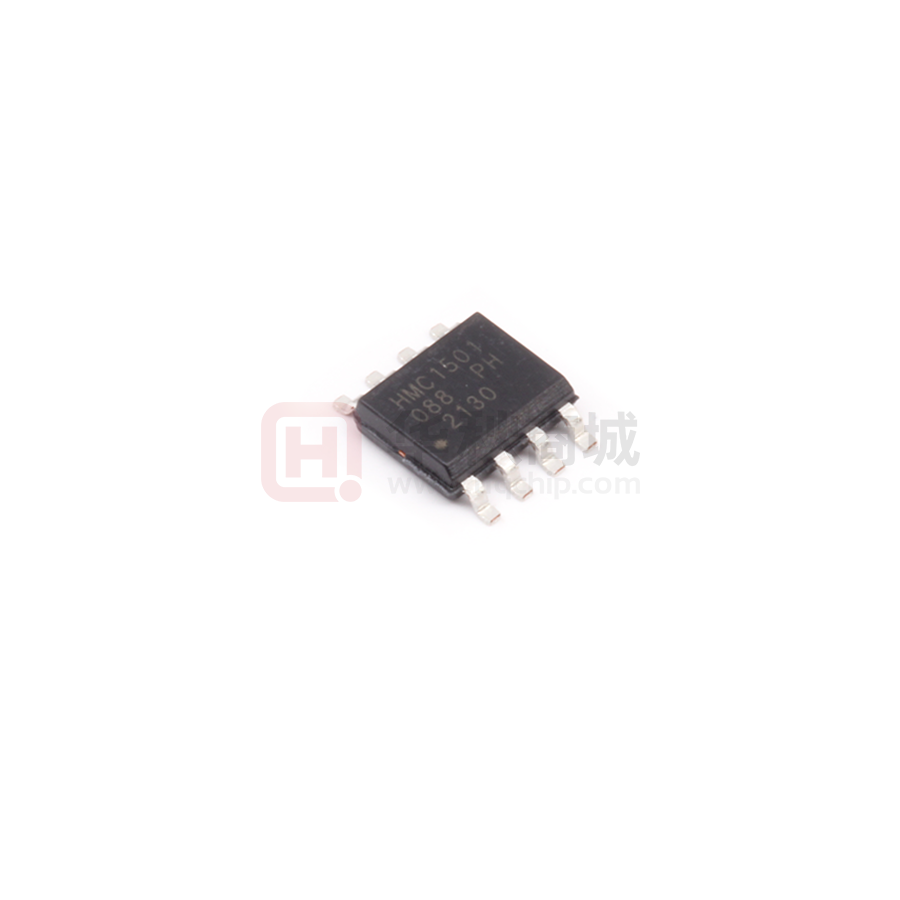
The Honeywell HMC1501 and HMC1512 are miniature surface
mount sensors for linear, angular, or rotary displacement designed
for magnetic saturating field sensing. The HMC1501 contains a
single saturated-mode Wheatstone bridge sense element that
creates an output voltage with respect to the direction of the
magnetic flux passing over the sensor surface. The HMC1512
contains dual saturated-mode Wheatstone bridge elements colocated to provide an extended range of angular displacements.
Both sensor types are cost effective and space-efficient solutions
for high-volume OEM designs. Applications for the HMC15xx
sensors include Position Sensing, Rotary speed and angle detection,
and non-contact precision location measurement systems.
The HMC15xx sensors utilize Honeywell’s Anisotropic Magnetoresistive
(AMR) technology that provides advantages over hall-effect based
magnetic sensors. They are able to resolve better than tenths of a
degree or tenths of millimeters, withstand large variations in magnetto-sensor gaps, and exhibit insensitivity to shocks and vibrations.
Honeywell’s Magnetic Sensors are among the most precise and
reliable position sensors in the industry. Honeywell continues to
maintain product excellence and performance by introducing
innovative solid-state magnetic sensor solutions. These are highly
reliable, top-performance products that are delivered when promised.
Honeywell’s magnetic sensor provide real solutions you can count on.
F E AT U R E S
BENEFITS
• Wide Angular Range
• HMC1501 – Angular range of ±45° with Saturation Field
-45
+45
deg
SENSITIVITY
Vb=5 volts, field=80Oe
@ zero crossing
@ zero crossing averaged in a 45°
range
HMC1501 BRIDGE ELEMENT
2.1
1.8
mV/°
mV/°
OUTPUT VOLTAGE
Vb=5 volts, field=80 Oe
100
120
140
mVpp
BRIDGE OFFSET
field=80 Oe
-7
3
+7
mV/V
RESOLUTION
BW=10Hz, Vb=5 volts
0.07
deg
NOISE DENSITY
@1Hz, Vb=5 volts
100
nV/sqrt Hz
HMC1512 BRIDGE ELEMENTS
SUPPLY
Vbridge (Vb) referenced to GND
1.0
5.0
25
Volts
RESISTANCE
Bridge current = 1mA
2000
2100
2800
ohms
ANGLE RANGE
>Saturation Field
-90
+90
deg
SENSITIVITY
Vb=5 volts, field=80Oe
@ zero crossing
@ zero crossing averaged in a 45°
range
2.1
1.8
mV/°
mV/°
OUTPUT VOLTAGE
Vb=5 volts, field=80 Oe
100
120
140
mVpp
BRIDGE OFFSET
field=80 Oe
Bridge A
Bridge B
-7
-7
0
0
+7
+7
mV/V
mV/V
RESOLUTION
BW=10Hz, Vb=5 volts
0.05
deg
NOISE DENSITY
@1Hz, Vb=5 volts
70
nV/sqrt Hz
COMMON
OPERATING TEMPERATURE
Ambient
-40
+125
°C
STORAGE TEMPERATURE
Ambient, unbiased
-55
+150
°C
HUMIDITY
Tested at 85°C
85
%
HYSTERESIS ERROR
Field > 80 Oe, Vb=5 volts
30
0.017
μV
deg
BRIDGE OHMIC TEMPCO
Vb=5 volts, TA= -40 to +125°C
2800
ppm/°C
SENSITIVITY TEMPCO
Vb=5 volts, TA= -40 to +125°C
-3200
ppm/°C
BRIDGE OFFSET TEMPCO
TA= -40 to +125°C
±100
ppm/°C
* Tested at 25°C except stated otherwise.
HMC1501
HMC1512
�Pin Configurations
HMC1501
HMC1512
Package Outline
PACKAGE DRAWING HMC1501/HMC1512 (8-PIN SOIC, dimensions in millimeters)
MILLIMETERS
INCHES
Min
Max
Min
Max
A
1.371
1.728
0.054
0.068
A1
0.101
0.249
0.004
0.010
B
0.355
0.483
0.014
0.019
D
4.800
4.979
0.189
0.196
E
3.810
3.988
0.150
e
1.270 ref
0.157
0.050 ref
H
5.816
6.198
0.229
0.244
h
0.381
0.762
0.015
0.030
�Magnetic Mounting Considerations
The HMC1501 has an internal sensor die placed toward the forward edge, between pins 1 and 8, to
make linear translation applications more convenient. The figure below indicates this location.
The HMC1512 has two sensor bridges optimized for rotary translation applications. Thus the die is
centered in all three dimensions within the SOIC-8 package. The figure below indicates location.
HMC1501
HMC1512
Basic Device Operation
The Honeywell HMC15xx magnetoresistive sensors are Wheatstone bridges to measure
magnetic field direction. The bridge elements change their resistance when a magnetic field is
applied across the silicon die with the thin films of magneto-resistive ferrous material forming
the resistive elements. The magnetoresistance is a function of cos2 ϴ, where ϴ is the angle
between the applied magnetic field (M) and the current flow direction in the thin film.
When the applied magnetic field becomes moderate (50 Oerstad or larger), the magnetization of
the thin films align in the same direction as the applied field; and becomes the saturation mode. In
this mode, is the angle between the direction of the applied field and the bridge current flow, and
the magnetoresistive sensor is only sensitive to the direction of the applied field (not amplitude).
The sensor is in the form of a Wheatstone bridge (see figures below). The resistance
(R) of all four bridge legs is the same. The bridge power supply Vb or Vbridge, causes
current to flow through the bridge elements as indicated in the figures.
Both the HMC1501 and HMC1512 are designed to be used in saturation mode, with applied
fields of 80 Oerstads or greater, required to meet the specifications in this datasheet.
�The HMC1501 contains one bridge and the HMC1512 has two identical bridges, coexisting
on a single die. Bridge B is physically rotated 45° from bridge A. The HMC1501 has a sensor
output of ΔV = - Vb*S sin (2ϴ), and the HMC1512 has a sensor output of ΔV = Vb*S sin (2ϴ) for
sensor A and sensor B’s output is ΔV = -Vb*S cos (2ϴ). Vb is the supply voltage, and S is a sensor
constant determined by the materials. For these Honeywell sensors, S is typically 12mV/V.
Application Notes
The HMC1501 and HMC1512 are Honeywell’s AMR based magnetic position sensors that
contain AMR sensor bridges to be used in saturation mode. The HMC1501 contains one AMR
bridge for a ±45° range of position sensing, and the HMC1512 contains two AMR bridges for a
±90° range of position sensing. The bridge differential output voltage ( V) for the HMC1501 is:
ΔV = -Vs S sin (2ϴ) where:
Vs = Supply Voltage (volts)
S = Material Constant (12mV/V)
ϴ= Reference to Magnetic Field Angle (degrees)
With the bridges on the HMC1512 oriented 45° in rotation from each other, the differential
output voltage for sensor bridge A is:
ΔVA = Vs S sin (2ϴ)
And for sensor bridge B, the differential output voltage is:
ΔVB = -Vs S cos (2ϴ)
Using the HMC1512 bridge A signal output plotted versus theta,
the figure below depicts the two-cycle waveform.
�As you can see above, the most linear range for this sensor bridge is in the ±45° range about the –180, -90,
0, 90, and 180 degree points. Of these the 0 and 180 points have a positive slope, and the ±90 points have a
negative slope. These slopes can be taken to full advantage for angular and linear positioning applications.
Basic Position Sensing
For simple magnetic position sensing, the HMC1501 sensor can used to detect the
relative motion of a nearby magnet in linear or angular displacement.
With the orientation of the stationary HMC1501, the magnet position can translate to ±45° and stay within
a linear slope of ΔV versus ϴ for position sensing. Given a typical supply voltage of 5 volts (Vs = +5Vdc), the
HMC1501 will provide about a 120 millivolt swing (±60 millivolts) on 2.5 volt bias voltage. The reason for the
2.5 volts is that with the Wheatstone bridge provides a differential voltage output with a bias voltage from
the 5 volt supply voltage. The figures show the mechanical orientation and the electrical transfer function.
�To interface with output pins of the HMC1501 (OUT+, OUT-), an instrumentation amplifier circuit is
typically used.
Instrumentation amplifiers can be purchased as complete integrated circuits, or constructed
via combinations of discrete components and integrated circuits; such as operational amplifiers
(op-amps). The purpose of an instrumentation amplifier is to derive the difference signal (OUT+
minus OUT-), and to provide additional signal amplification as desired. The figure below shows a
typical instrumentation amplifier circuit using an op-amp with external discrete components.
�With a typical HMC1501 position sensor, a low-cost operational
amplifier (e.g. LMV358) could be used as a differential amplifier shown
in the schematic above. The 10 kilo-ohm input resistors present a
high impedance from the Wheatstone bridge, and the 249 kiloohm resistor set the amplifier gain and bias at 25V/V and 2.5 volts
respectively. The 0.01 microfarad capacitor is placed in the feedback
loop to low system bandwidth and to further exclude noise outside
the sensor and amplifier circuits. The analog output voltage of the
amplifier is typically fed to an Analog-to-Digital Converter (ADC)
stage stand-alone or within a microprocessor integrated circuit. A
recommendation of 10-bit ADC circuits or higher is expected.
For angular measurements, the same information applies, except
the mechanical arrangement changes a bit.
The application circuits herein constitute typical usage and interface of
Honeywell product. Honeywell does not warranty or assume liability of
customerdesigned circuits derived from this description or depiction.
Honeywell reserves the right to make changes to improve reliability,
function, or design. Honeywell does not assume any liability arising out of
the application or use of any product or circuit described herein; neither
does it convey any license under its patent rights nor the rights of others.
U.S. Patents 4,441,072, 4,533,872, 4,569,742, 4,681,812, 4,847,584
6,529,114 and 7,095,226 apply to the technology described.
ORDERING INFORMATION
Ordering Number
Product
HMC1501
Magnetic Sensor
HMC1501-TR
Tape and Reel with 1k units/reel
HMC1512
Magnetic Sensor
HMC1512-TR
Tape and Reel with 1k units/reel
For more information
For more applications information,
see application note AN211 on the
magneticsensors.com website or
contact us at 800-323-8295.
Honeywell Aerospace
12001 State Highway 55
Plymouth, MN 55441
aerospace.honeywell.com
#900246 Rev D
N61-2042-000-000 | 03/19
© 2019 Honeywell International Inc.
�