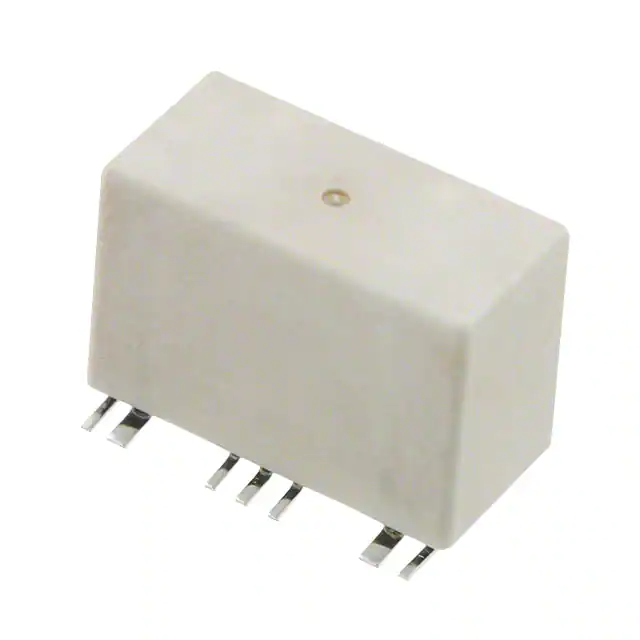
Axicom Signal and High Frequency Relays (RF Switches)
APPLICATION NOTE #2
Transportation, Storage, Handling, Assembly and Testing
of Axicom Surface Mount Terminal (SMT) Relays
Electromechanical relays are robust and reliable electronic components. To achieve desired performance of Axicom
relays, some precautions must be taken during transportation, storage, handling and assembly and testing of the
relays.
Following this guideline enables correct treatment of the relays during the critical phase in the relay life.
A. Transportation
In transit, care must be taken to avoid excessive shock and vibration. Mechanical stress can lead to changes in
operating characteristics or to internal damage of the relay (see vibration and shock resistance specifications in
datasheet). If mechanical stress is suspected, the relay should be checked and tested before use. Whenever relays
arrive in damaged boxes at customer site, there is a potential risk of transportation damage.
Fig. 1: Proper packing of relays for transportation
B. Packaging
Different packaging is used depending on the relay type and specific requirements of shipment or production.
The standard packing for SMT relays is blisters wounded on a reel (tape & reel) and dry packed to prevent the
relays from exposing to humidity.
Axicom /// APPLICATION NOTE
PAGE 1
�Transportation, Storage, Handling, Assembly
and Testing of Axicom SMT Relays
Fig. 2: Dry packed relays reel
Axicom SMT relays should be kept in the “Pizza Boxes” for storage and should be removed from the box just before
the assembly process directly on the SMT assembly line. Pizza boxes are equipped with shock absorbers, which
protect the relays from mechanical impacts.
Fig. 3: “Pizza Box” for protection of the relays. Opened box with shock
absorbers on the right-hand side
C. Handling
Modern relays are high precision components that are sensitive to mechanical stress and abusive handling. Care must
be taken when handling the relay during all stages of production. Special care must be taken, so that relays are not
dropped to the floor. Dropped relays shall not be used and must be scrapped.
Special care should be taken during splicing the reels, so that loose end of tape is not dropped to the floor and relay
terminals are not bent.
Axicom /// APPLICATION NOTE
PAGE 2
�Transportation, Storage, Handling, Assembly
and Testing of Axicom SMT Relays
D. Storage
Relays should be stored in a clean area within the specified temperature limits as indicated in relevant technical
documents. Extreme humidity and condensation can cause corrosion of the metal parts, both internal and external
SMT relays must be dry when soldered and it is very critical for higher peak temperatures. For this reason, all Axicom
SMD relays are dry packed. When the packing is opened, the relays must be soldered in a defined time, which is given
by the moisture sensitive level (MSL). MSL3 means that the parts must be soldered within 168 hours of opening the
bag. Remaining relays shall be dry repacked again.
When the open time is exceeded, relays must be dried before soldering.
Drying instructions are given in Table 1.
Table 1: Drying instructions
Axicom /// APPLICATION NOTE
PAGE 3
�Transportation, Storage, Handling, Assembly
and Testing of Axicom SMT Relays
Increasing contact resistance overtime, due to the formation of oxides and other layers, is to be expected for most
contact materials. This degradation is dependent on the ambient atmosphere and is more rapid at high
temperatures. Special care must be taken if relays are tested or used with low contact loads after being stored for
prolonged periods.
E. Testing
During incoming inspection, special care must be taken not to bend the relay terminals. Internal failure (e.g. breaking
of coil wires) or the degradation of sealing properties could be a consequence.
F. Automatic handling
The handling pressure or force of automatic feeders or robots must be adjusted to avoid mechanical damage such
as cracking the relay case. The design of the relay should be such that when held by its case or inserted into a socket,
it does not become detached.
Fig. 4: Clamping of relays in x-y-z direction
Clamping force shall not exceed the values given for x, y, z direction, for the proper internal function of the relay. The
force shall be applied in the largest possible area. Picking in the marked area would be preferred
Clamping force: x – direction: ≤ 5N
y – direction: ≤ 5N
z – direction: ≤ 5N
Due to the reduced size of modern Telecom and Signal Relays, they can be placed by pick and place machines with a
speed similar to passive PCB components. It is possible to use a mechanical as well as vacuum picker.
Fig. 5: Whenever possible a nozzle with a rubber ring should be used,
to prevent unintentionally high mechanical shock
Axicom /// APPLICATION NOTE
PAGE 4
�Transportation, Storage, Handling, Assembly
and Testing of Axicom SMT Relays
G. Manual handling
When relays are manually placed on PCB’s, relays shall not be dropped into a bin or on a hard table. They shall
directly be picked from the tube, to prevent bent terminals and excess mechanical shock.
Relays which were dropped to the floor or from a height of more than 250 mm are potentially damaged. After long
storage at high temperature it might happen that relays are picking on the plug and are suddenly released. This
might cause a major mechanical shock and might destroy the relay.
Proper and improper release of relays from the tube.
Do not pour relays from tube not
orientated to a hard table
Relays shall be placed carefully on a plate and the
plate should be covered with some soft material
H. Insertion
When inserting the relay into the PCB, do not press or use undue force on the pins as this may compromise the pin
seal or affect the integrity of the coil connections.
I. Clinching
Terminals should not be bent to hold the relay in place on the PCB to aid flow soldering. Bending or cutting the pins
after insertion generates extreme mechanical stress, especially in the case of rectangular PCB terminals. Bending of
pins compromises the relay sealing (of flux resistant, plastic or hermitically sealed) and performance.
J. Fluxing
Fluxing must be carefully considered depending on the type of relay. Unsealed relays must be hand soldered to
avoid flux contamination of the relay. Flux should be used sparingly and evenly, and joints should be examined after
soldering. If flow soldering is used however, the flux level should be set so that it cannot flood onto the PCB. This is
particularly critical if the PCB is dual sided and there are unused holes under the body of the unsealed relay. Flux
resistant and sealed relays may be used with most fluxing procedures due to the seal between the pins and the
relay base.
The PCB should not be flooded as only the pins are sealed and flux could possibly penetrate the relay by capillary
action between the relay cover and base. If there is any doubt about the fluxing process, fully sealed relays (plastic
or hermetically sealed) should be used.
Axicom /// APPLICATION NOTE
PAGE 5
�Transportation,
Storage,
Handling,
Assembly
Transportation, Storage,
Handling,
Assembly
and
and Testing
Testingof
ofAXICOM
AxicomSMT
SMTRelays
Relays
K. Preheating
Before flow soldering, the entire PCB should be preheated. This is to dry the flux and prevent it from penetrating the
relay during soldering. Also, better quality solder joints are achieved as a result of uniform temperature distribution.
Preheating should be carried out at 100°C for approximately 1 minute. Excessive exposure to high temperatures may
affect the relays characteristics.
L. SMT Soldering
In general, electromechanical relays should be soldered at the lower process limits of a soldering process.
However, the SMT soldering process has a lot more aspects. From the relay side, the oven type has an impact
on the temperature stress. While infrared ovens are replacing the convection ovens because of their more
homogeneous heat distribution, the impact on relays can be negative because the convection heats up the
relays faster inside. Plastic molded parts inside the relay can relax or deform which leads to a change in
operate and release voltages.
The soldering should be carried as per profile mentioned in respective part’s datasheet.
M. Wave soldering
The automated soldering process must be controlled carefully in order not to impair the performance of the relays.
Flux resistant and sealed relays can be used with most dip or wave soldering processes. The solder bath temperature
should not exceed 265°C and the soldering time should not exceed 5 seconds. The solder level must be adjusted so
that it does not flood the printed circuit board surface.
N. Hand soldering
If the relays are soldered by hand, the process should be completed as quickly as possible. The same temperature and
time limits apply as for wave soldering – A tip temperature of 300°C and a soldering time of 3 s shall not be exceeded.
O. Chemical cleaning
In modern PCB assembly process, less cleaning is required as many no clean fluxes are available on the market. If
cleaning is necessary, certain precautions must be taken.
•
Unsealed relays: Only the base of the PCB should be cleaned to prevent penetration of solvent and dissolved
flux into the relay. Any other cleaning method involving potential contamination of unsealed relays should be
avoided.
•
Flux resistant relays: Immersion cleaning is not possible with these types of relays. Only the soldered side
should be washed, and care must be taken not to allow washing solution to flood the PCB surface.
•
Sealed relays: Only fully sealed relays should be immersion cleaned. Even then the PCB should be allowed to
cool before the washing process in order not to damage the seal due to thermal shock or pressure
differential. When using high pressure cleaning processes, special care must be taken to avoid any ingress
into the relay. Liquids under high pressure can damage the seal of the relay.
Ultrasonic cleaning is not recommended as this can cause friction welding of the contacts, more so in case of
gold-plated contacts.
Modern cleaning equipment uses water, alcohol or alkaline solutions, which are more environmentally friendly than
CFC’s. If other cleaning solvents are used, ensure that the chemicals are suitable for the relay. The use of unsuitable
solvents can cause cracking or discoloring of the plastic parts.
Suitable solvents include isopropyl alcohol (alcohol-based solvents), water with wetting agents.
Unsuitable solvents are acetone, ethyl acetate, aqueous alkalines, phenolic combinations, thinner based
solvents, chlorosene-based solvents, trichlene-based solvents and chlorine. Fluor-based cleaning solvents like
Freon are forbidden today.
Axicom /// APPLICATION NOTE
PAGE 6
�Transportation,
Storage,
Handling,
Assembly
Transportation, Storage,
Handling,
Assembly
and Testing
and
Testingof
ofAXICOM
AxicomSMT
SMTRelays
Relays
Special care must be taken on the temperature of the cleaning and rinsing liquid. The temperature of the washing
and rinsing liquid shall be similar and not deviate by more than 10°C.
Fig. 10: Cleaning of PCB’s. It is most essential to keep the temperature level during cleaning, rincing and
drying constant. The temperature shall not deviate by more than ±10°C.
Ultrasonic cleaning is must be avoided for signal relays, as this might result in cold welding of the gold
contacts.
P. Coating
Coating of relays on PCB’s is possible. Only relays which are at
least wash tight (RTIII) can be coated. If the relays that are not
wash tight or sealed are coated there is a high risk that resin
will enter the relay and destroy the relay.
Suitable are Epoxy, Urethane and Fluorine coatings.
Absolutely forbidden are Silicone coatings.
Fig. 11: Coating of relays on PCB’s
© 2018 TE Connectivity. All Rights Reserved. Axicom, TE, TE Connectivity, and the TE connectivity (logo) are trademarks of TE Connectivity. Other logos, product and
Company names mentioned herein may be trademarks of their respective owners.
While TE has made every reasonable effort to ensure the accuracy of the information in this brochure, TE does not guarantee that it is error-free, nor does TE make any other representation,
warranty or guarantee that the information is accurate, correct, reliable or current. TE reserves the right to make any adjustments to the information contained herein at any time without
notice. TE expressly disclaims all implied warranties regarding the information contained herein, including, but not limited to, any implied warranties of merchantability or fitness for a
particular purpose. The dimensions in this catalog are for reference purposes only and are subject to change without notice. Specifications are subject to change without notice. Consult TE
for the latest dimensions and design specifications.
1-1773931-3 JN 07/2018
AXICOM /// APPLICATION NOTE
PAGE 7
�