Instruction Sheet
408-4087
23 JAN 12 Rev C
PROPER USE GUIDELINES
Cumulative Trauma Disorders can result from the prolonged use of manually powered hand tools. Hand tools are intended for occasional use
and low volume applications. A wide selection of powered application equipment for extended-use, production operations is available.
Read these instructions thoroughly before crimping
any contacts.
Front of
Tool
Anvil
Jaws
NOTE
i
Crimper
Jaws
All dimensions on this document are in metric units
[with U.S. customary units in brackets]. Illustrations
and figures are for reference only and are not
drawn to scale
Reasons for reissue of this instruction sheet are
provided in Section 7, REVISION SUMMARY.
2. DESCRIPTION
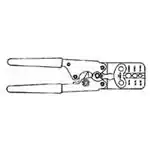
The tool features crimper and anvil jaws, color coded
wire size marking, spring actuated handles with
cushioned hand grips, and a ratchet mechanism which
will not release until the tool handles have been
FULLY closed, thus ensuring a reliable crimp
termination.
Ratchet
NOTE
If the ratchet should need adjustment, refer to
Paragraph 4.2.C.
i
3. CRIMPING PROCEDURES (Figure 2)
1. Close the tool handles until the ratchet releases,
then allow the tool handles to open fully.
2. Select the appropriate cavity for the splice being
crimped.
Cushioned
Hand Grips
Figure 1
1. INTRODUCTION
Hand Crimping Tool 607949-1, a three-cavity, two-jaw
crimping tool is designed to crimp the conductor
portion of insulated heat-shrink splices in the following
range of wire sizes:
• RED - Wire sizes 22 to 16 AWG, outer cavity.
• BLUE - Wire sizes 16 to 14 AWG, middle cavity.
• YELLOW - Wire sizes 12 to 10 AWG, inner cavity.
3. Align conductor portion of terminal in the cavity
as shown in Figure 2.
4. Close the tool carefully until the jaws grip the
terminal lightly and hold it in place without distortion.
5. Insert a properly stripped wire (Figure 2) into the
terminal until it bottoms.
6. To crimp, hold the wire in place, squeeze the
handles until the ratchet releases, allow the jaws to
open FULLY, and remove crimped splice.
4. MAINTENANCE/INSPECTION
4.1. Daily Maintenance
Maintenance and inspection should be performed
regularly. Tool should be wiped clean with special
emphasis on the crimping cavities.
©2012 Tyco Electronics Corporation, Berwyn, PA
TOOLING ASSISTANCE CENTER 1-800-722-1111
All Rights Reserved
PRODUCT INFORMATION 1-800-522-6752
TE logo and Tyco Electronics are trademarks.
*Trademark. Other products, logos, and company names might be trademarks of their respective owners.
This controlled document is subject to change.
For latest revision and Regional Customer Service,
visit our website at www.tycoelectronics.com
1 of 5
LOC B
ORIGINAL INSTRUCTIONS
Hand Crimping Tool 607949-1
(For Insulated Heat Shrink Splices)
�408-4087
Crimping
Jaws
Conductor
Crimp
Area
L
L = 7.14 [.281] 22-16-14 AWG
L= 9.53 [.375] 12-10 AWG
Splice
Stripped Wire
Figure 2
4.2. Periodic Inspection
C. Gaging the Crimping Chamber
Hand tool should be immersed (handles partially
closed) in a reliable commercial degreasing
compound which does not attack paint or plastic
material, to remove accumulated dirt, grease, and
foreign matter. The tool should be re-lubricated after
cleaning. The tool may then be wiped clean with a
soft, lint-free cloth. Do NOT use hard or abrasive
objects that could damage the tool. Ensure that the
tool conforms to the information in Figure 6.
This inspection requires the use of plug gages
conforming to the dimensions in Figure 3.
A. Lubrication
Lubricate all pins, pivot points, and bearing surfaces
with SAE† 20 motor oil as follows:
• Tools used in daily production - lubricate daily
• Tools used daily (occasionally) - lubricate weekly
• Tools used weekly - lubricate monthly
Wipe excess oil from tool, particularly from crimping
area. Oil transferred from the crimping area onto
certain terminations may affect the electrical
characteristics of an application.
B. Visual Inspection
1. Close tool handles until ratchet releases and then
allow them to open freely. If they do not open
quickly and fully, the tool is defective and must be
replaced. See Section 6, REPLACEMENT.
2. Inspect jaws for worn, cracked, or broken areas.
If damage is evident, the tool must be replaced. See
Section 6, REPLACEMENT.
TE Connectivity does not manufacture or market these
gages. To gage the crimping chamber, proceed as
follows:
1. Remove traces of oil or dirt from crimping
chamber and plug gages.
2. Close the tool handles until it is evident that the
jaws have bottomed, then HOLD in this position. Do
NOT force the jaws beyond initial contact.
3. Align the GO element with the crimping chamber.
Push element straight into the crimping chamber
without using force. The GO element must pass
completely through. Refer to Figure 3.
4. Now align the NO-GO element and try to insert it
straight into the same crimping chamber. The NOGO element may start entry but must not pass
completely through as shown in Figure 3.
If the crimping chamber conforms to the gage
inspection, it is considered dimensionally correct and
should be lubricated with a THIN coat of any good
SAE 20 motor oil. If not, the tool must be replaced.
See Section 6, REPLACEMENT.
D. Ratchet Inspection
Obtain a .025 mm [.001 in.] shim that is suitable for
checking the clearance between the bottoming
surfaces of the crimping jaws. (See Figure 3).
Proceed as follows:
1. Select a contact and wire (maximum size) for the
tool (see Figure 3).
† SAE is a trademark.
Rev C
2 of 5
�408-4087
“GO” Element Must
Pass Completely
Through the Section
25.4 [1.00]
Min Typ
GO Element
“”NO-GO” Element May
Enter Partially But Must
Not Pass Completely
Through the Section
Bottoming Surfaces
NO-GO Element
Gage dimension “G” with the handles closed to ratchet stop.
NEST DIMENSION “G”
WIRE SIZE (AWG)
GO DIAMETER
NO-GO-DIAMETER
22 - 16
2.29 [.090]
2.39 [.094]
16 - 14
2.65 [.1045]
2.78 [.1095]
12 - 10
3.68 [.145]
3.84 [.151]
Figure 3
2. Position the contact and wire between the
crimping jaws, according to Section 3, CRIMPING
PROCEDURE (Steps 1 through 6). Holding the wire
in place, squeeze the tool handles together until the
ratchet releases. Hold the tool handles in this
position, maintaining just enough pressure to keep
the jaws closed.
3. Check the clearance between the bottoming
surfaces of the crimping jaws. If the clearance is
025 mm [.001 in.], or less, the ratchet is satisfactory.
If clearance exceeds .025 mm [.001 in.] the ratchet
is out of adjustment and must be adjusted (see
Section 5, TOOL ADJUSTMENT).
E. Tool Force Values
1. Apply force as shown until ratchet releases. The
force at a point 44.45 mm [1.75 in.] from handle
ends should be 35 to 45 pounds. See Figure 4.
Apply Force as Shown Until Ratchet Releases.
The force at Point 44.45 mm [1.75 in.] from the
Handle Ends Should Be 1.88-2.42 kg [35-45 lb.]
44.45
[1.75]
Figure 4
Rev C
3 of 5
�408-4087
Ratchet Locknut
Adjustment Screw
Clockwise to tighten;
Counterclockwise to Loosen
Figure 5
2. To adjust the tool to obtain the proper force
values, open the handles and loosen the locknut
with Spanner Wrench 127298-1 (available from TE).
See Section 5, TOOL ADJUSTMENT.
3. On the opposite side of the tool, turn the eccentric
stud CLOCKWISE to increase the handle load; or
COUNTERCLOCKWISE to decrease the handle
load. Tighten locknut, measure force and continue
to adjust if necessary.
5. TOOL ADJUSTMENT (Figure 5)
If the ratchet must be adjusted, use the spanner
wrench, and proceed as follows:
1. Loosen the ratchet locknut on the back of the tool
(side with wire size markings).
2. Check bottoming of tool jaws according to
Paragraph 4.2.C. Turn screw on front of tool
CLOCKWISE to tighten ratchet (must reduce crimp
height) or COUNTERCLOCKWISE to loosen
ratchet (may increase crimp height).
3. When tool jaws bottom properly, retighten the nut.
NOTE
It may be necessary to hold the ratchet screw while
securing the ratchet locknut.
i
6. REPLACEMENT
This tool is not repairable and a spare should be
stocked to prevent lost time when replacement of tools
is necessary. Order replacement tools through your
representative, or call 1-800-526-5142, or send a
facsimile of your purchase order to 1-717-986-7605, or
write to:
CUSTOMER SERVICE (038-035)
TYCO ELECTRONICS CORPORATION
PO BOX 3608
HARRISBURG PA 17105-3608
7. REVISION SUMMARY
• Updated document to corporate requirements
• Removed “AMPLIVERSAL” in all instances in
document
Rev C
4 of 5
�408-4087
228.6 [9.00]
57.15 [2.25]
4.95 [.195]
Weight: 340 kg [.75 lb.]
Figure 6
Rev C
5 of 5
�