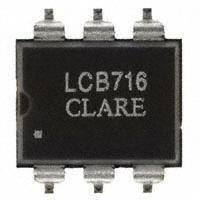
LCB716
60V, 500mA Single-Pole
Normally Closed Relay
INTEGRATED CIRCUITS DIVISION
Parameter
Blocking Voltage
Load Current
On-Resistance (max)
Rating
60
500
2
Units
VP
mArms / mADC
Features
•
•
•
•
•
•
•
3750Vrms Input/Output Isolation
Low Drive Power Requirements
Greater Reliability than Electromechanical Relays
No EMI/RFI Generation
Small 6-Pin Package
Flammability Rating UL 94 V-0
Tape & Reel, Surface Mount Version Available
Applications
•
•
•
•
•
•
•
•
•
•
Description
LCB716 is a single-pole, normally closed (1-Form-B)
solid state relay that uses optically coupled relay
technology to provide an enhanced 3750Vrms
isolation barrier between the input and the output
of the relay. The efficient MOSFET output switch
uses IXYS Integrated Circuits' patented OptoMOS
architecture. The optically coupled output is controlled
by a highly efficient infrared LED.
Approvals
• UL Recognized Component: File E76270
• TUV EN 62368-1: Certificate # B 082667 0008
Ordering Information
Sensor Circuitry
Instrumentation
Multiplexers
Data Acquisition
Electronic Switching
I/O Subsystems
Meters (gas, oil, electric and water)
Medical Equipment-Patient/Equipment Isolation
Security
Industrial Controls
Part #
LCB716
LCB716S
LCB716STR
Description
6-Pin DIP (50/Tube)
6-Pin Surface Mount (50/Tube)
6-Pin Surface Mount (1000/Reel)
Pin Configuration
AC/DC Configuration
+ Control
– Control
Do Not Use
1
6
2
5
3
4
Load
Do Not Use
Load
DC-Only Configuration
+ Control
– Control
Do Not Use
1
6
2
5
3
4
+ Load
– Load
Switching Characteristics
of Normally Closed Devices
Form-B
IF
ILOAD
10%
toff
DS-LCB716-R05
www.ixysic.com
90%
ton
1
�INTEGRATED CIRCUITS DIVISION
LCB716
Absolute Maximum Ratings @ 25ºC
Parameter
Blocking Voltage
Reverse Input Voltage
Input Control Current
Peak (10ms)
Input Power Dissipation 1
Total Power Dissipation 2
Isolation Voltage, Input to Output
Operational Temperature, Ambient
Storage Temperature
1
Derate linearly 1.33 mW / ºC
2
Derate output power linearly 6.67 mW / ºC
Ratings
60
5
50
1
Units
VP
V
mA
A
Absolute Maximum Ratings are stress ratings. Stresses in
excess of these ratings can cause permanent damage to
the device. Functional operation of the device at conditions
beyond those indicated in the operational sections of this
data sheet is not implied.
100
800
3750
-40 to +85
-40 to +125
mW
mW
Vrms
°C
°C
Typical values are characteristic of the device at +25°C,
and are the result of engineering evaluations. They are
provided for information purposes only, and are not part of
the manufacturing testing requirements.
Electrical Characteristics @ 25ºC
Parameter
Output Characteristics
Blocking Voltage
Load Current
Continuous, AC/DC Configuration
Continuous, DC Configuration
Peak
On-Resistance 1
AC/DC Configuration
DC Configuration
Off-State Leakage Current
Output Capacitance
Switching Speeds
Conditions
Symbol
Min
Typ
Max
Units
IL=1A
VDRM
60
-
-
VP
IF=0mA
IL
-
-
500
mArms / mADC
t < 10ms
ILPK
-
-
1000
±1.2
mADC
AP
1.63
0.4
280
2
0.5
1
-
ILEAK
COUT
-
ton
-
0.58
3
toff
-
0.76
3
IF=0mA, IL=500mA
IF=0mA, IL=1000mA
IF=2mA, VL=60V
IF=2mA, VL=50V, f=1MHz
RON
A
pF
Turn-On
Turn-Off
Input Characteristics
Input Control Current to Activate
Input Control Current to Deactivate
Input Voltage Drop
Reverse Input Current
Common Characteristics
IF=5mA, VL=10V
IL=500mA
IF=5mA
VR=5V
IF
IF
VF
IR
0.1
0.9
-
1.36
-
2
1.5
10
mA
mA
V
A
Capacitance, Input to Output
VIO=0V, f=1MHz
CIO
-
3
-
pF
ms
1 Measurement taken within one second of on-time.
2
www.ixysic.com
R05
�INTEGRATED CIRCUITS DIVISION
LCB716
PERFORMANCE DATA*
Typical LED Forward Voltage Drop
(N=50, IF=5mA)
30
Typical Turn-On Time
(N=50, IF=5mA, IL=100mA)
20
25
15
10
Device Count (N)
Device Count (N)
Device Count (N)
25
20
15
10
5
5
0.507
Typical IF for Switch Operation
(N=50, IL=200mA)
25
20
15
10
5
0.16
0.17
0.18
0.19
0.20
LED Forward Current (mA)
10
5
1.53
1.57
1.61
1.65
On-Resistance (:)
Typical Turn-On Time
vs. LED Forward Current
(IL=100mA)
1.3
1.2
421
420
419
418
1.1
-50
0.40
-25
0
25
50
Temperature (ºC)
75
0
100
Typical IF for Switch Operation
vs. Temperature
(IL=100mA)
Turn-On Time (Ps)
0.25
0.20
0.15
0
20
40
60
Temperature (ºC)
80
100
80
Typical Turn-Off Time
vs. LED Forward Current
(IL=100mA)
1.5
1.0
0.5
0
Typical Turn-On Time
vs. Temperature
(IL=100mA)
50
Typical Turn-Off Time
vs. Temperature
(IL=100mA)
4.5
600
500
400
IF=2mA
300
100
-40
10
20
30
40
LED Forward Current (ma)
4.0
IF=5mA
200
-20
76
77
78
79
Blocking Voltage (VP)
2.0
50
700
0.30
0.10
-40
10
20
30
40
LED Forward Current (mA)
800
0.35
75
0
417
1.0
5
2.5
Turn-Off Time (ms)
Turn-On Time (Ps)
1.4
0.83
10
1.69
422
1.5
0.71
0.75
0.79
Turn-Off Time (ms)
15
0
423
IF=10mA
IF=5mA
IF=2mA
0.67
Typical Blocking Voltage
(N=50, IF=2mA)
Turn-Off Time (ms)
LED Forward Voltage Drop (V)
0.63
15
Typical LED Forward Voltage Drop
vs. Temperature
1.6
5
20
1.49
1.7
10
Typical On-Resistance
(N=50, IF=0mA, IL=5mA)
0.21
1.8
15
0.622
0
0
LED Current (mA)
0.530 0.553 0.576 0.599
Turn-On Time (ms)
20
Device Count (N)
Device Count (N)
1.366
1.368
1.370
1.372
LED Forward Voltage Drop (V)
Device Count (N)
1.364
20
0
0
0
Typical Turn-Off Time
(N=50, IF=5mA, IL=100mA)
3.5
IF=2mA
3.0
2.5
2.0
1.5
IF=5mA
1.0
-20
0
20
40
60
Temperature (ºC)
80
100
0.5
-40
-20
0
20
40
60
Temperature (ºC)
80
100
*Unless otherwise noted, data presented in these graphs is typical of device operation at 25ºC.
R05
www.ixysic.com
3
�INTEGRATED CIRCUITS DIVISION
LCB716
PERFORMANCE DATA*
Typical On-Resistance
vs. Temperature
(IF=0mA, IL=100mA)
1.4
1.3
0.6
0.6
0.5
0.4
0.4
0.3
0.2
1.2
0.1
1.1
-40
0.0
-20
0
20
40
60
Temperature (ºC)
80
Typical Blocking Voltage
vs. Temperature
(IF=5mA)
350
90
88
86
84
82
-20
0
20
40
60
Temperature (ºC)
80
100
Typical Load Voltage
vs. Load Current
(IF=0mA)
0.2
0.0
-0.2
-0.4
-40
100
92
80
-40
Load Current (A)
1.5
94
Blocking Voltage (VP)
Load Current (A)
1.6
Leakage Current (nA)
On-Resistance (:)
1.7
-20
0
20
40
60
Temperature (ºC)
80
-0.6
-1.0 -0.75 -0.5 -0.25 0.0 0.25 0.5
Load Voltage (V)
100
Typical Leakage vs.Temperature
Measured Across Pins 4&6
(IF=5mA, VL=60V)
1.0
Energy Rating Curve
300
1.3
250
200
150
100
1.1
0.9
0.7
0.5
50
0
-40
0.75
1.5
Load Current (A)
1.8
Maximum Load Current vs. Temperature
(IF=0mA)
-20
0
20
40
60
Temperature (ºC)
80
100
0.3
10Ps 100Ps 1ms 10ms 100ms
Time
1s
10s
100s
*Unless otherwise noted, data presented in these graphs is typical of device operation at 25ºC.
4
www.ixysic.com
R05
�INTEGRATED CIRCUITS DIVISION
LCB716
Manufacturing Information
Moisture Sensitivity
All plastic encapsulated semiconductor packages are susceptible to moisture ingression. IXYS Integrated
Circuits classifies its plastic encapsulated devices for moisture sensitivity according to the latest version of
the joint industry standard, IPC/JEDEC J-STD-020, in force at the time of product evaluation. We test all of
our products to the maximum conditions set forth in the standard, and guarantee proper operation of our devices
when handled according to the limitations and information in that standard as well as to any limitations set forth in the
information or standards referenced below.
Failure to adhere to the warnings or limitations as established by the listed specifications could result in reduced product
performance, reduction of operable life, and/or reduction of overall reliability.
This product carries a Moisture Sensitivity Level (MSL) classification as shown below, and should be handled
according to the requirements of the latest version of the joint industry standard IPC/JEDEC J-STD-033.
Device
Moisture Sensitivity Level (MSL) Classification
LCB716S
MSL 1
ESD Sensitivity
This product is ESD Sensitive, and should be handled according to the industry standard JESD-625.
Soldering Profile
Provided in the table below is the IPC/JEDEC J-STD-020 Classification Temperature (TC) and the maximum total dwell
time (tP) in all reflow processes that the body temperature of these surface mount devices may be (TC - 5)°C or greater.
The device’s body temperature must not exceed the Classification Temperature at any time during reflow soldering
processes.
Device
Classification Temperature (Tc)
Dwell Time (tP)
Max Reflow Cycles
LCB716S
250ºC
30 seconds
3
For through-hole devices, the maximum pin temperature and maximum dwell time through all solder waves is
provided in the table below. Dwell time is the interval beginning when the pins are initially immersed into the solder
wave until they exit the solder wave. For multiple waves, the dwell time is from entering the first wave until exiting the
last wave. During this time, pin temperatures must not exceed the maximum temperature given in the table below.
Body temperature of the device must not exceed the limit shown in the table below at any time during the soldering
process.
Device
LCB716
Maximum Pin Temperature
260ºC
Maximum Body Temperature
250ºC
Maximum Dwell Time
10 seconds*
Wave Cycles
1
*Total cumulative duration of all waves.
Board Wash
IXYS Integrated Circuits recommends the use of no-clean flux formulations. Board washing to reduce or remove flux
residue following the solder reflow process is acceptable provided proper precautions are taken to prevent damage to
the device. These precautions include but are not limited to: using a low pressure wash and providing a follow up bake
cycle sufficient to remove any moisture trapped within the device due to the washing process. Due to the variability
of the wash parameters used to clean the board, determination of the bake temperature and duration necessary
to remove the moisture trapped within the package is the responsibility of the user (assembler). Cleaning or drying
methods that employ ultrasonic energy may damage the device and should not be used. Additionally, the device must
not be exposed to halide flux or solvents.
R05
www.ixysic.com
5
�INTEGRATED CIRCUITS DIVISION
LCB716
Mechanical Dimensions
LCB716
8.382±0.381
(0.330±0.015)
PCB Hole Pattern
7.239 TYP
(0.285 TYP)
2.54±0.127
(0.100±0.005)
6 - 0.800 DIA.
(6 - 0.031 DIA.)
9.144±0.508
(0.360±0.020)
6.350±0.127
(0.250±0.005)
1.524 TYP
(0.060 TYP)
Pin 1
1.651±0.254
(0.065±0.010)
2.540±0.127
(0.100±0.005)
7.620±0.127
(0.300±0.005)
7.620±0.254
(0.300±0.010)
0.254±0.0127
(0.010±0.0005)
5.080±0.127
(0.200±0.005)
Controlling dimension: inches
3.302±0.051
(0.130±0.002)
4.064 TYP
(0.160 TYP)
Dimensions
mm
(inches)
0.457±0.076
(0.018±0.003)
LCB716S
8.382±0.381
(0.330±0.015)
9.524±0.508
(0.375±0.020)
Pin 1
0.635±0.127
(0.025±0.005)
2.54
(0.10)
6.350±0.127
(0.250±0.005)
0.457±0.076
(0.018±0.003)
1.651±0.254
(0.065±0.010)
7.620±0.254
(0.300±0.010)
0.254±0.0127
(0.010±0.0005)
8.90
(0.3503)
1.65
(0.0649)
0.65
(0.0255)
3.302±0.051
(0.130±0.002)
4.445±0.254
(0.175±0.010)
Controlling dimension: inches
1.524 TYP
(0.060 TYP)
1.651±0.254
(0.065±0.010)
6
PCB Land Pattern
2.54±0.127
(0.100±0.005)
Dimensions
mm
(inches)
www.ixysic.com
R05
�INTEGRATED CIRCUITS DIVISION
LCB716
LCB716STR Tape & Reel
P1 = 12.00
(0.472)
330.2 Dia
(13.00 Dia)
Top Cover
Tape Thickness
0.102 Max
(0.004 Max)
W=16.00
(0.63)
B0 = 10.10
(0.398)
K0 = 4.90
(0.19)
K1 = 3.80
(0.15)
A0 = 10.10
(0.398)
User Direction of Feed
Embossed
Carrier
Embossment
Dimensions
mm
(inches)
NOTES:
1. All dimensions carry tolerances of EIA Standard 481-2
2. The tape complies with all “Notes” for constant dimensions listed on page 5 of EIA-481-2
For additional information please visit our website at: https://www.ixysic.com
Disclaimer Notice - Information furnished is believed to be accurate and reliable. However, users should independently evaluate the suitability of and
test each product selected for their own applications. Littelfuse products are not designed for, and may not be used in, all applications.
Read complete Disclaimer Notice at https://www.littelfuse.com/disclaimer-electronics.
7
Specification: DS-LCB716-R05
©Copyright 2021, Littelfuse, Inc.
OptoMOS® is a registered trademark of IXYS Integrated Circuits
All rights reserved. Printed in USA.
11/3/2021
�