KJ‐33000‐002
Joystick I2C Development Kit Programming and Application Note
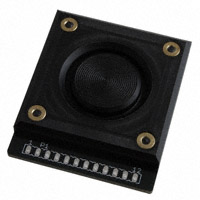
KJ‐33000 Installed within the Development Kit.
Knowles Acoustics
1151 Maplewood Drive Itasca, IL 60143
Revision: A Release Level: ACTIVE Sheet 1 of 5
©2011 Knowles Electronics
�KJ‐33000‐002
1. DESCRIPTION AND APPLICATION 1.1. DESCRIPTION
The KJ‐33000‐002 is a developer’s kit that includes the installed KJ‐3300 Joystick. The Joystick is a digital joystick that communicates via an I2C interface. This Application Note describes how to communicate with the Joystick.
1.2.
APPLICATION
The Joystick is developed for hand held telecommunication and electronic devices. Refer to manufacturer’s website (www.knowles.com) for current application notes.
2. I C Interface
2
The I2C controller can operate up to 400kHz (fast mode). Seven‐bit addressing is implemented. The preprogrammed I2C address is 0x38. If the ADDR line is tied to VDD, the device will respond to address 0x39. A read initiated from the device returns two bytes. The first byte contains a left justified 4 bit value for the X axis while the second byte contains a left justified 4 bit value for the Y axis. The least significant 4 bits of both bytes are zero filled. A write initiated to the device will send it into either Low Power Mode or Sleep Mode depending on the value of the least significant bit. A ‘1’ corresponds to Low Power Mode while a ‘0’ corresponds to Sleep Mode. The open drain interrupt line is asserted (low level) on a change in either the X or Y value. No interrupts are generated when there are consecutive zeros on both axes.
3. Programming Examples 3.1. Communication to the Joystick
Communicating with the joystick using the I2C bus, simply send the start condition, send the address of the device (0x38 or 0x39 based on the ADDR Pin) indicating a read operation. When an Idle condition exists, read a byte from the device ( X displacement ), issue an acknowledgement, then on the next idle, read another byte from the device ( Y‐ displacement ). Finally, issue a no‐acknowledgement, wait for an idle condition and issue a stop condition.
Revision: A Release Level: ACTIVE Sheet 2 of 5
©2011 Knowles Electronics
�KJ‐33000‐002
Sample:
IdleI2C (); // Wait for an Idle Condition StartI2C (); // Issue a Start Condition IdleI2C (); // Wait for an Idle Condition address = 0x38 operator. JoystickX = JoystickX >> 4;
JoystickY = JoystickY >> 4;
Each of the Joystick variables is now a number between 0 and 15 (4 bits). A lookup table consisting of a simple 16 byte array could be used to translate the value output by the joystick to a more relevant number. For example, the array:
char Xspeed[16] = {0,1,2,3,4,5,6,7,0,‐1,‐2,‐3,‐4,‐5,‐6,‐7};
would be used to translate the actual output of the device to a real, displacement number. Please note that due to the most significant bit indicating positive or negative displacement, there are 2 possibilities of zero in the joystick. 0b1000 is the same as 0b0000. The data in the array will then translate actual displacement to a number corresponding to the physical position of the stick. Lookup tables could also be used to expand the 4 bit value to a signed 8 bit value. For example:
Revision: A Release Level: ACTIVE Sheet 3 of 5
©2011 Knowles Electronics
�KJ‐33000‐002
char Xspeed[16] = {0,15,31,47,63,79,95,111,0,‐15,‐31,‐47,‐63,‐79,‐95,‐111}; linearly expands the value output by the joystick by indexing the JoystickX value in the array.
LookupXSpeed = Xspeed[JoystickX];
3.3.
Low Power Modes
There are two low power modes to the joystick; low power and sleep mode. To put the joystick into low power mode, a simple write to the joystick with the least significant bit being a one is required. To put the joystick into sleep mode, the least significant bit of the write must be a zero. Sample:
IdleI2C (); // Wait for an Idle Condition StartI2C (); // Issue a Start Condition IdleI2C (); // Wait for an Idle Condition address = 0x38
很抱歉,暂时无法提供与“KJ-33000-002”相匹配的价格&库存,您可以联系我们找货
免费人工找货






 工商网监
湘ICP备2023018690号
工商网监
湘ICP备2023018690号