1 MEG x 18, 512K x 36
2.5V VDD, HSTL, QDRb4 SRAM
18Mb QDR™ SRAM
4-WORD BURST
MT54V1MH18E
MT54V512H36E
Features
• Separate independent read and write data ports with
concurrent transactions
• 100 percent bus utilization DDR READ and WRITE
operation
• Fast clock to valid data times
• High frequency operation with future migration to
higher clock frequencies
• Full data coherency, providing most current data
• Four-tick burst counter for reduced-address frequency
• Double data rate operation on read and write ports
• Two input clocks (K and K#) for precise DDR timing at
clock rising edges only
• Two output clocks (C and C#) for precise flight time
and clock skew matching—clock and data delivered
together to receiving device
• Optional-use echo clocks (CQ and CQ#) for flexible
receive data synchronization
• Single address bus
• Simple control logic for easy depth expansion
• Internally self-timed, registered writes
• 2.5V core and 1.5 to 1.8V (±0.1V) HSTL I/O
• Clock-stop capability
• 13mm x 15mm, 1mm pitch, 11 x 15 grid FBGA package
• User-programmable impedance output
• JTAG boundary scan
Options
• Clock Cycle Timing
5ns (200 MHz)
6ns (167 MHz)
7.5ns (133 MHz)
10ns (100 MHz)
• Configurations
1 Meg x 18
512K x 36
• Package
165-ball, 13mm x 15mm FBGA
• Operating Temperature Range
Commercial (0°C £ TA £ +70°C)
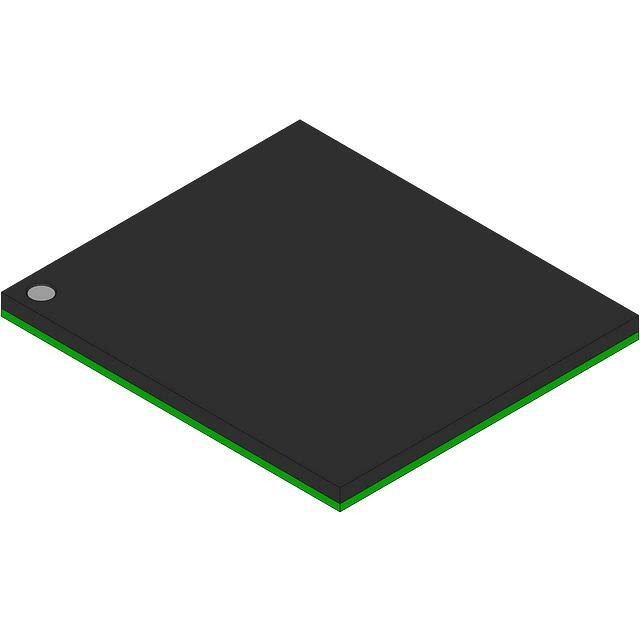
Figure 1: 165-Ball FBGA
Table 1:
PART NUMBER
DESCRIPTION
MT54V1MH18EF-xx
MT54V512H36EF-xx
1 Meg x 18, QDRb4 FBGA
512K x 36, QDRb4 FBGA
General Description
The Micron® QDR™ (Quad Data Rate™) synchronous, pipelined burst SRAM employs high-speed, lowpower CMOS designs using an advanced 6T CMOS
process.
The QDR architecture consists of two separate DDR
(double data rate) ports to access the memory array.
The read port has dedicated data outputs to support
READ operations. The write port has dedicated data
inputs to support WRITE operations. This architecture
eliminates the need for high-speed bus turnaround.
Access to each port is accomplished using a common
address bus. Addresses for reads and writes are latched
on alternate rising edges of the K clock. Each address
location is associated with four words that burst
sequentially into or out of the device. Since data can be
transferred into and out of the device on every rising
edge of both clocks (K, and K# and C and C#) memory
bandwidth is maximized and system design is simplified by eliminating bus turnarounds.
Marking1
-5
-6
-7.5
-10
MT54V1MH18E
MT54V512H36E
F
None
NOTE:
1. A Part Marking Guide for the FBGA devices can be found on
Micron’s Web site—http://www.micron.com/numberguide.
18Mb: 2.5V VDD, HSTL, QDRb4 SRAM
MT54V1MH18E_16_F.fm – Rev. F, Pub. 3/03
Valid Part Numbers
1
©2003 Micron Technology, Inc.
�1 MEG x 18, 512K x 36
2.5V VDD, HSTL, QDRb4 SRAM
Depth expansion is accomplished with port selects
for each port (read R#, write W#) which are received at
K rising edge. Port selects permit independent port
operation.
All synchronous inputs pass through registers controlled by the K or K# input clock rising edges. Active
LOW byte writes (BWx#) permit byte write or nibble
write selection. Write data and byte writes are registered on the rising edges of both K and K#. The
addressing within each burst of four is fixed and
sequential, beginning with the lowest and ending with
the highest address. All synchronous data outputs pass
through output registers controlled by the rising edges
of the output clocks (C and C# if provided, otherwise K
and K#).
Four balls are used to implement JTAG test capabilities: test mode select (TMS), test data-in (TDI), test
clock (TCK), and test data-out (TDO). JTAG circuitry is
used to serially shift data to and from the SRAM. JTAG
inputs use JEDEC-standard 2.5V I/O levels to shift data
during this testing mode of operation.
The SRAM operates from a 2.5V power supply, and
all inputs and outputs are HSTL-compatible. The
device is ideally suited for applications that benefit
from a high-speed, fully-utilized DDR data bus.
Please refer to Micron’s Web site (www.micron.com/
sramds) for the latest data sheet.
READ cycles are pipelined. The request is initiated
by asserting R# LOW at K rising edge. Data is delivered
after the next rising edge of K, using C and C# as the
output timing references, or using K and K# if C and C#
are tied HIGH. If C and C# are tied HIGH, they may not
be toggled during device operation. Output tri-stating
is automatically controlled such that the bus is
released if no data is being delivered. This permits
banked SRAM systems with no complex output enable
(OE) timing generation. Back-to-back READ cycles are
initiated every second K rising edge. Any command in
between is ignored, since the burst sequence may not
be interrupted and requires two full clock cycles.
WRITE cycles are initiated by W# LOW at K rising
edge. Data is expected at both rising edges of K and K#,
beginning one clock period later. Write registers are
incorporated to facilitate pipelined self-timed WRITE
cycles and provide fully coherent data for all combinations of reads and writes. A read can immediately follow a write even if they are to the same address.
Although the write data has not been written to the
memory array, the SRAM will deliver the data from the
write register instead of using the older data from the
memory array. The latest data is always utilized for all
bus transactions. WRITE cycles are initiated every second K rising edge. Any command is ignored, since the
burst sequence may not be interrupted.
READ/WRITE Operations
BYTE WRITE Operations
All bus transactions operate on an uninterruptable
burst of four data, requiring two full clock cycles of bus
utilization. Any request that attempts to interrupt a
burst-in-progress is ignored. The resulting benefit is
that the address rate is kept down to the clock frequency even when both buses are 100 percent utilized.
BYTE WRITE operations are supported. The active
LOW byte write controls are registered coincident with
their corresponding data. This feature can eliminate
the need for some READ-MODIFY-WRITE cycles, collapsing it to a single BYTE WRITE operation in some
instances.
18Mb: 2.5V VDD, HSTL, QDRb4 SRAM
MT54V1MH18E_16_F.fm – Rev. F, Pub. 3/03
2
Micron Technology, Inc., reserves the right to change products or specifications without notice.
©2003 Micron Technology, Inc.
�1 MEG x 18, 512K x 36
2.5V VDD, HSTL, QDRb4 SRAM
Programmable Impedance Output
Buffer
It is strontly recommended that the clocks operate for
a number of cycles prior to initiating commands to the
SRAM. This delay permits transmission line charging
effects to be overcome and allows the clock timing to
be nearer to its steady-state value.
The QDR SRAM is equipped with programmable
impedance output buffers. This allows a user to match
the driver impedance to the system. To adjust the
impedance, an external precision resistor (RQ) is connected between the ZQ ball and VSS. The value of the
resistor must be five times the desired impedance. For
example, a 350W resistor is required for an output
impedance of 70W . To ensure that output impedance
is one-fifth the value of RQ (within 15 percent), the
range of RQ is 175W to 350W . Alternately, the ZQ ball
can be connected directly to VDDQ, which will place
the device in a minimum impedance mode.
Output impedance updates may be required
because over time variations may occur in supply voltage and temperature. The device samples the value of
RQ. Impedance updates are transparent to the system;
they do not affect device operation, and all data sheet
timing and current specifications are met during an
update.
The device will power up with an output impedance
set at 50W . To guarantee optimum output driver
impedance after power-up, the SRAM needs 1,024
cycles to update the impedance. The user can operate
the part with fewer than 1,024 clock cycles, but optimal
output impedance is not guaranteed.
Single Clock Mode
The SRAM can be used with the single K, K# clock
pair by tying C and C# HIGH. In this mode, the SRAM
will use K and K# in place of C and C#. This mode provides the most rapid data output but does not compensate for system clock skew and flight times.
The output echo clocks are precise references to
output data. CQ and CQ# are both rising edge and falling edge accurate and are 180° out of phase. Either or
both may be used for output data capture. K or C rising
edge triggers CQ rising and CQ# falling edge. CQ rising
edge indicates first data response for QDRI and DDRI
(version 1, non-DLL) SRAM, while CQ# rising edge
indicates first data response for QDRII and DDRII (version 2, DLL) SRAM.
Depth Expansion
Port select inputs are provided for the read and
write ports. This allows for easy depth expansion. Both
port selects are sampled on the rising edge of K only.
Each port can be independently selected and deselected and does not affect the operation of the opposite port. All pending transactions are completed prior
to a port deselect.
Clock Considerations
This device does not utilize internal phase-locked
loops and can therefore be placed into a stopped-clock
state to minimize power without lengthy restart times.
18Mb: 2.5V VDD, HSTL, QDRb4 SRAM
MT54V1MH18E_16_F.fm – Rev. F, Pub. 3/03
3
Micron Technology, Inc., reserves the right to change products or specifications without notice.
©2003 Micron Technology, Inc.
�1 MEG x 18, 512K x 36
2.5V VDD, HSTL, QDRb4 SRAM
Figure 2: Functional Block Diagram
1 Meg x 18; 512K x 36
n
ADDRESS
R#
W#
n
ADDRESS
REGISTRY
& LOGIC
K
W#
BW0#
BW1#
MUX
2a
a
D (Data In)
R#
DATA
REGISTRY
& LOGIC
2a
K
WR
R E
I G
T
E 2
WD
R R
I I
T V
E E
R
2n x a
MEMORY
ARRAY
2a
S
E A
NM
S P
E S
2a
O
U
T
P
U
T
S
E
L
E
C
T
O
U
T
P
U
T
B
U
F
F
E
R
a
Q
(Data Out)
2
C
MUX
K
K#
RO
E U 3a
G T
P
AU
T
C,C#
or
K,K#
CQ, CQ#
(Echo Clock Out)
NOTE:
1. Figure 2 illustrates simplified device operation. See truth table, ball descriptions, and timing diagrams for detailed
information.
2. For 1 Meg x 18, n = 18, a = 18.
For 512K x 36, n = 17, a = 36.
18Mb: 2.5V VDD, HSTL, QDRb4 SRAM
MT54V1MH18E_16_F.fm – Rev. F, Pub. 3/03
4
Micron Technology, Inc., reserves the right to change products or specifications without notice.
©2003 Micron Technology, Inc.
�1 MEG x 18, 512K x 36
2.5V VDD, HSTL, QDRb4 SRAM
Figure 3: Application Example
SRAM 1
Vt
R
D
SA
B
R W W
# # #
R = 250Ω
ZQ
Q
CQ
CQ#
C C# K K#
DATA IN
DATA OUT
Address
Read#
Write#
BW#
SRAM 2
B
R W W
# # #
D
SA
R
R = 250Ω
ZQ
Q
CQ
CQ#
C C# K K#
Vt
Vt
BUS
MASTER SRAM 1 Input CQ
(CPU SRAM 1 Input CQ#
SRAM 2 Input CQ
or
ASIC) SRAM 2 Input CQ#
Source K
Source K#
Delayed K
Delayed K#
R
R = 50Ω Vt = VREF
NOTE:
1. Consult Micron Technical Notes for more thorough discussions of clocking schemes.
2. Data capture is possible using only one of the two signals. CQ and CQ# clocks are optional use outputs.
3. For high frequency applications (200 MHz and faster) the CQ and CQ# clocks (for data capture) are recommended
over the C and C# clocks (for data alignment). The C and C# clocks are optional use inputs.
18Mb: 2.5V VDD, HSTL, QDRb4 SRAM
MT54V1MH18E_16_F.fm – Rev. F, Pub. 3/03
5
Micron Technology, Inc., reserves the right to change products or specifications without notice.
©2003 Micron Technology, Inc.
�1 MEG x 18, 512K x 36
2.5V VDD, HSTL, QDRb4 SRAM
Table 2:
1 Meg x 18 Ball Layout (Top View)
165-Ball FBGA
1
2
3
1
4
5
6
7
8
9
10
11
A
CQ#
VSS
NC/SA
W#
BW1#
K#
NC
R#
SA
VSS
CQ
B
NC
Q9
D9
SA
NC
K
BW0#
SA
NC
NC
Q8
C
NC
NC
D10
VSS
SA
NC
SA
VSS
NC
Q7
D8
D
NC
D11
Q10
VSS
VSS
VSS
VSS
VSS
NC
NC
D7
E
NC
NC
Q11
VDDQ
VSS
VSS
VSS
VDDQ
NC
D6
Q6
F
NC
Q12
D12
VDDQ
VDD
VSS
VDD
VDDQ
NC
NC
Q5
G
NC
D13
Q13
VDDQ
VDD
VSS
VDD
VDDQ
NC
NC
D5
H
NC
VREF
VDDQ
VDDQ
VDD
VSS
VDD
VDDQ
VDDQ
VREF
ZQ
J
NC
NC
D14
VDDQ
VDD
VSS
VDD
VDDQ
NC
Q4
D4
K
NC
NC
Q14
VDDQ
VDD
VSS
VDD
VDDQ
NC
D3
Q3
L
NC
Q15
D15
VDDQ
VSS
VSS
VSS
VDDQ
NC
NC
Q2
M
NC
NC
D16
VSS
VSS
VSS
VSS
VSS
NC
Q1
D2
N
NC
D17
Q16
VSS
SA
SA
SA
VSS
NC
NC
D1
P
NC
NC
Q17
SA
SA
C
SA
SA
NC
D0
Q0
R
TDO
TCK
SA
SA
SA
C#
SA
SA
SA
TMS
TDI
NOTE:
1. Expansion address: 3A for 36Mb
18Mb: 2.5V VDD, HSTL, QDRb4 SRAM
MT54V1MH18E_16_F.fm – Rev. F, Pub. 3/03
6
Micron Technology, Inc., reserves the right to change products or specifications without notice.
©2003 Micron Technology, Inc.
�1 MEG x 18, 512K x 36
2.5V VDD, HSTL, QDRb4 SRAM
Table 3:
512K x 36 Ball Layout (Top View)
165-Ball FBGA
1
2
3
4
5
6
1
7
8
2
9
3
10
11
A
CQ#
VSS
NC
W#
BW2#
K#
BW1#
R#
VSS/SA
VSS
CQ
B
Q27
Q18
D18
SA
BW3#4
K
BW0#5
SA
D17
Q17
Q8
C
D27
Q28
D19
VSS
SA
NC
SA
VSS
D16
Q7
D8
D
D28
D20
Q19
VSS
VSS
VSS
VSS
VSS
Q16
D15
D7
E
Q29
D29
Q20
VDDQ
VSS
VSS
VSS
VDDQ
Q15
D6
Q6
F
Q30
Q21
D21
VDDQ
VDD
VSS
VDD
VDDQ
D14
Q14
Q5
G
D30
D22
Q22
VDDQ
VDD
VSS
VDD
VDDQ
Q13
D13
D5
H
NC
VREF
VDDQ
VDDQ
VDD
VSS
VDD
VDDQ
VDDQ
VREF
ZQ
J
D31
Q31
D23
VDDQ
VDD
VSS
VDD
VDDQ
D12
Q4
D4
K
Q32
D32
Q23
VDDQ
VDD
VSS
VDD
VDDQ
Q12
D3
Q3
L
Q33
Q24
D24
VDDQ
VSS
VSS
VSS
VDDQ
D11
Q11
Q2
M
D33
Q34
D25
VSS
VSS
VSS
VSS
VSS
D10
Q1
D2
N
D34
D26
Q25
VSS
SA
SA
SA
VSS
Q10
D9
D1
P
Q35
D35
Q26
SA
SA
C
SA
SA
Q9
D0
Q0
R
TDO
TCK
SA
SA
SA
C#
SA
SA
SA
TMS
TDI
NOTE:
1. BW2# controls writes to D18:D26
2. BW1# controls writes to D9:D17
3. Expansion address: 9A for 36Mb
4. BW3# controls writes to D27:D35
5. BW0# controls writes to D0:D8
18Mb: 2.5V VDD, HSTL, QDRb4 SRAM
MT54V1MH18E_16_F.fm – Rev. F, Pub. 3/03
7
Micron Technology, Inc., reserves the right to change products or specifications without notice.
©2003 Micron Technology, Inc.
�1 MEG x 18, 512K x 36
2.5V VDD, HSTL, QDRb4 SRAM
Table 4:
Ball Descriptions
SYMBOL
TYPE
DESCRIPTION
BW_#
Input
C
C#
Input
D_
Input
K
K#
Input
R#
Input
SA
Input
TCK
Input
TMS
TDI
VREF
Input
Input
W#
Input
ZQ
Input
Synchronous Byte Writes: When LOW, these inputs cause their respective bytes to be registered and
written if W# had initiated a WRITE cycle. These signals must meet setup and hold times around the
rising edges of K and K# for each of the four rising edges comprising the WRITE cycle. See Ball Layout
figures for signal to data relationships.
Output Clock: This clock pair provides a user-controlled means of tuning device output data. The rising
edge of C# is used as the output timing reference for first output data. The rising edge of C is used as
the output reference for second output data. Ideally, C# is 180 degrees out of phase with C. C and C#
may be tied HIGH to force the use of K and K# as the output reference clocks instead of having to
provide C and C# clocks. If tied HIGH, these inputs may not be allowed to toggle during device
operation.
Synchronous Data Inputs: Input data must meet setup and hold times around the rising edges of K and
K# during WRITE operations. See Ball Layout figures for ball site location of individual signals. The x18
device uses D0:D17, and the x36 device uses D0:D35.
Input Clock: This input clock pair registers address and control inputs on the rising edge of K, and
registers data on the rising edge of K and the rising edge of K#. K# is ideally 180 degrees out of phase
with K. All synchronous inputs must meet setup and hold times around the clock rising edges.
Synchronous Read: When LOW, this input causes the address inputs to be registered and a READ cycle
to be initiated. This input must meet setup and hold times around the rising edge of K and is ignored
on the subsequent rising edge of K.
Synchronous Address Inputs: These inputs are registered and must meet the setup and hold times
around the rising edge of K. See Ball Layout figures for address expansion inputs. All transactions
operate on a burst of four words (two clock periods of bus activity). These inputs are ignored when
both ports are deselected.
IEEE 1149.1 Clock Input: 2.5V I/O levels. This ball must be tied to VSS if the JTAG function is not used in
the circuit.
IEEE 1149.1 Test Inputs: 2.5V I/O levels. These balls may be left as No Connects if the JTAG function is
not used in the circuit.
HSTL Input Reference Voltage: Nominally VDDQ/2, but may be adjusted to improve system noise
margin. Provides a reference voltage for the HSTL input buffer trip point.
Synchronous Write: When LOW, this input causes the address inputs to be registered and a WRITE
cycle to be initiated. This input must meet setup and hold times around the rising edge of K and is
ignored on the subsequent rising edge of K. This input is also ignored if a READ cycle is being initiated.
Output Impedance Matching Input: This input is used to tune the device outputs to the system data
bus impedance. DQ output impedance is set to 0.2 x RQ, where RQ is a resistor from this ball to
ground. Alternately, this ball can be connected directly to VDDQ to enable the minimum impedance
mode. This ball cannot be connected directly to GND or left unconnected.
Synchronous Echo Clock Outputs: The edges of these outputs are tightly matched to the synchronous
data outputs and can be used as data valid indication. These signals run freely and do not stop when Q
tri-states.
Synchronous Data Outputs: Output data is synchronized to the respective C and C# or to K and K#
rising edges if C and C# are tied HIGH. This bus operates in response to R# commands. See Ball Layout
figures for ball site location of individual signals. The x18 device uses Q0:Q17, and the x36 device uses
Q0:35.
IEEE 1149.1 Test Output: 2.5V I/0 level.
Power Supply: 2.5V nominal. See DC Electrical Characteristics and Operating Conditions for range.
Power Supply: Isolated Output Buffer Supply. Nominally, 1.5V. 1.8V is also permissible. See DC Electrical
Characteristics and Operating Conditions for range.
Power Supply: GND.
No Connect: These balls are internally connected to the die, but have no function and may be left not
connected to the board to minimize ball count.
CQ#, CQ Output
Q_
Output
TDO
VDD
VDDQ
Output
Supply
Supply
VSS
NC
Supply
–
18Mb: 2.5V VDD, HSTL, QDRb4 SRAM
MT54V1MH18E_16_F.fm – Rev. F, Pub. 3/03
8
Micron Technology, Inc., reserves the right to change products or specifications without notice.
©2003 Micron Technology, Inc.
�1 MEG x 18, 512K x 36
2.5V VDD, HSTL, QDRb4 SRAM
Figure 4:
Bus Cycle State Diagram
RD
LOAD NEW
READ ADDRESS;
R_Count=0;
R_Init=1
RD & R_Count=4
always
READ DOUBLE;
R_Count=R_Count+2
always
R_Count=2
INCREMENT READ
ADDRESS BY TWO1
R_Init=0
/RD & R_Count=4
WT & R_Init=0
READ PORT NOP
R_Init=0
/RD
Supply
voltage
provided
POWER-UP
Supply
voltage
provided
LOAD NEW
WRITE ADDRESS;
W_Count=0
WT & W_Count=4
WRITE DOUBLE;
W_Count=W_Count+2
always
always
INCREMENT WRITE
ADDRESS BY TWO1
WRITE PORT NOP
/WT
W_Count=2
/WT & W_Count=4
NOTE:
1. The address is concatenated with two additional internal LSBs to facilitate BURST operation. The address order is
always fixed as: xxx...xxx+0, xxx...xxx+1, xxx...xxx+2, xxx...xxx+3. Bus cycle is terminated at the end of this sequence
(burst count = 4).
2. State transitions: RD = (R# = LOW); WT = (W# = LOW).
3. Read and write state machines can be simultaneously active. Read and write cannot be simultaneously initiated;
read takes precendence.
4. State machine, control timing sequence is controlled by K.
18Mb: 2.5V VDD, HSTL, QDRb4 SRAM
MT54V1MH18E_16_F.fm – Rev. F, Pub. 3/03
9
Micron Technology, Inc., reserves the right to change products or specifications without notice.
©2003 Micron Technology, Inc.
�1 MEG x 18, 512K x 36
2.5V VDD, HSTL, QDRb4 SRAM
Table 5:
Truth Table
Notes 1–8
OPERATION
WRITE Cycle:
Load address, input write data on
two consecutive K and K# rising
edges
READ Cycle:
Load address, output data on two
consecutive C and C# rising edges
NOP: No operation
STANDBY: Clock stopped
Table 6:
K
R#
W#
D or Q
D or Q
D or Q
D or Q
L®H
X
L
DA(A0)
at
K(t)
DA(A0 + 1)
at
K#(t + 1)
DA(A0 + 2)
at
K(t+ 2)
DA(A0 + 3)
at
K#(t + 3)
L®H
L
X
QA(A0)
at
C#(t)
QA(A0 + 1)
at
C(t + 1)
QA(A0 + 2)
at
C#(t + 2)
QA(A0 + 3)
at
C(t + 3)
L®H
H
H
Stopped
X
X
D=X
Q = High-Z
Previous
State
D=X
Q = High-Z
Previous
State
D=X
Q = High-Z
Previous
State
D=X
Q = High-Z
Previous
State
BYTE WRITE Operation
Notes 9, 10
OPERATION
K
K#
L®H
WRITE D0–17 at K rising edge
WRITE D0–17 at K# rising edge
WRITE D0–8 at K rising edge
WRITE D0–8 at K# rising edge
WRITE D9–17 at K rising edge
WRITE D9–17 at K# rising edge
WRITE nothing at K rising edge
WRITE nothing at K# rising edge
L®H
L®H
L®H
L®H
L®H
L®H
L®H
BW0#
BW1#
0
0
0
0
1
1
1
1
0
0
1
1
0
0
1
1
NOTE:
1. X means “Don’t Care.” H means logic HIGH. L means logic LOW. means rising edge; ¯ means falling edge.
2. Data inputs are registered at K and K# rising edges. Data outputs are delivered at C and C# rising edges, except if C
and C# are HIGH, then data outputs are delivered at K and K# rising edges.
3. R# and W# must meet setup and hold times around the rising edge (LOW to HIGH) of K and are registered at the rising edge of K.
4. This device contains circuitry that will ensure the outputs will be in High-Z during power-up.
5. Refer to state diagram and timing diagrams for clarification. A0 refers to the initial address input during a WRITE or
READ cycle. A0+1 refers to the next internal burst address in accordance with the burst sequence.
6. It is recommended that K = K# = C = C# when clock is stopped. This is not essential, but permits most rapid restart by
overcoming transmission line charging symmetrically.
7. If this signal was LOW to initiate the previous cycle, this signal becomes a “Don’t Care” for this operation; however,
it is strongly recommended that this signal is brought HIGH, as shown in the truth table.
8. This signal was HIGH on previous K clock rising edge. Initiating consecutive READ or WRITE operations on consecutive K clock rising edges is not permitted. The device will ignore the second request.
9. Assumes a WRITE cycle was initiated. BW0# and BW1# can be altered for any portion of the BURST WRITE operation,
provided that the setup and hold requirements are satisfied.
10.This table illustrates operation for x18 devices. The x36 device operation is similar except for the addition of BW2#
(controls D18:D26) and BW3# (controls D27:D35).
18Mb: 2.5V VDD, HSTL, QDRb4 SRAM
MT54V1MH18E_16_F.fm – Rev. F, Pub. 3/03
10
Micron Technology, Inc., reserves the right to change products or specifications without notice.
©2003 Micron Technology, Inc.
�1 MEG x 18, 512K x 36
2.5V VDD, HSTL, QDRb4 SRAM
Absolute Maximum Ratings
Stresses greater than those listed under Absolute
Maximum Ratings may cause permanent damage to
the device. This is a stress rating only, and functional
operation of the device at these or any other conditions above those indicated in the operational sections
of this specification is not implied. Exposure to absolute maximum rating conditions for extended periods
may affect reliability.
Maximum Junction Temperature depends upon
package type, cycle time, loading, ambient temperature, and airflow.
Voltage on VDD Supply Relative to VSS ..... -0.5V to +3.4V
Voltage on VDDQ Supply
Relative to VSS ....................................... -0.5V to +VDD
VIN ...................................................... -0.5V to VDD +0.5V
Storage Temperature ..............................-55ºC to +125ºC
Junction Temperature .......................................... +125ºC
Short Circuit Output Current .............................. ±70mA
Table 7:
DC Electrical Characteristics and Operating Conditions
Notes appear following parameter tables on page 14; 0°C £ TA £ +70°C; VDD = 2.5V ±0.1V unless otherwise noted
DESCRIPTION
CONDITIONS
Input High (Logic 1) Voltage
Input Low (Logic 0) Voltage
Clock Input Signal Voltage
Input Leakage Current
Output Leakage Current
Output High Voltage
Output Low Voltage
0V £ VIN £ VDDQ
Output(s) disabled,
0V £ VIN £ VDDQ (Q)
|IOH| £ 0.1mA
Note 1
IOL £ 0.1mA
Note 2
Supply Voltage
Isolated Output Buffer Supply
Reference Voltage
Table 8:
SYMBOL
MIN
MAX
UNITS
NOTES
VIH(DC)
VIL(DC)
VIN
ILI
ILO
VREF + 0.1
-0.3
-0.3
-5
-5
VDDQ + 0.3
VREF - 0.1
VDDQ + 0.3
5
5
V
V
V
µA
µA
3, 4
3, 4
3, 4
V
V
V
V
V
V
V
3, 5, 6
3, 5, 6
3, 5, 6
3, 5, 6
3
3, 7
3
VOH (LOW)
VOH
VOL (LOW)
VOL
VDD
VDDQ
VREF
VDDQ - 0.2
VDDQ
VDDQ/2 - 0.12 VDDQ/2 + 0.12
VSS
0.2
VDDQ/2 - 0.12 VDDQ/2 + 0.12
2.4
2.6
1.4
1.9
0.68
0.95
AC Electrical Characteristics and Operating Conditions
Notes appear following parameter tables on page 14; 0°C £ TA £ +70°C; VDD = 2.5V ±0.1V unless otherwise noted
DESCRIPTION
Input High (Logic 1) Voltage
Input Low (Logic 1) Voltage
18Mb: 2.5V VDD, HSTL, QDRb4 SRAM
MT54V1MH18E_16_F.fm – Rev. F, Pub. 3/03
CONDITIONS
SYMBOL
MIN
MAX
UNITS
NOTES
VIH(AC)
VIL(AC)
VREF + 0.2
-
VREF - 0.2
V
V
3, 4, 8
3, 4, 8
11
Micron Technology, Inc., reserves the right to change products or specifications without notice.
©2003 Micron Technology, Inc.
�1 MEG x 18, 512K x 36
2.5V VDD, HSTL, QDRb4 SRAM
.
Table 9:
IDD Operating Conditions and Maximum Limits
Notes appear following parameter tables on page 14; 0°C £ TA £ +70°C; VDD = 2.5V ±0.1V unless otherwise noted
MAX
DESCRIPTION
Operating Supply
Current: DDR
CONDITIONS
SYM
TYP
IDD
x18
x36
TBD
-5
-6
-7.5
-10
300
410
250
350
230
300
200
260
UNITS
NOTES
mA
8, 10
All inputs £ VIL or ³ VIH; Cycle time
³ tKHKH (MIN); Outputs open;
100% bus utilization; 50% address
and data bits toggling on each
clock cycle
Standby Supply
Current: NOP
Stop Clock Current
t
KHKH = tKHKH (MIN);
Device in NOP state;
All addresses/data static
Cycle time = 0;
Input Static
Output Supply
Current: DDR
(Information only)
CL = 15pF
ISB1
x18
x36
TBD
170
180
145
155
125
135
110
120
mA
10, 11
ISB
TBD
75
75
75
75
mA
10
IDDQ
x18
x36
TBD
25
57
21
47
17
38
13
19
mA
12
Table 10: Capacitance
Note 13; notes appear following parameter tables on page 14
DESCRIPTION
Address/Control Input Capacitance
Output Capacitance (Q)
Clock Capacitance
CONDITIONS
SYMBOL
TYP
MAX
UNITS
TA = 25ºC; f = 1 MHz
CI
CO
CCK
4.5
6
5.5
5.5
7
6.5
pF
pF
pF
Table 11: Thermal Resistance
Note 13; notes appear following parameter tables on page 14
DESCRIPTION
Junction to Ambient
(Airflow of 1m/s)
Junction to Case (Top)
CONDITIONS
Soldered on a 4.25 x 1.125 inch,
4-layer printed circuit board
Junction to Balls (Bottom)
18Mb: 2.5V VDD, HSTL, QDRb4 SRAM
MT54V1MH18E_16_F.fm – Rev. F, Pub. 3/03
12
SYMBOL
TYP
UNITS
NOTES
qJA
19.4
ºC/W
14
qJC
1.0
ºC/W
qJB
9.6
ºC/W
15
Micron Technology, Inc., reserves the right to change products or specifications without notice.
©2003 Micron Technology, Inc.
�1 MEG x 18, 512K x 36
2.5V VDD, HSTL, QDRb4 SRAM
Table 12: AC Electrical Characteristics and Recommended Operating Conditions
Notes 13, 16–19, notes appear following paramater tables on page 14; °C £ TA £ +70°C; TJ £ +95°C; VDD = 2.5V ±0.1V
-5
DESCRIPTION
SYM
MIN
-6
MAX
MIN
-7.5
MAX
MIN
-10
MAX
MIN
MAX
UNITS
Clock
Clock cycle time (K, K#, C, C#)
t
KHKH
5.0
6.0
7.5
10
ns
Clock HIGH time (K, K#, C, C#)
t
2.0
2.4
3.0
3.5
ns
Clock LOW time (K, K#, C, C#)
t
KLKH
2.0
2.4
3.0
3.5
ns
t
KHK#H
2.4
2.7
3.4
4.6
ns
t
K#HKH
2.4
2.7
3.4
4.6
ns
t
0.0
KHKL
Clock to clock# (K®K#,
C®C#)
Clock# to clock (K#®K,
C#®C)
Clock to data clock (K®C,
K#®C#)
Output Times
C, C# HIGH to output valid
KHCH
t
t
C HIGH to output High-Z
t
CHQX
1.2
C HIGH to output Low-Z
CHQX1
1.2
C, C# HIGH to CQ, CQ# HIGH
t
CHCQH
1.2
CQ, CQ# HIGH to output valid
t
CQHQV
CQ, CQ# HIGH to output hold
t
CQHQX
CQ HIGH to output High-Z
t
Setup Times
Address valid to K rising edge
Control inputs valid to K rising
edge
Data-in valid to K, K# rising
edge
Hold Times
K rising edge to address hold
K rising edge to control inputs
hold
K, K# rising edge to data-in
hold
18Mb: 2.5V VDD, HSTL, QDRb4 SRAM
MT54V1MH18E_16_F.fm – Rev. F, Pub. 3/03
-0.35
0.40
-0.40
0.35
3.0
3.0
1.2
1.2
3.2
1.2
-0.45
ns
ns
20
ns
20
3.2
ns
0.50
ns
-0.50
0.45
ns
ns
3.0
0.45
0.40
3.0
1.2
1.2
2.6
0.0
3.0
2.5
1.2
2.5
1.2
1.2
2.3
0.04
2.5
0.35
CQHQZ
2.00
1.2
2.2
CHQZ
t
CQ HIGH to output Low-Z
0.0
2.2
CHQV
C, C# HIGH to output hold
1.5
NOTES
ns
0.50
ns
20
-0.35
-0.40
-0.45
-0.50
AVKH
0.6
0.7
0.8
1.0
ns
16
t
IVKH
0.6
0.7
0.8
1.0
ns
16
t
DVKH
0.6
0.7
0.8
1.0
ns
t
KHAX
0.6
0.7
0.8
1.0
ns
16
t
KHIX
0.6
0.7
0.8
1.0
ns
16
t
KHDX
0.6
0.7
0.8
1.0
ns
t
CQHQX1
t
13
20
16
16
Micron Technology, Inc., reserves the right to change products or specifications without notice.
©2003 Micron Technology, Inc.
�1 MEG x 18, 512K x 36
2.5V VDD, HSTL, QDRb4 SRAM
Notes
1. Outputs are impedance-controlled. |IOH| =
(VDDQ/2)/(RQ/5) for values of 175W £ RQ £ 350W .
2. Outputs are impedance-controlled. IOL = (VDDQ/
2)/(RQ/5) for values of 175W £ RQ £ 350W .
3. All voltages referenced to Vss (GND).
4. Overshoot: VIH(AC) £ VDD + 0.7V for t £ tKHKH/2
Undershoot:VIL(AC) ³ -0.5V for t £ tKHKH/2
Power-up: VIH £ VDDQ + 0.3V and VDD £ 2.4V
and VDDQ £ 1.4V for t £ 200ms
During normal operation, VDDQ must not exceed
VDD. R#, W#, and address signals may not have
pulse widths less than tKHKL (MIN) or operate at
cycle rates less than tKHKH (MIN).
5. AC load current is higher than the shown DC values. AC I/O curves are available upon request.
6. HSTL outputs meet JEDEC HSTL Class I and Class
II standards.
7. The nominal value of VDDQ may be set within the
range of 1.5V to 1.8V DC, and the variation of
VDDQ must be limited to ±0.1V DC.
8. To maintain a valid level, the transitioning edge of
the input must:
a. Sustain a constant slew rate from the current AC
level through the target AC level, VIL(AC) or
VIH(AC).
b. Reach at least the target AC level.
c. After the AC target level is reached, continue to
maintain at least the target DC level, VIL(DC) or
VIH(DC).
9. IDD is specified with no output current and
increases with faster cycle times. IDD increases
with faster cycle times and greater output loading.
Typical value is measured at 6ns cycle time.
18Mb: 2.5V VDD, HSTL, QDRb4 SRAM
MT54V1MH18E_16_F.fm – Rev. F, Pub. 3/03
10. Typical values are measured at VDD =2.5V, VDDQ =
1.5V, and temperature = 25°C.
11. NOP currents are valid when entering NOP after
all pending READ and WRITE cycles are completed.
12. Average I/O current and power is provided for
informational purposes only and is not tested.
Calculation assumes that all outputs are loaded
with CL (in farads), f = input clock frequency, half
of outputs toggle at each transition (n = 18 for the
x36), CO = 6pF, VDDQ = 1.5V and uses the equations: Average I/O Power as dissipated by the
SRAM is: P = 0.5 × n × f × VDDQ2 x (CL + 2CO).
Average IDDQ = n × f × VDDQ x (CL + CO).
13. This parameter is sampled.
14. Average thermal resistance between the die and
the case top surface per MIL SPEC 883 Method
1012.1.
15. Junction temperature is a function of total device
power dissipation and device mounting environment. Measured per SEMI G38-87.8.
16. This is a synchronous device. All addresses, data,
and control lines must meet the specified setup
and hold times for all latching clock edges.
17. Test conditons specified with the output loading,
as shown in Figure 5 unless otherwise noted.
18. Control input signals may not be operated with
pulse widths less than tKHKL (MIN).
19. If C and C# are tied HIGH, then K and K# become
the references for C and C# timing parameters.
20. tCHQX1 is greater than tCHQZ at any given voltage and temperature.
14
Micron Technology, Inc., reserves the right to change products or specifications without notice.
©2003 Micron Technology, Inc.
�1 MEG x 18, 512K x 36
2.5V VDD, HSTL, QDRb4 SRAM
AC Test Conditions
Figure 5:
Output Load Equivalent
Input pulse levels ................................ 0.25V to 1.25V
Input rise and fall times...................................... 0.7ns
Input timing reference levels .............................0.75V
Output reference levels...................................VDDQ/2
ZQ for 50W impedance ...........................................250W
Output load ..............................................See Figure 5
VDDQ/2
0.75V
VREF
50Ω
SRAM
Z O = 50Ω
250Ω
ZQ
18Mb: 2.5V VDD, HSTL, QDRb4 SRAM
MT54V1MH18E_16_F.fm – Rev. F, Pub. 3/03
15
Micron Technology, Inc., reserves the right to change products or specifications without notice.
©2003 Micron Technology, Inc.
�1 MEG x 18, 512K x 36
2.5V VDD, HSTL, QDRb4 SRAM
Figure 6:
READ/WRITE Timing
NOP
1
READ
2
WRITE
3
READ
4
WRITE
5
NOP
6
7
K
tKHKL tKLKH
tKHKH
tKHK#H
K#
R#
tIVKH
tIVKH tKHIX
tKHIX
W#
A
A1
A0
A2
A3
tKHDX
tAVKH tKHAX
tKHDX
tDVKH
D
Q Qx2
Q00
tKHCH
tDVKH
D10
D11
D12
D13
D30
D31
D32
Q01
Q02
Q03
Q20
Q21
Q22
Q23
tCHQV
tCHQX1
tCHQV
tCHQX
tCHQX
D33
tCHQZ
tCQHQV
tCHQZ
tCQHQX
C
tKHCH
tKHKH
tKHKL tKLKH
tKHK#H
C#
tCHCQV
tCHCQX
CQ
tCHCQV
tCHCQX
CQ#
tCQHQX1
DON’T CARE
UNDEFINED
NOTE:
1. Q00 refers to output from address A0 + 1. Q01 refers to output from the next internal burst address following
A0, i.e., A0 + 1.
2. Outputs are disabled (High-Z) one clock cycle after a NOP.
3. In this example, if address A2 = A1, then data Q20 = D10, Q21 = D11, Q22 = D12, Q23 = D13. Write data is forwarded
immediately as read results. (This note applies to whole diagram.)
18Mb: 2.5V VDD, HSTL, QDRb4 SRAM
MT54V1MH18E_16_F.fm – Rev. F, Pub. 3/03
16
Micron Technology, Inc., reserves the right to change products or specifications without notice.
©2003 Micron Technology, Inc.
�1 MEG x 18, 512K x 36
2.5V VDD, HSTL, QDRb4 SRAM
IEEE 1149.1 Serial Boundary Scan
(JTAG)
Figure 7:
TAP Controller State Diagram
The SRAM incorporates a serial boundary scan test
access port (TAP). This port operates in accordance
with IEEE Standard 1149.1-1990 but does not have the
set of functions required for full 1149.1 compliance.
These functions from the IEEE specification are
excluded because their inclusion places an added
delay in the critical speed path of the SRAM. Note that
the TAP controller functions in a manner that does not
conflict with the operation of other devices using
1149.1 fully-compliant TAPs. The TAP operates using
JEDEC-standard 2.5V I/O logic levels.
The SRAM contains a TAP controller, instruction
register, boundary scan register, bypass register, and
ID register.
1
TEST-LOGIC
RESET
0
RUN-TEST/
IDLE
0
1
SELECT
DR-SCAN
1
SELECT
IR-SCAN
0
1
0
1
CAPTURE-DR
CAPTURE-IR
0
0
SHIFT-DR
0
SHIFT-IR
1
1
EXIT1-IR
0
0
PAUSE-IR
1
0
EXIT2-IR
1
UPDATE-DR
1
0
1
EXIT2-DR
1
It is possible to operate the SRAM without using the
JTAG feature. To disable the TAP controller, TCK must
be tied LOW (VSS) to prevent clocking of the device.
TDI and TMS are internally pulled up and may be
unconnected. Alternately, they may be connected to
VDD through a pull-up resistor. TDO should be left
unconnected. Upon power-up, the device will come up
in a reset state which will not interfere with the operation of the device.
1
0
PAUSE-DR
Disabling the JTAG Feature
0
1
EXIT1-DR
0
1
0
UPDATE-IR
1
0
NOTE:
The 0/1 next to each state represents the value
of TMS at the rising edge of TCK.
Test MODE SELECT (TMS)
The TMS input is used to give commands to the TAP
controller and is sampled on the rising edge of TCK. It
is allowable to leave this ball unconnected if the TAP is
not used. The ball is pulled up internally, resulting in a
logic HIGH level.
Test Access Port (TAP)
Test Clock (TCK)
The test clock is used only with the TAP controller.
All inputs are captured on the rising edge of TCK. All
outputs are driven from the falling edge of TCK.
Test Data-In (TDI)
The TDI ball is used to serially input information
into the registers and can be connected to the input of
any of the registers. The register between TDI and TDO
is chosen by the instruction that is loaded into the TAP
instruction register. For information on loading the
instruction register, see Figure 7. TDI is pulled up
internally and can be unconnected if the TAP is
unused in an application. TDI is connected to the most
significant bit (MSB) of any register, as illustrated in
Figure 8.
Test Data-Out (TDO)
The TDO output ball is used to serially clock dataout from the registers. The output is active depending
upon the current state of the TAP state machine, as
18Mb: 2.5V VDD, HSTL, QDRb4 SRAM
MT54V1MH18E_16_F.fm – Rev. F, Pub. 3/03
17
Micron Technology, Inc., reserves the right to change products or specifications without notice.
©2003 Micron Technology, Inc.
�1 MEG x 18, 512K x 36
2.5V VDD, HSTL, QDRb4 SRAM
Figure 8:
TAP Controller Block Diagram
illustrated in Figure 7. The output changes on the falling edge of TCK. TDO is connected to the least signifi
cant bit (LSB) of any register, as depicted in Figure 8.
0
Performing a TAP RESET
Bypass Register
A RESET is performed by forcing TMS HIGH (VDD)
for five rising edges of TCK. This RESET does not affect
the operation of the SRAM and may be performed
while the SRAM is operating.
At power-up, the TAP is reset internally to ensure
that TDO comes up in a High-Z state.
2 1 0
Selection
Circuitry
TDI
Instruction Register
31 30 29 .
.
Selection
Circuitry
TDO
. 2 1 0
Identification Register
x .
.
.
.
. 2 1 0
Boundary Scan Register
TAP Registers
Registers are connected between the TDI and TDO
balls and allow data to be scanned into and out of the
SRAM test circuitry. Only one register can be selected
at a time through the instruction register. Data is serially loaded into the TDI ball on the rising edge of TCK.
Data is output on the TDO ball on the falling edge of
TCK.
TCK
NOTE:
X = 106.
Boundary Scan Register
Instruction Register
The boundary scan register is connected to all the
input and bidirectional balls on the SRAM. The SRAM
has a 107-bit-long register.
The boundary scan register is loaded with the contents of the RAM I/O ring when the TAP controller is in
the Capture-DR state and is then placed between the
TDI and TDO balls when the controller is moved to the
Shift-DR state. The EXTEST, SAMPLE/PRELOAD, and
SAMPLE Z instructions can be used to capture the
contents of the I/O ring.
The Boundary Scan Order tables show the order in
which the bits are connected. Each bit corresponds to
one of the balls on the SRAM package. The MSB of the
register is connected to TDI, and the LSB is connected
to TDO.
Three-bit instructions can be serially loaded into
the instruction register. This register is loaded when it
is placed between the TDI and TDO balls, as shown in
Figure 8. Upon power-up, the instruction register is
loaded with the IDCODE instruction. It is also loaded
with the IDCODE instruction if the controller is placed
in a reset state, as described in the previous section.
When the TAP controller is in the Capture-IR state,
the two LSBs are loaded with a binary “01” pattern to
allow for fault isolation of the board-level serial test
data path.
Bypass Register
To save time when serially shifting data through registers, it is sometimes advantageous to skip certain
chips. The bypass register is a single-bit register that
can be placed between the TDI and TDO balls. This
allows data to be shifted through the SRAM with minimal delay. The bypass register is set LOW (Vss) when
the BYPASS instruction is executed.
18Mb: 2.5V VDD, HSTL, QDRb4 SRAM
MT54V1MH18E_16_F.fm – Rev. F, Pub. 3/03
TAP CONTROLLER
TMS
Identification (ID) Register
The ID register is loaded with a vendor-specific, 32bit code during the Capture-DR state when the
IDCODE command is loaded in the instruction register. The IDCODE is hardwired into the SRAM and can
be shifted out when the TAP controller is in the ShiftDR state. The ID register has a vendor code and other
information described in the Identification Register
Definitions table.
18
Micron Technology, Inc., reserves the right to change products or specifications without notice.
©2003 Micron Technology, Inc.
�1 MEG x 18, 512K x 36
2.5V VDD, HSTL, QDRb4 SRAM
TAP Instruction Set
Overview
and TDO balls and allows the IDCODE to be shifted
out of the device when the TAP controller enters the
Shift-DR state. The IDCODE instruction is loaded into
the instruction register upon power-up or whenever
the TAP controller is given a test logic reset state.
Eight different instructions are possible with the
three-bit instruction register. All combinations are
listed in the Instruction Codes table. Three of these
instructions are listed as RESERVED and should not be
used. The other five instructions are described in detail
below.
The TAP controller used in this SRAM is not fully
compliant to the 1149.1 convention because some of
the mandatory 1149.1 instructions are not fully implemented. The TAP controller cannot be used to load
address, data or control signals into the SRAM and
cannot preload the I/O buffers. The SRAM does not
implement the 1149.1 commands EXTEST or INTEST
or the PRELOAD portion of SAMPLE/PRELOAD;
rather, it performs a capture of the I/O ring when these
instructions are executed.
SAMPLE Z
The SAMPLE Z instruction causes the boundary
scan register to be connected between the TDI and
TDO balls when the TAP controller is in a Shift-DR
state. It also places all SRAM outputs into a High-Z
state.
SAMPLE/PRELOAD
SAMPLE/PRELOAD is a 1149.1 mandatory instruction. The PRELOAD portion of this instruction is not
implemented, so the device TAP controller is not fully
1149.1-compliant.
Note that since the PRELOAD part of the command
is not implemented, putting the TAP into the UpdateDR state while performing a SAMPLE/PRELOAD
instruction will have the same effect as the Pause-DR
command.
EXTEST
EXTEST is a mandatory 1149.1 instruction which is
to be executed whenever the instruction register is
loaded with all 0s. EXTEST is not implemented in this
SRAM TAP controller; therefore, this device is not
1149.1-compliant.
The TAP controller does recognize an all-0 instruction. When an EXTEST instruction is loaded into the
instruction register, the SRAM responds as if a
SAMPLE/PRELOAD instruction has been loaded.
EXTEST does not place the SRAM outputs (including
CQ and CQ#) in a High-Z state.
BYPASS
When the BYPASS instruction is loaded in the
instruction register and the TAP is placed in a Shift-DR
state, the bypass register is placed between the TDI
and TDO balls. The advantage of the BYPASS instruction is that it shortens the boundary scan path when
multiple devices are connected together on a board.
IDCODE
Reserved
The IDCODE instruction causes a vendor-specific,
32-bit code to be loaded into the instruction register. It
also places the instruction register between the TDI
18Mb: 2.5V VDD, HSTL, QDRb4 SRAM
MT54V1MH18E_16_F.fm – Rev. F, Pub. 3/03
These instructions are not implemented but are
reserved for future use. Do not use these instructions.
19
Micron Technology, Inc., reserves the right to change products or specifications without notice.
©2003 Micron Technology, Inc.
�1 MEG x 18, 512K x 36
2.5V VDD, HSTL, QDRb4 SRAM
Figure 9: TAP Timing
1
2
3
4
5
6
Test Clock
(TCK)
tTHTL
tMVTH
tTHMX
tDVTH
tTHDX
t
TLTH
tTHTH
Test Mode Select
(TMS)
Test Data-In
(TDI)
tTLOV
tTLOX
Test Data-Out
(TDO)
DON’T CARE
UNDEFINED
NOTE:
Timing for SRAM inputs and outputs is congruent with TDI and TDO, respectively, as shown in Figure 9.
Table 13: TAP DC Electrical Characteristics
Notes 1, 2; 0°C £ TA £ +70°C; VDD = 2.5V ±0.1V
DESCRIPTION
SYMBOL
Clock
Clock cycle time
t
THTH
MIN
UNITS
10
MHz
100
f
Clock frequency
MAX
TF
ns
40
ns
t
TLTH
40
ns
Output Times
TCK LOW to TDO unknown
t
TLOX
0
ns
TCK LOW to TDO valid
t
TDI valid to TCK HIGH
t
DVTH
10
ns
TCK HIGH to TDI invalid
t
THDX
10
ns
Setup Times
TMS setup
t
MVTH
10
ns
CS
10
ns
THMX
10
ns
10
ns
Clock HIGH time
t
Clock LOW time
THTL
20
TLOV
Capture setup
t
Hold Times
TMS hold
t
t
Capture hold
CH
ns
NOTE:
1. tCS and tCH refer to the setup and hold time requirements of latching data from the boundary scan register.
2. Test conditions are specified using the load in Figure 10.
18Mb: 2.5V VDD, HSTL, QDRb4 SRAM
MT54V1MH18E_16_F.fm – Rev. F, Pub. 3/03
20
Micron Technology, Inc., reserves the right to change products or specifications without notice.
©2003 Micron Technology, Inc.
�1 MEG x 18, 512K x 36
2.5V VDD, HSTL, QDRb4 SRAM
TAP AC Test Conditions
Figure 10:
TAP AC Output Load Equivalent
Input pulse levels........................................VSS to 1.8V
Input rise and fall times ......................................... 1ns
Input timing reference levels............................... 0.9V
Output reference levels ........................................ 0.9V
Test load termination supply voltage ................. 0.9V
0.9V
50Ω
TDO
Z O= 50Ω
20pF
Table 14: TAP DC Electrical Characteristics and Operating Conditions
Note 2; 0°C £ TA £ +70°C; VDD = 2.5V ±0.1V unless otherwise noted
DESCRIPTION
CONDITIONS
Input High (Logic 1) Voltage
Input Low (Logic 0) Voltage
Input Leakage Current
Output Leakage Current
Output Low Voltage
Output Low Voltage
Output High Voltage
Output High Voltage
0V £ VIN £ VDD
Output(s) disabled,
0V £ VIN £ VDD
IOLC = 100µA
IOLT = 2mA
IOHC = -100µA
IOHT = -2mA
SYMBOL
MIN
MAX
UNITS
NOTES
VIH
VIL
1.7
-0.3
VDD + 0.3
0.7
V
V
1, 2
1, 2
ILI
ILO
-5.0
-5.0
5.0
5.0
µA
µA
2
2
0.2
0.4
V
V
V
V
1, 2
1, 2
1, 2
1, 2
VOL1
VOL2
VOH1
VOH1
2.1
1.7
NOTE:
1. All voltages referenced to VSS (GND).
2. This table defines DC values for TAP control and data balls only. The DQ SRAM balls used in JTAG operation will have
the DC values as defined in Table 7, “DC Electrical Characteristics and Operating Conditions,” on page 11.
18Mb: 2.5V VDD, HSTL, QDRb4 SRAM
MT54V1MH18E_16_F.fm – Rev. F, Pub. 3/03
21
Micron Technology, Inc., reserves the right to change products or specifications without notice.
©2003 Micron Technology, Inc.
�1 MEG x 18, 512K x 36
2.5V VDD, HSTL, QDRb4 SRAM
Table 15: Identification Register Definitions
INSTRUCTION FIELD
ALL DEVICES
REVISION NUMBER (31:28)
DEVICE ID (28:12)
MICRON JEDEC ID CODE
(11:1)
ID Register Presence
Indicator (0)
000
00def0wx0t0q0b0s0
00000101100
1
DESCRIPTION
Revision number.
def = 010 for 36Mb density
def = 001 for 18Mb density
wx = 11 for x36 width
wx = 10 for x18 width
wx = 01 for x8 width
t = 1 for DLL version
t = 0 for non-DLL version
q = 1 for QDR
q = 0 for DDR
b = 1 for 4-word burst
b = 0 for 2-word burst
s = 1 for separate I/O
s = 0 for common I/O
Allows unique identification of SRAM vendor.
Indicates the presence of an ID register.
Table 16: Scan Register Sizes
REGISTER NAME
BIT SIZE
3
1
32
107
Instruction
Bypass
ID
Boundary Scan
Table 17: Instruction Codes
INSTRUCTION
CODE
EXTEST
000
IDCODE
001
SAMPLE Z
010
RESERVED
SAMPLE/
PRELOAD
011
100
RESERVED
RESERVED
BYPASS
101
110
111
18Mb: 2.5V VDD, HSTL, QDRb4 SRAM
MT54V1MH18E_16_F.fm – Rev. F, Pub. 3/03
DESCRIPTION
Captures I/O ring contents. Places the boundary scan register between TDI and TDO. This
instruction is not 1149.1-compliant.
Loads the ID register with the vendor ID code and places the register between TDI and TDO.
This operation does not affect SRAM operations.
Captures I/O ring contents. Places the boundary scan register between TDI and TDO. Forces
all SRAM output drivers to a High-Z state.
Do Not Use: This instruction is reserved for future use.
Captures I/O ring contents. Places the boundary scan register between TDI and TDO. This
instruction does not implement 1149.1 preload function and is therefore not 1149.1compliant.
Do Not Use: This instruction is reserved for future use.
Do Not Use: This instruction is reserved for future use.
Places the bypass register between TDI and TDO. This operation does not affect SRAM
operations.
22
Micron Technology, Inc., reserves the right to change products or specifications without notice.
©2003 Micron Technology, Inc.
�1 MEG x 18, 512K x 36
2.5V VDD, HSTL, QDRb4 SRAM
Table 18: Boundary Scan (Exit) Order
BIT#
FBGA BALL
BIT#
FBGA BALL
BIT#
FBGA BALL
1
2
3
4
5
6
7
8
9
10
11
12
13
14
15
16
17
18
19
20
21
22
23
24
25
26
27
28
29
30
31
32
33
34
35
36
6R
6P
6N
7P
7N
7R
8R
8P
9R
11P
10P
10N
9P
10M
11N
9M
9N
11L
11M
9L
10L
11K
10K
9J
9K
10J
11J
11H
10G
9G
11F
11G
9F
10F
11E
10E
37
38
39
40
41
42
43
44
45
46
47
48
49
50
51
52
53
54
55
56
57
58
59
60
61
62
63
64
65
66
67
68
69
70
71
72
10D
9E
10C
11D
9C
9D
11B
11C
9B
10B
11A
10A
9A
8B
7C
6C
8A
7A
7B
6B
6A
5B
5A
4A
5C
4B
3A
2A
1A
2B
3B
1C
1B
3D
3C
1D
73
74
75
76
77
78
79
80
81
82
83
84
85
86
87
88
89
90
91
92
93
94
95
96
97
98
99
100
101
102
103
104
105
106
107
2C
3E
2D
2E
1E
2F
3F
1G
1F
3G
2G
1J
2J
3K
3J
2K
1K
2L
3L
1M
1L
3N
3M
1N
2M
3P
2N
2P
1P
3R
4R
4P
5P
5N
5R
18Mb: 2.5V VDD, HSTL, QDRb4 SRAM
MT54V1MH18E_16_F.fm – Rev. F, Pub. 3/03
23
Micron Technology, Inc., reserves the right to change products or specifications without notice.
©2003 Micron Technology, Inc.
�1 MEG x 18, 512K x 36
2.5V VDD, HSTL, QDRb4 SRAM
Figure 11:
165-Ball FBGA
0.85 ±0.075
0.12 C
SEATING PLANE
C
BALL A11
165X Ø 0.45
SOLDER BALL DIAMETER REFERS
TO POST REFLOW CONDITION. THE
PRE-REFLOW DIAMETER IS Ø 0.40
10.00
BALL A1
PIN A1 ID
1.00
TYP
1.20 MAX
PIN A1 ID
7.50 ±0.05
14.00
15.00 ±0.10
7.00 ±0.05
1.00
TYP
MOLD COMPOUND: EPOXY NOVOLAC
6.50 ±0.05
SUBSTRATE: PLASTIC LAMINATE
5.00 ±0.05
SOLDER BALL MATERIAL: EUTECTIC 63% Sn, 37% Pb
SOLDER BALL PAD: Ø .33mm
13.00 ±0.10
NOTE:
1. All dimensions are in millimeters.
2. Molding dimensions do not include protrusion; allowable mold protrusion is 0.25mm per side.
Data Sheet Designation
No Marking: This data sheet contains minimum and maximum limits specified over the complete power
supply and temperature range for production devices. Although considered final, these specifications are subject to change, as further product development and data characterization sometimes occur.
®
8000 S. Federal Way, P.O. Box 6, Boise, ID 83707-0006, Tel: 208-368-3900
E-mail: prodmktg@micron.com, Internet: http://www.micron.com, Customer Comment Line: 800-932-4992
Micron, the M logo, and the Micron logo are trademarks and/or service marks of Micron Technology, Inc.
QDR RAMs and Quad Data Rate RAMs comprise a new family of products developed by Cypress Semiconductor, IDT, and Micron Technology, Inc.,
NEC, and Samsung.
18Mb: 2.5V VDD, HSTL, QDRb4 SRAM
MT54V1MH18E_16_F.fm – Rev. F, Pub. 3/03
24
Micron Technology, Inc., reserves the right to change products or specifications without notice.
©2003 Micron Technology, Inc.
�1 MEG x 18, 512K x 36
2.5V VDD, HSTL, QDRb4 SRAM
Document Revision History
Rev. F, Pub 3/03 ................................................................................................................................................................3/03
• Updated JTAG Section
• Removed Preliminary Status
Rev. E, Pub 2/03 ...............................................................................................................................................................2/03
• Added definitive notes to Figure 3
• Added definitive note to Table 9
• Updated Truth Table for clarity
• Added 1.5V references
• Update READ/WRITE Timing Diagram
• Updated JTAG section to reflect 1149.1 specification compliance with EXTEST features
• Updated JTAG description to reflect 1149.1 specification compliance with EXTEST feature
• Added definitive note concerning SRAM (DQ) I/O balls used for JTAG DC values and timing
• Changed process information in header to die revision indicator
• Updated Thermal Resistance Values to Table 12:
CI = 4.5 TYP; 5.5 MAX
CO = 6 TYP; 7 MAX
CCK = 5.5 TYP; 6.5 MAX
• Updated Thermal Resistance values to Table 12:
JA = 19.4 TYP
JC = 1.0 TYP
JB = 9.6 TYP
• Added TJ £ +95°C to Table 13
•
•
•
•
•
•
Modified Figure 2 regarding depth, configuration, and byte controls
Added definitive notes regarding I/O behavior during JTAG operation
Added definitive notes regarding IDD test conditions for read to write ratio
Removed note regarding AC derating information for full I/O range
Remove references to JTAG scan chain logic levels being at logic zero for NC pins in Tables 5 and 19
Revised ball description for NC balls:
These balls are internally connected to the die, but have no function and may be left not connected to the
board to minimize ball count.
Rev. D, Pub 6/02...............................................................................................................................................................6/02
• Removed ADVANCE designation
• Added CQ, CQ# to Ball Description table on page 5
• Added note 10 on page 8
• Deleted note 6 on page 9
• Revised note 5 on page 10
• Added “t” and description to Device ID code
• Deleted Boundary Scan (Exit) Order note on page 20
Rev. C, Pub. 5/02, ADVANCE...........................................................................................................................................5/02
• Fixed voltage range error in AC Electrical Characteristics and Operating Conditions table
Rev. B, Pub. 5/02, ADVANCE...........................................................................................................................................8/02
• Updated DC Electrical Characteristics and Operating Conditions table
• Added AC Electrical Characteristics and Operating Conditions table
Rev. A, Pub. 4/02, ADVANCE...........................................................................................................................................4/02
• New ADVANCE data sheet
18Mb: 2.5V VDD, HSTL, QDRb4 SRAM
MT54V1MH18E_16_F.fm – Rev. F, Pub. 3/03
25
Micron Technology, Inc., reserves the right to change products or specifications without notice.
©2003 Micron Technology, Inc.
�