MagAlpha MAQ430
The Future of Analog IC Technology
12-Bit, Automotive Angle Sensor
with ABZ & UVW Incremental Outputs
DESCRIPTION
FEATURES
The MAQ430 detects the absolute angular
position of a permanent magnet, typically a
diametrically magnetized cylinder on a rotating
shaft. Fast data acquisition and processing
provide accurate angle measurement at speeds
from 0 to 60,000 rpm.
The MAQ430 supports a wide range of
magnetic
field
strengths
and
spatial
configurations. Both end-of-shaft and off-axis
(side-shaft mounting) configurations
are
supported.
The MAQ430 features magnetic field strength
detection with programmable thresholds to
allow sensing of the magnet position relative to
the sensor for creation of functions such as
sensing of axial movements or for diagnostics.
On-chip non-volatile memory provides storage
for configuration parameters, including the
reference zero angle position, ABZ encoder
settings, UVW pole pair emulation settings, and
magnetic field detection thresholds.
12-Bit Resolution Absolute Angle Encoder
Contactless Sensing for Long Life
AEC-Q100 qualified
Simple and robust design
SPI Serial Interface with parity bit for Angle
Readout and Chip Configuration
Programmable Magnetic Field Strength
Detection for Diagnostic Checks
Incremental
10-Bit
ABZ
Quadrature
Encoder Interface with Programmable
Pulses Per Turn from 1 to 256
UVW Interface with 1 to 8 Pole Pair
Emulation
3.3V, 12mA Supply
-40°C to +150°C Operating Temperature
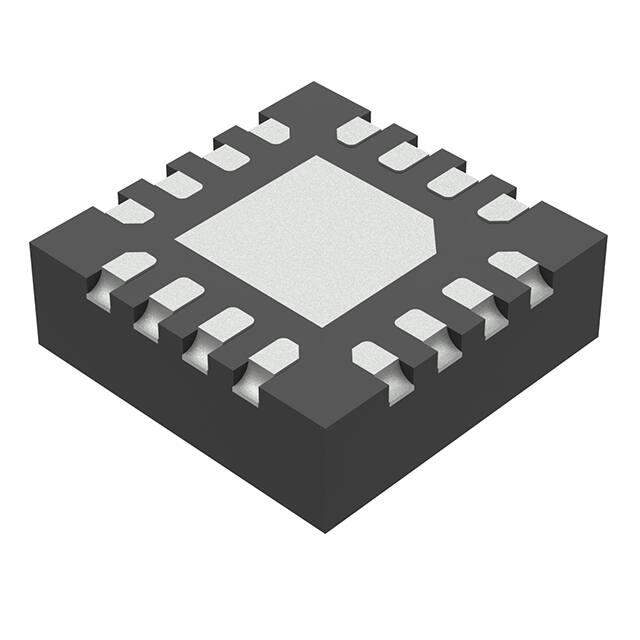
Available in a QFN-16 (3mmx3mm)
Package with Wettable flanks
APPLICATIONS
Brushless DC Motor Servo Drives
Motor Commutation
Motor Speed and Position Control
Automotive
All MPS parts are lead-free, halogen-free, and adhere to the RoHS directive. For
MPS green status, please visit the MPS website under Quality Assurance. “MPS”
and “The Future of Analog IC Technology” are registered trademarks of
Monolithic Power Systems, Inc.
TYPICAL APPLICATION
MAQ430 Rev. 1.1
6/22/2021
www.MonolithicPower.com
MPS Proprietary Information. Patent Protected. Unauthorized Photocopy and Duplication Prohibited.
© 2021 MPS. All Rights Reserved.
1
�MAQ430 – 12-BIT, AUTOMOTIVE ANGLE SENSOR WITH ABZ & UVW OUTPUTS
ORDERING INFORMATION
Part Number*
MAQ430GQE-AEC1
Package
QFN-16 (3mmx3mm)
Top Marking
See Below
* For Tape & Reel, add suffix -Z (e.g. MAQ430GQ-AEC1-Z)
TOP MARKING
BCV: Product code of MAQ430GQE
Y: Year code
LLL: Lot number
PACKAGE REFERENCE
TOP VIEW
QFN-16 (3mmx3mm)
MAQ430 Rev. 1.1
6/22/2021
www.MonolithicPower.com
MPS Proprietary Information. Patent Protected. Unauthorized Photocopy and Duplication Prohibited.
© 2021 MPS. All Rights Reserved.
2
�MAQ430 – 12-BIT, AUTOMOTIVE ANGLE SENSOR WITH ABZ & UVW OUTPUTS
ABSOLUTE MAXIMUM RATINGS (1)
Thermal Resistance (3)
Supply voltage ............................. -0.5V to +4.6V
Input pin voltage (VI) .................... -0.5V to +6.0V
Output pin voltage (VO) ................ -0.5V to +4.6V
Continuous power dissipation (TA = +25°C) (2)
..................................................................... 2.0W
Junction temperature ................................ 160°C
Lead temperature...................................... 260°C
Storage temperature ................... -65°C to 160°C
QFN-16 (3mmx3mm) ............. 50 ...... 12 ... °C/W
MAQ430 Rev. 1.1
6/22/2021
θJA
θJC
NOTES:
1) Exceeding these ratings may damage the device.
2) The maximum allowable power dissipation is a function of the
maximum junction temperature TJ (MAX), the junction-toambient thermal resistance θJA, and the ambient temperature
TA. The maximum allowable continuous power dissipation at
any ambient temperature is calculated by PD (MAX) = (TJ
(MAX)-TA)/θJA.
3) Measured on JESD51-7, 4-layer PCB.
www.MonolithicPower.com
MPS Proprietary Information. Patent Protected. Unauthorized Photocopy and Duplication Prohibited.
© 2021 MPS. All Rights Reserved.
3
�MAQ430 – 12-BIT, AUTOMOTIVE ANGLE SENSOR WITH ABZ & UVW OUTPUTS
ELECTRICAL CHARACTERISTICS
Parameter
Symbol Condition
Recommended Operating Conditions
Supply voltage
VDD
Supply current
IDD
Operating temperature
Applied magnetic field
Top
B
MAQ430 Rev. 1.1
6/22/2021
From -40°C to +125°C
Min
Typ
Max
Units
3.0
3.3
3.6
V
10.2
11.7
13.8
mA
125
°C
mT
-40
30
60
www.MonolithicPower.com
MPS Proprietary Information. Patent Protected. Unauthorized Photocopy and Duplication Prohibited.
© 2021 MPS. All Rights Reserved.
4
�MAQ430 – 12-BIT, AUTOMOTIVE ANGLE SENSOR WITH ABZ & UVW OUTPUTS
GENERAL CHARACTERISTICS
VDD = 3.3V, 45mT < B < 100mT, Temp = -40°C to +125°C, unless otherwise noted.
Parameter
Absolute Output – Serial
Symbol
Effective resolution
Condition
Min
Typ
Max
Units
3σ deviation of the noise
distribution
11.0
11.8
12.8
bit
0.01
850
16
0.02
980
0.03
1100
16
deg
kHz
bit
12
ms
10
µs
Noise rms
Refresh rate
Data output length
Response Time
Power-up time (4)
Constant speed propagation
delay
Latency (5)
Filter cutoff frequency (4)
Accuracy
8
Fcutoff
390
Hz
INL at 25°C
At room temperature over the
full field range
0.7
deg
INL between -40°C to
+125°C (5)
Over the full temperature range
and field range
1.1
deg
INL at 150°C
over the full field range
1.16
deg
0.015
deg/°C
0.5
1.0
0.005
deg
deg
deg/mT
deg/V
16
MHz
Output Drift
Temperature induced drift at
room temperature (5)
From 25°C to 85°C
From 25°C to 125°C
Temperature induced
variation (5)
Magnetic field induced (5)
Voltage supply induced (5)
Incremental Output – ABZ
ABZ update rate
Resolution - edges per turn
Pulses per channel per turn
ABZ hysteresis (5)
PPT+1
H
Random jitter (3σ)
MAQ430 Rev. 1.1
6/22/2021
4
1
For PPT = 255, between 0 and
100krpm, up to 60mT
For PPT = 127, between 0 and
100krpm
For PPT = 255, between 0 and
100krpm
For PPT = 127, between 0 and
100krpm
Up to 60mT
Systematic jitter (5)
Overall ABZ jitter (5)
Incremental Output – UVW
Cycle per turn
UVW hysteresis (5)
UVW jitter (3σ) (5)
Programmable
Programmable
NPP
H
1
0.1
www.MonolithicPower.com
MPS Proprietary Information. Patent Protected. Unauthorized Photocopy and Duplication Prohibited.
© 2021 MPS. All Rights Reserved.
1024
256
0.7
deg
13
%
7
%
5.5
%
2.8
%
0.3
deg
8
0.7
0.3
deg
deg
5
�MAQ430 – 12-BIT, AUTOMOTIVE ANGLE SENSOR WITH ABZ & UVW OUTPUTS
GENERAL CHARACTERISTICS (continued)
VDD = 3.3V, 45mT < B < 100mT, Temp = -40°C to +125°C, unless otherwise noted.
Parameter
Symbol Condition
Magnetic Field Detection Thresholds
Accuracy (5)
Hysteresis (5)
MagHys
Temperature drift (5)
Min
Typ
Max
5
6
-600
Units
mT
mT
ppm/°C
Digital I/O
Input high voltage
Input low voltage
Output low
voltage (5)
Output high voltage
(5)
Pull-down resistor
Rising edge slew rate (4)
Falling edge slew rate (4)
VIH
VIL
VOL
VOH
RPD
TR
TF
2.5
-0.3
5.5
0.8
0.4
IOL = 4mA
IOH = 4mA
CL = 50pF
CL = 50pF
2.4
43
V
V
V
V
55
0.7
0.7
97
kΩ
V/ns
V/ns
NOTES:
4) Guaranteed by design.
5) Guaranteed by characteristic test.
MAQ430 Rev. 1.1
6/22/2021
www.MonolithicPower.com
MPS Proprietary Information. Patent Protected. Unauthorized Photocopy and Duplication Prohibited.
© 2021 MPS. All Rights Reserved.
6
�MAQ430 – 12-BIT, AUTOMOTIVE ANGLE SENSOR WITH ABZ & UVW OUTPUTS
TYPICAL CHARACTERISTICS
VDD = 3.3V, Temp = 25°C, unless otherwise noted.
ABZ Jitter at PPT = 255
Noise Spectrum at 50mT
Filter Transfer Function
5
6
FILTER TRANSFER FUNCTION (dB)
0.01
1/2
NOISE DENSITY (deg/Hz )
RANDOM JITTER (%)
5
4
3
0.001
0
-3 dB
-5
-10
-15
2
-20
0.0001
1
0.1
1
10
100
1000
10
4
10
10
5
100
1000
10
4
10
10
5
100
1000
10
4
10
5
f (Hz)
FREQUENCY (Hz)
ROTATION SPEED (rpm)
Non-Linearity
(INL and harmonics)
Error Curves at 50mT
Effective Resolution (3σ)
1.5
12
2
11.5
-45癈
0
-1
EFFECTIVE RESOLUTION (bit)
NON-LINEARITY (deg)
ERROR (deg)
25癈
125癈
1
INL
1
H1
0.5
H2
11
10.5
10
9.5
9
8.5
-2
0
50
100
150
200
250
300
350
ANGLE (deg)
8
0
0
20
40
60
MAGNETIC FIELD (T)
80
100
0
20
40
60
80
100
120
MAGNETIC FIELD (mT)
Current Consumption at
VDD = 3.3V
12
SUPPLY CURRENT (mA)
11.5
11
10.5
10
-50
0
50
100
150
TEMPERATURE (癈 )
MAQ430 Rev. 1.1
6/22/2021
www.MonolithicPower.com
MPS Proprietary Information. Patent Protected. Unauthorized Photocopy and Duplication Prohibited.
© 2021 MPS. All Rights Reserved.
7
�MAQ430 – 12-BIT, AUTOMOTIVE ANGLE SENSOR WITH ABZ & UVW OUTPUTS
PIN FUNCTIONS
Package
Pin #
1
2
3
4
5
6
Name
Description
V
A
Z
MOSI
CS
B
Motor commutation output.
Incremental output.
Incremental output.
Data in (SPI). MOSI has an internal pull-down resistor.
Chip select (SPI). CS has an internal pull-up resistor.
Incremental output.
Data out (SPI). MISO has an internal pull-down resistor that is enabled at a high
impedance state.
Supply ground.
Motor commutation output.
Connect to ground.
Digital output indicating field strength below MGLT level.
Clock (SPI). SCLK has an internal pull-down resistor.
Supply 3.3V.
No connection. Leave NC unconnected.
Motor commutation output.
Digital output indicating field strength above MGHT level.
7
MISO
8
9
10
11
12
13
14
15
16
GND
W
TEST
MGL
SCLK
VDD
NC
U
MGH
MAQ430 Rev. 1.1
6/22/2021
www.MonolithicPower.com
MPS Proprietary Information. Patent Protected. Unauthorized Photocopy and Duplication Prohibited.
© 2021 MPS. All Rights Reserved.
8
�MAQ430 – 12-BIT, AUTOMOTIVE ANGLE SENSOR WITH ABZ & UVW OUTPUTS
BLOCK DIAGRAM
Figure 1: Functional Block Diagram
MAQ430 Rev. 1.1
6/22/2021
www.MonolithicPower.com
MPS Proprietary Information. Patent Protected. Unauthorized Photocopy and Duplication Prohibited.
© 2021 MPS. All Rights Reserved.
9
�MAQ430 – 12-BIT, AUTOMOTIVE ANGLE SENSOR WITH ABZ & UVW OUTPUTS
OPERATION
Sensor Front-End
The magnetic field is detected with integrated
Hall devices located in the center of the
package. The angle is measured using the
SpinaxisTM method, which directly digitizes the
direction of the field without complex arctangent
computation or feedback loop-based circuits
(interpolators).
The SpinaxisTM method is based on phase
detection and generates a sinusoidal signal with
a phase that represents the angle of the
magnetic field. The angle is then obtained by a
time-to-digital converter, which measures the
time between the zero crossing of the
sinusoidal signal and the edge of a constant
waveform (see Figure 2). The time-to-digital is
output from the front-end to the digital
conditioning block.
Sensor – Magnet Mounting
The sensitive volume of the MAQ430 is
confined in a region less than 100µm wide and
has multiple integrated Hall devices. This
volume is located both horizontally and
vertically within 50µm of the center of the QFN
package. The sensor detects the angle of the
magnetic field projected in a plane parallel to
the package’s upper surface. This means that
the only relevant magnetic field is the in-plane
component (X and Y components) in the middle
point of the package.
By default, when looking at the top of the
package, the angle increases when the
magnetic field rotates clockwise. Figure 3
shows the zero angle of the unprogrammed
sensor, where the cross indicates the sensitive
point. Both the rotation direction and the zero
angle can be programmed.
Top: Sine Waveform
Bottom: Clock of Time-to-Digital Converter
Figure 2: Phase Detection Method
The output of the front-end delivers a digital
number proportional to the angle of the
magnetic field at the rate of 1MHz in a
straightforward and open-loop manner.
Digital Filtering
The front-end signal is further treated to
achieve the final effective resolution. This
treatment does not add any latency in steady
conditions. The filter transfer function can be
calculated with Equation (1):
H ( s)
1 2s
(1 s ) 2
(1)
Where τ is the filter time constant, related to the
cutoff frequency by τ = 0.38/Fcutoff. See the
General Characteristics table on page 5 for the
value of Fcutoff.
MAQ430 Rev. 1.1
6/22/2021
Figure 3: Detection Point and Default Positive
Direction
This type of detection provides flexibility for the
design of an angular encoder. The sensor only
requires the magnetic vector to lie essentially
within the sensor plane with a field amplitude of
at least 30mT. Note that the MAQ430 can work
with fields smaller than 30mT, but the linearity
and resolution performance may deviate from
the specifications. The most straightforward
mounting method is to place the MAQ430
sensor on the rotation axis of a permanent
magnet (i.e.: a diametrically magnetized
cylinder) (see Figure 4). A typical magnet is a
Neodymium
alloy
(N35)
cylinder
with
dimensions Ø5x3mm inserted into an aluminum
shaft with an air gap between the magnet and
the sensor (surface of package) of 1.5mm. For
good linearity, the sensor is positioned with a
precision of 0.5mm.
www.MonolithicPower.com
MPS Proprietary Information. Patent Protected. Unauthorized Photocopy and Duplication Prohibited.
© 2021 MPS. All Rights Reserved.
10
�MAQ430 – 12-BIT, AUTOMOTIVE ANGLE SENSOR WITH ABZ & UVW OUTPUTS
Generally, the MagAlpha works fine with or
without the exposed pad connected to anything.
For optimum conditions (electrically, thermally,
and mechanically), it is recommended that the
exposed pad be connected to ground.
Figure 4: End-of-Shaft Mounting
If the end-of-shaft position is not available, the
sensor can be positioned away from the
rotation axis of a cylinder or ring magnet (see
Figure 5). In this case, the magnetic field angle
is no longer directly proportional to the
mechanical angle. The MAQ430 can be
adjusted to compensate for this effect and
recover the linear relation between the
mechanical angle and the sensor output. With
multiple pole pair magnets, the MAQ430
indicates multiple rotations for each mechanical
turn.
Serial Interface
The sensor supports the SPI serial interface for
angle reading and register programming.
SPI
SPI is a 4-wire, synchronous, serial
communication interface. The MagAlpha
supports SPI Mode 3 and Mode 0 (see Table 1
and Table 2). The SPI Mode (0 or 3) is detected
automatically by the sensor and therefore does
not require any action from the user. The
maximum clock rate supported on SPI is
25MHz. There is no minimum clock rate. Note
that real life data rates depend on PCB layout
quality and signal trace length. See Figure 7,
Figure 8, and Table 3 for SPI timing.
All commands to the MagAlpha (whether for
writing or reading register content) must be
transferred through the SPI MOSI pin and must
be 16 bits long.
Figure 5: Side-Shaft Mounting
Electrical Mounting and Power Supply
Decoupling
It is recommended to place a 1µF decoupling
capacitor close to the sensor with a low
impedance path to GND (see Figure 6).
For checking the integrity of the data received
(angle or register content) the master shall send
a 17th clock count and receive a parity bit.
See the SPI Communication section on page
13 for details.
Table 1: SPI Specification
SCLK idle state
Data capture
Data transmission
CS idle state
Data order
Mode 0
Mode 3
Low
High
On SCLK rising edge
On SCLK falling edge
High
MSB first
Table 2: SPI Standard
CPOL
CPHA
Data order (DORD)
Mode 0
Mode 3
0
1
0
1
0 (MSB first)
Figure 6: Connection for Supply Decoupling
MAQ430 Rev. 1.1
6/22/2021
www.MonolithicPower.com
MPS Proprietary Information. Patent Protected. Unauthorized Photocopy and Duplication Prohibited.
© 2021 MPS. All Rights Reserved.
11
�MAQ430 – 12-BIT, AUTOMOTIVE ANGLE SENSOR WITH ABZ & UVW OUTPUTS
tcsL
CS
tsclk
tsclkL tsclkH
tcsH
tMISO
tMISO
tidleAngle
tidleReg
tnvm
SCLK
tMISO
MISO
hi-Z
MOSI
MSB
X
LSB
MSB
hi-Z
MSB
X
LSB
MSB
tMOSI
Figure 7: SPI Timing Diagram
tidleAngle
tidleAngle
tidleAngle
tidleReg
tidleReg
tidleAngle
tnvm
tidleReg
CS
MISO
Angle
Angle
Angle
Angle
Reg Value
Angle
Angle
Reg Value
Angle
MOSI
0
0
0
Read Reg Cmd
0
0
Write Reg Cmd
0
0
Figure 8: Minimum Idle Time
Table 3: SPI Timing
(6)
Description
Min
tidleAngle
Idle time between two subsequent angle transmissions
150
ns
tidleReg
Idle time before and after a register readout
750
ns
tnvm
Idle time between a write command and a register readout
(delay necessary for non-volatile memory update)
20
ms
tcsL
Time between CS falling edge and SCLK falling edge
80
ns
tsclk
SCLK period
40
ns
Parameter
Max
Unit
tsclkL
Low level of SCLK signal
20
ns
tsclkH
High level of SCLK signal
20
ns
tcsH
Time between SCLK rising edge and CS rising edge
25
ns
tMISO
SCLK setting edge to data output valid
tMOSI
Data input valid to SCLK reading edge
15
15
ns
ns
NOTE:
6) All values are guaranteed by design.
MAQ430 Rev. 1.1
6/22/2021
www.MonolithicPower.com
MPS Proprietary Information. Patent Protected. Unauthorized Photocopy and Duplication Prohibited.
© 2021 MPS. All Rights Reserved.
12
�MAQ430 – 12-BIT, AUTOMOTIVE ANGLE SENSOR WITH ABZ & UVW OUTPUTS
SPI Communication
The sensor supports three types of SPI
operation:
Read angle
Read configuration register
Write configuration register
Angle reading can be therefore optimized
without any loss of information by reducing the
number of clock counts. In the case of a 12-bit
data output length, only 12 clock counts are
required to get the full sensor resolution.
MSB
Each operation has a specific frame structure
described below.
SPI Read Angle
Every 1µs, new data is transferred into the
output buffer. The master device triggers the
reading by pulling CS low.
When a trigger event is detected, the data
remains in the output buffer until the CS signal
is de-asserted (see Table 4).
LSB
MISO
Angle(15:4)
MOSI
0
If less resolution is needed, the angle can be
read by sending even fewer clock counts (since
MSB is first).
In case of fast reading, the MagAlpha keeps
sending the same data until the data is
refreshed (see the refresh rate in the General
Characteristics table).
Table 4: Sensor Data Timing
Event
Action
Start reading and freeze
CS falling edge
output buffer
CS rising edge
Release of the output buffer
See Figure 9 for a diagram of a full SPI angle
reading. See Figure 10 for a diagram of a
partial SPI angle reading. A full angle reading
requires 16 clock pulses. The sensor MISO line
returns:
LSB
MSB
MISO
Angle(15:0)
MOSI
0
Figure 9: Diagram of a Full 16-Bit SPI Angle
Reading
The MagAlpha family has sensors with different
features and levels of resolution. Check the
data
output
length
in
the
General
Characteristics table on page 5 for the number
of useful bits delivered at the serial output. If the
data length is smaller than 16, the rest of bits
sent are zeros.
For example, a data output length of 12 bits
means that the serial output delivers a 12-bit
angle value with four bits of zeros padded at the
end (MISO state remains zero). If the master
sends 16 clock counts, the MagApha replies
with:
LSB
MSB
MISO
MOSI
MAQ430 Rev. 1.1
6/22/2021
Angle(15:4)
0
0 0 0 0
Figure 10: Diagram of a Partial 8-Bit SPI Angle
Reading
SPI Read Register
A read register operation is constituted of two
16-bit frames. The first frame sends a read
request which contains the 3-bit read command
(010) followed by the 5-bit register address. The
www.MonolithicPower.com
MPS Proprietary Information. Patent Protected. Unauthorized Photocopy and Duplication Prohibited.
© 2021 MPS. All Rights Reserved.
13
�MAQ430 – 12-BIT, AUTOMOTIVE ANGLE SENSOR WITH ABZ & UVW OUTPUTS
last eight bits of the frame must be all set to
zero. The second frame returns the 8-bit
register value (MSB byte).
The first 16-bit SPI frame (read request) is:
MSB
MISO
LSB
Angle(15:0)
command
reg. address
MOSI 0 1 0 A4 A3 A2 A1 A0
0 0 0 0 0 0 0 0
0 0 0 0 0 0 0 0
MSB
MOSI
MSB
MISO
MOSI
LSB
Angle(15:0)
command
0 1 0
reg. address
1 1 0 1 1
0 0 0 0 0 0 0 0
In the second frame, the MagAlpha replies:
The second 16-bit SPI frame (response) is:
reg. value
MISO V7 V6 V5 V4 V3 V2 V1 V0
For example, to get the value of the magnetic
level high and low flags (MGH and MGL). Read
register 27 (bit 6, bit 7) by sending the following
first frame:
LSB
0
See Figure 11 for a complete transmission
overview.
reg. value
MISO MGH MGL X X X X X X
0 0 0 0 0 0 0 0
MSB
MOSI
LSB
0
See Figure 12 for a complete example overview.
Figure 11: Two 16-Bit Frames Read Register Operation
Figure 12: Example Read Magnetic Level Flags High and Low (MGH, MGH) on Register 27, Bit 7 to Bit 6
MAQ430 Rev. 1.1
6/22/2021
www.MonolithicPower.com
MPS Proprietary Information. Patent Protected. Unauthorized Photocopy and Duplication Prohibited.
© 2021 MPS. All Rights Reserved.
14
�MAQ430 – 12-BIT, AUTOMOTIVE ANGLE SENSOR WITH ABZ & UVW OUTPUTS
SPI Write Register
Table 5 shows the programmable 8-bit registers.
Data written to these registers are stored in the
on-chip non-volatile memory and reloaded
automatically during power on. The factory
default register values are shown in Table 6.
A write register operation is constituted of two
16-bit frames. The first frame sends a write
request which contains the 3-bit write command
(100) followed by the 5-bit register address and
the 8-bit value (MSB first). The second frame
returns the newly written register value
(acknowledge).
The on-chip memory is guaranteed to endure
1,000 write cycles at 25°C.
It is important to wait 20ms between the first
and the second frame. This is the time taken to
write the non-volatile memory. Failure to
implement this wait period results in the
register’s previous value being read. Note that
this delay is only required after a write request.
A read register request and read angle do not
require this wait time.
The second 16-bit SPI frame (response) is:
reg. value
MISO V7 V6 V5 V4 V3 V2 V1 V0
MSB
LSB
MOSI
0
The read-back register content can be used to
verify the register programming. See Figure 13
for a complete transmission overview.
For example, to set the value of the output
rotation direction (RD) to counterclockwise
(high), write register 9 by sending the following
first frame:
MSB
MISO
MOSI
LSB
Angle(15:0)
command
1 0 0
reg. address
0 1 0 0 1
reg. value
1 0 0 0 0 0 0 0
Send the second frame after a 20ms wait time.
If the register is correctly written, the reply is:
reg. value
MISO 1 0 0 0 0 0 0 0
The first 16-bit SPI frame (write request) is:
MSB
0 0 0 0 0 0 0 0
0 0 0 0 0 0 0 0
MSB
LSB
MISO
Angle(15:0)
MOSI
command
reg. address
reg. value
1 0 0 A4 A3 A2 A1 A0 V7 V6 V5 V4 V3 V2 V1 V0
MOSI
LSB
0
See Figure 14 for a complete example.
Figure 13: Overview of Two 16-Bit Frames Write Register Operation
MAQ430 Rev. 1.1
6/22/2021
www.MonolithicPower.com
MPS Proprietary Information. Patent Protected. Unauthorized Photocopy and Duplication Prohibited.
© 2021 MPS. All Rights Reserved.
15
�MAQ430 – 12-BIT, AUTOMOTIVE ANGLE SENSOR WITH ABZ & UVW OUTPUTS
Figure 14: Example Write Output Rotation Direction (RD) to Counterclockwise (High), on Register 9, Bit 7
Parity bit
The parity bit, or check bit, is added to the output string to ensure that the total number of 1’s in the
string is even. It is used as error detecting code for angle or register reading. The MagAlpha transmits
the parity bit at the 17th clock edge.
Table 5: Example of Parity bit
Number of
16-bits output
bits set to
Output with the parity bit
"1"
0
0000000000000000
00000000000000000
6
1000110001100010
10001100011000100
5
0101110100000000
01011101000000001
CS
6
5
4
3
2
1
0
Parity
7
6
5
4
3
2
1
0
7
8
9
10
12
13
14
11
8
9
10
11
12
13
14
16
MOSI
Angle
15
MISO
15
SCLK
0
Figure 15: Angle reading with parity bit
MAQ430 Rev. 1.1
6/22/2021
www.MonolithicPower.com
MPS Proprietary Information. Patent Protected. Unauthorized Photocopy and Duplication Prohibited.
© 2021 MPS. All Rights Reserved.
16
�MAQ430 – 12-BIT, AUTOMOTIVE ANGLE SENSOR WITH ABZ & UVW OUTPUTS
REGISTER MAP
Table 5: Register Map
Bit 7
MSB
No
Hex
Bin
0
0x0
00000
Z(7:0)
1
0x1
00001
Z(15:8)
2
0x2
00010
BCT(7:0)
3
0x3
00011
4
0x4
00100
5
0x5
00101
6
0x6
00110
MGLT(2:0)
7
0x7
00111
NPP(2:0)
9
0x9
01001
RD
-
27
0x1B
11011
MGH
MGL
Bit 6
-
-
Bit 5
-
Bit 4
-
PPT(1:0)
-
Bit 3
Bit 2
Bit 1
Bit 0
LSB
-
ETY
ETX
-
-
-
-
ILIP(3:0)
-
PPT(7:2)
MGHT(2:0)
-
-
-
-
-
-
-
-
-
-
-
-
-
-
-
Table 6: Factory Default Values
No
Hex
Bin
Bit 7
MSB
Bit 6
Bit 5
Bit 4
Bit 3
Bit 2
Bit 1
Bit 0
LSB
0
0x0
00000
0
0
0
0
0
0
0
0
1
0x1
00001
0
0
0
0
0
0
0
0
2
0x2
00010
0
0
0
0
0
0
0
0
3
0x3
00011
0
0
0
0
0
0
0
0
4
0x4
00100
1
1
0
0
0
0
0
0
5
0x5
00101
0
0
1
1
1
1
1
1
6
0x6
00110
0
0
0
1
1
1
0
0
7
0x7
00111
0
0
0
0
0
0
0
0
9
0x9
01001
0
0
0
0
0
0
0
0
MAQ430 Rev. 1.1
6/22/2021
www.MonolithicPower.com
MPS Proprietary Information. Patent Protected. Unauthorized Photocopy and Duplication Prohibited.
© 2021 MPS. All Rights Reserved.
17
�MAQ430 – 12-BIT, AUTOMOTIVE ANGLE SENSOR WITH ABZ & UVW OUTPUTS
Table 7: Programming Parameters
Parameters
Symbol
Zero setting
Bias current
trimming
Z
Number of
Bits
16
BCT
8
Enable trimming X
ETX
1
Enable trimming Y
ETY
1
Pulses per turn
PPT
8
ILIP
4
Parametrization of the ABZ index pulse.
Fig. 23
MGHT
3
Sets the field strength high threshold.
14
MGLT
3
Sets the field strength low threshold.
14
NPP
3
RD
1
Index length / index
position
Magnetic field high
threshold
Magnetic field low
threshold
Number of pole
pairs
Rotation direction
MAQ430 Rev. 1.1
6/22/2021
Description
See Table
Sets the zero position.
For side-shaft configuration: reduces the
bias current of the X or Y Hall device.
Biased current trimmed in the X-direction
Hall device.
Biased current trimmed in the Y-direction
Hall device.
Number of pulses per turn of the ABZ
output.
8
UVW cycles per turn for motor
commutation.
Determines the sensor positive direction.
www.MonolithicPower.com
MPS Proprietary Information. Patent Protected. Unauthorized Photocopy and Duplication Prohibited.
© 2021 MPS. All Rights Reserved.
11
12
12
15
17
10
18
�MAQ430 – 12-BIT, AUTOMOTIVE ANGLE SENSOR WITH ABZ & UVW OUTPUTS
REGISTER SETTINGS
Zero Setting
The zero position of the MagAlpha (a0) can be
programmed with 16 bits of resolution. The
angle streamed out by the MagAlpha (aout) is
given by Equation (2):
aout araw a0
(2)
Where araw is the raw angle provided by the
MagAlpha front end.
The parameter Z(15:0), which is zero by default,
is the complementary angle of the zero setting.
In decimals, it can be written as shown in
Equation (3):
a 0 216 Z (15 : 0)
(3)
Table 8: Zero Setting Parameter
Zero pos.
Zero pos.
Z(15:0)
a0 (16-bit dec)
a0 (deg)
0
65536
360.000
1
65535
359.995
2
65534
359.989
…
…
…
65534
2
0.011
65535
1
0.005
Example
To set the zero position to 20 degrees, the
Z(15:0) parameter shall be equal to the
complementary angle and can be calculated
with Equation (4):
20 deg 16
2 61895
360 deg
Table 10: Rotation Direction Parameter
RD
Positive Direction
0
1
Clockwise (CW)
Counterclockwise (CCW)
BCT Settings (Bias Current Trimming)
Side-Shaft
When the MAQ430 is mounted on the side of
the magnet, the relation between the field angle
and the mechanical angle is no longer directly
linear. This effect is related to the fact that the
tangential magnetic field is usually smaller than
the radial field. Define the field ratio k with
Equation (5):
Table 8 shows the zero setting parameter.
Z (15 : 0) 216
Figure 15: Positive Rotation Direction of the
Magnetic Field
k Brad / Btan
(5)
Where Brad is the maximum radial magnetic field,
and Btan is the maximum tangential magnetic
field (see Figure 16).
(4)
In binary, it is written as 1111 0001 1100 0111.
Table 9 shows the content of registers 0 and 1.
Table 9: Register Content
Reg Bit 7 Bit 6 Bit 5 Bit 4 Bit 3 Bit 2 Bit 1 Bit 0
0
1
1
0
0
0
1
1
1
1
1
1
1
1
0
0
0
1
Rotation Direction
By default, when looking at the top of the
package, the angle increases when the
magnetic field rotates clockwise (CW) (see
Figure 15 and Table 10).
MAQ430 Rev. 1.1
6/22/2021
Figure 16: Side-Shaft Field
The ratio k depends on the magnet geometry
and distance to the sensor. Having a k ratio
different than 1 results in the sensor output
response not being linear with respect to the
mechanical angle. Note that the error curve has
the shape of a double sinewave (see Figure 18).
E is the amplitude of this error.
www.MonolithicPower.com
MPS Proprietary Information. Patent Protected. Unauthorized Photocopy and Duplication Prohibited.
© 2021 MPS. All Rights Reserved.
19
�MAQ430 – 12-BIT, AUTOMOTIVE ANGLE SENSOR WITH ABZ & UVW OUTPUTS
The X-axis or the Y-axis bias current can be
reduced to recover an equal Hall signal for all
angles and suppress the error. The parameter
ETX and ETY controls in which direction the
sensitivity is reduced. The current reduction is
set by the parameter bias current trimming
BCT(7:0), which is an integer from 0 to 255.
In side-shaft configuration (i.e.: the sensor
center is located beyond the magnet outer
diameter), k is greater than 1. For optimum
compensation, the sensitivity of the radial axis
should be reduced by setting the BCT
parameter as shown in Equation (6):
1
BCT (7 : 0) 2581
k
Determining k with the MagAlpha
It is possible to deduce the k ratio from the
error curve obtained with the default BCT
setting (BCT = 0). For this purpose, rotate the
magnet over one revolution and record the
MagAlpha output. Then plot the error curve (the
MagAlpha output minus the real mechanical
position vs. the real mechanical position) and
extract two parameters: the maximum error E
and the position of this maximum with respect
to a zero crossing am (see Figure 18). k can be
calculated with Equation (7):
k
tan( E a m )
tan(a m )
(7)
(6)
40
Equation (6) is plotted in Figure 17 and Table 11.
20
2E
m
Error (deg)
200
150
0
BCT
-20
100
-40
50
0
50
100
150
200
250
300
350
rotor angle (deg)
0
1
1.5
2
2.5
3
3.5
4
4.5
5
k
Figure 17: Relation between the k Ratio and the
Optimum BCT to Recover Linearity
Figure 18: Error Curve in Side-Shaft
Configuration with BCT = 0
Some examples are given in Table 11.
Alternatively, the k parameter can be obtained
from the graph of Figure 19.
Table 11: Example of BCT Settings
E (deg)
Magnet Ratio k
BCT(7:0)
0
1.0
0
11.5
1.5
86
19.5
2.0
129
25.4
2.5
155
30.0
3.0
172
33.7
3.5
184
36.9
4.0
194
39.5
4.5
201
41.8
5.0
207
MAQ430 Rev. 1.1
6/22/2021
www.MonolithicPower.com
MPS Proprietary Information. Patent Protected. Unauthorized Photocopy and Duplication Prohibited.
© 2021 MPS. All Rights Reserved.
20
�MAQ430 – 12-BIT, AUTOMOTIVE ANGLE SENSOR WITH ABZ & UVW OUTPUTS
Magnetic Field Thresholds
The magnetic flags (MGL and MGH) indicate
that the magnetic field at the sensor position is
out of range, defined by the lower and upper
magnetic field thresholds, respectively MGLT
and MGHT (see Figure 21).
5
4.5
4
k
3.5
3
2.5
2
1.5
1
0
5
10
15
20
25
30
35
40
E (deg)
Figure 19: Relation between the Error Measured
with BCT = 0 and the Magnet Ratio k
Figure 21: MGH and MGL Signals as a Function
of the Field Strength
Sensor Orientation
The dot marked on the package shows whether
the radial field is aligned with the sensor
coordinate X or Y (see Figure 20).
MagHys, the typical hysteresis on the signals
MGH and MGL, is 6mT (see Figure 24). The
MGLT and MGHT thresholds are coded on
three bits and stored in register 6 (see Table
13).
Table 13: Register 6
Register 6
Bit 7 Bit 6 Bit 5 Bit 4 Bit 3 Bit 2 Bit 1 Bit 0
MGLT
MGHT
-
Figure 20: Package Top View with X and Y Axes
Determine which axis needs to be reduced (see
the qualitative field distribution around a ring in
Figure 16). For instance, with the arrangement
depicted in Figure 20, the field along the sensor
Y direction is tangential and weaker. Therefore,
the X-axis should be reduced (ETX = 1 and
ETY = 0). Note that if both ETX and ETY are
set to 1, the current bias is reduced in both
directions the same way (i.e.: without side-shaft
correction).
Table 12: Trimming Direction Parameters
ETX
Enable Trimming of the X-Axis
0
Disabled
1
Enabled
ETY
Enable Trimming of the Y-Axis
0
Disabled
1
Enabled
MAQ430 Rev. 1.1
6/22/2021
The 3-bit values of MGLT and MGHT
correspond to the magnetic field (see Table 14).
Table 14: MGLT and MGHT Binary to mT Relation
MGLT or
MGHT (8)
000
001
010
011
100
101
110
111
Field threshold in mT (7)
From low to high
magnetic. field
26
41
56
70
84
98
112
126
From high to low
magnetic. field
20
35
50
64
78
92
106
120
NOTES:
7) Valid for VDD = 3.3V. If different, then the field threshold is
scaled by the factor VDD/3.3V.
8) MGLT can have a larger value than MGHT.
The alarm flags MGL and MGH can be read in
register 27 (bit 6 and bit 7), and their logic state
is also given at the digital output pins 11 and 16.
www.MonolithicPower.com
MPS Proprietary Information. Patent Protected. Unauthorized Photocopy and Duplication Prohibited.
© 2021 MPS. All Rights Reserved.
21
�MAQ430 – 12-BIT, AUTOMOTIVE ANGLE SENSOR WITH ABZ & UVW OUTPUTS
To read the MGL and MGH flags by SPI, send
the 8-bit command write into register 27:
command
0 1 0
reg. address
1 1 0 1 1
value
LSB
0 0 0 0 0 0 0 0
MSB
The MAQ430 answers with the register 27
content in the next transmission:
MGH MGL
x
R[7:0]
x
x
x
x
For example, to set 120 pulses per revolution
(480 edges), set PPT to 120 - 1 = 119 (binary:
01110111). Registers 4 and 5 must be set as
shown in Table 16.
Table 16: Register 4 and Register 5
R4
R5
B7
1
0
B6
1
0
B5
0
0
B4
0
1
B3
0
1
B2
0
1
B1
0
0
B0
0
1
x
Front-end diagnostics
If the thresholds are set correctly, i.e. the
magnetic field is between the MGLT and MGHT
values, then register 27 also provides
diagnostic coverage of the sensor front-end.
Integrity is indicated by the following values in
register 27:
0
0
0
R[7:0]
0
1
1
1
1
Figure 22: Timing of the ABZ Output
ABZ Incremental Encoder Output
The MAQ430 ABZ output emulates a 10-bit
incremental encoder (such as an optical
encoder) providing logic pulses in quadrature
(see Figure 22). Compared to signal A, signal B
is shifted by a quarter of the pulse period. Over
one revolution, signal A pulses N times, where
N is programmable from 1 to 256 pulses per
revolution. The number of pulses per channel
per revolution is programmed by setting the
parameter PPT, which consists of eight bits split
between registers 0x4 and 0x5 (see Table 5).
The factory default value is 256. Table 15
describes how to program PPT(7:0) to set the
required resolution.
PPT(7:0)
00000000
00000001
00000010
00000011
…
11111100
11111101
11111110
11111111
MAQ430 Rev. 1.1
6/22/2021
Table 15: PPT
Pulses per Edges per
Turn
Turn
1
4
2
8
3
12
4
16
…
…
253
1012
254
1016
255
1020
256
1024
MIN
Signal Z (zero or index) raises only once per
turn at the zero-angle position.
The position and length of the Z pulse is
programmable via bit ILIP(3:0) in register 0x5
(see Figure 23).
Figure 23: ILIP Parameter Effect on Index Shape
By default, the ILIP parameter is 0000. The
index rising edge is aligned with the channel B
falling edge and the index length is half the A or
B pulse length.
ABZ Hysteresis
A hysteresis larger than the output noise is
introduced on the ABZ output to prevent any
spurious transitions (see Figure 24).
…
MAX
www.MonolithicPower.com
MPS Proprietary Information. Patent Protected. Unauthorized Photocopy and Duplication Prohibited.
© 2021 MPS. All Rights Reserved.
22
�MAQ430 – 12-BIT, AUTOMOTIVE ANGLE SENSOR WITH ABZ & UVW OUTPUTS
50% and are shifted by 60° relative to each
other (see Figure 26).
Figure 24: Hysteresis of the Incremental
OutputABZ Jitter
The ABZ state is updated at a frequency of
16MHz, enabling accurate operation up to a
very high rpm (above 105 rpm).
The jitter characterizes how far a particular ABZ
edge can occur at an angular position different
from the ideal position (see Figure 25).
Figure 25: ABZ Jitter
The measurable jitter is composed of a
systematic jitter (always the same deviation at a
given angle) and a random jitter.
The random jitter reflects the sensor noise, so
the edge distribution is the same as the SPI
output noise. Like the sensor resolution, it is
defined as the 3σ width of this distribution.
The random jitter is a function of the rotation
speed. At lower speeds, the random jitter is
smaller than the sensor noise (see the Typical
Characteristic curves on page 7).
Figure 26: UVW Output for One Pole Pair Rotor
during Rotation
If the number of pole pairs of the motor exceeds
the number of pole pairs of the target magnet,
the MAQ430 is able to generate more than one
UVW cycle per revolution. It does this by
dividing the digital angle into the required
number of commutation steps per 360°
revolution. The parameter NPP(2:0) in register
0x7 sets the number of pole pairs emulated,
and the corresponding commutation step angle
for the UVW signals. Table 17 describes the
pole pair configuration options.
Table 17: Number of UVW Pair Poles
NPP
Pole
States per
State Width
(2:0)
Pairs
Revolution
(deg)
000
1
6
60
001
2
12
30
010
3
18
20
011
4
24
15
100
5
30
12
101
6
36
10
110
7
42
8.6
111
8
48
7.5
This is a consequence of the fact that the
probability of measuring an edge at a certain
distance from the ideal position depends on the
number of ABZ updates at this position.
The minimum field for ABZ reading is 30mT.
Block Commutation – UVW
The UVW output emulates the three Hall
switches usually used for the block
commutation of a three-phase electric motor.
The three logic signals have a duty cycle of
MAQ430 Rev. 1.1
6/22/2021
www.MonolithicPower.com
MPS Proprietary Information. Patent Protected. Unauthorized Photocopy and Duplication Prohibited.
© 2021 MPS. All Rights Reserved.
23
�MAQ430 – 12-BIT, AUTOMOTIVE ANGLE SENSOR WITH ABZ & UVW OUTPUTS
An example of the 30° UVW commutation
signal spacing for a four-pole (two-pole pair)
motor is shown in Figure 27.
UVW Hysteresis
A hysteresis larger than the output noise is
introduced on the UVW output to avoid any
spurious transitions (see Figure 28).
Figure 27: UVW Commutation Signals for a FourPole (Two-Pole Pair) Motor
Figure 28: Hysteresis of the UVW Signal
MAQ430 Rev. 1.1
6/22/2021
www.MonolithicPower.com
MPS Proprietary Information. Patent Protected. Unauthorized Photocopy and Duplication Prohibited.
© 2021 MPS. All Rights Reserved.
24
�MAQ430 – 12-BIT, AUTOMOTIVE ANGLE SENSOR WITH ABZ & UVW OUTPUTS
TYPICAL APPLICATION CIRCUITS
Figure 29: Typical Configurations Using SPI Interface and MGH/MGL Signals
Figure 30: Typical Motor Configuration Using UVW Commutation Signals
MAQ430 Rev. 1.1
6/22/2021
www.MonolithicPower.com
MPS Proprietary Information. Patent Protected. Unauthorized Photocopy and Duplication Prohibited.
© 2021 MPS. All Rights Reserved.
25
�MAQ430 – 12-BIT, AUTOMOTIVE ANGLE SENSOR WITH ABZ & UVW OUTPUTS
PACKAGE INFORMATION
QFN-16 (3mmx3mm)
MAQ430 Rev. 1.1
6/22/2021
www.MonolithicPower.com
MPS Proprietary Information. Patent Protected. Unauthorized Photocopy and Duplication Prohibited.
© 2021 MPS. All Rights Reserved.
26
�MAQ430 – 12-BIT, AUTOMOTIVE ANGLE SENSOR WITH ABZ & UVW OUTPUTS
APPENDIX A: DEFINITIONS
Effective Resolution (3σ
noise level)
The smallest angle increment distinguishable from the noise. The
resolution is measured by computing 3 times σ (the standard deviation
in degrees) taken over 1,000 data points at a constant position. The
resolution in bits is obtained with log2(360/6σ).
Refresh Rate
Rate at which new data points are stored in the output buffer.
ABZ Update Rate
Rate at which a new ABZ sate is computed. The inverse of this rate is
the minimum time between 2 ABZ edges.
Latency
The time elapsed between the instant when the data is ready to be
read and the instant at which the shaft passes that position. The lag in
, where is the angular velocity in deg/s.
degrees is
Power-Up Time
Time until the sensor delivers valid data starting at power-up.
Integral Non-Linearity
(INL)
Maximum deviation between the average sensor output (at a fixed
position) and the true mechanical angle.
400
sensor out (deg)
350
300
lag
250
ideal
sensor output
200
150
INL
100
0
sensor out
best straight fit
resolution
( ? 3 )
50
0
100
200
300
400
500
600
700
rotor position (deg)
, where
It can be obtained from the error curve
is the average over 1,000 sensor outputs, and
is the
mechanical angle indicated by a high precision encoder (