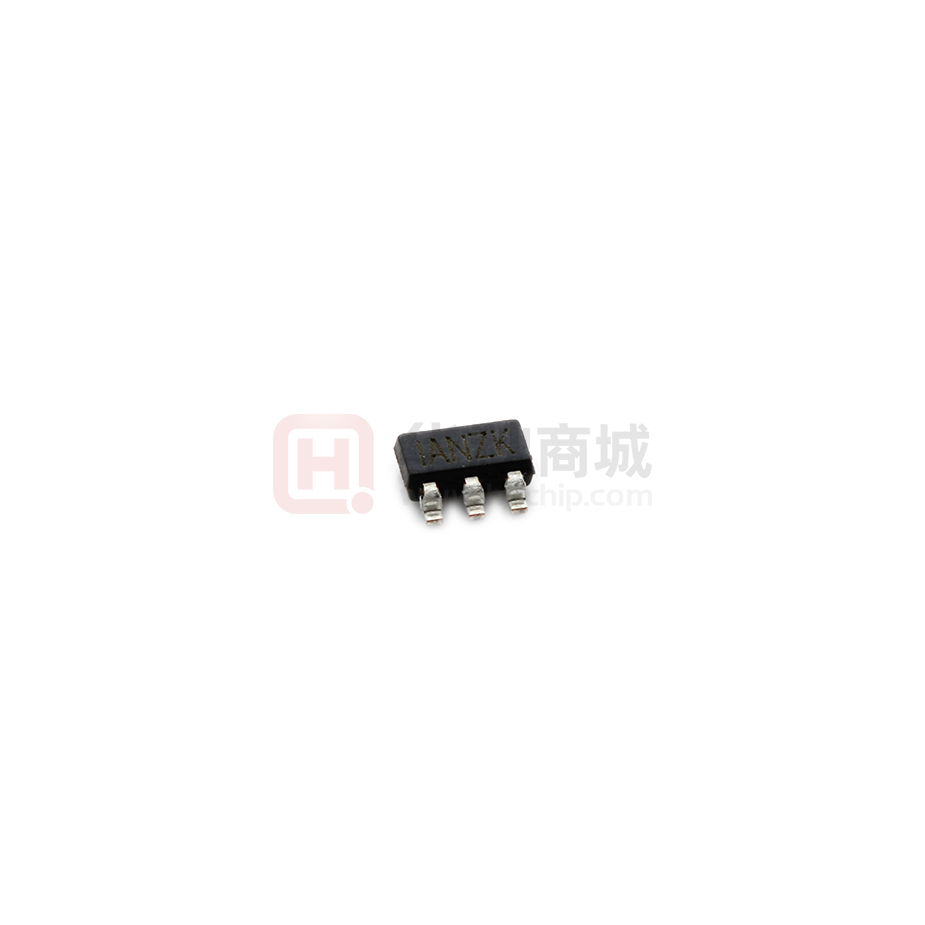
MP173
700 V Non-Isolated Off-Line Regulator
Up to 280 mA Output Current
EC
R NE O
EF W M
ER D ME
E
N
TO S D
IG E
M N D
P1 S F
O
73
R
A
The Future of Analog IC Technology
NOT RECOMMENDED FOR NEW DESIGNS. REFER TO MP173A
DESCRIPTION
FEATURES
MP173 is a primary-side regulator that provides
accurate constant voltage (CV) regulation
without an opto-coupler. It supports buck, boost,
buck-boost, and flyback topologies. It has an
integrated 700 V MOSFET to simplify the
structure and reduce cost. These features make
it an ideal regulator for offline, low-power
applications, such as home appliances and
standby power.
MP173 is a green-mode-operation regulator.
Both the peak current and switching frequency
decrease as the load decreases. This feature
provides excellent efficiency at light load and
improves the overall average efficiency.
MP173 has various protection features
including thermal shutdown (TSD), VCC undervoltage lockout (UVLO), overload protection
(OLP), short-circuit protection (SCP), and openloop protection.
MP173 is available in a small TSOT23-5
package and SOIC-8 package.
Primary-Side CV Control, Supporting Buck,
Boost, Buck-Boost, and Flyback Topologies
Integrated 700 V MOSFET and Current
Source
< 30 mW No-Load Power Consumption
Up to 4 W Output Power
Maximum DCM Output Current Less than
180 mA
Maximum CCM Output Current Less than
280 mA
Low VCC Operating Current
Frequency Foldback
Limited Maximum Frequency
Peak-Current Compression
Internally Biased VCC
TSD, UVLO, OLP, SCP, Open-Loop
Protection
APPLICATIONS
Home Appliances, White Goods, and
Consumer Electronics
Industrial Controls
Standby Power
R
All MPS parts are lead-free, halogen-free, and adhere to the RoHS directive. For
MPS green status, please visit the MPS website under Quality Assurance. “MPS”
and “The Future of Analog IC Technology” are registered trademarks of
Monolithic Power Systems, Inc.
N
O
T
TYPICAL APPLICATION
DRAIN
L
D2
VCC
C2
MP173
FB
R1
C3
R2
SOURCE
Input
SOURCE
VOUT
D1
N
MP173 Rev. 1.01
9/21/2018
L1
C1
C4
GND
www.MonolithicPower.com
MPS Proprietary Information. Patent Protected. Unauthorized Photocopy and Duplication Prohibited.
© 2021 MPS. All Rights Reserved.
1
�MP173– NON-ISOLATED OFFLINE REGULATOR
NOT RECOMMENDED FOR NEW DESIGNS. REFER TO MP173A
ORDERING INFORMATION
Package
Top Marking
MP173GJ*
MP173GS**
TSOT23-5
SOIC-8
See Below
See Below
EC
R NE O
EF W M
ER D ME
E
N
TO S D
IG E
M N D
P1 S F
O
73
R
A
Part Number
* For Tape & Reel, add suffix –Z (e.g. MP173GJ–Z).
** For Tape & Reel, add suffix –Z (e.g. MP173GS–Z).
TOP MARKING (TSOT23-5)
ANZ: product code of MP173GJ;
Y: year code;
TOP MARKING (SOIC-8)
R
MP173: part number;
LLLLLLLL: lot number;
MPS: MPS prefix:
Y: year code;
WW: week code:
N
O
T
PACKAGE REFERENCE
TOP VIEW
VCC
1
FB
2
SOURCE
3
5
DRAIN
8 NC
VCC 1
FB 2
4
TSOT23-5
MP173 Rev. 1.01
9/21/2018
TOP VIEW
SOURCE
7 DRAIN
SOURCE 3
6 NC
SOURCE 4
5 NC
SOIC-8
www.MonolithicPower.com
MPS Proprietary Information. Patent Protected. Unauthorized Photocopy and Duplication Prohibited.
© 2021 MPS. All Rights Reserved.
2
�MP173– NON-ISOLATED OFFLINE REGULATOR
NOT RECOMMENDED FOR NEW DESIGNS. REFER TO MP173A
ABSOLUTE MAXIMUM RATINGS (1)
Thermal Resistance (4)
DRAIN to SOURCE (TJ =+25°C) . -0.3 V to 700 V
All other pins ................................ -0.3 V to 6.5 V
Continuous power dissipation ..... (TA = +25°C)(2)
TSOT23-5 .................................................... 1 W
SOIC-8 ......................................................... 1 W
Junction temperature ................................150°C
Lead temperature .....................................260°C
Storage temperature ................ -60°C to +150°C
TSOT23-5 .............................. 100 ..... 55... °C/W
SOIC-8 .................................... 96 ...... 45... °C/W
θJC
EC
R NE O
EF W M
ER D ME
E
N
TO S D
IG E
M N D
P1 S F
O
73
R
A
θJA
Recommended Operating Conditions (3)
N
O
T
R
Operating junction temp. (TJ). .. -40°C to +125°C
Operating VCC range ................... 5.5 V to 5.7 V
NOTES:
1) Exceeding these ratings may damage the device.
2) The maximum allowable power dissipation is a function of the
maximum junction temperature TJ(MAX), the junction-toambient thermal resistance θJA, and the ambient temperature
TA. The maximum allowance continuous power dissipation at
any ambient temperature is calculated by PD(MAX)=(TJ(MAX)TA)/θJA. Exceeding the maximum allowance power dissipation
will produce an excessive die temperature, causing the
regulator to go into thermal shutdown. Internal thermal
shutdown circuit protects the device from permanent damage.
3) The device is not guaranteed to function outside of its
operating conditions.
4) Measured on JESD51-7, 4-layer PCB.
MP173 Rev. 1.01
9/21/2018
www.MonolithicPower.com
MPS Proprietary Information. Patent Protected. Unauthorized Photocopy and Duplication Prohibited.
© 2021 MPS. All Rights Reserved.
3
�MP173– NON-ISOLATED OFFLINE REGULATOR
NOT RECOMMENDED FOR NEW DESIGNS. REFER TO MP173A
ELECTRICAL CHARACTERISTICS
EC
R NE O
EF W M
ER D ME
E
N
TO S D
IG E
M N D
P1 S F
O
73
R
A
VCC = 5.5 V, TJ = -40°C~125°C, min and max are guaranteed by characterization, typical is tested
under 25°C, unless otherwise specified.
Parameter
Symbol
Condition
Start-up Current Source and Internal MOSFET (DRAIN)
Internal regulator supply current
Iregulator VCC = 4 V; VDrain = 100 V
DRAIN leakage current
ILeak
VCC = 5.8 V; VDrain = 400 V
Breakdown voltage
ON resistance
Supply Voltage Management (VCC)
VCC level (increasing) where the internal
regulator stops
VCC level (decreasing) where the
internal regulator turns on
VCC regulator on and off hysteresis
VCC level (decreasing) where the IC
stops
VCC level (decreasing) where the
protection phase ends
V(BR)DSS
TJ = 25°C
Ron
TJ = 25°C
TJ = 125°C
Min
Typ
Max
Units
2.2
4.1
10
6
17
mA
μA
700
6
V
VCCON
5.1
5.5
5.8
V
130
250
VCCstop
3
3.4
3.6
V
VCCpro
2
2.5
2.8
V
fs = 28 kHz, D = 67.8%
720
μA
VCC = 5.3 V
16
200
24
µA
μA
420
460
mA
ICC
ICCLATCH
ILimit
TJ = 25°C
380
τLEB1
ISCP
mV
350
TJ = 25°C
500
τLEB2
R
Leading-edge blanking for SCP
Ω
Ω
5.7
Internal IC consumption (no switching)
Internal IC consumption, latch-off phase
Internal Current Sense
Peak current limit
(1)
18
27
5.4
ICC
SCP threshold
14
22
VCCOFF
Internal IC consumption
Leading-edge blanking
V
600
ns
760
180
mA
ns
Feedback Input (FB)
Minimum off time
T
Maximum on time
N
O
Primary MOSFET feedback turn-on
threshold
OLP feedback trigger threshold
τminoff
τmanon
9
12
15
μs
17
24
31
μs
VFB
2.45
2.55
2.65
V
VFB_OLP
1.64
1.74
1.84
V
OLP delay time
τOLP
Open-loop detection
Thermal Shutdown
VOLD
Thermal shutdown threshold
(1)
Thermal shutdown recovery hysteresis
(1)
fs = 28 kHz
220
0.4
0.5
ms
0.6
V
150
°C
30
°C
NOTE:
1) This parameter is guaranteed by design.
MP173 Rev. 1.01
9/21/2018
www.MonolithicPower.com
MPS Proprietary Information. Patent Protected. Unauthorized Photocopy and Duplication Prohibited.
© 2021 MPS. All Rights Reserved.
4
�MP173– NON-ISOLATED OFFLINE REGULATOR
NOT RECOMMENDED FOR NEW DESIGNS. REFER TO MP173A
EC
R NE O
EF W M
ER D ME
E
N
TO S D
IG E
M N D
P1 S F
O
73
R
A
TYPICAL CHARACTERISTICS
5.73
2.56
5.72
2.55
5.71
2.54
5.70
2.53
710
-40 -25-10 5 20 35 50 65 80 95 110125
5.69
-40 -25-10 5 20 35 50 65 80 95 110125
2.52
-40 -25-10 5 20 35 50 65 80 95 110125
5.50
2.60
1.8
2.55
1.6
810
800
790
780
770
760
750
740
730
720
5.49
5.48
5.47
5.46
5.45
5.44
5.43
2.50
2.45
2.40
1.2
1.0
0.8
2.35
0.6
2.30
-40 -25-10 5 20 35 50 65 80 95 110125
0.4
-40 -25-10 5 20 35 50 65 80 95 110125
N
O
T
R
5.42
-40 -25-10 5 20 35 50 65 80 95 110125
1.4
430.0
425.0
420.0
610
600
590
12.6
12.4
12.2
12.0
415.0
580
410.0
570
11.6
405.0
-40 -25-10 5 20 35 50 65 80 95 110125
560
-40 -25-10 5 20 35 50 65 80 95 110125
11.4
-40 -25-10 5 20 35 50 65 80 95 110125
MP173 Rev. 1.01
9/21/2018
11.8
www.MonolithicPower.com
MPS Proprietary Information. Patent Protected. Unauthorized Photocopy and Duplication Prohibited.
© 2021 MPS. All Rights Reserved.
5
�MP173– NON-ISOLATED OFFLINE REGULATOR
NOT RECOMMENDED FOR NEW DESIGNS. REFER TO MP173A
TYPICAL PERFORMANCE CHARACTERISTICS
VDS
100V/div.
IL
200mA/div.
VDS
100V/div.
VDS
100V/div.
VDS
100V/div.
IL
200mA/div.
IL
200mA/div.
VDS
100V/div.
VDS
100V/div.
IL
500mA/div.
IL
200mA/div.
N
O
T
R
IL
500mA/div.
EC
R NE O
EF W M
ER D ME
E
N
TO S D
IG E
M N D
P1 S F
O
73
R
A
VIN = 230 VAC, VOUT = 12 V, IOUT = 250 mA, L = 1.2 mH, COUT = 100 μF, TA = +25°C, unless
otherwise noted.
VDS
100V/div.
IL
200mA/div.
MP173 Rev. 1.01
9/21/2018
VOUTRIPPLE
50mV/div.
VOUTRIPPLE
100mV/div.
IOUT
200mA/div.
www.MonolithicPower.com
MPS Proprietary Information. Patent Protected. Unauthorized Photocopy and Duplication Prohibited.
© 2021 MPS. All Rights Reserved.
6
�MP173– NON-ISOLATED OFFLINE REGULATOR
NOT RECOMMENDED FOR NEW DESIGNS. REFER TO MP173A
PIN FUNCTIONS
Pin #
TSOT23-5
1
2
3,4
Pin #
SOIC8
1
2
3,4
5
7
DRAIN
5,6,8
NC
Description
EC
R NE O
EF W M
ER D ME
E
N
TO S D
IG E
M N D
P1 S F
O
73
R
A
Name
VCC
Control circuit power supply.
FB
Regulator feedback.
SOURCE Internal power MOSFET source and ground reference for VCC and FB.
Internal power MOSFET drain and high-voltage current source input.
N
O
T
R
No connection.
MP173 Rev. 1.01
9/21/2018
www.MonolithicPower.com
MPS Proprietary Information. Patent Protected. Unauthorized Photocopy and Duplication Prohibited.
© 2021 MPS. All Rights Reserved.
7
�MP173– NON-ISOLATED OFFLINE REGULATOR
NOT RECOMMENDED FOR NEW DESIGNS. REFER TO MP173A
EC
R NE O
EF W M
ER D ME
E
N
TO S D
IG E
M N D
P1 S F
O
73
R
A
FUNCTIONAL BLOCK DIAGRAM
VCC
DRAIN
Start-Up Unit
Power
Management
Driving Signal
Management
Feedback Control
Peak Current
Limitation
Protection Unit
FB
SOURCE
N
O
T
R
Figure 1—Functional block diagram
MP173 Rev. 1.01
9/21/2018
www.MonolithicPower.com
MPS Proprietary Information. Patent Protected. Unauthorized Photocopy and Duplication Prohibited.
© 2021 MPS. All Rights Reserved.
8
�MP173– NON-ISOLATED OFFLINE REGULATOR
NOT RECOMMENDED FOR NEW DESIGNS. REFER TO MP173A
OPERATION
The MP173 acts as a fully integrated regulator
when used in buck topology (see Typical
Application on page 1).
Start-Up and Under-Voltage Lockout
The internal high-voltage regulator self-supplies
the IC from DRAIN. When VCC voltage reaches
VCCOFF, the IC starts switching, and the internal
high-voltage regulator turns off. The internal highvoltage regulator turns on to charge the external
VCC capacitor when the VCC voltage falls below
VCCON. A small capacitor (in the low μF range)
maintains the VCC voltage and thus lowers the
capacitor cost.
The IC stops switching when the VCC voltage
drops blow VCCstop.
R
Under fault conditions—such as OLP, SCP, and
TSD—the IC stops switching, and an internal
current source (~16 μA) discharges the VCC
capacitor. The internal high-voltage regulator will
not charge the VCC capacitor until the VCC
voltage drops below VCCpro. The re-start time
can be estimated using Equation (1):
(1)
T
VCC VCCpro VCCOFF VCCpro
restart C VCC
ICCLATCH
Iregulator
Soft Start (SS)
24 us
12 us
Driver
MP173 adopts a 2 phase minimum off time limit
soft start. Each soft-start phase retains 128
switching cycles. During a soft start, the off time
limit gradually shortens from 48 μs to 24 μs and
finally reaches the normal operation off-time limit
(see Figure 2).
MP173 Rev. 1.01
9/21/2018
128 Switching cycle 128 Switching cycle
Figure 2— min off at start-up
Constant Voltage (CV) Operation
The MP173 regulates the output voltage by
monitoring the sampling capacitor (C3).
At the beginning of each cycle, the integrated
MOSFET turns on while the feedback voltage
drops below the 2.55 V reference voltage, which
indicates insufficient output voltage. The peak
current limitation determines the on period. After
the on period elapses, the integrated MOSFET
turns off. The sampling capacitor (C3) voltage is
charged to the output voltage when the
freewheeling diode (D1) turns on. In this way, the
sampling capacitor (C3) samples and holds the
output voltage for output regulation. The
sampling capacitor (C3) voltage decreases when
the L1 inductor current falls below the output
current. When the feedback voltage falls below
the 2.55 V reference voltage, a new switching
cycle begins. Figure 3 shows this operation in
continuous
conduction
mode
(CCM).
MOSFET
Diode
IL
Ipeak
Io
Vo
The IC stops operation when the VCC voltage
drops blow VCCstop; the IC starts operation when
VCC charges to VCCOFF. Every time the chip
starts operation there is a soft-start period. The
soft start prevents the inductor current from
overshooting by limiting the minimum off time.
O
N
48 us
EC
R NE O
EF W M
ER D ME
E
N
TO S D
IG E
M N D
P1 S F
O
73
R
A
MP173 is a green-mode-operation regulator: The
peak current and the switching frequency both
decrease with a decreasing load. As a result, it
offers excellent light-load efficiency and improves
overall average efficiency. Also, the regulator
incorporates multiple features and operates with
a minimum number of external components.
V FB
2.55V
Figure 3—VFB vs. VO
Equation (2) determines the output voltage:
Vo 2.55V
R1 R2
R2
www.MonolithicPower.com
MPS Proprietary Information. Patent Protected. Unauthorized Photocopy and Duplication Prohibited.
© 2021 MPS. All Rights Reserved.
(2)
9
�MP173– NON-ISOLATED OFFLINE REGULATOR
fs
EC
R NE O
EF W M
ER D ME
E
N
TO S D
IG E
M N D
P1 S F
O
73
R
A
NOT RECOMMENDED FOR NEW DESIGNS. REFER TO MP173A
Ramp Compensation
Frequency Foldback and Peak Current
Compression
An internal ramp compensation circuit improves
the load regulation. An exponential voltage signal
The MP173 remains highly efficient at light-load
is added to pull down the reference voltage of the
conditions by reducing the switching frequency
feedback comparator (see Figure 4). The ramp
automatically.
compensation is a function of the load conditions:
Under light-load or no-load conditions, the output
the compensation is about the 1 mV/µs under
voltage drops very slowly, which increases the
full-load conditions. The compensation increases
MOSFET off time. Thus, the frequency
exponentially as the peak current decreases.
decreases along with the load.
Over-Load Protection (OLP)
The switching frequency is determined with
The maximum output power of the MP173 is
Equation (3) and Equation (4):
limited by the maximum switching frequency and
(Vin Vo ) Vo
peak current limit. If the load current is too large,
, for CCM
(3)
fs
2L(Ipeak Io ) Vin
the output voltage drops, causing the FB voltage
to drop.
2(Vin VO ) Io Vo
, for DCM
LI2peak
Vin
(4)
As the peak current limit decreases from 420 mA,
the off time increases. In standby mode, the
frequency and the peak current are both
minimized, allowing for a smaller dummy load. As
a result, peak current compression helps further
reduce no-load consumption. The peak current
limit can be estimated from Equation (5) where
τoff is the off time of the power module:
IPeak 420mA (1.6mA / s) ( off 12s)
(5)
EA Compensation
T
R
FB
Comparator
N
O
VFB
-
+
+
+
M
Vramp
+
Vramp
+
-
V
ref
2.55V
Ipeak
Figure 4—EA and ramp compensation
MP173 has an internal error amplifier (EA)
compensation loop. It samples the feedback
voltage 6 µs after the MOSFET turns off and
regulates the output based on the 2.55 V
reference voltage.
MP173 Rev. 1.01
9/21/2018
Delay 220ms
28kHz
fs
(6)
Short-Circuit Protection (SCP)
The MP173 monitors the peak current and shuts
down when the peak current rises above the
SCP threshold through short-circuit protection.
The power supply resumes operation with the
removal of the fault.
Thermal Shutdown (TSD)
EA
-
When the FB voltage drops below VFB_OLP, it is
considered an error flag, and the timer starts. If
the timer reaches 220 ms (fS = 28 kHz), OLP
occurs. This timer duration avoids triggering OLP
when the power supply starts up or the load
transitions. The power supply should start up in
less than 220 ms (fS = 28 kHz). The OLP delay
time is calculated using Equation (6):
To prevent thermal induced damage, the MP173
stops switching when the junction temperature
exceeds 150°C. During thermal shutdown (TSD),
the VCC capacitor is discharged to VCCpro,, and
the the internal high-voltage regulator re-charges.
MP173 recovers when the junction temperature
drops below 120°C.
Open-Loop Detection
If VFB is less than 0.5 V, the IC stops switching
and a re-start cycle begins. During a soft start,
the open-loop detection is blanked.
www.MonolithicPower.com
MPS Proprietary Information. Patent Protected. Unauthorized Photocopy and Duplication Prohibited.
© 2021 MPS. All Rights Reserved.
10
�MP173– NON-ISOLATED OFFLINE REGULATOR
NOT RECOMMENDED FOR NEW DESIGNS. REFER TO MP173A
Leading-Edge Blanking
EC
R NE O
EF W M
ER D ME
E
N
TO S D
IG E
M N D
P1 S F
O
73
R
A
An internal leading-edge blanking (LEB) unit
avoids premature switching pulse termination
due to a turn-on spike. A turn-on spike is caused
by parasitic capacitance and reverse recovery of
the freewheeling diode. During the blanking time,
the current comparator is disabled and cannot
turn off the external MOSFET. Figure 5 shows
the leading-edge blanking.
IDS
350ns
ILIMIT
t
N
O
T
R
Figure 5—Leading-edge blanking
MP173 Rev. 1.01
9/21/2018
www.MonolithicPower.com
MPS Proprietary Information. Patent Protected. Unauthorized Photocopy and Duplication Prohibited.
© 2021 MPS. All Rights Reserved.
11
�MP173– NON-ISOLATED OFFLINE REGULATOR
NOT RECOMMENDED FOR NEW DESIGNS. REFER TO MP173A
APPLICATION INFORMATION
EC
R NE O
EF W M
ER D ME
E
N
TO S D
IG E
M N D
P1 S F
O
73
R
A
Table 1—Common topologies using MP173
Topology
Circuit Schematic
DRAIN
5
1
MP173
High-side
buck
SOURCE
4
2
Features
VCC
FB
SOURCE
3
1.
2.
3.
4.
No isolation
Positive output
Low cost
Direct feedback
1.
2.
3.
4.
No isolation
Negative output
Low cost
Direct feedback
1.
2.
3.
4.
No isolation
Positive output
Low cost
Direct feedback
1.
2.
3.
4.
Isolation
Positive output
Low cost
Indirect feedback
Vin
Vo
DRAIN
1
5
MP173
High-side
buck-boost
SOURCE
2
3
4
VCC
FB
SOURCE
Vin
Vo
DRAIN
Boost
5
1
MP173
Vin
3
4
FB
T
O
N
Flyback
T
*
Vin
*
DRAIN
1
5
MP173
SOURCE
MP173 Rev. 1.01
9/21/2018
Vo
SOURCE
R
SOURCE
2
VCC
4
2
3
VCC
FB
SOURCE
*
www.MonolithicPower.com
MPS Proprietary Information. Patent Protected. Unauthorized Photocopy and Duplication Prohibited.
© 2021 MPS. All Rights Reserved.
12
�MP173– NON-ISOLATED OFFLINE REGULATOR
NOT RECOMMENDED FOR NEW DESIGNS. REFER TO MP173A
maximum power using Equation (7) and Equation
(8):
MP173 can be used in common topologies such
V
as buck, boost, buck-boost, and flyback (see
(7)
Po max Vo (Ipeak o min off ) , for CCM
2L
Table 1).
1 2
1
Component selection below is based on the
, for DCM
(8)
Po max LIpeak
typical application of MP173 (see it on page 1).
min off
2
For mass production, tolerance on the
Component Selection
parameters (such as peak current limitation and
Input Capacitor
the minimum off time) should be taken into
The input capacitor supplies the DC input voltage
consideration.
for the converter. Figure 6 shows the typical DC
Freewheeling Diode
bus voltage waveform of a half-wave rectifier and
Select a diode with a maximum reverse-voltage
a full-wave rectifier.
rating greater than the maximum input voltage
VDC(max)
Vin
and a current rating determined by the output
DC input voltage
current.
EC
R NE O
EF W M
ER D ME
E
N
TO S D
IG E
M N D
P1 S F
O
73
R
A
Topology Options
VDC(min)
AC input voltage
t
Vin
VDC(max)
Output Capacitor
DC input voltage
VDC( min)
The reverse recovery of the freewheeling diode
can affect efficiency and circuit operation during
a CCM condition, so use an ultra-fast diode such
as the EGC10JH.
The output capacitor is required to maintain the
DC output voltage. Estimate the output voltage
ripple using Equation (9) and Equation (10):
AC input voltage
t
VCCM _ ripple
i
i RESR , for CCM
8fsCo
Figure 6—Input voltage waveform
N
O
T
R
Typically, the use of a half-wave rectifier requires
an input capacitor rated at 3 µF/W for the
universal input condition. When using a full-wave
rectifier, the input capacitor is chosen between
1.5~2 µF/W for the universal input condition. A
half-wave rectifier is recommended for a < 2 W
output application, otherwise use a full-wave
rectifier.
Under very low input voltage, the inductor current
ramps up slowly; it may not reach the current
limit during τmanon, so the MOSFET on time
should be less than the minimum value of τmanon.
Inductor
The MP173 has a minimum off time limit that
determines the maximum power output. A power
inductor with a larger inductance increases the
maximum power. Using a very small inductor
may cause failure at full load. Estimate the
MP173 Rev. 1.01
9/21/2018
VDCM _ ripple
I
o
fsCo
(9)
2
I I
pk o Ipk RESR , for DCM (10)
I
pk
It is recommended to use ceramic, tantalum, or
low ESR electrolytic capacitors to reduce the
output voltage ripple.
Feedback Resistors
The resistor divider determines the output
voltage. Choose appropriate R1 and R2 values to
maintain VFB at 2.55 V. An excessively large
value for R2 should be avoided.
Feedback Capacitor
The feedback capacitor provides a sample and
hold function. Small capacitors result in poor
regulation at light loads, and large capacitors
affect the circuit operation. Roughly estimate an
optimal capacitor value using Equation (11):
www.MonolithicPower.com
MPS Proprietary Information. Patent Protected. Unauthorized Photocopy and Duplication Prohibited.
© 2021 MPS. All Rights Reserved.
13
�MP173– NON-ISOLATED OFFLINE REGULATOR
NOT RECOMMENDED FOR NEW DESIGNS. REFER TO MP173A
Surge Performance
(11)
An appropriate input capacitor value should be
chosen to obtain good surge performance. Figure
Dummy Load
8 shows the half-wave rectifier. Table 2 shows
the capacitance required under normal conditions
A dummy load is required to maintain the load
for different surge voltages. FR1 is a 20 Ω/2 W
regulation. This ensures sufficient inductor
fused resistor, and L1 is 1 mH for this
energy to charge the sample and hold capacitor
recommendation.
to detect the output voltage. Normally a 3 mA
dummy load is needed and can be adjusted
L1
FR1
L
according to the regulated voltage. There is a
compromise
between
small,
no-load
consumption and good, no-load regulation,
especially for applications that require 30 mW noC1
C2
load consumption. Use a zener to reduce no-load
consumption if no-load regulation is not a
concern.
EC
R NE O
EF W M
ER D ME
E
N
TO S D
IG E
M N D
P1 S F
O
73
R
A
C
Vo
C
1 Vo
o CFB
o
2 R1 R2 Io
R1 R2 Io
Auxiliary VCC Supply
N
R3
D3
C2
MP172
FB
R1
C3
R2
SOURCE
Figure 8—Half-wave rectifier
D2
VCC
SOURCE
L1
VOUT
Figure 7—Auxiliary VCC supply circuit
For VO above 7 V applications, the MP173
achieves the 30 mW no-load power requirement
by adopting an external VCC supply to reduce
overall power consumption (see Figure 7).
N
O
T
R
This auxiliary VCC supply is derived from the
resistor connected between C2 and C3. C3
should be set larger than the value
recommended above. D3 is used in case VCC
interferes with FB. R3 is determined Using
Equation (12).
R3
Vo VFW 5.8V (12)
IS
Where IS is the VCC consumption under a noload condition, and VFW is the forward voltage
drop of D3. Because IS varies in different
applications, R3 should be adjusted to meet the
application’s specific IS. In a particular
configuration, IS is measured at about 250 µA.
MP173 Rev. 1.01
9/21/2018
Table 2—Recommended capacitance
Surge
500 V
1000 V
2000 V
Voltage
1 μF
2.2 μF
3.3 μF
C1
1 μF
2.2 μF
3.3 μF
C2
PCB Layout Guidelines
Efficient PCB layout is critical for reliable
operation, good EMI, and thermal performance.
For best results, follow the guidelines below:
1) Minimize the loop area formed by the input
capacitor, IC, freewheeling diode, inductor,
and output capacitor.
2) Place the power inductor far away from the
input filter while keeping the loop area to the
inductor at a minimum (see example below).
3) Place a capacitor valued at several hundred
pF between FB and SOURCE as close to the
IC as possible.
4) Connect the exposed pads or large copper
area with DRAIN to improve thermal
performance.
www.MonolithicPower.com
MPS Proprietary Information. Patent Protected. Unauthorized Photocopy and Duplication Prohibited.
© 2021 MPS. All Rights Reserved.
14
�MP173– NON-ISOLATED OFFLINE REGULATOR
EC
R NE O
EF W M
ER D ME
E
N
TO S D
IG E
M N D
P1 S F
O
73
R
A
NOT RECOMMENDED FOR NEW DESIGNS. REFER TO MP173A
Top layer
Bottom layer
Design Example
Table 3 shows a design example for the following
application guideline specifications:
Table 3—Design example
85 VAC to 265 VAC
VIN
12 V
VOUT
250 mA
IOUT
N
O
T
R
The detailed application schematic is shown in
Figure 9. The typical performance and circuit
waveforms have been shown in the “Typical
Performance Characteristics” section. For
additional device applications, please refer to the
related evaluation board datasheets.
MP173 Rev. 1.01
9/21/2018
www.MonolithicPower.com
MPS Proprietary Information. Patent Protected. Unauthorized Photocopy and Duplication Prohibited.
© 2021 MPS. All Rights Reserved.
15
�MP173– NON-ISOLATED OFFLINE REGULATOR
NOT RECOMMENDED FOR NEW DESIGNS. REFER TO MP173A
TYPICAL APPLICATION CIRCUITS
F1
L
EC
R NE O
EF W M
ER D ME
E
N
TO S D
IG E
M N D
P1 S F
O
73
R
A
Figure 9 shows a typical application example of a 12 V, 250 mA non-isolated power supply using
MP173.
L1
10/1W
1mH
D3
D4
1N4007
1N4007
85~265VAC
NC
C4
10uF/400V
NC
Drain
Vcc
FB
4
RV1
C5
10uF/400V
1N4148WS
R2
R1
24K
19.1K
1
Source
Source
2
C3
3
C2
R3
R4
2.2uF
NC
4.99K
1nF
D7
1N4007
1N4007
L2 1.2mH
12V/250mA
VOUT
MP173
D5
D6
C1
220nF
NC
CX1
D2
1N4007
U1
5
R5
D1
STTH1R06
C6
C7
R6
100uF/35V
1uF
3K
GND
N
GND
N
O
T
R
Figure 9—Typical application at 12 V, 250 mA
MP173 Rev. 1.01
9/21/2018
www.MonolithicPower.com
MPS Proprietary Information. Patent Protected. Unauthorized Photocopy and Duplication Prohibited.
© 2021 MPS. All Rights Reserved.
16
�MP173– NON-ISOLATED OFFLINE REGULATOR
NOT RECOMMENDED FOR NEW DESIGNS. REFER TO MP173A
FLOW CHART
EC
R NE O
EF W M
ER D ME
E
N
TO S D
IG E
M N D
P1 S F
O
73
R
A
Power On
Vcc Decrease
to VCCPRO
Internal High Voltage
Regulator On
Shut Down
Internal High Voltage
Regulator
Y
Y
N
VCC>VCCOFF
N
Soft Start
Shuts Down
Internal High Voltage
Regulator
VCC>VCCSTOP
Stop Operation
Y
Y
Fault Logic N
High?
Monitor VCC
Y
VCC>VCCOFF
N
VCC