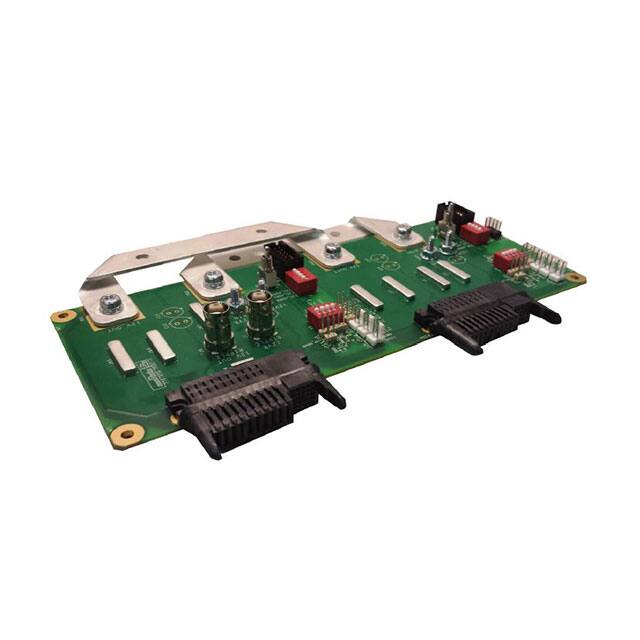
D1U54P-12-CONC
ACAN-64 Connector Card Application Note
OVERVIEW
The D1U54P-12-CONC (4407001-1) interface connector card is a dual card that is intended to interconnect the output voltages and
signals of two D1U54x Series power modules for laboratory/bench level evaluation of the product.
The outputs are capable of being parallel connected and a common ISHARE bus is provided to ensure that both power modules
share current within specified limits.
The Interface Card is capable of operation from standby voltages of 3.3V, 5V and 12V (provided by the D1U54x variant under test)
without any reconfiguration.
It is designed and intended to be used for the members within the following series (both AC and DC input source variants and both
airflow options):
3.3VSTANDBY
5VSTANDBY
12VSTANDBY
MODEL VARIANTS
Output
Output
Output
HB3xC
D1U54x-x-650-12-HBxxC-xxx
N/A
N/A
HB4xC
HC3PC
HA3PxC
D1U54x-x-1200-12-HxxxxC
N/A
HC4PC
HA4PxC
HC3C
HA3C
D1U54x-x-1500-12-HxxxC
HB4xC
HC4C
HA4C
End Users can also use this card in their applications as an alternative to a host system power/mid or interposer plane (consult
Murata Sales for details).
SAFETY PRECAUTION
The D1U54P-12-CONC output connector card is intended to facilitate the connection of the output supply rails of the power module.
As such there a high energy source exposed on the output connector card; please take the necessary safety precautions during the
use of this connector card for product evaluation.
IMAGES – D1U54P-12-CONC
Component Side (Top) View
SCHEMATIC – D1U54P-12-CONC
www.murata-ps.com/support
08 Feb 2016 ACAN64.A01 Page 1 of 6
�D1U54P-12-CONC
ACAN-64 Connector Card Application Note
www.murata-ps.com/support
08 Feb 2016 ACAN64.A01 Page 2 of 6
�D1U54P-12-CONC
ACAN-64 Connector Card Application Note
SCHEMATIC – D1U54P-12-CONC
www.murata-ps.com/support
08 Feb 2016 ACAN64.A01 Page 3 of 6
�D1U54P-12-CONC
ACAN-64 Connector Card Application Note
MECHANICAL OUTLINE
Top View
+12V_OUT
+12V_GND
J28
J8
S1
S21
S27
S7
J6
JP15
JP1
JP2
J7
JP22
JP21
JP11
J1
JP31
J21
3D View
www.murata-ps.com/support
08 Feb 2016 ACAN64.A01 Page 4 of 6
�D1U54P-12-CONC
ACAN-64 Connector Card Application Note
CONFIGURATION NOTES:
1. The Interface Connector card is basically two identical circuits provided on a single card (PCB). Each “half” has all the
necessary configuration links duplicated to enable each “half” to operate individually if required.
Common connections exist these being as follows:
a. Power bus bars that are intended to interconnect the main 12VDC outputs of each “half”; these can be removed as
required, and substituted with separate cables to the required load.
b. ISHARE signal bus between each “half”. This interconnection is provided by a single jumper JP15 and can be removed
if operation as two independent (no parallel connection) is required.
Note that no physical parallel connection is provided to interconnect the VSTANDBY output of each “half”. If required cable
connections can be provided by the End User (note: parallel connection of the VSTANDBY is subject to the limitations as
described in the respective product datasheets).
2. To configure each “half” for independent or parallel operation, ensure that the following configurable jumpers (headers)
have shorting links (shunts Dual Beam; TE Connectivity Pt# 390088-2) fitted across their respective Pins 1 & 2 (refer to
schematic & photograph):
a. JP1/JP21; +12VSENSE local voltage sense selection; deselect if remote sense connection is provided to the load.
b. JP2/JP22; +12VSENSE_RTN local voltage sense selection;deselect if remote sense connection is provided to the load.
c. JP11 & JP31 (PS_KILL connection to GNDB/GNDD return ; enables output.
d. JP15; this jumper interconencts the ISHARE signals between the two power modules. Fit the shorting link across Pins 1
& 2 if the units are to be operated in parallel to share a common load.
Remove the shorting link if the units are to be operated “independently” as separate power modules.
3. The two DC Main 12V DC outputs are interconnected with bus bars.
4. The BNC connectors for ripple & noise measurements of 12VSTBY (J7 bias/standby) and 12VOUT (J6 Main output) are
intended for direct (BNC to BNC) connection (or via a 10X probe if required) to an oscilloscope. Note also that the
measurement node is filtered with a parallel connected 10µF tantalum and 1µF ceramic capacitor (across tip to ground)
A short 50ohm coaxial cable connnection shall be provided between the relevant BNC measurement connector and the input
to the measuring ‘scope (the ‘scope bandwidth shall be limited to 20MHz).
5. Connector J8 is a PMBob I2C/SPI interface connector. The PMBob USB to I2C Interface external device allows
communications via a USB port of a laptop or PC that can be used with the provided MPS software GUI.
As such this is the recommended communication interface for use with this interface card for initial bench evaluation.
6. S1/S21 enables/disables (turns “on”/“off”) the main output by connecting PS_ON_L to the respective 12VSTBY Return.
Close S1/S21 to enable (turn “on”) the respective power module 12VDC Main Output.
www.murata-ps.com/support
08 Feb 2016 ACAN64.A01 Page 5 of 6
�D1U54P-12-CONC
ACAN-64 Connector Card Application Note
CONFIGURATION NOTES:
7. S7/S27 are a four (4) position DIL/DIP switches that is intended to select the User configurable bits that assign the variable
address for I2C communications with the power module.
The D1U54x products series’ employs an analogue input that is used to set the address of the internal slave devices (EEPROM
and microprocessor) used for digital communications.
Connection of a suitable resistor to +VSB_Return, in conjunction with a resistor divider chain (internal to the power module),
will configure the required address.
However since the purpose of this connector card is to provide a convenient means to evaluate the D1U54x products, this
method has been replaced by an analogue multiplexer device that allows selection of the slave address via a “pin strap”
method using three address bits (configured via S7/S27).
S7/S27
S7/S27
S7/S27
Position #3 (A2)
Position #2 (A1)
Position #1 (A0)
(Serial Address BIT 2) (Serial Address BIT 1) (Serial Address BIT 0)
LOW
LOW
LOW
LOW
HIGH
HIGH
HIGH
HIGH
LOW
LOW
HIGH
HIGH
LOW
LOW
HIGH
HIGH
LOW
HIGH
LOW
HIGH
LOW
HIGH
LOW
HIGH
Power Module Main
Controller
(Serial Comm Slave
Address)
0xB0
0xB2
0xB4
0xB6
0xB8
0xBA
0xBC
0xBE
Power Module Main EEPROM
(Serial Comm Slave Address)
0xA0
0xA2
0xA4
0xA6
0xA8
0xAA
0xAC
0xAE
The address convention uses 7-bit left shifted Slave Device addressing with the Read/Write bit either a “0” (Write) or a “1” (Read).
The addresses above assume the Read/Write bit is a “0”.
S7/S27 is shown in the diagram opposite (also refer to the schematic).
With any of the DIL switches (1, 2, & 3) set to the “off” (open) position, the
corresponding address line (A0/A1/A2 respectively ) shall be set to a logic level high (by
action of the 3K32K ohm pull up resistor upon the Interface Connector Card.
Operating the appropriate switch to the “on” (closed) position will connect the
appropriate line to a logic level low.
Note: The switch position DIL Position #4 is unused and has no connection (NC) on the
interface connector card.
NB: The D1U54x Series employs “left shifted” 7-Bit addressing; where Bit “0”of the device address is the Read/Write bit. The addresses, as shown above, assume that the
Read/Write bit is a logic level “0”.
www.murata-ps.com/support
08 Feb 2016 ACAN64.A01 Page 6 of 6
�
很抱歉,暂时无法提供与“D1U54P-12-CONC”相匹配的价格&库存,您可以联系我们找货
免费人工找货