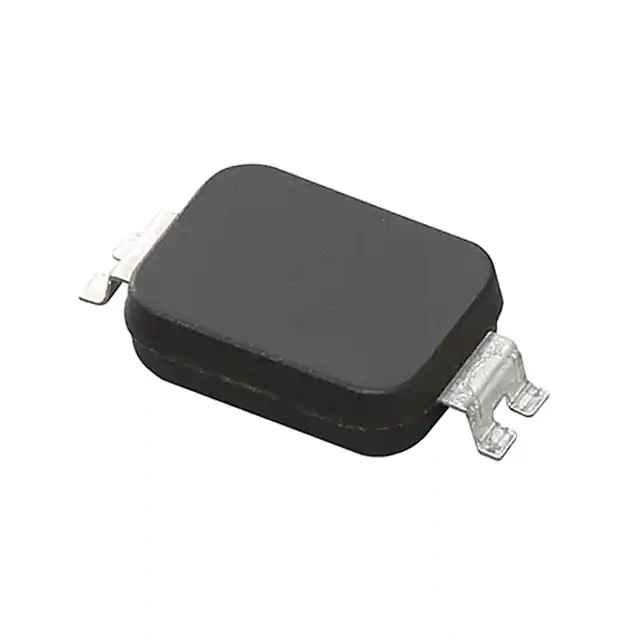
Reference Specification
Type EA
Safety Standard Certified Resin Molding
SMD Type Ceramic Capacitors for General Purpose
Product specifications in this catalog are as of Apr. 2022, and are subject to change or
obsolescence without notice.
Please consult the approval sheet before ordering.Please read rating and Cautions first.
�Referencce only
CAUTION
1. OPERATING VOLTAGE
1) Do not apply a voltage to a safety standard certified product that exceeds the rated voltage as called
out in the specifications. Applied voltage between the terminals of a safety standard certified product
shall be less than or equal to the rated voltage (+ 10%). When a safety standard certified product is
used as a DC voltage product, the AC rated voltage value becomes the DC rated voltage value.
(Example:AC250V (r.m.s.) rated product can be used as DC250V (+ 10%) rated product.)
If both AC rated voltage and DC rated voltage are specified, apply the voltage lower than the
respective rated voltage.
1-1) When a safety standard certified product is used in a circuit connected to a commercial power
supply, ensure that the applied commercial power supply voltage including fluctuation should be less
than 10% above its rated voltage.
1-2) When using a safety standard certified product as a DC rated product in circuits other than those
connected to a commercial power supply.
When AC voltage is superimposed on DC voltage, the zero-to-peak voltage shall not exceed the rated
DC voltage. When AC voltage or pulse voltage is applied, the peak-to-peak voltage shall not exceed
the rated DC voltage
Typical Voltage Applied to the DC Capacitor
DC Voltage
E
DC Voltage+AC
Pulse Voltage
AC Voltage
E
E
0
E
0
0
0
(E:Maximum possible applied voltage.)
2) Abnormal voltages (surge voltage, static electricity, pulse voltage, etc.) shall not exceed the rated DC
voltage.
2. OPERATING TEMPERATURE AND SELF-GENERATED HEAT
Keep the surface temperature of a capacitor below the upper limit of its rated operating temperature
range. Be sure to take into account the heat generated by the capacitor itself.
When the capacitor is used in a high-frequency current, pulse current or the like, it may have the selfgenerated heat due to dielectric-loss. Applied voltage should be the load such as self-generated
heat is within 20 °C on the condition of atmosphere temperature 25 °C. When measuring, use a
thermocouple of small thermal capacity-K of φ0.1mm and be in the condition where capacitor is not
affected by radiant heat of other components and wind of surroundings. Excessive heat may lead to
deterioration of the capacitor’s characteristics and reliability.(Never attempt to perform measurement
with the cooling fan running. Otherwise, accurate measurement cannot be ensured.)
3. TEST CONDITION FOR WITHSTANDING VOLTAGE
1) TEST EQUIPMENT
Test equipment for AC withstanding voltage should be used with the performance of the wave similar
to 50/60 Hz sine wave.
If the distorted sine wave or over load exceeding the specified voltage value is applied, the defective
may be caused.
2) VOLTAGE APPLIED METHOD
When the withstanding voltage is applied, capacitor’s lead or terminal should be firmly connected
to the out-put of the withstanding voltage test equipment, and then the voltage should be raised
from near zero to the test voltage.
If the test voltage without the raise from near zero voltage would be applied directly to capacitor, test
voltage should be applied with the *zero cross. At the end of the test time, the test voltage should be
reduced to near zero, and then capacitor’s lead or terminal should be taken off the out-put of the
withstanding voltage test equipment.
If the test voltage without the raise from near zero voltage would
voltage sine wave
be applied directly to capacitor, the surge voltage may arise,
and therefore, the defective may be caused.
0V
*ZERO CROSS is the point where voltage sine wave pass 0V.
zero cross
- See the right figure -
EGD30A
1/12
�Referencce only
4. FAIL-SAFE
When capacitor would be broken, failure may result in a short circuit. Be sure to provide an
appropriate fail-safe function like a fuse on your product if failure would follow an electric shock,
fire or fume.
5. VIBRATION AND IMPACT
Do not expose a capacitor or its leads to excessive shock or vibration during use.
6. SOLDERING
6-1 Reflow Soldering
[Standard Conditions for Reflow Soldering]
When soldering capacitor, it should be performed
Tem perature (℃)
in following conditions.
Soldering temperature : 230 ~ 260 °C
Soldering
260℃
Soldering time
: 10 ~ 30s
Gradual
230℃
Cooling
Preheating temperature : 170 °C max.
170℃
150℃
6-2 Flow Soldering
130℃
Preheating
When soldering capacitor, it should be performed
in following conditions.
Soldering temperature : 260 °C max.
Time
Soldering time
: 5s max.
60 - 120 s 10 - 30 s
Preheating temperature : 120 °C max.
Preheating time
: 60s max.
6-3 Soldering Iron
When soldering this product to a PCB/PWB, do not
exceed the solder heat resistance specification of
the capacitor. Subjecting this product to excessive
heating could melt the internal junction solder and
may result in thermal shocks that can crack the
ceramic element.
When soldering capacitor with a soldering iron,
it should be performed in following conditions.
Temperature of iron-tip : 400 °C max.
Soldering iron wattage : 50W max.
Soldering time
: 3.5s max.
7. BONDING, RESIN MOLDING AND COATING
Before bonding, molding or coating this product, verify that these processes do not affect the quality
of capacitor by testing the performance of the bonded, molded or coated product in the intended
equipment.
In case of the amount of applications, dryness / hardening conditions of adhesives and molding
resins containing organic solvents (ethyl acetate, methyl ethyl ketone, toluene, etc.) are unsuitable,
the outer coating resin of a capacitor is damaged by the organic solvents and it may result, worst
case, in a short circuit.
The variation in thickness of adhesive, molding resin or coating may cause an outer coating resin
cracking and/or ceramic element cracking of a capacitor in a temperature cycling.
EGD30A
2/12
�Referencce only
8. OPERATING AND STORAGE ENVIRONMENT
The insulation coating of capacitors does not form a perfect seal; therefore, do not use or store
capacitors in a corrosive atmosphere, especially where chloride gas, sulfide gas, acid, alkali, salt or
the like are present. And avoid exposure to moisture. Before cleaning, bonding, or molding
this product, verify that these processes do not affect product quality by testing the performance of a
cleaned, bonded or molded product in the intended equipment.
This one is MSL 3 product. So, in order to avoid the absorption of moisture, capacitors are packed in
moisture-proof envelope.
Store the capacitors in the following conditions at all times, and use within 6 months after delivered.
Temperature : 10 to 30°C
Humidity
: 60% max.
Solder the enclosed capacitors within 168 hours after opening the moisture-proof package.
After opening, store the capacitors in moisture-proof package with a desiccant and HIC card and keep
the above condition.
In case the storage period has been exceeded 6 months or the indicator color of a enclosed HIC card
has changed when the package has been opened, perform baking (60°C x 168 hr ) before soldering.
9. LIMITATION OF APPLICATIONS
Please contact us before using our products for the applications listed below which require especially
high reliability for the prevention of defects which might directly cause damage to the third party’s life,
body or property.
1. Aircraft equipment
2. Aerospace equipment
3. Undersea equipment
4. Power plant control equipment
5. Medical equipment
6. Transportation equipment (automotives, trains, ships, etc.)
7. Traffic signal equipment
8. Disaster prevention / crime prevention equipment
9. Data-processing equipment exerting influence on public
10. Application of similar complexity and/or reliability requirements to the applications listed
in the above.
NOTICE
1. CLEANING (ULTRASONIC CLEANING)
To perform ultrasonic cleaning, observe the following conditions.
Rinse bath capacity : Output of 20 watts per liter or less.
Rinsing time : 5 min maximum.
Do not vibrate the PCB/PWB directly.
Excessive ultrasonic cleaning may lead to fatigue destruction of the terminals.
2. CAPACITANCE CHANGE OF CAPACITORS
⋅ Class 1 capacitors
Capacitance might change a little depending on a surrounding temperature or an applied voltage.
Please contact us if you use for the strict time constant circuit.
⋅ Class 2 capacitors
Class 2 capacitors like temperature characteristic B, E and F have an aging characteristic, whereby
the capacitor continually decreases its capacitance slightly if the capacitor leaves for a long time.
Moreover, capacitance might change greatly depending on a surrounding temperature or an applied
voltage. So, it is not likely to be able to use for the time constant circuit.
Please contact us if you need a detail information.
EGD30A
3/12
�Referencce only
3. PERFORMANCE CHECK BY EQUIPMENT
Before using a capacitor, check that there is no problem in the equipment's performance and the
specifications.
Generally speaking, Class 2 ceramic capacitors have voltage dependence characteristics and
temperature dependence characteristics in capacitance. So, the capacitance value may change
depending on the operating condition in an equipment. Therefore, be sure to confirm the apparatus
performance of receiving influence in a capacitance value change of a capacitor, such as leakage
current and noise suppression characteristic.
Moreover, check the surge-proof ability of a capacitor in the equipment, if needed, because the surge
voltage may exceed specific value by the inductance of the circuit.
4. Land Dimensions
The recommendable land dimensions for reflow soldering are follows.
Regarding the "a" dimension, to ensure the creepage distance required by the safety standard
applys to your equipment.
Dimension
8.0 x 6.0
a
8.0
b
2.2
c
3.6
NOTE
1.Please make sure that your product has been evaluated in view of your specifications with our product
being mounted to your product.
2.You are requested not to use our product deviating from this specification.
EGD30A
4/12
�Reference only
1. Application
This specification is applied to Safety Standard Certified Resin Molding SMD Type Ceramic Capacitors
Type EA used for General Electric equipment.
Type EA is Safety Standard Certified capacitors of Class X1, Y1.
Do not use these products in any automotive power train or safety equipment including battery
charger for electric vehicles and plug-in hybrids.
Approval standard and recognized number
Standard number
UL60384-14/CSA E60384-14
UL/cUL
ENEC
(SEMKO)
CQC
KTC
*Certified number
E37921
AC Rated volt.
SE/16008-1A
X1:AC440V(r.m.s.)
Y1:AC250V(r.m.s.)
EN60384-14
IEC60384-14
CQC16001142384
KC60384-14
HU03008-16007
*Above Certified number may be changed on account of the revision of standards and
the renewal of certification.
2. Rating
2-1. Operating temperature range
-40 ~ +125℃
2-2. Rated voltage
X1 : AC440V(r.m.s.)
Y1 : AC250V(r.m.s.)
DC1kV
2-3. Part number configuration
ex.)
DK1
Series
E3
EA
102
M
86
R
Tempratature Certified Capacitance Capacitance
Body
Package
Characteristics Type
Tolerance Dimension
AH01
Individual
Specification
・Series
DK1 denotes resin molding SMD type safety standard recognized ceramic capacitor of class Y1.
・Temperature Characteristics
Temperature Characteristics
Code
SL
1X
B
B3
E
E3
Please confirm detailed specification on [Specification and test method].
・Certified Type
This denotes safety recognized type name Type EA.
・Capacitance
The first two digits denote significant figures : the last digit denotes the multiplier of in pF.
ex.) In case of 102
10 X 102 = 1000pF
・Capacitance Tolerance
Please refer to [Part number list]
・Body Dimension
Code
86
Body Dimension
8.0 X 6.0 mm
・Package
Code
R
Package
Φ330mm Reel type
・Individual Specification
Murata’s control code
Please refer to Part number list .
ETEA01C
5/12
�Reference only
3. Marking
Certified type
Capacitance
Rated Voltage
Company name code
Manufacturing year
Manufacturing month
: EA
: Actual value (under 100pF)
3 digit system (100pF and over)
: X1 440~
Y1 250~
:
(Made in Thailand)
: Letter code ( The last digit of A.D. year.)
: Code
ex.) YEAR
2022
MONTH
2N*
11(November)
*From January to September : “1” to “9”,
October : “O” , November : “N” , December : “D”
KTC Approval mark
:
(Example)
ETEA01C
6/12
�Reference only
4. Part number list
2.5+/-0.3
W
8.0+/-0.5
L
T
0.75+/-0.3
(10 typ.)
Unit : mm
T.C.
Cap.
(pF)
Cap.
Tol.
SL
SL
SL
B
B
B
B
B
E
E
10
22
47
100
220
330
470
680
1000
1500
±10%
±10%
±10%
±10%
±10%
±10%
±10%
±10%
±20%
±20%
Customer Part Number
Murata Part Number
DK11XEA100K86RAH01
DK11XEA220K86RAH01
DK11XEA470K86RAH01
DK1B3EA101K86RAH01
DK1B3EA221K86RAH01
DK1B3EA331K86RAH01
DK1B3EA471K86RAH01
DK1B3EA681K86RAH01
DK1E3EA102M86RAH01
DK1E3EA152M86RAH01
7/12
Dimension (mm)
L
11.4±0.5
11.4±0.5
11.4±0.5
11.4±0.5
11.4±0.5
11.4±0.5
11.4±0.5
11.4±0.5
11.4±0.5
11.4±0.5
W
6.0±0.5
6.0±0.5
6.0±0.5
6.0±0.5
6.0±0.5
6.0±0.5
6.0±0.5
6.0±0.5
6.0±0.5
6.0±0.5
T max.
2.5
2.5
2.5
2.5
2.5
2.5
2.5
2.5
2.5
2.5
Body
Dimension
86
86
86
86
86
86
86
86
86
86
Pack
qty.
(pcs)
2500
2500
2500
2500
2500
2500
2500
2500
2500
2500
�Reference only
■Specification and test methods
5. Specifications and test methods
Item
No.
1
2
3
4
Operating Temperature
Appearance
Dimensions
Dielectric strength
5 Insulation
Resistance(I.R.)
Specification
Test method
-40~+125°C
No defects or abnormalities
Within the specified dimension.
No defects or abnormalities.
Visual inspection.
Using calipers and micrometers.
The capacitor shall not be damage when AC4000V(r.m.s.)
is applied between the terminations for 60 s.
6000 MΩ or more
The insulation resistance shall be measured with
DC500±50V within 60±5 s of charging.
The voltage should be applied to the capacitor
through a resistor of 1MΩ.
6 Capacitance
Within the specified tolerance.
7 Dissipation Factor (D.F.) 0.025 max.
Capacitance/D.F. shall be measured at 20°C with the
frequency of 1±0.2kHz and a voltage of AC1±0.2V(r.m.s.).
8 Capacitance
Temperature
Characteristics
The capacitance measurement shall be made at each step
in table.
•Pretreatment for B,E char.
Perform the heat treatment at 150+0/-10 °C for 60±5 min
and then let sit for 24±2 h at *room condition.
Temp. Coefficient
SL: +350 to –1000 ppm/°C
(Temp. Range:+20 to +85°C)
Cap. Change
B:within ±10%
E:within +20/-55%
(Temp. Range:-25 to +85°C)
Step
Temp.(℃)
1
2
3
20±2 -25±2 20±2
4
85±2
5
20±2
9 Vibration
Appearance No marked defect.
resistance Capacitance Within the specified tolerance.
D.F.
Pass the item No.7.
Solder the capacitor to the Test Jig A (glass epoxy board)
shown in “Complement of test method”.
The capacitor shall be subjected to a simple harmonic
motion having a total amplitude of 1.5mm, the frequency
being varied uniformly between the approximate limits of
10 and 55Hz.
The frequency range, from 10 to 55Hz and return to 10Hz,
shall be traversed in approximately 1 min.
This motion shall be applied for a period of 2 h in each of 3
mutually perpendicular directions (total of 6h).
10 Solderability of
termination
75% of the terminations are to be soldered .
Immerse the capacitor in the solution of ethanol
(JIS K 8101) and rosin (JIS K 5902) (25% rosin in weight
proportion).
Immerse in solder solution for 2±0.5s.
Temp. of solder : 245±5°C
11 Soldering
effect
(Reflow)
No marked defects.
Within ±10%
1000 MΩ or more
Pass the item No.4.
Preheat the capacitor at 150 to 180°C for 90±30s.
Reflow temp. : 230°C min. (Max. temp. : 260°C)
Reflow time : 30±10s.
Reflow number of times : 4 times
Let sit at *room condition for 24±2 h, then measure.
• The next reflow porcess should be done after the
temperature of the sample has dropped to room
temperature.
• Pretreatment for B,E char.
Capacitor should be stored at 150+0/-10°C for 1 h, and
apply the AC4000V(r.m.s.) 60s then placed at *room
condition for 24±2 h before initial measurements.
No removal of the terminations or other
defects should occur.
Solder the capacitor to the Test Jig A (glass epoxy board)
shown in “Complement of Test method”.
Then apply 10N force in the direction of the arrow.
Appearance
Capacitance
I.R.
Dielectric
strength
12 Adhesive strength of
termination
10N, 10±1s
Glass Epoxy Board
* “room condition” Temperature:15 to 35°C, Relative humidity:45 to 75%, Atmosphere pressure:86 to 106kPa
ESEA01A
8/12
�Reference only
■Specification and test methods
Item
No.
Specification
Test method
13 Temperature Appearance No marked defect.
cycle
Capacitance Within ±15%
change
SL :0.025 max.
D.F.
B,E:0.05 max.
I.R.
3000 MΩ or more
Dielectric
Pass the item No.4.
strength
Fix the capacitor to the supporting Test Jig A (glass epoxy
board) shown in “Complement of test method”.
Perform the 5 cycles according to the 4 heat treatments
listed the following table.
Step
1
2
3
4
Templ( ℃)
-40±3
Room Temp.
125±3
Room Temp.
Time(min.)
30±3
2 to 3
30±3
2 to 3
Let sit for 24±2 h at *room condition, then measure.
•Pretreatment for B,E char.
Capacitor should be stored at 150+0/-10°C for 1 h, and apply
the AC4000V(r.m.s.) 60s then placed at *room condition for 24
±2 h before initial measurements.
14 Humidity
(Steady
state)
D.F.
15 Humidity
Loading
16 Life
Sit the capacitor at 40±2°C and relative humidity 90 to 95% for
500+24/-0 h. Remove and let sit for 24±2 h at *room condition,
then measure.
• Pretreatment for B,E char.
Capacitor should be stored at 150+0/-10°C for 1 h, and apply
the AC4000V(r.m.s.) 60s then placed at *room condition for 24
±2 h before initial measurements.
Appearance No marked defect.
Capacitance Within ±20%
change
SL :0.025 max.
B,E:0.05 max.
3000 MΩ or more
Pass the item No.4.
I.R.
Dielectric
strength
Appearance No marked defect.
Capacitance Within ±20%
change
SL :0.025 max.
D.F.
B,E:0.05 max.
I.R.
3000 MΩ or more
Dielectric
Pass the item No.4.
strength
Apply the rated voltage at 40±2°C and relative humidity
90 to 95% for 500+24/-0 h. Remove and let sit for 24±2 h at
*room condition, then measure.
• Pretreatment for B,E char.
Capacitor should be stored at 150+0/-10°C for 1 h, and apply
the AC4000V(r.m.s.) 60s then placed at *room condition for 24
±2 h before initial measurements.
Appearance No marked defect.
Impulse Voltage test is performed.
Each individual capacitor shall be subjected to a 8kV Impulse
(the voltage value means zero to peak) for 3 times.
Then the capacitors are applied to life test.
Front time (T1) = 1.7μs=1.67T
Time to half-value (T2) = 50μs
Capacitance Within ±20%
change
I.R.
3000 MΩ or more
Dielectric
Pass the item No.4.
strength
Apply voltage as Table for 1000 h at 125+2/-0°C, relative
humidity 50% max.
Applied voltage
AC550V(r.m.s.), except that once each hour the voltage is
increased to AC1000V(r.m.s.) for 0.1s.
Remove and let sit for 24±2 h at *room condition, then
measure.
• Pretreatment for B,E char.
Capacitor should be stored at 150+0/-10°C for 1 h, and apply
the AC4000V(r.m.s.) 60s then placed at *room condition for 24
±2 h before initial measurements.
* “room condition” Temperature:15 to 35°C, Relative humidity:45 to 75%, Atmosphere pressure:86 to 106kPa
ESEA01A
9/12
�Reference only
■Specification and test methods
Item
No.
17 Passive flammability
Specification
Test method
The burning time should not be exceeded the The capacitor under test shall be held in the flame in the
position which best promotes burning. Each specimen
time 30s.
shall only be exposed once to the flame. Time of
The tissue paper should not ignite.
exposure to flame : 30 s.
Length of flame : 12±1mm
Gas burner
: Length 35mm min.
Inside dia : 0.5±0.1mm
Outside dia : 0.9mm max.
Gas
: Butane gas purity 95% min.
Test specimen
Approximately 8mm
flame
burner
45°
200±5㎜
Tissue paper
Wood board of approximately 10mm in thickness
18 Active flammability
The cheese-cloth should not be on fire.
The capacitor shall be individually wrapped in at least
one but more than two complete layers of cheesecloth.
The capacitor shall be subjected to 20 discharges.
The interval between successive discharges shall be 5 s.
The UAC shall be maintained for 2 min after the last
discharge.
C1,2
L1∼4
R
UAC
F
Cx
Ut
: 1µF±10%,
C3 : 0.033µF±5% 10kV
: 1.5mH±20% 16A Rod core choke
: 100Ω±2%, Ct : 3mF±5% 10kV
: UR±5%,
UR : Rated Voltage
: Fuse, rated 16A
: Capacitor specimens
: Voltage impressed on the tank capacitor Ct
* “room condition” Temperature:15 to 35°C, Relative humidity:45 to 75%, Atmosphere pressure:86 to 106kPa
ESEA01A
10/12
�Reference only
■Specification and test methods
6. Complement of Test Method
6.1.Test Jig
The test jig should be Jig A as described in “Specifications and Test methods”.
The specimen should be soldered by the conditions as described below.
Soldering Method : Reflow soldering
Solder : Sn-3.0Ag-0.5Cu
Solder resist
1.0
19.4
8.0
7.4
2.2
5.4
3.6
0.5
9.4
2.0
(1) Test Jig A
Copper foil
•Material : Glass Epoxy Board
•Thickness : 1.6mm
•Thickness of copper foil : 0.035mm
ESEA01A
11/12
�Reference only
7. Packing
7.1. Dimension of tape
2.0+/-0.1
4.0+/-0.1
8.0+/-0.1
φ1.5+0.1/-0
0.4+/-0.1
1.75+/-0.1
A
B
11.5+/-0.1
24+/-0.3
A×B=12.0×7.0 (typ.)
4.0 max.
(Unit : mm)
29.4±1.0
330±2.0
2.0±0.5
Φ21.0±0.8
80+/-1.0
7.2. Dimension of Reel
Φ13.0±0.2
25.4±1.0
(Unit : mm)
(1) Part of the leader and part of the empty tape shall be attached to the end of the tape as follows.
Vacant section : 160 min.
Capacitor mounting
Vacant section
190 min.
Direction of
210 min.
(Unit : mm)
(2) The top tape or cover tape and base tape are not attached at the end of the tape
for a minimum of 2 pitches.
(3) Missing capacitors number within 0.1% of the number per reel or 1pc, whichever is greater,
and not continuous.
(4) The top tape or cover tape and bottom tape shall not protrude beyond
the edges of the tape and shall not cover sprocket holes.
(5) Cumulative tolerance of sprocket holes, 10 pitches : ±0.3mm.
(6) Peeling off force : 0.1 to 0.6N in the direction shown on the follows.
165 to 180°
Top Tape or Cover Tape
Base Tape
EKBCDK01
12/12
�