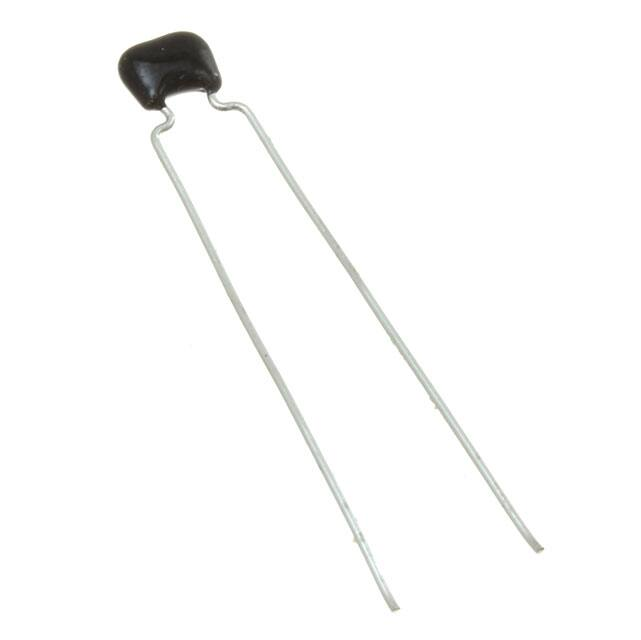
Reference Specification
175C Operation Leaded MLCC for Automotive with AEC-Q200
RHS Series
Product specifications in this catalog are as of Oct. 2018, and are subject to change or
obsolescence without notice.
Please consult the approval sheet before ordering.Please read rating and Cautions first.
�Reference only
CAUTION
1. OPERATING VOLTAGE
When DC-rated capacitors are to be used in AC or ripple current circuits, be sure to maintain the Vp-p
value of the applied voltage or the Vo-p which contains DC bias within the rated voltage range. When
the voltage is started to apply to the circuit or it is stopped applying, the irregular voltage may be
generated for a transit period because of resonance or switching. Be sure to use a capacitor within
rated voltage containing these irregular voltage.
When DC-rated capacitors are to be used in input circuits from commercial power source (AC filter),
be sure to use Safety Recognized Capacitors because various regulations on withstand voltage or
impulse withstand established for each equipment should be taken into considerations.
Voltage
DC Voltage
Positional
Measurement Vo-p
DC+AC Voltage
Vo-p
AC Voltage
Vp-p
Pulse Voltage(1)
Vp-p
Pulse Voltage(2)
Vp-p
2. OPERATING TEMPERATURE AND SELF-GENERATED HEAT
Keep the surface temperature of a capacitor below the upper limit of its rated operating temperature
range. Be sure to take into account the heat generated by the capacitor itself.
When the capacitor is used in a high-frequency current, pulse current or the like, it may have the selfgenerated heat due to dielectric-loss. In case of Class 2 capacitors (Temp.Char. : X7R,X7S,X8L, etc.),
applied voltage should be the load such as self-generated heat is within 20 C on the condition of
atmosphere temperature 25 C. Please contact us if self-generated heat is occurred with Class 1
capacitors (Temp.Char. : C0G,U2J,X8G, etc.). When measuring, use a thermocouple of small thermal
capacity-K of 0.1mm and be in the condition where capacitor is not affected by radiant heat of other
components and wind of surroundings. Excessive heat may lead to deterioration of the capacitor’s
characteristics and reliability.
3. Fail-safe
Be sure to provide an appropriate fail-safe function on your product to prevent a second damage that
may be caused by the abnormal function or the failure of our product.
4. OPERATING AND STORAGE ENVIRONMENT
The insulating coating of capacitors does not form a perfect seal; therefore, do not use or store
capacitors in a corrosive atmosphere, especially where chloride gas, sulfide gas, acid, alkali, salt or the
like are present. And avoid exposure to moisture. Before cleaning, bonding, or molding this product,
verify that these processes do not affect product quality by testing the performance of a cleaned, bonded
or molded product in the intended equipment. Store the capacitors where the temperature and relative
humidity do not exceed 5 to 40 C and 20 to 70%. Use capacitors within 6 months.
5. VIBRATION AND IMPACT
Do not expose a capacitor or its leads to excessive shock or vibration during use.
6. SOLDERING
When soldering this product to a PCB/PWB, do not exceed the solder heat resistance specification of
the capacitor. Subjecting this product to excessive heating could melt the internal junction solder and
may result in thermal shocks that can crack the ceramic element.
7. BONDING AND RESIN MOLDING, RESIN COAT
In case of bonding, molding or coating this product, verify that these processes do not affect the quality
of capacitor by testing the performance of a bonded or molded product in the intended equipment.
In case of the amount of applications, dryness / hardening conditions of adhesives and molding resins
containing organic solvents (ethyl acetate, methyl ethyl ketone, toluene, etc.) are unsuitable, the outer
coating resin of a capacitor is damaged by the organic solvents and it may result, worst case, in a short
circuit.
The variation in thickness of adhesive or molding resin may cause a outer coating resin cracking and/or
ceramic element cracking of a capacitor in a temperature cycling.
8. TREATMENT AFTER BONDING AND RESIN MOLDING, RESIN COAT
When the outer coating is hot (over 100 C) after soldering, it becomes soft and fragile.
So please be careful not to give it mechanical stress.
EGLEDMNO03
1 / 14
�Reference only
Failure to follow the above cautions may result, worst case, in a short circuit and cause fuming or partial
dispersion when the product is used.
9. LIMITATION OF APPLICATIONS
Please contact us before using our products for the applications listed below which require especially
high reliability for the prevention of defects which might directly cause damage to the third party’s life,
body or property.
1. Aircraft equipment
2. Aerospace equipment
3. Undersea equipment
4. Power plant control equipment
5. Medical equipment
6. Transportation equipment (vehicles, trains, ships, etc.)
7. Traffic signal equipment
8. Disaster prevention / crime prevention equipment
9. Data-processing equipment exerting influence on public
10. Application of similar complexity and/or reliability requirements to the applications listed in the above.
NOTICE
1. CLEANING (ULTRASONIC CLEANING)
To perform ultrasonic cleaning, observe the following conditions.
Rinse bath capacity : Output of 20 watts per liter or less.
Rinsing time : 5 min maximum.
Do not vibrate the PCB/PWB directly.
Excessive ultrasonic cleaning may lead to fatigue destruction of the lead wires.
2. Soldering and Mounting
Insertion of the Lead Wire
• When soldering, insert the lead wire into the PCB without mechanically stressing the lead wire.
• Insert the lead wire into the PCB with a distance appropriate to the lead space.
3. CAPACITANCE CHANGE OF CAPACITORS
• Class 2 capacitors (Temp.Char. : X7R,X7S,X8L, etc.)
Class 2 capacitors an aging characteristic, whereby the capacitor continually decreases its capacitance
slightly if the capacitor leaves for a long time. Moreover, capacitance might change greatly depending on
a surrounding temperature or an applied voltage. So, it is not likely to be able to use for the time constant
circuit.
Please contact us if you need a detail information.
NOTE
1. Please make sure that your product has been evaluated in view of your specifications with our product
being mounted to your product.
2. You are requested not to use our product deviating from this specification.
EGLEDMNO03
2 / 14
�Reference only
1. Application
This specification is applied to 175C Operation Leaded MLCC RHS series in accordance with
AEC-Q200 requirements used for Automotive Electronic equipment.
2. Rating
Applied maximum temperature up to 175C
Note : Maximum accumulative time to 175C is within 2000 hours.
Part number configuration
ex.) RHS
N1
2A
Series
Temperature
Characteristic
Series
Code
RHS
Rated
voltage
103
K
0
A2
H01
B
Capacitance
Capacitance
tolerance
Dimension
code
Lead
code
Individual
specification
code
Packing
style
code
Content
Epoxy coated, 175C max.
Temperature characteristic
Code
N1
Rated voltage
Code
2A
-55~+125C
Cap. Change
(Within%)
+/-15
+125~+175C
+15/-60
Temp. Range
Standard
Temp.
Operating
Temp. Range
25C
-55~+175C
Rated voltage
DC100V
When the product temperature exceeds 150°C, please use this product
within the voltage and temperature derated conditions in the figure below.
Capacitance
The first two digits denote significant figures ; the last digit denotes the multiplier of 10 in pF.
ex.) In case of 103.
10103 = 10000pF
ETRH10A
3 / 14
�Reference only
Capacitance tolerance
Code
Capacitance tolerance
K
+/-10%
Dimension code
Code
Dimensions (LxW) mm max.
0
3.9 x 3.5
1
4.2 x 3.5
2
5.5 x 4.0
Lead code
Code
A2
DG
K1
M2
Lead style
Straight type
Straight taping type
Inside crimp type
Inside crimp taping type
Lead spacing (mm)
2.5+/-0.8
2.5+0.4/-0.2
5.0+/-0.8
5.0+0.6/-0.2
Lead wire is solder coated CP wire.
Individual specification code
Murata’s control code
Please refer to Part number list .
Packing style code
Code
Packing style
A
Taping type of Ammo
B
Bulk type
ETRH10A
4 / 14
�Reference only
3. Marking
Temp. char.
Capacitance
Capacitance tolerance
Rated voltage
Company name code
: Letter code : 9
: 3 digit numbers
: Code
: Letter code : 1 (DC100V only. Except dimension code : 0,1)
: Abbreviation :
(Except dimension code : 0,1)
(Ex.)
Rated voltage
100V
Dimension code
0,1
2
9
103K
224
K19
ETRH10A
5 / 14
�Reference only
4. Part number list
Unit : mm
Customer Part Number
DC
Rated
T.C.
Volt.
(V)
Cap.
RHSN12A472K0A2H01B
XAN
100
4700pF ±10%
3.9
3.5
-
2.5
2.6 0A2
500
RHSN12A682K0A2H01B
XAN
100
6800pF ±10%
3.9
3.5
-
2.5
2.6 0A2
500
RHSN12A103K0A2H01B
XAN
100
10000pF ±10%
3.9
3.5
-
2.5
2.6 0A2
500
RHSN12A153K0A2H01B
XAN
100
15000pF ±10%
3.9
3.5
-
2.5
2.6 0A2
500
RHSN12A223K0A2H01B
XAN
100
22000pF ±10%
3.9
3.5
-
2.5
2.6 0A2
500
RHSN12A333K1A2H01B
XAN
100
33000pF ±10%
4.2
3.5
-
2.5
2.8 1A2
500
RHSN12A473K1A2H01B
XAN
100
47000pF ±10%
4.2
3.5
-
2.5
2.8 1A2
500
RHSN12A683K1A2H01B
XAN
100
68000pF ±10%
4.2
3.5
-
2.5
2.8 1A2
500
RHSN12A104K1A2H01B
XAN
100
0.1µF ±10%
4.2
3.5
-
2.5
2.8 1A2
500
RHSN12A154K2A2H01B
XAN
100
0.15µF ±10%
5.5
4.0
-
2.5
3.3 2A2
500
RHSN12A224K2A2H01B
XAN
100
0.22µF ±10%
5.5
4.0
-
2.5
3.3 2A2
500
RHSN12A472K0K1H01B
XAN
100
4700pF ±10%
3.9
3.5
6.0
5.0
2.6 0K1
500
RHSN12A682K0K1H01B
XAN
100
6800pF ±10%
3.9
3.5
6.0
5.0
2.6 0K1
500
RHSN12A103K0K1H01B
XAN
100
10000pF ±10%
3.9
3.5
6.0
5.0
2.6 0K1
500
RHSN12A153K0K1H01B
XAN
100
15000pF ±10%
3.9
3.5
6.0
5.0
2.6 0K1
500
RHSN12A223K0K1H01B
XAN
100
22000pF ±10%
3.9
3.5
6.0
5.0
2.6 0K1
500
RHSN12A333K1K1H01B
XAN
100
33000pF ±10%
4.2
3.5
5.0
5.0
2.8 1K1
500
RHSN12A473K1K1H01B
XAN
100
47000pF ±10%
4.2
3.5
5.0
5.0
2.8 1K1
500
RHSN12A683K1K1H01B
XAN
100
68000pF ±10%
4.2
3.5
5.0
5.0
2.8 1K1
500
RHSN12A104K1K1H01B
XAN
100
0.1µF ±10%
4.2
3.5
5.0
5.0
2.8 1K1
500
RHSN12A154K2K1H01B
XAN
100
0.15µF ±10%
5.5
4.0
6.0
5.0
3.3 2K1
500
RHSN12A224K2K1H01B
XAN
100
0.22µF ±10%
5.5
4.0
6.0
5.0
3.3 2K1
500
Murata Part Number
6 / 14
Cap.
tol.
Dimension (mm)
L
W
W1
F
T
Size Pack
Lead qty.
Code (pcs)
�Reference only
Unit : mm
Customer Part Number
Murata Part Number
DC
Rated
T.C.
Cap. Cap. tol.
volt.
(V)
Dimension (mm)
L
W
W1
F
T
Size Pack
Lead qty.
H/H0 Code (pcs)
RHSN12A472K0DGH01A
XAN
100
4700pF ±10%
3.9
3.5
-
2.5
2.6
20.0 0DG
2000
RHSN12A682K0DGH01A
XAN
100
6800pF ±10%
3.9
3.5
-
2.5
2.6
20.0 0DG
2000
RHSN12A103K0DGH01A
XAN
100
10000pF ±10%
3.9
3.5
-
2.5
2.6
20.0 0DG
2000
RHSN12A153K0DGH01A
XAN
100
15000pF ±10%
3.9
3.5
-
2.5
2.6
20.0 0DG
2000
RHSN12A223K0DGH01A
XAN
100
22000pF ±10%
3.9
3.5
-
2.5
2.6
20.0 0DG
2000
RHSN12A333K1DGH01A
XAN
100
33000pF ±10%
4.2
3.5
-
2.5
2.8
20.0 1DG
2000
RHSN12A473K1DGH01A
XAN
100
47000pF ±10%
4.2
3.5
-
2.5
2.8
20.0 1DG
2000
RHSN12A683K1DGH01A
XAN
100
68000pF ±10%
4.2
3.5
-
2.5
2.8
20.0 1DG
2000
RHSN12A104K1DGH01A
XAN
100
0.1µF ±10%
4.2
3.5
-
2.5
2.8
20.0 1DG
2000
RHSN12A154K2DGH01A
XAN
100
0.15µF ±10%
5.5
4.0
-
2.5
3.3
20.0 2DG
1500
RHSN12A224K2DGH01A
XAN
100
0.22µF ±10%
5.5
4.0
-
2.5
3.3
20.0 2DG
1500
RHSN12A472K0M2H01A
XAN
100
4700pF ±10%
3.9
3.5
6.0
5.0
2.6
20.0 0M2
2000
RHSN12A682K0M2H01A
XAN
100
6800pF ±10%
3.9
3.5
6.0
5.0
2.6
20.0 0M2
2000
RHSN12A103K0M2H01A
XAN
100
10000pF ±10%
3.9
3.5
6.0
5.0
2.6
20.0 0M2
2000
RHSN12A153K0M2H01A
XAN
100
15000pF ±10%
3.9
3.5
6.0
5.0
2.6
20.0 0M2
2000
RHSN12A223K0M2H01A
XAN
100
22000pF ±10%
3.9
3.5
6.0
5.0
2.6
20.0 0M2
2000
RHSN12A333K1M2H01A
XAN
100
33000pF ±10%
4.2
3.5
5.0
5.0
2.8
20.0 1M2
2000
RHSN12A473K1M2H01A
XAN
100
47000pF ±10%
4.2
3.5
5.0
5.0
2.8
20.0 1M2
2000
RHSN12A683K1M2H01A
XAN
100
68000pF ±10%
4.2
3.5
5.0
5.0
2.8
20.0 1M2
2000
RHSN12A104K1M2H01A
XAN
100
0.1µF ±10%
4.2
3.5
5.0
5.0
2.8
20.0 1M2
2000
RHSN12A154K2M2H01A
XAN
100
0.15µF ±10%
5.5
4.0
6.0
5.0
3.3
20.0 2M2
1500
RHSN12A224K2M2H01A
XAN
100
0.22µF ±10%
5.5
4.0
6.0
5.0
3.3
20.0 2M2
1500
7 / 14
�Reference only
5. AEC-Q200 Murata Standard Specifications and Test Methods
AEC-Q200
Test Item
No.
1
2
Pre-and Post-Stress
Electrical Test
High
Appearance
Temperature
Exposure
Capacitance
(Storage)
Change
D.F.
I.R.
3
Moisture
Resistance
Appearance
Capacitance
Change
D.F.
I.R.
AEC-Q200 Test Method
-
No defects or abnormalities except color
change of outer coating.
within ±12.5%
0.04 max.
More than 1,000M or 50 MF
(Whichever is smaller)
No defects or abnormalities except color
change of outer coating.
within ±12.5%
Sit the capacitor for 1,00012h at 1755C. Let sit for 242h at
*room condition , then measure.
•Pretreatment
Perform the heat treatment at 150+0/-10°C for 60±5 min and
then let sit for 24±2 h at *room condition.
Perform the 1,000 cycles according to the four heat treatments
listed in the following table. Let sit for 24±2 h at *room condition,
then measure.
Step
Temp.
(C)
Time
(min.)
0.05 max.
1,000M or 50M·F min.
(Whichever is smaller)
1
-55+0/-3
153
2
Room
Temp.
1
3
175+5/-0
4
Room
Temp.
153
1
•Pretreatment
Perform the heat treatment at 150+0/-10°C for 60±5 min and
then let sit for 24±2 h at *room condition.
Apply the 24h heat (25 to 65C) and humidity (80 to 98%)
treatment shown below, 10 consecutive times.
Let sit for 24±2 h at *room condition, then measure.
No defects or abnormalities
within ±12.5%
Humidity
Temperature
8098
Humidity
Humidity
C
9098
9098
70
65
60
55
50
45
40
35
30
25
+10
20
- 2 C
15
10
Initial measurement
5
0
-5
-10
One cycle 24 hours
0.05 max.
500M or 25M·F min.
(Whichever is smaller)
Humidity
8098 Humidity
9098
Temperature
4
Temperature Appearance
Cycling
Capacitance
Change
D.F.
I.R.
Specification
0 1 2 3 4 5 6 7 8 9 10 11 12 13 14 15 16 17 18 19 20 21 22 23 24
5
6
7
8
9
10
Biased
Humidity
Appearance
Capacitance
Change
D.F.
I.R.
Operational Appearance
Life
Capacitance
Change
D.F.
I.R.
External Visual
Physical Dimension
Marking
Resistance Appearance
to Solvents Capacitance
D.F.
I.R.
No defects or abnormalities
within ±12.5%
0.05 max.
500M or 25M·F min.
(Whichever is smaller)
No defects or abnormalities except color
change of outer coating.
within ±15.0%
0.04 max.
100M or 5M·F min.
(Whichever is smaller)
No defects or abnormalities
Within the specified dimensions
To be easily legible.
No defects or abnormalities
Within the specified tolerance
0.025 max.
More than 10,000M or 500 MF
(Whichever is smaller)
Hours
•Pretreatment
Perform the heat treatment at 150+0/-10°C for 60±5 min and
then let sit for 24±2 h at *room condition.
Apply the rated voltage and DC1.3+0.2/-0 V (add 100k resistor)
at 853C and 80 to 85% humidity for 1,00012h.
Remove and let sit for 24±2 h at *room condition, then measure.
The charge/discharge current is less than 50mA.
• Pretreatment
Perform a heat treatment at 150+0/-10C for 1hr.
and then set at room temperature for 242 hrs.
Apply 50% of the rated voltage for 1,00012h at 1755C.
Let sit for 24±2 h at *room condition, then measure.
The charge/discharge current is less than 50mA.
•Pretreatment
Apply test voltage for 60±5 min at test temperature.
Remove and let sit for 24±2 h at *room condition.
Visual inspection
Using calipers and micrometers.
Visual inspection
Per MIL-STD-202 Method 215
Solvent 1 : 1 part (by volume) of isopropyl alcohol
3 parts (by volume) of mineral spirits
Solvent 2 : Terpene defluxer
Solvent 3 : 42 parts (by volume) of water
1part (by volume) of propylene glycol
monomethyl ether
1 part (by volume) of monoethanolamine
* “room condition” Temperature:15 to 35°C, Relative humidity:45 to 75%, Atmosphere pressure:86 to 106kPa
ESRH07
8 / 14
�Reference only
AEC-Q200
Test Item
No.
11
12
13-1
13-2
13-3
14
Mechanical
Shock
Vibration
Appearance
No defects or abnormalities
Capacitance
Within the specified tolerance
D.F.
Appearance
0.025 max.
No defects or abnormalities
Capacitance
Within the specified tolerance
D.F.
0.025 max.
Resistance
to Soldering
Heat
(NonPreheat)
Appearance
Capacitance
Change
Dielectric
Strength
(Between
terminals)
No defects or abnormalities
Within 7.5%
Resistance
to Soldering
Heat
(OnPreheat)
Appearance
Capacitance
Change
Dielectric
Strength
(Between
terminals)
No defects or abnormalities
Within 7.5%
Resistance
to Soldering
Heat
(soldering
iron method)
16
ESD
Solderability
Three shocks in each direction should be applied along 3
mutually perpendicular axes of the test specimen (18 shocks).
The specified test pulse should be Half-sine and should have a
duration :0.5ms, peak value:1,500G and velocity change: 4.7m/s.
The capacitor should be subjected to a simple harmonic motion
having a total amplitude of 1.5mm, the frequency being varied
uniformly between the approximate limits of 10 and 2,000Hz.
The frequency range, from 10 to 2,000Hz and return to 10Hz,
should be traversed in approximately 20 min. This motion
should be applied for 12 items in each 3 mutually perpendicular
directions (total of 36 times).
The lead wires should be immersed in the melted solder 1.5 to
2.0mm from the root of terminal at 2605C for 101 seconds.
• Pre-treatment
Capacitor should be stored at 150+0/-10C for one
hour, then place at *room condition for 242 hours before
initial measurement.
• Post-treatment
Capacitor should be stored for 242 hours at *room condition.
First the capacitor should be stored at 120+0/-5C for 60+0/-5
seconds.
Then, the lead wires should be immersed in the melted solder
1.5 to 2.0mm from the root of terminal at 2605C for 7.5+0/-1
seconds.
No defects
No defects or abnormalities
Capacitance
Change
Dielectric
Strength
(Between
terminals)
Within 7.5%
Thermal Shock Appearance
AEC-Q200 Test Method
No defects
Appearance
Capacitance
Change
15
Specification
• Pre-treatment
Capacitor should be stored at 150+0/-10C for one
hour, then place at *room condition for 242 hours before
initial measurement.
• Post-treatment
Capacitor should be stored for 242 hours at *room condition.
Test condition
Termperature of iron-tip : 35010C
Soldering time : 3.50.5 seconds
Soldering position
Straight Lead:1.5 to 2.0mm from the root of terminal.
Crimp Lead:1.5 to 2.0mm from the end of lead bend.
No defects
No defects or abnormalities except color
change of outer coating.
within ±12.5%
• Pre-treatment
Capacitor should be stored at 150+0/-10C for one
hour, then place at *room condition for 242 hours before
initial measurement.
• Post-treatment
Capacitor should be stored for 242 hours at *room condition.
Perform the 300 cycles according to the two heat treatments listed
in the following table(Maximum transfer time is 20s.). Let sit for
24±2 h at *room condition, then measure.
Step
1
2
Temp.
-55+0/-3
175+5/-0
(C)
Time
153
153
(min.)
•Pretreatment
Perform the heat treatment at 150+0/-10°C for 60±5 min and
then let sit for 24±2 h at *room condition.
Per AEC-Q200-002
D.F.
I.R.
0.05 max.
1,000M or 50M·F min.
(Whichever is smaller)
Appearance
No defects or abnormalities
Capacitance
Within the specified tolerance
D.F.
0.025 max.
I.R.
More than 10,000M or 500 MF
(Whichever is smaller)
Lead wire should be soldered with uniform
coating on the axial direction over 95% of the
circumferential direction.
The terminal of a capacitor is dipped into a solution of ethanol
(JIS-K-8101) and rosin (JIS-K-5902) (25% rosin in weight
propotion) and then into molten solder (JIS-Z-3282) for 20.5 sec.
In both cases the depth of dipping is up to about 1.5 to 2mm from
the terminal body.
Temp. of solder :
2455C Lead Free Solder(Sn-3.0Ag-0.5Cu)
2355C H60A or H63A Eutectic Solder
* “room condition” Temperature:15 to 35°C, Relative humidity:45 to 75%, Atmosphere pressure:86 to 106kPa
ESRH07
9 / 14
�Reference only
AEC-Q200
Test Item
No.
17
Electrical
Characterization
Apperance
Specifications
AEC-Q200 Test Method
No defects or abnormalities
Visual inspection.
Capacitance Within the specified tolerance
D.F.
Insulation
Resistance
(I.R.)
The capacitance/D.F. should be measured at 25C at the
frequency and voltage shown in the table.
0.025 max.
Room
10,000M or 500MF min.
Temperature (Whichever is smaller)
10M or 0.5MF min.
High
Temperature (Whichever is smaller)
Dielectric
Strength
Between
Terminals
No defects or abnormalities
Body
Insulation
No defects or abnormalities
Frequency
Voltage
10.1kHz
10.2V(r.m.s.)
The insulation resistance should be measured at 253 C with a
DC voltage not exceeding the rated voltage at normal temperature
and humidity and within 2 min. of charging.
(Charge/Discharge current 50mA)
The insulation resistance should be measured at 1755 C with a
DC voltage not exceeding 50% of the rated voltage at normal
temperature and humidity and within 2 min. of charging.
(Charge/Discharge current 50mA)
The capacitor should not be damaged when DC voltage of 250%
of the rated voltage is applied between the terminations for 1 to 5
seconds.
(Charge/Discharge current 50mA.)
The capacitor is placed in a container with metal
balls of 1mm diameter so that each terminal,
short-circuit is kept approximately 2mm from
the balls, and 250% of the rated DC voltage is
Approx.
impressed for 1 to 5 seconds between
2mm
capacitor terminals and metal balls.
(Charge/Discharge current 50mA.)
Metal
balls
18
Terminal
Strength
Tensile
Strength
Termination not to be broken or loosened
As in the figure, fix the capacitor body, apply the force gradually
to each lead in the radial direction of the capacitor until reaching
10N and then keep the force applied for 101 seconds.
F
Bending
Strength
19
Capacitance
Temperature
Characteristics
Termination not to be broken or loosened
Within the specified Tolerance.
-55 to 125C : within 15%
125 to 175C :within +15/-60%
Each lead wire should be subjected to a force of 2.5N and then
be bent 90° at the point of egress in one direction. Each wire is
then returned to the original position and bent 90° in the opposite
direction at the rate of one bend per 2 to 3 seconds.
The capacitance change should be measured after 5min. at
each specified temperature step.
Step
1
2
3
4
5
Temperature(C)
252
-553
252
1755
252
The ranges of capacitance change compared with the above
25°C value over the temperature ranges shown in the table
should be within the specified ranges.
•Pretreatment
Perform the heat treatment at 150+0/-10°C for 60±5 min and
then let sit for 24±2 h at *room condition.
Perform the initial measurement.
* “room condition” Temperature:15 to 35°C, Relative humidity:45 to 75%, Atmosphere pressure:86 to 106kPa
ESRH07
10 / 14
�Reference only
6. Packing specification
Bulk type (Packing style code : B)
1
2
The number of packing = Packing quantity n
The size of packing case and packing way
1 : Please refer to [Part number list].
2 : Standard n = 20 (bag)
Polyethylene bag
Partition
Note)
The outer package and the number of
outer packing be changed by the order
getting amount.
270 max.
125 max.
340 max.
Unit : mm
Ammo pack taping type (Packing style code : A)
A crease is made every 25 pitches, and the tape with capacitors is packed zigzag into a case.
When body of the capacitor is piled on other body under it.
The size of packing case and packing way
240 max.
Position of label
Unit : mm
340 max.
Hold down tape
Capacitor
51 max.
Base tape
Hold down
tape upper
EKBCRPE01
11 / 14
�Reference only
7. Taping specification
7-1. Dimension of capacitors on tape
Straight taping type < Lead code : DG >
Pitch of component 12.7mm / Lead spacing 2.5mm
Unit : mm
Item
Code
Dimensions
Pitch of component
P
12.7+/-1.0
Pitch of sprocket hole
P0
12.7+/-0.2
Lead spacing
F
2.5+0.4/-0.2
Length from hole center to component center
P2
6.35+/-1.3
Length from hole center to lead
P1
5.1+/-0.7
Deviation along tape, left or right defect
S
0+/-2.0
Carrier tape width
W
18.0+/-0.5
Position of sprocket hole
Lead distance between reference and bottom
plane
W1
9.0+0/-0.5
H
20.0+/-0.5
Deviation of progress direction
They include deviation by lead bend .
Deviation of tape width direction
0.5 max.
Protrusion length
Diameter of sprocket hole
D0
4.0+/-0.1
Lead diameter
d
0.50+/-0.05
Total tape thickness
t1
0.6+/-0.3
Total thickness of tape and lead wire
t2
1.5 max.
Deviation across tape
Remarks
h1
h2
1.0 max.
Portion to cut in case of defect
L
11.0+0/-1.0
Hold down tape width
W0
9.5 min.
Hold down tape position
W2
1.5+/-1.5
Coating extension on lead
e
1.5 max.
ETP1DG01
12 / 14
They include hold down tape thickness.
�Reference only
Inside crimp taping type < Lead code : M2 >
Pitch of component 12.7mm / Lead spacing 5.0mm
Unit : mm
Item
Code
Dimensions
Pitch of component
P
12.7+/-1.0
Pitch of sprocket hole
P0
12.7+/-0.2
Lead spacing
F
5.0+0.6/-0.2
Length from hole center to component center
P2
6.35+/-1.3
Length from hole center to lead
P1
3.85+/-0.7
Deviation along tape, left or right defect
S
0+/-2.0
Carrier tape width
W
18.0+/-0.5
Position of sprocket hole
W1
9.0+0/-0.5
H0
20.0+/-0.5
Lead distance between reference and bottom
plane
Remarks
Deviation of progress direction
They include deviation by lead bend .
Deviation of tape width direction
0.5 max.
Protrusion length
Diameter of sprocket hole
D0
4.0+/-0.1
Lead diameter
d
0.50+/-0.05
Total tape thickness
t1
0.6+/-0.3
Total thickness of tape and lead wire
t2
1.5 max.
h1
h2
2.0 max.(Dimension code:W)
1.0 max.(except as above)
Portion to cut in case of defect
L
11.0+0/-1.0
Hold down tape width
W0
9.5 min.
Hold down tape position
W2
1.5+/-1.5
Coating extension on lead
e
Up to the end of crimp
Deviation across tape
ETP1M201
13 / 14
They include hold down tape thickness.
�Reference only
7-2. Splicing way of tape
1) Adhesive force of tape is over 3N at test condition as below.
W
Hold down tape
Base tape
2) Splicing of tape
a) When base tape is spliced
Base tape shall be spliced by cellophane tape.
(Total tape thickness shall be less than 1.05mm.)
Progress direction
in production line
Hold down tape
Base tape
About 30 to 50
Cellophane tape
No lifting for the direction of
progressing
Unit : mm
b) When hold down tape is spliced
Hold down tape shall be spliced with overlapping.
(Total tape thickness shall be less than 1.05mm.)
ape are spliced
Base tape and adhesive tape shall be spliced with splicing tape.
20 to 30
Hold down tape
Progress direction
in production line
Base tape
Unit : mm
c) When both tape are spliced
Base tape and hold down tape shall be spliced with splicing tape.
ETP2R01
14 / 14
�Appendix
EU RoHS and Halogen Free
This products of the following crresponds to EU RoHS and Halogen Free
(1) RoHS
EU RoHs 2011/65/EC compliance
maximum concentration values tolerated by weight in homogeneous materials
・1000 ppm maximum Lead
・1000 ppm maximum Mercury
・100 ppm maximum Cadmium
・1000 ppm maximum Hexavalent chromium
・1000 ppm maximum Polybrominated biphenyls (PBB)
・1000 ppm maximum Polybrominated diphenyl ethers (PBDE)
(2) Halogen-Free
The International Electrochemical Commission’s (IEC) Definition
of Halogen-Free (IEC 61249-2-21) compliance
・900 ppm maximum chlorine
・900 ppm maximum bromine
・1500 ppm maximum total chlorine and bromine
�