Built-in Sensors Catalog
Infrared Array Sensor Grid-EYE
Pressure Sensors
2021.4
Infrared Array Sensor
& Pressure Sensors
industrial.panasonic.com/ww/
�Guidelines and precautions regarding the
technical information and use of our products
described in this online catalog.
■ If you want to use our products described in this online catalog for applications requiring
special qualities or reliability, or for applications where the failure or malfunction of the
products may directly jeopardize human life or potentially cause personal injury
(e.g. aircraft and aerospace equipment, traffic and transportation equipment, combustion
equipment, medical equipment, accident prevention, anti-crime equipment, and/or safety
equipment), it is necessary to verify whether the specifications of our products fit to such
applications. Please ensure that you will ask and check with our inquiry desk as to whether
the specifications of our products fit to such applications use before you use our products.
■ The quality and performance of our products as described in this online catalog only apply
to our products when used in isolation. Therefore, please ensure you evaluate and verify
our products under the specific circumstances in which our products are assembled in your
own products and in which our products will actually be used.
■ If you use our products in equipment that requires a high degree of reliability, regardless
of the application, it is recommended that you set up protection circuits and redundancy
circuits in order to ensure safety of your equipment.
■ The products and product specifications described in this online catalog are subject to
change for improvement without prior notice. Therefore, please be sure to request and
confirm the latest product specifications which explain the specifications of our products in
detail, before you finalize the design of your applications, purchase, or use our products.
■ The technical information in this online catalog provides examples of our products'
typical operations and application circuits. We do not guarantee the non-infringement of
third party's intellectual property rights and we do not grant any license, right, or interest
in our intellectual property.
■ If any of our products, product specifications and/or technical information in this online
catalog is to be exported or provided to non-residents, the laws and regulations of the
exporting country, especially with regard to security and export control, shall be observed.
■ The switchover date for compliance with the RoHS Directive/REACH Regulations varies
depending on the part number or series of our products.
■ When you use the inventory of our products for which it is unclear whether those products
are compliant with the RoHS Directive/REACH Regulation, please select "Sales Inquiry" in the
website inquiry form and contact us.
We do not take any responsibility for the use of our products outside the scope of the
specifications, descriptions, guidelines and precautions described in this online catalog.
01-Oct-19
�Built-in Sensors Notes
Safety precautions
● Do not use these sensors under any circumstances in which the range of their ratings, environment conditions or other specifications are
exceeded. Using the sensors in any way which causes their specifications to be exceeded may generate abnormally high levels of heat, emit
smoke, etc., resulting in damage to the circuitry and possibly causing an accident.
● Before connecting a connector, check the pin layout by referring to the connector wiring diagram, specifications diagram, etc., and make
sure that the connector is connected properly. Take note that mistakes made in connection may cause unforeseen problems in operation,
generate abnormally high levels of heat, emit smoke, etc., resulting in damage to the circuitry.
● Do not use any motion sensor which has been disassembled or remodeled.
● Protection circuit recommended.
The possible failure mode is either open or short of the output transistor. An excess heat is the cause for short mode failure. For any important
and serious application in terms of safety, add protection circuit or any other protection method.
・ Various safety equipment and safety equipment
・ Traffic light
・ Security crime prevention equipment
・ Equipment concerning control and safety of trains, cars, etc.
・ Applications such as temperature control using sensor output etc. (Grid-EYE)
● If it is expected that malfunction of each sensor may cause injury to persons or serious expansion damage, be sure to implement safety
measures such as double safety circuit.
Request for ordering and use
The products and specifications listed in this document are subject to change for product improvement, etc. (including specification changes and
discontinued manufacturing). When examining mass-production design or placing an order for the listed products, please contact Panasonic to make
sure that the information listed in this document is up-to-date.
● If it is expected that malfunction of each sensor may cause injury to persons or serious expansion damage, be sure to implement safety me
Reference Standards : Computers, office automation equipment, communications equipment, audio-video products, home electrical
appliances, machine tools, personal devices, industrial robots.
: Transportation equipment (automobiles, trains, ships, etc.), traffic signal equipment, crime and disaster prevention
Special Standards
devices, electric power equipment, various safety devices, and medical equipment not directly targeted for life support.
Specified Standards : Aircraft equipment, aeronautical and space equipment, seabed relay equipment, nuclear power control systems,
and medical equipment, devices and systems for life support.
● Before considering the use of our products under the following conditions, you must contact one of our customer service representatives
without fail and exchange written specifications.
・ When our products are to be used in any of the applications listed for the Special Standards or Specified Standards.
・ When, even for any of the applications listed for the Reference Standards, our products may possibly be used beyond the range of the
specifications, environment or conditions listed in the document or when you are considering the use of our products in any conditions or
an environment that is not listed in the document.
[Acceptance Inspection]
For a purchased or delivered product, please conduct an acceptance inspection promptly with adequate consideration given to the management
and maintenance of the product before and during the acceptance inspection.
[Warranty Period]
The warranty period of these products is one year after the purchase or delivery to a location designated by your company, unless otherwise
specified by both parties.
[Scope of Warranty]
If a failure or a defect attributable to Panasonic is found during the warranty period, we will promptly provide a replacement or a necessary
replacement part or change/repair the defective part free of charge at the location of the purchase or delivery.
The warranty does not cover a failure or a defect when any of the following applies :
(1) Caused by specifications, standards, or handling methods, etc. designated by your company.
(2) Caused by modification of the structure, capabilities, or specifications, etc., in which Panasonic is not engaged, carried out after
the purchase or delivery.
(3) Caused by an unforeseen phenomenon that cannot be predicted with the technologies available after the time of the purchase or
at the time of concluding the agreement.
(4) When the product was used outside the scope of the conditions/environments described in the catalog or specifications.
(5) When the product is incorporated in your company's equipment for use, damages that could be avoided if your company's
equipment had industry-standard functions, structures, etc.
(6) Caused by natural disasters or Force Majeure.
The warranty described here is limited to the purchased or delivered product only and does not cover any consequential damages arising from
the failure or defect of the product.
[Before Purchase]
● The standard prices of the products listed in this catalog do not include consumption tax, delivery, installation & adjustment fees, used
product collection fees, etc.
● The specifications/appearance are subject to change without notice for product improvement.
● The export of products that fall into the category of strategic goods (or services) require an export (or a service transaction) license under
the Foreign Exchange and Foreign Trade Law. Please contact Panasonic for details.
● For details of the products listed in this catalog, please contact distributors, specialty contractor stores, or Panasonic.
Design and specifications are each subject to change without notice. Ask factory for the current technical specifications before purchase and/or use.
Should a safety concern arise regarding this product, please be sure to contact us immediately.
31-Mar-20
�Built-in Sensor
Built-in sensor contributes to energy savings, safety, and comfort.
Providing sensors for various aspects of our lives.
Microwave oven
Grid-EYE
Air conditioner
(Temperature measurement)
Grid-EYE
(Human detection)
ON/OFF of door light
Grid-EYE
(Human detection)
Light turns off
when surroundings
Sphygmomanomater
are bright.
Pressure Sensor
(Pressure detection)
Dim lighting
when it gets dark.
Security camera
100% when
Grid-EYE
Grid-EYE
(Human detection)
detects a
person nearby.
Returns to
dim lighting
when person
is gone.
ON/OFF of garage light
Grid-EYE
(Human detection)
Water level detection
for washing machine
PS-A Pressure Sensor
(Low pressure type)
Air bed
Pressure Sensor
(Pressure detection)
Automatic
Grid-EYE
(Human detection)
Sphygmomanomater
Pressure Sensor
(Pressure detection)
Automatic lighting
in conference room
Grid-EYE
Security for parking lot
Grid-EYE
(Human detection)
(Human detection)
Color mode screen
in the day.
Screen switches to
night vision mode
ON/OFF of lighting
Grid-EYE
(Human detection)
when it gets dark.
Motion detection for instant
photography machine
Grid-EYE
Design and specifications are each subject to change without notice. Ask factory for the current technical specifications before purchase and/or use.
Should a safety concern arise regarding this product, please be sure to contact us immediately.
(Human detection)
15-May-20
�Built-in Sensor
Human
Heat
Product name
Thermopile type
Grid-EYE
Infrared Array
High Precision Infrared Array Sensor based on Advanced MEMS
Detecting the heat
(infrared rays) of the
human body and
other objects.
Sensor
Characteristics
●Temperature detection achieved on a two
Operating Amplification
dimensional area with
voltage
factor
8 × 8 (64) pixels.
High gain
3.3 V
●Digital
output
Low gain
5.0 V
●Miniature SMD package
Pressure Sensors
Pressure
Product name
Type
Detection method
A wide range of rated pressure, including minute pressures
Pressure
medium
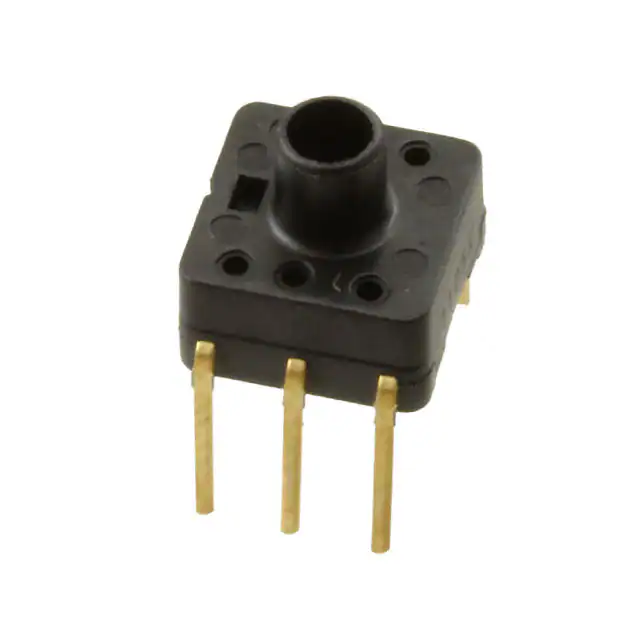
PS-A Pressure
Sensor
Terminal
direction
Type(*Without glass base type)
Rated pressure
Pressure inlet
hole length
3 mm
Opposite the
±100, -100, 25, 50,
100, 200, 500, 1,000
*40 kPa
pressure inlet
direction
Air
5 mm
Characteristics
●Compact pressure
sensor with built-in
amplification
and temperature
compensation circuit
5 mm
Φ3 mm
6 kPa
(SMD terminal)
13.5 mm
Φ5.45 mm
Rated pressure
PS/PF Pressure
Sensor
Air
4.9, 34.3,
49.0, 98.1,
196.1, 343.2,
490.3, 833.6,
980.7 k Pa
Bridge
resistanc
Opposite the
pressure inlet
direction
●Ultra-miniature base
area
5 kΩ
7.2 (W) x 7.2 (D) mm
ー
(SMD terminal)
*40 kPa
98.1, 980.7 kPa
(PS only)
3.3 kΩ
●Low pressure type ideal
for water level detection
applications added to
lineup.
Pressure inlet
direction
0.283 (W) x 0.283 (D) inch
●A wide range of rated
pressure, including a
minute pressure.
Design and specifications are each subject to change without notice. Ask factory for the current technical specifications before purchase and/or use.
Should a safety concern arise regarding this product, please be sure to contact us immediately.
15-May-20
�Infrared Array Sensor
Grid-EYE
�Infrared Array Sensor Grid-EYE (AMG88)
Safety Precautions
■ Head the following precautions to prevent injury or accidents.
(1) We take no responsibility for troubles caused by the product usage that is not specified in this specification.
Using the sensors in any way which causes their specifications to be exceeded may generate abnormally high levels of heat,
emit smoke, etc., resulting in damage to the circuitry and possibly causing an accident.
(2) Before connecting a connector, check the pin layout by referring to the connector wiring diagram, specifications diagram,
etc., and make sure that the connector is connected properly. Take note that mistakes made in connection may cause
unforeseen problems in operation, generate abnormally high levels of heat, emit smoke, etc., resulting in damage to the
circuitry.
(3) If the module heats up abnormally or smells abnormal, stop using it immediately by turning off the main power supply of
the device etc.
(4) The fact remains that electrical components and devices generally cause failures at probability. Furthermore, their durability
varies with use environments or use conditions. In this respect, we ask you to check for actual electrical components and
devices under actual conditions before use without fail.
(5) Failure modes of sensors include short-circuiting, open-circuiting and temperature rises. If the failure of the product is
considered to cause a personal injury or death or property damage, the safety rate should be added to the specified values
shown in this specifications and please consider the fail-safe design in the following considerations and ensure safety.
・ Provide protection circuits and protection devices to ensure system safety.
・ Provide of a redundant circuit so that a malfunction does not make the system unsafety.
(6) When a dogma shall be occurred about safety for this product, be sure to inform us rapidly, operate your technical
examination.
Notes
■ Precaution for fundamental structure of sensor
Infrared Array Sensor is a thermopile type infrared sensor which detects the amount of infrared rays. Below conditions
generally degrade the temperature accuracy.
Carefully check the performance and stability under actual use conditions, and perform temperature corrections when necessary.
(1) When heating elements exist near the mounting position of the sensor.
(2) When the sensor is exposed to cold or hot air.
(3) When the temperature of the sensor body rapidly changes.
(4) When substances (e.g., glasses, acrylics or steams), which hardly transmit a far infrared ray, exist between the sensor and
the detected object.
(5) When substances (e.g., foreign substances or water), which hardly transmit a far infrared ray, adhere to the lense of the
sensor.
■ Use environment
(1)
(2)
(3)
(4)
Temperature: See the specifications
Humidity: 15 % to 85 % R.H. (Avoid freezing and dew condensation)
Atmospheric pressure: 86 to 106 kPa
Vibrations and shocks may damage the sensor, and cause malfunction and performance deterioration. If loads and shocks
are applied on the lense, the damaged sensor may cause malfunction and performance deterioration.
(5) The product is not water/splash-proof. Perform water/dust-proofing and dew condensation / freezing countermeasures in
accordance with use environment. When dew condensation occurs, responsiveness of heat source detection may delay for
several seconds. Be careful to solder migration caused by adhesion of water droplets on solder parts.
(6) Avoid use and storage in the corrosive gas (organic solvent, sulfurous acid and hydrogen sulfide gases) to avoid malfunction
and performance deterioration.
(7) Use surge absorbers as applying the external surge voltage may damage the internal circuit.
(8) Malfunction may occur near electric noises from static electricity, lightning, broadcast or amateur radio stations and mobile
phones.
(9) The sensor can continuously operate within the range of using ambient temperature (using ambient humidity). However,
ensure that humidity is within the range described in the following page as humidity varies according to temperature.
Avoid the continuous operation near the operational limit. The temperature range does not guarantee the durability.
Low gain type
Hi gain type
Humidity (%RH)
Humidity (%RH)
85
85
Tolerance range
Tolerance range
Avoid
freezing
Avoid
Avoid dew
at 0 ℃
32 ℉
or below
0
Temperature (℃ ℉)
0 ℃ 32 ℉ or below
32 ℉
15
-20
condensation at
at 0 ℃
0 ℃ 32 ℉ or below
or below
Avoid dew
freezing
condensation at
80
-20
15
0
Temperature (℃ ℉)
80
Design and specifications are each subject to change without notice. Ask factory for the current technical specifications before purchase and/or use.
Should a safety concern arise regarding this product, please be sure to contact us immediately.
15-May-20
�Infrared Array Sensor Grid-EYE (AMG88)
Notes
■ Mounting
Use the land of the printed-circuit board on which the sensor is securely fixed. The recommended printed-circuit board is FR4
(thickness 1.6 mm 0.063 inch). When mounting on the deprecated circuit board, carefully check the performance and quality
under actual use conditions before use.
(1) A large noise on the power supply may cause malfunction. Place the recommended capacitor near the sensor
(within 20 mm 0.787 inch of the wiring pattern length) between sensor input terminals (VDD-GND) to secure power
superimposed noise resistance. Test with the actual machine and reselect the capacitor with optimal capacitance.
(2) Prevent the metal part of other electronic components from contacting with the sensor body as the upper face
(where part numbers are imprinted) of the sensor is GND.
■ Soldering
Due to the thermal capacity of the infrared array sensor is low, therefore, take steps to minimize the effects of external heat.
Damage and changes to characteristics may occur due to heat deformation.
(1) Manual soldering
Set the soldering tip from 350 to 400 ℃ (30 - 60 W), and solder within 3 seconds or less. Note that output may be changed
if the load is applied to the terminals when the soldering carefully clean the tip of soldering iron.
(2) Reflow soldering
・ Solder coating
We recommend the screen solder printing method as the method of cream. Halogen type (Chlorine type, Bromine type
, etc.) or other high-activity flux is not recommended as the residue may affect performance or reliability of resistors.
・ Mounting of sensor
Self alignment may not always work as expected, therefore, be carefully the position of the terminals and pattern.
・ The recommended reflow temperature profile
The recommended reflow temperature profile conditions are given below. The temperature of the profile is assumed to be
a value measured with the printed wiring board of the product terminal neighborhood. The temperature of PCB near this
product terminal at the time of mounting changes depending on PCB design. Therefore, please confirm the temperature of
PCB near this product terminal to become the specified temperature profile when this product be mounted on the PCB.
T3
T2
T1=150 to 180 ℃ 302 ℉ to 356 ℉
T1
T2=230 ℃ 446 °F
T3=Below 250 ℃ 482 ℉
t1
t2
t1=60 to 120 s
(3) Solder reworking
Finish reworking in one operation for reworking of the solder bridge, use a soldering iron with a flat tip do not add more flux
when reworking Refer the conditions of manual soldering to rework.
(4) Coating of PCB
To prevent the insulation of the PC board after soldering, not to place the chemicals on lens of the sensor when coating.
(5) Dividing of PCB
When you cut, fold, or fix with screw the PCB after mounting the sensor, not to stress to the sensor and the soldered parts.
(6) Structure of sensor terminals
The sensor terminals are designed to be exposed, so contact of the terminals with metal shards and the like will cause
output errors. Therefore, be careful not to touch the terminals with the metal piece or the hand.
(7) Both-side soldering
When you do the reflow solder to the back of the PC board after the reflow of the sensor, execute fixed processing,
or instance, with the adhesive etc.
(8) When handling this product, do not touch it with bare hands. Please wear gloves.
■ Wire connection
Correctly wire as in the connection diagram. Reverse connection may damage the product and degrade the performance.
Do not use empty terminals. Such use may damage the sensor. For cable wiring, use shield wires with possibly short wiring
lengths to prevent the influence of the noise.
■ Cleaning
If the dirt or water droplets is attached to the lens, wipe it with soft cloth. The lens is damaged when strongly rubbed, and
causes the characteristic deterioration. Avoid ultrasonic cleaning since this may cause breaks or disconnections in the wiring.
■ Transportation and storage
(1) Extreme vibration and shock during transport will damage the sensor. Handle the outer box and reel with care.
(2) Storage under extreme conditions will cause soldering degradation, external appearance defects, and characteristic
deterioration.
The following storage conditions are recommended.
Temperature:0 ℃ to 45 ℃ 32 ℉ to 113 ℉
Humidity:70 %RH
Others:Not storage in places full of corrosive gases such as sea breeze, Cl2, H2S, NH3, SO2, and NOx, minimal dust.
Not storage in places exposed to direct sunlight.
Design and specifications are each subject to change without notice. Ask factory for the current technical specifications before purchase and/or use.
Should a safety concern arise regarding this product, please be sure to contact us immediately.
15-May-20
�Infrared Array Sensor Grid-EYE (AMG88)
Notes
(3) The sensors are sensitive to moisture and come in moisture-proof packages.
Observe the following cautions when storing.
・ After the moisture-proof package is unsealed, take the sensors out of storage as soon as possible
(within 1 week, less than 30 ℃, less than 60 %R.H.,)
・ If the sensors are to be left in storage for a considerable period after the moisture-proof package has been unsealed,
keep them in another moisture-proof bag containing silica gel (within 3 months at the most).
(4) When using the product stored for a long time, dry the package before reflow work.
・ When mounting with solder, if thermal stress is applied to sensors that have absorbed moisture, the moisture will
vaporize, swelling will occur, and the inside of the package will become stressed. This may cause the package
surface to blister or crack. Therefore, take caution and observe the soldering conditions.
■ Other handling cautions
(1) To assure reliability, check the sensor under actual loading conditions. Avoid any situation that may adversely
affect its performance.
(2) This product may malfunction if dropped on its own before it is installed. Do not use if this happens.
(3) If the sensor get high frequency vibration, it can be cause of breakdown. When the product get impulse like below,
do not use it.
・ Touch to a object made of metal
・ Touch of mutual sensors
(4) Since static charge can damage the sensor, bear in mind the following handling precautions.
・ Plastic containers should not be used to store or transport the sensors since they readily become charged.
・ Store or transport the product in an environment that hinders the occurrence of static electricity (for example,
places with 45 % to 60 % humidity) and protect the product using electrically conductive packaging.
・ Implement static electricity prevention measures once the product packaging has been opened.
(5) Do not use this product which has been disassembled or remodeled.
(6) Do not reuse this product after removal from the mounting board.
■ Special remarks
Although the best attention will be paid for the quality controls of the products, consider the followings contents.
(1) This product is designed to use in general applications at general electric equipment (Household electric appliances,
AV products, office equipment, information and equipment, etc.). This product is not an important safety product.
This product is not equipped with fail proof/fault diagnosis functions. If there is possibilities to occur failure or
malfunction of this product which may cause unsafe event such as (a)~(d) and damage to personnel’s life, body
and property, we will be not responsible for any loss or damage caused by the use of products.
(a) Fire accident(Fire, smoke)
(b) Electrocution(Electric shock)
(c) Damages(Fall down/Explosion/Poisoning)
(d) Fire/electrocution/damages at life end
(2) This specification shows the quality and performance of a unit component. Before adoption, be sure to evaluate and
verify the product mounting it in your product.
(3) Unless otherwise stipulated by both parties, the warranty period of our products is one year after their purchase by
you or after their delivery to the location specified by you.
(4) In the event that we are found to blame for any failures or defects in our products during the warranty period, we
will provide replacements or supply the necessary spare parts or replace and/or repair the defective sections free of
charge and with all due speed at the location where the products concerned were purchased or delivered. However,
the following failures and defects are not covered by the warranty:
・ When the failure or defect was caused by a specification, standard, handling method, etc. which was specified by you.
・ When the failure or defect was caused after purchase by you or delivery to your premises by an alteration in
construction, performance, specification, etc. which did not involve us.
・ The case that the product condition changed by handling, storage and / or transportation after delivery.
・ When the failure or defect was caused by a phenomenon that could not be predicted by the technology that was
being applied in practice either after purchase by you or at the time when the contract was signed.
・ When the use of our products deviated from the scope of the conditions and environment set forth in the specifications.
・ When, after our products were incorporated into your products or equipment for use, damage resulted which could
have been avoided if your products or equipment had been equipped with the functions, construction, etc. the
provision of which is accepted practice in the industry.
・When the failure or defect was caused by a natural disaster or other force majeure. The terms and conditions of the
warranty here set forth apply solely to the warranty of the discrete products which were purchased by you or
delivered to your premises, and they do not cover any damage induced by their failure or defects.
(5) The products and specifications described in this document are subject to change (including specification changes
and production suspension) due to product improvements. When considering a using a new products, please contact
our sales office to confirm that the information in this specifications is up-to-date.
(6) In connection with the products you have purchased from us or with the products delivered to your premises, we ask
that you perform an acceptance inspection with all due speed and, in connection with the handling of our products both
before and during the acceptance inspection, we ask that you give full consideration to the control and preservation of
our products.
(7) As to the disposal of the product, check the method of disposal in each country or region where the product are
incorporated in your products to be used.
(8) The technical information in this specification provides examples of our products' typical operations and application
circuits. We do not guarantee the non-infringement of third party's intellectual property rights and we do not grant any
license, right, or interest in our intellectual property.
Design and specifications are each subject to change without notice. Ask factory for the current technical specifications before purchase and/or use.
Should a safety concern arise regarding this product, please be sure to contact us immediately.
15-May-20
�Infrared Array Sensor Grid-EYE
Surface Mount Type
AMG88xx(High performance type)
High Precision Infrared Array Sensor based on Advanced
MEMS Technology
Feature
●
●
●
●
Temperature detection of two-dimensional area: 8 × 8 (64 pixels)
Digital output (capability of temperature value output)
Compact SMD package (adaptively to reflow mounting)
RoHS compliant
Typical applications
●
●
●
●
Home appliances (Microwaves and air-conditioners)
Building automation (People counting, Air conditioning control)
Home automation (People detection)
Factory automation (Fault prevention)
Ordering information
AMG
8
Code
8
8
Vertical pixel
8 pixels
Code Horizontal pixel
8
8 pixels
Code Applied voltage
3
3.3 V
5
5.0 V
Code Amplification factor
3
High gain
4
Low gain
Types
Tape and reel package : 1,000 pcs.
Product name
Number of pixel
Infrared array sensor
Grid-EYE
(Vertical 8 × Horizontal 8 Matrix)
64
Operating voltage Amplification factor
High gain
3.3 V
Low gain
High gain
5.0 V
Low gain
Part number
AMG8833
AMG8834
AMG8853
AMG8854
Rating
Item
Performance
High gain
Applied voltage
Temperature range of measuring object
Low gain
3.3 V ± 0.3 V or 5.0 V ± 0.5 V
0 ℃ to 80 ℃ +32 ℉ to +176 ℉
−20 ℃ ~ 100 ℃ –4 ℉ to +212 ℉
Operating temperature range
0 ℃ to 80 ℃ +32 ℉ to +176 ℉
−20 ℃ ~ 80 ℃ –4 ℉ to +176 ℉
Storage temperature range
−20 ℃ to 80 ℃ –4 ℉ to +176 ℉
−20 ℃ ~ 80 ℃ –4 ℉ to +176 ℉
Terminal
Absolute maximum ratings
Item
Absolute maximum ratings
Applied voltage
−0.3 V to 6.5 V
VDD
Input voltage
−0.3 V to VDD +0.3 V
SCL, SDA, AD_SELECT
Output sink current
−10 mA to 10 mA
INT, SDA
Static electricity (Human Body Model)
1 kV
All terminals
Static electricity (Machine Model)
200 V
All terminals
Design and specifications are each subject to change without notice. Ask factory for the current technical specifications before purchase and/or use.
Should a safety concern arise regarding this product, please be sure to contact us immediately.
15-May-20
�Infrared Array Sensor Grid-EYE (AMG88)
Characteristics
Performance
Item
Temperature accuracy
NETD
High gain
Low gain
Typical ± 2.5 ℃ ±4.5 ℉
Typical ± 3.0 ℃ ±5.4 ℉
Typical 0.05 K (in 1 fps setting*2)
Typical 0.16 K (in 10 fps setting)
*1
Viewing angle
Typical 60 °
Typical 4.5 mA(normal mode)
Current consumption
Typical 0.2 mA(sleep mode)
Typical 50 ms(Time to enable communication after setup)
Setup time
Typical 15 s(Time to stabilize output after setup)
*1: It is calculated from 4 pixels of centers.
*2: fps: frame per second
Performance
Item
Performance
Number of pixel
64 (Vertical 8 × Horizontal 8 Matrix)
External interface
I2C
Typical 1 fps or 10 fps
Frame rate
Normal
Operating mode*3
Sleep
Output mode
Temperature output
Calculate mode
No moving average or Twice moving average
Temperature output resolution
0.25 ℃ 0.45 ℉
Number of sensor address
Thermistor output temperature range
2(I2C slave address))
−20 ℃ to 80 ℃ –4 ℉ to +176 ℉
Thermistor output resolution
0.0625 ℃ 0.1125 ℉
*3: Normal Mode : normal operation mode; Sleep Mode: detection is off (output and data reading not possible)
Internal circuit
Sensor
element
I2C I/F
Selector
Control
VDD
SDA
ROM
AD SELECT
Gain
amp
SCL
ADC
INT
GND
Thermistor
Design and specifications are each subject to change without notice. Ask factory for the current technical specifications before purchase and/or use.
Should a safety concern arise regarding this product, please be sure to contact us immediately.
15-May-20
�Infrared Array Sensor Grid-EYE (AMG88)
Pixel array and viewing angle
(1)Pixel array
(2)Viewing angle (Typical)
Pixel array from 1 to 64 is shown below.
Sensor viewing angle is shown below.
Vertical viewing angle 60°
Horizontal viewing angle 60°
Optical properties
Pixel number
viewing angle (°)
Each pixel’s vertical
viewing angle (°)
Each pixel’s horizontall
central angle (°)
Vertical viewing
(1) Each pixel’s viewing central angle (Typical) (2)Each pixel’s viewing angle (Typical)
Pixel number
Horizontal viewing
central angle(°)
Dimensions
External dimensions (Typical)
(AMG88 is omitted)
⑦
10-0.028
⑦
0.118
13- 0.079
⑭
13-2.0
0.343
P1.27x4=5.08
0.059
4.3
0.169
1.5
Number Terminal name
14-0.5 14-0.020
①
7.8
4-0.8 4-0.031
P0.050x4=0.200
0.350
0.307
3.0
*Four corners
10-0.7
Lot No.
0.457
8.9
0.433
3.5
(0.75)
3.6
0.209
5.3
11.6
0.142 (0.030)
①
11.0
⑧
0.315
8.0
⑭ 0.079
Part No.
Recommended PC board pad (Typical)
Lens □2.6 0.102
0.138
8.7
2.0
P1.27x4
P0.050x4
⑧
①
②
③
④
⑤
⑥
⑦
NC
SDA
SCL
INT
AD_SELECT
GND
NC
Number Terminal name
⑧
⑨
⑩
⑪
⑫
⑬
⑭
NC
VDD
AVDD-PC
NC
DVDD-PC
VPP
NC
Note)NC:Leave terminal unconnected.
10.9
0.429
Design and specifications are each subject to change without notice. Ask factory for the current technical specifications before purchase and/or use.
Should a safety concern arise regarding this product, please be sure to contact us immediately.
Unit : mm inch
15-May-20
�Infrared Array Sensor Grid-EYE (AMG88)
External circuit
⑬VPP
⑫DVDD-PC
②SDA
③SCL
④INT
⑤AD SELECT
⑥GND
⑩AVDD-PC
⑨VDD
10 μF±20%
GND
1.5 μF±10%
To microcomputer etc.
1 μF±10%
To microcomputer etc.
20 Ω±5%
To microcomputer etc.
VDD
10 kΩ±5%
10 kΩ±5%
10 kΩ±5%
(1)In case of setting I2C slave address of the sensor 1101000
※ Connect terminal 5 (AD_SELECT) to GND.
⑬VPP
⑫DVDD-PC
②SDA
③SCL
④INT
⑤AD SELECT
⑥GND
⑩AVDD-PC
⑨VDD
10 μF±20%
GND
1.5 μF±10%
To microcomputer etc.
1 μF±10%
To microcomputer etc.
20 Ω±5%
To microcomputer etc.
VDD
10 kΩ±5%
10 kΩ±5%
10 kΩ±5%
10 kΩ±5%
(2)In case of setting I2C slave address of the sensor 1101001
※ Connect terminal 5 (AD_SELECT) to VDD.
・ This circuit is an example to drive Infrared Array Sensor “Grid-EYE”, so that our company will not take any
responsibility of loss which is due to this circuit.
・ The wiring connected to VDD are same electrical potential (same supply voltage).
・ If there is a difference of electric potential between the terminals, it can be cause of breakdown.
・ Connect wiring to solid GND with wide and short pattern on PCB.
・ If wiring pattern is designed thin and long, temperature accuracy will be degraded.
Packing format (Tape and reel)
Tape dimensions (Typical)
Dimensions of tape reel (Typical)
16.0
0.630
7.5
1.75
21.5
0.35
0.069
0.295
17.5
0.014
0.846
Φ1.5
Φ3.15
Φ380.0
Φ14.961
Φ0.059
Embossed carrier tape
0.630
4.0
0.496
2.0
Φ13
Φ0.512
0.079
12.6
0.157
16.0
Top cover tape
Φ80.0
Direction of picking
0.689
9.0
4.7
0.354
0.185
Design and specifications are each subject to change without notice. Ask factory for the current technical specifications before purchase and/or use.
Should a safety concern arise regarding this product, please be sure to contact us immediately.
Unit : mm inch
15-May-20
�Infrared Array Sensor Grid-EYE (AMG88)
Safety Precautions
■ Head the following precautions to prevent injury or accidents.
(1) We take no responsibility for troubles caused by the product usage that is not specified in this specification.
Using the sensors in any way which causes their specifications to be exceeded may generate abnormally high levels of heat,
emit smoke, etc., resulting in damage to the circuitry and possibly causing an accident.
(2) Before connecting a connector, check the pin layout by referring to the connector wiring diagram, specifications diagram,
etc., and make sure that the connector is connected properly. Take note that mistakes made in connection may cause
unforeseen problems in operation, generate abnormally high levels of heat, emit smoke, etc., resulting in damage to the
circuitry.
(3) If the module heats up abnormally or smells abnormal, stop using it immediately by turning off the main power supply of
the device etc.
(4) The fact remains that electrical components and devices generally cause failures at probability. Furthermore, their durability
varies with use environments or use conditions. In this respect, we ask you to check for actual electrical components and
devices under actual conditions before use without fail.
(5) Failure modes of sensors include short-circuiting, open-circuiting and temperature rises. If the failure of the product is
considered to cause a personal injury or death or property damage, the safety rate should be added to the specified values
shown in this specifications and please consider the fail-safe design in the following considerations and ensure safety.
・ Provide protection circuits and protection devices to ensure system safety.
・ Provide of a redundant circuit so that a malfunction does not make the system unsafety.
(6) When a dogma shall be occurred about safety for this product, be sure to inform us rapidly, operate your technical
examination.
Notes
■ Precaution for fundamental structure of sensor
Infrared Array Sensor is a thermopile type infrared sensor which detects the amount of infrared rays. Below conditions
generally degrade the temperature accuracy.
Carefully check the performance and stability under actual use conditions, and perform temperature corrections when necessary.
(1) When heating elements exist near the mounting position of the sensor.
(2) When the sensor is exposed to cold or hot air.
(3) When the temperature of the sensor body rapidly changes.
(4) When substances (e.g., glasses, acrylics or steams), which hardly transmit a far infrared ray, exist between the sensor and
the detected object.
(5) When substances (e.g., foreign substances or water), which hardly transmit a far infrared ray, adhere to the lense of the
sensor.
■ Use environment
(1)
(2)
(3)
(4)
Temperature: See the specifications
Humidity: 15 % to 85 % R.H. (Avoid freezing and dew condensation)
Atmospheric pressure: 86 to 106 kPa
Vibrations and shocks may damage the sensor, and cause malfunction and performance deterioration. If loads and shocks
are applied on the lense, the damaged sensor may cause malfunction and performance deterioration.
(5) The product is not water/splash-proof. Perform water/dust-proofing and dew condensation / freezing countermeasures in
accordance with use environment. When dew condensation occurs, responsiveness of heat source detection may delay for
several seconds. Be careful to solder migration caused by adhesion of water droplets on solder parts.
(6) Avoid use and storage in the corrosive gas (organic solvent, sulfurous acid and hydrogen sulfide gases) to avoid malfunction
and performance deterioration.
(7) Use surge absorbers as applying the external surge voltage may damage the internal circuit.
(8) Malfunction may occur near electric noises from static electricity, lightning, broadcast or amateur radio stations and mobile
phones.
(9) The sensor can continuously operate within the range of using ambient temperature (using ambient humidity). However,
ensure that humidity is within the range described in the following page as humidity varies according to temperature.
Avoid the continuous operation near the operational limit. The temperature range does not guarantee the durability.
Low gain type
Hi gain type
Humidity (%RH)
Humidity (%RH)
85
85
Tolerance range
Tolerance range
Avoid
freezing
Avoid
Avoid dew
at 0 ℃
32 ℉
or below
0
Temperature (℃ ℉)
0 ℃ 32 ℉ or below
32 ℉
15
-20
condensation at
at 0 ℃
0 ℃ 32 ℉ or below
or below
Avoid dew
freezing
condensation at
80
-20
15
0
Temperature (℃ ℉)
80
Design and specifications are each subject to change without notice. Ask factory for the current technical specifications before purchase and/or use.
Should a safety concern arise regarding this product, please be sure to contact us immediately.
15-May-20
�Infrared Array Sensor Grid-EYE (AMG88)
Notes
■ Mounting
Use the land of the printed-circuit board on which the sensor is securely fixed. The recommended printed-circuit board is FR4
(thickness 1.6 mm 0.063 inch). When mounting on the deprecated circuit board, carefully check the performance and quality
under actual use conditions before use.
(1) A large noise on the power supply may cause malfunction. Place the recommended capacitor near the sensor
(within 20 mm 0.787 inch of the wiring pattern length) between sensor input terminals (VDD-GND) to secure power
superimposed noise resistance. Test with the actual machine and reselect the capacitor with optimal capacitance.
(2) Prevent the metal part of other electronic components from contacting with the sensor body as the upper face
(where part numbers are imprinted) of the sensor is GND.
■ Soldering
Due to the thermal capacity of the infrared array sensor is low, therefore, take steps to minimize the effects of external heat.
Damage and changes to characteristics may occur due to heat deformation.
(1) Manual soldering
Set the soldering tip from 350 to 400 ℃ (30 - 60 W), and solder within 3 seconds or less. Note that output may be changed
if the load is applied to the terminals when the soldering carefully clean the tip of soldering iron.
(2) Reflow soldering
・ Solder coating
We recommend the screen solder printing method as the method of cream. Halogen type (Chlorine type, Bromine type
, etc.) or other high-activity flux is not recommended as the residue may affect performance or reliability of resistors.
・ Mounting of sensor
Self alignment may not always work as expected, therefore, be carefully the position of the terminals and pattern.
・ The recommended reflow temperature profile
The recommended reflow temperature profile conditions are given below. The temperature of the profile is assumed to be
a value measured with the printed wiring board of the product terminal neighborhood. The temperature of PCB near this
product terminal at the time of mounting changes depending on PCB design. Therefore, please confirm the temperature of
PCB near this product terminal to become the specified temperature profile when this product be mounted on the PCB.
T3
T2
T1=150 to 180 ℃ 302 ℉ to 356 ℉
T1
T2=230 ℃ 446 °F
T3=Below 250 ℃ 482 ℉
t1
t2
t1=60 to 120 s
(3) Solder reworking
Finish reworking in one operation for reworking of the solder bridge, use a soldering iron with a flat tip do not add more flux
when reworking Refer the conditions of manual soldering to rework.
(4) Coating of PCB
To prevent the insulation of the PC board after soldering, not to place the chemicals on lens of the sensor when coating.
(5) Dividing of PCB
When you cut, fold, or fix with screw the PCB after mounting the sensor, not to stress to the sensor and the soldered parts.
(6) Structure of sensor terminals
The sensor terminals are designed to be exposed, so contact of the terminals with metal shards and the like will cause
output errors. Therefore, be careful not to touch the terminals with the metal piece or the hand.
(7) Both-side soldering
When you do the reflow solder to the back of the PC board after the reflow of the sensor, execute fixed processing,
or instance, with the adhesive etc.
(8) When handling this product, do not touch it with bare hands. Please wear gloves.
■ Wire connection
Correctly wire as in the connection diagram. Reverse connection may damage the product and degrade the performance.
Do not use empty terminals. Such use may damage the sensor. For cable wiring, use shield wires with possibly short wiring
lengths to prevent the influence of the noise.
■ Cleaning
If the dirt or water droplets is attached to the lens, wipe it with soft cloth. The lens is damaged when strongly rubbed, and
causes the characteristic deterioration. Avoid ultrasonic cleaning since this may cause breaks or disconnections in the wiring.
■ Transportation and storage
(1) Extreme vibration and shock during transport will damage the sensor. Handle the outer box and reel with care.
(2) Storage under extreme conditions will cause soldering degradation, external appearance defects, and characteristic
deterioration.
The following storage conditions are recommended.
Temperature:0 ℃ to 45 ℃ 32 ℉ to 113 ℉
Humidity:70 %RH
Others:Not storage in places full of corrosive gases such as sea breeze, Cl2, H2S, NH3, SO2, and NOx, minimal dust.
Not storage in places exposed to direct sunlight.
Design and specifications are each subject to change without notice. Ask factory for the current technical specifications before purchase and/or use.
Should a safety concern arise regarding this product, please be sure to contact us immediately.
15-May-20
�Infrared Array Sensor Grid-EYE (AMG88)
Notes
(3) The sensors are sensitive to moisture and come in moisture-proof packages.
Observe the following cautions when storing.
・ After the moisture-proof package is unsealed, take the sensors out of storage as soon as possible
(within 1 week, less than 30 ℃, less than 60 %R.H.,)
・ If the sensors are to be left in storage for a considerable period after the moisture-proof package has been unsealed,
keep them in another moisture-proof bag containing silica gel (within 3 months at the most).
(4) When using the product stored for a long time, dry the package before reflow work.
・ When mounting with solder, if thermal stress is applied to sensors that have absorbed moisture, the moisture will
vaporize, swelling will occur, and the inside of the package will become stressed. This may cause the package
surface to blister or crack. Therefore, take caution and observe the soldering conditions.
■ Other handling cautions
(1) To assure reliability, check the sensor under actual loading conditions. Avoid any situation that may adversely
affect its performance.
(2) This product may malfunction if dropped on its own before it is installed. Do not use if this happens.
(3) If the sensor get high frequency vibration, it can be cause of breakdown. When the product get impulse like below,
do not use it.
・ Touch to a object made of metal
・ Touch of mutual sensors
(4) Since static charge can damage the sensor, bear in mind the following handling precautions.
・ Plastic containers should not be used to store or transport the sensors since they readily become charged.
・ Store or transport the product in an environment that hinders the occurrence of static electricity (for example,
places with 45 % to 60 % humidity) and protect the product using electrically conductive packaging.
・ Implement static electricity prevention measures once the product packaging has been opened.
(5) Do not use this product which has been disassembled or remodeled.
(6) Do not reuse this product after removal from the mounting board.
■ Special remarks
Although the best attention will be paid for the quality controls of the products, consider the followings contents.
(1) This product is designed to use in general applications at general electric equipment (Household electric appliances,
AV products, office equipment, information and equipment, etc.). This product is not an important safety product.
This product is not equipped with fail proof/fault diagnosis functions. If there is possibilities to occur failure or
malfunction of this product which may cause unsafe event such as (a)~(d) and damage to personnel’s life, body
and property, we will be not responsible for any loss or damage caused by the use of products.
(a) Fire accident(Fire, smoke)
(b) Electrocution(Electric shock)
(c) Damages(Fall down/Explosion/Poisoning)
(d) Fire/electrocution/damages at life end
(2) This specification shows the quality and performance of a unit component. Before adoption, be sure to evaluate and
verify the product mounting it in your product.
(3) Unless otherwise stipulated by both parties, the warranty period of our products is one year after their purchase by
you or after their delivery to the location specified by you.
(4) In the event that we are found to blame for any failures or defects in our products during the warranty period, we
will provide replacements or supply the necessary spare parts or replace and/or repair the defective sections free of
charge and with all due speed at the location where the products concerned were purchased or delivered. However,
the following failures and defects are not covered by the warranty:
・ When the failure or defect was caused by a specification, standard, handling method, etc. which was specified by you.
・ When the failure or defect was caused after purchase by you or delivery to your premises by an alteration in
construction, performance, specification, etc. which did not involve us.
・ The case that the product condition changed by handling, storage and / or transportation after delivery.
・ When the failure or defect was caused by a phenomenon that could not be predicted by the technology that was
being applied in practice either after purchase by you or at the time when the contract was signed.
・ When the use of our products deviated from the scope of the conditions and environment set forth in the specifications.
・ When, after our products were incorporated into your products or equipment for use, damage resulted which could
have been avoided if your products or equipment had been equipped with the functions, construction, etc. the
provision of which is accepted practice in the industry.
・When the failure or defect was caused by a natural disaster or other force majeure. The terms and conditions of the
warranty here set forth apply solely to the warranty of the discrete products which were purchased by you or
delivered to your premises, and they do not cover any damage induced by their failure or defects.
(5) The products and specifications described in this document are subject to change (including specification changes
and production suspension) due to product improvements. When considering a using a new products, please contact
our sales office to confirm that the information in this specifications is up-to-date.
(6) In connection with the products you have purchased from us or with the products delivered to your premises, we ask
that you perform an acceptance inspection with all due speed and, in connection with the handling of our products both
before and during the acceptance inspection, we ask that you give full consideration to the control and preservation of
our products.
(7) As to the disposal of the product, check the method of disposal in each country or region where the product are
incorporated in your products to be used.
(8) The technical information in this specification provides examples of our products' typical operations and application
circuits. We do not guarantee the non-infringement of third party's intellectual property rights and we do not grant any
license, right, or interest in our intellectual property.
Design and specifications are each subject to change without notice. Ask factory for the current technical specifications before purchase and/or use.
Should a safety concern arise regarding this product, please be sure to contact us immediately.
15-May-20
�Infrared Array Sensor Grid-EYE
Surface Mount Type
AMG883642(Narrow type)
High Precision Infrared Array Sensor based on Advanced
MEMS Technology
Feature
●
●
●
●
Temperature detection of two-dimensional area: 8 × 8 (64 pixels)
Digital output (capability of temperature value output)
Compact SMD package (adaptively to reflow mounting)
RoHS compliant
Typical applications
●
●
●
●
Home appliances (Microwaves and air-conditioners)
Building automation (People counting, Air conditioning control)
Home automation (People detection, heat source detection)
Factory automation (Fault prevention)
Ordering information
8
AMG
8
Code
Vertical pixel
8
8 pixels
3
Code Horizontal pixel
8
8 pixels
Code
Power supply voltage
3
3.3 V
Code
642
Field of view
Horizontal Typ.35.6°
Vertical Typ.35.6°
Types
Tape and reel package : 800 pcs.
Product name
Number of pixel
Infrared array sensor
Grid-EYE
(Vertical 8 × Horizontal 8 Matrix)
Operating voltage
Part number
3.3 V
AMG883642
64
Rating
Item
Performance
Applied voltage
3.3 V ± 0.3 V
Temperature range of measuring object
−20 ℃ ~ 100 ℃ –4 ℉ to +212 ℉
Operating temperature range
−20 ℃ ~ 80 ℃ –4 ℉ to +176 ℉
Storage temperature range
−20 ℃ ~ 80 ℃ –4 ℉ to +176 ℉
Absolute maximum ratings
Item
Absolute maximum ratings
Terminal
Applied voltage
−0.3 V to 6.5 V
VDD
Input voltage
−0.3 V to VDD +0.3 V
SCL, SDA, AD_SELECT
Output sink current
−10 mA to 10 mA
INT, SDA
Static electricity (Human Body Model)
1 kV
All terminals
Static electricity (Machine Model)
200 V
All terminals
Design and specifications are each subject to change without notice. Ask factory for the current technical specifications before purchase and/or use.
Should a safety concern arise regarding this product, please be sure to contact us immediately.
30-Sep-20
�Infrared Array Sensor Grid-EYE (AMG883642)
Characteristics
Item
Performance
Temperature accuracy
Typical ± 3.0 ℃ ±5.4 ℉
NETD
Typical 0.11 K (in 1 fps setting*2)
*1
Typical 0.35 K (in 10 fps setting)
Viewing angle
Typical 35.6 °
Typical 4.5 mA(normal mode)
Current consumption
Typical 0.2 mA(sleep mode)
Typical 50 ms(Time to enable communication after setup)
Setup time
Typical 15 s(Time to stabilize output after setup)
*1: It is calculated from 4 pixels of centers.
*2: fps: frame per second
Performance
Item
Performance
Number of pixel
64 (Vertical 8 × Horizontal 8 Matrix)
External interface
I2C
Frame rate
Typical 1 fps or 10 fps
Normal
Operating mode*3
Sleep
Output mode
Temperature output
Calculate mode
No moving average or Twice moving average
Temperature output resolution
0.25 ℃ 0.45 ℉
Number of sensor address
2(I2C slave address))
Thermistor output temperature range
−20 ℃ to 80 ℃ –4 ℉ to +176 ℉
Thermistor output resolution
0.0625 ℃ 0.1125 ℉
*3: Normal Mode : normal operation mode; Sleep Mode: detection is off (output and data reading not possible)
Internal circuit
Sensor
element
I2C I/F
Selector
Control
VDD
SDA
ROM
AD SELECT
Gain
amp
SCL
ADC
INT
GND
Thermistor
Design and specifications are each subject to change without notice. Ask factory for the current technical specifications before purchase and/or use.
Should a safety concern arise regarding this product, please be sure to contact us immediately.
30-Sep-20
�Infrared Array Sensor Grid-EYE (AMG883642)
Pixel array and viewing angle
(1)Pixel array
(2)Viewing angle (Typical)
Pixel array from 1 to 64 is shown below.
Sensor viewing angle is shown below.
Vertical viewing angle 35.6°
Horizontal viewing angle 35.6°
Optical properties
Each pixel’s vertical viewing angle (°)
Horizontal viewing central angle(°)
Each pixel’s horizontall viewing angle (°)
Vertical viewing central angle (°)
(1) Each pixel’s viewing central angle (Typical) (2)Each pixel’s viewing angle (Typical)
Pixel number
Pixel number
Dimensions
External dimensions (Typical)
Lens □2.6 0.102
(AMG88 is omitted)
11.6
0.343
3.5
0.138
8.7
(0.75)
0.433
*Four corners
10-0.7
10-0.028
Lot No.
0.457
(0.030)
⑦
3.6
0.209
5.3
①
Part No.
11.0
⑧
0.315
8.0
0.079
0.142
2.0
⑭
Recommended PC board pad (Typical)
4-0.8 4-0.031
P1.27x4=5.08
P0.050x4=0.200
8.9
Number Terminal name
0.059
5.93
0.233
1.5
0.350
14-0.5 14-0.020
NC
SDA
SCL
INT
AD_SELECT
GND
NC
Number Terminal name
⑧
⑨
⑩
⑪
⑫
⑬
⑭
NC
VDD
AVDD-PC
NC
DVDD-PC
VPP
NC
Note)NC:Leave terminal unconnected.
13- 0.079
⑭
13-2.0
⑦
0.118
7.8
0.307
3.0
①
①
②
③
④
⑤
⑥
⑦
P1.27x4
⑧
P0.050x4
Unit : mm inch
10.9
0.429
Design and specifications are each subject to change without notice. Ask factory for the current technical specifications before purchase and/or use.
Should a safety concern arise regarding this product, please be sure to contact us immediately.
30-Sep-20
�Infrared Array Sensor Grid-EYE (AMG883642)
External circuit
(1)In case of setting I2C slave address of the sensor 1101000
※ Connect terminal 5 (AD_SELECT) to GND.
10 kΩ±5%
⑬VPP
⑫DVDD-PC
②SDA
③SCL
④INT
⑤AD SELECT
⑥GND
To microcomputer etc.
⑩AVDD-PC
⑨VDD
10 μF±20%
GND
1.5 μF±10%
To microcomputer etc.
1 μF±10%
To microcomputer etc.
20 Ω±5%
10 kΩ±5%
10 kΩ±5%
VDD
VDD
10 kΩ±5%
⑬VPP
⑫DVDD-PC
②SDA
③SCL
④INT
⑤AD SELECT
⑥GND
To microcomputer etc.
⑩AVDD-PC
⑨VDD
10 μF±20%
GND
1.5 μF±10%
To microcomputer etc.
20 Ω±5%
To microcomputer etc.
1 μF±10%
10 kΩ±5%
10 kΩ±5%
10 kΩ±5%
(2)In case of setting I2C slave address of the sensor 1101001
※ Connect terminal 5 (AD_SELECT) to VDD.
・ This circuit is an example to drive Infrared Array Sensor “Grid-EYE”, so that our company will not take any
responsibility of loss which is due to this circuit.
・ The wiring connected to VDD are same electrical potential (same supply voltage).
・ If there is a difference of electric potential between the terminals, it can be cause of breakdown.
・ Connect wiring to solid GND with wide and short pattern on PCB.
・ If wiring pattern is designed thin and long, temperature accuracy will be degraded.
Packing format (Tape and reel)
Tape dimensions (Typical)
Dimensions of tape reel (Typical)
16.0
0.630
7.5
1.75
0.069
0.295
0.35
21.5
0.014
17.5
0.846
Φ1.5
Φ3.15
Φ380.0
Φ14.961
Φ0.059
Embossed carrier tape
0.630
4.0
0.496
2.0
Φ13
Φ0.512
0.079
12.6
0.157
16.0
Top cover tape
Φ80.0
Direction of picking
0.689
9.0
4.7
0.354
0.185
Design and specifications are each subject to change without notice. Ask factory for the current technical specifications before purchase and/or use.
Should a safety concern arise regarding this product, please be sure to contact us immediately.
Unit : mm inch
30-Sep-20
�Infrared Array Sensor Grid-EYE (AMG88)
Safety Precautions
■ Head the following precautions to prevent injury or accidents.
(1) We take no responsibility for troubles caused by the product usage that is not specified in this specification.
Using the sensors in any way which causes their specifications to be exceeded may generate abnormally high levels of heat,
emit smoke, etc., resulting in damage to the circuitry and possibly causing an accident.
(2) Before connecting a connector, check the pin layout by referring to the connector wiring diagram, specifications diagram,
etc., and make sure that the connector is connected properly. Take note that mistakes made in connection may cause
unforeseen problems in operation, generate abnormally high levels of heat, emit smoke, etc., resulting in damage to the
circuitry.
(3) If the module heats up abnormally or smells abnormal, stop using it immediately by turning off the main power supply of
the device etc.
(4) The fact remains that electrical components and devices generally cause failures at probability. Furthermore, their durability
varies with use environments or use conditions. In this respect, we ask you to check for actual electrical components and
devices under actual conditions before use without fail.
(5) Failure modes of sensors include short-circuiting, open-circuiting and temperature rises. If the failure of the product is
considered to cause a personal injury or death or property damage, the safety rate should be added to the specified values
shown in this specifications and please consider the fail-safe design in the following considerations and ensure safety.
・ Provide protection circuits and protection devices to ensure system safety.
・ Provide of a redundant circuit so that a malfunction does not make the system unsafety.
(6) When a dogma shall be occurred about safety for this product, be sure to inform us rapidly, operate your technical
examination.
Notes
■ Precaution for fundamental structure of sensor
Infrared Array Sensor is a thermopile type infrared sensor which detects the amount of infrared rays. Below conditions
generally degrade the temperature accuracy.
Carefully check the performance and stability under actual use conditions, and perform temperature corrections when necessary.
(1) When heating elements exist near the mounting position of the sensor.
(2) When the sensor is exposed to cold or hot air.
(3) When the temperature of the sensor body rapidly changes.
(4) When substances (e.g., glasses, acrylics or steams), which hardly transmit a far infrared ray, exist between the sensor and
the detected object.
(5) When substances (e.g., foreign substances or water), which hardly transmit a far infrared ray, adhere to the lense of the
sensor.
■ Use environment
(1)
(2)
(3)
(4)
Temperature: See the specifications
Humidity: 15 % to 85 % R.H. (Avoid freezing and dew condensation)
Atmospheric pressure: 86 to 106 kPa
Vibrations and shocks may damage the sensor, and cause malfunction and performance deterioration. If loads and shocks
are applied on the lense, the damaged sensor may cause malfunction and performance deterioration.
(5) The product is not water/splash-proof. Perform water/dust-proofing and dew condensation / freezing countermeasures in
accordance with use environment. When dew condensation occurs, responsiveness of heat source detection may delay for
several seconds. Be careful to solder migration caused by adhesion of water droplets on solder parts.
(6) Avoid use and storage in the corrosive gas (organic solvent, sulfurous acid and hydrogen sulfide gases) to avoid malfunction
and performance deterioration.
(7) Use surge absorbers as applying the external surge voltage may damage the internal circuit.
(8) Malfunction may occur near electric noises from static electricity, lightning, broadcast or amateur radio stations and mobile
phones.
(9) The sensor can continuously operate within the range of using ambient temperature (using ambient humidity). However,
ensure that humidity is within the range described in the following page as humidity varies according to temperature.
Avoid the continuous operation near the operational limit. The temperature range does not guarantee the durability.
Low gain type
Hi gain type
Humidity (%RH)
Humidity (%RH)
85
85
Tolerance range
Tolerance range
Avoid
freezing
Avoid
Avoid dew
at 0 ℃
32 ℉
or below
0
Temperature (℃ ℉)
0 ℃ 32 ℉ or below
32 ℉
15
-20
condensation at
at 0 ℃
0 ℃ 32 ℉ or below
or below
Avoid dew
freezing
condensation at
80
-20
15
0
Temperature (℃ ℉)
80
15-May-20
�Infrared Array Sensor Grid-EYE (AMG88)
Notes
■ Mounting
Use the land of the printed-circuit board on which the sensor is securely fixed. The recommended printed-circuit board is FR4
(thickness 1.6 mm 0.063 inch). When mounting on the deprecated circuit board, carefully check the performance and quality
under actual use conditions before use.
(1) A large noise on the power supply may cause malfunction. Place the recommended capacitor near the sensor
(within 20 mm 0.787 inch of the wiring pattern length) between sensor input terminals (VDD-GND) to secure power
superimposed noise resistance. Test with the actual machine and reselect the capacitor with optimal capacitance.
(2) Prevent the metal part of other electronic components from contacting with the sensor body as the upper face
(where part numbers are imprinted) of the sensor is GND.
■ Soldering
Due to the thermal capacity of the infrared array sensor is low, therefore, take steps to minimize the effects of external heat.
Damage and changes to characteristics may occur due to heat deformation.
(1) Manual soldering
Set the soldering tip from 350 to 400 ℃ (30 - 60 W), and solder within 3 seconds or less. Note that output may be changed
if the load is applied to the terminals when the soldering carefully clean the tip of soldering iron.
(2) Reflow soldering
・ Solder coating
We recommend the screen solder printing method as the method of cream. Halogen type (Chlorine type, Bromine type
, etc.) or other high-activity flux is not recommended as the residue may affect performance or reliability of resistors.
・ Mounting of sensor
Self alignment may not always work as expected, therefore, be carefully the position of the terminals and pattern.
・ The recommended reflow temperature profile
The recommended reflow temperature profile conditions are given below. The temperature of the profile is assumed to be
a value measured with the printed wiring board of the product terminal neighborhood. The temperature of PCB near this
product terminal at the time of mounting changes depending on PCB design. Therefore, please confirm the temperature of
PCB near this product terminal to become the specified temperature profile when this product be mounted on the PCB.
T3
T2
T1=150 to 180 ℃ 302 ℉ to 356 ℉
T1
T2=230 ℃ 446 °F
T3=Below 250 ℃ 482 ℉
t1
t2
t1=60 to 120 s
(3) Solder reworking
Finish reworking in one operation for reworking of the solder bridge, use a soldering iron with a flat tip do not add more flux
when reworking Refer the conditions of manual soldering to rework.
(4) Coating of PCB
To prevent the insulation of the PC board after soldering, not to place the chemicals on lens of the sensor when coating.
(5) Dividing of PCB
When you cut, fold, or fix with screw the PCB after mounting the sensor, not to stress to the sensor and the soldered parts.
(6) Structure of sensor terminals
The sensor terminals are designed to be exposed, so contact of the terminals with metal shards and the like will cause
output errors. Therefore, be careful not to touch the terminals with the metal piece or the hand.
(7) Both-side soldering
When you do the reflow solder to the back of the PC board after the reflow of the sensor, execute fixed processing,
or instance, with the adhesive etc.
(8) When handling this product, do not touch it with bare hands. Please wear gloves.
■ Wire connection
Correctly wire as in the connection diagram. Reverse connection may damage the product and degrade the performance.
Do not use empty terminals. Such use may damage the sensor. For cable wiring, use shield wires with possibly short wiring
lengths to prevent the influence of the noise.
■ Cleaning
If the dirt or water droplets is attached to the lens, wipe it with soft cloth. The lens is damaged when strongly rubbed, and
causes the characteristic deterioration. Avoid ultrasonic cleaning since this may cause breaks or disconnections in the wiring.
■ Transportation and storage
(1) Extreme vibration and shock during transport will damage the sensor. Handle the outer box and reel with care.
(2) Storage under extreme conditions will cause soldering degradation, external appearance defects, and characteristic
deterioration.
The following storage conditions are recommended.
Temperature:0 ℃ to 45 ℃ 32 ℉ to 113 ℉
Humidity:70 %RH
Others:Not storage in places full of corrosive gases such as sea breeze, Cl2, H2S, NH3, SO2, and NOx, minimal dust.
Not storage in places exposed to direct sunlight.
15-May-20
�Infrared Array Sensor Grid-EYE (AMG88)
Notes
(3) The sensors are sensitive to moisture and come in moisture-proof packages.
Observe the following cautions when storing.
・ After the moisture-proof package is unsealed, take the sensors out of storage as soon as possible
(within 1 week, less than 30 ℃, less than 60 %R.H.,)
・ If the sensors are to be left in storage for a considerable period after the moisture-proof package has been unsealed,
keep them in another moisture-proof bag containing silica gel (within 3 months at the most).
(4) When using the product stored for a long time, dry the package before reflow work.
・ When mounting with solder, if thermal stress is applied to sensors that have absorbed moisture, the moisture will
vaporize, swelling will occur, and the inside of the package will become stressed. This may cause the package
surface to blister or crack. Therefore, take caution and observe the soldering conditions.
■ Other handling cautions
(1) To assure reliability, check the sensor under actual loading conditions. Avoid any situation that may adversely
affect its performance.
(2) This product may malfunction if dropped on its own before it is installed. Do not use if this happens.
(3) If the sensor get high frequency vibration, it can be cause of breakdown. When the product get impulse like below,
do not use it.
・ Touch to a object made of metal
・ Touch of mutual sensors
(4) Since static charge can damage the sensor, bear in mind the following handling precautions.
・ Plastic containers should not be used to store or transport the sensors since they readily become charged.
・ Store or transport the product in an environment that hinders the occurrence of static electricity (for example,
places with 45 % to 60 % humidity) and protect the product using electrically conductive packaging.
・ Implement static electricity prevention measures once the product packaging has been opened.
(5) Do not use this product which has been disassembled or remodeled.
(6) Do not reuse this product after removal from the mounting board.
■ Special remarks
Although the best attention will be paid for the quality controls of the products, consider the followings contents.
(1) This product is designed to use in general applications at general electric equipment (Household electric appliances,
AV products, office equipment, information and equipment, etc.). This product is not an important safety product.
This product is not equipped with fail proof/fault diagnosis functions. If there is possibilities to occur failure or
malfunction of this product which may cause unsafe event such as (a)~(d) and damage to personnel’s life, body
and property, we will be not responsible for any loss or damage caused by the use of products.
(a) Fire accident(Fire, smoke)
(b) Electrocution(Electric shock)
(c) Damages(Fall down/Explosion/Poisoning)
(d) Fire/electrocution/damages at life end
(2) This specification shows the quality and performance of a unit component. Before adoption, be sure to evaluate and
verify the product mounting it in your product.
(3) Unless otherwise stipulated by both parties, the warranty period of our products is one year after their purchase by
you or after their delivery to the location specified by you.
(4) In the event that we are found to blame for any failures or defects in our products during the warranty period, we
will provide replacements or supply the necessary spare parts or replace and/or repair the defective sections free of
charge and with all due speed at the location where the products concerned were purchased or delivered. However,
the following failures and defects are not covered by the warranty:
・ When the failure or defect was caused by a specification, standard, handling method, etc. which was specified by you.
・ When the failure or defect was caused after purchase by you or delivery to your premises by an alteration in
construction, performance, specification, etc. which did not involve us.
・ The case that the product condition changed by handling, storage and / or transportation after delivery.
・ When the failure or defect was caused by a phenomenon that could not be predicted by the technology that was
being applied in practice either after purchase by you or at the time when the contract was signed.
・ When the use of our products deviated from the scope of the conditions and environment set forth in the specifications.
・ When, after our products were incorporated into your products or equipment for use, damage resulted which could
have been avoided if your products or equipment had been equipped with the functions, construction, etc. the
provision of which is accepted practice in the industry.
・When the failure or defect was caused by a natural disaster or other force majeure. The terms and conditions of the
warranty here set forth apply solely to the warranty of the discrete products which were purchased by you or
delivered to your premises, and they do not cover any damage induced by their failure or defects.
(5) The products and specifications described in this document are subject to change (including specification changes
and production suspension) due to product improvements. When considering a using a new products, please contact
our sales office to confirm that the information in this specifications is up-to-date.
(6) In connection with the products you have purchased from us or with the products delivered to your premises, we ask
that you perform an acceptance inspection with all due speed and, in connection with the handling of our products both
before and during the acceptance inspection, we ask that you give full consideration to the control and preservation of
our products.
(7) As to the disposal of the product, check the method of disposal in each country or region where the product are
incorporated in your products to be used.
(8) The technical information in this specification provides examples of our products' typical operations and application
circuits. We do not guarantee the non-infringement of third party's intellectual property rights and we do not grant any
license, right, or interest in our intellectual property.
15-May-20
�Infrared Array Sensor Grid-EYE
PC board mounting
AMG8854M01(Narrow type)
High Precision Infrared Array Sensor based on
Advanced MEMS Technology
Features
●
●
●
●
Temperature detection of two-dimensional area: 8 × 8 (64 pixels)
Digital output (capability of temperature value output)
PC board mounting with connector (5 pin)
RoHS compliance
Typical applications
●
●
●
●
Home appliance (microwaves and air-conditioners)
Energy saving at office (air conditioning control)
Home automation (heat source detection)
Factory automation (Fault prevention)
Ordering information
AMG
8
8
5
4M01
Code
Vertical pixel
Code
Horizontal pixel
8
8 : 8 pixels
8
8 : 8 pixels
Code Applied voltage
5
5.0 V
Code
Product form
4M01
PC board mounting
Types
Shipment package : 1,000 pcs.
Product name
Infrared array sensor
Grid-EYE
Narrow angle type
Number of pixel
Operating voltage
Part number
64
(Vertical 8 × Horizontal 8 Matrix)
5.0 V
AMG8854M01
Rating
Item
Performance
Applied voltage
5.0 V ± 0.5 V
Temperature range of measuring object
−20 ℃ to 100 ℃ –4 ℉ to +212 ℉
Operating temperature range
Storage temperature range
−20 ℃ to 80 ℃
–4 ℉ to +176 ℉
−20 ℃ to 80 ℃ –4 ℉ to +176 ℉
Absolute maximum ratings
Item
Absolute maximum ratings
Terminal
Applied voltage
−0.3 V to 6.5 V
VDD
SCL, SDA, AD_SELECT
Input voltage
−0.3 V to VDD +0.3 V
Output sink current
−10 mA to 10 mA
INT, SDA
Static electricity (Human body model)
1 kV
All terminals
Static electricity (Machine model)
200 V
All terminals
Design and specifications are each subject to change without notice. Ask factory for the current technical specifications before purchase and/or use.
Should a safety concern arise regarding this product, please be sure to contact us immediately.
30-Sep-20
�Infrared Array Sensor Grid-EYE (AMG8854M01)
Characteristics
Item
Performance
Temperature accuracy
Typical ±3.0 ℃ ±5.4 ℉
Viewing angle
Typ. 35.6 °
Typical 4.5 mA (normal mode)
Current consumption
Typical 0.2 mA (sleep mode)
Typical 50 ms (Time to enable communication after setup)
Setup time
15 s or more (Time to stabilize output after setup)
Performance
Item
Performance
Number of pixel
64 (Vertical 8 × Horizontal 8 Matrix)
External interface
I2C (CLK is 50 kHz or less)
Typical 10 fps or 1 fps*1
Normal
Frame rate
Operating mode*2
Sleep
Output mode
Temperature output
Calculate mode
No moving average or Twice moving average
Temperature output resolution
0.25 ℃ 0.45 ℉
I2C slave address
Thermistor output temperature range
1101 000
−20 ℃ to 80 ℃
Thermistor output resolution
–4 ℉ to +176 ℉
0.0625 ℃ 0.1125 ℉
*1: fps: frame per second
*2: Normal Mode : normal operation mode
Sleep Mode: detection is off (output and data reading not possible)
Sensor internal circuit
Sensor
SDA
ROM
I2C I/F
Selector
Control
SCL
VDD
Gain
ADC
GND
Thermistor
Design and specifications are each subject to change without notice. Ask factory for the current technical specifications before purchase and/or use.
Should a safety concern arise regarding this product, please be sure to contact us immediately.
30-Sep-20
�Infrared Array Sensor Grid-EYE (AMG8854M01)
Print board circuit
*1
*2
*1: Please connect VPP pin and VDD pin by an
external circuit.
*2: For SDA and SCL pins connect a pull-up
resistor between VDD pin by an external circuit.
Pixel array and viewing field
(1) Pixel array
Pixel array from 1 to 64 is shown below.
(2) Viewing field
Sensor viewing field (typical) is shown below.
Horizontal viewing angle 35.6°
Vertical viewing angle 35.6°
Optical properties
(2) Each pixel’s viewing angle (half angle)
10
9
8
viewing angle (°)
Vertical viewing central angle (° )
Each pixel’s horizontall
(1) Each pixel’s viewing central angle
7
6
5
4
3
2
1
0
1
5
9 13 17 21 25 29 33 37 41 45 49 57 53 61
Pixel number
9
viewing angle (°)
Horizontal viewing central angle (° )
Each pixel’s vertical
10
8
7
6
5
4
3
2
1
0
1
5
9 13 17 21 25 29 33 37 41 45 49 57 53 61
Pixel number
Design and specifications are each subject to change without notice. Ask factory for the current technical specifications before purchase and/or use.
Should a safety concern arise regarding this product, please be sure to contact us immediately.
30-Sep-20
�Infrared Array Sensor Grid-EYE (AMG8854M01)
Dimensions
Part No. & Lot No.
25
12.0
8.0
6.0
2.0
2.5
5.3
Connector Maker : J.S.T connector
6.75
Housing
: ZHR-5
Contact
: SZH-00*T-P0.5
Note)
16.0
£1
£3 is center line of φ2.0 part.
General tolerance : ±0.3
£2
£3
10.5
3.5
£2
1.0
8.9
5.93
11.6
Pitch 1.5
£1
(3.7)
Lens
□2.6
(5.0)
£1、£2 is center line of the 2.6×2.6 part.
SDA
SCL
VPP
VDD
GND
unit : mm
Stamp mark area
Design and specifications are each subject to change without notice. Ask factory for the current technical specifications before purchase and/or use.
Should a safety concern arise regarding this product, please be sure to contact us immediately.
30-Sep-20
�Pressure Sensors
PS-A
�Pressure Sensor/PS-A (ADP5)
Notes
■ Mounting
Use the land of the printed-circuit board on which the sensor is securely fixed.
■ Soldering
Avoid the external thermal influence as the product has a limited thermal capacity due to its compact structure.
Heat deformation may damage the sensor or deteriorate its performance. Use the non-corrosive rosin flux.
Prevent the flux from entering into the inside of the product as the sensor is exposed to the atmosphere.
(1) Manual soldering
・ Raise the temperature of the soldering tip between 260 and 300 °C 500 and 572 °F (30 W) and solder
within 5 seconds.
・ The sensor output may vary if the load is applied on the terminal during soldering.
・ Keep the soldering tip clean.
(2) DIP soldering (DIP Terminal)
・ Keep the temperature of the DIP solder tank below 260 °C 500 °F and solder within 5 seconds.
・ To avoid heat deformation, do not perform DIP soldering when mounting on the circuit board which has a
small thermal capacity.
(3) Reflow soldering (SMD Terminal)
・ The recommended reflow temperature profile conditions are given below.
Main heating
Temperature
230 ℃
150 ℃
Preheating
302 ℉
With in
With in 60 sec.
10 sec.
Time
・ We recommend the screen solder printing method as the method of cream.
・ Please refer to the recommended PC board specification diagram for the PC board foot pattern.
・ Self alignment may not always work as expected, therefore, please carefully the position of the terminals
and pattern.
・ The temperature of the profile is assumed to be a value measured with the printed wiring board of the
terminal neighborhood.
・ Please evaluate solderbility under the actual mounting conditions since welding and deformation of the
pressure inlet port may occur due to heat stress depending on equipments or conditions.
(4) Rework soldering
・ Complete rework at a time.
・ Use a flattened soldering tip when performing rework on the solder bridge. Do not add the flux.
・ Keep the soldering tip below the temperature described in the specifications.
(5) Avoid drop and rough handling as excessive force may deform the terminal and damage soldering
and rough handling as excessive force may deform the terminal and damage soldering
(6) Keep the circuit board warpage within 0.05 mm of the full width of the sensor.
(7) After soldering, do not apply stress on the soldered part when cutting or bending the circuit board.
(8) Prevent human hands or metal pieces from contacting with the sensor terminal.
Such contact may cause anomalous outlets as the terminal is exposed to the atmosphere.
(9) After soldering, prevent chemical agents from adhering to the sensor when applying coating to avoid
insulation deterioration of the circuit board.
(10) Please consult us concerning leadfree soldering.
■ Wire connection
(1) Correctly wire as in the connection diagram. Reverse connection may damage the product and degrade the
performance.
(2) Do not use idle terminals to prevent damages to the sensor.
■ Cleaning
(1) Prevent cleaning liquid from entering the inside of the product as the sensor is exposed to the atmosphere.
(2) Do not perform ultrasonic cleaning in order to prevent damages to the product.
Design and specifications are each subject to change without notice. Ask factory for the current technical specifications before purchase and/or use.
Should a safety concern arise regarding this product, please be sure to contact us immediately.
31-Mar-20
�Pressure Sensor/PS-A (ADP5)
Notes
■ Environment
(1) Avoid use and storage in the corrosive gas (organic solvent, sulfurous acid and hydrogen sulfide gases) which
negatively affects the product.
(2) Install the capacitor on the power supply terminal of the sensor and stabilize supply voltage to maintain a
superimposed noise resistance. Recommended installation is to arrange 0.1 μF and 1,000 pF in parallel.
Before use, check the noise resistance and select/add the optimal capacitor.
(3) Use surge absorbers as applying the external surge voltage may damage the internal circuit.
(4) Malfunction may occur near electric noises from static electricity, lightning, broadcast or amateur radio stations
and mobile phones
(5) Avoid use in a place where these products come in contact with water as the sensor does not have a
splash proof construction.
(6) Avoid use in an environment where these products cause dew condensation.
When water attached to the sensor chip freezes, the sensor output may be fluctuated or damaged.
(7) Due to the structure of the pressure sensor chip, the output varies under light.
Do not expose the sensor chip to light when applying a voltage by using a transparent tube.
(8) Do not apply high-frequency oscillation, such as ultrasonic waves, to the product.
■ Quality check under actual use conditions
These specifications are for individual components. Before use, carefully check the performance and quality
under actual use conditions to enhance stability.
■ Other precautions
(1) The wrong mounting method and the pressure range may invite the risk of accidents.
(2) Only applicable pressure medium is dry air. Avoid use in the corrosive gas (organic solvent, sulfurous acid
and hydrogen sulfide gases) or other mediums containing moisture or foreign substances. Such mediums may
damage or break the product.
(3) The pressure sensor chip is located inside the pressure introduction port. Do not insert foreign substances,
such as wires, into the port as those substances may damage the chip and close the port. Do not block the
atmosphere introduction port.
(4) Use electric power within the rated power range. Use beyond the range may damage the product.
(5) Follow below instructions as static electricity may damage the product.
・ For Storage, short the circuit between terminals by using conductive substances or wrap the whole chip with
aluminum foil. For storage and transportation, avoid plastic containers which are easily electrified.
・ Before use, connect electrified materials on desk and operators to the ground in order to safely discharge static
electricity.
(6) Carefully select and fix tubes, introduction pipes and products based on the working voltage. Please contact
us for any inquires.
(7) After mounding the pressure sensor, prevent the potting agent from entering the pressure and the atmosphere
introduction ports when coating the circuit board. Use the elastic resin as the heated resin may expand, contract
and apply pressure to the sensor. After coating, carefully check if the sensor can be used.
Design and specifications are each subject to change without notice. Ask factory for the current technical specifications before purchase and/or use.
Should a safety concern arise regarding this product, please be sure to contact us immediately.
31-Mar-20
�Pressure Sensor/PS-A (ADP5)
Some product numbers are deprecated.
Pressure Sensor
PS-A series
Not recommended for new design.
Built-in amplifier and compensating circuit
Feature
●
●
●
●
Built-in amplifier and temperature compensation circuit, no need for circuit design and characteristic adjustment.
High accuracy and reliability : overall accuracy ±1.25% FS (Standard), ±2.5% FS (Low-pressure type)
Compact size, space-saving : compatible size for PS type (Standard/Economy, S and M packages)
RoHS compliant
Typical applications
● Industrial use :Pressure switches and pneumatic components, compressed air pressure measuring devices
● Medical use
:Airbeds
● Others
:Pressure sensing devices for air pressure mediums
[Low-pressure type]
● Water level detection for domestic appliances :Washing machines and dishwashers
● Air pressure control :Cleanrooms and smoking rooms
Ordering information
ADP5
Terminal profile
Code
0
1
2
3
4
5
6
7
A
B6
1 : DIP terminal
2 : SMD terminal
Code
Package/Pressure inlet hole
Code
Base type
±100 kPa
S package
With glass base
0
length : 3 mm 0.118 inch, dia : 3 mm 0.118 inch
(Standard type)
−100 kPa
Nil
25 kPa
M package
Low pressure type
1
length : 5 mm 0.197 inch, dia : 3 mm 0.118 inch
50 kPa
Without glass base
1
100 kPa
L package (Only low pressure type)
(Economy type)
2
length : 13.5 mm 0.531 inch, dia : 5.45 mm 0.215 inch
200 kPa
500 kPa
P package (Only low pressure type)
3
length : 15.6 mm 0.615 inch, dia : 5.45 mm 0.215 inch
1000 kPa
40 kPa
6 kPa (Low pressure type)
Note : Some part numbers may not be available depending on the
Rated pressure
combination.
Please refer to the Table of PRODUCT TYPES on the next page.
Product types
Standard packing : Carton : 100 pcs.; Case : 1,000 pcs.
Not Recommended for New Design
Package
(Pressure inlet
hole length)
Pressure Terminal
±100
−100
25
50
100
200
500
1000
kPa
kPa
kPa
kPa
kPa
kPa
kPa
kPa
Standard type
S package
(3 mm 0.118 inch)
Part No.
Standard / Economy type
M package
(5 mm 0.118 inch)
Low pressure type
M package
L package
P package
(5 mm 0.197 inch)
(13.5 mm 0.531 inch)
(15.6 mm 0.614 inch)
DIP
SMD
DIP
SMD
DIP
DIP
DIP
terminal
terminal
terminal
terminal
terminal
terminal
terminal
ADP5100
ADP5110
ADP5120
ADP5130
ADP5140
ADP5150
ADP5160
ADP5170
40 kPa
ー
6 kPa
ー
Standard
ADP5200
ADP5101
ADP5201
ADP5210
ADP5111
ADP5211
ー
ADP5121
ー
ー
ADP5131
ー
ADP5240
ADP5141
ADP5241
ADP5250
ADP5151
ADP5251
ADP5260
ADP5161
ADP5261
ADP5270
ADP5171
ADP5271
Economy type (without glass base)
ー
ADP51A11
ー
Low pressure type
ー
ー
ー
ー
ー
ー
ー
ー
ー
ー
ー
ー
ー
ー
ー
ー
ー
ー
ー
ー
ー
ー
ー
ー
ー
ー
ー
ー
ー
ー
ADP51B61
ADP51B62
ADP51B63
Design and specifications are each subject to change without notice. Ask factory for the current technical specifications before purchase and/or use.
Should a safety concern arise regarding this product, please be sure to contact us immediately.
01-Apr-21
�Pressure Sensor/PS-A (ADP5)
Rating
●Standard type
Not Recommended for New Design
Item
Standard type (with glass base)
Type of pressure
Gauge pressure
Pressure medium
Air*1
Rated pressure (kPa)
±100
-100
Max. applied pressure
25
50
100
200
500
Twice of the rated pressure
Ambient temperature
−10 ℃ to +60 ℃ 14 ℉ to +140 ℉ (no freezing or condensation)
Storage temperature
−20 ℃ to +85 ℃ −4 ℉ to +185 ℉ (no freezing or condensation)
Drive voltage
5±0.25 V
Temperature compensation
range
0 ℃ to 50 ℃ 32 ℉ to 122 ℉
Offset voltage
*2,3,5
Rated output voltage*2,3,5
Overall accuracy
2.5±0.05
4.5±0.05
1000
1.5 times
the rated
pressure
0.5±0.05 V
4.5±0.05 V
(+when
+100kPa)
±1.25 %FS*3,4,5
Current consumption
Max. 10 mA*2,3
Output impedance
15 Ω (Typical)*2
Source current
Max. 0.2 mA*2,3
Sink current
Max. 2 mA*2,3
*1: Please consult us for pressure media other than air.
*2: Indicates output when temperature is 25 ℃ 77 ℉.
*3: Indicates output when drive voltage is 5 V. Although output fluctuates due to fluctuations in the drive voltage, this is not included.
*4: Overall accuracy indicates the accuracy of the offset voltage and rated output voltage at a temperature compensation range of 0 to 50 ℃
32 to 122 ℉.
*5: Accuracy is the value at the time of our shipping. Please set Zero-point calibration function on your products in order to safely use if the
offset voltage is shifted.
●Economy type
Not Recommended for New Design
Item
Economy type (without glass base)
Type of pressure
Gauge pressure
Pressure medium
Rated pressure (kPa)
Air*1
40
Max. applied pressure
Twice of the rated pressure
Ambient temperature
−5 ℃ to +50 ℃ 23 ℉ to +122 ℉ (no freezing or condensation)
Storage temperature
−20 ℃ to +70 ℃ −4 ℉ to +158 ℉ (no freezing or condensation)
Drive voltage
3±0.15 V
Temperature compensation
range
5 ℃ to 45 ℃ 41 ℉ to 113 ℉
Offset voltage
0.3±0.09 V*2,3,5
Span voltage
2.4±0.03 V*2,3,5
Offset voltage temperature
characteristics
±4.0 %FS*3,4,5
Sensitivity temperature
characteristics
1.3 %FS*3,4,5
Current consumption
Max. 3 mA*2
Output impedance
20 Ω (Typical)*2,3
Source current
Max. 0.15 mA*2,3
Sink current
Max. 1.5 mA*2,3
*1: Please consult us for pressure media other than air.
*2: Indicates output when temperature is 25 ℃ 77 ℉.
*3: Indicates output when drive voltage is 3 V. Although output fluctuates due to fluctuations in the drive voltage, this is not included.
*4: Indicates from output value at 25 ℃ 77 ℉ and the change of output at 5 and 45 ℃ 41 to 113 ℉.
*5: Accuracy is the value at the time of our shipping. Please set Zero-point calibration function on your products in order to safely use if the
offset voltage is shifted.
Design and specifications are each subject to change without notice. Ask factory for the current technical specifications before purchase and/or use.
Should a safety concern arise regarding this product, please be sure to contact us immediately.
01-Apr-21
�Pressure Sensor/PS-A (ADP5)
Rating
ADP51B61、ADP51B62 : Not Recommended for New Design
●Low pressure type
Item
Type of pressure
Pressure medium
Rated pressure (kPa)
Max. applied pressure
Ambient temperature
Storage temperature
Drive voltage
Economy type (without glass base)
Gauge pressure
Air*1
6
Twice of the rated pressure
0 ℃ to +70 ℃ 32 ℉ to +158 ℉ (no freezing or condensation)
−30 ℃ to +100 ℃ −22 ℉ to +212 ℉ (no freezing or condensation)
5±0.25 V
Temperature compensation
range
0 ℃ to 70 ℃ 32 ℉ to 158 ℉
Offset voltage
Span voltage
Overall accuracy
Current consumption
Output impedance
Source current
Sink current
0.5 V (Typical)*2
4.0 V (Typical)*2
±2.5 %FS*2,3,4
Max. 10 mA
50 Ω (Typical)
Max. 0.2 mA
Max. 2.0 mA
*1:
*2:
*3:
*4:
Please consult us for pressure media other than air.
Indicates output when drive voltage is 5 V. Although output fluctuates due to fluctuations in the drive voltage, this is not included.
Overall accuracy indicates the accuracy of the offset voltage and span voltage at temperatures between 0 to 70 °C 32 to 158 °F (FS=4V)
The initial offset voltage error is not included in the overall accuracy.
Reference data
[Standard type]
1. -① Output voltage
1. -② Overall accuracy
(Offset voltage)
1. -③ Overall accuracy
(Rated output voltage)
ADP5170
Drive voltage:5 V
Temperature:25 ℃ 77 ℉
Applied pressure:0 to +1,000 kPa
ADP5170
Drive voltage:5 V
Temperature:0 to 50 ℃ 32 to 122 ℉
Applied pressure:0 kPa
ADP5170
Drive voltage:5 V
Temperature.:0 to 50 ℃ 32 to 122 ℉
Applied pressure:+1,000 kPa
3
2
1
0
0
500
1.25
1.25
1.00
1.00
0.75
0.75
0.50
0.25
0
-0.25
-0.50
0.25
0
-0.25
-0.50
-0.75
-1.00
-1.00
Pressure (kPa)
0
25 77
Temperature (℃ ℉)
50 122
-1.25
0
25 77
Temperature (℃ ℉)
50 122
2. -① Output voltage
2. -② Overall accuracy
(Offset voltage)
2. -③ Overall accuracy
(Rated output voltage)
ADP5100
Drive voltage:5 V
Temperature:25 ℃ 77 ℉
Applied pressure:-100 to +100 kPa
ADP5100
Drive voltage:5 V
Temperature:0 to 50 ℃ 32 to 122 ℉
Applied pressure:0 kPa
ADP5100
Drive voltage:5 V
Temperature:0 to 50 ℃ 32 to 122 ℉
Applied pressure:+100 kPa
1.25
1.00
1.25
1.00
4
0.75
0.75
0.50
0.50
3
2
1
0
0
-100
Accuracy (%FS)
5
Accuracy (%FS)
Output voltage (V)
0.50
-0.75
-1.25
1000
Accuracy (%FS)
4
Accuracy (%FS)
Output voltage (V)
5
0.25
0
-0.25
-0.50
-0.75
0
Pressure (kPa)
100
0
-0.25
-0.50
-0.75
-1.00
-1.00
-1.25
0
0.25
25 77
Temperature (℃ ℉)
50 122
-1.25
0
25 77
Temperature (℃ ℉)
Design and specifications are each subject to change without notice. Ask factory for the current technical specifications before purchase and/or use.
Should a safety concern arise regarding this product, please be sure to contact us immediately.
50 122
01-Apr-21
�Pressure Sensor/PS-A (ADP5)
Reference data
[Low pressure type]
ADP51B61 : Not Recommended for New Design
1. Output voltage
2. THB (high temperature high humidity bias test)
ADP51B61
Within 85 ℃ 185 ℉ and 85% RH
5 V applied between No.2 (Vdd) and No.3 (GND)
Applied pressure:0 kPa
1.00
4.5
4
0.80
4.3
3
2
Span voltage (V)
5
Offset voltage (V)
Output voltage(V)
ADP51B61
Drive voltage:5 V
Temperature:25 ℃ 77 ℉
Applied pressure:0 to 6 kPa
0.60
0.40
0.20
1
0
0
3.0
0.00
6.0
Applied pressure (kPa)
4.1
3.9
3.7
intial
100 h
500 h
3.5
intial
100 h
500 h
3. Ambient temperature characteristics
1.00
4.5
0.80
4.3
Span voltage (V)
Offset voltage (V)
Ambient temperature:25 ℃ 77 ℉ → 0 ℃ 32 ℉→ 10 ℃ 50 ℉ → 60 ℃ 140 ℉ → 70 ℃ 158 ℉
0.60
0.40
0.20
4.1
3.9
3.7
0.00
3.5
25 77
0 32
10 50
60 140
70 158
25 77
Temperature (℃ ℉)
0 32
10 50
60 140
70 158
Temperature (℃ ℉)
4. Shock test
1.00
4.5
0.80
4.3
Span voltage (V)
Offset voltage (V)
ADP51B61
Shock applied(981 m/s2, 3 times in x, y and z directions)
Applied pressure:0 kPa
0.60
0.40
0.20
0.00
4.1
3.9
3.7
intial
3.5
after test
intial
after test
5. Vibration test
1.00
4.5
0.80
4.3
Span voltage (V)
Offset voltage (V)
ADP51B61
Vibration applied(10 to 55 Hz, amplitude : 1.5mm, x, y and z directions, 2 hrs each)
Applied pressure:0 kPa
0.60
0.40
0.20
0.00
intial
after test
4.1
3.9
3.7
3.5
intial
after test
Design and specifications are each subject to change without notice. Ask factory for the current technical specifications before purchase and/or use.
Should a safety concern arise regarding this product, please be sure to contact us immediately.
01-Apr-21
�Pressure Sensor/PS-A (ADP5)
Reference data
6. Temperature/humidity cycle test
ADP51B61
ADP51B61 : Not Recommended for New Design
Exposed to 10 cycles in the temperature and humidity conditions given below.
Applied pressure:0 kPa
Temp.
1 cycle (24h)
65 ℃ 149 ℉
65 ℃ 149 ℉
25 ℃
14 ℉
77 ℉
Time
2.5 h
3h
2.5 h
2.5 h
3h
2.5 h 1.5 h
□□□
4.5
0.80
4.3
Span voltage (V)
1.00
0.60
0.40
0.20
0.00
3.5 h
25 ℃
77 ℉
3h
0 % RH
95 % RH
Offset voltage (V)
-10 ℃
intial
4.1
3.9
3.7
3.5
10 cyc
intial
10 cyc
Evaluation test
Classifi cation
Environmental
characteristics
Tested item
Tested condition
Storage at high
temperature
Temperature
Storage at low
temperature
Temperature
Humidity
Time
Time
Temperature/humidity
Time
Temperature
Temperature cycle
1 cycle
Times of cycle
Endurance
characteristics
High temperature/
high humidity operation
Vibration resistance
Mechanical
characteristics
Dropping resistance
Solderbility
Heat resistance (DIP)
:100 hrs
:Left in a –20 ℃ –4 ℉ constant temperature bath
:100 hrs
:Left at 40 ℃ 104 ℉, 90 % RH
:100 時間
Vibration
Applied vibration direction
:30 min
:40 ℃ 104 ℉, 90% RH
:10 to 55 Hz
:X, Y, Z 3 directions
:2 times
Bending strength :4.9 N {0.5 kgf}, left and right 90 ° 1 time
Time
Temperature
Time
Passed
Passed
Passed
Passed
Passed
:2 hrs each
Pulling strength :9.8 N {1 kgf}, 10 sec
Temperature
Passed
:100 cycle
Dropping height :75 cm 29.528 inch
Times
Result
:–20 ℃ to 85 ℃ –4 ℉ to 185 ℉
Operation times :106, rated voltage applied
Double amplitude :1.5 mm 0.059 inch
Time
Terminal strength
Soldering
characteristics
Temperature/humidity
:Left in a 85 ℃ 185 ℉ constant temperature bath
:230 ℃ 446 ℉
:5 sec
:260 ℃ 500 ℉
:10 sec
Passed
Passed
Passed
Passed
Note: For details other than listed above, please consult us.
Items
Criteria
Offset valtage
Variation amount
Output span voltage
within ±2.5 %FS of value
Design and specifications are each subject to change without notice. Ask factory for the current technical specifications before purchase and/or use.
Should a safety concern arise regarding this product, please be sure to contact us immediately.
01-Apr-21
�Pressure Sensor/PS-A (ADP5)
Dimensions
The CAD data of the products with a
CAD data
mark can be downloaded from: http://industrial.panasonic.com/
● Standard type S package (Terminal direction : DIP terminal Pressure inlet hole length : 3 mm 0.118 inch)
CAD data
Vcc
Recommended PC
board
NC Vout
6-Φ0.9
6-Φ0.035
4-R0.7
NC
C
7.5
4-R0.028
Φ3.0 Φ0.118
R0.2 R0.08
GND
1.8
⑥ ⑤ ④
0.256
6.5
Vout
① ② ③
0.071
3.0
0.118
GND NC
7.2 max.
Φ0.087
Vcc
(DC5V)
0.283 max.
7.0 max.
Φ2.2
0.276 max.
inlet hole
Terminal connection diagram
0.295
Pressure
0.5
2.5
2.5
0.098
0.098
0.020
2.5
2.5
0.098
0.098
GND NC
Atmospheric
9.5
0.374
NC
pressure inlet hole
JAPAN
Vcc
1
2
3
4
5
6
0.283
7.2
Terminal No.
NC Vout
7.0
0.276
Unit:mm inch, General tolerance ±0.3 ±0.012
Name
Vcc (Power supply ⊕)
NC (No connection)
Vout (Output)
NC (No connection)
NC (No connection)
GND (Ground)
● Standard type S package (Terminal direction : SMD terminal Pressure inlet hole length : 3 mm 0.118 inch) ADP52□0
CAD data
Recommended PC
board
Vcc
Pressure
Terminal connection diagram
NC Vout
inlet hole
7.2 max.
1.9
0.098
0.098
GND NC
9.5
0.5
10.0
⑥ ⑤ ④
0.059
0.15
2.5
2.5
2.5
0.098
0.098
0.020
0.394
NC
Terminal No.
7.2
Vcc
0.283
pressure inlet hole
JAPAN
NC Vout
7.0
0.283
0.374
GND
0.5
Atmospheric
0.075
C
0.256
6.5
0.283 max.
7.0 max.
4-R0.7
0.020
2.5
Vout
① ② ③
1.1 0.043
4-R0.028
R0.2 R0.08
1.8
GND NC NC
Φ3.0 Φ0.118
(DC5V)
0.071
3.0
0.118
Φ0.087
0.276 max.
Vcc
Φ2.2
Unit:mm inch, General tolerance ±0.3 ±0.012
1
2
3
4
5
6
Name
Vcc (Power supply ⊕)
NC (No connection)
Vout (Output)
NC (No connection)
NC (No connection)
GND (Ground)
Design and specifications are each subject to change without notice. Ask factory for the current technical specifications before purchase and/or use.
Should a safety concern arise regarding this product, please be sure to contact us immediately.
01-Apr-21
�Pressure Sensor/PS-A (ADP5)
Dimensions
The CAD data of the products with a
CAD data
mark can be downloaded from: http://industrial.panasonic.com/
Not Recommended for New Design
● Standard/Economy type M package (Terminal direction : DIP terminal Pressure inlet hole length : 5 mm 0.197 inch)
ADP51□1/ADP51A11
CAD data
Recommended PC
board
7.0 max.
Φ2.2
Φ0.087
Terminal connection diagram
Vcc
(DC5V)
Vout
① ② ③
6-Φ0.9
6-Φ0.035
4-R0.7
NC
C
Φ3.0 Φ0.118
7.5
4-R0.028
R0.2 R0.08
0.295
5.0
0.197
GND NC
7.2 max.
NC Vout
0.283 max.
Vcc
0.276 max.
Pressure
inlet hole
1.8
0.071
0.256
8.5
GND
⑥ ⑤ ④
2.5
2.5
0.098
0.098
0.5
0.020
2.5
2.5
0.098
GND NC
Atmospheric
9.5
0.098
0.374
NC
pressure inlet hole
7.2
JAPAN
Vcc
0.283
Terminal No.
1
2
3
4
5
6
NC Vout
7.0
0.276
Unit:mm inch, General tolerance ±0.3 ±0.012
Name
Vcc (Power supply ⊕)
NC (No connection)
Vout (Output)
NC (No connection)
NC (No connection)
GND (Ground)
● Standard type M package (Terminal direction : SMD terminal Pressure inlet hole length : 5 mm 0.197 inch) ADP52□1
CAD data
Recommended PC
board
Pressure
Vcc
Terminal connection diagram
NC Vout
inlet hole
1.9
0.374
9.5
0.059
1.8
0.15
10.0
0.098
GND NC
GND
⑥ ⑤ ④
2.5
2.5
0.098
0.098
0.5
0.020
2.5
2.5
Atmospheric
0.075
7.2 max.
7.0 max.
0.283 max.
C
4-R0.028
R0.2 R0.08
0.5
0.098
0.020
0.394
NC
Terminal No.
7.2
JAPAN
0.283
pressure inlet hole
Vcc
NC Vout
7.0
0.276
Vout
① ② ③
1.1 0.043
0.071
5.0
(DC5V)
4-R0.7
GND NC NC
Φ3.0 Φ0.118
0.256
8.5
0.197
Φ0.087
0.276 max.
Vcc
Φ2.2
Unit:mm inch, General tolerance ±0.3 ±0.012
1
2
3
4
5
6
Name
Vcc (Power supply ⊕)
NC (No connection)
Vout (Output)
NC (No connection)
NC (No connection)
GND (Ground)
Design and specifications are each subject to change without notice. Ask factory for the current technical specifications before purchase and/or use.
Should a safety concern arise regarding this product, please be sure to contact us immediately.
01-Apr-21
�Pressure Sensor/PS-A (ADP5)
Dimensions
The CAD data of the products with a
CAD data
mark can be downloaded from: http://industrial.panasonic.com/
Not Recommended for New Design
● Low pressure type M package (Terminal direction : DIP terminal, Pressure inlet hole length : 5 mm 0.197 inch) ADP51B61
CAD data
P2.54x3=7.62 P0.100 x 3=0.300
2.54
Pressure
0.100
inlet hole
Recommended PC board
pattern(TOP VIEW)
10.4
0.409
⑧⑦⑥⑤
P2.54x3=7.62 P0.100x3=0.300
10.4 0.409
5.0
①②③④
0.197
0.421
10.7
P/N, Lot
8-Φ0.047
0.550
8-Φ1.2
Φ3.0 Φ0.118
13.97
14.0 0.551
1B61
70124
JAPAN
Terminal connection
diagram
0.01 μF
1.0 μF
2.54
0.100
0.76
0.106
2.7
Unit:mm inch, General tolerance ±0.3 ±0.012
0.030
NC Vcc GNG Vout
Terminal No.
Atmospheric
1
2
3
4
pressure inlet hole
NC NC NC NC
Name
NC (No connection)
Vcc (Power supply⊕)
GND (Ground)
Vout (Output)
Terminal No.
5
6
7
8
NC
NC
NC
NC
(No
(No
(No
(No
Name
connection)
connection)
connection)
connection)
Not Recommended for New Design
● Low pressure type L Package (Terminal direction : DIP terminal, Pressure inlet hole length : 13.5 mm 0.531 inch) ADP51B62
P2.54x3=7.62 P0.100x3=0.300
2.54
Pressure
Recommended PC board
pattern(BOTTOM VIEW)
0.100
10.4
inlet hole
0.409
CAD data
Terminal connection
diagram
⑧⑦⑥⑤
P2.54x3=7.62 P0.100x3=0.300
10.4 0.409
0.550
(13.5)
8-Φ1.2
8-Φ0.047
(0.535)
P/N, Lot
0.760
19.3
Φ5.45 Φ0.215
13.97
14.0 0.551
①②③④
0.01 μF
1.0 μF
2.54
Unit:mm inch, General tolerance ±0.3 ±0.012
0.100
0.106
2.7
0.76
NC Vcc GNG Vout
0.030
Terminal No.
1
2
3
4
Atmospheric
pressure inlet hole
Name
NC (No connection)
Vcc (Power supply⊕)
GND (Ground)
Vout (Output)
Terminal No.
5
6
7
8
NC
NC
NC
NC
(No
(No
(No
(No
Name
connection)
connection)
connection)
connection)
NC NC NC NC
● Low pressure type P package (Terminal direction : DIP terminal, Pressure inlet hole length : 15.6 mm 0.614 inch) ADP51B63
P2.54x3=7.62 P0.100 x 3=0.300
Recommended PC board
pattern(BOTTOM VIEW)
2.54
0.100
10.4
pressure inlet hole
10.4 0.409
14.0 0.551
8-Φ1.2
15.6
0.220
5.6
20.2
0.795
①②③④
0.614
8-Φ0.047
Φ3.0
⑧⑦⑥⑤
P2.54x3=7.62 P0.100x3=0.300
Φ5.45 Φ0.215
Φ0.118
Terminal connection
diagram
0.550
inlet hole
Atmospheric
13.97
Pressure
0.409
CAD data
0.01 μF
1.0 μF
2.54
0.100
Unit:mm inch, General tolerance ±0.3 ±0.012
0.25
0.010
3.3
0.130
0.76
0.030
NC Vcc GNG Vout
Terminal No.
1
2
3
4
Name
NC (No connection)
Vcc (Power supply⊕)
GND (Ground)
Vout (Output)
Terminal No.
5
6
7
8
NC
NC
NC
NC
(No
(No
(No
(No
Name
connection)
connection)
connection)
connection)
NC NC NC NC
Design and specifications are each subject to change without notice. Ask factory for the current technical specifications before purchase and/or use.
Should a safety concern arise regarding this product, please be sure to contact us immediately.
01-Apr-21
�Pressure Sensors
PS / PF
�Pressure Sensor/PS(ADP4), PF(ADP1)
Notes
■ Mounting
Use the land of the printed-circuit board on which the sensor is securely fixed.
■ Soldering
Avoid the external thermal influence as the product has a limited thermal capacity due to its compact structure.
Heat deformation may damage the sensor or deteriorate its performance. Use the non-corrosive rosin flux.
Prevent the flux from entering into the inside of the product as the sensor is exposed to the atmosphere.
(1) Manual soldering
・ Raise the temperature of the soldering tip between 260 and 300 °C 500 and 572 °F (30 W) and solder
within 5 seconds.
・ The sensor output may vary if the load is applied on the terminal during soldering.
・ Keep the soldering tip clean.
(2) DIP soldering (DIP Terminal)
・ Keep the temperature of the DIP solder tank below 260 °C 500 °F and solder within 5 seconds.
・ To avoid heat deformation, do not perform DIP soldering when mounting on the circuit board which has a
small thermal capacity.
(3) Reflow soldering (SMD Terminal)
・ The recommended reflow temperature profile conditions are given below.
Main heating
Temperature
230 ℃
150 ℃
Preheating
302 ℉
With in
With in 60 sec.
10 sec.
Time
・ We recommend the screen solder printing method as the method of cream.
・ Please refer to the recommended PC board specification diagram for the PC board foot pattern.
・ Self alignment may not always work as expected, therefore, please carefully the position of the terminals
and pattern.
・ The temperature of the profile is assumed to be a value measured with the printed wiring board of the
terminal neighborhood.
・ Please evaluate solderbility under the actual mounting conditions since welding and deformation of the
pressure inlet port may occur due to heat stress depending on equipments or conditions.
(4) Rework soldering
・ Complete rework at a time.
・ Use a flattened soldering tip when performing rework on the solder bridge. Do not add the flux.
・ Keep the soldering tip below the temperature described in the specifications.
(5) Avoid drop and rough handling as excessive force may deform the terminal and damage soldering
and rough handling as excessive force may deform the terminal and damage soldering
(6) Keep the circuit board warpage within 0.05 mm of the full width of the sensor.
(7) After soldering, do not apply stress on the soldered part when cutting or bending the circuit board.
(8) Prevent human hands or metal pieces from contacting with the sensor terminal.
Such contact may cause anomalous outlets as the terminal is exposed to the atmosphere.
(9) After soldering, prevent chemical agents from adhering to the sensor when applying coating to avoid
insulation deterioration of the circuit board.
(10) Please consult us concerning leadfree soldering.
■ Cleaning
(1) Prevent cleaning liquid from entering the inside of the product as the sensor is exposed to the atmosphere.
(2) Do not perform ultrasonic cleaning in order to prevent damages to the product.
Design and specifications are each subject to change without notice. Ask factory for the current technical specifications before purchase and/or use.
Should a safety concern arise regarding this product, please be sure to contact us immediately.
31-Mar-20
�Pressure Sensor/PS(ADP4), PF(ADP1)
Notes
■ Environment
(1) Avoid use and storage in the corrosive gas (organic solvent, sulfurous acid and hydrogen sulfide gases) which
negatively affects the product.
(2) Avoid use in a place where these products come in contact with water as the sensor does not have a
splashproof construction.
(3) Avoid use in an environment where these products cause dew condensation.
When water attached to the sensor chip freezes, the sensor output may be fluctuated or damaged.
(4) Due to the structure of the pressure sensor chip, the output varies under light.
Do not expose the sensor chip to light when applying a voltage by using a transparent tube.
(5) Do not apply high-frequency oscillation, such as ultrasonic waves, to the product.
■ Quality check under actual use conditions
These specifications are for individual components. Before use, carefully check the performance and quality
under actual use conditions to enhance stability.
■ Other precautions
(1) The wrong mounting method and the pressure range may invite the risk of accidents.
(2) Only applicable pressure medium is dry air. Avoid use in the corrosive gas (organic solvent, sulfurous acid
and hydrogen sulfide gases) or other mediums containing moisture or foreign substances. Such mediums
may damage or break the product.
(3) The pressure sensor chip is located inside the pressure introduction port. Do not insert foreign substances,
such as wires, into the port as those substances may damage the chip and close the port. Do not block the
atmosphere introduction port.
(4) Use electric power within the rated power range. Use beyond the range may damage the product.
(5) Follow below instructions as static electricity may damage the product.
・ For Storage, short the circuit between terminals by using conductive substances or wrap the whole chip with
aluminum foil. For storage and transportation, avoid plastic containers which are easily electrified.
・ Before use, connect electrified materials on desk and operators to the ground in order to safely discharge
static electricity.
(6) Carefully select and fix tubes, introduction pipes and products based on the working voltage. Please contact
us for any inquires.
Application circuit diagram (Example)
The pressure sensor converts a voltage by constant current drive and if necessary, amplifies the voltage.
The circuit on the right is a typical use example.
Amplifier circuit unit
Constant current Amplifier
circuit unit circuit unit
Pressure sensor
OP
AMP
OP
AMP
OP
AMP
Mounting method
The general method of air pressure transmission varies depending on the low/high pressure condition.
● Usage note
① Select a study pressure introduction pipe to avoid pressure leak.
② Securely fix the pressure introduction pipe to avoid pressure leak.
③ Do not block the pressure introduction pipe.
Methods of transmitting air pressures
When the pressure is low
When the pressure is high
(4.9k Pa to 98.1 kPa)
(196.0k Pa to 980.7 kPa)
PC board
PC board
O-ring
Pressure
Tube
inlet pipe
If a tube is used as the pressure inlet pipe,
it may become disengaged. Use a sturdy
tube and secure it using O-rings.
Design and specifications are each subject to change without notice. Ask factory for the current technical specifications before purchase and/or use.
Should a safety concern arise regarding this product, please be sure to contact us immediately.
31-Mar-20
�Pressure Sensor/PS(ADP4)
Pressure Sensor
PS/PF series
Pressure Sensor/PF(ADP1)
Some product numbers are deprecated.
Not recommended for new design.
PS Pressure sensor
High precision pressure sensor (without amp.)
PF Pressure sensor
Feature
●
●
●
●
Compact size (PS type)
High accuracy and liner characteristic
Broad line-up
RoHS compliant
Typical applications
● Industrial use :Pressure switches and pneumatic components, compressed air pressure measuring devices
and airbeds
● Medical use
:Airbeds
● Others
:Pressure sensing devices for air pressure mediums
Ordering information
ADP
Product name
Code
Code
Terminal profile and direction
1
PF pressure sensor
4
PS pressure sensor
Rated pressure
0
4.9 kPa
(Direction opposite to the
2
34.3 kPa
pressure inlet direction)
3
49.0 kPa
4
98.1 kPa
5
196.1 kPa
6
343.2 kPa
7
490.3 kPa
8
833.6 kPa
9
980.7 kPa
A
40.0 kPa
1 : DIP terminal
2 : DIP terminal
(Pressure inlet direction)
Code
1
2
Type
Code
Bridge resistance
Standard type
Nil
PF 5 kΩ
(With glass base)
0
PS 5 kΩ
Economy type
3
3.3 kΩ
(Without glass base)
Types
Standard packing : Carton : 100 pcs.; Case : 1,000 pcs.
Not Recommended for New Design
Part No.
Pressure
Brige
resistance
Terminal
PS pressure sensor
PF pressure sensor
5 kΩ
DIP terminal:
Direction opposite
to the pressure
inlet direction
DIP terminal:
DIP terminal:
Pressure inlet
5 kΩ
3.3 kΩ
SMD terminal
direction
Direction opposite
to the pressure
inlet direction
DIP terminal:
Pressure inlet
direction
DIP terminal:
Direction opposite
to the pressure
inlet direction
3.3 kΩ
DIP terminal:
Pressure inlet
direction
DIP terminal:
Direction opposite
to the pressure
inlet direction
DIP terminal:
Pressure inlet
Pressure direction
Standard type (with glass base)
4.9 kPa
ADP41010
ADP42010
ー
ー
ー
ADP1101
ADP1201
ー
ー
34.3 kPa
ADP41210
ADP42210
ー
ー
ー
ADP1121
ADP1221
ー
ー
49.0 kPa
ADP41310
ADP42310
ー
ー
ー
ADP1131
ADP1231
ー
ー
98.1 kPa
ADP41410
ADP42410
ADP4932
ADP41413
ADP42413
ADP1141
ADP1241
ー
ー
196.1 kPa
ADP41510
ADP42510
ー
ー
ー
ADP1151
ADP1251
ー
ー
343.2 kPa
ADP41610
ADP42610
ー
ー
ー
ADP1161
ADP1261
ー
ー
490.3 kPa
ADP41710
ADP42710
ー
ー
ー
ADP1171
ADP1271
ー
ー
833.6 kPa
ADP41810
ADP42810
ー
ー
ー
ADP1181
ADP1281
ー
ー
980.7 kPa
ADP41910
ADP42910
ADP4933
ADP41913
ADP42913
ADP1191
ADP1291
ー
ー
ー
ADP11A23
ADP12A23
Economy type (without glass base)
40.0 kPa
ー
ー
ー
ADP41A23
ADP42A23
ー
Design and specifications are each subject to change without notice. Ask factory for the current technical specifications before purchase and/or use.
Should a safety concern arise regarding this product, please be sure to contact us immediately.
01-Apr-21
�Pressure Sensor/PS(ADP4), PF(ADP1)
Rating
Economy type
Standard type (With glass base)
Type
Type of pressure
Gauge pressure
Pressure medium
Air*1
Rated pressure (kPa)
4.9 to 49.0
98.1,196.1
343.2
490.3
833.6
980.7
1.5 times of the
rated pressure
Twice of the rated pressure
Max. applied pressure
5,000 Ω ± 1,000 Ω
Bridge resistance
(Without glass base)
98.1*2
980.7*2
Twice of the
rated pressure
1.5 times of the
rated pressure
3,300 Ω ± 700 Ω
Ambient temperature
−20 ℃ to +100 ℃ −4 ℉ to +212 ℉ (no freezing or condensation)
Storage temperature
−40 ℃ to +120 ℃ −40 ℉ to +248 ℉ (no freezing or condensation)
25 ℃ 77 ℉
30 ℃ 86 ℉
25 ℃ 77 ℉
0 ℃ to 50 ℃ 32 ℉ to +122 ℉
0 ℃ to 60 ℃
32 ℉ to +140 ℉
5 ℃ to 45 ℃
41 ℉ to +113 ℉
1.5 mA
1.0 mA
1.5 mA
65 ± 25 mV
43.5 ± 22.5 mV
±1.0 %FS
±0.3 %FS
±1.0 %FS
±0.7 %FS
±3.5 %FS
±10 %FS
Standard temperature
Temperature
compensation range
Drive current
(constant current)
Output span voltage
40 ± 20 mV
100 ± 40 mV
±20 mV
Offset voltage
Linearity
±0.7 %FS
±0.3 %FS
Pressure hysteresis
±0.6 %FS
±0.2 %FS
Offset voltage-temperature
characteristics
40.0
Twice of the
rated pressure
3,300 Ω ± 600 Ω
−5 ℃ to +50 ℃
23 ℉ to +122 ℉
−20 ℃ to +70 ℃
−4 ℉ to +158 ℉
*3
Sensitivity-temperature
characteristics*3
±0.5 %FS
±15 mV
±0.6 %FS
±0.4 %FS
±15 %FS
±5.0 %FS
±10 %FS
±2.5 %FS
±1.3 %FS
Not recommended for new design
*1: Please consult us if a pressure medium other than air is to be used.
*2: For PS pressure sensor only
*3: This is the regulation which applies within the compensation temperature range.
◆ Unless otherwise specified, measurements were taken with a drive current of ±0.01 mA and humidity ranging from 25% to 85%.
◆ Please consult us if the intended use involves a negative pressure.
Reference data
[PS pressure sensor]
●Characteristics data
1.-(1) Output characteristics
1.-(2) Offset voltage - temperature
characteristics
ADP41913
Drive current : 1.0 mA
Rating : ±3.5 % FS
ADP41913
Drive current : 1.0 mA
Temperature : 30 ℃ 86 ℉
30
20
10
0
0
4
3
3
2
1
0
-1
-2
980.7/2{5}
Puressure (kPa{kgf/cm2})
980.7{10}
0
characteristics (%FS)
40
4
Sensitivity-temperature
Output voltage (mV)
50
characteristics (%FS)
Offset voltage-temperature
60
1.-(3) Sensitivity -temperature
characteristics
ADP41913
Drive current : 1.0 mA
Rating : ±2.5 % FS
2
1
0
-1
-2
30 86
Temperature (℃ ℉)
60 140
0
30 86
Temperature (℃ ℉)
60 140
●Pressure cycle range (0 to rated pressure)
Tested sample : ADP41913, temperature : 100 ℃ 212 ℉, No. of cycle: 1×10⁶
Offset voltage range
Output span voltage range
3
Output span voltage range (%FS)
Offset voltage range (%FS)
3
2
1
0
-1
-2
-3
0
5x10⁶
Pressure cycle(Cycle)
1x10⁶
Even after testing for 1 million times,
2
the variations in the offset voltage
1
and output span voltage
0
are minimal.
-1
-2
-3
0
5x10⁶
Pressure cycle(Cycle)
1x10⁶
Design and specifications are each subject to change without notice. Ask factory for the current technical specifications before purchase and/or use.
Should a safety concern arise regarding this product, please be sure to contact us immediately.
01-Apr-21
�Pressure Sensor/PS(ADP4), PF(ADP1)
Reference data
[PF pressure sensor]
●Characteristics data
1. -② Offset voltage - temperature
characteristics
ADP1141
Drive current : 1.5 mA
Rating : ±5 % FS
Offset voltage-temperature
Output voltage (mV)
80
60
40
20
0
-20
-40
49{0.5}
0
characteristics (%FS)
100
4
4
3
3
2
1
0
-1
-2
98.1{1}
0
25 77
Temperature (℃ ℉)
Puressure (kPa{kgf/cm2})
characteristics (%FS)
ADP1141
Drive current : 1.5 mA
Temp. : 25 ℃ 77 ℉
1. -③ Sensitivity - temperature
characteristics
ADP1141
Drive current : 1.5 mA
Rating : ±2.5% FS
Sensitivity-temperature
1. -① Output characteristics
50 122
2
1
0
-1
-2
0
30 86
60 140
Temperature (℃ ℉)
●Pressure cycle range (0 to rated pressure)
Tested sample : ADP1131, temperature : 25 ℃ 77 ℉
Offset voltage range
1
0
-1
-2
Output span voltage range
Output span voltage range (%FS)
Offset voltage range (%FS)
2
1
0
-1
-2
5x10⁵ 1x10⁶
1x10⁵
0
2
0
1x10⁵
5x10⁵ 1x10⁶
Pressure cycle(Cycle)
Pressure cycle(Cycle)
Evaluation test
Classifi cation
Environmental
characteristics
Tested item
Storage at high
temperature
Storage at low
temperature
Humidity
Temperature cycle
Endurance
characteristics
High temperature/
high humidity operation
Vibration resistance
Mechanical
characteristics
Dropping resistance
Terminal strength
Soldering
characteristics
Solderbility
Heat resistance (DIP)
Temperature
Time
Temperature
Time
Tested condition
:Left in a 120 ℃ 248 ℉ constant temperature bath
:1000 h
:Left in a −40 ℃ –40 ℉ constant temperature bath
:1000 h
Temperature/humidity :Left at 40 ℃ 104 ℉, 90 % RH
Time
:1000 h
Temperature
:–40 ℃ to 120 ℃ –40 ℉ to 248 ℉
1 cycle
:30 Min.
Times of cycle :100
Temperature/humidity :40 ℃ 104 ℉, 90% RH
Operation times :106, rated voltage applied.
Double amplitude :1.5 mm 0.059 inch
Vibration
:10 ~ 55 Hz
Applied vibration direction:X, Y, Z 3 directions
Time
:2 hrs each
Dropping height :75 cm
Times
:2times
Pulling strength :9.8 N {1 kgf}, 10 sec.
Bending strength :4.9 N {0.5 kgf}, left and right 90 ° 1 time
Temperature
:230 ℃ 446 ℉
Time
:5 sec
Temperature
:260 ℃ 500 ℉
Time
:10 sec
Result
Passed
Passed
Passed
Passed
Passed
Passed
Passed
Passed
Passed
Passed
Note: For details other than listed above, please consult us.
Items
Offset valtage
Output span voltage
Criteria
Variation amount
within ±5.0 %FS of value
Design and specifications are each subject to change without notice. Ask factory for the current technical specifications before purchase and/or use.
Should a safety concern arise regarding this product, please be sure to contact us immediately.
01-Apr-21
�Pressure Sensor/PS(ADP4), PF(ADP1)
Dimensions
The CAD data of the products with a
mark can be downloaded from: http://industrial.panasonic.com/
CAD data
[PS pressure sensor]
● Terminal direction : DIP terminal Direction opposite to the pressure inlet direction ADP41□□□
7.2 0.283
Recommended PC board
Terminal connection diagram
CAD data Pressure
pattern(BOTTOM
VIEW)
inlet hole
+Output
6-Φ0.9
0.181 0.138 0.197
3.5
4.0
0.157
5.0
4.6
7.5
8.2 max.
0.323max.
R3
R0.2
R0.08
2.5
0.098
0.098
-Output
⑥ is no connection
9.5
JAPAN
Unit:mm inch, General tolerance ±0.3 ±0.012
5
4
Note: Leave terminal 6 unconnected.
● Terminal direction : DIP terminal Pressure inlet direction ADP42□□□
Recommended PC board
7.2 0.283
CAD data
pattern(BOTTOM
VIEW)
Pressure
Terminal connection diagram
+Output
inlet hole
Φ4
Φ0.197
Φ0.157
Φ2.5
3
pressure inlet hole
5
4
③
-Input
④
+Input ①
R3
R4
⑤
R0.2
R0.08
2.5
2.5
0.098
0.098
-Output
1
2
3
4
5
6
8.2 max.
Unit:mm inch, General tolerance ±0.3 ±0.012
⑥ is no connection
Name
Power supply (+)
Output (+)
Power supply (–)
Power supply (–)
Output (–)
NC (No connection)
Terminal No.
0.323 max.
JAPAN
6
R1
R2
Φ0.098
0.138
2
3.5
1
Atmospheric
0.295
Φ5.0
0.197
4.0
3.7
9.5 0.374
0.164
0.157
5.0
2.5
0.098
0.5
0.020
2.5
0.098
②
6-Φ0.9
6-Φ0.035
7.5
7.2
Φ0.043
0.283
Φ1.1
Name
Power supply (+)
Output (+)
Power supply (–)
Power supply (–)
Output (–)
NC (No connection)
1
2
3
4
5
6
0.374
pressure inlet hole
6
R4
⑤
2.5
Terminal No.
3 0.098
2
③
-Input
④
+Input ①
0.5 0.020
2.5
0.098
1
Atmospheric
R1
R2
Φ4 Φ0.157
Φ2.5 Φ0.098
2.5
②
6-Φ0.035
0.295
7.2
0.283
Φ1.1
Φ0.043
Note: Leave terminal 6 unconnected.
● Terminal direction : SMD terminal ADP4932, ADP4933
CAD data
Recommended PC board
pattern(BOTTOM VIEW)
7.2 0.283
Pressure
Terminal connection diagram
+Output
inlet hole
7.2
0.283
②
Φ1.1
Φ0.043
1.1
0.043
0.5 0.020
2.5
2
3 0.098
0.5
10.0
0.020
2.5
2.5
0.098
0.098
JAPAN
6
5
4
R4
⑤
-Output
⑥ is no connection
0.394
pressure inlet hole
0.374
9.5
0.075
1.9
0.15
R0.45
R0.018
R3
0.006
0.335
0.197
8.5
4.0
0.157
5.0
Φ2.5 Φ0.098
0.098 1
Atmospheric
③
-Input
④
+Input ①
Φ4.0 Φ0.157
2.5
R1
R2
Unit:mm inch, General tolerance ±0.3 ±0.012
Terminal No.
1
2
3
4
5
6
Name
Power supply (+)
Output (+)
Power supply (–)
Power supply (–)
Output (–)
NC (No connection)
Note: Leave terminal 6 unconnected.
Design and specifications are each subject to change without notice. Ask factory for the current technical specifications before purchase and/or use.
Should a safety concern arise regarding this product, please be sure to contact us immediately.
01-Apr-21
�Pressure Sensor/PS(ADP4), PF(ADP1)
Dimensions
The CAD data of the products with a
CAD data
mark can be downloaded from: http://industrial.panasonic.com/
〔PF pressure sensor〕
● Terminal direction : DIP terminal Direction opposite to the pressure inlet direction ADP11□□(□)
CAD data
Pressure inlet hole
10.0 0.394
Recommended PC board
pattern(BOTTOM VIEW)
Φ0.8 Φ0.031
Atmospheric
8.6
0.339
pressure inlet hole
Terminal connection diagram
6-Φ0.9
10.16
+Input
6-Φ0.035
0.400
②
C0.5
C0.020
0.400
10.16
R1
R2
①
-Output
⑥
+Output ③
2.54
2.54
0.100
5.08
R3
0.100
0.236
6.0
4.9
3.3
0.6
0.024
R0.5
R0.020
0.193 0.130
0043
1.1
Φ3.0 Φ0.118
R4
⑤
-Input
0.200
0.5 0.0020
1.2 0.047
2.54 0.100
2.54 0.100
6
5
4
Terminal No.
1
2
3
4
5
6
JAPAN
1
2
3
unit : mm inch、General tolerance : ±0.3 ±0.012
Name
-Output (-)
Power supply (+)
+Output (+)
No connection
Power supply (-)
-Output (-)
Note: Leave terminal 4 unconnected.
● Terminal direction : DIP terminal Pressure inlet direction ADP12□□(□)
CAD data
Recommended PC board
pattern(BOTTOM VIEW)
10.0 0.394
Terminal connection diagram
Pressure inlet hole
Φ0.8 Φ0.031
Atmospheric
+Input
6-Φ0.9
0.339
8.6
pressure inlet hole
②
6-Φ0.035
Φ3.0
C0.5
Φ0.118
C0.020
0.400
1.2 0.047
10.16
Φ0.236
2.54 0.100
5
4
2
0.100
0.236
-Input
0.200
10.16
0.400
JAPAN
1
R4
⑤
0.130
6.0
3.3
4.0
0.157
0.024
6
0.100
5.08
2.54
R3
2.54
0.010
0.6
①
-Output
⑥
+Output ③
0.5 0.020
0.25
R1
R2
Φ6.0
3
unit : mm inch、General tolerance : ±0.3 ±0.012
Terminal No.
1
2
3
4
5
6
Name
-Output (-)
Power supply (+)
+Output (+)
No connection
Power supply (-)
-Output (-)
Note: Leave terminal 4 unconnected.
Design and specifications are each subject to change without notice. Ask factory for the current technical specifications before purchase and/or use.
Should a safety concern arise regarding this product, please be sure to contact us immediately.
01-Apr-21
�Glossary of Common Terms for Pressure Sensors
EXPLANATION OF TERMS
■ Pressure object
This is what can be used to activate the pressure sensor.
(The Panasonic Corporation pressure sensor can be
used with gas.)
■ Rated pressure
The pressure value up to which the specifications of the pressure sensor are guaranteed.
■ Maximum applied pressure
The maximum pressure that can be applied to the pressure sensor, after which, when the pressure is returned
to below the rated pressure range, the specifications of the pressure sensor are guaranteed.
■ Temperature compensation range
The temperature range across which the specification values of the pressure sensor are guaranteed.
■ Drive current (voltage)
The supply current (voltage) required to drive a pressure sensor.
■ Output span voltage
The difference between the rated output voltage and the offset voltage. The output span voltage is also called
the full-scale voltage (FS).
■ Offset voltage
The output voltage of a pressure sensor when no pressure is applied.
■ Rated pressure output voltage
Output voltage when rated pressure is applied.
■ Linearity
When the pressure is varied from no load to the rated pressure, the linearity is the amount of shift between
the straight line that joins the no-load voltage value and the rated pressure voltage value (expressed as the
ratio of the amount of shift (D1) at half of the rated pressure value with respect to the full scale voltage (FS)).
■ Output hysteresis
D1
FS
D2
Offset
voltage
No load
1/2 rated pressure
Rated pressure output voltage
Output voltage
The ratio of the difference (D2) in the noload output voltages when the pressure is varied from no load to
the rated pressure then reduced back to no load, with respect to the full scale voltage (FS).
Rated pressure
■ Offset voltage temperature characteristic
The variation of the offset voltage with changes in ambient temperature. The difference between the offset
voltage at the standard temperature and the offset values at the compensation lower limit temperature
(low temperature) (D1) and compensation upper limit temperature (high temperature) (D2) are obtained,
and the offset voltage temperature characteristic is expressed as the ratio of the larger of these two
differences (absolute) with respect to the full scale voltage (FS).
Design and specifications are each subject to change without notice. Ask factory for the current technical specifications before purchase and/or use.
Should a safety concern arise regarding this product, please be sure to contact us immediately.
31-Mar-20
�Glossary of Common Terms for Pressure Sensors
EXPLANATION OF TERMS
■ Temperature sensitivity characteristic
Output voltage
The variation of the sensitivity with changes in ambient temperature (variation in full scale (FS)).
The difference between the full scale voltage at the standard temperature (FS) and the full scale values at the
compensation lower limit temperature (low temperature) (FS1) and compensation upper limit temperature
(high temperature) (FS2) are obtained, and the offset voltage temperature characteristic is expressed as the ratio
of the larger of these two differences (FS1 - FS and FS2 - FS (absolute)) with respect to the full scale voltage (FS).
Compensation upper limit temperature
FS3
Δ2
Standard temperature
FS2
FS1
Δ1
No load
Compensation lower limit temperature
Rated pressure
■ Bridge resistance
Refers to the resistance value of a piezo resistance formed on a monolithic silicon substrate.
For example, the values of the resistances R1 to R4 in the bridge are typically 5 kΩ each.
✽ When the resistances of the resistive elements R1 to R4 that comprise the bridge are 5 kΩ each, the
equivalent composite resistance of the bridge is 5kΩ (3 kΩ bridges are also available).
R2
R1
R3
R4
The bridge resistance is the
resistance of the four resistive
elements that make up the bridge
expressed as one combined resistance.
■ Overall accuracy
Accuracy of offset voltage and rated pressure output voltage within the temperature compensation range.
Design and specifications are each subject to change without notice. Ask factory for the current technical specifications before purchase and/or use.
Should a safety concern arise regarding this product, please be sure to contact us immediately.
31-Mar-20
�CAUTION AND WARNING
1. The electronic components contained in this catalog are designed and produced for use in home electric appliances, office
equipment, information equipment,communications equipment, and other general purpose electronic devices.
Before use of any of these components for equipment that requires a high degree of safety, such as medical instruments, aerospace
equipment, disaster-prevention equipment, security equipment, vehicles (automobile, train, vessel), please be sure to contact our
sales representative corporation.
2. When applying one of these components for equipment requiring a high degree of safety, no matter what sort of application it might
be, be sure to install a protective circuit or redundancy arrangement to enhance the safety of your equipment. In addition, please
carry out the safety test on your own responsibility.
3. When using our products, no matter what sort of equipment they might be used for, be sure to make a written agreement on the
specifications with us in advance.
4. Technical information contained in this catalog is intended to convey examples of typical performances and or applications and
is not intended to make any warranty with respect to the intellectual property rights or any other related rights of our company or
any third parties nor grant any license under such rights.
5. In order to export products in this catalog, the exporter may be subject to the export license requirement under the Foreign
Exchange and Foreign Trade Law of Japan.
6. No ozone-depleting substances (ODSs) under the Montreal Protocol are used in the manufacturing processes of Automotive &
Industrial Systems Company, Panasonic Corporation.
Please contact
Factory
Device Solutions Business Division
Industrial Solutions Company
The information in this catalog is valid as of March 2021.
�