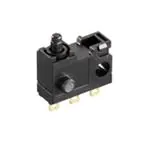
For detection: Non Seal Type Switches
AEQ ( EQ ) Switches
Product Catalog
2022.4
�For detection: Non Seal Type Switches
AEQ (EQ) Switches
Sliding contact construction Switches for Low-level Loads
FEATURES
13.3
Handles low level load: 100 μA at 3 V DC to 100 mA
30 V DC
Long stroke: For pin plunger type, it maintains OT
(Over Travel) with over 2.2 mm on the N.O. side and
over 2.5 mm on the N.C. side.
Since contact pressure does not depend on the
operation stroke, the range of possible use over the
entire stroke is greatly increased.
Silent operation construction with sliding contact
Protection grade: IP40
5.4
10.1
TYPICAL APPLICATIONS
Crime prevention devices, Household appliances
(Air conditioners, Air purifier, etc.)
(Unit: mm)
ORDERING INFORMATION (PART NO.)
AEQ1
Size of mounting hole
0: Mounting hole 3 mm standard type
1: Mounting hole 3 mm without boss type
terminal
4: Solder terminal
Contact form
1: SPDT
5: P/C board terminal
Actuator
0: Pin plunger
7: Leaf lever
8: Simulated leaf lever
COM N.O. N.C.
TYPES
Terminal type (Mounting hole: 3 mm standard type / 3 mm without boss type)
Actuator
Operating Force OF, Max.
Mounting hole: 3mm standard type
Mounting hole: 3mm without boss type
Solder terminal
P/C board terminal
Pin plunger
1.2 N
AEQ10410
AEQ11510
Leaf lever
1.7 N
AEQ10417
AEQ11517
Simulated leaf lever
1.5 N
AEQ10418
AEQ11518
Panasonic Industry Co., Ltd. Electromechanical Control Business Division
industrial.panasonic.com/ac/e/
ー1ー
Panasonic Industry Co., Ltd. 2022
AECTB14E 202204
�AEQ (EQ) Switches
RATING
Contact rating
100 μA 3 V DC to 100 mA 30 V DC.
(Min. switching capacity (Reference value*) 10 μA 1 V DC)
* �This value is a rough indication of the lowest possible low level load at which switching is possible.
This value can change due to the switching frequency, environmental conditions, and desired reliability level, therefore it is recommended to check this with the actual load.
Operation environment and conditions
Item
Specifications
Ambient and storage temperature
–25 to +85°C (no freezing and condensing)
Allowable operating speed
30 to 500 mm/sec
Max. operating cycle rate
120 cpm
Note 1: �When switching at low and high speeds or under vibration, or in high-temperature, high-humidity environments, life and performance may be reduced significantly depending
on the load capacity. Please consult us.
Note 2:
Humidity (% RH)
95
Allowable range
50
Avoid con
densation when
used at tem
peratures higher
than 0°C
Avoid icing
when used at
temperatures
lower than 0°C
5
25
0
Ambient temperature (℃)
85
Electrical characteristics
Dielectric strength (Initial)
Between non-continuous terminals: 600 Vrms for 1 min
Between each terminal and other exposed metal parts: 1,500 Vrms for 1 min
Between each terminal and ground: 1,500 Vrms for 1 min
(at detection current of 1 mA)
Insulation resistance (Initial)
Min. 100 MΩ (at 500 V DC insulation resistance meter, Locations measured same as breakdown voltage.)
Contact resistance (Initial)
Max. 1 Ω (by voltage drop 0.1 A, 6 to 8 V DC)
Characteristics
Item
Electrical
switching
life
Specifications
3 V DC 0.1 mA (resistive load)
Min. 2 × 10⁵
30 V DC 100 mA (resistive load)
Min. 105
Switching frequency: 20 times/min
Conduction ratio: 1:1
Pushbutton operation speed: 100 mm/s
Pushbutton switching position: free position (FP) to total travel position (TTP)
Vibration resistance
(malfunction vibration resistance)
Single amplitude: 0.75 mm
Amplitude of vibration: 10 to 55 Hz (4 minutes cycle)
Direction and time: 2 hours each in X, Y and Z directions
Shock resistance
(malfunction shock resistance)
Shock value: 294 m/s2
Direction and time: 3 times each in X, Y and Z directions
Vibration resistance endurance
Frequency of vibration: 33.3 Hz
Acceleration: 43.1 m/s2
Direction and time: 8 hours each in X, Y and Z directions
Terminal strength
Min. 6 N (to each direction, applied power at 1 minute) *Terminal deformation possible.
Salt spray resistance
Density of salt water: 5 %
Temperature: 35°C each 100 hours
At free position (FP) and total travel position (TTP)
Heat and cold resistance
–45 to –40°C 48 hours
85 to 90°C 48 hours
Humidity resistance
40°C 95% RH 96 hours
Unit weight
Approx. 0.8 g
Protection grade
IP40
Note: �As long as there are no particular designations, the following conditions apply to the test environment.
• Ambient temperature: 5 to 35°C
• Relative humidity: 25 to 85% RH
• Air pressure: 86 to 106 kPa
Panasonic Industry Co., Ltd. Electromechanical Control Business Division
industrial.panasonic.com/ac/e/
ー2ー
Panasonic Industry Co., Ltd. 2022
AECTB14E 202204
�AEQ (EQ) Switches
Operating characteristics
Characteristics
Operating Force (OF) Max. *Note 1
Total travel Force (TF) Max. (reference value)
Free Position (FP) Max.
Pin plunger
Leaf lever
1.2 N
1.7 N
Simulated leaf lever
1.5 N
(1.8 N)
(3.1 N)
(2.8 N)
14.4 mm
From mounting boss and hole center line
9.2. mm
11.5 mm
From standoff
13.4 mm
15.7 mm
18.6 mm
8.7±0.3 mm
9.8±0.5 mm
12.5±0.5 mm
12.9±0.3 mm
Operating Position on N.C. side From mounting boss and hole center line
(OP) N.C. *Note 2, 4
From standoff
14.0±0.3 mm
16.7±0.3 mm
Operating Position on N.O. side From mounting boss and hole center line
(OP) N.O. *Note 3, 4
From standoff
8.4±0.3 mm
9.3±0.5 mm
12.0±0.5 mm
12.6±0.3 mm
13.5±0.3 mm
16.2±0.3 mm
From mounting boss and hole center line
8.8±0.3 mm
10.1±0.5 mm
12.9±0.5 mm
From standoff
13.0±0.3 mm
14.3±0.3 mm
17.1±0.3 mm
From mounting boss and hole center line
8.5±0.3 mm
9.6±0.5 mm
12.4±0.5 mm
From standoff
12.7±0.3 mm
13.8±0.3 mm
16.6±0.3 mm
Over travel on N.C. side (OT) N.C. Min.
2.5 mm
3.1 mm
3.3 mm
Over travel on N.O. side (OT) N.O. Min.
2.2 mm
2.6 mm
2.8 mm
From mounting boss and hole center line
(5.9 mm)
(6.2 mm)
(8.7 mm)
From standoff
(10.1 mm)
(10.4 mm)
(12.9 mm)
Release Position on N.C. side
(RP) N.C. *Note 5
Release Position on N.O. side
(RP) N.O. *Note 6
Total Travel Position (TTP)
(reference value)
Notes: The above indicates the characteristics when operating the pushbutton from the vertical direction.
1. Indicates operation load for N.O. contact to achieve ON status.
2. Indicates position for N.C. contact to achieve OFF status.
3. Indicates position for N.O. contact to achieve ON status.
4. �Although there is some overlap in the range of the operating position (OP) on the N.C. and N.O. sides due to the tolerance, in actuality there is always an intermediateOFF range
(the N.C. and N.O. sides will never ON at the same time.)
5. Indicates position for N.C. contact to achieve ON status.
6. Indicates position for N.O. contact to achieve OFF status.
DATA
Applicable current range (Reference)
100 mA
Applicable range
0.1 mA
0
DC 3 V
30 V
OPERATION CONCEPT DIAGRAM
Standard ( mounting boss and
hole center diameter or standoff )
Contact form: terminal type
Operation
load
TF
Operation load
OF
RF
0
RP (N.C.)
N.C. side
Contact force
OT (N.C.)
OP (N.C.)
0
(OFF)
Stroke
N.O. side
OT (N.O.)
RP (N.O.)
Range of possible use
TTP
OP (N.O.)
FP
N.C. side
N.O. side
Panasonic Industry Co., Ltd. Electromechanical Control Business Division
industrial.panasonic.com/ac/e/
ー3ー
Panasonic Industry Co., Ltd. 2022
AECTB14E 202204
�AEQ (EQ) Switches
CONTACT FORM
COM
DIMENSIONS
N.O. N.C.
Unit: mm
CAD The CAD data of the products with a “CAD” mark can be downloaded from our Website.
Solder terminal; Mounting hole: 3 mm, standard type
CAD
Pin plunger
External dimensions
C0.3
8.4±0.2
5.4±0.15
13.3±0.15
φ1.9
5.9
5.1
+0.3
3.0-0.2
1.2
2.0
4.53±0.15
0.4
+0
-0.1
1.5
φ3.0
3.7
3.0+0.1
-0
8.3±0.1
4.2
TTP(5.9)
3.2±0.1
TTP(10.1)
RP(N.O.)8.5±0.3
OP(N.O.)8.4±0.3
RP(N.O.)12.7±0.3
OP(N.O.)12.6±0.3
RP(N.C.)8.8±0.3
OP(N.C.)8.7±0.3
RP(N.C.)13.0±0.3
OP(N.C.)12.9±0.3
FP Max. 13.4
FP Max. 9.2
5.4
2.7
4.1
4.53±0.15
0.4
General tolerance: ±0.25
Operating Force (OF) Max.
1.2 N
Total travel Force (TF) Max.
(reference value)
(1.8 N)
Free Position
(FP) Max.
From mounting boss
and hole center line
9.2 mm
From standoff
13.4 mm
From mounting boss
Operating
Position on N.C. and hole center line
side (OP) N.C. From standoff
From mounting boss
Operating
Position on N.O. and hole center line
side (OP) N.O. From standoff
From mounting boss
Release
Position on N.C. and hole center line
side (RP) N.C.
From standoff
ー4ー
12.9±0.3 mm
8.4±0.3 mm
12.6±0.3 mm
8.8±0.3 mm
13.0±0.3 mm
From mounting boss
Release
Position on N.O. and hole center line
side (RP) N.O. From standoff
12.7±0.3 mm
Over travel on N.C. side (OT) N.C. Min.
2.5 mm
Over travel on N.O. side (OT) N.O. Min.
2.2 mm
Panasonic Industry Co., Ltd. Electromechanical Control Business Division
industrial.panasonic.com/ac/e/
8.7±0.3 mm
Panasonic Industry Co., Ltd. 2022
8.5±0.3 mm
AECTB14E 202204
�AEQ (EQ) Switches
Leaf lever
External dimensions
C0.3
13.3±0.15
φ1.9
8.3±0.1
4.53±0.15
5.9
1.5
0.4
1.2
2.0
3.0
+0.3
-0.2
φ3.0+0
-0.1
4.2
1.2
5.1
0.5
3.0 +0.1
-0
TTP(6.2)
3.2±0.1
)
8゚
(1
0
0.2
TTP(10.4)
RP(N.O.)9.6±0.5
OP(N.O.)9.3±0.5
RP(N.O.)13.8±0.5
OP(N.O.)13.5±0.5
RP(N.C.)10.1±0.5
OP(N.C.)9.8±0.5
RP(N.C.)14.3±0.5
OP(N.C.)14.0±0.5
FP Max. 15.7
FP Max. 11.5
14.
8.4±0.2
5.4±0.15
3.3
3.7
5.4
2.7
0.4
4.1
4.53±0.15
General tolerance: ±0.25
Note) When switching at high speed or under shock, lever endurance may drop.
Therefore, please be sure to conduct an endurance evaluation under actual switching conditions.
Operating Force (OF) Max.
1.7 N
Total travel Force (TF) Max.
(reference value)
(3.1 N)
Free Position
(FP) Max.
From mounting boss
and hole center line
11.5 mm
From standoff
15.7 mm
From mounting boss
Operating
Position on N.C. and hole center line
side (OP) N.C. From standoff
From mounting boss
Operating
Position on N.O. and hole center line
side (OP) N.O. From standoff
From mounting boss
Release
Position on N.C. and hole center line
side (RP) N.C.
From standoff
ー5ー
14.0±0.3 mm
9.3±0.5 mm
13.5±0.3 mm
10.1±0.5 mm
14.3±0.3 mm
From mounting boss
Release
Position on N.O. and hole center line
side (RP) N.O. From standoff
13.8±0.3 mm
Over travel on N.C. side (OT) N.C. Min.
3.1 mm
Over travel on N.O. side (OT) N.O. Min.
2.6 mm
Panasonic Industry Co., Ltd. Electromechanical Control Business Division
industrial.panasonic.com/ac/e/
9.8±0.5 mm
Panasonic Industry Co., Ltd. 2022
9.6±0.5 mm
AECTB14E 202204
�AEQ (EQ) Switches
Simulated leaf lever
External dimensions
8.4±0.2
5.4±0.15
3.3
0.5
8.3±0.1
5.9
+0.3
0.4
1.2
2.0
1.5
3.0 -0.2
φ3.0 +0
-0.1
4.2
1.2
3.7
3.0 +0.1
-0
3.2±0.1
5.1
0.2
13.3±0.15
5.4
2.7
φ1.9
R2.0
)
15.
8゜
0
(1
TTP(8.7)
R0.5
TTP(12.9)
RP(N.O.)12.4±0.5
OP(N.O.)12.0±0.5
RP(N.O.)16.6±0.5
OP(N.O.)16.2±0.5
RP(N.C.)12.9±0.5
OP(N.C.)12.5±0.5
FP Max.14.4
RP(N.C.)17.1±0.5
OP(N.C.)16.7±0.5
FP Max.18.6
2.8
C0.3
4.53±0.15
4.53±0.15
4.1
0.4
General tolerance: ±0.25
Note) When switching at high speed or under shock, lever endurance may drop.
Therefore, please be sure to conduct an endurance evaluation under actual switching conditions.
Operating Force (OF) Max.
1.5 N
Total travel Force (TF) Max.
(reference value)
(2.8 N)
Free Position
(FP) Max.
From mounting boss
and hole center line
14.4 mm
From standoff
18.6 mm
From mounting boss
Operating
Position on N.C. and hole center line
side (OP) N.C. From standoff
From mounting boss
Operating
Position on N.O. and hole center line
side (OP) N.O. From standoff
From mounting boss
Release
Position on N.C. and hole center line
side (RP) N.C.
From standoff
From mounting boss
Release
Position on N.O. and hole center line
side (RP) N.O. From standoff
12.5±0.5 mm
16.7±0.3 mm
12.0±0.5 mm
16.2±0.3 mm
12.9±0.5 mm
17.1±0.3 mm
12.4±0.5 mm
16.6±0.3 mm
Over travel on N.C. side (OT) N.C. Min.
3.3 mm
Over travel on N.O. side (OT) N.O. Min.
2.8 mm
P/C board terminal; Mounting hole: 3 mm, without boss type
CAD
Pin plunger
+0.3
C0.2
0.9
5.08±0.15 5.08±0.15
3.0 -0.2
P/C board terminal
General tolerance: ±0.25
P/C board pattern
φ1.0 +0.1
-0
5.08±0.1 5.08±0.1
Panasonic Industry Co., Ltd. Electromechanical Control Business Division
industrial.panasonic.com/ac/e/
ー6ー
Panasonic Industry Co., Ltd. 2022
AECTB14E 202204
�AEQ (EQ) Switches
GUIDELINES FOR USAGE
Soldering conditions
Cautions regarding the circuit
The application of excessive heat upon the switch when
soldering can cause degradation of switch operation.
Therefore, be sure to keep within the conditions given below.
Manual soldering: use soldering irons (Max. 350°C, within 3
seconds at each terminal) capable of temperature adjustment.
This is to prevent deterioration due to soldering heat. Care
should be taken not to apply force to the terminals during
soldering.
(More than one second interval is required to apply heat
at each terminal.) Please consult us if you intend to use a
soldering iron that exceeds 60 W.
1) �In order to prevent malfunction in set devices caused by
bounce and chattering during the ON-OFF switch operation,
please verify the validity of the circuit under actual operating
conditions and temperature range.
2) �When switching inductive loads (relays, solenoids, buzzers,
etc.), an arc absorbing circuit is recommended to protect
the contacts.
Mounting
Please avoid use in which load would be applied to the sides
[hatch part (both sides) shown below] of the switch in the
direction indicated by the arrows. This could cause erroneous
operation. Also, when using a metal installation board, please
make allowance for burr direction designation and burr
suppressing, etc., so that the burr side will not be on the switch
installation side.
1) �To secure the switch, please use an M3 small screw on a
flat surface and tighten using a maximum torque of 0.29
N·m. It is recommended that spring washers be used with
the screws and adhesive be applied to lock the screws to
prevent loosening of the screws. Please make sure not to
apply adhesive onto the moving parts.
2) �Be sure to maintain adequate insulating clearance between
each terminal and ground.
3) �Although it is possible to directly operate the pin plunger
type from the lateral direction, please consult us if doing so.
4) �After mounting please make sure no tensile load will be
applied to the switch terminals.
5) �Range of possible use: Please set the operation position
to within the ranges in the following table so that there
is sufficient insulation distance and to maintain contact
reliability.
Plunger/lever free
Actuator
From boss
and hole
center line
Pin plunger
Please verify under actual conditions.
Please be sure to conduct quality verification under actual
operating conditions in order to increase reliability during
actual use.
Selection of switch
Please make your selection so that there will be no problems
even if the operating characteristics vary up to ±20% from the
standard values.
Others
1) �Keep away from environments where silicon based
adhesives, oil or grease are present as faulty contacts
may result from silicon oxide. Do not use in areas where
flammable or explosive gases from gasoline and thinner,
etc., may be present.
2) �When using the lever type, please be careful not to apply
unreasonable load from the reverse or lateral directions of
operation.
3) �Do not exceed the total travel position (TTP) and press the
actuator. This could cause operation failure. Also, when
switching at high speed or under shock even within the
operation limit, the working life may decrease. Therefore,
please be sure to verify the quality under actual conditions
of use.
4) �Please make considerations so that the switch does not
become the stopper for the operating part. The switch could
break.
Plunger/Lever pushed
From
standoff
From boss
and hole
center line
From
standoff
>9.2 mm
>13.4 mm
7.8 to 5.9
mm
12.0 to 10.1
mm
Leaf lever
>10.7 mm
>14.9 mm
8.4 to 6.2
mm
12.6 to 10.4
mm
Simulated
leaf lever
>13.5 mm
>17.7 mm
11.1 to 8.7
mm
15.3 to 12.9
mm
6) �P/C board terminal type should be used if the products are
to be soldered on the P/C board. (Solder terminal type is
not for soldering on P/C board.)
Panasonic Industry Co., Ltd. Electromechanical Control Business Division
industrial.panasonic.com/ac/e/
ー7ー
Panasonic Industry Co., Ltd. 2022
AECTB14E 202204
�AEQ (EQ) Switches
Quality Assurance
We make every effort assure the quality of these parts.
To prevent as far as possible the effects of unforeseen
circumstances that do not correspond with those described
in this specification, we request that you provide us with
specifications of the product in which these parts will be used,
along with details of the destination and conditions of use of
your finished product, and the mounting mechanism of the
parts.
To minimize the risk of product liability, in the unlikely event
that a quality defect in any of these parts causes a significant
impact on property or human life, to supplement the warranted
operations and performance figures described in this
specification, we recommend the implementation of safety
measures such as redundant circuits.
The quality of these parts is assured for one year after delivery
to your company. Quality assurance is limited solely to the
items described in this specification and operation within
the ranges specified. After you have received a part, in the
unlikely event that it proves defective, acting in good faith, we
will promptly send you a replacement or replace or repair the
defective part at the place of delivery.
However, this warranty does not apply in the circumstances
listed below.
1) �We accept no responsibility for other failures that may be
attributed to a defect or failure of the delivered parts.
2) �After receipt by your company, conditions other than those
described in these specifications that occur during handling,
storage, and transportation (conveyance).
3) �When a phenomenon that could not have been foreseen
has been caused by technology put to practical use at the
time of delivery of the part to your company.
4) �Failures due to natural or man-made disasters such as
earthquakes, floods, fires, public or industrial disturbances
and other events that are not the fault of our company.
The above stipulations apply only to parts purchased and used
in Japan. If you are considering purchasing or using these
parts outside of Japan, please consult our sales office.
Please refer to "the latest product specifications"
when designing your product.
•Requests to customers:
https://industrial.panasonic.com/ac/e/salespolicies/
Panasonic Industry Co., Ltd. Electromechanical Control Business Division
industrial.panasonic.com/ac/e/
ー8ー
Panasonic Industry Co., Ltd. 2022
AECTB14E 202204
�Technical Terminology & Cautions for Use (Detection Switches)
TECHNICAL TERMINOLOGY
Detection Switches
Contact form
A compact switch equipped with an enclosed micro-gap snapaction
contact mechanism that makes a specified motion with a specified
force to open/close a circuit, and an actuator outside the enclosure
(hereinafter referred to as the switch)
This refers to the components determining the type of application
which make up the electrical input/output circuits in the contact.
SPDT
Actuator
SPSTN.C.
A part of the switch that transmits the received external force to an
internal spring mechanism to move the movable contact so that the
switch can be opened and closed
SPSTN.O.
Actuator stopper
Insulation resistance
A part of the switch to limit the actuator movement in the switch
operation direction
Resistance between non-continuous terminals, each terminal and
other exposed metal parts and between each terminal and ground.
Rated values
Values indicating the characteristics and performance guarantee
standards of the snap-action switches. The rated current and rated
voltage, for instance, assume specific conditions (type of load,
current, voltage, frequency, etc.).
Dielectric
Mechanical life
Contact resistance
Threshold limit value that a high voltage can be applied to a
predetermined measuring location for one minute without causing
damage to the insulation.
The service life when operated at a preset operating frequency
without passing electricity through the contacts. (The life test is
performed at a switching frequency of 60 times/minute and
operating speed of 100 mm/second at the regular cam.)
This indicates the electrical resistance at the contact part.
Generally, this resistance includes the conductor resistance of the
spring and terminal portions.
Vibration resistance
Electrical life
The service life when the rated load is connected to the contact and
switching operations are performed. (The life test is performed at a
switching frequency of 20 times/minute and operating speed of 100
mm/second at the regular cam.)
Malfunction vibration ... Vibration range where a closed contact does
not open for longer than a specified time due to vibrations during
use of the snap-action switches.
Shock resistance
Shock durability ... Shock range where the mechanical shocks
received during snap-action switches transport and installation do
not damage the parts or harm the operating characteristics.
Malfunction shock ... Shock range where a closed contact does not
open for longer than a specified time due to shocks during use of
the snap-action switches.
Panasonic Industry Co., Ltd. Electromechanical Control Business Division
industrial.panasonic.com/ac/e/
ー9ー
Panasonic Industry Co., Ltd. 2022
AECTB36E 202204
�Technical Terminology & Cautions for Use (Detection Switches)
TECHNICAL TERMINOLOGY
■ Definition of operating characteristic
The main terminological illustrations and
meanings which are used with snapaction
switches are as follows.
RF
OF
PT
FP
Classification
TF
OT
OP
TT
Force
MD
RP
TTP
Movement
Center of mounting holes
Symbol
Unit
Varying
display
method
Operating
Force
OF
N
Max.
The force required to cause contact
snap-action. It is expressed terms of force
applied to the the actuator.
Release
Force
RF
N
Min.
The force to be applied to the the actuator
at the moment contact snaps back from
operated position to total travel position.
Totaltravel
Force
TF
N
Pretravel
PT
mm,
degree
Max.
Distance or agree of the actuator movement
from free position to operating position.
Overtravel
OT
mm,
degree
Min.
The distance or degree which the actuator
is permitted to travel after actuation without
any damage to the switching mechanism.
Movement
Differential
MD
mm,
degree
Max.
The distance or degree from operating
position to release position of the actuator.
Totaltravel
TT
mm,
degree
The migration length or the move angle
from the free position to total travel position
of actuator
Free Position
FP
mm,
degree
Position of the actuator when no force is
applied to.
Operating
Position
OP
mm,
degree
Release
Position
RP
mm,
degree
The position of the actuator when the
traveling contact snaps back from operating
position to its original position.
Total travel
Position
TTP
mm,
degree
The stopping position of the actuator after
total travel.
Terminology
Starting current
Force applied to an actuator required to
move from an operating position to a total
travel position
Position
±
The position of the actuator when the
traveling contacts snaps with the fixed
contact.
Panasonic Industry Co., Ltd. Electromechanical Control Business Division
industrial.panasonic.com/ac/e/
ー 10 ー
Panasonic Industry Co., Ltd. 2022
AECTB36E 202204
�Technical Terminology & Cautions for Use (Detection Switches)
TECHNICAL NOTES ON MECHANICAL CHARACTERISTICS
Actuation Force and Stroke
Changes in Operating Characteristics
Adequate stroke setting is the key to high reliability. It is also
important that adequate contact force be ’maintained to ensure high
reliability. For a normally closed (N.C.) circuit, the driving mechanism
should be set so that the actuator is normally in the free position.
For a normally open (N.O.) circuit, the actuator should be pressed to
70% to 100% of the specified stroke to absorb possible errors.
If the stroke is set too close to the operating point (OP), this may
cause unstable contact, and in the worst case may cause actuator
damage due to inertia of the drive mechanism. It is advisable that
the stroke be adjusted with the mounting plate or driving
mechanism.
Exercise design care so that malfunctions will not occur if the
operating characteristics vary by as much as 20% from, rated
values.
In the OF Max. 0.98N specification for FS snap-action switches,
the allowable Max. is 0.98 N (100%+20%) = 1.18 N
In the RF Min. 0.15 N Min. specification
the allowable Min. 0.15 N (100%–20%) = 0.12 N
Mechanical Conditions for Type Selection
Actuator type should be selected according to activation method,
activation speed, activation rate, and activation frequency.
1) �An extremely slow activation speed may cause unstable contact
transfer, possibly resulting in contact failures or contact fusion.
2) �An extremely high activation speed may cause damage to
contacts or contact response failure.
Contact force
Operating force
The figure at right shows a typical example of activation
and contact forces varying with stroke.
In the vicinity of the OP and RP, the contact force is diminished,
causing chatter and contact bounce immediately before or after
reversal. For this reason, use the switch while giving
due consideration to this. This also causes the snap action switch to
be sensitive to vibration or shock.
Driving Mechanism
Use of a driving mechanism which will cause physical impact to the
actuator should be avoided.
OF
<Example>
RF
RP
FP
OP
MD
PT
TTP Stroke
Bad
OT
Good
N.C.
On FP
On reversal
Stroke
On reversal
On OTP
N.O.
TECHNICAL NOTES ON ELECTRICAL CHARACTERISTICS
1) �The snap-action switch is designed for AC operations. While it has
small contact gaps and no arc absorber, it may be used for lowcapacity DC operations.
Please refer to the rating of each products
2) �For applications with very small switching voltage or current, choose
the low-level load type (Au contact).
Small current and voltage application range (Au contact)
Current (mA)
500
100
50
10
5
2
1
4
8
12
16
20
DC voltage (VDC)
24
3) �When selecting a contact type of a snap-action switch to be used
for low-level load switching, the following should be noted.
Silver contacts’ surfaces are prone to be oxidized and form a sulfide
film. The switch operates with no problems at thebeginning of use.
However, as the contact surfaces develop films with time, the film
may not be broken by the switching operation, causing a conduction
failure. Therefore, please choose the Au contact type for switching a
load of 0.1 A or below.
4) Application to Electronic Circuits
• �The snap-action switch contacts can sustain bounce or chatter
when closed. Bounce or chatter can cause noise or pulse count
errors when the snap action switch is used in electronic circuits.
• If contact bounce or chatter poses problems in the vicinity of the
OP and RP, use a suitable absorption network, such as a C/ R
network.
5) �Check the surge current, normal current and surge duration.
6) �Contact resistance given in performance specifications is measured
with a voltage drop method using 6 to 8 V DC, 1 A (except for
low-level load type). Contact resistance across COM and N.C.
terminals is measured in the free position, while contact resistance
across COM and N.O. terminals is measured in the total travel
position.
7) �To prevent contact welding failure, be sure to use a serial resistance
for each capacitive load.
8) �If snap-action switch operation is synchronized with the AC supply
phase, this may cause: shortened electrical life, contact fusion
failure, contact transfer, or other reliability problems.
Panasonic Industry Co., Ltd. Electromechanical Control Business Division
industrial.panasonic.com/ac/e/
ー 11 ー
Panasonic Industry Co., Ltd. 2022
AECTB36E 202204
�Technical Terminology & Cautions for Use (Detection Switches)
CAUTIONS IN A CIRCUIT
1) �Contact protection is recommended when snap-action switches are
used in an inductive load circuit.
Circuit diagram
Cautions for use
Contact for snapaction switch
r
c
R
2) �Do not connect the contacts on individual switches to different type
or different poles of the power supply.
Examples of power supply connections (connection to different
poles)
Wrong
(1) r = more than 10 Ω
(2) I�n an AC circuit
Impedance of R is to be slightly
smaller than impedance of r and c.
Lamp load
PL
Solenoid load
Contact for snapaction switch
r
R
c
Can be used for both AC and DC.
Impedance of r is nearly equal to
impedance of R.
C: 0.1 μF
Right
Lamp load
PL
Solenoid load
Load connected to same pole
Contact for snapaction switch
diode
(1) For DC circuits only.
R
Example of wrong power supply connection (connection to different
poles of power supply)
This may lead to mixed DC and AC.
ZNR
Varistor
Induction load
Contact for snapaction switch
Wrong
Can be used for both AC and DC.
Load
L
AC
DC
Load
L
3) �Avoid circuits which apply voltage between contacts. (This may lead
to mixed deposition.)
Wrong
200 V
L
100 V
Panasonic Industry Co., Ltd. Electromechanical Control Business Division
industrial.panasonic.com/ac/e/
ー 12 ー
Panasonic Industry Co., Ltd. 2022
AECTB36E 202204
�Technical Terminology & Cautions for Use (Detection Switches)
MOUNTING STATE AND ENVIRONMENT
Checking the insulation distance
Soldering precautions
After mounting and wiring, check the insulation distance between
terminals and the ground. If the insulation distance is inadequate,
mount insulating material between as required.
For manual soldering, lay the terminals flat (horizontal with the
ground) and quickly perform the soldering operation using a
soldering iron with the appropriate heat capacity and the proper
amount of solder. Take care that the flux does not flow into the
switch interior by using a ventilation fan to discharge flux gas and to
prevent contact of the switch body with the soldering iron tip.
Be careful not to apply force to the lead wires or the terminal
portions immediately after soldering.
The temperature setting and time conditions vary depending on the
product.
See the section “CAUTIONS FOR USE” for each product.
Fastening the snap-action switch body
See the Section “CAUTIONS FOR USE” for the individual switch.
Position adjustment with effector
1) �The effector should be positioned so that direct force is not applied
to the plunger or actuator in its free position. The operating force to
the plunger should only be applied in a perpendicular direction.
2) �Note that the use of the switch as a stopper may cause an
operational problem.
<Examples>
Soldering iron tip
Switch installation position
�Basically, the switch should be installed so that the object to press
the switch’s plunger or lever can press it down to 70 to 100% of OT
of the switch. When determining the position, the tolerance of OP
(Operating Position) and other factors should be taken into account.
The following describes the case where the strictest tolerance
conditions are adopted.
�Example: Hinge lever type FS switch
Reference values: �OP = 8.8±0.8 mm
PT = Max. 2.8 mm
OT = Min. 1.2 mm
Wrong
Avoid using in a silicon atmosphere
Avoid using organic silicon rubber, adhesives, sealing compounds,
oil, grease, and wires in a silicon atmosphere.
� lease consult us when using under the following
P
conditions*:
FP
OP
TTP
Correct
PT
1) �Environments where hydrogen sulfide or other corrosive gases are
present.
2) �Environments where gasoline, thinner or other flammable, explosive
gases are present.
3) �Dusty environments (for non-seal type snap action switches).
4) �The perpendicular operating speed exceeds the allowable operating
speed.
5) �Switching between different poles.
6) �Use in environments not in the prescribed temperature or humidity
range.
OT
(1) �When the switch is not pressed
The object to press the lever should not be in contact with the
lever.
For this purpose, the object should be at a distance from the
switch father than the maximum FP (Free Position) value.
FP Max = OP Max + PT Max = 9.6 + 2.8 = 12.4 mm Max
The object should be at a distance of 12.4 mm or more
from the mounting hole.
(2) �Depressed position
The plunger/lever should be pressed down to 70% or more of
OT (Over Travel). Therefore, the depressed position should be
calculated based on the minimum value of OP (Operating
Position) and the 70 and 100% of the OT value.
OP Min - 70% of OT = 8.0 - 0.84 = 7.16 mm
OP Min - 100% of OT = 8.0 - 1.2 = 6.80 mm
The plunger/lever should be pressed down to the position of
6.80 to 7.16 mm from the mounting hole.
Storage precautions
To prevent discoloration due to sulfurization of the terminals (silverplated), store the switches in a polyethylene bag or other suitable
airtight container.
Panasonic Industry Co., Ltd. Electromechanical Control Business Division
industrial.panasonic.com/ac/e/
ー 13 ー
Panasonic Industry Co., Ltd. 2022
AECTB36E 202204
�Technical Terminology & Cautions for Use (Detection Switches)
� sage, storage, and transport conditions (except
U
turquoise switches)
During usage, storage, or transportation, avoid locations subject to
direct sunlight and maintain normal temperature, humidity, and
pressure conditions.
The allowable specifications for environments suitable for usage,
storage, and transportation are given below.
1) �Temperature: The allowable temperature range differs for each
switch, so refer to the switch’s individual specifications. In
addition, when transporting or storing switches while they are
tube packaged, there are cases when the temperature may differ
from the allowable range. In this situation, be sure to consult the
individual specifications.
2) �Humidity: The allowable temperature range differs for each
switch, so refer to the switch’s individual specifications.
3) �Pressure: 86 to 106 kPa
The humidity range varies with the temperature. Use within the
range indicated in the graph below.
Humidity (% RH)
85
Allowable range
Avoid icing
when used at
temperatures
lower than 0°C
Avoid con
densation when
used at tem
peratures higher
than 0°C
5
40
0
Ambient temperature (℃)
� e reserve the right to modify without notice the
W
materials, internal components, and other parts to
improve product quality.
Handling precautions
When handling the switches, be careful not to drop them on the floor
since this may damage them.
* �Select contact sulfurization (clipping) prevention products (FS and Au-clad double
layer contacts) for use with extremely small loads or an environment-resistant
Turquoise switch.
Others
1) �Failure modes of switches include short-circuiting, opencircuiting
and temperature rises. If this switch is to be used in equipment
where safety is a prime consideration, examine the possible
effects of these failures on the equipment concerned, and ensure
safety by providing protection circuits or protection devices. In
terms of the systems involved, make provision for redundancy in
the design and take steps to achieve safety design.
2) �The ambient operating temperature (and humidity) range quoted
is the range in which the switch can be operated on a continuous
basis: it does not mean that using the switch within the rating
guarantees the durability performance and environment
withstanding performance of the switch. For details on the
performance guarantee, check the specifications of each product
concerned.
85
(The allowable temperature depends on the switch.)
� ondensation will occur inside the switch if there is a sudden
C
change in ambient temperature when used in an atmosphere of
high temperature and high humidity. This is particularly likely to
happen when being transported by ship, so please be careful of
the atmosphere when shipping. Condensation is the phenomenon
whereby steam condenses to cause water droplets that adhere to
the switch when an atmosphere of high temperature and humidity
rapidly changes from a high to low temperature or when the
switch is quickly moved from a low humidity location to one of high
temperature and humidity.
Please be careful because condensation can cause adverse
conditions such as deterioration of insulation, coil cutoff, and rust.
�Condensation or other moisture may freeze on the switch when the
temperatures is lower than 0°C 32°F. This causes problems such as
sticking of movable parts or operational time lags.
�The plastic becomes brittle if the switch is exposed to a low
temperature, low humidity environment for long periods of time.
�Storage for extended periods of time (including transportation
periods) at high temperatures or high humidity levels or in
atmospheres with organic gases or sulfide gases may cause a
sulfide film or oxide film to form on the surfaces of the contacts and/
or it may interfere with the functions. Check out the atmosphere in
which the units are to be stored and transported.
�In terms of the packing format used, make every effort to keep the
effects of moisture, organic gases and sulfide gases to the absolute
minimum.
Panasonic Industry Co., Ltd. Electromechanical Control Business Division
industrial.panasonic.com/ac/e/
ー 14 ー
Panasonic Industry Co., Ltd. 2022
AECTB36E 202204
�Technical Terminology & Cautions for Use (Detection Switches)
Shape
Pretravel
(PT)
Overtravel
(OT)
Operating
Force
(OF)
Vibration
Shock
Features
Pin plunger
Small
Small
Large
Outstanding
Appropriate for linear short-stroke action. Pin plunger acts directly
on snap action mechanism, enabling high-precision positioning.
Amount of movement after operation is smallest among all of the
actuators, however, so reliable stopper is required.
Hinge lever
Large
Medium
Small
Possible
Little force required for operation. Appropriate for use with
low-speed cams and dogs; has large stroke.
Lever available in various shapes to fit operating unit.
Simulated roller
lever
Large
Medium
Small
Possible
Tip of hinge lever is bent into a semi-circle, enabling use as a
simple roller type.
Leaf lever
Large
Large
Small
Excellent
Play in lever is used to assure maximum stroke. Construction
provides for space where lever is attached, for outstanding
resistance to freezing.
Hinge roller
lever
Large
Medium
Small
Possible
This is a hinge lever with a roller, and can be used with highspeed cams and dogs.
The force required for pin plunger action is lighter than that of the
lever, and the stroke is longer.
Classification
Panasonic Industry Co., Ltd. Electromechanical Control Business Division
industrial.panasonic.com/ac/e/
ー 15 ー
Panasonic Industry Co., Ltd. 2022
AECTB36E 202204
�Electromechanical Control Business Division
1006, Oaza Kadoma, Kadoma-shi, Osaka 571-8506, Japan
industral.panasonic.com/ac/e/
©Panasonic Industry Co., Ltd. 2022
Specifications are subject to change without notice.
AECTB14E 202204
2022.4
�