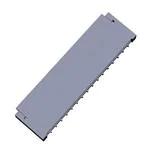
For FPC
FPC connectors
(0.3mm pitch)
Back lock
Y3B/Y3BW
FEATURES
1. Slim (width: 3.15 mm, including the
lever) and low profile design (height:
0.9 mm)
0.9
Y3B
5
3.1
Unit: mm
2. Mechanical design freedom is
achieved with double top and bottom
contacts.
Top and bottom double contacts
eliminate the need of using different
connectors (with either top or bottom
contacts) depending on the FPC wiring
conditions.
3. Easy-to-handle back lock structure
4. FPC insertion displacement
prevention
Constructed to make positional
displacement difficult
by surrounding the
four sides on the FPC
inlet side with wall
molding
Y3BW
RoHS compliant
6. Wiring patterns can be placed
underneath the connector.
7. Ni barrier with high resistance to
solder creepage.
8. Y3BW features lock holding type,
including a structure to temporarily
hold the FPC and a higher holding
force.
The FPC holding contacts located on
both ends of the connector facilitate
positioning of FPC and further enhance
the FPC holding force.
Structure to lock
notches on both
ends of the
FPC with
holding
contacts
Applicable
FPC shapes
(1) The inserted FPC can be temporarily
held until the lever is closed.
(2) When the lever is closed, the holding
contacts lock the FPC by its notches,
enhancing the FPC holding force.
APPLICATIONS
5. Man-hours of assembly time can be
reduced by delivering the connectors
with their levers opened.
Mobile devices, such as cellular
phones, smartphones, digital still
cameras and digital video cameras.
ORDERING INFORMATION
AYF 3
3
5
33: FPC Connector Y3B/Y3BW (0.3 mm pitch)
Back lock
Number of pins (2 digits)
Function
3: Top and bottom double contacts (Y3B)
6: Top and bottom double contacts, lock holding type (Y3BW)
Surface treatment (Contact portion / Terminal portion)
5: Au plating/Au plating (Ni barrier)
–1–
ACCTB47E 201607-T
�FPC connectors Y3B/Y3BW (0.3mm pitch)
PRODUCT TYPES
Y3B
Height
Number of pins
Part number
0.9 mm
7
8
9
11
13
15
17
21
23
25
27
31
33
35
37
39
41
45
51
61
71
AYF330735
AYF330835
AYF330935
AYF331135
AYF331335
AYF331535
AYF331735
AYF332135
AYF332335
AYF332535
AYF332735
AYF333135
AYF333335
AYF333535
AYF333735
AYF333935
AYF334135
AYF334535
AYF335135
AYF336135
AYF337135
Height
Number of pins
Part number
0.9 mm
11
25
51
AYF331165
AYF332565
AYF335165
Packing
Inner carton (1-reel)
Outer carton
5,000 pieces
10,000 pieces
Y3BW
Packing
Inner carton (1-reel)
Outer carton
5,000 pieces
10,000 pieces
Notes: 1. Order unit; For volume production: 1-inner carton (1-reel) units.
For samples, please contact our sales office.
2. Please contact our sales office for connectors having a number of pins other than those listed above.
–2–
ACCTB47E 201607-T
�FPC connectors Y3B/Y3BW (0.3mm pitch)
SPECIFICATIONS
1. Characteristics
The followings show specifications, when using an applicable FPC (thickness 0.20 mm)
Item
Rated current
Electrical
characteristics
Rated voltage
Insulation resistance
Dielectric strength
Contact resistance
Mechanical
characteristics
FPC holding force
Ambient temperature
Storage temperature
Specifications
0.2A/pin contact
(For min. 61 pins: Max. 12 A at total contacts)
50V AC/DC
Min. 1,000MΩ (initial)
150V AC for 1 min.
Max. 100mΩ
Y3B: Min. 0.13N/pin contact × pin contacts (initial)
Y3BW: Min. 0.13N/pin contact × pin contacts + 1.00N
(initial)
–55°C to +85°C
–55°C to +85°C (product only)
–40°C to +50°C (emboss packing)
Conditions
Using 250V DC megger (applied for 1 min.)
No short-circuiting or damage at a detection current of 1 mA
when the specified voltage is applied for one minute.
Based on the contact resistance measurement method
specified by JIS C 5402.
Measurement of the maximum force applied until the
inserted compatible FPC is pulled out in the insertion axis
direction while the connector lever is closed
No icing or condensation.
Conformed to MIL-STD-202F, method 107G
Thermal shock resistance
(with FPC mated)
Environmental
characteristics
120 hours,
insulation resistance min. 100MΩ,
contact resistance max. 100mΩ
24 hours,
insulation resistance min. 100MΩ,
contact resistance max. 100mΩ
Order Temperature (°C)
1
–55 −30
2
3
85 +30
4
–55 −30
Time (minutes)
30
Max. 5
30
Max. 5
H2S resistance
(with FPC mated)
48 hours,
contact resistance max. 100mΩ
Soldering heat resistance
Peak temperature: 260°C or less
300°C within 5 sec. 350°C within 3 sec.
Conformed to IEC60068-2-78
Bath temperature 40°C±2°C,
humidity 90% to 95% R.H.
Conformed to IEC60068-2-11
Bath temperature 35°C±2°C,
saltwater concentration 5%±1%
Bath temperature 40°C±2°C,
gas concentration 3 ppm ±1 ppm,
humidity 75% to 80% R.H.
Reflow soldering
Soldering iron
20 times
Repeated insertion and removal: min. 10 sec./time
Humidity resistance
(with FPC mated)
Saltwater spray resistance
(with FPC mated)
Lifetime
characteristics
5 cycles,
insulation resistance min. 100MΩ,
contact resistance max. 100mΩ
Insertion and removal life
Y3B 61 pin contacts: 0.10 g
Y3BW 51 pin contacts: 0.09 g
Unit weight
2. Material and surface treatment
Part name
Molded portion
Material
Housing: LCP resin (UL94V-0)
Lever: LCP resin (UL94V-0)
Contact
Copper alloy
Holding contact (Only Y3BW)
Copper alloy
–3–
Surface treatment
—
Contact portion; Base: Ni plating, Surface: Au plating
Terminal portion; Base: Ni plating, Surface: Au plating
Contact portion; Base: Ni plating, Surface: Au plating
ACCTB47E 201607-T
�FPC connectors Y3B/Y3BW (0.3mm pitch)
DIMENSIONS (Unit: mm)
The CAD data of the products with a
CAD Data
mark can be downloaded from: http://industrial.panasonic.com/ac/e/
Y3B
CAD Data
A
0.60±0.10 (Terminal pitch)
0.90±0.10
0.30±0.10 (Contact pitch)
0.60±0.10 (Terminal pitch)
(3.15)
(1.84)
1.35 (Suction area)
No. of pins: Odd number
2.95
(1.35)
(FPC
insertion
depth)
Terminal
coplanarity
0.1
(0.40)
(Contact)
B±0.20
(0.10)
(0.30)
(0.10)
C±0.20
A
B
C
3.60
1.80
1.20
9
11
13
15
17
21
23
25
27
31
33
35
37
39
41
45
51
61
71
4.20
4.80
5.40
6.00
6.60
7.80
8.40
9.00
9.60
10.80
11.40
12.00
12.60
13.20
13.80
15.00
16.80
19.80
22.80
2.40
3.00
3.60
4.20
4.80
6.00
6.60
7.20
7.80
9.00
9.60
10.20
10.80
11.40
12.00
13.20
15.00
18.00
21.00
1.80
2.40
3.00
3.60
4.20
5.40
6.00
6.60
7.20
8.40
9.00
9.60
10.20
10.80
11.40
12.60
14.40
17.40
20.40
CAD Data
3.90
0.30±0.10 (Contact pitch)
0.60±0.10
(Terminal pitch)
(3.15)
(1.84)
0.60±0.10 (Terminal pitch)
0.90±0.10
1.35 (Suction area)
No. of pins: Even number (8 pin contacts)
Number of pins/
dimension
7
The degree of
terminal flat
0.1
(0.40)
1.80±0.20
(0.10)
(Contact) (1.35)
(FPC
insertion
depth)
2.95
General tolerance: ±0.3
Each mentioned dimension is at the stage
of initial delivery.
(0.30)
(0.10)
1.80±0.20
–4–
ACCTB47E 201607-T
�FPC connectors Y3B/Y3BW (0.3mm pitch)
RECOMMENDED FPC DIMENSIONS
Y3B
(Finished thickness: t = 0.2±0.03)
The conductive parts should be based by Ni plating and then Au plating.
No. of pins: Odd number
0.30±0.07
0.60±0.07
Cutting direction*
0.10 max.
*Cut FPC from the copper foil side
0.20±0.02
to
the reinforcing plate side.
0.30+0.04
–0.03 (Contact width)
No. of pins: Even number (8 pin contacts)
For Top Contacts
1.20
2.40
3.00
3.60
4.20
4.80
6.00
6.60
7.20
7.80
9.00
9.60
10.20
10.80
11.40
12.00
13.20
15.00
18.00
21.00
1.80
2.40
3.00
3.60
4.20
5.40
6.00
6.60
7.20
8.40
9.00
9.60
10.20
10.80
11.40
12.60
14.40
17.40
20.40
B
C
0.75±0.10
0.65±0.10
0.15 max.
3.00±0.50
(Reinforcing board)
0.20±0.03
0.10 max.
0.20±0.02
0.60±0.07
0.60±0.02 (pitch)
Cutting direction*
*Cut FPC from the copper foil side
to the reinforcing board side.
–5–
2.70±0.05
1.80±0.03
1.80±0.03
0.30±0.07
0.10 max.
0.30 +0.04
−0.03
(Width of contact area)
0.60±0.07
0.20±0.03
3.00±0.50
(Reinforcing board)
0.30±0.07
0.60±0.02 (pitch)
0.30±0.02 (pitch)
0.30 +0.04
−0.03
(Width of contact area)
2-R0
.20±
0.05
0.30±0.07
0.30 +0.04
−0.03
(Width of contact area)
0.10 max.
0.20±0.02
0.60±0.07
1.80
3.00
3.60
4.20
4.80
5.40
6.60
7.20
7.80
8.40
9.60
10.20
10.80
11.40
12.00
12.60
13.80
15.60
18.60
21.60
A
For Bottom Contacts
2.70±0.05
1.80±0.03
1.80±0.03
1.35±0.15
1.45±0.15
1.55±0.15
2.00±0.30
(Conductor exposed area)
0.75±0.10
0.65±0.10
0.15 max.
0.30 +0.04
−0.03
(Width of contact area)
0.60±0.07
0.60±0.02 (pitch)
2.40
9
11
13
15
17
21
23
25
27
31
33
35
37
39
41
45
51
61
71
1.35±0.15
1.45±0.15
1.55±0.15
2.00±0.30
(Conductor exposed area)
0.60±0.07
0.60±0.02 (Pitch)
0.30±0.07
0.60±0.02 (pitch)
0.30±0.02 (pitch)
0.10 max.
2-R
0.20
±0.0
5
0.20±0.03
3.00±0.50
(Reinforcing plate)
0.10 max.
0.30+0.04
–0.03 (Contact width)
0.15 max.
5
.0
±0
20
0.
R
2-
A±0.05
B±0.03
C±0.03
0.60±0.02 (Pitch)
0.30±0.02 (Pitch)
0.65±0.10
0.75±0.10
1.35±0.15
1.45±0.15
1.55±0.15
2.00±0.30
(Exposed part of the conductor)
0.30±0.07
Number of pins/
dimension
7
Cutting direction*
*Cut FPC from the copper foil side
to the reinforcing board side.
ACCTB47E 201607-T
�FPC connectors Y3B/Y3BW (0.3mm pitch)
DIMENSIONS (Unit: mm)
The CAD data of the products with a
CAD Data
mark can be downloaded from: http://industrial.panasonic.com/ac/e/
CAD Data
1.35 (Suction area)
Y3BW
A
0.60±0.10 (Terminal pitch)
0.30±0.10 (Contact pitch)
0.60±0.10 (Terminal pitch)
(3.15)
(1.84)
0.90±0.10
Holding contacts
(The holding contacts cannot be used as conductors.)
Terminal coplanarity
(1.35) (FPC insertion depth)
0.1
(2.95)
(Contact and holding contact)
(0.40)
B±0.20
(0.10)
General tolerance: ±0.3
Each mentioned dimension is at the stage of initial
delivery.
(0.10)
A
B
C
D
5.40
3.00
2.40
3.60
25
51
9.60
17.40
7.20
15.00
6.60
14.40
7.80
15.60
A
B
C
(0.30)
C±0.20
(0.10)
Number of pins/
dimension
11
D±0.20
RECOMMENDED FPC DIMENSIONS
Y3BW
(Finished thickness: t = 0.2±0.03)
The conductive parts should be based by Ni plating and then Au plating.
.20
±0
R0
.20
±0
.05
.05
0.45 +0.03
−0.05
0.90±0.07
0.60±0.02 (Pitch)
0.10 max.
0.20±0.02
0.30 +0.04
−0.03 (Contact width)
–6–
0.20±0.03
3.00±0.50 (Support plates)
05
.
±0
R0
1.35±0.15
1.45±0.15
1.55±0.15
2.00±0.30
(Exposed part of the conductor)
20
0.
R
2-
1.45±0.10
0.75±0.05
0.15 max.
0.60±0.07
0.65±0.10
0.75±0.10
0.60±0.07
A±0.05
B±0.03
C±0.03
0.60±0.02 (Pitch)
0.30±0.02 (Pitch)
0.30 +0.04
−0.03 (Contact width)
0.10 max.
Cutting direction*
* Cut FPC from the copper foil side
to the reinforcing plate side.
Number of pins/
dimension
11
4.20
3.00
2.40
25
51
8.40
16.20
7.20
15.00
6.60
14.40
ACCTB47E 201607-T
�FPC connectors Y3B/Y3BW (0.3mm pitch)
EMBOSSED TAPE DIMENSIONS (Unit: mm)
• Specifications for taping
Tape I
(A +0.3
−0.1 )
(A±0.3)
28.40
(B)
(C±1)
Taping reel
Top cover tape
Embossed carrier tape
380 dia.
(2.0)
(4.0)
(8.0)
(1.75)
(2.0)
(4.0)
(1.75)
(8.0)
Leading direction after packaging
(B)
• Specifications for the plastic reel
(In accordance with EIAJ ET-7200B.)
Tape II
Embossed mounting-hole
Label
1.5
1.5
.1
+0 .0
00
.1
+0 .0
00
dia
dia
.
.
• Y3B Dimension table (Unit: mm)
Number of pins
7 to 17
21 to 45
51, 61
71
Type of taping
Tape I
Tape I
Tape II
Tape II
A
16.0
24.0
32.0
44.0
B
7.5
11.5
14.2
20.2
C
17.4
25.4
33.4
45.4
Quantity per reel
5,000
5,000
5,000
5,000
A
16.0
24.0
32.0
B
7.5
11.5
14.2
C
17.4
25.4
33.4
Quantity per reel
5,000
5,000
5,000
• Y3BW Dimension table (Unit: mm)
Number of pins
11
25
51
Type of taping
Tape I
Tape I
Tape II
• Connector orientation with respect to embossed tape feeding direction
Type
Direction
of tape progress
Y3B
Y3BW
–7–
ACCTB47E 201607-T
�FPC connectors Y3B/Y3BW (0.3mm pitch)
NOTES
1. Recommended PC board and metal
mask patterns
Connectors are mounted with high pitch
density, intervals of contact pitch 0.4 mm,
0.5 mm or 0.6 mm.
In order to reduce solder and flux rise,
solder bridges and other issues make
sure the proper levels of solder is used.
The figures to the right are recommended
metal mask patterns. Please use our
recommended patterns basically.
• Y3B
No. of pins: Odd number
• Y3BW
0.30±0.03
0.60±0.03
0.23±0.03
0.60±0.03
0.23±0.03
: Insulation
0.30±0.03
0.30±0.03
0.23±0.03
0.60±0.03
0.23±0.03
0.60±0.03
Recommended metal mask pattern
Metal mask thickness: When 120μm
(Front terminal portion opening area ratio: 96%)
(Back terminal portion opening area ratio: 96%)
Metal mask thickness: When 120μm
(Front terminal portion opening area ratio: 96%)
(Back terminal portion opening area ratio: 96%)
0.60±0.01
0.22±0.01
0.30±0.01
0.34±0.01
0.44±0.01
3.15±0.01
Recommended metal mask pattern
0.34±0.01
0.44±0.01
3.15±0.01
Recommended metal mask pattern
0.30±0.01
0.60±0.01
0.22±0.01
0.23±0.03
0.60±0.03
Metal mask thickness: When 120μm
(Front terminal portion opening area ratio: 96%)
(Back terminal portion opening area ratio: 96%)
0.60±0.01
0.22±0.01
0.30±0.01
0.34±0.01
0.44±0.01
3.15±0.01
0.30±0.03
Recommended PC board pattern
(mounting layout)
(TOP VIEW)
0.34±0.03
0.44±0.03
3.15±0.03
0.60±0.03
0.23±0.03
0.34±0.03
0.44±0.03
3.15±0.03
Recommended PC board pattern
(mounting layout)
(TOP VIEW)
Recommended PC board pattern
(mounting layout)
(TOP VIEW)
0.34±0.03
0.44±0.03
3.15±0.03
No. of pins: Even number
(8 pin contacts)
0.22±0.01
0.60±0.01
0.22±0.01
0.60±0.01
0.22±0.01
0.60±0.01
Please refer to the latest product
specifications when designing your
product.
–8–
ACCTB47E 201607-T
�Notes on Using FPC Connectors
Notes on Using FPC Connectors
■ About safety Remarks
• Do not use these connectors beyond the specification sheets.
The usage outside of specified rated current, dielectric strength,
and environmental conditions and so on may cause circuitry
damage via abnormal heating, smoke, and fire.
• In order to avoid accidents, your thorough specification review
is appreciated.
Please contact us if your usage is out of the specifications.
Otherwise, Panasonic Corporation cannot guarantee the quality
and reliability.
• Panasonic Corporation is consistently striving to improve
quality and reliability.
However, the fact remains that electrical components and
devices generally cause failures at a given statistical probability.
Furthermore, their durability varies with use environments or use
conditions. In this respect, please check for actual electrical
components and devices under actual conditions before use.
Continued usage in a state of degraded condition may cause the
deteriorated insulation, thus result in abnormal heat, smoke or
firing. Please carry out safety design and periodic maintenance
including redundancy design, design for fire spread prevention,
and design for malfunction prevention so that no accidents
resulting in injury or death, fire accidents, or social damage will
be caused as a result of failure of the products or ending life of
the products.
■ PC board design
• Design the recommended foot pattern in order to secure the
mechanical strength in the soldered areas of the terminal.
• In order to facilitate the connector mount, make sure to design
the board with reduced warpage.
• Please design and pay attention to the distance from the board
edge to the pattern. When cutting the board, do not give an
excessive stress to the connector, which risks damaging the
connector.
(Y3BW/Y5BW)
• Depending on FPC dimension and FPC insertion location,
there is a possibility that the holding contact and an FPC pattern
of both end of signal contacts are in short-circuited.
Please design the equipment not to be affected even if a board
pattern of holding contacts and an FPC pattern of both end of
signal contacts are in short-circuited.
(For example: Do not connect a board pattern of holding
contacts and GND. If connect a board pattern of holding
contacts and GND, also connect board pattern of both end of
signal contacts.)
■ FPC and equipment design
• Design the FPC based with recommended dimensions to
ensure the required connector performance.
• When back lock type is used, secure enough space for closing
the lever and for open-close operation of the lever.
• Make sure that connector positioning and FPC length are
appropriate to prevent diagonal insertion of the FPC.
• Due to the FPC size, weight, or the reaction force of the routed
FPC, FPC removed and connector deformation may occur by a
fall, vibration, or other impact.
When using FPC connector for smart phones, cellular phones
and other applications which require falling resistance, please
pay attention to precautions.
• Carefully check the equipment design and take required
measures to prevent the FPC removed.
• If the shock of falling, vibration is applied to the FPC, please
design the equipment not to be applied a load to connector, such
as fixing the FPC.
• Make sure to design the FPC insertion part with reduced
warpage. Otherwise, the warpage may adversely affect the FPC
insertion.
(Y4BH)
When using in high-speed transmission applications,
please take care when designing the FPC/FFC, because the
differential impedance values may be uneven depending on
FPC/FFC dimensions settings, uneven dimensions, and
layering composition.
(Y3BW/Y5BW)
■ The holding contacts cannot be used as conductors.
The holding contacts are located on both ends of the
connector, and the shape of the soldered portions is the
same as that of the signal contacts.
Use caution to ensure connect identification.
(Y3BL)
■ Soldering terminal structure
• Since soldering terminals touch FPC, note that the short
circuit may occur when the metal parts exposed on side of
FPC.
• Depending on FPC dimension, there is a possibility that
soldering terminals and an FPC pattern of both end of signal
contacts are in short-circuited.
Please design the equipment not to be affected even if a
board pattern of soldering terminals and an FPC pattern of
both end of signal contacts are in short-circuited.
(For example: Do not connect a board pattern of soldering
terminals and GND. If connect a board pattern of soldering
terminals and GND, also connect board pattern of both end of
signal contacts.)
■ Connector mounting
• Excessive mounter chucking force may deform the molded or
metal part of the connector. Consult us in advance if chucking is
to be applied.
• In case of dry condition, please note the occurrence of static
electricity.
The product may be adhered to the embossed carrier tape or
the cover tape in dry condition.
Recommended humidity is from 40%RH to 60%RH and please
remove static electricity by ionizer in manufacturing process.
–1–
ACCTB13E 201701-T
�Notes on Using FPC Connectors
■ Soldering
1) Manual soldering
• As this product is compact size, please avoid the excessive
solder. Because the excessive solder makes creepage and flux
wicking at contact portion, or impact contact by soldering
interference.
• Please use the soldering iron under specified temperature and
times.
• Soldering flux may contaminate the contact portion, please
check the contact portion after soldering with a magnifying
glass. If the contamination is found, please clean the
contamination before use.
• As excessive force to terminal by manual soldering has some
possibilities of contact portion deformation, please be careful to
the force by hand.
• Please clean soldering iron tip.
• Make sure that the soldering iron tip is heated within the
temperature and time limits indicated in the specifications.
• Flux from the solder wire may adhere to the contact surfaces
during soldering operations. After soldering, carefully check the
contact surfaces and cleans off any flux solder use.
• Be aware that a load applied to the connector terminals while
soldering may displace the contact.
• Thoroughly clean the iron tip.
2) Reflow soldering
• When cream solder printing is used, screen method is
recommended.
• To achieve the appropriate soldering state, make sure that the
reflow temperature, PC board foot pattern, window size and
thickness of metal mask are recommended condition.
• Note that excess solder on the terminals prevents complete
insertion of the FPC, and causes flux climbing up.
• A screen thickness of 120μm is recommended during cream
solder printing.
• When applying the different thickness of a screen, please
contact us.
• There may be a case of difficult self-alignment depending on
the connector size. In that case, please be careful to align
terminals and solder pads.
• The following diagram shows the recommended reflow
soldering temperature profile.
Upper limit (Soldering heat resistance)
Lower limit (Solder wettability)
Temperature
260°C
230°C
180°C
Peak temperature
Preheating
220°C
200°C
3) Rework of soldering portion.
• Rework shall be only one time.
• Please avoid the supplementary flux in case of rework for
soldering bridge, as this may cause flux creepage to contact
portion.
When adding the solder for reworking, do not add an excessive
solder.
• Please use the soldering iron under specified temperature.
■ As the excessive force on the terminals may cause the
deformation and the integrity of solderability will be lost
during reflow soldering, please avoid dropping or rough
handling of the product.
■ When the soldering is not completed, do not open/ close
the lever or insert/ remove an FPC.
And the external compulsory force to the terminal may
cause the fixing force lowering between the terminal and
the molding or the coplanarity failures.
In addition, do not insert an FPC into the connector before
soldering the connector.
■ When cutting or bending the PC board after mounting the
connector, please avoid the stress at the soldering portion.
No stress here
■ PC board
As thick coverlay / solder resist and adhesive may cause poor
soldering, please set thickness of coverlay and adhesive as thin
as possible.
■ Precautions for insertion/removal of FPC
(Except for Y3BC)
• Avoid touching the lever (applying any external force) until
an FPC is inserted.
Do not open/close the lever without an FPC inserted. Failure
to follow this instruction will cause the contacts to warp,
leading to the contact tips to interfere with the insertion of an
FPC, deforming the terminals. Failure to follow this
instruction may cause the lever to be removed, terminals to
be deformed, and/or the FPC insertion force to increase.
25 sec.
150°C
60 to 120 sec.
Without an FPC inserted
70 sec.
Time
• Infrared reflow soldering is able to passed two times.
• The temperature is measured on the PC board surface near
connector terminals.
• The condition of solder or flux creepage and wettability depend
on the type of solder and flux. Please set the reflow temperature
and oxygen level by considering the solder and flux
characteristics.
• Do not use resin-containing solder. Otherwise, the contacts
might be firmly fixed.
• When performing reflow soldering on the back of the PC board
after reflow soldering the connector, secure the connector using,
for example, an adhesive.
(Double reflow soldering on the same side is possible.)
Do not apply reflow heating while a lever is closing (or on the
way of closing). The terminals may be deformed by reflow
heating with a lever is closing (or on the way of closing).
• These connectors are of the back lock type, which has the FPC
insertion section on the opposite side of the lever.
Be careful not to make a mistake in the FPC insertion position or
the lever opening/closing position. Otherwise, a contact failure or
connector breakage may occur.
• Do not insert an FPC upside down. Inserting an FPC in a
direction opposite to that you intended may cause an operation
failure or malfunction.
• Insert an FPC with the lever opened at right angle, that is, in
the factory default position.
–2–
ACCTB13E 201701-T
�Notes on Using FPC Connectors
• After checking the position of FPC insertion slot and FPC,
completely insert the FPC horizontally to the full depth of the
connector without altering the angle.
An FPC inserted at an excessive angle to the board may cause
the deformation of metal parts, crack of molding parts, FPC
insertion failures, and FPC circuit breakages.
• Insert the FPC into the connector after checking the position of
FPC insertion slot and FPC. Do not insert the FPC without
positioning the FPC and connector. Otherwise, it may cause
connector breakages. When it is hard to insert the FPC, do not
insert the FPC on that condition. Confirm the FPC and
connector positioning.
• Do not apply an excessive load to the lever in the opening
direction beyond its open position; otherwise, the lever may be
deformed or removed.
• Do not apply an excessive load to the lever in a direction
perpendicular to the lever rotation axis or in the lever opening
direction; otherwise, the terminals may be deformed, and the
lever may be removed.
• To close the lever, turn down the lever by pressing the entire
lever or both sides of the lever with fingers tips. And close the
lever completely. Be careful not to apply partial load to the lever
that may cause its deformation or destruction or lever going back
to initial position.
Close the lever completely to prevent contact failure.
• Avoid applying an excessive load to the top of the lever during
or after closing the lever. Otherwise, the terminals may be
deformed.
• When opening the lever to remove the FPC, rotate the lever to
the initial position. Do not push the lever into the FPC inlet side
and ensure that the lever will not go over the initial position;
otherwise, it may be deformed or broken.
• To open the lever, if pressure to the lever is applied unevenly,
such as to an edge only, it may deform or break.
• Do not open the lever forcefully with something sharp tool,
otherwise, the lever may be deformed.
• Remove the FPC at parallel with the lever fully opened. If the
lever is closed, or if the FPC is forcedly pulled, the product or
FPC may break.
• If a lever is accidentally detached during the handling of a
connector, do not use the connector any longer.
■ After an FPC is inserted, carefully handle it so as not to
apply excessive stress to the base of the FPC. When using
FPC with a bent condition, please pay attention to
precautions below; otherwise, in some conditions it may
cause conduction failure, connector breakage, unlocking
lever or FPC disconnection.
• Design so that a load is not applied to connector directly by
FPC bending.
• Avoid sharp FPC bending at the root of FPC insertion part.
• Design so that a load is not applied to the part of FPC bending.
• If there might be a load on FPC, please fix the FPC.
(Y3BW and Y5BW)
• Fix the FPC if there might be a load to the cut out, do not apply
bending load to the cutout part of FPC. Otherwise, it may cause
FPC disconnection and deformation since the cutout part of
FPC is subjected to bending stress.
FPC cutout part
■ Cleaning treatment
Cleaning this product is not needed basically.
Please note the following points to prevent the negative effect to
the product when cleaning is necessary.
• Please keep the cleanliness of the cleaning fluid to make sure
that the contact surfaces are not contaminated by the cleaning
fluid itself.
• Semi-aqueous cleaning solvent is recommended as some
powerful solvent may dissolve the molding portion or the marked
letters.
Please contact us when other solvent is used.
■ Precautions for operating environment and storage
environment
Panasonic Corporation does not guarantee the failures caused
by condensation.
■ Other precautions
• When the coating material is used for preventing PC board
isolation deterioration after soldering, please assure the coating
material is not adhered on any part of connector.
• Please avoid the usage of connector as electric switching
basically.
• There is no problem on the product quality though the swelling,
the black spot, the small scars and the foreign matter, etc. might
be generated in the molding parts.
• There is no problem on the product quality though the weld line
might be generated in the weld part of molding parts when the
use of product is within the specifications.
• The detailed shape of metal parts and molding parts may differ
depending on the mold.
• Height in FPC mating depends on the way to being used, such
as mounting condition, thickness of FPC, and angle of lever lock
etc. Please check it by actual equipment.
Please refer to the latest product specifications when
designing your product.
–3–
ACCTB13E 201701-T
��