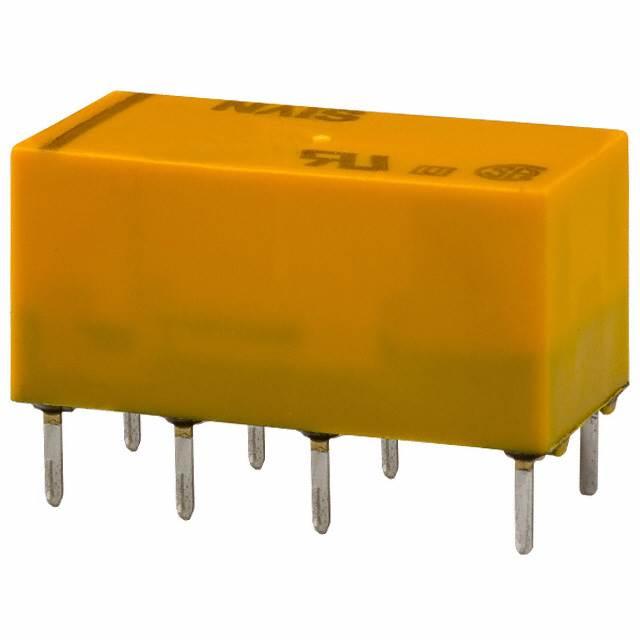
Automation Controls Catalog
DS2Y RELAYS
Miniature Relay
FEATURES
1. 2 Form C contact
2. High sensitivity-200 mW nominal
operating power
3. High breakdown voltage
1500 V FCC surge between open
contacts
4. DIP-2C type matching 16 pin IC
5. Sealed construction
TYPICAL APPLICATIONS
1.
2.
3.
4.
5.
Telecommunication equipment
Office equipment
Computer peripherals
Security alarm systems
Medical equipment
ORDERING INFORMATION
DS2Y-S
Operating function
Nil: Single side stable
Nominal coil voltage
DC 3, 5, 6, 9, 12, 24, 48 V
Note: UL/CSA approved type is standard.
TYPES
Contact
arrangement
2 Form C
Single side stable type
Nominal coil voltage
Part No.
3V DC
DS2Y-S-DC3V
5V DC
DS2Y-S-DC5V
6V DC
DS2Y-S-DC6V
9V DC
DS2Y-S-DC9V
12V DC
DS2Y-S-DC12V
24V DC
DS2Y-S-DC24V
48V DC
DS2Y-S-DC48V
Standard packing: Carton: 50 pcs.; Case: 500 pcs.
2020.09
industrial.panasonic.com/ac/
ー1ー
c Panasonic Corporation 2020
ASCTB16E 202009
�DS2Y
RATING
1.Coil data
•�Operating characteristics such as ‘Operate voltage’ and ‘Release voltage’ are influenced by mounting conditions, ambient temperature,
etc.Therefore, please use the relay within ± 5% of rated coil voltage.
•‘Initial’ means the condition of products at the time of delivery.
Single side stable type
Nominal coil
voltage
Drop-out voltage
(at 20°C 68°F)
Pick-up voltage
(at 20°C 68°F)
Nominal operating
current
[±10%] (at 20°C 68°F)
Coil resistance
[±10%] (at 20°C 68°F)
3V DC
66.7mA
45Ω
5V DC
40mA
125Ω
33.3mA
180Ω
22.2mA
405Ω
6V DC
9V DC
12V DC
70%V or less of
nominal voltage
(Initial)
10%V or more of
nominal voltage
(Initial)
16.7mA
720Ω
24V DC
8.3mA
2,880Ω
48V DC
6.3mA
7,680Ω
Nominal operating
power
200mW
Max. applied
voltage
(at 70°C 158°F)
200%V of
nominal voltage
300mW
2.Specifications
Characteristics
Contact
Rating
Item
Specifications
Arrangement
2 Form C
Initial contact resistance, max.
Max. 50 mΩ (By voltage drop 6 V DC 1A)
Contact material
Ag+Au clad
Max. switching power
60 W, 62.5 VA (resistive load)
Max. switching voltage
220 V DC, 250 V AC
Max. switching current
2A
Max. carrying current
3A
Minimum operating power
Approx. 98 mW (147 mW: 48 V)
Nominal operating power
Approx. 200 mW (300 mW: 48 V)
Insulation resistance (Initial)
Min. 100MΩ (at 500V DC)
Measurement at same location as “Initial breakdown voltage” section.
Breakdown voltage
(Initial)
Electrical
characteristics
Expected life
Conditions
750 Vrms for 1min. (Detection current: 10mA.)
Between contact sets
1,000 Vrms for 1min. (Detection current: 10mA.)
Between contact and coil
1,000 Vrms for 1min. (Detection current: 10mA.)
FCC surge breakdown voltage between contacts
and coil
1,500 V
Temperature rise (at 20°C 68°F)
Max. 65°C with nominal coil voltage across coil and at nominal switching capacity
Operate time [Set time] (at 20°C 68°F)
Approx. 4 ms [approx. 3 ms]
(Nominal coil voltage applied to the coil, excluding contact bounce time.)
Release time [Reset time] (at 20°C 68°F)
Approx. 3 ms [approx. 3 ms]
(Nominal coil voltage applied to the coil, excluding contact bounce time.)
(without diode)
Shock resistance
Mechanical
characteristics
Between open contacts
Vibration resistance
Functional
Min. 490 m/s2 (Half-wave pulse of sine wave: 11 ms; detection time: 10µs.)
Destructive
Min. 980 m/s2 (Half-wave pulse of sine wave: 6 ms.)
Functional
10 to 55 Hz at double amplitude of 3.3 mm (Detection time: 10µs.)
Destructive
10 to 55 Hz at double amplitude of 5 mm
Mechanical
Min. 108
Electrical
Min. 5×10⁵ (1 A 30 V DC), Min. 105 (2 A 30 V DC)
Conditions for operation, transport and storage*
Ambient temperature: –40°C to +70°C –40°F to +158°F
Humidity: 5 to 85% R.H. (Not freezing and condensing at low temperature)
Max. operating speed (at rated load)
60 cpm
Unit weight
Approx. 4g .14oz
Notes: �*1 �This value can change due to the switching frequency, environmental conditions, and desired reliability level, therefore it is recommended to check this with the actual load.
TX/TX-S/TX-D relay AgPd contact type are available for low level load switching (10V DC, 10mA max. level).
�*2 �Half-wave pulse of sine wave: 11ms; detection time: 10μs
�*3 �Refer to “AMBIENT ENVIRONMENT” in GENERAL APPLICATION GUIDELINES.
Panasonic Corporation Electromechanical Control Business Division
industrial.panasonic.com/ac/e/
ー2ー
c Panasonic Corporation 2020
ASCTB16E 202009
�DS2Y
REFERENCE DATA
1. Maximum switching capacity
2. Coil temperature rise (Single side stable) 3. Operate/release time for single side
stable (Without diode)
Tested sample: DS2Y-S-DC12V, 5 pcs.
Measured portion: Inside the coil
Ambient temperature: 21 °C to 25 °C 70 °F to 77 °F
Tested sample: DS2Y-S-DC12V, 10 pcs.
Ambient temperature: 20 °C 68 °F
1,000 V
Contact voltage
100 V
10 V
10 mA
10 mA
100 mA
4
2A
0A
20
100
0
110
Coil applied voltage, %V
4-(2) Influence of adjacent mounting
Tested sample: DS2Y-S-DC12V, 10 pcs.
Ambient temperature: 20 °C 68 °F
Tested sample: DS2Y-S-DC12V, 10 pcs.
Ambient temperature: 20 °C 68 °F
TEST METHOD
TEST METHOD
1. �Apply nominal voltage to No. (1) and (3) DS2Y
relays.
2.�Measure pick-up voltage and drop-out voltage of
No. (2) relay when inter-relay distance (ℓ) changes.
1. �Apply nominal voltage to No. (1) and (3) DS2Y
relays.
2.�Measure pick-up voltage and drop-out voltage of
No. (2) relay when inter-relay distance (ℓ) changes.
Pick-up voltage
ON
(3)
OFF
ON
6
OFF
OFF
4
Drop-out voltage
ON
ON
2
0
Mean value
80
100
120
Coil applied voltage, %V
10
Pick-up/Drop-out voltage, V
Pick-up/Drop-out voltage, V
8
(2)
Mean value
1
4-(1) Influence of adjacent mounting
(1)
OFF
3
2
1A
Switching current
10
Operate time
Release time
3A
30
Time, ms
Temperature rise, °C
5
(1)
OFF
(2)
(3)
OFF
8
Pick-up voltage
ON
ON
OFF
OFF
ON
ON
6
4
Drop-out voltage
2
0
5
10
15
.197 .394 .591
Inter-relay distance, mm inch
5
10
15
.197 .394 .591
Inter-relay distance, mm inch
DIMENSIONS (mm inch)
The CAD data of the products with a CAD mark can be downloaded from: https://industrial.panasonic.com/ac/e/
CAD
PC board pattern (Bottom view)
External dimensions
9.9
.390
20
.787
9.3
.366
8-0.9 dia.
8-.035 dia.
5.08 5.08
.200 .200
7.62
.300
2.0
.078
0.6
.024
0.6
.024
5.6
.220
7.62
.300
3.4
.134
7.62
.300
0.3
.012
General tolerance: ±0.3 ±.012
For general cautions for use,
please refer to the “Cautions for
use of Signal Relays” or “General
Application Guidelines”.
16
–
N.O. N.C. COM
8
6
4
+
1
Direction indication*
matching 16 pin IC socket
*A polarity bar shows the relay direction.
Tolerance: ±0.1 ±.004
Please refer to "the latest product specifications"
when designing your product.
•Requests to customers:
https://industrial.panasonic.com/ac/e/salespolicies/
Panasonic Corporation Electromechanical Control Business Division
industrial.panasonic.com/ac/e/
9
13
11
N.O. N.C. COM
2.54
.100
2.54
.100
0.6
.024
Schematic (Bottom view)
ー3ー
c Panasonic Corporation 2020
ASCTB16E 202009
�GUIDELINES FOR RELAY USAGE
�For cautions for use, please read "GUIDELINES FOR RELAY USAGE".
https://industrial.panasonic.com/ac/e/control/relay/cautions_use/index.jsp
PRECAUTIONS FOR COIL INPUT
Long term current carrying
Maximum allowable voltage and temperature rise
A circuit that will be carrying a current continuously for
long periods without relay switching operation. (circuits for
emergency lamps, alarm devices and error inspection that, for
example, revert only during malfunction and output warnings
with form B contacts)
Continuous,long-term current to the coil will facilitate
deterioration of coil insulation and characteristics due to
heating of the coil itself.For circuits such as these, please use
a magnetic-hold type latching relay. If you need to use a single
stable relay, use a sealed type relay that is not easily affected
by ambient conditions and make a failsafe circuit design that
considers the possibility of contact failure or disconnection.
Proper usage requires that the rated coil voltage be impressed
on the coil.
Note, however, that if a voltage greater than or equal to the
maximum continuous voltage is impressed on the coil, the coil
may burn or its layers short due to the temperature rise.
Furthermore, do not exceed the usable ambient temperature
range listed in the catalog.
Steady state DC current should be applied to the coil.
The wave form should be rectangular. If it includes ripple, the
ripple factor should be less than 5%.However, please check
with the actual circuit since the electricalcharacteristics may
vary.
The rated coil voltage should be applied to the coil and the set/
reset pulse time of latching type relay differs for each relays,
please refer to the relay's individual specifications.
Coil connection
When connecting coils of polarized relays, please check coil
polarity(+,-) at the internal connection diagram (Schematic).
If any wrong connection is made, it may cause unexpected
malfunction, like abnormal heat, fire and so on, and circuit do
not work.
Avoid impressing voltages to the set coil and reset coil at the
same time.
Current passage time
%
For continuous passage
Temperature rise value is 100%
ON : OFF = 3 : 1
About 80%
ON : OFF = 1 : 1
About 50%
ON : OFF = 1 : 3
About 35%
ON : OFF = 1 : 1
Voltage
DC Coil operating power
Temperature rise due to pulse voltage
When a pulse voltage with ON time of less than 2 minutes is
used, the coil temperature rise bares no relationship to the ON
time.
This varies with the ratio of ON time to OFF time, and
compared with continuous current passage, it is rather small.
The various relays are essentially the same in this respect.
Time
Pick-up voltage change due to coil temperature rise (hot start)
In DC relays, after continuous passage of current in the coil, if
the current is turned OFF, then immediately turned ON again,
due to the temperature rise in the coil, the pick-up voltage will
become somewhat higher. Also, it will be the same as using it
in a higher temperature atmosphere.
The resistance/temperature relationship for copper wire is
about 0.4% for 1°C, and with this ratio the coil resistance
increases.
That is, in order to operate of the relay, it is necessary that
the voltage be higher than the pick-up voltage and the pick-up
voltage rises in accordance with the increase in the resistance
value.
However, for some polarized relays, this rate of change is
considerably smaller.
Panasonic Corporation Electromechanical Control Business Division
industrial.panasonic.com/ac/e/
Panasonic Corporation 2020
ASCTB414E 202003
�GUIDELINES FOR RELAY USAGE
NOTES
Usage, Storage, and Transport Conditions
During usage, storage, or transportation, avoid locations
subject to direct sunlight and maintain normal temperature,
humidity, and pressure conditions.
The allowable specifications for environments suitable for
usage, storage, and transportation are given below.
(1) �Temperature: The allowable temperature range differs for
each relay, so refer to the relay’s individual specifications.
In addition, when transporting or storing relays while they are
tube packaged, there are cases when the temperature may
differ from the allowable range. In this situation, be sure to
consult the individual specifications.
(2) Humidity : 5 to 85% R.H.
(3) Pressure : 86 to 106 kPa
The humidity range varies with the temperature.
Use within the range indicated in the graph.
(The allowable temperature depends on the relays.)
Humidity(%RH)
85
Allowable range
Avoid icing
when used at
temperatures
lower than 0°C
5
Avoid condensation when
used at temperatures higher
than 0°C
0
-40
Ambient temperature(℃)
85
Dew condensation
Condensation occurs when the ambient temperature drops
suddenly from a high temperature and humidity, or the relay
and microwave device is suddenly transferred from a low
ambient temperature to a high temperature and humidity.
Panasonic Corporation does not guarantee the failures caused
by condensation.
The heat conduction by the equipment may accelerate the
cooling of device itself, and the condensation may occur.
Please conduct product evaluations in the worst condition of
the actual usage. (Special attention should be paid when high
temperature heating parts are close to the device. Also please
consider the condensation may occur inside of the device.)
Icing
Condensation or other moisture may freeze on relays when
the temperature become lower than 0°C.
This icing causes the sticking of movable portion, the operation
delay and the contact conduction failure etc.
Panasonic Corporation does not guarantee the failures caused
by the icing.
The heat conduction by the equipment may accelerate the
cooling of relay itself and the icing may occur.
Please conduct product evaluations in the worst condition of
the actual usage.
Low temperature and low humidity
The plastic becomes brittle if the switch is exposed to a low
temperature, low humidity environment for long periods of
time.
High temperature and high humidity
Storage for extended periods of time (including transportation
periods) at high temperature or high humidity levels or in
atmospheres with organic gases or sulfide gases may cause a
sulfide film or oxide film to form on the surfaces of the contacts
and/or it may interfere with the functions.
Check out the atmosphere in which the units are to be stored
and transported.
Package
In terms of the packing format used, make every effort to keep
the effects of moisture, organic gases and sulfide gases to the
absolute minimum.
Panasonic Corporation Electromechanical Control Business Division
industrial.panasonic.com/ac/e/
Panasonic Corporation 2020
ASCTB414E 202003
�GUIDELINES FOR RELAY USAGE
Storage requirements
Since the SMD type is sensitive to humidity it is packaged with
tightly sealed anti-humidity packaging. However, when storing,
please be careful of the following.
1) Please use promptly once the anti-humidity pack is opened.
(within 72 hours, Max. 30°C / 70% R.H.).
If left with the pack open, the relay will absorb moisture which
will cause thermal stress when reflow mounting and thus
cause the case to expand. As a result, the seal may break.
2) �If relays will not be used within 72 hours, please store relays
in a humidity controlled desiccator or in an anti-humidity bag
to which silica gel has been added.
4) �The following cautionary label is affixed to the anti-humidity
pack.
* �If the relay is to be soldered after it has been exposed to excessive humidity
atmosphere, cracks and leaks can occur.
Be sure to mount the relay under the required mounting conditions.
3) �When relays (which is packaged with humidity indicator and
silica gel) meeting one of below criteria, please bake (dry)
before use.
When the storage conditions specified in 1) are exceeded.
�When humidity indicator is in Ⅲ or Ⅳ status according to
judgement standard.
Please check humidity indicator color and decide if baking is
necessary or not.
● : indicate brown, ○ : Other than brown (blueish color)
Ⅰ
Ⅱ
Ⅲ
Ⅳ
5%
10%
60%
●
○
○
○
●
●
○
○
●
●
●
○
Bake treatment
necessity judgment
No need to bake
No need to bake
Need to bake
Need to bake
Spot
5%
10%
60%
Silicon
When a source of silicone substances (silicone rubber, silicone
oil,silicone coating materials and silicone filling materials
etc.) is used around the relay, the silicone gas (low molecular
siloxane etc.) may be produced
This silicone gas may penetrate into the inside of the relay.
When the relay is kept and used in this condition, silicone
compound may adhere to the relay contacts which may cause
the contact failure.
Do not use any sources of silicone gas around the relay
(Including plastic seal types).
NOx Generation
When relay is used in an atmosphere high in humidity to
switch a load which easily produces an arc, the NOx created
by the arc and the water absorbed from outside the relay
combine to produce nitric acid.
This corrodes the internal metal parts and adversely affects
operation.
Avoid use at an ambient humidity of 85% RH or higher (at
20°C).
If use at high humidity is unavoidable, please contact our sales
representative.
Humidity indicator card
With reel : 45°C, 96 hours or more.
Without reel (including relay only) : 60°C, 35 hours or more.
Panasonic Corporation Electromechanical Control Business Division
industrial.panasonic.com/ac/e/
Panasonic Corporation 2020
ASCTB414E 202003
�GUIDELINES FOR RELAY USAGE
OTHERS
Cleaning
1) �Although the environmentally sealed type relay (plastic sealed
type,etc.) can be cleaned, avoid immersing the relay into cold
liquid (such as cleaning solvent) immediately after soldering.
Doing so may deteriorate the sealing performance.
2) �Surface mount terminal type relay is sealed type and it can be
cleaned by immersion.
Use pure water or alcohol-based cleaning solvent.
3) �Cleaning with the boiling method is recommended (The
temperature of cleaning liquid should be 40°C or lower).Avoid
ultrasonic cleaning on relays.
Use of ultrasonic cleaning may cause breaks in the coil or
slight sticking of the contacts due to the ultrasonic energy.
Please refer to "the latest product specifications"
when designing your product.
•Requests to customers:
https://industrial.panasonic.com/ac/e/salespolicies/
Panasonic Corporation Electromechanical Control Business Division
industrial.panasonic.com/ac/e/
Panasonic Corporation 2020
ASCTB414E 202003
�Please contact ..........
Electromechanical Control Business Division
1006, Oaza Kadoma, Kadoma-shi, Osaka 571-8506, Japan
industral.panasonic.com/ac/e/
©Panasonic Corporation 2020
ASCTB16E 202009
Specifications are subject to change without notice.
�