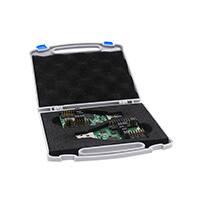
PAN1760A
Bluetooth Low Energy Module
Product Specification
Rev. 1.0
Wireless Modules
�
PAN1760A Bluetooth Module
Overview
The PAN1760A is Panasonic’s next generation
Bluetooth module with the industry’s lowest power
Bluetooth Low Energy SoC.
Features
• Small 15.6 mm x 8.7 mm x 1.9 mm SMD module
• Same form factor and pinout as PAN1026,
PAN1760, and PAN1761
•
•
•
•
•
•
•
Bluetooth Low Energy 4.2 compliant
Embedded 256 kB flash memory and 192 kB
internal RAM
Bluetooth
• GAP central and peripheral support for LE
• GATT, SMP, and SDB support for LE
• Over-the-Air firmware update
• Support for Scatternet/Mesh network
• BT 4.2 secure connections support through
Elliptic-Curve-DH Cryptography
•
•
•
AES-128 hardware encryption (FIPS-approved)
Frequent changing of device address (improved
privacy, reduced tracking ability)
Larger packet sizes (more efficient application and
network layer security)
83 kB RAM available for user application
AT Command mode, Host mode, Stand-Alone
mode
Standard SIG BLE profiles as well
as SPPoverBLE profile
UART (2x), SPI & I2C interface, PWM output (4x),
ADC (5 ext, 1 int), 17 programmable I/O
ARM Cortex-M0 processor with Single Wire
Debug (SWD) interface
Characteristics
• Receiver sensitivity -93 dBm typ.
• Output power 0 dBm maximum setting
• Power supply 1.8 V to 3.6 V single operation
voltage
•
•
•
Transmit and receive 3.3 mA Tx/Rx peak power
consumption
Low Power 50 nA Deep Sleep mode
Operating temperature range -40 °C to +85 °C
Block Diagram
PAN1760A
Bluetooth 4.2 Module
Vcc 3.3 V
Slow Clock
32 KHz
UART
Crystal
26 MHz
GPIOs
Chip
Antenna
SWD
Host Wake up
Toshiba
TC35678
DC-DC
Conversion
Wake up
Flash
256 kB
Reset
Product Specification Rev. 1.0
LPF
Page 2
�
PAN1760A Bluetooth Module
By purchase of any of the products described in this document the customer accepts the document's
validity and declares their agreement and understanding of its contents and recommendations. Panasonic
reserves the right to make changes as required at any time without notification. Please consult the most
recently issued Product Specification before initiating or completing a design.
© Panasonic Industrial Devices Europe GmbH 2017.
All rights reserved.
This Product Specification does not lodge the claim to be complete and free of mistakes.
Engineering Samples (ES)
If Engineering Samples are delivered to the customer, these samples have the status “Engineering
Samples”. This means that the design of this product is not yet concluded. Engineering Samples may be
partially or fully functional, and they may differ from the published Product Specification.
Engineering Samples are not qualified and they are not to be used for reliability testing or series
production.
Disclaimer
The customer acknowledges that samples may deviate from the Product Specification and may bear
defects due to their status of development and the lack of qualification mentioned above.
Panasonic rejects any liability or product warranty for Engineering Samples. In particular, Panasonic
disclaims liability for damages caused by:
The use of the Engineering Sample other than for evaluation purposes, particularly the installation
or integration in another product to be sold by the customer,
Deviation or lapse in function of the Engineering Sample,
Improper use of the Engineering Sample.
Panasonic Industrial Devices Europe GmbH disclaims any liability for consequential and incidental
damages. In case of any queries regarding the Engineering Samples, please contact your local sales
partner or the related product manager.
Product Specification Rev. 1.0
Page 3
�
PAN1760A Bluetooth Module
Table of Contents
1
2
3
4
5
6
About This Document......................................................................................................................... 5
1.1
Purpose and Audience .............................................................................................................. 5
1.2
Revision History ......................................................................................................................... 5
1.3
Use of Symbols ......................................................................................................................... 5
1.4
Related Documents ................................................................................................................... 5
Overview .............................................................................................................................................. 6
2.1
Block Diagram ........................................................................................................................... 7
2.2
Pin Configuration ....................................................................................................................... 8
2.3
UART Interface ........................................................................................................................ 10
2.4
Bluetooth Features .................................................................................................................. 10
Detailed Description ......................................................................................................................... 11
3.1
Dimensions .............................................................................................................................. 11
3.2
Footprint .................................................................................................................................. 12
3.3
Packaging ................................................................................................................................ 13
3.4
Case Marking .......................................................................................................................... 16
Specification ..................................................................................................................................... 17
4.1
Default Test Conditions ........................................................................................................... 17
4.2
Absolute Maximum Ratings ..................................................................................................... 17
4.3
Recommended Operating Conditions ...................................................................................... 18
4.4
Current Consumption............................................................................................................... 18
4.5
Bluetooth ................................................................................................................................. 19
4.6
Reliability Tests ....................................................................................................................... 19
4.7
Recommended Soldering Profile ............................................................................................. 20
Cautions, Life Support Policy, RoHS Declaration, and Regulatory Information ......................... 21
5.1
Cautions .................................................................................................................................. 21
5.2
Life Support Policy ................................................................................................................... 23
5.3
RoHS and REACH Declaration ............................................................................................... 24
5.4
Regulatory Information ............................................................................................................ 24
Appendix ........................................................................................................................................... 25
6.1
Ordering Information ................................................................................................................ 25
6.2
Contact Details ........................................................................................................................ 26
Product Specification Rev. 1.0
Page 4
�
PAN1760A Bluetooth Module
1 About This Document
1 About This Document
1.1
Purpose and Audience
This Product Specification provides details on the functional, operational, and electrical
characteristics of the Panasonic PAN1760A module. It is intended for hardware design,
application, and OEM engineers. The product is referred to as “the PAN1760A” or “the module”
within this document.
1.2
1.3
Revision History
Revision
Date
Modifications/Remarks
0.1
23.05.2017
1st preliminary version
0.2
12.06.2017
Editorial review
1.0
12.06.2017
First published version
Use of Symbols
Symbol
Description
Note
Indicates important information for the proper use of the product. Non-observance
can lead to errors.
Attention
Indicates important notes that, if not observed, can put the product’s functionality
at risk.
[chapter number]
[chapter title]
Cross reference
Indicates crossreferences within the document.
Example:
Description of the symbols used in this document 1.3 Use of Symbols.
1.4
Related Documents
Please refer to the Panasonic website for related documents 6.2.2 Product Information.
Product Specification Rev. 1.0
Page 5
�
PAN1760A Bluetooth Module
2 Overview
2 Overview
The PAN1760A is Panasonic’s next generation Bluetooth module with the industry’s lowest
power Bluetooth Low Energy SoC.
The module is based on Toshiba's single chip TC35678 Bluetooth semiconductor device with
embedded Toshiba Bluetooth 4.2 LE stack and embedded flash for the user application in
stand-alone operation. Peak power consumption of only 3.6 mA in Tx and Rx mode allows
advanced wireless functionalities in IoT, medical, and industrial applications without
compromising battery life. Mandatory and optional Bluetooth 4.2 features are supported.
The PAN1760A can either be operated in AT-Command or Host mode for very simple
integration of Bluetooth connectivity into existing products, or in Stand-Alone mode.
In Stand-Alone mode, with 256 kB flash memory and 83 kB RAM for user application, the
PAN1760A can be used for many applications without the need for an external processor,
saving cost, complexity, and space.
Older versions of the PAN1760, the PAN1761, and the PAN1026 share the same footprint.
Only minor code changes are required when migrating from PAN1026 or PAN1760. Previously
developed software (Bluetooth Low Energy profiles and applications) can be easily migrated
with a minimal effort.
FCC, IC, and CE approval are in preparation.
Please refer to the Panasonic website for related documents 6.2.2 Product Information.
Further information on the variants and versions 6.1 Ordering Information.
Product Specification Rev. 1.0
Page 6
�
PAN1760A Bluetooth Module
2 Overview
2.1
Block Diagram
PAN1760A
Bluetooth 4.2 Module
Vcc 3.3 V
Slow Clock
32 KHz
UART
Crystal
26 MHz
GPIOs
Chip
Antenna
SWD
Host Wake up
Toshiba
TC35678
DC-DC
Conversion
Wake up
Flash
256 kB
Reset
Total capacitor value:
2.4 µF +/-10 %
Total inductance:
10 µH +/-10 %
Total resistance:
100 KΩ +/-10 %
Product Specification Rev. 1.0
LPF
Page 7
�
PAN1760A Bluetooth Module
2 Overview
2.2
Pin Configuration
Pin Assignment
Top View
15.6 mm
5.0
1.2
2.4
F2
F3
F4
F5
F6
F7
F8
F9
E1
E2
E3
E4
E5
E6
E7
E8
E9
D1
D2
D3
D4
D5
D6
D7
D8
D9
C1
C2
C3
C4
C5
C6
C7
C8
C9
B1
B2
B3
B4
B5
B6
B7
B8
B9
A1
A2
A3
A4
A5
A6
A7
A8
A9
F11
F12
A11
A12
1.35
1.2
F1
8.70 mm
0.6
1.35
1.0
0.6
Pin Functions
No
Pin Name
Pin Type
Description
A1
GND
Ground Pin
Connect to ground
A2
GPIO3
Digital I/O
A3
RESET
Digital Input
Reset, active low
A4
NC
NC
Not connected
A5
VCC
Power
Analog/digital power supply connection
A6
VCC
Power
Analog/digital power supply connection
A7
GND
Ground Pin
Connect to ground
A8
NC
NC
Not connected
A9
GND
Ground Pin
Connect to ground
A11
GND
Ground Pin
Connect to ground
A12
GND
Ground Pin
Connect to ground
B1
GPIO9
Digital I/O
B2
GPIO4
Digital I/O
Product Specification Rev. 1.0
Page 8
�
PAN1760A Bluetooth Module
2 Overview
No
Pin Name
Pin Type
Description
B3
NC
NC
Not connected, leave open
B4
NC
NC
Not connected, leave open
B5
GPIO7
Digital I/O
B6
GPIO8
Digital I/O
B7
GPIO25
Digital I/O
B8
NC
NC
Not connected, leave open
B9
NC
NC
Not connected, leave open
C1
NC
NC
Not connected, leave open
C2
NC
NC
Not connected, leave open
C3
GPIO10
Digital I/O
C4
SWDIO
JTAG
C5
SWDCLK
JTAG
C6
GPIO1
Digital I/O
C7
NC
NC
Not connected, leave open
C8
GND
Ground Pin
Connect to ground
C9
GND
Ground Pin
Connect to ground
D1
NC
NC
Not connected, leave open
D2
NC
NC
Not connected, leave open
D3
NC
NC
Not connected, leave open
D4
GPIO0/WakeUp0
Digital I/O
D5
NC
NC
D6
GPIO15/WakeUp1
Digital I/O
D7
GND
Ground Pin
Connect to ground
D8
GND
Ground Pin
Connect to ground
D9
ANT
RF-Signal
Antenna pin (not connected for standard version)
E1
GPIO12/SDA
Digital I/O
I2C interface
E2
GPIO11/SCL
Digital I/O
I2C interface
E3
NC
NC
Not connected, leave open
E4
NC
NC
Not connected, leave open
E5
SLPXOIN
Digital Input
32 kHz clock input, leave open
E6
GPIO6/UARTRXD
Digital Input
UART RXD
Product Specification Rev. 1.0
Not connected, leave open
Page 9
�
PAN1760A Bluetooth Module
2 Overview
No
Pin Name
Pin Type
Description
E7
NC
NC
Not connected, leave open
E8
GND
Ground Pin
Connect to ground
E9
GND
Ground Pin
Connect to ground
F1
GND
Ground Pin
Connect to ground
F2
NC
NC
Not connected, leave open
F3
NC
NC
Not connected, leave open
F4
NC
NC
Not connected, leave open
F5
GPIO14/UARTCTS
Digital Input
UART CTS
F6
GPIO2
Digital I/O
F7
GPIO5/UARTTXD
Digital Output
UART TX
F8
GPIO13/UARTRTS
Digital Output
UART RTS
F9
GND
Ground Pin
Connect to ground
F11
GND
Ground Pin
Connect to ground
F12
GND
Ground Pin
Connect to ground
Minimal configuration
•
•
•
2.3
GND
UART Rx, Tx, no flow control
UART Interface
•
•
•
2.4
VCC
Default baud rate: 115 200 bps
Data format: 8N1, LSB first
Rx, Tx, no flow control
Bluetooth Features
•
•
•
•
•
•
•
•
GAP central and peripheral support for LE
GATT, SMP, and SDB support for LE
Over-the-Air firmware update
Support for Scatternet/Mesh network
BT 4.2 secure connections support through Elliptic-Curve-DH Cryptography
AES-128 hardware encryption (FIPS-approved)
Frequent changing of device address (improved privacy, reduced tracking ability)
Larger packet sizes (more efficient application and network layer security)
Product Specification Rev. 1.0
Page 10
�
PAN1760A Bluetooth Module
3 Detailed Description
3 Detailed Description
3.1
Dimensions
All dimensions are in millimeters.
No.
Item
Dimension
Tolerance
Remark
1 Width
8.70
± 0.20
2 Length
15.60
± 0.20
3 Height
1.80
Product Specification Rev. 1.0
± 0.20 With case
Page 11
�
PAN1760A Bluetooth Module
3 Detailed Description
3.2
Footprint
The outer dimensions have a tolerance of 0.2 mm.
Top View
15.6 mm
5.0
1.2
2.4
F2
F3
F4
F5
F6
F7
F8
F9
E1
E2
E3
E4
E5
E6
E7
E8
E9
D1
D2
D3
D4
D5
D6
D7
D8
D9
C1
C2
C3
C4
C5
C6
C7
C8
C9
B1
B2
B3
B4
B5
B6
B7
B8
B9
A1
A2
A3
A4
A5
A6
A7
A8
A9
F11
F12
A11
A12
1.35
1.2
F1
8.70 mm
0.6
1.35
1.0
0.6
Product Specification Rev. 1.0
Page 12
�
PAN1760A Bluetooth Module
3 Detailed Description
3.3
Packaging
The product is a mass production status product and will be delivered in the package described
below.
3.3.1
Tape Dimensions
3.3.2
Packing in Tape
Direction of unreeling (for customer)
trailer (empty)
1 x circumference /
hub
(min 160mm)
component
packed area
standard
1500pcs
leader (empty)
minimum 10 pitch
Top cover tape more
than 1 x
circumference plus
100mm to avoid
fixing of tape end on
sealed modules.
Empty spaces in the component packed area shall be less than two per reel and those spaces
shall not be consecutive.
100730-PAN1720.vsd
The top cover tape shall not be found on reel holes and it shall not stick out from the reel.
Product Specification Rev. 1.0
Page 13
�
PAN1760A Bluetooth Module
3 Detailed Description
3.3.3
Component Direction
3.3.4
Reel Dimension
Product Specification Rev. 1.0
Page 14
�
PAN1760A Bluetooth Module
3 Detailed Description
3.3.5
Package Label
Example
(1T)
(1P)
(2P)
(9D)
(Q)
(HW/SW)
3.3.6
Lot code
Customer order number, if applicable
Order number
Date code
Quantity
Hardware/software version
Total Package
Product Specification Rev. 1.0
Page 15
�
PAN1760A Bluetooth Module
3 Detailed Description
3.4
Case Marking
Example
1
2
3
4
5
6
7
8
9
Product Specification Rev. 1.0
MIC ID
Brand name
Hardware/software version
Order number
FCC ID
Lot code
Engineering Sample marking, if applicable
Marking for Pin 1
2D barcode, for internal usage only
Page 16
�
PAN1760A Bluetooth Module
4 Specification
4 Specification
All specifications are over temperature and process, unless indicated
otherwise.
4.1
Default Test Conditions
Temperature:
Humidity:
Supply Voltage:
4.2
25 ± 10 °C
40 to 85 % RH
3.3 V
Absolute Maximum Ratings
The maximum ratings may not be exceeded under any circumstances, not even
momentarily or individually, as permanent damage to the module may result.
Symbol
Parameter
TSTOR
Storage
temperature
VESD
ESD
robustness
PRF
RF input level
VDIG
Voltage on
any digital
pins
Product Specification Rev. 1.0
Condition
Min.
Typ.
-40
Max.
Units
+125
°C
All pads, according to human
body model (HBM),
JEDEC STD 22, method A114
1 000
V
According to charged device
model (CDM), JEDEC STD 22,
method C101
500
V
+10
dBm
-0.3
VDD +
0.3
V
Page 17
�
PAN1760A Bluetooth Module
4 Specification
4.3
Recommended Operating Conditions
The maximum ratings may not be exceeded under any circumstances, not even
momentarily or individually, as permanent damage to the module may result.
4.4
Symbol
Parameter
Condition
Min.
Typ.
TA
Ambient
operating
temperature
range
-40
VDD
3V3 Supply
voltage
1.8
Max.
Units
+85
°C
3.6
V
3.3
Current Consumption
The current consumption depends on the user scenario and on the setup and
timing in the power modes.
Assume VDD = 3.3 V, Tamb = 25 °C, if nothing else stated.
Parameter
Condition
Min.
Typ.
Max.
Units
Transmit
Peak Current
3.3
mA
Receive Peak
Current
3.3
mA
Deep Sleep
mode
50
nA
Product Specification Rev. 1.0
Page 18
�
PAN1760A Bluetooth Module
4 Specification
4.5
Bluetooth
Parameter
Condition
Min.
Operation
frequency
range
Channel
spacing
Typ.
2 402
2 480
BLE
Output Power Maximum setting, measured at dual ended
50 Ohm.
Sensitivity
4.6
Max.
Symbol
Parameter
Condition
1
Spurious
emissions
Conducted measurement with a
50 Ω dual-ended load.
Complies with EN 300 328,
EN 300 440 class 2, FCC
CFR47, Part 15 and
ARIB STD-T-66.
Min.
Units
MHz
2
MHz
0
dBm
-93
dBm
Typ.
Max.